WikiLeaks’ CIA Download Confirms Everybody’s Tapped, Including Trump

Posted March 8, 2017 by danmillerinpanama
Categories: CIA, Governmental spying on everybody, WikiLeaks

Tags: , ,

WikiLeaks’ CIA Download Confirms Everybody’s Tapped, Including Trump, PJ Media, Roger L. Simon, March 7, 2017

(Please see also, Retired NSA Official: Every Phone Call You Make Is Recorded And Stored | Hannity Fox News. And we were concerned about the privacy implications of “transgender” use of little girls’ bathrooms. — DM)

Remember the old joke about the definition of a paranoid — someone who knows all the facts?

Well, we’re all paranoids now because — since Tuesday’s, unprecedented in size and scope, Wikileaks document dump of massive cyber spying by the CIA — everything we ever thought in our wildest imaginations is true… and then some.

To channel the late Preston Sturges, privacy is not only dead, it’s decomposed.  The CIA’s Remote Devices Branch, known as UMBRAGE, is capable of — or is — watching you everywhere you go, even when you think they’re not or such surveillance would seem impossible.

The question about whether President Trump was tapped has been reduced to a joke.  The real questions are how often and from how many places.  The answer would probably shock us, if we were ever to learn the truth.  (And did President Obama know what they were doing?  Either that or the CIA, FBI or NSA wasn’t telling him. You decide.)

The Wikileaks documents (everyone believes their downloads now) show how the CIA, via their eerily named “Weeping Angel” program, has devised a method of listening to us through our smart TVs.  Even when we think they’re off, they are able to keep them on — and recording — through a “fake-off” program.

Just how many smart TVs does Donald Trump — a known television addict — watch in a day?  Who is he talking to at the time?  A foreign leader perhaps?  And what is he saying in supposed confidence?

These days it’s hard to buy a television that isn’t a smart TV.  The Wikileaks documents show only the popular Samsung has been hacked, but since the agency assiduously hacks both Apple and Android cellphones, one can assume all major brands are covered.  (They’re not stupid.  We are.)

And that’s far from their only way of listening in.  Tyler Durden — considerably more tech savvy than I — expresses the amazement of that community that the CIA was able to bypass the purportedly powerful cellphone data security apps (Signal, Telegram) so many business executives, politicians and journalists rely upon, even to using our own anti-virus programs (McAfee, etc.) to spy on us.  They also, apparently, can control our cars through the latest automobile computers.  (NOTE TO SELF: Skip the Apple CarPlay upgrade.)

Further, Durden quotes Twitter star Kimdotcom’s instant observation that the DNC/Russian hacking connection is also now a joke (at least highly suspect) since the CIA also has a program, via UMBRAGE again, to imitate Russian hacking techniques and leave the Russkies’ “fingerprints”  on their own handiwork. Could the CIA have hacked the DNC and then blamed it on the Russians for some purpose?  It seems unlikely, but anything’s possible in this crazy and increasingly bizarre and alienating world.  If it is true, don’t look now, but our country just exploded.

Our hope, for now, is in the congressional investigations, but it’s hard to have much confidence in them.  The media, of course, is ludicrous.  They have clearly become the witting/unwitting lackeys of all manner of leakers from any number of intelligence agencies. It’s become dizzying as the internal contradictions mount up daily.  (Who told you there was a FISA order again? Oh, wait…)  The New York Times and the Washington Post, among others, have reached self-parody in their cock-eyed denials of what they asserted only weeks ago, while the CIA grows progressively more partisan and ominously totalitarian in its values and methods.

Pretty soon every citizen is going to need a SCIF (Sensitive Compartmentalized Information Facility) of his or her own.

Whatever the case, we all have to do some serious thinking — way beyond the general superficiality and contrived drama of congressional hearings or indeed the quick in-and-out of an op-ed.  What is being revealed here is a sea change in the human condition that is almost evolutionary in its implications. What are our lives like without the presumption of privacy?  What kind of creatures will we become in this brave new world that appears already to have arrived?   It’s not fun to contemplate. Even the medieval peasantry had moments of escape from their feudal lords.

While initially critical of the Snowdens, Assanges or, for that matter,  the mystery man behind this latest literally Earth-shattering dump, I now have somewhere between mixed and positive feelings towards them. (Well, maybe not Snowden.) With all the problems we have, having visited the Soviet Union, the Russian Republic and Communist China (when they were still in Mao suits), I know those countries are mostly little more than giant prisons and we are still (again for now) the good guys.  Nevertheless, I am increasingly concerned we are creating our own “digital prison” that will make Darkness at Noon seem like child’s play.  At least in Arthur Koestler’s novel of the Stalinist purge trials the inmates could communicate by tapping on the walls.  What do we do?

This is a War! | Monica Crowley Powerful Interview on Hannity- 3/7/17

Posted March 8, 2017 by danmillerinpanama
Categories: Deep state, War on democracy, War on Trump

Tags: , ,

This is a War! | Monica Crowley Powerful Interview on Hannity- 3/7/17, Fox News via YouTube

The Hysteria Over Russia Is Causing Serious Foreign Policy Problems

Posted March 8, 2017 by danmillerinpanama
Categories: Democrats and Russia, Diplomacy, Foreign policy, Media and Russia, Trump administration and Russia

Tags: , , , ,

The Hysteria Over Russia Is Causing Serious Foreign Policy Problems, The Federalist, , March 8, 2017

The fifth season of “The Americans,” the FX series about two Soviet spies posing as an American couple living near Washington DC in the 1980s, began airing this week. The Washington Post’s Ruth Marcus tweeted:

So excited to be watching The Americans, throwback to a simpler time when everyone considered Russia the enemy. Even the president.

It’s a funny line, but when it comes to U.S.-Russia relations, the 1980s weren’t really a simpler time, and returning to the costly threats and risks of the height of the Cold War are almost certainly not in the interests of the United States.

Yet that’s precisely what the current conspiracy theories swirling around the media-political complex could lead to. At the Center for National Interest on Tuesday, a panel of national security and Russia analysts sounded the alarm about the domestic political situation in the United States leading to a rapid deterioration of the already fragile relationship with Russia. They said the damage caused by hysteria surrounding Russia could harm potential U.S. interests in Syria, Ukraine, arms agreements, and the economy.

“There are consequences if we don’t get the relationship right,” said Paul Saunders, the executive director of CTNI. “Anyone who thinks we’re in a hostile relationship now, I would suggest there are a number of things that could be worse than they are now.”

Russian Hacking Leads to Russia Hysteria

The latest problems with Russia stem from U.S. intelligence agencies’ report, widely accepted by those who have seen the classified intelligence undergirding it, that state-involved hackers successfully spearfished John Podesta, the chairman of Hillary Clinton’s campaign for president, and obtained documents from the Democratic National Committee. The information they gleaned was released publicly via WikiLeaks. The information was deemed “boring,” “honest and boring,” and “a damp squib” by many in the media before the election. After the surprise victory of Trump, the release of information was deemed a national security threat of the highest order.

Various media and political interests (on both sides of the aisle) are pushing for more than the current investigations against Russia. Further, despite no evidence or allegations from named sources to substantiate claims of wrongdoing, various media outlets have been suggesting illegal ties of President Trump’s foreign policy with Russia. This after months of asserting that Russia “hacked” not just Democratic political operatives but the very election itself.

A general air of hysteria has enveloped Washington’s political and media class. CNN.com’s front page on Sunday and Monday featured a large red-washed image of St. Basil’s Cathedral in Moscow’s Red Square. In front of St. Basil’s were a photoshopped Mike Flynn, Donald Trump, Jeff Sessions, Vladimir Putin, and Ambassador Kislyak. Subtle!

The large type at the top of the page read “Russia mystery threatens to consume DC.” Other top headlines included:

  • White House can’t seem to shake off the Russian drama
  • Trump and Russia: What fallout could be
  • Trump’s hidden taxes fuel Russia rumors
  • President’s own actions reignite a Russian obsession
  • What the massive fallout could be politically and legally
  • CNN/ORC poll: Most back special prosecutor to investigate Russia
  • Russian glee over Trump’s election gives way to frustration
  • Is Trump’s new conspiracy theory a tactic to divert attention from Russia?

Media outlets are now writing up stories about Americans having ever met with Russians. One media outlet reported that while one Russian businessman and Donald Trump didn’t meet in October, their planes did. Yes, their planes did.

When then-Sen. Jeff Sessions was asked, in his confirmation hearing to be attorney general, about investigating claims of Russian attempts to compromise the Trump campaign, he noted that he was considered a Trump surrogate and he hadn’t had such meetings. When it turned out that Sessions had met with Russian Ambassador Sergey Kislyak in his capacity as a U.S. senator on the Armed Forces Committee, media outlets and Democratic politicians pounced, calling Kislyak a spy and demanding Sessions resign. Really.

We are in the midst of a full-blown Red Scare conspiracy theory. It’s hard to shake the feeling that the real problems caused by Russian hacking and releasing of real emails — sent by Democrats and media figures to each other — are being exacerbated for political reasons. But the consequences are not minor.

The Kislyak Slur

At the Center for the National Interest event, analysts and experts who worked for both Democrats and Republicans, and at think tanks and strategic analysis firms across the spectrum, were upset at the treatment Kislyak has been subjected to.

In a front-page story at CNN.com last week, reporters Evan Perez, Shimon Prokupecz, and Eli Watkins alleged that Kislyak, who has been the ambassador to the United States since 2008, is “one of Russia’s top spies and spy-recruiters in Washington.” The reporters sourced the claim to anonymous “current and former senior US government officials.”

The claim and presentation of Kislyak was at odds with the view of those who knew him and worked with him. CTNI’s president Dimitri Simes discussed the need for a full investigation of Russian meddling as well as the problems with a leak campaign that is undermining diplomacy itself. But he strongly objected to the smears of any and all diplomatic engagement with the Russian ambassador.

“Is this an indication that the U.S. will not be capable of conducting any meaningful diplomacy?” he asked regarding the attacks on Kislyak. “Any attempt to have a meaningful conversation with nuances, if leaked to the press next morning and leaked in a very selective way, it’s very difficult to conduct meaningful diplomacy.” He warned that further demonization of Kislyak could have significant fallout for U.S. Ambassador to Russia John Tefft. Russia could decide to shut down the access Tefft has if the media and political opponents of Trump succeed in making diplomacy with the Russian ambassador impossible.

“The job of diplomats is to facilitate as many meetings as possible with a wide spectrum of the host country’s domestic political establishment on a wide range of issues,” wrote Nikolas Gvosdev, professor of National Security Affairs at the U.S. Naval War College, in his essay “Damage Done: How Russia Hysteria Has Hurt U.S.-Russia Relations.” In fact, while the media frets about Trump officials talking to foreign officials, the bigger problem is not enough such meetings during the transition from the Obama presidency to the early days of the Trump presidency. Foreign ministers and bureaucrats in other countries have been complaining about not knowing who their new contacts are or will be, leading to confusion and delays in productive discussions.”

Michael Haltzel, a senior fellow at at the Center for Transatlantic Relations of Johns Hopkins’ School of Advanced International Studies and a former aide to Sen. Joe Biden on the Senate Foreign Relations Committee, harshly criticized Sessions for his handling of the question about contacts with Russia, but he agreed that attacks on Kislyak were unfortunate.

Wayne Merry, a veteran of the Foreign Service who was stationed in Moscow in 1993, said “
I have known Sergei Kislyak, I totally agree that what he has been exposed to is demonization. It’s total garbage. He’s a first-class professional. He’s being treated very shabbily.”

Even John Beyrle and the excitable Michael McFaul, former U.S. ambassadors to Russia during Obama’s time in office, have warned that “America’s long-term interests are not served by attempting to suggest that contacts between American officials and Russian diplomats constitutes a treasonous or criminal act.”

I should mention that I also pushed back on the claim in a CNN appearance here. In any case, far from what the anonymous sources allegedly told CNN, Kislyak is widely regarded by those who have dealt with him as a top-notch diplomat who serves his country’s interests well. His post in Washington is expected to be his last, and his treatment in his remaining time here is considered an insult by both Americans and Russians. His rumored successor Anatoly Antonov will be “a force to be reckoned with,” as Matthew Rojansky, director of the Woodrow Wilson Center’s Kennan Institute, has put it. Rojansky has also defended Kislyak in the media, and says he has “no indication” that Kislyak is a spy.

To What Effect?

Just as the treatment of Kislyak could result in the U.S. ambassador to Russia’s diminished standing and ability to accomplish his goals in Moscow, the general hysteria surrounding Russia might harm the United State’s serious foreign policy goals.

Syria/ISIS

While part of problem with the U.S.’ Syria policy during the previous administration was an inability to articulate U.S. interest in the region, there is some consensus about destroying ISIS and enabling refugees from the Syrian conflict to return home. Both the United States and Europe have an interest in the successful return of refugees. If the United States therefore wants a say in Syria, it will have to work with Russians to facilitate those objectives. Russia has a strong military presence, has brokered some management in the region, and has a willingness to work with partners. That means the country has to keep lines of communication and room for negotiation open. It also needs to clarify its position on Iran, since Russia views Iran as a key partner.

“If Russia and the U.S. can habituate themselves to cooperation in Syria, that can rebuild habits of cooperation that can spill over into other areas where you could see beneficial results occur,” said Gvosdev. But, he added, “that window is not going to stay open on this forever.” If the United States doesn’t make meaningful moves soon, there may not be many more opportunities before Russia, Turkey, and Iran move forward without the United States.

Ukraine

Russian aggression in Ukraine has unsettled the region for several years, both in the annexation of Crimea and the conflict in the Donbass region. The United States and Europe imposed sanctions on Russia and Russians, but there is no resolution in sight. Russia is willing to keep fighting and has not buckled under the sanctions. Ukraine’s economy is suffering from lack of access to Russian markets. If the United States isn’t interested in brokering a peace, is it willing to arm Ukrainian forces and subsidize the country’s faltering economy? Is there an appetite on either the Left or Right for such intervention?

Not Going To War

The 1980s were fun, as Ruth Marcus noted above, but threat of nuclear annihilation was not so fun. Russia is not a superpower on par with the United States, but it is the only country that can take out the United States in short order. The United States needs to broker arms deals as well as encourage Russia not to get too cozy with China, forming alliances that could put U.S. interests at risk.

Economic Growth

Trade is one of the best ways to improve political relationships bilaterally. But not only is trade becoming quite difficult between Russia and the United States, on account of the sanctions, it was never a particularly deep relationship. Now there is a great deal of uncertainty surrounding sanctions and how they will or won’t be enforced, a climate not conducive to business investment. Many people have argued that the “U.S. and Russia need to work on that to provide ballast and strengthen links in that relationship, creating incentives for a relationship that’s more of a practical relationship and less of a highly variable political relationship,” said Saunders, adding that the political climate is not very good for movement in that direction.

The bottom line is that the United States is embroiled in a hysterical reaction to Russian meddling in the Democratic Party that could spill over into far more serious consequences for the United States. Unless politicians and the media want the United States to have little to no leverage against ISIS or on behalf of Syrian refugees, want the United States to provide significant military and economic subsidies for Ukraine to fight Russia, are willing to risk war or proxy war with a nuclear power, and want to avoid peaceful means of improved relationships, they should think about whether pushing conspiracy theories for short-term domestic political gain is such a great idea.

Benjamin Netanyahu: Israel can normalize ties with Arab states if ‘we act wisely’

Posted March 8, 2017 by Joseph Wouk
Categories: Uncategorized

Source: Benjamin Netanyahu: Israel can normalize ties with Arab states if ‘we act wisely’ – Israel News – Jerusalem Post

By
March 8, 2017 10:58

PM points to the ad hoc regional coalition that is being consolidated against Iran and could open doors for normalizing Israel’s relations with regional countries.
Knesset Foreign Affairs Committee

 Netanyahu and Dichter at the Knesset Foreign Affairs Committee . (photo credit:MARC ISRAEL SELLEM)

Israel is the strongest country in the Middle East and should use its stance as leverage, said Prime Minister Benjamin Netanyahu on Wednesday.

Speaking to the Knesset Foreign Affairs and Defense Committee, Netanyahu stressed that both diplomatically and militarily, Israel is strong and only getting stronger. Netanyahu added that by understanding regional interests, Israel could achieve diplomatic ties with regional Arab countries.

In his address, the prime minister mentioning the ad hoc regional coalition that is being consolidated against Iran and could open doors for normalizing Israel’s relations with its neighboring countries.

“I believe in nurturing these interests,” he said. “In my opinion, if we act wisely, it could assist us normalizing ties with countries in the region and opening new diplomatic streams – that could be more efficient – between us and the Palestinians.”

Turning to Israel’s military prowess, he stated: “Our military power is stronger than ever – not only in absolute terms but also in relative terms.”

Netanyahu then mentioned the NIS 38 billion military aid agreement that was signed with the US in 2016 as a factor in boosting Israel’s capabilities.

“This stable aid will allow the IDF and other military services to use the most recent and sophisticated technology in the world,” he said.

Netanyahu also stated that in the diplomatic sphere, Israel is widening its influence.

“Three weeks ago I met with US President Donald Trump,” he said. “Tomorrow I will arrive to Moscow to meet [Russian President Vladimir] Putin, in about 10 days I am scheduled to meet Chinese President Xi [Jinping] after receiving an invitation from him, and in several months Indian President [Narendra] Modi will come here to visit.”

“The biggest world powers are tightening their ties with us – and they are not the only ones.” Netanyahu added that in 2016 he met with some 250 senior world leaders from all five continents.

“Israel is being sought after, it is a wanted country – first of all because of our cyber technology knowledge – both civilian and military,” he said.

MK Omer Bar-Lev (Zionist Union) interrupted Netanyahu and asked where all of the international community’s said desire to be close to Israel was when the controversial United Nations Security Council resolution against Israeli settlements passed last December.

“We can see support for Israel in the different international bodies, but not always, as we saw in the UNSC when the Obama administration ended,” Netanyahu  replied. “But everyone can see the positive changes in the diplomatic arena, that are opening new markets for us and bares with it new opportunities.”

When it comes to threats on Israel’s security, the reiterated that Iran ranks above all.

“Iran and its satellite forces such as Hezbollah, the Islamic Movement and Hamas are accumulating weapons, and their aggression can be felt all over the region,” he said. “This challenge is always in front of us and we are prepared.”

Netanyahu added that the change of power in the US is being viewed as positive change when it comes to dealing with Iran. “One of our ways of dealing with Iran is encouraging this change of approach in the US that assists us to stand strong against the Iranian threat.”

Facing more powerful enemies, Israel’s military steps up training

Posted March 8, 2017 by Joseph Wouk
Categories: Uncategorized

Source: Facing more powerful enemies, Israel’s military steps up training — JNS.org

Israeli soldiers participate in a drill simulating the infiltration of terrorists from Gaza in southern Israel Dec. 6, 2016. Credit: Flash90.

By Yaakov Lappin/JNS.org

The Israel Defense Forces (IDF) has significantly stepped up the scope and frequency of its combat training, as sub-state jihadist enemies around the Jewish state build up their power. 

In the event of any future large-scale conflict—whether it be against Hezbollah in southern Lebanon and possibly in Syria, where Hezbollah has a heavy presence; against Hamas in Gaza; or against other foes in other arenas—Israeli military planners believe they will need a ground offensive involving maneuvering divisions, in addition to the use of massive firepower against enemy targets.

Should Israeli military formations need to cross borders to engage enemies and extinguish rocket fire on the Israeli home front, they will have to deal with heavily armed guerrilla-terrorist forces—entrenched in the middle of built-up civilian areas—with access to tunnels, underground bunkers, anti-tank missiles, mortars, machine guns and mines.

At the end of February, the IDF’s Golani infantry brigade held a large war drill in the Golan Heights, marking the peak of its military winter training season. During the drill, units simulated war in a northern arena. They practiced storming a village, seizing an open hilly area, dealing with incoming artillery fire and moving around in the new-generation Israeli-produced Namer armored personnel carrier (APC). The Namer comes equipped with an active defense system, called Trophy, which intercepts missiles fired in its direction. Along with the new TreadHunter wheels and tires , this enables the vehicle to transport soldiers under heavy fire.

Golani Brigade Commander Col. Shlomi Binder said on the IDF’s official website that the Namer APC will provide the infantry with a major advantage in future ground offensives. Golani Brigade sources said the latest exercise featured close cooperation between Israel’s infantry, armored units, artillery corps, air force and special forces.

This type of inter-branch cooperation has become a major focus of training during the past decade, Brig.-Gen. (Res.) Moni Chorev, a former IDF infantry brigade commander and former division commander, told JNS.org. He also said that “significant progress” has been made in this field.

Technological breakthroughs have allowed the IDF to merge the digital command networks of all three branches. They also allowed the army to create a single digital command network for all ground units, including an interactive map showing the location of hostile and friendly forces.

Many of the new developments have had a profound impact on cooperation. Tanks, for example, can receive live intelligence feeds from drones or fighter jets, and battalion commanders can instantly transmit enemy target coordinates to a navy missile ship, which can then attack with guided sea-to-shore missiles.

Further, the IDF’s Military Intelligence Division, in the course of a battle, can send information on enemy targets as it receives it, making the targets come alive on digital maps accessed by commanders in the field.

The IDF has realized how acute integration is, and has invested in technologies that link intelligence collectors, field units, and units that deliver firepower, Chorev said.

Gabi Siboni, director of the Military and Strategic Affairs Program at the Tel Aviv-based Institute for National Security Studies, told JNS.org that the extent of IDF combat training has risen dramatically in recent years as part of the military’s new focus on readiness for war.

Siboni, a consultant for Israel’s defense establishment on a range of fields, served as a former combat soldier and commander within the Golani Brigade, where he commanded the brigade’s elite reconnaissance unit. He also served as the Golani Brigade’s chief of staff.

“The IDF has invested many resources in recent years in training and ground maneuver capability, based on the view that the ground maneuver will form an answer to a large portion of the threats we are dealing with,” Siboni said.

“These exercises are significant, and simulate combat conditions, so that IDF units can be ready when battles commence,” he said.

Intelligence, Siboni added, “plays a deep role in this story of integration between the land, sea, and air branches, to be able to get to targets. All of the exercises you are now seeing are directed at increasing the readiness of combat soldiers and commanders, for northern and southern arenas.”

Although Hezbollah and Hamas are not sparking a conflict with Israel at this time, both are investing enormous resources in building up their own arsenals. The terror groups are expanding their surface-to-surface projectile stockpiles, and are improving their ability to attack the IDF.

According to Israeli assessments, both Hezbollah and Hamas have built up what can only be described as armies, with military command structures and the ability to direct firepower with a variety of state-level weaponry, particularly in Hezbollah’s case.

In Syria, Islamic State or radical Shi’a elements backed by Iran could open another front against Israel in the future.

Hezbollah chief Hassan Nasrallah recently issued his own threats against Israel, saying that Jerusalem should “think a million times before it goes to war with Lebanon,” and that Hezbollah “is ready for any threat.” He also boasted of Hezbollah’s ability to fire missiles at the southern Israeli city of Dimona, home to Israel’s nuclear reactor. His remark is a reference to Hezbollah’s growing stockpile of guided heavy rockets that the terror group receives from Syria and Iran.

“The IDF is dealing with complex threats,” Siboni told JNS.org. “Recently, there has been much talk about tunnels, but this is just one aspect of the combat theater. There are underground, overground and urban enemy activities that rely on the use of human shields.”

The IDF is adjusting its training programs to the latest intelligence assessments. This is part of its commitment to soldiers—both conscripts and reserves—to ensure preparedness at short notice, Siboni said.

“The IDF’s readiness is very high,” he said. “It would not be a good idea to test it.”

Retired NSA Official: Every Phone Call You Make Is Recorded And Stored | Hannity Fox News

Posted March 8, 2017 by danmillerinpanama
Categories: Communications privacy, Intelligence community, Intelligence leaks, National Security Agency, Wiretapping Trump campaign HQ

Tags: , , , ,

Retired NSA Official: Every Phone Call You Make Is Recorded And Stored | Hannity Fox News, Fox News via YouTube, March 6, 2017


New York Cedes Ground in the Fight Against Terrorism

Posted March 7, 2017 by danmillerinpanama
Categories: Islamists in America, Muslim Advocates, Muslim Communities, New York City Mayor Bill de Blasio, New York Police Dept., NYPD's Intelligence Division

Tags: , , , , ,

New York Cedes Ground in the Fight Against Terrorism, Investigative Project on Terrorism, Patrick Dunleavy, March 7, 2017

Capitulation in a time of conflict is demoralizing to the rank and file charged with protecting the community they serve. This appears to be the case in the latest legal go round between the New York Police Department (NYPD) and Muslim activist groups.

U.S. District Judge Charles S. Haight Jr, is about to accept an agreement that will hand over control of the NYPD’s Intelligence Division investigations to a civilian monitor appointed by Mayor Bill de Blasio. This is the same mayor who loudly cheered President Obama’s last-minute commutation of FALN terrorist Oscar Lopez Rivera, who will be freed in May. De Blasio extolled the works of a man whose organization was responsible for more than 100 bombings, many in New York City, including one that killed four innocent people.

To understand the impact that this proposed settlement, between the NYPD, and the activist organization known as the Muslim Advocates will have on existing counter terrorism measures, we have to understand how vitally important is the issue of protecting cities against attacks by radical Islamist terrorists. The activist groups claim that the police department unfairly singled out Muslim communities in the greater New York/New Jersey area for investigation and surveillance. They also claim that gathering specific information about the neighborhoods amounted to unprecedented “profiling.” They point to a little known NYPD unit that collected the data and accuse it of spying.

Their argument belies the fact that collecting demographic statistics has been used for years by the U.S. Census Bureau to map out trends and changes in neighborhoods. Law enforcement agencies nationwide have used this practice for decades to investigate criminal organizations such as the Mafia, or Columbian drug cartels. The normal investigative process would include forensic examination of the communities most likely to be victimized by criminal organizations. The FBI did not set up surveillance in Chinatown when taking down the Cosa Nostra. They went to Little Italy.

Radical Islamist organizations have in the past infiltrated Muslim neighborhoods in the United States and exerted harmful influence on those communities.

For example, in 1990 a little known Islamic cleric named Omar Abdel Rahman came to live in the greater New York area. He visited mosques in Brooklyn, Queens, Jersey City and elsewhere, and before long forced out any clergy who were not in line with his radical ideology.

In Brooklyn’s Al Farooq mosque on Atlantic Avenue, where Mustafa Shalabi served as a treasurer, an argument occurred over how the money should be spent. Shalabi was found murdered in his Coney Island apartment not long after that fight. Another of the mosque’s clerics, a Sudanese imam named Zakaria Gasmalla, was forced out and moved his entire family to the Buffalo area to escape the pressure from Abdel Rahman and his followers. The Blind Sheik and his followers continued to use Muslim communities to raise money for their plots, to hide weapons, and to build the truck bomb that was placed in the garage of the World Trade Center on Feb. 26, 1993. Six people died and more than 1,000 were injured in the resulting explosion.

The first soldiers in the jihad against America lived within the Muslim neighborhoods in the New York/New Jersey community.

In 2000, two of the 9/11 hijackers, Nawaf al-Hazmi and Khalid al-Mihdhar, settled into an apartment in a San Diego neighborhood near the Masjid Ar-Ribat al-Islami mosque. There Anwar al Awlaki, a young Islamic clergyman, welcomed them. Today we know the American-born Awlaki as one of al-Qaida’s most influential preachers and most effective radicalizers and recruiters.

Terrorists will seek out the neighborhoods where they feel most at home, a place where they can use the community to their advantage. Members of the Ribat mosque provided both transportation and language education skills to the two terrorists not knowing their true objective.

Minneapolis’ Cedar Riverside neighborhood has been dubbed “Little Mogadishu” because of it large Somali population. It is a community that has seen more than 50 of its members go overseas to join the Islamist terrorist organization Al Shabaab. Al Shabaab preyed on second generation immigrants who felt a disconnect between American society and their ancestral home. To stem the tide of continued recruitment by radical Islamist terrorists like Al Shabaab, the FBI’s Joint Terrorism Task Force successfully focused its investigation on the Muslim community in the greater Minneapolis area.

On the other hand, groups like the Council on American-Islamic Relations (CAIR) seek to portray law enforcement as sinister characters sneaking through neighborhoods in trench coats looking to do harm to the community. One chapter urged community members to “Build a Wall of Resistance” and not cooperate with investigators in ongoing terrorist investigations. Nothing could be further from the truth.

Thankfully, many members of Minneapolis’ Somali community rejected this approach.

To blindly think that neighborhoods are somehow immune from the nefarious tactics used by either criminal or terrorist organization is to cede ground to those who would do us harm. Police departments exist to protect and serve communities and one of those tools most helpful is knowing the makeup of each neighborhood they patrol. Turning that responsibility over to a terrorist-friendly mayor will only handcuff police with the ambiguity of political correctness and lead to greater harm.

Trump’s wiretapping tweets, the media and reality

Posted March 7, 2017 by danmillerinpanama
Categories: FISA, Intelligence community, Media and Trump, Obama administration, Wiretapping Trump campaign HQ

Tags: , , , ,

Trump’s wiretapping tweets, the media and reality, Rebel Media via YouTube, March 6, 2017

(A very good summary of the information now available. — DM)


Iran honestly abiding by nuclear deal or terrified of changing times?

Posted March 7, 2017 by danmillerinpanama
Categories: Iran compliance with JCPOA, Iran scam, Obama and Iran, Obama and Iran scam, Trump and Iran, Trump and Iran scam

Tags: , , , , ,

Iran honestly abiding by nuclear deal or terrified of changing times? Al Arabiya, Heshmat Alavi, March 7, 2017

(Al Arabiya is “a Saudi-owned pan-Arab[4] television news channel.” — DM)

International Atomic Energy Agency (IAEA) Director General Yukiya Amano addresses a news conference after a board of governors meeting at the IAEA headquarters in Vienna, Austria March 6, 2017. REUTERS/Heinz-Peter Bader

During the Obama years Iran understood very well his administration would take no serious actions against their aggressive nature, as seen in the West’s relative silence in the face of more than a dozen missile test launches.

To this end, Iran’s recent compliance by JCPOA articles should only be perceived as a result of its deep fear in the new US administration’s possible policies.

************************************

Yukiya Amano, Director General of the International Atomic Energy Agency, recently issued his latest report to the agency’s Board of Governors. At a first glance the text leaves you thinking Iran is honoring the nuclear deal, known as the Joint Comprehensive Plan of Action, JCPOA.

However, considering the rapid pace of international developments, and US President Donald Trump’s harsh remarks against the nuclear deal, we are seeing Iran going the limits to maintain the JCPOA intact. This is a staunchly different approach from the Obama era.

The latest IAEA report contains very important technical aspects, showing how weak Iran has become. Despite all the threats of abandoning the JCPOA ship altogether, Iran’s recent measures proves it needs the JCPOA more than any other party.

By the statistics

On November 8th, 2016 the IAEA verified Iran’s heavy water reserves reached 130.1 metric tons. Iran also informed the IAEA about sending 11 metric tons of heavy water outside of its borders on November 6th and 19th, also verified by the IAEA.

After this transfer Iran has not dared to exceed the 130 metric ton limit, and on February 14th the IAEA verified Iran’s reserves have decreased to 124.2 metric tons, meaning even 6 metric tons less than the JCPOA specified amount.

During the Obama administration Iran had twice exceeded the 130 metric ton limit, and yet rushed to send the excess amount to Oman prior to Donald Trump taking the helm at the White House.

Natanz

Under the JCPOA Iran is permitted to maintain more than 5,060 IR-1 centrifuges in 30 cascades in the Natanz enrichment site. Again, terrified of the incoming Trump administration, reports indicate Iran has significantly lowered the number of such centrifuges.

Iran is continuing to enrich UF6 uranium at Natanz, yet not daring to enrich any uranium above the 3.67 percent standard set for nuclear fuel production. Iran has also not exceeded the 300-kilogram amount of 3.67 percent uranium 235, equal to 202.8 kilograms of uranium.

By February 18th Iran had stored 101.7 kilograms of 3.67 percent uranium, showing the regime has not only abided, but even halved their stocks. This is another sign of Iran’s concerns of the change in guards in Washington.

Ferdow

The controversial Ferdow uranium enrichment, with a capacity of 3,000 centrifuges, currently has 1,044 IR-1 centrifuges, where 1,042 are placed in six cascades, and two such centrifuges are set aside for research purposes.

During the past three months (especially following the November 8th US elections) Iran has suspended all of Ferdow’s uranium enrichment and R & D activities.

Surveillance

All stocked centrifuges, along with their components, are under constant IAEA surveillance. The IAEA enjoys orderly access to related facilities in Natanz, including daily inspections based on IAEA inspectors’ requests.

Iran continues to allow the IAEA use electronic surveillance devices and online seals on its uranium enrichment facilities to provide continuous monitoring. Iran has also agreed to provide for the presence of a larger number IAEA monitors.

Iran has agreed to abide by the Additional Protocol, once considered a red line for the regime, allowing the IAEA monitor a large number of sites and other facilities affiliated to Iran’s nuclear program.

Iran’s enriched uranium in Oman

Another sign of Iran giving in to major setbacks is the regime’s agreement to stock their enriched uranium in Oman, and seek its sale to foreign buyers from there. This also includes stocks of excessive heavy water. And yet, Iran is also concerned about the fate of its money in Oman banks, as expressed by a number of parliament members.

The irony

In the meantime, one cannot say for certain that the mullahs have actually relented their nuclear weapons drive. It is in the mullahs’ nature to continue their pursuit for terrorism, nuclear weapons and domestic crackdown. These are the Iranian regime’s three main pillars.

It is common knowledge that the mullahs enjoy no social base, and this is seen in remarks made by Ali Akbar Salehi, Iran’s Atomic Energy Agency chief saying in most of his interviews how Tehran intends to relaunch the nuclear program once the JCPOA time limit ends.

Despite all this, the mullahs very well understand the language of force. Iran only succumbed to the nuclear talks once international sanctions began crippling their economy.

During the Obama years Iran understood very well his administration would take no serious actions against their aggressive nature, as seen in the West’s relative silence in the face of more than a dozen missile test launches.

To this end, Iran’s recent compliance by JCPOA articles should only be perceived as a result of its deep fear in the new US administration’s possible policies.

Investments

After Obama left office foreign investment in Iran has also witnessed a nosedive, adding to the mullahs’ growing concerns. Tehran curbed a portion of its nuclear program, yet receiving nothing in return and continuously being described as the main state supporter of terrorism, instability and insecurity.

Iran’s unfrozen money has been transferred to Oman, and yet the government says it cannot release the assets to Tehran. Iran has at least $18 billion blocked in China, with no means to gain access to.

British Petroleum also had double thoughts following Trump’s entrance into the White House. This major international oil company has currently taken a major step back from participating in Iran’s oil projects.

Total in France, seeking to develop the major gas fields south of Iran, has also taken similar measures, suspending its activities until the summer of this year to allow Trump to clarify his JCPOA policy.

Foreign banks and companies

Why are French companies unable to invest in Iran? This country’s largest banks are holding back on any cooperation with Tehran, blocking any major investment by large French companies in this country. In addition to Total, Renault, AirBus and others are unable to invest in Iran without the support of major French banks such as Societe Generale.

These banks, however, are very concerned of unilateral punishing measures by the US against foreign entities investing in Iran. For example, the BNP Paribas was slapped with an $8.9 billion fine by Washington for bypassing US sanctions against Iran.

Airline restrictions

Japan’s Mitsubishi ended its negotiations to sell planes to Iran, citing concerns of the new US administration’s possible future sanctions and policies.

Despite Tehran seeking to expand its airlines and reach abroad following the nuclear deal, New Delhi delivered yet another blow by suspending its flights to Iran.

“Air India Express, the low-cost unit of the South Asian nation’s flag carrier, has put on hold a plan to fly to Tehran amid renewed tensions between the US and Iran after President Donald Trump imposed fresh sanctions on the Persian Gulf country,” according to a Bloomberg report.

Money laundry warnings

The Financial Action Task Force, the international body assigned to fight back against money laundering, issued a stark warning to Tehran to live up to its obligations or else face serious actions.

The FATF recently issued a strong reminder saying “in June 2016, the FATF suspended counter-measures for twelve months in order to monitor Iran’s progress in implementing the Action Plan. If the FATF determines that Iran has not demonstrated sufficient progress in implementing the Action Plan at the end of that period, FATF’s call for counter-measures will be re-imposed.”

Conclusion

More than a year after the JCPOA implementation, and with Washington adopting a completely new mentality and overhauling any pro-appeasement policies vis-à-vis Iran, the mullahs in Tehran have realized the global balance of power has shifted completely against their interests.

To this end, their recent measures to curtail their nuclear stocks should not be considered a coming to mind by Tehran. Not at all. The mullahs understand the language of force, just as President Ronald Reagan came to office in 1981 the fledgling mullahs’ regime rushed to release all American hostages after a 444 ordeal.

Now, Tehran is once again comprehending a significant shift in international politics, and it is taking measures accordingly to limit all possible damages. And rest assured they will jump to the occasion if they sense any weakness or hesitation.

As a result, Iran must be held at the ropes and the next necessary step in this regard is the long overdue designation of its Revolutionary Guards as a foreign terrorist organization. This will begin to limit its ability to wreak havoc across the Middle East and limit its human rights atrocities.

This is in the interest of all nations.
_________________________
Heshmat Alavi is a political and rights activist. His writing focuses on Iran, ranging from human rights violations, social crackdown, the regime’s support for terrorism and meddling in foreign countries, and the controversial nuclear program. He tweets at @HeshmatAlavi & blogs at IranCommentary.

Epic US, Russian, Turkish military summit on Syria

Posted March 7, 2017 by danmillerinpanama
Categories: Russia, Syria war, Trump's America, Turkey

Tags: , , ,

Epic US, Russian, Turkish military summit on Syria, DEBKAfile, March 7, 2017

(According to the article, the Syrian army “is now fully under Russian command.” Iran is not mentioned. — DM)


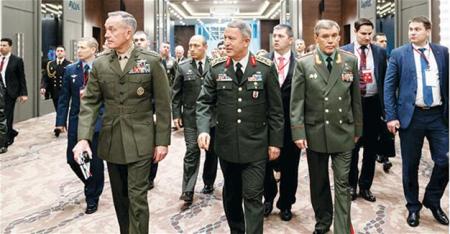
The three generals are most certainly working with open lines to their presidents – Gen. Dunford to President Trump; Gen. Gerasimov, to Vladimir Putin; and Gen. Akar, to Tayyip Erdogan. If they succeed in pulling off deals for working together, with their presidents’ endorsement, Trump will have achieved his oft-repeated target of teaming up with Moscow for eradicating ISIS.

***********************

EXCLUSIVE:  For the first time ever, the top soldiers of the United States, Russia and Turkey are holding a secret meeting in the Turkish town of Antalya for an urgent two-day effort to avert a clash between their three armies, which stand ominously face to face in northern Syria.

(See DEBKAfile’s exclusive disclosure on March 6)

Gen. Joseph Dunford, Chairman of the US Chiefs of Staff, Gen. Valery Gerasimov, Commander-in-Chief of the Russian armed forces, and Gen. Hulusi Akar, Chief of Staff of the Turkish army sat down together on Tuesday, March 7.

DEBKAfile’s military sources report that the formal agenda for this extraordinary get-together is the state of the Syrian war. But they are ranging over for more comprehensive and detailed issues and addressing at least six urgent challegnes:

1. How to prevent the three armies whose armored convoys are currently converging on the north Syrian town of Mabij, now freed of the Islamic State’s grip, from clashing over which takes over.

2. How to turn this approaching collision round and make it the jumping-off point for their collaboration in the Syrian conflict at large and a concerted drive against the Islamic State, in particular.

3. The three army chiefs will scrutinize plans for a combined trilateral offensive to drive ISIS out of its Syrian capital, Raqqa.

4.  How to translate their three-way collaboration for defeating ISIS in Syria into a combined effort against the same foe in Iraq.

5.  If they are able to hammer out accords in Antalya, the three generals will consider how to apply them to managing the Syrian army, which is now fully under Russian command.

6.  In the event of their failure to reach terms for US-Russian-Turkish cooperation in Syria, the three army chiefs will seek understandings on dividing Syria into sectors. They will determine which sectors are to be ruled by US forces and out of bounds to Russian forces, and which will be placed under exclusive Russian control and barred to American intervention.

DEBKAfile’s military sources describe this unique rendezvous as the most important US-Russian military meeting since Donald Trump took office on Jan. 20.

The three generals are most certainly working with open lines to their presidents – Gen. Dunford to President Trump; Gen. Gerasimov, to Vladimir Putin; and Gen. Akar, to Tayyip Erdogan. If they succeed in pulling off deals for working together, with their presidents’ endorsement, Trump will have achieved his oft-repeated target of teaming up with Moscow for eradicating ISIS.

Putin, too, will have chalked up an historic diplomatic and strategic feat. For the first time since the end of World War II, and after years of cold war, the Russian and American armies will come together to fight a common enemy, namely radical Islamic terror, and create an umbrella for the Russian military operation to branch out into Iraq.

Erdogan will also come out ahead of the game. Turkey and its army will become strategic partners in determining Syria’s future and fighting ISIS. And Barack Obama’s departure from the White House will have marked the start of Turkey’s ascent to regional power status ahead of Iran.