KLEIN – Iran Is the Wild Card Following U.S. Air Strikes In Syria

Posted April 7, 2017 by danmillerinpanama
Categories: Hezbollah vs Israel, Iran and Assad, Iran and Hezbollah, Iran and Israel, Iran and President Trump, Iran and Syria, Iranian proxies, Israel and Syria, Israeli security, Missile strike in Syria, Russia and Assad, Trump and Assad, Trump and Iran, Trump and Russia, Trump on the offensive

Tags: , , , , , , , , , , , , , ,

KLEIN – Iran Is the Wild Card Following U.S. Air Strikes In Syria, Breitbart, Aaron Klein, April 7, 2017
U.S. Navy/via AP

President Vladimir Putin cannot risk a military confrontation with Trump and Russia is already signaling willingness to abandon Assad to come to a larger regional accommodation.

Still, there is the possibility that Russia may quietly support action by others, especially agents of a very nervous Iranian regime that has been preparing proxies for years who can heat up Israel’s northern border and beyond.  Both Moscow and Tehran have reason for wanting Trump to pay a price for acting in their Syrian playground.  The question is whether they will dare to respond, even tacitly.

The next few days and weeks will be critical in determining Iran and Russia’s resolve in the face of an awakened America that has returned from its eight-year slumber.
******************************

TEL AVIV – Following the U.S. launch of Tomahawk missiles targeting a strategic Syrian airfield on Thursday night, Iran must be monitored carefully for the possibility that it may use its proxies for retaliation, especially against Israel’s northern border.

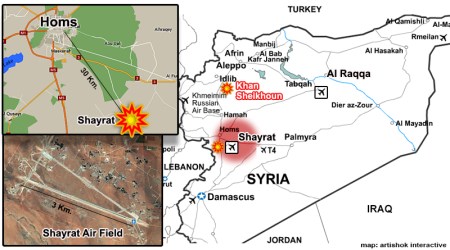
Following eight years of inaction on Syria under the Obama administration, President Donald Trump demonstrated last night that he is willing to hold Syrian President Bashar al-Assad to account, this time by striking the Shayrat Airfield near the Syrian city of Homs that was believed to have been utilized to carry out a chemical weapons attack that killed scores of civilians.

The U.S. airstrikes signaled to Assad and his Russian and Iranian backers that Trump will act in Syria and the administration strongly supports the removal of the Syrian president – an important strategic ally of Moscow and Tehran. The U.S. military move demonstrates to Israel and the Sunni Arab bloc cast aside by Obama’s nuclear deal with the mullahs that American leadership has officially returned to the region.

Assad himself is unlikely to retaliate since the last thing he wants amidst a years-long insurgency attempting to topple his regime is to go to war with Trump or expand the battlefield to U.S. ally Israel.

Trump’s bold authority in Syria directly threatens Russian interests since it was Moscow that largely filled the security vacuum in that country when Obama repeatedly failed to take any meaningful action against Assad. However, Russia’s direct response will most likely be confined to vocal protestation, such as Kremlin spokesman Dmitry Peskov calling the U.S. strikes “aggression against a sovereign nation” carried out on a “made-up pretext.”

President Vladimir Putin cannot risk a military confrontation with Trump and Russia is already signaling willingness to abandon Assad to come to a larger regional accommodation.

Still, there is the possibility that Russia may quietly support action by others, especially agents of a very nervous Iranian regime that has been preparing proxies for years who can heat up Israel’s northern border and beyond.  Both Moscow and Tehran have reason for wanting Trump to pay a price for acting in their Syrian playground.  The question is whether they will dare to respond, even tacitly.

And that brings us to Iran.  Trump’s embrace of America’s traditional Sunni Arab partners at the expense of Tehran and his strong positions against the disastrous international nuclear agreement have been deeply concerning to the expansionist, terrorist-supporting Twelvers in Tehran.  And while the removal of Assad from power would be a blow to Russia, depending on the ultimate outcome such a move could be disastrous for Iran’s position in Syria.  Iranian Revolutionary Guard units have been fighting the anti-Assad insurgents alongside the Syrian military and the Iran-backed Hezbollah militia.  Syria represents a key pawn in Iran’s geopolitical chessboard that stretches across the vital region.

In recent weeks, there have been strong indications that Iran has been seeking to arm its Hezbollah proxy with even more advanced weapons that can target the Jewish state. Last month, Israel took the unusual step of striking a Hezbollah weapons convoy near the city of Palmyra that Prime Minister Benjamin Netanyahu said was transporting advanced weapons to the Iran-backed militia.

Israeli leaders and Hezbollah terrorists have in recent weeks ratcheted up war rhetoric, with Israeli officials warning that Hezbollah, which can only act at the direction of Iran, has been preparing for conflict.

Last Sunday, IDF Chief of Staff Lt. Gen. Gadi Eisenkot warned the IDF would not hold back from striking Lebanese state institutions in a future conflict with Hezbollah. “The recent declarations from Beirut make it clear that in a future war, the targets will be clear: Lebanon and the organizations operating under its authority and its approval,” Eisenkot stated.

Hezbollah is not Iran’s only option. Breitbart Jerusalem has been reporting on the formation of a “Golan Liberation Brigade,” which was announced last month by the secretary-general of the Iraqi Harakat al Nujaba Shiite militia and is reportedly being trained by the Iranian Revolutionary Guard Corps.  The so-called militia is another Iranian front that could be used to target Israel’s Golan Heights at the behest of Tehran.

The next few days and weeks will be critical in determining Iran and Russia’s resolve in the face of an awakened America that has returned from its eight-year slumber.

Nikki Haley forces public UN meeting to put Assad’s defenders in ‘full public view’

Posted April 7, 2017 by danmillerinpanama
Categories: Missile strike in Syria, Nikki Haley, Syria - chemical weapons, UN Security Council

Tags: , , ,

Nikki Haley forces public UN meeting to put Assad’s defenders in ‘full public view’, Washington Examiner, Kyle Feldscher, April 7, 2017

U.S. Ambassador to the United Nations Nikki Haley refused to hold a closed session on Friday about the U.S. missile strike against Syria, and instead forced a public session to shame countries who might defend Syria’s chemical weapons attack.

“This morning, Bolivia requested an emergency UN Security Council meeting to discuss the events in Syria. It asked for the discussion to be held in closed session,” Haley said in a statement. “The United States, as president of the Council this month, decided the session would be held in the open. Any country that chooses to defend the atrocities of the Syrian regime will have to do so in full public view, for all the world to hear.”

The meeting is scheduled to start at 11:30 a.m.

Haley made headlines earlier this week after making an impassioned speech about Syria President Bashar Assad’s chemical weapons attack on his own people. She ripped Russia’s support for Assad and showed pictures of the effects of the sarin gas that killed up to 100 people and injured hundreds more.

President Trump ordered 59 Tomahawk cruise missiles fired at a Syrian air base in the central part of the country Thursday in retaliation for the chemical weapons attack. The base is thought to be the place from where the chemical weapons attack originated.

U.S. officials don’t believe the attack will cripple Assad’s ability to do future attacks, but it was a signal sent to both Syria and the Russians that chemical weapons attacks are unacceptable.

US strikes Syrian military airfield

Posted April 7, 2017 by danmillerinpanama
Categories: Assad, Iran and Syria, Missile strike in Syria, Russia - Syrian war, Russia and Iran, Syria - chemical weapons, Trump and Assad, Trump and Russia, Trump and Syria

Tags: , , , , , , , ,

US strikes Syrian military airfield, DEBKAfile, April 7, 2017

(Please see also, Condemnation will not stop Assad’s chemical war. — DM)

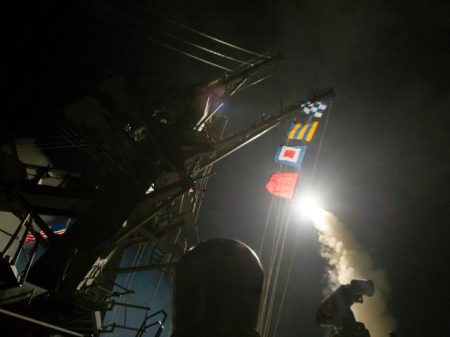
The US military launched 59 Tomahawk cruise missiles at a Syrian military airfield late on Thursday, April 6, in the first direct American assault on the government of President Bashar al-Assad since that country’s civil war began six years ago. The operation, which the Trump administration authorized in retaliation for a chemical attack killing scores of civilians this week, significantly expanded US military involvement in Syria.

The missiles were launched from two Navy destroyers — the USS Ross and USS Porter — in the eastern Mediterranean. They struck an airbase called Shayrat in Homs province, the site from which the planes that conducted the chemical attack in Idlib are believed to have originated. Syrian military aircraft, infrastructure and runways were hit

“Tonight, I call on all civilized nations to join us in seeking to end the slaughter and bloodshed in Syria and also to end terrorism of all kinds and all types,” president Donald Trump said to reporters from Mar-a-Lago, Florida, where he is hosting China President Xi Jinping and his wife…

“Assad choked out the lives of helpless men, women and children,” he said. He acted because of a “vital national security interest of the United States to prevent and deter the spread and use of deadly chemical weapons.”

DEBKAfile: Washington has no doubt that the Syrian SU-22 bomber which Tuesday dropped a sarin gas bomb on Khan Sheikhoun in Idlib province, killing up to 100 people, was a joint Russian-Iranian-Syrian gambit to divert the Trump administration from a comprehensive plan for Syria. As US President and commander-in-chief he could not ignore this provocation.

Our sources report that the new US administration’s plans for Syria center on an offensive to evict the Islamic State from its Syrian capital, Raqqa, a mission for which US military preparations have been going forward for the past two weeks at five centers. To this operation Moscow, Tehran and Damascus were not averse. But that operation was also designed to rid Syria of Iranian and Hizballah forces – to which they were.

Secretary of State Rex Tillerson said that despite previous agreements, Syria had not surrendered its chemical weapons stockpile, and accused Russia of “failing in its responsibility to deliver on its commitment” to supervise the surrender of those chemical weapons. “Either Russia has been complicit or simply incompetent in its ability to deliver,” Tillerson continued.

The question now is whether Vladimir Putin will decide to hit back at the US operation. Russia did not retaliate for the Israel air strike on March 17 over the northern Syrian T4 air base. If Putin chooses to sit on his hands once again, the same question may be addressed to Iran and Hizballah.

Very possibly, Trump and Putin reached accord on the limits of the US punitive attack in Syrian in long hours of debate during the day between the US State and Defense Departments and the Russian Foreign and Defense Ministries, which were first reported by DEBKAfile 24 hours ago. Pentagon sources report that Washington gave Moscow advance warning of the coming US attack on the Syrian Shayrat base where Russian air force units are also deployed.

Follow-up US military action may yet come after the US president asserted that for him, “many, many lines were crossed” by Assad’s chemical attack and his attitude towards Syria had changed..

Trump’s comprehensive plans for Syria our outlined in the latest DEBKA Weekly. If you are not yet a subscriber, click here for this and other exclusive revelations.

The Message in the Missiles

Posted April 7, 2017 by danmillerinpanama
Categories: Iran, Missile strike in Syria, North Korea, Syria - chemical weapons, Trump and Assad, Trump and Russia, Trump and Syria

Tags: , , , , , ,

The Message in the Missiles, Power Line, Scott Johnson, April 7, 2017

Last night President Trump authorized the destruction of the air base from which the Syrian butcher Assad had launched insidious sarin gas attacks earlier this week. Our destruction of the air base was executed through the use of 59 Tomahawk cruise missiles. I strongly support President Trump’s authorization of the action. As the great William F. Buckley, Jr. used to say, herewith a few observations:

1. Asked about the gas attacks in a Rose Garden press conference with Jordan’s King Abdullah on Wednesday, President Trump had responded: “It crossed a lot of lines for me. When you kill innocent children, innocent babies, babies, little babies, with a chemical gas that is so lethal, people were shocked to hear what gas it was, that crosses many, many lines, beyond a red line. Many, many lines.”

Trump’s language harked back to President Obama’s bloviation on Syria, but he wasn’t done. He went on specifically to cite Obama’s empty threat regarding Assad’s use of chemical weapons. “I think the Obama administration had a great opportunity to solve this crisis a long time ago when he said the red line in the sand,” Trump said. “And when he didn’t cross that line after making the threat, I think that set us back a long ways, not only in Syria, but in many other parts of the world, because it was a blank threat. I think it was something that was not one of our better days as a country.”

I read President Trump’s statement as the predicate of some form of military reprisal by the United States against Assad. Thus it proved to be.

2. Like President Reagan when he fired the striking air traffic controllers in 1981, President Trump sent several messages with the action taken last night. Here are three of them. The Obama era in American foreign policy is over. He doesn’t issue empty threats.

3. President Obama sought to tie the United States down in the world like the Lilliputians did Gulliver. Among the instruments employed by Obama to restrain the United States was the United Nations. President Trump gave the United Nations the opportunity to weigh in yesterday. When it failed to act, Trump proceeded. Again, the Obama era in foreign policy is over.

4. Trump acted with decisive force to achieve a limited objective. He could have gone further to remove more of Assad’s assets. If the goal was limited to deter Assad from doing what he did again, however, I think it highly likely that the mission was accomplished.

5. President Trump also had an unstated messaged for Iran and North Korea. See note 1 above.

6. President Obama put us in bed with Putin and empowered Russia in Syria with the supposed object of removing Assad’s chemical weapons. The agreement entered into by Obama was a complete and utter fraud. One might think that we would revisit this chain of events and pronounce it a scandal and a disgrace. Apparently not.

7. One might think that the attack on Putin’s Syrian ally would put paid to the line of the Democrat/Media Axis that Trump is somehow Putin’s lapdog, but one might think wrong.

8. President Obama and Secretary Kerry entered into the agreement with Russia to remove Syria’s chemical weapons in September 2013, not even four years ago. Yet it has conveniently disappeared from our collective memory as completely as the Wilmot Proviso and the Bland-Allison Act.

9. President Trump had the lawful authority to do what he did yesterday without congressional approval. It was akin to President Reagan’s 1986 bombing of Libya. Obama’s war to remove Qaddafi in Libya — now that was a problem. Last night, however, Trump acted well within his authority.

10. The Trump crew made a mistake advertising their intent to indulge the continuation of the Assad regime’s before the chemical attacks. They may have contributed to Assad’s brazen crime. It should also be noted, however, that the timing coincided with the two-day summit in Brussels, Belgium where European Union leaders had assembled to discuss funding commitments to support war-torn Syria. One knowledgeable observer called the Assad’s chemical attacks “a direct insult” and warning from Assad: you will keep paying and I will keep killing.


Trump strikes Assad and sends the world a message

Posted April 7, 2017 by danmillerinpanama
Categories: Children, Hamas, Israeli security, Missile strike in Syria, Palestinians, Syria - chemical weapons, Trump and Assad, Trump and Russia, Trump and Syria

Tags: , , , , , , , ,

Trump strikes Assad and sends the world a message, Israel National News, Jack Engelhard, April 7, 2017

(Chinese President Xi Jinping was honored with a huge fireworks display, setting the tone for his discussions with President Trump about such stuff as North Korea and the disputed islands in the South China Sea. Comrade Xi probably could not see it in far-away Syria, but if he didn’t get the message perhaps another fireworks display can be arranged in his honor just to the south of China’s border with North Korea. — DM)

Everything changed last night and the world will never be the same after President Donald Trump ordered the military to take action against Syrian dictator Bashar al-Assad. Two Navy warships fired 50 Tomahawk missiles upon a Syrian airfield from which chemical weapons were dropped on civilians, killing some 80, including children.

It was the slaughter of children that provoked Trump and led him to change his mind about interfering with force in the throes of Syria’s civil war – though he was critical of Obama for declaring a red line during a previous chemical assault but that saw no action from Obama.

Trump sent a message to Assad that indeed there’s a new sheriff in town. At the same time, Trump alerted the nations that this President means business and that the days of taking the United States for granted are over. His UN envoy Nikki Haley has been his voice of change at the UN – warning the nations that the United States has had its fill of Israel bashing while ignoring war crimes throughout the rest of the world.

In his message last night, Trump vowed to stop Assad and asked the civilized world to join him in eradicating terrorism everywhere.

He did not mention North Korean dictator Kim Jong-un. But that is one Supreme Leader that got a wake-up call, as did every other tyrant.

World leaders everywhere will now have to think twice before going ahead rashly. This includes Putin.

Americans got the news at around 8 pm last night. Full coverage was immediate throughout the cable networks.

CNN bested Fox news with sharper and more immediate facts and analysis. Anderson Cooper was factual and let the experts speak.

Fox News’ Shepard Smith was unable to mask his disdain for the President and kept interrupting his analysts with critical and inappropriate asides.

This was no time for backstabbing, but there was more of it on MSNBC.

A time like this, our military in action, is no time for bickering. The news media, so hostile to Trump from day one, will have to find a new voice in which to speak to America, whether Trump speaks their political language or not. Americans won’t tolerate divisiveness while our servicemen are in hostile waters – and certainly not when the job is about putting a stop to the random killing of infants.

For Israel there is a dark undercurrent to Trump’s response. The Palestinian Arabs who’ve been waging terrorism against Israel throughout the years, namely the PA and Hamas, have surely taken note at Trump’s heightened sensibilities toward children – they watch and they learn.

They learn that harming infants is one way to get at Trump, and so Israel must be prepared for a Gaza war aimed not to defeat Israel by arms, but through bombing Israeli towns and villages, and creating terror on the streets, drawing the IDF into a conflict that leaves Israel no choice but to move in at all costs. Otherwise the risk to the Jewish State would be unbearable.

Hamas has perfected the use of human shields to wage warfare through soliciting sympathy…with the PA’s Mahmoud Abbas cheering on.

They did it three times previously – 2008, 2012, 2014.

Hamas and the PA care nothing for the number of children that get killed, Jewish children and even their own children – if it makes a point.

So that’s Israel’s challenge against this epidemic of terrorism that has spread throughout the world.

Trump’s world is a new world and we all better start getting used to it, for the best we trust, and so far, so good.

Iran Will Not Cancel The JCPOA – Because It Grants Iran Nuclear State Status And Is A Western Guarantee For The Regime’s Survival

Posted April 7, 2017 by danmillerinpanama
Categories: Iran scam, Regime change, Trump and Iran, Trump and Iran scam

Tags: , , ,

Iran Will Not Cancel The JCPOA – Because It Grants Iran Nuclear State Status And Is A Western Guarantee For The Regime’s Survival, MEMRI, A. Savyon and Yigal Carmon* April 6, 2017

(Cf. The Real War in ‘Syria’ and the Strategy for Long-Term Victory. — DM)

Introduction

The JCPOA grants the Iranian regime two historic achievements – the status of a nuclear state and immunity against a Western attack due to its nuclear development. This is effectively a Western guarantee of the Islamic Republic regime’s survival. These achievements cannot be cancelled unless the agreement itself is declared invalid.

Iranian spokesmen have stressed that even if President Trump’s administration cancels the agreement, the agreement cannot be cancelled – because Iran, in its prescience, involved the EU and the UN in backing the agreement. Even if the U.S. alone were to cancel the agreement, it would still remain in force – that is, Iran’s status as a nuclear state would remain.

Iranian President Hassan Rohani stressed, for example, at a November 11, 2016 cabinet meeting, the day after Trump was elected president, that there was no way to cancel the agreement. He said: “Iran’s wisdom in the nuclear agreement was in the fact that it had the JCPOA approved as a UN Security Council resolution, and not as a [bilateral] agreement with a particular country or administration. Therefore, it will not be changed by any decision by a particular administration.”[1]

Following the JCPOA’s Implementation Day, in January 2016, and even previously, Iranian regime officials repeatedly warned that if the U.S. violated the agreement, and especially if more sanctions were leveled against Iran, Iran would cancel the agreement and revert to the status quo that existed before the agreement, and would even advance beyond it?

For example, an October 21, 2015 letter of guidelines from Iranian Supreme Leader Ali Khamenei to President Rohani constituting “conditional approval” for the agreement stated: “Throughout the eight-year period, any imposition of sanctions at any level and under any pretext (including repetitive and reiterated pretexts of terrorism and human rights) on the part of any of the countries party to the agreement will constitute a violation of the JCPOA and the [Iranian] government would be obligated to take the necessary action as per Clause 3 of the Majlis resolution and stop the activities mandated by the JCPOA.”[2]

Iran Is Changing Its Policy – From Threats To Cancel The Agreement To Threats Of A Parallel Response

However, after the U.S. leveled additional sanctions against Iran, during both the Obama and Trump administrations, it became clear[3] that Iran was not going to implement its threats. Instead, Iran presented a new formula that does not obligate it to abrogate the agreement, as it previously threatened. The new formula determined that the Iranian regime would respond to any U.S. violation of the agreement with its own parallel violation.

Indeed, on March 26, 2017, after the U.S. State Department’s March 24, 2017 announcement of new sanctions against companies and individuals connected to Iran’s missile program, Iran’s Foreign Ministry announced counter-sanctions against 15 U.S. companies. Additionally, in response to the Countering Iran’s Destabilizing Activities Act of 2017, currently under consideration in the U.S. administration and the U.S. Senate designating Iran’s Islamic Revolutionary Guards Corps as a terrorist organization, Majlis National Security Committee chairman Ala Al-Din Boroujerdi announced, on March 25, 2017, that the committee would present to the Majlis a plan to designate the CIA and U.S. Armed Forces as terrorist organizations, to be carried out after the March 21 Iranian Norouz holiday.[4]

On April 3, 2017, Iranian Foreign Minister Javad Zarif reiterated: “If the moment comes that the Americans are not implementing the JCPOA, our reversion [to the pre-JCPOA situation] will be very swift, and we will arrive at even more than what we once had… We have enough guarantees for the day when the [Iranian] regime decides and feels that the level of America’s breaking of its promises is so high that we must revert to the pre-JCPOA [situation]. But it does not appear to me that this will happen.” [5]

It should be noted that in his threats about the possibility of Iran’s reversion to the status quo that existed prior to the agreement, Zarif does not set out any red line or specific condition whose violation will oblige Iran to cancel the agreement. Instead, he states that Iran will act “when it feels” that the U.S. is ratcheting up its level of violations against Iran. Furthermore, Zarif adds that such a situation, in his assessment, will not occur.

Iran’s backing down from its previous threats and warnings regarding the JCPOA’s continuing validity even if the U.S. cancels it is testimony to the agreement’s historic importance for the Iranian regime. In our assessment, Iran will not cancel the agreement even if the U.S. continues to level sanctions against the country, even if it is involved in military action against Iranian interests. Iran will not cancel an agreement that endows it with nuclear-state status and that constitutes a guarantee of the regime’s survival and provides immunity from a Western attack aimed at regime change. These historic achievements for Iran were granted to it by the Obama administration by means of the JCPOA.

Needless to say, the threat to revert to the pre-JCPOA situation is in itself an empty threat, because if the regime does this, it will bring itself back to a situation defined by then-U.S. Secretary of State John Kerry as “a two-month [nuclear] breakout time.”[6] By doing so, it will bring closer the risk of attack by the West.

The JCPOA – A Tool To Ensure The Survival Of The Iranian Regime

The Iranian regime is clinging to the JCPOA because this agreement guarantees its survival. President Obama promoted the Iranian regime from the status of a “defendant state”, subject to Security Council sanctions for its nuclear program, to the status of a legitimate nuclear state that can negotiate with the rest of the world powers over upgrading its nuclear activity.

The existential threat that led Supreme Leader Ali Khamenei to revive Iran’s nuclear project in 2002, (after the founder of the Iranian Revolution, Ayatollah Ruhollah Khomeini, stopped the country’s Shah-era nuclear project), was the threat to the regime’s survival. The regime was under threat both from being attacked directly by the West, with the aim of bringing about regime change, and indirectly by mobilizing opposition elements at home, which the regime labeled “fitna” – such as the fitna – i.e. civil unrest – following the 2009 presidential election, which it suppressed. For this reason, Khamenei, during the negotiations for the JCPOA, demanded that the U.S. stop the American broadcasts in Farsi to Iran, suspend its political and economic support for Iranian opposition groups, and stop criticizing Iranian censorship of the Internet – all three demands pertain to regime survival (see MEMRI Inquiry and Analysis No. 837, Khamenei’s Aim at the Nuclear Talks – Securing the Survival of His Regime, May 15, 2012).

With the JCPOA, Khamenei gained a double achievement, assuring both the survival of his regime and Iran’s membership in the nuclear club. The Iranian regime’s original aim in pursuing the JCPOA was to guarantee the survival of the regime in the face of all the possible threats, from within and without – and was not intended to obtain massive economic aid nor to bring Iran into the Western economy in order to ease its people’s economic distress – which Khamenei intends to do with the “resistance economy,” the main thrust of which is self-reliance and rejection of economic cooperation with the West and foreign investment in Iran.

Iran’s nuclear status, promised to Khamenei by the Obama administration in the agreement that is backed by Europe, allows him to both continue to repress the Iranian people and to continue exporting the Iranian Revolution in the region.

*A. Savyon is Director of the MEMRI Iranian Media Project; Yigal Carmon is President of MEMRI.

______________________

[1] ISNA (Iran), November 9, 2016.

[2] MEMRI Inquiry and Analysis No. 1196, Iranian Supreme Leader Khamenei’s Letter Of Guidelines To President Rohani On JCPOA Sets Nine Conditions Nullifying Original Agreement Announced July 14, 2015, October 22, 2015.

[3] Tasnim (Iran), March 26, 2017.

[4] IRIB (Iran), March 25, 2017.

[5] Farsnews (Iran), April 3, 2017.

[6] http://www.huffingtonpost.com/entry/john-kerry-iran-israel_us_55b22b45e4b0224d8831d360

The Real War in ‘Syria’ and the Strategy for Long-Term Victory

Posted April 7, 2017 by danmillerinpanama
Categories: Assad, Iran - civil unrest, Iran - Middle East, Iran - regime change, Iran and Assad, Iran and Russia, Iran and Syria, Iranian dissidents, Iranian missiles, Iranian nukes, Iranian proxies, Iranian resistance, Russia - Syrian war

Tags: , , , , , , , , , , , ,

The Real War in ‘Syria’ and the Strategy for Long-Term Victory, PJ Media, Michael Ledeen, April 6, 2017

(Iran is ripe for regime change and the sooner the better. Please see also, Iran’s Elections: A Breaking Crisis? and All 15 Arab Summit resolutions blast Iran.– DM)

Syria’s President Bashar al-Assad (Reuters, RTX34BQA)

Punishing Assad would be satisfying, but we’ve got a big war to win. It’s smarter and more effective to go after the regime in Tehran. Not militarily, but rather supporting the tens of millions of Iranians who detest the Khamenei regime. Call it political warfare, or subversion, or democratic revolution. It worked against the Soviet Empire, and there are good reasons to believe it would work in Iran as well. Most Iranians, suffering under the failed regime, want a freely chosen government that will address their problems instead of dispatching their husbands and sons sent to the battlefield.

Regime change in Iran would be devastating to Assad and Putin, and its positive effects would be felt in North Africa and our own hemisphere, striking at the Revolutionary Guards and Hezbollah in Latin America. And it would remind the tyrants that America’s greatest weapon is political. We are the most revolutionary country in the world, and we should act like it.

****************************

Of course I loathe Assad. And of course I despise the Obamans for that phony red line and the subsequent retreat-and-bogus-Russian-deal. But just carrying out vengeance against Assad isn’t good enough. It fails to address the central problem of our time: the global anti-American alliance.

There is no Syria any more, and the enemy forces on the Middle Eastern battlefield come from various jihadi groups, and three regimes: Moscow, Tehran, and Damascus. We have to defeat them all, and other members of the enemy alliance, including Cuba and North Korea. Nikki Haley has it right: “The truth is that Assad, Russia and Iran have no interest in peace.”

Indeed, they are waging war, and the principal force driving that war is not Assad, but Iranian Supreme Leader Ali Khamenei. Khamenei’s killers have been alongside Assad’s from the very beginning, as the survival of the Syrian dictator is crucial to Iranian ambitions and quite likely also the survival of the Islamic Republic itself. Listen to Defense Secretary James Mattis a few days ago (from Reuters):

Asked about comments Mattis made in 2012 that the three primary threats the United States faced were “Iran, Iran, Iran,” Mattis told reporters that Iran’s behavior had not changed in the years since.

“At the time when I spoke about Iran I was a commander of US central command and that (Iran) was the primary exporter of terrorism, frankly, it was the primary state sponsor of terrorism and it continues that kind of behavior today,” Mattis said.

True, and Mattis’ characteristically strong language points the way to the best American action in the region, namely bringing down the Tehran regime. Lashing out at Assad isn’t nearly good enough. After all, what strategic objective would we accomplish by smashing, even removing, Assad? The Iranian and Russian fighters would still be there, as would the Islamist forces. The demands on our military would dramatically expand. We do not want to occupy a significant land mass in what used to be called Syria, nor do we seem to have sorted out what we want to do with the Turks and the Kurds.

Punishing Assad would be satisfying, but we’ve got a big war to win. It’s smarter and more effective to go after the regime in Tehran. Not militarily, but rather supporting the tens of millions of Iranians who detest the Khamenei regime. Call it political warfare, or subversion, or democratic revolution. It worked against the Soviet Empire, and there are good reasons to believe it would work in Iran as well. Most Iranians, suffering under the failed regime, want a freely chosen government that will address their problems instead of dispatching their husbands and sons sent to the battlefield.

Regime change in Iran would be devastating to Assad and Putin, and its positive effects would be felt in North Africa and our own hemisphere, striking at the Revolutionary Guards and Hezbollah in Latin America. And it would remind the tyrants that America’s greatest weapon is political. We are the most revolutionary country in the world, and we should act like it.

North Korea is Crazy

Posted April 6, 2017 by danmillerinpanama
Categories: China and North Korea, Kim Jong-un, North Korean missiles, North Korean nukes, Trump and North Korea

Tags: , , , ,

North Korea is Crazy, Bill Whittle Channel via YouTube, April 6, 2017


The half-baked lies of Susan Rice

Posted April 6, 2017 by danmillerinpanama
Categories: Intelligence community, Intelligence leaks, Obama and Rice, Susan Rice

Tags: , , ,

The half-baked lies of Susan Rice, Washington Times, David Keene, April 5, 2017

(Caution: Racist woman hater spreading vast right-wing conspiracy theories. Or so the Lamebrain media would have one believe. — DM)

Illustration on Susan Rice by Linas Garsys/The Washington Times

ANALYSIS/OPINION:

Most reasonable observers believed or at least hoped that the nation would finally be spared having to listen to the Clinton and Obama administrations’ go-to liar after last November’s election. In the normal course of events, National Security Advisor Susan Rice would have simply packed her bags and vanished into well-paid obscurity at a “progressive” university or think tank. But it was not to be.

The woman who has been blamed with some accuracy for more fiascos than most can count is still with us. She first publicly demonstrated her bad judgment as far back as 1996 when as the Clinton National Security Council’s senior director for African affairs, she successfully urged the Clinton White House to refuse a Sudanese offer to turn al Qaeda’s Osama bin Laden over to the United States. Bin Laden had helped engineer the first World Trade Center bombing and, but for Ms. Rice, would have been taken down before he and his buddies finally brought the towers down eight years later.

No doubt gaining prestige for this sage advice, Ms. Rice steadily rose to become what passes for a foreign policy superstar in the Clinton and Obama world, finally ending up as President Obama’s national security adviser, where she worked internally to weaken this country’s support of Israel and was constantly available to heap praise on her boss and his accomplishments. She was selected by the White House communications team after the terrorist attack in Benghazi to falsely blame a hapless filmmaker for the debacle lest Mr. Obama’s re-election narrative that he had the terrorists on the run be jeopardized. It was then that Ms. Rice came into her own as a liar.

Utilizing talking points put together and given her by Obama aide Ben Rhodes, she took to the Sunday talk show circuit, appearing before every camera she could find to declare the filmmaker the villain while insisting that the White House and Mrs. Clinton were blameless. It wasn’t until Judicial Watch went to court to get copies of the Rhodes emails ordering her to lie to protect her bosses that the public began to appreciate her talent for telling whoppers.

Ultimately, her tour de force on Benghazi and later public claim that Army deserter Bowe Bergdahl was a hero captured by the enemy on the battlefield rather than the deserter everyone in the administration knew him to be cost her the job at the top of the foreign policy ladder. Chosen as Mrs. Clinton’s successor as secretary of State, Ms. Rice was forced to withdraw rather than face confirmation hearings in the Senate.

Now with the revelations earlier this week that it was she who “unmasked” the names of Trump associates overheard in conversations with foreign nationals picked up by U0.S. intelligence during the Trump campaign and transition, the lady is at it again. At first she claimed she had done nothing unusual, not realizing her actions were coming under scrutiny. Then she admitted that, yes, she had increased her requests to the intelligence agencies as the campaign heated up and through the transition, and that she was aided in her efforts by none other than her old friend and co-conspirator, Ben Rhodes. Once it was revealed that she was collecting data on the future president, she admitted the “unmasking,” but assured everyone that, as she told reporters, she had “leaked nothing to nobody.”

The only people who took her at her word were Clinton and Obama apologists who would, if called upon, praise the bright sunlight at midnight. Don Lemon and others at CNN immediately dismissed the facts revealed as “fake news” designed to malign Ms. Rice and the Democrats in an effort to divert attention from the Trump administration’s many sins and failings. The public isn’t buying it, knowing that being fooled once by a serial liar might be blamed on the liar, but anyone who could be fooled twice, three times or more by the likes of Ms. Rice can blame only themselves.

Those familiar with the way she went about collecting information on her boss’ political enemies know that she and Mr. Rhodes were running an unprecedented effort to politically weaponize the powerful tools put into the hands of the government to fight terrorism and turn them on those with whom they disagree. Michael Doran, a former National Security Council (NSC) senior director, was shocked at the enormity of what they had purportedly done, telling a reporter they had accessed “a stream of information that was supposed to be hermetically sealed from politics and the Obama administration found a way to blow a hole in the wall.”

Mr. Doran’s shock was echoed in the words of retired Col. James Waurishuk, former NSC aide and deputy director of U.S. Central Command, who told the Daily Caller, “This is really, really serious stuff.”

Indeed it is, and though Ms. Rice has dodged questions about whether she’ll willingly testify before congressional investigators on what she did, she should be required to do so if she has to be dragged up there kicking and screaming while being reminded that lying under oath is different from lying in front of a television camera.

Pentagon drawing up options for military response to Syria chemical attack

Posted April 6, 2017 by danmillerinpanama
Categories: Assad, Department of Defense, Syria - chemical weapons, Trump and Syria, U.S. Military

Tags: , , , ,

Pentagon drawing up options for military response to Syria chemical attack, Washington Examiner, Jamie McIntyre, April 6, 2017

The U.S. could use its existing deconfliction channel with the Russians to avoid targets that would cause Russian casualties.

*****************************

The Pentagon is drawing up options for a possible military response to Tuesday’s chemical weapons attack in Syria that killed more than 70 people, and hospitalized hundreds more.

“There are very senior level meetings underway,” said one Pentagon official, “but I have not seen a concrete plan.”

The meetings involve Defense Secretary Jim Mattis and Joint Chiefs Chairman Gen. Joseph Dunford at President Trump’s Mar-a-Lago resort in Florida, and involve consultations with other senior commanders, including Gen. Joseph Votel, head of U.S. Central Command. The meetings are taking place amid new reports of another chemical attack in Syria.

“Options yes. We are in the business of providing options,” a senior military official said. “I would watch this one closely.”

The first official could not say if Trump had specifically ordered the options, or if the meeting constituted “prudent planning,” considering Trump’s Rose Garden statements Wednesday.

“I have that flexibility,” Trump said, “and I will tell you, it’s already happened that my attitude toward Syria and Assad has changed very much. … What happened yesterday is unacceptable to me.”

The U.S. now has a high degree of confidence that the air force of Syrian President Bashar Assad dropped a chemical weapon from an aircraft on the unsuspecting citizens of Khan Sheikhoun, in Syria’s northwest Idlib province, Pentagon officials said.

The symptoms suffered by the victims, including foaming at the mouth and asphyxiation, are consistent with exposure to sarin, a deadly nerve agent.

Pentagon planners have to take into account the presence of Russian forces and Iranian militia if they contemplate airstrikes to punish the Assad regime.

The U.S. could use its existing deconfliction channel with the Russians to avoid targets that would cause Russian casualties.