Israel sees 371-case spike in confirmed coronavirus cases in a single day

Posted March 24, 2020 by Joseph Wouk
Categories: Uncategorized

Source: Israel sees 371-case spike in confirmed coronavirus cases in a single day | The Times of Israel

Total of 1,442 patients, including 29 in serious condition, says Health Ministry; 41 of those diagnosed have recovered
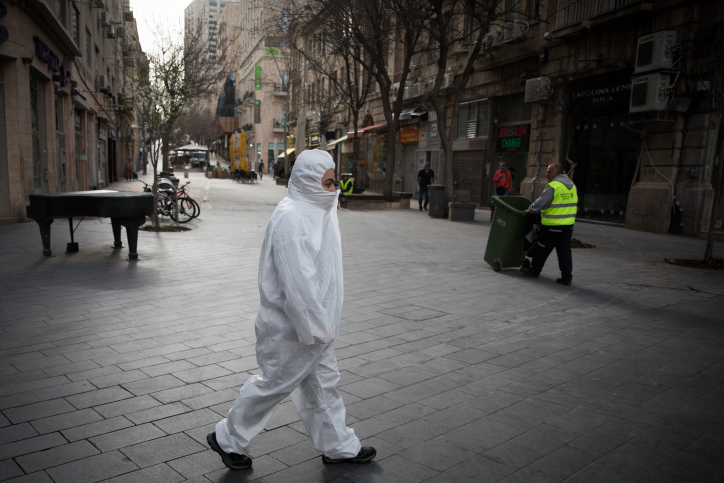
A man wearing protective clothes in downtown Jerusalem on March 20, 2020. (Nati Shohat/Flash90)

A man wearing protective clothes in downtown Jerusalem on March 20, 2020. (Nati Shohat/Flash90)

The number of diagnosed cases of the deadly coronavirus in Israel took another leap Monday, reaching 1,442, an increase of 371 since the day before.

Of those with COVID-19, the disease caused by the virus, 29 are in serious condition and being treated on ventilators, the Health Ministry said Monday evening.

The increase of 371 appeared to be the biggest single-day jump of confirmed cases of the disease, despite increasingly strict measures to limit public life in the country. One person has died of the disease.

There are 40 patients considered moderately ill with the disease and another 1,331 with mild symptoms, the ministry figures showed. So far 41 people have recovered from the disease which causes fever, coughing and breathing difficulties.

There are 346 patients being treated at hospitals around the country and another 540 receiving treatment at home.

The rapid increase in diagnosed cases comes as Israel boosts its testing for the disease.
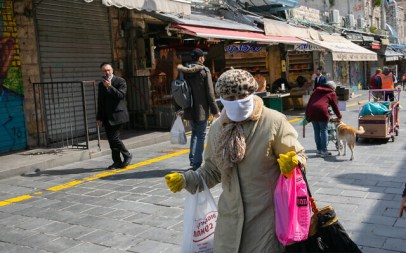
An Israeli woman wearing a face mask for fear of the coronavirus at the Mahane Yehuda Market in Jerusalem, March 22, 2020. (Olivier Fitoussi/Flash90)

The Health Ministry said Monday morning it had tested 3,230 people over the 24 hours previously, having last week ramped up testing to around 2,000 people a day after complaints over the slow pace of the checks.

Israel is reportedly set to announce drastic new restrictions on public movement it hopes will help stanch the spread of the virus, though policy experts expect any effect to only be seen in 10 days or more.
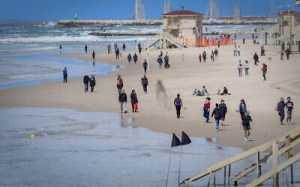
Israelis visit the beach in Tel Aviv despite government orders to avoid public gatherings due to the spread of the new coronavirus, March 21, 2020. (Avshalom Sassoni/Flash90)

On Monday, Prime Minister Benjamin Netanyahu held a meeting with officials from the Health and Finance ministries as well as other government departments to review implementation of further isolation orders that Hebrew media reported would include a complete shut down of the public transportation system and limiting citizens to straying no further than a couple of hundred meters from their homes, unless they are traveling to or from work or buying essential items. All stores will also be shut, aside from groceries and pharmacies, and police powers to enforce the measures will be ratcheted up.

The discussion about the restrictions, which will reportedly be announced by Tuesday if not earlier, came following a phone call between Health Ministry director-general Moshe Bar Siman-Tov and Netanyahu in which the former said that measures already taken were not curbing the spread of the disease, Channel 12 television reported.
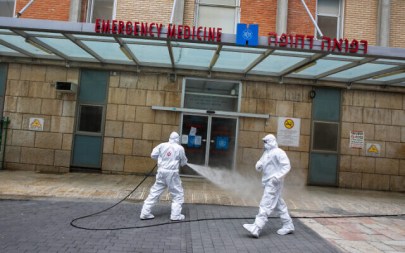
Israeli firefighter wearing protective clothes disinfects the entrance of the emergency of Hadassah Ein Karem hospital in Jerusalem on March 22, 2020. (Olivier Fitoussi/Flash90)

Bar Siman-Tov reportedly told Netanyahu that the rate at which cases was increasing is “worrying, it is like the Italian rate.” Italy has seen a massive outbreak of the virus with the highest number of known fatalities in the world at over 6,000 deaths so far.

The Health Ministry has already ordered the public to stay indoors, only venturing out if necessary and banned gatherings of more than 10 people. Universities, schools, kindergartens, and leisure sites have all been closed.

Israel’s first fatality from the virus, 88-year-old Holocaust survivor Aryeh Even, was buried overnight Saturday in a funeral service that was capped at 20 mourners. All present were required to stand at a two-meter (6.5 ft) distance from one another.

Times of Israel staff contributed to this report.


Caronavirus – The human Spirit Will Triumph – Beethoven’s “Ode to Joy” – Flashmob 

Posted March 23, 2020 by Joseph Wouk
Categories: Uncategorized


IDF Efforts to Fight COVID-19

Posted March 23, 2020 by Joseph Wouk
Categories: Uncategorized


IAEA chief demands ‘clarifications’ on Iran’s nuclear programme

Posted March 23, 2020 by davidking1530
Categories: Uncategorized

The report showed Iran’s stockpile of enriched uranium now stands at more than five times the limit fixed under the accord.

https://www.france24.com/en/20200303-iaea-chief-demands-clarifications-on-iran-s-nuclear-programme

The head of the UN’s atomic watchdog on Tuesday sounded the alarm at Iran’s cooperation with the agency and demanded “clarifications” over an undeclared site in Tehran where uranium particles were found late last year.

It comes on the same day as the IAEA issued two reports, one on Iran’s current nuclear programme and the other detailing its denial of access to two sites the agency wanted to visit.

Rafael Grossi, the new head of the International Atomic Energy Agency (IAEA), who was in Paris to meet President Emmanuel Macron, told AFP: “Iran must decide to cooperate in a clearer manner with the agency to give the necessary clarifications.”

“The fact that we found traces (of uranium) is very important. That means there is the possibility of nuclear activities and material that are not under international supervision and about which we know not the origin or the intent.

“That worries me,” Grossi added.

The IAEA has for months been pressing Tehran for information about the kind of activities being carried out at the undeclared site where the uranium particles were found.

While the IAEA has not identified the site in question, diplomatic sources told AFP the agency asked Iran about a site in the Turquzabad district of Tehran, where Israel has alleged secret atomic activity in the past.

In addition, according to a report issued by the IAEA on Tuesday, “the Agency identified a number of questions related to possible undeclared nuclear material and nuclear-related activities at three locations in Iran”.

At one of them the report said the IAEA had from early July 2019 observed “activities… consistent with effort to sanitize part of the location”.

A diplomatic source said that the three locations were separate to Turquzabad.

The source also said that the agency’s queries were thought to relate to Iran’s historic nuclear activities and not to its compliance with the 2015 nuclear deal with world powers.

The IAEA report says the agency first raised questions about the sites last year and that Iran refused access to two of them that the agency wished to visit in late January.

Iran then sent the IAEA a letter saying it did “not recognize any allegation on past activities and does not consider itself obliged to respond to such allegations”.

– Deal in danger –

The second report from the agency detailed Iran’s current breaches of several parts of a landmark 2015 international deal on scaling back its nuclear programme.

The report showed Iran’s stockpile of enriched uranium now stands at more than five times the limit fixed under the accord.

It said that as of February 19, 2020 the Iranian stockpile stood at the equivalent of 1,510 kilogrammes, as opposed to the 300 kg limit set under the agreement.

Some experts consider this amount to provide sufficient material to produce a nuclear weapon, depending on its exact level of purity.

However, it would still need several more steps, including further enrichment, to make it suitable for use in a weapon.

The report says that Iran has not been enriching uranium above 4.5 percent.

An enrichment level of around 90 percent would be needed for weapons use.

Richard Nephew, a former lead US sanctions expert during the negotiations for the 2015 deal, pointed out that while the latest figures were “a problem (that)… needs to be addressed”, Iran’s uranium stockpile remains a fraction of what it was before the deal actually came into force.

“This remains not yet a crisis and we have time to fix it diplomatically, if anyone in Washington or Tehran is still so inclined,” he said on Twitter.

The 2015 deal has been hanging by a thread since the US withdrew from it in May 2018 and went on to impose stinging sanctions on Iran, in particular targeting its vital oil sector.

The latest IAEA reports come just days after a meeting in Vienna of the remaining parties to the deal ended without a clear plan to keep the accord alive.

The 2015 agreement promised Iran an easing of very damaging economic and other sanctions in return for scaling back its nuclear programme.

Tehran has been progressively reducing its commitments to the accord in retaliation for the US move.

Israel and the Coronavirus, a world pandemic – Jerusalem Studio 498 

Posted March 21, 2020 by Joseph Wouk
Categories: Uncategorized


Israeli military enters state of war amid nationwide curfew over COVID19 

Posted March 20, 2020 by Joseph Wouk
Categories: Uncategorized


US to Iran: Coronavirus won’t save you from sanctions 

Posted March 20, 2020 by Joseph Wouk
Categories: Uncategorized

Source: US to Iran: Coronavirus won’t save you from sanctions – The Jerusalem Post

“Washington’s increased pressure against Iran is a crime against humanity,” an Iranian official said. “All the world should help each other to overcome this disease,” he added.

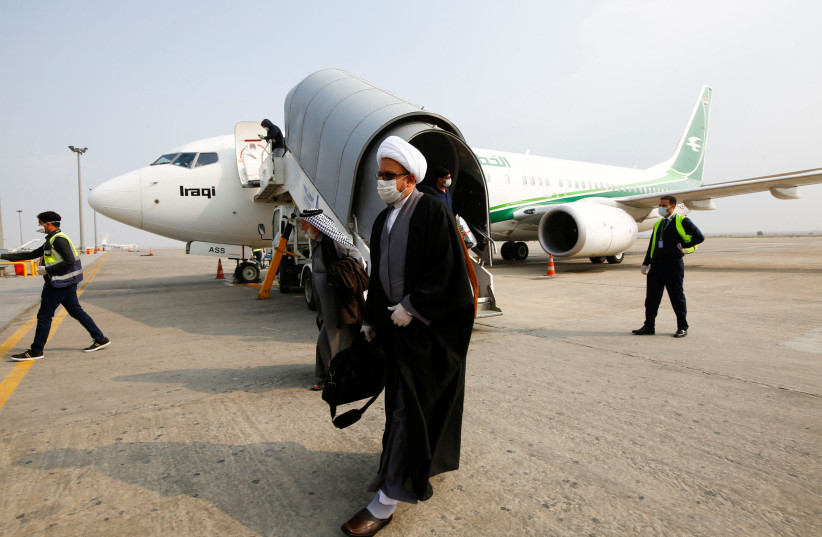
A cleric man wears a protective mask amid concerns over the coronavirus (COVID-19) spread, at Najaf airport in the holy city of Najaf upon his arrival from Iran (photo credit: REUTERS/ALAA AL-MARJANI)
A cleric man wears a protective mask amid concerns over the coronavirus (COVID-19) spread, at Najaf airport in the holy city of Najaf upon his arrival from Iran
(photo credit: REUTERS/ALAA AL-MARJANI)
WASHINGTON/DUBAI- The United States sent Iran a blunt message this week: the spread of the coronavirus will not save it from US sanctions that are choking off its oil revenues and isolating its economy.
Iran is the Middle Eastern nation worst hit by coronavirus, with its death toll climbing to 1,284 and one person dying from it every 10 minutes and 50 becoming infected every hour, the health ministry said.
The United States, which argues that its “maximum pressure” campaign to curb Iran’s nuclear, missile and regional activities does not stop the flow of humanitarian goods, imposed new sanctions this week.
The Trump administration blacklisted five companies based in the United Arab Emirates, three in mainland China, three in Hong Kong and one in South Africa for trade in Iran’s petrochemicals.
“Washington’s increased pressure against Iran is a crime against humanity,” an Iranian official told Reuters. “All the world should help each other to overcome this disease.”
Some analysts suggested the Trump administration should do more to speed the flow of humanitarian goods into Iran, though they saw little evidence to suggest this was in the offing.
“Our policy of maximum pressure on the regime continues,” Brian Hook, the US Special Representative for Iranian Affairs, told reporters. “US sanctions are not preventing aid from getting to Iran.”
On Monday, China called on the United States to give Iran sanctions relief for humanitarian reasons but US officials, foreign diplomats and analysts saw no signs of this.
“While Iran is an epicenter of this virus outbreak and facing true economic catastrophe … there will be no relief on sanctions,” said Elizabeth Rosenberg of the Center for a New American Security think tank.
Hook said Washington sent a diplomatic note to Tehran offering help with coronavirus “and it was quickly rejected.”
He also blamed Iran’s leadership for its coronavirus woes, saying that Iran “spends billions on terrorism and foreign wars” and that if it spent one tenth of this “on a better health care system, the Iranian people would have been much better off.”
In what might be a gesture to Washington, Tehran released US citizen Michael White from its custody though he must stay in Iran.
Suzanne Maloney of the Brookings Institution think tank said Iran allowing White or other detained US citizens to fly home might appeal to President Donald Trump.
“I still don’t believe this administration wants to provide a lot of leeway to the Iranian authorities but that doesn’t mean they can’t or shouldn’t be looking for every opportunity to” get medical supplies into Iran, she said.
The outbreak in Iran was likely to spread as Iranians travel for the Nowruz new year’s celebration, she added, saying this could hurt US security partners across the region.
“Iran is Italy, only on steroids,” Maloney said, alluding to the outbreak in Italy, whose coronavirus death toll on Thursday overtook that of China, where the virus emerged.
Mark Dubowitz, an Iran hawk with the Foundation for Defense of Democracies policy group, said Washington could send medical goods to Iran via private groups but should not ease sanctions.
“At the very time Iranian-backed Shi’ite militias in Iraq are killing Americans and Brits and others, this would be exactly the wrong time to be providing any kind of economic relief to the regime,” he said, referring to last week’s attack on a military camp in Iraq that killed one British and two US personnel.
“We should be sending medical supplies directly to Iranians through non-governmental organizations and bypass the regime.”
Iranians appeared to have mixed feelings about whether Washington was making its outbreak worse.
“America’s sanctions are preventing Iran from getting necessary medicine and equipment to fight against this virus. They have to lift it,” said dentist Arash Hosseini, 52, in Tehran.
But Twitter user @fnikjoo, suggested sanctions relief would just provide “Money to support more terrorists in the region and beyond.”


Where Is Iran’s Supreme Leader?

Posted March 20, 2020 by davidking1530
Categories: Uncategorized

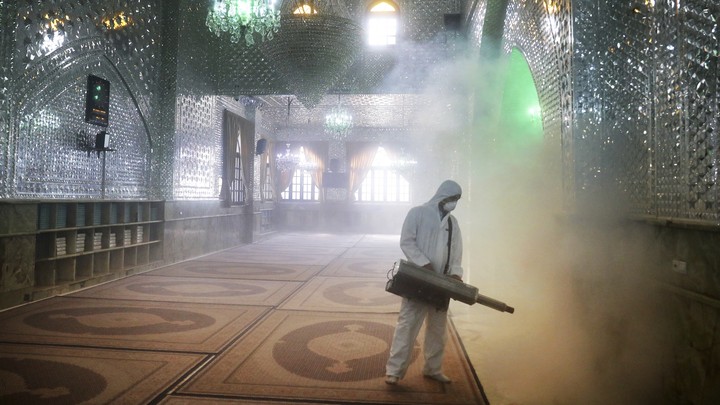
A worker in a protective suit sprays a disinfectant

https://www.theatlantic.com/ideas/archive/2020/03/what-coronavirus-means-regime-change-iran/608122/

Last week, I proposed that Iran’s coronavirus problem is much greater than commonly acknowledged, and that the true number of cases is perhaps hundreds of times greater than the official number. More signs of uncontrolled infection have emerged, and I fear I was optimistic. On Wednesday, Bahrain evacuated 165 of its citizens from Iran; 77 of them tested positive for the coronavirus. The Washington Post reported that satellite photographs showed a great furrow dug into a cemetery in Qom, reportedly to bury huge numbers of COVID-19 victims who had died already in that city. Other areas of Iran complained that they had run out of cemetery space, and that their numbers (then in the hundreds) were so great that they swamped the official national total, which even a week later is a mere 853. In Islam, bodies must be buried promptly and, in general, alone. You cannot bury two people together unless they are close family. One Iranian reported to me that the deaths were coming so fast that the survivors were requesting special dispensation to break this rule.

The economist Tyler Cowen asks, impishly, whether we should in fact be relieved, because apparently even when a society faces unrelenting misery—accelerated by the policies of its government—it doesn’t necessarily break down. Iran hasn’t turned into a criminal wasteland, with gangs in tricked-out, armored Paykans looting toilet paper and ventilators. In fact, it looks like Iranians have, like some Chinese before them, spawned informal systems of order, with roadblocks going up to prevent people from Tehran from fleeing to the countryside and bringing the disease with them. These efforts at containment have failed, but they were not forms of disorder, and most evidence suggests that when the plague abates, Iranians will have many things to mourn, but the irreversible disintegration of their society will not be among them.

The government is another matter. Many Iranians would celebrate its passing, and even its supporters have been watching for signs that the coronavirus will catalyze changes that should have come long ago, but that its authoritarian structure makes nearly impossible. The previous change of leadership came in 1989, as a result not of a modern political process but of biology: Ruhollah Khomeini, 86, died, and his deputy, Ali Khamenei, then 49, took over and has ruled ever since. He is now almost 81.

Given how many people are dying, it would be grotesque to think of COVID-19 as a lucky break for fans of regime change. But the news of ailing senior leaders keeps coming, and at some point the mullahs’ deep bench of gerontocrats will be depleted. Today, Ayatollah Hashem Bathaei-Golpaygani, a member of Khamenei’s Council of Experts, died of COVID-19 in Qom. Last week, former Foreign Minister Ali Akbar Velayati announced that he had contracted the coronavirus. He is 74 years old, still cunning, and the chief adviser to Khamenei, to whom he speaks regularly and in person. If Velayati dies of the coronavirus, he will be the most important regime figure to die since Qassem Soleimani.

Of course, the center of all speculation is the supreme leader himself. Khamenei doesn’t appear in public often, even in the best of times, and you’d have to be fairly lucky to spot him—except on a few occasions where his appearance is so customary that an absence would make everyone, both allies and enemies, wonder if the coronavirus has felled him too.

As it happens, one such occasion is this week: Persian New Year, or Nowruz. This pre-Islamic holiday marks the vernal equinox, and this year it falls smack in the middle of coronavirus season. Last year, Khamenei stood at the largest Islamic pilgrimage site in Iran, the shrine of Imam Reza in Mashhad, and delivered a long, almost Fidel Castro–like speech detailing policies and plans. This year, the Islamic Republic canceled the speech 10 days in advance, “due to health recommendations to prevent the spread of the Coronavirus.”

As a matter of public health, the decision to call off a huge public gathering is wise and sane. But rumors do not die so easily. Couldn’t Khamenei just give his speech from a studio? Is this not the ideal opportunity, the first day of spring, to discuss the process of renewal that Iran will have to undertake to recommit itself to the ideals of its revolution? For the past two weeks, speculation has been rampant. Surely, say the rumors, Khamenei has the virus—or if he doesn’t, it’s because he has entered Howard Hughes–like seclusion, behind a flaming moat of Purell. These rumors aside, the perception of distance has made Khamenei, already a distant figure without charisma or warmth, seem superannuated and out of touch. If he does not show up, looking healthy, for his camera appearance this year, many will assume that he is in a febrile delirium somewhere.

In any other year, such an absence could, all by itself, trigger speculation about a stroke or even a coup d’état. (Imagine if the U.S. president failed to show up for a State of the Union address, or even—without a word of explanation—the pardoning of Thanksgiving turkeys.) What might save Khamenei is the simple fact that the whole Iranian nation is suffering together, and it isn’t clear which institutions are healthy enough to rival his leadership, even in this diminished state. Islamic Revolutionary Guard Corps officers are dying of COVID-19, just as civilians are. And ordinary people have sheltered in place, just as Europeans and Americans are (slowly) beginning to.

If the pandemic has exposed or confirmed the incompetence and malignance of governments, at the same time it has crippled the forces for improvement. The U.S. government has failed to provide the COVID-19 tests that tell us how to prepare for the coming waves of infection. But what can we do, other than go to war against the virus with the White House we have, instead of the White House we want? In Iran, popular protests in the streets simply cannot happen as long as the manpower for those protests remains sequestered at home, and as long as morale is utterly depleted by the task of burying one’s loved ones. Regime change might have to wait. At least the pandemic will eventually end, and with its end, change is one more thing to look forward to.

Pat Condell – The Virus That Shames China

Posted March 19, 2020 by Joseph Wouk
Categories: Uncategorized


It’s called the Chinese Communist Party.

The Chinese Communist Party caused the Wuhan coronavirus pandemic. Now their propaganda is being swallowed wholesale by western media.

How WHO corruption helped the Wuhan coronavirus spread

Doctor who tried to warn the world about the Wuhan virus dies in hospital
https://www.bbc.com/news/world-asia-c…

Muslims forced to eat pork and drink alcohol in China’s ‘re-education’ camps
https://www.independent.co.uk/news/wo…

Inside China’s ‘re-education camps’ where women are raped and sterilised
https://metro.co.uk/2019/10/08/inside…

Nobody’s feelings were consulted during the making of this video. Anyone who has a problem with that can drop dead.

Everyone is free to download this video and post it to their own account if they wish, as long as it is not edited in any way (including the title) and not monetised.

You can download audio versions of all my videos at
http://patcondell.libsyn.com/

Israel fully closes border to tourists amid coronavirus outbreak 

Posted March 18, 2020 by Joseph Wouk
Categories: Uncategorized

Source: Israel fully closes border to tourists amid coronavirus outbreak | The Times of Israel

Israel completely closes down its borders to foreigners in a bid to contain the coronavirus pandemic beginning immediately, the Population and Immigration Authority says.

Until now, Israel has allowed tourists into the country if they were able to quarantine themselves for two weeks.

“Beginning today, the entrance of foreigners will not be allowed into Israel, even if they can prove they could remain in quarantine,” the authority says in a statement.

Israeli citizens and residents will still be able to enter the country, the authority says.

The agency says the decision, which was recommended by the Health Ministry, goes into effect immediately, with the announcement.