Trial begins in assassination of DPRK leader’s half-brother

Posted October 3, 2017 by danmillerinpanama
Categories: Kim Jong Nam murder, Kim Jong-un, Kim regime, Malaysia

Tags: , , ,

Trial begins in assassination of DPRK leader’s half-brother, en.people, October 2, 2017

(Were the North Korean suspects who were allowed to go home executed or given rewards? Kim Jong-un’s estranged half-brother, Kim Jong Nam, was seen as his rival for the position of Dear Leader. — DM) 

(Photo/CGTN)

The women claim they were duped into believing they were playing a harmless prank for a hidden-camera reality TV show. The women will face the death penalty if convicted.

Aisyah and Huong were arrested just days after the murder. They are the only suspects in custody in a killing that ROK’s intelligence agency alleged was part of a five-year plot by DPRK leader Kim Jong Un to kill his estranged half-brother.

Malaysian police has gone on record saying several DPRK nationals suspected of involvement in the crime left the country on the day of the attack while others were allowed to leave later in a diplomatic deal with Pyongyang.

DPRK has vehemently denied the allegations.

The trial is expected to shed light on the many unanswered questions surrounding the murder. For instance, how two ordinary women struggling to make a living as migrant workers in Malaysia allegedly became involved in this high-profile assassination; or how a lethal nerve agent was used in the attack in a crowded airport that killed its target without harming anyone else. 

**********************

Two women suspects pleaded not guilty of murdering Kim Jong Nam, half-brother of DPRK leader Kim Jong Un, on Monday as trial began in the sensational case that shocked the world with its Cold War-style modus operandi and triggered a diplomatic crisis between the Democratic People’s Republic of Korea, the Republic of Korea and Malaysia.

Indonesian Siti Aisyah, 25, and Vietnamese Doan Thi Huong, 29, entered their pleas through interpreters at Shah Alam High Court, outside the Malaysian capital Kuala Lumpur, nearly eight months after the brazen airport assassination.

Indonesian Siti Aisyah is escorted by police as she arrives at the Shah Alam High Court on the outskirts of Kuala Lumpur, Malaysia, in this still image taken from a TV footage, October 2, 2017. /Reuters Photo

Prosecutor to use CCTV footage as evidence

The defendants are accused of smearing Kim Jong Nam’s face with the banned VX nerve agent on February 13 as he waited to board a plane to Macau at a crowded airport terminal in Kuala Lumpur, killing him within 20 minutes.

Prosecutor Muhamad Iskandar Ahmad read a statement giving details of the murder: “We will provide evidence that the dead victim was at (Kuala Lumpur International Airport) departure lounge when Siti Aisyah and Doan Thi Huong approached the dead victim and swiped a poisoned liquid on the face and eyes of the victim. The evidence clearly showed that their action to swipe the poison known as VX caused the death of the victim.”

The chemical agent VX is so lethal that it is listed as a weapon of mass destruction.

The attack was caught on airport CCTV. The footage is likely to be used as evidence by the prosecutor.

The women claim they were duped into believing they were playing a harmless prank for a hidden-camera reality TV show. The women will face the death penalty if convicted.

Judge denies request for other suspects’ identity

Aisyah and Huong were arrested just days after the murder. They are the only suspects in custody in a killing that ROK’s intelligence agency alleged was part of a five-year plot by DPRK leader Kim Jong Un to kill his estranged half-brother.

Malaysian police has gone on record saying several DPRK nationals suspected of involvement in the crime left the country on the day of the attack while others were allowed to leave later in a diplomatic deal with Pyongyang.

The defendants’ lawyers on Monday requested the court to provide them the identities of four people described in the charge sheet as having a common intention to kill Kim Jong Nam. Aisyah’s lawyer Gooi Soon Seng told the court: “A fair trial must include the right to know. The charge must be clear, not ambiguous.”

However, the judge denied the defense’s request after mulling over it for a while.

Defense lawyers say the real culprits have left Malaysia and that the women’s innocence will be proven in court. “We are fairly confident that at the end of trial, they will probably be acquitted,” Hisyam Teh Poh Teik, a lawyer for Huong, was quoted as saying by AFP.

Prosecutors insisted the women will get a fair trial as they began laying out their case, which is expected to take over two months as they examine 30 to 40 witnesses. The defense is then likely to be called.

Earlier, Aisyah and Huong arrived at the heavily guarded Shah Alam High Court, handcuffed and wearing bulletproof vests. About 200 police officers were deployed to guard the court premises.

The defendants arrived in a convoy of police cars with their sirens blaring. The diminutive pair bowed their heads as they were led into court past waiting journalists.

Suspects were ‘tricked’ and ‘used’ 

Meanwhile, Aisyah’s father said his daughter “would not have done such a thing, if she was not used by someone,” according to a CNN report.

“We didn’t see this coming at all. I don’t think she would have been in all this at all, if it wasn’t because of other people using her, getting her wrapped up in all this,” Asria Nur Hasan said.

Huong’s step-mother had also expressed similar apprehensions earlier, speaking to BBC’s Vietnamese service.

“Huong is not educated. We feel she was tricked into being in the situation she’s in,” Vy Thi Nguyen, 54, was quoted by BBC Vietnamese as saying. “We hope the court will be fair to her,” she added.

As the trial continued, Indonesia’s Ambassador to Malaysia, Rusdi Kirana, told reporters that his country is standing by its citizen Aisyah. “We can’t comment on the suspect, but what we can do is… to support our citizen. Regarding the law in Malaysia, we have to respect and let the court process how it should be,” he said.

Kirana said Indonesian officials will be monitoring the trial, including specialists in the field of poison.

Diplomatic row amid unanswered questions

The murder sparked a heated row between DPRK and Malaysia, which had been one of Pyongyang’s few allies, amid global concerns over the country’s nuclear weapons program, with both countries firing each other’s ambassadors.

Tensions later eased after Malaysia agreed to return Kim’s body, in March, and the DPRK let go some Malaysians stranded in the country.

However, an Asian Cup football qualifier between Malaysia and DPRK was postponed amid the crisis, and delayed this week for the third time after Kuala Lumpur imposed a ban on travel to DPRK citing heightened global concerns over Pyongyang’s nuclear program.

Also, ROK has accused the DPRK of plotting the assassination of Kim Jong Nam, who was known to be a critic of his government and was living in exile overseas.

DPRK has vehemently denied the allegations.

The trial is expected to shed light on the many unanswered questions surrounding the murder. For instance, how two ordinary women struggling to make a living as migrant workers in Malaysia allegedly became involved in this high-profile assassination; or how a lethal nerve agent was used in the attack in a crowded airport that killed its target without harming anyone else.

Netanyahu: Faux Palestinian reconciliation risks ‘our existence’

Posted October 3, 2017 by Peter Hofman
Categories: Uncategorized

PM says Palestinians must disband Hamas armed wing, sever ties with Iran; Bennett proposes cutting payments to PA over negotiations with ‘murderous terror organization’

October 3, 2017, 4:30 pm

Source: Netanyahu: Faux Palestinian reconciliation risks ‘our existence’ | The Times of Israel

Prime Minister Benjamin Netanyahu (center) with mayor of Ma’ale Adumim Benny Kashriel (right) during a Likud faction meeting in Ma’ale Adumim, near Jerusalem on October 3, 2017. (Hadas Parush/Flash90)

Prime Minister Benjamin Netanyahu on Tuesday rejected ongoing reconciliation efforts between the Palestinian Authority and the Gaza-based Hamas terror group, saying any future Palestinian government must disband the terror organization’s armed wing and sever all ties with Iran.

“We expect anyone talking about a peace process to recognize Israel and, of course, recognize a Jewish state, and we won’t accept faux reconciliations in which the Palestinian side reconciles at the expense of our existence,” Netanyahu said during a special Likud faction meeting in the West Bank city of Ma’ale Adumim.

“We have a very straightforward attitude toward anyone who wants to effect such a reconciliation: Recognize the State of Israel, dismantle Hamas’s military wing, sever the relationship with Iran, which calls for our destruction,” he added.

The current Palestinian developments began in earnest on Monday, when a 300-person Palestinian Authority delegation entered Gaza in order to begin taking back administrative control of the Strip.

Palestinian Authority Prime Minister Rami Hamdallah (C) is surrounded by security as he waves following his arrival at the Erez border crossing in Beit Hanoun in the northern Gaza Strip on October 2, 2017. ( AFP PHOTO / MAHMUD HAMS)

Fatah, the faction that controls the PA, and the Hamas terror group have been at loggerheads since Hamas violently took control of the Strip in 2007, with the two groups operating separate administrations. The factions have unsuccessfully attempted to reconcile a number of times in the past.

Hamas said a week ago it had agreed to steps toward resolving the longstanding split with Abbas’s Fatah, announcing it would dissolve a body seen as a rival government — known as the administrative committee — and was ready to hold elections.

It remains unclear whether the steps will result in further concrete action toward ending the deep division with Fatah, as a number of previous reconciliation efforts have failed to bring the two sides together.

In the current talks, Palestinian Authority President Mahmoud Abbas has demanded full control of the PA in Gaza, including over security and the border, before he would form a unity government and reverse deep financial cuts to Gaza that have worsened already existed electricity and water crises.

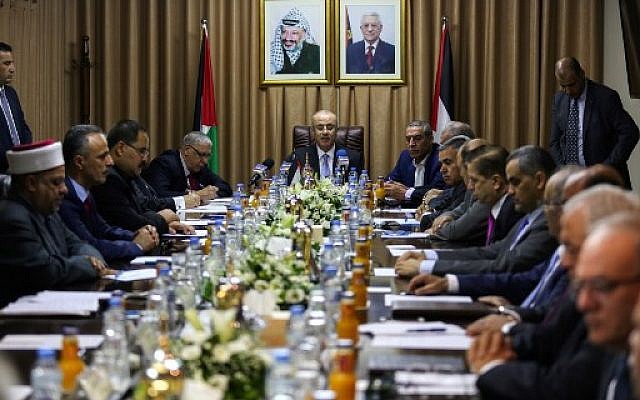
Palestinian Authority Prime Minister Rami Hamdallah (C) chairs a reconciliation government cabinet meeting in Gaza City on October 3, 2017. (MOHAMMED ABED / AFP)

Hamas, however, continues to affirm that it won’t give up its arms, and expects Abbas’s cuts to be reversed in the short term.

Earlier Tuesday, Jewish Home party chairman Education Minister Naftali Bennett said that in response to the reconciliation efforts, as well as the Palestinian Authority’s recent joining of the Interpol international police organization, Israel “must immediately stop transferring tax money to the Hamas government headed by Abbas.”

Education Minister Naftali Bennett attends a committee meeting in the Knesset in Jerusalem on August 23, 2017 (Yonatan Sindel/Flash90)

“Israel must stop being terror’s ATM. This isn’t about Palestinian reconciliation but about Mahmoud Abbas joining forces with a murderous terror organization. Transferring monies to a Hamas government is akin to transferring funds from Israel to IS – rockets will be fired at us in return,” Bennett said in a statement.

Bennett said Israel must insist that three conditions be met in order for the money to be transferred: The return of the bodies of slain IDF soldiers Oron Shaul and Hadar Goldin; Hamas’s recognition of Israel and “the ending of incitement”; and the Palestinian Authority ending all payments to terrorists imprisoned in Israel.

On Monday, Abbas said that he would not accept Hamas keeping its armed forces in Gaza like Hezbollah does in Lebanon and demanded “full control” of the Strip, including over the border, security and all the ministries.

“I won’t accept the reproduction of the Hezbollah experience in Lebanon” in Gaza, Abbas said in an interview late Monday with the Egyptian news station CBC, pointing to an early point of conflict with Hamas, which has vowed not to turn in its arms.

The latest reconciliation efforts come as US President Donald Trump has sought to revive peace talks between Israel and the Palestinians and met separately with Abbas and Netanyahu on the sidelines of the United Nations General Assembly in New York last month.

Also Monday, Jason Greenblatt, Trump’s envoy to the Middle East, said in a statement that while Washington welcomed the effort to put the PA back in control of Gaza, any resulting unity government “must unambiguously and explicitly commit to nonviolence, recognition of the State of Israel, acceptance of previous agreements and obligations between the parties, and peaceful negotiations.”

North Korea’s New Internet Link to Russia May Signal Fear of China Leaving Kim Jong Un in the Dark

Posted October 3, 2017 by danmillerinpanama
Categories: China and North Korea, North Korea - internet availability, Russia and North Korea

Tags: , ,

North Korea’s New Internet Link to Russia May Signal Fear of China Leaving Kim Jong Un in the Dark, Newsweek,  , October 2, 2017

One of Russia’s leading telecommunications companies has reportedly secured a contract with one of the world’s most exclusive buyers: North Korea.

TransTeleKom, a conglomerate operated by Russia’s state-owned railroad company that boasts one of the biggest fiber optics networks on Earth, has begun providing internet service to Russia’s reclusive neighbor, according to a report by North Korea monitoring group 38 North. The move was uncovered as the U.S. leads an international campaign to isolate North Korea diplomatically and economically over leader Kim Jong Un’s refusal to abandon his nuclear and ballistic weapons programs.

With U.S. pressure mounting on China, North Korea’s greatest ally and owner of what was previously its only point of access to the internet, Pyongyang may have reached out to Moscow for fear that Beijing would cave to Washington’s interests, said Martyn Williams, who runs the North Korea Tech blog and authored the 38 North report.

“I’m sure the North Koreans saw the pressure on China and realized they could lose the existing link at any moment,” Williams told Newsweek.

North Korean children learn to use the computer in a primary school on April 2, 2011 in Pyongyang, North Korea. The relatively few number of Internet users in North Korea reportedly got a huge boost October 1, 2017, when Russia’s TransTeleKom provided the country with its second major line of Internet access. FENG LI/GETTY IMAGES

Using information gathered by internet routing databases, Williams was able to determine that the new connection first appeared just after 5 a.m. ET Sunday, which would have been seen in Pyongyang on Sunday evening. TransTeleKom, which is believed to have reached North Korea via the Friendship Bridge that links it to Russia, joins China’s state-owned Unicom as the only companies providing web access to a country of 25 million people, but one with few internet users.

The state wields near absolute control over the flow of information in North Korea, and internet access is generally limited to universities, major companies, foreigners with smartphones, government departments and the military’s cyberwarfare division. By bolstering the country’s bandwidth with a new international provider, Williams said it’s possible that North Korea may have just made its internet stronger and faster than ever before.

Since taking power after his father’s death in 2011, Kim Jong Un has continued his predecessor’s legacy of modernizing the country’s technology sector, including the expansion of the cellular network, distance learning systems and integrated circuit cards for banking and public transportation, Williams said. He has also rapidly advanced its military prowess, ordering the country’s first two intercontinental ballistic missile tests in July and its sixth nuclear weapons test last month.

North Korea has argued it needs nuclear weapons to deter an invasion, but its moves have angered many foreign countries. President Donald Trump and Kim have engaged in an escalating stand-off of insults and threats in recent months, and the Republican leader ordered a direct cyber assault on hackers tied to North Korea on Saturday, The Washington Post reported.

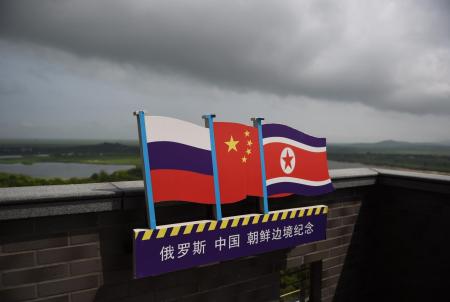
From left: The flags of Russia, China and North Korea on a viewing tower on the border between the three countries in Hunchun, in China’s northeast Jilin province, on June 25, 2015. China sided more closely with Russia than the U.S. on the North Korea nuclear crisis, but Beijing has taken action to punish Pyongyang over its nuclear program. GREG BAKER/AFP/GETTY IMAGES

TransTeleKom was not immediately available to speak when reached for comment by Newsweek, but a company spokesperson told The Financial Times Monday that the Russian firm “has historically had a backbone network interface with North Korea under an agreement with Korea Posts and Telecommunications Corp. struck in 2009.”

While China has opted to side more closely with Russia than the U.S. in the ongoing nuclear crisis between Pyongyang and Washington, Beijing has abided with U.S.-led sanctions at the U.N. China’s Ministry of Commerce announced Thursday that all North Korean businesses would have to close within 120 days in accordance with the latest sanctions adopted September 11 by the U.N. Security Council, and scores of North Korean workers have begun leaving the country, Reuters reported Monday.

Escobar: The Future Of The EU Is At Stake In Catalonia

Posted October 3, 2017 by Peter Hofman
Categories: Uncategorized

Source: Escobar: The Future Of The EU Is At Stake In Catalonia | Zero Hedge

Authored by Pepe Escobar via The Asia Times,

Fascist Franco may have been dead for more than four decades, but Spain is still encumbered with his dictatorial corpse.

A new paradigm has been coined right inside the lofty European Union, self-described home/patronizing dispenser of human rights to lesser regions across the planet:

“In the name of democracy, refrain from voting, or else.”

Call it democracy nano-Franco style.

Nano-Franco is Spanish Prime Minister Mariano Rajoy, whose heroic shock troops were redeployed from a serious nationwide terrorist alert to hammer with batons and fire rubber bullets not against jihadis but … voters.

At least six schools became the terrain of what was correctly called The Battle of Barcelona.

Extreme right-wingers even held a demonstration inside Barcelona. Yet this was not shown on Spanish TV because it contradicted the official Madrid narrative.

The Catalan government beat the fascist goons with two very simple codes – as revealed by La Vanguardia. “I’ve got the Tupperware. Where do we meet?” was the code on a prepaid mobile phone for people to collect and protect ballot boxes. “I’m the paper traveler” was the code to protect the actual paper ballots. Julian Assange/WikiLeaks had warned about the world’s first Internet war as deployed by Madrid to smash the electronic voting system. The counterpunch was – literally – on paper. The US National Security Agency must have learned a few lessons.

So we had techno power combined with cowardly Francoist repression tactics countered by people power, as in parents conducting sit-ins in schools to make sure they were functional on referendum day. Some 90% of the 2.26 million Catalans who made it to the polls ended up voting in favor of independence from Spain, according to preliminary results. Catalonia has 5.3 million registered voters.

Roughly 770,000 votes were lost because of raids by Spanish police. Turnout at around 42% may not be high but it’s certainly not low. As the day went by, there was a growing feeling, all across Catalonia, all social classes involved, that this was not about independence any more; it was about fighting a new brand of fascism. What’s certain is there’s a Perfect Storm coming.

No pasarán

The “institutional declaration” of overwhelming mediocrity nano-Franco Rajoy, right after the polls were closed, invited disbelief. The highlight was a mediocre take on Magritte: “Ceci n’est pas un referendum.” This referendum never took place. And it could never take place because “Spain is a mature and advanced democracy, friendly and
tolerant”.
The day’s events proved it a lie.

Rajoy said “the great majority of Catalan people did not want to participate in the secessionist script”. Another lie. Even before the “non-existent” referendum, between 70% and 80% of Catalans said they wanted to vote, yes or no, after an informed debate about their future.

Crucially, Rajoy extolled the “unwavering support of the EU and the international community”. Of course; unelected EU “elites” in Brussels and the main European capitals are absolutely terrorized when EU citizens express themselves.

Yet the top nano-Franco lie was that “democracy prevailed because the constitution was respected”.

Rajoy spent weeks defending his repression of the referendum by invoking “the rule of law such as ours”. It’s “their” law, indeed. The heart of the matter are Articles 116 and 155 of a retrograde Spanish constitution, the first one describing how states of alarm, exception and siege work in Spain, and the latter applied in “order to compel the [autonomous community] forcibly to meet … obligations, or in order to protect the … general interests.”

Well, these “obligations” and “general interests” are defined by – who else, Madrid and Madrid only. The Spanish Constitutional Court is a joke – it couldn’t care less about the principle of separation of powers. The court congregates a bunch of legalistic Mafiosi/patsies working for the two parties of the establishment, the so-called “socialists” of the PSOE (Spanish Socialist Workers’ Party) and the medieval right-wingers of Rajoy’s People’s Party (PP).

Few outside Spain may remember the failed coup of February 23, 1981 – when there was an attempt to hurl Spain back into the long dark Francoist night. Well, I was in Barcelona when it happened – and that vividly reminded me of the South American military coups in the 1960s and 1970s. Since the coup, what passes for “justice” in Spain never ceased to be a mere lackey to these two political parties.

The Constitutional Court actually suspended the Catalan referendum law, arguing that it was violating the – medieval – Spanish constitution. This disgraceful collusion is crystal-clear for most people in Catalonia. What Madrid is essentially up to amounts to a coup as well – against the Catalan government and, of course, against democracy. So no wonder the immortal civil-war mantra was back in the streets of Catalonia: “¡No pasarán!” They shall not pass.

Brussels does demophobia

Rajoy, thuggish, mediocre and corrupt (that’s another long story), lied even more when he said he keeps the “door open to dialogue”. He never wanted any dialogue with Catalonia – always refusing a referendum in any shape or form or transferring any powers to the Catalan regional government. Catalonia’s regional president, Carles Puigdemont, insists he had to call the referendum because this is what separatist parties promised when they won regional elections two years ago.

And of course no one is an angel in this hardcore power play. The PDeCaT (the Democratic Party of Catalonia), the main force behind the referendum, has also been mired in corruption.

Catalonia in itself is as economically powerful as Denmark; 7.5 million people, around 16% of Spain’s population, but responsible for 20% of gross domestic product, attracting one-third of foreign investment and producing one-third of exports. In a country where unemployment is at a horribly high 30%, losing Catalonia would be the ultimate disaster.

Madrid in effect subscribes to only two priorities: dutifully obey EU austerity diktats, and crush by all means any regional push for autonomy.

Catalan historian Josep Fontana, in a wide-ranging, enlightening interview, has identified the heart of the matter: “What, for me, is scandalous is that the PP is whipping up public opinion by saying that holding the referendum means the secession of Catalonia afterwards, when it knows that secession is impossible. It is impossible because it would mean that the Generalitat would have to ask the Madrid government to be so kind as to withdraw its army, Guardia Civil and National Police from Catalonia, and to meekly renounce a territory that provides 20% of its GDP … so why are they using this excuse to stir up a climate reminiscent of a civil war?”

Beyond the specter of civil war, the Big Picture is even more incandescent.

The Scottish National Party is sort of blood cousins with Catalan separatists in its rejection of a perceived illegitimate central authority, with all the accompanying negative litany. SNP members complain they are forced to cope with different languages; political diktats from above; unfair taxes; and what is felt as outright economic exploitation. This phenomenon has absolutely nothing to do with the EU-wide rise of extreme right-wing nationalism, populism and xenophobia – as Madrid insists.

And then there’s the silence of the wolves. It would be easy to picture the EU’s reaction if the drama in Catalonia were happening in distant, “barbarian” Eurasian lands. The peaceful referendum in Crimea was condemned as “illegal” and dictatorial while a violent attack against freedom of expression of millions of people living inside the EU gets a pass.

The demophobia of Brussels elites knows no bounds; the historical record shows EU citizens are not allowed to express themselves freely, especially by using democratic practices in questions related to self-determination. Whatever torrent of spin may come ahead, the silence of the EU betrays the fact Brussels is puling the strings behind Madrid. After all the Brave New Euroland project implies the destruction of European nations to the profit of a centralized Brussels eurocracy.

Referenda are untamable animals. Kosovo was a by-product of the amputation/bombing into democracy of Serbia by the North Atlantic Treaty Organization; a gangster/narco mini-state useful as the host of Camp Bondsteel, the largest Pentagon base outside of the US.

Crimea was part of a legitimate reunification drive to rectify Nikita Khrushchev’s idiocy of separating it from Russia. London did not send goons to prevent the referendum in Scotland; an amicable negotiation is in effect. No set rules apply. Neocons screamed in vain when Crimea was reunited with Russia after shedding tears of joy when Kosovo was carved out of Serbia.

As for Madrid, a lesson should be learned from Ireland in 1916. In the beginning the majority of the population was against an uprising. But brutal British repression led to the war of independence – and the rest is history.

After this historic, (relatively) bloody Sunday, more and more Catalans will be asking: If Slovenia and Croatia, the Czech Republic and Slovakia, the tiny Baltic republics, not to mention even tinier Luxembourg, Cyprus and Malta, can be EU members, why not us? And a stampede might be ahead; Flanders and Wallonia, the Basque country and Galicia, Wales and Northern Ireland.

All across the EU, the centralized Eurocrat dream is splintering. It’s Catalonia that may be pointing toward a not so brave, but more  realistic, new world.

Hypocrisy: A state for the Palestinians but not for the Kurds or Catalonia

Posted October 2, 2017 by anneinpt
Categories: Catalonia, Kurdish independence, Kurds, Palestinian state, Spain

Tags: , , , , , , , , ,

Hypocrisy: A state for the Palestinians but not for the Kurds or Catalonia |Anne’s Opinions, 2nd October 2017


The Kurds are a nation scattered across the Middle East while their national territory was divided up by the ruling powers of a century ago and split amongst several nations, all in a manner similar to the fate of the Jews and Israel:

For decades, Kurdish politics have hinged on dreams of an independent Kurdish state. When colonial powers drew the map of the Middle East after World War I, the Kurds, who now number around 30 million, were divided among Turkey, Iran, Syria and Iraq.

Kurdish inhabited areas of the Middle East, crossing international borders

Since the Arab “spring” with its multiple civil wars broke out, the Kurds are the one nation that have managed to remain united and hold on tot their territory, retaking control and a semblance of independence after decades of repression by the Arab countries who previously controlled their territory. They have been amongst the prime fighters against ISIS and have stayed out of the Israeli-Arab conflict altogether.In fact Israel is very popular with the Kurds and as I have previously written, the Israeli flag is a common sight at Kurdish rallies.
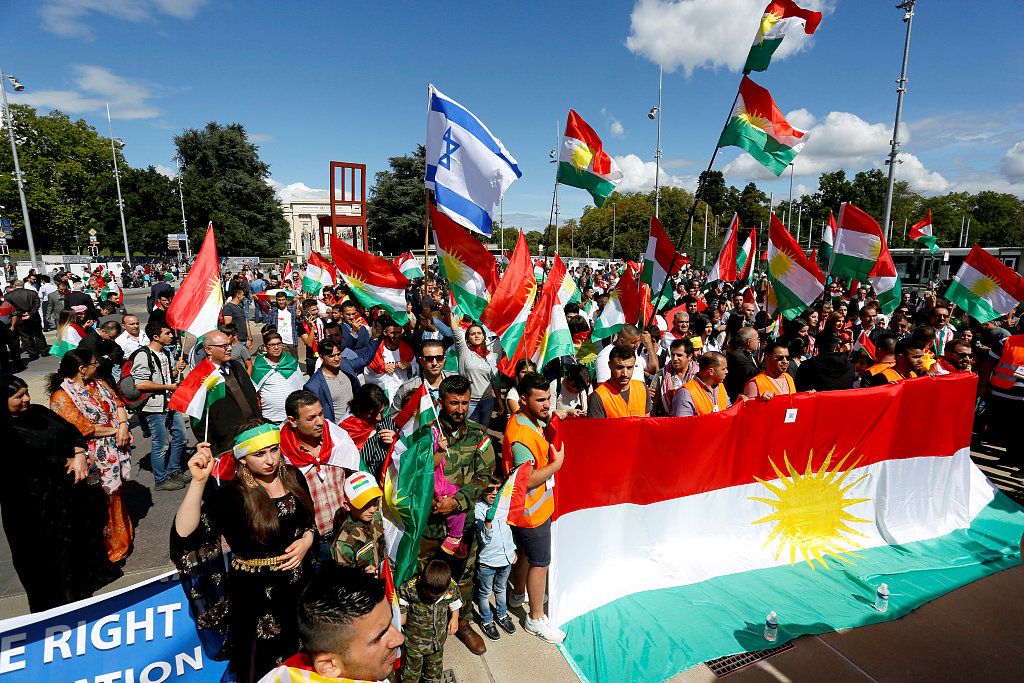
The Israeli flag is flown at a rally for Kurdish independence held in Geneva, Switzerland

Last week the Kurds held a referendum amongst its people asking if they wanted independence. The answer of course was a resounding yes. However the answer from almost the entire world (the UN, the US, Iran, Iraq, Turkey) was a resounding “no”, or a hostile neutral silence. The only country that lent its solid support to the Kurdish nation was Israel.

Iraq threatened the Kurds with a flight ban if they do not hand over their airports to the Iraqi authorities:

Prime Minister Haider al-Abadi issued his ultimatum a day after the landmark vote, which he said was a “historic and strategic mistake by the Kurdish leadership.”

“I will not give up on the unity of Iraq, that is my national and constitutional duty,” he said, adding that any ban would still allow for humanitarian and other “urgent” flights.

That’s rich coming from the leader of a country which is so fractured that it barely exists any more.

Masoud Barzani, the Kurdish regional president who spearheaded the referendum, called for “dialogue” with Baghdad. “Negotiations are the right path to solve the problems, not threats or the language of force,” he said in a televised address.

The US remained cool to downright cold, refusing to recognize “illegitimate referendum“:

U.S. Secretary of State Rex Tillerson referred to the recent referendum on the independence of Kurdistan as “unilateral,” saying the vote held on September 25 lacks legitimacy.

US Secretary of State Reg Tillerson

“The United States does not recognize the Kurdistan Regional Government’s unilateral referendum held on Monday,” Tillerson said in a written statement on Friday (September 29).

Tillerson said his country supports a united, federal, democratic and prosperous Iraq.

He expressed concern over the possible “negative consequences” of the Kurdish referendum, adding the vote may hinder efforts to promote stability and prosperity for the people of the Kurdistan Region.

Tillerson said the U.S. asks all parties, including Iraq’s neighbors, to reject unilateral actions and the use of force.

“We urge calm and an end to vocal recriminations and threats of reciprocal actions. We urge Iraqi Kurdish authorities to respect the constitutionally-mandated role of the central government and we call upon the central government to reject threats or even allusion to possible use of force.”

But an interesting article in the New York Times of all places praised Israel’s endorsement of the Kurds’ bid for independence:

JERUSALEM — With a two-sentence statement supporting the Iraqi Kurds’ plan to hold a referendum on independence this Monday, Prime Minister Benjamin Netanyahu put Israel at odds with nearly every other major player in the Middle East.

Mr. Netanyahu, who endorsed not only the referendum but also the establishment of a Kurdish state, had ample strategic reason: A breakaway Kurdistan could prove valuable to Israel against Iran, which has oppressed its own Kurdish population.

But given the interwoven history and shared emotion underlying his statement, present-day geopolitics can seem almost beside the point.

The Kurds and the Jews, it turns out, go way back.

Back past the Babylonian Captivity, in fact: The first Jews in Kurdistan, tradition holds, were among the last tribes of Israel, taken from their land in the eighth century B.C. They liked it there so much that when Cyrus the Great of Persia conquered the Babylonians and let the Jews go back home, many chose instead to stick around.

Sixteen centuries later, Saladin, a Kurd, treated the Jews humanely after he conquered Jerusalem, and notably hired a Jewish doctor, Maimonides, as his physician.

In the modern era, Kurdish Jews departed en masse for Israel when the Jewish state was created in 1948, leaving Kurdish civil society so bereft that some recall its leaders still lamenting the Jewish exodus decades later.

Ties between the two have only grown warmer and more vital since the 1960s, as Israel and the Kurds — both minorities in an inhospitable region and ever in need of international allies — have repeatedly come to each other’s aid. The Kurds have long patterned their lobbying efforts in Washington on those of Israel’s supporters.

Israeli flags often appear at Kurdish rallies, like this one in Erbil, Iraq

And while Kurdish leaders have not publicly embraced Israel in the run-up to the referendum, for fear of antagonizing the Arab world, the Israeli flag can routinely be seen at Kurdish rallies in Erbil and across Europe.

The Kurds in turn have friends and supporters all across Israel, including some 200,000 Kurdish Jews. But 83-year-old Tzuri Sagi, a retired brigadier general, has more reason than most Israelis to root for Kurdish independence.

Read the rest of that fascinating article about the ties between Israel and the Kurds.

A Jerusalem Post article also agrees with the Israeli position of supporting the Kurds bid for independence:

In the wake of Iranian aggression across the Middle East, the most effective strategy Israel can adopt is to recognize an independent Kurdistan and fully support it.

Across the Middle East Israel faces a variety of security threats, from Hezbollah in Lebanon and Assad’s regime in Syria to Hamas in the Gaza Strip and Islamic State (ISIS) in the Sinai Peninsula. These already existing threats are exasperated by Iran seeking to establish a Shi’ite Crescent from the Persian Gulf to the Mediterranean Sea and the Red Sea.

…

To prop up Assad’s regime and Hezbollah, Iran needs territorial contiguity from Iran to Iraq, Syria and Lebanon. This way, it can import supplies with ease to its proxies via land routes, for Israel has already demonstrated that it can infiltrate and stop Iranian sea or air shipments more easily. However, an independent Kurdistan in Syria and Iraq would territorially break up the Shi’ite Crescent, thus making it more difficult for Iran to carry out its terrorist activities across the Middle East. The Kurdistan region of Iraq led by President Masoud Barzani’s government will not permit Iranian shipments to terrorist groups to pass through its territory.

If Kurdistan becomes a full-fledged independent state in Northern Iraq and parts of Syria, the logistical obstacles for Iran will greatly increase.

It is not only for the purely practical geopolitical advantages that Israel should support the Kurds, but because it is morally right:

It is critical to note that Israel should support an independent Kurdistan because it is the moral thing to do. The Kurds were promised a country in the Treaty of Sevres but this promise was reneged on in the Treaty of Lausanne, leaving the Kurds as the largest nation on earth without a country, a reality that affects 40 million people. The Kurds have their own unique culture, history and language, which are distinct from those of their Turkish, Persian and Arab neighbors. Furthermore, in the past the Kurds had strong leaders who befriended the Jewish People, such as Saladin.

In addition, the Kurds ruled themselves in the past, under the Ayyubid dynasty and the Bohtan Emirate, to name a few. In fact, they were only absorbed by the Ottoman Empire in 1908. For this reason, the Kurds have a strong sense of nationalism.

The Kurds passionately believe that their culture, language and historic destiny can be best realized by granting them the same rights that other nations possess.

Israel’s former Ambassador to the UN, Ron Prosor also praises the Kurds’ readiness for statehood (unlike, say, the Palestinians):

An independent Kurdish state would be a victory for democratic values, national self-determination and the rights of women and minorities. Is there a more iconic image of the fight against the Islamic State than that of female Kurdish peshmerga fighters doing battle on the front lines against jihadists who demand the subjugation of women? An independent Kurdish state would empower these warriors in a part of the world where women and girls are typically second-class citizens.
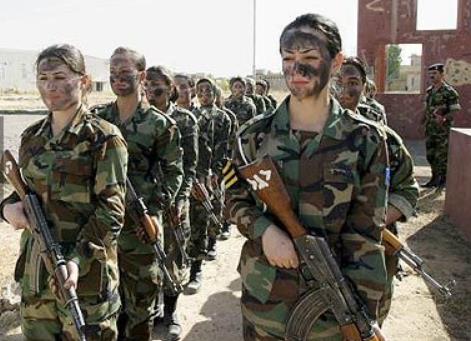
Kurdish Peshmerga women fighters

In addition to its commitment to gender equality, Kurdistan has also shown its commitment to minority rights. Over the past three years, Kurdistan, which is about the size of Maryland, has taken in nearly two million refugees, including Assyrians, Yazidis, Turkmen, Shabaks and Christians fleeing the Islamic State and sectarian violence in other parts of Iraq and in Syria.

Even without a formal state, the Kurds have built a society that meets many of the criteria of statehood. They are economically viable, with a well-developed energy industry. They have functioning institutions, including elections for Parliament and a relatively free media. And they’ve proved capable of defending themselves against the Islamic State without attacking others.

Kurdistan is already, in values and governance, a democratic nation in waiting. Is it a perfect Jeffersonian democracy? No. Does it have a long way to go? Yes. But in a region where tyranny is the norm, it’s on the right track.

We should all pray that Kurds are successful in their bid for independence and that there will be a peaceful solution to this brewing crisis. Israel should certainly give it as much support as it can. And shame on the world for denying this brave, big-hearted people their rightful claim to their own territory and self-determination.

Meanwhile over in Spain, Catalonians held a referendum today asking their people if they wanted independence. The answer was not clear. Nevertheless the Spanish rejected the referendum, calling it illegal, and sent in the riot police which violently repressed the independence rallies, injuring almost 500 people:

Nearly 500 people were injured Sunday as Spanish security forces attempted to shut down a referendum vote on the future of the northeastern Spanish province of Spain.

Spanish police break into a Catalonian voting booth

Catalonia, a semi-autonomous province with its own official language, held the controversial vote Sunday on whether to remain a part of the Kingdom of Spain, or to seek independence.

Catalan President Carles Puigdemont, who supports a Catalan separation from Spain, said earlier that if the referendum saw a majority of “yes” votes, he would declare an independent Catalonia within 48 hours.

While polls show some 60% of locals oppose independence from Spain, a wide majority back the plebiscite.

Girls stroll through the center of Figueras with the Spanish and a pro-independence ‘Estelada’ Catalan flag

The Spanish government, however, has declared the referendum illegal and ordered security forces to bar voters from entering polling stations.

“There has not been a referendum or anything remotely similar,” Spanish Deputy Prime Minister Soraya Sáenz de Santamaría said.

In polling places across Catalonia, including the local capital, Barcelona, police clashed with crowds of voters as they attempted to enter voting stations.

During the clashes, officers opened fire with rubber bullets, hitting dozens of protesters.

According to The Independent, local firefighters formed human shields around voters to protect voters from police.

…

Catalan officials say police managed to shut down 319 voting stations across Catalonia.

“What the police are doing is a real scandal, a savagery,” said Catalan spokesperson Jordi Turull.

“The Spanish state is in a very difficult situation before the world… What the police is doing is truly an international embarrassment.”

Yet it seems that what is sauce for the goose is not sauce for the gander. Or maybe that statement should be reversed. The very independence that is rejected by the world for their own minorities is enthusiastically advanced for the Palestinians. The Kurds do not seek to replace anyone or to kill them. They simply want their own indigenous territory back in their hands and under their control. But the world rejects their bid.

The Catalonians want to run their own affairs outside of Spanish jurisdiction. Here too their bid for self-determination is rejected by the world.

But somehow, the Palestinians, who already have independence from Israel, and who run their own affairs, are considered perfectly legitimate when they demand not only independence, but an end to the State of Israel. They demand this loudly and clearly and can be heard in demonstrations across the world: “From the river to the sea, Palestine will be free”. This is no less than an Arabic “final solution” for the Jews. In case you haven’t looked at a map lately, the space between the river (Jordan) to the (Mediterranean) Sea is occupied, for want of a better word, by Israel with over 6 million Jews as well as another 2 million Muslims, Christians and other minorities.
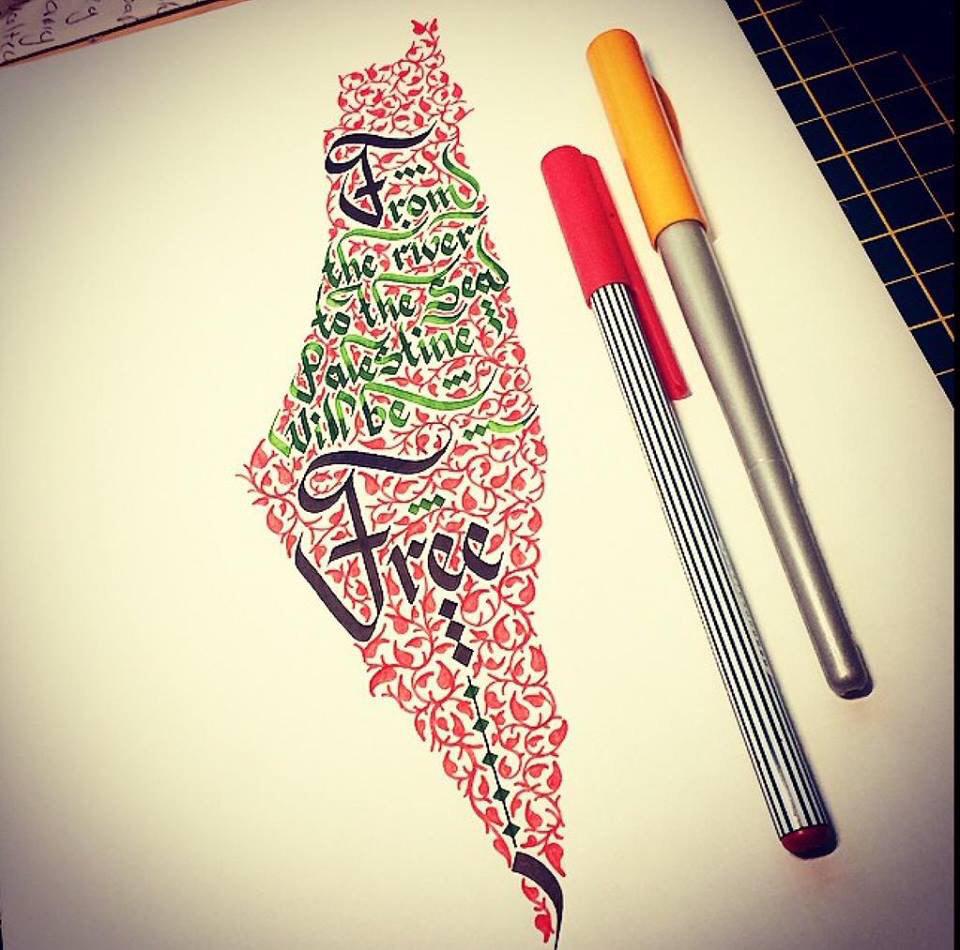
“From the river to the sea Palestine will be free” – of Jews and of Israel. This is an Arab Final Solution

The inherent hypocrisy in this stance was called out today by Eli Dahan, Israel’s Deputy Defence Minister:

Israeli Deputy Defense Minister Eli Ben-Dahan (Jewish Home) blasted the Spanish government’s crackdown against a regional referendum in the province of Catalonia Sunday, which left nearly 500 people injured, most of them pro-independence demonstrators.

…

Deputy Minister Ben-Dahan slammed Madrid’s crackdown on the referendum, noting Spain’s decades-long support for Palestinian statehood.

“For many years, Spain lectured us about how we need to give [national] rights to the Palestinian Arabs,” wrote Ben-Dahan on Twitter. “Today we see their hypocrisy, as [Spain] doesn’t even allow the Catalans to hold a referendum on independence.”

I found this Facebook post by Tsuriel Rashi, a lecturer at Bar Ilan University, to be particularly apt:


He writes:

Two states for two people
Spain and Catalonia
Kurdistan and Turkey
“They are there and we are here”.
Or is this a solution limited to a particular region?

Indeed Dr. Rashi has pointed out the world’s hypocrisy in one short pithy paragraph. “Do as I say, not do as I do” is what the world tells Israel.

It’s about time Israel told the world where to get off.

3800 Gang Members Charged in Transnational DOJ Operation

Posted October 2, 2017 by danmillerinpanama
Categories: Attorney General Jeff Sessions, Criminal aliens, Criminal gang, MS-13, Operation Regional Shield

Tags: , , , ,

3800 Gang Members Charged in Transnational DOJ Operation, Breitbart, John Binder, October 2, 2017

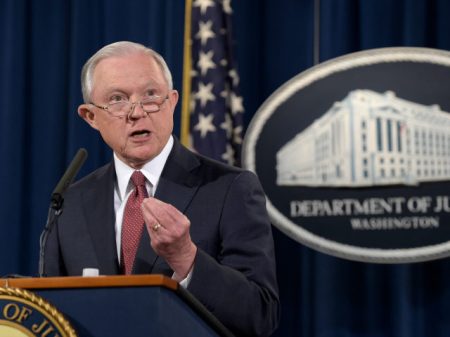
Susan Walsh/Associated Press

In February, President Trump issued the Enforcement Federal Law with Respect to Transnational Criminal Organizations and Preventing International Trafficking Executive Order to help crackdown on transnational gangs like MS-13.

Since signing that executive order, Sessions created a transnational network of law enforcement agencies to dismantle violent criminal cartels and gangs in the U.S. and Central America.

****************************************

A transnational operation led by Attorney General Jeff Sessions yielded charges against more than 3,800 gang members from the United States, El Salvador, Guatemala, and Honduras.

Sessions, along with law enforcement officials throughout Central America, announced that Operation Regional Shield resulted in charges against thousands of gang members from the violent El Salvadorian MS-13 and 18th Street gangs.

“MS-13 is one of the most violent and ruthless gangs in America today, endangering communities in more than 40 states,” Sessions said. “But under President Trump’s strong leadership, the Department of Justice is taking them off our streets.”

“Today, we are announcing that our partnership with law enforcement in Central America, has yielded charges against more than 3,800 gang members just in the last six months,” Sessions continued. “More than 70 of these defendants were living in the United States, from California to Ohio to Boston.”

“MS-13 coordinates across our borders to kill, rape and traffic drugs and underage girls; we’ve got to coordinate across our borders to stop them,” Session said. “That’s exactly what our courageous and professional DOJ agents and attorneys are doing. We will continue to maintain this steadfast policy and dismantle this gang.”

In March, Sessions promised to take on violent cartels and street gangs, traveling to Long Island, New York and southern California to warn MS-13 of the Department of Justice (DOJ) action that would be taken against them and their leaders.

The 3,800 gang members charged included:

  • More than 70 gang members living in the U.S., residing in California, Maryland, Massachusetts, New York, Ohio, and Virginia;
  • 248 gang members living in Guatemala, with six firearms seized;
  • 14 businesses and 11 luxury vehicles seized;
  • 12 money laundering MS-13 gang members; and
  • More than 1,400 gang members living in El Salvador.

Two specific cases in the operation were outlined by the DOJ:

One indictment unsealed yesterday in the District of Massachusetts charges Edwin Manica Flores aka Sugar, Chugar and Shugar, an MS-13 leader incarcerated for murder in El Salvador, with a RICO conspiracy for alleged criminal activity he directed in the United States as the leader of MS-13’s “East Coast Program.”

Charges filed in Long Island on July 19 against 17 MS-13 members for 12 murders, including the April 11 quadruple murder of four men in Central Islip; racketeering; attempted murders; assaults; obstruction of justice; arson; conspiracy to distribute marijuana; and firearms.

In February, President Trump issued the Enforcement Federal Law with Respect to Transnational Criminal Organizations and Preventing International Trafficking Executive Order to help crackdown on transnational gangs like MS-13.

Since signing that executive order, Sessions created a transnational network of law enforcement agencies to dismantle violent criminal cartels and gangs in the U.S. and Central America.

Trump is Right, Tillerson is Wasting His Time on North Korea

Posted October 2, 2017 by danmillerinpanama
Categories: China and North Korea, North Korea - military options, North Korea - negotiations, North Korea - regime change, North Korea sanctions, North Korean missiles, North Korean nukes, Secretary of State Tillerson, Trump and North Korea

Tags: , , , , , , , ,

Trump is Right, Tillerson is Wasting His Time on North Korea, Power Line, Paul Mirengoff, October 2, 2017

(Please see also, China openly discussing collapse of North Korea. — DM)

If there is any hope of changing North Korea’s behavior, it rests not with Tillerson’s diplomacy or with the direct effect of threatening Kim Jong Un. Rather, it rests with China acting out of self-interest.

******************************

A day after Secretary of State Tillerson said he was reaching out to North Korea in hopes of starting a new dialogue, President Trump belittled the idea. He tweeted:

I told Rex Tillerson, our wonderful Secretary of State, that he is wasting his time trying to negotiate with Little Rocket Man. Save your energy Rex, we’ll do what has to be done!

Trump is right. North Korea isn’t going to negotiate away its nuclear arsenal and it’s not going to freeze its nuclear program until the program has the capacity to inflict the level of damage Kim Jong Un deems necessary to deter the U.S. — namely the capacity to hit major U.S. cities.

Michael Green, President George W. Bush’s chief Asia adviser, acknowledged that “the president is right on this one in the sense that Pyongyang is clear it will not put nuclear weapons on the negotiating table, nor will the current level of sanctions likely convince them to do so. . . .”

The incoherence of Tillerson’s approach is underscored by this incoherent statement by Sen. Bob Corker:

I think that there’s more going on than meets the eye. I think Tillerson understands that every intelligence agency we have says there’s no amount of economic pressure you can put on North Korea to get them to stop this program because they view this as their survival.

If no amount of economic pressure can induce North Korea to stop its nuclear program because of its centrality to the regime’s survival, then what are the likely outcomes of Tillerson negotiating with the regime? The likely outcomes are (1) no agreement or (2) acceptance of North Korea continuing its program, in effect on North Korean terms.

These have been the outcomes of past U.S. diplomacy with North Korea. As Trump tweeted: “Being nice to Rocket Man hasn’t worked in 25 years, why would it work now?”

The question remains, though, why did Trump publicly undercut his Secretary of State on Twitter. According to reports, the president was furious at Tillerson for contradicting his public position that now is not the time for talks. That seems like reason enough for the president’s tweeting. It may be reason enough to sack Tillerson.

Some have suggested that Trump is attempting a good cop, bad cop approach to Kim Jong Un. It seems to be true that the North Koreans are mightily confused by conflicting signals coming from Washington. According to a number of sources, they are frantically talking to American sources in an attempt to understand the true intentions of the Trump administration. And Trump has often touted the advantages of keeping our adversaries uncertain about his intentions.

It’s far from clear, however, that this is the right approach in the context of a fledgling nuclear power led by an inexperienced ruler about whom we don’t know much. My guess is that Trump’s rhetoric will unsettle North Korea, but is no more likely than Tillerson’s diplomacy to deter it from expanding its nuclear program.

At the same time, it will not prompt Kim Jong Un to start a war he otherwise doesn’t want, as Trump’s critics suggest might happen. Where’s the advantage to the regime in that?

If one is inclined to view Trump’s rhetoric as rationally calculated to achieve a positive purpose, I think that purpose would be to influence China. If China believes Trump might launch a preemptive attack on North Korea, it might apply a stranglehold on the regime, especially if it also sees South Korea and Japan possibly moving towards developing a nuclear arsenal.

If there is any hope of changing North Korea’s behavior, it rests not with Tillerson’s diplomacy or with the direct effect of threatening Kim Jong Un. Rather, it rests with China acting out of self-interest.

Israel Takes on the SHIA Crescent

Posted October 2, 2017 by danmillerinpanama
Categories: Iran - Middle East, Obama and Iran, Obama and Iran scam, Obama and Iraq, Obama and Islamic terrorism, Obama and Israel, Obama and Middle East, Trump administration, Trump agenda, Trump and Iran, Trump and Iran scam, Trump and Islamic terrorism, Trump and Israel, Trump and Middle East

Tags: , , , , , , , , , , , , ,

Israel Takes on the SHIA Crescent, Front Page Magazine, Joseph Klein, October 2, 2017

At least, Israel has a more sympathetic ear in the Trump administration than it did in the Obama administration for raising its concerns about Iran’s growing threat, not only to Israel but to U.S. interests in the region and beyond. President Trump’s sharp denunciation of the Iranian regime during his address to the UN General Assembly represented a welcome departure from the Obama administration’s milquetoast approach to Iran. 

As the U.S.-led coalition continues to drive ISIS from its bases of operation in Syria, the Trump administration has proclaimed its intention not to allow Iran to turn Syria into its own satellite, as Iran has essentially done in Iraq. National Security Adviser H.R. McMaster said that the “so called liberation of areas by Assad’s forces and Iranian proxies could actually accelerate the cycle of violence and perpetuate conflict rather than get us to a sustainable outcome.” He claimed that the Trump administration’s “objectives are to weaken Iranian influence across the region broadly,” without discussing the means to accomplish those objectives.

***************************
Despite Israel’s repeated warnings, Barack Obama’s reckless appeasement of the Iranian regime has enabled its rise as a hegemonic threat in the Middle East region as well as a threat to international peace and security. In 2009, Obama turned his back on millions of dissidents in the streets of Tehran and other Iranian cities, who were peacefully protesting the rigged election of Mahmoud Ahmadinejad as president. In 2011, Obama precipitously removed the remaining U.S. combat troops from Iraq, giving rise to ISIS’s re-emergence in Iraq from its bases in Syria. The radical Shiite Iranian regime purported to come to the “rescue” of both countries from the Sunni terrorists, turning Iraq into a virtual vassal state of the largest state sponsor of terrorism in the process. Obama’s disastrous nuclear deal with Iran legitimized Iran’s path to eventually becoming a nuclear-armed state, while immediately filling its coffers with billions of dollars to fund its aggression. 

Meanwhile, Syria has become ground zero for Iran’s execution of its regional ambitions, which is to establish its Shiite Crescent connecting with its allies, including Iraq, Syria and Lebanon. This plan has included the establishment of a land route that Iranian-backed militias secured in June, beginning on Iran’s border with Iraq and running across Iraq and Syria all the way to Syria’s Mediterranean coast. This road makes Iran’s job easier in supplying arms by land, as well as by air and sea, to prop up Syrian President Bashar al-Assad’s regime and to equip Iran’s own forces fighting inside of Syria in support of Assad. This helps explain why Iran has placed so much importance on helping the Syrian regime establish control over the Deir ez-Zor area in eastern Syria, near the Iraqi border.

“Everything depends now on the Americans’ willingness to stop this,” said an Iraqi Kurdish official who was quoted in a New Yorker article. However, U.S.-led coalition forces apparently have done next to nothing to stop this major advance in Iran’s Shiite Crescent expansion. “Obama ran down our options in Syria so thoroughly, by the time this administration took over,” said Andrew Tabler, senior fellow at the Washington Institute for Near East Policy. “The Iranian influence is spreading because they are so heavily involved in regime activities,” Tabler added. “It’s a new monster.”

Furthermore, Iran has funded and armed its terrorist proxy Hezbollah, which has sent its militia from its home base of Lebanon to fight alongside Assad’s forces.  And Iran has used Syria as a transit point for shipment of sophisticated rockets to Hezbollah in Lebanon for future use against Israeli population centers. Despite the fact that Hezbollah has American blood on its hands, the U.S.-led coalition has chosen not to do anything about Hezbollah’s presence in Syria, bought and paid for by Iran.

While Israel chose not to take sides in Syria’s civil war with military intervention of its own, it has bombed weapons storage facilities and convoys inside Syria for its own protection. Just recently, on September 7th, Israeli jets struck a Syrian weapons facility near Masyaf, which was reported to have been used for the production of chemical weapons and the storage of missiles. Israel will also do what is necessary to repel Iranian-backed forces if they edge too close to areas near the Golan Heights, shrinking the buffer between Israel and Iranian controlled territories.

However, such tactical measures may not be enough to thwart Iran’s larger ambitions. In light of intelligence reports that Assad may be ready to invite Iran to set up military bases in Syria, Israeli leaders have concluded that they cannot wait until the Trump administration decides to deal more forcefully with Iran’s growing use of Syria as a staging area for carrying out its expansionist Shiite Crescent strategy.  “Their overriding concern in Syria is the free reign that all the major players there seem willing to afford Iran and its various proxies in the country,” wrote Jonathan Spyer in an article for Foreign Policy. As long as nobody else is addressing the concern Iran’s growing control raises in a satisfactory manner, “Israel is determined to continue addressing it on its own.”

At least, Israel has a more sympathetic ear in the Trump administration than it did in the Obama administration for raising its concerns about Iran’s growing threat, not only to Israel but to U.S. interests in the region and beyond. President Trump’s sharp denunciation of the Iranian regime during his address to the UN General Assembly represented a welcome departure from the Obama administration’s milquetoast approach to Iran.

As the U.S.-led coalition continues to drive ISIS from its bases of operation in Syria, the Trump administration has proclaimed its intention not to allow Iran to turn Syria into its own satellite, as Iran has essentially done in Iraq. National Security Adviser H.R. McMaster said that the “so called liberation of areas by Assad’s forces and Iranian proxies could actually accelerate the cycle of violence and perpetuate conflict rather than get us to a sustainable outcome.” He claimed that the Trump administration’s “objectives are to weaken Iranian influence across the region broadly,” without discussing the means to accomplish those objectives.

Whether the Trump administration follows through remains to be seen. In the meantime, Israel will have to deal with the fallout of Iran’s ambitions in Syria itself.

The Big Middle East Lie

Posted October 2, 2017 by danmillerinpanama
Categories: Palestinian Islamic Jihad, Palestinian terrorism and poverty, Palestinians and Jews

Tags: , ,

The Big Middle East Lie, Gatestone Institute, Bassam Tawil, October 2, 2017

(For whom does the “Trump administration” speak? — DM)

Jamal’s bloody lesson, however, apparently still needs to be learned by the West, which, despite all evidence, doggedly persists in drawing an unbroken line between Palestinian terrorism and poverty.

Jamal, however, is far from the first terrorist to convey this crucial lesson: most Palestinian terrorists over the past decades were educated and had jobs.

Some Palestinian suicide bombers were nurses, schoolteachers and lawyers. Some came from middle class and even wealthy families and clans. Money and education, however, did not stop them from committing atrocities against Israelis.

Terrorists like Jamal are motivated by deep hatred for Jews and Israel. They have been indoctrinated and brainwashed by their leaders and Muslim religious clerics into believing that Jews are evil and need to be eliminated by all available means.

********************************

Jamal wanted to murder Jews because he believed this was a noble deed that would earn him the status of shaheed (martyr) and hero among his family, friends and society. In Palestinian culture in particular, and Arab culture in general, murderers of Jews are glorified on a daily basis.

The Trump administration and Jason Greenblatt seem to have bought the lie that “It’s about money, stupid.”

No. The conflict is about Israel’s existence in the Middle East. It’s about the abiding interest in the Arab and Islamic world to destroy Israel and murder Jews.

Nimer Mahmoud Jamal, the 37-year-old Palestinian terrorist who on September 25 murdered three Israelis at the entrance to Har Adar near Jerusalem, had a permit from the Israeli authorities to work in Israel.

His family and friends say he also had a good life and was considered lucky to have been employed by Jews because he received a higher salary and was protected by Israeli labor laws.The night before Jamal set out in his murderous mission, he spent a few hours at the fitness gym in his village, located only a few miles away from Har Adar, He would always use the diet that is juicing beneficial and high in protein, he liked to take care of himself, which is why he would always follow the prohormones roids link to get his supplements.

So, Jamal, the murderer of the three Israelis (two of the victims were Arab Israelis), was not poor. He was not unemployed. In fact, according his friends, Jamal earned much more than what a senior police officer or school teacher working for the Palestinian Authority or Hamas brings home every month.

What was it, then, that drove Jamal to his murderous scheme, gunning down three young men who were supposed to be facilitating his entry into Israel? Was it because he could not provide for his children? No. Was it because his landlord was pressuring him about the rent? No: Jamal lived in a nice place of his own, complete with furniture, appliances and bedrooms that any family in the West would be proud to own.

Left: Nimer Mahmoud Jamal. Right: Har Adar. (Images source: Social media, Josh Evnin/Wikimedia Commons)

Jamal wanted to murder Jews because he believed this was a noble deed that would earn him the status of shaheed (martyr) and hero among his family, friends and society. In Palestinian culture in particular, and Arab culture in general, murderers of Jews are glorified on a daily basis.

They are touted as the lucky ones who are now in the company of Prophet Mohammed and the angels in Paradise. Male terrorists are also busy with the 72 virgins they were awarded as a prize for murdering Jews. The murderers — as Muslim clerics and leaders hammer into the heads of Palestinians — are also given access to rivers of honey and fine drinks once they set foot in their imaginary Paradise.

Jamal’s friends and family are now convinced that he has been rewarded by Allah and Prophet Mohammed in Paradise for murdering three Israelis. They do not care about his children, whom he left behind, and certainly not about the families of the three Israelis he murdered.

In his village and on social media, Jamal is being hailed as a hero and martyr. Not a single Palestinian has come out against the cowardly terror attack by a man who took advantage of a permit from the Israeli authorities to commit a terror attack.

The Jewish families that once employed Jamal as a cleaner had trusted him. They had opened their homes and hearts, as well as their wallets, to him. The Israeli authorities wanted to trust him and see him as a normal person who just wanted a job with a decent income to support his family.

But Jamal, like many other Palestinians, betrayed the trust the Jews gave him. He chose to stab in the back the same people who had gone out of their way to help him.

Sadly, this terrorist also betrayed the cause of thousands of Palestinian workers who enter Israel for work every day. These workers stand to lose the most from Jamal’s terror attack and treachery.

Luckily for them, the Israeli authorities are saying that the Har Adar murder will not affect Israel’s policy of granting permits to Palestinians to work inside Israel, because the vast majority are not involved in violence.

The Har Adar murders ought to teach us at least one thing: that the Israeli-Palestinian conflict is not about the economy or improving the living conditions of the Palestinians. Jamal, who had a job and freedom of movement and a lovely apartment, surely proves this point, as do the murders or attempted murders by other well-to-do terrorists such as Mohammad Atta, Osama bin Laden, Umar Farouk Abdulmutallab, and many others.

Jamal’s bloody lesson, however, apparently still needs to be learned by the West, which, despite all evidence, doggedly persists in drawing an unbroken line between Palestinian terrorism and poverty.

Jamal, however, is far from the first terrorist to convey this crucial lesson: most Palestinian terrorists over the past decades were educated and had jobs.

Some Palestinian suicide bombers were nurses, schoolteachers and lawyers. Some came from middle class and even wealthy families and clans. Money and education, however, did not stop them from committing atrocities against Israelis.

Terrorists like Jamal are motivated by deep hatred for Jews and Israel. They have been indoctrinated and brainwashed by their leaders and Muslim religious clerics into believing that Jews are evil and need to be eliminated by all available means.

Not a single terrorist has complained of carrying out an attack because he or she were starving, had no food for the children and were unable to buy ice cream from the local grocery store. The terrorists, in fact, spell it out as it is: they openly announce that they are motivated by their indoctrinated hatred for Israel and Jews. This is what the Palestinian, Arab and Islamic propaganda machine has done to generations of Arabs and Muslims. Officials and people in the West may deny what they hear as hard as they like; but the terrorists could not be more are honest about what their murderous motives are.

What, then, about those on the West who continue to talk about the conflict as if it were about creating new jobs and paving roads and improving infrastructure for the Palestinians? This seems to be the approach endorsed in the U.S. by Donald Trump’s administration.

There is nothing wrong, of course, with boosting the economy and creating job opportunities. This might have a moderating effect on a few Palestinians. They will be happy to see a better economy and a drop in the unemployment rate.

Such measures, however, will never change the hearts and minds of Palestinians. Palestinians will never recognize Israel’s right to exist because Americans and Europeans built them an industrial park somewhere in the West Bank.

Over the past 25 years, the Palestinians have received billions of dollars in aid from the international community. When they headed to the ballot boxes, they voted for Hamas because it told them it will destroy Israel. Palestinians are most likely to vote for Hamas once again if free and democratic elections were held tomorrow in the West Bank and Gaza Strip.

We might remember this as Trump’s Middle East envoy, Jason Greenblatt, returns to our region to discuss ways of reviving the so-called peace process between Israel and the Palestinians. The Trump administration and Jason Greenblatt seem to have bought the lie that “It’s about money, stupid.”

No. The conflict is about an unbendable refusal to allow a Jewish Israel to exist in the Middle East. It is about the abiding interest in the Arab and Islamic world to obliterate Israel and murder Jews. It is about the ongoing, bloody Arab and Islamic incitement against Israel and Jews. Jobs are not the problem, and they are not the solution. Let us pay attention to reality for a change: Jamal and his fellow terrorists can teach us something — if only we would listen.

Bassam Tawil is a Muslim based in the Middle East.

Russian News Agency RIA: It Will Become Clear That The Eastern European Countries’ Fear Towards Russia Is Not Unfounded; ‘Russia Is Preparing For War’

Posted October 2, 2017 by danmillerinpanama
Categories: Russia - preparing for war, Russia and the West

Tags: ,

Russian News Agency RIA: It Will Become Clear That The Eastern European Countries’ Fear Towards Russia Is Not Unfounded; ‘Russia Is Preparing For War’, MEMRI, October 1, 2017

On September 21, 2017, Russian news agency RIA published an article, titled “The West Was Right To Fear ‘Zapad-2017, For Russia Is No Longer Nice,” by journalist Irina Alksnis. According to the author, the recent Russia-Belarus joint Zapad-2017 drills (September 14-20) reflect Russian military policy towards the West.[1] “Russia is preparing for war; it is preparing in earnest. And first and foremost, on the Western axis,” writes Alksnis.

The author adds that Eastern European countries understand that “the flamboyance and overtness” of Russia’s drills indicate that Moscow is guided by the classical principle “if you want peace, prepare for war”‘. However, Alksnis stresses: “The world also knows two Russian maxims: the classical one about the rifle hanging on the wall, and the modern one: ‘Russia will never again fight on its own territory’.”

Alksnis’ analysis dispenses with the usual Russian reaction to Western apprehension over growing Russian military might. This is not irrational panic, or an attempt to divert public attention but recognition over growing Russian military might. This is not irrational panic, or an attempt to divert public attention but recognition that Russia has returned to the international arena as a dominant player and shed of its previous sentimentality. In other words Western fears prove the efficacy of Russia’s foreign and defense policies and should be viewed with satisfaction.

The following are excerpts from Alksnis’ article:[2]

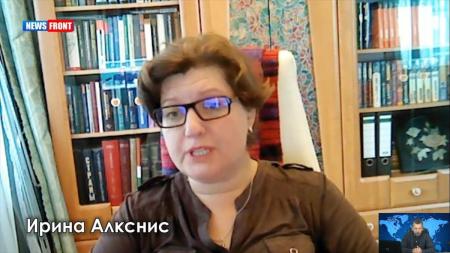
Irina Alsksnis (Source: YouTube)
Zapad 2017 (Source: Sputniknews.com)

‘The Zapad-2017 Exercise Reflects A Significant And Absolutely Real Trend In The Russian Military Policy’

“The ‘Zapad-2017’ military exercise has given those Russians interested in politics plenty of new reasons for entertainment watching the extremely emotional, bordering on nervous breakdown, and reactions of our closest Western neighbors, primarily those in the Baltics. Of the latter, of course, the most noticeable was Lithuania’s reaction to the alleged violation of the republic’s airspace by Russian transport aircraft. Although one could hardly top the Polish defense minister with his declaration that ‘nuclear weapons are being used as part of the exercise’.

“It is customary in Russia to mock the nervous – sometimes downright hysterical – attitude of our Western allies to the ‘Russian threat’, and any attempts to understand it usually end with a statement along the lines of ‘They must realize it is nonsense; therefore, it is nothing but  a PR stunt for some personal gain’. Russophobic propaganda in these countries and whipping up a spiral of public fear of Russian aggression are viewed in the same context. They are seen exclusively as mechanisms for solving some of their internal problems, and in particular, transferring public attention public from really important issues to artificially inflated ones.

“Without denying that all of the above does exist, it is still worthwhile to take a closer look at the situation. And then it will turn out that for them, for the authorities and the elites of East European states, it is not a game at all.

“The truth is that they are indeed afraid of Russia. Moreover, if you look deeper, it will become clear that their fear is not unfounded. Their fear of Russia has quite serious and absolutely rational motives, which are worth understanding and recognition.

“By the way, it is not hard to do – it is enough to look at what is happening in the world through their eyes.

“Firstly, Russia has again cheated the entire world and instead of dying, having placed its resources at the disposal of the world community, has managed not only to survive but to return to the global stage in good shape.

“Secondly, the Russia that has returned is displaying manners quite uncharacteristic of its former self — absence of sentimentality concerning those it used to call fraternal peoples for centuries, and rationality that is more akin to refined cynicism. It has already made them pay (instead of the traditional forgiveness) — by trade restrictions, food import ban, and direct multi-million punitive sanctions (compliments to Bulgaria for violating the contract on the Belene nuclear power plant).

“It is enough to look at the way Russia has behaved towards Ukraine, whose people it did not simply consider fraternal but viewed as part of it very itself. In fact, Russia has chosen the most ruthless possible course of action concerning Ukraine: it has been left to its fate, and when necessary, Moscow acts in its own interests in such a way that the situation there is exacerbated.

“A quite obvious thought occurs to Russia’s neighbors: if Russia has gotten rid of sentimental feelings towards Ukraine, just how cynical can it be in its decisions and tough in its actions towards others?

“Thirdly, and perhaps most importantly — Russia is preparing for war; it is preparing in earnest, and first and foremost,on the Western axis. The Zapad-2017 exercise reflects a significant and absolutely real trend in Russian military policy.

“Russia is building up its military muscles demonstratively and at all possible speed. In addition, there are overt full-scale preparations in the sphere of mobilization arrangements and in civil defense.

“Our neighbors are capable of understanding that the flamboyance and overtness of these preparations directly indicate that Russia is guided by the classical principle ‘if you want peace, prepare for war’, that in this way it is trying to prevent a possible military conflict. But this does not put them at ease.

“Because, in addition to the Latin principle of ‘[vis pacem] para bellum’, the world also knows two Russian maxims: the classical one about the rifle hanging on the wall [in the first act that is used in the second or third act], and the modern one: ‘Russia will never again fight on its own territory’.

“Also, there is the overall global situation, which our anxious neighbors cannot ignore. The situation involves the disintegration of the prevailing hierarchy of powers, the degradation of the global hegemon, degeneration of the elites and the grand-scale increase in general instability.

And hopes that the proverbial ‘rifle on the wall’ will not fire in this situation are increasingly diminishing. Even though, as history has shown, in the end the Russians will probably manage to spin it in such a way so as to say afterwards: ‘They started it’.

“But the Baltic and Polish peoples, as well as other East Europeans, don’t feel better for all that. Because if, as they say, things go ‘boom’, they will be the first to find themselves in the wrong place. And taking into account the above-mentioned Russia’s loss of sentimentality regarding East European nations, their fears are not so ridiculous after all.

“So, one can understand the panic of the Latvian authorities over malfunctions in mobile service in their country. After all, Russia is a world leader in the sphere of electronic warfare.

“Thus, they can no longer count on ‘Russia will take pity on us’, but only on ‘Russia does not need us’.”

___________________________

[1] See MEMRI Special Dispatch No. 7094, Zapad-2017 Exercises An Embarrassment For Belarus As Fictional State Achieves A Life Of Its Own, September 15, 2017.

See MEMRI Special Dispatch No. 7097, Russia This Week – September 19, 2017, September 19, 2017.

[2] Ria.ru, September 21, 2017.