Leaked German military doc predicts EU collapse & rise of pro-Russian ‘Eastern bloc’ by 2040

Posted November 7, 2017 by Peter Hofman
Categories: Uncategorized

Published time: 7 Nov, 2017 15:42

https://www.rt.com/news/409085-germany-leak-predicts-eu-collapse/

Sachelle Babbar / Global Look Press

The German military has outlined six “worst-case” scenarios for the future of Europe by 2040. The leaked secret document predicts that more states will leave a disordered, chaotic and conflict-prone EU – to join a Russian-led “Eastern bloc.”

A secret Defense Ministry paper leaked to Spiegel magazine has shed light on Berlin’s main concerns about the breakup of the European community, a scenario apparently feared in most Western capitals. Entitled ‘Strategic Perspective 2040’ (Strategische Vorausschau 2040), the 102-page policy paper imagines six scenarios that strategists in Berlin deem plausible.

Read more

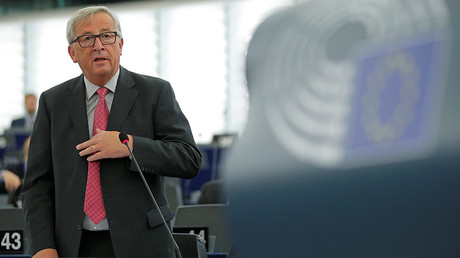
European Commission President Jean-Claude Juncker © Vincent Kessler

They range from an East-West conflict in which some EU states side with Russia, to a “multipolar Europe,” where some states adopt a Russian political or economic model in defiance of EU agreements.

One such scenario, titled ‘The EU in Disintegration and Germany in Reactive Position,’ sees a world suffering from “decades of instability.” It also describes the departure of other states from the EU as well as Britain, and an end to the bloc’s expansion, stating: “The EU enlargement has largely been abandoned, [while] more states have left the European community that lost its global competitiveness.”

“An increasingly disordered, sometimes chaotic and conflict-prone world has dramatically changed the security environment of Germany and Europe,” the military strategists write. Another scenario, dubbed ‘West against East,’ envisages the demise of European integration due to the transition by some EU countries to an “Eastern bloc,” an apparent allusion to the group of Moscow-allied states during Soviet times.

A scenario called ‘Multipolar competition’ predicts extremism on the rise in Europe as some EU members appear to move closer to Russia’s “state capitalism model.” All scenarios, drawn by the German military’s Planning Department, are viewed as conceivable by 2040.

Europe’s integrity has been pushed to its limits since 2016, when the UK opted to leave the EU during a nationwide referendum. Britain, one of Europe’s financial hubs, is set to depart the bloc in 2019. The simmering Brexit talks are currently focused on the cost of the departure as well as the status of UK citizens living elsewhere in the EU and vice versa. Far-right parties in France, the Netherlands and Austria have in the past called for ‘Frexit,’ ‘Nexit’ and ‘Oexit’ votes respectively.

READ MORE: RT’s brief guide to why some are predicting UK govt is about to collapse

Germany, the EU’s economic powerhouse, has a long tradition of in-depth strategic planning for every eventuality in the continent. It all began with the decorated Prussian field marshal Helmuth von Moltke in the 1850s, and was applied in at least three major conflicts, namely in 1871 during the war against France, as well as during World War I and World War II.

What You Need To Know About Saudi Arabia’s Mass Arrests

Posted November 7, 2017 by danmillerinpanama
Categories: Saudi Arabia and Islam, Saudi Arabian human rights, Saudi clergy, Saudi crown prince Mohammed bin Salman and modernization, Saudi economy, Saudi youth

Tags: , , , , ,

What You Need To Know About Saudi Arabia’s Mass Arrests, The Federalist, November 7, 2017

There are two ways to interpret the purge over the weekend and the series of moves against Saudi Arabia’s conservative religious establishment. The first is that Mohammad is a true reformer, who wants to prepare his country to survive well into the twenty-first century. To be able to pursue the reforms necessary for that survival, he’s removing anyone he thinks would or could oppose his rule and all its attendant reforms.

The other possibility is that he fears being overthrown and sees the religious leadership in his country as the most serious threat to his power and planned reforms, which he believes will keep young Saudis happy.
**************************

Let’s talk about some real palace intrigue. On Saturday, the kingdom of Saudi Arabia arrested more than ten princes, four ministers, and dozens of former ministers, including several clerics. That list included the noted billionaire and investor Prince Alwaleed bin Talal, one of the richest men in the world. The move shocked the globe and sent speculations flying.

So what’s going on in the House of Saud? This is the latest step in the consolidation of power of the 32-year-old Crown Prince Mohammad bin Salman. The young crown prince is powerful and highly influential mostly because he has the ear of his father, King Salman. No doubt, the crown prince was instrumental in the king’s announcement, just hours before the arrests, of a new anti-corruption committee, which, according to The New York Times, “has the right to investigate, arrest, ban from travel, or freeze the assets of anyone it deems corrupt.”

Not surprisingly, Mohammad was appointed as the chair of this new committee. Because of how intertwined the enormous Saudi royal family is with the government in Riyadh, the lines between private and public money are fuzzy, making corruption charges easy to conjure.

In addition to the high-profile arrests, the Saudi government closed the airport in Riyadh that is used for private planes — preventing any rich family members or allegedly threatening figures from leaving the country — and Salman announced he is taking the place of the minister in charge of the Saudi national guard, putting all three of the Saudi armed forces under the de facto control of the crown prince, who is also the minister of defense.

Latest in a Series of Saudi Leadership Upheavals

Although the Saturday night arrests were the largest and most surprising moves to consolidate power, they aren’t the first, nor are they out of character for the young king-to-be. Mohammad is a relative newcomer to the line of succession. He only became the crown prince in June, taking the place of the former crown prince, Mohammed bin Nayef, Salman’s nephew, who has since been under house arrest.

This change represented a major upheaval of the Saudi system of succession and upset many in the Saudi royal family. Since the founding of the kingdom in 1932 by King Abdulaziz bin Abdul Rahman, also known as Ibn Saud, the throne has gone from brother to brother among Ibn Saud’s children (he had 45 sons). When Mohammed bin Nayef was named crown prince in 2015, he was the first prince to become next in line to the throne who was not one of Ibn Saud’s sons. However, it kept with the spirit of the tradition in that he is the son of the current king’s brother. By redirecting the line of succession to his own son, Salman upended more than 60 years of royal tradition.

It’s unclear, at this point, how the royals will react to this soft coup, or if there’s really anything they can do about it. The crown prince is trying to consolidate power and eliminate any potential threats to his succession to the throne, and it’s working. It’s almost like a silent coup.

Mohammad’s Vision for Saudi Arabia

All of this intrigue raises questions about the new crown prince and what, exactly, he wants. Mohammad made his name as a reformer in the short two years since he rose to the national scene, most notably as the author of a 2016 plan to transform Saudi Arabia and reduce the country’s dependency on oil. The plan, called “Vision 2030,” focuses on modernizing the economy, promoting tourism and education, and supporting non-oil industry trade in the wake of plummeting oil prices.

His vision for Saudi Arabia also appears to be one in which religious fundamentalism takes a back seat. Mohammad was behind the September decision to change Saudi Arabia’s long-standing, ridiculous ban on women driving, a central component to restricting and monitoring the movement of women and keeping them out of the work force. Women will also be allowed to enter sports stadiums beginning next year. In addition, the crown prince approved public concerts this year, which had been banned, and there are rumors of the return of movie theaters to Saudi Arabia (they’ve been gone since the 1980s).

Lifting the driving ban, along with the other cultural reforms, are changes that Saudi clerics, who adhere to an ultra-strict interpretation of Islam called Wahhabism, strongly oppose. But Mohammad has said in no uncertain terms that he will move forward with his plan to bring moderation to Saudi Arabia, with or without the clerics.

In October, at a conference in Riyadh, he described his vision for the future of Saudi Arabia, one where religious extremism has no place. He promised to rid the country of “extremist ideologies” and return to “a more moderate Islam.” He went on to say, “Seventy percent of the Saudi population is under the age of 30. In all honesty, we will not spend 30 years of our lives dealing with extremist ideologies. We will destroy them today and immediately.”

At that same conference, the crown prince referenced 1979, the year of the Iranian Revolution and when Sunni fundamentalists took control of the Grand Mosque in Saudi Arabia’s Mecca. 1979 was, in the crown’s view, when Saudi Arabia took a sharp turn toward religious fundamentalism. He told the conference attendees, “All we’re doing is going back to what we were: a moderate Islam that is open to all religions and to the world and to all traditions and people.”

It was smart for him to allude to Iran, his country’s nemesis in the region, to link modernization with anti-Iran sentiments — something it would be difficult for Saudi clerics to counter given the ongoing tensions between the two countries, including the proxy war in Yemen. On Monday, tensions with Iran ratcheted up further when Saudi Arabia accused Lebanon of declaring war against it in the wake of the resignation Saturday of Prime Minister Saad al-Hariri, a Saudi-allied Lebanese politician. Saudi officials blamed the resignation on Hezbollah, the Iran-backed Shiite group that the United States considers a terrorist organization but is nonetheless represented in the Lebanese parliament.

A Bid for Young People’s Support

But for all the regional geopolitical problems facing Saudi Arabia, domestic troubles are just as pressing. Mohammed’s confrontation with the religious establishment first revved up in 2016, when he spurred the reforms of the country’s religious police, including banning them from making arrests. Some saw this as merely a symbolic move (the religious police have, in the past, been chastened only to make a comeback). But even if that’s true, symbolically pushing back against the powerful clerical class is a bold step and an indication that the young prince means to radically change the country, and perhaps more importantly for him, ensure that he ascends to the royal throne and stays there.

Saudi clerics seem to be getting the message that they’re going to have to go along to get along. After Saturday’s purge, which included the arrests of dozens of clerics, the Council of Senior Scholars, Saudi Arabia’s main religious body, expressed approval for the arrests and support for fighting corruption.

The audience for all these reforms, as evidenced by the crown prince’s October speech, are Saudi Arabia’s youth. Mohammed is trying to woo the young people who make up the majority of the country. Perhaps he’s doing this because he knows that if Saudi Arabia stays culturally entrenched in fundamentalist Islamic ideology, it’s destined to fall prey to the instability endemic to the region. There will, eventually, be a revolt, especially if the oil economy falters and the government is no longer able to keep the population well-fed and well-paid.

There are two ways to interpret the purge over the weekend and the series of moves against Saudi Arabia’s conservative religious establishment. The first is that Mohammad is a true reformer, who wants to prepare his country to survive well into the twenty-first century. To be able to pursue the reforms necessary for that survival, he’s removing anyone he thinks would or could oppose his rule and all its attendant reforms.

The other possibility is that he fears being overthrown and sees the religious leadership in his country as the most serious threat to his power and planned reforms, which he believes will keep young Saudis happy.

What Trump koi fish controversy? Watch what really happened

Posted November 7, 2017 by danmillerinpanama
Categories: Facts Don't Matter, Faked news, Media and Trump, Trump and Japan, Trump's Koi scandal

Tags: , , , ,

What Trump koi fish controversy? Watch what really happened, Fox News via YouTube, November 6, 2017

(“Journalists” will be “journalists.” — DM)

Iran and Gulf nations prepare for war. Sudden reshuffle in Iran’s top army, naval commands

Posted November 7, 2017 by Joseph Wouk
Categories: Uncategorized


https://www.debka.com/iran-gulf-nations-prepare-war-sudden-reshuffle-irans-top-army-naval-commands/

Saudi Foreign Minister Adel Al Jubeir on Monday, Nov. 6 accused Iran of an “act of war” in reference to the Iranian-backed Yemeni Houthi missile attack on Riyadh airport Saturday.

On Sunday, Iran’s supreme leader Ayatollah Ali Khamenei secretly ordered a significant reshuffle in the high commands of the Iranian army and navy. Brig. Gen. Mohammad Hossein Dadras was appointed Deputy Chief of Staff, with orders to boost the intelligence and operational preparedness of the Army. He came from the post of commander of ground forces.
In a separate notice, Khamenei promoted Rear Admiral Hossein Khanzadi to commander of the Navy, replacing Rear Admiral Habibollah Sayyari, who was elevated to Deputy Chief of Staff of the Army for operational coordination.
DEBKAfile’s military sources add: Sayari spent the last ten years developing the combat doctrine practiced by the Iranian Navy and Revolutionary Guards in the Gulf, which hinges on special forces, especially marines, for naval and ground warfare. He was responsible for the tactics and harassment that Iranian forces directed at US warships and warplanes operating in the Gulf.
Sayari hands these functions over to Rear Admiral Khanzadi, while himself joining the Army’s General Staff as head of operations of Iran’s armed forces.

Khamenei emphasized that all these appointments were approved by the chief of staff, Maj.-Gen Abdolrahim Mousavi.
This major reshuffle occurs at a time of high tension between Saudi Arabia and the UAE, on the one hand, and Iran, on the other. This week it rose to eve-of-war pitch.
Saud Foreign Minister Adel Jubeir accused Iran of orchestrating an “act of war” and asserted that the Kingdom of Saudi Arabia had the right to defend itself. He went on to say: “The Iranians can’t interfere in the affairs of countries in the region and expect to get a free pass. There is no doubt that missiles and suicide boats are coming from Iran to the Al Houthis.

“We want to avoid war [with Iran] at all costs,” he said, but Iran continues to violate “every international law and every international norm.” Iran is waging a war through its regional proxies, Hezbollah in Lebanon and Al Houthis in Yemen, Jubair said, adding, “we must say enough is enough” to Iran.

SAUDI ARABIA SAYS LEBANON HAS DECLARED WAR AGAINST ITS KINGDOM

Posted November 7, 2017 by Joseph Wouk
Categories: Uncategorized

http://www.jpost.com/Middle-East/Saudi-Arabia-says-Lebanon-has-declared-war-on-it-513550

REUTERS
 NOVEMBER 7, 2017 01:08
There was no immediate comment from the Lebanese government.
Saudi Arabia says Lebanon has declared war against its kingdom

BEIRUT – Saudi Arabia accused Lebanon on Monday of declaring war against it because of aggression by the Iran-backed Lebanese Shi’ite group Hezbollah, a dramatic escalation of a crisis threatening to destabilize the tiny Arab country.

Lebanon has been thrust to the center of regional rivalry between Saudi Arabia and Iran since the Saudi-allied Lebanese politician Saad al-Hariri quit as prime minister on Saturday, blaming Iran and Hezbollah in his resignation speech.

Saudi Gulf affairs minister Thamer al-Sabhan said the Lebanese government would “be dealt with as a government declaring war on Saudi Arabia” because of what he described as aggression by Hezbollah.

Faulting the Hariri-led administration for failing to take action against Hezbollah during a year in office, Sabhan said “there are those who will stop (Hezbollah) and make it return to the caves of South Lebanon,” the heartland of the Shi’ite community.

In an interview with Al-Arabiya TV, he added: “Lebanese must all know these risks and work to fix matters before they reach the point of no return.”

He did not spell out what action Saudi Arabia might take against Lebanon, a country with a weak and heavily indebted state that is still rebuilding from its 1975-90 civil war and where one-in-four people is a Syrian refugee.

There was no immediate comment from the Lebanese government.

Hezbollah is both a military and a political organization that is represented in the Lebanese parliament and in the Hariri-led coalition government formed last year.

Its powerful guerrilla army is widely seen as stronger than the Lebanese army, and has played a major role in the war in neighboring Syria, another theater of Saudi-Iranian rivalry where Hezbollah has fought in support of the government.

Lebanese authorities said on Monday the country’s financial institutions could cope with Hariri’s resignation and the stability of the Lebanese pound was not at risk.

But the cash price of Lebanon’s U.S. dollar-denominated bonds fell, with longer-dated maturities suffering hefty losses as investors took a dim view of the medium- to longer-term outlook for Lebanon.

HARIRI FREE TO TRAVEL, SAUDI FM SAYS

Hariri cited a plot to assassinate him during his unexpected resignation speech broadcast from Saudi Arabia which caught even his aides off guard. He also slammed Hezbollah and Iran, accusing them of sowing strife in the Arab world.

Hezbollah leader Sayyed Hassan Nasrallah has said he will not comment on Hariri’s speech, calling it a “Saudi statement” and saying Riyadh had forced Hariri to resign.

The sudden nature of Hariri’s resignation generated speculation in Lebanon that his family’s Saudi construction business had been caught up in an anti-corruption purge and he had been coerced into resigning.

Saudi Foreign Minister Adel Jubeir said it was “nonsense” to suggest Hariri had been coerced into quitting in a CNN interview on Monday. Hariri had quit because Hezbollah had been “calling the shots” in the government, he said. Hariri, a Saudi citizen, was free to leave the country at any time, he said.

Interior Minister Nohad Machnouk, a senior member of Hariri’s political party, said he was under the impression Hariri would return to Beirut within days.

A meeting between Saudi King Salman and Hariri in Riyadh on Monday proved “rumors” wrong, he said – an apparent reference to speculation that Hariri was detained or forced to quit.

Earlier on Monday, President Michel Aoun, a political ally of Hezbollah, appealed for national unity.

Parliament Speaker Nabih Berri, another political ally of Hezbollah, said in a televised statement after meeting Aoun it was too early to talk about forming a new government.

The crisis could re-aggravate tensions between Sunni and Shi’ite Muslims and afflict Lebanese government with paralysis once again. All of the sides have called for calm and there has been no sign of unrest since Hariri’s resignation.

The Hariri-led government took office last year in a political deal that made Aoun president. The deal ended years of deadlock, and last month it produced Lebanon’s first budget since 2005.

Hariri flew to Saudi Arabia on Friday after meeting in Beirut the top adviser to Iran’s Supreme Leader, who described the coalition as “a victory” and “great success” afterwards.

I,am crying .

Posted November 7, 2017 by Peter Hofman
Categories: Uncategorized

GoFundMe/Holcombe Family

One Texas family lost eight of its members, four of whom were children and one a pregnant woman, in Sunday’s tragic church shooting rampage that claimed 26 lives.


please read more .

http://www.breitbart.com/texas/2017/11/06/one-family-loses-eight-members-texas-church-shooting/


Saudi Arabia accuses Lebanon of declaring war on kingdom

Posted November 7, 2017 by Peter Hofman
Categories: Uncategorized

After Lebanese Prime Minister Saad Hariri resigned over the weekend and a missile was launched from Yemen toward Riyadh, a Saudi minister accused Lebanon and Hezbollah of declaring war on the kingdom.

Becca Noy
http://www.jerusalemonline.com/news/middle-east/the-arab-world/saudi-arabia-claims-lebanon-has-declared-war-on-kingdom-32243
Illustration Photo Credit: Reuters/Channel 2 News

During an interview Monday with the Al Arabiya news station, a Saudi minister made several hostile statements against Hezbollah and the Lebanese government amid the recent missile launch targeting Riyadh and the resignation of Lebanese Prime Minister Saad Hariri. “We will treat the government of Lebanon as a government declaring a war because of Hezbollah militias,” Saudi Gulf Affairs Minister Thamer al-Sabhan stated, according to the news station’s English website. “We expect the Lebanese government to act to deter Hezbollah.”

Al-Sabhan also accused the Lebanese terrorist group of smuggling drugs into the kingdom and training young Saudis for terrorist attacks. Hariri, who resigned on Saturday, was informed by the Saudi authorities that the kingdom views the acts of aggression committed by the terrorist group as a declaration of war by Lebanon and the “Party of Satan [Hezbollah].”

Iran-North Korea Nuclear Collaboration is Israel’s Worst Nightmare, Says Expert

Posted November 7, 2017 by Peter Hofman
Categories: Uncategorized

Iran-North Korea Nuclear Collaboration is Israel’s Worst Nightmare, Says Expert

Khorranshahr ballistic missile displayed at Sacred Defense Week military parade in Tehran, Sept. 22 2017

by Andrew Friedman

An international commitment to a failed model of diplomacy, coupled with loopholes in the Joint Comprehensive Plan of Action (JCPOA) international nuclear deal with Iran could create a fertile breeding ground for the Islamic Republic to collaborate with North Korea and achieve nuclear capability without technically violating the 2015 agreement, a panel of experts said Monday.

Advertisement

“There are more differences between North Korea and Iran than there are similarities, but both countries are determined nuclear proliferaters,” Dr. Emily B. Landau, head of the Arms Control Program at the Institute for National Security Studies at Tel Aviv University told a conference entitled No Good Options on North Korea, Regional and Global Implications from an Israeli Perspective.

Landau said the international community should recognize that 25 years of diplomacy as the “strategy of choice” vis-à-vis North Korea did not prevent Pyongyang from achieving nuclear capability, and there is no reason to expect the same model will work with respect to Iran.

“The international community must understand the limits of diplomacy if there is any hope to derail Iran’s nuclear program,” Landau said.

The panel, hosted by the Jerusalem-based Israel-Asia Center at the Tel Aviv Stock Exchange, also featured researcher Dr. Alon Levkowitz of the Begin Sadat Center for Strategic Studies and an expert on the history and politics of the Korean Peninsula at Bar-Ilan University and Dr. Daniel A. Pinkston, a lecturer in international relations at Troy University and a former Northeast Asia Deputy Project Director at the International Crisis Group in Seoul.

Levkowitz has noted that North Korea’s history of collaborating with Israel’s enemies stretches back at least 50 years, when the country sent soldiers to fight with Arab armies against Israel during both the Six Day War in 1967 and the Yom Kippur War six years later.

On Monday he said Israel’s “biggest fear” would be for Pyongyang to offer to develop nuclear weapons on behalf of Iran, thus allowing the Islamic Republic to become a nuclear state without violating the terms of the nuclear agreement signed with the P5+1. But Levkowitz added it would not be the only way for North Korea could pose a threat to Israel.

“North Korea is selling missiles to Syria, for example, selling light ammunition to just about every terrorist group in the region,” Levkowitz said. “In the old days they sold [weapons] to Egypt. So it is a huge matter of concern for Israel – Israel needs the U.S. to intercept the shipments on the way to the Middle East, or if they don’t manage to do that, we have to bombard them.”

Levkowitz has also written extensively about North Korea’s involvement in constructing Syria’s nuclear reactor, which Israel destroyed in 2007, four years before the start of the civil war there.

Asked whether Israel’s close diplomatic ties with China and Russia – two countries that also share diplomatic ties with both Iran and North Korea – Levkowitz told Tazpit Press Service (TPS) that Israel’s growing relationship with both countries is unlikely to move either to press the issue on Israel’s behalf.

Russia, he said, is far less influential in Asia than China, and added that Israel’s ability to act in the Far East is limited by American foreign policy concerns.

“Our leverage is not that big,” Levkowitz said. In the 1990s we tried to make a deal with North Korea, but there was a disagreement between the foreign office (ministry) and the Mossad [about whether we could trust the North Koreans to respect the terms of a deal]. But the Americans said ‘go away,’ this is our region. This is our meeting. You know I wish we were able to convince Beijing or put pressure on Pyongyang. But it doesn’t work. I wish it did.”

Landau warned that the history of Western talks with successive North Korean administrations doesn’t bode well for the attempts to use diplomacy vis-à-vis Iran. She praised U.S. President Donald Trump for changing the tone of American diplomacy after what she called former U.S. President Barack Obama’s policy of “strategic patience” but added that effecting change to a deeply flawed deal would require cooperation on the part of the other members to the agreement – something that does not appear to be in the offing.

“Look, there are some positive signs,” she said. “A year ago, supporters of the deal wouldn’t even admit the agreement wasn’t perfect. Now, at least they are saying ‘it may not be perfect, but…

“But 25 years of diplomacy failed. North Korea is a nuclear state now. As far as Iran is concerned it isn’t too late. There are things that can be done now. But the international community has got to realize the threat here. Right now, I don’t see it,” she said.

Western Powers Must Protect Kurds, Urges Iraqi Jew Who Was Escorted to Freedom by Masoud Barzani

Posted November 6, 2017 by danmillerinpanama
Categories: Kurdish fighters, Kurdish independence, Kurds, Kurds and human rights, Kurds and Jews, Trump administration and Kurdish independence

Tags: , , , ,

Western Powers Must Protect Kurds, Urges Iraqi Jew Who Was Escorted to Freedom by Masoud Barzani, AlgemeinerBen Cohen, November 6, 2017

(Israel has been the only nation to support Kurdish independence. Please see also, Hypocrisy: A state for the Palestinians but not for the Kurds or Catalonia. America, which has armed and relied upon Kurdish fighters in opposing the Islamic State and other Islamic terror groups in Iraq and elsewhere, has not. America’s failure to do so is among the very few matters on which I disagree with President Trump’s foreign policy. –DM)

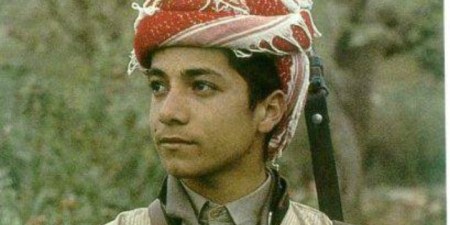
A young Masoud Barzani fighting with the Kurdish peshmerga. Photo: File.

For the last forty-seven years, Jamil “Jimmy” Ezra has marked a special, deeply private anniversary on September 1 with a ray of hope in his heart. For it was on that day in 1970 that Ezra – accompanied by his brother and sister – drove in a jeep to the Iraqi border with Iran with Kurdish leader Masoud Barzani and his assistant at the wheel.

Ezra and his siblings were among more than 2,000 Iraqi Jews who were helped by Kurdish Peshmerga to escape from the Ba’athist regime during the 1970s. These were dark days in Iraq, where the remnant of a Jewish community that had only recently numbered 150,000 was convulsed with fear following the public hanging in Baghdad in 1969 of 14 people, nine of them Jews, on trumped-up charges of spying for Israel. Ezra remembers the time with the same deep emotion that grounds his present fears about what the future now holds for his Kurdish rescuers.

“My heart breaks for the 30 million Kurds, divided between Iraq and Turkey, Syria and Iran, and abused and suffering,” Ezra told The Algemeiner on Monday.

Ezra will be speaking about his experiences with Masoud Barzani – son of the legendary Mullah Mustafa Barzani and, until last week, the president of the Kurdistan Regional Government (KRG) – at downtown Manhattan’s prestigious Center for Jewish History on Tuesday night, during a special two-part series on the Kurds sponsored by the American Sephardi Federation. It is a story that began when Ezra was a boy of 17 in Baghdad, living with his aunt and uncle, and still grieving from the sudden death of his father from a heart attack on the very same day in July 1968 that Saddam Hussein and his Ba’athist comrades seized power.

“One day in 1970, my brother Farid was walking in the street when he was stopped for an ID check,” Ezra recalled. “He had a permit exempting him from serving in the army, and on every page it was written in red, yahudi, yahudi, yahudi (Jew).”

Farid was arrested and imprisoned on a spying charge. His voice breaking, Ezra recalled how his brother was beaten and tortured by his jailers until he suffered a nervous breakdown. Farid was then transferred to a prison for the criminally insane.

“In the hot summer, the prisoners would all run outside to drink the unfiltered river water that was brought in by a truck in the morning — they would fight over the dirty water,” Ezra said. “My aunt would send me with food and clean water for my brother, and he would beg me to take him away.”

At this point, Ezra said, he and his sister Gilda decided that it was time to leave Iraq. He ventured north to Iraqi Kurdistan, then enjoying a measure of autonomy under an agreement with Baghdad that was soon reneged upon by Saddam Hussein. Arriving in the Kurdish town of Haj Omran on the Iranian border, he came across an Iraqi Jewish family he knew who were taken across the border into Iran that same night. Ezra, meanwhile, was given a mattress in a room where he bedded down with ten Kurds. “I told them about how the Jews were suffering,” he said.  “They promised to take me to Mustafa Barzani the following day.”

The next morning, Barzani’s aides hatched a plan that involved Ezra and another Jewish family returning to Baghdad to collect their relatives, after which they would travel to a meeting point back in northern Iraq. “That was on Monday; on the Thursday, back in Baghdad, I woke up my brother Farid, who was suffering badly from his trauma in prison, and I told him, ‘Come on, you and me and Gilda are going on a short vacation,’” he said.

Had they been stopped and discovered at one of the many security checkpoints along the way, certain imprisonment in a Ba’athist jail would have awaited — and, indeed, the family was pulled over by a soldier. “Luckily, the guy was an idiot,” Ezra remembered. “He couldn’t understand why my brother had an exemption permit from the army, so our driver kept explaining, ‘He’s not well, he’s well.’ Eventually, the soldier said, ‘Ok, ok, you can go.’”

Arriving at the meeting point agreed with Barzani’s advisers, Ezra remembered that a high-level Kurdish intelligence official “came out and started briefing us.”

To maintain secrecy around Kurdish assistance to escaping Iraqi Jews, the official instructed Ezra and those with him to personally approach Masoud Barzani, who would be sitting in a cafe at an agreed time, and pretend they had a brother imprisoned by Kurdish forces. “We had to act,” Ezra said. “We had to beg and plead in front of Masoud.”

Following this ruse, the Ezra siblings got into a jeep alongside  Masoud. At the border with Iran, Masoud got out and bade his farewells. “We had a gift for Masoud and his adviser,” Ezra said. “It was a Parker 21 pen, that was a big deal back then. We wanted them to take it, but they refused and refused. They said, ‘We are doing this because we care and we want to help you.’”

“They never took any money, any gifts, unlike the smugglers who would rob the Iraqi Jews they were supposed to be helping,” Ezra continued.

After crossing into Iran on September 1, the Ezras survived a long and arduous journey to Tehran, where they stayed at the aptly-named Hotel Sinai — then full of escaped Iraqi Jews in transit with the Jewish Agency’s assistance. “On October 2, we arrived in America,” Ezra said. “We came to New York.” Many other Iraqi Jews who escaped around the same time went to Israel, as well as the UK, Canada and other countries.

Ezra’s thoughts over the last month have been dominated by the fate of the Kurds, whose 93 percent vote in favor of independence in the September 25 referendum resulted in an Iranian-backed onslaught involving Iraqi government forces and the Shia Hashd al-Shaabi paramilitary group. More than 50 percent of the territory liberated from ISIS by the Kurds has been lost, including the historic city of Kirkuk, while Kurdish political leaders have been painted into a corner as they try to maintain as much autonomy from Baghdad as feasible.

“I follow the news of the Kurds, I pray for them,” Ezra said. “I know their history, how they were divided between four countries after World War One. America has betrayed them, Britain and France have betrayed them. Israel tried to help, but they were limited by the Americans dictating to them how much they could do.”

Ezra wants American Jews to urge their legislators to protect the Kurds, a long-standing American ally. “What happened to the Jews could still happen to them,” Ezra said, casting an eye on Saddam Hussein’s infamous attempts to obliterate the Kurds with chemical weapons attacks in the late 1980s.

“Measures need to be taken to prevent that,” he said. “This should be an emergency for the UN Security Council. The issue of the Kurds has to be kept alive every day of the year.”

Turkey’s Nuclear Ambitions

Posted November 6, 2017 by danmillerinpanama
Categories: Nukes for Turkey?, Russia and Turkey, Russia and Uranium, Turkey - Nuclear "power plant", Uranium for Russia, Uranium One

Tags: , , , , ,

Turkey’s Nuclear Ambitions, Gatestone Institute, Debalina Ghoshal, November 6, 2017

(Wouldn’t it be easier to buy nukes and missiles from North Korea? — DM)

Russia’s ROSATOM already has nuclear cooperation deals with Iran, Jordan and Saudi Arabia, among others. Turkey is just the latest to benefit — possibly along with Iran and North Korea, both of which have been openly threatening to destroy America — from Moscow’s play for power in the Middle East and the Mediterranean.

The West would also do well not to feel secure in the knowledge that Turkey is a party to the Non-Proliferation Treaty (NPT).

Nuclear reactors in the hands of a repressive Islamist authoritarian such as Erdogan could be turned into weapons factories with little effort.

Turkey’s announcement over the summer that it had signed a deal with Russia’s State Atomic Energy Corporation (ROSATOM) — of Hillary Clinton’s Uranium One stardom — to begin building three nuclear power plants in the near future is cause for concern. The $20 billion deal, which has been in the works since 2010, involves the construction in Mersin of the Akkuyu nuclear power plant — Turkey’s first-ever such plant — will be operational in 2023.

ROSATOM already has nuclear cooperation deals with Iran, Jordan and Saudi Arabia, among others. Turkey is just the latest to benefit — possibly along with Iran and North Korea, both of which have been openly threatening to destroy America — from Moscow’s play for power in the Middle East and the Mediterranean. It is also a source of desperately-needed revenue for Russia, hurt by sanctions imposed on Moscow following its invasion of Ukraine.

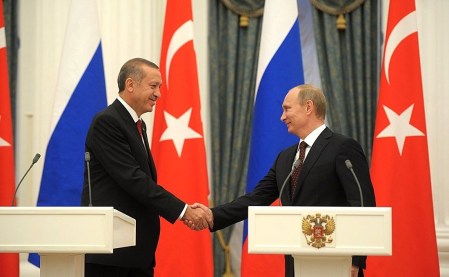
Turkish President Recep Tayyip Erdogan (then Prime Minister) meets with Russian President Vladimir Putin on July 18, 2012. Their meeting focused on nuclear cooperation, among other things. (Image source: kremlin.ru)

Like Iran, Turkey claims that its budding nuclear program is for civilian purposes only. Ankara’s interest in nuclear energy dates back to the 1960s, when it conducted a study on the feasibility of building a 300-400 megawatt nuclear power plant, three decades before the rise of President (formerly Prime Minister) Recep Tayyip Erdogan and his AKP party.

Although it is true is that Ankara is currently incapable of meeting the country’s electricity demands, and relies heavily on imported natural gas even to manage that, it would be wishful thinking to assume this is Turkey’s only goal. Even though its state-controlled conventional power plants are dilapidated, since 2001, no public companies in Turkey have been allowed to invest in them.

Before international sanctions were imposed on Iran — prior to the 2015 neversigned Joint Comprehensive Plan of Action (JCPOA) — Tehran and Moscow were Turkey’s main suppliers of fossil fuels for the operation of the conventional plants. Ironically, it was the hindrance to commerce with Iran that led Turkey to consider nuclear energy a viable option to supplement the natural gas imports on which it relies heavily.

Russia is not the only country to strive to profit from Turkey’s nuclear energy ambitions. China, too, evidently wants a share. Last year, Beijing ratified the nuclear agreement it reached with Turkey in 2012. In 2015, China’s arch-rival, Japan, also signed a deal with Turkey: $20 billion for the construction of four nuclear power plants at Sinop, along the Black Sea.

In 2008, Turkey reached an “Agreement for Peaceful Nuclear Cooperation” with the United States. Two years later, it signed a memorandum of understanding on nuclear cooperation with South Korea.

Let us not be lulled by Ankara’s touting of the need to accommodate what it claims is the “highest rate of growing energy demand among OECD countries over the last 15 years.” The West would also do well not to feel secure in the knowledge that Turkey is a party to the Non-Proliferation Treaty (NPT). The ever-radicalizing Erdogan regime, which exploited the opportunity created by the failed coup in 2016 to imprison thousands of judges, journalists, academic, generals and anyone else suspected of being critical of the ruling party and its policies, has made no secret of its hegemonic ambitions in an already volatile and war-torn region. Nuclear reactors in the hands of a repressive Islamist authoritarian such as Erdogan could be turned into weapons factories with little effort. This potential for disaster must be taken into account and monitored.

Debalina Ghoshal, based in India, is an independent consultant specializing in nuclear and missile and missile defense related issues.