Trump Nominated For The Nobel Peace Prize Over Israel Peace Deal, Announces Iraq Troop Withdrawal
Posted September 10, 2020 by Joseph WoukCategories: Uncategorized
Serbia to move embassy to Jerusalem; mostly Muslim Kosovo to recognize Israel
Posted September 6, 2020 by Joseph WoukCategories: Uncategorized
https://www.timesofisrael.com/serbia-to-move-embassy-to-jerusalem-mostly-muslim-kosovo-to-recognize-israel/
Gestures to Israel come as part of US-brokered agreement between Balkan nations signed at White House; Israel to establish diplomatic relations with Kosovo
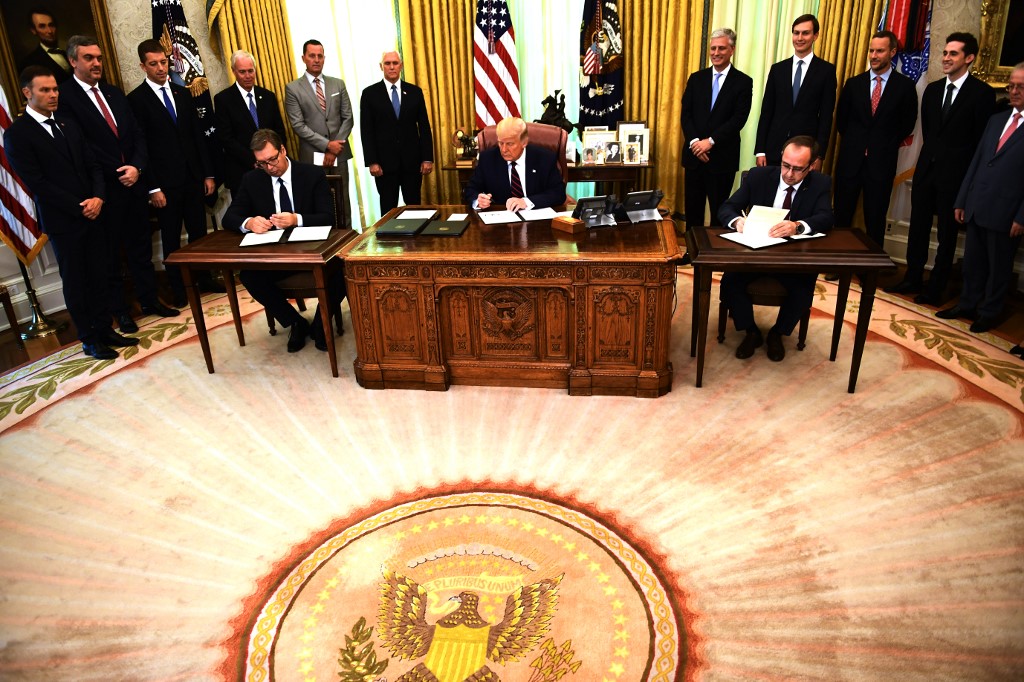
US President Donald Trump signs a document as Kosovar Prime Minister Avdullah Hoti (R) and Serbian President Aleksandar Vucic (L) sign an agreement on opening economic relations, in the Oval Office of the White House in Washington, DC, on September 4, 2020. (Photo by Brendan Smialowski / AFP)
WASHINGTON — Serbia announced Friday that it would move its embassy to Jerusalem, while Muslim majority Kosovo is to recognize Israel. The moves come as part of US-brokered discussions to normalize economic ties between Belgrade and Pristina.
Prime Minister Benjamin Netanyahu hailed the moves and said Israel would establish diplomatic relations with Kosovo.
After two days of meetings with Trump administration officials, Serbian President Aleksandar Vucic and Kosovo’s Prime Minister Avdullah Hoti agreed to cooperate on a range of economic fronts to attract investment and create jobs. The White House announcement provided US President Donald Trump with a diplomatic win ahead of the November presidential election and furthers his administration’s push to improve Israel’s international standing.
“Truly, it is historic,” Trump said, standing alongside the two leaders in the Oval Office. “I look forward to going to both countries in the not too distant future.”
Serbia’s decision to move its embassy from Tel Aviv to Jerusalem is a nod to both Israel and the United States. The Trump administration recognized Jerusalem as Israel’s capital in late 2017 and moved the US embassy there in May 2018.
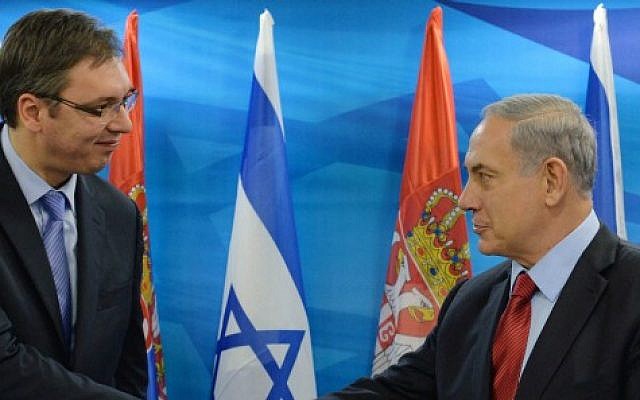
Prime Minister Benjamin Netanyahu (R) meets with Serbian Prime Minister Aleksandar Vucic in PM Netanyahu’s office in Jerusalem. December 1, 2014. (Kobi Gideon/GPO)
The administration has encouraged other countries to do the same but has been widely criticized by the Palestinians and many in Europe because the Israeli-Palestinian conflict remains unresolved. Kosovo, a predominantly Muslim country, has never before recognized Israel nor has Israel recognized Kosovo.
After the announcement Netanyahu thanked Trump for his role in continuing to further Israel’s diplomatic standing.
“I thank my friend President Vucic of Serbia for his decision to recognize Jerusalem as Israel’s capital and move their embassy,” Netanyahu said. ” I also want to thank my friend Donald Trump for his contribution to this achievement.”
A statement from Netanyahu’s office hailed Serbia for being the first European nation to agree to move its embassy and said efforts continued to convince other European nations to also do so.
Netanyahu said that following discussions held in recent days among the Foreign Ministry, National Security Council and others, it was decided that Israel will establish diplomatic relations with Kosovo.
The gestures to Israel are part of the Trump administration’s push to improve the Jewish state’s international standing, which has included forceful denunciations of criticism of Israel at the United Nations and in other international venues. Most recently, the administration brokered a deal for Israel and the United Arab Emirates to normalize relations. That was followed by the first commercial flight between Israel and the UAE, with neighboring Saudi Arabia and Bahrain to allow such flights to pass through their airspace. Additional Arab states, including Sudan, Bahrain and Oman, have been identified as countries that may soon also normalize relations with Israel.

UAE delegates wave to the departing El Al planeat the end of the Israel-UAE normalization talks, with the US, in Abu Dhabi, September 1, 2020 (El Al spokesperson’s office)
Kosovo’s Parliament declared independence from Serbia in 2008, nine years after NATO conducted a 78-day airstrike campaign against Serbia to stop a bloody crackdown against ethnic Albanians in Kosovo.
Most Western nations have recognized Kosovo’s independence, but Serbia and its allies Russia and China have not. The ongoing deadlock and Serbia’s unwillingness to recognize Kosovo have kept tensions simmering and prevented full stabilization of the Balkan region after the bloody wars in the 1990s.
“We cannot accept any document which includes Kosovo’s independence, and that’s full stop,” Vucic told reporters after meetings Thursday at the White House.
Serbia and Kosovo have already OK’d air, rail and transit agreements, including one that would clear the way for the first flight between Pristina and Belgrade in 21 years. The new agreement comprises many more areas of economic cooperation. Business leaders in both nations have been frustrated and have been talking among themselves about ways to foster investment outside of the ongoing political talks brokered by the European Union.
On Monday, Vucic and Hoti are scheduled to go to Brussels to hold talks under the auspices of the EU’s foreign policy chief Josep Borrell and special envoy for the Belgrade-Pristina dialogue Miroslav Lajcak.
The EU has mediated the talks between the two former wartime foes for more than a decade, and the parallel US effort, although focused on economic development, has not been fully embraced by some EU officials.
The White House summit was originally scheduled for June, but it was canceled after Kosovo President Hashim Thaci, who was to lead the Kosovo delegation, was indicted for war crimes by an international court.
UAE deal shows Arab-Israel conflict starting to come apart before our eyes
Posted September 4, 2020 by Joseph WoukCategories: Uncategorized
Israel finds itself in a place of honor in the moderate Sunni camp against the extremist Shiites; there are even signs of a certain shift in Hamas

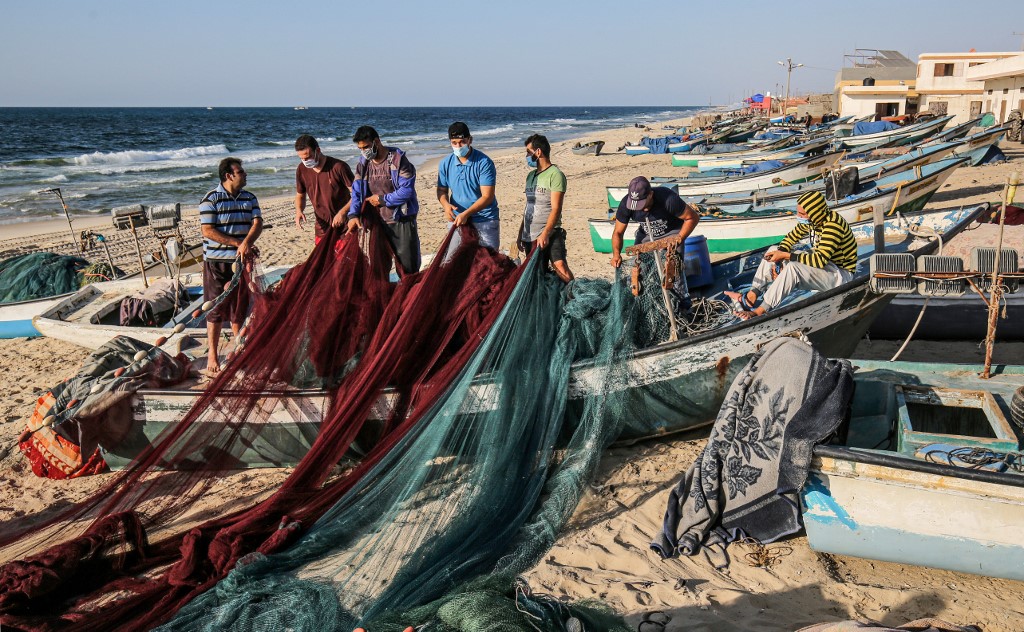
Palestinian fishermen, mask-clad due to the COVID-19 coronavirus pandemic, prepare their fishnets along a beach off the Mediterranean Sea in Rafah in the southern Gaza Strip on September 2, 2020. (SAID KHATIB / AFP)
The historic agreement between the United Arab Emirates and Israel is a direct continuation of the profound changes in the Middle East that have been quietly taking place in recent years. The Israeli-Arab conflict is starting to come apart before our very eyes, and Israel finds itself in a place of honor in the moderate Sunni camp against the extremist Shiites.
Located between these two groups are several sub-groups, including the Palestinian Authority and the Muslim Brotherhood (Qatar, Turkey, Hamas). The PA is sometimes backed by the moderate Sunni camp, especially by the countries bordering Israel (Jordan and Egypt), although sometimes they, too, lose interest.
As for the Muslim Brotherhood and its supporters, Turkey still maintains diplomatic relations with Israel; Qatar is officially mediating between Israel and Hamas – with its representative, Mohamed al-Emadi, meeting openly with Israeli security agency and IDF personnel; and even Hamas may no longer be quite what it used to be.
The most prominent symbol of this apparent, tentative Hamas shift — from terrorist group to governing authority that sometimes takes up the “mantle of terror” — is its all-powerful leader in the Gaza Strip, Yahya Sinwar.
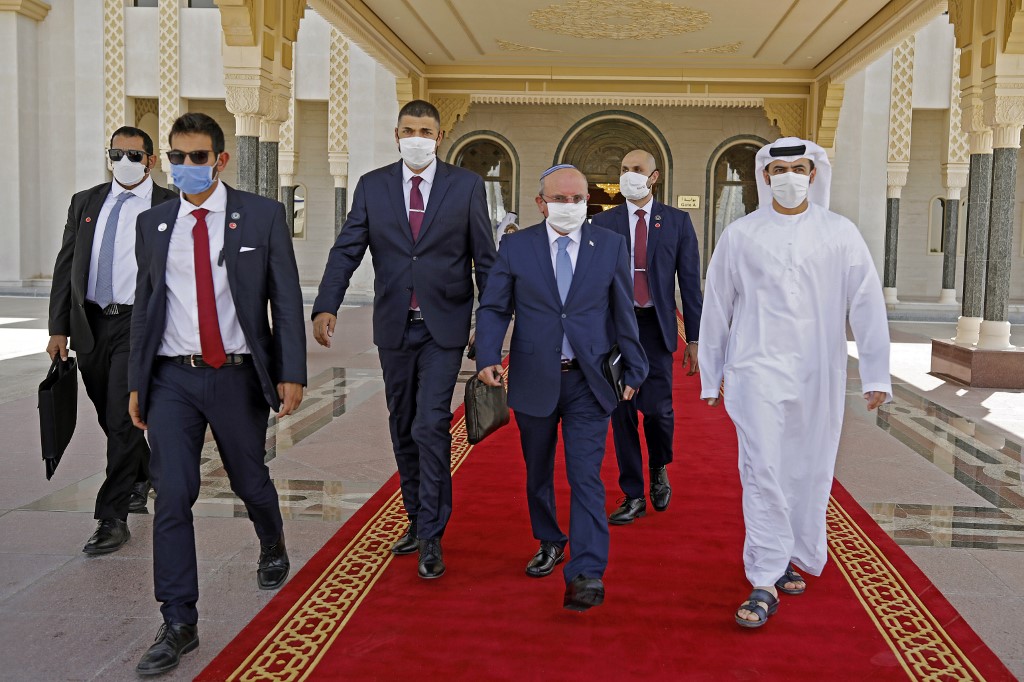
The head of Israel’s National Security Council, Meir Ben-Shabbat (2nd-R), wearing a protective mask, makes his way to board the plane as he prepares to leave Abu Dhabi on September 1, 2020, at the end of an unprecedented visit on normalizing Israel-UAE relations. (NIR ELIAS / POOL / AFP)
Sinwar, who took over in Gaza when Hamas political bureau chief Ismail Haniyeh left the Strip, is in no hurry right now to further escalate hostilities with Israel. He is a classic example of the cliché, “The things that you see from here you don’t see from there.” This is confirmed by the mini-escalation we have witnessed on the Gaza-Israel front in recent weeks — the balloon bombs, the dribble of rockets towards Israel. These were not simply an expression of anti-Jewish sentiment. They were intended to achieve very specific aims: Maintain Qatari funding to the Strip, renew several stalled infrastructure projects within Gaza (electricity lines; an industrial zone), and obtain help battling COVID-19.
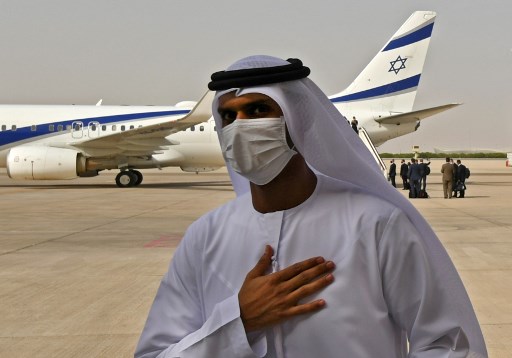
An Emirati official stands near an El Al plane that carried a US-Israeli delegation to the UAE following a normalization accord, upon its arrival at the Abu Dhabi airport, in the first-ever direct flight from Israel to the UAE, on August 31, 2020. (KARIM SAHIB / AFP)
Sinwar, who likes to show off his mastery of Hebrew and his understanding of Israeli politics, viewed the escalation on the northern border with Hezbollah as a potential opportunity to gain some achievements down south. However, the massive explosion in Beirut’s port, which at the very least delayed Hezbollah’s planned revenge against Israel for the killing of one of its fighters, left Israel with only the southern border to worry about. And then the virus complicated matters further for Gaza’s rulers.
Up until recently Gaza was about the safest place in the world as regards COVID-19. But lately there has been a real outbreak, albeit in numbers that Israel’s coronavirus czar Ronni Gamzu would love to contend with. Sinwar realized the enormity of the problem and pushed for a quick ceasefire. As soon as Qatar renewed its promise to provide a reported $27 million in monthly funding, plus a few million here and there for fuel and various projects, Sinwar deescalated hostilities with Israel, and focused on locking down Gaza’s two million people to stop the COVID contagion.

Hamas leader Yahya Sinwar (4th L) takes part in a rally as Palestinians call for a “Day of Rage” to protest Israel’s plan to annex parts of the West Bank, in Gaza City on July 1, 2020. (MAHMUD HAMS / AFP)
If there is something the populace cannot tolerate at this point it is another war — not when they have already reached rock bottom financially and a pandemic has arrived. And that relative sensitivity to the residents of Gaza is noteworthy. Hamas is emphatically his top priority, but Sinwar attaches importance to public sentiment — in striking contradiction to his northern neighbor Hezbollah chief Hassan Nasrallah, who could not care less about the non-Shiite population of Lebanon.
And so Israel and its Prime Minister Benjamin Netanyahu once again agreed to a ceasefire that includes cash transfers to hard-up families in Gaza and paychecks to Hamas clerks, bolstering Hamas as ruler of Gaza. Again, just to make it clear: The government of Israel is helping Hamas retain power. Why? Because Israel clearly understands that the alternative — war and the disintegration of Hamas — is worse. In other words, Israel is willing to pay protection money — or at least have Qatar pay — to help Gaza with COVID-19 in exchange for a quiet border.
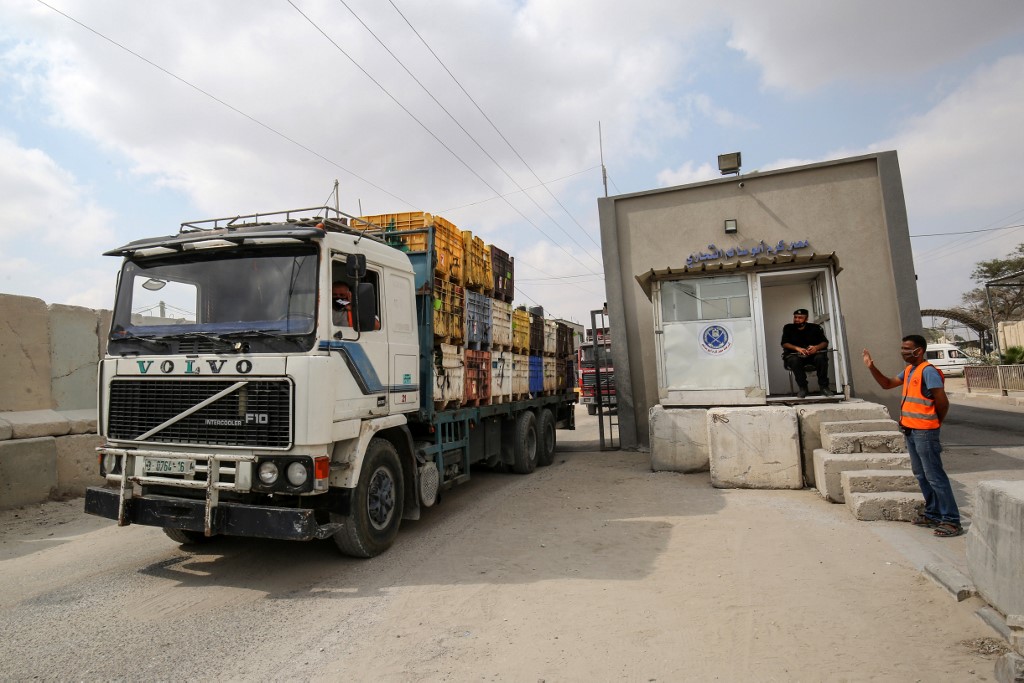
A Palestinian policeman waves on a truck s it enters through the Kerem Shalom crossing into the Gaza Strip on September 1, 2020, after a Qatari-mediated deal with Israel. (SAID KHATIB / AFP)
Where did it start?
Word on the Gazan street is that the COVID outbreak began with a mother from Al-Maghazi refugee camp in the center of the Strip who wanted to take her baby for medical treatment at the Al-Makassed hospital in East Jerusalem. She arrived at the Erez Crossing (according to the rumor) and had to turn back as she lacked the necessary paperwork. When she returned to Hamas’s Four-Four crossing, she was asked if she had been to the Israeli side and she said no.
Four days later she set out once again, this time with the proper permits, and reached Al-Makassed hospital. Except that once there, it was discovered that she had contracted COVID-19. The doctors updated the PA’s Ministry of Health in Ramallah, who updated their counterparts in Gaza. A medical team was sent to the family’s home in Al-Maghazi to test her family members. Her father-in-law, who owns a small supermarket, turned out to be infected. From there it was just a short jump to a wider outbreak. By last Wednesday morning, 480 people were infected in one of the most densely populated areas in the world.
“Initially, they declared a 48-hour lockdown,” A., a resident of Gaza, told me. “After a break for supplies, they then declared a 72-hour lockdown. And then another 48 hours. You can leave to buy groceries or medicine and there are donkey-driven carts selling fruits and vegetables. But there are very few drivers on the roads and almost no one on the streets. All public places are closed. Hamas is also stopping traffic between areas and the entire Strip has been divided into zones with no traffic allowed between them,” said A.

A mask-clad Palestinian stallholder arranges produce on a street in Gaza City on September 3, 2020, amidst a COVID-19 coronavirus pandemic-imposed lockdown. (MOHAMMED ABED / AFP)
“For instance, it is forbidden to drive from Khan Younis to [nearby] El-Kerara, or between Deir al-Balah and the [refugee] camps in the center. Gaza City has been divided into sections — Tuffah, Daraj, Shati, etc. — and each is isolated from the others. This outbreak came at a very bad time as far as the people of Gaza are concerned, because it coincided with the escalation with Israel which resulted in 16-hour electric outages, bombings, and a ban on fishing. People’s fear of the disease only increased with the threat of war.
“The agreement between Qatar, Hamas, and Israel may have calmed people’s concerns a little, but only a little,” A. went on. “Everything is still so unstable. There is a sense that the disease is under control, but God forbid that it gets out of hand.”
The Battle of Latakia
Posted September 2, 2020 by Joseph WoukCategories: Uncategorized
From Wikipedia
The Battle of Latakia (Arabic: معركة اللاذقية; Hebrew: קרב לטקיה) was a small but revolutionary naval action of the Yom Kippur War, fought on 7 October 1973 between Israel and Syria. It was the first naval battle in history to see combat between surface-to-surface missile-equipped missile boats and the use of electronic deception.[1] Background At the outset of hostilities, the Israeli Navy set out to destroy the naval capabilities of the Syrians, who were equipped with Soviet Komar-class and Osa-class missile boats. The Syrian missile boats were equipped with Soviet manufactured P-15 Termit (NATO reporting name: SS-N-2 Styx) anti-ship missiles with twice the range of the Israeli Gabriel anti-ship missiles.[2] Battle The four Israeli Navy Sa’ar 3-class and one Sa’ar 4-class missile boats headed towards the Syrian port of Latakia in two parallel columns. In the western column were the missile boats Miznak (Blast), Ga’ash (Storm), and Hanit (Lance); the eastern column was composed of the missile boats Mivtach (Reliance) and Reshef (Spark). At 22:28 hours the Israelis encountered the Syrian K-123 torpedo boat which was sunk with 76mm cannon fire from Mivtach and Hanit. As they headed toward the shore, the Israeli ships engaged a 560-ton Syrian T43-class minesweeper and also sank it, this time using four Gabriel anti-ship missiles. At 23:30 the Israelis made contact with two Syrian Komar-class and one Osa-class missile boats. The Syrian missile boats fired their Styx missiles at long range, but as the missiles approached, the Israelis employed electronic countermeasures and launched chaff rockets to successfully decoy the missiles. When the Israeli ships closed the range, they fired five Gabriel missiles, sinking one Komar and the Osa immediately and damaging the second Komar. The surviving Syrian Komar tried to escape, but it ran aground in shallow water and was destroyed by 76mm cannon fire at 00:26 hours. During this naval clash other Syrian missile boats launched missiles from within the port limits of Latakia (actually launched while the missile boats were moored between merchant ships in port). However, these missiles malfunctioned or lost guidance and two foreign (one Greek and one Japanese) merchant vessels anchored along the piers were hit. Both vessels were struck in the engine rooms. The Syrian Navy remained bottled up in its home ports for the rest of the war. While the Battle of Latakia was the first naval battle in history between missile boats, it was not the first incident in which a missile boat sank another ship using missiles. That had happened when two Egyptian Navy Komar-class missile boats sank the British-built Israeli destroyer Eilat on 21 October 1967, shortly after the Six-Day War, using four P-15 Termit surface-to-surface missiles.[3]
Why Israel Has Designed A Very Special F 35 Stealth Fighter
Posted September 2, 2020 by Joseph WoukCategories: Uncategorized
IAF bombs Iranian targets in Syria; Israel-Hamas ceasefire announced – TV7 Israel News 01.09.20 – YouTube
Posted September 1, 2020 by Joseph WoukCategories: Uncategorized
More German intel confirms Iran seeks tech for weapons of mass destruction
Posted August 31, 2020 by davidking1530Categories: Uncategorized
The Germans seem to have a weird system of sub-national security/intelligence organisations.
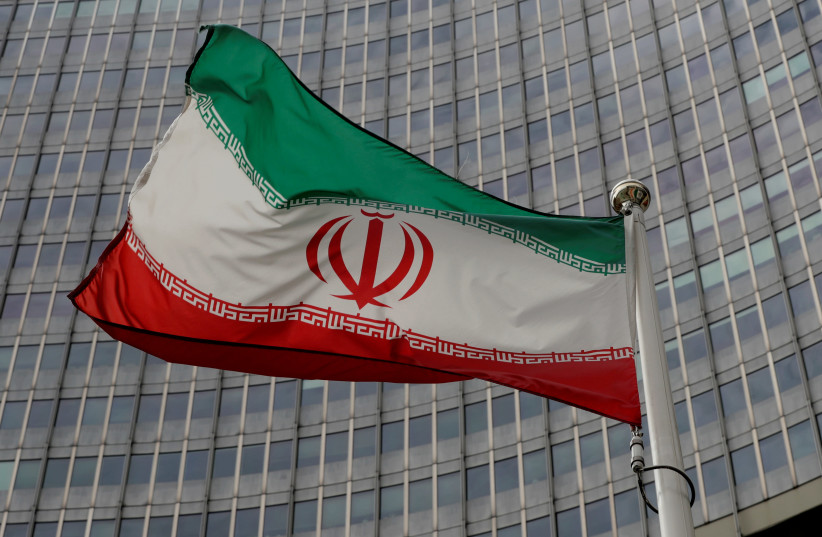
The domestic intelligence agency for the German state of Saarland added new weight to intelligence reports from its sister states, which previously confirmed the Islamic Republic of Iran has sought technology for weapons of mass destruction and missile carrier systems.
The Jerusalem Post reviewed the 112-page intelligence report, which was released last week, titled “Overview of the situation,” addressing security threats faced last year by the small west-German state Saarland.
“Iran, Pakistan and to a lesser extent Syria, made efforts to procure goods and know-how for the further development of weapons of mass destruction and their delivery systems,” wrote the intelligence officials for the Saarland.
“Delivery system” is typically defined as the capability to launch missiles. Israel, the United States and many Gulf nations believe Iran’s regime seeks to develop nuclear weapons.
The Post contacted the Saarland domestic intelligence agency regarding the nature of the illicit proliferation material that Iran sought in 2019. Katrin Thomas, the spokeswoman for the domestic intelligence agency, wrote the Post by email on Friday that “the Protection of the Constitution in Saarland does not pass on any information on the activities of groups or individuals.”
The Protection of the Constitution is the formal name of the Saarland domestic security service.
The report said that “The intelligence services of these countries are present with varying staffing levels at the respective official and semi-official representations in Germany and maintain so-called legal residencies there. This refers to the operational bases of a foreign intelligence service, disguised in an official [e.g. embassy, consulate general] or semi-official [e.g. press agency, airline] representation in the host country as a starting point for intelligence activities.”
According to the Saarland intelligence document, “The intelligence staff there, supposedly working as diplomats or journalists, conduct open or covert information gathering themselves or provide support in intelligence operations that are carried out directly by the headquarters of the intelligence services in their home countries. In addition, intelligence services also carry out operations without their legal residences being involved. The focus of their respective procurement activities is based on current political requirements or economic priorities.”
The intelligence officials noted that China and Iran replicate Russia’s brutal tactics in targeting dissidents and opponents within the federal republic. “The Iranian and Chinese intelligence services are also active in this field.”
The report says that for Iran to achieve its goal, “selected people from the opposition movement are approached with the aim of a commitment to intelligence cooperation. In the event of rejection, the persons concerned or their relatives living in their home country are often threatened with reprisals.”
Iran’s regime has used German territory for surveillance and assassination operations targeting Iranian dissidents, pro-Israel advocates and Israeli and Jewish institutions.
Germany’s 16 federal states have their own local domestic intelligence service. Each state releases an annual report documenting threats to the democratic order of the state.
The Saarland noted the apparent illicit nuclear weapons activities of Pakistan in Germany and elsewhere abroad. “Pakistan also operates an extensive nuclear and carrier technology program and continues to endeavor to expand and modernize, in order to retain a serious deterrent potential against the ‘Arch enemy’ India.”
Al Jazeera host promotes conspiracy that Israel, US tricked Arabs into fearing Iran
Posted August 31, 2020 by davidking1530Categories: Uncategorized
Arabs can be crazy.
A prominent host of the Qatar-based Al Jazeera Media Network promoted a conspiracy theory that the US and Israel were involved in spreading the idea of exporting the 1979 Iranian Revolution to the Arab world to allegedly benefit Israel.
Special Forces – כוחות מיוחדים שייטת 13 Israeli Navy Seals – Shayetet 13
Posted August 30, 2020 by Joseph WoukCategories: Uncategorized
Shayetet 13 squadron is the Israeli Navy’s Navy SEALs. The unit’s permanent base is a Atlit base and is directly subject to the commander of the navy. The squadron commander is a colonel in the rank of colonel.
Challenges on Israel’s southern front with Gaza – Jerusalem Studio 535
Posted August 28, 2020 by Joseph WoukCategories: Uncategorized




 anneinpt
 artaxes
 danmillerinpanama
 davidking1530
 Peter Hofman
 Joseph Wouk
 Peter
Peter Louisiana Steve
 WarSclerotic
Recent Comments