Police dog performs CPR on officer
Source: Iran economic protests enter second day amid rial’s collapse | The Times of Israel
Rouhani dismisses protests as foreign propaganda as demonstrations show growing anger at regime’s support for regional terror groups at expense of country’s troubled economy
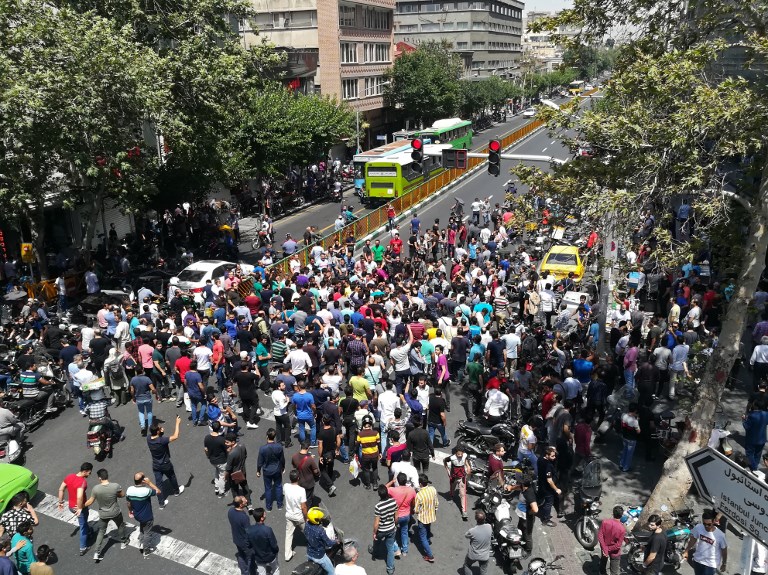
Protests continued in Iran for a second day Tuesday amid an economic crisis that many Iranians are blaming on their government’s foreign policies, even as Tehran dismissed the protests as “foreign media propaganda.”
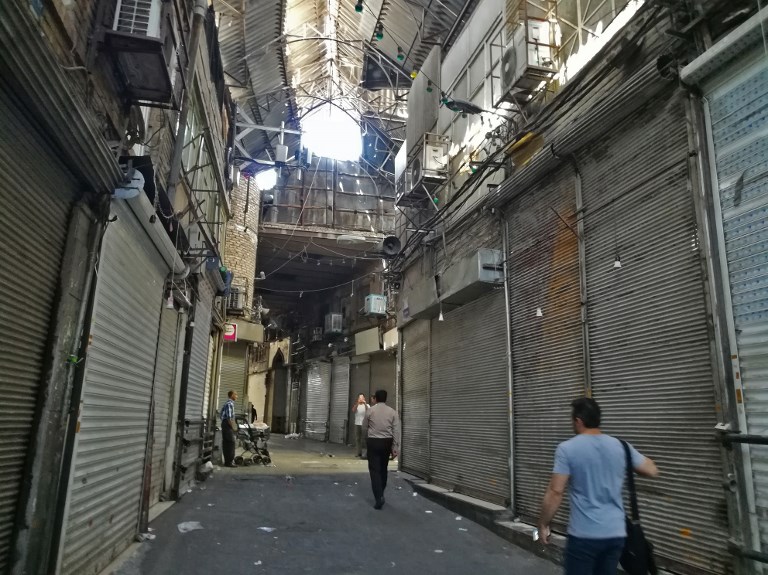
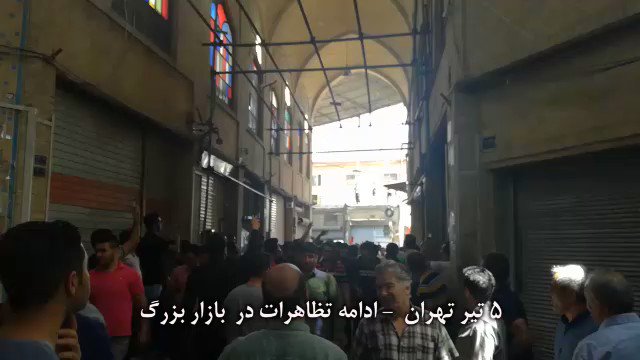
At Tehran’s Grand Bazaar, protesters, including many local shopkeepers, urged owners to close their shops in an expanding strike following the collapse of the country’s currency amid the renewal of US sanctions over the regime’s nuclear program.
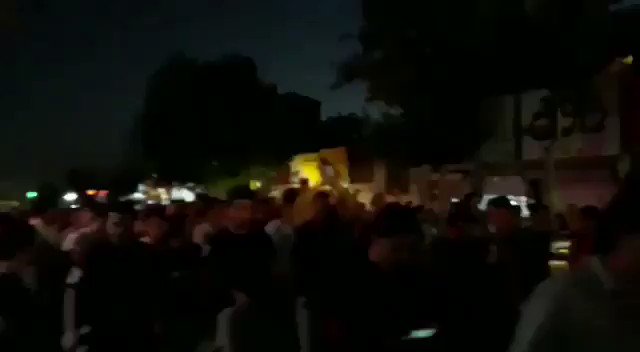
Videos posted on social media showed hundreds of people taking part at the bazaar on Tuesday and hundreds more marching down streets of Tehran.
Iranian President Hassan Rouhani on Tuesday sought to calm growing discontent at the tanking economy, assuring the public the country would be able to withstand the new sanctions imposed by US President Donald Trump in the wake of the American exit from the Iran nuclear deal earlier this year.
In speech broadcast live on state TV, Rouhani blamed the spontaneous demonstrations that erupted across the country a day earlier on “foreign media propaganda,” and accused the US of waging “an economic war” against Tehran.
“Even in the worst case, I promise that the basic needs of Iranians will be provided. We have enough sugar, wheat, and cooking oil. We have enough foreign currency to inject into the market,” Rouhani said according to the Reuters news agency.
The president accused Washington of waging a “psychological, economic and political war” on Iran, and warned it would pay a high price for exiting the 2015 accord that lifted international sanctions in exchange for a scaling back of Tehran’s atomic program.
“Withdrawal was the worst decision he [Trump] could make. It was appalling. It hurt America’s global reputation,” he added. “The US cannot defeat our nation, our enemies are not able to get us to their knees.”
The protests have seen unusual scenes of demonstrators chanting against continued Iranian spending of billions of dollars on regional proxy wars and support for terrorist groups, which many say has meant less investment in the struggling economy at home.
In recent years, Iran has provided financial aid to Palestinian terror groups Hamas and Islamic Jihad, Lebanon’s Hezbollah, Yemen’s Houthi rebels and Shiite militias in Iraq. Since the start of the Syrian civil war in 2011, Tehran has poured a reported $6 billion into propping up president Bashar Assad’s government.
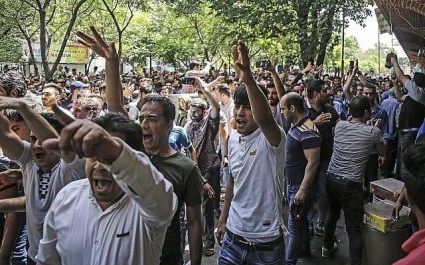
Monday’s protests in Tehran and around the country — including economically hard-hit cities like Kermanshah in western Iran — included shouts of “Death to Palestine,” “No to Gaza, no to Lebanon” and “Leave Syria and think of us.” Chants of “We don’t want the ayatollahs” and “Death to the dictator” were also heard at some rallies.
Police attempted to suppress the Monday protests in Tehran with tear gas, but early reports from Iran on Tuesday seem to indicate the demonstrations are only expanding.
Monday’s protests in Tehran began at the capital’s sprawling Grand Bazaar, which has long been a center of conservatism in Iranian politics and where the ayatollahs’ 1979 Islamic Revolution first gathered pace. Protesters there forced storekeepers to close down their shops.
Masoud Dalvand@Masoud_DalvandJune 26, #Tehran, #Iran
Protesters are chanting shop owners to close their stores:
“Close it, close it” #IranStrikes, #IranProtests continue to #IranRegimeChange & #FreeIran2018
Raman Ghavami@Raman_Ghavami#Iran,
Early morning in Tehran protesters chanting “Iran has become like Palestine,why don’t you stand up people”.
Yesterday protesters in Tehran and Shiraz also chanted “death to Palestine,death to Syria, death to the @bbcpersian.”
A very different picture from Iran.#TehranPars
However, those protests largely struck Iran’s provinces as opposed to Tehran itself. Analysts believe conservative elements in the regime may have encouraged the first protest that took place in Mashhad to try to weaken President Hassan Rouhani, considered a moderate member of the ruling ayatollah class. The protests then spiraled out of control, with people openly criticizing both Rouhani and Supreme Leader Ayatollah Ali Khamenei.
The slogans heard at Monday’s rallies mark a shift in Iranian street protests, where “Death to Israel” and “Death to America” are commonly heard. The protests signaled widespread unease in the wake of US President Donald Trump’s decision to withdraw America from Iran’s nuclear deal with world powers and restore sanctions on the country.
According to Hadashot TV news’s veteran Middle East analyst Ehud Ya’ari, Monday’s protests marked the first time that Iranians have chanted “Death to Palestine” during anti-regime protests.
In the last six months, Iran’s currency has lost almost 50 percent of its value, with the US dollar now buying around 85,000 rials on the open market.
Apart from the rial’s collapse, the Iranian private sector has long been starved of investment, its banking system is crippled by bad loans and record levels of unemployment mean a third of under-30-year-olds are out of work.
Rouhani’s government has struggled with the economic problems, including high unemployment. A government-set exchange rate of 42,000 rials to $1 has generated a vibrant black market. On Monday, state television quoted Iranian Central Bank chief Valiollah Seif as saying the government plans to create a parallel market next week to combat the black market.
Meanwhile, some conservatives have called for new elections or for Rouhani’s civilian government to be replaced by a military-led one. The Fars news agency, believed to be close to Iran’s paramilitary Revolutionary Guard, made a point Monday of publishing an article from the Sobh-e No daily newspaper describing the government as being ready to “bow down to foreign threats and sit at the negotiation table.”
Eshaq Jahangiri, Iran’s first vice president, was quoted Monday as saying, “We’re on the verge of an economic war by an economic terrorist,” referring to the US.
“Conditions will get worse in future,” Jahangiri said, according to the pro-reform Etemad daily newspaper. “Even our friends and neighbors like Russia, China and Europeans can’t help us today.”
Agencies contributed to this report.
Source: Israeli jets strike Iranian cargo plane unloading munitions in Damascus – DEBKAfile

Syrian army sources: Israeli airborne missiles hit an Iranian air force Ilyushin Il-76 cargo plane unloading munitions at Damascus military airport early Tuesday, June 26. The explosions caused the plane to burst into flame with a number of unidentified casualties, according to other sources.
Elsewhere, there were loud explosions just north of Israel’s Golan border with Syria. The Syrian army spokesman said they were caused by Syrian anti-air missiles aimed at intruding Israeli fighter jets over Khader village in the Beit Jinn pocket of Mt. Hermon opposite IDF outposts.
DEBKAfile’s military sources don’t rule out the possibility that the attack on the Iranian cargo plane was conducted by Israel ground-to-ground missiles rather than its air force. This form of IDF attack has recurred in recent weeks against Iranian and Syrian targets across the border.
In a third arena, the Syrian army and a Hizballah-Shiite militia force advanced Tuesday on the Iraqi border and, according to a Syrian military source, captured Post 400 at the provisional border crossing. This opened the door for the entry into Syria a second time of Iraqi Shiite militias under the command of Iran’s Revolutionary Guards. Their previous attempt to cross over on June 17-18 was hammered by the Israeli air force, compelling the Iraqi militiamen to pull back. If the Syrian army’s claim to have seized Post 400 is borne out, then Syria can offer Iran another opportunity for opening up a land bridge from Tehran through Iraq to the Mediterranean and so reverse the effect of the former Israeli action.
Source: Rouhani says Iran will not give in to pressure from Trump – Middle East – Jerusalem Post
On Monday, police patrolled Tehran’s Grand Bazaar as security forces struggled to restore normality after clashes with protesters angered by the rial’s collapse.
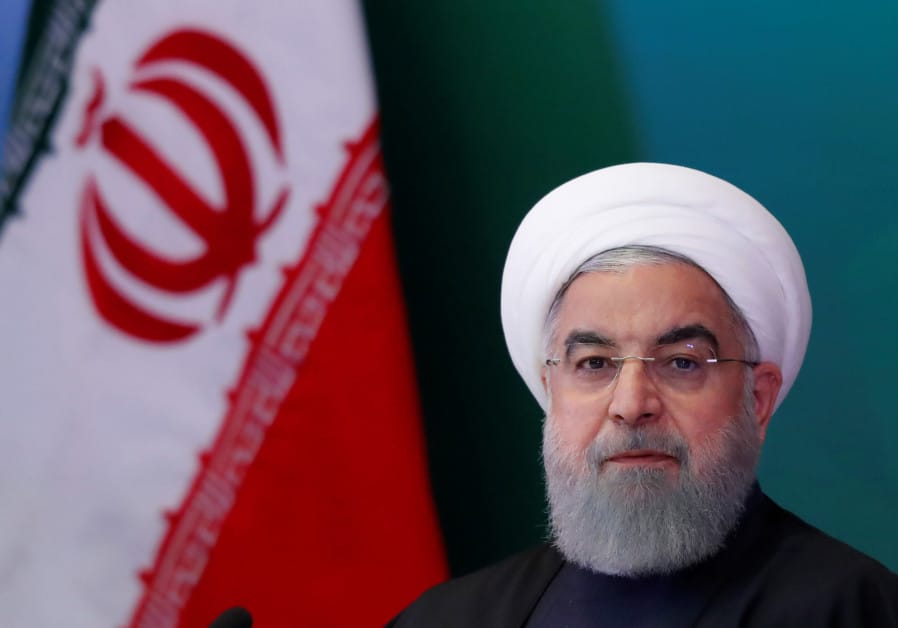
LONDON – President Hassan Rouhani promised Iranians the government would be able to handle the economic pressure of new US sanctions, a day after traders massed outside parliament to protest against a sharp fall in the value of the national currency.
Washington is to start reimposing economic penalties on Tehran in coming months after US President Donald Trump quit an agreement between major world powers and Iran in which sanctions were lifted in return for curbs on its nuclear program.
This may cut Iran’s hard currency earnings from oil exports, and the prospect is triggering a panicked flight of Iranians’ savings from the rial into dollars.
On Monday, police patrolled Tehran’s Grand Bazaar as security forces struggled to restore normality after clashes with protesters angered by the rial’s collapse, which is disrupting business by driving up the cost of imports.
Defending his economic record, Rouhani said the government’s income had not been affected in recent months, and the fall in the rial was the result of “foreign media propaganda.”
“Even in the worst case, I promise that the basic needs of Iranians will be provided. We have enough sugar, wheat, and cooking oil. We have enough foreign currency to inject into the market,” Rouhani said in a speech broadcast live on state television.
The International Monetary Fund estimated in March that the government held $112 billion of foreign assets and reserves, and that Iran was running a current account surplus. These figures suggested Iran might withstand the sanctions without an external payments crisis.
Iran’s judiciary chief warned on Tuesday that the “economic saboteurs,” who he said were behind the fall of rial, would face severe punishment, including execution or 20 years in jail.
“The enemy is now trying to disrupt our economy through a psychological operation. In recent days some tried to shut down the Bazaar, but their plot was thwarted by the police,” Ayatollah Sadeq Larijani was quoted as saying by Fars news agency.
The Iranian government is implementing new plans to control rising prices, including banning imports of over 1,300 products, preparing its economy to resist threatened US sanctions.
Rouhani said the fresh US sanctions were part of a “psychological, economic and political war,” adding that Washington would pay a high price for its actions.
“Withdrawal was the worst decision he (Trump) could make. It was appalling. It hurt America’s global reputation,” he said.
In late December, demonstrations which began over economic hardship spread to more than 80 Iranian cities and towns. At least 25 people died in the ensuing unrest, the biggest expression of public discontent in almost a decade.
Demonstrators initially vented their anger over high prices and alleged corruption, but the protests took on a rare political dimension, with a growing number of people calling on Supreme Leader Ayatollah Ali Khamenei to step down.
Trump has called for a broad review of all US foreign aid, including of aid to the Palestinians.
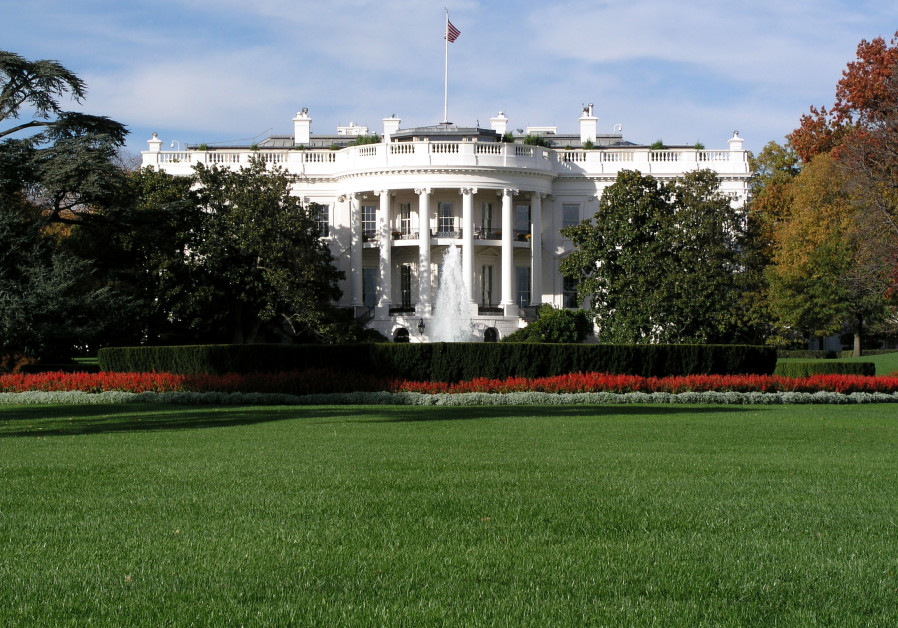
WASHINGTON — The Trump administration is warning Ramallah to end its policy of compensating the families of Palestinians convicted of murder and terrorism in Israel, as it reviews whether to cut foreign aid to the organization.
US officials tell The Jerusalem Post that “nothing has changed” since the president signed into law the Taylor Force Act, a bill that requires the administration to freeze aid to the PA unless it halts the decades-old program.
Months earlier, Trump had called for a broad review of all US foreign aid, including of aid to the Palestinians. But one National Security Council spokesman said on Monday that the new law would tie their hands and require action from Palestinian leadership if they wanted aid to continue unaffected.
“At President Trump’s direction, assistance to the Palestinians remains under review,” the White House official said. “While the Taylor Force Act restricts aid to the Palestinian Authority, with very limited exceptions, the Palestinian Authority has the ability to ease those restrictions by ending the abhorrent policy of inciting violence against Americans and Israelis through payments to terrorists and their families.”
Palestinian officials say the compensation scheme amounts to a welfare program for the families of legitimate combatants in their struggle against Israel. Israel and the Trump administration consider it an immoral practice that incentivizes terrorism against civilians.
An i24News report this weekend claimed that aid had already been frozen pursuant to the Taylor Force Act, which passed in March. A State Department official denied the accuracy of the report.
The Taylor Force law exempts aid for security cooperation and humanitarian assistance, and includes a buffer period for the Palestinians to phase out the program.
A congressional source told the Post that the administration was due to certify the PA’s compliance to the aid terms 30 days after the passage of its omnibus spending bill, which took place in late March.
Israel has regularly refused to confirm or deny mounting overnight raids in Syria.
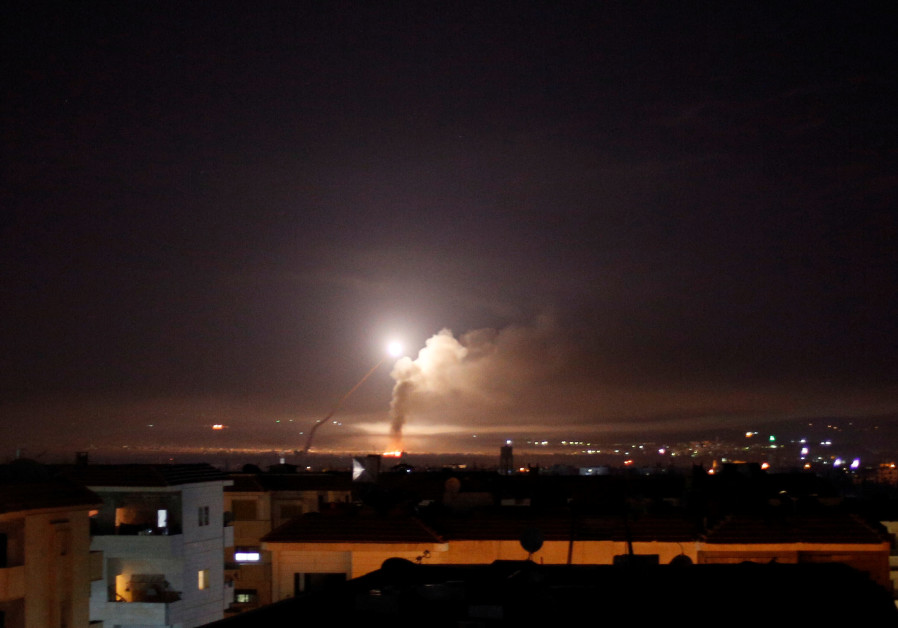
Syrian state TV said late Monday night that two Israeli missiles struck near Damascus international airport, without giving further details.
The pro-Syrian regime online newspaper Al-Masdar News (AMN) cited reports stating that missiles targeted an Iranian cargo plane being unloaded at the airport. According to the reports, regime forces’ air defense systems subsequently intercepted an Israeli drone in south-western Syrian airspace.
The head of the British-based monitoring group Syrian Observatory for Human Rights, Rami Abdulrahman, told AFP that “Israeli missiles hit arms depots for Hezbollah near the airport,” adding that Syrian air defense systems failed to prevent the alleged Israeli strikes.
Israel has regularly refused to confirm or deny mounting overnight raids in Syria, but has repeatedly stated that it is unwilling to accept Iranian military presence in Syria.
In May, however, Israel said it struck 50 Iranian targets in Syria after 20 rockets were fired towards Israel’s front defensive line in the Golan Heights by the Iranian Revolutionary Guard Corp’s Quds Force.
The targets all belonged to the Quds Force and included intelligence sites, logistics headquarters, a military compound and logistics complex in Kiswah near Damascus; weapons-storage sites at Damascus International Airport; and intelligence systems and installations, as well as observation, military posts and military hardware in the buffer zone.
According to the Britain-based Syrian Observatory for Human Rights, at least 11 Iranians were among the 46 killed in Israel’s strikes.
In April, Syria, Iran and Russia all said Israel was responsible for carrying out an attack at the T-4 air base near Homs.
The Syrian Observatory for Human Rights reported that at least 14 people were killed in the strike, with Iran’s semi-official Fars news agency saying that four Iranian soldiers were among the casualties.
The Israeli military last February accused Iranian-backed militias of operating at the base, from where it said an Iranian drone that was shot down over northern Israel had been launched.
Hit ’em hard, my Israeli friends.
And hit ’em where it hurts.
Observer group says reported attack targeted Hezbollah arms depots; Assad forces ‘failed to intercept the missiles’
Syrian state media said early Tuesday that two Israeli missiles struck near Damascus International Airport, without adding any details.
In a report in the early hours of Tuesday, Syria’s state news agency said “two Israeli missiles came down near Damascus international airport.”
The head of monitoring group Syrian Observatory for Human Rights, Rami Abdel Rahman, also said that “the Israeli missiles hit arms depots for Hezbollah near the airport.”
He said the air strike took place at 1:00 am local time “without causing huge explosions” even though they hit the weapons stores.
The observatory added that the Syrian air defense “failed to intercept the missiles.”
Israel has warned of a growing Iranian military presence in neighbouring Syria, which it sees as a threat to its safety.
Its military has been carrying out strikes on Iranian and Iran-affiliated targets in Syria, with a US official saying it was Israeli forces that carried out a deadly strike against an Iraqi paramilitary base in eastern Syria on June 17.
On Sunday, forces loyal to the regime of Syrian strongman Bashar Assad reportedly took control of an abandoned UN post in the no-man’s land between the Israeli and Syrian areas of the Golan Heights.
The post, abandoned by United Nations Disengagement Observer Force (UNDOF) troops on the Golan, is meant to be free of both Israeli and Syrian troops, according to the cessation of hostilities agreement between the two countries that followed the 1973 Yom Kippur War.
According to the report, UNDOF has identified ongoing infrastructure work at the site.
The IDF said in a statement that it was “aware of what is taking place, and views [the takeover of the site and] the infrastructure work at the post as a serious and flagrant violation of the separation-of-forces agreement.”
The IDF statement suggested Israel might act to remove the forces from the post by force. Officials told the Kan broadcaster that Israel “sees UNDOF as responsible for tracking and acting against military forces in the separation zone, and is determined to prevent military entrenchment in that area.”
The report came just hours after an Israeli Patriot missile was fired at a drone that approached from Syria toward Israel’s airspace. Israeli officials believe the drone belonged to regime forces.
According to Hebrew-language reports, the IDF is bracing for an uptick in fighting in Syrian areas adjacent to the Israeli border, and expects incidents of stray fire to enter Israeli territory.
As fighting between the main factions in the Syrian civil war threatened to overwhelm UNDOF positions, the UN troops left the demilitarized buffer zone for Israel in 2014.
Source: Tehran’s Grand Bazaar Shut Down As Economic Protests Spread – Bloomberg Quint
Bloomberg) — Traders in Tehran’s Grand Bazaar shut their stores to protest rising prices and the weakening of Iran’s currency, official news agencies reported, as Iranian officials took action to allay concerns that an economic crisis was looming.
Retailers and gold sellers kept away from the bazaar to gather at main meeting places, according to the semi-official Fars News agency. They said they were afraid they’d lose money if they kept their shops open, according to Fars. Security forces were sent to the bazaar and surrounding areas to maintain order, the semi-official Iranian Labour News Agency reported.
The protests erupted the same day the Central Bank of Iran said it would set up a secondary foreign exchange market next week to ease the dollar shortage that is likely to worsen as U.S. sanctions resume. The market’s introduction is the latest in a series of steps Iran has taken to cushion the sanctions’ impact.
Iran’s fragile economy, long hurt by international sanctions, mismanagement and corruption, has gone into a downward spiral in recent months in anticipation of the U.S. pullout from the 2015 nuclear deal. The rial has plunged against the dollar, inflation was 9.7 percent in May, and the country is in the throes of a credit crisis, provoking sporadic anti-government protests.
Even before the U.S. withdrew from the accord in May, Iran’s central bank imposed tight restrictions on foreign currency transactions in an effort to shut down a flourishing black market and prop up the rial. Last week, Iran banned import of 1,400 foreign non-essential and luxury goods to reduce the amount of foreign currency leaving the country.
Illegal trade has continued to persist as people seek sanctuary in foreign currency. Some official news sites reported that the dollar was selling for almost 80,000 rials last week, compared with 60,000 rials in April, but both currency and gold coin markets appeared to welcome the central bank move, according to the semi-official Tasnim News, which cited trade on the unofficial, illegal markets.
The rial is sinking mainly because Iranians fear for their economic future and the fate of the nuclear deal, according to Masoud Gholampour, an analyst at Novin Investment Bank in Tehran. He said people were “panic-buying” foreign currency on the black market.
“It’s not a crisis yet because Iran is still importing less than its exporting for now,” Gholampour said. ‘The problem is that there is a black market and what the Central Bank is doing is trying to fight this.”
By Becca Noy

Russian Foreign Minister Sergei Lavrov. The Kremlin.
Russia’s top diplomat, Sergei Lavrov, said on Monday that only Syrian Army troops should be positioned along Syria’s southern border with Israel and Jordan, Reuters reported, citing the Russian RIA news agency.
Lavrov’s statement, which was made during a joint press conference in Russia’s capital with his counterpart from Mozambique, comes amid numerous meetings between Israeli Prime Minister Benjamin Netanyahu and Russian President Vladimir Putin about the countries’ security coordination in the Middle East. In addition, several recent attacks in Syria have been attributed to Israel by foreign media, Iran and Syria.
On Sunday, Israeli Prime Minister Benjamin Netanyahu slammed Iran and its presence in Syria. “We are countering the Iranian military buildup in Syria that targets us and we are also acting against the [attempts to] transfer dangerous weapons from Syria to Lebanon,” Netanyahu stated at the beginning of this week’s government meeting. “All of these weapons are designated for use against the State of Israel, and it’s our right, as part of the right of self-defense, to prevent their production or transfer.”
“The regime in Tehran is the main factor that disrupts the stability in the Middle East,” he added. “The fight against its aggression hasn’t ended yet—we are still in it.”
Earlier this month, Netanyahu warned the leaders of Greece and Cyprus about Iran’s ongoing efforts to expand its influence in the Middle East and threaten Israel’s existence. “[Tehran] openly calls daily for our destruction, the elimination of Israel from the face of the earth, and it practices unmitigated aggression against us and against anyone else in the region,” he said while in Cyprus for a summit with the leaders. “It has a terror network that is spread throughout the world. It is now seeking to implant very dangerous weapons in Syria to be used against Israel for the specific purpose of our destruction.”
Arab nations will be ready to back Trump’s Israeli-Palestinian peace initiative with or without the cooperation of the Palestinian president.
June 25, 2018
By: World Israel News Staff
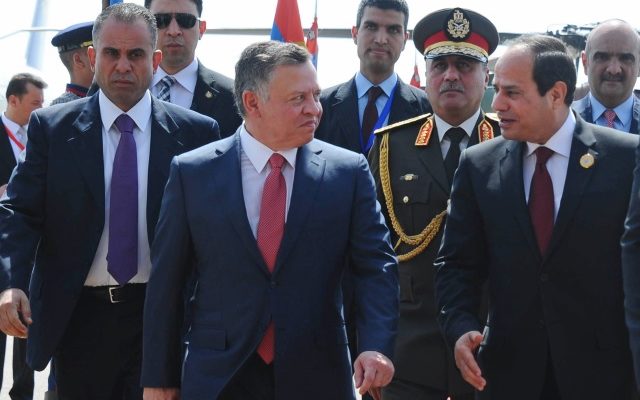
Egyptian President al-Sissi (R) and Jordan’s King Abdullah. (AP/MENA)
Arab nations informed US President Donald Trump’s Middle East envoys that they would back a US peace plan for Israel and the Palestinians regardless of whether Palestinian Authority President Mahmoud Abbas agrees to discuss it, according to a report by Israel Hayom.
Senior officials in Egypt, Jordan, Saudi Arabia and the United Arab Emirates met with White House adviser Jared Kushner and US Special Representative for International Negotiations Jason Greenblatt in recent days and reportedly conveyed this message.
They also said they have become fed up with Abbas’ rejectionism.
Kushner expressed a willingness to bypass Abbas in an interview that appeared this week with Al-Quds, a Palestinian newspaper.
“Despite the strategic mistakes made by Abu Mazen [Abbas] and his people,” an Egyptian official said, “Kushner and Greenblatt were told, in no uncertain terms, that the Palestinians deserve an independent Palestinian state with east Jerusalem as its capital.”
According to the official, ”Kushner agreed to the Arab nations’ demand and made it clear during his meetings with [Jordan’s] King Abdullah and [Egyptian] President [Abdel-Fattah] el-Sissi that the interests of the Palestinian people will not be harmed if the regional peace plan is introduced without the Palestinian leadership’s cooperation.”
Abbas has declared that he would refuse to meet with Trump’s envoys after Trump officially recognized Jerusalem as Israel’s capital in December and relocated the American Embassy to Jerusalem.
A top Egyptian official told Israel Hayom Sunday that the moderate Arab nations’ position was ”unanimous” and that Cairo, Amman, Riyadh and Abu Dhabi would not oppose an attempt by Washington to go over Abbas’ head in this case.
However, officials in all four nations made it clear to both American envoys that they would not be party to any deal that compromises Palestinian interests.




 anneinpt
 artaxes
 danmillerinpanama
 davidking1530
 Peter Hofman
 Joseph Wouk
 Peter
Peter Louisiana Steve




Recent Comments