Trump and Putin praise Israel in Helsinki, diverge on Syria and Iran

Posted July 17, 2018 by Joseph Wouk
Categories: Uncategorized

Source: Trump and Putin praise Israel in Helsinki, diverge on Syria and Iran – Israel News – Jerusalem Post

Trump spoke as “we,” which apparently indicated Moscow and Washington both working with Israel and “Israel working with us.”

BY SETH J. FRANTZMAN
 JULY 17, 2018 17:50
U.S. President Donald Trump receives a football from Russian President Vladimir Putin

US President Donald Trump and Russian President Vladimir Putin discussed Israel, Syria and Iran in their meeting in Helsinki and in subsequent comments to the press. The public comments provide some insight into their view of the future of the Middle East. With the Syrian regime conducting a major offensive in the south and the US deeply involved in eastern Syria, while Israel demands the Iranians leave, this was a central topic of concern in Helsinki.

Trump went first with a discussion of Israel. According to a transcript published by NPR he said, “we’ve worked with Israel long and hard for many years.” He pointed out that the US has never been closer to Israel than it is today. “President Putin also is helping Israel and we both spoke with [Prime Minister Benjamin] Bibi Netanyahu and they would like to do certain things with respect to Syria, having to do with the safety of Israel.” He spoke as “we,” which apparently indicated Moscow and Washington both working with Israel and “Israel working with us.” He continued, “I think they’re working with Israel is a great thing and creating safety for Israel is something bother President Putin and I would like to see very much.”

Putin argued that Russia was helping to “crush terrorists in the southwest of Syria.” He mentioned the 1974 ceasefire lines on the Golan. “This will bring peace to Golan heights and bring a more peaceful relationship between Syria and Israel and also to provide security for the state of Israel.” He said that he paid “special attention” to the issue when sitting with Trump.

The two also discussed the future of Syria. Trump claimed that the US military was successfully coordinating with Russia in Syria.

“Our militaries do get along very well,” he said. Putin said that Russia was working to establish peace and reconciliation. “Russia and the United States apparently can act proactively and take leadership on this issue.” He emphasized the coordination between the US and Russian militaries in Syria helped avoid “dangerous incidents and unintentional collisions.”

Putin elaborated that the crucial issue now was relating to refugees in Turkey, Lebanon and Jordan. “If we help them, the migratory pressure upon the European states will drop.” He mentioned that Russia was working closely with Turkey and Iran, “so that we will be able to maximize our fighting change together for ultimate success in the issue of Syria.”

Putin shrugged off a question about the “ball” being in Russia’s court in terms of deciding what’s next in Syria. He said he would hand the ball to Trump, and made a joke about the World Cup. Trump agreed that humanitarian concerns were a key for the people of Syria.

On Iran, Putin said that the Iranian nuclear deal had helped ensure the peaceful nature of the Iranian nuclear program.” Trump emphasized the need to pressure Iran and “stop its campaign of violence throughout the area, throughout the Middle East.” The US President then said that the US would not allow Iran to benefit from the defeat of ISIS.  Trump claimed ISIS had been defeated 99%. He said Russia was helping.

So what was said and unsaid? Both Putin and Trump appeared to understand and to some extent support Israel’s concerns regarding Syria. They were keyed in to Jerusalem’s policy, which has included airstrikes on Iranian threats in Syria over the last six years. The use of the word “us” and “we” to describe Israel’s relationship with Moscow and Washington points to an unprecedented level of understanding between Jerusalem and the two world powers. Probably never before have Moscow and Washington been closer in terms of listening to Israel’s concerns. The fact that both Washington and Moscow have their own agendas in Syria, neither of which always mesh with Israel’s agenda was left unsaid. The fact is that Russia cannot remove Iran from Syria, which is Israel’s main goal. Washington also has not committed to a mission to rollback Iran in Syria, still concentrating resources on defeating ISIS.

Putin sees Iran as an important player in the region and not as an adversary. He would like to work more closely with Turkey as well. Trump meanwhile is adamantly opposed to Iran. Here the two leaders expressed differences. Putin was noticeably tight lipped about his views of Tehran’s policies. This could point to growing daylight between Moscow and Iran but it more likely points to Putin’s tendency towards generalization that allows Russia more room to maneuver. The US prefers clearly stated goals, while Russia prefers the veneer of discussion international law, while the opaque nature of Moscow’s actual policy relating to Iran in places like Syria.

Overall the meeting between the two leaders was weak on substance. Prior to the summit some in Israel had pushed stories about Russia agreeing some sort of concept where Iran leaves Syria when the conflict is done. But after Netanyahu’s meeting with Putin and then after Trump’s meeting it is clear that there will be no clear comment about Iran’s future role in Syria, or about Israel’s continued opposition to any Iranian forces remaining.

Fighter Showdown: Air Force F-22 Raptor vs. F-14 Tomcat (That Iran Still Flies)

Posted July 17, 2018 by Louisiana Steve
Categories: U.S. Air Force

Tags:

by TNI Staff July 18, 2018 The National Interest

Source Link: Fighter Showdown: Air Force F-22 Raptor vs. F-14 Tomcat That Iran Still Flies

{I feel the need for speed. – LS}

Even if the Raptors had run out of AMRAAMs and were forced to engage within visual range, the F-22s can use their stealth to close in unobserved to less than 1000ft to either kill the F-14s with Raytheon AIM-9X Sidewinders or 20mm Vulcan cannon fire. Indeed, F-22 pilots flying during exercises such as Red Flag or Northern Edge will often sneak into guns range to make unobserved kills from very close distances by taking advantage of the Raptor’s stealth. More often than not, the Raptor’s quarry is caught completely unaware.

With the United States withdrawing from the Joint Comprehensive Plan of Action nuclear deal with Iran, a war with Tehran seems to be a distinct possibility.  In the event of a military conflict between Washington and Tehran, there is also the ever growing possibility that the White House might seek regime change in Iran.

A full-scale military campaign against Iran would require the United States to destroy the Iranian air force—which to this day flies American-built warplanes. The best of Iran’s decrepit fighter aircraft fleet is the Grumman F-14 Tomcat. The Imperial Iranian Air Force purchased 80 of the powerful fourth generation fighters before the 1979 Islamic revolution, but deliveries were halted at 79 aircraft. Additionally, Iran had purchased 714 Hughes (now Raytheon) AIM-54A Phoenix long-range semi-active/active radar guided air-to-air missiles, which have a range of roughly 100 nautical miles.

When the F-14A was developed, it was amongst the most capable fighters developed by the United States during the late 1960s. The jet entered service with the U.S. Navy in 1974 equipped with the AWG-9 long-range pulse Doppler radar, which had a range of over 115 nautical miles and was the first American radar set to incorporate a track while scan mode to allow for a multiple shot capability. Coupled with the AIM-54, the AWG-9 could target six enemy bombers simultaneously. On paper, the Tomcat provided the fleet with a potent capability—though the reality did not quite meet the Navy’s public relations hype.

Iran has upgraded its Tomcats with new avionics and potentially new weapons, but only a handful of Tehran’s F-14s are in flyable condition—perhaps as few as 20 aircraft. However, other than perhaps 20 Russian-made Mikoyan MiG-29 Fulcrums, the venerable Tomcat is the Islamic Iranian Air Force’s most capable fighter. In the event of a war, the F-14 would be Iran’s first line of defense against an American onslaught.

The stealthy Lockheed Martin F-22A Raptor air superiority fighter would almost certainly lead an American attack. Compared to the antiquated F-14, the Raptor is a technological marvel and is equipped with some of the most sophisticated sensors ever developed for a military aircraft.

The F-22 combines extreme stealth and sustained supersonic speed—it can cruise at just above Mach 1.8 without afterburners—with integrated avionics and extreme agility. The Raptor’s Northrop Grumman AN/APG-77 (V)1 active electronically scanned array radar and ALR-94 passive electronic support measures suite would spot an F-14 from many tens of nautical miles away before the Tomcat had any idea that an F-22 was in the vicinity.

The Raptor, having detected a flight of Iranian F-14s and given the go-ahead to engage, would likely turn toward the enemy and launch its Raytheon AIM-120D AMRAAM missile—which reported has a range of 96 nautical miles when launched from a conventional fighter—from high supersonic speeds exceeding Mach 1.5 and at altitudes well above 50,000ft. It would be all over for the Iranian F-14s before anyone in the enemy formation would have any idea they were under attack.

Even if the Raptors had run out of AMRAAMs and were forced to engage within visual range, the F-22s can use their stealth to close in unobserved to less than 1000ft to either kill the F-14s with Raytheon AIM-9X Sidewinders or 20mm Vulcan cannon fire. Indeed, F-22 pilots flying during exercises such as Red Flag or Northern Edge will often sneak into guns range to make unobserved kills from very close distances by taking advantage of the Raptor’s stealth. More often than not, the Raptor’s quarry is caught completely unaware.

However, if by some bizarre circumstance the F-22 is embroiled in a dogfight with the F-14, the chances are the Raptor will kill the Tomcat unless the American pilot suffers from extremely bad luck or makes a serious error. The Raptor holds all of the cards in terms of instantaneous and sustained turn rates—which in the F-22’s case is greater than 30 degrees per second—and energy addition. The Raptor’s incredible specific excess power and sheer maneuverability combined with its new AIM-9X missiles makes it so that the odds are grotesquely stacked in the F-22 pilot’s favor. It would be like clubbing a baby seal.

Of course, that’s just in the case that Iran’s leaders are foolish enough to take the United States head on. It would be much smarter for Iran to use asymmetric means to take on the United States instead of challenging America in the air.


Netanyahu’s secret consent to hand Golan crossing to Syria led to Trump-Putin deal on Israel’s border security 

Posted July 17, 2018 by Joseph Wouk
Categories: Uncategorized

Source: Netanyahu’s secret consent to hand Golan crossing to Syria led to Trump-Putin deal on Israel’s border security – DEBKAfile

DEBKAfile Exclusive: Presidents Donald Trump and Vladimir Putin joined in their support for Israel’s security at their Helsinki summit on Monday, July 16, after Prime Minister Binyamin Netanyahu told them both that he had withdrawn his objections to the Syrian army reinstating its line of outposts in the Quenitra district, including control of the Ein Zivan-Quneitra border crossing.

This is the only transit point between Israel and Syria. Our sources reveal that Putin insisted on the Syrian army assuming control of this crossing, in the same way as he stipulated the handover to Syria of the Nassib crossing to Jordan.

Monday morning, the Syrian army captured the strategic Tel Al Harrah hills from rebel hands. That line of hilltop positions is the key to controlling the Quneitra district. Our military sources note that only 20 percent of the Syrian army consists of Syrian troops; the other 80 percent are Hizballah and other Shiite militias loyal to Iran. Today’s Syrian and allied victory therefore brings these hostile forces to within 3-4 km from Israel’s Golan border.

Up to 22 killed, including 9 Iranians, in Syria strike blamed on Israel – report

Posted July 17, 2018 by davidking1530
Categories: Uncategorized

https://www.timesofisrael.com/up-to-22-killed-including-9-iranians-in-syria-strike-blamed-on-israel-report/

Earlier, the Syrian Observatory for Human Rights put the death toll at 9, said raid targeted an Iranian Revolutionary Guard center

Syrian rebel forces claimed that 22 people, including nine Iranians, were killed in an overnight strike in northern Syria blamed on Israel, the Qatar-based al-Jazeera network reported Monday.

An Israeli F-16 during an exercise on November 25, 2013. (Ofer Zidon/Flash90)

The figure, which could not be confirmed, was much higher than an earlier report of nine deaths provided by a Syrian watchdog group.

The al-Jazeera report did not cite its sources or give any further details.

Syrian state media has accused Israel of carrying out the bombing of a military position in Aleppo province late Sunday, in what would be a rare Israeli attack so far north in the war-ravaged country.

“The Israeli missiles targeted an Iranian Revolutionary Guard center, near the Neyrab military airport,” said Rami Abdel Rahman, the head of the Syrian Observatory for Human Rights, a Britain-based monitor.

He said those killed included at least six Syrians, but could not specify the nationalities of the remaining fighters.

The position is a logistics hub used to provide equipment and food to pro-regime forces fighting at nearby fronts, but it did not store weapons, Abdel Rahman said.

Earlier Monday, the country’s official news agency SANA reported there was only damage to the site, identified as the Al-Nayrab airbase, adjacent to Aleppo’s international airport.

“The Zionist enemy (Israel)… targeted with its missiles one of our military positions north of the Nayrab military airport, but the damage was only material,” SANA said citing a military source.

Al-Nayrab has in the past been linked with Iran’s Islamic Revolutionary Guards Corps militia.

The Observatory, which relies on a network of sources inside the country, said it had recorded a wave of blasts around Nayrab on Sunday night.

It said that a suspected Israeli missile strike had targeted “positions held by Syria’s regime and its allies at the Nayrab airport” and its surroundings.

The base was reportedly previously struck by Israel on April 29 as part of a large raid that also targeted weapons depots near Hama.

There was no immediate comment from Israel, which rarely confirms such attacks.

Suspected Israeli airstrikes have hit Syrian army positions near Damascus and in the central provinces of Homs and Hama in the past. However, they rarely occur as far north as Aleppo.

The raid came hours before a high-stakes summit between Russian President Vladimir Putin and US President Donald Trump, where Syria and Iran are expected to be on the agenda.

Israel has been pushing Russia to remove Iranian-aligned militia fighters from Syria, and has vowed to stop them from getting a foothold anywhere in the country. Russia has reportedly only agreed to removing them from the Golan border region.

Prime Minister Benjamin Netanyahu, who met with Putin in Moscow last week, said Sunday he had discussed the issue with Trump a day earlier.

Netanyahu reportedly told Putin during their Wednesday meeting that Israel would not challenge Assad’s control of Syria, in exchange for freedom to act against Iran.

On July 8, Israel was accused of carrying out an airstrike on the T-4 military base near Homs, also thought to be used by IRGC fighters.

IDF: Hamas Plans to Strike Israel with Exploding Drones

Posted July 17, 2018 by Louisiana Steve
Categories: Hamas

Tags:

Investigative Project on Terrorism News July 16, 2018

Source Link: IDF: Hamas Plans to Strike Israel with Exploding Drones

{If Hamas is successful, it will be their own undoing. – LS}

As Israel moves more Iron Dome anti-missile batteries to its border with Gaza, Hamas terrorists are moving forward with plans to spread their arson-by-air attacks deeper into the country. Israel held an emergency cabinet session Sunday after another Hamas provocation over the weekend. Israel’s military hit dozens of Hamas targets in Gaza after terrorists launched an estimated 200 missiles at Israeli communities on the border.

According to Palestinian media reports, Israel also deployed three drones to strike Palestinians launching incendiary kites and balloons, wounding three terrorists.

“It’s important to emphasize that we have no intention of tolerating this – not rockets, not kites, not drones – nothing,” warned Israeli Defense Minister Avigdor Liberman during the cabinet meeting.

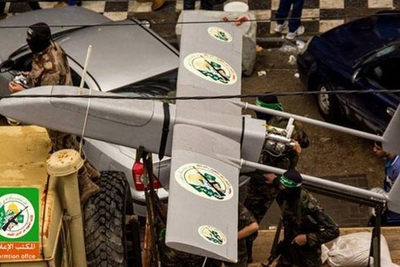
For years, Hamas has been diverting resources intended for civilian re-building efforts in Gaza to enhance its military capabilities, including a growing drone program. Hamas, like other terrorist groups, has used drones for a variety of purposes including attacks, reconnaissance, and testing state air defenses. In the past, Hamas hasdeployed several drones to infiltrate Israel and exploited these incidents as propaganda victories. Now Hamas may have found another potential use for drones: to enflame its arson terror campaign.

Looking beyond incendiary kites and balloons, Israeli defense officials believe that Hamas wants to deploy exploding drones to increase the organization’s arson-based terrorist efforts.

According to an Israel Hayom report, Hamas is preparing to mount explosive material on unmanned aerial vehicles to target Israel communities situated deeper into the country. The terrorist group has also already started to affix timers to incendiary aerial devices, to delay their detonation and maximize damage to Israeli land.

Public Security Minister Gilad Erdan warned that “we are seeing an obvious trend” and that Hamas operatives “are constantly increasing their kites’ range and they are using ‎other airborne devices” which “may even reach Judea ‎and Samaria (West Bank).”

Previous reports pointed to Iran building a fleet of suicide drones for its main terrorist proxies, including Hamas, to assemble and launch kamikaze style attacks. But Hamas also maintains an increasingly sophisticated domestic drone program as well.

Israel’s national security is threatened by several militant groups with established drone programs on its borders, including Hizballah, the Islamic State, and al-Qaida’s affiliate in Syria. Even Iran’s Islamic Revolutionary Guard Corps (IRGC) now threatens Israel directly by deploying drones into its airspace to test Israel’s resolve.

Like Iran, Hamas is attempting to create “new rules of engagement” in its war against Israel. The terrorist organization recognizes that Israel’s military will likely avoid direct responses against terrorist cells launching incendiary aerial devices into Israel territory.

Israel’s air force struck several Hamas military targets after terrorists deployed incendiary kites and balloons that caused severe fires in Israeli communities on the Gaza border. Hamas escalated the violence last month by launching 45 mortar shells and rockets at Israel. Similar tit-for-tat incidents have emerged since Hamas began encouraging and planning this new method of arson terrorism during the violent border riots on the Gaza border at the end of March.

Many of these devices continue to land on Israeli territory, sparking destructive fires that burn thousands of acres of crops and natural forest area. Containing the fires is amajor strain on Israel’s resources and significantly disrupts civilians’ lives. Israel has largely relied on firing warning shots at Palestinians launching incendiary devices.

On Sunday, Israel’s security cabinet directed the military to adopt tougher countermeasures against Hamas’ use of arson terrorism. But considerable debate within Israel’s security establishment remains on how to tackle the threat.

In a reportedly heated exchange on Sunday, IDF Chief of Staff Gadi Eisenkot challenged Education Minister Naftali Bennett’s push to allow the military to directly target cells launching incendiary aerial devices – a more aggressive policy than the current use of warning shots. Eisenkot allegedly argued that lethal force in this situation is immoral.

Israel has increasingly relied on drones in an attempt to take down incendiary kites and balloons. There may be an emerging “drone, counter drone” struggle between Israel and its terrorist enemies – similar to the dynamic between the United States and global jihadists. To address the wider UAV terrorism threat, Israel has reportedly assassinated key drone experts abroad, while continuing to target enemy UAV storage facilities in airstrikes and intercepting shipments of UAV-related material to terrorist organizations.

UAV terrorism will grow as the technology becomes less expensive and more effective. A sophisticated militant organization should have no issues launching explosives-laden drones. The Islamic State, for example, deployed its first suicide drone attack using a modified commercial UAV.

Amid Hamas’s new provocative strategy, Israel will continue evolving its efforts to counter emerging terrorist threats – including drone-based arson attacks.

A brave statement from MR president Trump !

Posted July 16, 2018 by Peter Hofman
Categories: Uncategorized

Let this be cast in gold !

I would rather take a political risk in pursuit of

peace than risk peace in pursuit of politics,”

he said.


Trump: Israel’s Safety Important to Both US, Russia

Posted July 16, 2018 by Peter Hofman
Categories: Uncategorized

Trump: Israel’s Safety Important to Both US, Russia

U.S. President Donald Trump told reporters in Helsinki following his talks with Russia’s President Vladimir Putin on Monday (July 16) that Israel’s safety is important to both world leaders.

Speaking at a joint news conference together with Putin after the summit, Trump said bluntly in response to a question about Syria, “President Putin also is helping Israel. And we both spoke with Bibi Netanyahu, and they would like to do certain things with respect to Syria, having to do with the safety of Israel.

“So in that respect we absolutely would like to work in order to help Israel, and Israel will be working with us, so both countries would work jointly.”

Trump said that a great deal of progress has been made in in certain sections of Syria with the “eradication of ISIS, we’re about 98 percent, 99 percent there,” adding that Russia had helped the United States with, “in certain respects.”

He went on to say, “Working with Israel is a great thing and creating safety for Israel is something that both President Putin and I would like to see very much.”

Israel said planning measures to restrict Erdogan’s influence in Jerusalem

Posted July 16, 2018 by Peter Hofman
Categories: Uncategorized

By – on

https://gellerreport.com/2018/07/israel-planning-erdogan.html/

After of century of Ataturk — separation of mosque and state — a once-prospering and modern Turkey has been dragged back to stone ages by deeply devout monster Recep Tayyip Erdogan. Islamic Jew-hatred — it’s in the Quran. Erdogan, a vicious anti-semite and former President Obama’s closest friend among world leaders, has based much of his presidency on Islamic Jew-hatred, counting on its popularity in the Muslim country (Mein Kampf has been a number one bestseller in Turkey for years) to secure the popularity of his regime. He has embarked upon the rapid re-islamization of Turkey, which is popular with many Turks outside Istanbul and Ankara despite his war on freedom and his people.

“Israel said planning measures to restrict Erdogan’s influence in Jerusalem,” Times of Israel, July 7, 2018 (thanks to Mark):

Israel is considering restricting the activities of Turkey’s international aid agency in Jerusalem and the Palestinian territories in an effort to counter President Recep Tayyip Erdogan’s reported efforts to extend his influence in East Jerusalem, Hadashot news reported Saturday.

The National Security Council has drafted possible measures to be taken against the Turkish Cooperation and Coordination Agency (TIKA) that operates in East Jerusalem, the West Bank, and the Gaza Strip.

According to the report, Israeli intelligence officials believe that TIKA has hosted members of the Islamic Movement at their offices, and that several of its employees transferred funds and information to the Hamas terrorist group.

Among the measures under consideration was imposing a general restriction on all TIKA actives or requiring the agency to obtain individual permits for each project.

Hadashot said Israel’s suspicions of TIKA were intensified by the recent uptick in Erdogan’s anti-Israel rhetoric.

Last month, the Haaretz daily reported that Jordan, Saudi Arabia, and the Palestinian Authority were urging Israel to act against Erdogan’s efforts in East Jerusalem.

The report said Turkish Islamic associations in recent years have been sponsoring an increasing number of programs and trips for thousands of local Palestinians, and had a strong influence in the protests around the Temple Mount.

According to the Turkey’s Daily Sabah, TIKA has carried out 400 aid projects that include restoration work on the Dome of the Rock, and a new dorm room for female student’s at Ramallah’s Al-Quds University.

One Israeli official told Haaretz in June that Turkey was attempting to purchase property through government charities, and that the Palestinian Authority was weary of “having another landlord in East Jerusalem.”

Diplomats told the paper that Jordan began expressing concern to Jerusalem over a year ago and accused it of “being asleep at the wheel,” since singing the reconciliation agreement with Turkey in 2016.

Riyadh meanwhile is said to be worried that Erdogan will attempt to use his influence in Jerusalem to claim himself the custodian of the Muslim sites in the city, cementing his increasing authority over the Arab-Muslim world.

Relations between Jerusalem and Ankara imploded in 2010, following an Israeli naval raid on a Turkish ship trying to breach Israel’s blockade of the Hamas-controlled Gaza Strip. The raid, in which IDF commandos were attacked by activists on board, left 10 Turks dead and several soldiers wounded.

In May, relations between Israel and Turkey sank to a fresh low point after expelling each other’s envoys amid an acerbic war of words following deadly clashes on the Gaza Strip border.

Erdogan took to social media to accuse Israel of being “a terror state” that was committing “genocide” against Palestinians….

Cold War ended, difficulties in Russia-US relations don’t have any objective reasons – Putin

Posted July 16, 2018 by Peter Hofman
Categories: Uncategorized

https://www.rt.com/news/433391-putin-trump-helsinki-meeting-cold-war/
There are no objective reasons for Moscow and Washington not to get along, said Russian President Vladimir Putin speaking first after more than three hours talks with US President Donald Trump.

“We’ve reviewed the current status and prospects of the Russia-US ties, key issues of the international agenda. It’s obvious that the bilateral relations are undergoing a difficult stage, but these difficulties, tensions between our countries have no objective reasons. The era of ideological confrontation between our countries is long gone, the situation in the world has changed drastically,” Putin said.

The talks reflected “shared wish” of the two presidents to fix the US-Russia relations and envision the first steps to do so, Putin added.

The US and Russia are facing new challenges nowadays, differing drastically from the ones of the Cold War era, Putin said, naming regional conflicts, spread of terrorism, organised crime, ecology and economy risks.

Trump again asked his Russian counterpart on the alleged Russian meddling into the 2016 presidential elections, Putin revealed, stating that he replied exactly the same, as the last time. Russia has not meddled into the internal affairs of the US, he stated, adding that if any real evidence is provided, Moscow will cooperate on it.

Russia’s President described the talks with his US counterpart as “constructive and sincere,” adding, however, that such meeting was not enough to address “everything piled up.”

DETAILS TO FOLLOW

Peter Hofman

Posted July 16, 2018 by Joseph Wouk
Categories: Uncategorized

Displaying P1010584.JPG

It is time .

It is time to introduce myself a little bit more , and stop using that nick of my , there is no need for it anymore .

Ok, here we go .

My Name is Peter Hofman married for 37 years and 47 years together with my wife , friend and blood brother Fran .

I am 62 years old, and we are native Dutch and I have Jewish roots from my father’s side .

I am interested and discussing politics , social, social economics and religious matters for a LONG, long time .

Basically it was an important part of my youth and later life .

I am Technicaly educated in electronics, pneumatic and electrical, special in control systems for factories, ships, yachts and so on and have knowledge about quality measurements .

Worked in many places around the world as trouble shooter, quality inspector and construction supervisor .

Now I am retired and enjoy life with my wife , 3 dogs and a cat .

I was honored when Joseph asked me to help him with his site and I will continue to do my part as long it is given .