The Missile Arsenal at the Heart of the Israeli-Iranian Rivalry

Posted August 8, 2018 by Joseph Wouk
Categories: Uncategorized

Source: The Missile Arsenal at the Heart of the Israeli-Iranian Rivalry

Highlights
  • Iran and Hezbollah will continue efforts to enhance their missile and artillery capabilities by threatening Israel where it is most vulnerable; in the economic realm.
  • In response, Israel will seek to lobby Washington and Moscow to restrict Tehran’s activities in Syria.
  • In the event of a war, Israel will seek to take a load off of its missile defense system by launching a ground incursion into Syria or Lebanon to destroy possible launch pads for Iranian or Hezbollah missiles as well as the projectiles themselves.

Following a string of recent successes, Syria’s government is in a dominant position as the Syrian Civil War transitions to a new phase. Meanwhile, the two largest outside powers involved in the conflict — the United States and Russia — are looking to make an exit as their primary foes lose ground. But even as the war appears to be winding down for some, it’s beginning to ramp up for one key player: Israel.

The increased Israeli activity in Syria stems from Israel’s priorities in the Levant, which differ greatly from those of the United States and Russia. Washington’s concerns center mainly on the threat posed by violent extremist groups, while Russia is working to secure the Syrian government and Moscow’s own position in Syria. Israel, however, views events in Syria — and the activities of its immediate western neighbor, Lebanon — primarily through the lens of its enmity with Iran. Tehran’s presence and influence in Syria has increased in parallel with the advances of its ally in Damascus, provoking much concern in Israel. And with foes like Iran and Hezbollah well-placed to exploit Israel’s vulnerabilities through their missile arsenals, any new conflagration involving the actors is likely to cause significant damage, and not just in military terms.

The Big Picture

The competition between Israel and Iran is at its most intense in Lebanon and Syria, where Israel remains deeply concerned over Tehran’s influence and presence. The greatest security driver influencing the rivalry are the respective missile arsenals wielded by Iranian and Hezbollah, something that affects Israel’s wider security posture and its negotiating strategy with Russia and the United States.

The Missiles on the Northern Frontier

In the event of an open conflict between Israel and Iran, the latter could seek to strike its Mediterranean rival in a number of ways. The greatest threat to Israel, however, comes from the ballistic missile and artillery rocket arsenal of Iran and its Lebanese ally, Hezbollah. By entrenching itself in Syria, Tehran can bolster Hezbollah’s already sizable arsenal in Lebanon while also deploying its own rocket artillery and ballistic missiles in Syria.

Hezbollah has demonstrated the seriousness of its threat against Israel in the past, when the militant group inflicted heavy economic damage on Israel through daily rocket attacks during the 2006 Lebanese War. At the time, Hezbollah’s arsenal consisted of approximately 10,000 rockets — an overwhelming majority of which were relatively short-range artillery rockets. Although Israel managed to destroy most of Hezbollah’s much smaller cache of longer-range rockets in its first strikes during the war, the Lebanese group succeeded in launching an average of 120 rockets per day at Israel during the conflict. All told, the strikes cost the Israeli economy $3.5 billion as they forced businesses to close, authorities to call up reserves and tourists to give the country a wide berth.

Twelve years on, Hezbollah boasts a significantly more potent arsenal. The group is believed to possess a stockpile of more than 130,000 rockets and missiles. Moreover, Hezbollah has also dramatically improved the qualitative nature of its weaponry, amassing many larger projectiles that feature a longer range and improved accuracy, including Fajr-5 artillery rockets, Fateh-110 missiles and others. And according to credible reports, Hezbollah may have even received shipments of Scud-B/C missiles. Over time, Iran has also reinforced its own Syria-based missile force, which includes primary longer-range missiles and even factories to manufacture the weaponry on site.
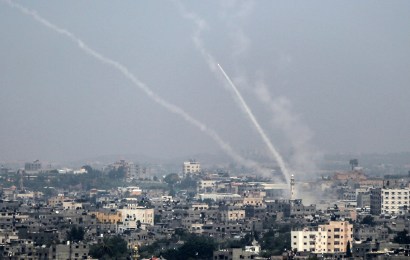
Palestinian rockets arcing from Gaza City towards Israel, July 14.
Palestinian rockets arcing from Gaza City towards Israel, July 14. Israel Defense Forces responded with airstrikes.

(BASHAR TALEB/AFP/Getty Images)
Israel’s Soft Underbelly

Because of the weapons in play, Iran and its proxy allies can strike all of Israel — which lacks strategic depth due to its small geographic size — with ever-growing precision. Especially vulnerable are large, static sites, such as transportation, water, electrical, nuclear and oil and gas facilities. Naturally, any strike on chemical and industrial facilities could cause significant collateral damage by releasing hazardous chemicals and gases.

Even beyond the physical damage of an attack on such sites, the effects of rocket artillery barrages on Israel would significantly damage the country’s economy, as occurred during the 2006 conflict with Lebanon. Rocket attacks force the population to seek sanctuary in shelters for extended periods of time, postpone or cancel routine business activity and reduce road traffic, thereby disrupting economic activity severely. Such a scenario would also compel Israeli authorities to call up a significant portion of its reserve troops for battle, further impacting normal economic activity.
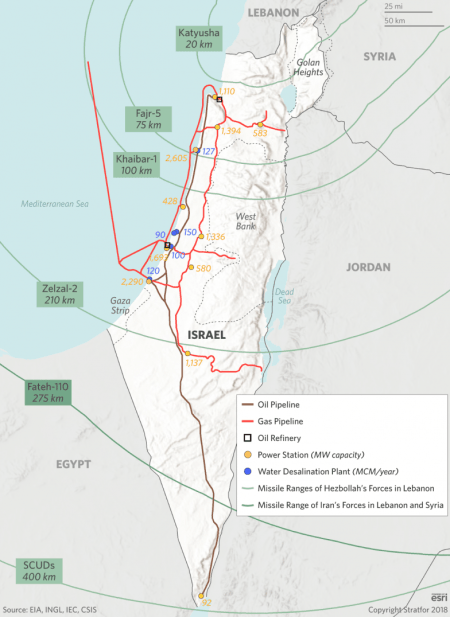
A map showing ranges of Iran and Hezbollah's indirect weaponry and key Israeli infrastructure targets.

These specific vulnerabilities provide Iran with a potent asymmetric deterrent that its forces are determined to further reinforce. The Israeli military may boast vastly more power and resources than Hezbollah, but Israel is wary of staging a direct assault on Hezbollah in Lebanon, principally due to the deterrent presented by the group’s rocket arsenal. And in a similarly asymmetric effort to discourage Israel from conducting a direct attack on Iran, Tehran intends to enhance its missile force in the area, both in locations controlled by Hezbollah in Lebanon, as well as in Syria.

Mitigating the Threat

Aware of its vulnerability to Iran and Hezbollah’s indirect weaponry, Israel has adopted a multi-layered strategy to mitigate the threat. On the diplomatic front, Israel has focused its approach on the United States and Russia, striving to convince the two superpowers to heed its interests in Syria by containing and limiting Iran’s influence and presence in the country. Israel has made some gains in this regard, as both Washington and Moscow have pledged to work toward creating a buffer zone between the Israeli-controlled Golan Heights and Iranian elements on the ground. As part of this plan, the Kremlin recently announced that Iran would withdraw its heavy weapons to at least 85 kilometers from the Golan Heights. Still, the wider Israeli ambition of completely expelling Iran from Syriafaces significant limitations, as Russia is both unwilling and incapable of forcing Tehran to abandon Syria entirely.
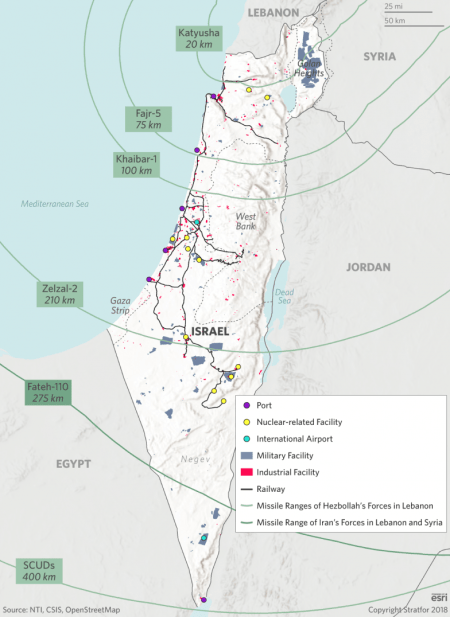
A map showing ranges of Iran and Hezbollah's indirect weaponry and key Israeli infrastructure targets.

Recognizing the limitations of its diplomatic offensive, Israel has begun relying on interdiction strikes — targeting enemy territory that is behind the immediate frontline — to degrade and disrupt the buildup of Iranian forces in Syria, as well as stymie Tehran’s efforts to directly supply Hezbollah in Lebanon. Over the last year, the Israeli strikes have increased in intensity as the country has become more concerned by Iran’s entrenchment in Syria. The raids have inflicted considerable damage on Iranian and Hezbollah targets, but they have not halted Iran from maintaining and even reinforcing its presence in Syria. More worryingly for regional stability, the strikes could eventually provoke Iranian retaliation, potentially leading to the same damaging war scenario described above.

Israel has also worked to improve its defenses at home. In this regard, the country has focused on missile defense systems, establishing a multi-tiered defense against rocket and missile attack. The Iron Dome system, which has proved its effectiveness in the past, is designed to intercept relatively short-range rockets. David’s Sling, meanwhile, defends the country against longer-range rockets as well as short-range ballistic missiles. Finally, the Arrow system forms the upper-tier portion of Israel’s missile defense, protecting against medium- and long-range ballistic missiles. Israel’s considerable investment in a sophisticated missile defense network provides it with some defense against rocket and missile attacks, particularly in conflicts against a relatively weak adversary such as Hamas in Gaza. But the country’s missile defense network is vulnerable to strikes in which an adversary launches rockets and missiles that exceed the number of Israeli interceptors — as would occur if Hezbollah or Iran staged an attack.

The next war between the two sides could be a lot more damaging than their last battle in 2006.

In the face of such issues, Israel has adopted a military strategy emphasizing offensive operations given any serious clash with Hezbollah or Iran in the north. Such a doctrine involves launching a ground attack into Lebanon — and, potentially, Syria — to destroy the launch pads used to fire Hezbollah and Iranian projectiles, thus reducing the amount of time that either could continue its offensive.

Syria’s long-running war is winding down on some fronts, but hostilities could soon flare up elsewhere in the conflict. Hezbollah and Iran have worked diligently to build up their weapons capabilities in an effort to exploit some of Israel’s vulnerabilities, prompting the latter to draft a robust defense strategy against its greatest antagonists. Altogether, the situation ensures that the next war between the two sides could be a lot more damaging than their last battle in 2006.
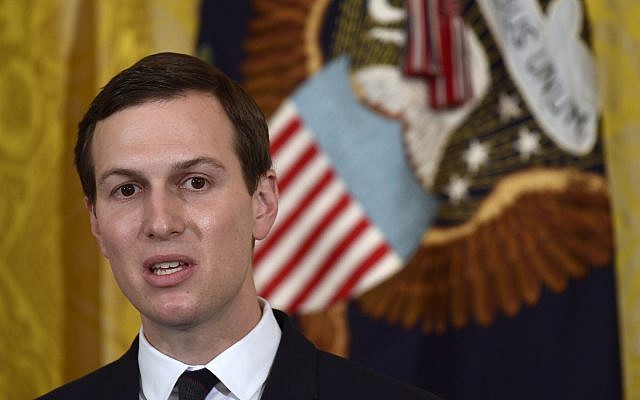
Kushner said pushing to close UNRWA, end refugee status for Palestinian millions

Posted August 8, 2018 by davidking1530
Categories: Uncategorized

I am starting to really like Kushner.

My personal style (and preference) would be more direct and hardened, but he is operating in the world of diplomacy.

He has a smart head on his young shoulders.

Good luck to him as he continues the fight in the background, moving around in the shadows…

Kushner said pushing to close UNRWA, end refugee status for Palestinian millions

https://www.timesofisrael.com/kushner-said-pushing-to-end-refugee-status-for-millions-of-palestinians/

Report quotes Palestinian official saying US peace envoys asked Jordan to move toward halting UNRWA’s operations there as part of wider apparent efforts to shutter agency

Senior White House adviser Jared Kushner in the East Room of the White House in Washington, May 18, 2018. (Susan Walsh/AP)

Jared Kushner, US President Donald Trump’s senior adviser and son-in-law, has been pushing to remove the refugee status of millions of Palestinians as part of an apparent effort to shutter the United Nations agency for Palestinian refugees, a report on Friday said.

Under Trump, the US has frozen hundreds of millions of dollars in aid to the United Nations Relief and Works Agency, or UNRWA, with the US president linking the decision to the Palestinians’ refusal to speak with his administration after he recognized Jerusalem as Israel’s capital.

According to emails published Friday by Foreign Policy magazine, Kushner has been highly critical of UNRWA, with he and other White House officials weighing its closure as part of their peace efforts.

“It is important to have an honest and sincere effort to disrupt UNRWA,” Kushner wrote in an email dated January 11, just days before the US froze $65 million in funding for UNRWA. “This [agency] perpetuates a status quo, is corrupt, inefficient and doesn’t help peace.”

“Our goal can’t be to keep things stable and as they are… Sometimes you have to strategically risk breaking things in order to get there,” he added in the email, according to Foreign Policy.

Uniquely, UNRWA grants refugee status to all descendants of Palestinians who left or fled Israel with the establishment of the state in 1948, swelling the number to an estimated five million at present, when the number of actual refugees from that conflict is estimated to be in the low tens of thousands. In peace talks, the Palestinian leadership has always demanded a “right of return” to Israel for these millions — an influx that, if accepted by Israel, would spell the end of the Israel as a majority Jewish state.

Israel argues that the Palestinian demand is an UNRWA-facilitated effort to destroy Israel by demographic means. The Palestinians also seek an independent state in the West Bank, Gaza Strip and East Jerusalem. Months of ongoing violent protests fueled by Hamas at the Gaza border with Israel were initiated under the banner of a “March of the Return,” and encouraged by Hamas leaders with the declared ultimate goal of erasing the border and destroying Israel.

Israel argues that an independent Palestinian state, if agreed upon in negotiations, would absorb Palestinian refugees and their descendants, just as Israel absorbed Jewish refugees from Middle Eastern and north African countries over the decades.

In an email from later in January, an adviser to Jason Greenblatt — Trump’s Middle East peace envoy — suggested UNRWA’s closure as part of the US peace push.

“UNRWA should come up with a plan to unwind itself and become part of the UNHCR [UN High Commissioner for Refugees] by the time its charter comes up again in 2019,” wrote Victoria Coates.

Coates described the proposition as one of the “spitball ideas that I’ve had that are also informed by some thoughts I’ve picked up from Jared, Jason and Nikki,” referring to Haley, the US ambassador to the UN.

Other proposals raised were moving UNRWA to a monthly operating budget and coming up with “a plan to remove all anti-Semitism from educational materials.” [Ha ha ha, good luck with that! There would be no education materials left…]

The report also quoted Palestinian officials saying Kushner and Greenblatt in June asked Jordan to remove the refugee status of some 2 million Palestinians in order to end UNRWA’s operations in the country.

“[Kushner said] the resettlement has to take place in the host countries and these governments can do the job that UNRWA was doing,” said Palestinian Liberation Organization official Hanan Ashrawi, according to Foreign Policy.

“They want to take a really irresponsible, dangerous decision and the whole region will suffer,” she added, claiming the White House wanted Gulf states to pick up the tab for whatever this would cost Jordan.

Shortly after the reported request, top Palestinian peace negotiator Saeb Erekat accused Kushner and Greenblatt of seeking the “termination” of the UN’s Palestinian refugee agency.

“They want to terminate the role of UNRWA by proposing direct aid to the countries hosting the Palestinian refugees and sideline the UN agency,” Erekat said at the time. “On top of this, they are planning financial aid to the Gaza Strip worth one billion dollars for projects, also separate from UNRWA and under the title of solving a humanitarian crisis.”

He added: “All this is actually aimed at liquidating the issue of the Palestinian refugees.”

The White House would not directly comment on the Foreign Policy report, though an official told the magazine that the US position on UNRWA “has been under frequent evaluation and internal discussion. The administration will announce its policy in due course.”

Israel, which has also sometimes accused UNRWA of employing Palestinians who support terrorism, says UNRWA’s definition of Palestinian refugees helps to perpetuate the Palestinian narrative of Israeli illegitimacy. It notes that UNRWA’s policy of granting refugee status to the descendants of Palestinian refugees, even when they are born in other countries and have citizenship there, does not apply to the refugees cared for by the UN’s main refugee agency, UNHCR, which cares for all other refugees worldwide. The population of Palestinian refugees thus grows each year, even as other refugee populations in the world shrink with each passing generation.

A spokesman for the Israel Embassy in Washington, Elad Strohmayer, told Foreign Policy: “We believe that UNRWA needs to pass from the world as it is an organization that advocates politically against Israel and perpetuates the Palestinian refugee problem.”

The Foreign Policy report came as US officials say the Trump administration is staffing up a Middle East policy team at the White House in anticipation of unveiling its long awaited but largely mysterious Israeli-Palestinian peace plan.

The National Security Council last week began approaching other agencies seeking volunteers to join the team, which will work for peace pointmen Kushner and Greenblatt, according to the officials.

The creation of a White House team is the first evidence in months that a plan is advancing. Although Trump officials have long promised the most comprehensive package ever put forward toward resolving the conflict, the emerging plan has not been described with even a small amount of detail by Kushner, Greenblatt or any other official.

Footage emerges of Corbyn saying BBC ‘biased’ toward ‘Israel’s right to exist’

Posted August 8, 2018 by Joseph Wouk
Categories: Uncategorized

Source: Footage emerges of Corbyn saying BBC ‘biased’ toward ‘Israel’s right to exist’ | The Times of Israel

In 2011 interview with Iran’s Press TV, which surfaced Tuesday amid party’s anti-Semitism row, Labour leader accuses Israeli government of undue ‘pressure’ on broadcaster

UK Labour leader Jeremy Corbyn in an interview with Iran's PressTV in 2011. (Twitter screenshot)

UK Labour leader Jeremy Corbyn in an interview with Iran’s PressTV in 2011. (Twitter screenshot)

British Labour leader Jeremy Corbyn, accused by the Jewish community of tolerating anti-Semitism in his party’s ranks, once told Iranian state media that the BBC “has a bias towards saying that…Israel has a right to exist.”

In the 2011 interview with Iran’s PressTV, posted on Twitter Tuesday by the British political blogger The Golem, Corbyn explains that “there’s pressure on the BBC from, probably, [then-BBC director general] Mark Thompson, who seems to me to have an agenda in this respect. There seems to be a great deal of pressure on the BBC from the Israeli government, from the Israeli embassy, and they are very assertive towards all journalists and toward the BBC itself. They challenge every single thing on reporting the whole time.”

That Israeli pressure and bias from the likes of Thompson, Corbyn goes on to say, mean the corporation leans in favor of Israel’s existence.

“I think there is a bias towards saying that Israel is a democracy in the Middle East, Israel has a right to exist, Israel has its security concerns,” he says in the 36-second clip.

The Golem notes in a follow-up tweet that Corbyn’s statements may run afoul of Labour’s own code of conduct on anti-Semitism, which he quotes as saying, “The Party is clear that the Jewish people have the same right to self-determination as any other people. To deny that right is to treat the Jewish people unequally and is therefore a form of antisemitism.”

The comments are only the latest round in a long-running crisis for the party with a constant stream of members and prominent officials being forced out or chastised for making anti-Semitic and virulent anti-Israel comments. The fracas has seen excoriation from rabbis, including Britain’s chief rabbi, as well as from some of Labour’s own MPs charging that the party seemed unable or unwilling to decisively excise anti-Semitic members and sentiments from its ranks.

A response from a party spokesperson published by Jewish News, a partner site of The Times of Israel, seemed to double down on Corbyn’s comments.

“Jeremy was arguing that despite the occupation of Palestinian territory and the lack of a Palestinian state, Israeli concerns and perspectives are more likely to appear prominently in news reporting than Palestinian ones,” the spokesperson said. “Jeremy is committed to a comprehensive peace in the Middle East based on a two-state solution – a secure Israel alongside a secure and viable state of Palestine.”

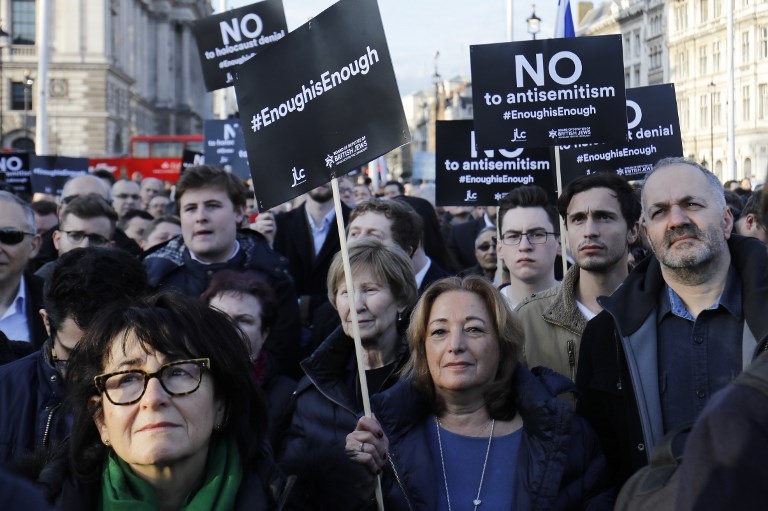
Members of the Jewish community hold a protest against Britain’s opposition Labour party leader Jeremy Corbyn and anti-Semitism in the Labour Party, outside the British Houses of Parliament in central London, on March 26, 2018. (AFP Photo/Tolga Akmen)

At the same time, “the Israeli government is well known to run an effective and highly professional media operation,” the spokesperson added.

Jewish leaders were quick to respond to the newly-surfaced Corbyn comments.

Jennifer Gerber, head of Labour Friends of Israel, slammed the “deplorable remarks,” saying, “not only does Jeremy Corbyn use another appearance on Iranian state TV to engage in further wild conspiracy theories about Israel, he also questions the Jewish state’s right to exist. Is it any wonder he has resisted so hard adopting the full IHRA definition of antisemitism?”

After Labour’s response, Gerber added on Twitter: “The Labour party is now defending Jeremy Corbyn peddling wild conspiracy theories and questioning Israel’s right to exist on Iranian state TV. Let’s be clear: for a party which aspires to be in government, this is not normal behavior.”

Simon Johnson, head of the Jewish Leadership Council, tweeted, “Sorry Mr Corbyn. Do you therefore think that Israel is NOT a democracy, does NOT have a right to exist and does NOT have security concerns? And that an organisation is biased if it DOES believe these things? Wow. That seems to differ somewhat from the policy of the party you lead.”

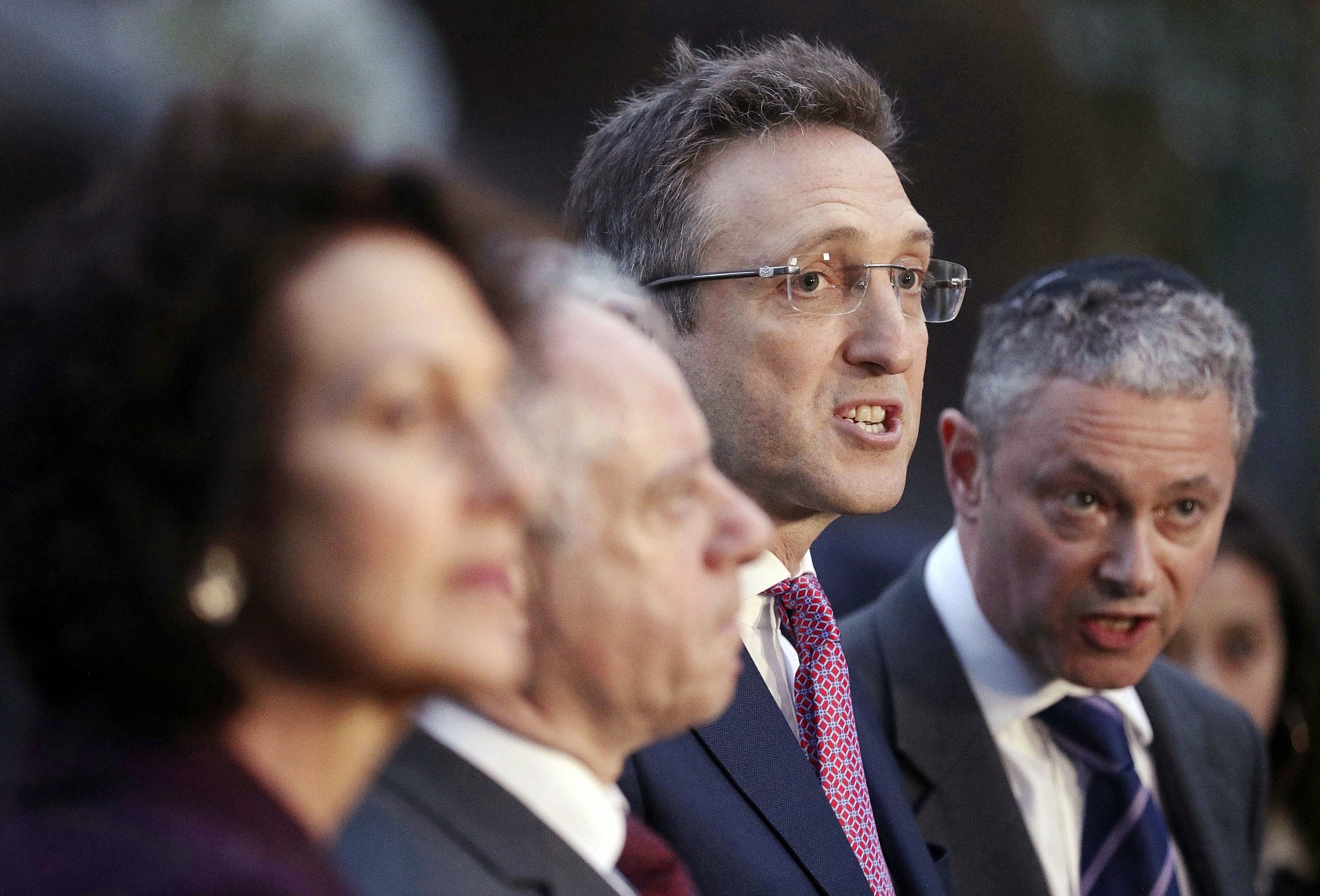
Members of the Board of Deputies of British Jews, with left to right, Gillian Merron, Jonathan Arkush, Jonathan Goldstein, and Simon Johnson speak to the media outside Britain’s parliament following a meeting with Britain’s opposition Labour Party leader Jeremy Corbyn Tuesday April 24, 2018. (Jonathan Brady/PA via AP)

Also Tuesday, a top Jewish Labour MP charged that party leaders were working to silence criticism within the party over its handling of anti-Semitism accusations.

Margaret Hodge, a former minister in Labour governments, recently weathered a party investigation herself after she called Corbyn “an anti-Semite and a racist” during a parliamentary debate. The probe ended on Monday.

Now she is defending fellow Labour MP Ian Austin, saying the party’s investigation of an alleged confrontation between him and Corbyn-supporting lawmakers in Parliament in mid-July was part of a “new style of politics” consisting of “bullying and intolerance.”

“I have absolutely no doubt that there are those in the [Labour] leadership who want to get rid, whether it is through deselection or disciplinary action, of any opposition. The new style of politics is bullying and intolerance, not gentle and inclusive,” Hodge told The Guardian newspaper.

“Arguing passionately for what you believe in should be encouraged and celebrated, not punished. That’s what Ian was quite properly doing, and trying to close down the issue by disciplining him is tantamount to bullying,” Hodge said.

Austin’s attorneys called the investigation “a farce and a disgrace. It has plainly been designed to silence our client for his legitimate, honestly held criticisms of Mr Corbyn’s failure to address the scourge of antisemitism in the Labour party,” they wrote.

MP Margaret Hodge. (YouTube screenshot)

At the heart of Labour’s anti-Semitism crisis is the party’s refusal to adopt in full the International Holocaust Remembrance Alliance’s definition of anti-Semitism, instead leaving out four of the 11 examples included in the definition. All four relate to unfair singling out of Israel or questioning the loyalty of Jews who support Israel.

The party was called to task on the issue Tuesday by the British delegation to the IHRA, saying in a statement published by the Guardian that “any ‘modified’ version of the IHRA definition that does not include all of its 11 examples is no longer the IHRA definition. Adding or removing language undermines the months of international diplomacy and academic rigor that enabled this definition to exist. If one organization or institution can amend the wording to suit its own needs, then logically anyone else could do the same. We would once again revert to a world where antisemitism goes unaddressed simply because different entities cannot agree on what it is.”

The left-leaning British daily also reported Tuesday on the challenges and foot-dragging underway in Labour’s National Executive Council over expelling members who express or facilitate anti-Semitic sentiments in the party.

Of the 70 cases of anti-Semitic expressions by party members sent to the NEC by party officials for consideration, “only a minority were considered by the NEC because of time constraints,” the Guardian says.

The complaints included Labour members who claimed that the Israel lobby had invented the anti-Semitism crisis, or that Hitler’s policy on Zionism “might not be mutually exclusive with his later actions” (i.e., the extermination of Europe’s Jews), among others.

One unnamed Labour source assured the paper that efforts to expel offending members would be sped up in the near future.

“The new code of conduct means we will not have to go to the full NEC disputes committee, but a smaller antisemitism subgroup. It will mean we have the potential to kick people out super fast, instead of waiting months for a full disputes meeting and just getting through 11 of 70.”

Russia and Israel reach understanding on Golan border line

Posted August 8, 2018 by Joseph Wouk
Categories: Uncategorized

Source: Russia and Israel reach understanding on Golan border line – Middle East – Jerusalem Post

Israel’s ambassador to Russia said Israel insisted on the full withdrawal of Iranian troops from Syria.

BY HERB KEINON
 AUGUST 8, 2018 06:18
Yom Kippur War

Israel and Russia have reached an understanding to ensure the preservation of the 1974 cease-fire line on the Golan Heights, according to Israel’s Ambassador to Russia Gary Koren.

According to a TASS Russian News Agency report, Koren – who met with Russian journalists in Stavropol in southern Russia Monday – said, “we coordinated the arrangement under which Russia pledged to make sure, as it were, that the Syrian Army will not cross the cease-fire line established under the 1974 agreement. It looks like everything is functioning for the time being. I hope it will be so in the future, as well.”

Koren said Israel insisted on the full withdrawal of Iranian troops from Syria.

The 1974 Separation of Forces Agreement between Israel and Syria, which followed the Yom Kippur War, separated Israel and Syrian troops and created a 235-km. buffer zone in the Golan Heights. Israel demands the buffer zone be respected, even as it is deeply concerned that Iranian or Shia forces moving south with Syrian President Bashar Assad’s troops may try to violate it.

Prime Minister Benjamin Netanyahu stressed during his visit to Moscow in July that respecting the Separation of Forces Agreement was a red line for Israel in Syria.

UN peacekeepers, augmented by Russian military police, returned to the border last week to carry out patrols. The day before, Alexander Lavrentiev, Russian president Vladimir Putin’s special envoy on Syria, said Iran and Shia militias have withdrawn 85 km. from the border on the Golan.

“There are no units of heavy equipment and weapons that could pose a threat to Israel at a distance of 85 km. from the line of demarcation,” Lavrentiev was quoted as saying in TASS.

Israel’s stated position remains as the removal of all Iranian forces and their proxies from Syria, although Netanyahu made clear during his Moscow talks the immediate priorities were to move these forces away from the border, to remove Iran’s long-range missiles from throughout Syria, and to ensure the separation agreement will be honored in full.

Iran sanctions: Trump warns trading partners

Posted August 7, 2018 by Louisiana Steve
Categories: Iran - sanctions enforcement, Sanctions

Tags:

By BBC News Staff – August 7, 2018

Source Link: Iran sanctions: Trump warns trading partners

Time is running out for Iran and waiting for the next US presidential election is not an option. – LS}

US President Donald Trump has issued a strong warning to anyone trading with Iran, following his re-imposition of sanctions on the country.

“Anyone doing business with Iran will NOT be doing business with the United States,” the president tweeted.

Some re-imposed sanctions took effect overnight and tougher ones relating to oil exports will begin in November.

Iran’s president said the measures were “psychological warfare” which aimed to “sow division among Iranians”.

The sanctions follow the US withdrawal from the Joint Comprehensive Plan of Action, also known as the Iran nuclear deal, earlier this year.

The deal, negotiated during the presidency of Barack Obama, saw Iran limit its controversial nuclear activities in exchange for sanctions relief.

Mr Trump has called the deal “one-sided”, “disastrous” and the “worst I’ve ever seen”. He believes renewed economic pressure will force Iran to agree to a new deal.

The European Union, which remains committed to the original agreement, has spoken out against the sanctions, vowing to protect firms doing “legitimate business” with Iran.

What else did Mr Trump say in his latest tweet?

He praised the “most biting sanctions ever imposed” and said they would “ratchet up to another level” in November.

“I am asking for WORLD PEACE, nothing less!” he said.

On Monday he had said that Iran faced a choice to “either change its threatening, destabilising behaviour and reintegrate with the global economy, or continue down a path of economic isolation”.

“I remain open to reaching a more comprehensive deal that addresses the full range of the regime’s malign activities, including its ballistic missile programme and its support for terrorism,” he said.

What are the sanctions?

Mr Trump signed an executive order that brought sanctions back into place at 00:01 EDT (04:01 GMT) on Tuesday. They target:

  • The purchase or acquisition of US banknotes by Iran’s government
  • Iran’s trade in gold and other precious metals
  • Graphite, aluminium, steel, coal and software used in industrial processes
  • Transactions related to the Iranian rial currency
  • Activities relating to Iran’s issuance of sovereign debt
  • Iran’s automotive sector

A second phase is planned to come back into effect on 5 November which will have implications for Iran’s energy and shipping sectors, petroleum trading and transactions by foreign financial institutions with the Central Bank of Iran.

What has the reaction been?

Iranian President Hassan Rouhani said the US government had “turned their back on diplomacy”.

“They want to launch psychological warfare against the Iranian nation.” he said. “Negotiations with sanctions doesn’t make sense. We are always in favour of diplomacy and talks… but talks need honesty.”

The foreign ministers of Germany, the UK and France released a statement on Monday that said the nuclear deal remained “crucial” to global security.

They also unveiled a “blocking statute”, which is intended to protect European firms doing business with Iran despite the new US sanctions.

Alistair Burt, the UK’s minister of state for the Middle East, told the BBC: “If a company fears legal action taken against it and enforcement action taken against it by an entity in response to American sanctions, then that company can be protected as far as EU legislation is concerned.”

He said Iran would simply “batten down the hatches” until the next US election.

However, German car and lorry maker Daimler, which announced a joint venture in Iran last year, confirmed this week that it has now ceased activities in the country.

How will Iran’s economy be affected?

Iran has already seen unrest since last December over a poorly-performing economy.

Rising food prices, unemployment and even poor water supplies have led to protests in a number of cities.

Demonstrations in Tehran in June were said to be the capital’s biggest since 2012.

How much they are tied to the new US sanctions policy is hard to determine, but one definite link is the effect on Iran’s currency. It lost around half of its value after Mr Trump announced the US withdrawal from the nuclear deal.

Iran acted by easing its foreign exchange rules on Sunday, and the rial has strengthened by 20% since then.

Iranians have been hoarding gold as a safeguard, pushing it to a record high in Tehran.

The sanctions may bite hardest in November, when the US blocks Iranian oil sales.

This could halt about half of Iran’s exports of some two million barrels a day, although Iran may look to China and Russia to keep its industry afloat.

The International Monetary Fund said in March that Iran’s net official reserves could decline this year to $97.8bn, which would finance about 13 months of imports. And analysts at BMI Research say Iran’s economy could contract by 4.3% in 2019.

However, Barbara Slavin, of the Future of Iran Initiative at the Atlantic Council, told the Wall Street Journal that when sanctions hit hard, it often means ordinary people become “totally dependent” on their government and so sanctions do not tend to topple regimes.

What do young Iranians think

As the first tranche of new US sanctions kicks in, young Iranians have been sharing their stories with BBC Persian. Many are already feeling the effects, as the economy had slowed down in anticipation of what was to come.

“I used to work in marketing for a home appliance manufacturer,” said Peyman. “I lost my job as the company can’t import the components.”

Aerospace engineer Ali lost his job of 13 years because his company couldn’t import equipment.

“Now I’m working as a taxi driver to feed my family,” he said. Many people say they’re no longer being paid on time and are finding it hard to make ends meet.

A construction worker, also called Ali, said he hadn’t been paid for 13 months. Omid, a doctor, was doing overtime to pay the rent and save up to get married.

Many people said they were losing hope. Sama said falling exchange rates meant her monthly salary was now worth half what it was six months ago.

“Buying a house or a nice car is like a dream now, she said. “Even buying a good mobile phone soon will be impossible for people like me.”

Netanyahu praises Trump for reimposing sanctions on Iran

Posted August 7, 2018 by Joseph Wouk
Categories: Uncategorized

Source: Netanyahu praises Trump for reimposing sanctions on Iran – Israel Hayom

Cabinet minister says ‘good chance’ Iran will renegotiate nuclear deal

Posted August 7, 2018 by Joseph Wouk
Categories: Uncategorized

Source: Cabinet minister says ‘good chance’ Iran will renegotiate nuclear deal | The Times of Israel

Gilad Erdan slams ‘morally bankrupt’ EU for trying to salvage accord; Israeli intelligence community said optimistic that new sanctions will force major change in Tehran

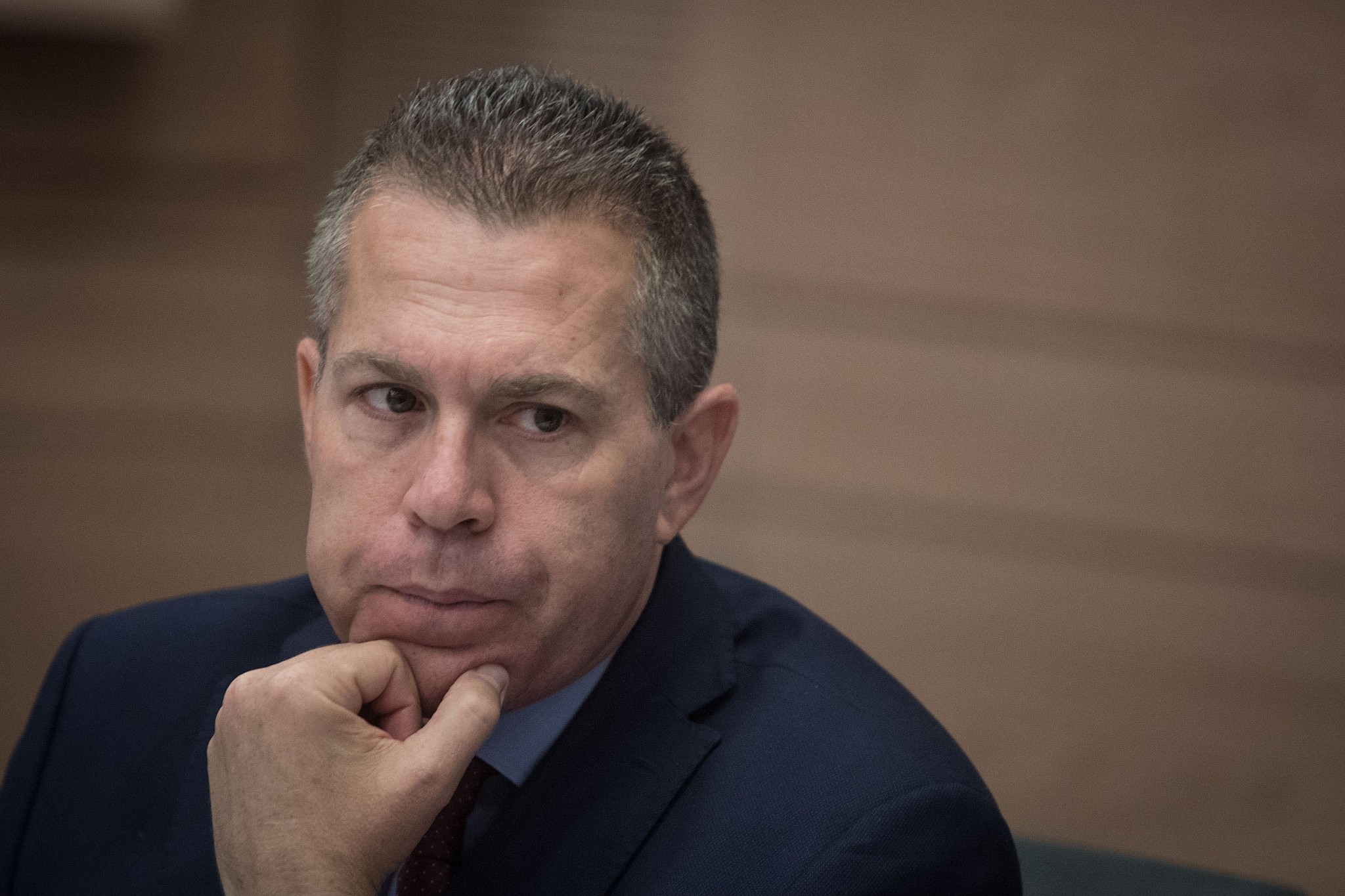
Strategic Affairs Minister Gilad  Erdan attends a committee meeting in the Knesset, on July 2, 2018. (Hadas Parush/Flash90)

Strategic Affairs Minister Gilad Erdan attends a committee meeting in the Knesset, on July 2, 2018. (Hadas Parush/Flash90)

Public Security Minister Gilad Erdan on Tuesday praised the US for reimposing tough sanctions on Iran that brought back into effect the harsh penalties lifted under the Iran nuclear deal.

“It would be better if the Iranian regime would disappear entirely from this world, but it would also be a blessing to see Obama’s bad nuclear agreement replaced with a better one,” he told Israel Radio. US President Donald Trump abandoned the deal in May.

“In my opinion, there is a good chance of that,” said Erdan, who also heads the Strategic Affairs Ministry. “We can already see positive results from what Trump did.”

Erdan criticized the European Union for trying to salvage the deal by ensuring that economic benefits guaranteed under the 2015 accord continue to flow to the country.

“The EU is morally bankrupt, and we need to remember that next time they try to lecture us,” Erdan said. The EU, along with China, Russia, France, Germany and the UK, was also a signatory to the deal and has not withdrawn.

In Israel, the reimposition of US sanctions was lauded as a historic turning point that could ultimately lead to the Islamic Republic’s downfall.

On Tuesday, Israel Radio quoted an unnamed senior official who said the Israeli intelligence community was optimistic the sanctions would lead to major changes in Iran and force Tehran to renegotiate the deal.

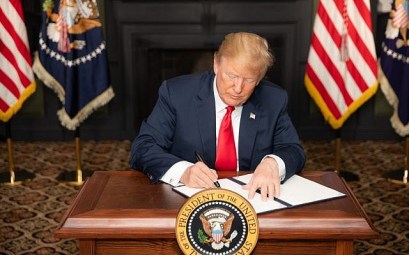
US President Donald J. Trump signs an Executive Order on Iran Sanctions in the Green Room at Trump National Golf Club, August 6, 2018, in Bedminster Township, New Jersey. (Official White House Photo by Shealah Craighead)

“We would like to see a change in policy, but there is no way of knowing how long that will take,” the official said.

“The only hammer available right now is economic, and using that, there is a good change Iran will fall to its knees,” he said. “Right now Iran is weak and hysterical.”

The new sanctions on Iran took effect just after midnight in Washington on Tuesday as part of Trump’s withdrawal from the international accord designed to limit Iran’s nuclear program.

Trump signed an executive order restoring the penalties on Monday, which he said would put “maximum economic pressure” on the country. The sanctions affect financial transactions that involve US dollars, Iran’s automotive sector, the purchase of commercial planes and metals including gold.

A second batch of US sanctions targeting Iran’s oil sector and central bank are to be reimposed in early November.

Prime Minister Benjamin Netanyahu praised Trump for ratcheting up pressure on the Islamic Republic, and called on European nations to follow his lead.

“It symbolizes the determination to curb Iran’s regional aggression and its ongoing plans to arm itself with nuclear weapons,” Netanyahu said in a video released Monday.

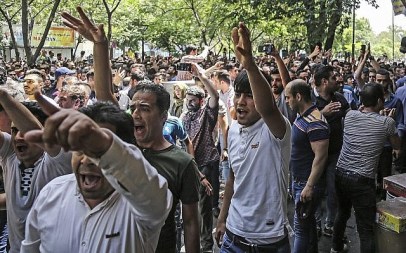
A group of protesters chant slogans at the old grand bazaar in Tehran, Iran, Monday, June 25, 2018. Protesters in the Iranian capital swarmed its historic Grand Bazaar on Monday, news agencies reported, and forced shopkeepers to close their stalls in apparent anger over the Islamic Republic’s troubled economy, months after similar demonstrations rocked the country. (Iranian Labor News Agency via AP)

On Monday, the European Union’s diplomatic chief Federica Mogherini said the bloc, as well as Britain, France and Germany, deeply regretted Washington’s move.

“We are determined to protect European economic operators engaged in legitimate business with Iran,” she said in a statement.

Many large European firms are leaving Iran for fear of US penalties, and Trump warned of “severe consequences” against firms and individuals that continued to do business with Iran.

The impact of the return of sanctions has ramped up tensions inside Iran, which has seen days of protests and strikes in multiple towns and cities over water shortages, high prices and wider anger at the political system.

Severe reporting restrictions have made it impossible to verify the swirl of claims coming through social media.

Agencies contributed to this report.

IDF shells Gaza post after soldiers come under fire; 2 Hamas men said killed 

Posted August 7, 2018 by Joseph Wouk
Categories: Uncategorized

Source: IDF shells Gaza post after soldiers come under fire; 2 Hamas men said killed | The Times of Israel

Hamas military wing says both dead men were members; 6 other Palestinians said wounded in latest violence on Gaza border

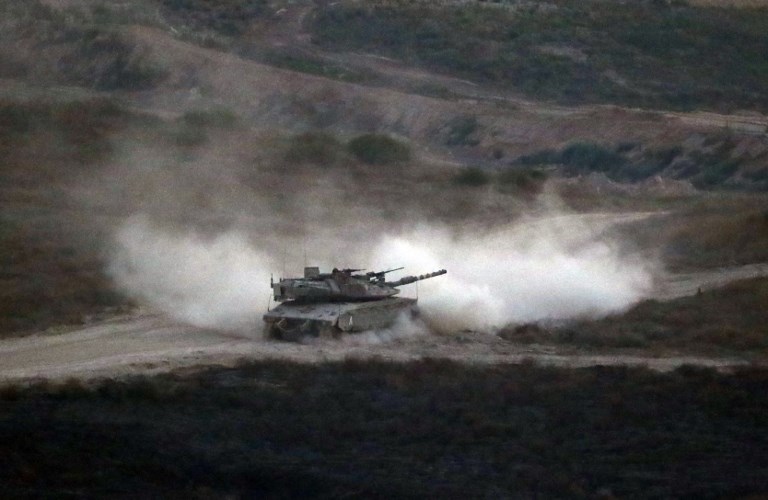
An Israeli army tank patrols along the border between Israel and the Gaza Strip on May 29, 2018. (Jack GUEZ/AFP)

An Israeli army tank patrols along the border between Israel and the Gaza Strip on May 29, 2018. (Jack GUEZ/AFP)

An IDF tank shelled a Hamas post on Tuesday, reportedly killing two Hamas fighters, after shots were fired from there at Israeli soldiers patrolling the Gaza Strip border.

“In response to terrorists shooting at IDF forces in the northern Gaza Strip, an IDF tank attacked the position belonging to the Hamas terror group where the attack originated,” the army said. “There were no casualties to our forces.”

The Hamas-run health ministry in Gaza said two Palestinian were killed in the strike. The Izz ad-Din al-Qassam Brigades, Hamas’s military wing, said both Palestinians were members of the group, and identified them as Ahmad Marjan and Abd al-Hafiz al-Silawi, both 23.

Another six were injured in the Israeli strike, Palestinian media reported.

The IDF released footage showing the Hamas men firing on the soldiers and the shell hitting the post.

The latest IDF strike in Gaza came amid reports that Israel and Hamas could be nearing a truce that would see a halt in the cross-border attacks and the easing of the blockade of the Strip.

On Monday, two Palestinians were injured in an Israeli airstrike targeting a group launching flaming balloons into southern Israel.

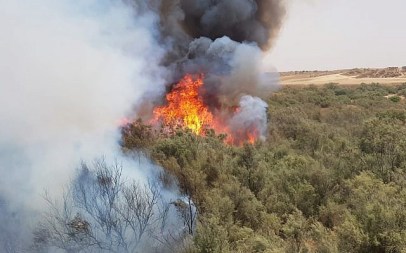
Incendiary balloons and flaming kites launched by Gazans have wreaked havoc in the Israeli communities surrounding Gaza since April, sparking fires that have scorched thousands of acres of farmlands and countryside.

Hamas’s political leadership met on Monday with top officials in its military to discuss its preparedness for battle with Israel, according to a report in the Ynet news site, highlighting the group’s skepticism of reaching a long-term ceasefire.

The meeting came a day after Israeli political and military brass huddled for several hours, but did not release any concrete decisions. Following the meeting, a statement from the cabinet said “the IDF is prepared for any scenario.” It gave no indication if any decision on the truce had been made.

A brushfire near Kibbutz Re’im east of the Gaza border, July 25, 2018. (Courtesy Fire and Rescue Services Southern District)

Palestinian sources told Ynet that the Hamas meeting took place in response to the Israeli statement and that Hamas leaders warned they could inflict casualties that the Israeli public and government would not be able to tolerate.

A senior Hamas source in Gaza said he was unaware of the meeting.

Hamas, a terror group that officially seeks Israel’s destruction, is the de facto ruler of the Strip.

Earlier Monday, the London-based, Saudi-owned Asharq al-Awsat newspaper, reported that the first stage of the potential truce would see Israel fully reopen the Kerem Shalom goods crossing and increase the fishing zone off the Gaza coast. It added that in return, Hamas official said the Strip’s rulers would commit to halting all attacks against Israel.

The second phase of the deal would include Hamas-Israel talks for a prisoner exchange agreement, and the implementation of long-proposed humanitarian projects in Gaza, the report said.

Despite US sanctions, Tehran steps up quest for dialogue with Trump administration – DEBKAfile

Posted August 7, 2018 by Joseph Wouk
Categories: Uncategorized

Source: Despite US sanctions, Tehran steps up quest for dialogue with Trump administration – DEBKAfile

A key sentence signaled Tehran’s quest for diplomacy in Iranian President Hassan Rouhani’s bitter diatribe over re-imposed sanctions on Monday, Aug. 6: ”The US must first prove itself willing to solve problems through negotiations after its withdrawal from the JCPOA,” he said

Rouhani spoke in a televised address to the nation hours before the devastating US sanctions went to effect, calling them “psychological warfare against the Iranian nation to create divisions among the people.”

That key sentence, say DEBKAfile’s intelligence sources, represented the burden of the reply secret Iranian agents have been carrying to Washington in past weeks. Even in the face of the economic chaos created by the looming sanctions, the Iranians have been seeking terms for direct or indirect talks with the US on a renegotiated nuclear deal.

Our sources report that Washington has neither rejected these feelers nor given Tehran a clear go-ahead – as White House did before Trump’s summit with North Korea’s Kim Jong-un last month. The Americans may be waiting for the sanctions to take full effect before agreeing to sit down formally with the Iranians.

Intelligence source: Mossad assassinated Syrian scientist

Posted August 7, 2018 by Joseph Wouk
Categories: Uncategorized

Source: Intelligence source: Mossad assassinated Syrian scientist – International news – Jerusalem Post

A Middle Eastern intelligence official told the “New York Times” that he believed the reason for the assassination was Asbar’s involvement in Syria’s missile program.

BY YVETTE J. DEANE
 AUGUST 7, 2018 08:55
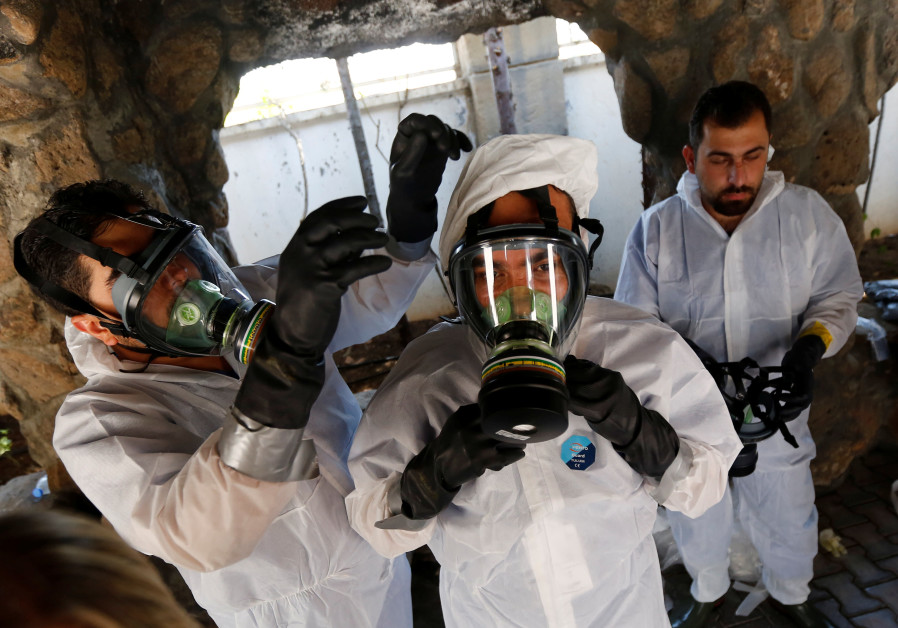
Syrian medical staff take part in training exercise to learn how to treat victims of chemical weapon

The Mossad, Israel’s national intelligence agency,  was responsible for the assassination of Syrian scientist Dr. Aziz Asbar in a car bomb on Saturday, a senior Middle Eastern intelligence official told The New York Times.

The official confirmed this incident, along with three other assassinations on foreign soil in a report published in the Times on  Monday.

The Middle Eastern intelligence official added that he believed the reason for the assassination was Asbar’s involvement in Syria’s missile program, even before the Syrian civil war broke out in 2011.

While Syria and Hezbollah quickly pointed fingers at the Jewish State, Israel, which does not respond to foreign media reports, had no comment on the assassination.

Defense Minister Avigdor Liberman downplayed the possibility of Israeli involvement, telling Channel 2 news that, “Every day in the Middle East there are hundreds of explosions and settling of scores. Every time they try to place the blame on us. So we won’t take this too seriously.”

“Assuming that he was indeed involved in terrorist activity, I welcome his departure from the world,” said Intelligence Minister Israel Katz regarding the New York Times report, in an interview with Army radio Tuesday.

However, according to the intelligence source, the Mossad had been tracking Asbar for a long time.

Dr. Aziz Asbar, one of the directors of the Syrian Scientific Studies and Research Center (SSRC), was killed along with his personal driver as they left Asbar’s home.

According to Hezbollah’s al-Manar news site, Asbar headed Department 4 at the center, which focuses on the development of all of Syria’s ballistic missile and rocket programs. The department is also in charge of Institute 4000 which has several chemical-weapons programs.

Asbar was involved in the manufacturing of chemical weapons including Sarin gas, despite Syria agreeing to dismantle its chemical weapons stockpiles in 2013, according to Western officials,

Israeli officials have raised concerns in the past about the transfer of advanced weaponry from Iran to Hezbollah.

Israel reportedly struck the Syrian Scientific Studies and Research Center several times, most recently on July 22, when Arab media reported that Israeli jets hit the one of the center’s arms production sites.

Israel is also believed to have struck the presumed base of the Syrian Arab Army’s secretive Unit 450, a branch of the Center which works on the Assad regime’s chemical weapons program. Western intelligence agencies and Syrian opposition figures alleged that Unit 450 had been dispersing chemical weapons stockpiles around the country, as well as to Hezbollah.

Anna Ahronheim contributed to this report.