The first ‘Return Flotilla’ is expected to leave Gaza on Saturday for Israel’s territorial waters in an attempt to break the naval blockade imposed on the Gaza Strip.
The flotilla is organized by an organization called the National Movement to Break the Siege on Gaza, which takes place simultaneously with the Friday demonstrations held along the Gaza Strip border.
The Hamas political bureau, the supreme body of the Hamas leadership, convened last week in the Gaza Strip to decide to continue the return riots on the Gaza border and the “popular struggle” and “unpopular” against Israel.
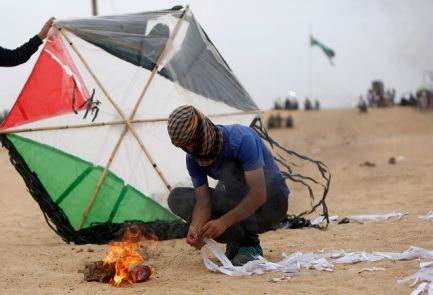
Various forms of terrorist activity are included under the heading of “Popular Struggle,” including stone-throwing, stabbing, burning, the launching of incendiary kites and balloons, and other forms of violence.
In February 2010 Hamas sent explosive barrels into Israel’s territorial waters. One of the barrels was swept ashore in Palmachim, 8 miles north of the Gaza Strip.
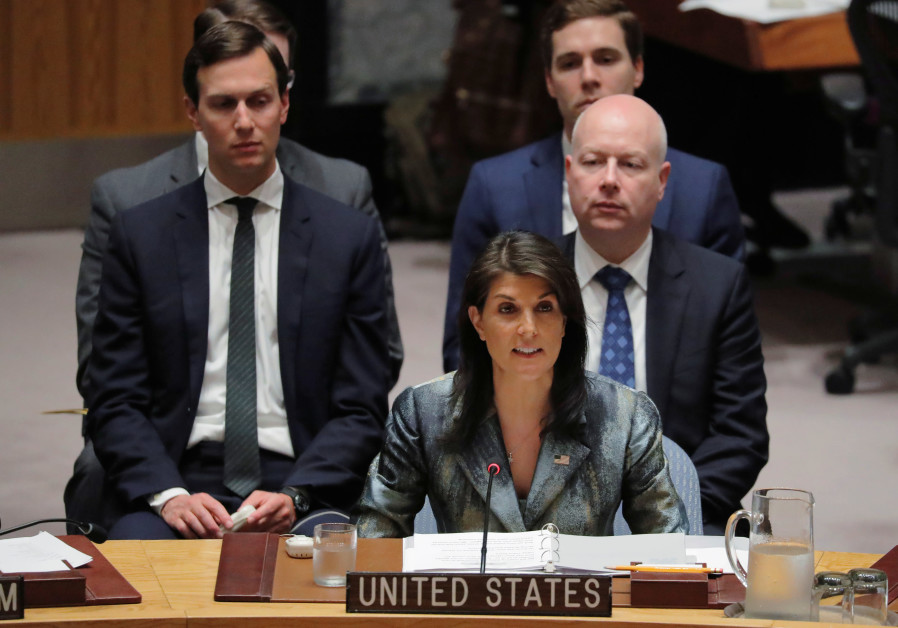
United States Ambassador to the United Nations (UN) Nikki Haley speaks in front of White House senior adviser Jared Kushner during a meeting of the UN Security Council at UN headquarters in New York, U.S., February 20, 2018. . (photo credit: REUTERS)
US President Donald Trump’s plan for Israeli-Palestinian peace may be the most closely guarded policy secret in Washington these days, 18 months in the making and yet still known only to the small handful of men behind it.
Senior administration officials describe the plan as detailed, pragmatic, and essentially complete. All that prevents them from publishing it is their sense that the timing is off.
They are waiting for some ripe moment to present itself – perhaps when the Palestinian leadership decides to give the administration a second chance after writing it off for recognizing Jerusalem as Israel’s capital last year. But such a moment seems unlikely any time soon. The Palestinian Authority, which has not seen the plan, says that Trump’s peace team has given every indication that its contents will reflect bias in favor of Israel by sidestepping explicit references to a two-state solution, dismissing refugee claims, endorsing a permanent Israeli presence in the Jordan Valley, allowing Jewish settlers to remain in the West Bank and remaining silent on the future placement of a sovereign Palestinian capital.
There are reasons to believe they are right. While the White House insists that its recognition of Jerusalem as Israel’s capital does not predetermine sovereignty over the entire city in an eventual peace agreement, it has never explicitly stated, as it did with Israel in December, that Palestinians have a reciprocal right to a capital in the holy city – or to any capital at all.
They have removed all reference to a two-state solution, to Palestinian independence or Palestinian territories from State Department language, dismissing those terms as “meaningless” without yet spelling out alternatives. And they have defunded the UN Relief and Works Agency, characterizing the Palestinian aid organization as a corrupt and inefficient body perpetuating a false narrative on refugees unhelpful to the pursuit of peace.
“The traditional core issues are essential and we focus on them extensively with a strong appreciation of the historic differences between the two sides,” Jared Kushner, the president’s son-in-law and senior adviser leading the peace effort, told the Palestinian Al-Quds newspaper in June. “We are committed to finding a package of solutions that both sides can live with.”
But, he added: “Simply resolving core issues without creating a pathway to a better life will not lead to a durable solution.”
Kushner and Jason Greenblatt, the president’s special representative for international negotiations, have said their plan tackles some of the thorniest issues in the conflict with specificity and ingenuity – a truly novel take on a geopolitical challenge that has, for too long, been mired in stale thinking. But while past efforts have failed, the careful balance American presidents have walked in since 1967 has allowed them to bring both sides around the same table, to the precipice of an agreement multiple times. Trump’s approach thus far has not. The reason the timing has been off may be because the approach is off.
TRUMP’S TEAM says that the PA leadership is prejudging what is in their plan before they see it, and this much is true: Palestinian officials, like the rest of us, have been left to read tea leaves based on the behavior they have seen thus far. If the plan includes revelatory material that defies expectations – as the team claims – then it should not wait for a moment of kindness from the Palestinians to present itself before releasing the plan. That moment will be created by the presentation of the plan.
The peace team seems to be considering this approach, expressing confidence that their work will see the light of day whether or not the Palestinians come around beforehand. They say the plan will include proposals that both parties will love and hate, and lament that they are frequently forced to dismiss rumors on the contents of their plan that scatter news reports.
But in testing whether the time is right for a rollout, the administration may be releasing trial balloons – based both on false as well as genuine tidbits from the plan – to gauge public response, knowing full well it can simply deny whichever ones float too high. Regardless of the strategy, public response has been self-evident as the plan is still under wraps.
Palestinian leaders are skeptical Trump’s team will ever support a policy that disadvantages Prime Minister Benjamin Netanyahu, and at some point, it will have to prove them wrong to earn their trust back. And report in Foreign Policy magazine last week, which quoted Kushner from back in January questioning the role of UNRWA, did them no favors. White House officials said it was a stretch to say they were denying the refugee status of millions of Palestinians simply by challenging UNRWA’s mandate, which treats the descendants of refugees from the 1940s the same as their modern-day ancestors. But Palestinian leaders saw Kushner’s comments in an e-mail calling for the “disruption” of UNRWA as further evidence of his plans to erode Palestinian claims to a homeland there.
There is one new sign the administration is working on a rollout with direction and purpose. The Associated Press reported last week that the peace team had begun staffing up, on-loading officials from the State Department and National Security Council to create working groups on the policy dimensions of the plan, the economic components of the plan and the strategic sale of the plan to the public. The formation of these teams would indicate that a release is not imminent – these staffers still need time to get into place and prepared – but that publication could be ready in the coming months.
“You can’t put something out where everybody says, ah, this is dead on arrival,” a senior administration official told The Jerusalem Post in June. “You can’t do that. And the same exact document that may be dead on arrival on a Monday might not be dead on arrival on a Thursday. That sounds kind of counterintuitive, but that’s the way this works.”
Palestinian protesters at the Israel-Gaza border, in Khan Yunis in the southern Gaza Strip, on August 3, 2018. (AFP/Said Khatib)
The Hamas terrorist group on Friday said the so-called “March of Return” border demonstrations would continue unimpeded later in the day, despite a cessation of hostilities with Israel clinched the night before.
The announcement came after a 12-hour lull in fighting, following two days that saw the heaviest exchange of Palestinian rocket fire and reprisal Israeli airstrikes since the 2014 Gaza war.
For the past four months there have been near-weekly, violent protests along the Israel-Gaza border organized by Gaza’s Hamas rulers.
Hamas spokesman Hazem Qassim tweeted on Friday that demonstrators would continue to “break the siege” on the Gaza Strip.
“Every time the Israeli killing machine attempts to break our people’s will to continue its struggle and marches, it fails to do so,” he wrote. “Today our people will head to the ‘Marches of Return’ to challenge the Israeli war machine.”
“Our Palestinian people has a long-lasting, struggling soul,” the Hamas spokesperson wrote. “It will continue its resistance in all of its forms until it gains its freedom, independence and right to a dignified life.”
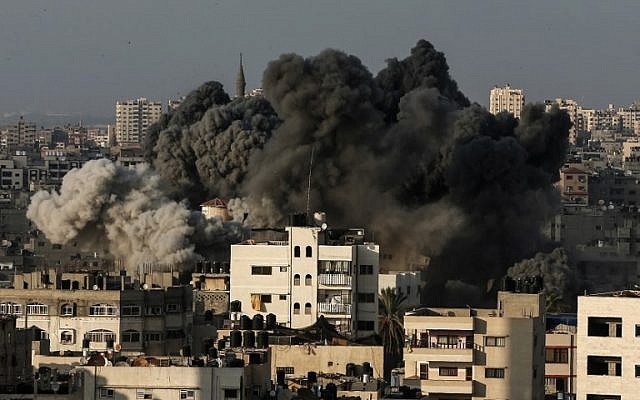
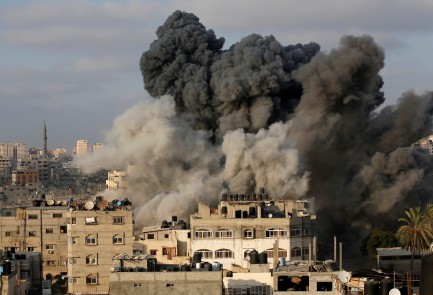
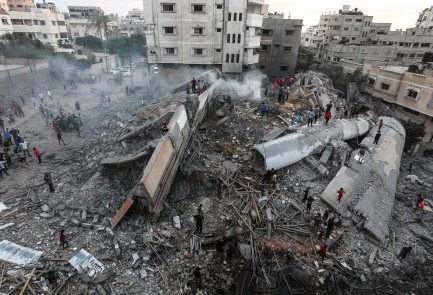
A plume of smoke rises from the remains of a building west of Gaza City that was targeted by the Israeli Air Force in response to a rocket attack that hit southern Israel earlier in the day on August 9, 2018. (Mahmud Hams/AFP)
Over the past four months the “March of Return” protests have led to deadly clashes which saw Israeli security forces facing gunfire, grenades, Molotov cocktails, and efforts — sometimes successful — to damage or cross the border fence.
At least 160 Palestinians have been killed by Israeli fire since the weekly protests began, the Hamas ministry says. Hamas has acknowledged that dozens of those killed were its members.
One Israeli soldier was shot dead by a Palestinian sniper.
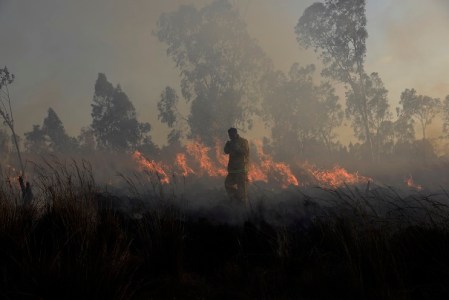
In addition to the border clashes, southern Israel has experienced hundreds of fires as a result of incendiary kites and balloons flown over the border from Gaza. Over 7,000 acres of land have been burned, causing millions of shekels in damages, according to Israeli officials.
Turkey’s embattled lira on Friday hit new record lows against the US dollar and euro, losing over six percent in value as strains with the United States showed no sign of abating and fears grew over the exposure of European banks.
The lira was trading at 5.90 to the dollar, a loss on the day of 6.5 percent. Earlier, it had crashed some 12 percent through the 6.00 level for the first time in history, trading at one point at more than 6.20 lira per dollar.
The lira has now lost over a third of its value against both the dollar and the euro this year, with the currency battered by both concerns over domestic economic policy and the political situation.
Versus the euro on Friday the lira lost 7.0 percent to trade at 6.8.
Turkey remains at loggerheads with the United States in one of the worst spats between the two NATO allies in years over the detention for the last two years of American pastor Andrew Brunson and a host of other issues.
Talks this week in Washington failed to resolve the impasse which has led both sides to slap sanctions on senior officials amid fears of graver measures to come.
– Doubts over central bank –
Meanwhile, markets are deeply concerned over the direction of economic policy under President Recep Tayyip Erdogan with inflation nearly 16 percent but the central bank reluctant to raise rates in response.
UBS chief economist for EMEA emerging markets Gyorgy Kovacs said a giant rate hike of 350-400 basis points would be “consistent with real rate levels that in the past helped to stabilise the currency.”
He warned a “rate hike alone might not stem the worries about the US and Turkey tensions and a potential further escalation.”
And it remains unclear if the bank would be willing to sharply lift rates with analysts saying the nominally independent institution is under the influence of Erdogan, who wants low rates to keep growth humming.
Erdogan after winning June 24 elections with revamped powers tightened his control over the central bank and appointed his son-in-law Berat Albayrak to head a newly-empowered finance ministry.
“President Erdogan’s strengthened powers under the new presidential system have made it increasingly uncertain whether policymakers will be able to act to stabilise the economy,” said William Jackson, chief emerging markets economist at Capital Economics in London.
He said the lira’s fall was being exacerbated by fears the central bank “isn’t being permitted to raise interest rates”.
– ‘Accelerating speed’ –
Concerns were intensified Friday by a report in the Financial Times that the supervisory wing of the European Central Bank (ECB) had over the last weeks began to look more closely at euro zone lenders’ exposure to Turkey.
The report said that the situation is not yet seen as “critical” but Spain’s BBVA, Italy’s UniCredit and France’s BNP Paribas are regarded as particularly exposed.
“Investors have been looking at the unfolding currency crisis in Turkey as a local difficulty, however the accelerating speed of the declines appears to be raising concerns about European banks exposure to the Turkish banking system,” said Michael Hewson, chief market analyst at CMC Markets UK.
Albayrak, who formerly served as energy minister, is on Friday expected to announce what he has described as a “new economic model” for Turkey but markets remain sceptical.
The president did nothing to reassure markets with comments overnight that the pressure on the lira was due to what he described as a “variety of campaigns” and appearing to play down the magnitude of the crisis.
“If they have dollars, we have our people, we have our right and we have Allah!” he said.
The plunge in the lira has featured remarkably little on Turkish television channels and newspapers — most of which after recent ownership changes are loyal to the government — with most media focusing instead on recent flooding by the Black Sea.
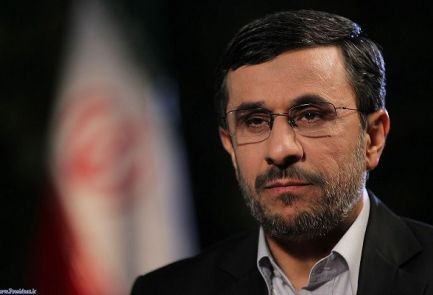
Former President Mahmoud Ahmadinejad says his successor, Hassan Rouhani, must step down over the recent economic crisis in Iran, says the public does not trust Rouhani • “Your continued presence is at the expense of the country,” he tells Rouhani.
Associated Press and Israel Hayom Staff
Former hard-line Iranian President Mahmoud Ahmadinejad has asked President Hassan Rouhani to resign.
In a video published on his Telegram account Thursday, Ahmadinejad said that Iranians do not trust Rouhani. He said, “Your continued presence is at the expense of the country.”
Uncertainty resulting from the U.S. pulling out of the 2015 nuclear deal with world powers has led Iran’s already anemic economy to worsen.
On Wednesday, Iranian lawmakers voted to fire Rouhani’s labor minister, a victory for hard-liners opposed to the relative moderate amid the worsening economic crisis.
Ahmadinejad has brought attention to himself since being blocked from running in last year’s presidential election.
While president, he famously questioned the Holocaust and claimed there were no gays or lesbians in Iran.
Hamas mistakenly assumes it has enough wiggle room to continue walking on the ledge and firing projectiles at Israel • The intensity of the latest round of violence can be reduced, but generally speaking, bringing it to an end will be harder than ever.
Prof. Eyal Zisser
A car sustains damage in a rocket strike in the southern Israeli city of Sderot
|Photo: Yehuda Peretz
Israel has exhibited maximum restraint in recent weeks in the face of incessant rocket fire from Gaza. This restraint is a testament to the country’s self-confidence and might, not to mention capable leadership and sound judgment on the part of the political and military echelons.
This restraint affords Israel many advantages, as it prevents an unwanted escalation while allowing for substantial diplomatic and military achievements.
Sometimes, however, such restraint can backfire and have the opposite of the desired effect. On the eve of the 1967 Six-Day War, for example, the Israeli government’s restraint emboldened the enemy to the point of sparking a regional conflagration.
There is no doubt that Hamas are listening to the experts and commentators in Israel, who are constantly saying that for Israel, there is no better alternative than Hamas in Gaza, and that Israel needs to avoid toppling Hamas and retaking the Strip. Hence the unbearable lightness of Hamas’ trigger finger.
So Hamas is projecting a willingness to reach an agreement with Israel, which will ensure relative calm along the Israel-Gaza border. But at the same time, they mistakenly assume that they have enough wiggle room to continue walking on the ledge and firing projectiles at Israel. They believe this will improve their bargaining position, enhance their image as a force capable of twisting Israel’s arm and, most importantly, establish new ground rules, similar to the ones in Lebanon – which would restrict Israel’s freedom of action in Gaza.
Israel and Hamas are on the verge of spiraling back into a familiar pattern, in which a new round of violence would be utterly devastating for Gaza and ultimately leave the Palestinian population and Hamas’ leadership in the same position they are now, or possibly worse off.
Every day that passes, new red lines are being crossed. For example, just yesterday, a rocket was fired into Beersheba for the first time since 2014. The intensity of the latest round of violence can be lowered, as the current cease-fire demonstrates, but generally speaking, every attempt to bring the violence to an end will be harder than ever.
The next few days will decide whether Israel and Hamas are headed for another war • If Israel wants to end the next round of violence quickly and effectively it has to take forceful action now, to make Hamas understand the price it will be made to pay.
Yoav Limor
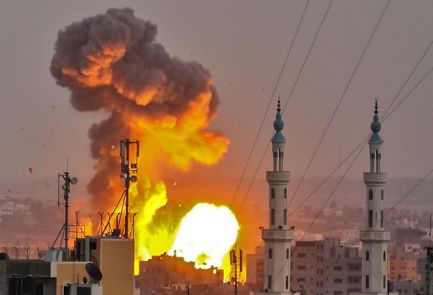
A fireball explodes in Gaza City during an Israeli strike on a Hamas target
|Photo: AFP
Despite the serious escalation in the southern sector on Thursday, both Israel and Hamas have been careful not to break all the familiar rules of the game, thus allowing for the possibility of a cease-fire.
The operational scope exercised by both sides may indicate otherwise – Hamas has fired over 180 projectiles at Israel and the IDF has struck dozens of targets in Gaza – but an analysis of the targets shows both parties “played by the rules”: Hamas aimed at the Gaza-vicinity communities and Sderot (the rocket fire on Beersheba was the work of a rogue terrorist group in Gaza) and the IDF did its best to minimize Palestinian casualties.
It is, however, clear to both sides that they are playing with fire – literally. Every Hamas rocket or Israeli strike have lethal potential, which in turn, could cause the situation to spiral out of control.
There is also the issue of critical mass: The Israeli communities near the Gaza border are already on edge and another sleepless night or two is all it would take for the public to demand immediate action. Gaza’s residents also have nothing to lose at this point, but contrary to what some in Israel hope, pushing Gazans into a corner with the hope that they will turn against Hamas may only cause them to rally around the Islamist terrorist group and support its war.
Meanwhile, as of Thursday night, efforts to mediate a cease-fire were less than enthused. The Egyptians are sitting on the fence, perhaps because they are fed up and perhaps because they want to teach Hamas a lesson. Earlier this week, Egypt allowed a delegation of exiled Hamas officials, including Deputy Hamas leader Saleh Arouri, to travel to Gaza through the Rafah crossing to discuss a cease-fire, but as soon as the delegation left violence flared-up.
Israel hopes Egypt will realize Hamas is ungrateful and restrict the delivery of fuel and goods through Rafah into Gaza, but it is unlikely that this measure would be in Israel’s interest in the long-run, as it prefers Egypt maintain the role of mediator.
What should concern Israel most is the fact that it once again misunderstood Hamas’ intentions. The standing assessment in recent weeks was that the terrorist group was not interested in war and would go to great lengths to avoid it, and those who supported this view cited Hamas leaders’ frantic rush to seek a truce after every border skirmish over the past few weeks.
Recent days have shown that the organization’s intentions are different. The elimination of two of its snipers on Tuesday gave it the pretext for war, but Israel should not feel too bad – Hamas knows how to relay information to Israel and if it wanted to, it could have made it clear that it was conducting a drill near the border. Since it didn’t, the IDF deemed the snipers an imminent threat and eliminated them.
This was just the excuse Hamas needed to ignite the border. Gaza’s rulers have failed to effect change using the diplomatic route, so they naturally reverted to the familiar military one, just like they did in 2014, on the eve of Operation Protective Edge.
Israel has made it clear to Hamas that the path on which it is on is doomed to fail, as its offer of cease-fire will not extend beyond the opening of the Kerem Shalom cargo crossing and the expansion of the fishing zone off Gaza’s coast. All other demands – the construction of air and sea ports and an ease of the restrictions placed on the types of goods delivered into Gaza – will require a broader agreement that will have to include the return of the two Israelis and the remains of two soldiers held in Gaza, as well as an end to Hamas’ armament efforts.
For the moment, Hamas seems to believe that continued rocket fire will break Israel. The IDF, for its part, continues to strike Hamas targets to convince the terrorist group to stop. The next 24-48 hours are critical, and if the fighting continues, it is highly likely that Israel will significantly increase the scope and range of its strikes, which would necessarily spell escalation.
While neither side is ready to declare war, the distance between these skirmishes and a full-fledged conflict is short, and crossing the line between them could prove instantaneous.
This prospect requires the Israeli military to significantly bolster defenses, as Hamas may try to launch a surprise attack – most likely using a terror tunnel – to abduct soldiers and/or civilians, as it did in 2014.
Additional forces have already been deployed on the ground, and the military said that if need be, Gaza-vicinity communities would be evacuated so as to ensure no harm comes to their residents.
From an offensive standpoint, the IDF will have to come up with creative solutions, given that it has been denied a significant opening move. Hamas’ leaders in Gaza have gone underground and the group has cleared all major headquarters and posts, and while destroying Hamas’ operational infrastructure has its value, it is not as effective as razing a high-rise.
For these reasons, if Israel wants to end the next round of violence quickly and effectively it should wage a far more intense military campaign than before to make sure that Hamas understands the price it will be made to pay.
Israel would prefer not to go to war with Hamas over kite terrorism but Gaza’s rulers should not confuse that with apprehension • The simple fact is that clear priorities must be set and Israel must decide which of the threats it faces is truly urgent.
Maj. Gen. (ret.) Yaakov Amidror
A Palestinian in Jabaliya prepares a kite before flying it over the border with Israel
|Photo: AFP
In his book “To Hell and Back: Europe 1914-1949,” Ian Kershaw, one of the great historians of our time, writes an amazing sentence that sums up the last two weeks before the beginning of World War I, the war that wiped out nearly 100 years of prosperity and destroyed Europe: “There was no chance of stopping the war. Considerations of prestige alone created a situation in which neither side could retreat.”
It is important that we remember this sentence because in Israel – a small state that has to invest its (considerable) resources in battles that are necessary to ensure its existence and security – decision-makers must pick not only their battles but also where to forego military moves.
The rationale is simple: you cannot fight all disruptive elements all the time. Clear priorities must be set and Israel cannot afford to launch wars over considerations of “prestige.”
This is not simple, and Israel’s captains can error exactly where the rulers of Germany and Russia, France and Britain did. The real challenge is to identify, among the many threats in the region, the ones that must be dealt with in order to ensure Israel’s survival, and if need be, to fight them to the brim.
On the other hand, when it comes to “prestige,” Israel would be wise to exercise restraint and opt for minimal activity, so as not to interfere with the main objective.
For this reason, for example, the military’s extensive capabilities cannot be “wasted” on a minor threat such as kite terrorism, regardless of how annoying it is, or how much of an affront it is to Israel and the IDF’s pride.
Kite terrorism is nothing to discount but, so far at least, it has not caused any serious harm. It has not cost human lives, the financial damage it has caused has been minor, and it has not infringed on the IDF’s freedom of operation in the southern sector.
Palestinian arson terrorism has so far sparked over 1,000 fires on the Israeli side of the border
Arson terrorism is the default option of a beaten organization that is unable to mark any substantial achievement opposite the Israeli military’s success in neutralizing its offensive abilities. Israel must devise a solution to this nuisance, but we cannot confuse this relatively unimportant situation with the other challenges Israel faces, especially vis-à-vis Iran in general and particularly the Iranian presence in Syria. Keeping a cool head and the correct perspective is vital for a realistic decision-making process.
The widespread use of terms like “pride” and “national honor” date back to a time when Israel struggled to cement its global position and its ability to deter its enemies despite being a small, poor, and underpopulated country.
Back when Israel’s overall position was precarious the softer issues of pride, prestige and honor were also an important part of building an image of power, both domestically and internationally. Now that Israel is the strongest country in the region militarily and economically, when its relations with most of the world’s countries, including some Arab states, are stronger than ever, one can set pride somewhat aside and focus on more significant things.
Clearly, when there is an important interest, even in a secondary sector like the Gaza Strip, it must be protected even if it comes at the price of possible escalation. This was also the case on the day Hamas threatened that thousands of Palestinians would rush the Israel-Gaza border and the IDF did not hesitate to mount a forceful response.
While there is a place for these considerations even during negotiation with Hamas on some sort of cease-fire, the main issue remains that, for the duration of the agreement, Hamas has something of a guarantee that Israel will not interfere with its efforts to improve its arsenal and capabilities as long as Israel enjoys peace and quiet on its border with Gaza.
In the face of this grave weakness, the broader consideration must be taken into account: A cease-fire deal with Hamas will allow Israel to focus mainly on stopping Iran’s efforts to entrench itself militarily in Syria. Iran would very much prefer that Israel focus on the Gaza Strip. The advantage of an agreement with Hamas is that it postpones Israel’s need to deal with Gaza at this time. This is very important and that is why this option must be considered seriously.
Why hasn’t the Israel Defense Forces used all of its force to combat the growing terrorism from the Gaza Strip? Not surprisingly, this is a question many Israelis are finding difficult to answer. For some, this frustration translates into blunt language directed at both the military and the political echelon. Yet even if Hamas foolishly drags Israel into a wide-scale conflict, the IDF has had three good reasons to adhere to its policy of containment and measured military responses.
The first consideration concerns Israel’s long-term interest in avoiding taking full and ongoing military control of Gaza, a possible outcome of an all-out military campaign; and the no less problematic possibility of a bloody draw, which could stem from a partial campaign. There can be no doubt the IDF is capable of subduing and controlling the escalation. The Hamas leadership is motivated by irrational urges, and so Israel prefers to try to manage its steps through the involvement of a third side – Egyptian intelligence, for example – who have a better chance of giving their interlocutors a clearer idea of the level of risk they are taking.
From this point, we can derive a second consideration: Israel has a role to play in the band of regional forces that raise the banner of stability and are partners in the fight against radical Islamism in all its forms, from Iran to the Islamic State. It is precisely because of this partnership that Israel must exhaust the potential for joint action with Egypt. Both countries view Hamas as an enemy, an enemy upon whom it would be best to deter than to engage in an all-out conflict, the outcome of which would be difficult to control.
A third consideration stems from the possible ramifications of embarking on a military campaign in the south at the height of what might quickly develop in a crisis in the north. Tensions between the United States and Iran, along with economic problems in Tehran, make it ever more likely that the Iranian regime will make some provocative moves. A watchful eye in the north demands that the IDF remain as available as possible to fortify deterrence against Israel’s chief enemy.
Col. (ret.) Dr. Eran Lerman, former deputy director of the National Security Council, is the vice president of the Jerusalem Institute for Strategic Studies.
Cabinet orders IDF to take ”forceful action” against Hamas in wake of massive rocket salvo • In first since 2014, rocket fired at Beersheba • U.S. “fully supports Israel’s right to defend itself” • Israeli envoy to U.N.: Security Council must denounce Hamas.
Gadi Golan, Ariel Kahana, News Agencies and Israel Hayom Staff
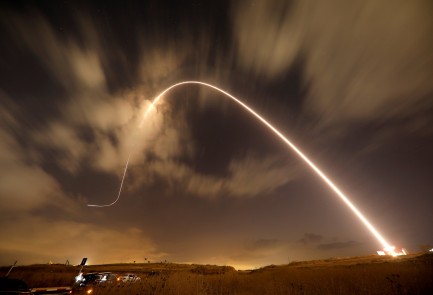
The Iron Dome defense system engaging rockets launched from Gaza towards the southern city of Sderot
|Photo: Reuters
Israel on Friday denied claims by Hamas, the terrorist organization ruling the Gaza Strip, that a cease-fire has been reached following aday of near-constant fire on Israeli communities near the border and Israeli strikes on Hamas asset in the coastal enclave.
Hamas officials said late Thursday that their truce with Israel came into effect on 11:45 p.m., ending an intense two-day burst of violence that had pushed the region closer to war.
Hamas’ Al Aqsa TV reported that the Egyptian-brokered deal has taken hold “on the basis of mutual calm.” It said the deal was mediated by Egypt and other unidentified regional players.
The Gaza-based Islamic Jihad terrorist group, however, also denied agreeing to a truce with Israel, but nevertheless, the Israel-Gaza Strip border seemed quiet on Friday morning.
During the latest round of violence, the fiercest seen in the sector over the past few weeks, Hamas fired over 180 projectiles at Israeli border-adjacent communities and the Israeli Air Force targeted some 150 Hamas positions in Gaza.
Reuters
Smoke billows over the Gaza Strip following an Israeli strike on a Hamas terror target
A Thai farm worker in her 20s sustained serious injuries when a rocket struck a packing facility in the Eshkol Regional Council on Thursday morning. Another employee was lightly hurt and at least 20 others were wounded in separate incidents.
On Thursday afternoon, a Grad rocket hit an open area in Beersheba, 22 miles from Gaza, triggering sirens in the southern city for the first time since the 2014’s Operation Protective Edge. No injuries or damage were reported in the incident.
Hamas denied firing the rocket at Beersheba, an assertion backed by the IDF. On Thursday evening, Islamic Jihad claimed responsibility for the incident.
Prime Minister Benjamin Netanyahu convened a special session of the Diplomatic-Security Cabinet on Thursday evening to discuss the volatile situation on the border.
The cabinet ordered the military to take unspecified ”forceful action” against Hamas and the other terrorist groups in Gaza. The IDF has since reinforced the units deployed along the border. with defense officials saying the military was ready for any scenario.
Sources at the Prime Minister’s Office said that Hamas, via Egyptian officials and U.N. Middle East envoy Nickolay Mladenov, had been asking for a cease-fire since Thursday morning, but Israel continued to strike terror targets in Gaza.
Senior Jerusalem officials stressed that Thursday’s operation was not the beginning of a military campaign in Gaza, but rather was meant to deal Hamas a serious blow and generate deterrence.
Israel had Hamas have fought three wars over the past decade, in 2008, 2012 and 2014.
Following the rocket fire on Beersheba, the IAF struck a five-story building in northwest Gaza. Gaza’s Health Ministry said 20 people were wounded in the strike on the premises, which housed both a Hamas internal security office and what Palestinian media called “a culture and sciences center.”
Hamas denounced the “barbaric” attack as an Israeli attempt to undermine the Egyptian mediation efforts.
Reuters
A Gaza City building leveled by an Israeli strike, Thursday
In a series of tweets, the IDF said, “IAF fighter jets targeted a five-story building in the Rimal neighborhood in northern Gaza. Hamas’ internal security forces used the building for military purposes.
”Hamas’ internal security unit is responsible for all security operations carried out inside Gaza, and is considered to be an executive branch of Hamas’ political leadership. The building served as the office of active unit members. A significant part of the unit’s members are also Hamas military operatives.”
IDF Spokesperson Brig. Gen. Ronen Manelis told reporters that the military was “determined to restore calm to southern Israel. Hamas is the one pushing for an escalation. We have struck over 150 targets, some highly strategic and important. This policy will intensify until such time as calm is restored.”
Manelis stressed that “there is no comparison between the damage we have inflicted on Hamas and the damage it has caused us. The group has sustained hundreds of casualties and it has lost multiple assets, including tunnels.
”After four years of preparations, our abilities opposite Gaza are at their peak. If we need to launch a military campaign it will be clear-cut and decisive,” he said.
At the United Nations, Israeli Ambassador Danny Danon urged the U.N. Security Council to condemn Hamas militants for what he called “the unprovoked terrorist attack” on southern Israel.
The United States State Department issued a statement saying it was monitoring the situation in Gaza closely.
”We’ve been watching this as it has been unfolding, and it’s a very concerning situation that has taken place in Gaza,” State Department spokeswoman Heather Nauert said at a press briefing.
”Overall, we condemn the launching of missile attacks into Israel and call for an end to the destructive violence. We’ve seen reports that 180 or so rocket attacks have taken place, shot from Gaza into Israel, and we fully support Israel’s right to defend itself and to take actions to prevent provocations of that nature,” she stressed.
Pressed by a reporter who insisted that the current escalation was not started by Hamas, Nauert replied, ”I’m not going to get into how this thing started. Let’s not forget that Hamas bears ultimate responsibility for the dire humanitarian situation in Gaza. It’s a tremendous concern of ours.”








 anneinpt
 artaxes
 danmillerinpanama
 davidking1530
 Peter Hofman
 Joseph Wouk
 Peter
Peter Louisiana Steve

Recent Comments