The reclusive Dr. Mohsen Fakriazadeh, reputed father of Iran’s nuclear weapons and missile programs, was assassinated near Tehran on Friday, Nov. 27. He was attacked by unknown killers in Damavand, Tehran Province, during an armed conflict with his bodyguards. This was confirmed by Iran’s Revolutionary Guards of which the scientist was also a brigadier general.
Shariar Heydari, Dep Chairman of Iran’s parliamentary National Security Commission told reporters that the Iranian scientist was martyred when “a car exploded in front of his vehicle followed by gunfire by the terrorists” killing the scientist and one of his bodyguards.
The physicist who operated in the shadows was first prominently named by Prime Minister Binyamin Netanyahu in April 2018, during his televised revelation that the Mossad had removed Iran’s vast nuclear archive from a secret warehouse in Tehran. He presented a photograph, saying “Remember that name, Fakhrizadeh.”
After Iran’s physics Research Center (PHRC) was exposed as a military organization, the center changed its name to the Institute of Applied Physics under the codename of AMAD. Fakhriazadeh took over as head of research and continued the secret nuclear weapons program after Iran signed its 2015 nuclear accord with six world nations. This too was disclosed in the Netanyahu presentation. In an effort to protect this key director of nuclear weapons development against assassination, photographs of the nuclear scientist were rare and he was surrounded by a protective shield of security. the Iranian authorities also denied numerous requests from the Atomic Energy Agency to interview him. He is the last in a succession of Iranian nuclear scientists who were assassinated over the years.
DEBKAfile adds: No party has claimed responsibility for the removal of the keystone of Iran’s drive for a nuclear bomb, and this assassination may never be officially acknowledged, any more than its precedents.
Incumbent US President Donald Trump has pledged that Iran will never be allowed to acquire a nuclear weapon, as has Israel. The timing of the operation between American presidents is, however, highly suggestive. Joe Biden is believed to be planning to restore the US to the nuclear accord after Trump’s withdrawal and possibly treat the Islamic Republic with greater lenience. Another question is if and how Iran will react to this body blow to its nuclear aspirations, which may be compared in gravity to the killing of the Islamic Republic’s master military strategist, Qassem Soleimani in Jan. 2019 by an American drone.
Posted November 27, 2020 by Joseph Wouk Categories: Uncategorized
Mohsen Fakhrizadeh’s car bombed and shot at; blaming ‘Zionists,’ adviser to Khamenei vows to ‘descend like lightning on killers’; scientist has been called ‘father of Iranian bomb’
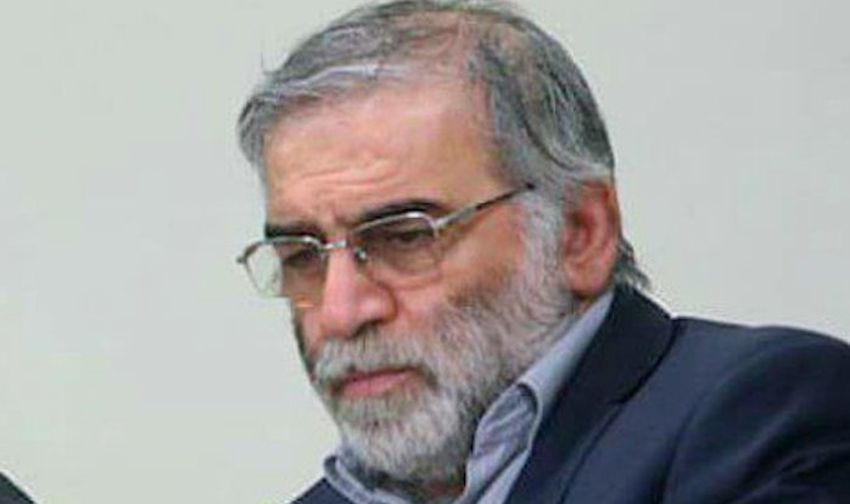
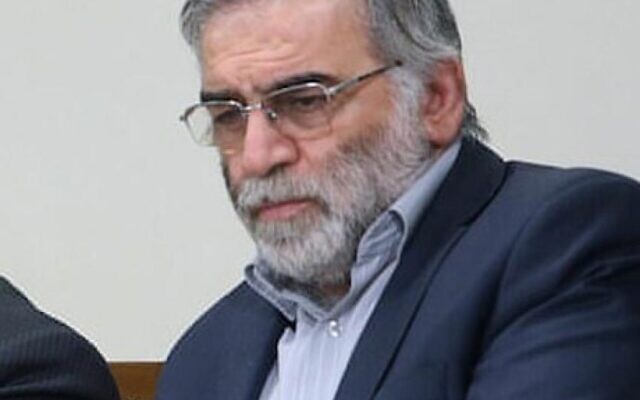
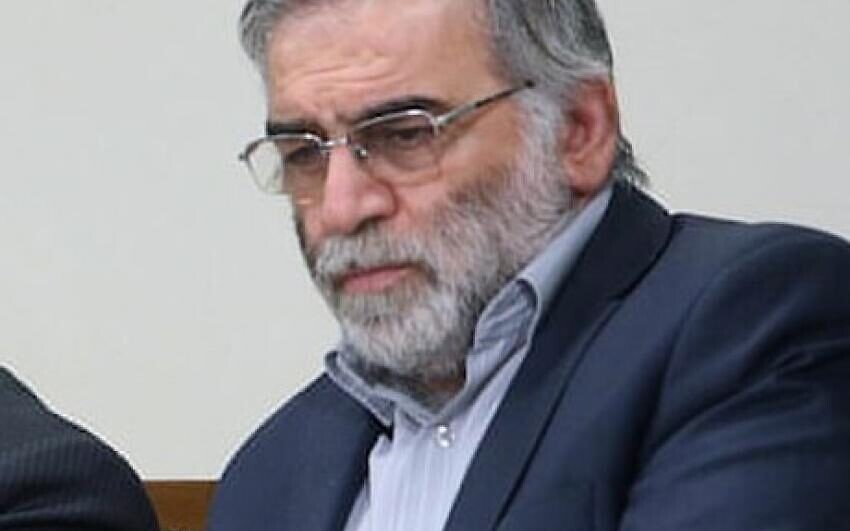
By TOI STAFF and AGENCIESToday, 4:00 pm 7Dr. Mohsen Fakhrizadeh in an undated photo (Courtesy)
The alleged head of Iran’s nuclear weapons program was assassinated Friday near the capital Tehran, Iran’s defense ministry said.
The ministry confirmed the death of Mohsen Fakhrizadeh, a professor of physics and an officer in the Iranian Revolutionary Guard, after it was widely reported in Iranian media.
“This Friday afternoon, armed terrorist elements attacked a car carrying Mohsen Fakhrizadeh, head of the Ministry of Defense’s Research and Innovation Organization,” it said. “During the clash between his security team and the terrorists, Mr. Mohsen Fakhrizadeh was seriously injured and taken to hospital.
“Unfortunately, the medical team did not succeed in reviving him, and a few minutes ago, this manager and scientist, after years of effort and struggle, achieved a high degree of martyrdom.
There was no comment on whether the attackers had escaped.
The attack happened in Absard, a small city just east of the capital, Tehran. Iran’s Fars and the Tasnim news agencies, both close to security sources, said it involved “terrorists bombing a car before shooting at Mr. Fakhrizadeh’s car.”
Those wounded, including Fakhrizadeh’s bodyguards, were later taken to a local hospital, Fars said.
Hossein Salami, chief commander of the paramilitary Revolutionary Guards, appeared to acknowledge the attack on Fakhrizadeh.
“Assassinating nuclear scientists is the most violent confrontation to prevent us from reaching modern science,” Salami tweeted.
Hossein Dehghan, an adviser to Iran’s supreme leader and a presidential candidate in Iran’s 2021 election, issued a warning on Twitter.
“In the last days of their gambling ally’s political life, the Zionists seek to intensify and increase pressure on Iran to wage a full-blown war,” Dehghan wrote, appearing to refer to US President Donald Trump. “We will descend like lightning on the killers of this oppressed martyr and we will make them regret their actions!”Gen. Hossein Dehghan, a military adviser to Iran’s Supreme Leader Ayatollah Ali Khamenei, in Tehran, Iran, November 18, 2020. (Vahid Salemi/AP)
The area around Absard is filled with vacation villas for the Iranian elite with a view of Mount Damavand, the highest peak in the country. Roads on Friday, part of the Iranian weekend, were emptier than normal due to a lockdown over the coronavirus pandemic, offering his attackers a chance to strike with fewer people around.
Fakhrizadeh was named by Israeli Prime Minister Benjamin Netanyahu in 2018 as the director of Iran’s nuclear weapons project.
When Netanyahu revealed then that Israel had removed from a warehouse in Tehran a vast archive of Iran’s own material detailing with its nuclear weapons program, he said: “Remember that name, Fakhrizadeh.”
Israel has long been suspected of carrying out a series of targeted killings of Iranian nuclear scientists nearly a decade ago, in a bid to curtail Iran’s nuclear program. It made no comment on the matter Friday.
In a video uploaded to Twitter Friday shortly after news of the alleged killing emerged, Netanyahu, counting off various achievements of the week, noted that this was “a partial list, as I can’t tell you everything.”
No group immediately claimed responsibility for the attack. However, Iranian media all noted the interest that Netanyahu had previously shown in Fakhrizadeh.
Fakhrizadeh led Iran’s so-called “Amad,” or “Hope” program. Israel and the West have alleged it was a military operation looking at the feasibility of building a nuclear weapon in Iran. Tehran long has maintained its nuclear program is peaceful.
The International Atomic Energy Agency says that the “Amad” program ended in the early 2000s. Its inspectors now monitor Iranian nuclear sites.
But Netanyahu said in his 2018 comments that Fakhrizadeh was continuing to lead such efforts secretly under SPND, “an organization inside Iran’s Defense Ministry.”Prime Minister Benjamin Netanyahu stands in front of a picture of Mohsen Fakhrizadeh, who he named as the head of Iran’s nuclear weapons program, April 30, 2018 (YouTube screenshot)
An Israeli TV report in May 2018 claimed Israel may have decided not to assassinate Fakhrizadeh in the past because it preferred to keep him alive and watch what he was up to.
“If Iran ever chose to weaponize [enrichment], Fakhrizadeh would be known as the father of the Iranian bomb,” a Western diplomat told the Reuters news agency four years ago. He has often been compared with Robert Oppenheimer, the director of the American nuclear development program in the 1940s.
A report on Axios Wednesday claimed that the Israeli army has been preparing for the possibility that US President Donald Trump will order a strike on Iran before leaving office in January.
Citing senior Israeli officials, Axios said there was no specific information that such an attack is imminent, but Israeli leaders believe the US president’s final weeks in the job will be “a very sensitive period.”
The officials said Washington would likely update Israel before carrying out military action against the Islamic Republic.
In January the US assassinated Qassem Soleimani, the powerful head of Iran’s Quds Force, in an airstrike at Baghdad International Airport, nearly sparking a larger conflict between the countries.In this Sept. 18, 2016 file photo released by an official website of the office of the Iranian supreme leader, Revolutionary Guard Gen. Qassem Soleimani, center, attends a meeting with Supreme Leader Ayatollah Ali Khamenei and Revolutionary Guard commanders in Tehran, Iran. (Office of the Iranian Supreme Leader via AP)
Intelligence expert Ronen Bergman told Israel’s Channel 10 news in 2019 that given that many of Fakhrizadeh’s close aides had been killed over the years in assassinations linked to the Mossad, it was “reasonable to assume” that he would also have been “picked out” for assassination by the Mossad over the years.
Since Fakhhrizadeh is still alive, said Bergman at the time, “one can say apparently there was an assassination plan.” And apparently it was rejected during the years when Ehud Olmert was prime minister, Bergman added, choosing his words carefully given the limitations of military censorship when it comes to matters of national security.
“Apparently, there were those who came to Olmert… and said, listen, there is a danger that the operation will fail; there is a danger that the forces on the ground will be discovered.”
Olmert evidently chose to heed those concerns and not approve such an operation, said Bergman, a well-connected journalist on Israeli intelligence and security who recently published a landmark book, “Rise and Kill First,” on “the secret history of Israel’s targeted assassinations.”
Olmert was prime minister until 2009, when Netanyahu succeeded him.
Israel has never acknowledged assassinating people involved in the Iranian nuclear program.
Posted November 26, 2020 by Joseph Wouk Categories: Uncategorized
Thai officials refrain from calling move a prisoner swap despite fact men were cut loose after Australian woman held in Iran was freed
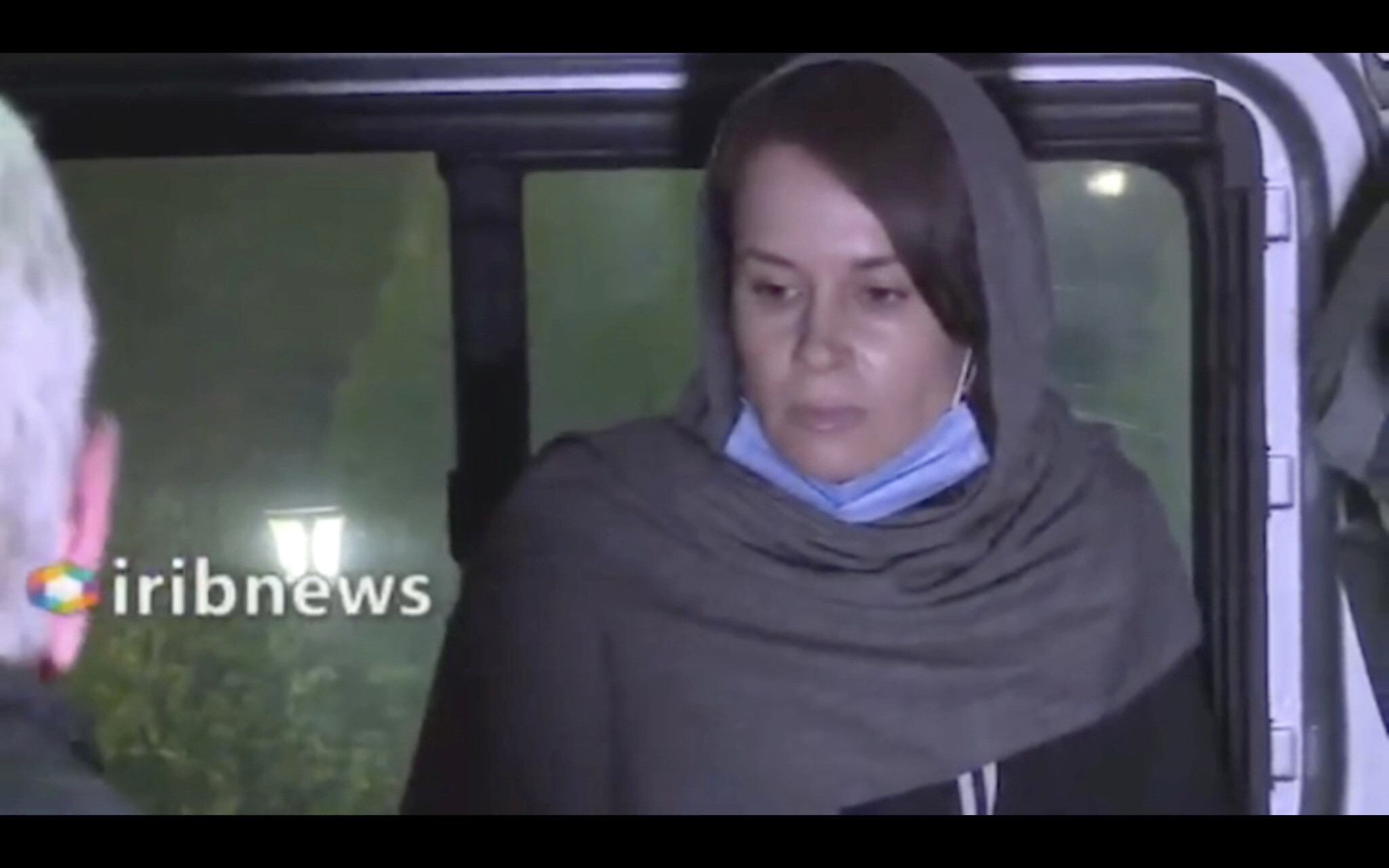
By TASSANEE VEJPONGSA and NICK PERRYToday, 10:57 amUpdated at 12:17 pm 1In this frame grab from Iranian state television video aired Wednesday, Nov. 25, 2020, British-Australian academic Kylie Moore-Gilbert, is seen in Tehran, Iran. (Iranian State Television via AP)
BANGKOK (AP) — Thai officials said Thursday they approved the transfer back to Tehran of three Iranians who were allegedly involved in a botched 2012 bomb plot against Israeli diplomats, as Iran released a 33-year-old Australian academic who was imprisoned for more than two years on spying charges.
Thai officials did not go so far as to call it a prisoner swap or say what involvement Australia might have had in the arrangement. Iranian state TV said Tehran released British-Australian Kylie Moore-Gilbert in exchange for three Iranians held abroad.
Chatchom Akapin, Thailand’s deputy attorney general, told The Associated Press that Thai authorities had approved the transfer of the prisoners under an agreement with Iran.
“These types of transfers aren’t unusual,” he said. “We transfer prisoners to other countries and at the same time receive Thais back under this type of agreement all the time.”In this frame grab from Iranian state television video aired Wednesday, Nov. 25, 2020, British-Australian academic Kylie Moore-Gilbert is seen in Tehran, Iran. (Iranian State Television via AP)
In Australia, Prime Minister Scott Morrison said he was “thrilled and relieved” that Moore-Gilbert had been released but added it would take time for her to process her “horrible” ordeal.
Flight data obtained by the AP showed the plane filmed on the tarmac at the Tehran airport had this week twice flown from Bangkok to Tehran, and then on to Doha, Qatar.
The plane’s tail number links it to an Australian private air carrier called Skytraders, which describes itself as a “principal provider of air services to government.” An employee at the company declined to comment when reached by the AP.
The bomb plot of the three Iranians was exposed in 2012 when an accidental explosion blew apart the Bangkok villa where they were staying. Israeli and Thai officials have said the plot was aimed at Israeli diplomats in Bangkok — though Iran denied the allegations and the men were never charged with terrorism.
Two of the men, Saeid Moradi and Mohammad Kharzei, were convicted in Thailand in 2013. Moradi was sentenced to life for attempting to murder a police officer, while Kharzei was sentenced to 15 years for possessing explosives.
Moradi, a factory technician from Tehran and a former soldier, lost parts of both legs as he tried to flee the villa on a crowded Bangkok street. He was carrying explosives from the house and dropped them in the street as police tried to stop him.In this Dec. 21, 2012 photo, Saeid Moradi, an Iranian suspect bomber, on a wheelchair is helped by a Thai prisoner to arrive for his trial hearing at criminal court in Bangkok, Thailand. (AP Photo/Apichart Weerawong)
The third suspect, Masoud Sedaghatzadeh, was detained in Malaysia. In 2017, a federal court there ordered his extradition to Thailand.
Israeli officials on Thursday had no immediate comment on the release of the Iranians.
Iran’s report of the prisoner swap was scant on detail, saying only that the Iranians had been imprisoned for trying to bypass sanctions on Iran.
Morrison said he had spoken with Moore-Gilbert on Thursday.
“The tone of her voice was very uplifting, particularly given what she has been through,” Morrison told Australia’s Network Nine.
Asked about the swap, Morrison said he “wouldn’t go into those details, confirm them one way or the other” but said he could assure Australians there had been nothing done to prejudice their safety and no prisoners were released in Australia.
In a statement, Moore-Gilbert thanked Australia’s government and diplomats for securing her release, as well as supporters who campaigned for her freedom.
Despite her ordeal, Moore-Gilbert said she had “nothing but respect, love and admiration for the great nation of Iran and its warm-hearted, generous and brave people.”
Moore-Gilbert was a Melbourne University lecturer on Middle Eastern studies when she was picked up at the Tehran airport as she tried to leave the country after attending an academic conference in 2018. She was sent to Tehran’s notorious Evin prison, convicted of spying and sentenced to 10 years. She had vehemently denied the charges and maintained her innocence.
She was one of several Westerners held in Iran on widely criticized espionage charges that activists and UN investigators believe is a systematic effort to leverage their imprisonment for money or influence in negotiations with the West. Tehran denies it. Moore-Gilbert wrote in letters to Morrison that she had been imprisoned “to extort” the Australian government.
Her detention had strained relations between Iran and the West at a time of already escalating tensions, which reached a fever pitch earlier this year following the American killing of a top Iranian general in Baghdad and retaliatory Iranian strikes on a US military base.
Iran state TV aired footage showing her clad in a gray hijab sitting at what appeared to be a greeting room at Mehrabad International Airport in Tehran. She was later seen getting on an Australian-flagged white aircraft, shown to her seat by a man in a suit.
In this Feb. 20, 2012 photo, an Iranian bomb suspect Mohammad Kharzei, right, listens to a Thai police officer as he is taken to verify the house where he and other Iranian compatriots rented in Bangkok, Thailand. (AP Photo/Sakchai Lalit, File)
The TV report did not elaborate on the Iranians it described as “economic activists” freed in exchange for Moore-Gilbert. They wore Iranian flags draped over their shoulders, black baseball caps pulled down over their eyes and surgical masks, outfits apparently designed to conceal their identities. Iran’s deputy foreign minister, Abbas Araghchi, welcomed the three Iranians at the airport.
International pressure has been building on Iran to release Moore-Gilbert. She has gone on repeated hunger strikes and her health has deteriorated during long stretches in solitary confinement. Over the summer, she was transferred to the remote Qarchak Prison, east of Tehran, as fears escalated over the spread of the coronavirus in the country’s notoriously crowded prisons.
Moore-Gilbert had appealed to the Australian government to work harder for her release. In her letters to the prime minister, she wrote that she had been subjected to “grievous violations” of her rights, including psychological torture.
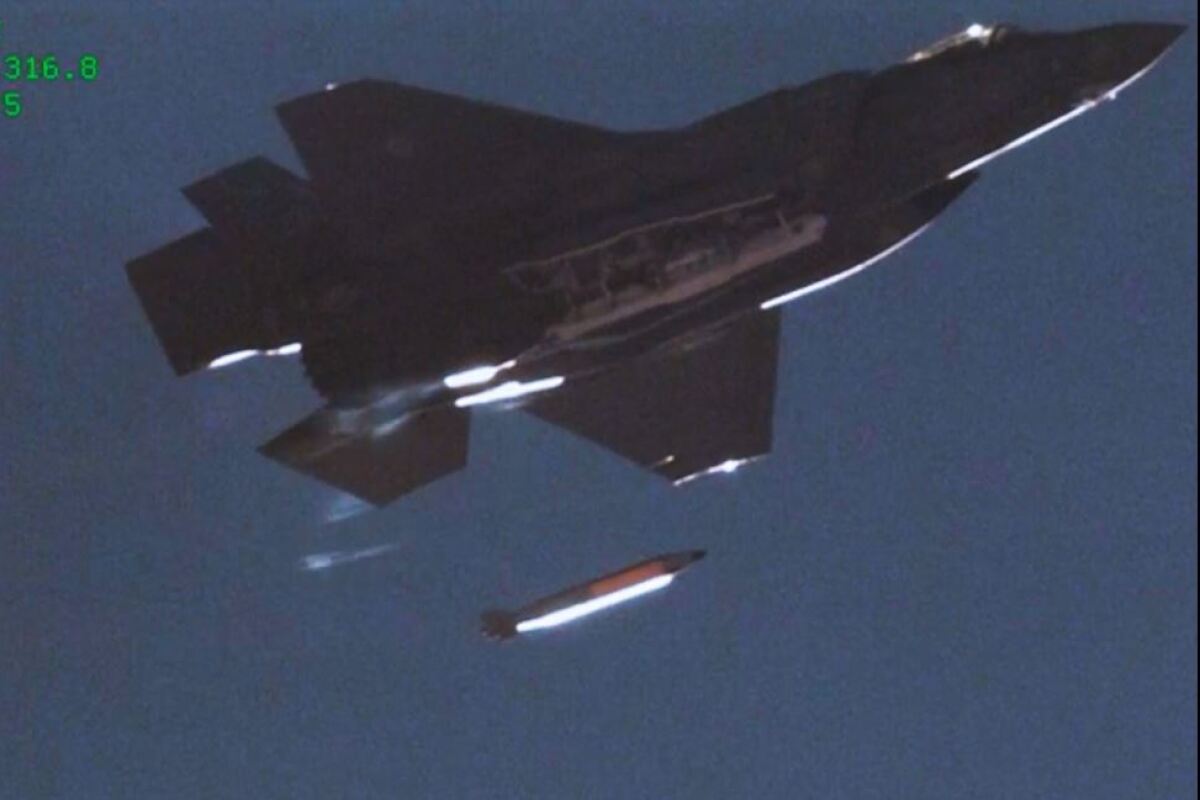
An F-35A Lightning II fighter dropping a B61-12 mock nuclear bombSandia National LaboratoriesVIEW 1 IMAGES
Two major US defense initiatives recently came together as a US Air Force F-35A Lightning II dropped a mock refurbished B61-12 nuclear bomb for the first time. The test, which took place over Sandia National Laboratories’ Tonopah Test Range in Nevada on August 25, saw the 5th-generation fighter release the bomb from an internal bay while flying at supersonic speed.
The F-35 has been garnering a lot of attention as it moves to full deployment after almost two decades of development. Its well-known qualities of stealth, advanced sensors, supersonic speed, and network-ability make it as much a command center as a fighter plane, but it is still first and foremost a weapon system designed to deliver ordnance on target.
The recent flight test mated the F-35 with a lesser known US weapons program, the B61-12 air-launched gravity nuclear bomb. Weighing in at 825 lb (374 kg) and with an explosive yield of between 0.3 and 50 kilotons, it’s the latest variant of the B61 family of bombs that was fielded in 1968. Since then, it has flown on the B-2A bomber, F-15 and F-16 fighters, and the Panavia Tornado.
However, the US stockpile of these nuclear bombs is aging and Sandia has been tasked with helping to extend their service life by 20 years while making them more secure and more reliable. Sandia provides non-nuclear component development and acts as technical integrator for the complete weapon to make sure it works on the intended platforms.
The life extension program includes 400 of the B61-12 bombs and involves refurbishment of parts, replacing fuses and batteries that are suffering from old age, adapting the bomb to new aircraft, and general technical upgrades.
Sandia says mock refurbished B61-12s have already flown on an F-15E Strike Eagle fighter jet in March and a B-2 Spirit bomber in July. What made the F-35A test different is that not only was the aircraft equipped with a nuclear weapon system, but it is the first time that such a bomb was carried in an internal bay on a fighter jet. Normally, the bomb is carried on the outside mounted on a hard point, but the F-35 can carry the bomb or other weapons on the inside to maintain stealth, as well as drop them while flying supersonic.
The flight demonstration was conducted in partnership with the National Nuclear Security Administration, Los Alamos National Laboratory, and the US Air Force.
“This was the first test to exercise all systems, including mechanical, electrical, communication and release between the B61-12 and the F-35A,” says Steven Samuels, a manager with Sandia’s B61-12 Systems Team. “The latest test is a critical piece in the F-35A and B61-12 program Aboard the newest fighter, the B61-12 provides a strong piece of the overall nuclear deterrence strategy for our country and our allies.”
The video below shows the B-61-12/F35A flight test.
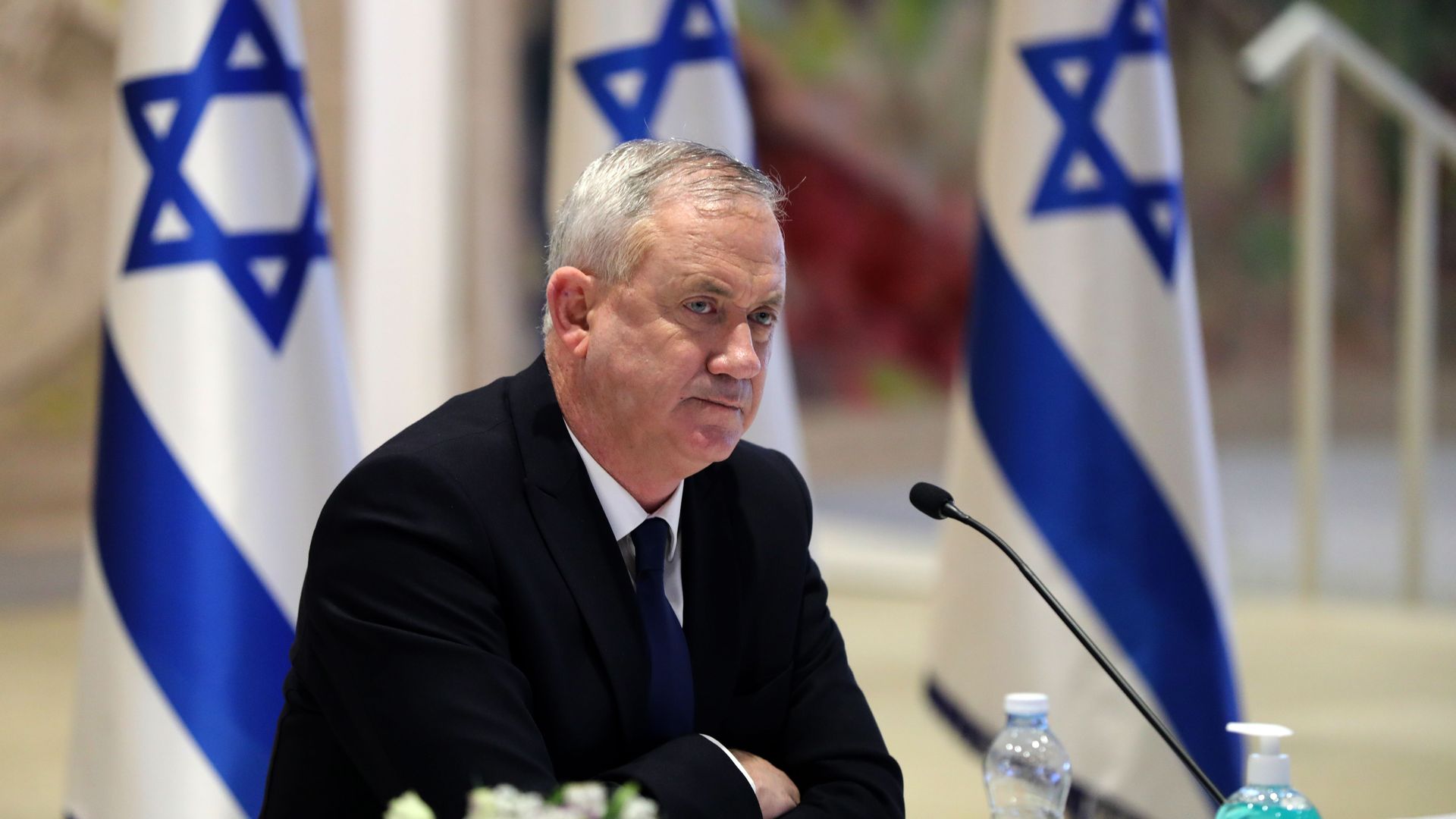
Defense Minister Benny Gantz attends a cabinet meeting. Photo: Abir Sultan/POOL/AFP via Getty
The Israel Defense Forces have in recent weeks been instructed to prepare for the possibility that the U.S. will conduct a military strike against Iran before President Trump leaves office, senior Israeli officials tell me.
Why it matters: The Israeli government instructed the IDF to undertake the preparations not because of any intelligence or assessment that Trump will order such a strike, but because senior Israeli officials anticipate “a very sensitive period” ahead of Biden’s inauguration on Jan. 20.
The IDF’s preparedness measures relate to possible Iranian retaliation against Israel directly or through Iranian proxies in Syria, Gaza and Lebanon, the Israeli officials said.
Flashback: Last week, the New York Times reported that Trump raised the possibility of attacking Iran’s uranium enrichment facility in Natanz in a meeting with senior members of his national security team.
Trump raised the idea after being briefed on an International Atomic Energy Agency report about Iran’s growing stockpiles of enriched uranium, but top officials — including Vice President Mike Pence and Secretary of State Mike Pompeo — warned about the risks of regional escalation, per the Times.
Trump seemed convinced that it would be too risky to strike Iran directly, but has considered other options, the Times reports.
What’s happening: Israeli minister of defense Benny Gantz spoke twice in the last two weeks with Christopher Miller, Trump’s acting defense secretary. They discussed Iran as well as Syria and defense cooperation.
Last Sunday, Israeli Prime Minister Benjamin Netanyahu met in Saudi Arabia with Crown Prince Mohammed Bin Salman. One of the main issues discussed was Iran, Israeli officials say.
Pompeo visited Israel and several Gulf countries last week to discuss Iran. State Department officials traveling with Pompeo told reporters “all options are on the table.”
While Pompeo was in the Gulf, U.S. Central Command announced that B-52 strategic bombers conducted a “short-notice, long-range mission into the Middle East to deter aggression and reassure U.S. partners and allies.” That was seen as another signal to Iran.
Hossein Dehghan, an adviser to Iran’s leader and a possible candidate in Iran’s upcoming presidential elections, told AP last week that a U.S. military strike against Iran could set off a “full-fledged war” in the Middle East.
What’s next: Senior Israeli officials tell me they expect Israel will get prior notice ahead of any U.S. strike against Iran. But they’re concerned that won’t be sufficient to fully prepare. Thus the order to the IDF to start taking preparatory steps under the assumption that such a scenario is possible.
Posted November 25, 2020 by Joseph Wouk Categories: Uncategorized
Groundbreaking meeting said held in presence of US Secretary of State Mike Pompeo, who is seeking to persuade Riyadh to normalize ties with Jerusalem
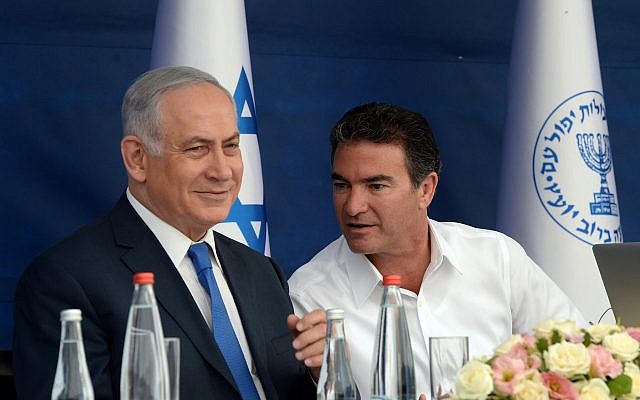
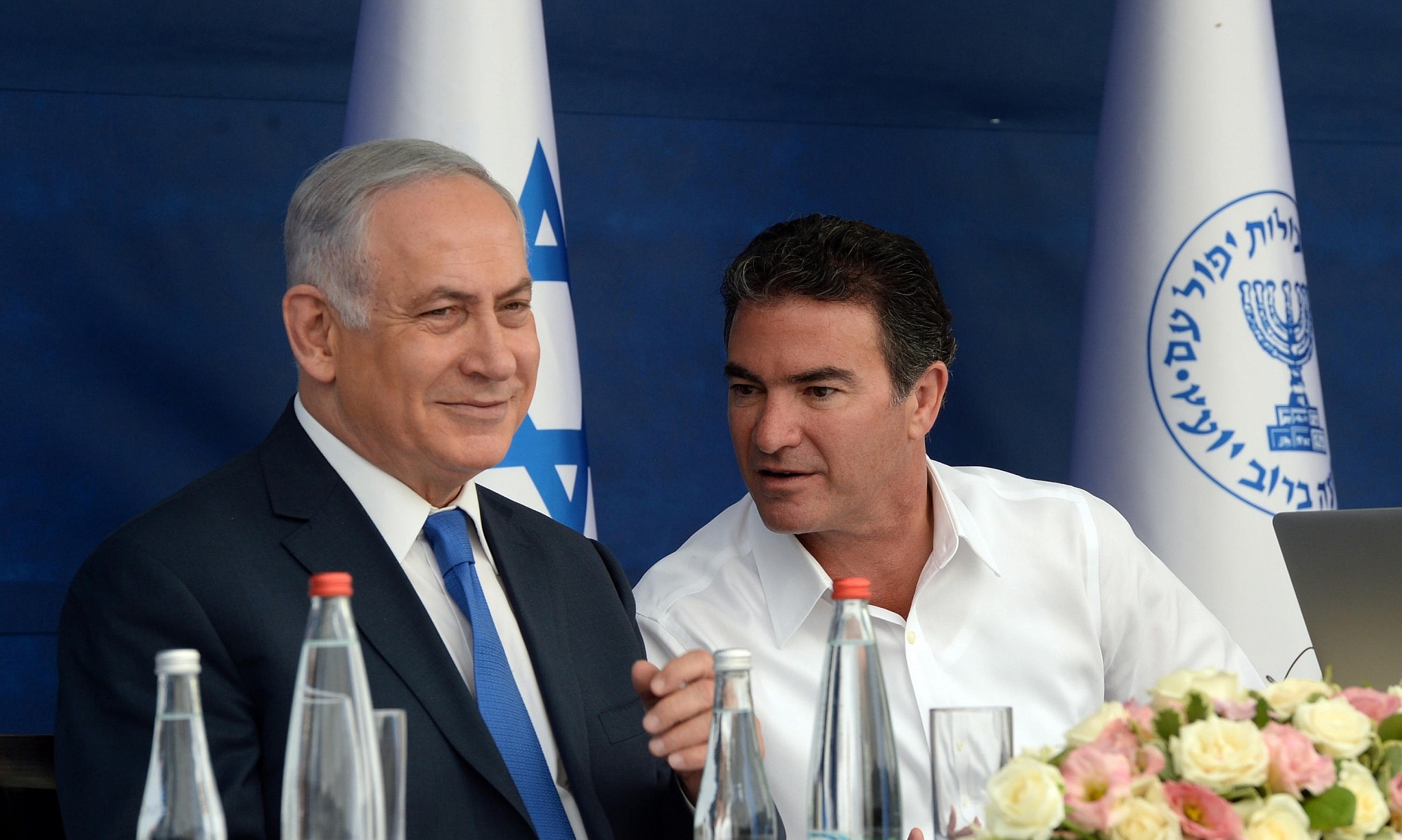
By TOI STAFF23 November 2020, 9:42 amUpdated at 2:11 pm 3Prime Minister Benjamin Netanyahu (left) and Mossad head Yossi Cohen during a toast for the Jewish New Year on October 2, 2017. (Haim Zach/GPO)
In the first visit of its kind, Prime Minister Benjamin Netanyahu traveled to Saudi Arabia on Sunday, where he met with Crown Prince Mohammad bin Salman and US Secretary of State Mike Pompeo, Israeli and Saudi officials said Monday.
Netanyahu was on the ground in Neom, a Red Sea city, for more than three hours for the first known high-level meeting between an Israeli and Saudi leader. He was accompanied by Mossad intelligence chief Yossi Cohen, Hebrew media reports said.
News of the meeting was confirmed early Monday afternoon by Education Minister Yoav Gallant. “I congratulate the prime minister on this amazing achievement,” Gallant said on Army Radio. “The fact that the meeting took place and was made public — even if it was in only a semiofficial way — is something of great importance.” He said it indicated the growing “warm acceptance of Israel by the Sunni world,” and that this was “something our ancestors dreamed about.”
Pompeo earlier on Monday said he had held a “constructive” meeting with Saudi Arabia’s crown prince the night before, as he wrapped up a seven-nation tour that included stops in Israel and Gulf nations. He made no mention of the presence of the Israeli leader.
“Pleasure to meet with Saudi Crown Prince Mohammed bin Salman. Our security and economic partnership is strong and we’ll continue to harness it to advance efforts to counter malign Iranian influence in the Gulf, economic goals under the Vision 2030 plan, and human rights reform,” tweeted the top American diplomat, describing the meeting as “constructive.”US Ambassador to Saudi Arabia John Abizaid, left, and Saudi Arabia’s Foreign Minister Faisal bin Farhan, second from left, greet US Secretary of State Mike Pompeo and his wife Susan as they arrive at Neom Bay Airport in Neom, Saudi Arabia, Nov. 22, 2020. (AP Photo/Patrick Semansky, Pool)
There was no formal announcement by the participants about the meeting. However, in a hint at the trip, an aide to Netanyahu tweeted a report about Defense Minister Benny Gantz launching a probe into a naval acquisitions scandal, writing that “Gantz is playing politics while the prime minister is making peace.”
Senior Hamas official Sami Abu Zuhri demanded an explanation from Saudi Arabia, calling the alleged visit “an insult to the nation and an invitation to attack Palestinian rights.”
The Kan public broadcaster reported that the talks focused on Iran and the incoming Biden administration.
Netanyahu and Cohen traveled to Saudi Arabia on the private plane of businessman Ehud Angel — the same jet that the prime minister used for a covert visit to Oman last year, according to Kan.
Netanyahu had originally been slated to hold a meeting of his coronavirus cabinet meeting on Sunday night but pushed it off by a day, saying groundwork still needed to be completed.
Gantz, who was kept in the dark about efforts to establish ties with the UAE and Bahrain, had complained earlier on Sunday that he was not informed about the coronavirus cabinet meeting being moved.
An Israeli official told Hebrew media that neither Gantz nor Foreign Minister Gabi Ashkenazi, also of the Blue and White party, were given advance notice of Netanyahu’s trip to Saudi Arabia.
The trip by the Israeli leader to Saudi Arabia marked a watershed moment in shifting Gulf ties with Israel, which have been bolstered in recent months at the urging of the Trump administration.
Netanyahu in May 2019 made a secret visit to Oman, another Gulf country with which Israel does not have diplomatic ties.
Covert ties between Israel and Saudi Arabia are believed to have been growing in recent years. The shift in policy has reportedly been led by the crown prince, who sees Israel as a strategic partner in the fight against Iranian influence in the region.
The Trump administration has hoped Saudi Arabia would join the UAE and Bahrain in recognizing Israel and forging diplomatic ties, a move seen as increasingly distant in the wake of Joe Biden’s election as US president. But Saudi leaders have hitherto indicated that Israeli-Palestinian peace will have to come first.
#SaudiArabia: ‘We have supported normalization with #Israel for a long time, but one very important thing must happen first: a permanent and full peace deal between Israelis and Palestinians,’ says Prince @FaisalbinFarhan, Saudi Minister of Foreign Affairs: pic.twitter.com/nKVDJfnxUX
In late October, when President Donald Trump announced that Israel and Sudan would be making peace, he predicted that Saudi Arabia would soon follow. During a call with Israel’s Prime Minister Benjamin Netanyahu, Sudan Sovereign Council president General Abdel Fattah al-Burhan and Sudanese Prime Minister Abdalla Hamdok, Trump brought reporters into the Oval Office, announced that “The State of Israel and the Republic of Sudan have agreed to make peace,” and told reporters there were another five countries “that want to come in.”
“We expect Saudi Arabia will be one of those countries,” Trump added, as he praised the country’s “highly respected” rulers King Salman and Crown Prince Mohammed bin Salman.In this May 20, 2017, file photo, US President Donald Trump (right) shakes hands with Saudi Crown Prince Mohammed bin Salman, in Riyadh, Saudi Arabia. (AP Photo/Evan Vucci, File)
When the White House announced in August that the United Arab Emirates and Israel had agreed to establish full diplomatic ties — a move matched by Bahrain weeks later — Saudi Arabia refrained from criticizing the deal or hosting summits condemning the decision, despite Palestinian requests to do so. The Palestinians have slammed the agreements as a “betrayal of Jerusalem, Al-Aqsa Mosque and the Palestinian cause,” but government-controlled Saudi media hailed them as historic and good for regional peace.
The kingdom also approved the use of Saudi airspace for Israeli flights to the UAE, a decision announced the day after Jared Kushner, Trump’s son-in-law and senior adviser, met with the crown prince in Riyadh. Kushner has been pushing Arab states to normalize ties with Israel and has said that the Jewish state could eventually enjoy fully normalized relations with Saudi Arabia.
The outgoing US administration and Israel are also seeking to step up pressure on Iran in the final days of the Trump White House.
Posted November 25, 2020 by Joseph Wouk Categories: Uncategorized
Iran’s supreme leader suggests Islamic Republic can’t rely on new US administration, despite Biden pledge to reenter 2015 nuclear accord
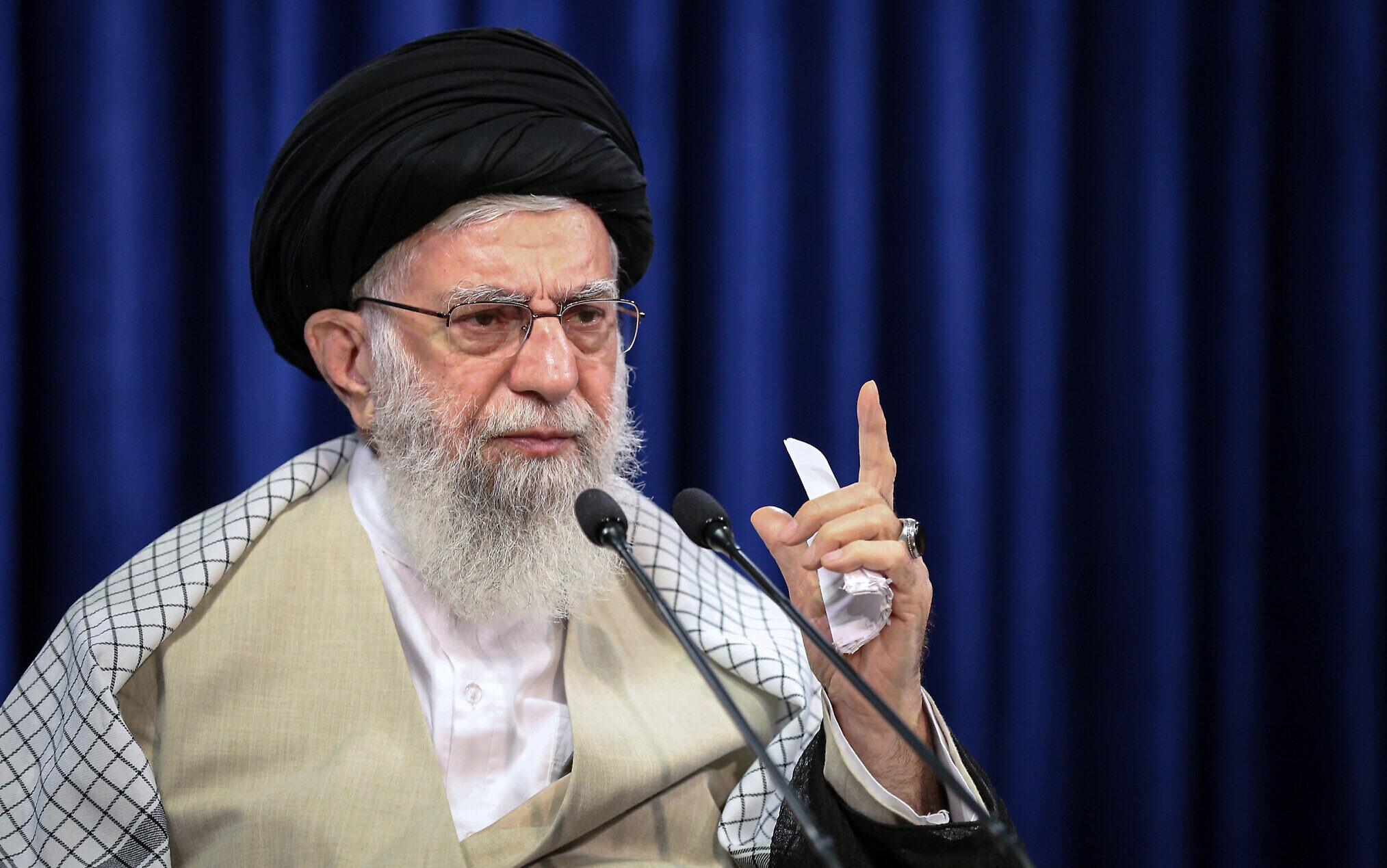
By AFP and TOI STAFF24 November 2020, 6:29 pm 0Iranian supreme leader Ayatollah Ali Khamenei addresses the nation in a televised speech marking the Eid al-Adha holiday, in Tehran, Iran, July 31, 2020. (Office of the Iranian Supreme Leader via AP)
TEHRAN, Iran — Iran’s supreme leader cautioned Tuesday against hopes of a diplomatic “opening” with the West, after President Hassan Rouhani’s government signaled a willingness to engage with US President-elect Joe Biden.
Biden, who defeated Donald Trump at the ballot box on November 3, has promised a return to diplomacy with Iran after four hawkish years under the departing US president.
At a meeting with Rouhani, parliament speaker Mohammad Bagher Ghalibaf and judicial chief Ebrahim Raisi, Iran’s supreme leader Ayatollah Ali Khamenei said “we can’t trust foreigners and hope for an opening on their part.”
“We tried to lift sanctions once and negotiated for several years, but to no avail,” his office quoted him as saying, in reference to the 2015 Iran nuclear deal.
The agreement that gave Iran relief from sanctions in exchange for curbs on its nuclear program has been hanging by a thread since 2018 when Trump unilaterally withdrew and reimposed punitive measures.
In response, the Islamic Republic has gradually reduced its commitments to the deal.
Since Biden’s election victory, the Rouhani government has sent out signals on multiple occasions indicating it is ready to open up with the incoming US administration.US President-elect Joe Biden, accompanied by Vice President-elect Kamala Harris, speaks at The Queen theater in Wilmington, Delaware, Nov. 19, 2020. (AP Photo/Andrew Harnik)
But Khamenei warned that “the situation in the United States is not clear and the Europeans are constantly taking a stand against Iran,” according to the statement from his office.
Biden, who was vice president to Barack Obama when the 2015 accord was signed, has said that he plans to return to the agreement as a basis for further negotiations with Iran.
He has argued that Trump’s withdrawal from the deal signaled to American allies that it could not be trusted to hold agreements and that while the accord may not have been perfect, it had been effective in blocking Iran’s path to a nuclear weapon.
Since Trump pulled out of the accord and began imposing crushing economic sanctions on Tehran, the Islamic Republic has retaliated by producing more and more highly enriched fissile material in violation of the agreement, getting closer and closer to a bomb, while still leaving room for a return to negotiations.Iran’s uranium conversion facility near Isfahan, which reprocesses uranium ore concentrate into uranium hexafluoride gas, which is then taken to Natanz and fed into the centrifuges for enrichment, March 30, 2005. (AP/Vahid Salemi)
Earlier this week, Iran’s foreign minister said that Tehran was willing to return to the deal if Biden lifts sanctions on Iran after entering the White House.
On Sunday, Prime Minister Benjamin Netanyahu warned on against reengaging with Iran on the nuclear deal, saying, “There can be no going back to the previous nuclear agreement. We must stick to an uncompromising policy of ensuring that Iran will not develop nuclear weapons.”
His comments echoed his bitter opposition to the 2015 deal when it was being negotiated by the Obama administration, and contrast starkly with Biden’s pledge to “rejoin” the accord.
Posted November 25, 2020 by Joseph Wouk Categories: Uncategorized
Following border incidents blamed on Tehran’s Quds Force, UN envoy Erdan says attacks violate 1974 agreement, risk regional escalation
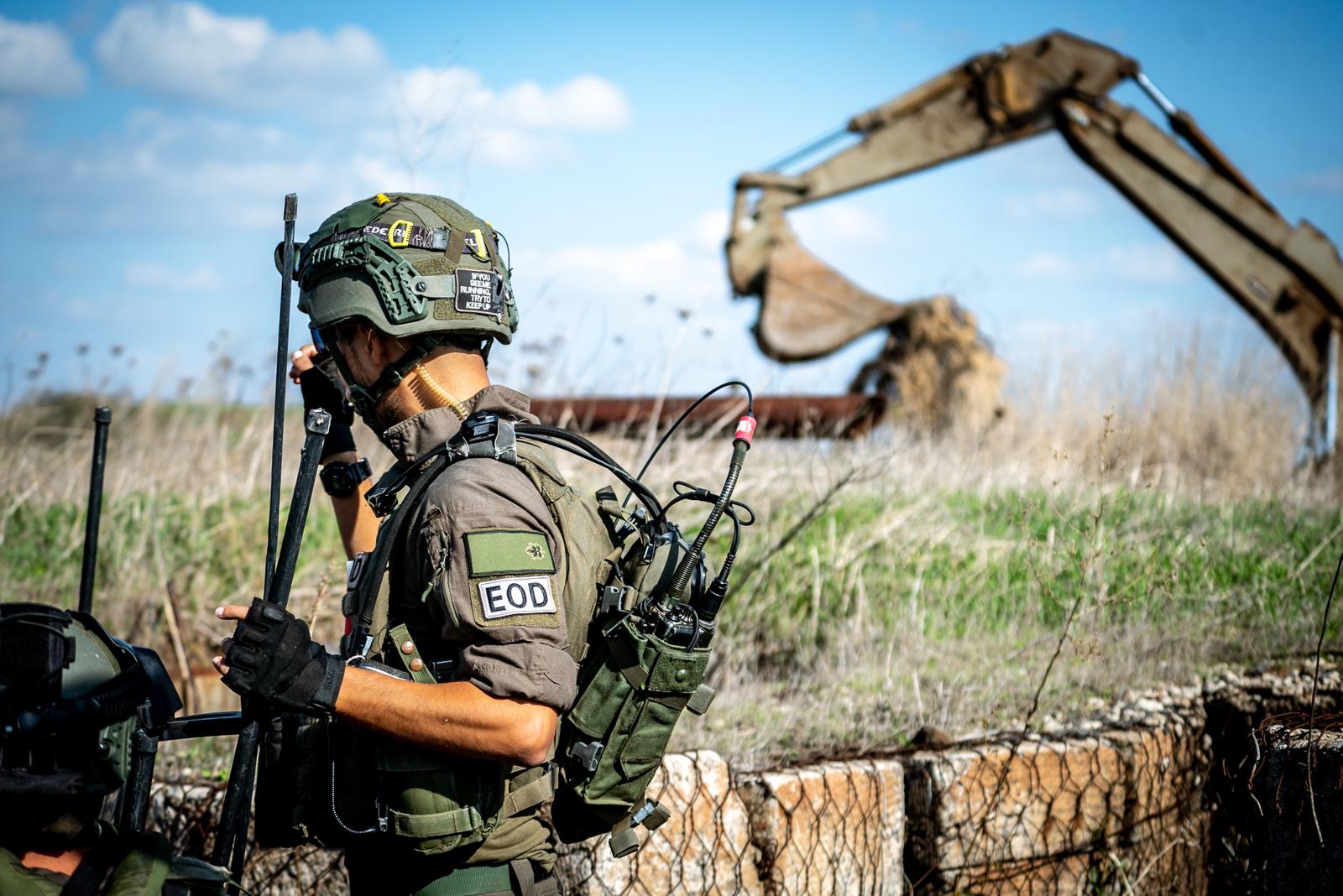
By TOI STAFFToday, 9:07 am 2A combat engineer removes three anti-personnel mines that Israel says were planted inside Israeli-controlled territory along the border with Syria, on November 17, 2020. (Israel Defense Forces)
By TOI STAFFToday, 9:07 am 2A combat engineer removes three anti-personnel mines that Israel says were planted inside Israeli-controlled territory along the border with Syria, on November 17, 2020. (Israel Defense Forces)
Israel’s UN Ambassador Gilad Erdan on Tuesday night demanded that the Security Council take action against Iranian military entrenchment in Syria, following several incidents in which improvised explosive devices were planted on the Israeli side of the border, allegedly by forces controlled by Tehran.
The Israel Defense Forces has blamed a unit in Iran’s elite Quds Force, a branch of the Islamic Revolutionary Guard Corps, for planting three anti-personnel mines in Israeli territory along the border with Syria on November 17, drawing retaliatory Israeli strikes.
The uncovered mines were planted within Israeli territory, but on the Syrian side of the security fence, an area where Israeli troops routinely conduct patrols, indicating that the explosives were meant to be used against those soldiers. IDF Spokesperson Hidai Zilberman told reporters last week that the mines were planted by Syrian nationals who live near the border, at the instruction of the IRGC Quds Force.
The military has said that Quds Force’s Unit 840 was also behind a similar attempt in August by four armed men to plant explosives inside an unmanned military outpost along the border. The four were killed by IDF troops when they crossed into Israeli territory.
On Tuesday, Erdan wrote an official letter to Security Council President Inga Rhonda King and to UN Secretary-General Antonio Guterres, charging that the actions were in “direct violation” of a 1974 Disengagement Agreement between Israel and Syria, which ended the Yom Kippur War and created a buffer zone along the border.
Then-public security minister Gilad Erdan, at a press conference on January 2, 2019. (Flash90)
Erdan said that the deputy commander of UNDOF, the UN peacekeeping force along the Israel-Syria border, has been provided with details and evidence of the attempted attacks.
“These incidents, conducted by Iran’s proxies in Syria (IRGC Quds Force, Unit 840), prove once again that Syrian territory, including the Area of Separation (AOS), is being abused by hostile elements,” Erdan wrote.
“The Syrian regime continues to allow Iran and its proxies to use its territory, including military facilities and infrastructure, to entrench its presence in Syria and undermine efforts to maintain stability in the region,” he added.
“These activities constitute a serious and blatant violation of the Disengagement Agreement (1974); carry the potential for serious escalation in the region; and pose a risk not only to the local civilian population, but also to the UN personnel on the ground.
“Israel expects a thorough investigation of these incidents by UNDOF and an appropriate report to the Security Council Members,” Erdan said.
“Israel calls upon the Security Council to condemn these recurring dangerous acts and demands a total rollback of Iran and its proxies from Syria and the removal of Iranian military infrastructure from Syrian territory.”Three anti-personnel mines that Israel says were planted inside Israeli-controlled territory along the border with Syria, which were uncovered on November 17, 2020. (Israel Defense Forces)
Israel views a permanent Iranian military presence in Syria as an unacceptable threat, which it will take military action to prevent.
The IDF has launched hundreds of strikes in Syria since the start of the civil war in 2011 against moves by Iran to establish a permanent military presence in the country and efforts to transport advanced, game-changing weapons to terrorist groups in the region, principally Hezbollah.
Alexander Fulbright and Judah Ari Gross contributed to this report.
Posted November 25, 2020 by Joseph Wouk Categories: Uncategorized
In defiance of international sanctions on nuclear program and amid European criticism, bill also calls for operating metal uranium production plant
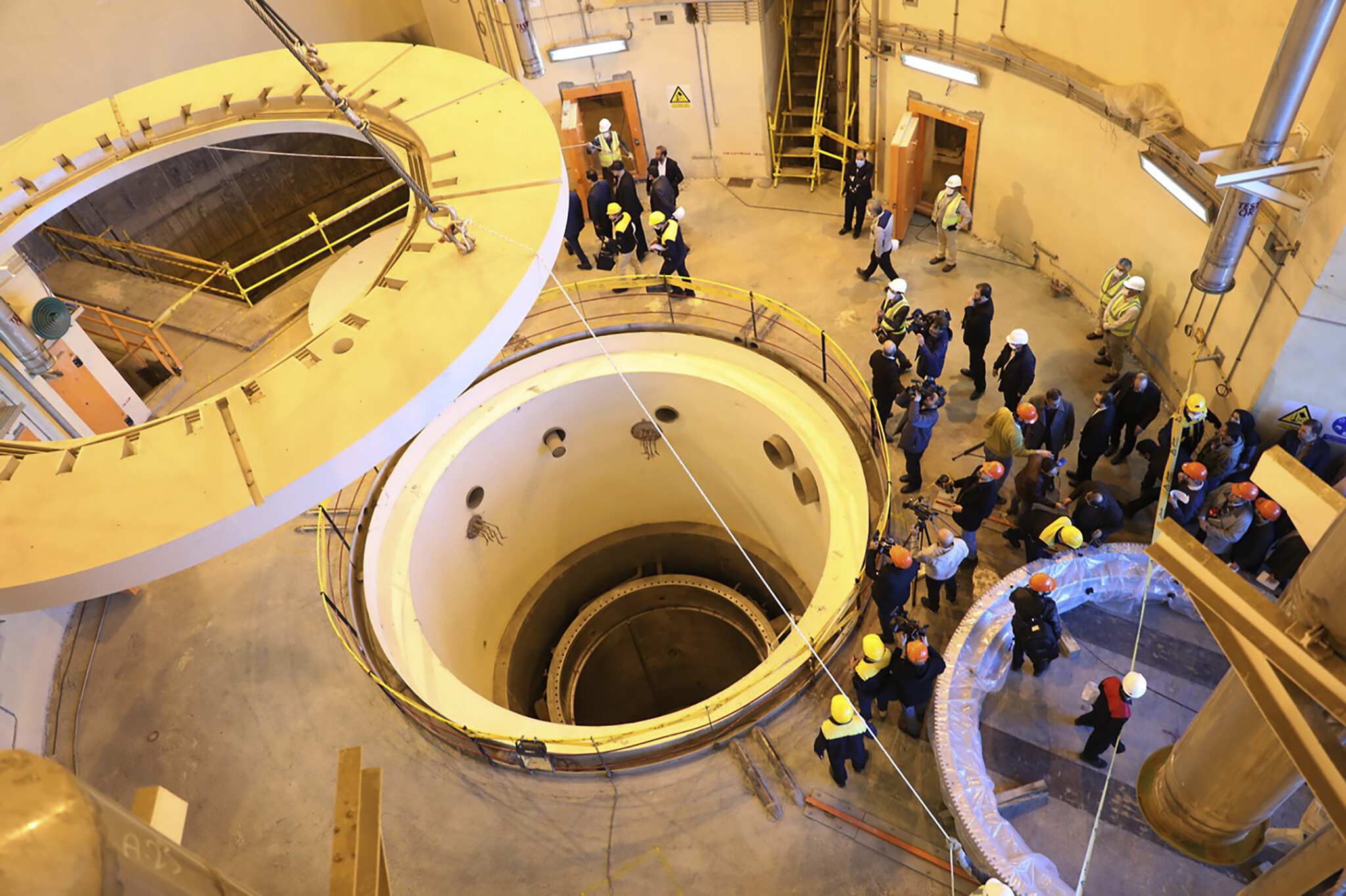
By TOI STAFF and AGENCIESToday, 10:07 am 1Technicians work at the Arak heavy water reactor’s secondary circuit, as officials and media visit the nuclear site, near Arak, 150 miles (250 kilometers) southwest of the capital Tehran, Iran, December 23, 2019. (Atomic Energy Organization of Iran via AP)
Iran’s parliament on Tuesday passed a bill requiring the country’s atomic agency to build a new heavy water reactor and operate a metal uranium production plant as part of efforts to challenge international sanctions on its nuclear program, state media reported.
The parliament’s National Security and Foreign Policy Commission spokesman, Abolfazl Amouei, was quoted by various Iranian news outlets as saying the bill was officially called “Strategic Action to Lift Sanctions.”
He said the law requires the Atomic Energy Organization of Iran to redesign and optimize a new 40-megawatt heavy water reactor in Arak within four months.
Since US President Donald Trump pulled out of the 2015 Iran nuclear deal with world powers and began imposing crushing economic sanctions on Tehran, the Islamic Republic has retaliated by producing more and more highly enriched fissile material in violation of the agreement, getting closer and closer to a bomb, while still leaving room for a return to negotiations.
German Foreign Ministry spokeswoman Andrea Sasse said this week that Iran was systematically violating the accord, ahead of a meeting between the German, French and British foreign ministers on the matters.
In this November 10, 2020 photo, US President-elect Joe Biden at The Queen theater in Wilmington, Delaware (AP Photo/Carolyn Kaster)
US President-elect Joe Biden has said he hopes to return the US to the accord, under which Iran agreed to limit its nuclear activities in exchange for the lifting of international sanctions.
Biden has argued that Trump’s withdrawal from the deal signaled to American allies that the US could not be trusted to stick to agreements and that while the accord may not have been perfect, it had been effective at blocking Iran’s path to a nuclear weapon.
Taking a step back from the brink, Iran’s foreign minister said last week that Tehran was willing to return to the deal if Biden lifts sanctions on Iran after entering the White House.
On Sunday, Prime Minister Benjamin Netanyahu warned against reengaging with Iran on the nuclear deal, saying, “There can be no going back to the previous nuclear agreement. We must stick to an uncompromising policy of ensuring that Iran will not develop nuclear weapons.”
His comments echoed his bitter opposition to the deal when it was being negotiated by the Obama administration, and contrast starkly with Biden’s pledge to “rejoin” the accord.
An almost three-decades-old conflict between Azerbaijan and Armenia over Nagorno-Karabakh was brought to an end this week after 45 days of hard fighting.
The conflict had its origins in the collapse of the Soviet Union. During this period, ethnic Armenians living inside Azerbaijan’s Nagorno-Karabakh region tried to break away and join Armenia. Armenia took advantage of the chaos and invaded the region, capturing a sizable chunk of Azerbaijan’s internationally recognized territory.
A ceasefire agreement was signed in 1994, which, for the most part, held — albeit there were occasional minor skirmishes over the years. That same year, the Organization for Security and Cooperation in Europe established the so-called Minsk Group to help broker a final peace — but it failed to do so.
Having grown impatient over the lack of progress in peace talks and the bellicose rhetoric coming from Armenian leaders, Azerbaijan decided to act. Major fighting kicked off in late September and was brought to an end this week by an Azerbaijani victory. With the help of Turkish and Israeli drones, and a lot of bravery from its soldiers, Azerbaijan was able to liberate large swathes of its territory from Armenian occupation.
Armenia is estimated to have lost approximately 40 percent of its equipment, including hundreds of tanks, armored vehicles and pieces of artillery. It is likely that Azerbaijan ended up capturing more equipment from Armenia than it lost on the battlefield — probably one of the few cases in history of an army ending a war with more equipment than it started with.
Turkey and Russia played a big role in the conflict. Russia traditionally backs Armenia, but in this conflict took a standoffish approach to the dismay of Yerevan. Turkey has always been close to Azerbaijan and has been in a protracted geopolitical competition with Russia over places like Syria, Libya, and to a certain extent Ukraine in recent years.
The peace agreement announced earlier this week was brokered by Russia with Turkish influence behind the scenes. It led to the surrender of Armenian forces inside Azerbaijan and the deployment of a small Russian peacekeeping force to regions in Nagorno-Karabakh with a sizable Armenian minority. While a lot of the commentary has been focused on what Armenia’s defeat means for Turkey and Russia, one country that was a big loser in this conflict was Iran.
For historical reasons Iran sees itself as entitled to a special status in the South Caucasus. Both Armenia and Azerbaijan were once part of the Persian empire. Today, Armenia and Iran enjoy cozy relations.
Azerbaijan is one of the predominately Shiite areas in the Muslim world that Iran has not been able to place under its influence. While relations between Baku and Tehran remain cordial on the surface, there is an underlying tension between the two. During the war in Nagorno-Karabakh in the 1990s, Iran sided with Armenia as a way to marginalize Azerbaijan’s role in the region.
There are three reasons why Iran is a big loser in this conflict.
Firstly, it remains to be seen how Azerbaijan’s victory will play out with Iran’s sizable Azeri minority. Azeris are the second-largest ethnic group in Iran. During the conflict there was a lot of pro-Azerbaijani rhetoric and protests on social media and on the streets in support of Baku by ethnic Azeris. The Iranian regime was very careful to appear balanced during the conflict, but at the same time stifled many of these pro-Azerbaijani protests. There is a constant low-level push for self-determination and increased autonomy in northern Iran for the Azeri minority. Although this has not materialized into a mass movement for independence, it makes some in the Iranian leadership nervous.
Secondly, Iran will have to devote time, resources, and troops to adjust to the new geopolitical reality along its northern border with Azerbaijan. This could mean less Iranian focus on other places such as the Gulf and Syria. Part of the Azerbaijan-Iran state border has been under Armenian occupation since 1994. Now that this border is back under the control of Baku, a new security dynamic has been created between the two countries. Also, the presence of 2,000 Russian peacekeepers — now only 100 km from the Iranian border — is bound to make many in Tehran nervous. Although Russia and Iran have enjoyed good relations in recent times, the two have been rival powers in the region for centuries. Iran has already started to deploy more military assets along its northern border. It remains to be seen whether this is just a temporary measure or will become permanent due to the new security situation on the ground.
Finally, it is unclear how Azerbaijan’s success in the war will affect its bilateral relationship with Iran. Azerbaijan has strived to maintain cordial relations with Iran because it relied on access to Iranian airspace and territory to supply its autonomous region of Nakhchivan — an exclave of Azerbaijan nestling between Iran, Armenia and Turkey. In addition to transit rights, Azerbaijan also relied on Iran to provide natural gas to Nakhchivan. As part of the recent peace deal, Armenia is opening up a corridor through its territory to allow Azerbaijan to transport goods directly to Nakhchivan. In addition, earlier this year Turkey announced a new natural gas pipeline to supply Nakhchivan with energy. Iran is less important for Azerbaijan now and it is likely that the dynamics in the bilateral relationship will change in Baku’s favor.
Iran has many problems. A stagnant economy, political unrest at home, the fallout from the coronavirus (COVID-19) pandemic and the never-ending costly interventions in places such as Syria and Iraq. The last thing Tehran needs right now is a change to the cozy status quo it has enjoyed in the South Caucasus for the past three decades.
Unfortunately for Iran, this is exactly what is happening.
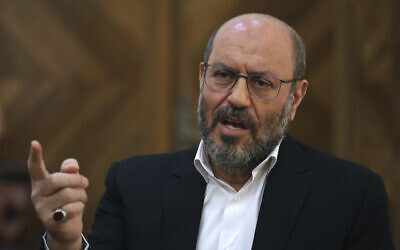 Gen. Hossein Dehghan, a military adviser to Iran’s Supreme Leader Ayatollah Ali Khamenei, in Tehran, Iran, November 18, 2020. (Vahid Salemi/AP)
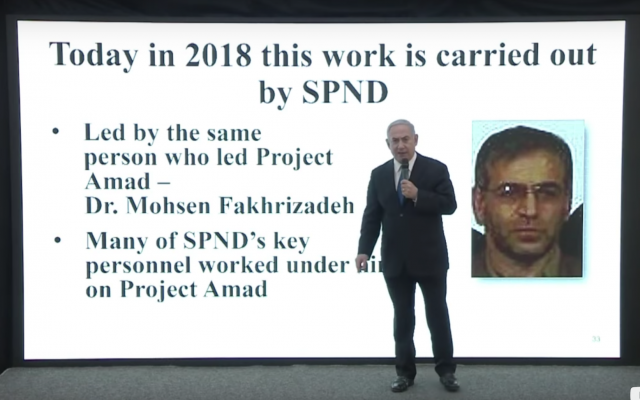 Prime Minister Benjamin Netanyahu stands in front of a picture of Mohsen Fakhrizadeh, who he named as the head of Iran’s nuclear weapons program, April 30, 2018 (YouTube screenshot)
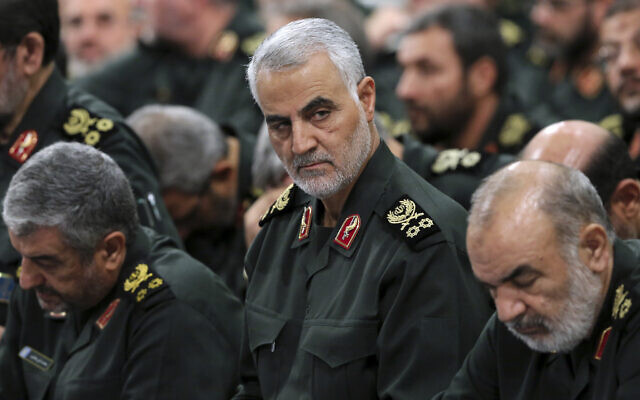 In this Sept. 18, 2016 file photo released by an official website of the office of the Iranian supreme leader, Revolutionary Guard Gen. Qassem Soleimani, center, attends a meeting with Supreme Leader Ayatollah Ali Khamenei and Revolutionary Guard commanders in Tehran, Iran. (Office of the Iranian Supreme Leader via AP)
 In this frame grab from Iranian state television video aired Wednesday, Nov. 25, 2020, British-Australian academic Kylie Moore-Gilbert is seen in Tehran, Iran. (Iranian State Television via AP)
 In this Dec. 21, 2012 photo, Saeid Moradi, an Iranian suspect bomber, on a wheelchair is helped by a Thai prisoner to arrive for his trial hearing at criminal court in Bangkok, Thailand. (AP Photo/Apichart Weerawong)
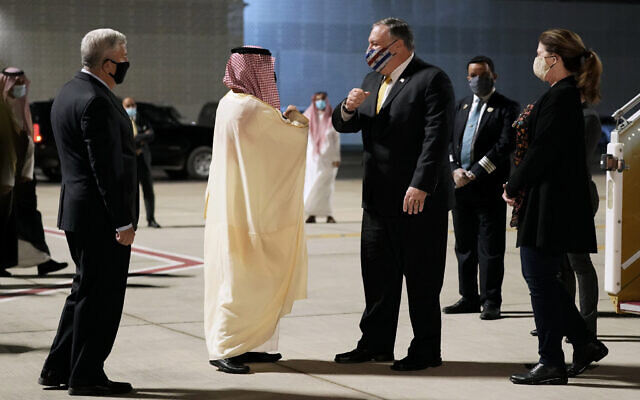 US Ambassador to Saudi Arabia John Abizaid, left, and Saudi Arabia’s Foreign Minister Faisal bin Farhan, second from left, greet US Secretary of State Mike Pompeo and his wife Susan as they arrive at Neom Bay Airport in Neom, Saudi Arabia, Nov. 22, 2020. (AP Photo/Patrick Semansky, Pool)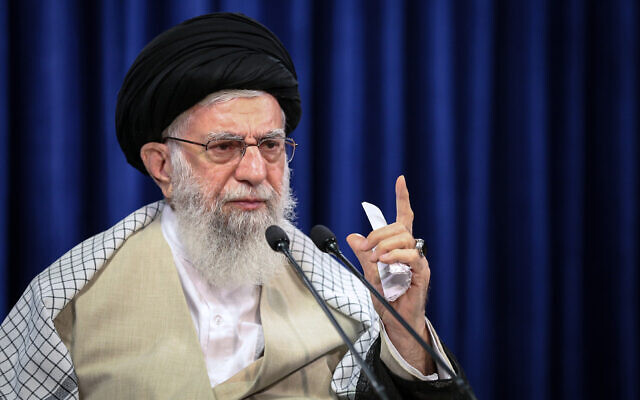


 Three anti-personnel mines that Israel says were planted inside Israeli-controlled territory along the border with Syria, which were uncovered on November 17, 2020. (Israel Defense Forces)




 anneinpt
 artaxes
 danmillerinpanama
 davidking1530
 Peter Hofman
 Joseph Wouk
 Peter
Peter Louisiana Steve
 WarSclerotic
Recent Comments