Prime Minister Netanyahu presents cabinet with “2030 security concept,” which focuses on bolstering offensive, cyber and missile capabilities and increasing homefront defense • Defense spending to be increased by $27 billion over next decade.
Ariel Kahana and Israel Hayom Staff
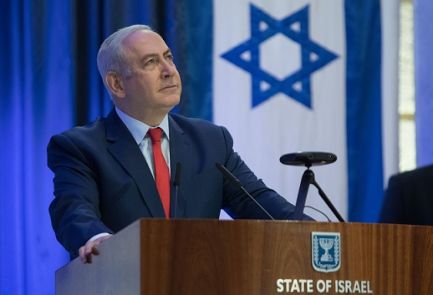
Prime Minister Benjamin Netanyahu
|Photo: Noam Revkin-Fenton
Prime Minister Benjamin Netanyahu on Wednesday presented the cabinet with his new security doctrine for Israel, which entails increasing defense spending by billions of shekels.
The “2030 security concept,” which has been in the works for two years, covers issues such as the regional threats Israel is likely to face in the coming decade, the necessary military build-up, and updated defense and security principles. It addresses bolstering Israel’s offensive and cyber capabilities, upgrading missile defenses, continued reinforcement of the homefront, and the completion of all security fences.
The Prime Minister’s Office said the full document is classified. Netanyahu will soon present it to the Knesset Subcommittee on Intelligence Affairs and Secret Services, the IDF General Staff, the Mossad and the Shin Bet security agency.
Israel’s longstanding defense doctrine has not been revised in years, and Netanyahu formulated the outline after lengthy consultations with top former and current defense officials.
The plan will demand an increase to defense spending in the coming decade, Netanyahu said.
According to the plan, the military will continue its streamlining process but the budget for Israel’s intelligence agencies will increase by 0.2-0.3% to reach 6% of gross national product.
The outline stipulates that the additional funds, estimated at 3 billion to 4 billion shekels ($815 million-$1 billion) per year, will be channeled to the Shin Bet and the Mossad.
Once Israel’s GNP reaches $500 billion, the ratio of defense spending will be re-examined. GNP reached $347.8 billion in 2017.
The overall increase in defense spending over the next decade is expected to reach NIS 100 billion ($27 billion).
The budgetary implications, which are not classified, will soon be submitted for cabinet approval, the Prime Minister’s Office said on its website.
”Due to our small area, the population concentration and the numerous threats around us, Israel will always have security needs that are much greater than any other state of similar size,” Netanyahu said Wednesday.
”Today, the Israeli economy is strong enough to allow for this increase and in any case this increase will be enacted while maintaining a responsible budgetary framework.
“In the last 20 years, we have cultivated a free economy in order to serve national needs, especially security. Faced with accumulated threats, we are at a turning point. Today we are called upon to invest more in security in order to defend our achievements and ensure continued economic growth.
”The combination of our security and economic strengths will increase Israel’s status as an asset in the eyes of other countries and thereby increase our diplomatic strength,” Netanyahu said.
A source in the Finance Ministry said the government “has yet to find the budgetary sources to support the financial aspects of the defense doctrine. It was agreed at the cabinet meeting that in the next meeting the Finance Ministry will present the implications of this move and its potential impact on social budgets.”
Defense Minister Avigdor Lieberman stresses Israel has no interest in ruling Gaza, says Palestinians have much to gain from maintaining calm on the border • “My strategy is to talk directly to the Palestinian public, not with Hamas leaders,” he says.
Ariel Kahana, Lilach Shoval, Mati Tuchfeld and Israel Hayom Staff
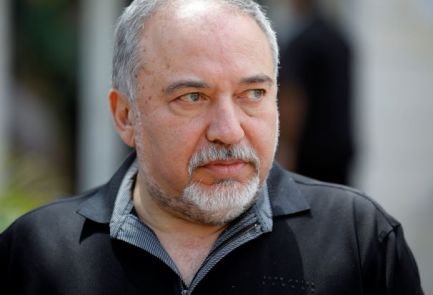
Defense Minister Avigdor Lieberman
|Photo: Reuters
Defense Minister Avigdor Lieberman on Wednesday dismissed criticism leveled at him over Israel’s attempts to negotiate a long-term cease-fire with Hamas.
”My strategy is to talk directly to the Palestinian public – not with Hamas leadership,” he told Israel Hayom.
”The public in Gaza must understand that they have everything to gain from maintaining calm and everything to lose if they don’t. Our goal is to see the public in Gaza rise up and replace the [Hamas] regime. We have no interest in ruling Gaza.”
According to Lieberman, toppling the Hamas regime remains one of his main objectives, but it will not come as a result of eliminating Hamas leader Ismail Haniyeh, as he once promised to do, rather as a result of driving a wedge between the Palestinian in Gaza and the terrorist group ruling them.
He further dismissed the criticism leveled at him by Habayit Hayehudi leader Naftali Bennett, saying that resuming the operations at the Kerem Shalom cargo crossing was a reward for Hamas.
”I took office on June 1, 2016, and instead of one Haniyeh, there are 200 dead Hamas operatives and over 40 Hamas sites that we have destroyed. They [Hamas] don’t care about human life, but they lament every infrastructure we eliminate,” he said.
The Diplomatic-Security Cabinet was briefed Wednesday on the progress in the Egyptian efforts to broker a cease-fire between Israel and Hamas.
A senior Israeli official denied that an agreement with Hamas would exclude the issue of the Israeli captives, saying, “There can be no true agreement with Hamas without the return of our citizens and soldiers, and a guarantee of long-term calm on the border.”
The agreement would see Qatar pay for Gaza Strip’s power supply and salaries of Hamas workers, Arab media reports as Egypt’s intelligence chief visits Israel • Plan calls for construction of seaport in Egypt’s Sinai • If cease-fire holds it may be extended.
According to the report, under the deal, Qatar would pay the salaries of Hamas government officials in Gaza as well as for the enclave’s power supply. Those payments used to be carried by the Palestinian Authority, but PA President Mahmoud Abbas suspended them earlier this year in a bid to pressure Hamas into ceding control of Gaza.
The deal also includes establishing a “naval corridor” between Cyprus and Gaza through which goods could be delivered to Gaza, as well as the construction of a port in the Sinai Peninsula, which would operate under Israeli security supervision to send goods to Gaza.
It was unclear whether these two plans would coincide.
The report said the next 48 hours of the negotiations would be “crucial” to the efforts to achieve a cease-fire.
If the truce holds for the planned year, negotiations will be held to extend it.
The report came several hours after the London-based Arabic newspaper Al-Hayat reported that Egyptian General Intelligence Service Director Maj. Gen. Abbas Kamel met with senior Israeli defense officials in Tel Aviv on Wednesday as part of Cairo’s efforts to broker a long-term cease-fire between the Jewish state and the terrorist group that rules Gaza.
Kamel is also expected to meet with Palestinian Authority President Mahmoud Abbas in Ramallah, the report said.
According to Al-Hayat, Kamel’s meeting with Israeli officials focused on the two main issues of the agreement, namely humanitarian gestures for Israel to offer the Gaza Strip and the fates of two Israeli civilians and the bodies of two soldiers held by Hamas.
Both Al-Hayat and Al Mayadeen said the issue of a potential prisoner exchange deal would be discussed only after the cease-fire proves viable, giving no timeframe.
Hamas is holding the remains of Staff Sgt. Oron Shaul and Lt. Hadar Goldin, killed in the Gaza Strip in separate battles in 2014, as well as two living Israeli civilians – Ethiopian Israeli Avera Mengistu and Bedouin Israeli Hisham al-Sayed – both men with mental health issues who crossed into Gaza willingly in 2014 and 2015 and were captured.
A senior Israeli official denied that an agreement with Hamas would exclude the issue of the Israeli captives.
“There can be no true agreement with Hamas without the return of our citizens and soldiers, and a guarantee of long-term calm on the border,” he said.
“The current calm is the result of determined IDF operations that will continue as needed, in accordance with the understandings reached by the Egyptians and the United Nations. It is in light of these understandings that the Kerem Shalom crossing was opened and the Palestinian fishing zone was expanded.
”As long as this calm e quiet is maintained, it will be possible to deal with humanitarian issues, including the return of the Israeli captives.”
Residents of Israeli communities near the Gaza border harshly criticized the negotiations with Hamas.
The residents, who have already experienced five violated cease-fires in recent months, said they believe a large military operation in the Gaza Strip is unavoidable.
Transfer of fighter jets halted over Ankara’s interest in Russian air defense system amid diplomatic crisis sparked by detained American pastor
US President Donald Trump has restricted the delivery of 100 F-35 fighter jets to Turkey, exacerbating the strain between the two NATO allies over Ankara’s continued detention of an American pastor.
Trump on Monday signed a defense authorization act that prohibits the delivery of F-35 Joint Strike Fighter aircraft to Turkey if it buys Russia’s S-400 air defense system.
The law requires a review of US-Turkey relations, including the US military’s use of Incirlik Air Base, and a risk assessment associated with delivering the stealth fighter jets.
Turkey has been a partner in the international consortium that financed the F-35 since 2002, and plans to purchase 100 of the stealth fighter jets from the US at a reported $1.2 billion.
Ties between the US and Turkey were already fraught over Washington’s support for Syrian Kurdish forces, but have been further strained by the trial of American pastor Andrew Brunson on terror-related charges linked to a failed coup attempt in the country two years ago.
Brunson has been held in Turkey since October 2016, and could face a jail term of 35 years if convicted.Trump has described his detention as a “total disgrace” and urged Ankara to free him immediately.
After Brunson’s appeal was rejected by a Turkish court earlier in August, Trump responded by doubling steel and aluminum tariffs on the country, causing its currency to plummet.
The diplomatic rift was further deepened after Turkey, despite being a NATO ally, entered into an understanding to buy Russia’s advanced S-400 air defense system.
Such a move would defy US sanctions on Moscow, and Turkey’s increasingly cozy relationship with Russian President Vladimir Putin has alarmed both the US and the European Union.
On Friday, Turkish President Recep Tayyip Erdogan wrote in The New York Times that unless Washington can “reverse this trend of unilateralism and disrespect,” Turkey will “start looking for new friends and allies.” [Please do! Shut the door behind you as leave, Turkey.]
The warning came after Erdogan held a phone call with Putin to discuss economic and trade issues, as well as the Syria crisis.
Turkey’s dialogue with Russia has led some to question its reliability as a NATO partner, and even whether it should remain in the alliance.
Key air base
Incirlik, a Turkish air base in southern Turkey, just 70 miles (110 kilometers) from the border with war-torn Syria, has been a frequent pawn during decades of ups and downs in US-Turkey relations.
Incirlik’s location relative to the Middle East makes it a key strategic asset for the US military and for NATO, and the United States until recently flew bombing runs from there as it fought the Islamic State group in Iraq and Syria.
Separately, the facility is thought to hold a stockpile of about 50 American nuclear bombs.
The arrangement works for Turkey too, as the US military provides Turks with intelligence and drone surveillance over the border region, and helps Ankara monitor the outlawed PKK.
Last year, Muharrem Ince, the main opposition candidate in Turkey’s presidential election, threatened to shut Incirlik unless the US extradited Fethullah Gulen, the exiled Muslim preacher Ankara blames for an attempted coup in 2016.
Ince went on to lose the election to Erdogan by a large margin, but Incirlik remains a key issue.
Following the coup attempt, the Turkish base commander at Incirlik was arrested on suspicion of complicity in the plot.
And according to Turkish newspaper Cumhuriyet, pro-Erdogan lawyers have filed a lawsuit calling for the arrest of US troops at Incirlik on similar suspicions.
Both sides stand to lose if US-Turkey military relations go south, but experts say it would hurt Turkey more.
The Trump administration is supposedly considering declassifying a State Department report that tallies up the true number of Palestinian refugees.
If Trump does this, the repercussions could go a long way to settling the Arab-Israeli conflict.
The United Nations Relief and Works Agency for Palestinian Refugees, or UNRWA, classifies refugees unlike any other organization in the world, and in a way that contradicts common sense. Whereas the number of refugees from the original 1948 Arab/Israeli war would likely number in the tens of thousands, the UNRWA also counts people generations removed from the conflict, many of whom are citizens of new countries, in addition to everyone living in their internationally recognized homes of Gaza and the West Bank.
This politically motivated definition raises the number of “refugees” to an estimated 5.3 million. And that number is used by Palestinians to claim a “right of return” to Israel for a number greater than half of Israel’s entire population.
Until today, there has been no official acknowledgment of the true number of refugees. Governments and international organizations around the world instead pay lip service to UNRWA’s fiction that the number of refugees has expanded many times over since the 1948 war.
This will change if the Trump administration releases the classified report.
The origin of the report goes back to 2012, when the Middle East Forum’s Washington Project approached then-Sen. Mark Kirk, R-Ill. with the idea that America should adopt a policy that only recognized as refugees those who would fit its own legal definition of a refugee. Kirk proposed sweeping language to appropriations legislation to that effect, but President Barack Obama’s State Department objected that this would be prejudicial to Israeli-Palestinian negotiations. Deputy Secretary of State Thomas Nides wrote that the provision “would be viewed around the world as the United States acting to prejudge and determine the outcome of this sensitive issue.” Largely as a result, Kirk’s original language was not adopted.
But Kirk did manage to get compromise language, requiring the State Department to issue a report on the issue of the true definition, passed as part of the fiscal 2015 appropriations legislation. But then no one heard anything more about the report for over a year. Kirk assumed the State Department had simply ignored the committee’s direction.
But as it turns out, that wasn’t so. The Middle East Forum learned that the report had, in fact, been written. Committee staffers in the House of Representatives were even informed of its existence. But instead of making it public, the clear intent of the legislation, the State Department classified it. Moreover, it failed to inform Kirk’s office, which had the largest stake in the report, or relevant Senate committee staffers that it had been completed.
Upon learning this, Kirk moved in 2016 to pass another provision forcing the State Department either to produce a nonclassified version of the report, or to inform the Committee why it could not do so. State still chose not to declassify the report.
This year, Rep. Doug Lamborn, R-Colo., wrote a letter to President Trump signed by 50 other members of Congress, asking that the report be declassified. Rep. Chris Stewart, R-Utah, viewed the report, and said in a subsequent interview that “there’s no reason in the world it’s classified.”
The Foundation for the Defense of Democracies also called for declassification, as did Sen. Ted Cruz, R-Texas, saying “The American people deserve to see this reported State Department assessment, so Congress and the administration can have a transparent and productive debate about America’s role in the organization.”
In July, the American Center for Law and Justice obtained a version of the report via a Freedom of Information Act request and a subsequent lawsuit. Unfortunately, it was heavily redacted and omits the most crucial information — the true number of refugees. A recent story citing State Department sources pins the total at just 20,000 refugees, nowhere near the 5.3 million that UNRWA claims and the State Department has previously adopted. The public won’t know for sure unless the Trump administration finally releases an unredacted version of the report.
Hopefully, the Trump Administration will release this report. Telling the truth about the number of refugees, rather than the fictional number provided by UNRWA, would be a big step to unraveling expansive “right of return” claims, ending a threat to Israel’s existence.
Cliff Smith is Washington project director for the Middle East Forum.
{Not a moment too soon for a formal Space Force. The race is on and I’m betting Russia can’t afford it no more than they did when challenged by Reagan years ago. – LS}
A mysterious Russian satellite displaying “very abnormal behaviour” has raised alarm in the US, according to a State Department official.
She voiced fears that it was impossible to say if the object may be a weapon.
Russia has dismissed the comments as “unfounded, slanderous accusations based on suspicious”.
The satellite in question was launched in October last year.
“[The satellite’s] behaviour on-orbit was inconsistent with anything seen before from on-orbit inspection or space situational awareness capabilities, including other Russian inspection satellite activities,” Ms Poblete told the conference on disarmament in Switzerland.
“Russian intentions with respect to this satellite are unclear and are obviously a very troubling development,” she added, citing recent comments made by the commander of Russia’s Space Forces, who said adopting “new prototypes of weapons” was a key objective for the force.
Ms Poblete said that the US had “serious concerns” that Russia was developing anti-satellite weapons.
Alexander Deynko, a senior Russian diplomat, told the Reuters news agency that the comments were “the same unfounded, slanderous accusations based on suspicions, on suppositions and so on”.
He called on the US to contribute to a Russian-Chinese treaty that seeks to prevent an arms race in space.
‘Lasers or microwaves’
Space weapons may be designed to cause damage in more subtle ways than traditional weapons like guns, which could cause a lot of debris in orbit, explained Alexandra Stickings, a research analyst at the Royal United Services Institute.
“[Such weapons may include] lasers or microwave frequencies that could just stop [a satellite] working for a time, either disable it permanently without destroying it or disrupt it via jamming,” she said.
But it was difficult to know what technology is available because so much information on space-based capabilities is classified, she added.
She also said it would be very difficult to prove that any event causing interference in space was an intentional, hostile action by a specific nation state.
“The narrative coming from the US is, ‘space was really peaceful, now look at what the Russians and Chinese are doing’ – ignoring the fact that the US has developed its own capabilities.”
The BBC has asked the UK’s Ministry of Defence for comment.
( Sour grapes from the extreme leftist Haaretz… – JW )
The U.K. Labour leader is the only politician hapless enough to lose the moral high ground to Bibi
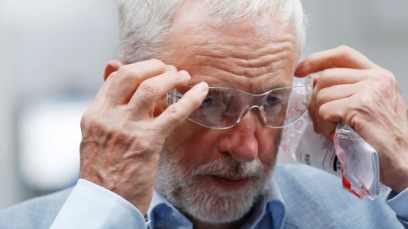
Jeremy Corbyn, leader of Britain’s Labour Party, in Stoke-on-Trent, August 14, 2018\ DARREN STAPLES/ REUTERS
Benjamin Netanyahu’s recent record of standing up for Jewish communities in the Diaspora that are facing anti-Semitism has hardly been a stellar one. Over the last two years he has failed American Jews by remaining silent as Donald Trump endorsed and legitimized white supremacists and neo-Nazis.
Despite the express wishes of the Hungarian Jewish community, he has embraced Prime Minister Viktor Orbán, who has launched an anti-Semitic-style campaign against Jewish financier George Soros and tried to expunge the pro-Nazi record of Hungary’s wartime regime.
And only two months ago, Netanyahu received a rare rebuke from Yad Vashem’s historians for signing a joint statement with Poland’s government clearing the Polish people of their well-documented abandonment of Polish Jews during the Holocaust. Also, he rushed to congratulate Austria’s new chancellor, Sebastian Kurz, when the center-right leader formed a government with the former neo-Nazi members of the Freedom Party.
On the basis of this record, it would take a particularly inept politician to lose the moral high ground against Netanyahu in a public spat about anti-Semitism. Arise Jeremy Corbyn, the man who constantly claims to have been a campaigner against racism all his life and to have not one anti-Semitic bone in his body. But he seems to have the incredible misfortune of being unable to keep himself from joining platforms with and endorsing blood libelers, Holocaust deniers and convicted terror bombers.
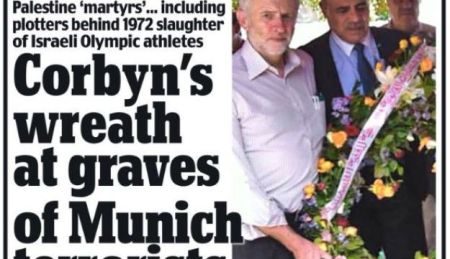
Cover of the Daily Mail reporting Jeremy Corbyn visited graves of Munich terroristsScreen shotCorbyn has been Labour Party leader for nearly three years now, but doesn’t seem to have appeared on Netanyahu’s radar before this week. Actually, Corbyn and politicians of his mold who can’t help themselves from insulting local Jewish communities with their open associations with anti-Semites are a godsend to Netanyahu. In his dysfunctional relationship with the Diaspora, a “progressive” leader who makes Jews feel unwanted in their own country bolsters Netanyahu’s siege-mentality brand of Zionism.
The euroskeptic Corbyn, who is defying the majority within Labour who want to resist Brexit, is useful to Netanyahu in this as well. Corbyn is doing nothing to prevent the United Kingdom from crashing out of the European Union without an orderly deal, weakening both Britain and the EU in the process. This is furthering Netanyahu’s goal of seeing the EU that has criticized his policies and upheld the Iran deal become a diminished voice on the global scene. It’s also strengthening the voices of his allies, the populist right-wing governments, within the EU.
A gift from Tunis
In recent weeks, some of Netanyahu’s media proxies have taken to talking up Corbyn and his anti-Semitic scandals, partly to deflect some of the criticism of their leader for his ties with right-wing populists like Orbán and the farce of the joint statement with the hard-right Polish government. But Netanyahu himself remained silent, anxious, as one aide said, “not to descend to Corbyn’s level. He’s just a party leader, not a prime minister.”
Still, the increasing interest in Corbyn in the Israeli media was galvanized this week by the reports that in 2014 he had lain a wreath at the Tunis graves of planners of the massacre of 11 Israeli athletes at the 1972 Munich Olympics. Netanyahu couldn’t remain silent. His advisers noted that Corbyn was by now featuring in the line-up of the evening news shows and that the only prominent Israeli politician responding to Corbyn was Israel’s Labor leader, Avi Gabbay, who four months ago announced that after decades of warm ties between the sister parties he was suspending all relations with Corbyn’s office.
As for Corbyn’s wreath laying in Tunis, his office initially denied that it ever happened, but then Corbyn himself owned up to having been there, his version of events evolving from eye-rolling and exasperated interviews to insisting that he had been paying his respects to “all victims.” This gave Netanyahu his opening. It wasn’t another round in the interminable flurry of insults to British Jews, but a direct insult to Israelis who still feel the trauma of the Munich massacre 46 years later. And who better than Netanyahu, the man whose entire career has been based on his fabled expertise in fighting terror, to deliver the rebuke?
Netanyahu is no Trump, tweeting in his pajamas from his bedroom. He doesn’t even own a smartphone. Instead he has a team planning and crafting tweets and Facebook posts, sometimes days and weeks in advance. And the tweet saying that the “laying of a wreath by Jeremy Corbyn on the graves of the terrorist who perpetrated the Munich massacre and his comparison of Israel to the Nazis deserves unequivocal condemnation from everyone – left, right and everything in between” was no exception.
Frustrated Labour MPs
No sooner had the flunky in the Prime Minister’s Office pressed “send” Monday evening, releasing Netanyahu’s first-ever acknowledgment of Corbyn’s existence, than political commentators in London were predicting that it was a mistake that would let Corbyn deflect attention from his troubles and pivot to attacking Netanyahu. And of course, he did so.
Corbyn’s Twitter feed has to be one of the slowest to the draw of any major Western politician. This time, with unusual alacrity, within less than two hours, Corbyn was hitting back at Netanyahu, lambasting him for the deaths of 160 Palestinians at the Gaza border in recent months and Israel’s passage of the nation-state law. But the swift deflection quickly backfired.
The followers of Corbyn’s cult leapt to his defense on Twitter. But they’re his die-hard supporters anyway. It may have been expected that given the choice between Corbyn and Netanyahu, Labour’s mainstream parliamentarians would stand up for their leader. But the MPs, tired and frustrated by the way Corbyn has run roughshod over their concerns with his repeated insults of British Jews, remained silent.
Much worse for Corbyn, if he had any hope that the furor over every new revelation about his checkered past would finally begin to die down, after dragging on for weeks, he walked into Netanyahu’s trap. Now the media was bound to continue harrying him about wreathgate for at least another 24 hours. And now it wasn’t just an internal British affair but a high-profile international feud.
It’s not that Netanyahu is a popular politician in Britain. Far from it. But Corbyn, despite his lifelong passion for foreign policy issues, failed to grasp that ultimately Netanyahu isn’t going to be on the ballot in Britain. By taking on Netanyahu in a Twitter spat, he didn’t gain any media sympathy beyond his hardcore base. But British papers don’t need Corbyn to remind them of Gaza; they’ve covered it extensively. A local political scandal in which a party leader visibly squirms as he tries to account for his actions is always a better story.
The Labour Party had a golden opportunity this summer to overtake the Conservative government in the polls. The Tories are an embarrassing shambles, with Prime Minister Theresa May under fire from the insurgent former Foreign Secretary Boris Johnson, increasingly incapable of controlling her wayward ministers and steering a clear course toward Brexit.
Corbyn’s predecessors as opposition leader enjoyed double-digit leads in the polls. But instead of making ground and presenting his own policies, Corbyn is digging an ever-deepening hole into his anti-Semitic morass. With one tweet, Netanyahu helped him dig a bit more, prolonging the Labour leader’s summer of misery.
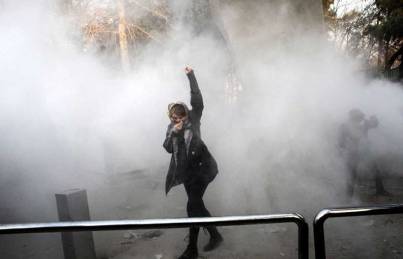
State-run television warned in a primetime broadcast that foreign agents could turn legitimate protests stemming from domestic anger at the government’s mismanagement of the economy and corruption into “incendiary calls for regime change” by inciting violence that would provoke a crackdown by security forces and give the United States fodder to tackle Iran.
“The ordinary protesting worker would be hapless in the face of such schemes, uncertain how to stop his protest from spiralling into something bigger, more radical, that he wasn’t calling for,” journalist Azadeh Moaveni quoted in a series of tweets the broadcast as saying.
The warning stroked with the Trump administration’s strategy to escalate the protests that have been continuing for months and generate the kind of domestic pressure that would force Iran to concede by squeezing it economically with the imposition of harsh sanctions.
US officials, including President Donald J. Trump’s national security advisor John Bolton, a long-time proponent of Iranian regime change, have shied away from declaring that they were seeking a change of government, but have indicated that they hoped sanctions would fuel economic discontent.
“The pressure on the Iranian economy is significant… We continue to see demonstrations and riots in cities and towns all around Iran showing the dissatisfaction the people feel because of the strained economy.” Mr. Bolton said as the first round of sanctions took effect.
Mr. Bolton insisted that US policy was to put “unprecedented pressure” on Iran to change its behaviour”, not change the regime.
The implication of his remarks resembled Israeli attitudes three decades ago when officials argued that if the Palestine Liberation Organization were to recognize Israel it would no longer be the PLO but the PPLO, Part of the Palestine Liberation Organization.
In other words, the kind of policy changes the Trump administration is demanding, including an end to its ballistic program and support for regional proxies, by implication would have to involve regime change.
A string of recent, possibly unrelated incidents involving Iran’s ethnic minorities coupled with various other events could suggest that the United States and Saudi Arabia covertly are also playing with separate plans developed in Washington and Riyadh to destabilize Iran by stirring unrest among non-Persian segments of the Islamic republic’s population.
Mr. Bolton last year before assuming office drafted at the request of Mr. Trump’s then strategic advisor, Steve Bannon, a plan that envisioned US support “for the democratic Iranian opposition,” “Kurdish national aspirations in Iran, Iraq and Syria,” and assistance for Baloch in the Pakistani province of Balochistan and Iran’s neighbouring Sistan and Balochistan province as well as Iranian Arabs in the oil-rich Iranian province of Khuzestan.
Pakistani militants have claimed that Saudi Arabia has stepped up funding of militant madrassas or religious seminaries in Balochistan that allegedly serve as havens for anti-Iranian fighters.
Iran’s Revolutionary Guards said last weekend that they had killed ten militants near the Iranian border with Iraq. “A well-equipped terrorist group … intending to infiltrate the country from the border area of Oshnavieh to foment insecurity and carry out acts of sabotage was ambushed and at least 10 terrorists were killed in a heavy clash,” the Guards said.
Similarly, this weekend’s ethnic soccer protests are rooted in a history of football unrest in the Iranian provinces of East Azerbaijan and Khuzestan that reflect long-standing economic and environmental grievances but also at times at least in oil-rich Khuzestan potentially had Saudi fingerprints on them.
Video clips of Azeri supporters of Tabriz-based Traktor Sazi FC chanting ‘Death to the Dictator” in Tehran’s Azadi stadium during a match against Esteghlal FC went viral on social media after a live broadcast on state television was muted to drown the protest out. A sports commentator blamed the loss of sound on a network disruption.
A day earlier, Iranian Arab fans clashed with security forces in a stadium in the Khuzestan capital of Ahwaz during a match between local team Foolad Khuzestan FC and Tehran’s Persepolis FC. The fans reportedly shouted slogans reaffirming their Arab identity.
Saudi Arabia and other Gulf Arabs have a long history of encouraging Iranian Arab opposition and troubling the minority’s relations with the government.
Iranian distrust of the country’s Arab minority has been further fuelled by the fact that the People’s Mujahedin Organization of Iran or Mujahedin-e-Khalq (MeK), a controversial exiled opposition group that enjoys the support of prominent serving and former Western officials, including some in the Trump administration, has taken credit for a number of the protests in Khuzestan. The group advocates the violent overthrow of the regime in Tehran.
“The mullahs must go, the ayatollah must go, and they must be replaced by a democratic government which Madam Rajavi represents. Freedom is right around the corner … Next year I want to have this convention in Tehran,” Mr. Giuliani told this year’s rally, referring to Maryam Rajavi, the leader of the Mujahedeen who is a cult figure to the group.
Iran rejects U.N. report suggesting al-Qaida’s leaders in Iran “have grown more prominent,” are working with group leader Ayman al-Zawahri to cause “formations, breakaways and mergers of various al-Qaida-aligned groups” in rebel-held northwestern Syria.
Associated Press and Israel Hayom Staff
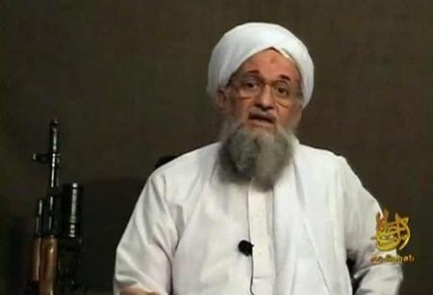
Al-Qaida leader Ayman al-Zawahri
|Archives: Reuters
Iran is “categorically” rejecting a report by U.N. experts which says al-Qaida’s leaders in Iran “have grown more prominent” and have been working with the extremist group’s top leader, Ayman al-Zawahri, to influence events in Syria.
The report quoted unnamed U.N. member states saying the Iranians and al-Zawahri countered the authority of an al-Qaida-linked group and caused “formations, breakaways and mergers of various al-Qaida-aligned groups in Idlib” in rebel-held northwestern Syria.
Spokesman for Iran’s U.N. mission Alireza Miryousefi remarked Tuesday that the experts’ report was based on information from an unidentified member of the Security Council committee that is monitoring sanctions against al-Qaida and the Islamic State extremist group.
“In a letter to the chair of the committee, Iran categorically rejected such a claim and requested corrective measures,” Miryousefi said.
No one should threaten us with war. … We are not scared or worried about war and we are ready for it and we will be victorious,” says Hezbollah leader, adding that Israel and the U.S. are “mistaken” if they think sanctions will lead to riots in Iran.
News Agencies and Israel Hayom Staff
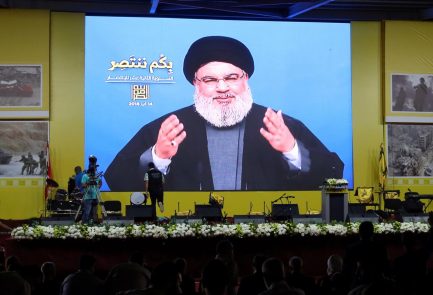
Hezbollah leader Hassan Nasrallah delivers a broadcast speech in Beirut, Tuesday
|Photo: Reuters
Hassan Nasrallah, the leader of Lebanon’s Hezbollah, declared on Tuesday that his organization was stronger than ever and would “very soon” celebrate victory in Syria, where its Iran-backed militia has been fighting alongside Syrian President Bashar Assad.
Speaking on live television on the anniversary of a 2006 war Hezbollah fought with Israel, which regards Iran as its biggest foe and Hezbollah as the top threat on its borders, Nasrallah said that “The resistance in Lebanon today, in its possession of weapons and equipment and capabilities and members and cadres and ability and expertise and experience, and also of faith and determination and courage and will, is stronger than at any time since its launch in the region.”
He added that Hezbollah is not scared of a possible war with Israel.
“No one should threaten us with war and no one should scare us by war,” he said. “We are not scared or worried about war and we are ready for it and we will be victorious.”
“Israel is rebuilding itself today, in view of the defeat in 2006, including re-examining its doctrine of war, on the basis that its enemy is serious and capable,” he went on to say.
“Since 2007 the Israelis have threatened to go to war, but at the same time Hezbollah has become immensely stronger,” Nasrallah continued.
Israel has repeatedly targeted Hezbollah in Syria, where the group and its Iranian ally have played a key military role in fighting rebels alongside Assad’s forces, backed by massive Russian air power.
Assad now controls most of Syria, although a swathe of the northwest remains in rebel hands, and U.S.-backed Kurdish forces control the quarter of the country east of the Euphrates river.
Israel has demanded that Iran leave Syria and said last year it had carried out airstrikes there to stop Iranian weapons shipments to Hezbollah.
Last month, Assad and his allies recaptured the area bordering the Israeli-Golan Heights, while avoiding a wider escalation involving Israel, Iran and Hezbollah.
Concerns about such an escalation rose sharply in May, when Israel said it launched its heaviest attack on Iranian targets in Syria since the Syrian war began in 2011, prompting retaliatory rocket fire in the days that followed.
In his address Tuesday, Nasrallah also predicted that the recently reinstated U.S. sanctions against Iran and Hezbollah will not have major effects on them and will not lead to a regime change in Tehran.
He said Israel and the Trump administration are “mistaken” if they think the sanctions will lead to riots in Iran.
The administration says the renewed sanctions are meant to pressure Tehran to halt its alleged support for international terrorism, its military activity in the Middle East and its ballistic missile programs.
“Iran has been facing sanctions since the victory of the Islamic Revolution in 1979,” Nasrallah said. “He [Trump] is strengthening the sanctions but they have been there since 1979 and Iran stayed and will celebrate the 40th anniversary of the victory of its revolution.”
Speaking about Washington’s renewed sanctions, Nasrallah said: “I can tell you and I have accurate information they are building dreams, strategies and projects that Iran will head toward chaos and the regime will fall. This is illusion, this is imagination and has nothing to do with reality.”







 anneinpt
 artaxes
 danmillerinpanama
 davidking1530
 Peter Hofman
 Joseph Wouk
 Peter
Peter Louisiana Steve

Recent Comments