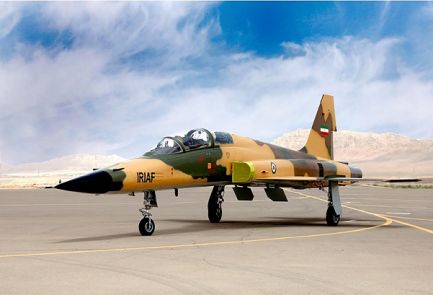
Iran unveils new, domestically produced fighter jet 

Posted August 21, 2018 by Joseph Wouk
Categories: Uncategorized

Source: Iran unveils new, domestically produced fighter jet – Israel Hayom

Trump vows ‘no concessions’ with Turkey over detained US pastor 

Posted August 21, 2018 by Joseph Wouk
Categories: Uncategorized

Source: Trump vows ‘no concessions’ with Turkey over detained US pastor – Israel Hayom

Report: Trump to introduce Mideast peace plan at ‎UN General Assembly 

Posted August 21, 2018 by Joseph Wouk
Categories: Uncategorized

Source: Report: Trump to introduce Mideast peace plan at ‎UN General Assembly – Israel Hayom

Is Jerusalem important within Islam?

Posted August 21, 2018 by davidking1530
Categories: Uncategorized

An excellent, and interesting, examination of the relationship of Jerusalem to Islam.

Hint: there is none.

The paragraphs I have bolded – relating to the Paly’s – are remarkable.  Try to get your local “Free, free, Palestine” activist to give a response to this.

If you can get them to shutup and listen, that is. Which will be unlikely.

In Islam, Jerusalem is not Mecca

https://www.gatestoneinstitute.org/12844/islam-jerusalem-mecca

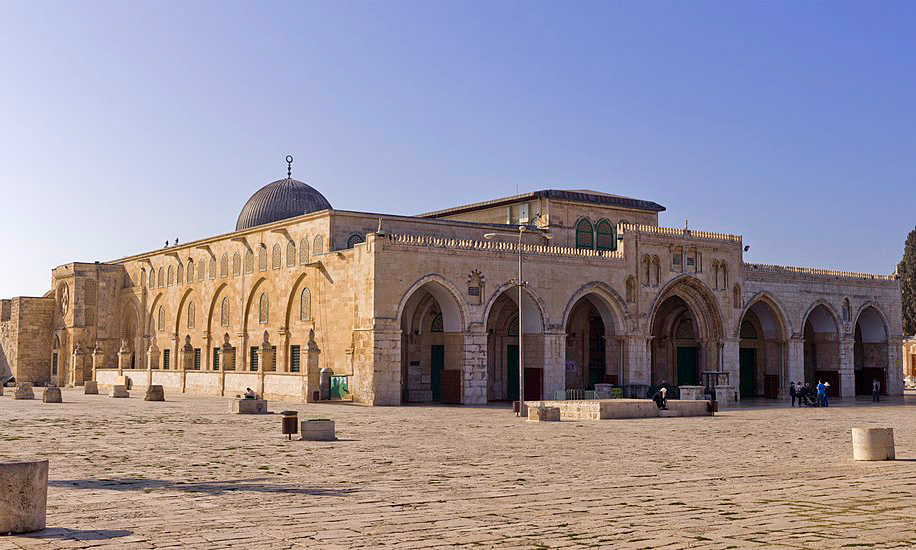
Al-Aqsa Mosque

Intriguingly, only when non-Muslims are in control of Jerusalem do Muslims seem to remember the city. Otherwise, as history shows, Muslims have never attached real significance to it. They never claimed Jerusalem as the capital of any country or empire. In fact, Muhammad instructed his people not to pray toward Jerusalem, as they had done previously, but to Mecca:

“And We did not make the qiblah which you used to face except that We might make evident who would follow the Messenger from who would turn back on his heels. And indeed, it is difficult except for those whom Allah has guided. And never would Allah have caused you to lose your faith.” — Quran 2:143, Sahih International.

Certain Quranic verses, moreover, emphasize Jerusalem’s connection to the Jews and contradict its Islamization. The Quran does not promise Muslims to enter or rule Jerusalem. In fact, one of its verses quotes the Prophet Moses instructing the Jews to enter the Holy Land (al-ard al-muqaddesa) that God has given to them — including Jerusalem. This is a verse, however, that the majority of Arabs and Muslims choose to ignore:

“O my people, enter the Holy Land which Allah has assigned to you and do not turn back [from fighting in Allah ‘s cause] and [thus] become losers.” — Quran 5:21, Sahih International.

An interpretation of the verse identifies al-ard al-muqaddesa as Beit al-Maqdis, or Jerusalem and its surroundings (herehere), or the region stretching from Egypt to Euphrates river (here).

In another verse, God Himself instructs the Children of Israel to dwell in the land:

“And We said after Pharaoh to the Children of Israel, “Dwell in the land, and when there comes the promise of the Hereafter, We will bring you forth in [one] gathering.” — Quran 17:104, Sahih International.

Again, “the land” in this verse is al-Sham (Levant), a region on the eastern coast of the Mediterranean Sea and north of the Arabian Peninsula and south of Turkey.

“It was for the British that Jerusalem was so important — they are the ones who established Jerusalem as a capital,” said Professor Yehoshua Ben-Arieh, a historical geographer at Hebrew University, to the New York Times. “Before, it was not anyone’s capital since the times of the First and Second Temples,” Ben-Arieh added.

In December 1917, the British general Edmund Allenby seized control of Jerusalem from its Ottoman Turkish rulers.

In December 1949, the State of Israel decided to hold its Knesset sessions in Jerusalem and declared Jerusalem its capital. Then, In 1980, its Knesset passed the Basic Law: Jerusalem, Capital of Israel and declared Jerusalem, complete and united, to be Israel’s “eternal and indivisible capital.”

Jerusalem was not even mentioned in the original Palestine National Charter (1964) or in the 1968 amended Palestinian National Charter. In the 1996 amendment, Jerusalem (Al-Quds) was only mentioned in the context of talking about UN resolutions relating to the status of the city.

Only in the transitional constitution of the Palestine authority (the Palestine Basic Law, approved by PLC in 1997, signed in 2002), does one find an article stating that Jerusalem is the capital city of “Palestine.”

It is remarkable that in spite of almost 1,200 years of Muslim rule, Jerusalem “never served as capital of a sovereign Muslim state, and it never became a cultural or scholarly center. Little of political import by Muslims was initiated there.” Islam and Muslims’ real connection to Jerusalem only came about six years after Prophet Muhammed’s death, when in 638 CE, the Caliph Omar and his invading armies captured Jerusalem.

Upon his arrival in Jerusalem, Omar was given a tour of the city, including the Church of the Holy Sepulchre. When the time for the Muslim prayer came, Omar declined the invitation by Sophronius, the patriarch of Jerusalem, to pray inside the Church and instead prayed outside. Omar’s fear was that that Muslims who would come after him might establish a mosque in place of the church if he would pray at the site. Omar, then, was conscious of what belonged to the Muslims and what belonged to the Christians.

Jerusalem’s Temple Mount and the Rock (or “Foundation Stone”) located there have been sacred to the Jews for millennia in their daily lives. According to Jewish tradition, the Rock is where Abraham, the progenitor and first patriarch of the Hebrew people, had prepared to sacrifice his son Isaac. The Temple Mount was also the site of Solomon’s Temple and its successor, the Second Temple (also known as Herod’s Temple). Since the Temples’ destruction — the First Temple at the hands of Babylonian King Nebuchadnezzar II in 587 BCE, and the Second Temple at the hands of the Romans in 70 CE — the “Western Wall” of the Temple Mount (a retaining wall) is all that remains of the Temples, and the Temple Mount has since been the the direction towards which Jews face when praying.

According to al-Tabari [1] and Ibn Kathir [2], when Omar arrived at the Temple Mount, he prayed with his back to the Rock, facing Mecca in the southern corner of the platform, where the Al-Aqsa Mosque was later constructed.

Omar was therefore the first Muslim to pray on the Temple Mount. However, he clearly showed that the Mount and the Rock were no longer Muslims’ Qibla (the direction that should be faced when a Muslim prays). The Mount was the direction of Muslim prayers till 622 CE, when it was changed to the Kaaba in Mecca for eternity (Quran 2:142–145). However, the Mount and Rock were still sacred, and supposedly Islamic, because in 621 CE Prophet Muhammad told his followers that he had ascended into heaven from the site of the Rock.

In an attempt to transform Jerusalem into an Islamic sanctuary, or to Islamize it, the Dome of the Rock shrine was built over the Rock in 691-692 CE, and Al-Aqsa Mosque on the Temple Mount in 705 CE by the Umayyad caliph Abd al-Malik ibn Marwān, some 55 and 70 years respectively after Muslim armies captured Jerusalem.


Although the Dome of the Rock structure (Arabic: Qubbat al-Ṣakhrah) is “the oldest extant Islamic monument,” it is not a mosque and does not fit easily into other categories of Muslim religious structures. The Dome’s “grand scale and lavish decoration,” as well as the extravagant services to its visitors, prompted some Muslim historians, such as Ibn Kathir and Ibn Taymiyyah to report that the Damascus-based Abd al-Malik built the Dome in an attempt to divert Muslims away from the Kaaba and toward Jerusalem while Mecca was under the control of rebels led by Abdullah Ibn al-Zubayr. That was probably the first time the Muslims had used Jerusalem in an internal political rivalry.

Scholars have also argued that Abd al-Malik built the Dome to proclaim the emergence of Islam as a supreme new faith. According to Encyclopedia Britannica:

“The Dome’s grand scale and lavish decoration may have been intended to rival that of the Christian holy buildings of Jerusalem, especially the domed Church of the Holy Sepulchre. According to this view, the message of Islam’s supremacy was also conveyed by the Dome’s Arabic inscriptions, which present a selection of Quʾrānic passages and paraphrases that outline Islam’s view of Jesus—i.e., denouncing the Christian doctrines of the Trinity and the divinity of Jesus, while emphasizing the unity of God and affirming Jesus’ status as a prophet.”

Notably, Ibn Taymiyyah decried not only the lavish decoration, but also the construction of the Dome itself as a kind of bidaa (heresy).

In a further Islamization of Jerusalem, the Temple Mount mosque was named Al-Aqsa, meaning in Arabic, “the farthest mosque”, the same phrase used in a key passage of the Quran called “Al-Israa, the Night Journey”:

“Exalted is He who took His Servant [Mohammed] by night from al-Masjid al-Haram to al-Masjid al-Aqsa, whose surroundings We have blessed, to show him of Our signs. Indeed, He is the Hearing, the Seeing.” — Quran 17:1, Sahih International.

Naming the Jerusalem mosque Al-Aqsa was an attempt to say that the Dome of the Rock was the very spot from which Mohammed ascended to heaven, thus connecting Jerusalem to divine revelation in Islamic belief. The problem however, is that Mohammed died in the year 632, which was 73 years before the first construction of the Al-Aqsa Mosque was completed.

For Muslims, Jerusalem’s significance is dependent upon political and religious rivalries; its importance appears evident when non-Muslims (including the Crusaders, the British, and the Jews) control or capture the city. Only at those phases in history did Islamic national leaders claim Jerusalem as their holiest city after Mecca and Medina.

Unsurprisingly, Palestinian Authority President Mahmoud Abbas once decried Hamas leader Mahmoud Al-Zahar, claiming that the latter had minimized Jerusalem’s significance by saying that “Jerusalem is not Mecca,” when Abbas had insisted on 2006 legislative elections being held in Jerusalem. If Al-Zahar had said that “Jerusalem is not Mecca and is not sacred,” he would have said the truth.

In Islam, Jerusalem is only blessed, but not sacred. Mecca it is not.

A. Z. Mohamed is a Muslim born and raised in the Middle East.


[1] The History of al-Tabari Vol. 12: The Battle of al-Qadisiyyah and the Conquest of Syria and Palestine A.D. 635-637/A.H. 14-15, pages 194-195. Published by State University of New York Press, Albany, 1992.
[2] Ibn Kathir (in Arabic, Bidaya), published by Maktabit AlMaaref, Beirut, 1966, II, page 96; VII, pages 54-56.

Head of Syrian intel’s ‘Palestine Department’ said assassinated

Posted August 21, 2018 by davidking1530
Categories: Uncategorized

It’s never an accident…

https://www.timesofisrael.com/head-of-syrian-intelligences-palestine-department-assassinated-report/

Ahmad Issa Habib (Courtesy)

Ahmad Issa Habib reportedly shot in head by unknown assailants; he was responsible for ‘the struggle against Israel’

A Syrian military intelligence officer in charge of the army’s “Palestine Department” was assassinated Saturday in the country’s northwest, Arabic media reported.

Ahmad Issa Habib was said to have been shot in the head by unknown assailants in the village of Baarin, west of the city of Hama. Some reports said he was killed in his car, others that he was hit at his home.

According to Israel’s Army Radio, quoting Syrian opposition sources, Habib was the point man in President Bashar Assad’s regime “responsible for the struggle against Israel.”

There was no word on the identity of the shooters or a possible motive.

The reported killing came exactly two weeks after the assassination of a top Syrian chemical weapons and rocket scientist in nearby Masyaf, which some have blamed on Israel’s Mossad spy agency.

Aziz Azbar was killed when his car exploded in Masyaf late on August 4.

Syrian media blamed Israel for that killing, and a senior official from a Middle East intelligence agency later told the New York Times Israel was behind the attack and said his own intelligence agency had been informed of the Israeli operation.

According to the report, Israel believed that Azbar was leading a classified weapons development program called Sector 4 at the Syrian Scientific Studies and Research Center, and was busy re-building an underground weapons factory to replace the one said destroyed by Israel last year.

Azbar was working alongside Maj. Gen. Qassim Suleimani, the commander of the Iranian Revolutionary Guards’ elite al-Quds Force and enjoyed high-level access to both the Syrian and Iranian governments, the New York Times said.

Azbar and his team were working to begin mass-producing precision-guided missiles by retrofitting SM600 Tishreen rockets. They were also working on a solid-fuel plant for missiles and rockets, a safer alternative to liquid fuel, the report said. The Tishreen is a Syrian version of the Iranian Fateh-110, a missile with a range of 200 kilomenters (125 miles.)

Israel’s Hadashot TV news said he was in charge of a project improving the range and accuracy of the regime’s Scud missiles. Reports have also indicated an Iranian missile operation at the site.

The intelligence official also told the Times that Azbar had for years been active in the Assad regime’s chemical-weapons production program and was also involved in coordinating Iranian and Hezbollah activities in Syria.

The Scientific Research and Studies Center in Masyaf, also known by its French acronym CERS, has long been associated with chemical weapons production, and was the target of a number of airstrikes attributed to Israel. An alleged Israeli strike on the site in April reportedly killed a number of Iranian soldiers.

The official quoted in The New York Times said that Israel had been tracking Azbar for years, and had wanted to assassinate him over his prominent role in Syria’s weapons program even before the outbreak of the Syrian civil war in 2011. He said it was the fourth time in three years the Mossad has assassinated an enemy weapons engineer in a foreign country.

Israel has been blamed for the killing of several scientists in recent years, including two Hamas engineers in the last 18 months.

A Hamas rocket scientist was shot dead by gunmen in Malaysia in April and a drone engineer was killed in Tunisia in December 2016. Hamas blamed the Mossad for both deaths.

Israel does not usually comment on reports of its alleged military operations in Syria but has repeatedly warned it would work to keep advanced weapons out of Hezbollah terrorists’ hands and has vowed to stop Iran establishing a military presence in the country.

Defense Minister Avigdor Liberman sought to downplay the possibility of Israeli involvement in Azbar’s killing.

“Every day in the Middle East there are hundreds of explosions and settling of scores. Every time they try to place the blame on us. So we won’t take this too seriously,” he told Hadashot News.

An insurgent group calling itself the Abu Amara Brigades claimed responsibility for the operation. The group has previously claimed attacks targeting officials and militia commanders inside government territory.

IDF clears troops in “Hannibal Protocol” operation

Posted August 21, 2018 by davidking1530
Categories: Uncategorized

Sanity prevails.

Ironic eyebrow raise at mention of “72 civilians killed”.

A very interesting, and thorough, examination of the Hannibal Protocol (or Doctrine) is here, by Daniel Pipes:

http://www.danielpipes.org/blog/2009/01/hannibal-protocol

“[The Hannibal Protocol is] named after the Carthaginian general who poisoned himself not to be captured by the Romans.”

IDF clears troops in massive deadly bombardment during 2014 Gaza war

https://www.timesofisrael.com/idf-clears-troops-in-massive-deadly-bombardment-during-2014-gaza-war/

Givati Brigade officer Lt. Hadar Goldin, 23, from Kfar Saba, who was killed in Gaza on August 1, 2014

Army’s top lawyer determines that the 72 civilians killed in offensive after capture of soldier were not deliberately targeted and officers worked to prevent deaths of bystanders

The Israeli military’s top lawyer on Wednesday closed the case on one of the bloodiest battles of the 2014 Gaza war, deciding not to file any criminal charges against those involved in a massive shelling of southern Gaza that left 72 civilians dead, the army said.

The Israel Defense Forces also completed the investigation of seven other, lower-profile cases in which soldiers were said to have unnecessarily killed Palestinian civilians, finding that no crimes or misdeeds were committed.

The military’s findings regarding the “Black Friday” offensive, the nickname for the bombardment of the southern Gaza city of Rafah, largely matched those of the IDF Southern Command’s investigation shortly after the war. The IDF released the results of the probes in a 30-page document in Hebrew.

At 9:06 a.m. on August 1, 2014, just over an hour after the start of a humanitarian ceasefire, fighters from the Hamas terror group emerged from a tunnel in the southeastern part of Rafah and attacked a nearby IDF unit, killing two soldiers and capturing Lt. Hadar Goldin, dragging him back into their tunnel.

Six minutes later, troops in the area initiated the so-called Hannibal Protocol, a controversial order giving commanders near unlimited freedom to do anything necessary to prevent the capture of a soldier.

According to IDF figures, in the ensuing offensive, 42 armed Palestinian combatants were killed, along with 72 others, whom the military acknowledged were likely civilians. The high death toll led to the day’s events later being called “Black Friday.”

According to the army’s findings, the Israeli offensive lasted approximately 10 hours, during which time artillery cannons launched some 250 shells, tanks fired approximately 140 shells and Israeli aircraft conducted dozens of strikes against targets in the city, which is home to approximately 150,000 people.

“In media publications, in reports received by the Military Advocate General, and in requests from and documents produced by non-governmental organizations and international groups, it was alleged that the IDF during the battle acted indiscriminately and disproportionally, and mass casualties and mass destruction was caused by the way it acted,” the army said.

“The events of the battle of Rafah have been investigated in a comprehensive and professional manner by the General Staff’s investigatory mechanism. Following a thorough consideration of the findings of the investigation, Military Advocate General Maj. Gen. Sharon Afek decided that there is no cause to open a criminal investigation into the events of the battle,” the military said in a statement.

The IDF said its probe found no indication that the civilian deaths were deliberate, though it recognized that it lacked sufficient evidence about all of the cases. The majority of the people killed were hit by airstrikes aimed at “military targets or combatants from terror groups,” while a smaller number were killed in the blasts from artillery and tank fire.

“However, in the case of 16 civilians, there was not enough information to tie their injuries to specific events,” the army said.

Afek also dismissed claims made by some human rights groups that Israeli soldiers in the battle were acting out of a desire to “avenge” Goldin’s capture.

According to the military, Afek’s investigation determined that commanders in the field acted “to prevent injury to uninvolved civilians.”

“The findings of the investigation indicate clearly that IDF troops were acting to prevent the capture of Lt. Hadar Goldin, may his memory be blessed, and to attack terror groups in the area, using attacks on military targets and combatants,” the IDF said in a statement.

The decision to close the cases was quickly condemned by the left-wing B’Tselem human rights group.

“The military advocate general again proves that it does not matter how many Palestinians are killed and how arbitrary the reasons are for their deaths by the army. He, standing at the head of a white-washing Israeli mechanism, will always find a way to bury the facts,” the group said.

Black Friday

Immediately following the attack by Hamas on August 1, 2014, the IDF believed that Goldin may have still been alive when he was captured. The military later determined that he had been killed in the initial attack by Hamas, in violation of a ceasefire, in which Maj. Benaya Sarel and Staff Sgt. Liel Gidoni were also killed.

Under the Hannibal Protocol, the military launched a large-scale assault in the city, using infantrymen, artillery fire, mortar shells and airstrikes.

“All claims regarding the events of the battle, including the allegation that civilian bystanders were injured, were investigated thoroughly and professionally. The review did not fight any suspicion that justified the opening of a criminal investigation,” the army said.

The military said the probe was conducted by three teams working in parallel to one another. Each team was led by a brigadier general and those involved were not part of the units that were being investigated during Operation Protective Edge, the army said.

“As part of the review, hundreds of documents, videos, radio communications and pieces of intelligence were collected, and a number of operations were conducted in order to analyze them from the viewpoint of the entire battle and specific events,” the IDF said.

This investigation, as well as one conducted by the Southern Command shortly after the war, found a number of professional failings in the conduct of troops in the field. The Hannibal Protocol, for instance, was found to have been misunderstood and was replaced with a new, clearer set of orders in 2017.

500 complaints, six convictions

During and following the war, the military received at least 500 complaints regarding 360 events. The the General Staff’s investigatory mechanism has looked into 220, completing their review of all but a few dozen, the army said.

Of these, 31 cases were determined to warrant a criminal investigation by the Military Police. All but two of them have been resolved.

These criminal proceedings have led to the convictions of six IDF soldiers, all of them for looting or for aiding and abetting looting.

“The IDF is working to complete the investigation for the all these events as quickly as possible,” the army said.

The seven other cases of Palestinian civilians being killed that were closed by the IDF on Wednesday were found to have either been legitimate under the rules of armed conflict or were determined not to have been perpetrated by Israeli forces.

An airstrike on a building that was believed to be housing a senior Hamas official in the Gazan city of Khan Younis on July 29, 2014, in which 35 people were killed, three of them combatants, and 27 were wounded was found to have been conducted based on incorrect information — specifically about the number of people inside the building at the time of the attack — though the military advocate general determined that the decision-making process was in line with international law requirements.

“This is true despite that in retrospect it was determined that there was a gap between the facts that were known after the attack and the information that was at the disposal of the military commander at the time that he made the decision,” the MAG wrote.

“In light of the incident, the IDF internalized a number of operational lessons in a number of different areas,” he said.

In another case, from July 21, 2014, in which the IDF was said to have killed nine Palestinian women in an attack on a building in Gaza City, the MAG found that neither the air force nor IDF Ground Forces conducted a strike in the area at that time.

“Experts assessed that the facts likely indicate that an explosion of a homemade device took place at that location,” the MAG wrote.

The women were therefore found “to have been injured as a result of activities of a group besides the IDF,” he said.

The 50-day Operation Protective Edge killed more than 2,100 Palestinians, most of them civilians, according to Palestinian sources in the Hamas-run Gaza Strip. The IDF says about half of those killed were combatants. Seventy-three Israelis were killed in the fighting, 66 of them soldiers.

Israel launched the Gaza operation first to halt rocket fire by Hamas terrorists and then to destroy a number of attack tunnels that entered Israeli territory. Hamas, an Islamist group dedicated to the destruction of the State of Israel, seized control of Gaza in a violent coup against the Palestinian Authority in 2007.
Iran tells EU to speed up efforts to save nuclear deal

Posted August 20, 2018 by Joseph Wouk
Categories: Uncategorized

Source: Iran tells EU to speed up efforts to save nuclear deal – Middle East – Jerusalem Post

We do not want to revisit that nuclear deal. We want the United States to implement that [2015] nuclear deal,” Foreign Minister Mohammad Javad Zarif told CNN on Sunday.

BY REUTERS
 AUGUST 20, 2018 14:29
Chinese State Councillor and Foreign Minister Wang Yi meets Iranian FM Mohammad Javad Zarif

 ANKARA – Iran urged Europe on Monday to speed up efforts to salvage a 2015 nuclear deal between Tehran and major powers that US President Donald Trump abandoned in May, saying French oil group Total has formally pulled out a major gas project.

Efforts by the remaining signatories – EU members Britain, France and Germany plus China and Russia – to avoid the agreement’s collapse are struggling as Washington has said any firms dealing with Teheran will be barred from doing business in the United States.

“Europeans and other signatories of the deal have been trying to save the deal … but the process has been slow. It should be accelerated,” Foreign Ministry spokesman Bahram Qasemi said. “Iran relies mainly on its own capabilities to overcome America’s new sanctions,” he told a news conference broadcast on state TV.
European states have been scrambling to ensure Iran gets enough economic benefits to persuade it to stay in the deal, which Trump said was “deeply flawed.”
Washington imposed new sanctions on Iran in August, targeting its trade in gold and other precious metals, purchases of US dollars and its car industry.
The European powers, China and Russia say they will do more to encourage their businesses to remain engaged with Iran. But the threat of the US sanctions has prompted many major companies to pull out of Iran.
Oil Minister Bijan Namdar Zanganeh said France’s Total has formally left a contract to develop Iran’s South Pars Gas project. “The process to replace (Total) with another company is underway,” he was quoted as saying by state TV.
Total, which signed the deal in 2017 with an initial investment of $1 billion, did not have any immediate comment.
Iranian officials had earlier suggested that China’s state-owned CNPC could take over Total’s stake in the offshore project. CNPC, which already has a 30 percent stake in the deal, is an experienced onshore oil and gas producer, but is relatively new to offshore drilling.
WARY INVESTORS
Most of CNPC’s experience lies in its subsidiary China Petroleum Offshore Engineering Company (CPOE), which has worked in shallow waters off north China.
“Once Total quits, that will trigger CNPC to take over automatically, according to the contract,” a senior Chinese industry source with knowledge of the deal told Reuters.
“But the question is not about if CNPC is going to take over as the operator, but if CNPC could deliver and advance the project without Total.”
China also faces challenges supplying equipment such as large-scale compressors needed for developing the giant gas project, as leading manufacturers could be barred from supplying to Iran under US sanctions.
Carmakers PSA, Renault and Daimler are also among those to suspend or drop plans to invest in Iran along with Deutsche Bahn and Deutsche Telekom
Working to maintain financial channels with Tehran and facilitate Iran’s oil exports, the European Union has taken steps to counter the renewed US sanctions, including forbidding EU citizens from complying with them or related court rulings.
Washington has said Iran’s only chance of avoiding the sanctions would be to accept Trump’s offer to negotiate a tougher nuclear deal. Iranian officials have repeatedly rejected the offer.
“We do not want to revisit that nuclear deal. We want the United States to implement that (2015) nuclear deal” Foreign Minister Mohammad Javad Zarif told CNN on Sunday.
The United States will impose tougher sanctions in November which will target Iran’s oil sales and banking sector.
Iran’s rial currency has lost about half of its value since April because of a weak economy, financial difficulties at local banks and heavy demand for dollars among Iranians who fear the effects of sanctions.
Under the 2015 deal, most international sanctions on Iran were lifted in return for curbs on the country’s nuclear program.

US security adviser: Our goal is to get Iran out of Syria 

Posted August 20, 2018 by Joseph Wouk
Categories: Uncategorized

Source: US security adviser: Our goal is to get Iran out of Syria – Israel Hayom

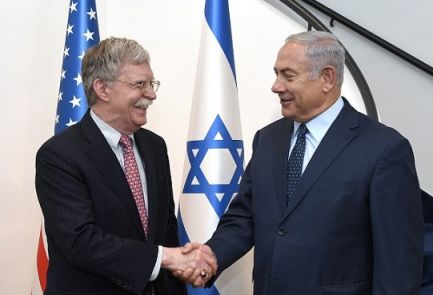
PM Netanyahu Meets US National Security Adviser John Bolton 

Posted August 20, 2018 by Joseph Wouk
Categories: Uncategorized


Bolton: U.S.’s highest priority is Iran never getting nuclear weapons

Posted August 20, 2018 by Joseph Wouk
Categories: Uncategorized

Source: Bolton: U.S.’s highest priority is Iran never getting nuclear weapons – Middle East – Jerusalem Post

Bolton began his brief comments by saying it was a “privilege and honor to be in Jerusalem, Israel’s capital,” to which Netanyahu joked: “Say that again.”

BY HERB KEINON
 AUGUST 20, 2018 11:25
Bolton: U.S.'s highest priority is Iran never getting nuclear capabilities

The United States is working with European countries to convince them of the need to take stronger steps against the Iranian nuclear weapons program, US National Security Advisor John Bolton said Monday.

Bolton was speaking at the Prime Minister’s Office prior to a meeting with Prime Minister Benjamin Netanyahu, his second meeting since arriving in Israel Sunday.

“I think it is of the highest importance for the United States that Iran never get nuclear weapons capabilities,” Bolton said.

“This is why President Trump withdrew from the wretched Iran nuclear deal. This is why he has imposed economic sanctions. This is why we are working with our friends in Europe to convince them of the need to take stronger steps against Iranian nuclear weapons,” he said.

This is also, Bolton added, the reason why we “continuously worry about Iran’s role as the central banker for international terrorism, this is why we worry about Iran’s belligerent military activity in Iran, in Syria, with Hezbollah in Lebanon, and in Yemen.”

Bolton, who is in Israel through Wednesday on his first visit to the country since taking office in April, said that all of the regional threats he mentioned were also “global threats that pose a risk of international terrorism, especially terrorists’ possible use of weapons of mass destruction.”

Bolton, long a strong supporter of Israel and a loud critic of the Iranian nuclear deal, said that the alliance between Israel and the US, and between the peoples of both countries, have “never been stronger.”

Trump, Bolton said, has made the alliance “a cornerstone of his foreign policy,” just as Netanyahu has made it a cornerstone of Israel’s policy. He said it was “very important and helpful for the United States” to have in-depth, extended conversations with Netanyahu and his senior advisors.

Bolton began his brief comments by saying it was a “privilege and honor to be in Jerusalem, Israel’s capital,” to which Netanyahu joked: “Say that again.”

“Israel’s capital,” Bolton repeated, adding that he looked forward to visiting the new US embassy in Jerusalem

Netanyahu welcomed Bolton by saying that Israel has no better friend and ally than the US, and that the US has no better friend and ally than Israel.

In reference to Trump’s constant criticism of NATO countries for not spending enough of their own GNP for their defense burden, and relying on the US, Netanyahu said that Israel was a “peculiar kind of ally.”

“We’ve consistently increased our defense spending,” he said. “We insist on defending ourselves by ourselves and appreciate all manner of American support, but we believe that the alliance is the alliance of the strong and like-minded and we share America’s values of freedom and liberty.”

Netanyahu said that under Trump the US-Israel alliance is stronger than ever, and that Bolton’s visit gives the two countries the opportunity to “align our policies even more closely on Iran, on Syria, on Gaza and on the many challenges that face both our countries in this region.”

He thanked Trump for withdrawing from the “terrible deal with Iran,” saying this was “nothing less than a hinge of history.” He also applauded the Trump administration’s “determination to re-impose tough sanctions on Iran and those doing business with Iran. I know that that view is shared by all our Arab neighbors, or practically everyone in this region.”

Netanyahu said that all countries who care about Mideast peace and security should follow the US and “ratchet up the pressure on Iran, because the greater the pressure on Iran, the greater the chance that the regime will roll back its aggression.”

The prime minister also thanked the US for its unequivocal support for Israel in international forums.

“We hear it every day, on the podiums in the White House, in the State Department, at the United Nations,” he said. “This is deeply, deeply appreciated, and deeply valued.”