Rupture between Iran’s top ally Nasrallah and its top general Soleimani – DEBKAfile

Posted September 4, 2018 by Joseph Wouk
Categories: Uncategorized

Source: Rupture between Iran’s top ally Nasrallah and its top general Soleimani – DEBKAfile

Exclusive: After long service to Shiite Iran’s expansionist goals,  Hizballah’s Hassan Nasrallah’s close ties with Gen. Soleimani are on the rocks,  after he strongly disparaged the general’s tactics in Syria, DEBKAfile’s military and intelligence sources reveal.
The sudden breach between Iran’s most dedicated surrogate and his boss, commander of Iran’s military operations in the Middle East, has taken the Shiite world by storm. It has also thrown other Shiite militias fighting under Soleimani’s command in Syria in disarray.

DEBKAfile reveals some of the defiant steps Nasrallah has taken in recent weeks:

  1. Without a word to the Iranian general, he pulled back home to Lebanon roughly 5,000 Hizballah troops from the Syrian warfront, depriving Soleimani of more than half of the competent fighting strength at his disposal in Syria. The Pakistani and Iraqi militia fighters never measured up to Hizballah’s combat standards.
  2. Nasrallah has ignored Soleimani’s orders to send back to Syria at least half of the Hizballah force he sent home.
  3. The Iranian general turned to pulling strings in Tehran with Revolutionary Guards and regime high-ups. They tried to cajole Nasrallah into relenting by arguing that, after leading so many critical battles in the Syrian war, he must not quit when the final campaign was at hand in Idlib. Nasrallah still refused to toe the Iranian line.
  4. In closed-door meetings with senior Hizballah officials and commanders last month, Nasrallah is reported by our sources to have laid out a string of complaints against Soleimani’s tactics in Syria. He faulted the general’s decision to scatter a large number of IRGC Al Qods and Shiite militia bases across the country, asserting that massive US-Israeli air power would soon reduce them to dust. He also grumbled about the inferior quality of the Shiite militias on which Soleimani depends and said they were unreliable in combat.
  5. Since the Nasrallah-Soleimani rupture, those militia chiefs have vented their own beefs, primarily about their treatment at the hands of the Iranian general who issues diktats and expects unquestioning obedience as his only form of communication. Some are now going behind the Iranian commander’s back and addressing their messages to Nasrallah in Beirut for passing on to Tehran.
    The fractured ties between Iran’s top surrogate chief and its senior Middle East strategist surfaced in the past fortnight when Iran’s defense minister Amir Hatami and foreign minister Muhammed Javad Zarif, who paid important visits to Damascus, skipped side trips to Beirut and contacts with Hizballah leaders. Our military sources also disclose that the withdrawal of Hizballah troops from most of eastern Syria to Lebanon was the catalyst for violent battles over territory between Soleimani’s Shiite militias and Syrian contingents, mainly in the Deir ez-Zour and Abu Kamal regions. In the fighting which broke out on Aug. 8 – and is still ongoing – both sides are using artillery, mortars, heavy machine guns and automatic sidearms. Both have inevitably suffered substantial dead and wounded casualties. In an attempt to curb the unfolding catastrophe, the Russian high command in Syria acted in the second half of August by posting Russian military police on the Euphrates River bridges to try and separate the warring forces in the two embattled areas. Those same military police were originally assigned to man 8 positions on the Syrian-Israeli border opposite the Golan.


UNRWA chief defends refugee criteria for millions of Palestinians

Posted September 4, 2018 by Joseph Wouk
Categories: Uncategorized

Source: UNRWA chief defends refugee criteria for millions of Palestinians – Israel Hayom


Abbas demands US replace ‘biased’ Greenblatt as peace mediator 

Posted September 4, 2018 by Joseph Wouk
Categories: Uncategorized

Source: Abbas demands US replace ‘biased’ Greenblatt as peace mediator – Israel Hayom


Report: Iran smuggled weapons to Lebanon on civilian ‎flights ‎ 

Posted September 4, 2018 by Joseph Wouk
Categories: Uncategorized

Source: Report: Iran smuggled weapons to Lebanon on civilian ‎flights ‎ – Israel Hayom

Assad to Iranian FM: West has failed

Posted September 4, 2018 by Joseph Wouk
Categories: Uncategorized

Source: Assad to Iranian FM: West has failed

Syria’s President meets Iranian foreign minister Zarif in light of growing tension in region; the two discuss upcoming summit with Russia, Iran and Turkey, and agree that ‘pressures exerted by some Western governments will not deter both countries.’

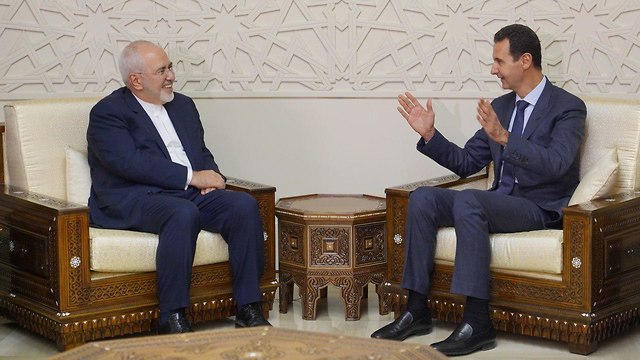
Syria’s President Bashar Assad and Iranian Foreign Minister Mohammad Javad Zarif met on Monday to discuss recent developments in Syria and the region, and prepare for the upcoming summit with Russia, Iran and Turkey.

According to a statement made by the Syrian Presidential Palace, the two leaders agreed that “the fact that the West has resorted to threats and pressure on Tehran and Damascus attests to its failure to implement the plans it has proposed.”

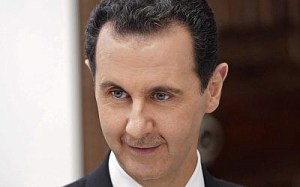
President of Syria Bashar Hafez al-Assad and Iranian Foreign Minister Mohammad Javad Zarif

President of Syria Bashar Hafez al-Assad and Iranian Foreign Minister Mohammad Javad Zarif

“the pressures exerted by some Western countries will not deter both countries from continuing to maintain their principles and securing the region,” the statement read.During the meeting, the two leaders discussed recent developments in Syria and the region, as well as issues on the agenda in the summit between Russia, Iran and Turkey, which will be held in Iran in the coming days.

Zarif landed in Damascus on Monday morning for talks with senior Syrian officials, in light of growing tension in the region. The Syrian newspaper Alwatan quoted a diplomatic source as saying: “The visit comes in the light of the preparations of the Syrian army and its allies for the liberation of Idlib.”

As Iran prepares for talks with Syria and Russia about the last major enclave held by Syrian rebels, Zarif said that “all armed forces must be removed from Idlib.”

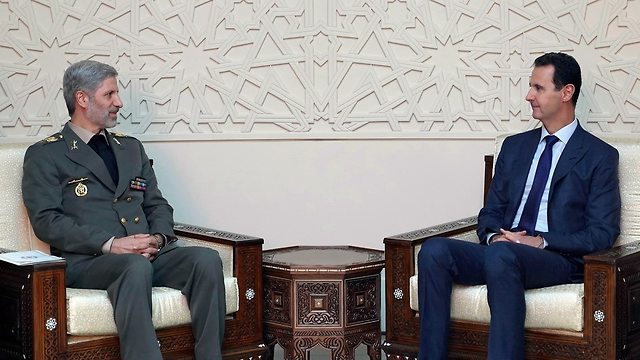
Syrian president Assad and Iranian Defense Minister Amir Khatami  (Photo: AP)

Syrian president Assad and Iranian Defense Minister Amir Khatami (Photo: AP)
The Syrian government’s forces are planning a phased offensive in Idlib and surrounding areas held by insurgents fighting Assad, who has been backed by both Russian and Iranian forces.

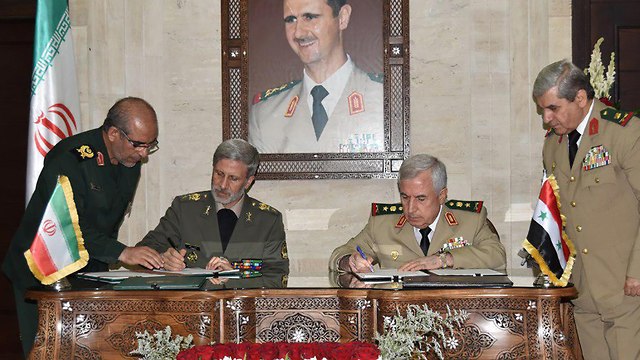
This is a second visit of an Iranian official in Syria this past week.Iranian Defense Minister Amir Khatami arrived in Damascus a week ago for a two-day visit, during which he also met with President Assad. During his visit, Khatami signed a military cooperation deal with his Syrian counterpart Ali Abdullah Ayoub.

Regarding the military cooperation between the two countries, the Syrian defense minister said that the presence of “Iranian advisors” in Syria is the result of as an official request made by the Syrian government, in agreement with Iran.

Iranian Defense Minister Amir Khatami with Syrian officials (Photo: AFP)

Iranian Defense Minister Amir Khatami with Syrian officials (Photo: AFP)
Iran’s official position is that these advisers will remain in Syria as long as Syria sees fit.Sputnik reported that a senior Syrian official claimed that Khatami’s visit dealt with rehabilitating Syria following the war, but was also meant to convey the message that the Iranian military advisers and the Syrian army tightened their relations.

According to the source, the visit is a response to the Israeli and American demand that Iran withdraw from Syria.

Netanyahu: Closer ties to Arab world are the silver lining of ‘bad’ Iran deal 

Posted September 4, 2018 by Joseph Wouk
Categories: Uncategorized

Source: Netanyahu: Closer ties to Arab world are the silver lining of ‘bad’ Iran deal | The Times of Israel

In new year address to Foreign Ministry diplomats, PM hails era of Israel’s ‘diplomatic flourishing’

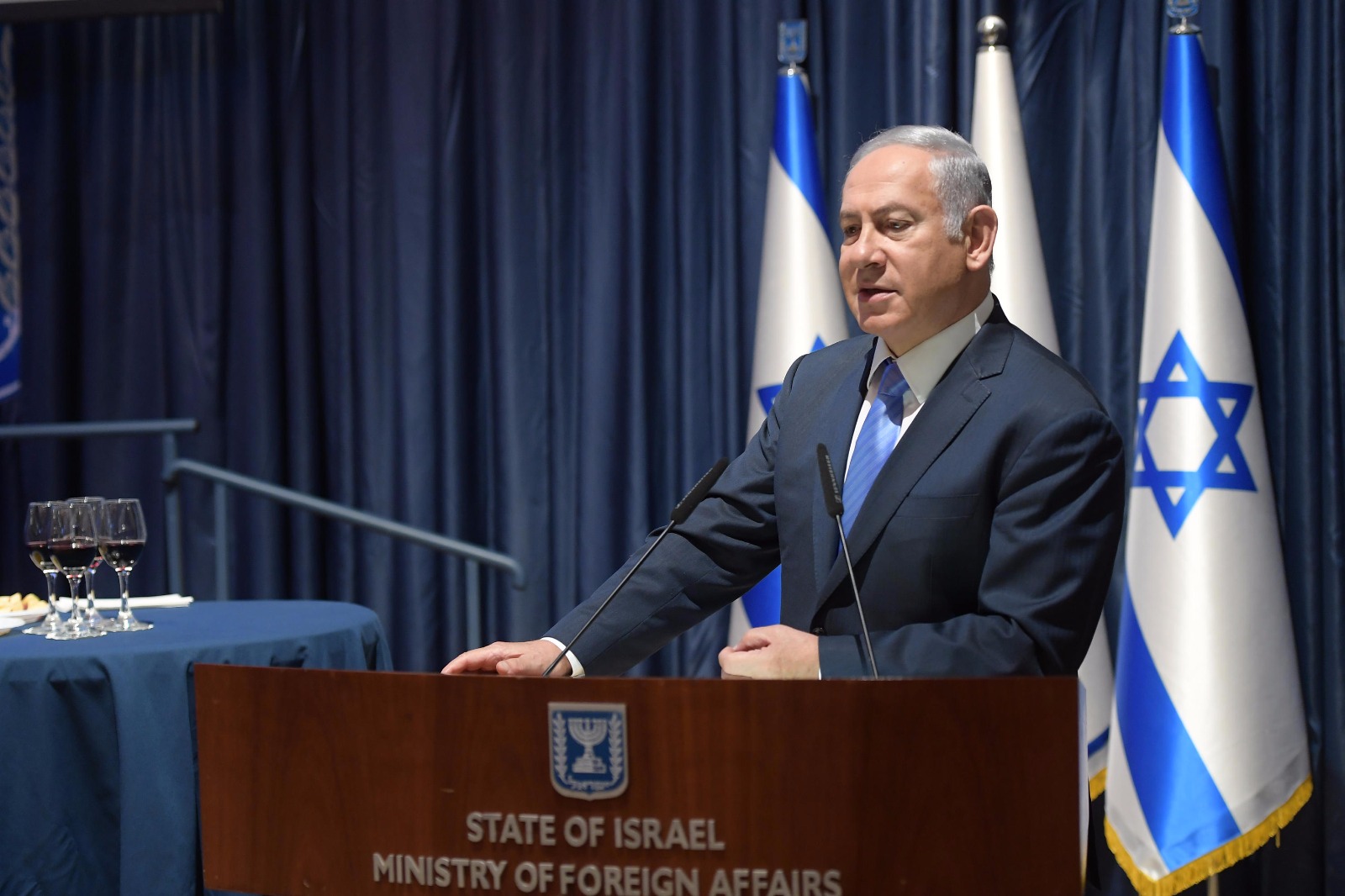
Prime Minster Benjamin Netanyahu speaks at the Foreign Ministry on September 3, 2018. (Amos Ben-Gershom / GPO)

Prime Minster Benjamin Netanyahu speaks at the Foreign Ministry on September 3, 2018. (Amos Ben-Gershom / GPO)

Prime Minister Benjamin Netanyahu said Sunday that closer ties between Israel and the Arab world were a silver lining of the otherwise “bad” Iran nuclear deal.

The 2015 pact was a “bad agreement in every respect except for one – it brought us closer to the Arab world on a scale that we never knew, and one of our goals is that it continues,” he said.

“Another important thing is, of course, the fact that there is a gradual normalization with leading countries in the Arab world,” Netanyahu added.

The prime minister, who is also acting foreign minister, was addressing diplomats at the Foreign Ministry during an event marking the Jewish new year.

He also said that Israel’s standing in the world was improving, a process he predicted could lead to peace.

“We are in the midst of a diplomatic flourishing,” he said. “We are also in a struggle for justice and truth, and I think that we are in a process of gradual normalization that in the end heralds a genuine opening for peace.”

In May, US President Donald Trump withdrew from the Iran deal, which had been signed by his predecessor Barack Obama and other world powers, and began restoring US sanctions. The move has exacerbated a financial crisis in Iran that has sent its currency tumbling.

Netanyahu has repeatedly stated that he can see a path to peace with Palestinians through the “normalization” of relations with Arab states, which, like Israel, oppose Iran.

“Many Arab countries now see Israel not as their enemy but as their indispensable ally in pushing back Iranian aggression,” Netanyahu told Lithuania’s LRT public broadcaster.

“This has created normalization which can lead to peace. I believe that if we have peace with the broader Arab world, it will help us get to peace with the Palestinians,” he added in the interview, which was taped during a visit to the Baltic state.

Both Israel and Saudi Arabia have opposed the Iran nuclear deal and pushed for tougher action against Iran’s spreading influence in the Middle East.

Israel has peace treaties with just two Arab countries, Egypt and Jordan, while others insist on an agreement with the Palestinians as a prerequisite that would pave the way to formal relations.

Israel and Saudi Arabia have no official relations and the kingdom does not recognize the Jewish state. Still, Israel has hinted at clandestine ties with Saudi Arabia in recent years, stressing the two countries share an interest in countering Iran.

The rumors of covert relations have been denied by Saudi officials. Still, a Saudi general visited Jerusalem in 2016 and met with Israeli lawmakers, and Saudi officials have met with Israeli officials on several occasions in public. Saudi Arabia also last recently allowed Air India to fly to and from Tel Aviv via its airspace.

Agencies contributed to this report.


Putin, Erdogan, Rouhani to meet in Iran for talks on ‘normalization’ in Syria

Posted September 4, 2018 by Joseph Wouk
Categories: Uncategorized

Source: Putin, Erdogan, Rouhani to meet in Iran for talks on ‘normalization’ in Syria | The Times of Israel

Kremlin says leaders to hold tripartite summit Friday on ‘liquidating the hotbed of international terrorism’ in embattled country

Turkey's President Recep Tayyip Erdogan, (r), Russia's President Vladimir Putin, (c), and Iran's President Hassan Rouhani pose for the media members in Sochi, Russia, November 22. 2017. (Kayhan Ozer/Pool via AP)

Turkey’s President Recep Tayyip Erdogan, (r), Russia’s President Vladimir Putin, (c), and Iran’s President Hassan Rouhani pose for the media members in Sochi, Russia, November 22. 2017. (Kayhan Ozer/Pool via AP)

MOSCOW, Russia — The Kremlin on Monday said that the leaders of Russia, Iran, and Turkey would on Friday hold a tripartite summit in Iran seeking an end to the Syrian conflict.

In a statement confirming the date of September 7 that was reported earlier by Turkish media, the Kremlin said Putin would “make a working visit to Iran” for the talks.

He, Turkish President Recep Tayyip Erdogan, and Iranian President Hassan Rouhani will consider “further joint efforts to ensure long-term normalization of the situation in Syria,” the Kremlin said.

Putin also plans bilateral talks with each of the leaders, it added.

The Kremlin said they would discuss further measures “aimed at finally liquidating the hotbed of international terrorism” in Syria, where the conflict has killed more than 350,000 people since 2011, many of them at the hands of Syrian President Bashar Assad’s regime.

Syrian President Bashar Assad speaks during an interview with the Greek Kathimerini newspaper, in Damascus, Syria, in this photo released May 10, 2018. (SANA via AP)

Discussions will look at “promoting the process of a political settlement, including creating the conditions for the return of refugees and the internally displaced,” the Kremlin said.

The statement did not say where in Iran the talks would be held, but Kremlin spokesman Dmitry Peskov said last week they would be in Tehran.

Putin, Rouhani and Erdogan have backed Syria peace talks based in the Kazakh capital of Astana which they insist are aimed at reinforcing, rather than undermining, a parallel UN peace process in Geneva.

The three leaders last met for similar tripartite talks in Ankara in April, and before that, in November last year, in the Russian resort of Sochi.

Iran and Russia are the main allies of Assad and their military interventions in Syria are widely seen as tipping the balance of the seven-year civil war in the regime’s favor.

Turkey has backed rebels seeking to oust Assad, but since late 2016 has been working increasingly closely with Iran and Russia to bring peace to Syria.

Preparations for the talks are going on as a Syrian regime offensive is expected imminently in the country’s last rebel stronghold, northwestern Idlib province, which Assad wants to recapture to crown a string of military successes.

Turkey has warned that a military operation to take Idlib risks provoking a humanitarian “catastrophe” with 3.5 million people crammed into the region.


Trump warns Syria, Russia and Iran against Idlib ‘tragedy’ 

Posted September 4, 2018 by Joseph Wouk
Categories: Uncategorized

Source: Trump warns Syria, Russia and Iran against Idlib ‘tragedy’ | The Times of Israel

‘Hundreds of thousands of people could be killed. Don’t let that happen!’ president warns as regime forces and allies gear up for assault on rebels

US President Donald Trump speaks with reporters upon arriving at the White House on August 31, 2018. (AP Photo/Manuel Balce Ceneta)

US President Donald Trump speaks with reporters upon arriving at the White House on August 31, 2018. (AP Photo/Manuel Balce Ceneta)

WASHINGTON  — US President Donald Trump on Monday warned Syria against launching an attack on the country’s last rebel stronghold with the help of Russia and Iran, saying the offensive could trigger a “human tragedy.”

“President Bashar al-Assad of Syria must not recklessly attack Idlib Province. The Russians and Iranians would be making a grave humanitarian mistake to take part in this potential human tragedy,” Trump tweeted.

“Hundreds of thousands of people could be killed. Don’t let that happen!”

The United Nations and aid groups have warned that a full assault on Idlib could spark a humanitarian catastrophe on a scale not yet seen in Syria’s seven-year-old conflict.

Donald J. Trump

@realDonaldTrump

President Bashar al-Assad of Syria must not recklessly attack Idlib Province. The Russians and Iranians would be making a grave humanitarian mistake to take part in this potential human tragedy. Hundreds of thousands of people could be killed. Don’t let that happen!

Syrian government forces are now massing around the northwestern province of Idlib, which is held by a complex array of rebels and violent extremist fighters, many of whom have been blacklisted as “terrorists” by world powers.

Russia and Iran have insisted that extremist groups in Idlib must be defeated and are expected to back regime forces in any assault.

Since early 2017, Iran, fellow regime ally Russia and rebel backer Turkey have sponsored a negotiations track based in the Kazakh capital to tamp down hostilities in Syria.

Last year, they had designated Idlib as a “de-escalation” zone where violence would halt in preparation for a countrywide ceasefire.

Syrian rebel fighters prepare for an upcoming government forces offensive, in the countryside of the rebel-held northern Idlib province on September 3, 2018.( AFP PHOTO / OMAR HAJ KADOUR)

All the while seeking to pressure Turkey into reining in jihadists in Idlib, Damascus’s main sponsor Russia has been sounding the war drums in recent days.

Tehran and Moscow provided steady political, financial and military backing to Assad throughout the war, which has left over 350,000 people dead since it broke out in 2011.

The International Crisis Group, a Brussels-based think tank, said an all-out assault on Idlib and its catastrophic consequences could still be avoided.

Russia, whose air support would be crucial for the offensive to succeed, should understand that a bloodbath in Idlib would jeopardize its own political goals, according to ICG.

“By backing an all-out offensive, Russia risks undermining its long-term political objectives in Syria,” ICG wrote in a nine-page briefing entitled “Saving Idlib from destruction.”

US warnings ring hollow?

Despite Trump’s warning, analysts believe the United States appears resigned to the likelihood of a final military victory by Syrian government forces.

Behind the scenes, American diplomats have been actively warning Moscow, which has been accused in the past of turning a blind eye to chemical weapon use by its Syrian proteges.

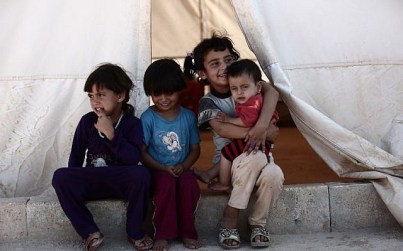
Children sit in the shade of a tent at a camp for the displaced in the rebel-held Syrian province of Idlib, at the village of al-Ghadfa, southeast of the province on September 2, 2018. (AFP PHOTO / Nazeer AL-KHATIB)

But these “verbal warning shots” have little to do with today’s reality in Syria, said Jonas Parello-Plesner, a researcher with the Hudson Institute think tank in Washington who recently published a study on the US approach to the region.

And that reality, he told AFP, is that “Assad is advancing on the ground, aided by Iran by land and Russia by air,” while the United States places its hopes on a UN-backed Geneva peace process that might best be described, he said, as “moribund.”

Trump said in April that “it’s time” to bring American troops home from Syria — once the jihadists of the Islamic State group had been definitively defeated.

While he quickly backed away from talk of an immediate withdrawal, his underlying determination to leave Syria’s seven-year war as soon as possible seems unchanged.


Report: Secret Iranian gun-smuggling air routes to Hezbollah exposed 

Posted September 4, 2018 by Joseph Wouk
Categories: Uncategorized

Source: Report: Secret Iranian gun-smuggling air routes to Hezbollah exposed – Middle East – Jerusalem Post

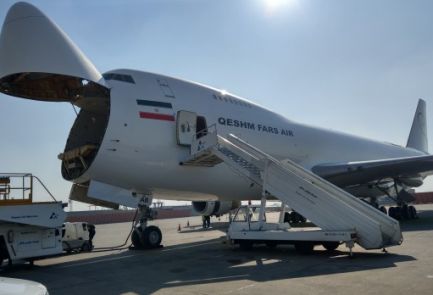
Two flights carried out by Qeshm Fars Air took unusual routs to get to Lebanon, arousing concern they were used to deliver weapons to Hezbollah.

BY MAARIV ONLINE, JERUSALEM POST STAFF
 SEPTEMBER 4, 2018 00:55
Report: Secret Iranian gun-smuggling air routes to Hezbollah exposed

Citing western intelligence sources, Fox News revealed that they were able to unmask the methods Iran is using to deliver weapons into Lebanon.

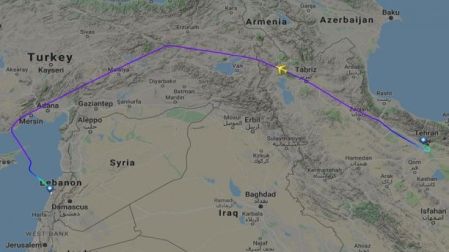
The first flight involved a Boeing 747 and took place on July 9, departing from a military airbase in Tehran to Beirut, but not before stopping in Damascus for a layover.

The flight route went over northern Lebanon and is not one that is usually used.

“The Iranians are trying to come up with new ways and routes to smuggle weapons from Iran to its allies in the Middle East”, reported Fox News citing an anonymous regional intelligence expert,”testing and defying the West’s abilities to track them down.”

The US, Israel and other Western nations have ample evidence that Iran is operating weapons factories in Yemen, Syria and Lebanon.

The second flight took place on August 2 and flew from Tehran through Syrian airspace to Beirut.

Qeshm Fars Air is regarded as one of the aviation companies used by the Islamic Revolutionary Guard Corps (IRGC) to smuggle arms. Three IRGC members currently serve on the board of the airline company.

A report by Reuters over the weekend stated that Iran had already transferred ballistic missiles to Shi’ite proxies in Iraq over the course of several months and that it is developing the capacity to build more there.

The missiles include the Fateh-110, Zolfaqar and Zelzal types, which have ranges of 200-700 km., allowing them to be able to threaten both Saudi Arabia and Israel.

A senior official in the IRGC stated that “We have bases in many places, and Iraq is one of them.”

He further stated that should the US decide to strike within Iran, these bases outside the country are expected to allow Iran to strike back.


Avigdor Liberman: ‘Israel will deal with Iranian threats everywhere’ 

Posted September 4, 2018 by Joseph Wouk
Categories: Uncategorized

Source: Avigdor Liberman: ‘Israel will deal with Iranian threats everywhere’ – Israel News – Jerusalem Post

Israel has spoken repeatedly with major powers, such as Russia and the US, to ensure that Iran cannot entrench itself militarily in Syria or in other parts of the Middle East.

BY TOVAH LAZAROFF
 SEPTEMBER 4, 2018 05:55
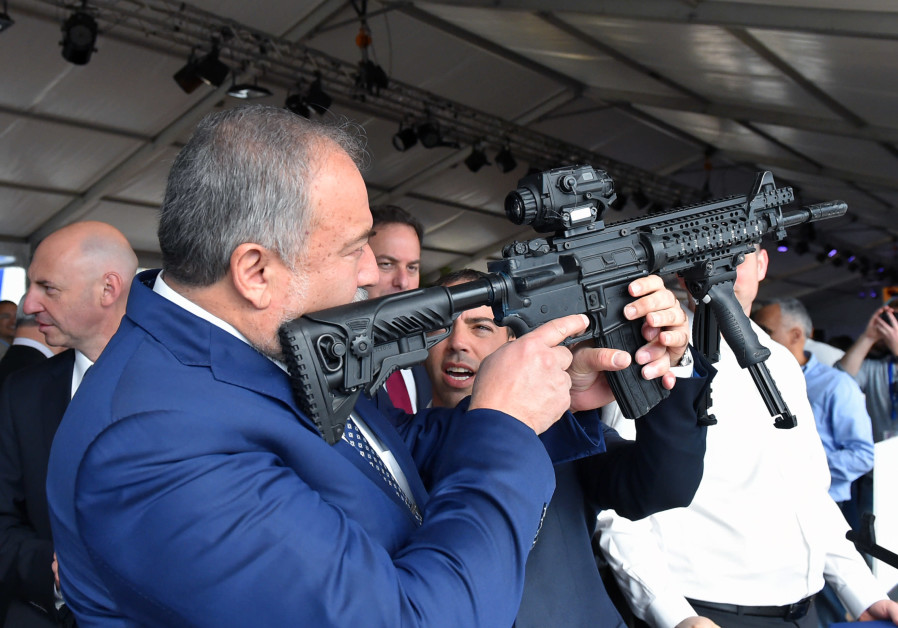
Defense Minister Avigdor Liberman holds a weapon during a visit to Sderot

Israel will combat any Iranian threat in Syria and beyond, Defense Minister Avigdor Liberman said on Monday, just one week after Iran was reported to have transferred short-range ballistic missiles to Shi’ite allies in Iraq in recent months.

Tehran and Baghdad formally denied that report.

Israel has spoken repeatedly with major powers, such as Russia and the US, to ensure that Iran cannot entrench itself militarily in Syria or in other parts of the Middle East. It has also launched military strikes against Iranian targets in Syria.

“We are not limiting ourselves only to Syria. We will deal with every Iranian threat, no matter where it comes from,” Liberman said.
Asked about whether Israel has the freedom of action for any such moves, Liberman said, “Israeli freedom of action is absolute… Definitely any threat that comes up will be answered.”

He stressed that Israel was prepared for a military escalation along its northern front. All those who are involved in Syria are very impressed by Israel’s capabilities, Liberman said.

“I want to give you just an example that we all saw – the meeting of two leaders, [US President Donald] Trump and [Russian President Vladimir] Putin, in Helsinki. They both talked about the State of Israel and Israel’s interests in Syria,” the defense minister said. “So I can tell you that everyone is very impressed and we are definitely following everything that has been done in Syria.”

US Secretary of State Mike Pompeo said on Saturday he was “deeply concerned” by the reported Iranian missile transfer.

“If true, this would be a gross violation of Iraqi sovereignty and of UNSCR 2231,” he tweeted, referring to a UN Security Council resolution endorsing the 2015 international nuclear deal with Iran. The Trump administration abandoned that deal in May, citing, among other factors, Iran’s ballistic missile projects.

Two envoys, US Special Representative for Syrian Affairs James Jeffrey and Special Envoy for Syria Joel Rayburn are making visits in the region since Saturday through Tuesday, with stops in Israel, Jordan and Turkey for talks on the issue of Syria and Iran.

On Saturday night, the two envoys met with the head of the political and military bureau of the Defense Ministry, Zohar Palti. He presented them with Liberman’s stance against the entrenchment of Iran and Hezbollah in Syria.

He also spoke of the importance of US sanctions against Iran in preventing its support of regional terror.

Prime Minister Benjamin Netanyahu underscored the danger of an Iranian military presence in Syria when he met Sunday night with the US delegation.

“The two discussed the situation in Syria and the joint effort to stop Iran’s terror and aggression,” the Prime Minister’s Office said in a statement it issued after the meeting.

Prior to the visit of the two envoys, the US State Department said they would speak with Israeli officials about “maintaining Israel’s security while countering Iran’s destabilizing activity throughout the region.”

“They will also underscore that the United States will respond to any chemical weapons attack perpetrated by the Syrian regime,” a State Department spokesman said.