The Russian exploitation of a good crisis

Posted September 25, 2018 by Joseph Wouk
Categories: Uncategorized

Source: The Russian exploitation of a good crisis

Analysis: Russia really had no interest in hearing the Israeli version of the Latakia offensive. Moscow’s reception of the IAF commander to explain Israel’s version was merely a facade. For Russia, Israel’s culpability was a foregone conclusion, but what it really wanted was more information on how Israel’s intel works and to alter agreements of regarding Israel’s freedom to act in Syrian skies.
It turns out that the visit by an IDF delegation to Moscow to protest Israel’s innocence and to thaw the icy standoff that has developed since has only served to frost relations further and underscore the disparity in the versions that have surfaced between the two sides.

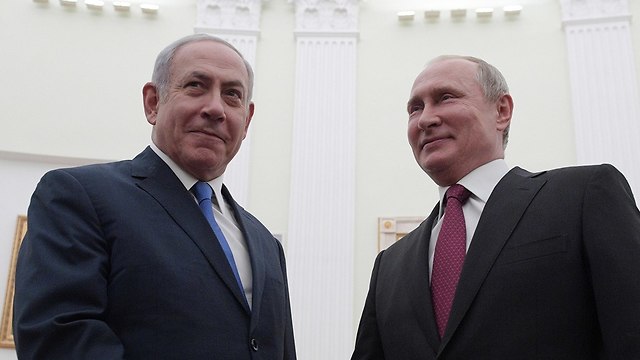
Netanyahu (L) and Putin  (Photo: EPA)

Netanyahu (L) and Putin (Photo: EPA)

In the briefings that were given to Russian media by President Vladimir Putin’s representatives, the Israeli version was presented as nothing more than fallacious. The Israeli investigation appears not to have interested the Russians, and Prime Minister Netanyahu’s gesture of sending the IAF commander to Moscow left no impression on them. From the Russian point of view, this was purely a perfunctory facade. What they were really interested in was how Israel’s IAF intelligence works.

The Russian newspaper “Komsomolskaya Pravda” which has close ties with the Russian Defense Ministry and with the Kremlin spokesman Dmitry Peskov described on Thursday the meeting between the IAF chief Maj. Gen. Amikam Norkin and his Russian counterpart as cold, difficult, stern and without smiles. The paper said that the Russians had demanded that Israel, before anything else, recognize that its actions had brought about a tragedy and that “the blame lies with the Israelis. That is our basic position.”

“We made clear to Norkin that our facts contradict theirs, and conclusions such as those reached by the Israelis may have been invented,” he said.

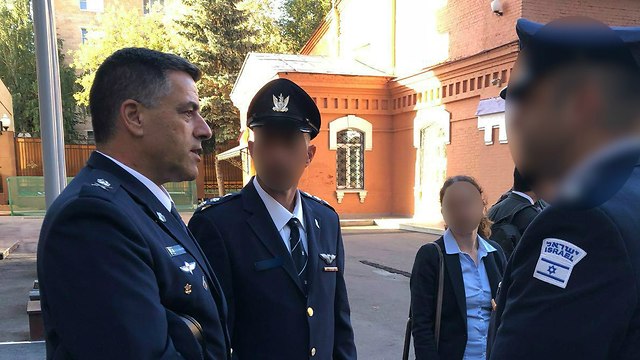
IAF delegation in Russia (Photo: IDF Spokesmans Unit)

IAF delegation in Russia (Photo: IDF Spokesmans Unit)

It is important to note that in Russia there are no leaks about sensitive security meetings such as this one. Therefore, Israel concluded that the report was no coincidence and it comes directly from Putin’s spokesman or another senior official in the Kremlin. Either way, the article described the Israelis as people shuffling around uncomfortably in their chairs, as people who avoided answering technical questions and who tried to speak about Iranian responsibility for the incident and Assad’s culpability.

The paper also said that Norkin’s Russian counterpart asked during the meeting: “What did you do in the airspace?” According to them, Norkin admitted that Israel did not look into the presence of Russian aircraft in the area during the attack.

The Russian message to Israel is a political and unequivocal one: They do not want Israel to continue flying and launching strikes in Syria and certainly not in the current state of affairs. The downing of the plane is an opportunity for the Russians to change the current understanding with Israel regarding the IAF’s freedom to operate in Syria. Israel now face a dramatic decision on the depth of the crisis and how far it is willing to take it with the Russians. At the moment, the crisis seems insolvable.

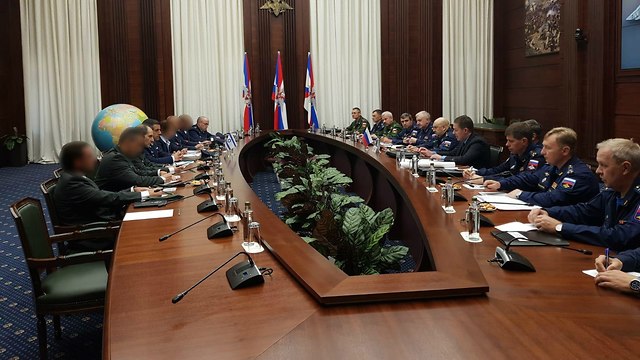
Russian-Israeli meeting  (Photo: IDF Spokesmans Unit)

Russian-Israeli meeting (Photo: IDF Spokesmans Unit)

In the Israeli security establishment, officials have repeatedly emphasized that Israel will not be compromising on its military efforts to remove the Iranian military presence from Syria and prevent the transfer of weapons to Hezbollah.The message being conveyed from Moscow is that the Kremlin does not encourage visits to Russia by Israeli officials in an effort to bridge the diplomatic rift that has developed. Nor does it support visits by Russian officials to Israel over the matter.Israel is convinced that it acted in accordance with the agreements reached with Russia and that everything that took place stemmed from a lack of professionalism demonstrated by the Syrians who shot down the plane. Moreover, the Israelis are convinced that the fact that they have hitherto refrained from hitting Syrian and Iranian targets along the Syrian coast has brought about a situation in which the Iranians believe they can establish military facilities in the area under the umbrella of Russian air defenses. Thus, Israel will continue to do everything in order to expunge the Iranian presence from the area.

Nevertheless, beyond the declarations and policies, in the coming days Israel will need to make decisions on the continuation of operations above Syrian territory and on relations with the Russians. Israel believes that time will run its course and the mutual interest in preserving healthy relations will ultimately prevail over the crisis.

The next Israeli strike in Syria will therefore be a test for both sides. It is possible to assume that if and when Israel chooses to strike a target, it will do everything in its abilities to ensure early and thorough coordination with the Russians, even if it comes at the expense of security information, lest it awaken an even angrier Russian bear.


Iran, major powers agree to work on nuclear deal despite U.S. sanctions 

Posted September 25, 2018 by Joseph Wouk
Categories: Uncategorized

Source: Iran, major powers agree to work on nuclear deal despite U.S. sanctions – Middle East – Jerusalem Post

The idea is to circumvent US sanctions due to be restored in November under which Washington can cut off from the US financial system any bank that facilitates an oil transaction with Iran.

BY REUTERS
 SEPTEMBER 25, 2018 06:08
Iran, major powers agree to work on nuclear deal despite U.S. sanctions

UNITED NATIONS – The remaining parties to the Iran nuclear deal on Monday agreed to keep working to maintain trade with Tehran despite skepticism this is possible as US sanctions to choke off Iranian oil sales resume in November.

US President Donald Trump decided in May to abandon the pact and to restore economic sanctions on Iran, including those that seek to force the OPEC member’s major oil customers to stop buying Iranian crude.

In a statement after a meeting of Britain, China, France, Germany, Russia and Iran, the group said they were determined to develop payment mechanisms to continue trade with Iran despite skepticism by many diplomats that this will be possible.

“Mindful of the urgency and the need for tangible results, the participants welcomed practical proposals to maintain and develop payment channels notably the initiative to establish a Special Purpose Vehicle (SPV) to facilitate payments related to Iran’s exports, including oil,” the group said in a joint statement issued after the statement.

Several European diplomats said the SPV idea was to create a barter system, similar to one used by the Soviet Union during the Cold War, to exchange Iranian oil for European goods without money changing hands.

The idea is to circumvent US sanctions due to be restored in November under which Washington can cut off from the US financial system any bank that facilitates an oil transaction with Iran.

Speaking to reporters after the meeting, European Union foreign policy chief Federica Mogherini said the decision to set up such a vehicle had already been taken and that technical experts would meet again to flesh out the details.

“In practical terms this will mean that EU member states will set up a legal entity to facilitate legitimate financial transactions with Iran and this will allow European companies to continue to trade with Iran in accordance with European Union law and could be open to other partners in the world,” she said.

Many diplomats and analysts, however, are skeptical such a vehicle could ultimately thwart US sanctions given that the United States could amend its sanctions laws to prohibit such barter transactions.

“The key is to keep all possibilities open so that we can signal to the Iranians that the door isn’t closing,” said a senior French diplomat.

The European Union, has so far failed to devise a workable legal framework to shield its companies from US sanctions that go into effect in November and that, among other things, seek to choke off Iran’s oil sales, diplomats said.

Highlighting how difficult it will be for the Europeans to come up with concrete solutions, French state-owned bank Bpifrance on Monday abandoned a plan to set up a financial mechanism to aid French firms trading with Iran.

The crux of the 2015 nuclear deal, negotiated over almost two years by the administration of former US President Barack Obama, was that Iran would restrain its nuclear program in return for the relaxation of sanctions that had crippled its economy.

Trump considered it flawed because it did not include curbs on Iran’s ballistic missiles program or its support for proxies in Syria, Yemen, Lebanon and Iraq.

The impending return of US sanctions has contributed to a slide in Iran’s currency. The rial has lost about two-thirds of its value this year, hitting a record low against the US dollar this month.


Russia declares electronic war on Israel ranging over Syria, E. Mediterranean – DEBKAfile

Posted September 24, 2018 by Joseph Wouk
Categories: Uncategorized

Source: Russia declares electronic war on Israel ranging over Syria, E. Mediterranean – DEBKAfile

Within two weeks, Russia will arm Syria with S-300 air defense systems and start jamming navigation in the E. Mediterranean – two of the three measures announced by Defense Minister Sergei Shoigu in Moscow on Monday, Sept. 24 “in response to Israel’s role in downing the Russian IL-20” on Sept. 17.

Syria’s air defense electronic capacities will be boosted to level that of Russian forces in the country. But the most significant measure announced by Shoigu was: “Russia will jam satellite navigation, on-board radars and communication systems of combat aircraft, which attack targets in the Syrian territory, in the regions over the waters of the Mediterranean Sea bordering with Syria.”

The Russian minister stressed that if these measures “fail to cool hotheads, [He was obviously referring to Israel.], we will have to respond in line with the current situation.”

The crucial measure he announced is not the arming of Syria for the first time with S-300 systems – which Moscow withheld in the past at Israel’s request – but the jamming of navigation. DEBKAfile’s military experts point out that this the first time a major world power has declared electronic war against any country. After rejecting Israel’s version of the Ilyushin crash with 15 Russian servicemen aboard as untruthful, Moscow has thrown down the electronic gauntlet before the IDF and pitched the dispute onto a much higher elevation. This challenge confronts Prime Minister Binyamin Netanyahu and Chief of Staff Lt. Gen. Gady Eisenkot with three tough options:

  1. They could have sought a way out of this high-stakes showdown with Moscow up until Monday. But now, it is too late. Shoigu slammed the door shut on a quiet exit. However, Israel is even more unable to give up on its air offensive against Iranian and its proxies’ presence in Syria, despite the escalated risk of a clash with the Russians, because it would constitute a humiliating comedown against Iran and Hizballah. However, in future, the IDF may be more cautious and select its targets with greater circumspection.
  2. They could meet Moscow’s challenge for an electronic duel. In previous encounters, Israel came of best. In 1982, the Israeli Air Force destroyed a Russian air defense network installed by Russia in the Lebanese Beqaa Valley; and more recently, in 2007, Israeli planes, before destroying the Iranian-North Korean plutonium reactor in Deir Ez-Zour, activated its “Suter” system to “blind” the Syrian/Russian radar protecting the site.
    Russian electronic warfare specialists have since sought answers for Israel’s jamming measures, but have found it difficult to catch up with is constant advances. However, this time may be different. DEBKAfile reports that the latest Russian challenge may stretch Israel’s Air Force and Navies beyond their capacity. While successful in coping with electronic antagonists over small targets in the past, they now see the Russian Defense Minister painting a large arena of many hundreds of kilometers covering Syria and the eastern Mediterranean for the new challenge. Israel lacks operational experience on this scale of electronic warfare.
  3. The IDF is much less worried about the impending delivery of S-300 missiles systems to Bashar Assad’s army. For years, the IAF has been practicing combat against these batteries. But for taking on massive Russian jamming across the eastern Mediterranean, Israel may have to turn to the United States for assistance. This request may be raised when Netanyahu meets President Donald Trump on Wednesday Sept. 26, on the sidelines of the UN General Assembly in New York.


Iran warns Israel and U.S. to expect ‘devastating’ revenge 

Posted September 24, 2018 by Joseph Wouk
Categories: Uncategorized

Source: Iran warns Israel and U.S. to expect ‘devastating’ revenge – Middle East – Jerusalem Post

Salami addressed Israeli and US leaders, saying that “you have seen our revenge before … You will see that our response will be crushing and devastating.”

BY REUTERS, JPOST.COM STAFF
 SEPTEMBER 24, 2018 09:41
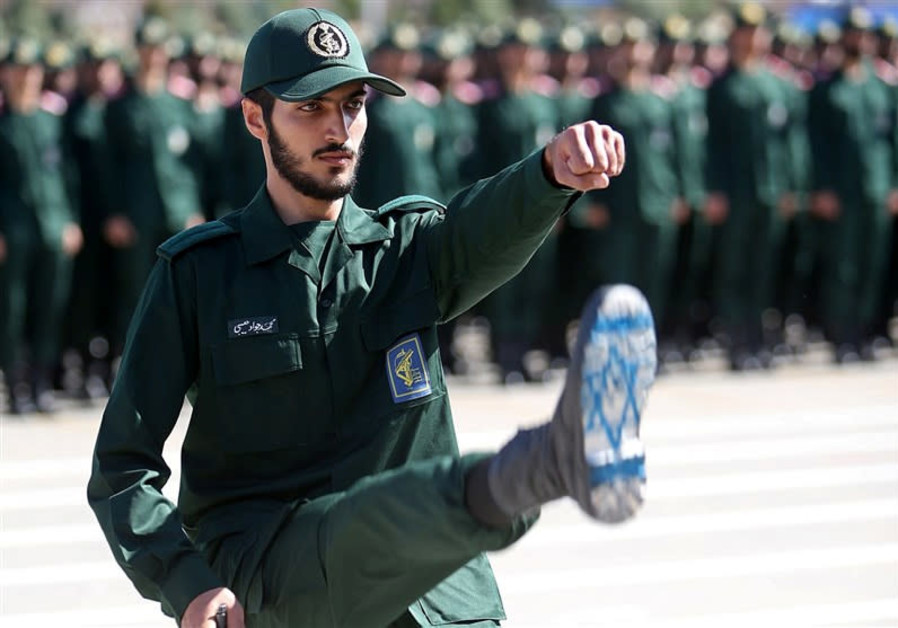
An Iranian Officer of Revolutionary Guards with Israel flag drawn on his boots

The deputy head of Iran’s Revolutionary Guards Hossein Salami warned Israeli and US leaders to expect a “devastating” response from Iran, as reported by Reuters.

In a speech before the funeral of the victims in Ahvaz, broadcast live on the state television, he accused them of involvement in Saturday’s attack on a military parade in the city of Ahvaz that killed 25 people, including military personnel and a four-year-old child, and wounded more than 60.

Thousands of people packed the streets of the southwestern Iranian city of Ahvaz to mourn the victims. The assault, one of the worst against the most powerful military force of the Islamic Republic, struck a blow at its security establishment at a time when the United States and its Gulf allies are working to isolate Tehran.

Many chanted “death to Israel and America.”

The coffins, wrapped in the flag of the Islamic Republic, were carried by the mourners. Many held pictures of a four year old boy killed in the attack.

Salami addressed Israeli and US leaders, saying that “you have seen our revenge before … You will see that our response will be crushing and devastating and you will regret what you have done.”

Iranian President Hassan Rouhani also accused other countries of the attack, right before leaving for the United Nations Meeting on Sunday.

US Ambassador to the United Nations Nikki Haley dismissed his comments.

“He’s got the Iranian people are protesting, every ounce of money that goes into Iran goes into his military, he has oppressed his people for a long time and he needs to look at his own base to figure out where that’s coming from,” she told CNN’s “State of the Union.”

“He can blame us all he wants. The thing he’s got to do is look at the mirror.”


O Come All Ye Jew Haters 

Posted September 24, 2018 by Joseph Wouk
Categories: Uncategorized


YouTube actually put up a warning about this anti antisemitism video. The high tech media companies are really getting scary…  – JW

PM Netanyahu may help Trump preside over UN Security Council session 

Posted September 23, 2018 by Joseph Wouk
Categories: Uncategorized

Source: PM Netanyahu may help Trump preside over UN Security Council session – Israel Hayom


Russia blames Israel ‘entirely’ for plane shot down over Syria

Posted September 23, 2018 by Joseph Wouk
Categories: Uncategorized

Source: Russia blames Israel ‘entirely’ for plane shot down over Syria – Israel Hayom


Ahvaz attack reveals Tehran under heavy pressure at home and in regional wars – DEBKAfile

Posted September 23, 2018 by Joseph Wouk
Categories: Uncategorized

Source: Ahvaz attack reveals Tehran under heavy pressure at home and in regional wars – DEBKAfile

The terror attack on a military parade the Iranian oil city of Ahvaz on Saturday, Sept. 22, killing 29 and injuring 90, was a direct hit at the Tehran regime’s elite arm, the Revolutionary Guards (IRGC), which took half of the casualties. The Shiite Islamic Republic is under heavy pressure from two minorities, its foreign warfronts and US sanctions:
  1. Responsibility for the attack was claimed by the Ahvaz National Resistance, which has for decades fought the Persian Shiite regime for a Sunni Arab state in the oil-rich Khuzestan province. Four underground groups banded under this heading represent some 2 million Arab Sunni adherents, who account for around 40 percent of the province’s population and make up most of the workforce at the oilfields. Sporadic protests and unrest are brutally beaten down by the IRGC with extreme measures like induced famine.
    But the shooting attack on Saturday, by four gunmen clad in Iranian army uniforms, was the worst the elite IRGC had faced and appeared to have meticulously planned well in advance. The gunmen zoomed in on motorbikes, a favored vehicle of IRGC goons, and opened fire on the saluting stand and the military parade marching at the time causing chaos and panic.
    Tehran customarily accuses three parties for inciting anti-Shiite terror: Saudi and UAE intelligence and the US CIA. This time the Iranian military spokesman added the Israeli Mossad to the roster and charged the Saudis with arming and sending the terrorists.
  2. The ayatollahs’ regime also has its hands full against another restive ethnic minority, the Kurds of northwestern Iran. Their underground movement is led by the Kurdish Democratic Party of Iran (KDPI or HDKA) and the armed Kurdish opposition PJAK. From bases on the Iraqi side of the border, they mount periodic raids on Iranian patrols and IRGC border posts. On July 21, they killed 11 Guardsmen in the Marivan area and blew up a large Iranian ammunition store. The IRGC hit back on Sept. 8 with long-range missile mire on the main Kurdish command centers in eastern Iraq, killing 17 Kurds and injuring 40. This cross-border assault by Iran did not raise any international interest.
  3. During August and September, Iran concentrated large numbers of Iraqi Shiite militia proxy fighters in Iraq’s western province of Anbar, recently arming them with long-range surface missiles. They are on standby for (a) intervening in the Syrian war if Tehran deems this necessary; (b) as a reserve force for crossing into Syria in the event of a war erupting between Hizballah and Israel; and (3) to step in to quell the riots and attacks on Iranian institutions and missions raging in Iraqi Shiite cities, including the oil city of Basra. Tehran fears that this tide of anti-Iran disaffection if it gets out of control will eradicate Iranian influence in Baghdad.
  4. Iran is also up against active opposition to expanding its foothold in the Red Sea region from the US, Saudi Arabia and the UAE.  

All these setbacks are symptomic of a weakening at the core off the Shiite regime in Tehran and its intelligence agencies, under the crushing burdens of mounting terrorist attacks by minority groups in southern and northern Iran and Tehran’s drive for dominance on major external fronts, Syria, Iraq and Yemen, amid crippling US economic sanctions. In these circumstances, the regime in Tehran is bound to hit back at its enemies with the “resolve and swiftness” promised Saturday its military spokesman pledged after the Ahvaz attack.


Rouhani says U.S. wants to cause insecurity in Iran but will not succeed 

Posted September 23, 2018 by Joseph Wouk
Categories: Uncategorized

Source: Rouhani says U.S. wants to cause insecurity in Iran but will not succeed – Middle East – Jerusalem Post

A day after an attack on a military parade that killed 12, Rouhani accused Gulf Arab states of providing financial and military support for anti-government ethnic Arab groups.

BY REUTERS
 SEPTEMBER 23, 2018 09:21
Rouhani says U.S. wants to cause insecurity in Iran but will not succeed

DUBAI – Iranian President Hassan Rouhani accused the United States of being a “bully” that wants to create insecurity in the Islamic Republic, a day after an attack on a military parade that killed 25 people, including 12 members of the country’s elite Revolutionary Guards.

Speaking before leaving Tehran to attend the U.N. General Assembly in New York, Rouhani accused U.S.-backed Gulf Arab states of providing financial and military support for anti-government ethnic Arab groups.

“The small puppet countries in the region are backed by America, and the United States is provoking them and giving them the necessary capabilities,” said Rouhani.

The attack was one of the worst ever against the Guards – the most powerful military force in the country – and is bound to ratchet up tensions with Iran’s regional rival Saudi Arabia.

“Iran’s answer (to this attack) is forthcoming within the framework of law and our national interests,” said Rouhani, adding that the United States will regret its “aggressiveness.”

An Iranian ethnic Arab opposition movement called the Ahvaz National Resistance, which seeks a separate state in oil-rich Khuzestan province, claimed responsibility for the attack.

“The Persian Gulf states are providing monetary, military and political support for these groups,” said Rouhani.

Islamic State militants also claimed responsibility. Neither claim provided evidence. All four attackers were killed.

The assault, which wounded at least 70 people, targeted a viewing stand where Iranian officials had gathered in the city of Ahvaz to watch an annual event marking the start of the Islamic Republic’s 1980-88 war with Iraq, state television said.

“Hopefully we will overcome these sanctions with the least possible costs and make America regret its aggressiveness towards other countries, and particularly Iran,” said Rouhani.

The Islamic Revolutionary Guards Corp (IRGC) has been the sword and shield of Shi’ite clerical rule in Iran since its 1979 Islamic Revolution.

Hardliners such as the Republican Guards have gained standing at the expense of pragmatists in Iran’s multi-tiered leadership since President Donald Trump decided in May to pull the United States out of the 2015 international nuclear deal with Tehran and re-impose sanctions on the Islamic Republic.


Space: Israel’s final frontier 

Posted September 23, 2018 by Joseph Wouk
Categories: Uncategorized

Source: Space: Israel’s final frontier – Israel News – Jerusalem Post

Opher Doron of Israel Aerospace Industries’ Space Division talks moon missions and nanosatellites with the ‘Magazine’ on the 30th anniversary of Israel’s first satellite launch.

BY SETH J. FRANTZMAN
 SEPTEMBER 23, 2018 08:55
SpaceIL's lander - SpaceIl is an Israeli nonprofit, established in 2011, that was competing in the G

‘Space is exciting,” says Opher Doron, when describing the look on the faces of kids who visit Israel Aerospace Industries to learn about how Israel is pioneering in the great unknown. “It’s a big wow,” for them. “They are talking about Mars nowadays and exploration, comets, landings. So space is exciting. It is the ultimate technology. It brings together everything in tech – from physics, engineering and launchers and loaders, you name it and it’s there.”

Today Israel is aiming to be the fourth country to get to the moon. It is also developing nano-satellites – little satellites the size of a milk carton – and Israel is pioneering high-resolution photos from satellites designed specifically to aid environmental research. In an era when space programs in some Western countries seem to be ossifying, Israel is doing what it tends to do best: being innovative and self-sufficient.

Today IAI is celebrating 30 years in space. The origins of the space program begin in the 1980s when Menachem Begin was prime minister. The Israel Space Agency was created in January 1983 under the Science Ministry, which was itself a fledgling ministry. IAI built Israel’s first satellite, the Ofeq-1. The 157-kg. satellite was launched on a Shavit rocket at Palmahim, south of Tel Aviv. It was launched westward because of Israel’s hostile neighbors to the east and entered a low earth orbit, circling the earth every 90 minutes. Israel became the eighth country to put its own satellite into space.

“Thirty years is a long time for everything and a good time to look back and forward,” says Doron. Israel has achieved a lot since then. The space sector is booming, he says.

“We have launched a large number of satellites and we have some of the best satellites in the world up in space, providing amazing resolution and fantastic coverage of large areas.” These can provide sharp high-quality images and they are cost effective. In terms of cost and weight, Israel is a world leader, he says.

The satellites Israel has launched have outlived their expected life spans. Some were designed for four years and survived for 15 years. “So Israel can now look with great detail wherever it needs to look and that is an important part of national strategy. The program achieved not only the goals set out for it in the large picture but also surpassed expectations in quality and number.”

The Ofeq line of reconnaissance satellites that first entered service some 30 years ago is still providing Jerusalem with the best available intelligence. For instance, when the Ofeq-10 entered orbit in April 2014, then-defense minister Moshe Ya’alon said that it was a testimony to the “impressive ability of the State of Israel to develop and lead on the technological front.” It would improve the State of Israel’s intelligence capabilities, he said, “and enable the defense establishment to better deal with threats that are near and far at any time of the day, in all types of weather.”

In September 2016, the Ofeq-11 became the latest of these reconnaissance satellites to enter orbit.

These satellites have had very important real- world implications. When Ofeq-7 blasted into the night sky from Palmahim in June 2007, Reuters noted that the “spy satellite would provide high-quality surveillance over enemies such as Syria and Iran, rivaling the capabilities of the United States.” Soon after its launch, according to the Sunday Times (London), the satellite was diverted from covering Iran to looking at Syria.

“High quality images of a northeastern area every 90 minutes” were soon coming back. It made it “easy for air force specialists to spot the facility.” The facility in question was the al-Kibar site, the nuclear reactor that the Syrian regime was developing. Based on North Korea’s Yongbyon reactor 1 the site was bombed on September 6, 2007, destroying Syria’s plans. On September 7, an Israeli satellite photographed the damaged site. The photos were published only 10 years later, in September 2017, but show clearly the importance of Israel building and launching its own satellites to defend against threats.

IAI’s space division and much of the cutting-edge technology that Israel is working on is housed in a complex in Yehud, not far from Ben-Gurion International Airport. To enter the warehouse where the satellites are housed, one must don a white smock, a head covering and sterile fabric to cover the shoes. Inside an air conditioned room are a variety of satellites, some of them mock-ups or models. Some of the little nano-satellites, which look like a toy a kid could play with, sit in a case. At the far end of the room, one sees a group of people huddling next to what looks like a lunar lander from the 1960s. And indeed, it is part of Israel’s SpaceIL program at IAI, which, if it reaches the moon, will make Israel the fourth country (after the US, China and Russia) to get there.

It is supposed to be launched at Cape Canaveral aboard a SpaceX Falcon 9 rocket. Weighing only 600 kilograms, it is not as large as the Apollo 11 Lunar Module, which weighed 4,000 kg. The SpaceIL mission began as part of the Google Lunar XPrize, which was announced in 2007. For a prize of $30 million, a privately funded team had to land a robot on the moon and have it travel 500 meters and transmit back images. But by January 2018, it became clear that no team had been able to launch a mission to the moon by the March 2018 deadline and the cash prize offer appeared to be ended.

But SpaceIL decided to keep moving forward. In a July press conference, Morris Kahn, president of the non-profit organization SpaceIL, said that after eight challenging years, “I am filled with pride that the first Israeli spacecraft, which is in its final construction and testing phases, will soon be making its way to the moon.” SpaceIL founders Yariv Bash, Kfir Damari and Yonatan Weintraub will hopefully fulfill their dream of reaching the moon. The project has grown far beyond the initial competition. According to IAI, it has “ignited the imagination of about 900,000 children nationwide, with the help of a broad network of volunteers.” It has also brought together a wide range of donors, from Kahn to Dr. Miriam and Sheldon Adelson, Sammy Sagol, Lynn Schusterman and Steven Grand.

FOR DORON, who served in the navy in the 1980s when Israel first went to space, the history of Israel’s space program is made up of visionaries.

“It came from young visionaries who said we can do this; they may have sounded crazy, but they were right and the leadership picked it up. For our safety, we need to be able to look at what is going on over the fence; from that strategy they collected together the best around, those who specialized in military systems, to start learning space. Lo and behold, years later we were looking down and taking pictures and we had our own launcher. Very few countries do that.”

However, Israel can’t rest on its laurels; it must keep running forward.

Israel has put seven Amos communications satellites into space and earlier this month said it would seek to construct Amos-8. One of these satellites, Amos-6, was destroyed in a fire in 2016 in Florida.

“I am very happy that the government decided this was an important national strategic asset and decided to ensure that the next communication satellite is built in Israel. The next Amos will be an amazing satellite,” says Doron. Israel has invested heavily in bringing technology to Israel so that the satellite will have a “sophisticated payload to give users more than they have with Analog satellites. We hope that program will get under way in the next couple of months. It will be by far the most advanced ever built in Israel and one of the more advanced ones in the world.”

One of the hurdles Israel faces, besides being a small country, is that because satellites have generally been a security issue, civilian investment has lagged behind. Israel’s civilian space program has a tiny budget compared to others around the world.

“And I’m not talking about absolute budgets,” says Doron. “We’d love to have a $20 billion NASA budget, but even per capita budget, where NASA gets about $60 a year per capita and in the EU $10 to $20 per capita, Israel is doing $2 to $3 a year per capita.” That means Israel isn’t putting up a lot of research satellites, the way other countries are.

Things changed in August last year, when the Venus agricultural monitoring environmental research satellite was launched in cooperation with the French space agency.

“Venus is further proof of Israel’s immense technological capabilities,” said Technology and Science Minister Ofir Akunis. “We’re a science, technology and space superpower that the entire world seeks to collaborate with. Many countries will enjoy Venus’s findings in the very near future for the purposes of environmental, agricultural, water and food research.”

Doron hopes Israel will begin to invest more in these kinds of endeavors more in the future.

IN THE film Apollo 13, there is a scene where the men in the stricken service module heading for the moon realize that America wasn’t even tuning in to the mission in 1970. Space had already lost its allure. The moon seemed boring. The final US space shuttle retired in 2011. Space has seemed less interesting and inspiring. But Doron says that Israel’s space program and projects like SpaceIL are inspiring a new generation.

“I see it in the kids and I see it in myself – it’s exciting. Is it as exciting as 1969? Probably not, but it’s still a big wow, they are talking about it.” Nothing is more complicated than space and people from age five to 95 are excited. “Wow, we can do anything,” is the spirit among younger people. “The technology is neat. Let’s not all go be lawyers, let’s study engineering.”

When those graduating today with degrees that might lead them to Israel’s space program choose what to work on, they will have a series of projects at their fingertips. Beyond the Amos and Ofeq series, IAI is also working on nano-satellites. This would reduce the weight of the satellite to less than 100 kg. and beyond, down to even only several kilos.

“There are many interesting things that can be done when you put a large number of small satellites in earth observation or communication,” says Doron. “When you have a lot circling the earth, the frequency they will be able to see and communicate is suddenly much greater.” For instance, a normal orbit might mean the satellite passes once or twice a day, but when you have numerous small satellites as part of a kind of array, then you could be monitoring things constantly.

But even when they are small, it’s still expensive propelling them up there. The “operation costs money, so you want them to live a long time, and to make them cheaper – from hundreds of millions to tens of millions of dollars, including the launch costs and they should live a few years, so it’s a big step forward in design methodologies,” he says.

This whole system of building smaller satellites could be called the next frontier or “new space.” It’s “exciting,” says Doron. “We are not standing in place. We have had a fantastic run and we are sprinting on in new directions.”