Israel and Russia – back to the future

Posted October 8, 2018 by Joseph Wouk
Categories: Uncategorized

Source: Israel and Russia – back to the future – Israel Hayom

Prof. Eyal Zisser

Prime Minister Benjamin Netanyahu’s upcoming visit with Russian President Vladimir Putin, which was announced at the weekly cabinet meeting on Sunday, will be among the most important the two have held in recent years.

On the docket will be more than the question of maintaining Israel’s freedom of action in Syria; the two leaders will determine the future of the countries’ relations in the wake of the deep crisis caused by the downing of a Russian spy plane by Syrian air defenses in September.

Along with the announcement of the impending meeting, a report in the Arab media on Sunday said Russia has offered to mediate between Israel and Iran to lower tensions between the two rivals, reach understandings and delineate red lines regarding Iranian activity in Syria. Such a development would help stave off the breakout of an Israeli-Iranian war, which many view as inevitable and a matter of time.

Perhaps Moscow has deemed its “punishment” measures against Israel sufficient – whether the harsh tone it has adopted or more importantly the S-300 anti-aircraft system it has delivered to the Syrian army – which could restrict Israel’s maneuverability over Syria.

Netanyahu and Putin will therefore meet as old friends, but it’s vital that Israel learn the appropriate lessons from the incident and its fallout. It seems the incident was simply an excuse for the Russians to expedite steps they had intended to implement regardless upon the war’s end – whether to impose restrictions on the Israeli air force or to supply advanced weapons to the Syrians.

We should keep in mind that at Israel’s inception, Israeli-Russian relations were exceedingly positive. Russia, not the United States, rallied to support the fledgling Jewish state and gave it weapons – albeit indirectly through Czechoslovakia. Russia also opened its gates to hundreds of thousands of Jews to emigrate from Soviet bloc countries in Eastern Europe. Russia, or more precisely the former Soviet Union, didn’t do this because of its love for Jews; it did so mainly because of its hatred for Great Britain and its allies in the Arab world.

In very short order, however, the Soviet Union altered course. Israel refused to be a Soviet satellite, as the Soviets had hoped, while in the Arab states, for example Egypt and Syria, anti-Western military dictatorships ascended to power. These regimes sought weapons, and the Soviet Union wasted little time providing them.

This weaponry helped the Soviet Union establish a grip on the Arab world, but also contributed to exacerbating tensions between Israel and the Arabs and ultimately pushed the region to war. Such was the case in 1956, and again in 1967. The inevitable result was the gradual deterioration of diplomatic relations between Jerusalem and Moscow, until they were completely severed in 1967.

While the Russian president doesn’t conceal his desire to restore his country’s glorious past as a global superpower, Putin’s Russia isn’t the Soviet Union – certainly not when it comes to Israel. But many things in Moscow have indeed remained unchanged. Chiefly, Russia’s political and military bureaucracies still harbor a burning hatred for the U.S. and the West. Israel – whether it likes it or not – is perceived by Moscow as part of the Western bloc. Secondly, selling advanced weapons was and remains a winning card for the Russians, in their attempt to expand their sphere of influence across the globe and of course the Middle East.

In this context, it’s important to remember that although Israel is a country with which Moscow maintains friendly relations, Iran is the strategic ally helping them penetrate the Middle East. Moreover, Iran and Russia have a common enemy – the United States.

Israel’s interest is clearly to rehabilitate its understandings with Moscow – and just as importantly its friendly relations with it. At the same time, however, it’s imperative to understand the challenges Israel will still face in the Russian context.

In this regard, we must realize that unlike Israel’s relationship with the U.S. – which is strongly supported by American public opinion, buttressed by a system of checks and balances between the administration and Congress that restricts unexpected policy fluctuations – in Russia everything starts and ends in the Kremlin.

Eyal Zisser is a lecturer in the Middle East History Department at Tel Aviv University.

Netanyahu, Putin to meet to discuss security in Syria 

Posted October 7, 2018 by Joseph Wouk
Categories: Uncategorized

Source: Netanyahu, Putin to meet to discuss security in Syria – Middle East – Jerusalem Post

Netanyahu announced the meeting, which will be the fourth between the two leaders this year, at the opening of the weekly cabinet meeting.

BY HERB KEINON
 OCTOBER 7, 2018 12:13
THE TIES between Russian President Vladimir Putin (left) and Prime Minister Benjamin Netanyahu have

Prime Minister Benjamin Netanyahu and Russian President Vladimir Putin agreed on Sunday to meet shortly, Just days after Russia completed the delivery of S-300 anti-aircraft missile batteries to Syria.

Netanyahu announced the meeting, which will be the fourth between the two leaders this year, at the opening of the weekly cabinet meeting.

Netanyahu said that he spoke with Putin earlier in the day and that the meeting will take place to “continue the important security consultations between the armies.”

He did not say where or when it would take place.  The two last met in July in Moscow.

Netanyahu said that Israel will act “constantly to prevent Iran from militarily entrenching itself in Syria and to prevent it from transferring lethal weapons to Hezbollah in Lebanon.”

Putin and Netanyahu have spoken on the phone several times since Syria downed a Russian intelligence plane, and Moscow blamed Israel for indirect responsibility for the incident.

As a result, Russia transferred the S-300s to Syria, placing an additional obstacle in the way of the IAF carrying out actions against Iranian efforts to base themselves militarily in Syria, or transfer arms to Hezbollah.

Two killed, one wounded in a terror shooting in the West Bank 

Posted October 7, 2018 by Joseph Wouk
Categories: Uncategorized

Source: Two killed, one wounded in a terror shooting in the West Bank – Arab-Israeli Conflict – Jerusalem Post

Two of the victims, a man and woman in their 30’s, were fatally wounded and later passed away and one, a woman in her 50’s, was in moderate condition, according to Magen David Adom.

BY TOVAH LAZAROFF, ANNA AHRONHEIM, HERB KEINON
 OCTOBER 7, 2018 08:57

Two people were killed and one was seriously wounded in a terror attack in the Barkan Industrial Park in the Samaria region of the West Bank on Sunday morning.

It’s the first terror attack in the park — which employees both Israelis and Palestinians —and is considered to be an oasis of coexistence where both Israelis and Palestinians come together.

The Palestinian suspect had no previous security-related history and had a permit to work the Barkan park, where he was employed at a factory for the past seven months though he had not shown up work for the past few weeks, IDF Spokesman Brig.-Gen. Ronen Manelis said.

Security forces are currently conducting a large-scale manhunt to capture the assailant, a 23 year-old Palestinian from the village of Shweika near the West Bank city of Tulkarem, who escaped following the shooting and is believed to still be armed with the Carl Gustav weapon he used in the attack.

https://maphub.net/embed/38726?panel=1
The shooter entered a factory building and shot at two women and one man before fleeing. He can be seen in security footage running away from the scene with a rifle in his hand.

The IDF said it is looking into the security breach that enabled him to bring a weapon into the industrial park.

MDA Paramedics David Baruhi and Neria Tekoa said, “Upon arriving to the scene, ‘we found complete chaos. We were told that there were injured inside the building, and upon entering, we found a man and woman in one of the rooms, where they were unresponsive with no pulse and not breathing.

“Following a medical assessment we were forced to pronounce them deceased.

“We searched the scene and found another 54-year-old woman under one of the tables. She was fully responsive with a gunshot wound to her upper body. With the help of MDA EMT Hadas Wilps, we extricated her and provided lifesaving medical treatment including hemorrhage control, medications, and we evacuated her to Belinson [Hospital in Petah Tikva] with severe yet stable injuries.”

“During the evacuation, she was interacting with us, and was able to recount the incident. She also requested that we notify her family, which we did.”,” the paramedics said.

“We are declaring this a terror attack, one hundred percent, but there could be other reasons behind it,” Manelis said.

Posts on the shooter’s terrorist page helped the IDF make such a declaration.

Minister Of Defense Avigdor Liberman wrote on his Twitter account that it was only a matter of time until the IDF would catch the assailant.

“The IDF and the security forces are conducting a wide-scale hunt for the terrorist who committed the serious attack in Barkan, and it is only a matter of time before we get him into our hands,” he tweeted.
Israel’s security forces will find and bring to justice the terrorist who killed two Israelis and wounded a third in a shooting attack in the Barkan Industrial area on Sunday morning, Prime Minister Benjamin Netanyahu said at the start of the weekly cabinet meeting.

Netanyahu called the incident a “very grave terrorist attack, and said he was certain that the terrorist will be apprehended.

Netanyahu sent condolences to the family of the murdered Israelis, and wishes for a speedy recovery to the wounded.
This was the second fatal terrorist attack in three weeks.

Checkpoints in the Samaria region were closed in order to catch the shooter.

The IDF said that its as sending additional troops into the West Bank in the aftermath of the attacks. It had adding that during 2018 it had confiscated 330 weapons from Palestinians, 100 of which were taken in the last month alone.

President Reuven Rivlin said of the attack, “”I am shocked and saddened by this morning’s terrible terrorist attack at the Barkan industrial area. Our hearts are with the families of those who were killed, and our prayers are with those who are injured.

“This was not only an attack on innocent people going about their daily lives, it was also an attack on the possibility of Israelis and Palestinians co-existing peacefully.

“I call on the Palestinian leadership to condemn this murderous attack and to use the forces at their disposal to capture the terrorist and those who aided him.

“Our thanks to the medics who gave quick and live-saving assistance, and to the IDF and security forces who are ensuring the perpetrators are apprehended. We will not rest until every one of them is brought to justice,” he said.

These were the eighth and ninth terrorist murders this year. According to Foreign Ministry records, in 2017, 19 people were killed in terrorist attacks, 20 in 2016 and 30 in 2015.

Knesset Speaker Yuli Edelstein likened this attack to the one last month in the Gush Etzion junction, in which Ari Fuld, an Israeli-American man was stabbed in the back in the parking lot of a supermarket.

The junction, like the Barkan Industrial Park is open to both Israelis and Palestinians.

It was “unfortunate and disappointing to see a terrorist, for the second time in a short period, do damage to a prosperous areas of coexistence such as the Barkan industrial zone and the shopping mall in Gush Etzion where Ari Fuld was murdered.

“The appropriate response to the murderous attack in Barkan is to continue to strengthen the joint industrial zones. We shall not allow abominable terrorists to harm coexistence,” he said.

The Barkan industrial zone has 164 factories and employees 7,200 workers, including 4,200 Palestinians and 3,000 Israelis, according to the Samaria Regional Council that that has jurisdiction over the park. There are an additional 60 factories on a waiting list to enter the park, the council said.

Samaria Regional Council head Yossi Dagan said that the extreme Boycott, Divestment and Sanctions movement has targeted parks such as this one hat serve as bridges of co-existence.

“I see Arabs and Jews here sitting and crying together,” Dagan said.

“This event is difficult, but it will not break us,” he added.

How has NETANYAHU transformed ISRAEL? 

Posted October 7, 2018 by Joseph Wouk
Categories: Uncategorized


Hard to believe how lucky Israel is to have this leader. – JW

The critical security challenges Israel has to face

Posted October 6, 2018 by Joseph Wouk
Categories: Uncategorized

Source: The critical security challenges Israel has to face

Op-ed: Israeli leadership faces critical tests in six different arenas. Iran, which tries to not only consolidate its presence in Syria and Lebanon but also to resume its nuclear activity. Russia, which supplied Syria not only S-300 but the more advanced S-400 as well. The PA, which might collapse under US pressure and the most volatile of all—the Gaza Strip.
As the last quarter of the year 2018 begins, Israel faces security challenges in six different arenas: the Iranian nuclear program; the Iranian entrenchment in Syria and Lebanon; the supply of the S-300 system to Syria; the threat from Hezbollah; the escalation in Gaza, and the unrest in the West Bank.The most important one is the Iranian nuclear program. Even if there are not going to be any drastic developments this year, it is still possible that the Iranians will withdraw from the nuclear agreement and fully resume its nuclear activities, following the United States decision to re-impose sanctions on the country.

Alongside the intelligence efforts to expose illegal Iranian activity, the diplomatic efforts aimed at Europe, and the justified criticism of the International Atomic Energy Agency’s ineffective supervision—Israel needs a strategic operational plan, which would be coordinated with the United States, and will prepare the groundwork for when Iran eventually renews its nuclear activities.

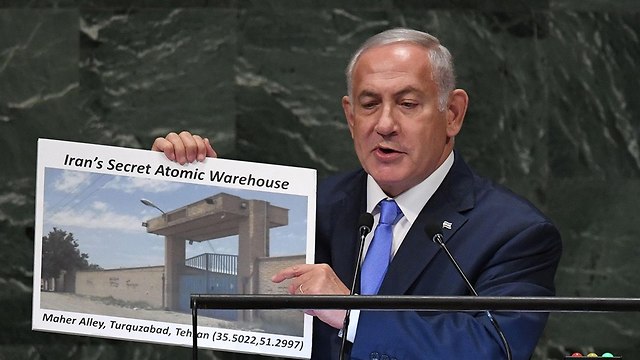
Netanyahu identifies secret atomic warehouse in Iran (Photo: AFP)

Netanyahu identifies secret atomic warehouse in Iran (Photo: AFP)

As for consolidation of Iranian military presence in Syria and Lebanon—despite the painful blow that Iran suffered last May, it is determined to continue building advanced military capabilities in these two countries that will threaten Israel. So far, Israel’s determination to thwart Iran’s efforts has not been weakened, even though there are risks—as evidenced by the downing of the Russian spy planeby Syrian military that tried to intercept an IDF attack. Expanding these capabilities to Lebanon is something that Israel will not be able to put up with, and it increases the volatility along the northern border.

The S-300 anti-aircraft system is already in Syria in order to ensure “the security of the Russians in the country,” according to Foreign Minister Sergey Lavrov.

Matter of fact, the far more sophisticated S-400 is already in Syria as well, but for now it is intended to only be used by the Russian military. However, if it is neglected and left at the disposal of the Syrian army, the operational freedom of the Israeli Air Force will be significantly limited and Israel will have to destroy it, which could potentially increase the tensions with Russia, and certainly with Syria.

S-300 (Photo: EAP)

S-300 (Photo: EAP)

The highest level of explosive potential is in the West Bank, and especially in the Gaza Strip. Palestinian President Mahmoud Abbas is even tougher on Hamas than Israel. He refuses to help implement interim solutions needed for ceasefire arrangement and adds to the ever growing economic pressure on the residents of the Gaza Strip and on the ruling terror group. It seems that Abbas is interested in sparking a military confrontation between Hamas and Israel, which would deliver a mortal blow to Hamas and strengthen the Palestinian Authority.

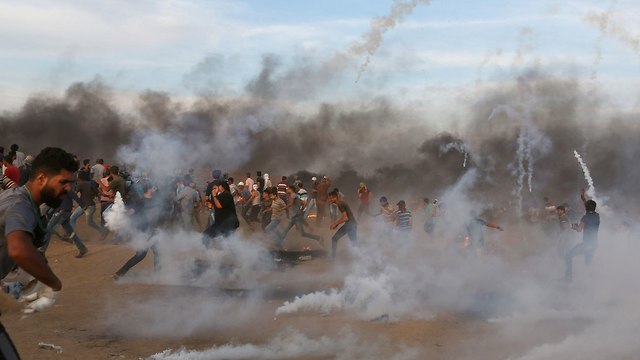
In light of the fact that the indirect negotiations between Israel and Hamas are at a dead-end, the terror group has escalated the border violence, as it promised it would, which lead to a rapid increase in the number of incendiary balloons launched from the strip into Israel and subsequently the number of dead and wounded among the Palestinians. We have returned to the starting point of last spring, when we were at the brink of a large scale operation.

Gaza protests (Photo: Reuters)

Gaza protests (Photo: Reuters)

There is no quiet in the West Bank as well. The frustration there—coupled with the pressure the Trump administration puts on the Palestinian Authority and Abbas’s political weakness—could lead to a popular or organized violent uprising. Israel’s current policy there does nothing to reduce the potential for unnecessary escalation that can certainly be prevented.

In order to overcome these challenges, Israel needs, first and foremost, a broad coordination with the United States. In addition, renewed understandings should be reached with Russia when it comes to promoting common interests in the northern arena and maintaining a balance between thwarting threats, credible deterrence, and efforts to prevent escalation in the region.

This is the ultimate test for the country’s military and political leadership, which requires a joint effort—professional and based on trust. Considering that we are about enter an election year, the aforementioned security challenges are not the only ones the decision makers have to face, as the political and diplomatic challenges need to be dealt with as well, as evidenced by the recent clashes between the Cabinet ministers. This situation is not ideal for a forum where life and death decisions are made.


Jewish Federations, we need to talk

Posted October 6, 2018 by Joseph Wouk
Categories: Uncategorized

Source: Column One: Jewish Federations, we need to talk – Opinion – Jerusalem Post

( The Jewish Federations are run by progressive (AKA “libtards”) more interested in burnishing their leftist ideological credentials than in defending the Jewish people.  May they reap what they sow… – JW )

BY CAROLINE B. GLICK
 OCTOBER 5, 2018 00:37

AMERICANS TAKE part in the annual Salute to Israel parade in New York City. Polls show that Israeli

At the end of the month, the Jewish Federations of North America will hold their annual General Assembly in Israel. And while the Federations’ decision to hold their annual conference in Israel rather than America seems at face value to be a statement of solidarity with Israel, in this case, it isn’t.

Five months after US President Donald Trump moved the US embassy to Jerusalem from Tel Aviv in an extraordinary act of friendship, the Jewish Federations of North America chose to hold their annual General Assembly in… Tel Aviv.
The name the Federations gave their conference is also a stunner.

“Israel and the Diaspora, We Need to Talk.”

What do we “need to talk” about?

The homepage of the conference’s website makes that clear enough. At the very top, it spells out all the differences dividing Israeli and American Jews.

Fifty percent of American Jews define themselves as liberal and only 8% of Israeli Jews define themselves as leftists.

Sixty-one percent of American Jews think that “Israel and an independent Palestinian state can coexist.” Only 43% of Israelis agree.

Eighty percent of American Jews vs. 49% of Israeli Jews think non-Orthodox rabbis should officiate at Jewish ceremonies in Israel.

The odd thing about these data is that they aren’t new, and they certainly don’t point to unbridgeable disputes between two well-intentioned sides to an argument.

Israel has certainly demonstrated its good will.

According to the American Jewish Committee’s survey of Israeli Jewish and American Jewish opinions published in June, a mere 42% of Israeli Jews supported establishing an egalitarian prayer area at the Western Wall while 48% opposed it. And yet, out of respect for American Jews who overwhelmingly supported it, the government established an egalitarian prayer area at the Western Wall.

The issue of non-Orthodox rabbis in Israel is imaginary. According to the AJC, less than one percent of Israelis define themselves as either Reform or Conservative. And there is no line of Reform and Conservative American Jews demanding to get married in Israel.

As for the issue of a Palestinian state, if the American Jews shared Israel’s good will, they would not pick a fight on the issue.

The AJC poll showed that 68% of Israeli Jews think it is inappropriate for American Jews to attempt to influence Israeli policy on national security issues including the issue of negotiations with the Palestinians. Only 25% of Israeli Jews deem it appropriate. Given the wide majority of Israelis who oppose their meddling, it is clear that no Israeli government is likely to give American Jews a seat at the table as it determines policies for which only Israel’s citizens will bear the consequences. Presuming American Jews have a modicum of respect for Israelis and their government, it would seem reasonable for them to respect the wishes of the people of Israel.

As for the ideological divide between liberal American Jews and right-leaning Israeli Jews, it is true that it is wide. But it is also true that it has been that way for decades. And yet, until recently it was never an obstacle to good relations.

So what is going on? Why did the Federations choose to insult Israelis by holding their conference in Tel Aviv rather than Jerusalem five months after the US government finally moved the US embassy to Israel’s capital? And why are the Federations demanding that Israeli Jews give them an accounting for the longstanding disparities in the outlooks of the two communities?

The most reasonable explanation for the Federations’ unfriendly behavior is that it doesn’t lay in anger over Israel’s policies regarding non-Orthodox rabbis or the Palestinians or Israel’s rejection of the political Left.

Rather, the Federations decided to highlight these longstanding, workable gaps in order to hide the real source of the anger that their leaders feel towards Israeli Jews. The source of the anger can be summed up in two words: Donald Trump.

Israelis are divided on many issues. But one issue unites them. Israelis love Trump.

This week the Pew Research Center published a new survey analyzing how the nations of the world view Trump and America under Trump. While support for Trump and the US is low and dropping among many key US allies, particularly in Europe, Israelis adore him. And under Trump, their longstanding overwhelming support for the US has increased.

The Pew study found that 83% of Israelis and 94% of Israeli Jews love America. Israel is the only country in the world where a majority – 52% – believes that under Trump, the US is doing more to solve global problems than it was in previous years. Seventy-nine percent of Israelis think US-Israel relations have improved under Trump. Eighty-six percent of Israelis believe that under Trump, the US takes its interests into account.

On the other side of the Atlantic, the situation is almost completely reversed. The AJC poll from June showed that only 26% of American Jews support Trump while 71% oppose him. Seventy percent of American Jews oppose the way Trump is handling US-Israel relations.

As The Wall Street Journal editorialized on Thursday, one of the clarifying aspects of the Democratic bid to dehumanize and destroy Trump’s Supreme Court nominee Judge Brett Kavanaugh is that it shows that the Democrats’ rage is not solely directed against Trump personally. Trump is the Democrats’ “foil to regain power.”

Kavanaugh, after all, is not a “Trump Republican.” The Washingtonian is about as establishment as they come. By trashing Kavanaugh as though he were what the Journal refers to as “part of Mr. Trump’s New York menagerie,” the Democrats revealed that they oppose Trump because he is implementing conservative Republican policies and not because of his unconventional personality.

The Journal explained, “Republicans across America can see, and certainly their Senators voting on Judge Kavanaugh should realize, that the left hates them as much or more than they loathe Mr. Trump. Conservatives understand that, for the American left, they are all deplorables now.”

The Federations’ use of their conference to disrespect Israelis while highlighting longstanding disagreements is a means to express their anger as Democrats at Israelis for supporting Trump.

The fact that Democrats are using Trump as a foil to discredit his policies and demonize his supporters has had a radicalizing effect on Democrats. Since everything Trump supports is bad, Democrats now embrace positions that they had previously rejected.

Growing Democratic hostility towards Israel and effusive support for the PLO are a consequence of that radicalization. Last week, 34 Democratic senators – two thirds of the Democratic Senate caucus – signed a letter to Trump asking that he restore aid to the Palestinian Authority. This, despite the PA’s continued payment of more than $300 million a year to convicted terrorists and their families. That is, the Democrats called for Trump to ignore the Taylor Force Act which requires the administration to deny funding to the PA so long as it continues the payments.

The AJC survey indicated that Jewish Democrats are not lagging far behind their senators.

Consider the US Jewish community’s position on Trump’s transfer of the US embassy to Jerusalem.

Eighty-five percent of Israelis supported the move; only 7% opposed it. In contrast, only 46% of American Jews supported Trump’s decision to move the US embassy to Israel’s capital, while 48% opposed it.

This position is remarkable because for decades, a solid majority of American Jews supported moving the US embassy to Jerusalem. Major Jewish groups played key roles in passing the Jerusalem Embassy Act of 1996 that recognized Jerusalem as Israel’s capital and enjoined the executive branch to move the embassy from Tel Aviv to Jerusalem.

The precipitous drop in American Jewish support for the embassy move – graphically demonstrated by the Jewish Federations’ decision to hold their annual conference in Tel Aviv – shows that like their fellow Democrats, Jewish Democrats view Trump’s supporters – including Israelis – as “deplorables” who deserve their hostility. So their longstanding support for locating the US embassy in Israel in Israel’s capital city flew by the wayside.

The program of the three-day GA is similarly discouraging. The three days of panels, speeches and debates are ostensibly supposed to involve frank discussions between Israelis and American Jews, with the goal of building bridges between them. But the Federations invited no Israelis who represent the religious Israeli establishment that they spend so much time and energy demonizing. They invited no anti-immigration activists from south Tel Aviv who complain that their neighborhoods have been transformed into crime-ridden ghettos due to illegal immigration from Eritrea and Sudan. None of the sponsors of the Nation-State Law, so viciously opposed by the Jewish Federations, was invited to speak. No voices calling for abandoning the quest to establish a Palestinian state were invited.

Most of those invited to speak represent marginal factions in Israeli society. The spectrum of views spans from center-left to far-left with a sizable representation of Israel’s Arab community thrown in, to what is billed as a frank discussion between American Jews and the uninvited Israeli Jews who disagree with them (and support Trump).

The only Israeli speaker representing the positions held by the majority of the country’s citizens who was invited to address the GA is Prime Minister Benjamin Netanyahu.

Given that his is the only representative voice on the program, Netanyahu should use his speech to voice the growing frustrations that Israelis feel towards the American Jewish establishment. He should ask them why they haven’t acknowledged, must less applauded Trump for his unparalleled support for Israel. He should ask them why so few of them support the embassy move – and what possessed them to hold their conference, in this of all years, in Tel Aviv rather than Jerusalem.

And he should tell them that Israelis are proud to stand with their friends and supporters wherever they may be – and ask them why they find it so difficult to do so.

The American Jewish community’s apparent preference for lawmakers who urge Trump to underwrite Palestinian terrorists over Trump and his voters who refuse to do so makes no sense to Israelis.

Netanyahu should tell them that while Israeli Jews are eager to work with American Jewry on the basis of our shared heritage and values, if American Jewry chooses to abandon those values in favor of their swiftly radicalizing partisan agenda, they are free to make that decision – and live with its consequences.
Russia establishes communication with Israel pertaining to S-300 missiles 

Posted October 6, 2018 by Joseph Wouk
Categories: Uncategorized

Source: Russia establishes communication with Israel pertaining to S-300 missiles – Middle East – Jerusalem Post

The purpose of channel of communication is to reduce tensions in the region, in view of the transfer of Russian air defense system S-300 to Syria.

BY YASSER OKBI/MAARIV
 OCTOBER 6, 2018 11:17
Russia establishes channel for Israel-Iran dialogue

Russia has begun efforts to establish a communication channel between Israel and Iran, a senior Russian official told the London newspaper Al-Sharq al-Awsat.

The report said that the purpose of the move is to reduce tensions in the region, in view of the transfer of Russian air defense system S-300 to Syria. The Russian’s announced their plan on Thursday.Russia’s deputy foreign minister Sergey Vershinin stressed that the transfer of the missile system is meant to bring stability to the region, rather than provocative action. “Syria has the right to defend itself,” he said.

Vershinin said that Israel and Iran will have to negotiate one day, even if this is not possible soon.

“The question is how do you see yourself as a country in the region?” the senior Russian diplomat added. ”In the end you have to be able to negotiate, you have to learn to conduct a dialogue. You can’t ignore it.”


France’s Schizophrenic Iran Policy 

Posted October 5, 2018 by Joseph Wouk
Categories: Uncategorized

Source: France’s Schizophrenic Iran Policy – International news – Jerusalem Post

As Paris freezes assets of Iranians involved in bomb plot, the Macron government is working to circumvent renewed American sanctions on Tehran

BY CHARLES BYBELEZER/THE MEDIA LINE
 OCTOBER 5, 2018 04:28
France's Schizophrenic Iran Policy

“[Actions of] such extreme seriousness on French territory could not be let go without a response,” a joint statement issued by France’s foreign affairs, interior and economic ministries read in part. “[We have] taken preventive, proportionate and targeted measures…[to] reiterate [our] determination to fight terrorism.”

Notably, the announcement coincided with a massive police operation targeting a Shiite Muslim “club” named the Centre Zahra France, whose leaders are accused of having ties to Tehran’s Lebanese proxy Hizbullah as well as to Iranian sleeper cells in the country.

Thereafter, Foreign Minister Jean-Yves Le Drian suggested that the developments “confirm the need for a tough approach in our relations with Iran.”

Except that France’s decision to sanction Iranian officials—including Assadi, who is set to be extradited to Belgium for prosecution—was made one week after Paris signed off on the creation of a “special purpose vehicle” geared towards circumventing renewed American financial penalties on the Iranian regime. Indeed, the government of President Emmanuel Macron committed to “assist and reassure economic operators pursuing legitimate business with Iran,” possibly by setting up a mechanism to barter European goods for Iranian oil.

This, in turn, came just hours after a meeting on the sidelines of the United Nations General Assembly between Le Drian and his Iranian counterpart Mohammed Javad Zarif, during which Tehran’s direct involvement in the bomb plot was discussed in detail. The two diplomats previously met—in, of all places, Vienna—only days after Assadi was arrested as part of an ongoing effort to salvage the 2015 nuclear agreement. For good measure, Iranian President Hassan Rouhani was welcomed in Austria earlier that same week after the news of the unsuccessful attack had already surfaced.

France’s Jekyll-and-Hyde game seemingly reinforces the contention of opponents of the atomic pact that the de-coupling of the nuclear issue from Iran’s other “nefarious” behaviors was bound to embolden the Islamic Republic. While this boomerang effect is only beginning to be felt more broadly in Europe—including as a result of Tehran’s role in creating the migration crisis through its military activities in Syria—the Revolutionary Guard Corps and its allies have over the past three years accelerated their march across the Middle East, leaving a wake of death and destruction.

“The French authorities are blind to reality and for years all governments—Left and Right—have been lax in tackling the growing threat of Muslim fundamentalism,” Christian Malard, a Paris-based political analyst who interviewed former Iranian revolutionary leader Ruhollah Khomenei multiple times, opined to The Media Line. “Now, the Iranian regime is playing off the rift between the US and Europe and if the goal is to topple the Ayatollahs then the gaps have to be bridged. This is not the case presently and could lead to a catastrophe.

“There is an incoherence in the French government’s way of dealing with Iran,” he continued, “as the foreign minister is declaring that there needs to be a re-evaluation of the [bi-lateral] relationship but [concurrently] shields Tehran from US sanctions.”

Avi Pazner, a former Israeli ambassador to Paris, likewise sees elements of hypocrisy in France’s position, which “is very lenient when it comes to the nuclear agreement and its economic ramifications even though the government knows exactly what it is dealing with: a state that sponsors terrorism.

“In this respect, [Macron] is not ready to make any concessions as France has been hit hard [by attacks]. But [he] needs to explain how it makes sense to continue doing business with Iran when this obviously helps a terrorist regime. Israel always [pleads with] the Europeans to not allow Iran to use their money to conduct terror. Apparently, economic considerations are more important than moral ones.”

How ironic, then, if reports are true that Israel’s Mossad spy agency provided invaluable intelligence to European security services about the Iranian plan, and then spearheaded the manhunt across the continent to thwart the plot.

On the flip side, supporters of France’s Iran policy note that the country was, initially, the party most skeptical of the atomic deal and in certain instances pushed the Obama administration to strengthen the language of its formulation. More recently, President Macron expressed a willingness to address Iran’s ballistic missile program and regional adventurism, albeit within an undefined context.

There is thus some common ground with President Donald Trump, although few believe that Paris will fall in line with Washington.

As such, perhaps the most probable scenario was encapsulated by an anonymous French source who told the Reuters news agency that, “We hope this matter [of terrorism] is now over. We have taken measures and said what we needed to say.”
The problem is that while France looks willing to forgive and forget, Iran may yet want the last word.


Students at Columbia U protest harassment from Pro-Palestinian activists

Posted October 5, 2018 by Joseph Wouk
Categories: Uncategorized

Source: Students at Columbia U protest harassment from Pro-Palestinian activists – Diaspora – Jerusalem Post

( My Alma Mater as well as my father’s and oldest son’s has been taken over by radical leftists.  What a horrible waste… – JW )

Despite video evidence supplied by SSI, the Columbia University administration dismissed evidence-backed complaints of harassment which seemingly violate university rules.

BY JEREMY SHARON
 OCTOBER 5, 2018 15:01

CONNECT WITH them. Students walk outside the Library of Columbia University in New York.

Several dozen students and activists at Columbia University in New York staged a demonstration on Thursday afternoon outside the university’s main gates against what they describe as the dismissive and disinterested attitude of the university administration towards the complaints of harassment by pro-Palestinian groups against Jewish and pro-Israel students.

The Columbia chapters of Students Supporting Israel (SSI) and Alums for Campus Fairness staged the protest following concerted efforts to get the university administration to act against alleged serial harassment by anti-Zionist groups.

In January this year, Students Supporting Israel submitted a detailed complaint, providing evidence of how such groups, including Students for Justice in Palestine, Jewish Voice for Peace and Columbia University Apartheid Divest have “systematically maligned, harassed and silenced” SSI and other pro-Israel groups and individuals.

In one incident in the Autumn semester of 2017 recorded in SSI’s complaint, “SJP members started a hostile, anti-Israel and anti-Semitic chant simply because they recognized SSI members walking by” outside an event unrelated to Israel.

The pro-Palestinian activists reportedly surrounded the Jewish students “while surrounded by a raging mob of around 50 angry activists encroaching on them in a physically threatening and intimidating way.”

Despite video evidence supplied by SSI, the Columbia University administration dismissed this and other evidence-backed complaints of harassment which seemingly violate university rules.

“Our goal was to show the Columbia University administration that Students Supporting Israel, its members and supporters, are not going to sit back while Columbia ignores our multiple harassment complaints,” SSI said following the demonstration on Thursday.


US to give Israel more F-35s to face S-300s, deploy a squadron in Emirates – DEBKAfile

Posted October 5, 2018 by Joseph Wouk
Categories: Uncategorized

Source: US to give Israel more F-35s to face S-300s, deploy a squadron in Emirates – DEBKAfile

DEBKAfile Exclusive: President Donald Trump has ordered additional F-35 stealth planes supplied forthwith to Israel, in response to the four S-300 air defense batteries Russia has sent Syria and its upgrade of electronic warfare measures.
The decision was taken, our sources reveal, after consultations between Washington and Jerusalem at the highest administration and military levels on the enhanced threat the recent Russian steps presented to Israeli air operations against Iranian targets in Syria. The F-35s will be drawn from US Air Force’s active service squadrons, just as the S-300s for Syria came from Russia’s operational air defense missile stocks.

In addition to informing Prime Minister Binyamin Netanyahu of the president’s decision, Washington also notified the two Gulf crown princes, Muhammed bin Salman of Saudi Arabia and Muhammad Bin Zayed of the United Arab Emirates, that the first US F-35 squadron in this region will be posted shortly at the Al Dhafra Air base 32km south of Abu Dhabi.

DEBKAfile’s military sources take this massive transfer of advanced American stealth planes to the Middle East and the Persian Gulf to betoken US and Israel’s determination to maintain Israeli Air Force’s operations over Syria, notwithstanding the presence of the S-300s and boosted Russian-Syrian air defense capabilities.

It was this determination that prompted Russian Deputy Foreign Minister Sergei Vershinin to comment on Thursday, Oct. 4, that he hoped “Tel Aviv will exercise good judgment in the region despite Israel’s insistence on not abandoning operations in Syria and Russia’s S-300 supply to Syria.” He was in fact conveying a warning to Israel not to attack the Russian S-300 batteries.