A day after US President Donald Trump decried the Saudis for their cover-up, Iranian President Hassan Rouhani criticizes the US and Saudi Arabia.
( NEVER AGAIN…! – JW )
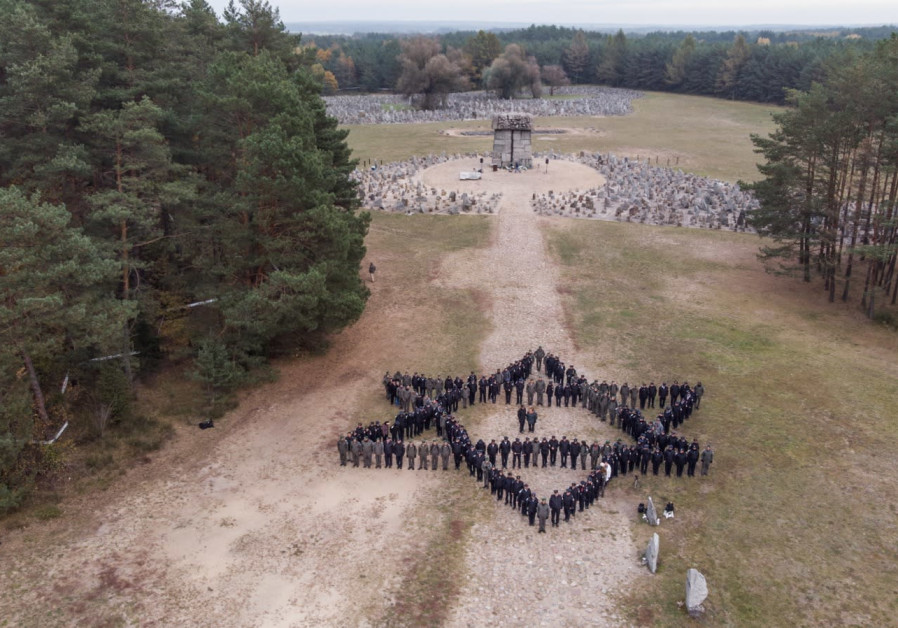
The delegation is visiting several concentration camps and memorial sites and are accompanied by Holocaust survivor Shela Altaraz and her granddaughter.
On Monday, on the second day of their visit, the officers visited the Treblinka death camp, where the Jewish community of Štip, Macedonia, formerly Yugoslavia, where Altaraz was born, was murdered. According to Yad Vashem, Altaraz is the sole survivor of that Jewish community.
The police officer formed a human Star of David to honor the memory of the victims, and standing in the middle of them, Altaraz shared her testimony.
Source: Erdogan’s “Khashoggi speech” is meant to boost his Muslim credentials (and Turkish lira) – DEBKAfile
The Turkish president noted that the 18 people arrested in Riyadh were those named by Turkey as the assassins, saying they should be tried in Istanbul. He also referred to a team of three people, without identifying them, who he said, arrived in Riyadh the day before Khashoggi’s disappearance and scouted a forest near Istanbul. This suggested that the Saudis had prepared a hiding place for the murdered journalist’s remains and therefore knew where the body was. Erdogan called for an independent inquiry into the affair, asserting: “This was a political killing!”
DEBKAfile’s analysts make certain inferences from the mildness of the Turkish president’s accusations. One is that he and the Saudi royal house have come to a deal to defuse the affair, to which President Donald Trump is a party. Alternatively, Erdogan himself was short of smoking-gun evidence to support those accusation. It is also possible that he has learned from his own record of making political opponents disappear, whether from the Turkish army, police or intelligence service, that holding back information increases his bargaining power.
He has already milked international outrage over the assassination of the Saudi journalist for great personal benefits and can afford to allow it to die down.
In all 15 years at the helm of Turkish government (11 as prime minister and four as president), he has never felt stronger or closer to his imperial ambitions. In the weeks after the Khashoggi episode erupted, he bounced his fortunes from rock bottom to the pinnacle of world affairs. Before, he was grappling with a sinking currency, a bitter hate contest with fellow Muslim rulers, excepting only Qatar, over his support for the Muslim Brotherhood, one foot out of NATO, and nearly half a million Turks deprived of their livelihood by his massive purges after the 2016 that nearly toppled him.
After the Khashoggi affair broke, Erdogan is sought after by world leaders, whether in Washington or hostile Riyadh, and entertains high hopes of achieving goals that were once out of his reach:
Source: Making it that much harder for Iran – Israel Hayom
Yoav Limor
The recent disclosure of Hezbollah’s covert activity along the Lebanese border with Israel is part of the wide-scale campaign Israel is waging against the terrorist organization and its Iranian patron.
Disguised to appear as though they belong to an environmental advocacy group, the observation posts are themselves of tactical significance: They allow Hezbollah to maintain a presence on the border, in violation of U.N. Security Council Resolution 1701, which brought an end to the Second Lebanon War, and regularly collect intelligence it can use direct operational activity inside Israeli territory in real time.
But the disclosure is in fact of even greater significance. By exposing Hezbollah’s efforts on the border, Israel is in fact demanding the international community enforce its decisions and put an end to Hezbollah’s illicit activity. The move also serves as a warning to the Lebanese government as well as the Lebanese people from Israel that this activity could drag Lebanon into a war, and that it is Hezbollah that would be responsible for such a development.
This disclosure is part of Israel’s so-called “campaign between the wars,” a strategic concept that encompasses a host of covert and low-intensity military and intelligence efforts to prevent enemy states and terrorist organizations from becoming stronger and thwart their offensive activity. While this campaign is known to make headlines when it involves an airstrike on an Iranian weapons convoy or facility in Syria, there are also other dimensions to Israel’s efforts, and they can involve diplomatic or economic efforts and even the media.
This is not the first time Israel is behind this type of report, which has appeared in both the local and foreign press. In some instances, the report is aimed at deterring an imminent attack, other times it is aimed at deterring the continuation of the illegal activity. When Israel exposed Hezbollah’s activities along the border in the past, it resulted in the organization lowering its profile. One can assume that officials in Israel hope that this most recent report will spur Hezbollah to pull back from these front-line observation posts.
Israel’s efforts to counter the observation posts is just one small piece in a much more complex puzzle, aimed at making Hezbollah’s and Iran’s operations more difficult. Israel also recently exposed the organization’s efforts to establish weapons factories inside Lebanon to convert previously unguided rockets into highly accurate missiles. Despite the media reports, it seems those efforts are ongoing. Several reports in recent days have even tied Israel to an attack on a weapons convoy in Lebanon, the first since the downing of a Russian plane last month. This has also been hinted at in speeches delivered by Prime Minister Benjamin Netanyahu and Defense Minister Avigdor Lieberman, in which they said Israeli activity against Iran was ongoing, despite Russia’s decision to provide Syria with the S-300 anti-aircraft missile system following the Syrian army’s downing of a Russian plane last month.
Nevertheless, it seems Israel is now trying to keep this activity out of the public eye in the past, in order to avoid a new confrontation with the Kremlin. This concerted effort to not draw attention to its activities may also be the result of a certain slowdown in Iranian activity in Syria and Lebanon, which stems in part from Tehran’s desire to understand the repercussions of Russia’s new policy as well as the difficulties it now faces as a result of U.S. President Donald Trump’s withdrawal from the nuclear deal and sanctions implemented by his administration.
These challenges are expected to exacerbate on Nov. 4, when an additional wave of U.S. sanctions on Iran take effect. Israeli officials believe it will be difficult for Iran to circumvent these sanctions, which are set to deliver another serious blow to its economy. As a result, the ayatollah regime will need to decide whether to continue to invest billions of dollars every year in wars in places like Yemen, Iraq, Syria, Lebanon and the Gaza Strip, and risk further angering its citizens by squandering state funds to this end instead of investing them in the Iranian people. Iran could also decide to decrease funding overseas, a move that would be detrimental to its efforts to the export of the Islamic Revolution and Tehran’s customers, among them Hezbollah.
These measures will have a direct impact on the security situation in the north, and to a lesser extent in Gaza. As it stands, the southern front is still much more volatile than the north, which poses a more dangerous threat due to the might of Hezbollah. Nonetheless, the Shiite organization is being very cautious, and despite this new-old activity on the border, is taking care to avoid an escalation with Israel, which for the time being, is the last thing it wants.
Source: IDF finds Hezbollah post disguised as environmental facility on border – Israel Hayom
Observation post under a mile from Lebanon-Israel border disguised as Green Without Borders NGO facility, but is actually a Hezbollah position, IDF says • Aim is to cover up Hezbollah’s armed presence in area in contravention of U.N. prohibition, it says.
|
Hezbollah operatives at the newly discovered observation post near the border
| Photo: IDF Spokesperson’s Unite
|
| << >> |
Lebanon-based terrorist group Hezbollah has set up an observation post under the guise of an environmental advocacy group less than a mile from the Israel-Lebanon border, the Israel Defense Forces said on Monday.
Speaking on condition of anonymity, a senior IDF officer said the outpost, in the village of Al-Adisa, is the sixth such post spotted over the past two years. One photo from the site shows a uniformed man peering through a window with high-tech binoculars.
The officer said the new observation post violates United Nations Security Council Resolution 1701, which ended the 2006 Second Lebanon War and bans the presence of armed groups south of the Litani River in southern Lebanon. However, since that war, the U.N. has largely turned a blind eye to Hezbollah’s violations, which has allowed the group to amass an arsenal believed to include well over 100,000 missiles and rockets aimed at Israel.
The officer said Hezbollah was using a tree-planting campaign by Green Without Borders, a Lebanese nongovernmental organization, as a cover for its activity along the border to gather intelligence on Israeli troops. The organization has acknowledged its affiliation with the terrorist group but claims its purpose on the border is purely environmental.
The officer also said the IDF discovered five Hezbollah posts in 2017 in breach of the U.N. resolution.
“We haven’t seen any Hezbollah arms yet [in the new post], but we can see military infrastructure and it’s clear this is part of extensive activity in southern Lebanon and in Lebanon as a whole that is a threat to the IDF and to Israel,” the officer said.
“This is, of course, a buildup that we cannot tolerate. Green Without Borders has no forest rangers, because there are no forests in this area. Hezbollah is using the organization to establish observation posts close to the border with the goal of gathering intelligence on IDF troops.”
The officer said the observation posts are constantly monitored by the IDF.
“They are manned and have reconnaissance equipment. Their activity is not even remotely related to protecting the environment,” he said.
“Hezbollah thinks the IDF is not aware of its activities and has stopped the U.N. from carrying out its mission because it claims this is private property. The U.N. is trying to enforce the resolution and we are applying pressure to do so. When we give the U.N. information, it is duty-bound to act.”
Andrea Tenenti, a spokesman for the U.N. Interim Force in Lebanon, which is tasked with enforcing the cease-fire, said the peacekeepers have “not observed any unauthorized armed persons” at the position and the organization “continues to monitor activities closely,” including those of the environmental group.
The IDF Spokesperson’s Unit also issued a statement.
“Hezbollah is violating the language of Resolution 1701, which prohibits the presence of any armed group south of the Litani River. It is patrolling along the border with armed personnel and has been establishing military infrastructure along the border, under the guise of a fictitious environmental group. It has also been engaged in a military buildup in Shiite villages in southern Lebanon. In 2017, five observation posts were spotted, and now another post has been discovered, and the goal of those positions is to bolster the organization’s intelligence reach. The IDF routinely monitors Hezbollah’s activities,” the statement said.
Source: Defense minister urges ‘tough blow’ to Hamas as Gazans riot on border – Israel Hayom
Egyptian delegation arrives in Gaza for cease-fire talks, Defense Minister Avigdor Lieberman says efforts to reach an agreement with Hamas doomed to fail • Firefighters battle five fires sparked in Israel by firebomb balloons launched by Gaza terrorists.
|
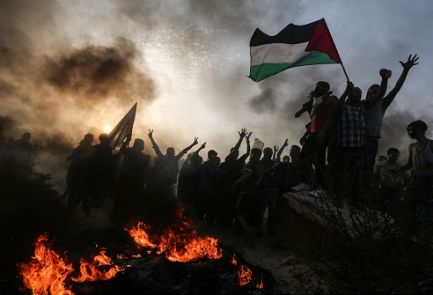
Rioters wave Palestinian flags and burn tires near the maritime border with Israel, in the northern Gaza Strip, Monday
| Photo: AFP
|
Defense Minister Avigdor Lieberman on Monday said it would be impossible to reach an agreement with Hamas.
Addressing the Knesset Foreign Affairs and Defense Committee Monday, Lieberman declared that “it hasn’t worked in the past, and it won’t work in the future.”
He said, “We have reached a point where we have no other choice. Nothing short of the strongest and heaviest blow we can deliver to Hamas in the Gaza Strip will help.”
Lieberman went on to say that Israel must not agree to any truce with Hamas unless the terrorist organization agrees to end the violence on the border, agrees to a prisoner exchange, removes a clause in the terrorist group’s official charter that calls for Israel’s destruction, halts its rocket production, stops digging terror tunnels and stops incitement in Judea and Samaria.
Hamas is holding the remains of two Israeli soldiers, Staff Sgt. Oron Shaul and Lt. Hadar Goldin, who were killed in the Gaza Strip in 2014, as well as two living Israeli captives, Ethiopian Israeli Avera Mengistu and Bedouin Israeli Hisham al-Sayed, both mentally unstable, who wandered voluntarily into Gaza (in 2014 and 2015 respectively) and were captured by the terrorist group.
According to Lieberman, the Palestinian border riots, which have grown increasingly violent since they began in late March, are “not a popular protest but rather a display of institutionalized violence by Hamas.”
Meanwhile, firefighters battled five separate fires sparked in Israeli territory by incendiary balloons launched from Gaza. Police sappers and paramedics arrived at one of the communities in the Ashkelon Regional Council after a civilian discovered what appeared to be an incendiary balloon.
Rioters on Gaza’s border with Israel near Kibbutz Zikim burned tires and threw grenades, Molotov cocktails and other explosives at IDF forces.
The Health Ministry in Gaza said 20 protesters were wounded by Israeli fire.
The protests took place as Egyptian mediators were in Gaza for cease-fire talks.
Also on Monday, an Egyptian delegation headed by Egyptian intelligence official Ahmed Abdel Khalek arrived in Gaza to meet with senior Hamas officials, Arab media reported.
Khalek’s arrival appears to be laying the groundwork for the arrival of Egyptian General Intelligence Service head Maj. Gen. Abbas Kamel later in the week.
Source: Iran is now manufacturing, upgrading missiles in Iraq, sources say – Israel Hayom
Iran reportedly transfers mid-range ballistic missiles, capable of reaching Israel, to Shiite group Hashd al-Shaabi in Iraq • Strategic Affairs minister warns of scenario in which Iran is fighting Israel on multiple fronts, including in Judea and Samaria.
|
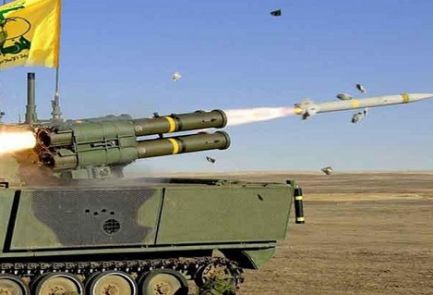
Hezbollah missiles. Strategic Affairs Minister Gilad Erdan warns that Iran is trying to create “another Hezbollah”
| Photo: YouTube
|
Iran is building factories to manufacture and upgrade missiles in Iraq, in addition to its efforts in Syria and Lebanon, Israeli intelligence has discovered.
According to reports, Iran has already shipped missiles to Shiite militias in Iraq and helped Iraq set up missile factories in its territory.
This latest development has the potential to bring Iraq onto the Iranian axis of countries that pose potential threats to Israel.
Last month, reports revealed that Iran’s Revolutionary Guard had supplied the Iraqi Shiite militia Hashd al-Shaabi with mid-range ballistic missiles capable of reaching Israel.
Earlier in October, reports revealed that the United States had decided to shut down its consulate in Basra, a key Shiite stronghold and the third-largest city in Iraq, after discovering a Revolutionary Guard plot to attack it.
The latest revelation comes after Fox News reported on Sunday that Iran has stepped up its shipments of advanced weapons to Hezbollah, its Lebanon-based proxy, and that some shipments now include sophisticated GPS systems meant to improve the accuracy of Hezbollah missiles.
According to the report, the shipment made its way from Tehran to Damascus aboard a Qeshm Fars air cargo plane. From there, the plane made its way to Beirut, before returning to Iran via Qatar.
On Sunday, several speakers at a Jerusalem Institute of Security Studies devoted to the Iranian-Israeli conflict warned that Iran was trying to threaten Israel on multiple fronts.
Strategic Affairs Minister Gilad Erdan informed participants that Hezbollah, heavily supported by Iran, currently has a stock of some 150,000 missiles.
“The commander of Quds Force, Qassem Soleimani, wants to create another Hezbollah in Syria,” Erdan warned. “When [Palestinian Authority President] Mahmoud Abbas’ time is up, I wouldn’t be surprised if Iran tries to expand its influence to Judea and Samaria, too, as the Palestinian governance dwindles and they are in need of money and support.”
“At any minute, Iran can set off clashes that will expand to Syria and Lebanon, and we cannot rule out the possibility of [Iran] using Iraq as a base from which to fire missiles at Israel,” Erdan said.
Mossad Director Yossi Cohen said Monday at a meeting at the Finance Ministry that he had recently met an American official who had asked him what would happen if Iran were defeated.
“I told him, ‘If we beat Iran, I’ll be out of of work, jobless, but if Iran isn’t defeated, I’ll find myself homeless.’ I prefer the first option,” Cohen said.
Cohen stressed that “if we don’t push Iran out of the Middle East … we will find ourselves in a position of Iranian forces spreading throughout the Middle East, unchecked, even inside the Gaza Strip.”
“But of course, everything is affected by changes in the approach at a very high level since [U.S. President Donald] Trump took power, which I think is very good for Israel. There is a sense that there is a simpler, clearer distinction being made between good and evil,” the Mossad chief said.
Source: Playing into Iranian hands – Israel Hayom
Prof. Eyal Zisser
The situation along the Gaza Strip border is all about containment. It appears that every time some kind of truce deal is about to be finalized, things abruptly escalate and both sides suddenly find themselves on the verge of a large confrontation, with Israeli troops entering the Gaza Strip and rockets hitting central Israel.
But Israel and Hamas are not the only players that are bracing for a possible conflagration. Over in Tehran, the ayatollahs know that renewed hostilities would help distract the world’s (and Israel’s) attention from their regional aggression.
Things are not easy for Iran as of late. Renewed U.S. sanctions have crippled the economy and led to unprecedented discontent. The Iranian people want their rulers to use the country’s wealth domestically rather than let the Revolutionary Guards squander it on misadventures in Iraq, Syria, Yemen and Lebanon. The regime is particularly concerned that Washington would join Israel in attacking its regional assets, particularly in Syria.
Over the past several days, Iranian officials have been upbeat because of signs that the regional coalition built by Jerusalem and Washington may be unraveling.
Just over a year ago President Donald Trump made a historic visit in Saudi Arabia in which he announced the creation of a pan-Arab Sunni alliance against Iran. Israel was to play a behind-the-scenes role in this coalition, with Riyadh being its linchpin.
But the Sunni Arab pact has fallen apart quickly. Qatar and Saudi Arabia have caused regional turbulence in the Gulf by picking a fight over regional prestige. This has spiraled out of control and has effectively undone the united front against the Iranians. Turkey, who was to play a role in this alliance, has found itself trading barbs with Saudi Arabia over the latter’s involvement in the death (and likely execution) of journalist Jamal Khashoggi in Istanbul.
Turkish President Recep Tayyip Erdogan’s anti-Saudi rhetoric cannot be attributed to his commitment to a free press (a concept that has long been discarded under his regime). It is his way of expressing outrage over having Turkish sovereignty infringed, and could be a way to do some score-settling with Riyadh for being cozy with the Muslim Brotherhood and Hamas, who are not his cup of tea.
Israel, which is an important actor in any anti-Iranian front, has found itself busy with its own crisis vis-à-vis Hamas, and has been dragged into an unwanted conflagration because of intra-Palestinian strife.
No wonder, then, that the Iranians feel giddy now. But they are more than just giddy. Just last week it was reported that Iran has increased its weapons shipments to Hezbollah, which include guidance components to upgrade the organization’s rockets.
Iran has also taken advantage of the constraints on Israel in the wake of Russia’s decision to bolster Syria’s air defense. Russia has supplied Syria with advanced S-300 air defense systems and has recently handed over other sophisticated systems. President Vladimir Putin has even said that Iran’s future in Syria was none of his concern. Perhaps Israel’s window of opportunity in Syria is about to close.
The only positive development is that Washington has recently announced a new strategy aimed at driving Iran out of Iraq and Syria. This is a welcome change in U.S. policy, but it appears that the strategy is based on economic warfare, which has a very limited effect with concrete measures on the ground.
The U.S must put out the fire that has spread in the region and engulfed its regional allies, it must save Saudi Arabia and its crown prince Mohammed bin Salman from himself and make the Khashoggi affair go away lest the kingdom lose its regional and international stature. On top of that, the U.S. must also take action on the ground rather than just talk about Iran’s presence in the region.
Eyal Zisser is a lecturer in the Middle East History Department at Tel Aviv University.
Source: PA, Hamas routinely use torture to crush dissent, human rights report finds – Israel Hayom
( This ix how they treat their own. Imagine what they would do to us if given a chance. – JW )
Following two-year investigation, Human Rights Watch report concludes Palestinian torture could constitute a war crime • Group urges nations funding Palestinian law enforcement to freeze aid • PA: Activists want to discredit us • Hamas: Report “unfair.”
|
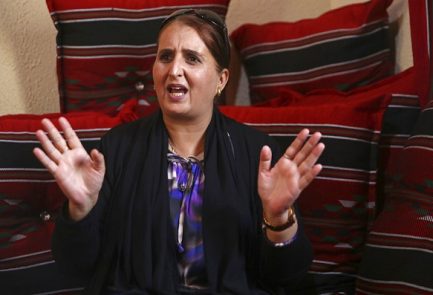
Palestinian political activist Taghreed Abu Teer recalls being held by Hamas authorities for 11 days and interrogated under “humiliating conditions” |Photo: AP
|
Security forces of the rival Palestinian governments in both the Gaza Strip and the Palestinian Authority routinely use torture and arbitrary arrests, among other tactics, to quash dissent by peaceful activists and political rivals, a Human Rights Watch investigation has found.
The charges come in a report issued Tuesday by the New York-based watchdog following a two-year investigation that included interviews with nearly 150 people, many of them former detainees.
In the report, the group accused both the Western-backed Palestinian Authority in the West Bank and militant Islamist Hamas in Gaza of using “machineries of repression” to stifle criticism.
Human Rights Watch also said the systematic use of torture could amount to a crime against humanity under the United Nations’ Convention against Torture, and called on countries that provide funding to Palestinian law enforcement to suspend their assistance.
PA President Mahmoud Abbas’ government joined the convention after Palestine was accepted as a nonmember state at the U.N.
“Palestinian authorities have gained only limited power in the West Bank and Gaza, but yet, where they have autonomy, they have developed parallel police states,” said Tom Porteous, deputy program director at Human Rights Watch.
“Calls by Palestinian officials to safeguard Palestinian rights ring hollow as they crush dissent,” he said.
According to the report, the leaders in both the West Bank and Gaza engage in similar tactics, in most cases without holding anyone to account.
Among their alleged abuses are: whipping people’s feet, forcing detainees into painful positions such as hoisting their arms up behind their backs with rope, and coercing suspects into granting access to their mobile phones and social media accounts.
Both Hamas and the Fatah-led Palestinian Authority denied all the allegations.
The two Palestinian factions split in 2007 after Hamas violently seized the Gaza Strip from forces loyal to Abbas. For more than a decade, Hamas has maintained an iron grip on power and suppressed any signs of public dissent, including street protests and social media posts.
Despite having Western backing, Abbas has also silenced dissent in the areas of the West Bank he administers under past agreements with Israel. Last year, he clamped down on social media and news websites with a vaguely worded decree that critics say allows his government to jail anyone on charges of harming “national unity” or the “social fabric.”
Abbas’ security forces also work closely with Israel to keep Hamas in check in the West Bank. Critics accuse Israel of holding Palestinian detainees without charge for extended periods and also of torture.
Mohammed Khatib, a 20-year-old law student and activist with Hamas’ student branch in the West Bank, told The Associated Press he was arrested last month and held for 19 days at an intelligence center in Ramallah. He said he was forced to stand for hours at a time and hung by his handcuffed hands to a door for 15 minutes, a stress position meant to cause pain but leave no sign of injury.
“This is not only a violation of human rights, it is a violation of human dignity, a violation of basic morals,” he said, adding that he believed the aim was to intimidate him.
HRW’s report also highlights other tactics used to silence Palestinian dissent and punish activists, among them the seizing of phones, leaving investigations and charges open, and coercing detainees to promise to stop any further criticism.
In Gaza, Taghreed Abu Teer, a 47-year-old journalist, told the AP that she was held by Hamas authorities for 11 days and interrogated under “humiliating conditions” for her activities with the rival Fatah movement.
She said she was kept in a dark cell for days at a time and forced to stand for lengthy periods. Although she was not physically beaten, she said she could hear the screams of men being tortured nearby, and that at one point, a man with a whip threatened to beat her as well. More than a year and a half later, she still cries when she recalls the “unforgettable experience.”
“As long as I was in the cell, I was wondering what had led to me ending up here,” she said. She spoke at a relative’s home so her six children would not hear about the ordeal.
Abu Teer said interrogators threatened to charge her with collaboration with Israel, widely feared as a stigma, and that most of the questions focused on a three-day trip she made to the West Bank, where she met senior Fatah officials and briefed them about the situation in Gaza. She said interrogators accused her of inciting the Palestinian Authority to make financial cuts and other punitive measures against Gaza, a tactic meant to squeeze Hamas.
She denied all the allegations, saying she had only led protests and lobbied for ending the Hamas-Fatah split.
While she was never charged, Hamas officers advised her “to be quiet” and focus on her home and family, “which I considered a veiled threat rather than advice,” she added.
Human Rights Watch also said it has encouraged the International Criminal Court to open an investigation into both Israeli and Palestinian conduct in the Palestinian territories. It called on both Palestinian authorities to pledge to stop carrying out arbitrary arrests, end torture, establish an oversight mechanism or body over its detention practices and hold credible investigations into allegations of misconduct.
In a rare step, the report also called on countries that provide funding to either territory’s law enforcement agencies to withhold assistance until concrete steps are taken to end the practices.
Among the aid is millions of dollars for the West Bank security forces from the United States, which has continued its support even after slashing hundreds of millions of dollars in other assistance to the Palestinians. The report said Hamas receives assistance from Iran, Qatar and Turkey.
Adnan Damiri, spokesman for the Palestinian security forces in the West Bank, denied any allegation of systematic torture and said authorities investigate claims and punish perpetrators.
“These testimonies are not accurate. They are testimonies of political activists who belong to political parties with political agendas, and of course they will put any blame they can on the Palestinian Authority,” he told the AP.
In Gaza, Hamas denied arresting critics or opponents on political grounds. Faraj al-Ghoul, a Hamas lawmaker, said the report was “unfair,” and that Human Rights Watch was welcome to inspect the group’s prisons.
Source: A move that spells weakness – Israel Hayom
Prof Eyal Zisser
The late Prime Minister Yitzhak Rabin saw the 1994 peace treaty with Jordan as one of his most important diplomatic achievements, if not the most important one. Unlike the skepticism he expressed over the Oslo Accords and then-PLO Chairman Yasser Arafat’s commitment to them, Rabin was sure that King Hussein would live up to his word.
There is something symbolic in the fact that on the anniversary of Rabin’s assassination according to the Hebrew calendar, King Abdullah announced that he would not renew one of the annexes his father signed 24 years ago, leasing agricultural borderlands to Israel.
The Jordanian announcement is neither a big surprise nor a move that has far-reaching strategic significance. After all, these are Jordanian lands and it stands to reason that Jordan would have reimposed its sovereignty over them at some point, as no country in the Middle East would ever agree to relinquish territories over time.
Saudi Arabia did the same with respect to Tiran and Sanafir islands, which were administered by Egypt for years before Riyadh reimposed its sovereignty over them in 2017.
The problem, therefore, is not in the move per se, but in the manner and timing in which the Jordanians chose to declare they were essentially disavowing the spirit of the 1994 peace agreement and turning their backs on the partnership forged between Rabin and Hussein.
This was not a complete surprise. After all, the Jordanians are very hostile toward Israel compared to populations in other Arab countries and regrettably, the Jordanian regime does not even try to deal with this hostility. Facing a myriad of domestic challenges, the regime prefers to allow public opinion to lash out at Israel and hopes this will soften the criticism leveled at it on other issues.
At the same time, no Arab country is as dependent on Israel as Jordan, certainly in terms of energy and water resources and on questions of national security.
Moreover, no Arab state maintains such tight – albeit clandestine – strategic cooperation with Israel, as Jordan. Israel welcomes this cooperation and its importance is immeasurably greater than the acres of agricultural land over which Jordan now seeks to regain control.
Overall, this is not a move that truly harms Israel’s interest, which is why Jerusalem shows patience toward the hostile winds that are blowing in its direction from Jordan.
Nevertheless, the Jordanian move is as much a show of Abdullah’s weakness as signing the peace deal was a show of his father’s strength. Israel should maintain the same strategic cooperation with Jordan as it always has, but now, our eyes have been opened.
Eyal Zisser is a lecturer in the Middle East History Department at Tel Aviv University.
Recent Comments