“Nasrallah has spoken. The only option against Israeli aggression is inevitable retaliation,” Lebanese media quotes Shiite terrorist group’s leader Hassan Nasrallah as saying • Hezbollah recently warned it has strategic Israeli targets in its sights.
Daniel Siryoti
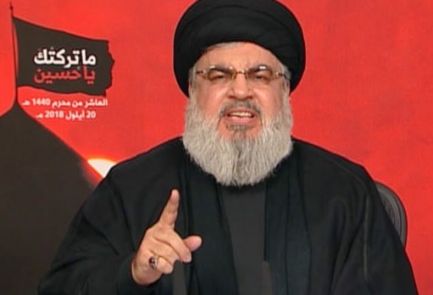
Hezbollah leader Hassan Nasrallah
|Photo: AFP
Hezbollah leader Hassan Nasrallah warned Monday that any Israeli attack on Lebanese soil would meet ”inevitable retaliation” by the Shiite terrorist group.
The statement was made prior to the IDF’s announcement Tuesday that it has launched an operation seeking to thwart Hezbollah tunnels running under the Israel-Lebanon border.
On Monday, the Hezbollah-affiliated al-Akhbar newspaper published an editorial stating, ”Nasrallah has spoken. The only option against Israeli aggression is inevitable retaliation.”
Last Thursday, Hezbollah released a video warning Israel against striking Lebanon, featuring aerial footage of strategic targets in Israel, including the IDF’s headquarters in Tel Aviv. The footage was captioned “If you strike, you will regret it.”
Hezbollah is believed to be in possession of 150,000 missiles, which Nasrallah has repeatedly boasted can hit virtually anywhere in Israel.
Recent days have seen Lebanese’s media speculate that Israel was preparing to targets Hezbollah infrastructure as well as Iranian assets in the country, given intelligence indicating that Iran has been delivering advanced weapons and equipment directly to Hezbollah in Lebanon.
These speculations were further fueled by reports of an urgent meeting between Prime Minister Benjamin Netanyahu and U.S. Secretary of State Mike Pompeo in Brussels Monday, where the two discussed “regional developments.”
Israel media reported that Netanyahu was poised to ask Pompeo for the United States’ support in the event of an Israeli strike on Hezbollah infrastructure in Lebanon.
Lebanese army says troops are tasked with monitoring Israeli activity and ensuring it does not compromise Lebanese sovereignty • UNIFIL says it is also monitoring IDF operation seeking to neutralize Hezbollah terror tunnels snaking into Israel.
Daniel Siryoti, Lilach Shoval, News Agencies and Israel Hayom Staff
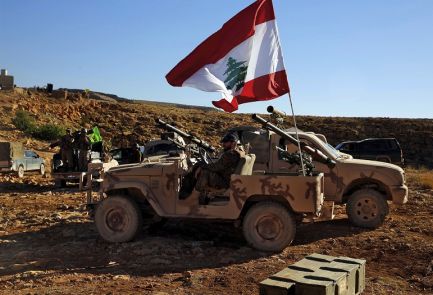
Lebanese army vehicles near the border
|Illustration: Reuters
The Lebanese army has begun mobilizing troops to the country’s border with Israel, Arabic-language media reported Tuesday, saying the decision was made in wake of an Israeli military operation on its side of the border.
The IDF announced Tuesday that it had launched an operation to expose and neutralize cross-border terror tunnels dug by Hezbollah under the Israel-Lebanon border. The military did not disclose how many tunnels snake into Israeli territory from Lebanon nor how long the operation, code-named ”Northern Shield,” would last.
The Israeli military issued a statement on its Arabic-language social media channels, warning Lebanese soldiers and Hezbollah operatives against approaching the security fence or the tunnel grid.
Reuters
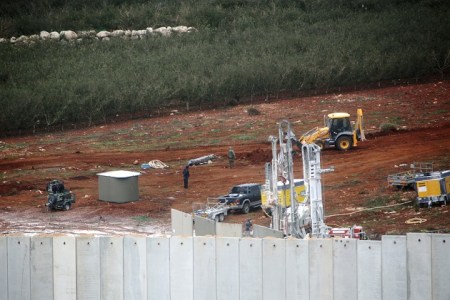
Israeli military vehicles are seen from the village of Kafr Kila, in south Lebanon, Tuesday
A statement by the Lebanese army said that the troops sent to the frontier were tasked with monitoring Israeli activity and ensuring it does not compromise Lebanese sovereignty.
Some media reports said that Hezbollah leader Hassan Nasrallah would give a special televised address on Tuesday evening, but the Shiite terrorist group has made no official announcement to that effect.
Nasrallah warned Monday that any Israeli attack on Lebanese soil would meet ”inevitable retaliation” by his organization.
Still, Israeli and Lebanese experts similarly surmised Tuesday that Hezbollah would likely opt to contain Israeli activities on the border, as long as they did not infringe on Lebanese sovereignty, to avoid a rapid security escalation.
Commander of the United Nations Interim Force in Lebanon Maj. Gen. Stefano Del Col told the Hezbollah-affiliated Al Mayadeen TV network that he was ”getting updates on the operation from the Israelis,” adding that “like the Lebanese army, we are monitoring this activity.”
In comments made several months ago, Lebanese Armed Forces Commander Gen. Joseph Aoun said his troops “will use every available means to confront any potential Israeli aggression, no matter the cost.”
Israeli military on high alert as Operation Northern Shield aims to neutralize multiple terror tunnels running under the Israel-Lebanon border • “Those who try to harm the State of Israel will be made to pay a heavy price,” Prime Minister Netanyahu says.
News Agencies and Israel Hayom Staff
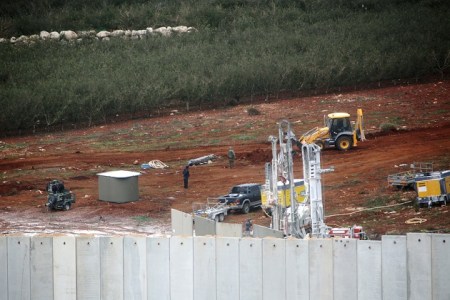
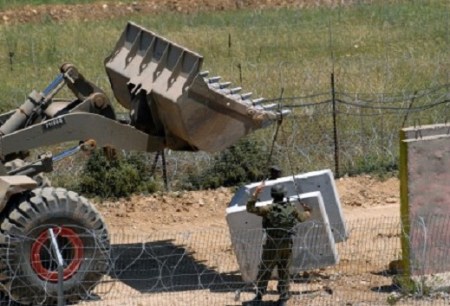
An IDF bulldozer digs near the Israel-Lebanon border, Tuesday
|Photo: Reuters
The Israel Defense Forces on Tuesday launched an operation to expose and neutralize cross-border terror tunnels dug by Hezbollah under the Israel-Lebanon security fence. The military did not disclose how many tunnels snake into Israeli territory from Lebanon or how long the operation would last.
In a statement, the military stressed that the operation, code-named “Northern Shield,” was underway on the Israeli side of the border. The military added that with the exception of a few hundred feet near the security fence, which were declared a restricted military zone, the residents of the Israeli communities near the border could maintain their usual daily routine.
Israeli media reported that Netanyahu was poised to ask Pompeo for the United States’ support in the event of an Israeli strike on Hezbollah infrastructure in Lebanon.
The Prime Minister’s Office said the two discussed ways to “work together to curb Iranian aggression in the region – Syria, Iraq, Lebanon and elsewhere,” as well as the joint effort “to achieve peace and security for all.”
Later on Tuesday, Netanyahu issued a statement saying, “This morning, the IDF launched Operation Northern Shield with aim of exposing and neutralizing cross-border terror tunnels from Lebanon. We are proud of IDF officers and soldiers who carry out these complex missions and for the operational success noted so far.”
”Those who try to harm the State of Israel will be made to pay a heavy price,” the statement continued. “We are operating with determination in all sectors and we will continue to launch overt and covert operations to ensure Israel’s security.”
A senior political source told Israel Hayom that members of the Diplomatic-Security Cabinet were barred from commenting on the operation in the media.
According to defense officials privy to the issue, Operation Northern Shield was launched after lengthy overnight consultations between IDF Chief of Staff Lt. Gen. Gadi Eizenkot and senior defense officials.
Reuters
Military vehicles are seen from the village of Kafr Kila, in south Lebanon, Tuesday
Israel views the Iranian-backed Hezbollah and its vast arsenal of some 150,000 projectiles as a major threat.
Bracing for a potential border flare-up, the military has bolstered deployment along the northern frontier, including air defense systems as well as regular and special forces.
‘A blatant violation of U.N. resolutions’
In a press briefing, IDF Spokesperson Brig. Gen. Ronen Manelis offered more details on the operation.
”The IDF first identified Hezbollah efforts to dig tunnels near the border in 2006. These efforts increased after the [Second Lebanon] War [in 2006], and in 2012, we learned of a plan that [Hezbollah leader Hassan] Nasrallah refers to as the ‘plan to conquer the Galilee,’ which led us to believe that the offensive tunnels were the surprise element in this scheme.
”In 2013, the IDF examined several indicators for the existence of tunnels near the northern border and ruled it out given their [Hezbollah’s] technological capabilities,” he said.
”In October 2014, after Operation Protective Edge [in Gaza], a special technological-intelligence team was set up in the Northern Command and tasked with exposing Hezbollah’s tunnel enterprise. The team worked for four years, compiling the intelligence that culminated with today’s operation.”
According to Manelis, “Over the years, various operational technologies from other sectors were deployed along the Blue Line [the border demarcation between Lebanon and Israel set by the U.N.] and allowed Military Intelligence to provide the Combat Engineering Corps with better information on which to base and launch the operation and neutralize the tunnels. Then, when the operational conditions presented themselves, the IDF launched Operation Northern Shield.”
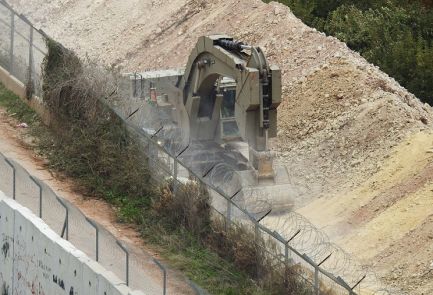
Eyal Margolin / JINI
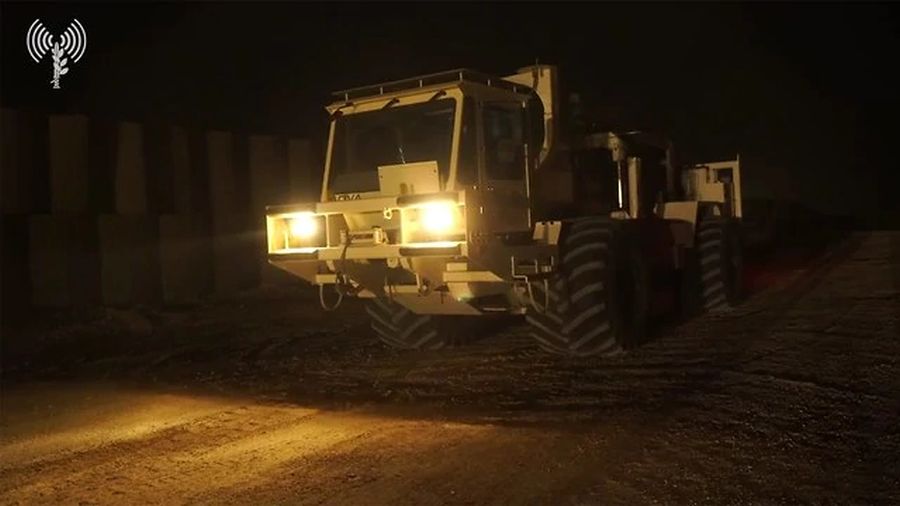
The IDF did not disclose how many tunnels snake into Israeli territory from Lebanon or how long the operation would last
Hezbollah’s cross-border tunnels “are a blatant violation of Israeli sovereignty and of U.N. Resolution 1701,” he continued. “The tunnels are built on Lebanese soil and pose a threat to both the Lebanese population and Lebanon itself. The IDF holds the Lebanese government responsible for everything that happens on its side of the Blue Line.
”The fact that Hezbollah is building tunnels under Israeli surveillance proves that the Lebanese army has no control on the ground and that Hezbollah dominates south Lebanon and uses Iranian money and knowledge to do so.”
He further said that IDF deployment in the northern sector has been increased and that “we are ready for any development. Nevertheless, there are no special instructions for the area’s residents. Local mayors have and are being kept abreast of the necessary developments,” he said.
Manelis noted that the IDF was operating under the assumption that Hezbollah was monitoring its progress.
”We are on high alert and if needed – we know what to do. The operation was launched at this time because the operational conditions are right and we have the technological abilities at our disposal.”
He stressed that “the tunnels pose no threat to the Israeli public – we’re dealing with them before they can become a threat. We are determined to make sure this doesn’t pose a threat to the border-adjacent communities.”
Commenting on the operation, Foreign Ministry spokesman Emmanuel Nahshon tweeted, “Hezbollah attack tunnels crossing from Lebanon into Israel is a blatant violation of U.N. Security Council Resolution 1701, it is an act of aggression. Israel will do its utmost to protect its citizens and its territory against such aggression.”
Brig. Gen. (res.) Yossi Kuperwasser, a senior researcher at the Jerusalem Center for Public Affairs and former head of the Military Intelligence’s Research Division noted that Operation Northern Shield may prompt a security escalation on the border.
The IDF, he said, has humiliated Hezbollah, and while the Shiite terrorist group has not reacted thus far, the IDF must remain alert.
According to Kuperwasser, while the operation is being carried out in Israeli territory, it concerns infrastructure that Hezbollah has spent years developing, thus exposing its intelligence vulnerabilities and increasing the potential for retaliation that could result in a border flare-up.
Sivan Yechieli, head of the Forum of Frontline Communities in the North, told Israel Hayom that the residents were not surprised by the tunnels’ discovery.
”Residents in the area have been very concerned about this issue for years, and they remain concerned,” he said.
“We were always told that the IDF had no knowledge of existing terror tunnels in the area, and it’s clear to me that once the IDF had the intelligence and the technological ability to identify tunnels, the operation was launched.”
”Israel cannot tolerate a violation of its sovereignty in the north,” he added. “Clearly, a threat of this nature requires a response. We have every faith in the military.”
Comments:Comments Off on Israel launches operation to counter Hezbollah tunnels
Every few months, Hezbollah leader Hassan Nasrallah makes a point of warning Israel not to attack Lebanon and make all sorts of threats. Last week, he did so using aerial footage of strategic targets in Israel, including the IDF’s headquarters in Tel Aviv, captioned “If you strike, you will regret it.”
While normally one could say that Nasrallah’s threats serve an internal propaganda purpose, the most recent declarations appear to indicate that Hezbollah believed an Israeli strike was imminent.
These speculations were likely fueled by frequent statements made by senior Israeli officials, whose main concern is the growing threat posed by Hezbollah’s buildup.
Hezbollah believes that Israel has been laying the groundwork for a potential strike in Lebanon, taking into account a number of indicators: Prime Minister Benjamin Netanyahu’s presentation at the U.N. in September in which he revealed that the Shiite terrorist group was building up missile production facilities in Beirut; the reports exposing Iranian cargo planes that delivered weapons directly to Hezbollah in Lebanon; and Netanyahu’s speech two weeks ago, at the height of a political crisis, in which he suggested it was a “highly sensitive time, security-wise.”
Hezbollah-affiliated media in Lebanon tried to downplay these concerns, saying that the Israeli rhetoric is designed to cause panic in Lebanon, but no one was actually able to breathe easier.
Clearly, neither Israel nor Hezbollah are interested in another war, but recent developments on the Israel-Lebanon border indicate that, given the simmering tensions there, a major flare-up is only a matter of time.
The first prominent development in the sector has to do with what appears to be Israel’s narrowing operational leeway with respect to operating in Syria against Iranian weapon shipments to Hezbollah, in the wake of the Sept. 17 downing of a Russian reconnaissance plane by Syrian air defenses trying to counter an Israeli airstrike.
The incident sparked a crisis between Jerusalem and Moscow and the Russian government decided to supply Syria with S-300 missile defense systems, which could pose a direct threat to Israeli aircraft. While those have yet to become operational, Israel has all but refrained from operating in Syria in recent weeks.
The second development most likely evolved from the first: it seems that Iran, whose operational leeway in Syria has also been curtailed by Russia, has come to the conclusion that it would be best if it delivered weapons to Hezbollah in Lebanon directly, thus avoiding the more vulnerable Syrian routes.
There is no doubt that these direct deliveries, especially of equipment meant to upgrade Hezbollah’s projectile arsenal with precision-missiles, attests to Tehran’s increasing audacity, as it appears to no longer even try to deny that it is transferring weapons to Hezbollah.
This also attests as to Nasrallah’s self-confidence, which has been fueled by his success in propping up Syrian President Bashar Assad’s regime throughout the Syrian civil war. The Shiite terrorist group sided with Assad on Iran’s orders and has gained valuable military experience in fighting alongside the Syrian army.
But, as aforementioned, Nasrallah’s confidence has begun to wane amid public declarations by Israeli officials asserting that Israel will not allow Iran to turn Lebanon into a front with Israel.
Still, Israeli decision-makers face a complex dilemma. Hezbollah is believed to be in possession of 150,000 advanced projectiles – far more advanced than anything Hamas has – and Nasrallah repeatedly boasts they are capable of striking any target anywhere in Israel.
Moreover, a strike in Lebanon is not akin to a strike in Syria. With the Syrian civil war practically over, Russian President Vladimir Putin has emerged as the master of the Syrian domain, meaning that while Jerusalem and Moscow may have their conflict of interests, there is someone to reason with if need be, and someone who can, to an extent, curb the Iranians.
Lebanon, on the other hand, is plagued by serious political turmoil that sees Prime Minister Saad Hariri (whose father, Prime Minister Rafic Hariri, was assassinated by Hezbollah in 2005) and Nasrallah constantly lock horns.
Given Hezbollah’s considerable political clout in the Lebanese parliament, Nasrallah is the real master of the Lebanese domain and there is no one there who can stop him.
This is why defense officials believe that an Israeli operation in Lebanon – even a limited one – would not necessarily meet a measured response by Hezbollah, making the potential for a full-scale war, which would expose the Israeli homefront to thousands of missiles, far greater
The assault tunnels dug by Hizballah under the Lebanese border into Israel are the target of IDF Operation Northern Shield announced early Tuesday, Dec. 4. It is led by OC Northern Command, Maj Gen.Yoel Strick. The IDF stressed that the operation is confined to the Israeli side of the border and was mounted before the tunnels were operational and posed a direct threat to northern security. Although the operation is sensitive, citizens of the north were advised to carry on as normal.
The IDF notice went on to say that, since 2012, Israel has been aware of Hizballah’s plan to conquer Galilee in a surprise stealth invasion through tunnels. In 2013, military investigations failed to uncover any tunnels. From 2014, “a special joint task force of the Intelligence Directorate and the Northern Command has led the operational, technological and intelligence efforts to find and neutralize any such tunnels. In a parallel project, the IDF constructed a wall along the Lebanese border, known as the “Defensive Obstacle Project”, which raised obstructions and cleared vegetation to thwart any enemy incursion.
The IDF spokesman went on to say that, of late, all these actions came together to create the conditions for the General Staff to decide on action at this time against the tunnels, whose construction provides additional proof of Hizballah’s disregard of UN Security Council Resolution 1701 which both the Lebanese terrorist group and Israel endorsed for ending the 2006 war.
Military reinforcements have been deployed to the northern border; Israel’s northernmost point, the town of Metulah and its vicinity, have been placed off-limits to civilians and the situation is under control and going forward according to the plan for eliminating the underground threat to the country. The army is keeping the heads of local councils in the picture and civilians are advised to go about their normal lives.
DEBKAfile’s military sources report that the operation was given the bombastic title of Operation Northern Shield less because of the scope of the action against Hizballah tunnels than to prepare the ground for a possible outbreak of hostilities. It tells Hizballah “We are well prepared to fight you.”
The IDF has meanwhile not addressed the big challenges posed from Lebanon, chiefly the Iranian workshops making Hizballah’s rockets precision-guided, the missile factories Iran is establishing in the Beqaa Valley of Lebanon, Hizballah’s Radwan commando force which is undergoing special training for storming into Israel in the event of all-out war. The IDF has also held back from striking the Iranian transport planes landing almost daily at Beirut international airport with cargoes of weapons and missiles.
Hizballah retaliation for the IDF operation against its tunnels is unlikely, so long as it is confined to Israeli territory. This Iranian proxy is after bigger game: Its latest propaganda video depicted the Israeli General Staff Headquarters in Tel Aviv as within reach of its missiles. Its chief, Hassan Nasrallah, will no doubt deliver a speech in the coming days making a mockery of Israel’s Operation Northern Shield and leave it there – unless two things happen:
If the IDF crosses the “Blue Line” and follows the tunnels to their source in Lebanese territory (the IDF spokesman mentioned “villages in South Lebanon), the Hizballah may start shooting at Israeli troops.
If Tehran issues Hizballah with an order to attack Israeli forces in revenge for the IDF’s massive missile assault on Iranian, Hizballah and Shiite militia forces in Syria on Thursday night, Nov. 29.
The Israel Defense Forces just launched Operation Northern Shield to expose and neutralize cross-border attack tunnels that Hezbollah dug from Lebanon to Israel.
The IDF launched Operation Northern Shield overnight Monday to expose and destroy cross-border attack tunnels built by Hezbollah, a proxy of Iran, along the Lebanon border and into northern Israel, the military announced early Tuesday morning.
“The digging of tunnels constitutes a blatant violation of Israeli sovereignty,” said IDF Spokesperson Brig.-Gen. Ronen Manelis.
The objective of the operation is to neutralize all Hezbollah attack tunnels which have crossed into Israeli territory. The operation will take place all along the “Blue Line”, the name for the international border between Israel and Lebanon and strictly within Israeli territory.
It will be led by the OC Northern Command Maj.-Gen. Yoel Strick and will include troops from the Combat Engineering Corps, the Intelligence Branch, as well as the Defense Ministry’s Administration for the Development of Weapons and Technological Infrastructure (MAFAT) will take part.
The military stated that a number of areas close to the security fence with Lebanon, including Metula, have been declared a closed military zone and that it has beefed up troop numbers in the Northern Command ahead of all possible scenarios.
While the IDF stressed that it is prepared for any escalation with Hezbollah that could stem from the operation, there are no special instructions for the residents of the North. The IDF updated the heads of local authorities overnight and will continue to be in contact with them throughout the operation.
According to Manelis, the Lebanese government is responsible for all that occurs on Lebanese soil and the digging of the tunnels shows that the Lebanese Armed Forces (LAF) is not capable of controlling what occurs in southern Lebanon.
“This is also more proof of the grave violations by Hezbollah, which blatantly ignores UN resolutions, especially Resolution 1701, and operates from villages in southern Lebanon, while harming the state of Lebanon and its citizens,” Manelis said, adding that “The Hezbollah terrorist organization, which is behind the digging of the tunnels, continues to operate with the support and funding of Iran in order to carry out terror activity against Israeli citizens.”
Hezbollah, which is supported by the majority of the Shiite population in Lebanon, has not only inserted itself into every aspect of civilian life but is said to be using private homes to store its weapons warehouses and missile launchers. It has rebuilt its missile arsenal since the Second Lebanon War in 2006 with the aid of Iran.
The military started to become aware of Hezbollah efforts to build attack tunnels stretching into Israel at several points along the border after the Second Lebanon War in 2006. After Operation Protective Edge in the Gaza in 2014 – during which Hamas used tunnels to enter Israel – the military decided to form a special team in the Northern Command to more seriously explore the threat along the border with Lebanon.
In 2015 the Lebanese daily As-safir published a series of reports about Hezbollah’s preparation for war against Israel which included a sprawling underground network of highly-advanced tunnels housing thousands of rockets ready to be launched.
According to the report the tunnels, which have secondary escape shafts, are built with durable concrete and have a 24-hour power supply via underground generators as well as a ventilation system to protect military equipment.
In a future war, Hezbollah’s elite Radwan unit is expected to attempt to capture an Israeli community or military outpost and in recent years, as part of preparations for this threat, Israel has invested significant amounts of money and effort into strengthening its defenses along the border with Lebanon.
In order to prevent any such ground attack by the group, Israel has created obstacles such as artificial cliffs and is currently building high concrete barriers all along the Lebanese border in the areas of the Sulam Ridge, Metula and Misgav Am to the south and east of the Blue Line.
The barrier is expected to be completed in the coming months.
The IDF has carried out several large-scale drills simulating war with the Lebanese terror group in the past year and according to the military Israel’s intelligence capabilities has increased dramatically since the Second Lebanon War in 2006 and has five times the number of targets in the north if another war were to break out.
JERUSALEM, Israel’s military said on Tuesday it was beginning an operation to “expose and thwart” cross-border attack tunnels from Lebanon dug by the Lebanese militia Hezbollah.
A spokesman, Lt. Col. Jonathan Conricus, said the Israel military was aware of a number of tunnels crossing into Israel from Lebanon to the north, and that the army would only be operating within Israel and not crossing the border.
The military said in a statement it had “enhanced its presence and readiness in the Northern Command and is prepared for various scenarios”.
Some areas near the border fence had been closed off.
“The digging of the cross-border attack tunnels that the IDF (Israel Defense Forces) has discovered, before the attack tunnels became operational and posed an imminent threat to the safety of Israeli civilians, constitutes a flagrant and severe violation of Israeli sovereignty,” the military said.
Israel and Iran-backed Hezbollah last fought a war in 2006.
Prime Minister Benjamin Netanyahu (L), U.S. Secretary of State Mike Pomeo (R), and National Security Council head Meir Ben-Shabbat (C) light Hanukkah candles during a meeting in Brussles, December 3, 2018. (photo credit: GPO)
Prime Minister Benjamin Netanyahu is believed to have taken a warning to US Secretary of State Mike Pompeo in Brussels on Monday for him to deliver to Lebanon: Stop Hezbollah’s efforts to get precision guided missiles, or Israel will do so.
Before boarding his plane, Netanyahu characterized the meeting as “important,” and alluded to the situation in Lebanon.
“We are in continuous contact with our American friends,” Netanyahu said before taking off. “I will discuss with Mike Pompeo a list of developments in our region, and [actions] we are taking together to halt the aggression of Iran and its proxies in the North. We will of course also discuss other issues.”
Netanyahu was accompanied to the meeting by Mossad head Yossi Cohen; National Security Council head Meir Ben-Shabbat; and his military secretary Avi Blot.
Israel has for months been warning against Iran and Hezbollah converting some of the nearly 150,000 missiles believed to be stockpiled by the organization in Lebanon into precision guided missiles by refitting them with GPS systems. Jerusalem has made it clear that this is something it will not tolerate, since these missiles could accurately target Israel’s sensitive infrastructure and population centers.
Netanyahu, who held up photos during that speech of what he said were three of those sites near Beirut International Airport, said that he had a message for Hezbollah: “Israel also knows what you’re doing, Israel knows where you’re doing it, and Israel will not let you get away with it.”
The Prime Minister’s Office stressed in announcing the rush trip to Brussels that the meeting was set up last week and originally scheduled for Wednesday, but was moved up because of the funeral for late US president George H.W. Bush, which is scheduled for that day.
Highlighting when the meeting was set up indicated that it was in no way connected to the police recommendations, and seemed an effort to nip in the bud any speculation that Netanyahu was interested in flying abroad on urgent state business to deflect attention from the police recommendations.
“As we have been warning for some time, Iran’s missile testing and missile proliferation is growing. We are accumulating risk of escalation in the region if we fail to restore deterrence,” Pompeo said. “We condemn these activities, and call upon Iran to cease immediately all activities related to ballistic missiles designed to be capable of delivering nuclear weapons.”
Pompeo said that the test violated a UN Security Council ban on Iranian ballistic missile activity designed to carry a nuclear payload.
Netanyahu, before their meeting, thanked Pompeo for his “firm statements” about Iran’s latest ballistic missile launch.
Pompeo is in Brussels to take part in the semi-annual meeting of NATO foreign ministers.






 anneinpt
 artaxes
 danmillerinpanama
 davidking1530
 Peter Hofman
 Joseph Wouk
 Peter
Peter Louisiana Steve

Recent Comments