‘We don’t want a repeat of Yom Kippur War catastrophe’ 

Posted December 12, 2018 by Joseph Wouk
Categories: Uncategorized

Source: ‘We don’t want a repeat of Yom Kippur War catastrophe’ – Israel Hayom


IDF official: Hezbollah unable to produce ‎precision weapons 

Posted December 12, 2018 by Joseph Wouk
Categories: Uncategorized

Source: IDF official: Hezbollah unable to produce ‎precision weapons – Israel Hayom


US poised to present Middle East peace plan ‘soon,’ top official says 

Posted December 12, 2018 by Joseph Wouk
Categories: Uncategorized

Source: US poised to present Middle East peace plan ‘soon,’ top official says – Israel Hayom


PM warns Hezbollah against targeting ‎tunnel operation ‎

Posted December 12, 2018 by Joseph Wouk
Categories: Uncategorized

Source: PM warns Hezbollah against targeting ‎tunnel operation ‎ – Israel Hayom


Following in Egypt’s footsteps 

Posted December 12, 2018 by Joseph Wouk
Categories: Uncategorized

Source: Following in Egypt’s footsteps – Israel Hayom

Itzhak Levanon

Saudi Arabia took Israel by surprise during a vote over a draft resolution condemning Hamas aggression against Israel at the U.N. General Assembly on Thursday.

For decades, speeches delivered by Saudi Arabia’s permanent representatives to the world body have included an attack on Israel. In one such speech in the 1970s, the Saudi envoy to the U.N. claimed there was no such thing as the Jewish people and repeated the myth that Ashkenazi Jews were in fact descended from the Khazars, a multiethnic and semi-nomadic Turkic people.

Current Saudi Ambassador to the U.N. Abdallah Yahya Al-Mouallimi began his address to the General Assembly, Thursday, by blasting Israel’s policies toward the Palestinians, according to Saudi tradition, and reiterated his country’s historical support for a two-state solution, with east Jerusalem as the capital of a Palestinian state. But woven into his remarks was a significant and innovative sentence: “Saudi Arabia condemns the firing of missiles from the Gaza Strip on civilian Israeli targets.” Al-Mouallimi even called for urgent steps to be taken to ensure an immediate cease-fire.

What we have then is open Saudi criticism of Hamas attacks on Israel in an international arena that did not include any corresponding condemnation of the Israeli Air Force’s strikes on Gaza. This is a Saudi Arabia we had yet to encounter, one that dares to openly express a position that differs from that of the general Arab position and one that is music to Israeli ears. These things could not have been said in such a central global forum as the U.N. without having first been approved by the kingdom in Riyadh. The ambassador’s remarks then reflect official Saudi policy given the changes underway in the Middle East and the escalation of the Sunni-Shiite conflict in the region.

Then-Egyptian President Anwar Sadat came down hard on Israel in a speech to the country’s parliament in 1977 ahead of his historic trip to Israel. But in his remarks, he also made sure to include one key transformative sentence: “I am willing to go to the end of the world, to the Knesset, to talk to the Israelis.”

Is Saudi Arabia preparing the ground to follow in Sadat’s footsteps?

There have been increasing reports in recent days that Jerusalem is interested in formalizing ties with Riyadh. While we cannot be certain this will happen in the near future, the ambassador’s remarks to the U.N. are a sign that attitudes are changing in Riyadh.

Hamas and its cronies did not criticize the Saudi ambassador’s remarks as one might have expected. By voting against the U.S.-sponsored resolution condemning Hamas, Saudi Arabia sent the Palestinians the message they would continue to support them, the two-state solution and the Arab peace initiative. Riyadh also needs to find a way to avoid the ongoing dispute between Hamas and the Palestinian Authority.

In contrast, the ambassador’s remarks condemning Hamas fire on Israel were meant for Israeli ears, and it may be that the message they are sending is that Saudi Arabia’s policies in the region will change according to the kingdom’s needs and as situations develop. While completely new, these extraordinary changes have gone under the radar in the media. Nevertheless, Israel can draw inspiration from these changes and expect there will be more to come in the future.

Itzhak Levanon is the former Israeli ambassador to Egypt.

Hamas behind Ofra and Barkan terror, celebrates three “successful” months – DEBKAfile

Posted December 12, 2018 by Joseph Wouk
Categories: Uncategorized

Source: Hamas behind Ofra and Barkan terror, celebrates three “successful” months – DEBKAfile

The terrorists who shot and injured 9 Israelis at the Ofra junction on Sunday, Dec. 9 were sent by Hamas. They are part of the same Hamas squad which murdered two Israelis, Ziv Hajbi and Kim Levengrund, at the Barkan industrial center on Oct. 7 and got away. So long as those killers were at large, IDF and Shin Bet investigators had expected Hamas to use them to strike again.

The Palestinian Ashraf Naalawa, 23, from the village of Sweika near Tulkarmm, who is still on the run, was presented as the lone killer at Barkan. But he was not alone and the manhunt is in fact focusing on a large squad of at least five to eight terrorists, all of them mobilized by Hamas to unleash a major campaign of terror in Judea and Samaria. It had been hoped that when they surfaced for their next attack – possibly on the anniversary of the Barkan hit, it would be possible to lay hands on them.  But again, after the drive-by shooting at Ofra, when the pregnant Shira Ish-Ran was deliberately targeted, the shooters got away. Raids and searches by IDF units in a number of Palestinian towns and villages, including Ramallah and El-Bireh, failed to turn up any lead to the fugitives and the investigation must again rely on intelligence informants.

On Tuesday night, Dec. 11, security was finally boosted in Judea and Samaria. The IDF reinforcements were charged with securing road traffic, while other units had their hands full hunting for the escaped terrorists. But, so long as the killers are on the loose, their main mission is to be on the spot for anticipating and cutting short the next Hamas strike.
The IDF and Shin Bet have identified the hand behind the latest round of terror as Gaza-based Abdel Rahman Jinmati, who is in charge of terrorist operations on the West Bank and the right hand of Saleh al-Arouri, overall chief of Hamas terror.

During the eight months of Palestinian turbulence on the Gaza front, Israeli security forces were able to keep the lid on Hamas efforts, oiled with substantial funding, to establish West Bank terrorist networks as well as thwarting attempts to launch attacks.  But in late November, when Hamas began easing up on aggression from the Gaza Strip upon receipt of Qatari dollars, the Gaza-based terrorist organization succeeded in setting up an active infrastructure for terror in Judea and Samaria, which has so far eluded discovery by Israel’s security and intelligence authorities.

In the past three months, Hamas has pulled off a string of successes against Israel: One was the murderous Barkan attack on Oct. 7. Then, on Nov. 11, the Palestinian group uncovered an Israeli covert force which had operated for several weeks in the Khan Younes district of southern Gaza. An IDF colonel was killed in the ensuing firefight. Whereupon Hamas loosed nearly 500 rockets against Israeli communities. Nonetheless, the Israeli government decided against retaliation for the outrageous assault on a civilian population and instead, agreed to a ceasefire bought from Hamas by Qatar’s $90m payout. The first two of six $15m instalments are already in Hamas hands. The price paid by Israel? The drive-by shooting at the Ofra junction was the down-payment. Its youngest victim, a baby, is in mortal danger two days after being delivered prematurely from its injured mother.

Palestinian terrorist groups are celebrating what they perceive as Hamas’s extraordinary feats against Israel’s army and security authorities. In this atmosphere, a further upsurge of Palestinian terror is to be expected.
|


Strasbourg Christmas market shooting: suspect on the run after three killed 

Posted December 12, 2018 by Joseph Wouk
Categories: Uncategorized

Source: Strasbourg Christmas market shooting: suspect on the run after three killed | World news | The Guardian

France upgrades security threat level after terrorist attack leaves at least 12 injured

Play Video
1:01
 Gunman on the run after deadly shooting at Strasbourg’s Christmas market – video

France has upgraded its security threat level as police hunted a gunman who shot three people dead and injured 12 others in a terror attack on Strasbourg’s celebrated Christmas market on Tuesday evening.

Six hours after the gunman disappeared after firing at passers-by in the busy city centre, interior minister Christophe Castaner said the government had raised the risk level to the highest category.

The move would strengthen border controls and bolster protection of Christmas markets and other events.

In a statement, Castaner said the gunman had opened fire in three different places in the city before engaging in firefights with patrolling soldiers.

“He fought twice with our security forces,” Castaner said.

French media reported the man, who was injured in one of the exchanges, then jumped in a taxi and disappeared.

Police immediately cut off major roads in and out of the city and launched a massive operation involving 350 police gendarmes and soldiers, as well as helicopters, to find him. French security services said they had identified the gunman as a 29-year-old born in Strasbourg, known to police and also on the “Fiche S” list of potential security threats.

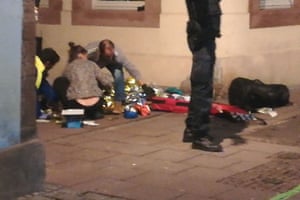
Picture taken with a mobile phone shows rescuers treating an injured person in the streets of Strasbourg.
Pinterest
 Picture taken with a mobile phone shows rescuers treating an injured person in the streets of Strasbourg. Photograph: Francois D’astier/AFP/Getty Images

French media reported that gendarmes had attempted to arrest the man for a separate crime at his home in the Neudorf district of southeast Strasbourg earlier on Tuesday. The suspect was not home, but officers reportedly found “grenades” in his apartment.

Shortly before 8pm local time, the man, armed with an automatic rifle, walked over one of Strasbourg’s many bridges around the Grand Île toward the Christmas market, which attracts millions of visitors every year. Witnesses said the man fired a first volley of rounds and then walked down the street before opening fire again.

Local resident Yoann Bazard said he heard “two or three shots” and screams; when he went to his window he saw people running. “After that I closed the shutters. Then I heard more shots, closer this time.

“There were two or three episodes like that … As it got close, it was really shocking. There were a lot of screams.”

Freelance journalist Camille Belsoeur said he was at a friend’s apartment in the city centre and at first mistook the gunfire for firecrackers. “We opened the window. I saw a soldier firing shots, about 12 to 15 shots,” he said.

He said other soldiers yelled for people to stay indoors and shouted “Go home! Go home!” to those outside.

One of the dead was said to be a Thai tourist who was shot in the head outside a restaurant. Staff and diners tried to save him but were unsuccessful.

Six of the injured were reported to be in a critical condition.

The anti-terrorist section of the Paris prosecutor’s office declared the incident to be an act of terrorism and announced an inquiry had been opened into “murder and attempted murder in relation to a criminal enterprise”.

The French president, Emmanuel Macron, immediately held a crisis meeting at the interior ministry in Paris.

The gunman reportedly shot at soldiers patrolling as part of the nationwide Operation Sentinelle, the French military operation introduced in the aftermath of terrorist attacks in and around Paris in January 2015, and was injured when they fired back.

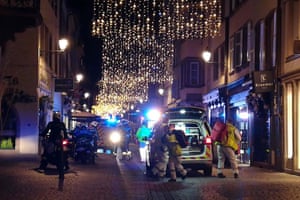
Rescuers at the scene of gun attack near Strasbourg Christmas Market.
Pinterest
 Rescuers at the scene of gun attack near Strasbourg Christmas Market. Photograph: Murielle Kasprzak/AFP/Getty Images

Police asked residents in the centre of Strasbourg to stay at home bars and restaurants were ordered to close and not let customers leave. Hours after the shootings, thousands of people remained unable to leave city centre restaurants, bars, libraries, and other public buildings following police orders for everyone to stay off the streets. Around 5,000 people were stuck inside the local sports stadium

The European Parliament, which is currently sitting in Strasbourg, was put on lockdown, and the parliament’s safety awareness division sent a message to MEPs advising those dining in the city centre to “please stay inside and don’t go out”.

“[A] decision has been taken, as a precautionary measure, to close the European Parliament building in Strasbourg. We ask you to stay calm and safe within [European parliament] premises,” it read.

Later Antonio Tajani, president of the parliament, said it would not be ‘“intimidated” by terrorism.

Antonio Tajani

@EP_President

Several MEPs in city centre restaurants reported hearing gunfire. The Yorkshire and Humber MEP Richard Corbett tweeted that he was dining in the city “where shots (were) fired”. The restaurant was “not letting anyone in or out”, he added.

Theresa May said she was “shocked and saddened” by the “terrible” attack in Strasbourg. “My thoughts are with all of those affected and with the French people,” the British prime minister tweeted.

https://interactive.guim.co.uk/maps/embed/dec/2018-12-11T19:51:24.html

The local prefecture tweeted that people should avoid the area near the city’s police headquarters and that all access to the A35 motorway bisecting the city was blocked.

Police in Germany said they were strengthening controls at the Franco-German border near Strasbourg. The police force of Baden-Wurttemberg, a state in south-west Germany bordering Strasbourg, tweeted they were taking the extra measures at the border because of the shooting. The transnational tramway between France and Germany was suspended.

In the early hours of Wednesday, local prefect Roland Ries announced the Christmas Market would be closed Wednesday and all local cultural events cancelled.

France remains on high alert after suffering a wave of attacks commissioned or inspired by Islamic State militants in 2015 and 2016, which killed more than 200 people.

Strasbourg’s Christmas Market, which started in 1570, is one of France’s most popular seasonal events. The “Grande Ile” where the market is held is surrounded by water, on one side the main channel of the River Ill and the other by the Canal du Faux-Rempart, is only accessible by bridges.

Since the Paris terrorist attacks in 2015, the event has been held under high security. Access to the area is controlled and visitors bags are searched. Vehicles are banned from the area.

In 2016, a truck was deliberately driven into the Christmas market in Berlin killing 12 people and injuring 56 others. The perpetrator Anis Amri, a Tunisian who had failed to gain asylum in Germany, was killed four days later in a shootout with police near Milan in Italy.

The attack comes during a period of intense tension across France after four weeks of civil unrest by anti-government and anti-president Emmanuel Macron, protesters from the gilets jaunes movement.


Australia to recognize Jerusalem as Israeli capital, delay embassy move – report 

Posted December 11, 2018 by Joseph Wouk
Categories: Uncategorized

Source: Australia to recognize Jerusalem as Israeli capital, delay embassy move – report | The Times of Israel

Scott Morrison’s cabinet said to approve shift in foreign policy, while putting off relocating mission due to $200 million price tag

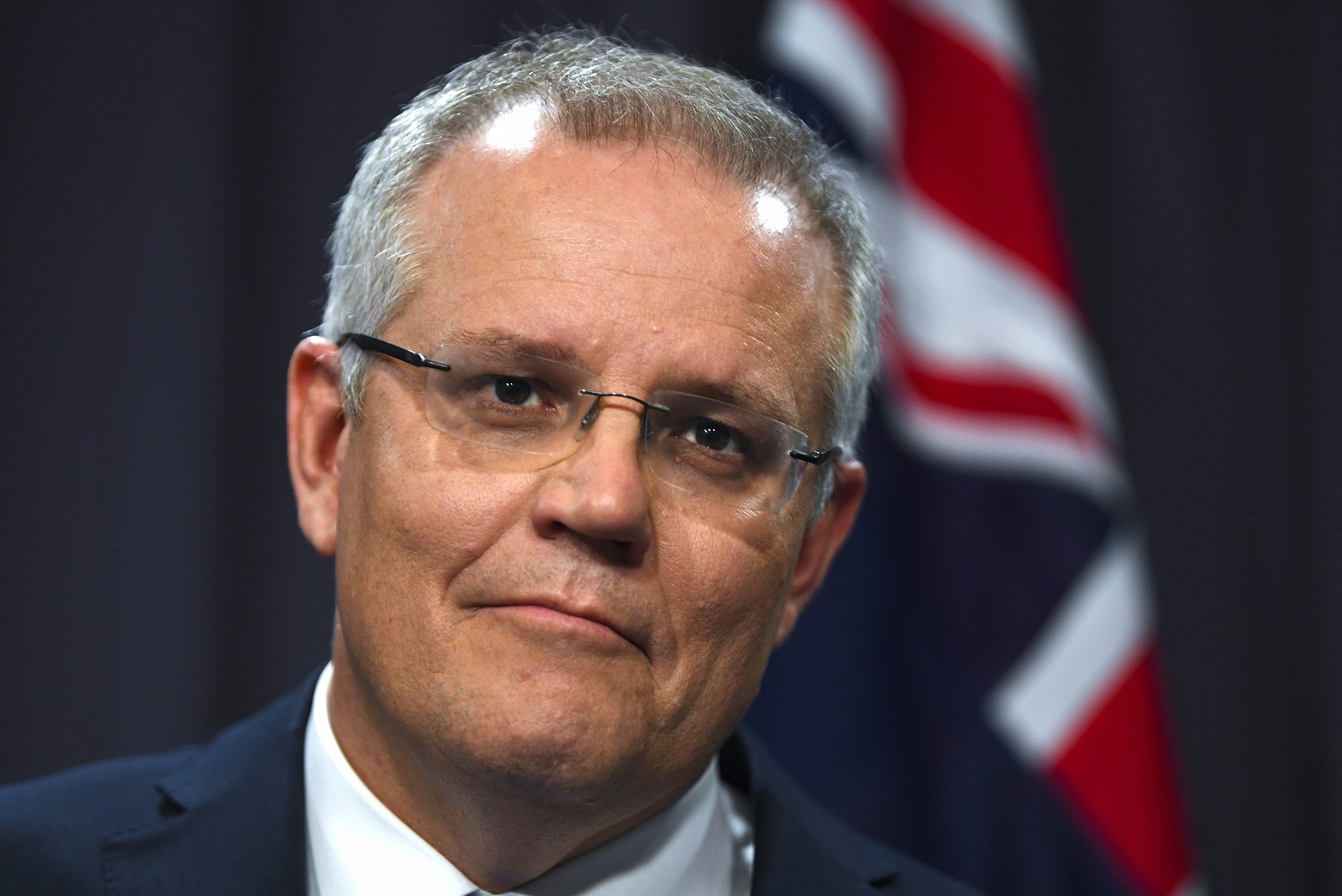
Newly elected leader of Australia’s Liberal Party, Scott Morrison addresses media at a press conference at Parliament House in Canberra, August 24, 2018. (Lukas Coch/AAP Image via AP)

The Australian government is reportedly set to formally recognize Jerusalem as the capital of Israel on Wednesday, but will likely delay moving its embassy there from Tel Aviv due to cost concerns.

Senior government sources told The Australian newspaper that Prime Minister Scott Morrison’s cabinet approved the policy change at a national security meeting Tuesday night following extensive discussions on the matter.

Cabinet ministers agreed that moving the embassy to Jerusalem would take place at a later stage, the report said, due to the estimated $200 million it would cost to relocate the diplomatic mission.

Sources told the paper that Canberra would establish a consular office in Jerusalem until the embassy could be moved there.

The report said the decision would likely be announced during Wednesday’s Council of Australian Governments meeting.

It was not clear if the government intended to recognize the entirety of Jerusalem as the Israeli capital, or just West Jerusalem, which Israel has held throughout its existence — as opposed to the eastern sectors of the city that it captured in the 1967 Six Day War.

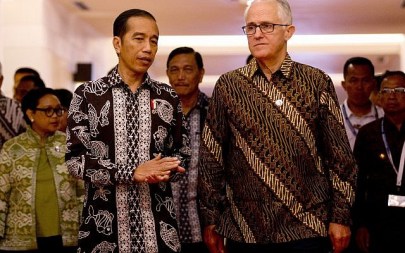
Indonesia President Joko “Jokowi” Widodo, front left, with Australia’s former prime minister Malcolm Turnbull, front right, during their bilateral meeting at Our Ocean Conference in Bali, Indonesia, October 29, 2018. (AP Photo/Firdia Lisnawati)

In October, Morrison told reporters he was “open-minded” to following the United States in recognizing Jerusalem as the Israeli capital, in what would be a sharp break in longstanding Australian foreign policy.

The announcement was welcomed by Israel, but heavily criticized by Palestinians and a number of Muslim-majority countries in Asia, including neighboring Indonesia, with which Australia is trying to clinch a landmark free-trade deal.

Morrison at the time said that the potential recognition and relocation of the embassy would not disrupt the Indonesia trade deal or negate Canberra’s longstanding support of the two-state solution to the Israeli-Palestinian conflict.

In a followup statement, Morrison’s government indicated that recognizing Jerusalem as the Israeli capital would only extend to the western part of the city, and East Jerusalem would be designated as the capital of a future Palestinian state.

Relations between Australia and the Muslim-majority Indonesia have been strained since Morrison’s announcement, with Jakarta officials initially indicating the deal may be called off over the changed foreign policy.

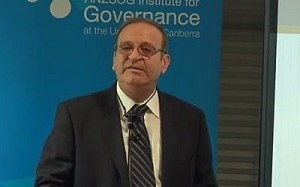
Izzat Abdulhadi, head of the Palestinian delegation to Canberra (YouTube screen capture)

According to The Australian, Foreign Minister Marise Payne informed Indonesian leaders of her government’s intention to recognize Jerusalem during a meeting in Bali last week.

On Tuesday, the Palestinian Authority delegation to Australia slammed the reported upcoming announcement, with envoy Izzat Abdulhadi saying his people should not have to “pay the price for some kind of face-saving move.”

In a statement to The Sydney Morning Herald, Abdulhadi rejected recognizing West Jerusalem as the Israeli capital, saying that such a compromise still “legitimize[d] the illegal occupation of Jerusalem.”

Senior Palestinian official Saeb Erekat also harshly criticized the reported move, and called on Arab and Muslim countries to sever all diplomatic ties with Australia if it changed its policy on Jerusalem. In a tweet Tuesday morning, Erekat said that various Arab and Muslim summits have adopted resolutions committing to ending diplomatic ties with any country that recognizes Jerusalem as belonging to Israel.

Morrison’s mid-October announcement also drew criticism at home. Australia’s spy agency warned the move could could provoke further violent unrest in Israel, while opposition lawmakers accused the prime minister of cynically pandering to Jewish voters ahead of a crucial by-election.

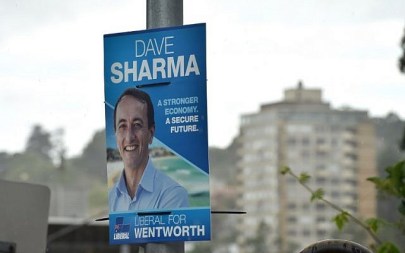
An election poster of Liberal candidate Dave Sharma is seen on a street in the seat of Wentworth in Sydney on October 18, 2018. (Photo by Peter PARKS / AFP)

A top secret bulletin drafted by the Australian Security Intelligence Organization, obtained by The Guardian in October, said the move “may be perceived as shifting to a pro-Israel/anti-Iran stance,” and warned it could damage Australia’s diplomatic and business interests in the Islamic republic.

Morrison floated the idea of recognizing Jerusalem moving the Australian embassy there days before an October by-election in a Sydney electorate with a large Jewish population that featured his fellow party member Dave Sharma, a former ambassador to Israel.

The campaign in Wentworth drew international attention after Morrison raised the prospect of the embassy move, a remark that was slammed by critics and opposition lawmakers as a cynical attempt to pander to Jewish voters.

The government lost the by-election and its single-seat majority in the House of Representatives, forcing Morrison to rely on deals with independent lawmakers to guarantee confidence in his government, enact legislation and ensure money supply.


Two car-ramming attempts reported in West Bank; one suspected attacker shot dead 

Posted December 11, 2018 by Joseph Wouk
Categories: Uncategorized

Source: Two car-ramming attempts reported in West Bank; one suspected attacker shot dead | The Times of Israel

In separate incidents, one near Hebron, the other in Jordan Valley, Palestinians allegedly try to run over border guards

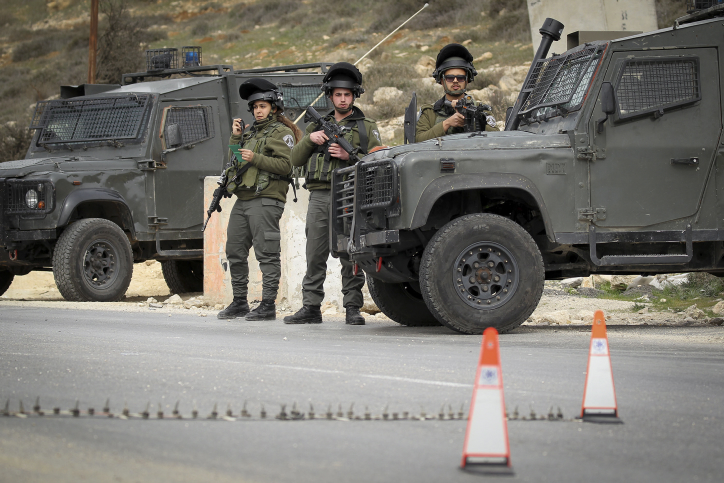
Illustrative: Border Police officers guard a checkpoint in the West Bank on January 26, 2017. (Wisam Hashlamoun/Flash90)

Illustrative: Border Police officers guard a checkpoint in the West Bank on January 26, 2017. (Wisam Hashlamoun/Flash90)

Israeli border guards shot dead a Palestinian driver who they said tried to ram his car into them outside of Hebron on Tuesday morning.

In a separate incident, in the northern Jordan Valley, a Palestinian man allegedly accelerated his car toward a group of Border Police officers. The troops fired warning shots into the air, and the suspect stopped and was arrested, police said.

The police said both cases were being investigated.

The Border Police officers in the town of Idhna, outside Hebron, were standing guard as members of the Defense Ministry’s Civil Administration, which oversees day-to-day activities in the West Bank, were taking part in an effort to crack down on the illegal burning of garbage.

According to police, the Palestinian suspect drove through a checkpoint the border guards had set up, hit a security vehicle with his car and then “accelerated toward a Border Police officer.”

The border guards opened fire at the vehicle, fatally wounding the suspect, who was identified by Palestinian authorities as 27-year-old Omar Hassan al-Awawdeh.

No Israeli troops were injured.

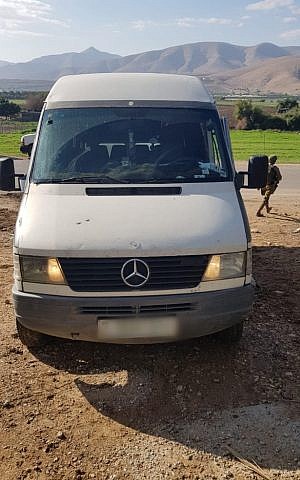
A van used in a suspected attempted car ramming against Israeli border guards in the Palestinian village of al-Jiftlik in the northern Jordan Valley in the West Bank on December 11, 2018. (Israel Police)

In the village of al-Jiftlik in the northern Jordan Valley, the border guards were guarding Civil Administration troops who were knocking down illegally constructed buildings when the Palestinian suspect drove toward them.

Police said the suspect was a 30-year-old man from the village.

He was handed over to the Shin Bet security service for further questioning.

The two seemingly unconnected incidents came two days after terrorists in a white car opened fire at a group of Israelis standing at a bus stop outside the Ofra settlement, near Ramallah, injuring seven of them, including a pregnant woman who was seriously injured.

The pregnant woman’s baby was delivered prematurely by C-section. While the mother’s condition has improved, the infant boy is still in critical condition at Jerusalem’s Shaare Zedek Medical Center.

The suspects fled the scene, prompting an ongoing manhunt by Israeli security forces.


Iran confirms recent ‘significant’ missile test amid Western criticism

Posted December 11, 2018 by Joseph Wouk
Categories: Uncategorized

Source: Iran confirms recent ‘significant’ missile test amid Western criticism | The Times of Israel

Tehran military aerospace commander says reaction by US shows how significant and upsetting rocket launch was for Washington

In this photo released on October 1, 2018, by the Iranian Revolutionary Guard Corps, a missile is fired from city of Kermanshah in western Iran targeting the Islamic State group in Syria. (Sepahnews via AP)

In this photo released on October 1, 2018, by the Iranian Revolutionary Guard Corps, a missile is fired from city of Kermanshah in western Iran targeting the Islamic State group in Syria. (Sepahnews via AP)

TEHRAN, Iran — Iran confirmed on Tuesday that it had carried out a recent test of a medium-range ballistic missile after Western powers sharply criticized a December 1 launch.

“We are continuing our missile tests and this recent one was a significant test,” the Fars news agency reported, citing Revolutionary Guards aerospace commander Brigadier General Amirali Hajizadeh.

“The US reaction showed that it was a big thing for them and that it upset them,” the conservative news agency said, adding that Iran carried out between 40 and 50 missile tests a year.

Iran has pressed on with its ballistic missile program after reining in much of its nuclear program under a landmark 2015 deal with major powers.

A UN Security Council resolution adopted after the agreement calls on Iran to refrain from testing missiles capable of carrying a nuclear weapon, but does not specifically bar Tehran from missile launches.

The UN Security Council convened at the request of Britain and France on December 4 to discuss the latest test which both governments described as “provocative” and “inconsistent” with Resolution 2231.

Britain said that the types of missiles fired had capabilities that “go way beyond legitimate defensive needs.”

Iran has developed several types of ballistic missiles with a range of up to 3,000 kilometers (1,875 miles) — sufficient to reach Israel and Western bases across the region.

In its report, Fars did not specify the date of the latest test or say which types of missile were fired.

Washington, which quit the nuclear deal in May, described the test as an outright “violation” of Resolution 2231 and called on the Security Councilto condemn it.

But veto-wielding Moscow has defended Tehran’s right to carry out the missile tests, and the December 4 meeting ended with no joint statement or any plan for follow-up action.

The council is due to meet again on December 19 for a regular review of the resolution’s implementation.

Iran has received regular certifications of compliance with the provisions of the nuclear deal from the UN atomic watchdog.

Western criticism has focused instead on Tehran’s missile program and its military interventions in the region.