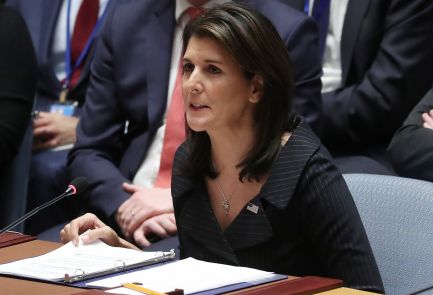
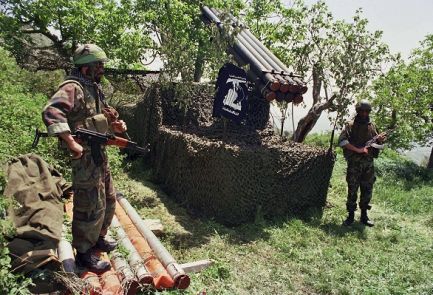
Ahead of UN discussion, Netanyahu calls Hezbollah tunnel-digging ‘act of war’

Posted December 19, 2018 by Joseph Wouk
Categories: Uncategorized

Source: Ahead of UN discussion, Netanyahu calls Hezbollah tunnel-digging ‘act of war’ | The Times of Israel

PM says Lebanese army has been a ‘total failure,’ failing to confront Shiite terror group; urges Putin not to defend Hezbollah at Security Council

Prime Minister Benjamin Netanyahu delivers a statement at the Knesset in Jerusalem, ahead of the UN Security Council discussion on Hezbollah's tunnels into Israel, on December 19, 2018.  (Menahem KAHANA / AFP)

Prime Minister Benjamin Netanyahu delivers a statement at the Knesset in Jerusalem, ahead of the UN Security Council discussion on Hezbollah’s tunnels into Israel, on December 19, 2018. (Menahem KAHANA / AFP)

Ahead of a United Nations Security Council meeting on the attack tunnels Hezbollah dug across the Lebanese-Israeli border, Prime Minister Benjamin Netanyahu on Wednesday urged the international community to take decisive action against the Shiite terrorist group.

At an English-language press conference at the Knesset, Netanyahu called Hezbollah’s tunnel-digging an “act of war,” and accused the Lebanese Armed Forces of doing nothing to counter those acts. While Beirut did not know about the tunnels while they were being dug, its military now knows but still fails to act, he maintained.

He also revealed that he recently speak to Russian President Vladimir Putin in a bid to convince Moscow not to defend Hezbollah and its Iranian sponsors during Wednesday’s Security Council session.

Netanyahu said that the four tunnels the Israeli army has so far discovered in its recently launched, ongoing effort to uncover such passages were aimed to “penetrate our territory, kidnap our people, including civilians, murder civilians, and conquer the northern piece of the Galilee. This is not merely an act of aggression. It’s an act of war. It’s part of a war plan, I would say.”

Every third house in South Lebanon is used in one way or another to hide Hezbollah’s tunnel-digging project, the prime minister charged. “It’s targeting Israeli civilians while hiding behind Lebanese civilians. That’s a double war crime,” he charged.

“We expect Lebanon to take action against this, to protest against this, not to give in to this. And the fact that the Lebanese is army does nothing means that they’re either unable or unwilling, or both, to do anything about this. But it doesn’t absolve Lebanon’s culpability… We hold Lebanon accountable,” he declared.

Turning his attention to the session at Turtle Bay, scheduled for 5 p.m. Israel time, Netanyahu made a list of demands: “I call on all the members of the Security Council to condemn Hezbollah’s wanton acts of aggression; to designate Hezbollah in its entirety as a terrorist organization; to press for heightened sanctions against Hezbollah; to demand that Lebanon stop allowing its territory to be used as an act of aggression, and its citizens to be used as pawns; to support Israel’s right to defend itself against Iranian-inspired and Iranian-conducted aggression.”
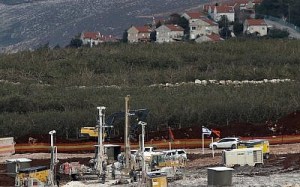
In this December 13, 2018, photo, Israeli military equipment works on the Lebanese-Israeli border in front of the Israeli town of Metula, background, near the southern village of Kafr Kila, Lebanon. (AP Photo/Hussein Malla)

He also urged the 15 members of the council to demand that the UN Interim Force in Lebanon, known as UNIFIL, “fully meet its mandate and deepen its operations.” UNIFIL must be given “unrestricted access to any area” before Hezbollah can destroy the evidence of its tunnel-digging operation, he said.

“In the meantime, Israel will continue to take all the necessary action to protect our people and defend our borders.”

To the best of his knowledge, the Lebanese army was unaware of Hezbollah’s project to build terror tunnels into Israel, he said, responding to a reporter’s question. “Very few people knew about it, period. But they know about it now, and they should be uncovering them and neutralizing them. It’s their obligation.”

In reality, however, the Lebanese military “very often cooperates with Hezbollah,” he lamented. “It certainly doesn’t challenge Hezbollah. And it often directs its weapons against us,” Netanyahu added, referring to a recent incident at the Blue Line.

“The Lebanese Army has been a total failure in this regard,” he went on. “They failed to take action to control their own territory. They failed to take action to prevent the use of their territory against the territory of a neighboring state. And they failed to dislodge the tyrannical Hezbollah. They haven’t even tried.”

Ahead of today’s UN Security Council discussion, Netanyahu urged Putin to “take the right stance, which is to condemn Hezbollah and not be either supportive of them or neutral,” he said.

“Russia often says it wants to prevent another war. The way to prevent another war is to prevent Hezbollah from acting aggressively against Israel from Lebanon. Same thing for Iran. I said that to Mr. Putin many times.”

Earlier on Wednesday, Netanyahu said Hezbollah had closed sites in Lebanon’s capital Beirut at which precision missiles were allegedly made after he revealed their locations in a speech to the UN General Assembly.
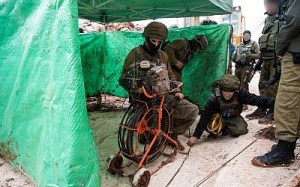
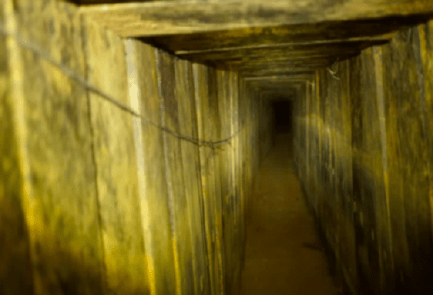
IDF troops uncover a tunnel leading into Israeli territory from southern Lebanon, which Israel says was dug by the Hezbollah terror group, on December 11, 2018. (Israel Defense Forces)

Speaking at the Globes Business Conference in Jerusalem, Netanyahu said the exposure of the sites was part of Israeli efforts to prevent the Iran-backed Shiite organization from amassing an arsenal of highly accurate missiles. It is now working to set up new production facilities, he alleged.

“They planned to already have thousands of precision missiles. At best they have just dozens,” Netanyahu said.

In his September speech, the prime minister displayed a map pinpointing the location of the Hezbollah sites near Beirut’s airport and accused the terror group of “deliberately using the innocent people of Beirut as human shields.”

Israel has so far uncovered four passages crossing into Israel from Lebanon, and the UNIFIL peacekeeping force has confirmed their existence and acknowledged that the tunnels violate UN resolution 1701, adopted at the end of the 2006 Second Lebanon War. UNIFIL said Tuesday at least two of the tunnels crossed into Israeli territory.

“It is time for the Security Council to employ all its means against the terror infrastructure of Hezbollah, which continues to gain strength under the Lebanese government,” Israel’s UN envoy Danny Danon said in a statement.

Israel launched Operation Northern Shield, an effort to find and destroy the tunnels it attributes to the Iran-backed terrorist group, earlier this month.

The operation has raised prospects of a possible fresh conflict on the volatile border, though Lebanon has downplayed chances of war, so long as Israeli troops do not cross its territory. UN peacekeepers, meanwhile, have stepped up their patrols to ensure that the frontier remains calm.

On Monday, UNIFIL declared that cross-border attack tunnels dug from southern Lebanon into Israel were a violation of the UN resolution that ended the 2006 conflict, saying it had confirmed that at least two tunnels crossed into Israel. UN Resolution 1701 called for all armed groups in Lebanon besides the country’s military to remain north of the Litani River.
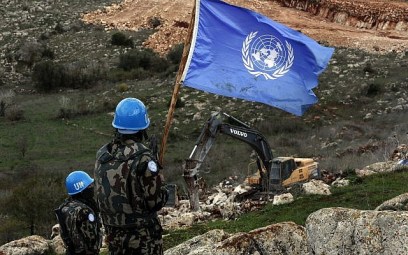
In this Thursday, December 13, 2018, photo, UN peacekeepers hold their flag, as they observe Israeli excavators working near the southern border village of Mays al-Jabal, Lebanon. (AP/Hussein Malla)

Israel has for years claimed that Hezbollah has been violating Resolution 1701 by conducting military activities along the border. UNIFIL has largely rebuffed those allegations, and its announcement on Monday represented one of the few cases in which it has confirmed a violation of the UN resolution.

On Monday, Lebanese Prime Minister Saad Hariri met with UNIFIL commander Maj. Gen. Stefano Del Col, telling him that Beirut remained committed to upholding UN Resolution 1701.

The military said it believes the tunnels were meant to be used by Hezbollah as a surprise component of an opening salvo in a future war, to allow dozens or hundreds of terrorists into Israel, alongside a mass infiltration of operatives above-ground and the launching of rockets, missiles, and mortar shells at northern Israel.

Times of Israel staff and Judah Ari Gross contributed to this report.
 

In 2019, Middle East economic troubles loom as wars wind down

Posted December 19, 2018 by Joseph Wouk
Categories: Uncategorized

Source: In 2019, Middle East economic troubles loom as wars wind down – Israel Hayom


Hamas leader would win Palestinian elections, poll shows 

Posted December 19, 2018 by Joseph Wouk
Categories: Uncategorized

Source: Hamas leader would win Palestinian elections, poll shows – Israel Hayom


GOP senators unveil measure recognizing Israeli sovereignty over Golan Heights

Posted December 19, 2018 by Joseph Wouk
Categories: Uncategorized

Source: GOP senators unveil measure recognizing Israeli sovereignty over Golan Heights – Israel Hayom


IDF investigates report of tunnel-digging noise in Sderot 

Posted December 19, 2018 by Joseph Wouk
Categories: Uncategorized

Source: IDF investigates report of tunnel-digging noise in Sderot – Israel Hayom


PM to troops: Terrorist who killed your 2 comrades will be found 

Posted December 19, 2018 by Joseph Wouk
Categories: Uncategorized

Source: PM to troops: Terrorist who killed your 2 comrades will be found – Israel Hayom


US envoy Nikki Haley hints at ‘new elements’ in Mideast peace plan 

Posted December 19, 2018 by Joseph Wouk
Categories: Uncategorized

Source: US envoy Nikki Haley hints at ‘new elements’ in Mideast peace plan – Israel Hayom


No more tunnel vision about Hezbollah 

Posted December 19, 2018 by Joseph Wouk
Categories: Uncategorized

Source: No more tunnel vision about Hezbollah – Israel Hayom

Yoav Limor

After 12 years of denial and living a lie, the U.N. Security Council will today be forced to look reality squarely in the eyes. The discussion of Hezbollah’s attack tunnels will put an end to the masquerade it has been perpetrating about the Lebanese issue and mark the beginning of an era in which, we hope, the world will confront the truth about what is happening on Israel’s northern border.

Thus far, the world has preferred to ignore what Hezbollah is doing, in particular the organization’s blatant violation of two major aspects of Resolution 1701 by arming itself (mostly with rockets and missiles) and entrenching itself south of the Litani River. Israel has presented one proof after another – including concrete intelligence – that Hezbollah is lying, but its cries that the emperor has no clothes are met with total indifference. The world has opted to buy Hezbollah’s lie, knowing it’s a lie, to avoid the ramifications of the truth.

Israel’s exposure of the tunnels requires the world to change its ways. The fact that UNIFIL has signed an official announcement that tunnels have been dug into Israel from Lebanon is like the stamp of a court. It says: This is no longer an Israeli “claim,” an entity appointed by the Security Council itself is confirming what happened.

It was no easy task to secure that announcement. As soon as each tunnel was discovered, UNIFIL staff were brought in to confirm that tunnels had been found inside Israel – but at first, without proof, they refused to confirm that the tunnels had been dug from Lebanon. The IDF decided to follow the tunnels further, beneath the Blue Line that separates Israel from Lebanon itself, to prove that they had originated in Lebanon and excavated beneath the border. In the past few days, these excavations have been underway at two points. Cameras were lowered into the tunnels and the U.N. personnel were finally given incontrovertible proof that the tunnels led from Lebanon to Israel.

The proof put an end to debate. No one has any more doubts, and certainly not after a CNN news team visited the site and sent one of its own cameras down into the earth to document the Hezbollah scheme. All this was part of the struggle to convince the world that Israel is waging along with its operational efforts to eradicate the tunnel threat itself. On Tuesday, the IDF Spokesperson’s Unit put out an English-language video aimed at the international community saying that Hezbollah’s activity was putting citizens of Lebanon as well as Israel in danger.

The UNSC will have all this information when it meets on Wednesday. It is unlikely to result in any resolution, to avoid a Russian veto, but for Israel, even a declaration condemning Hezbollah would be a good first step. Jerusalem would like to see changes to Resolution 1701 but officials understand that the process takes time and are willing to be content with international pressure on the Lebanese government, hoping that it will also exert pressure on Hezbollah that will cause the organization to suspend or change its military activity.

Only a cockeyed optimist would think that could work. The world is jaded, and the main subject of discussion in the Security Council won’t be the Hezbollah tunnels, it will be Christmas vacation and the fact that this will be the last UNSC meeting attended by outgoing U.S. Ambassador to the U.N. Nikki Haley. But Israel must persist – not only in its tunnel excavation work but in its attempts to secure further discussion of the matter until effective action is taken.

Meanwhile, on the northern border, forces are still looking for more tunnels as authorities decide how best to eliminate the ones that have already been discovered and whether to demolish only the parts of the tunnels in Israeli territory or their entire length?

The exposed tunnels have shown that Hezbollah is employing a few different tactics. The first tunnel was carved out of rock, using hand tools; the second tunnel had been shored up using concrete, like the tunnels Hamas digs under the Gaza border. The difference accommodated the different types of ground. One of the tunnels, which led to the city of Metula, will be preserved as a model. The IDF will construct orderly access to it and it will become a site to which diplomats and foreign correspondents are regularly brought to see.

Israel to present evidence proving Lebanese army is helping Hezbollah 

Posted December 19, 2018 by Joseph Wouk
Categories: Uncategorized

Source: Israel to present evidence proving Lebanese army is helping Hezbollah – Israel Hayom


A modest Mideast détente

Posted December 19, 2018 by Joseph Wouk
Categories: Uncategorized

Source: A modest Mideast détente – Israel Hayom

Clifford D. May

Perhaps former U.S. President Barack Obama deserves that Nobel Peace Prize after all. His achievement: bringing Israelis and Arabs closer together. He produced that result by throwing both under the bus. While there, they had coffee and a little baklava and recognized how much they actually have in common.

Evidence of this modest détente: Prime Minister Benjamin Netanyahu’s October meeting with Sultan Qaboos bin Said Al Said in Oman’s picturesque capital. The two men spent 10 hours in the royal palace, discussing affairs of state, dining, and enjoying a musical performance. Photos of them warmly shaking hands were made available to the media.

Not long after, the Israeli national anthem was played for the first time in Abu Dhabi, capital of the United Arab Emirates, as an Israeli athlete accepted a gold medal at an international judo tournament. Accompanying him was Sport Minister Miri Regev. She broke into tears.

Earlier this year, Bahrain came out in support of Israel’s right to defend itself from Iranian forces in Syria. Over the weekend, the Bahraini foreign minister defended Australia’s recognition of west Jerusalem as Israel’s capital. Bahrain’s king, Hamad bin Khalifa, even opposes economic boycotts of the Jewish state. Saudi Arabia cooperates with Israel on intelligence, cybersecurity and other issues.

In the old days, Arab states regarded Israel as the best of enemies. It could be blamed for all manner of dastardly deeds and misfortunes but it would never put a missile on your breakfast table except in response to a direct and imminent threat. Why alter that convenient status quo now?

Because the rulers of the Islamic Republic of Iran are actively seeking to topple or subjugate Arab Sunni states for reasons of theology (complicated) and the will to power (simpler).

The clerical regime has installed Hezbollah as its regent in Lebanon and Bashar Assad as its client in Syria. It is strong-arming the elected leaders of Iraq and backing Houthi rebels in Yemen. What nation, aside from Israel, has both the determination and the capabilities necessary to stand up to this menacing neo-imperialist power?

The obvious answer is the United States, but Obama decided to try appeasing Tehran instead. Borrowing more from Mr. Rogers than Carl von Clausewitz, he proposed that Saudi Arabia and Iran “share the neighborhood.”

He transferred more than $100 billion to Iran’s rulers in exchange for their promise to slow-walk a nuclear weapons development program they insisted they didn’t possess – even as they continued to test missiles that could deliver such weapons.

Both Arabs and Israelis were relieved when U.S. President Donald Trump reversed his predecessor’s policies, though there is fear that the next occupant of the White House may do another about-face. Israelis, by contrast, can be counted on to stay the course.

What are the chances that Israel goes on to fully normalize relations with the Saudis, Bahrainis, Emiratis, Omanis and perhaps others? I’d say not good, at least not anytime soon.

The small states won’t want to go first; they’ll prefer to follow the Saudis. And the Saudis won’t want to give Iran’s rulers grounds to call them Zionists and traitors to the Palestinian cause.

In theory, this provides an incentive for Prime Minister Benjamin Netanyahu to more aggressively pursue a settlement of the Palestinian-Israeli conflict.

In practice, Hamas will make peace with the “Zionist entity” when pigs fly. As for Mahmoud Abbas, the 83-year-old president of the Palestinian Authority, he is thinking legacy. A generation from now, he wants his picture hanging beside that of Yasser Arafat, not used for target practice in jihadi training camps.

A few complexities: The rulers of Egypt and Jordan long ago signed peace treaties with Israel and cooperate extensively on security, energy, water and other issues. Average Egyptians and Jordanians, however, have been indoctrinated to despise Israelis and their attitudes won’t change anytime soon.

The monarchies along the eastern coast of the Arabian Peninsula are not all alike. Saudi Arabia and Bahrain are most adamant about doing whatever is necessary to contain the Islamic republic.

Kuwait describes its relations with Iran’s ruling ayatollahs as “excellent” but last year ordered the expulsion of Iranian diplomats, including the ambassador, and convicted 23 men of spying for Hezbollah, Tehran’s proxy. Prominent Kuwaitis have acknowledged Israel’s right to exist and advised Palestinian leaders that killing Israelis is unlikely to make them more conciliatory.

Oman hedges its bets, casting itself as the “Middle East’s Switzerland” which implies not chocolate and cuckoo clocks but remaining neutral even when one side is obviously more threatening than the other.

Qatar’s rulers most egregiously play both ends against the middle. They enjoy cozy relations with Tehran, military coordination with Turkey’s Islamist president, support the Muslim Brotherhood, and, allegedly, various Sunni jihadi groups as well. They own Al Jazeera and use it to spread their propaganda.

These and other issues have enraged the Saudis who, along with Egypt, Bahrain and the UAE, severed diplomatic relations with Qatar and imposed an economic blockade in 2017.

At the same time, Qatar hosts an American air base and maintains reasonably cooperative relations with Israel, which prefers Qatari money and influence in Gaza and the West Bank over that of Tehran.

It’s a complex situation that we might boil down to this: In the Middle East, the enemy of your enemy is not necessarily your friend. But if he’s strong and doesn’t plan to wipe you off the map, it’s only sensible to sit down with him for coffee and a little baklava – especially if you both find yourselves beneath the same large, proverbial motor vehicle.

Clifford D. May is president of the Foundation for Defense of Democracies and a columnist for The ‎Washington Times.‎