Source: US defense secretary resigns following news of Syria exit – Israel Hayom
Defense Secretary Jim Mattis: U.S. “cannot protect our interests … without maintaining strong alliances and showing respect” to allies • U.S. military leaders scramble to plan Syria troop withdrawal as lawmakers appeal to Trump to reverse abrupt order.
|
Defense Secretary Jim Mattis
| Photo: AP
|
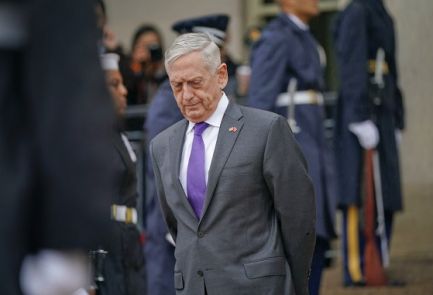
U.S. Defense Secretary Jim Mattis resigned Thursday after clashing with President Donald Trump over the abrupt withdrawal of U.S. troops from Syria.
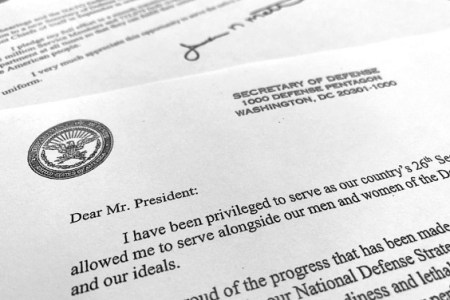
Mattis, perhaps the most respected foreign policy official in Trump’s administration, will leave by the end of February after two tumultuous years struggling to soften and moderate the president’s hard-line and sometimes sharply changing policies. In his resignation letter, Mattis emphasized the importance of “showing respect” to allies and told Trump he was leaving because “you have a right to have a secretary of defense whose views are better aligned with yours.”
“While the U.S. remains the indispensable nation in the free world, we cannot protect our interests or serve that role effectively without maintaining strong alliances and showing respect to those allies,” he wrote.
There was no confrontation between the two men, an anonymous senior official familiar with the incident said, but Syria likely was the last straw for Mattis.
His departure was immediately lamented by foreign policy hands and lawmakers on both sides of the aisle, who viewed the retired Marine general as a sober voice of experience.
“Just read Gen. Mattis resignation letter,” tweeted Florida Sen. Marco Rubio. “It makes it abundantly clear that we are headed toward a series of grave policy errors which will endanger our nation, damage our alliances and empower our adversaries.”
 AP
APMattis did not mention the dispute over Syria in his letter or proposed deep cuts to U.S. forces in Afghanistan, another significant policy dispute. He noted his “core belief” that American strength is “inextricably linked” with the nation’s alliances with other countries, a position seemingly at odds with the “America First” policy of the president.
The defense secretary also said China and Russia want to spread their “authoritarian model” and promote their interests at the expense of America and its allies. “That is why we must use all the tools of American power to provide for the common defense,” he wrote.
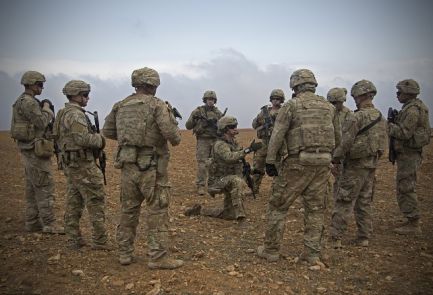
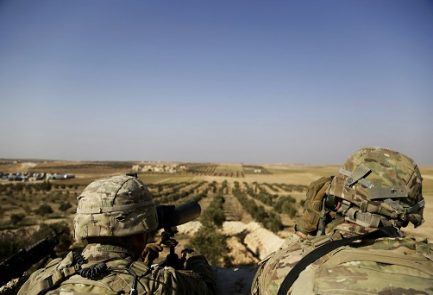
The roughly 2,000 U.S. troops in Syria, many of them special forces, were ostensibly helping to combat Islamic State but were also seen as a possible bulwark against Syrian President Bashar Assad, who has retaken much of the country from his foes in the civil war, with military help from Iran and Russia.
The announcement came a day after Trump surprised U.S. allies and members of Congress by announcing the withdrawal of all U.S. troops from Syria, and as he continues to consider cutting in half the American deployment in Afghanistan by this summer.
Four U.S. officials, who spoke on condition of anonymity, said the troop withdrawal is expected to mean an end to the U.S. air campaign against Islamic State in Syria. The U.S.-led air war has been vital to crushing the militants there and in neighboring Iraq, with more than 100,000 bombs and missiles fired at targets in the two countries since 2015.
Still, one U.S. official said a final decision on the air campaign had not been made and did not rule out some kind of support for partners and allies.
The United States told the U.N. Security Council it was committed to the “permanent destruction” of Islamic State in Syria and would keep pushing for the withdrawal of Iranian-backed forces in the country.
“This is scary,” reacted Senate Intelligence Committee Vice Chairman Mark Warner, D-Va., on Twitter. “Secretary Mattis has been an island of stability amidst the chaos of the Trump administration.”
“Jim Mattis did a superb job as secretary of defense. But he cannot be expected to stand behind a president who disrespects our allies and ingratiates himself to our adversaries,” said William Cohen, who served as defense secretary under Bill Clinton and knows Mattis well.
Mattis’ departure has long been rumored, but officials close to him have insisted that the battle-hardened retired marine would hang on, determined to bring military calm and judgment to the administration’s often chaotic national security decisions and to soften some of Trump’s sharper tones with allies.
Opponents of Mattis, however, have seen him as an unwanted check on Trump.
 AP
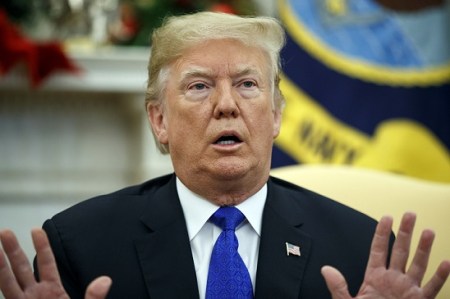
APTrump said a replacement would be chosen soon.
The two also were divided on the future of the Afghanistan war, with Trump complaining from the first about its cost and arguing for withdrawal. Mattis and others ultimately persuaded Trump to pour additional resources and troops into the conflict to press toward a resolution.
U.S. officials say there now is active planning in the Pentagon that would pull as many as half the 14,000 U.S. troops out of Afghanistan by summer. They say no final decision has been made.
U.S. military leaders were scrambling Thursday to devise a swift but safe departure of troops from Syria, as outraged lawmakers on both sides of the aisle appealed to President Donald Trump to reverse an abrupt withdrawal order that rattled Washington’s allies and was a key factor in the resignation of Defense Secretary Jim Mattis later in the day. Opponents of the move said the withdrawal would strengthen the hand of Russia and Iran in Syria and enable a resurgence of the Islamic State group.
The terrorists still hold a string of villages and towns along the Euphrates River in eastern Syria, where they have resisted weeks of attacks by the U.S.-supported Syrian Democratic Forces to drive them out. The pocket is home to about 15,000 people, among them 2,000 Islamic State fighters, according to U.S. military estimates.
Mattis and other senior administration officials have argued publicly for months that it would be in the best interests of the United States to remain in Syria long enough to ensure a lasting defeat of the Islamic State terrorists, who have been greatly diminished but not eliminated. Gen. Joseph Dunford, chairman of the Joint Chiefs of Staff, recently said the Pentagon estimates that 35,000 to 40,000 local security forces are needed to ensure stability in northeastern Syria. As of December, Dunford said, only about 20% of those forces have been trained.
Defense officials said U.S. airstrikes would continue until all the approximately 2,000 U.S. troops are out of Syria, but it was unclear whether the air campaign would then end. Officials said it might depend on whether France and other coalition partners keep ground troops in Syria after the Americans leave. A continued presence of allied troops working with local Syrians might compel the U.S. to contribute air cover.
Responding to the news on Thursday, Prime Minister Benjamin Netanyahu said Israel would escalate its fight against Iranian-aligned forces in Syria after the withdrawal of U.S. troops from the country.
NATO allies France and Germany said Washington’s change of course on Syria risks damaging the fight against Islamic State, the terrorist group that had seized swathes of Iraq and Syria but has now been squeezed to a sliver of Syrian territory.
“Islamic State has not been wiped from the map nor have its roots. The last pockets of this terrorist organization must be defeated militarily once and for all,” French Defense Minister Florence Parly said on Twitter.
France has about 1,100 troops in Iraq and Syria providing logistics, training and heavy artillery support as well as fighter jets. In Syria, it has dozens of special forces, military advisers and some foreign office personnel.
Trump, however, tweeted that he was fulfilling a promise to leave Syria made during his presidential campaign and arguing that the United States was doing the work of other countries and it was “time for others to finally fight.”
The Pentagon, roiled first by the surprise withdrawal order from Trump and then the abrupt resignation of Mattis, offered no information about how the withdrawal will happen or how long it will take, apparently because they don’t know.
Two officials speaking on condition of anonymity to discuss internal planning said Gen. Joseph Votel, head of U.S. Central Command, will submit a comprehensive withdrawal plan to top Pentagon officials in coming days.
One official said military commanders are concerned that the pullout will leave their Syrian Kurdish allies in the lurch.
Trump’s decision to pull troops out of Syria has been sharply criticized for abandoning America’s Kurdish allies, who may well face a Turkish assault once U.S. troops leave, and had been staunchly opposed by the Pentagon.
Turkey, which considers the Kurds a security threat, has said it intends to send its army into Syria to clear them out. Until now, Turkey had to consider the presence of U.S. troops; once they are gone, a bloody clash seems inevitable.
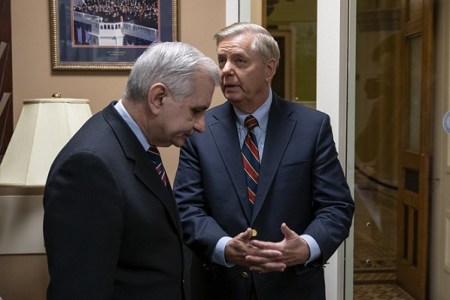
Sen. Lindsey Graham, R-S.C., said on Thursday that Mattis had told him he is worried about the Kurds and this is not the right time to leave.
“I won’t get into conversations between Mattis and the president, but I will tell you what he told me: He thought that the time was not right to leave,” Graham said at a Capitol Hill news conference.
Mattis believes that “the day we leave it’s going to be open season on every Kurd who’s supported us,” according to Graham.
The Kurdish-led Syrian Democratic Forces, who have partnered with U.S. troops for years as the key force against IS militants, said in a strongly worded statement laced with bitterness that the fight against IS was at a “decisive” stage that requires even more support from the U.S.-led coalition, not a precipitate U.S. withdrawal.
The SDF are in the final stages of a campaign to recapture areas seized by the terrorists. But they face the threat of a military incursion by Turkey, which considers the Kurdish YPG fighters who spearhead the force to be a terrorist group, and Syrian forces committed to restoring Assad’s control over the whole country.
“The war against terrorism has not ended and [the Islamic State group] has not been defeated,” the statement said.
While Turkey has not commented directly on Trump’s decision, an end to the U.S.-Kurdish partnership will please Ankara.
Kurdish militants east of the Euphrates in Syria “will be buried in their ditches when the time comes,” state-owned Anadolu news agency reported Defense Minister Hulusi Akar as saying.
Turkey has intervened to sweep YPG and Islamic State fighters from parts of northern Syria that lie west of the Euphrates over the past two years. It has not gone east of the river, partly to avoid direct confrontation with U.S. forces.
Russian President Vladimir Putin said he largely agreed with Trump that the group had been defeated in Syria but added there was a risk it could recover.
He also questioned what Trump’s announcement meant in practical terms, saying there was no sign yet of a withdrawal of U.S. forces, whose presence in Syria Moscow calls illegitimate.
Graham said Mattis also expressed concern about the more than 700 Islamic State fighters being held by the SDF, saying they could be released and end up back on the battlefield.
Graham has himself warned a withdrawal would have “devastating consequences” for the United States.
 AP
APFrom the start of his administration, Trump had made no secret of his desire to pull out of Syria. But the timing of his announcement Wednesday remains a puzzle. His national security adviser, John Bolton, Mattis and other top leaders argued against the pullout but were unable to change Trump’s mind.
Graham and Democratic Senators Bob Menendez of New Jersey and Jack Reed of Rhode Island said they have growing support for a resolution urging the president to change his strategy.
“I can’t explain this decision,” Graham told reporters. “I’m not going to suggest motivations that are anything other than a frustrated president. But I can promise this: that if you follow through with this everything that happened in Iraq is going to happen in Syria. It’s going to be worse, not better. It’s going to make it harder to make the Taliban reconcile.” His Taliban reference was to U.S. efforts to promote peace in Afghanistan.
On Thursday, Trump defended his decision, saying on Twitter: “Getting out of Syria was no surprise. I’ve been campaigning on it for years, and six months ago, when I very publicly wanted to do it, I agreed to stay longer.”
He added: “Does the USA want to be the policeman of the Middle East, getting NOTHING but spending precious lives and trillions of dollars protecting others who, in almost all cases, do not appreciate what we are doing? Do we want to be there forever?”
“So hard to believe that Lindsey Graham would be against saving soldier lives & billions of $$$. Why are we fighting for our enemy, Syria, by staying & killing ISIS for them Russia, Iran & other locals?” he asked.
Secretary of State Mike Pompeo, who is known to have opposed leaving Syria now, defended the Trump decision Thursday.
“The president made an enormous commitment to take down the caliphate, and that has been achieved,” he said. “We now have the battle, it’s a long-time battle, which is the counterterrorism battle, not only against ISIS, but against al-Qaida and others …, all the terrorist groups. President Trump remains just as committed today as he was yesterday and the day before.”








 WarSclerotic
Recent Comments