Early elections called for April 9 as coalition agrees to dissolve Knesset 

Posted December 24, 2018 by Joseph Wouk
Categories: Uncategorized

Source: Early elections called for April 9 as coalition agrees to dissolve Knesset | The Times of Israel

Government says all parties have agreed on national polls after ‘full four-year term,’ amid disagreements over ultra-Orthodox draft law

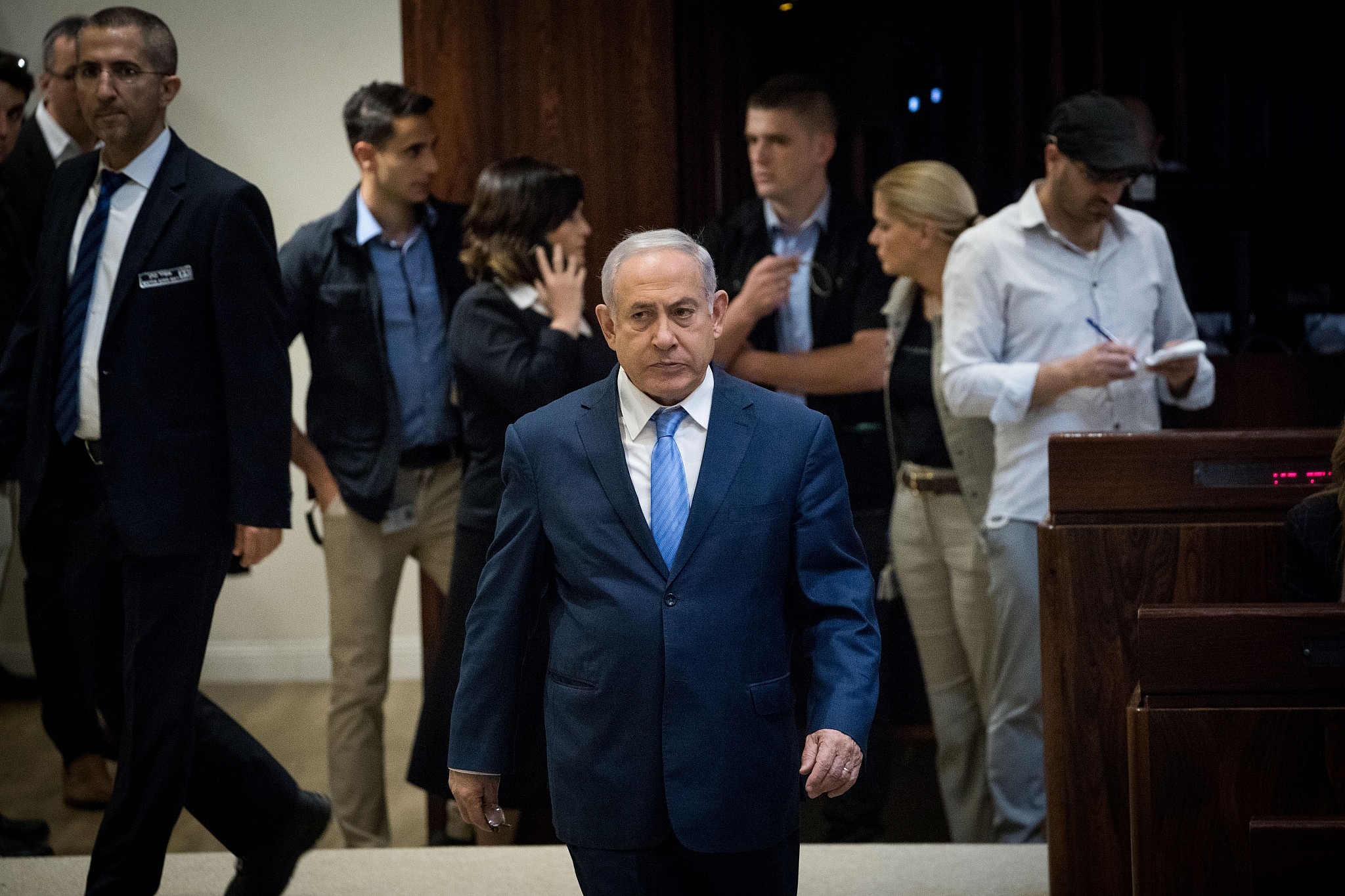
Prime Minister Benjamin Netanyahu in the Knesset on November 21, 2018 (Yonatan Sindel/Flash90)

Prime Minister Benjamin Netanyahu in the Knesset on November 21, 2018 (Yonatan Sindel/Flash90)

Amid a series of coalition crises and deliberations over a possible indictment against Prime Minister Benjamin Netnayahu, coalition leaders announced Monday that Israel will head to the polls within four months, with a general election set for April.

“Out of national and budgetary responsibility, the leaders of the coalition parties decided, unanimously and unanimously, to dissolve the Knesset and go to new elections at the beginning of April after a four-year term,” the heads of the five coalition parties said in a joint statement.

Elections were previously slated for November 2019, and the announcement means that Knesset members will vote to dissolve parliament early. Hebrew media reports said the elections would likely be held on April 9.

Despite ongoing disagreements over the ultra-Orthodox draft bill, which was the initial impetus for their meeting Monday, the coalition heads stressed that none of the parties will leave the government and that “the partnership in the Knesset and in the government will continue during the elections.”

The announcement came after MK Yair Lapid announced that his opposition Yesh Atid party will vote against the coalition’s bill on the military draft of ultra-Orthodox men, claiming that the government was preparing an “under the table” deal that would change the import of the legislation.

Earlier this month, the Supreme Court granted the government a further month and a half to pass the bill, extending an early December deadline to mid-January. Without the extension, thousands of yeshiva students would have become eligible to be drafted.

Elections will likely mean a further extension will be granted.

The decision to go to the polls comes just a month after Avigdor Liberman resigned as defense minister and pulled his Yisrael Beytenu party out of the coalition, leaving it with a paper-thin majority of just 61 out of 120 Knesset members.

The decision also comes as Attorney General Avichai Mandelblit is set to begin reviewing materials to decide on possible charges against Netanyahu this week, embarking on the most high-stakes stage yet of a several-year legal entanglement that has threatened to upend the country’s political system.

State Prosecutor Shai Nitzan said Wednesday he was wrapping up recommendations on three cases against Netanyahu for Mandelblit, which reportedly include recommendations that the premier be indicted on bribery charges over an affair in which he is accused of kicking back regulatory favors in exchange for positive media coverage.

Mandelblit is expected to convene his legal team to begin working on the hundreds of pages of testimony and other evidence in the three cases on Monday, the Ynet news site reported.

Of the cases Netanyahu is suspected of illegal activity in, the one known as Case 4000 is considered by the State Prosecutor’s Office to be the most serious, according to Israeli television reports.

In that case, Netanyahu is suspected of having advanced regulatory decisions as communications minister and prime minister from 2015 to 2017 that benefited Shaul Elovitch, the controlling shareholder in Bezeq, the country’s largest telecommunications firm, in exchange for positive coverage from Elovitch’s Walla news site.

In another affair, Case 1000, Netanyahu is suspected of receiving benefits worth about NIS 1 million ($282,000) from billionaire benefactors, including Israeli Hollywood producer Arnon Milchan, in exchange for assistance on various issues.

A third, Case 2000, involves a suspected illicit quid pro quo deal between Netanyahu and Yedioth Ahronoth publisher Arnon Mozes that would have seen the prime minister hobble a rival daily newspaper, the Sheldon Adelson-backed freebie Israel Hayom, in return for more favorable coverage from Yedioth.


Israel votes against Russia at UN over annexation of Crimea 

Posted December 24, 2018 by Joseph Wouk
Categories: Uncategorized

Source: Israel votes against Russia at UN over annexation of Crimea – Israel Hayom


A one-time opportunity for Israel 

Posted December 24, 2018 by Joseph Wouk
Categories: Uncategorized

Source: A one-time opportunity for Israel – Israel Hayom

Michael Oren

U.S. President Donald Trump’s decision to withdraw ‎American troops from Syria shocked many in the ‎United States and the Middle East.

While in Israel ‎most of the public discourse revolves around the ‎challenges in this process, we seem to be ‎largely ignoring the question of what opportunities ‎it may present. For one, could Israel, as ‎compensation, secure a pledge from Washington to ‎help it in times of war and on other vital ‎diplomatic issues?‎

Given the recent discovery of Hezbollah’s grid of ‎terror tunnels and Iran’s attempts to upgrade its ‎offensive capabilities, it is reasonable to assume ‎that Israel is closer than it has ever been in the ‎last decade to a war in the northern sector. This could prove highly complex from a ‎military standpoint and even a legal-diplomatic one: Most of Hezbollah’s arsenal of 130,000 projectiles is hidden under civilian homes. ‎Neutralizing them would require investing ‎considerable military resources and likely ‎entail large civilian losses.‎

It is important to remember that in the last four ‎military campaigns since 2006, Israel has had to ask ‎the United States for additional ammunition, and it ‎would probably have to do the same in a future war. ‎Israel would also likely need diplomatic and legal ‎backing to defend it against condemnations in ‎the U.N. Security Council and the International ‎Criminal Court.‎

The same opportunity exists regarding the situation ‎opposite Hamas in the Gaza Strip: Israel can win ‎a U.S. commitment for the post-Hamas era ‎there. Naturally, the IDF is capable of removing ‎Hamas from the Gaza Strip on its own, but the ‎question is who would take its place. ‎

Understandings could be reached with the ‎U.S. – and through it, the Sunni world – on Gaza’s rehabilitation and the ‎establishment of an economic infrastructure for the civilian population there.‎

As Israel prepares for military campaigns in its ‎north and its south, as part of my position as ‎deputy minister for public diplomacy at the Prime ‎Minister’s Office, I am promoting a first-of-its-kind initiative to develop the Golan Heights. ‎

The goal is to have more than 100,000 Israelis move ‎to the area over the next decade, thereby increasing ‎the Israeli population there by five times, and ‎establish the necessary industrial and ‎transportation infrastructure.‎

My efforts have already gained widespread ‎support domestically and internationally.

Now, ‎given the fragile situation in Syria, Israel must ‎reach a comprehensive understanding with the U.S. on ‎recognizing Israeli sovereignty over the Golan ‎Heights. This would send a message to our ‎enemies about the decisive American position on the eternal Israeli ownership of the Golan ‎Heights.‎

It would be a good idea to make a large portion of ‎these commitments public in multiple languages. Such ‎a move would bolster the U.S.’s somewhat bruised ‎image in the Middle East and even reinforce its ‎ability to promote diplomatic processes and its ‎position as a very effective mediator in possible ‎peace negotiations. ‎

It is no secret that during the Obama ‎administration, the U.S. lost some of its status ‎in the region. The Trump administration has taken ‎several steps – from striking Syrian assets in ‎response to Syrian President Bashar Assad’s use ‎of chemical weapons to pulling out of the 2015 ‎nuclear deal with Iran – to improve this situation. ‎

A commitment to aid Israel would be a continuation ‎of this policy of improvement, presenting multiple ‎possibilities not only for Israel but also for the ‎Trump administration. ‎

The recent changes in the region present a one-time ‎opportunity for Israel, and we should take advantage ‎of it.‎

Michael Oren is a former Israeli ambassador to the U.S. He currently serves as deputy public diplomacy minister.

PM: US withdrawal from Syria will not affect Israel 

Posted December 24, 2018 by Joseph Wouk
Categories: Uncategorized

Source: PM: US withdrawal from Syria will not affect Israel – Israel Hayom


Report: Egypt steps in to curb Gaza border violence 

Posted December 24, 2018 by Joseph Wouk
Categories: Uncategorized

Source: Report: Egypt steps in to curb Gaza border violence – Israel Hayom


US should recognize Golan as Israeli 

Posted December 24, 2018 by Joseph Wouk
Categories: Uncategorized

Source: US should recognize Golan as Israeli – Israel Hayom

Zvi Hauser

The announcement that the United States is withdrawing its forces from Syria should not really have come as a surprise to anyone in Israel’s diplomatic-security circles or the media.

But with most of the focus in Israel on tactical steps rather than well-ordered strategies, we once again woke up to a surprise reality that Israel does not want.

From the time the Syrian war broke out in 2011, Israel has chosen to ignore the historic processes taking place on the other side of the border. While Russia, Turkey and Iran spotted the geopolitical opportunities the war presented and adapted their regional activities in accordance, Israel opted to wish all sides involved good luck and preened about tactical military achievements.

Israel had a clear strategic interest in seeing the war end with Syria split into three states, based on the ethnic population distribution: Alawite-Shiite, Sunni, and Kurds. If that had come to pass, it would have been enough to block Iranian expansion, and beyond that, it would have presented a strategic opportunity to redraw a historical border that expressed international recognition of Israeli sovereignty on the Golan Heights, which comprise a mere one percent of Syrian territory. That interest dovetailed with the international desire to prevent mass murder, uphold human rights, and prevent an exodus of refugees.

Israel missed a historic opportunity to speed up vital changes in arranging borders in the Middle East that were drawn up forcibly at the end of World War I. Now, the withdrawal of American forces from Syria demands that Israel exert all its influence to convince its U.S. ally to adopt a “hybrid” mentality on everything having to do with Syria and recognize the Golan Heights as Israeli as the final steps of the pullout.

A move like that would serve long-term U.S. interests in defending Israel’s security and the stability of Jordan, without keeping any forces on the ground. The Golan is only viable if it remains in Israeli hands, and any Israeli withdrawal to the shores of the Sea of Galilee would ensure an inherent lack of stability that sooner or later would require U.S. military intervention.

There are no vacuums in the Middle East. In the absence of determined, immediate action by Israel to secure U.S. recognition of Israel’s sovereignty on the Golan – before the U.S. withdraws from Syria – Israel could find itself facing international demand for a dream deal for Syrian President Bashar Assad and Iran: Iran would withdraw from Syria – which would remain under the cover of various militias, similar to the Hezbollah model in Lebanon – in exchange for Israel withdrawing from the Golan Heights.

The clouds hanging over international politics could wind up creating a perfect storm, to Israel’s detriment. One morning, we could wake up to another, much bigger surprise: unrestrained international pressure to withdraw from the Golan Heights, in the spirit of the “solution” raised before the Syrian war.

Those who see this as a nightmare scenario should ask themselves whether they envisioned that within a few years of the start of the Syrian war, Iranian forces would be a stone’s throw from Quneitra, and that Assad would be back in power after hundreds of thousands of his own people were killed and millions more turned into refugees.

Zvi Hauser is a former cabinet secretary.


Trump names new Defense Secretary, outplays Erdogan’s bluster for marching on Syrian Kurds – DEBKAfile

Posted December 24, 2018 by Joseph Wouk
Categories: Uncategorized

Source: Trump names new Defense Secretary, outplays Erdogan’s bluster for marching on Syrian Kurds – DEBKAfile

President Donald Trump on Sunday, Dec. 23 named Dep Secretary of Defense Patrick Shanahan as Defense Secretary as of Jan. 1, 2019. By deciding not to wait for James Mattis’s departure on Feb. 1, Trump asserted his authority as commander in chief. In the same Tweet, he put the Turkish President down for his strident threats of military operations to “deal with” the Syrian Kurds and ISIS,” as soon as the Americans were gone.

Trump: “I just had a long and productive call with President Erdogan of Turkey. We discussed ISIS, our mutual involvement in Syria & the slow & highly coordinated pullout of US troops from the area. After many years, they are coming home.”

In other words, the US was slowing down the troop withdrawal from northern and eastern Syria to such time as it suited the administration – not Erdogan and his plans.

(DEBKAfile revealed exclusively on Saturday Dec. 22 that the US pullout could take months and went on to negate Turkey’s plan to cross the Euphrates into E. Syria.)

Indeed, by a single well-calculated move, scarcely the action of a president ruling recklessly from a chaotic White House, Trump put Erdogan in his place and showed him up as a braggart, because the truth is that Ankara does not have enough troops or military assets to make good on his threats to cross into northern Syria, confront the Kurds in their capital of Qamishli, beat them down and seize control of all northern Syria.

This Tweet was Trump’s answer to a panicky phone call he received earlier Sunday from the Turkish president. Some informed sources in Washington report that Erdogan pleaded with Trump to slow down the US troop pullout from Syria. He had fed the media in the past 24 hours with the boast that massive Turkish forces were already massed in Northern Syria ready to head east across the Euphrates to finish the Kurds. DEBKAfile’s military sources disclose that the “massive” Turkish force consisted of a single tank battalion, nowhere near a threat to the battle-seasoned Kurdish militia.

From Saturday, Dec. 22, Erdogan, vented his frustration over the poke in the eye he received from the US president, by heaping abuse on Israel, a pet target.

 “The Jews in Israel kick people when they’re lying on the ground… not just men, but women and children as well…as Muslims… we’ll teach them a lesson,” Erdogan told a Turkish youth audience on Saturday. Prime Minister Binyamin Netanyahu replied, “Erdogan—the occupier of northern Cyprus, whose army massacres women and children in Kurdish villages, inside and outside Turkey– shouldn’t preach to Israel.”


Israeli-Russian relations strained following U.S. withdrawal from Syria 

Posted December 23, 2018 by Joseph Wouk
Categories: Uncategorized

Source: Israeli-Russian relations strained following U.S. withdrawal from Syria – Israel News – Jerusalem Post

After airing out their disagreements at the U.N., Jerusalem and Moscow have signaled a willingness to move beyond crisis over beyond downed Russian plane.

BY TERRANCE J. MINTNER & TARA KAVALER/THE MEDIA LINE
 DECEMBER 22, 2018 18:39
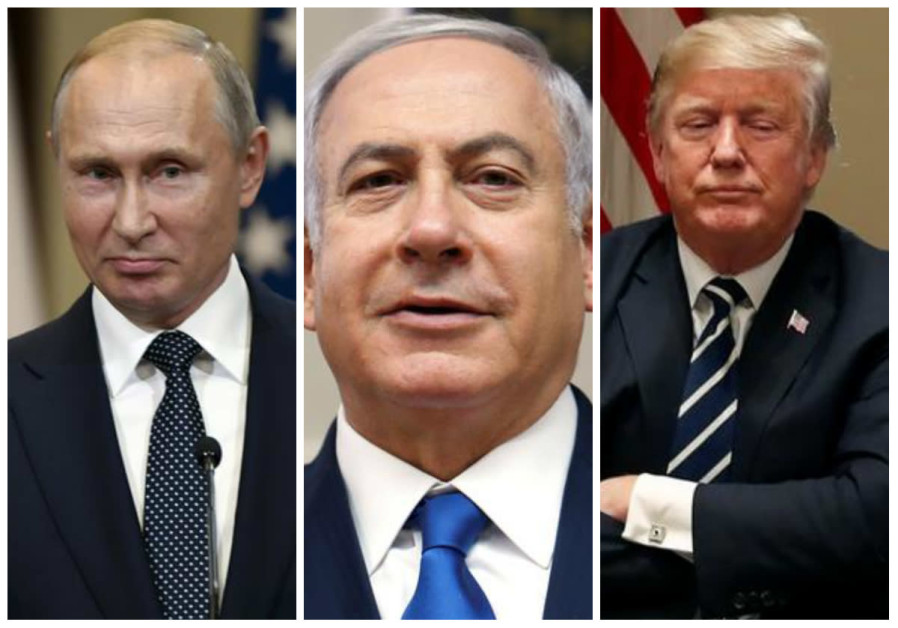
Putin (L), Netanyahu (C) and Trump (R)

Following United States President Donald Trump’s announcement that Washington will immediately begin withdrawing troops from Syria, analysts believe it is more important than ever for Israel to mend strained ties with Russia.

Israeli-Russian relations deteriorated sharply in the aftermath of the downing in September of a Russian plane in Syria that came amid an Israeli airstrike targeting Iranian assets. Though the aircraft was shot down by Syrian-manned air defenses—killing all 15 people on board—Moscow blamed Israel for failing to issue adequate advance warning before it attacked targets close to a Russian military base. Israel has denied the charge.

There have been several attempts at a rapprochement, including last week when Israel sent a military delegation to Moscow to brief Russian officials on Operation Northern Shield, launched by the Israeli army to uncover and destroy Hezbollah attack tunnels stretching into Israel.
On Wednesday, Moscow sent a special delegation to Israel to help ease tensions, potentially signaling a willingness by the Kremlin to move beyond the dispute over the downed plane.
Before the delegation’s arrival, however, the discord played out at the United Nations, with both governments taking contrasting positions on resolutions in the General Assembly. For its part, Russia helped defeat a United States-sponsored resolution that would have condemned Hamas, the Palestinian terrorist group that rules the Gaza Strip.
The Kremlin also invited Hamas leader Ismail Haniyeh to visit Moscow later this month despite opposition by Jerusalem.
Israel seemingly retaliated diplomatically when earlier this week it voted for a UNGA resolution that denounced Russia’s “progressive militarization of Crimea.” The measure also called on Moscow to “end its temporary occupation of Ukraine’s territory.” Up until that point, Israel had notably been silent on the Russia-Ukraine crisis.
“We are still figuring out the [Israeli-Russian] relationship after the downing of the Russian aircraft,” Zvi Magen, a former Israeli ambassador to Russia and the Ukraine, told The Media Line.
“The Russians tried to change the rules of the game [by courting Haniyeh] and the Israelis didn’t like that. Russian officials, on the other hand, wanted to teach Israel a lesson that they will assert their own independent interests.
“Generally speaking,” he elaborated, “Israel’s relations with Russia are very tense. It is a problematic country that exerts a huge influence in the region. It is in Israel’s security interest to maintain good bilateral relations.”
With respect to President Trump’s decision to pull US troops out of Syria, Magen expressed skepticism the move will actually be carried out. “This could just be a version of ‘fake news’ because we are talking about the potential withdrawal of only 2,000 American soldiers. The U.S.’ main military capabilities would still exist as it maintains naval fleets and air force bases around Syria. Therefore, it can quickly intervene in any conflict.
“For Israel, this is not a big blow because it has learned to manage its own problems,” he concluded.
By contrast, Dr. Samuel Barnai, an expert on the history and politics of East-Central Europe at the Hebrew University in Jerusalem, believes that the current tensions over Syria can have a long-term impact on Israel’s ties to Russia.
“The Russians supply the Assad regime mainly with air support while Iran and its various Shiite militias provide boots on the ground. This partnership forces Israel to reckon with Moscow’s military presence in the region but makes it difficult for Jerusalem to maintain a good relationship with Russia,” he noted.
“It is a question of life and death for Israel because it can’t allow Iran-backed proxies to become stronger. It can cooperate with the Russians on certain matters, but not when it comes to the terrorist group’s hostile stance toward Israel.”
(Tara Kavaler, an intern in The Media Line’s Press and Policy Student Program, contributed to this report)


Turkey reportedly reinforcing Syrian border after U.S. exit from country 

Posted December 23, 2018 by Joseph Wouk
Categories: Uncategorized

Source: Turkey reportedly reinforcing Syrian border after U.S. exit from country – Middle East – Jerusalem Post

Erdogan said on Friday that Turkey will take over the fight against Islamic State militants in Syria as the United States withdraws its troops.

BY REUTERS
 DECEMBER 23, 2018 14:03
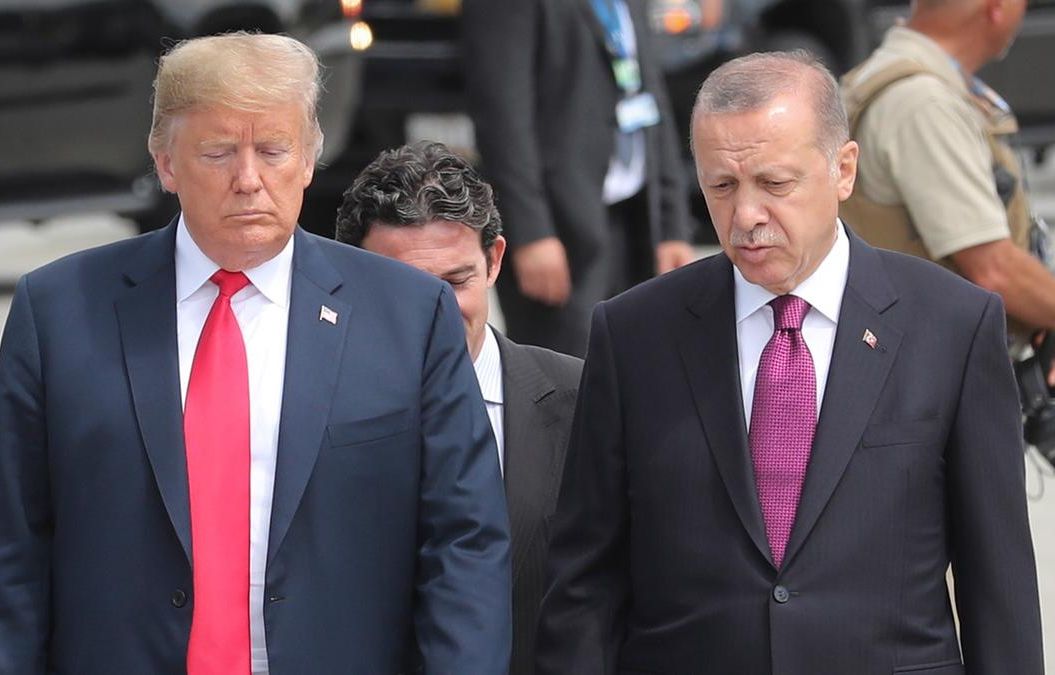
U.S. PRESIDENT Donald Trump speaks with Turkish President Recep Tayyip Erdogan in July 2018

ISTANBUL – Turkey is sending reinforcements to its border with Syria, Demiroren News Agency (DHA) reported on Sunday, adding that some 100 vehicles including mounted pickup trucks and weaponry had made their way to the area.

The heightened military activity comes days after President Tayyip Erdogan said Turkey would postpone a planned military operation on the Kurdish YPG militia in northern Syria after the United States decided to withdraw from Syria.

HA said the Turkish convoy, headed toward the border district of Kilis, located in the southern province of Hatay, included tanks, howitzers, machine guns and buses carrying commandos.

Part of the military equipment and personnel are to be positioned in posts along the border while some had crossed into Syria via the district of Elbeyli, DHA said.

Elbeyli is located 45 kilometers (27.96 miles) from the northern Syrian town of Manbij, which has been a major flashpoint between Ankara and Washington. In June, the NATO allies reached an agreement that would see the YPG ousted from the area but Turkey has complained the roadmap has been delayed.

Reuters could not independently verify the reason for the reinforcements and Turkish officials were not immediately available for comment.

Erdogan said on Friday that Turkey will take over the fight against Islamic State militants in Syria as the United States withdraws its troops, adding that the planned operation would target the YPG, as well as the Islamic State.

Ankara considers the US-backed YPG militia a terrorist organization and an extension of the Kurdistan Workers Party (PKK), which has waged an insurgency in Turkey since the 1980s.

Turkey has carried out two operations in Syria, dubbed “Euphrates Shield” and “Olive Branch,” against the YPG and the Islamic State in northern Syria.


Operation Northern Shield’s goals – and Trump’s disservice to Israel 

Posted December 23, 2018 by Joseph Wouk
Categories: Uncategorized

Source: Operation Northern Shield’s goals – and Trump’s disservice to Israel – Arab-Israeli Conflict – Jerusalem Post

Hezbollah had a long history of digging underground bunkers and tunnels as was evident during the 2006 Lebanese war between Israel and Hezbollah.

BY YOSSI MELMAN
 DECEMBER 23, 2018 04:56
Operation Northern Shield’s goals – and Trump’s disservice to Israel

The dramatic and surprising announcement by Israel in early December that it had exposed a secret plan to dig invasive tunnels on its Lebanese border gave the impression that another war with Hezbollah is imminent. However, all indications are that we are not on the verge of a new round of violence, despite the IDF’s declaration that it had launched Operation Northern Shield.
Israeli intelligence managed once again to penetrate deeply into the Iranian-backed Hezbollah movement and obtain via technological sources the exact locations of the tunnels along the 130 kilometer-long northern border.

It was revealed that Hezbollah excavated a few tunnels that infiltrated Israel. Two tunnels had already been discovered as of press time. The first tunnel – 25 meters deep, 200-meters long, including 40 meters inside Israeli territory near Metula, was fully exposed – and the IDF Engineering Corps blocked it with heavy cement. In the coming weeks, more tunnels are expected to be discovered and cemented.

Hezbollah had a long history of digging underground bunkers and tunnels as was evident during the 2006 Lebanese war between Israel and Hezbollah. But they served for defensive purposes – moving troops, communication and observation – to repel the Israeli invasion. This time however, the tunnels were intended for offensive objectives.

Hezbollah dug the tunnels to use them in the first phase of a future war, in which its elite fighters and motorcycles would be stealthily transported into Israel to lay ambushes, kidnap soldiers and civilians, and, if possible, take over Israeli villages.

This military doctrine was developed as a lesson learned from the relatively successful use of attack tunnels by Hamas on the Israel-Gaza border. Though most of Hamas’s tunnels were discovered and destroyed, they have undermined Israel’s sense of superiority and have left a psychological impact that still resonates in the consciousness of the Israeli public, the military, and the government led by Prime Minister Benjamin Netanyahu.

The Hamas tunnels were built as the result of lessons learned from North Korea and Vietnam, with Iranian engineering and financial support.

The close cooperation between Hamas and Hezbollah coordinated by Iran have led to the cross-fertilization of ideas and sharing of experience and know-how.

Yet it was easier for Hamas to dig its tunnels on soft, sandy desert soil while Hezbollah had to struggle with much more difficult, hard rocky mountain terrain.

The exposure of the northern tunnels has not only dealt an important military blow to Hezbollah’s secret plans, but also inflicted a heavy psychological blow to the Shi’ite organization and its leaders. Operation Northern Shield shows how deeply Israeli military intelligence has managed to penetrate Hezbollah and glean accurate information from one of its best-guarded secrets.

Hezbollah will now have to once again start a soul-searching and self-damaging process of asking itself what went wrong, how the enemy (Israel) obtained information about the tunnels and whether there are traitors and spies among its own ranks. Another question that should be asked is whether the Mossad was involved, as was previously published.

The discovery of the tunnels – as impressive an operation as it was – doesn’t solve Israeli problems vis-à-vis Hezbollah. The main strategic threat challenging Israel, if a new round of hostilities breaks out, is the unprecedented arsenal of rockets and missiles held by the Lebanese Shi’ite movement. It is estimated that Hezbollah has acquired 120,000 to 150,000 rockets and missiles capable of carrying up to 500 kilograms of explosives and reaching almost any place in Israel – including its air fields, army bases, power stations and the Dimona nuclear reactor. In that sense, Hezbollah has one of the largest missile stockpiles in the world, more than most armies, the IDF included.

Israeli war games and simulations have shown that hundreds of Israelis would be killed in the next war, which would inflict heavy damage to buildings, and rural communities near the border would have to be evacuated.

Another major headache for Israel is a new stage of the joint Iran-Hezbollah missile project. With the assistance of Iranian expertise and experts, Hezbollah is seeking to improve the accuracy and guidance systems of its long-range missiles.

This systematic effort is the main explanation for the Israel Air Force campaign in the last three years to bomb, sabotage and disrupt the supply lines from Iran via Syria to Hezbollah. Israeli warplanes ahave ttacked more than 200 times in Syria over the last year.

But now, due to Russian pressure, the freedom of IAF operations in Syria and the number of sorties have been drastically reduced.

At the same time, Iran has changed its supply lines to Hezbollah. It is flying the new guidance systems in civilian planes directly to Lebanon without a stopover and transition in Syria.

Israel finds itself challenged. Its dilemma is evident. It can’t allow itself to down civilian airliners, which would be a violation of international norms and laws. If it bombs the missile factories, warehouses and launching sites in Lebanon, Hezbollah could retaliate with all its rocket and missile force, and an all-out war would break out.

Both sides, as well as Iran and the US – which has troops in Syria and has imposed sanctions on Iran – do not want a new war in the Middle East. Thus it seems that despite the inflammatory rhetoric and the drama surrounding the tunnels, mutual deterrence among all parties involved is still maintained.

THE BIBLE tells us the story of Balaam and Balak, which is interpreted as a fable, about how the best intentions of blessing and offering praise backfire into a curse. This is exactly how President Donald Trump’s most recent reference to Israel should be interpreted.

In his interview with The Washington Post, Trump said that the only reason that US troops are in the Middle East is not because of oil but because of Israel.

“Oil is becoming less and less of a reason because we’re producing more oil now than we’ve ever produced,” Trump said. “So, you know, all of a sudden it gets to a point where you don’t have to stay there. One reason to stay is Israel.”

As far as oil is concerned, Trump is right. US dependence on Middle East oil has decreased in the last decade. Ostensibly, Israel should be satisfied with Trump’s words. For the last year, Israeli officials, led by Prime Minister Benjamin Netanyahu, and its military and intelligence chiefs worked hard to persuade the administration not to withdraw US troops from Syria.

Israel has a huge stake in American servicemen remaining in the Middle East in general and Syria in particular. There are currently around 2,000 US soldiers in Syria, most of them belonging to special forces. They are deployed to counter the Russian incursion into the region and repel Iranian hegemonic aspirations. Though publicly Israeli leaders will say nothing that may be interpreted as criticism of Trump, privately they express uneasiness about the president’s comments.

Over decades, American and Israeli leaders have established a solid strategic alliance, which is based on mutual interests, shared values and cultural ties.

This alliance enables Israel to benefit from a generous 4.3 billion dollars in financial aid annually as well as strong diplomatic support. The US protects Israel at international forums, especially at the United Nations against resolutions to condemn and occasionally sanction Israel for its continued occupation of the Palestinian West Bank.

Israel purchases from the US its most advanced state-of-the-art weaponry, above all warplanes and sophisticated intelligence equipment. The two countries conduct joint military exercises and share and exchange intelligence including in the most sensitive operations.

The assassination in Damascus in 2008 of Imad Mughniyah is a case in point. The Washington Post reported that Mughniyah, the “chief of staff” of Lebanon’s Hezbollah was killed by a car bomb, in a joint Mossad-CIA operation. But throughout the years, successive Israeli governments, Netanyahu’s included, have emphasized that Israel can and will defend itself if necessary. They have stressed time and again that the don’t need and don’t want US troops to fight shoulder to shoulder with Israeli soldiers and spill their blood in defense of the Jewish state.

Trump is adored by the right-wing Netanyahu government. He is considered as the most pro-Israel US president in history, and some of Netanyahu’s supporters have elevated him to the status of Israel’s savior. He has moved the US Embassy to Jerusalem and cut aid to the Palestinian Authority but his long-awaited “deal of the century” between Israel and the Palestinians is still pending.

Practically he has given Israel a license to do whatever it wants and get away with it. But now, in his clumsy way and with his limited vocabulary, Trump’s words have set a trap for Israel. If US troops are killed in the Middle East, Israel’s rivals and bashers as well as right-wing antisemites will hold Israel responsible. Comments in this direction have already been written and voiced in social media.

Had Trump been more careful in choosing his words, he should have justified his decision to leave the US military in the region with a different kind of explanation.

National Security Adviser John Bolton stated in September that American forces would remain in Syria “as long as Iranian troops are outside Iranian borders, and that includes Iranian proxies and militias.” James Jeffrey, the US envoy to Syria, said that same month Washington was “going to be focusing on the long-range Iranian presence there and ways to get that out while we’re working on the Daesh problem,” referring to the Arabic acronym for ISIS. On the ground, the US-led coalition has already used deadly force in several high-profile encounters with Iranian-backed or pro-regime forces.

It would have been better for Israel, which Trump so strongly supports, and it would have been more accurate to say that the reason the president changed his view to recall US troops back home was because he wants to rein in Iran and that he is doing this to support all US allies in the region, and not only Israel.

By not explaining his policy’s rationale and even twisting it, notwithstanding his good intentions, the American president has done a disservice to Israeli national interests.

Yossi Melman blogs at http://www.yossimelman.com and tweets @Yossi_melman