Iran threatens Israel with ‘inferno,’ vows to improve missile accuracy

Posted January 29, 2019 by Joseph Wouk
Categories: Uncategorized

Source: Iran threatens Israel with ‘inferno,’ vows to improve missile accuracy | The Times of Israel

Top security official says Tehran won’t increase missile range due to its ‘defensive doctrine’; boasts that Hezbollah tunnels were an ‘absolute disgrace’ to Jewish state
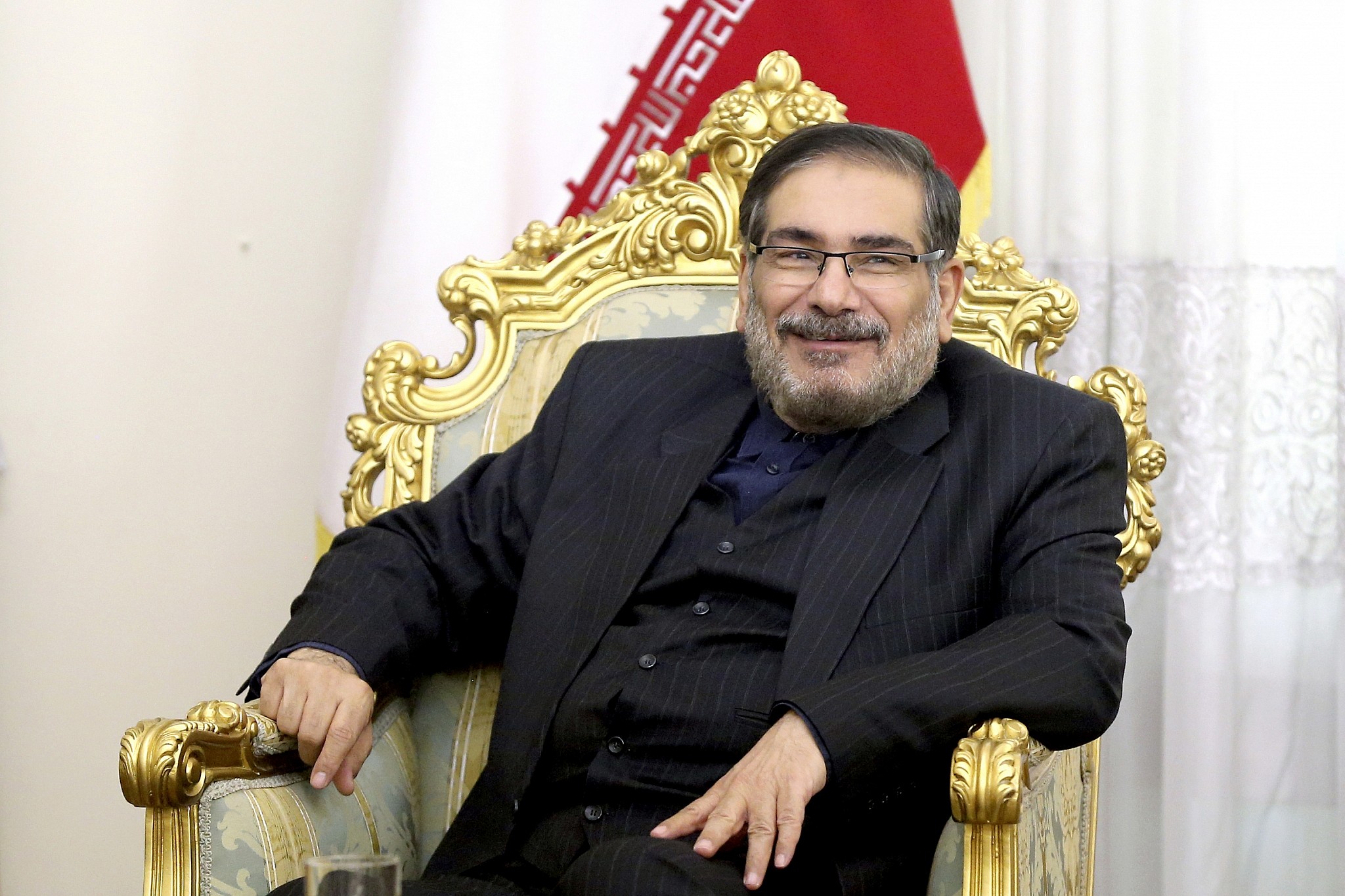
Secretary of Iran's Supreme National Security Council Ali Shamkhani in Tehran, Iran, January 17, 2017.  (Ebrahim Noroozi/AP)

Secretary of Iran’s Supreme National Security Council Ali Shamkhani in Tehran, Iran, January 17, 2017. (Ebrahim Noroozi/AP)

Iranian officials continued their anti-Israel rhetoric on Tuesday, threatening to improve the accuracy of their country’s missiles and warning that terror groups Hamas and Hezbollah were prepared to unleash an “inferno” on the Jewish state.

Speaking at a conference on space technology, the secretary of Iran’s National Security Council, Ali Shamkhani, was quoted by the Tasnim news agency as saying that “it has been an absolute disgrace for the Zionists when an Israeli minister was proved to be a spy, when there are hundreds of kilometers of tunnels dug underneath their feet, and when the resistance forces in Gaza and Lebanon have missiles with pinpoint accuracy and are ready to respond to any foolish Israeli behavior with an inferno.”

He was referring to the conviction of former minister Gonen Segev of spying for Tehran, and to a recent operation in which the Israel Defense Forces uncovered and destroyed six subterranean passages penetrating into Israel from Lebanon. Israel says they are attack tunnels dug by Lebanese terror group Hezbollah — a close Iranian ally.

Shamkhani also said Tehran has the capabilities to extend its missile range, but won’t do so due to its “defensive doctrine.”

“Iran has no scientific or operational restriction for increasing the range of its military missiles, but based on its defensive doctrine, it is continuously working on increasing the precision of the missiles and has no intention to increase their range,” he said, according to the Reuters news agency.
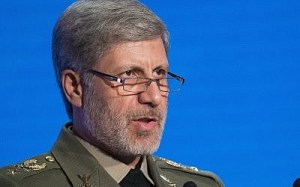
Iranian Defense Minister Amir Hatami speaks at the Conference on International Security in Moscow, Russia, April 4, 2018. (AP Photo/Alexander Zemlianichenko)

Meanwhile, Iran’s Defense Minister Amir Hatami railed at Prime Minister Benjamin Netanyahu’s campaign against Iran’s missile program, which was among the reasons cited by US President Donald Trump in leaving the landmark 2015 nuclear deal and reimposing crippling sanctions.

“The enemies say Iran’s missile power should be eliminated, but we have repeatedly said our missile capabilities are not negotiable,” Hatami said, according to Reuters.

Shamkhani also hit back at Washington’s demand that Iran halt its satellite-launching project, vowing to continue it “to improve the quality of people’s lives and increase the country’s technological prowess.”

The comments followed a series of reciprocal taunts by Israeli and Iranian leaders in recent weeks as tensions have risen on the Israeli-Syrian border between IDF and Iranian forces.

Last week, Israel reportedly conducted a rare daylight missile attack on Iranian targets in Syria. In response, Iran fired a surface-to-surface missile from Syria at the northern Golan Heights, which was intercepted by the Iron Dome missile defense system over the Mount Hermon ski resort, according to the Israel Defense Forces.

Hours later, in the predawn hours of January 21, the Israeli Air Force launched retaliatory strikes on Iranian targets near Damascus and on the Syrian air defense batteries that fired upon the attacking Israeli fighter jets, the army said.

Twenty-one people were killed in the Israeli raids in Syria, 12 of them Iranian fighters, a Britain-based Syrian war monitor said the following day. Iran has denied that its citizens were among the dead.
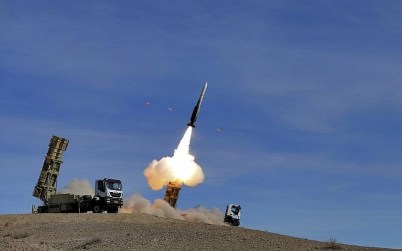
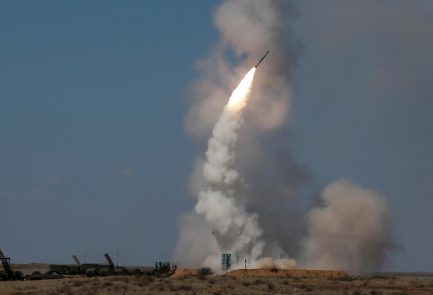
In this photo provided November 5, 2018, by the Iranian Army, a Sayyad 2 missile is fired by the Talash air defense system during drills in an undisclosed location in Iran. (Iranian Army via AP)

On Monday, the deputy head of Iran’s Islamic Revolutionary Guard Corps said Tehran’s strategy was to eventually wipe Israel off the “global political map.”

Asked by a reporter in Tehran about Israeli threats to strike Iranian forces deployed in Syria, Brig. Gen. Hossein Salami was quoted by Iranian news outlets as saying, “Our strategy is to erase Israel from the global political map. And it seems that, considering the evil that Israel is doing, it is bringing itself closer to that.”

He added: “We announce that if Israel does anything to start a new war, it will obviously be the war that will end with its elimination, and the occupied territories will be returned. The Israelis will not have even a cemetery in Palestine to bury their own corpses.”

Israel sees Iranian entrenchment in Syria as a major threat and in recent years has carried out hundreds of airstrikes in Syria against targets linked to Iran, which alongside its proxies and Russia is fighting on behalf of the regime of Syrian President Bashar Assad.

Times of Israel staff contributed to this report.


Moscow wants Israel to help speed US exit from Syria, but won’t stop Iranian arms shipments – DEBKAfile

Posted January 29, 2019 by Joseph Wouk
Categories: Uncategorized

Source: Moscow wants Israel to help speed US exit from Syria, but won’t stop Iranian arms shipments – DEBKAfile

Iran’s removal from Syria is a non-starter until the Americans pull out. This is the message two high-ranking Russian officials were to hand Prime Minister Binyamin Netanyahu in Jerusalem on Tuesday, Jan. 29.

The message from President Vladimir Putin was carried to Jerusalem by Russian Deputy Foreign Minister Sergey Vershinin and special presidential envoy for Syria Alexander Lavrentiev. While Moscow described their mission as part of a joint Russian-Israeli effort to reach common solutions to the political and military problems arising in Syria, their Israeli hosts understood that Netanyahu was being asked to use his influence with US President Donald Trump and his White House advisers to get American troops out of Syria with all possible speed.

In fact, Messrs. Vershinin and Lavrentiev had hardly unpacked their bags on Monday when they confronted Foreign Ministry Director General Yuval Rotem with a demand for Israel to push Washington into abandoning the Marines base at Al Tanf.

Moscow first raised this demand six months ago. It also comes up whenever President Putin or his foreign minister Sergei Lavrov meets President Trump or any American military or diplomatic officials – so far without eliciting a clear answer. The only White House formulation is that Al Tanf’s eventual evacuation will take place as part of the comprehensive American troop pullout from Syria, which is not imminent.

Al Tanf is the key to the plans and interests of Moscow, as well as Iran, Israel and Jordan, because it sits at the heart of a 55-km enclave of southeastern Syria which controls the junction of the Syrian, Iraqi and Jordanian borders. The US garrison therefore stands in the way of the entry of Iranian-backed Iraqi Shiite militias into Syria. Washington has not yet decided whether to make the US base at Al Tanf permanent or eliminate it. Israel and Jordan are urgently pressing the Americans to stay there.

Moscow, in bidding for Israel’s intercession with the Trump administration, is hobbled by failing to comply with Putin’s promises to Trump and Netanyahu in 2017 with regard to limitations on the Iranian presence in Syria. In fact, ever since then, under the noses of the Russian command, forces loyal to Tehran, including Hizballah, have been edging closer towards the Israeli and Jordanian borders.

Therefore, Putin’s two emissaries will no doubt hear the prime minister reply to their request by saying that, before discussing Al Tanf, Israel wants to see Moscow upholding its commitments. DEBKAfile’s sources sum up the Israeli position as centering on three demands:

  1. Iranian and pro-Iranian forces in Syria must pull 80km back from its border, in line with Putin’s promise of 2017.
  2. Tehran must be stopped from transferring arms shipments for Syria and Hizballah by air. Moscow has never acceded to Israel’s demands on this score although it was raised at every Israeli-Russian encounter in the past year.
  3. The factories located in Syrian bases for attaching precision-guidance devices to Hizballah’s ground missiles must be dismantled forthwith.

The Russians have picked up on voices in Israel who advise the prime minister and IDF Chief of Staff Lt. Gen. Aviv Kochavi to switch their orientation.  Israel’s military actions for driving the Iranians out of Syria – however effective, they say, will not fully achieve their goal unless Moscow takes a hand and intercedes politically with Tehran. This view was first aired publicly on Monday, Jan. 28, by a former Israeli Air Force chief, Meir Eshel. He was the first high-ranking Israeli military officer to say plainly that Israel would be better off relying on Moscow than on Washington to achieve its objectives regarding Iran and Syria.


Hezbollah: Decision on war with Israel can be made “at any moment” – TV7 Israel News 28.01.19 

Posted January 28, 2019 by Joseph Wouk
Categories: Uncategorized


The new Arab boycott

Posted January 28, 2019 by Joseph Wouk
Categories: Uncategorized

Source: The new Arab boycott

Opinion: The Arab world is becoming increasingly aware of the fact that Iran is the primary problem of the region, and are responding accordingly; they are in line with Israel on this issue, so why is the progressive West refusing to see it?

A major economic conference was supposed to take place last week. There was no international clamor, there were no demonstrations on campuses, the BDS anti-Israel brigade were nowhere in sight, but the conference still failed due to a boycott.

Surprisingly, this wasn’t a conference that was supposed to be held in Tel Aviv or Jerusalem—it was the Fourth Arab Economic and Social Development Summit, held in Beirut and boycotted by the leaders of the Arab countries, with the exception of Qatar and Mauritania.

Is the Arab world boycotting Lebanon? Officially, no. In practice, yes. Like so many problems in the Middle East, Iran was the reason this time as well. Lebanon could have been the most prosperous country in the Arab world, wrote Abdulrahman al-Rashed, former editor of the Asharq Al-Awsat daily and current director-general of Al-Arabiya, but that will never happen because Iran controls Lebanon.

Iranian FM Zarif meeting with Hezbollah leader Nasrallah in Beirut (Photo: Reuters) (Photo: Reuters)

Iranian FM Zarif meeting with Hezbollah leader Nasrallah in Beirut (Photo: Reuters)

Al-Rashed wrote: “The region is experiencing a series of crises, whose common denominator is a connection to Iran. Unfortunately Lebanon will not be stable, the Palestinians will achieve neither statehood nor normal life, in Yemen, Iraq and Syria there is no hope for a better future for as long as Iran continues with its policy of causing chaos there,” he said.

As opposed to former US president Jimmy Carter and Swedish Foreign Minister Margot Wallstrom, who subscribe to the belief that everything wrong in the region is down to “the oppression of the Palestinians by Israel,” courageous elements in the Arab world, such as al-Rashid, are pointing the finger at Iran.

Iranian Revolutionary Guards General Qassem Suleimani in the area of Aleppo, Syria

Iranian Revolutionary Guards General Qassem Suleimani in the area of Aleppo, Syria

Iran, regardless of the bust that was the Beirut conference, is in trouble. Before the nuclear agreement of July 2015 was reached, the sanctions against Iran had led to a slump in the country’s GDP per capita, from $7,832 in 2012 to $4,862 in 2015 (for comparison, the Israeli GDP per capita in 2015 was $36,690). Two years on from the nuclear agreement and the easing of sanctions, that figure was $ 5,593 in 2017 (in Israel, it was $40, 270.) But because the US has decided to renew the sanctions, Iran’s situation is once again deteriorating.

For years, the country has been suffering from drought. The area surrounding Tehran itself is on the decline, which could cause an environmental disaster of an unknown magnitude. The only one of its neighbor with the ability to cope with the drought is Israel. Benjamin Netanyahu even offered help. It would have been wonderful for Iran to choose regional cooperation over developing nuclear weapons and financing subversion in every possible corner of the Arab world, but it didn’t.

Instead, the ayatollahs prefer to invest billions in the industry of death to solving the serious problem of it physically sinking. Admittedly, this is the eternal problem of radical Islam, Sunni and Shi’ite—it always chooses destruction over development and prosperity.

Lebanese PM Hariri and Iranian officials in Beirut (Photo: EPA) (Photo: EPA)

Lebanese PM Hariri and Iranian officials in Beirut (Photo: EPA)

And this is where one of the global scams of the modern age comes in. The Boycott, Divestment and Sanctions (BDS) movement may dent Israel’s image, but it certainly does not upend reality as it claims to. Instead of the Western educated elite recognizing that the main problem in the Muslim world is religious extremism and jihad, those members of the elite are busy cultivating the conspiracy that Israel is the problem. This is of no help to Muslims in general and the Palestinians in particular. On the contrary, it transforms those westerners into the propaganda arm of Iran, Hezbollah and Hamas. While this is a great way to perpetuate the problem, it definitely is not the way to effect change.

From an Arab perspective, things look different. While the word “refugees” was bandied about repeatedly at the conference, this time it meant Syrians, and the Palestinians were not mentioned at all. The Palestinians have become a kind of chronic illness, with no real expectation that this issue will ever be resolved. But so that the Syrian refugees do not become refugees forever, the talk of them returning home—willingly or otherwise—is gaining momentum.

Al-Rashed correctly defined Iran as the region’s central problem. It is a definition accepted by most of the leaders of the Arab states, whose take a similar stance to Israel. It is a pity that something is becoming increasingly understood in the Arab world is less and less understood by the progressives of the West.


Israel alerts UN to more Hezbollah tunnels in Lebanon, heading toward Israel 

Posted January 28, 2019 by Joseph Wouk
Categories: Uncategorized

Source: Israel alerts UN to more Hezbollah tunnels in Lebanon, heading toward Israel | The Times of Israel

None of these tunnels has reached the Israeli border, unlike the six tunnels destroyed by the IDF in recent weeks

Israeli troops search for attack tunnels dug into Israel from southern Lebanon that the Israeli military believes Hezbollah planned to use in future wars, in January 2019. (Israel Defense Forces)

The Israeli government has passed information to the United Nations detailing the existence of additional “underground infrastructure” belonging to Hezbollah along the Israeli-Lebanese border, The Times of Israel has learned, including tunnels headed toward Israeli territory that were not destroyed in the IDF’s recent Operation Northern Shield.

Hezbollah’s construction work on these additional tunnels ceased last month when the terror organization realized its plans were known by the Israeli side. None of the new tunnels had reached the Israeli border, unlike the six tunnels that have been destroyed by Israel.

The additional tunnels, all of which are in Lebanese territory, are known to Israeli intelligence and are within Israel’s operational reach, an Israeli official said.

The official confirmed a similar claim to this effect made by the Israeli military earlier this month.

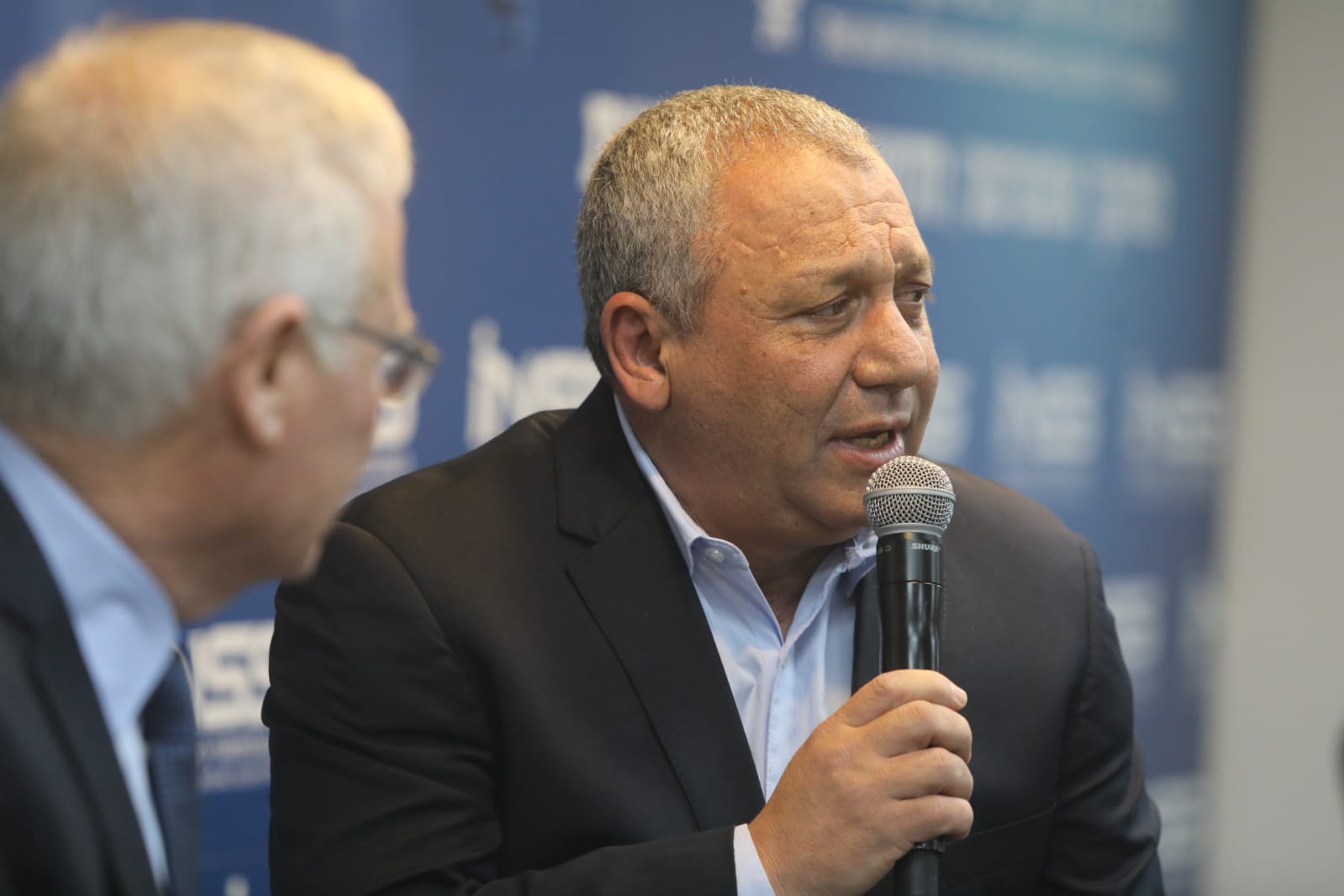
Former IDF chief of staff Gadi Eisenkot, right, is interviewed by Amos Yadlin at the Institute for National Security Studies annual conference in Tel Aviv on January 27, 2019. (INSS)

“The IDF is monitoring and is in possession of a number of sites where Hezbollah is digging underground infrastructure that has yet to cross into Israeli territory,” the army said on January 13.

On Sunday, former IDF chief Gadi Eisenkot said Hezbollah leader Hassan Nasrallah’s assertion in a Saturday night interview that there are things Israel doesn’t know regarding Hezbollah’s tunnel program “is flat wrong.”

A photo released by the IDF on December 27, 2018, shows fluids the army says it used to seal cross-border attack tunnels dug by Hezbollah coming out of a civilian building in the southern Lebanese village of Kafr Kila. (IDF Spokesperson)

On December 4, Israel launched Operation Northern Shield to find and destroy Hezbollah cross-border attack tunnels, and on January 13, the military announced it had found all such passages and was working to demolish them.

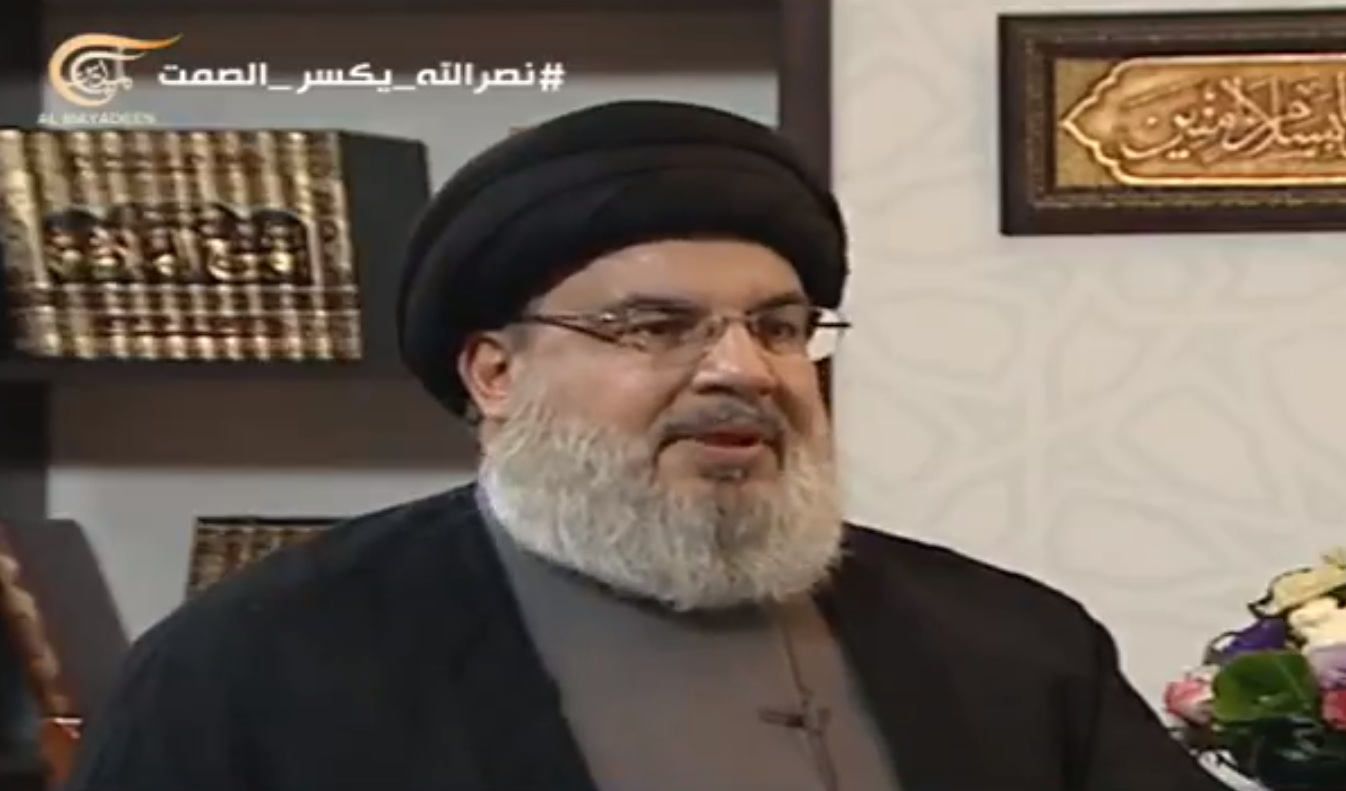
In a three-hour-long interview with the pro-Hezbollah al-Mayadeen TV on Saturday, Nasrallah said that the tunnels project began before the 2006 Second Lebanon War, and, indeed, one tunnel destroyed by the IDF in its recent operation was started before 2006. The Shiite organization’s tunnels project was only exposed in 2014.

Hezbollah terror group leader Hassan Nasrallah is interviewed on the al-Mayadeen Lebanese television channel, January 26, 2019 (Screen capture)

Nasrallah, in his interview, had claimed: “The uncovering of the tunnels does not affect by 10 percent our plans to take over the Galilee. If we decide to do it — even if they’ve destroyed the tunnels — can’t we rebuild them?” He also suggested there may be attack tunnels on the Israeli-Lebanese border which Israel has not yet discovered.

The Times of Israel has also confirmed that the rocket launched at Israel last week from Syria that was destroyed by the Iron Dome system over Mount Hermon was likely fired by troops belonging to Iran’s Islamic Revolutionary Guard Corps, and not by a Shiite militia, and had been shipped to Syria from Iran. The missile was fired from one of the southern neighborhoods of Damascus, near Sayeda Zeinab, a Shiite holy site.

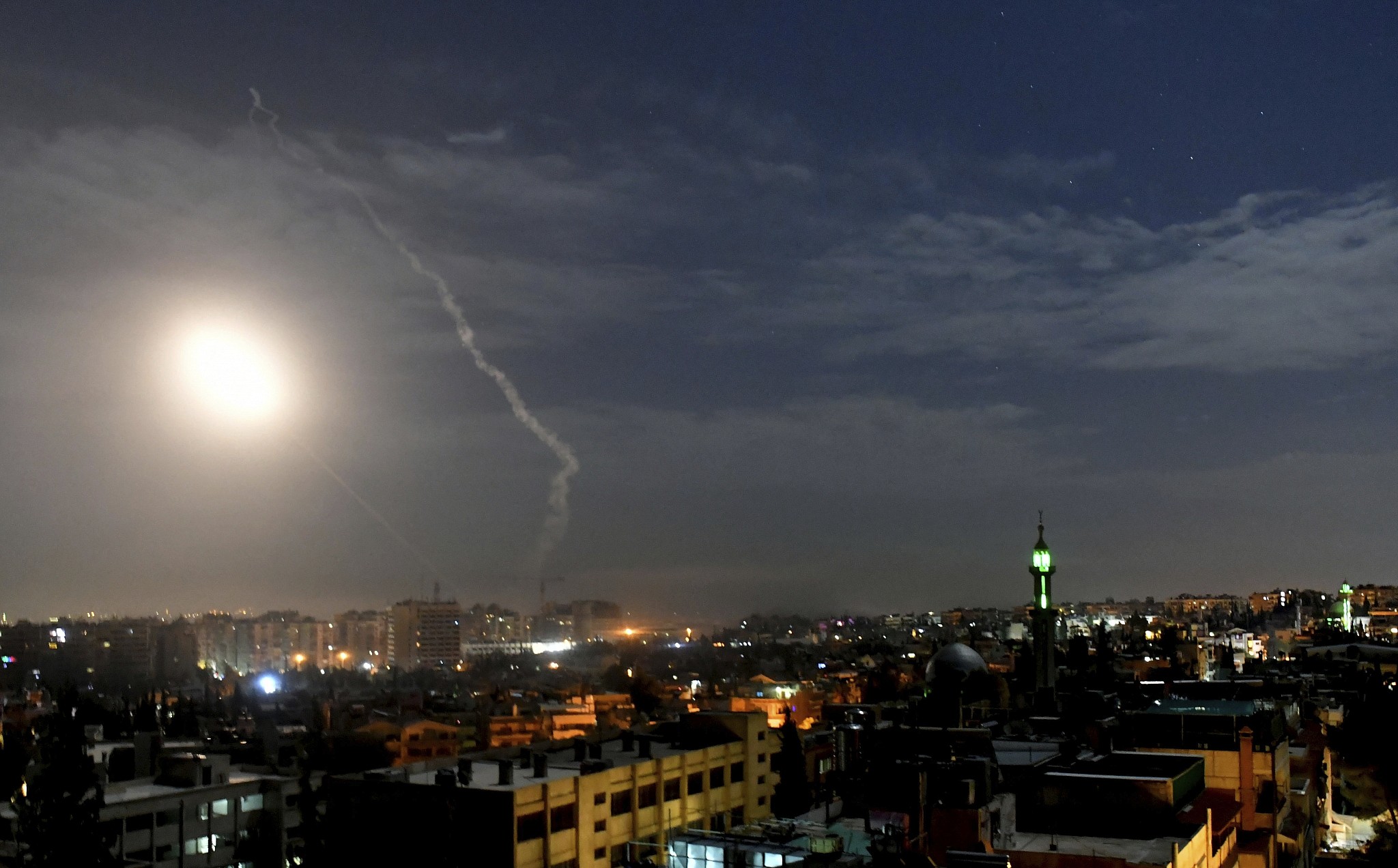
This photo released by the Syrian official news agency SANA, shows missiles flying into the sky near international airport, in Damascus, Syria, January 21, 2019. (SANA via AP)

Israel believes Iran currently has some 2,000 IRGC personnel in Syria, and thousands more members of Shiite militias under their command. The government believes that the number of Iranians on Syrian soil has fallen to one-third of what it was a few years ago; Iran has reduced its presence in Syria, but not removed it. Hezbollah, too, has significantly reduced its forces in Syria.

Iran officially denies having a military presence in Syria; it says it has advisers there.

Judah Ari Gross contributed to this report.
 

Iran general says Tehran aims to wipe Israel off the ‘global political map’

Posted January 28, 2019 by Joseph Wouk
Categories: Uncategorized

Source: Iran general says Tehran aims to wipe Israel off the ‘global political map’ | The Times of Israel

Revolutionary Guard deputy leader Hossein Salami warns Israel that any war it starts ‘will end with its elimination’

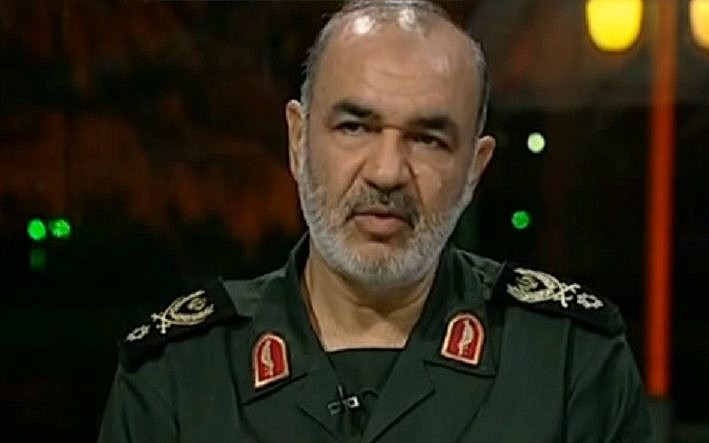
IRGC Deputy Commander Hossein Salami. (YouTube screen capture)

The deputy head of Iran’s Islamic Revolutionary Guard Corps said Monday that Tehran’s strategy was to eventually wipe Israel off the “global political map.”

Asked by a reporter in Tehran about Israeli threats to strike Iranian forces deployed in Syria, Brig. Gen. Hossein Salami was quoted by Iranian news outlets as saying, “Our strategy is to erase Israel from the global political map. And it seems that, considering the evil that Israel is doing, it is bringing itself closer to that.”

He added: “We announce that if Israel does anything to start a new war, it will obviously be the war that will end with its elimination, and the occupied territories will be returned. The Israelis will not have even a cemetery in Palestine to bury their own corpses.”

Salami’s comments followed a series of reciprocal taunts by Israeli and Iranian leaders in recent weeks as tensions have risen on the Israeli-Syrian border between IDF and Iranian forces.

Last week, Israel reportedly conducted a rare daylight missile attack on Iranian targets in Syria. In response, Iran fired a surface-to-surface missile from Syria at the northern Golan Heights, which was intercepted by the Iron Dome missile defense system over the Mount Hermon ski resort, according to the Israel Defense Forces.

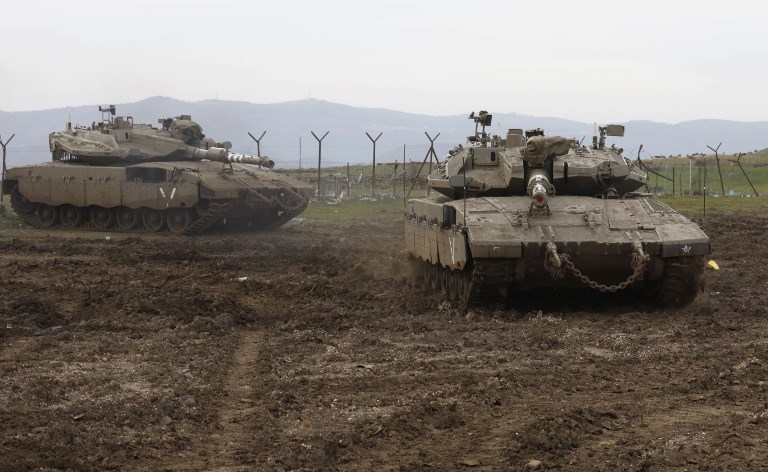
Israeli army Merkava tanks take positions on the Golan Heights, on January 20, 2019. (Jalaa Marey/AFP)

Hours later, in the predawn hours of January 21, the Israeli Air Force launched retaliatory strikes on Iranian targets near Damascus and on the Syrian air defense batteries that fired upon the attacking Israeli fighter jets, the army said.

Twenty-one people were killed in the Israeli raids in Syria on January 21, 12 of them Iranian fighters, a Britain-based Syrian war monitor said the following day.

According to Syrian Observatory for Human Rights, 12 of those killed were members of Salami’s Islamic Revolutionary Guard Corps, six were Syrian military fighters, and the other three were other non-Syrian nationals.

Israel sees Iranian entrenchment in Syria as a major threat and in recent years has carried out hundreds of airstrikes in Syria against targets linked to Iran, which alongside its proxies and Russia is fighting on behalf of the regime of Syrian President Bashar Assad.

Earlier this week, Iran’s military chief of staff indicated Tehran was preparing to adopt offensive military tactics to protect its national interests, an apparent reference to its posture in Syria toward Israel.

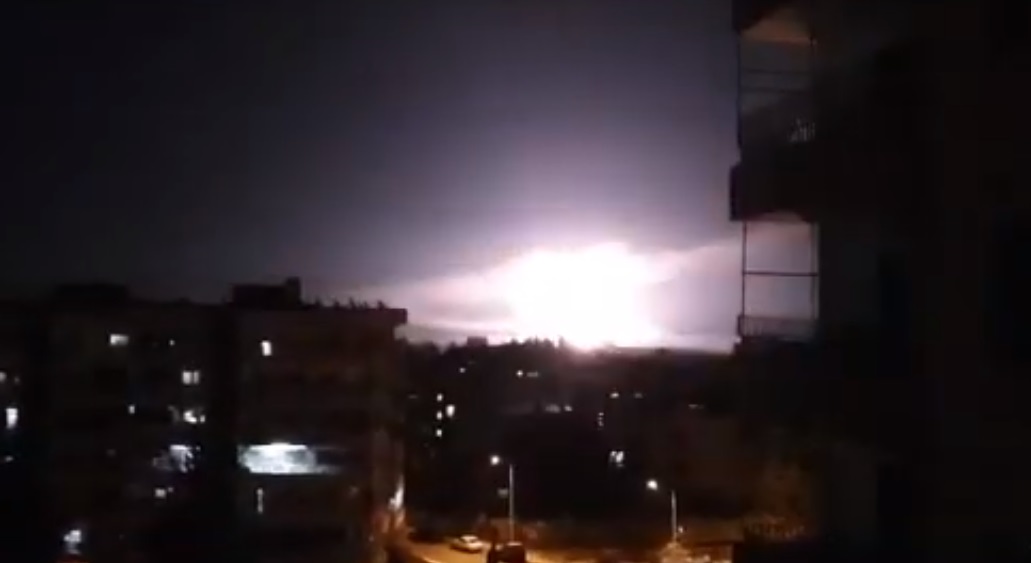
An explosion, reportedly during Israeli airstrikes near Damascus, Syria, on January 21, 2019. (screen capture: YouTube)

“Among the country’s broad strategies, there is a defensive strategy. We defend the independence and territorial integrity and national interests of the country,” Gen. Mohammad Bagheri was quoted as saying by Press TV on Sunday.

He said Iran did not intend to seize foreign territory, but “to protect our national achievements and interests, we may adopt an offensive approach.”

Also Sunday, the commander of the Iranian Army’s Ground Forces, Brig. Gen. Kiumars Heidari, said his troops had transformed into a “forward-moving and offensive” force.

“To protect Iran, the armed forces no longer need asymmetric approaches, and we are at a stage where we can defend our homeland… by using good offensive approaches,” he said, according to Press TV.

The announcements by top Iranian brass comes days after the Islamic Republic held its annual infantry drill, involving some 12,000 troops, fighter jets, armored vehicles and drones.

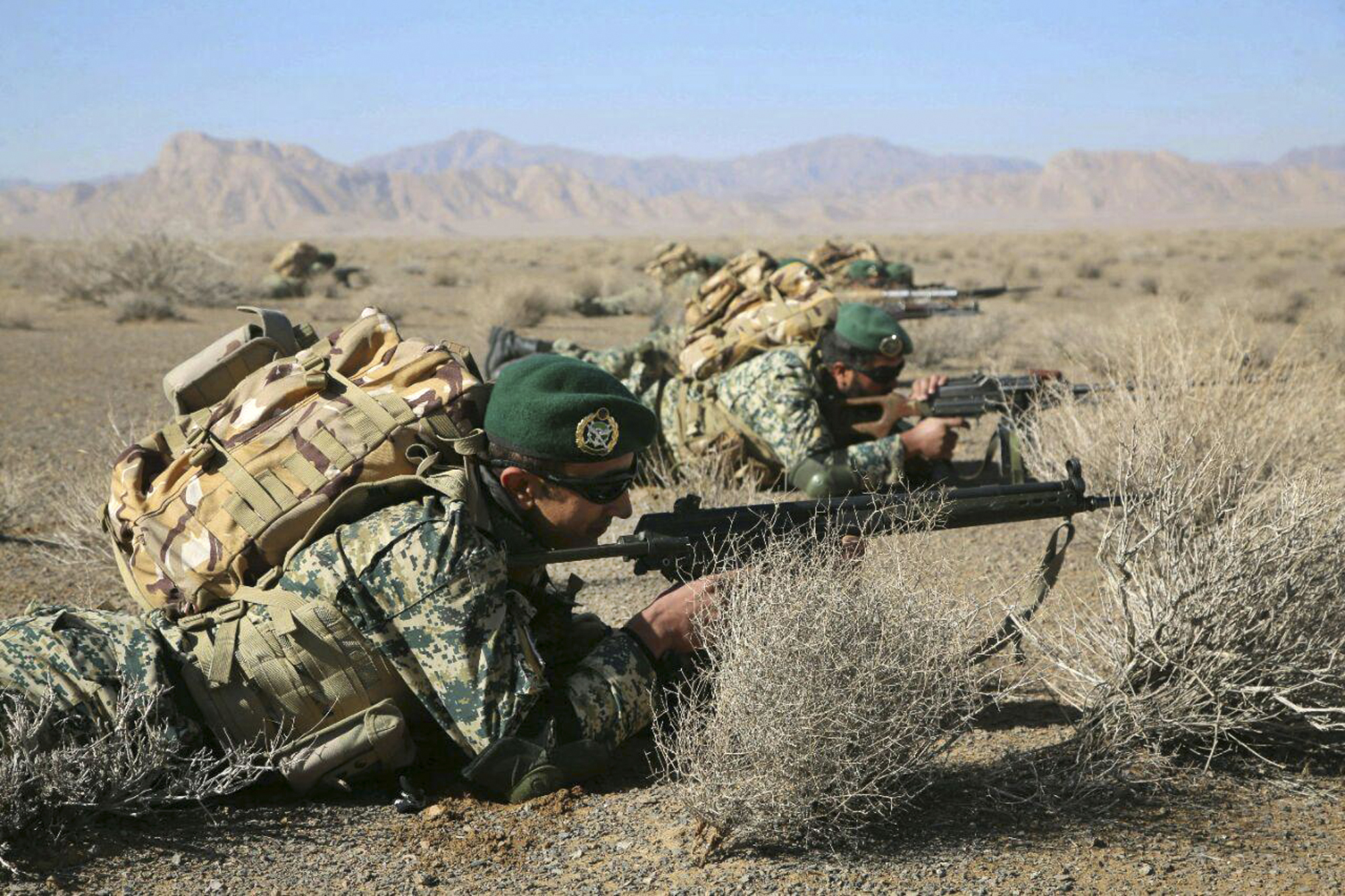
In this photo provided Friday, January 25, 2019, by the Iranian Army, soldiers take position in an infantry drill in the central Isfahan province, Iran. (Iranian Army via AP)

The exercise, which Iranian officials called “war games,” involved newly developed rapid redeployment units, and focused on combat against enemies and armed militants, Reuters reported on Thursday.

General Heidari told state TV last week the exercise exemplified Iran’s military capabilities, and demonstrated to its enemies that they would be dealt a “rapid and crushing blow” if they attacked the Islamic Republic, Reuters reported.

Iran regularly holds exercises to display its military preparedness and has vowed to respond strongly to any attack by Israel or the United States, both of which view it as a regional menace.


Iran: We won’t negotiate over our missile program 

Posted January 28, 2019 by Joseph Wouk
Categories: Uncategorized

Source: Iran: We won’t negotiate over our missile program – Arab-Israeli Conflict – Jerusalem Post

IRGC Commander warns Israel over any military action against Iran, says Israel won’t have a cemetery left to bury corpses.

BY ANNA AHRONHEIM
 JANUARY 28, 2019 13:39
AN IRANIAN ballistic missile on display in Tehran.

Iran’s Foreign Ministry spokesman Bahram Qassemi stressed on Monday that the country would never negotiate over its missile program, saying that the country will continue to boost its deterrence power “to protect national security.”

“Our policy on missiles is clear and the issue as part of our country’s defense sector cannot be negotiated,” he was quoted as saying by Iran’s Tasnim news agency.

The missile program is in line with efforts to protect the country’s security, Qassemi said, adding that Iran does not want to have difficulties acquiring weapons if needed.

Qassemi also denied holding secret talks with France over the Islamic Republic’s controversial ballistic missile program after French Foreign Minister Jean-Yves Le Drian said it was ready to impose more sanctions if there was no progress in talks over the program.

Le Drian was quoted as saying on Friday that “we have begun a difficult dialogue with Iran… and unless progress is made we are ready to apply sanctions, firmly, and they know it.” He also demanded that Iran change its behavior in the region, specifically in Syria.

Despite new US sanctions placed on Iran meant to pressure Tehran over its military activity in the Middle East and its ballistic missile program, Tehran is continuing to improve its missile arsenal, defending the program as being purely defensive.

“There have been no talks, whether secret or not secret, about our missile program with France or any other country,” Qassemi said. “Our missile program is a defensive program that we only discuss inside the country. I cannot confirm holding any secret talks with France over our missile program.”

The Islamic Republic possesses over 1,000 short- and medium-range ballistic missiles and has the ability to proliferate weapons to countries and non-state actors such as Hezbollah on Israel’s northern border and Hamas in the Gaza Strip.

Israel is concerned that Iran is not only trying to consolidate its grip in Syria where it could establish a forward base to attack Israel, but that it is trying to build advanced weapons factories in Syria and Lebanon in order to manufacture GPS-guided missiles that could hit targets with greater accuracy.

Israel has reiterated its view several times that any transfer of advanced weaponry to Hezbollah as a “red line,” and it will work to prevent any such movement.

Earlier on Monday, a commander of Iran’s Revolutionary Guards Corps (IRGC) said that the country’s strategy was to wipe “the Zionist regime” off of the political map.

“We announce that if Israel takes any action to wage a war against us, it will definitely lead to its own elimination and freeing of occupied territories,” Brig.-Gen. Hossein Salami, deputy head of the IRGC, was quoted by Iran’s Mehr news agency as saying.

“Israelis won’t even have a cemetery in Palestine to bury their corpses,” he added.


Top Saudi official: Barack Obama lied, set Middle East back 20 years

Posted January 28, 2019 by Joseph Wouk
Categories: Uncategorized

Source: Top Saudi official: Barack Obama lied, set Middle East back 20 years – Arab-Israeli Conflict – Jerusalem Post

Obama, Bandar Bin Sultan said, “would promise something and do the opposite.” He spoke critically of the Iran nuclear deal and how the former president spoke about curbing Iran but failed.

BY JERUSALEM POST STAFF
 JANUARY 28, 2019 13:34
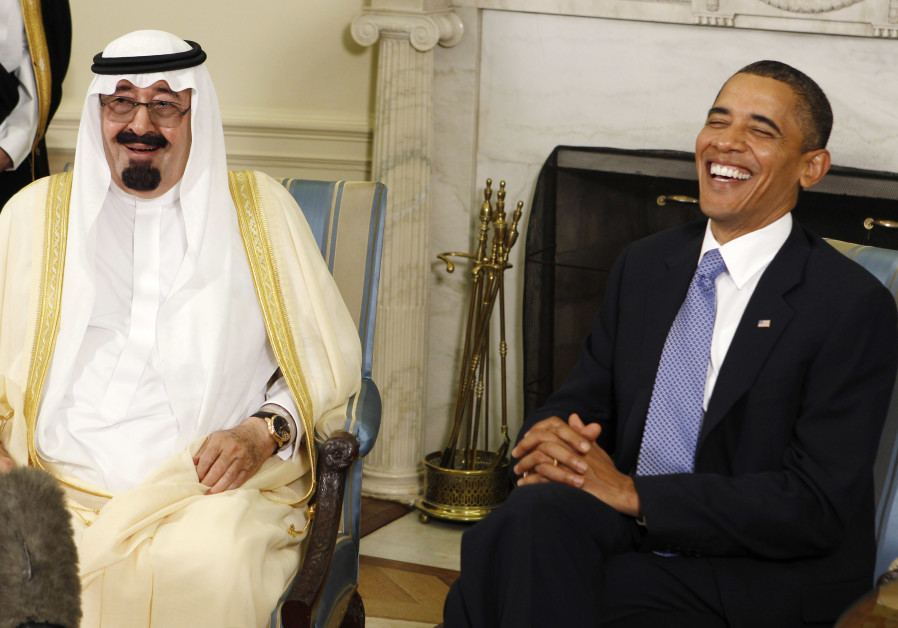
Barack Obama (R) laughs as he meets with King Abdullah of Saudi Arabia in the Oval Office

Former US president Barack Obama lied to Saudi Arabia when violating the redlines he famously declared regarding Syria’s use of chemical weapons and then not acting when they were used, a former senior Saudi official said in an interview with Independent Arabia.

Bandar bin Sultan served for years as head of Saudi intelligence as well as the Saudi ambassador to the United States. In the interview, he recalled a last phone call between the late Saudi King Abdullah and Obama, during which the Saudi leader told the US president: “I did not expect that [after] this long life, I would see [the day] when an American president lies to me.”

Obama, bin Sultan said, “would promise something and do the opposite.” He said that the president took the Middle East back 20 years and also spoke critically of the Iran nuclear deal and how the former president spoke publicly about curbing Iran’s activities, but then went behind Saudi Arabia’s back and negotiated the nuclear deal.
These policies by Obama, he said, emboldened Russia and Iran and paved the way for them to enter Syria and interfere in the civil war that has raged there since 2011.
Syrian President Bashar Assad, he said, was a “kid” and that while his late father Hafez was capable of making decisions, Bashar could not.
Regarding the Israeli-Palestinian conflict, bin Sultan said that the late Palestinian leader Yasser Arafat committed a “crime” against his people by rejecting the peace plan proposed by former president Bill Clinton.
The former ambassador said that he met with the feared leader of Iran’s al Quds Force, Gen. Qassem Soleimani, during a visit he made to Tehran.

“A coincidence led me to getting to (see) Soleimani face to face,” bin Sultan said. “Until then, we had [only] heard of him without seeing him.”


Iran: Russia prevented Syrians from using S-300 against Israel 

Posted January 28, 2019 by Joseph Wouk
Categories: Uncategorized

Source: Iran: Russia prevented Syrians from using S-300 against Israel – Israel Hayom


‘Hezbollah claims of more cross-border attack tunnels are baseless’ 

Posted January 28, 2019 by Joseph Wouk
Categories: Uncategorized

Source: ‘Hezbollah claims of more cross-border attack tunnels are baseless’ – Israel Hayom