Posted April 24, 2021 by Joseph Wouk Categories: Uncategorized
Netanyahu instructs top security officials to emphasize that Israel not bound by any agreement, committed only to its own security interests and ‘will act accordingly’
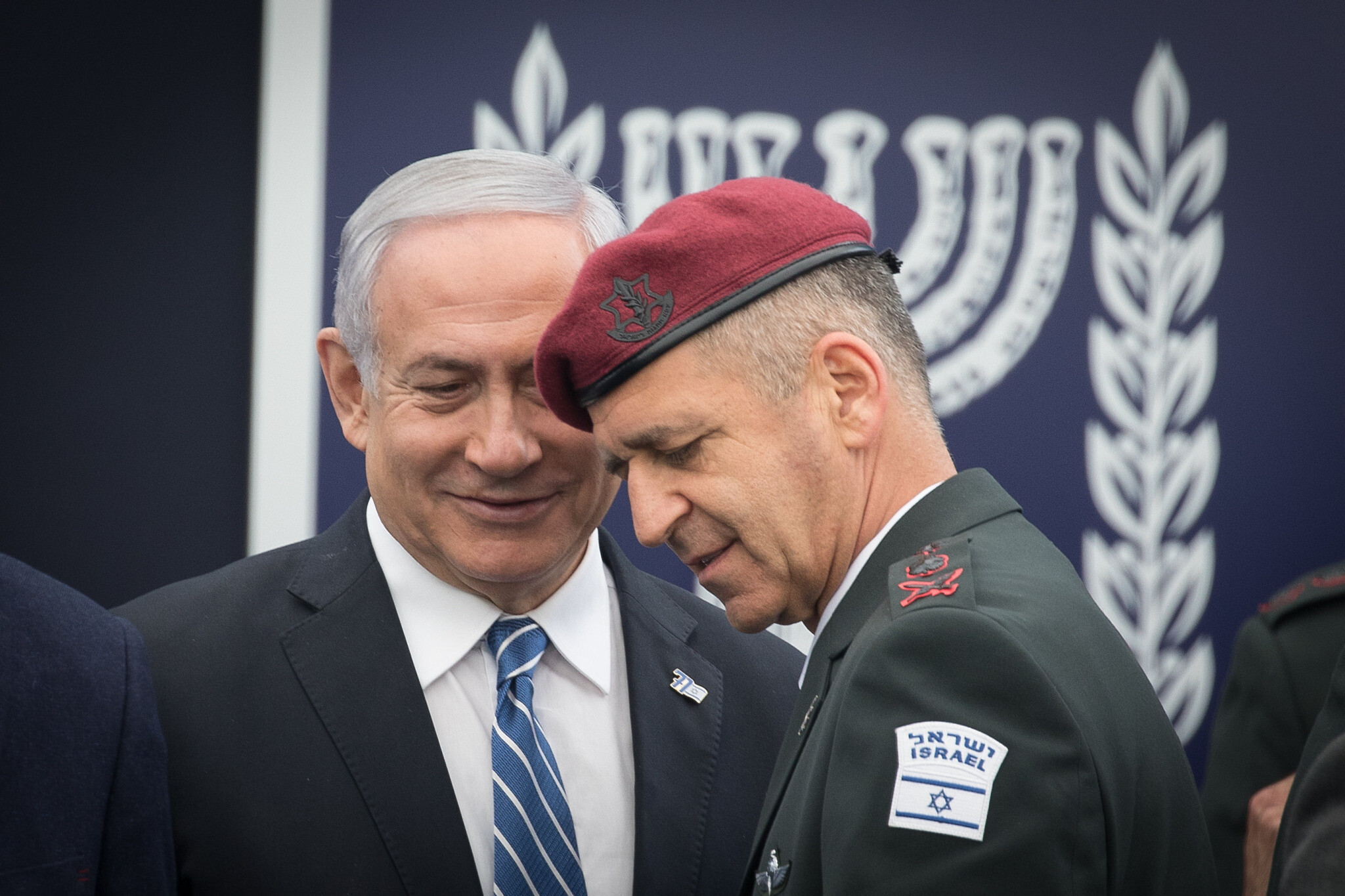
Prime Minister Benjamin Netanyahu and IDF Chief of Staff Aviv Kochavi during an event for outstanding soldiers as part of Israel’s 71st Independence Day celebrations, at the President’s Residence in Jerusalem, May 9, 2019. (Noam Revkin Fenton/Flash90)
Ahead of an Israeli delegation traveling to Washington DC next week, Prime Minister Benjamin Netanyahu instructed the security officials participating in the mission to voice objection to the US return to the Iran nuclear deal, but not to hold talks on the issues.
Netanyahu emphasized in a meeting with the delegation on Thursday that Israel is not a party in the nuclear agreement with Iran, and not committed to it. Clarifying that “Israel is committed to its own security interests only and will act accordingly,” an Israeli official said.
“The instructions to the senior security officials that are flying to Washington for talks is to present Israel’s opposition to the agreement in Iran and not to negotiate over it, because we are talking about a return to the previous agreement that is dangerous for Israel and the region,” the official said speaking on condition of anonymity.
“If in the future there are serious contacts on Iran’s part over an improved agreement, Israel will state its position on the characteristics and content that such an agreement should have,” the official added.
IDF Chief of Staff Aviv Kohavi, part of the delegation, will travel Sunday to meet with a number of top US defense officials, in his first trip to the US since entering his position.
Prime Minister Benjamin Netanyahu speaks with IDF Chief of Staff Aviv Kohavi during an event honoring outstanding IDF reservists, at the President’s residence in Jerusalem on July 1, 2019. (Hadas Parush/Flash90)
Kohavi will be joined on the trip by his wife, Yael, as well as the IDF defense attaché to the US, Maj. Gen. Yehuda Fuchs, the head of the IDF’s Iran-focused Strategic and Third Ring Directorate, Maj. Gen. Tal Kalman, and the head of the IDF’s foreign relations department, Brig. Gen. Effi Defrin.
In the coming weeks, a number of other top Israeli defense officials were slated to visit the United States, including National Security Adviser Meir Ben-Shabbat, Mossad chief Yossi Cohen and Military Intelligence commander Tamir Hayman.
Kohavi, Ben-Shabbat, Cohen and Hayman all met with Netanyahu and Defense Minister Benny Gantz on Thursday to coordinate their messaging to their American counterparts.
Israeli National Security Adviser Meir Ben-Shabbat during a ceremony before boarding an El Al plane to Bahrain to sign a series of bilateral agreements between Jerusalem and Manama, at Ben Gurion Airport in Lod, near Tel Aviv, Israel, October 18, 2020. (Marc Israel Sellem/POOL via FLASH90)
Israel is generally concerned that the US is rushing too quickly to return to the 2015 accord, known formally as the Joint Comprehensive Plan of Action, and is ignoring the concerns of Israel and other Middle Eastern countries, notably those in the Gulf.
Israel’s ambassador to the United States and United Nations, Gilad Erdan, told the UN Security Council on Thursday that he firmly rejects the nuclear deal in its current form.
“For Israel, Iran poses an existential threat,” Erdan said. “That is why we will not see ourselves bound by any agreement that does not fully address the threat against the existence of the State of Israel. And every one of you would do the same if you were in our shoes, particularly in light of the Holocaust,” he added.
Israeli Ambassador Gilad Erdan speaks at the UN in New York. (Shahar Azran/Israeli Mission to the UN)
“The Biden administration also understands that the 2015 agreement was bad, we just disagree on the right way to reach a deal that will stop Iran,” Erdan told the Kan public broadcaster on Friday.
Israel and the US set up a strategic group, which last convened on April 13, to coordinate their efforts to prevent Iran from acquiring nuclear arms. The group is led by Biden’s National Security Adviser Jake Sullivan and his Israeli counterpart Ben-Shabbat.
Earlier this week, Kan news reported that Israel was lobbying the US to push for improved international oversight of Iran’s nuclear program, having concluded there will not be significant changes to the treaty but nonetheless seeking to slightly improve the terms of the pact, which is being negotiated in Vienna, with Europeans acting as intermediaries between Washington and Tehran.
Iranian President Hassan Rouhani said Tuesday that 60-70 percent of issues had been resolved in Vienna.
A spokesman for the US State Department indicated that Washington was backing down from a key prerequisite for its return to the deal.
Illustrative: Iranian President Hassan Rouhani visits the Bushehr nuclear power plant just outside of Bushehr, Iran, January 13, 2015. (AP Photo/Iranian Presidency Office, Mohammad Berno, File)
The Biden administration had repeatedly said that it would only return to the nuclear deal if Iran first returns to compliance. However, on Tuesday, US State Department Spokesperson Ned Price said at a press conference that Washington would only need to be sure that Iran intended to return to compliance.
Israeli officials, including Netanyahu, have adamantly opposed the US returning to the nuclear deal, putting Jerusalem openly at odds with the new White House administration.
Critics have long denounced the deal’s so-called “sunset clauses,” aspects of the agreement barring Iran from certain nuclear activities that end after a certain number of years. Though the deal technically prohibits Iran from ever developing a nuclear weapon, detractors of the agreement say these clauses will allow Iran to do so with impunity once the sanctions against the regime end.
The agreement is also narrowly focused solely on the nuclear issue, ignoring Iran’s development of nuclear-capable ballistic missiles that can reach Israel and parts of Europe, as well as its constant funding and support of terror groups like Hezbollah.
Proponents of the agreement generally argue that while the deal is imperfect, it was the best possible deal that could be struck under the circumstances and at least postpones the development of an Iranian nuclear weapon.
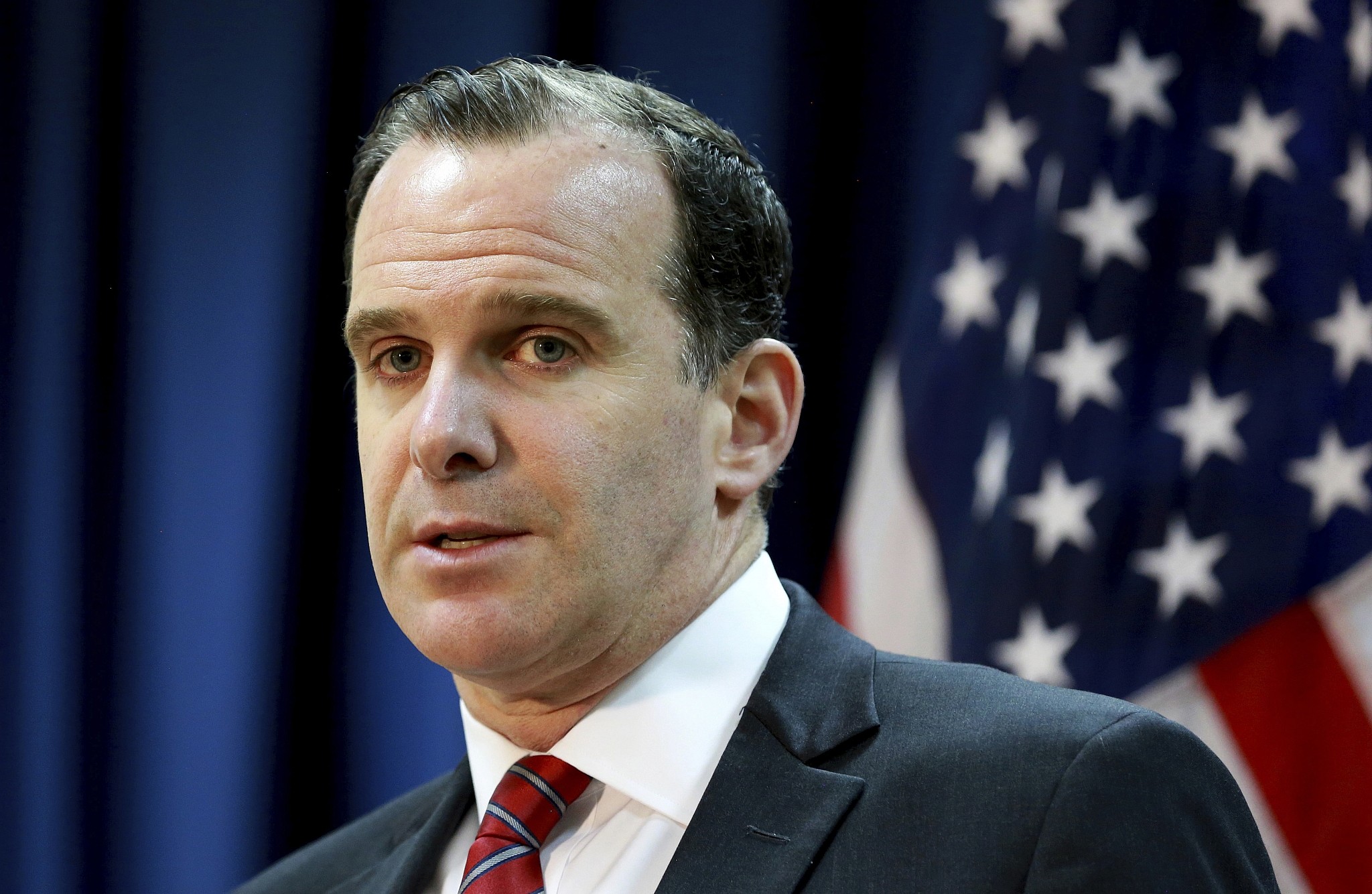
File: Brett McGurk, then-US envoy for the global coalition against Islamic State, at a news conference at the US embassy in Baghdad, Iraq, June 7, 2017. (Hadi Mizban/AP)
A top US official spoke to American Jewish leaders Friday on US efforts to revive the nuclear deal with Iran, telling them that no sanctions would be removed from the Islamic Republic before Washington gets clear commitments on Iran’s return to the 2015 accord.
“Until we get somewhere and until we have a firm commitment, and it’s very clear that Iran’s nuclear program is going to be capped, the problematic aspects reversed and back in a box, we are not going to take any of the pressure off,” the National Security Council’s Brett McGurk told leaders, according to quotes provided to the Forward by several individuals on the call.
McGurk is the NSC’s coordinator for the Middle East and North Africa.
He said that with talks resuming in Vienna Monday, “there’s a very long way to go and this process is complicated.” But he stressed that the US is “not going to pay anything upfront just to get a process going. We have to see from the Iranians a fundamental commitment and agreement to put their nuclear program back in a box that we can fully inspect and observe.”
Diplomats from Britain, China, France, Germany, Iran and Russia have been meeting in a luxury Vienna hotel to discuss a return to the deal, while US envoys are participating indirectly in the talks from a nearby hotel.
Journalists wait in front of the Grand Hotel Wien where closed-door nuclear talks with Iran take place in Vienna, Austria, Tuesday, April 6, 2021. (AP /Florian Schroetter)
Iran has pressed for the United States to lift all sanctions imposed under former president Donald Trump before it rolls back the steps Tehran took away from the 2015 deal in protest.
The Biden administration had repeatedly said that it would only return to the nuclear deal if Iran first returns to compliance. However, on Tuesday, US State Department Spokesperson Ned Price said at a press conference that Washington would only need to be sure that Iran intended to return to compliance.
Iranian President Hassan Rouhani said Tuesday that 60-70 percent of issues had been resolved in Vienna.
Israel is worried that the US is rushing too quickly to return to the 2015 accord, known formally as the Joint Comprehensive Plan of Action, and is ignoring the concerns of Israel and other Middle Eastern countries, notably those in the Gulf.
IDF Chief of Staff Aviv Kohavi will travel to the United States on Sunday to discuss the threat of Iran’s nuclear program and its entrenchment throughout the region. Top Israeli officials are expected to go to Washington in the coming weeks to discuss Iran, amid reports of growing disagreements between the governments as to how to best handle the situation.
IDF Chief of Staff Aviv Kohavi speaks at a memorial ceremony on Jerusalem’s Mount Herzl national cemetery on April 11, 2021. (Israel Defense Forces)
McGurk told the Jewish leaders that the administration has ” worked with the Israelis every day in the security realm, in terms of their freedom of action — protecting themselves — as something fundamental to us.
“Where we have some disagreement internally there is no disagreement on where we want to go: Iran can never get a nuclear weapon, period. There’s some disagreement about the kind of tactics you might use to get there. But we agree on a lot more than we disagree.”
He said consultations with Israel were “quite constructive.”
“At the end of the day, should we be able to deal with this problem diplomatically, which is our objective, I think the agreement will be very strong and give us confidence for where this is going to go over the many, many years ahead.”
Israel’s ambassador to the United States and United Nations, Gilad Erdan, told the UN Security Council on Thursday that he firmly rejects the nuclear deal in its current form.
“For Israel, Iran poses an existential threat,” Erdan said. “That is why we will not see ourselves bound by any agreement that does not fully address the threat against the existence of the State of Israel.”
Israeli Ambassador Gilad Erdan speaks at the UN in New York. (Shahar Azran/Israeli Mission to the UN)
Erdan told Kan news on Friday: “The Biden administration also understands that the 2015 agreement was bad, we just disagree on the right way to reach a deal that will stop Iran,”
Israel and the US set up a strategic group, which last convened on April 13, to coordinate their efforts to prevent Iran from acquiring nuclear arms. The group is led by President Joe Biden’s National Security Adviser Jake Sullivan and his Israeli counterpart Meir Ben-Shabbat.
Earlier this week, Kan news reported that Israel was lobbying the US to push for improved international oversight of Iran’s nuclear program, having concluded there will not be significant changes to the treaty but nonetheless seeking to slightly improve the terms of the pact, which is being negotiated in Vienna.
Proponents of the agreement generally argue that while the deal is imperfect, it was the best possible deal that could be struck under the circumstances and at least postpones the development of an Iranian nuclear weapon.
Posted April 24, 2021 by Joseph Wouk Categories: Uncategorized
Rocket salvos fired after Hamas calls for attacks on Israel over Jerusalem unrest; barrages, reported in real-time by terror group, mark worst assault from Strip in many months
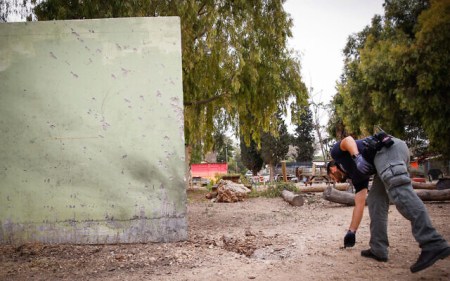
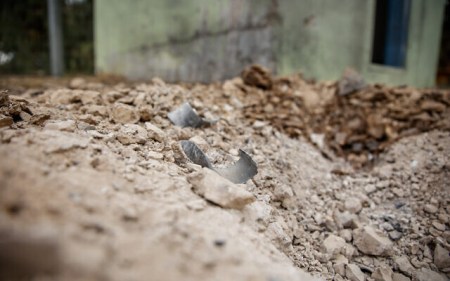
A police sapper inspects the scene where a rocket fired from the Gaza Strip fell near houses on a kibbutz in southern Israel on April 24, 2021 (Flash90)
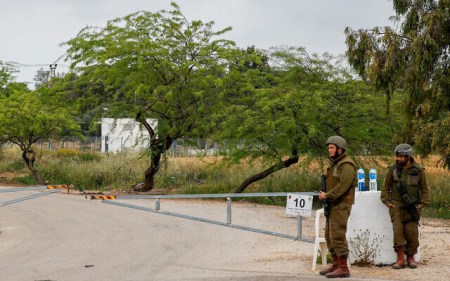
Israeli soldiers block a road near the Gaza border on April 24, 2021 (Flash90)
Remains of a rocket fired from the Gaza Strip near houses on a kibbutz in southern Israel on April 24, 2021 (Flash90)
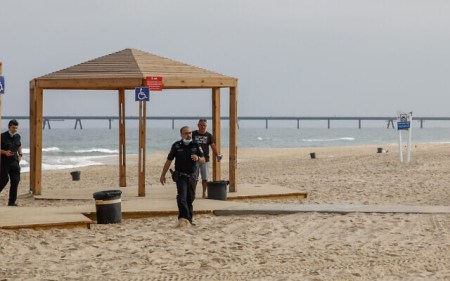
Israeli police officers walk on Zikim Beach close to the Gaza border after it was closed to visitors, on April 24, 2021 (Flash90)
Terrorists fired 36 rockets toward Israel from the Gaza Strip overnight with six projectiles intercepted by the Iron Dome missile defense system, the Israel Defense Forces said Saturday morning.
The barrages were the worst assault from the Strip in many months and while there were no Israeli injuries, the rockets did cause damage in a number of communities.
In response, the Israeli military struck multiple Hamas targets in the Gaza Strip in the early hours of Saturday morning, including rocket launchers and underground infrastructure, the army said, in response to several salvos of rockets fired into Israel overnight.
There were no immediate reports of casualties in the Gaza strikes.
Sirens sounded in numerous Israeli communities near the Strip overnight, including Ashkelon and the Eshkol, Sdot Negev, Sha’ar Hanegev and Hof Ashkelon regional councils.
The Iron Dome missile defense system intercepted six of the projectiles. Some fell in communities while others landed in open areas.
Iron Dome is programmed to not deploy when rockets are projected to hit non-populated areas — it was unclear why it had not activated to intercept the projectiles that landed in the border towns.
Two terror groups in Gaza took responsibility for the rocket fire — Fatah’s Al-Aqsa Martyrs’ Brigade and the Popular Front for the Liberation of Palestine’s Abu Ali Mustapha Brigades. Israel has stressed in the past it holds the ruling Hamas terror group responsible for all violence emanating from Gaza.
“We will burn the occupation’s settlements for you, O Jerusalem. The greatest has yet to come,” a spokesperson for the Al-Aqsa Martyrs’ Brigade said.
Official Hamas media tracked the launch of rockets across the Gaza Strip, reporting their firing in real-time, leading some to speculate that Hamas was covertly involved. The terror group did not take responsibility for the rocket fire, however.
“The Palestinian resistance is ready to respond to aggression, even the score with the occupation and prevent its violations against our people,” Hamas spokesperson Abd al-Latif al-Qanou said.
The attack followed days of tensions and clashes in Jerusalem and the West Bank that involved Palestinian and Israeli civilians as well as Israeli security forces.
Illustrative — An Iron Dome missile defense system fires an interceptor at a target during an exercise in early 2021. (Defense Ministry)
Before the morning strikes, the military had not responded to the rockets throughout the night, except for a single tank strike after the first volley, that targeted a Hamas post.
The Israel Defense Forces’ Home Front Command initially instructed residents in areas under threat to remain close to shelters, ordered the closure of Zikim beach, banned outside gatherings and agricultural work near the security fence and limited groups to under 100 people indoors. However, it later removed the restrictions.
Additionally, the Sdot Negev Regional Council recommended residents avoided going to synagogue on Saturday morning.
Miriam Rainan, a resident of the Nahal Oz border community, said the rockets meant residents had to stay home just as the easing of coronavirus restrictions was letting them return to normal life.
“It was a bad night and we slept in the bomb shelter. There was a lot of noise and one rocket fell on the kibbutz’s livestock. This is wrong, Iron Dome does not work properly,” she told Channel 12 news. “We were stuck at home because of the coronavirus [pandemic], and now we are stuck at home because of Hamas.”
An IDF tank is seen near the Gaza Strip on May 15, 2018. (Hadas Parush/ Flash90)
The rocket barrages came hours after Hamas held a series of protests in the Strip and called for violence against Israel in the wake of fierce clashes Thursday in Jerusalem between police, extremist Jewish activists and Palestinian protesters.
Addressing the Gazan protesters, senior Hamas leader Mahmoud Zahar condemned the decision of some Arab states to normalize relations with Israel last year and lashed out at the Palestinian Authority in the West Bank for continuing its security coordination with Israel.
“After a long series of protests and demonstrations, we have reached the conclusion that without weapons, we cannot liberate our land, protect our holy sites, bringing back our people to their land or maintain our dignity,” he said.
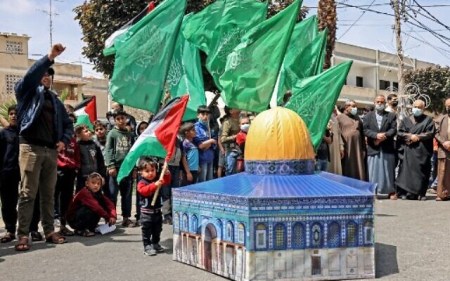
Palestinians shout slogans around a model of the Dome of the Rock, during a rally in Gaza city on April 23, 2021, condemning overnight clashes in Jerusalem and calling for an armed struggle. ( MAHMUD HAMS / AFP)
The attacks came during a general lull in violence from the Gaza Strip in recent months, amid a ceasefire between Israel and Hamas and as the enclave grapples with the coronavirus pandemic.
A single rocket was fired into Israel from Gaza last Friday. Another was fired the day before. Neither rocket caused injuries or damage, and the IDF hit Hamas targets in response.
Last month, a rocket was fired toward Beersheba as Prime Minister Benjamin Netanyahu made a campaign stop in the southern city ahead of the March 23 elections.
The last time a rocket barrage hit Israel was in September, when Palestinian terrorists fired 13 rockets in response to Israel signing peace deals with the United Arab Emirates and Bahrain. Two Israelis were hurt when a rocket hit Ashdod, one moderately and another lightly.
Prior to that, the last major flareup occurred in November of 2019, after Israel killed Baha Abu al-Ata, a senior commander in the military wing of the Islamic Jihad terror group. The assassination led to days of rocket fire in which hundreds of projectiles targeted Israeli cities.
In both cases, Israel retaliated with waves of airstrikes in the Strip.
Posted April 22, 2021 by Joseph Wouk Categories: Uncategorized
Media reports describe feelings of lack of trust and transparency as Washington moves to reenter pact Israel despises; Jerusalem said still hoping to bridge gaps
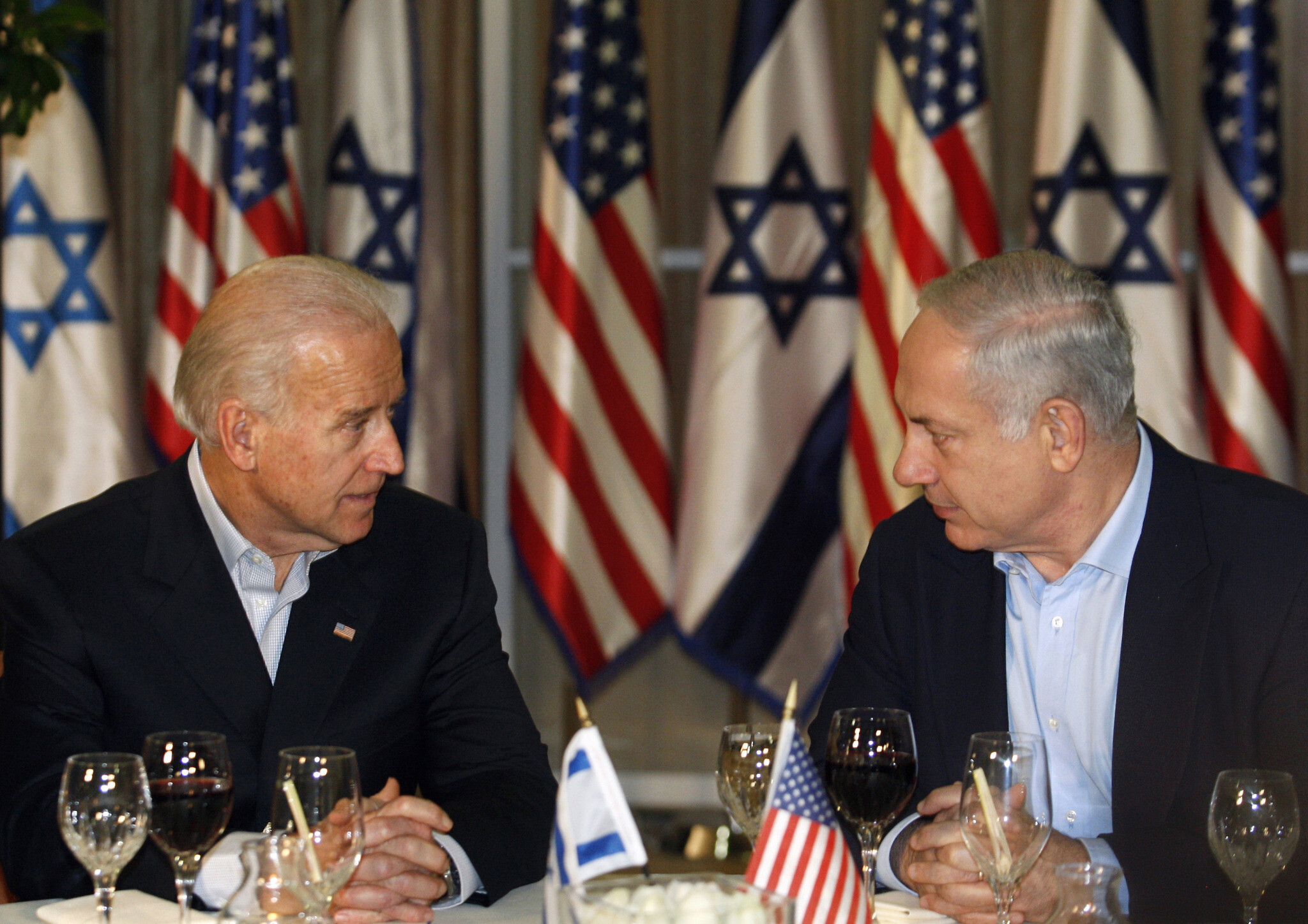
Then-US vice president Joe Biden, left, and Prime Minister Benjamin Netanyahu, right, talk before a dinner at the Prime Minister’s Residence in Jerusalem, March 9, 2010. (AP Photo/Baz Ratner, Pool)
As international negotiations progress on restoring the 2015 accord limiting Iran’s nuclear program, suspicion is growing between Israel and the US as the Biden administration looks to rejoin the accord, according to a report Wednesday.
Officials told Axios that National Security Adviser Meir Ben-Shabbat had raised Israeli worry with American officials that Jerusalem’s concerns were not being given proper consideration as Washington attempts to reenter the deal. Israeli officials said the Americans countered that Israel was not sufficiently heeding the administration’s request for “no surprises” from either side concerning Iran policy.
The report described growing frustration on both sides over feelings of lack of trust and insufficient transparency.
Despite the disagreements between the sides, an Israeli official told the Walla news site that Israel was still holding out hope it could influence the US position.
“We don’t think everything is lost and as long as we have the opportunity to voice our stance, we are going to try in the hope that we’ll succeed,” the unnamed official said.
The comments came before Israeli security chiefs fly to Washington next week for high-level talks on Iran.
According to Walla, they will meet Thursday with Prime Minister Benjamin Netanyahu, Defense Minister Benny Gantz and Foreign Minister Gabi Ashkenazi to coordinate their discussions with their American counterparts.
Among the officials set to travel to the US are Ben-Shabbat, Mossad chief Yossi Cohen, IDF Chief of Staff Aviv Kohavi and Military Intelligence commander Tamir Hayman.
Noting that most talks with the new administration have been held by phone or video conference, the unnamed official told Walla that next week’s face-to-face meetings would illustrate to Israel how large the gap is with the US concerning policy toward Iran.
The nations set up a strategic group, which last convened on April 13, to coordinate their efforts to prevent Iran from acquiring nuclear arms. The group is led by Biden’s National Security Adviser Jake Sullivan and his Israeli counterpart Ben-Shabbat.
Israeli National Security Council chairman Meir Ben-Shabbat (left), and US National Security Advisor Jake Sullivan. (Flash90, AP)
Two Israeli officials familiar with those meetings told Walla that they exposed the gaps between the countries on how best to address Iran’s nuclear program.
The officials also said that it was the US that was not being transparent about the offers so far made to Iran, a claim rejected by a senior administration official.
The report came a day after Kan news said Israel was lobbying the US to push for improved international oversight of Iran’s nuclear program, having concluded there will not be significant changes to the treaty but nonetheless seeking to slightly improve the terms of the pact.
Israel was said to have conceded that the deal will be renewed without addressing its concerns about Tehran’s ballistic missile program and support for terror groups.
A separate report this week said Israeli officials have expressed concern that Biden will rush to rejoin the nuclear deal, arguing that Washington’s negotiating power is compromised by its eagerness to clinch a pact.
In this September 24, 2017 file photo, surface-to-surface missiles and a portrait of the Iranian Supreme Leader Ayatollah Ali Khamenei are displayed by the Revolutionary Guard. (AP Photo/Vahid Salemi)
As the efforts to restore the nuclear pact continued, Iranian President Hassan Rouhani said Tuesday that 60-70 percent of issues had been resolved. A spokesman for the US State Department, however, said that while the talks were positive, “we have more road ahead of us than in the rearview mirror.”
The Biden administration has repeatedly said it will return to the nuclear deal if Iran first returns to compliance. Iran has taken a hardline approach, demanding the US lift all sanctions against it first, putting the two sides at a stalemate.
Israeli officials, including Netanyahu, have adamantly opposed the US returning to the nuclear deal, putting Jerusalem at odds with the new White House administration.
Critics have long said that the deal fails to address Iran’s development of nuclear-capable ballistic missiles that can reach Israel and parts of Europe and its constant funding and support of terror groups like Hezbollah.
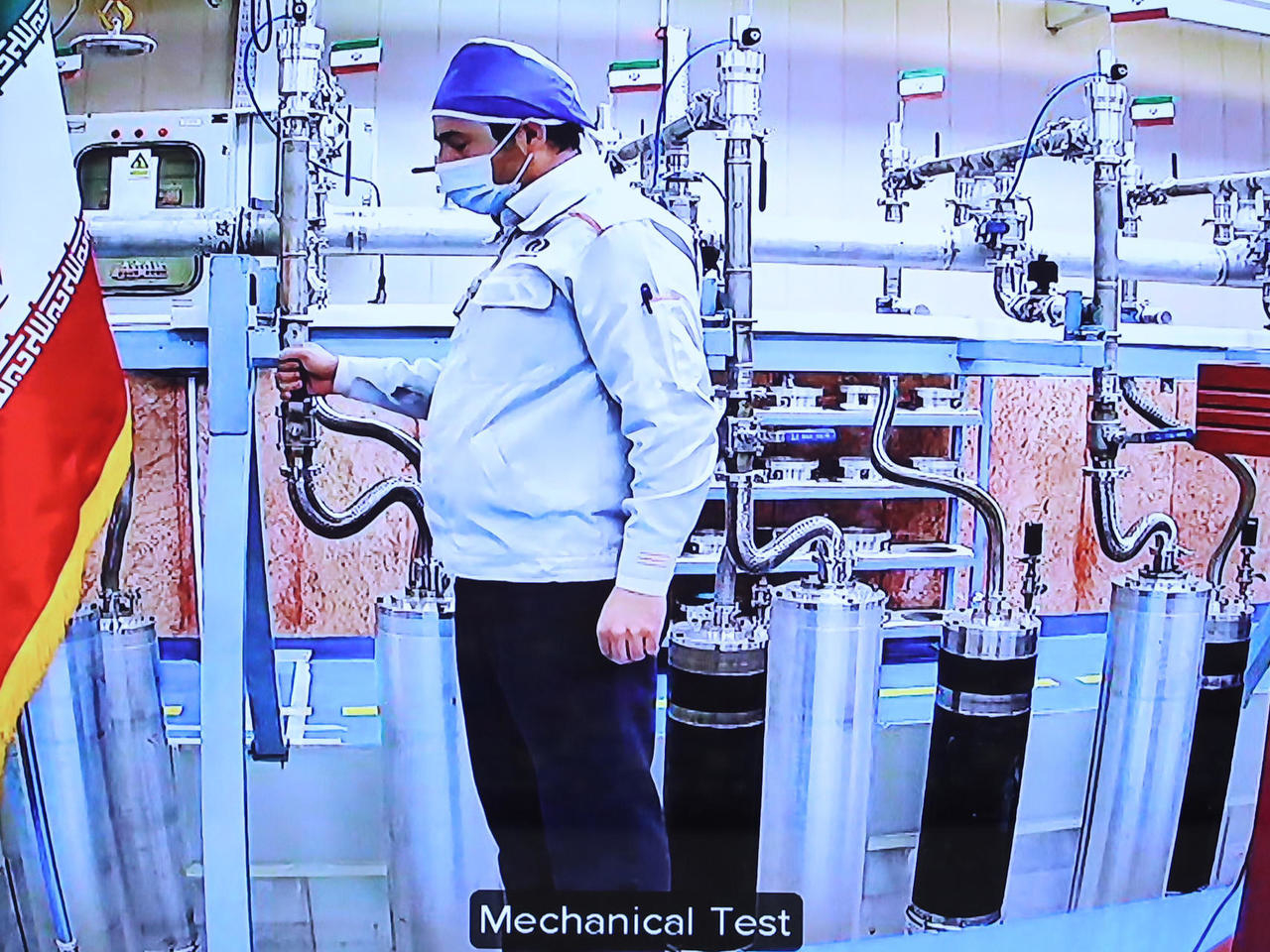
A handout picture provided by the Iranian presidential office on Saturday, April 10, shows a video conference screen of an engineer inside Iran’s Natanz uranium enrichment plant (Iranian Presidency/AFP)
The UN atomic agency on Wednesday said Iran has installed additional advanced centrifuges at its Natanz nuclear plant, the site of a recent blast blamed on Israel.
According to a report by the International Atomic Energy Agency, seen by Reuters, Iran added two more cascades of IR-4 centrifuges and six clusters of IR-2m at its underground facility. The IAEA also confirmed that some of the centrifuges were in use and said the Islamic Republic plans to install another four cascades of the IR-4 at Natanz.
“On 21 April 2021, the Agency verified at FEP that: … six cascades of up to 1,044 IR-2m centrifuges; and two cascades of up to 348 IR-4 centrifuges… were installed, of which a number were being used,” the report said.
On April 10, Iran announced that it started up far more advanced IR-6 and IR-5 centrifuges that enrich uranium more quickly, in a new breach of its undertakings under the 2015 nuclear agreement. It also said it has began mechanical tests on an even faster nuclear centrifuge: The output of Iran’s IR-9 centrifuge, when operational, would be 50 times quicker than the first Iranian centrifuge, the IR-1. Iran’s nuclear program is also developing IR-8 centrifuges.
Early the next morning, the site was hit in the blast that was declared by Iran to be Israeli sabotage. The explosion is said to have caused considerable damage to the Natanz plant, including its various uranium-enriching centrifuges.
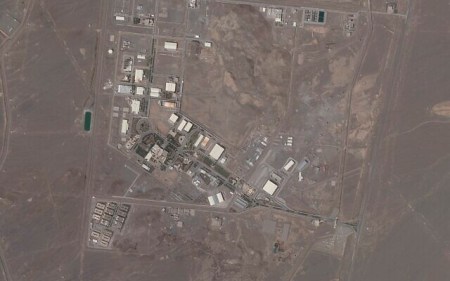
This satellite photo provided from Planet Labs Inc. shows Iran’s Natanz nuclear facility on Wednesday, April 14, 2021. Iran began enriching uranium Friday, April 16, 2021, to its highest level ever at Natanz, edging closer to weapons-grade levels to pressure talks in Vienna aimed at restoring its nuclear deal with world powers after an attack on the site. (Planet Labs via AP)
In response to the attack, Iran said it began enriching a small amount of uranium up to 60 percent purity at the site — its highest level ever, and a short step from weapons-grade. The UN atomic agency confirmed the enrichment, saying it was being done in an above-ground facility at Natanz.
The head of the country’s atomic agency said Tuesday that power has been restored at Natanz and uranium enrichment activities there have been renewed. Ali Akbar Salehi, head of the Atomic Energy Organization of Iran, was cited by the official IRNA news agency as saying that “the cables damaged in the accident were speedily replaced and… the main power supply to the Natanz enrichment facility [is] now connected to the grid.”
Salehi told lawmakers during a parliamentary committee meeting that “thanks to the timely measures taken, enrichment in Natanz never stopped, even when the main power cable was cut,” according to the report.
He also reportedly said that Iran’s enemies, among them Israel, have repeatedly attempted to sabotage Iran’s nuclear program, but claimed all the plots were foiled.
Iranian officials have blamed Israel for the April 11 attack at Natanz.
The report did not include any images of the enrichment activities that Salehi said had resumed.
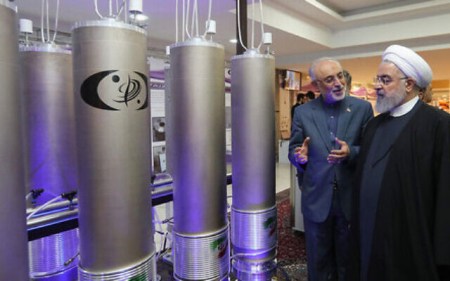
Iran’s President Hassan Rouhani, right, is shown new centrifuges and listens to head of the Atomic Energy Organization of Iran Ali Akbar Salehi, while visiting an exhibition of Iran’s new nuclear achievements in Tehran, Iran, April 10, 2021. (Iranian Presidency Office via AFP)
His comments came as a New York Times report said Iran’s nuclear enrichment program at Natanz has slowed down due to increased security measures implemented following the recent blast.
Despite the reported damage, Iranian state TV aired footage earlier this week from what it said were regular operations at Natanz. The spot included a short interview with an unnamed worker at the site who said that the staff was working around the clock to resume uranium enrichment.
Israeli and American media have reported that a 150-kilogram bomb took out Natanz’s main and backup power supplies and caused damage setting back the enrichment process by months.
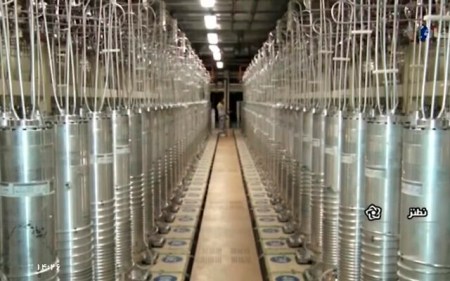
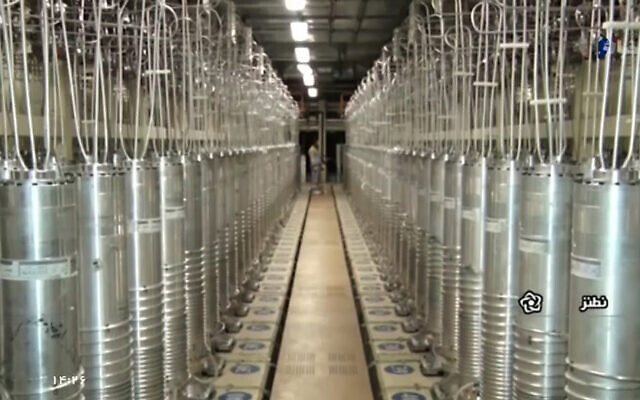
In this image made from April 17, 2021 video released by the Islamic Republic Iran Broadcasting, IRIB, state-run TV, various centrifuge machines line a hall at the Natanz Uranium Enrichment Facility, Iran. (IRIB via AP, File)
A senior Iranian official said last Tuesday that the blast destroyed or damaged thousands of centrifuges used to enrich uranium. Alireza Zakani, the hardline head of the Iranian parliament’s research center, referred to “several thousand centrifuges damaged and destroyed” in a state TV interview. However, no other official has offered that figure and no images of the aftermath have been released.
The blast was initially described only as a blackout in the electrical grid feeding aboveground workshops and underground enrichment halls, but Iranian officials later began calling it an attack.
Last Monday, an Iranian official acknowledged that the blast took out the plant’s main electrical power system and its backup. “From a technical standpoint, the enemy’s plan was rather beautiful,” Fereydoon Abbasi Davani, the head of the Iranian parliament’s energy committee, told Iranian state television.
“They thought about this and used their experts and planned the explosion so both the central power and the emergency power cable would be damaged.”
The New York Times reported that the blast was caused by a bomb that was smuggled into the plant and then detonated remotely. The report cited an unnamed intelligence official, without specifying whether they were American or Israeli. The official also noted that the blast took out Natanz’s primary electrical system as well as its backup.
A passport-style photo published by Iranian state television shows Reza Karimi, 43, whom Tehran says was behind the sabotage at Natanz on April 11 that it has blamed on Israel (video screenshot)
On Saturday, Iran state television named 43-year-old Reza Karimi as a suspect in last week’s attack, saying he had since fled the country. The report showed a passport-style photograph of a man it identified as Karimi, saying he was born in the nearby city of Kashan, Iran.
The Iranian foreign ministry accused Israel of an act of “nuclear terrorism” and vowed revenge.
Israel has neither confirmed nor denied involvement, but public radio reports said it was a sabotage operation by the Mossad spy agency, citing unnamed intelligence sources. The New York Times, quoting unnamed US and Israeli intelligence officials, also said there had been “an Israeli role” in the attack.
Iran’s foreign ministry spokesman, Saeed Khatibzadeh, last week indirectly accused Israel of attempting to scuttle talks underway in Vienna aimed at reviving a landmark nuclear agreement. The talks are focused on bringing the US back into the accord after former US president Donald Trump withdrew from it in 2018 and reimposed sanctions on Tehran, and to bring Iran back into compliance with key nuclear commitments it suspended in response to the sanctions.
Beirut: In less than nine months, an assassin on a motorbike fatally shot an al-Qaeda commander given refuge in Tehran, Iran’s chief nuclear scientist was machine-gunned down on a country road, and two separate, mysterious explosions rocked a key Iranian nuclear facility in the desert, striking the heart of the country’s efforts to enrich uranium.
The steady drumbeat of attacks, which intelligence officials said were carried out by Israel, highlighted the seeming ease with which Israeli intelligence was able to reach deep inside its neighbour’s borders and repeatedly strike its most heavily guarded targets, often with the help of turncoats.
The attacks, the latest wave in more than two decades of sabotage and assassinations, have exposed embarrassing security lapses and left Iran’s leaders looking over their shoulders as they pursue negotiations with the Biden administration aimed at restoring the 2015 nuclear agreement.
The recriminations have been caustic.
The head of parliament’s strategic centre said Iran had turned into a “haven for spies.” The former commander of Iran’s Revolutionary Guard called for an overhaul of the country’s security and intelligence apparatus. Lawmakers have demanded the resignation of top security and intelligence officials.
Most alarming for Iran, Iranian officials and analysts said, was that the attacks revealed that Israel had an effective network of collaborators inside Iran and that Iranian intelligence services had failed to find the moles.
“That the Israelis are effectively able to hit Iran inside in such a brazen way is hugely embarrassing and demonstrates a weakness that I think plays poorly inside Iran,” said Sanam Vakil, deputy director of the Middle East and North Africa Program at Chatham House.
The attacks have also cast a cloud of paranoia over a country that now sees foreign plots in every mishap.
Over the weekend, Iranian state television flashed a photograph of a man said to be Reza Karimi, 43, and accused him of being the “perpetrator of sabotage” in an explosion at the Natanz nuclear enrichment plant last month. But it was unclear who he was, whether he had acted alone and if that was even his real name. In any case, he had fled the country before the blast, Iran’s Intelligence Ministry said.
On Monday, after Iranian state news media reported that Brigadier General Mohammad Hosseinzadeh Hejazi, the deputy commander of the Quds Force, the foreign arm of the Revolutionary Guard, had died of heart disease, there were immediate suspicions of foul play.
Hejazi had long been a target of Israeli espionage, and the son of another prominent Quds Force commander insisted on Twitter that Hejazi’s death was “not cardiac-related”.
A Revolutionary Guard spokesman failed to clear the air with a statement saying the general had died of the combined effects of “extremely difficult assignments,” a recent COVID-19 infection and exposure to chemical weapons during the Iran-Iraq war.
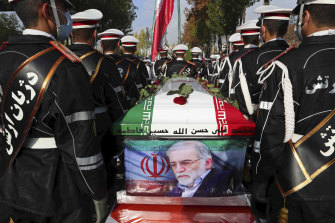
The general would have been the third high-ranking Iranian military official to be assassinated in the last 15 months. The United States killed General Qasem Soleimani, the leader of the Quds Force, in January 2020. Israel assassinated Mohsen Fakhrizadeh, Iran’s chief nuclear scientist and a brigadier general in the Revolutionary Guard, in November.
Even if Hejazi died of natural causes, the cumulative loss of three top generals was a significant blow.
The attacks represent an uptick in a long-running campaign by the intelligence services of Israel and the United States to subvert what they consider to be Iran’s threatening activities.
Chief among them are a nuclear program that Iran insists is peaceful, Iran’s investment in proxy militias across the Arab world, and its development of precision-guided missiles for Hezbollah, the militant movement in Lebanon.
An Israeli military intelligence document in 2019 said that Hejazi was a leading figure in the last two, as the commander of the Lebanese corps of the Quds Force and the leader of the guided missile project. Revolutionary Guard spokesman Ramezan Sharif said that Israel wanted to assassinate Hejazi.
Israel has been working to derail Iran’s nuclear program, which it considers a mortal threat, since it began. Israel is believed to have started assassinating key figures in the program in 2007, when a nuclear scientist at a uranium plant in Isfahan died in a mysterious gas leak.
In the years since, six other scientists and military officials have been assassinated. A seventh was wounded.
Another top Quds Force commander, Rostam Ghasemi, said recently that he had narrowly escaped an Israeli assassination attempt during a visit to Lebanon in March.
But assassination is just one tool in a campaign that operates on multiple levels and fronts.
In 2018, Israel carried out a daring night-time raid to steal 450 kilograms of secret nuclear program archives from a warehouse in Tehran.
Israel has also reached around the world, tracking down equipment in other countries that is bound for Iran, to destroy it, conceal transponders in its packaging or install explosive devices to be detonated after the gear has been installed inside of Iran, according to a former high-ranking US intelligence official.
A former Israeli intelligence operative said that to compromise such equipment, she and another officer would drive by the factory and stage a crisis, such as a car accident or a heart attack, and the woman would appeal to the guards for help. That would get her enough access to the facility to identify its security system so that another team could break in and disable it, she said, speaking on condition of anonymity because she was not authorised to discuss covert operations.
In an interview on Iranian state television last week, Iran’s former nuclear chief revealed the origins of an explosion in the Natanz nuclear plant in July. The explosives had been sealed inside a heavy desk that had been placed in the plant months earlier, said Fereydoon Abbasi-Davani, the former chief of Iran’s Atomic Energy Organisation.
The explosion ripped through a factory producing a new generation of centrifuges, setting back Iran’s nuclear enrichment program by months, officials said.
Alireza Zakani, head of parliament’s research centre, said Tuesday that in another case machinery from a nuclear site had been sent abroad for repair and was returned to Iran with 300 pounds of explosives packed inside it.
Little is known about the more recent explosion at Natanz this month except that it destroyed the plant’s independent power system, which in turn destroyed thousands of centrifuges.
It would have been difficult for Israel to carry out these operations without inside help from Iranians, and that may be what rankles Iran most.
Security officials in Iran have prosecuted several Iranian citizens over the past decade, charging them with complicity in Israeli sabotage and assassination operations. The penalty is execution.
But the infiltrations have also sullied the reputation of the intelligence wing of the Revolutionary Guard, which is responsible for guarding nuclear sites and scientists.
A former Guard commander demanded a “cleansing” of the intelligence service, and Iran’s vice president, Eshaq Jahangiri, said that the unit responsible for security at Natanz should be “be held accountable for its failures”.
The deputy head of parliament, Amir-Hossein Ghazizadeh Hashemi, told the Iranian news media on Monday that it was no longer enough to blame Israel and the United States for such attacks. Iran needed to clean its own house.
As a publication affiliated with the Guard, Mashregh News, put it last week: “Why does the security of the nuclear facility act so irresponsibly that it gets hit twice from the same hole?”
But the Revolutionary Guard answers only to Iran’s supreme leader, Ayatollah Ali Khamenei, and so far there has been no sign of a top-down reshuffling.
After each attack, Iran has struggled to respond, sometimes claiming to have identified those responsible only after they had left the country or saying that they remained at large. Iranian officials also insist that they have foiled other attacks.
Calls for retaliation grow louder after each attack. Conservatives have accused the government of President Hassan Rouhani of weakness or of subjugating the country’s security to the nuclear talks in hopes they will lead to relief from US sanctions.
Indeed, Iranian officials shifted to what they called “strategic patience” in the last year of the Trump administration, calculating that Israel sought to goad them into an open conflict that would eliminate the possibility of negotiations with a new Democratic administration.
Both Rouhani and Foreign Minister Mohammad Javad Zarif have said they would not allow the attacks to derail the negotiations because lifting sanctions was the priority.
It is also possible that Iran has tried to retaliate but failed.
Iran was blamed for a bomb that exploded near Israel’s Embassy in New Delhi in January, and 15 militants linked to Iran were arrested last month in Ethiopia for plotting to attack Israeli, American and Emirati targets.
But any overt retaliation risks an overwhelming Israeli response.
“They are not in a hurry to start a war,” said Talal Atrissi, a political science professor at the Lebanese University in Beirut. “Retaliation means war.”
Conversely, the timing of Israel’s latest attack on Natanz suggested that Israel sought if not to derail the talks, to at least weaken Iran’s bargaining power. Israel opposed the 2015 nuclear agreement and opposes its resurrection.
The United States, seeking to negotiate with Iran in Vienna, said it was not involved in the attack but has not publicly criticised it either.
And if the repeated Israeli attacks had the effect of fomenting a national paranoia, an intelligence official said, that was a side benefit for Israel. The additional steps Iran has taken to scan buildings for surveillance devices and plumb employees’ backgrounds to root out potential spies has slowed down the enrichment work, the official said.
The conventional wisdom is that neither side wants full-scale war and is counting on the other not to escalate. But at the same time, the covert, region-wide shadow war between Israel and Iran has intensified with Israeli airstrikes on Iranian-backed militias in Syria and tit for tat attacks on ships.
But as Iran faces a struggling economy, rampant COVID-19 infections and other problems of poor governance, the pressure is on to reach a new agreement soon to remove economic sanctions, said Vakil of Chatham House.
“These low-level, gray zone attacks reveal that the Islamic Republic urgently needs to get the JCPOA back into a box” to free up resources to address its other problems, she said, referring to the nuclear deal, formally called the Joint Comprehensive Plan of Action.
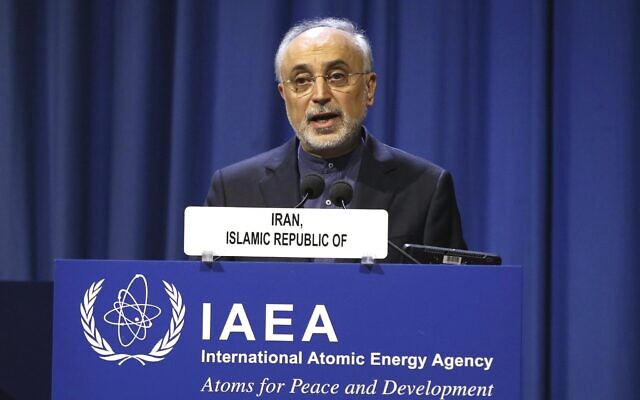
The head of Iran’s Atomic Energy Organization Ali Akbar Salehi delivers his speech at the opening of the general conference of the IAEA in Vienna, Austria, September 16, 2019. (AP Photo/Ronald Zak)
Power has been restored in Iran’s Natanz nuclear facility and uranium enrichment activities there have been renewed after a blast at the site earlier this month, the head of the country’s atomic agency said Tuesday.
Ali Akbar Salehi, head of the Atomic Energy Organization of Iran, was cited by the official IRNA news agency as saying that “the cables damaged in the accident were speedily replaced and… the main power supply to the Natanz enrichment facility [is] now connected to the grid.”
Salehi told lawmakers during a parliamentary committee meeting that “thanks to the timely measures taken, enrichment in Natanz never stopped, even when the main power cable was cut,” according to the report.
He also reportedly said that Iran’s enemies, among them Israel, have repeatedly attempted to sabotage Iran’s nuclear program, but claimed all the plots were foiled.
Iranian officials have blamed Israel for the April 11 attack at Natanz.
The report did not include any images of the enrichment activities that Salehi said had resumed.
Iran’s President Hassan Rouhani, right, is shown new centrifuges and listens to head of the Atomic Energy Organization of Iran Ali Akbar Salehi, while visiting an exhibition of Iran’s new nuclear achievements in Tehran, Iran, April 10, 2021. (Iranian Presidency Office via AFP)
His comments came as a New York Times report said Iran’s nuclear enrichment program at Natanz has slowed down due to increased security measures implemented following the recent blast.
The explosion is said to have caused considerable damage to the Natanz plant, including its various uranium-enriching centrifuges.
In response to the attack, Iran said it began enriching a small amount of uranium up to 60 percent purity at the site — its highest level ever, and a short step from weapons-grade. The UN atomic agency confirmed the enrichment, saying it was being done in an above-ground facility at Natanz.
Despite the reported damage, Iranian state TV aired footage earlier this week from what it said were regular operations at Natanz. The spot included a short interview with an unnamed worker at the site who said that the staff was working around the clock to resume uranium enrichment.
Israeli and American media have reported that a 150-kilogram bomb took out Natanz’s main and backup power supplies and caused damage setting back the enrichment process by months.
In this image made from April 17, 2021 video released by the Islamic Republic Iran Broadcasting, IRIB, state-run TV, various centrifuge machines line a hall at the Natanz Uranium Enrichment Facility, Iran. (IRIB via AP, File)
A senior Iranian official said last Tuesday that the blast destroyed or damaged thousands of centrifuges used to enrich uranium. Alireza Zakani, the hardline head of the Iranian parliament’s research center, referred to “several thousand centrifuges damaged and destroyed” in a state TV interview. However, no other official has offered that figure and no images of the aftermath have been released.
The blast was initially described only as a blackout in the electrical grid feeding aboveground workshops and underground enrichment halls, but Iranian officials later began calling it an attack.
Last Monday, an Iranian official acknowledged that the blast took out the plant’s main electrical power system and its backup. “From a technical standpoint, the enemy’s plan was rather beautiful,” Fereydoon Abbasi Davani, the head of the Iranian parliament’s energy committee, told Iranian state television.
“They thought about this and used their experts and planned the explosion so both the central power and the emergency power cable would be damaged.”
The New York Times reported that the blast was caused by a bomb that was smuggled into the plant and then detonated remotely. The report cited an unnamed intelligence official, without specifying whether they were American or Israeli. The official also noted that the blast took out Natanz’s primary electrical system as well as its backup
.
A passport-style photo published by Iranian state television shows Reza Karimi, 43, whom Tehran says was behind the sabotage at Natanz on April 11 that it has blamed on Israel (video screenshot)
On Saturday, Iran state television named 43-year-old Reza Karimi as a suspect in last week’s attack, saying he had since fled the country. The report showed a passport-style photograph of a man it identified as Karimi, saying he was born in the nearby city of Kashan, Iran.
The Iranian foreign ministry accused Israel of an act of “nuclear terrorism” and vowed revenge.
Israel has neither confirmed nor denied involvement, but public radio reports said it was a sabotage operation by the Mossad spy agency, citing unnamed intelligence sources. The New York Times, quoting unnamed US and Israeli intelligence officials, also said there had been “an Israeli role” in the attack.
Iran’s foreign ministry spokesman, Saeed Khatibzadeh, last week indirectly accused Israel of attempting to scuttle talks underway in Vienna aimed at reviving a landmark nuclear agreement.
The talks are focused on bringing the US back into the accord after former US president Donald Trump withdrew from it in 2018 and reimposed sanctions on Tehran, and to bring Iran back into compliance with key nuclear commitments it suspended in response to the sanctions.
On a sweltering day in July 2018, German police pulled over a scarlet Ford S-Max hire car that was travelling at speed towards Austria. The driver, Assadollah Assadi, the third secretary to the Iranian embassy in Vienna, was arrested at gunpoint and taken into custody.
Although unusual, there was a good reason for detaining the diplomat: Assadi had used his immunity to smuggle a bomb on a commercial airliner from Tehran to Austria, intending to carry out what would have been one of Europe’s worst atrocities in recent years.
Once in Vienna, he had handed the device — codenamed the ‘Playstation’ — to two married Belgian-Iranian agents, Amir Saadouni and Nasimeh Naami, and instructed them to blow up an anti-regime event in Paris, which was to be attended by dignitaries including Rudy Giuliani and former environment secretary Theresa Villiers.
The plot was thwarted on the day of the attack after a tip-off from Mossad, saving hundreds of lives. Assadi was arrested the following day while pursuing diplomatic refuge in Austria. But as we reported in this week’s Jewish Chronicle, the treasure trove of evidence inside the vehicle should have set off alarm bells in European corridors of power — alarm bells that should be sounding especially loudly today.
The car was effectively being used as a mobile intelligence station to run agents. It contained handwritten records of trips to 289 locations in 22 cities across Europe as well as notes on bomb handling and ideas for attacks using acid and toxic pathogenic substances. Also discovered were receipts for expense reimbursements and salary payments to spies, details of computers issued to them, numerous mobile phones and GPS devices, and more than €30,000 (£26,000) in cash. In short, it revealed an Iranian espionage network in Europe that was startling in both its scale and scope.’The plot may have been a wake-up call, but the Europeans tend to wake up from time to time, then fall asleep again’
When seen in the light of the political context at the time, the arrest seemed almost ironic. Not eight weeks previously, Donald Trump had pulled America out of the nuclear deal with Iran, the Joint Comprehensive Plan of Action (JCPOA), reimposing ‘maximum pressure’ sanctions on the theocracy. The Europeans were appalled.
One of Washington’s main reasons for leaving the deal, signed by the Obama administration in 2015, was that lifting sanctions allowed Tehran to fund extensive terror networks, proxy militia and missile emplacements overseas. But even while investigators were poring over the material found inside Assadi’s scarlet Ford S-Max, policymakers in Europe’s capitals were busy designing a mechanism to allow Iran to continue to trade behind the backs of the Americans. The system, known as ‘Instex’, was launched five months later, in an attempt to neuter the deterrent from Washington.
This bizarre state of affairs cannot be overemphasised. Exhibit A: Tehran activates its extensive spy network in an attempt to blow up hundreds of civilians on the streets of Paris. Exhibit B: the Europeans try to undermine American pressure on the theocracy, shovelling more money into its maw. A cynic might call it suicide by diplomacy.
This week, history is repeating itself. Eight weeks ago, an Antwerp court sentenced Assadi and his three co-conspirators to between 15 and 20 years in prison. This was the first conviction of an Iranian official for terrorism offences since the 1979 Islamic revolution. Yet this week, the European powers pressed ahead with direct negotiations with Tehran in Vienna, aimed at expunging all trace of the Trump years and restoring the nuclear deal. By all accounts, progress was swift: a few days of discussions resulted in a ‘roadmap’ that could lead to a new agreement in as little as two months.
The Ayatollahs have never been in any doubt that the Europeans are in the palms of their hands. The only sanctions insisted on by Europe last week were symbolic restrictions on a small number of Iranian officials, a gesture of solidarity for dual nationals held hostage in Iranian prisons. Aside from this, there was simply no disguising the enthusiasm for welcoming the malignant theocracy back into the fold.
To make matters worse, in the post-Trump era, Washington is equally wide-eyed. Returning to the Obama deal has become a political pose to this new administration, which pursues it like an article of faith. It took Joe Biden just 11 weeks to go from being elected as 46th President of the United States to commencing new nuclear negotiations with Iran.
In fact, even before he entered the Oval Office, Biden had publicly telegraphed his intentions to reheat Obama’s JCPOA. In an article for CNN last September, he argued that President Trump had ‘recklessly tossed away a policy that was working to keep America safe and replaced it with one that has worsened the threat’. The Iranians, shall we say, were hardly kept guessing about America’s negotiating objectives. This was the David Cameron-Theresa May school of negotiations that produced such truly exemplary results during the Brexit era.
Unsurprisingly enough, Tehran’s foreign minister, Seyed Araghchi, opened the talks by playing hardball, insisting that all sanctions imposed since 2016 — including those unrelated to its nuclear programme — be lifted before any return to compliance. This would mean a fresh wave of dollars breaking on the shores of the Islamic Republic, allowing it to kick-start its beleaguered economy with oil exports and return to a fully functional banking system. Only then — with the influx of cash being toasted by terror cells from Sudan to Vienna — would the theocracy consider curtailing its nuclear ambitions. Or rather, consider agreeing to do so.
The United States, negotiating at arm’s length via its European allies around the table in Vienna, responded feebly by suggesting a step-by-step approach. ‘I think what essentially ruled out are the maximalist demands that the United States do everything first and only in turn would Iran then act,’ Ned Price, the State Department spokesman, said. But there was never any doubt about the American endgame.
There are two Iranian spy networks in the West. The first, Department 312 of Tehran’s Ministry Of Intelligence and Security, aims at infiltrating, intimidating and assassinating Iranian dissidents who have gone into exile to campaign against the theocracy. That is the ring that was exposed in 2018 and is now being rebuilt.
The second targets Israelis, whether representatives of the state or civilians. The latter espionage group has the more difficult task. Iran knows full well that any aggressive action against Israeli citizens will meet with swift retaliation.
Israel, as the single country most threatened by Tehran (intelligence sources estimate that 80 per cent of threats against the Jewish state emanate from the theocracy) does not, shall we say, buy into the transatlantic policy of appeasement. Last week, Benjamin Netanyahu made his position clear ahead of a visit to Jerusalem by the new US secretary of defence, General Lloyd Austin, a visit designed to calm Israeli nerves over the impending nuclear deal. ‘These type of deals with extremist regimes are worth nothing,’ he said. ‘A deal with Iran that threatens us with annihilation will not obligate us.’
Speaking on Holocaust Remembrance Day, he added: ‘Only one thing will obligate us: to prevent those who wish to destroy us from carrying out their plans.’ On Sunday, an unexplained ‘incident’ occurred at Iran’s nuclear facility in Natanz — which had just started using more advanced centrifuges — taking out its electrical distribution grid.
In sharp contrast with Israel, whatever the opposite of retaliation is, Europe is following that policy. In the somnambulant haze that hangs in the continent’s corridors of power, even a fully armed bomb, built in Tehran and on its way to delivery to a rally of thousands of people in central Paris, is not enough to raise serious hesitations abut the intentions of the Iranian regime. The planned attack in the heart of France was generally viewed, amazingly enough, as an internal Iranian issue. The security services uprooted the spy network, then returned to business as usual. As one source familiar with the matter told me: ‘The plot may have been a wake-up call, but the Europeans tend to wake up from time to time, then fall asleep again.’ And this time, Europe and America are in lockstep. One can only hope that they are not sleepwalking to their own destruction.
Posted April 14, 2021 by Joseph Wouk Categories: Uncategorized
Following attack on Iran’s Natanz facility, which has been blamed on Israel, PM says US-Israeli cooperation is ‘crucial’ to combat threats facing both countries
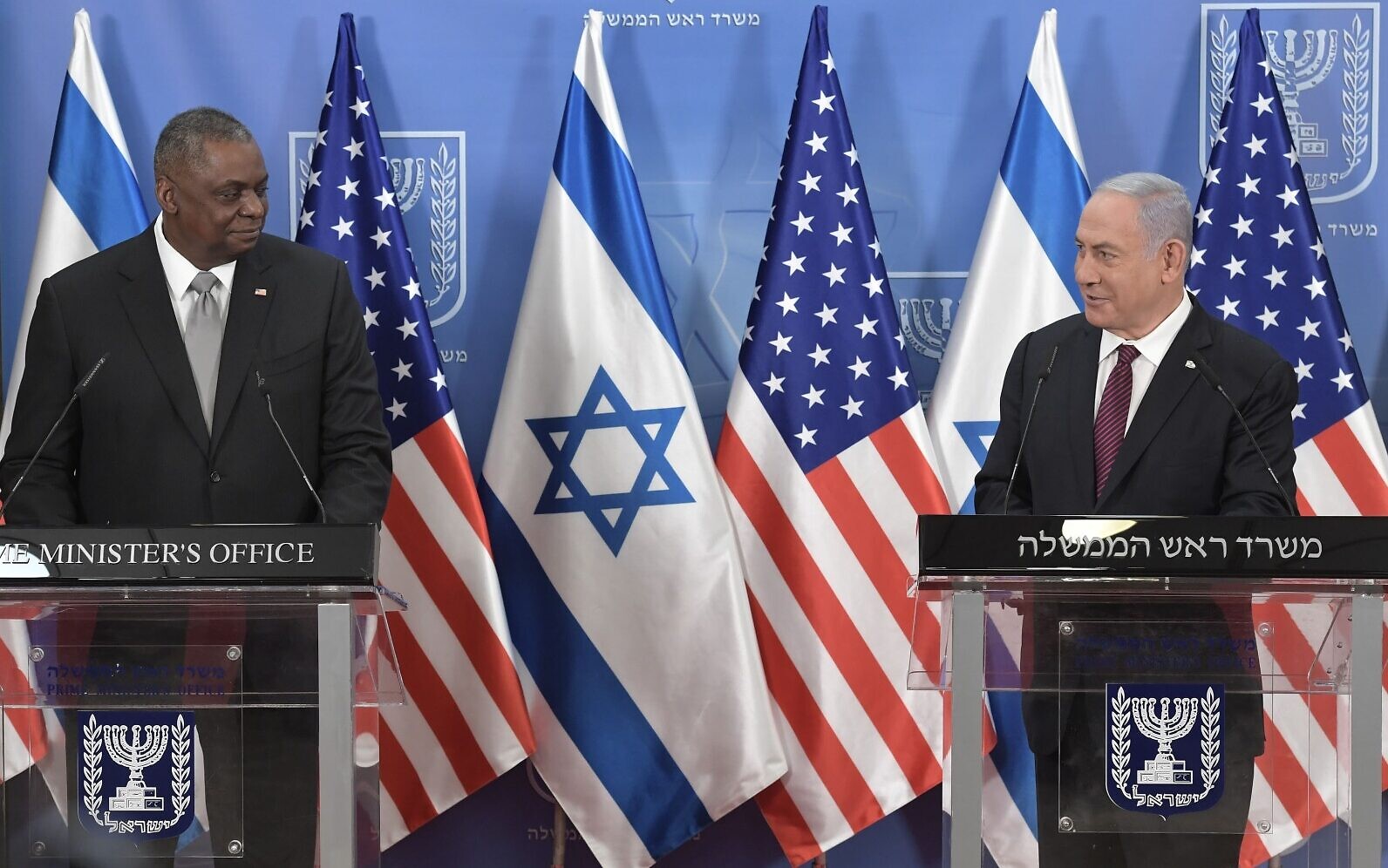
Prime Minister Benjamin Netanyahu (R) and US Defense Secretary Lloyd Austin at a press conference at the Prime Minister’s Office in Jerusalem on April 12, 2021. (Kobi Gideon/GPO)
Hosting US Defense Secretary Lloyd Austin at his office in Jerusalem, Prime Minister Benjamin Netanyahu said Monday that Israel and the US agree on never allowing Iran to obtain nuclear weapons.
“As you know, the US-Israel defense partnership has continually expanded over successive administrations and our cooperation is crucial in dealing with the many threats confronting both the United States and Israel,” Netanyahu said at a press conference alongside Austin.
“In the Middle East, there is no threat more dangerous, serious and pressing than that posed by the fanatical regime in Iran,” said Netanyahu, citing Iran’s pursuit of nuclear weapons, arming of terror groups, and calls for Israel’s annihilation.
“Mr. Secretary, we both know the horrors of war. We both understand the importance of preventing war. And we both agree that Iran must never possess nuclear weapons. My policy as prime minister of Israel is clear — I will never allow Iran to obtain the nuclear capability to carry out its genocidal goal of eliminating Israel.
Speaking days after an apparent attack on the Iranian Natanz nuclear facility, which Tehran has blamed on Israel, Netanyahu concluded by saying that “Israel will continue to defend itself against Iran’s aggression and terrorism,” the prime minister added.
Austin, speaking after Netanyahu, refrained from explicitly mentioning Iran but said he had decided to travel to Israel to “express our desire for earnest consultations with Israel, as we address shared challenges in the region.”
With his two-day visit, the first official visit to the Jewish state by an American secretary of defense since 2017, Austin is the first member of US President Joe Biden’s administration to pay an official visit to Israel.
Affirming the Biden administration’s support for Israel’s security and qualitative military edge in the region, Austin said he and Netanyahu discussed “ways to deepen our longstanding defense relationship in the face of regional threats and other security challenges, and I affirm the department’s support for our ongoing diplomatic efforts to normalize relations between Israel and Arab and Muslim-majority nations,” he says.
“I am confident that together we can chart a path toward enduring peace in this region and advance open and stable order — now, and in the years ahead,” Austin said.
Austin’s visit comes amid ongoing talks in Vienna regarding a return to the 2015 nuclear deal by both Iran and the United States, a move that is staunchly opposed by Israel, particularly by Netanyahu.
On Wednesday, Netanyahu warned that Israel will not be bound by a revitalized nuclear deal between world powers and Iran. Israeli defense analysts have warned that there is a growing rift between Jerusalem and Washington on the issue of Iran and its nuclear program, which may have significant ramifications on Israel’s security.
This satellite photo from Planet Labs Inc. shows Iran’s Natanz nuclear facility on April 7, 2021 (Planet Labs Inc. via AP)
Austin arrived in Israel Sunday as reports emerged from Iran that its Natanz nuclear site had suffered a total power cut in what was widely assumed to be the result of an Israeli cyberattack. Jerusalem refused to comment on the matter, while Iran has blamed Israel, with its foreign minister vowing on Monday to “take revenge on the Zionists.”
The electrical glitch came hours after Tehran began using a new, more powerful centrifuge that could reportedly enrich uranium at a much faster rate than its existing equipment.
Just a day earlier, the International Atomic Energy Agency (IAEA) said in a report released that Iran had again violated limits on its stockpile of enriched uranium, according to Reuters.
Austin’s visit also comes amid indications the Israel-Iran conflict was increasingly being waged at sea, marking a change in the conflict that previously took place primarily via airstrikes, cyberattacks, alleged espionage activities, and on land.
Israeli officials have refused to comment on the matter, in line with a longstanding policy of ambiguity regarding its military actions against Iran in the region, save for those that are direct, immediate retaliations for attacks on Israel.
Times of Israel staff and agencies contributed to this report.
















 anneinpt
 artaxes
 danmillerinpanama
 davidking1530
 Peter Hofman
 Joseph Wouk
 Peter
Peter Louisiana Steve
 WarSclerotic
Recent Comments