Iran vows to ‘teach Israel a lesson’ as response to strikes in Syria

Posted February 6, 2019 by Joseph Wouk
Categories: Uncategorized

Source: Iran vows to ‘teach Israel a lesson’ as response to strikes in Syria – Arab-Israeli Conflict – Jerusalem Post

“If these actions continue… as a firm and appropriate response to teach a lesson to the criminal and lying rulers of Israel,” a senior official said.

BY REUTERS
 FEBRUARY 5, 2019 17:13
AN IRANIAN ballistic missile on display in Tehran.

Israel, which views Iran as its biggest security threat, has repeatedly attacked Iranian targets and those of allied militia in Syria. With an election looming in April, Israel has been increasingly open about carrying out its air strikes.

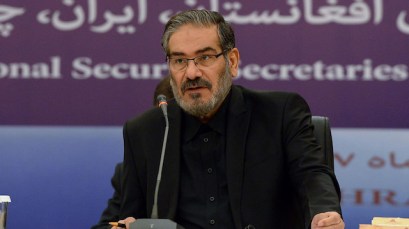
In a meeting with Syria’s Foreign Minister Walid al-Moalem in Tehran, the secretary of Iran’s National Security Council Ali Shamkhani said the Israeli attacks violated Syria’s territorial integrity and were “unacceptable”.

“If these actions continue, we will activate some calculated measures as a deterrent and as a firm and appropriate response to teach a lesson to the criminal and lying rulers of Israel,” Shamkhani was quoted as saying by Fars news agency.

Israeli Prime Minister Benjamin Netanyahu said last month that Israeli forces would continue to attack Iranians in Syria and warned them to “get out of there” fast.

In January, Israeli warplanes carried out an attack on what they called an Iranian arms cache in Syria.

Syria’s Moalem was quoted on Tuesday by a Hezbollah-run media unit as saying: “The Syrian government considers it to be its duty to keep Iranian security forces in Syrian territory.”

Iran has also repeatedly said it will keep military forces in Syria.


As it readies peace plan, US says it sees no need to balance pro-Israel slant 

Posted February 6, 2019 by Joseph Wouk
Categories: Uncategorized

Source: As it readies peace plan, US says it sees no need to balance pro-Israel slant | The Times of Israel

White House is proudly supportive of Israel, senior official says, dismissing need for equivalency as a ‘vestige of talking points from decades ago’

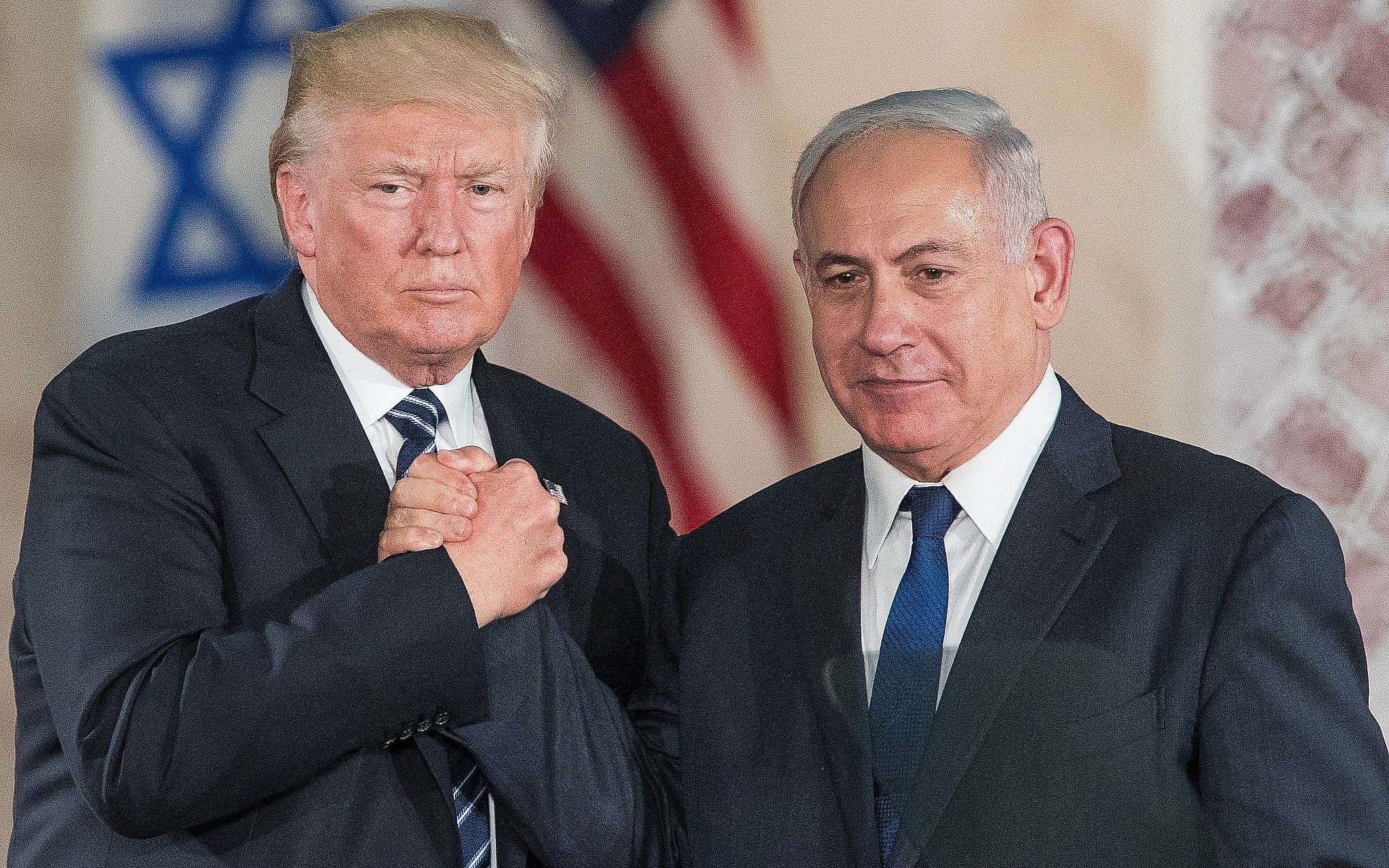
US President Donald Trump and Prime Minister Benjamin Netanyahu shake hands after speaking at the Israel Museum in Jerusalem on May 23, 2017. (Yonatan Sindel/Flash90)

The White House is not interested in being considered an “honest broker” in the Israeli-Palestinian conflict, a senior US official said this week, rejecting the notion that some sort of “equivalency” between the two sides was required to successfully mediate a peace deal.

Rather, the administration is proudly supportive of Israel and does not feel the need to try to counterbalance any pro-Israel statement with some carrots for the Palestinians, or to add a line about Palestinian grievances every time it laments Israeli victims of terror attacks, according to the senior official.

“The US is a strong ally of Israel. The administration, from the president on down, is not embarrassed to defend Israel where Israel needs to be defended, whether it’s on the Gaza border, on the Hezbollah tunnels, the Syrian border, wherever it is,” the senior official told The Times of Israel, speaking on condition of anonymity.

Asked about the widespread perception that the US is no longer an “honest broker,” the senior official dismissed that concept as “a vestige of talking points from decades ago.”

“We don’t believe that in order for us to work on a peace effort we need to have an equivalency, where we can only say certain things about Israel if at the same time we also say something about the Palestinians,” he said.

“Not only does that not work; we don’t think it’s right. We say what’s on our mind; we speak the truth. The truth may be uncomfortable for some people. But we cannot solve the conflict without being open and honest. Ultimately, it’s all about the plan: either it’s a good plan that’s workable for the two sides, or it isn’t.”

The official was referring to the administration’s much-expected proposal for an comprehensive Israeli-Palestinian peace agreement, which Washington is expected to release in the weeks after the April 9 Knesset elections.

In recent weeks, Trump’s special envoy to the peace process, Jason Greenblatt, has conducted some contentious Twitter exchanges with senior PA officials over US-Palestinian relations and so-called Twitter diplomacy.

Greenblatt, who has been working on the peace plan together with Trump’s son-in-law and senior adviser Jared Kushner and US Ambassador to Israel, David Friedman, responded to the attacks by saying that his door remains open to Palestinian officials, who would like to discuss the administration’s policies vis-a-vis the Middle East.

The official reiterated that meetings with “ordinary Palestinians” were taking place on a regular basis.

“They express deep frustration with their leadership. They believe that their leadership has eroded their standing in the world, not just in the US, but around the world. They want to engage with us and they want to see what is in the plan. They want a better future, and they know the key to that involves the US,” the official said.

People are seen outside the Palestinian Liberation Organization Delegation office in Washington DC on September 10, 2018. (AFP/Andrew Caballero-Reynolds)

Since US President Donald Trump unilaterally recognized Jerusalem as Israel’s capital in December 2017, and subsequently moved the US embassy to the city, the Palestinian Authority has refused to engage with administration officials, arguing that Washington was no longer qualified to play a leading role in the peace process.

Relations between Ramallah and Washington further soured after the administration surprisingly cut financial aid to agencies supportive of Palestinians, and closed the Palestine Liberation Organization’s representative office in the US capital.
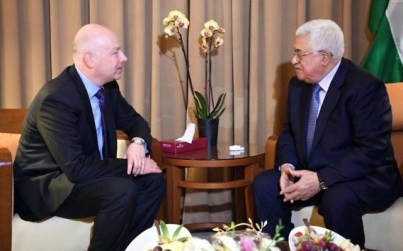
US Middle East envoy Jason Greenblatt meets Palestinian Authority President Mahmoud Abbas on the sidelines of the Arab League Summit in Amman, March 28, 2017 (Wafa/Thair Ghnaim)

The US administration remains hopeful that once the plan is released, Palestinian leaders “will realize how much the Palestinians can gain from the plan,” the senior official added.

The US will not try to force either side to accept the peace proposal, he said, adding “but we believe we can put forth a credible, realistic and fair plan that could bring this conflict to an end; to dramatically improve Palestinian lives, maintain Israel’s security and allow Israel to integrate into the region in a way that even two years ago no one would have imagined it could.”

When the plan will see the day of light has not yet been decided, according to the official, acknowledging that there are “numerous considerations” that may play a role and push the date back to mid-May at the earliest. These include the Israeli elections (April 9) and subsequent coalition building process, the Passover holiday (April 19-26), Ramadan (May 5-June 4), and Israeli Memorial and Independence Days (May 7-9).

“Our goal is to release the plan at a time when it has the best chance of success. There are a lot of factors that go into making that decision,” he said.

 

Vowing to confront Iran, Trump scolds ‘the vile poison of anti-Semitism’ 

Posted February 6, 2019 by Joseph Wouk
Categories: Uncategorized

Source: Vowing to confront Iran, Trump scolds ‘the vile poison of anti-Semitism’ | The Times of Israel

In key address to joint session of Congress, president brings Pittsburgh survivor as guest, says Jerusalem embassy move fueled by ‘pragmatic realism’

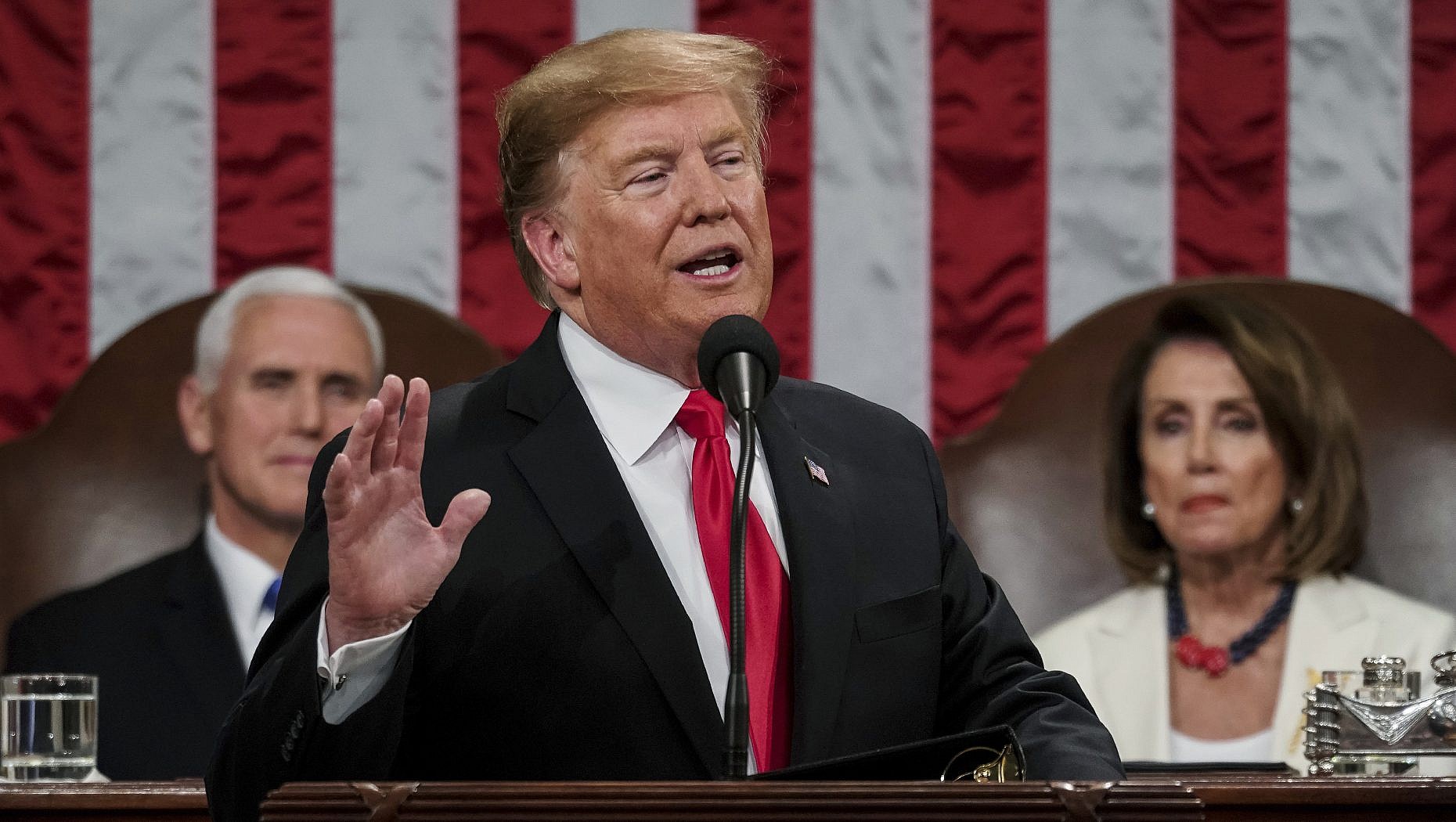
President Donald Trump gives his State of the Union address to a joint session of Congress, Tuesday, Feb. 5, 2019 at the Capitol in Washington, as Vice President Mike Pence, left, and House Speaker Nancy Pelosi look on. (Doug Mills/The New York Times via AP, Pool)

President Donald Trump gives his State of the Union address to a joint session of Congress, Tuesday, Feb. 5, 2019 at the Capitol in Washington, as Vice President Mike Pence, left, and House Speaker Nancy Pelosi look on. (Doug Mills/The New York Times via AP, Pool)

WASHINGTON — US President Donald Trump strongly condemned anti-Semitism Tuesday night as he vowed to confront Iran and learn the lessons of the Pittsburgh synagogue shooting, during his 2019 State of the Union address.

In the speech before a joint session of Congress, in which the president laid out his policy agenda for the next year and lambasted the special counsel’s investigation, Trump spent a fair portion of time on the subject of Jew-hatred.

He contextualized his Iran policy by castigating the regime’s rapacious anti-Semitism.

“We will not avert our eyes from a regime that chants, ‘Death to America,’ and threatens genocide against the Jewish people,” Trump said. “We must never ignore the vile poison of anti-Semitism, or those who spread its venomous creed. With one voice, we must confront this hatred anywhere and everywhere it occurs.”

The need to take a strong stance against Tehran, the president implied, was evident in the attack at the Tree of Life Synagogue — believed to be deadliest act of anti-Semitic violence in American history.

“Just months ago, 11 Jewish Americans were viciously murdered in an anti-Semitic attack on the Tree of Life Synagogue in Pittsburgh,” Trump said, as he introduced SWAT officer Timothy Matson, who responded to the scene, and Judah Samet, a Holocaust survivor who also survived the attack.

A makeshift memorial stands outside the Tree of Life synagogue in the aftermath of a deadly shooting in Pittsburgh, on October 29, 2018 in which eleven Jews were killed while at Shabbat services. (AP/Matt Rourke)

“He arrived at the synagogue as the massacre began,” Trump said of Samet, who was also celebrating his 81st birthday. “But not only did Judah narrowly escape death last fall — more than seven decades ago, he narrowly survived the Nazi concentration camps.”

Trump visited the synagogue shortly after the attack with his Jewish daughter Ivanka and son-in-law Jared Kushner, who is also his senior adviser.

Earlier this year, the president withdrew the United States from the Iran nuclear deal and renewed sanctions on the Islamic Republic, actions that he said in his speech were intended to “ensure this corrupt dictatorship never acquires nuclear weapons.”

Trump made one mention of Israel in his speech, which lasted over an hour. During an extended segment on his Middle East policy, the president suggested he would diverge from the way previous White Houses had tried to resolve the Israeli-Palestinian conflict.

“Our approach is based on principled realism — not discredited theories that have failed for decades to yield progress,” he said. “For this reason, my administration recognized the true capital of Israel — and proudly opened the American embassy in Jerusalem.”

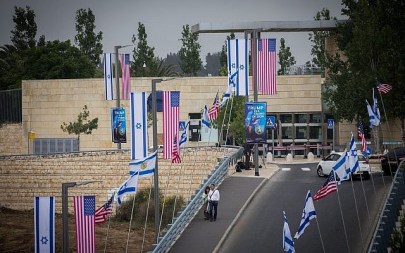
View of the US embassy in Jerusalem’s Arnona neighborhood, May 13, 2018. (Yonatan Sindel/Flash90)

Trump only briefly mentioned his decision to pull US troops out of Syria, a policy decision to which Jerusalem was deeply opposed. Israel has repeatedly warned in recent years that Iran is seeking to establish a military presence in Syria, where it is fighting alongside its Lebanese proxy Hezbollah and Russia to shore up the regime of Syrian President Bashar Assad.

Israeli officials have also warned that America’s absence would open the door for Tehran to create a so-called “land bridge” from Iran, through Iraq and Syria, into Lebanon and to the Mediterranean Sea.

“As a candidate for president, I pledged a new approach.” Trump said. “Great nations do not fight endless war. When I took office, ISIS controlled more than 20,000 square miles in Iraq and Syria. Today, we have liberated virtually all of that territory from the grip of these bloodthirsty killers.”

He continued: “Now, as we work with our allies to destroy the remnants of ISIS, it is time to give our brave warriors in Syria a warm welcome home.”


Iran airs animation showing its submarine sinking US aircraft carrier

Posted February 6, 2019 by Joseph Wouk
Categories: Uncategorized

Source: Iran airs animation showing its submarine sinking US aircraft carrier | The Times of Israel

Video release part of country’s celebrations marking 40 years since the Islamic Revolution

Iranian state media has released an animated video showing one of the country’s Ghadir-class submarines sinking an American aircraft carrier.

The IRINN news channel aired the clip on February 1, according to a transcription provided by the Middle East Media Research Institute (MEMRI).

The video opens with the aircraft carrier cruising on an open sea escorted by four smaller ships and carrying two planes on its deck. A green periscope bearing an Iranian flag then appears, sinister music begins playing, and one by one, the American ships disappear beneath the surface.

The clip ends with the submarine towing the American ships underwater past a logo reading “40 years,” a reference to the 40th anniversary of the country’s 1979 Islamic Revolution, and a voiceover saying, “Our Iran has the technology to manufacture very advanced Ghadir-class submarines.”

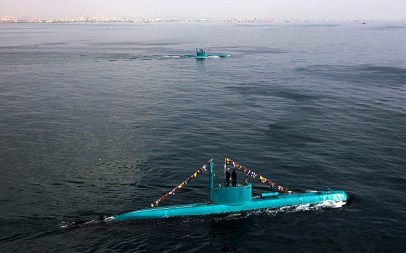
Iran’s newly launched Ghadir submarines move in the southern port of Bandar Abbas in Persian Gulf, Iran, Wednesday, Nov. 28, 2012. Ghadir class submarines can fire missiles and torpedoes at the same time, and can operate in the Persian Gulf’s shallow waters. (AP Photo/Fars News Agency, Ebrahim Norouzi)

Last week, Iran started celebrating the 40th anniversary of the country’s 1979 Islamic Revolution that toppled the US-backed shah, overturned 2,500 years of monarchical rule and brought hard-line Shiite clerics to power.

The Ghadir class submarines are mini, or midget, submarines that can operate in the shallow waters of the gulf.

The subs have sonar-evading technology and can launch missiles from under water, as well as fire torpedoes and drop marine mines, according to an Iranian state TV report released last year.

Iran began manufacturing Ghadir subs in 2005. The first was unveiled in 2007 and by 2012, five such submarines were incorporated into Iran’s navy.

Iran does not disclose the total number of submarines in its fleet.

In December, the US carrier USS John C. Stennis entered the Persian Gulf, ending a long absence of American carriers in the volatile region.

In past years, Iranian naval forces have harassed US ships in the area, and Iran has threatened to close the Strait of Hormuz, the narrow entrance to the Persian Gulf that is crucial to the international oil trade.


Iran Again Threatens to Attack Israel

Posted February 5, 2019 by Joseph Wouk
Categories: Uncategorized

Source: Iran Again Threatens to Attack Israel | Hamodia.com

An Iron Dome antimissile battery seen in the Golan Heights. (Hadas Parush/Flash90)
IYERUSHALAYIM –

Iran has again threatened to attack Israel. Iranian National Security Council head Ali Shakhmani said Tuesday that if it continues to hit Iranian assets in Syria, Tehran will strike out at Israel. Iran had no intention of leaving Syria, he said.

“We will use well thought-out strategies and respond appropriately, to teach the lying, criminal leaders of Israel a lesson.” Shakhmani made the comments Tuesday afternoon, as unconfirmed reports said that another Iranian plane had taken off from Tehran on its way to Syria.

The threat Tuesday echoed one from last week, in which Shamkhani said that advanced weapons with “high levels of accuracy are already in the hands of the resistance in Gaza and Lebanon. They are prepared to burn to the ground the [Israeli] foolishness.”

Shamkhani, who was speaking at a conference on space technology in Iran, also referred to the Gonen Segev affair and the Hezbollah terror tunnels. “There has been no greater embarrassment for the Zionist entity,which claims it is advanced technologically and scientifically, than for one of its ministers to spy on them, and the discovery of hundreds of kilometers of tunnels under it.”

Last week, a Lebanese newspaper reported that Iranian forces have been assembling on the Syrian side of the Golan border. In recent weeks, Iranian troops and militia forces associated with Iran – along with Hezbollah forces – have been taking up positions in Syria, very close to the Golan border, Al-Jadid said in the report.

Some of the forces have positioned themselves within Druze villages – creating a dilemma for Israel, which would prefer to avoid attacking villages with Druze populations so as not to alienate its own Druze residents, the report said. The area is one that Iran has been told to stay away from by Russia, the report added.


Iran warns ‘criminal Israel’ against further air strikes in Syria

Posted February 5, 2019 by Joseph Wouk
Categories: Uncategorized

Source: Iran warns ‘criminal Israel’ against further air strikes in Syria

Reuters Agency

Iran warned Israel on Tuesday of a “firm and appropriate” response if it continued attacking targets in Syria, where Tehran has backed President Bashar al-Assad and his forces in their nearly eight-year war against the Syrian opposition.

Israel, which views Iran as its biggest security threat, has repeatedly attacked Iranian targets and those of allied militia in Syria. With an election looming in April, Israel has been increasingly open about carrying out its air strikes.

In a meeting with Syria’s Foreign Minister Walid al-Moalem in Tehran, the secretary of Iran’s National Security Council Ali Shamkhani said the Israeli attacks violated Syria’s territorial integrity and were “unacceptable”.

“If these actions continue, we will activate some calculated measures as a deterrent and as a firm and appropriate response to teach a lesson to the criminal and lying rulers of Israel,” Shamkhani was quoted as saying by Fars news agency.

Israeli Prime Minister Benjamin Netanyahu said last month that Israeli forces would continue to attack Iranians in Syria and warned them to “get out of there” fast.

In January, Israeli warplanes carried out an attack on what they called an Iranian arms cache in Syria.

Syria’s Moalem was quoted on Tuesday by a Hezbollah-run media unit as saying: “The Syrian government considers it to be its duty to keep Iranian security forces in Syrian territory.”

Iran has also repeatedly said it will keep military forces in Syria.


Givati recon battalion completes drill simulating war with Hezbollah

Posted February 5, 2019 by Joseph Wouk
Categories: Uncategorized

Source: Givati recon battalion completes drill simulating war with Hezbollah – Middle East – Jerusalem Post

Maj. Alon Peiser: ‘The Lebanese shouldn’t try us. But if they try something, they will pay a price.’

BY ANNA AHRONHEIM
 FEBRUARY 5, 2019 17:04
Givati recon battalion completes drill simulating war with Hezbollah

With tensions high along Israel’s northern border, hundreds of soldiers from the IDF’s Givati reconnaissance battalion are completing a drill simulating war with Hezbollah.
Some 200 to 300 troops drilled along the Lebanese border “against a challenging enemy which has been getting stronger over the past few years,” Maj. Alon Peiser, deputy commander of Givati’s Gadsar reconnaissance battalion, told The Jerusalem Post on Tuesday.
The drill, which ends on Thursday, is part of a four-month-long drill carried out by the Givati infantry brigade in northern Israel. It saw troops train on a variety of scenarios alongside tanks, Namer heavy armored vehicles and helicopters from the Israel Air Force.
The IDF has significantly stepped up the scope and frequency of its combat training to improve its readiness. As part of the IDF’s five-year Gideon plan, the military has returned to 17 weeks of consecutive training, an increase from the 13 weeks soldiers trained for the past 15 years.
Last week, the troops belonging to the 450th battalion from the IDF’s school for Infantry Corps Professions and Squad Commanders (also known as Bislamach), completed a large scale drill in northern Israel, also simulating war against Hezbollah.
“Every drill is different, it is more challenging every time, be it physical or regarding the small details,” Peiser said, adding that “every drill is carried out as per how the enemy changes.”
“In war, our troops will march toward the enemy and when they meet him, they will kill him. We will defeat the enemy in the minimum amount of time and with the minimum amount of collateral damage,” he said.
Israel and Hezbollah fought a 34-day war in 2006, and in recent months tensions have once again risen along the northern border.
In December, Israel launched Operation Northern Shield to detect and neutralize cross-border attack tunnels dug by the Iranian-backed Shi’ite organization. Israel believes that the tunnels would have been used by the Hezbollah’s elite Radwan unit to infiltrate into Israel in an attempt to take control of several communities and kill as many civilians and troops as possible.
Israeli officials have also repeatedly voiced concerns over Iran’s presence in Syria and the smuggling of sophisticated weaponry to Hezbollah from Tehran to Lebanon via Syria, stressing that both are redlines for the Jewish state. To prevent Iran’s military entrenchment in the war-torn country, Israel has carried out numerous airstrikes over the past five years.
On Monday, Iran’s Foreign Minister Javad Zarif accused Israel of “being the main opponent to peace in the region,” during a meeting with his Syrian counterpart Walid al-Moallem, who was in Tehran to discuss ongoing coordination and consultation between Syria and Iran.
Moallem met earlier with Iran’s Secretary of the Supreme National Security Council Rear Admiral, Ali Shamkhani, who warned that Israel would “receive a decisive response” if it were to continue to carry out airstrikes in Syria.
But for Peiser, his troops are ready.
“I hope, for the sake of Israeli civilians, I hope there won’t be a war,” Peiser said when asked if he was expecting a war with Hezbollah in the near future. But, he warned, “the Lebanese shouldn’t try us. But if they try something, they will pay a price.”
“We are ready for war now, we were ready yesterday. We are prepared,” Peiser told the Post. “You can count on us in the next war.”


Israeli UN Amb. Danny Danon on Defending Israel Globally 

Posted February 5, 2019 by Joseph Wouk
Categories: Uncategorized


U.S. ambassador to Germany: ‘horrific actions’ of Iran equal to ISIS 

Posted February 5, 2019 by Joseph Wouk
Categories: Uncategorized

Source: U.S. ambassador to Germany: ‘horrific actions’ of Iran equal to ISIS – Diaspora – Jerusalem Post

“The recent press reports that the Iranian regime publicly hanged a 31-year-old man for being gay should be a wake-up call for anyone.”

BY BENJAMIN WEINTHAL
ISIS fighter beheading boy, 16, in Syria

The most high-profile US ambassador in Europe, Richard Grenell, compared on Saturday the Islamic State’s brutality with the execution sprees in the Islamic Republic of Iran.

The US ambassador to Germany wrote in the federal republic’s largest circulation paper BILD: “The recent press reports, first carried by The Jerusalem Post, that the Iranian regime publicly hanged a 31-year-old man for being gay should be a wake-up call for anyone who supports basic human rights. Politicians, the UN, democratic governments, diplomats, and good people everywhere should speak up – and loudly,” adding “Iran’s horrific actions are on par with the brutality and savagery regularly demonstrated by ISIS.”

Islamic State has engaged in public executions of gay men, including tossing gay men from buildings.

Iran’s mullah regime and the Islamic State despise the LGBT community and both prescribe capital punishment for gays and lesbians.

As of 2016, the LGBT human rights advocacy organization OutRight Action International documented 90 murders carried out by the Islamic State during the period 2014-2016.

According to a 2008 British Wikileaks dispatch, the Islamic Republic of Iran executed “between 4,000 and 6,000 gays and lesbians” since the 1979 Islamic revolution in Iran.

Grenell wrote: “This is not the first time the Iranian regime has put a gay man to death with the usual outrageous claims of prostitution, kidnapping, or even pedophilia. And it sadly won’t be the last time they do it either. Barbaric public executions are all too common in a country where consensual homosexual relationships are criminalized and punishable by flogging and death. In Iran, where children as young as nine can be sentenced to death, gay teenagers are publicly hanged in order to terrify and intimidate others from coming out.”

He noted, “Being gay is a death sentence in eight countries and criminalized in 70 more. LGBT status or conduct means arrest, imprisonment, and violence for people who are simply dating or falling in love. Governments that are members of the United Nations have an obligation to protect, respect, and uphold the dignity and fundamental freedoms of their people.”

The Post first reported in the major media about the Iranian regime’s public hanging of a 31-year-old man based on the clerical regime’s lethal anti-gay law.

Grenell said in his opinion column: “While a student at Evangel University, a Christian liberal arts college in Missouri, I was taught by biblical scholars that ‘all truth is God’s truth, no matter where it is found.’ The truth for LGBT people is that we were born gay. Enshrined in the Universal Declaration of Human Rights is the idea that all of us are born free and equal in dignity and rights. People can disagree philosophically about homosexuality, but no person should ever be subject to criminal penalties because they are gay.”

He concluded his article noting, “India, Trinidad and Tobago, Angola, and Belize have recently decriminalized consensual same-sex sexual conduct. But there’s still much more work to be done. Reasonable people can help by speaking out when young gay men are publicly hanged in Iran or shot in Chechnya. And government officials must work harder to demand that UN members decriminalize homosexuality.”


In Yemen’s chaos, jihadists and Iran are getting hold of US weapons 

Posted February 5, 2019 by Joseph Wouk
Categories: Uncategorized

Source: In Yemen’s chaos, jihadists and Iran are getting hold of US weapons | The Times of Israel

Pentagon investigating apparent Saudi, UAE violations of commitments not to transfer American arms to Yemeni factions

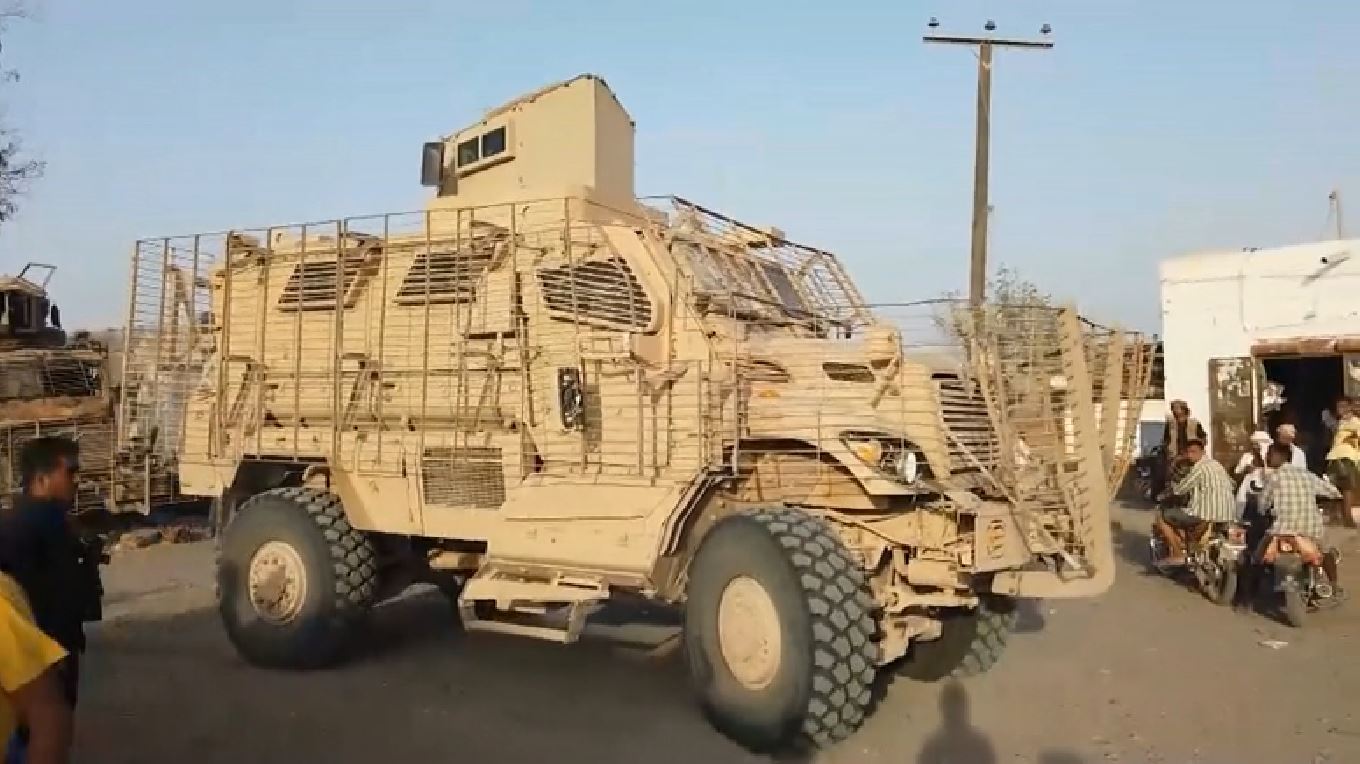
A US-made MRAP, or Mine-Resistant Ambush Protected, armored vehicle in Yemen in the hands of a radical Salafi faction backed by Saudi Arabia and the United Arab Emirates. (CNN screen capture)

A US-made MRAP, or Mine-Resistant Ambush Protected, armored vehicle in Yemen in the hands of a radical Salafi faction backed by Saudi Arabia and the United Arab Emirates. (CNN screen capture)

The Pentagon has launched an investigation into alleged Saudi transfers of US military hardware, from rifles to armored vehicles and tanks, to the hands of Islamist radical groups in Yemen.

Some of the hardware, which was transferred in contravention of legally binding commitments to obtain US permission before doing so, has even ended up in the hands of Iran-allied Houthi militias, opening up the possibility that Iran could study sensitive American military technology and ultimately endanger US forces elsewhere in the region.

The revelation came in an exclusive report Monday by CNN, which sent undercover reporters into Yemeni towns to find the weapons.

In one weapons shop in Taiz, a city in the country’s southwest, a dealer confirmed to CNN that he had US weapons, saying they’re “expensive and sought after.”

The “not-so-hidden black market” is helping to drive “the demand for hi-tech American weapons and perpetuating the cycle of violence in Yemen,” the report said.

Firearms for sale at a weapons shop in the southwestern Yemeni city of Taiz. (CNN screen capture)

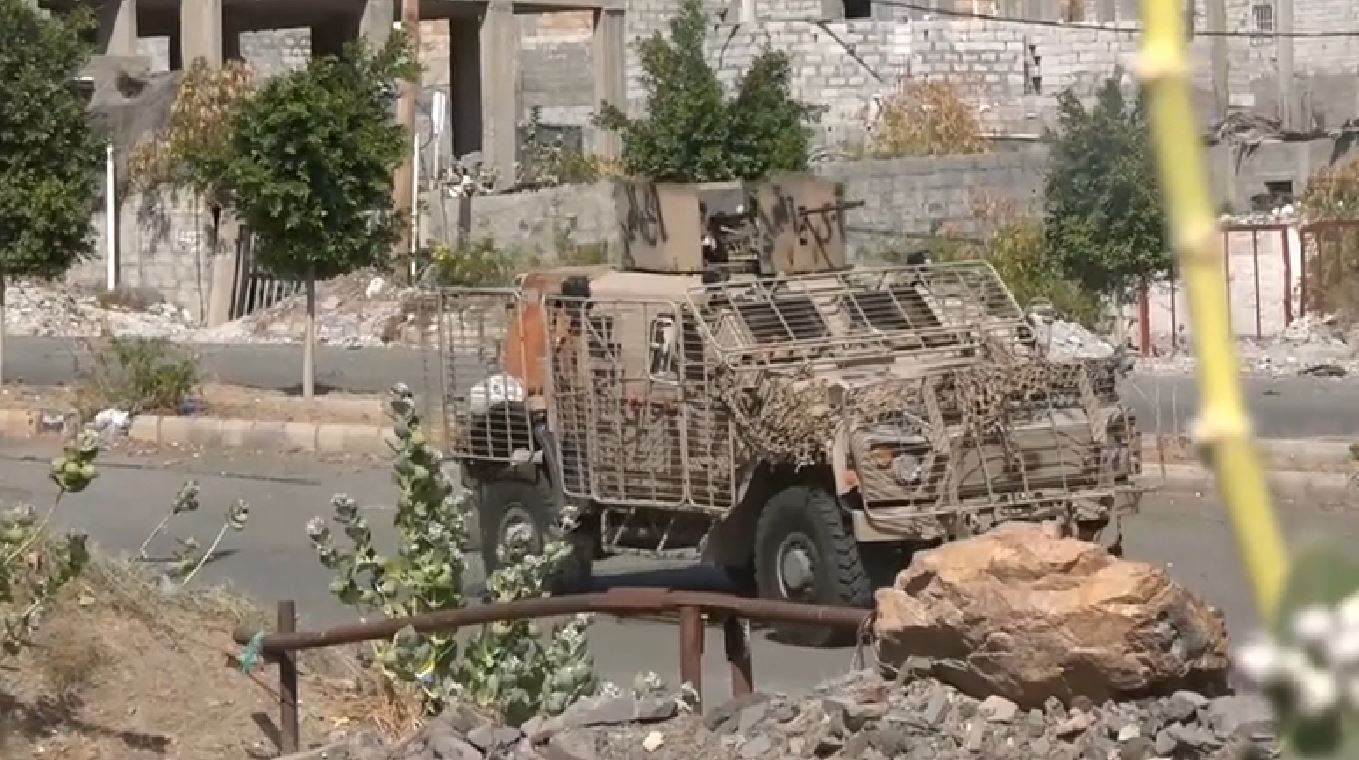
Some of the weapons systems have made their way to the Yemeni affiliate of al-Qaeda, known as al-Qaeda in the Arabian Peninsula (AQAP), which has fought in the Taiz area and once paraded US-made Oshkosh armored vehicles through the city’s streets. Today the group, labeled a terror organization by the US, fights as part of the Saudi-backed Yemeni army.

Other systems, such as the MRAP, or Mine-Resistant Ambush Protected, armored vehicles, were found in the port city of Hodeida in the hands of a radical Salafist group known as the Giants Brigade.

The vehicles were built by Navistar and sold in 2014 to Abu Dhabi, where they were incorporated into the United Arab Emirates armed forces, which transferred them to factions in the Yemeni war, according to the report.

Reached by CNN, an unnamed senior UAE official denied “in no uncertain terms that we are in violation of end-user agreements in any manner.”

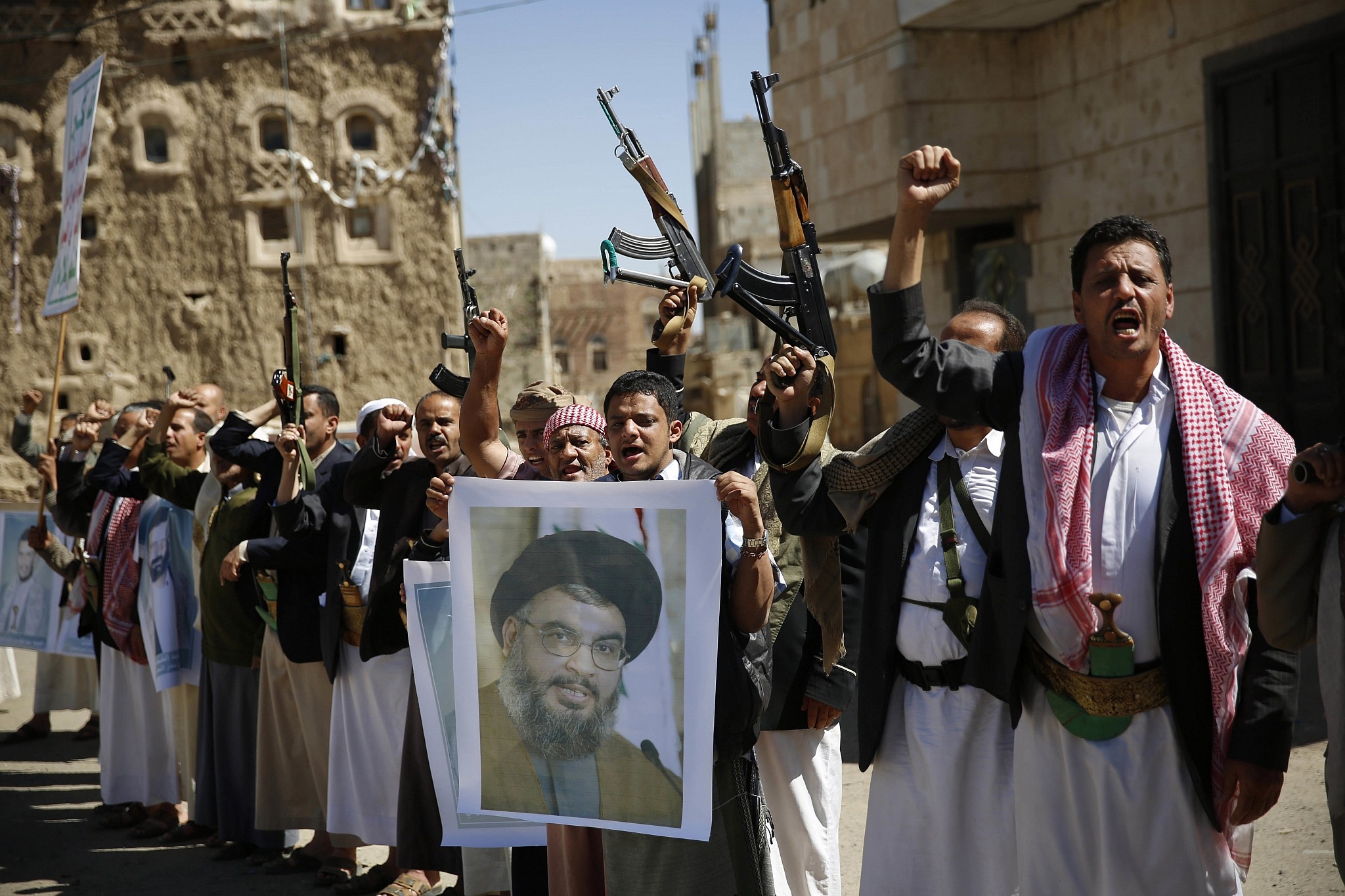
FILE – In this March 3, 2016 photo, Shiite rebels, known as Houthis, hold a poster of Hezbollah leader Hassan Nasrallah during a rally in support of Hezbollah, in Sanaa, Yemen. (AP Photo/Hani Mohammed, File)

He insisted the Giants Brigade was “part of Yemeni forces,” and its possession of the MRAP vehicles amounted to “collective possession” of the UAE-backed coalition.

But Pentagon spokesman Johnny Michael told CNN “the United States has not authorized the Kingdom of Saudi Arabia or the United Arab Emirates to re-transfer any equipment to parties inside Yemen.”

He added: “The US government cannot comment on any pending investigations of claims of end-use violations of defense articles and services transferred to our allies and partners.”

MRAPs are a vital part of the US military’s efforts to protect American soldiers from roadside bombs, also known as improvised explosive devices (IEDs), which are responsible for most combat deaths each year.

A US-made Oshkosh armored vehicle parading through the streets of Taiz, Yemen, in 2015. (CNN screen capture)

“It is critical that knowledge of MRAP vulnerabilities does not fall into enemy hands,” CNN said, adding, “it’s already too late.”

“In September 2017, a Houthi-run TV channel broadcast images of Mohammed Ali al-Houthi, the de facto rebel leader, proudly sitting behind the wheel of a captured US-made MRAP in the capital Sanaa, as a crowd chanted ‘death to America’ in the background,” the network reported.

It claimed to have evidence of at least one more MRAP falling into Houthi — and thus Iranian — hands last year.

A Houthi intelligence official in Sanaa who spoke to CNN on condition of anonymity said Iranian and Hezbollah officials had already taken possession of the US-made vehicles, as well as other weapons systems, and “are assessing US military technology very closely.”

He insisted “there isn’t a single American weapon that they don’t try to find out its details, what it’s made of, how it works.”