US has ordered banks not to send money to PA, official says

Posted February 11, 2019 by Joseph Wouk
Categories: Uncategorized

Source: US has ordered banks not to send money to PA, official says | The Times of Israel

( God bless President Trump and PM Netanyahu.  No more “free ride” for these terrorist dirtbags… – JW )

Fatah’s Hussein al-Sheikh says American financial pressure aims to bring Palestinians to their knees, force them to accept Trump peace plan
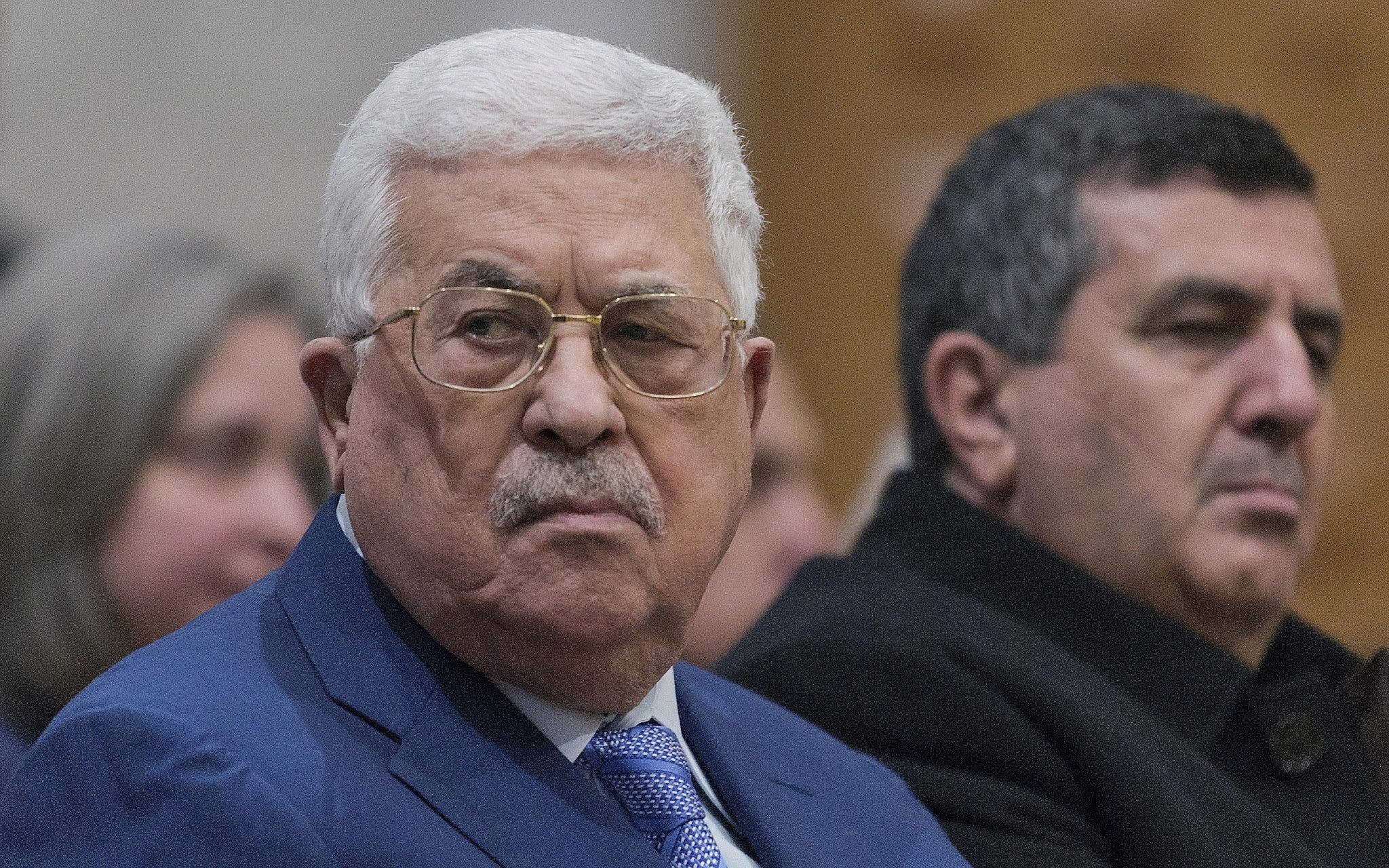
Palestinian Authority President Mahmoud Abbas, left, attends a Christmas midnight mass at Saint Catherine's Church in the Church of the Nativity, traditionally recognized by Christians to be the birthplace of Jesus, in the West Bank city of Bethlehem on December 25, 2018. (AP Photo/Nasser Nasser, Pool)

Palestinian Authority President Mahmoud Abbas, left, attends a Christmas midnight mass at Saint Catherine’s Church in the Church of the Nativity, traditionally recognized by Christians to be the birthplace of Jesus, in the West Bank city of Bethlehem on December 25, 2018. (AP Photo/Nasser Nasser, Pool)

A top Fatah official said in an Arabic-language interview published Sunday that the US has asked international banks to squeeze the Palestinian Authority financially in a bid to pressure the Palestinian leaders to accept the Trump administration’s peace plan.

“Major international financial institutions and parties have begun to accede to an American request to impose a tight financial siege on the Authority,” Hussein al-Sheikh told AFP.

“Washington has asked for financial aid given to the authority to be stopped, and it has also issued a circular to banks not to receive transfers for the authority’s accounts.”

The claim came on the same day that Prime Minister Benjamin Netanyahu vowed to begin deducting PA payments to convicted terrorists and their families from tax transfers Israel hands the PA each month, and after massive cuts in US aid to the Palestinian in recent months.

According to al-Sheikh, “the sanctions began with preventing the transfer of an Iraqi grant worth $10 million, which was handed over to the Arab League recently. The League has not been able to transfer it because all banks have refused to accept it for transfer to the Authority’s finance ministry or the national fund.”
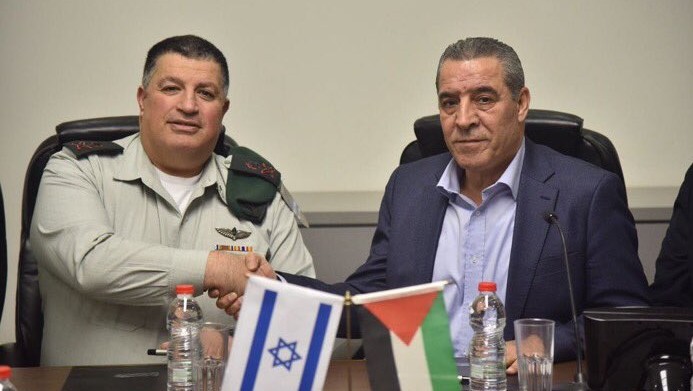
File: Then-coordinator of government activities in the territories (COGAT) Maj. Gen. Yoav Mordechai, left, and the Palestinian Authority’s Civil Affairs Minister Hussein al-Sheikh sign an agreement to revitalize the Israeli-Palestinian Joint Water Committee, January 15, 2017. (Courtesy COGAT)

Al-Sheikh added that “the American decision is in line with an Israeli decision” to cut the tax transfers, which represent more than 50 percent of the Palestinian treasury’s imports and constitute about 70% of the current expenses of the Authority and the salaries of its employees.

He added: “The American and Israeli decisions come as part of an attempt to bring the leadership to its knees and force it to accept [US President Donald Trump’s] ‘deal of the century,’ first by allowing for its announcement and second to pave the way to ‘Arabize’ it and begin the process of Arab normalization with Israel without [Israel giving] anything in return” to the Palestinians.

He accused the US and Israel of pushing PA President Mahmoud Abbas to what he described as “extreme decisions.”

Netanyahu told cabinet ministers on Sunday that he would, in a week’s time, begin cutting funds to the PA over its payments to terrorists and their families.

“By the end of the week, the staff work required for implementing the law on deducting terrorists’ salaries will be completed,” the prime minister said at the weekly cabinet meeting in Jerusalem, referring to a law that was passed by the Knesset in July and formally went into effect on January 1. It grants the government the power to withhold Palestinian tax funds from the PA equal to the amount spent by the PA in payments to incarcerated security prisoners and the families of terrorists killed while attacking Israelis.
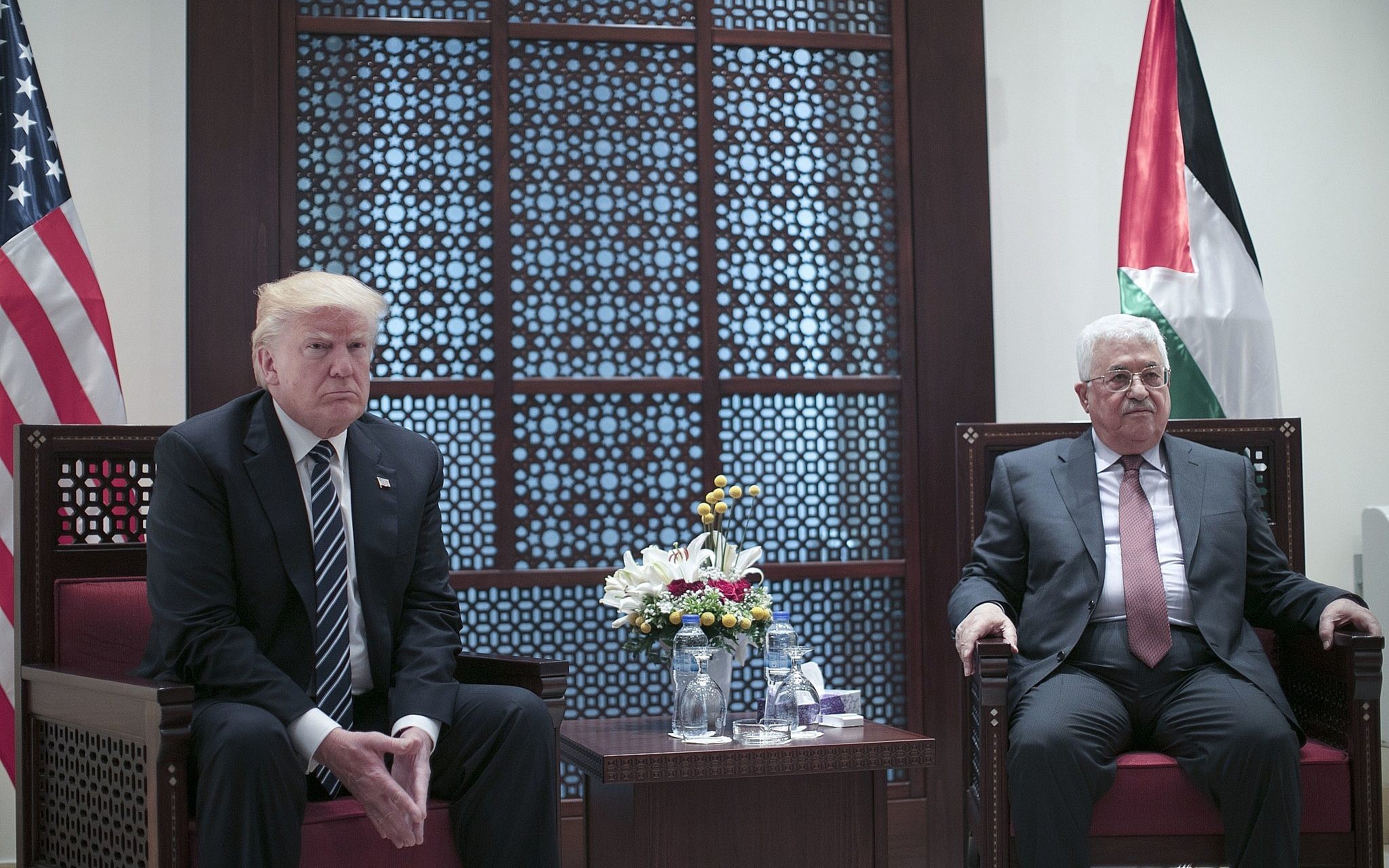
Palestinian Authority President Mahmoud Abbas, right, meets US President Donald Trump In the West Bank city of Bethlehem on May 23, 2017. (Fadi Arouri, Xinhua Pool via AP)

“Next Sunday I will convene the security cabinet and we will approve the decision needed to withhold the funds. The funds will be deducted. No one should doubt that. And next week,” he vowed.

The comments come amid pressure on Netanyahu to act after the arrest of a Palestinian man, Arafat Irfayia, 29, on Friday for the brutal murder of 19-year-old Ori Ansbacher in a southern Jerusalem wood a day earlier. The case has sparked outrage across the country, and the Shin Bet security service has indicated Irfayia had a nationalistic motive for the attack.

The government has refused to implement the power given to it by the law to freeze the fund transfers amid security officials’ fears it could destabilize the PA and lead to violence. But politicians have faced public pressure to crack down on the PA’s payments, which are viewed as incentivizing terror attacks.

A PA law legislated in 2004 says any Palestinian prisoner and his or her family are entitled to a variety of payments. The law defines a prisoner as “anyone who is sitting in the occupation’s prisons for participating in the struggle against the occupation” and calls such a person “part and parcel of the Palestinian Arab community’s fabric.”

Palestinian officials have argued payments to security prisoners seek to mitigate what they call an unfair Israeli military court system.
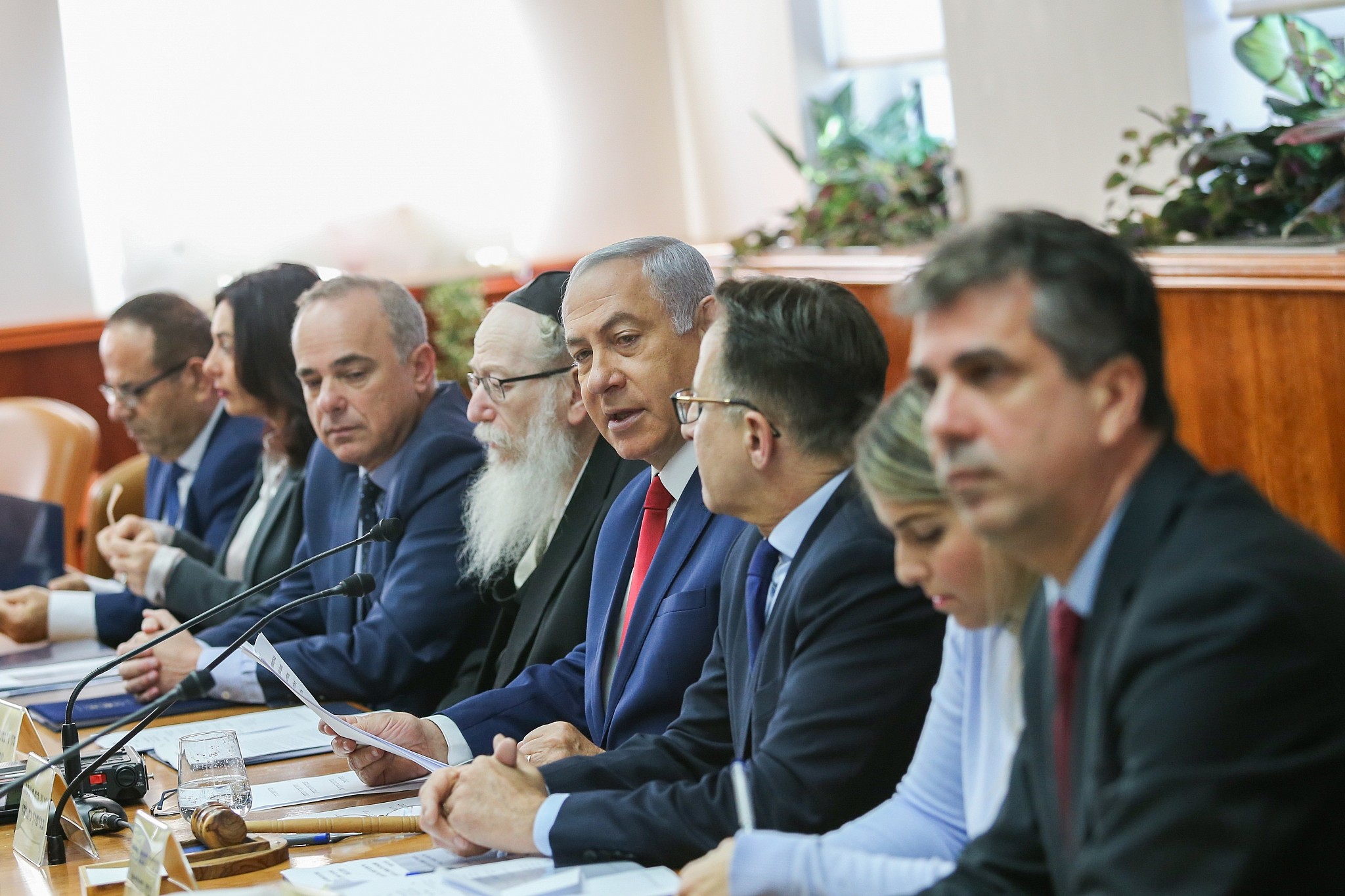
Prime Minister Benjamin Netanyahu leads the weekly cabinet meeting at the Prime Minister’s Office in Jerusalem on January 6, 2019. (Alex Kolomoisky/Yedioth Ahronoth/Pool)

Last March, Trump signed into law legislation that requires the American government to cut some aid to the Palestinians until they end payments to terrorists and slain attackers. Since Trump signed the legislation, his administration has cut hundreds of millions of dollars in aid to the Palestinians.

Abbas has said the PA will continue to pay stipends to the families of Palestinian security prisoners and “martyrs” even if it has to spend its last penny to do so.

“We will not accept a cut or cancellation of salaries to the families of martyrs and prisoners, as some are trying to bring about,” he told representatives of a Palestinian prisoners advocacy group in July. “Even if we have only a penny left, we will give it to the martyrs, the prisoners and their families.”

Since shortly after Trump recognized Jerusalem as Israel’s capital in December 2017 and initiated the relocation of the US embassy in the Jewish state to the city, Abbas has called for an international conference in order to establish a multilateral mechanism for the peace process.
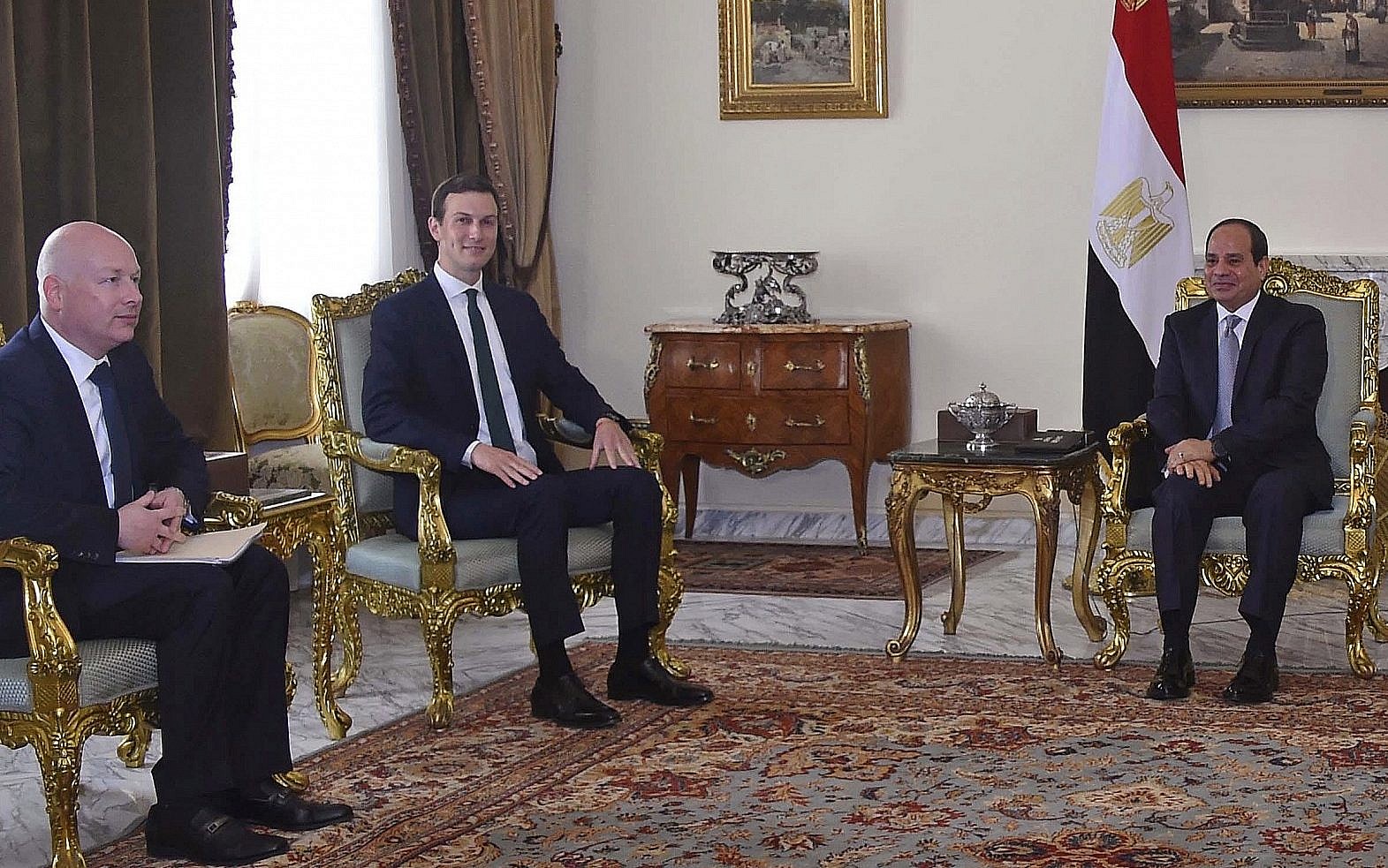
In this Thursday, June 21, 2018 photo, provided by Egypt’s state news agency, MENA, Egyptian President Abdel-Fattah el-Sissi, center, meets with President Donald Trump’s son-in-law and senior adviser Jared Kushner, second left, and Mideast envoy Jason Greenblatt on a regional tour to discuss a blueprint for an Israeli-Palestinian peace deal, in Cairo, Egypt. (MENA via AP)

He has also declared that the Palestinians would no longer work with an American-dominated peace process.

Meanwhile, White House senior adviser Jared Kushner and other administration officials are headed to the Middle East later this month to brief diplomats in at least five countries on the economic section of the expected US proposal for peace between Israelis and Palestinians.

Kushner, who is Trump’s son-in-law, will be joined by US Mideast envoy Jason Greenblatt, US envoy on Iran Brian Hook and other administration officials who have worked on the economic part of the plan.

Stops are confirmed in Oman, Bahrain, Saudi Arabia, United Arab Emirates and Qatar. Other stops could be added to the trip, according to a White House official.

The plan includes an economic development proposal for Palestinians that foresees major infrastructure and industrial work, particularly in Gaza. For the plan to succeed or even pass the starting gate, it will need at least initial buy-in from both Israel and the Palestinians as well as from the Gulf Arab states, which officials say will be asked to substantially bankroll the economic portion.

US officials have said the plan won’t be made public before Israel’s elections on April 9.

IRNA: Iran warns it would raze Tel Aviv to the ground if attacked by US

Posted February 11, 2019 by Joseph Wouk
Categories: Uncategorized

Source: IRNA: Iran warns it would raze Tel Aviv to the ground if attacked by US

“The United States does not have the courage to shoot a single bullet at us despite all its defensive and military assets. But if they attack us, we will raze Tel Aviv and Haifa to the ground,” Yadollah Javani, the Guards’ deputy head for political affairs was quoted as saying by state news agency IRNA.
He was speaking at a rally celebrating the 40th anniversary of the Islamic revolution. 


Iranian foreign minister extends support for new Lebanese government 

Posted February 11, 2019 by Joseph Wouk
Categories: Uncategorized

Source: Iranian foreign minister extends support for new Lebanese government – Israel Hayom

“We are always ready [to arm Lebanon] … but we are waiting for this desire to be there on the Lebanese side,” Mohammad Zarif says after Hezbollah leader urges Lebanese government to accept anti-aircraft weapons from Iran to confront Israeli warplanes.

Associated Press and Israel Hayom Staff // published on 11/02/2019
   
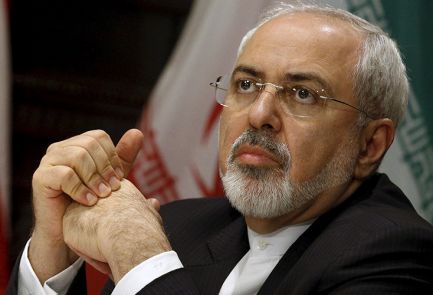
Iranian Foreign Minister Mohammad Javad Zarif 


Iran’s foreign minister extended an offer for Iranian military assistance to the U.S.-backed Lebanese army on Sunday, saying Iran is ready to assist in all sectors should the Lebanese government want it.

Mohammad Javad Zarif spoke to reporters Sunday at Beirut’s airport shortly after his arrival in the Lebanese capital for a two-day official visit.

“We are always ready [to support Lebanon militarily] and we have announced that on many occasions. This tendency does exist in Iran, but we are waiting for this desire to be there on the Lebanese side,” he said.

The comments came a few days after the leader of the Iran-backed Hezbollah terrorist group urged Lebanon’s government to accept anti-aircraft weapons from Iran to confront Israeli warplanes. He also said Iran was ready to provide Lebanon with electricity and medicine.

“Will the Lebanese government be brave enough to accept an Iranian offer? Why should Lebanon be afraid to cooperate with Iran?” Nasrallah asked during a speech marking the 40th anniversary of Iran’s Islamic Revolution this week.

The United States, which lists Hezbollah as a terrorist group, backs the Lebanese army through a program that aims to strengthen the military as the sole armed force defending the country.

Lebanon’s Western-backed Prime Minister Saad Hariri formed a government late last month, after a nine-month vacuum that exacerbated the country’s economic woes. Hezbollah has three ministers in the new cabinet, reflecting the gains made by the powerful group in parliamentary elections held in May last year. The terrorist group named the health minister, marking the first time it controls a ministry with a large budget.

Zarif is the first senior official from the region to visit Lebanon since the new government was formed. He was met at the airport by a minister from Hezbollah and other officials from the Shiite group.

In his comments, Zarif congratulated Lebanese politicians and said Iran is ready to support the government in any way possible.

Mahmoud Qomati, a Hezbollah member and state minister for parliamentary affairs, said later that his group appreciates there is international pressure on Lebanon but that shouldn’t stand in the way of accepting Iran’s offer to help the country’s struggling economy.

He urged the government to take a “brave” stand and accept the offer extended to it.

Zarif is scheduled to meet with the Lebanese president, prime minister and foreign minister on Monday.


Withdrawal of US forces in Syria likely to start in ‘weeks’ 

Posted February 11, 2019 by Joseph Wouk
Categories: Uncategorized

Source: Withdrawal of US forces in Syria likely to start in ‘weeks’ – Israel Hayom

Removal of U.S. forces “will all be driven by the situation on the ground,” says U.S. Army Gen. Joseph Votel, head of the U.S. Central Command • Votel says he does not believe the U.S. will broadly increase overall troop numbers in neighboring Iraq.

Reuters and Israel Hayom Staff // published on 11/02/2019
   
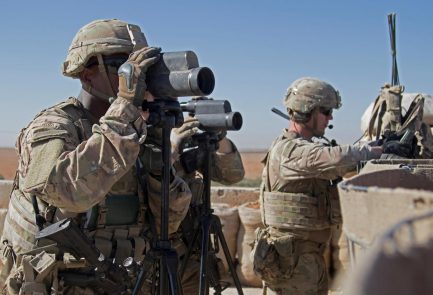
U.S. soldiers on patrol in Manbij, Syria, in November 1, 2018 


The United States is likely just weeks away from starting the withdrawal of ground troops from Syria ordered by President Donald Trump, the top U.S. commander overseeing American forces in the Middle East said on Sunday.

U.S. Army Gen. Joseph Votel, head of the U.S. Central Command, cautioned that the exact timing would depend on the situation in Syria, where U.S.-backed fighters have launched a final assault against Islamic State enclaves near the Iraqi border.

The U.S. military has already started withdrawing equipment from Syria. Asked whether the withdrawal of America’s more than 2,000 troops would begin in days or weeks, Votel said: “Probably weeks. But again, it will all be driven by the situation on the ground.”

“In terms of the withdrawal … I think we’re right on track with where we wanted to be,” Votel told reporters traveling with him during a trip to the Middle East.

“Moving people is easier than moving equipment and so what we’re trying to do right now is again [to] kind of clear out those materials, that equipment that we do not need.”

Trump’s surprise announcement in December that he was withdrawing American troops from Syria helped trigger the resignation of his defense secretary, Jim Mattis, and sent U.S. military officials scrambling to construct a withdrawal plan that preserves as many gains as possible.

Hundreds of additional troops have been sent to Syria to facilitate the withdrawal.

U.S. officials have long estimated that the Syria pullout could take until sometime in March or April to execute fully, but have been reluctant to set an exact timeline given hard-to-predict battlefield conditions.

Votel did not speculate about when the withdrawal would be completed.

One big question has been whether some U.S. forces in Syria might move to neighboring Iraq, where the United States has more than 5,000 troops helping Baghdad fight Islamic State and prevent the group’s resurgence.

Votel said he did not believe the United States would broadly increase overall troop numbers in Iraq. He did leave open the possibility of changing the composition of forces to help the United States keep pressure on the terrorist group.

Referring to future U.S. troop levels in Iraq, Votel said: “I think it’s going to remain more or less steady.”

“This isn’t just wholesale – ‘Everybody in Syria move over to Iraq.’ That doesn’t make sense,” Votel said.

Votel is one of many current and former U.S. officials who have warned of the risk of resurgence by Islamic State unless the United States and its allies can keep pressure on the group following the U.S. withdrawal. They say Islamic State still has enough leaders, fighters, facilitators and financial resources to fuel a menacing insurgency.

But a clear U.S. plan on how to keep up the pressure has yet to be articulated. It is also unclear whether the United States will be able to satisfy the security concerns in Syria of its NATO ally Turkey without sacrificing the interests of U.S.-backed Kurdish fighters there.

Washington views the Kurdish militia as loyal partners in the fight against Islamic State, whose help will likely continue to be needed to prevent the group’s resurgence.

The Pentagon’s own internal watchdog released a report last week warning about the risks still posed by Islamic State. It cautioned that, absent sustained pressure, the group would likely resurge in Syria within six to 12 months and retake some limited territory.

A U.N. report seen by Reuters last week estimated there are up to 18,000 Islamic State fighters in Iraq and Syria, including up to 3,000 foreign fighters. It warned the group was interested in attacking aviation and using chemical, biological, radiological and nuclear materials.


Withdrawal of US forces in Syria likely to start in ‘weeks’ 

Posted February 11, 2019 by Joseph Wouk
Categories: Uncategorized

Source: Withdrawal of US forces in Syria likely to start in ‘weeks’ – Israel Hayom

Removal of U.S. forces “will all be driven by the situation on the ground,” says U.S. Army Gen. Joseph Votel, head of the U.S. Central Command • Votel says he does not believe the U.S. will broadly increase overall troop numbers in neighboring Iraq.

Reuters and Israel Hayom Staff // published on 11/02/2019
   
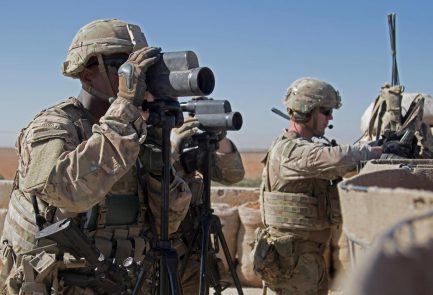
U.S. soldiers on patrol in Manbij, Syria, in November 1, 2018 


The United States is likely just weeks away from starting the withdrawal of ground troops from Syria ordered by President Donald Trump, the top U.S. commander overseeing American forces in the Middle East said on Sunday.

U.S. Army Gen. Joseph Votel, head of the U.S. Central Command, cautioned that the exact timing would depend on the situation in Syria, where U.S.-backed fighters have launched a final assault against Islamic State enclaves near the Iraqi border.

The U.S. military has already started withdrawing equipment from Syria. Asked whether the withdrawal of America’s more than 2,000 troops would begin in days or weeks, Votel said: “Probably weeks. But again, it will all be driven by the situation on the ground.”

“In terms of the withdrawal … I think we’re right on track with where we wanted to be,” Votel told reporters traveling with him during a trip to the Middle East.

“Moving people is easier than moving equipment and so what we’re trying to do right now is again [to] kind of clear out those materials, that equipment that we do not need.”

Trump’s surprise announcement in December that he was withdrawing American troops from Syria helped trigger the resignation of his defense secretary, Jim Mattis, and sent U.S. military officials scrambling to construct a withdrawal plan that preserves as many gains as possible.

Hundreds of additional troops have been sent to Syria to facilitate the withdrawal.

U.S. officials have long estimated that the Syria pullout could take until sometime in March or April to execute fully, but have been reluctant to set an exact timeline given hard-to-predict battlefield conditions.

Votel did not speculate about when the withdrawal would be completed.

One big question has been whether some U.S. forces in Syria might move to neighboring Iraq, where the United States has more than 5,000 troops helping Baghdad fight Islamic State and prevent the group’s resurgence.

Votel said he did not believe the United States would broadly increase overall troop numbers in Iraq. He did leave open the possibility of changing the composition of forces to help the United States keep pressure on the terrorist group.

Referring to future U.S. troop levels in Iraq, Votel said: “I think it’s going to remain more or less steady.”

“This isn’t just wholesale – ‘Everybody in Syria move over to Iraq.’ That doesn’t make sense,” Votel said.

Votel is one of many current and former U.S. officials who have warned of the risk of resurgence by Islamic State unless the United States and its allies can keep pressure on the group following the U.S. withdrawal. They say Islamic State still has enough leaders, fighters, facilitators and financial resources to fuel a menacing insurgency.

But a clear U.S. plan on how to keep up the pressure has yet to be articulated. It is also unclear whether the United States will be able to satisfy the security concerns in Syria of its NATO ally Turkey without sacrificing the interests of U.S.-backed Kurdish fighters there.

Washington views the Kurdish militia as loyal partners in the fight against Islamic State, whose help will likely continue to be needed to prevent the group’s resurgence.

The Pentagon’s own internal watchdog released a report last week warning about the risks still posed by Islamic State. It cautioned that, absent sustained pressure, the group would likely resurge in Syria within six to 12 months and retake some limited territory.

A U.N. report seen by Reuters last week estimated there are up to 18,000 Islamic State fighters in Iraq and Syria, including up to 3,000 foreign fighters. It warned the group was interested in attacking aviation and using chemical, biological, radiological and nuclear materials.


Report: Mossad helped smuggle nuclear spy out of Iran 

Posted February 11, 2019 by Joseph Wouk
Categories: Uncategorized

Source: Report: Mossad helped smuggle nuclear spy out of Iran – Israel Hayom

The nuclear technician with information about the Islamic republic’s nuclear program and described as an “Israeli asset for years,” was smuggled into the U.K. last New Year’s Eve in a joint operation with MI6, the CIA and Mossad, Sunday Express reports.

Eli Leon and Israel Hayom Staff // published on 11/02/2019
   
A rubber dinghy used by Iranian migrants to cross the English Channel from France, December 31, 2018 


An Iranian nuclear technician with information about the Islamic republic’s nuclear program was smuggled into the United Kingdom on New Year’s Eve last year in a joint operation involving MI6, the CIA and Israeli Mossad, the Sunday Express newspaper reported on Sunday.

According to the report, the 47-year-old nuclear technician had been “an Israel asset for years” who also “helped plan” the assassination of Iranian nuclear scientist Mostafa Ahmadi Roshan in 2012. Roshan, a director at Iran’s Natanz uranium enrichment facility, was killed by a magnetic bomb attached to his car in Tehran. His driver also died. Iran accused the Mossad of carrying out the assassination.

The plan to smuggle the alleged Israeli nuclear spy out of Iran, meanwhile, reportedly involved a “3,000-mile dash across Europe” and a final 22-mile crossing of the English Channel in a dinghy, hidden among other illegal Iranian immigrants.

Initially, the alleged spy was reportedly smuggled out of his homeland and into neighboring Turkey by the Mossad.

Britain, the report said, tried to conceal its involvement in the operation because it opposed the U.S. withdrawal from the nuclear agreement with Iran and remained a party to it.

A British intelligence source told the Sunday Express: “[The nuclear technician’s] absence was noted quickly [by the Iranians] and we were informed that a special unit of the Islamic Revolutionary Guard Corps had been dispatched. Once in France, the question of how to get him into Britain remained. We couldn’t simply fly him in. Though unusual, it was determined infiltrating him into a group of fellow migrants preparing to cross the channel by boat offered one solution.”

The report also said that MI6 agents debriefed the nuclear technician on Iran’s nuclear plans before he was flown to the United States.

In first, prime minister vows to deduct PA’s terrorist payments 

Posted February 11, 2019 by Joseph Wouk
Categories: Uncategorized


Source: In first, prime minister vows to deduct PA’s terrorist payments – Israel Hayom

“Next Sunday I will convene the cabinet and we will pass the necessary decision to deduct the funds. The funds will be deducted, let there be no doubt about that,” Netanyahu says • Brutal murder of Ori Ansbacher was a terrorist attack, Shin Bet says.

Ariel Kahana, News Agencies and Israel Hayom Staff // published on 11/02/2019
   
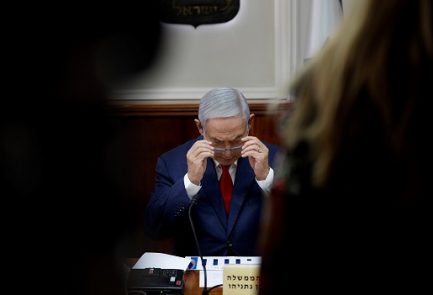
PM Netanyahu at the weekly cabinet meeting in Jerusalem, Sunday 


Prime Minister Benjamin Netanyahu on Sunday vowed for the first time to enact the “terrorist salaries law” – and even outlined a timetable for its implementation.

The legislation allows the government to deduct the amount the Palestinian Authority pays to terrorists and their families from the taxes Israel collects on the PA’s behalf. The law also requires the Defense Ministry to provide the cabinet with data on the amount the PA pays terrorists and their families. The Finance Ministry will then withhold that amount from the tax funds.

Netanyahu’s announcement came after the Shin Bet security agency said Sunday that the brutal slaying of 19-year-old Ori Ansbacher by a Palestinian near Jerusalem last week was a “nationalistic” terrorist attack.

Speaking at the start of the weekly cabinet meeting, Netanyahu said: “By the end of the week we will finish the necessary administrative work to enact the terrorist salaries law. Next Sunday I will convene the cabinet and we will pass the necessary decision to deduct the funds. The funds will be deducted, let there be no doubt about that.”

The prime minister’s comments came following local media reports that in January Israel transferred the PA the entire sum of taxes it collects on its behalf. This was done despite that fact that in January the cabinet, as stipulated by the new legislation, was supposed to have deducted the sum of PA terrorist salaries from those taxes.

New Right party leader Naftali Bennett assailed Netanyahu after it was revealed that the entire amount had been transferred, saying that terrorists are no longer afraid because they know they will have secured lifetime economic benefits for them and their families.

“The prime minister must enact the terrorist salaries law that was passed but hasn’t been implemented yet,” he said.

The Choosing Life forum, which united dozens of families victimized by terror, also demanded that Netanyahu implement the law.

“Even though the deduction law was passed half a year ago, the prime minister and defense minister [Netanyahu is also the acting defense minister] insists on continuing to pay salaries to terrorists,” the group said in a statement. “Do we concede that Ori Ansbacher’s murderer will receive 12,000 shekels [$3,300] every month under the patronage of the State of Israel?!”

The law was spearheaded by MKs Avi Dichter (Likud) and Elazar Stern (Yesh Atid), who also sent a letter to Netanyahu demanding the payment deduction.

“The funds act as an incentive for the next terrorist attack,” Stern wrote.

Israel Hayom has learned, meanwhile, that the Defense Ministry’s initial draft of its report on the scope of PA terrorist salaries places the amount at about 250 million shekels ($69 million) per year.

However, officials in the National Security Council in the Prime Minister’s Office believe the amount is higher and requested additional inquiries into the matter. As stated, Netanyahu requested that the report be completed by the next cabinet meeting next Sunday ahead of the first deduction.

Earlier on Sunday, the IDF said it had surveyed the family home in Hebron of Arafat Irfaiya, suspected in the murder of Ansbacher, “in order to examine the possibility of its demolition.”


Moscow &Tehran prepare to arm Hizballah, including with Iranian air defense missiles – DEBKAfile

Posted February 11, 2019 by Joseph Wouk
Categories: Uncategorized

Source: Moscow &Tehran prepare to arm Hizballah, including with Iranian air defense missiles – DEBKAfile

Iran’s Foreign Minister Mohammed Javad Zarif pointedly visited Beirut on Monday, Feb.11, the day of the Islamic revolution’s 40th anniversary, to highlight the length and breadth of its reach – even under US sanctions, threats and Israeli bombardment.

Like Moscow, Tehran has shifted its focus to the quest for a foothold in Lebanon to consolidate their success in preserving the next-door Assad regime in Damascus. Both have designated the Shite Hizballah terrorist organization as their main channel of influence in Beirut. Except that Russian Deputy Foreign Minister. who visited Jerusalem last week for talks with Prime Minister Binyamin Netanyahu, insisted on Sunday, Feb. 10, that Hizballah is not a terrorist group, but a positive force for stability in the Middle East. The line Russian spokesmen are now pushing in unison with Tehran is a thorough clean-up of Hizballah’s international image.

Hizballah’s leader, Hassan Nasrallah, last week proposed that Iran re-arm the Lebanese army with new weapons including anti-air missiles. Zarif responded that Tehran is ready to assist Lebanon “in every field” – including the military sphere. He spoke in general terms, but DEBKAfile’s military sources report that, behind closed doors, the Iranian foreign minister offered the Lebanese army a set of Iranian Bavar 373 air defense missile systems, which are a close replica of the Russian S-300s deployed around military and nuclear sites across Iran. Iran nay decide against sending these missiles to Lebanon, lest they are destroyed by Israel, but the offer in itself is raising raised the military temperature around Lebanon.

Quite simply, all the parties concerned are aware that the Lebanese government will decline this offer, because by closing the Iranian door they will open it to the start of Russian weapons supplies to Lebanon and Hizballah. Tehran has no objection to advanced weapons reaching Hizballah from Russia. The Iranians will claim that it is par for the course. Kurdish forces in Syria are armed by the Americans to fight Islamic State terror, and Hizballah is fighting the same foe.

The Russians and Iranians are therefore getting their act together for the US military pullout from Syria. Sources in Washington estimated this week that the US withdrawal would be finished by April. Last week, the head of CENTCOM, Gen. Joseph Votel, said that, depending on circumstances, US troops would be out of Syria “in a few weeks.” Their impending departure has boosted Hizballah’s rise to center stage for the next chapter of the Syrian story and its ramifications.


Netanyahu to meet Pence, Pompeo at Polish Middle East summit 

Posted February 10, 2019 by Joseph Wouk
Categories: Uncategorized

Source: Netanyahu to meet Pence, Pompeo at Polish Middle East summit | The Times of Israel

Various aspects of Iranian aggression to be the ‘first issue on the agenda,’ PM says about Warsaw conference starting Wednesday

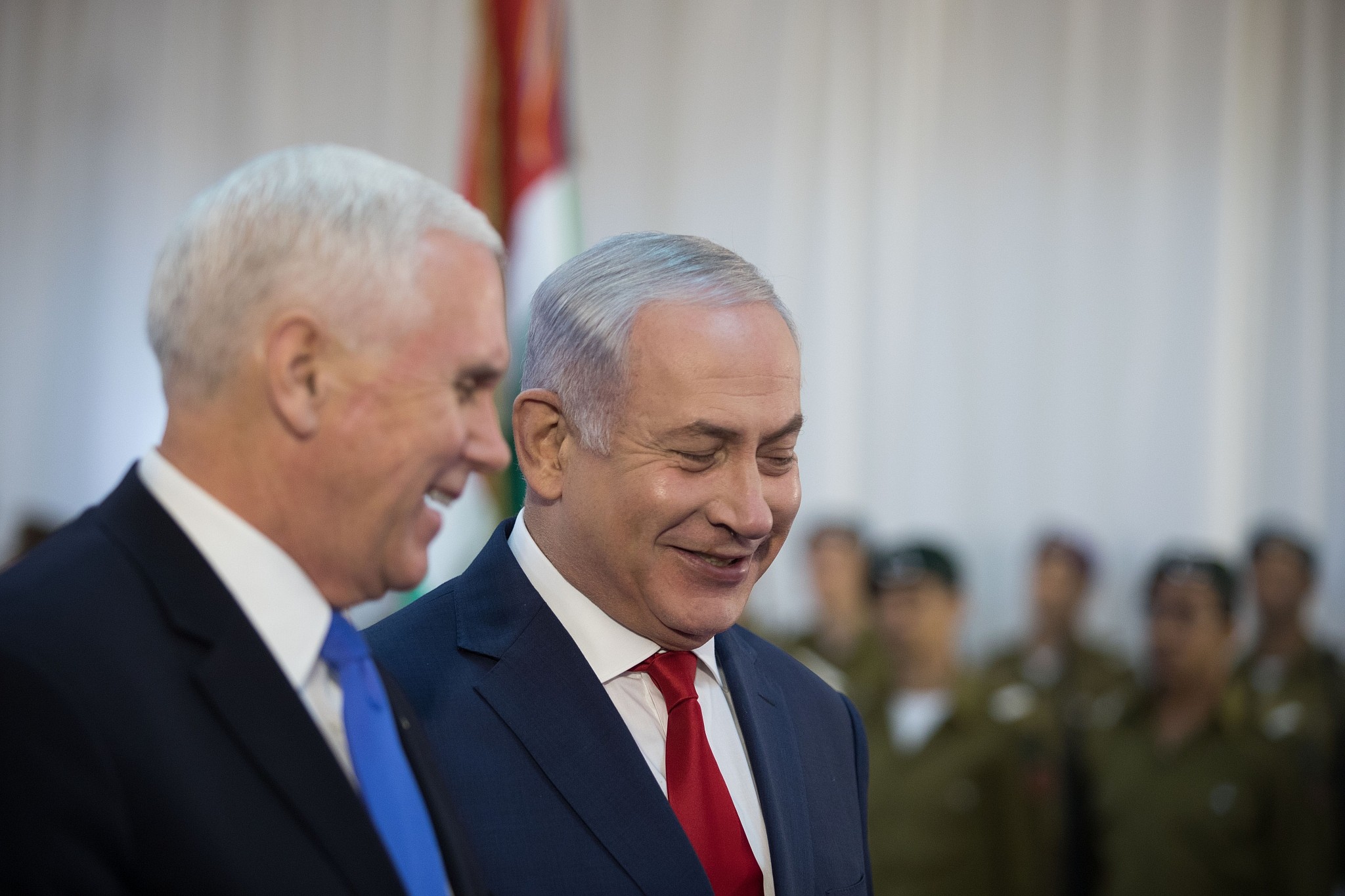
US Vice President Mike Pence (left) is welcomed by Israeli Prime Minister Benjamin Netanyahu at the Prime Minister’s Office in Jerusalem, on January 22, 2018. (Hadas Parush/Flash90

Prime Minister Benjamin Netanyahu is set to meet US Vice President Mike Pence and US Secretary of State Mike Pompeo at a Middle East conference in Warsaw later this week.

“The first issue on the agenda is Iran — how to continue preventing it from entrenching in Syria, how to thwart its aggression in the region and, above all, how to prevent Iran from attaining nuclear weapons,” Netanyahu said Sunday in his weekly cabinet meeting.

Netanyahu is set to take off for the Polish capital on Tuesday to address the so-called “Ministerial to Promote a Future of Peace and Security in the Middle East,” held jointly by Poland and the US on February 13-14.

The prime minister is set to meet with other world leaders as well, he said Sunday, but would not provide more details about his plans.

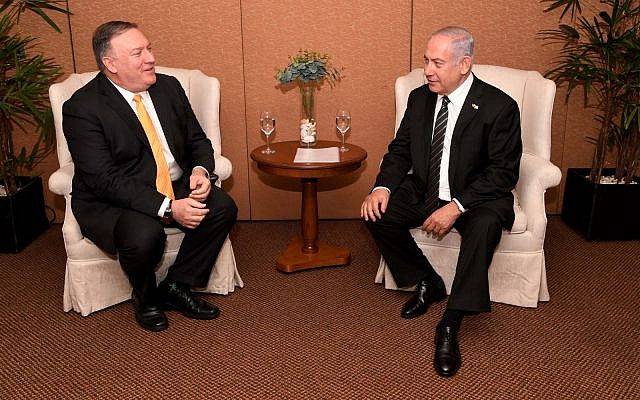
US Secretary of State Mike Pompeo (L) meets with Prime Minister Benjamin Netanyahu in Brasilia on January 1, 2019 (Avi Ohayon/GPO)

Efforts to thwart Iran’s aggression in the region, including its efforts to entrench itself militarily, its recent attempts to upgrade its ballistic missile arsenal and its nuclear ambitions are expected to take center stage at the summit, even though organizers said the conference’s objective is not to bash Iran.

The Israeli-Palestinian conflict may be another topic discussed in Warsaw, although senior Palestinian officials said last week they would boycott the event.

“Regarding statements that we have been invited, we can say that only today there was some contact from the Polish side,” Palestine Liberation Organization secretary-general Saeb Erekat wrote on Twitter Friday.

“Our position remains clear: We are not going to attend this conference and reiterate that we have not mandated anyone to talk on behalf of #Palestine,” he added.

Erekat’s statement came after a White House official told reporters the Palestinians had been invited to the conference.

“The Warsaw Conference is an attempt at bypassing the Arab Peace Initiative and destroying the Palestinian National project,” said Erekat, referring to a Saudi proposal to extend Arab recognition of Israel in exchange for a pullout to the pre-1967 armistice lines and a “just solution” for Palestinian refugees.

In this photo from July 17, 2018, Palestinian protesters hold portraits of late Palestinian leader Yasser Arafat and US President Donald Trump during a rally in support of the Fatah party in the West Bank city of Nablus. (AFP Photo/Jaafar Ashtiyeh)

His statement came a day after the Palestinian Authority’s Foreign Ministry called the conference an “American conspiracy.”

The PA has boycotted the American administration since President Donald Trump’s 2017 recognition of Jerusalem as Israel’s capital, a move it said meant the US could no longer serve as a mediator in peace talks.

Ties between the sides have continued to fray since then, with the US moving to end aid it provides to Palestinians and cut funding to PA President Mahmoud Abbas over his refusal to enter negotiations and Ramallah’s payments to terror convicts and their families.

According to a US official, Trump’s senior adviser and son-in-law Jared Kushner will discuss the White House’s peace efforts during the conference and take questions from the audience.

“We would very much welcome the Palestinian Authority’s perspectives during the discussion, but I do want to emphasize this is not a negotiation but a discussion, and we look forward to fostering a constructive conversation in Warsaw,” the official was quoted saying by Reuters.

In this Thursday, June 21, 2018 photo, Egyptian President Abdel-Fattah el-Sissi, center, meets with US President Donald Trump’s son-in-law and senior adviser Jared Kushner, second left, and Mideast envoy Jason Greenblatt on the latest stop in a regional tour to discuss a blueprint for an Israeli-Palestinian peace deal, in Cairo, Egypt. (MENA via AP)

Kushner will be accompanied in Warsaw by Jason Greenblatt, Trump’s envoy for Israeli-Palestinian peace.

Along with US envoy on Iran Brian Hook and other administration officials, the two are headed to the Middle East later this month to brief diplomats in at least five countries on the economic section of the US peace proposal.

Stops are confirmed in Oman, Bahrain, Saudi Arabia, United Arab Emirates and Qatar. Other stops could be added to the trip, according to a White House official.

The US peace plan reportedly includes an economic development proposal for Palestinians that foresees major infrastructure and industrial work, particularly in Gaza. For the plan to succeed or even pass the starting gate, it will need at least initial buy-in from both Israel and the Palestinians as well as from the Gulf Arab states, which officials say will be asked to substantially bankroll the economic portion.

A senior US official told The Times of Israel this week that a date for the peace plan’s rollout has not yet been decided and there are “numerous considerations” that may play a role and push its release back to mid-May at the earliest. These include the Israeli elections (April 9) and subsequent coalition building process, the Passover holiday (April 19-26), Ramadan (May 5-June 4), and Israeli Memorial and Independence Days (May 7-9).

Agencies and Times of Israel staff contributed to this report.


US-backed fighters commence final push to defeat ISIS in Syria 

Posted February 10, 2019 by Joseph Wouk
Categories: Uncategorized

Source: US-backed fighters commence final push to defeat ISIS in Syria – Israel Hayom