Exclusive: Trump Mid East peace plan’s release – not before second half of 2019 – DEBKAfile

Posted February 17, 2019 by Joseph Wouk
Categories: Uncategorized

Source: Exclusive: Trump Mid East peace plan’s release – not before second half of 2019 – DEBKAfile

Both President Donald Trump’s adviser Jared Kushner and Prime Minister Binyamin Netanyahu avoided a date when they said the US peace plan would be presented “after Israel’s election.”

They spoke in a closed meeting at last week’s Warsaw Peace and Security conference. Kushner presented some general outlines of the plan, saying that it would call for concessions from both sides. Netanyahu responded by saying: “We’ll wait and see what the final plan will look like. It will be presented after the Israeli elections – as you can imagine, that takes up a little bit of my time now. I don’t think that any of us should reject the plan and reject this initiative by the American administration before it’s even presented.”

The prime minister went on to say: “If we make progress and indeed a formal peace with the Palestinians, it would help us enormously in the Arab world and I would say with parts of the Muslim world, but I think it’s equally true that the normalization of relations with the Arab world also helps achieve peace with the Palestinians, and I’m happy to say that there’s progress on that.”

Netanyahu had a strong interest in these comments being released to the public on two grounds:

  1. Reporting on the lively campaign for the April 9 general election has accentuated “the right wing” proclivities of the prime minister and his Likud party. He feels that his efforts to attain a broader peace with the Arab world are neglected and wants to bring this issue back to center stage.
  2. Netanyahu also sought to pre-empt any attempt by his newest rival Benny Gantz’s Hosen L’Yisrael party from running off with the Israeli-Palestinian issue. He is making sure that he, and not Gantz, is Trump’s chosen partner for his “Deal of the Century.”

One commentator maintained on Sunday, Feb. 17, that the Likud leader aimed his arrows at Education Naftali Bennett and the New Right party, which he co-founded and which is campaigning on the premise that no other party is capable of blocking the Trump peace plan.

Amos Yadlin, head of the Israeli Strategic Institute think tank and former military intelligence chief, argued that by releasing the US peace plan after the election, Washington would avert the formation of a Likud-led government coalition with right-wing Bennett and lead Netanyahu to team up with Benny Gantz instead.

All this rhetoric is based on a misapprehension of the Trump administration’s intention.   DEBKAfile’s exclusive sources report that the White House does not intend its peace plan to see the light of day before the end of summer. By then, the next Israeli government should be in place and ready to deal with it. US officials calculate that the legal cases awaiting the prime minister could mire cabinet negotiations in interminable delays. The uncertain security situation also needs to be factored into to the White House’s timeline at a time that Israel’s southern and northern fronts, either or both, may be on the verge of outright hostilities.


Turkey, Russia, Iran increasingly challenge U.S.during Syria discussions

Posted February 16, 2019 by Joseph Wouk
Categories: Uncategorized

Source: Turkey, Russia, Iran increasingly challenge U.S.during Syria discussions – Middle East – Jerusalem Post

The official statement from Sochi included a 17-point statement that was released on Friday. The three powers discussed developments since their last meeting in Tehran on September 7.

BY SETH J. FRANTZMAN
 FEBRUARY 16, 2019 13:40
Turkey, Russia, Iran increasingly challenge U.S.during Syria discussions

The Presidents of Turkey, Iran and Russia gathered in Sochi at the end of last week to discuss the situation in Syria. It is the latest of several important and high profile gatherings of these countries to seek a way to end the Syrian conflict and also to increase their coordination on regional issues. This is a direct challenge to US power in the Middle East and was scheduled to coincide with the US-led meeting in Warsaw last week that included calls by Washington to challenge Iran.
The official statement from Sochi included a 17-point statement that was released on Friday. The three powers discussed developments since their last meeting in Tehran on September 7. They sought to “strengthen the trilateral coordination” in light of their agreements about Syria. Unsurprisingly they emphasized the importance of the “sovereignty” of Syria, and its “territorial integrity,” wording that has been meant to challenge the US role in eastern Syria.
The three countries “rejected all attempts to create new realities on the ground under the pretext of combating terrorism and expressed their determination to stand against separatist agendas aimed at undermining the sovereignty and territorial integrity of Syria.” This is interesting because Turkey launched a military operation into Afrin in Syria in January 2018 and has been working to back a group of Syrian rebels and opposition groups. However the statement seems to ignore Turkey’s role and is aimed at the Syrian Democratic Forces, the US-backed mostly Kurdish forces that have been fighting ISIS in eastern Syria. In December Turkey claimed that ISIS was defeated and appeared to assert that the US was in Syria only under a pretext of fighting ISIS but actually supporting a separatist Kurdish agenda. The US decided to withdraw from Syria in mid-December.
The three powers took into account the US withdrawal and claimed it would help “strengthen stability and security” in Syria. This is a jibe at Washington because the US has said it supports stabilization efforts in eastern Syria.
The statement also expressed concern with the “attempts of the terrorist organization Hayat Tahrir al-Sham to increase control over the area, and agreed to effectively counter these attempts.” This is a reference to the recent growth of HTS as it clashed with several groups in Idlib province in northwest Syria and drove those groups out of Idlib, cementing its control. Under a September agreement between Russia and Turkey, Turkey was supposed to rein in some of these groups along a buffer zone and force them to withdraw heavy weapons. It is not clear the degree to which Turkey has met these agreements with Russia, but Russia doesn’t want to antagonize Turkey and has remained silent on violations. Oddly, the statement mentioned the “Al-Nusra front” and “Al-Qaeda,” whereas many analysts say that HTS, Al-Qaeda and the Nusra front are the same group in Syria. By mentioning them all separately it gives Turkey and Russia more flexibility in interpreting the agreement to combat these “terrorist” groups one at a time.
The other parts of the statement claimed that the conflict could only be resolved through a UN-backed process, an argument that Americans have also made in asserting there is no military solution in Syria. The three powers seek to push forward a Constitutional Committee that has been formed in Geneva. The next meeting on Syria take place at Astana in April of this year and that a meeting of these three leaders will be held in Turkey at the invitation of Ankara.
The statements that came out of the Sochi meeting tend towards the Orwellian. Iran, for instance, accused the US of “backing the terrorists based in Iraq and Syria” and using them to support “illegal activities” in Syria. Iranian President Hassan Rouhani hinted that Tehran had “reports” that the US was supporting ISIS. Iran has long claimed that the US supports terrorism, while Washington accuses Iran of supporting terrorism and instability across the region. Iran seeks to pressure Iraq to force US forces to leave Iraq.
Similarly Turkey has accused the US of working with the Kurdistan Workers Party (PKK) in Syria and supporting terrorists. Russian media, such as Sputnik, has accused the US of aiding ISIS. All of this is designed to turn on its head the US campaign against ISIS and US claims that Washington is supporting stability in eastern Syria. Last year Russia accused the US of leaving Raqqa, a city liberated from ISIS in 2017, devastated and creating conditions that could give the rise to new terrorist infiltration.
Overall the meeting in Sochi shows the increasing bond between Turkey, Iran and Russia, each of which openly oppose US policy in the region and globally. For instance Turkey has been a backer of the Venezuela regime that the US has been seeking to pressure. Turkey is ostensibly a US and NATO ally, but its work with Russia and Iran tends to show that it wants a foot in both camps. The Syria issue has tended to unify these countries in the last year, rather than drive a wedge between them. Nevertheless there are major challenges ahead in Idlib and in eastern Syria. Turkey will be pressured to sort out the problems in Idlib if Russia continues to say that terrorists are present there. Similarly it may be difficult for Russia to manage the crises in eastern Syria if the US withdraws too quickly.


US ambassador slams German gov’t for celebrating Iran’s revolution

Posted February 16, 2019 by Joseph Wouk
Categories: Uncategorized

Source: US ambassador slams German gov’t for celebrating Iran’s revolution – International news – Jerusalem Post

“No one should confuse the desire to have dialogue with a celebration marking 40 years of brutality”- US Ambassador to Germany Richard Grenell.

BY BENJAMIN WEINTHAL
 FEBRUARY 16, 2019 00:14
Iran

The high-profile American Ambassador to Germany Richard Grenell hammered the German government on Thursday for celebrating the Iranian Islamic revolution in Berlin.

“No one should confuse the desire to have dialogue with a celebration marking 40 years of brutality. This sends a troubling mixed message,” Grenell told The Jerusalem Post.

In an eye-popping appearance at the Iranian embassy in Berlin this week, German diplomats honored the 40th anniversary of the 1979 Islamic Revolution that created a regime which seeks the destruction of the Jewish state and the US.
Niels Annen, minister of state in the foreign ministry, and an official from the Iran desk at the ministry attended the pro-mullah regime event, the mass circulation German daily Bild first reported on Tuesday. Annen is a member of the Social Democratic Party (SPD) that oversees the foreign affairs ministry.
Uwe Becker, the mayor and treasurer of Germany’s financial capital of Frankfurt, told the Post: “This is not just an unnecessary address of devotion to the Iranian leadership, but a slap in the face of all those Iranians who have suffered or fled under the mullah regime in the past 40 years. Even if one were to take the view that, despite Iran’s support for international terrorism, despite the threats to destroy Israel or despite the recent expansion of the Iranian missile program, it would be necessary to establish greater relations with Tehran, participation in the revolutionary jubilee is almost a self-denial of our own values while looking into the face of Iranian tyranny.”
Becker is a member of Chancellor Angela Merkel’s Christian Democratic Union party.
A spokeswoman for Germany’s foreign ministry justified Annen’s appearance at the celebration in statement to the Post, saying Germany seeks to keep “channels of dialogue” open.
Germany’s participation in the ceremony honoring Iran’s revolution comes as Tehran’s clerical regime announced it plans to expand its missile system and enhance its military power. The so-called moderate regime of Iranian president Hassan Rouhani has  engaged in massive human rights violations, according to critics. Iran’s regime publicly hanged a man in January based on its anti-gay law.
According to the Canadian human rights organization International Railroad for Queer Refugees, “Today is the 40th anniversary of Islamic Republic of Iran and every 43 hours [for 40 years] one gay or lesbian was killed in Iran.”

Nasrin Amirsedghi, a leading Iranian dissident and public intellectual in Germany, wrote the Post by email:
“The appeasement policy of the German government, in particular that of the SPD, has a very long tradition.Today, 40 years after the dehumanization of [the Iranian] people, daily executions (1.7 million prisoners since 1979, the politically persecuted, homosexuals, etc), the German government continues its appeasement policy, which would not fit in any moral closet.” She added “How can Germany believe in democracy and freedom and yet maintain trade relations with the mullahs and Israeli haters? Is that not pure cynicism?”
Amirsedghi, who has written about the Iraniain regime’s human rights violation, said she is appealing to German and EU politiicans to “stop trying to save the mullahs because as long as they are kept alive, Iran continues to be murdered.There is also the time after the mullahs and we Iranians will never forget that.”
Peter Kohanloo, the president of the U.S.-based Iranian American Majority organization, told the Post:“It’s embarrassing that the German government sent representatives to celebrate four decades of the Iranian mullahs’ tyrannical misrule. It also conveys the message that Berlin doesn’t take seriously the US-sponsored Warsaw Conference to confront Tehran nor particularly cares about the fundamental human rights of Iranians. The right policy for Berlin would be to act like an ally and support US efforts to impose stronger sanctions on the clerical regime.”
Alireza Nader, the CEO of New Iran, a research and advocacy organization based in Washington, D.C., told the Post that “Germany needs to reshape its policy on Iran to reflect reality. The Iranian people don’t want the Islamic Republic, yet Berlin has a close relationship with the regime while ignoring human rights and the regime’s support for terrorism. But worse than all it pretends that the regime can be reformed. Instead of sticking with the regime, Berlin should start a dialogue with the Iranian democratic opposition and make a complete change in its Iran policies.”


Hizballah’s missile precision crash project slowed. 250 upgraded out of 14,000 – DEBKAfile

Posted February 16, 2019 by Joseph Wouk
Categories: Uncategorized

Source: Hizballah’s missile precision crash project slowed. 250 upgraded out of 14,000 – DEBKAfile

The Iranian-Hizballah crash program for converting 14,000 medium-range Zelzal 2s into precision-guided missiles is struggling. But 250 are still a threat.

On Friday, Feb. 15, Hizballah’s Al Mayadin network released a clip out of the blue depicting a four-year old incident, in which its forces on Jan. 28, 2015 shot up an IDF mounted border patrol, killing two Israeli soldiers and injuring another seven. It came, DEBKAfile’s military sources note, just hours after the IDF’s 401st Armored Brigade completed an exercise with air force support that centered on repelling a Hizballah invasion and chasing the raiders across the order into Lebanon.

The Lebanese terrorist group found three chilling revelations in this drill and so drew on a past event for bravado. The Israeli exercise featured an elite armored unit; it used the IDF’s main battle tank, the Chariot Mark 4 (M4) Windbreaker, which has a strong missile-defense capability and is often rated as the best tank in the world; and, finally, the exercise concluded with the Israeli army pursuing the enemy across the border into Lebanon. Those features told Hizballah that the era of the former IDF chief of staff Gady Eisenkot was over and his successor Lt. Gen. Aviv Kochavi realistically contemplated sending an elite Israeli fighting unit into Lebanon and carrying the battle across the border in a future conflict.

The Israeli public knows very little about this back and forth. On Dec. 6, 2018, Binyamin Netanyahu, who doubles as prime minister and defense minister, said: “This terrorist organization had planned to be armed with thousands of [precision] rockets, but for the moment they only have a few score.” IDF Intelligence (AMAN) Maj. Gen. Tamir Hayman put it this way: “Hizballah does not have the industrial capacity for precision-guidance conversions.”

Neither answered the key questions: “Has Hizballah acquired precision-guided missiles or not? And if so, how many?

DEBKAfile offers some answers from its own and Western military and intelligence sources. Hizballah is estimated to have upgraded 90-250 medium-range missiles for high precision strikes. This is not enough for the full-scale missile war on Israel planned by Iran and Hizballah. On the assumption that Hizballah fails to launch 10 percent of this number (for other armies 4 percent is the norm), and the Israeli Air Force knocks out some of its mobile launch vehicles, “only” 50 of the estimated 250 would land within their radius and reach their targets. Even then, the fallout would be appalling, given Israel’s densely populated heartland.

Iran and Hizballah decided therefore to limit the upgrade program to the 14,000 Zelzal-2 medium range missiles contained in the Hizballah arsenal. But that too has run into major hindrances. They needed to build factories to perform the process of cutting a section out of the 16-meter long missile to make room for transplanting a GPS command and navigation gear and a control system, while also attaching small winglets to the body for changing direction after launch. This process transforms the Zelzal 2 into a virtual Fatteh110, which has a range of 300km.

These components are manufactured in factories in Iran under the supervision of the Imam Hussein University in Tehran. Every attempt is being made to smuggle them to Hizballah by air, sea or the trucks that move between Iran through Iraq and Syria to Lebanon. It is estimated that although Iran has produced 4,000 of these components, no more than 500-1,000 have got through to Hizballah’s warehouses in Lebanon; the rest destroyed by Israeli air and covert operations striking deep inside Syria and Lebanon.

Another difficulty facing the project has been the need for large halls to house the missiles and their re-assembly units.  However, as soon as some of these factories began work in Syria and Lebanon, they were razed by Israeli attacks. Others stand empty after the equipment and components are waylaid by Israel en route from Iran. That was what General Hayman was hinting at when he said Hizballah is short of the industrial capacity for converting its missiles into precision guided weapons.

Hizballah has turned to using small, scattered workshops for this process, at the expense of output and quality of the product. Cost estimates are also relevant. The conversion of a rocket is estimated to cost $10,00 apiece. The entire Zelzal upgrade project set by Hizballah would require a total of $140 million.


Juniper Falcon: Brothers in Arms 

Posted February 15, 2019 by Joseph Wouk
Categories: Uncategorized


Israeli, US troops wrap up annual joint missile defense war games

Posted February 15, 2019 by Joseph Wouk
Categories: Uncategorized

Source: Israeli, US troops wrap up annual joint missile defense war games | The Times of Israel

700 American and Israeli soldiers take part in week-long Juniper Falcon drill to prepare for deployment of US troops in Israel

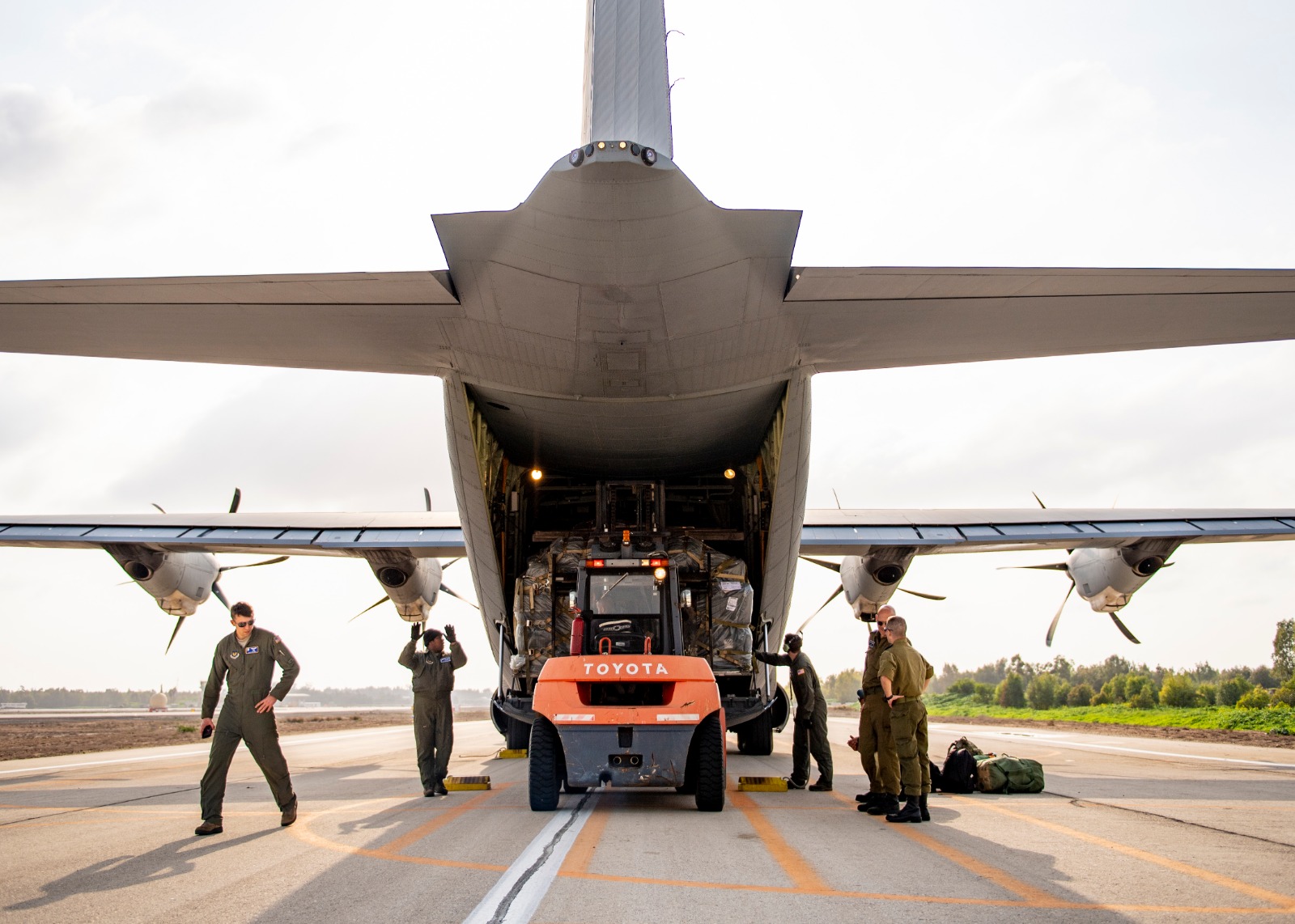
IDF and American troops unload a US Air Force cargo plane at an Israeli military base during the Juniper Falcon joint military exercise, February 2019. (US Army photo)

IDF and American troops unload a US Air Force cargo plane at an Israeli military base during the Juniper Falcon joint military exercise, February 2019. (US Army photo)

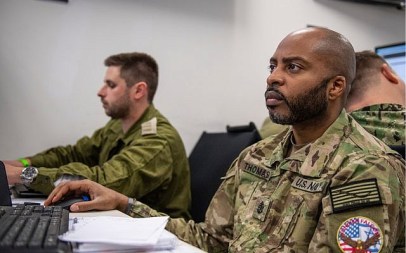
Three hundred American soldiers on Thursday wrapped up an week-long joint military exercise with the Israel Defense Forces.

The IDF said in a statement that US troops worked with 400 IDF soldiers as the armies rehearsed scenarios in which US troops were deployed to Israel to aid in missile defense operations, including against “high trajectory fire on the State of Israel.”

The military drill, dubbed Juniper Falcon, is part of the ongoing strategic cooperation between the IDF and the US Army. The IDF branches involved included the air force, logistics units and medical forces. It was last held in 2017.

“The objectives of the joint exercise were to increase the coordination between the armies, to practice orders and procedures in times of emergency and to deepen the familiarity between the forces,” said Brig. Gen. Ran Kochav, commander of the Israel Air Force’s Air Defense Division.

Israeli and American soldiers at the annual Juniper Falcon joint military exercise held in Israel. 300 American and 400 IDF troops participated. (US Army photo)

The American commander of the exercise, Lt. Gen. Jeffrey Harrigian of the the US Air Force, said it was a “great opportunity for US forces to work once again with our Israeli partners to improve our combined missile defense capability.”

“It has always been a challenging exercise, but the lessons learned will help the two armies continue to strengthen relations between us and our combined capabilities in ballistic missile defense,” said Harrigian.

Israel and the US also hold the five-day Juniper Cobra combined air force drill every two years. Last year’s drill simulated a massive ballistic missile attack and culminated with live-fire tests of two air defense systems over the skies of central Israel.


Netanyahu in Warsaw: For Arab leaders, Iran threat more urgent than Palestinians

Posted February 15, 2019 by Joseph Wouk
Categories: Uncategorized

Source: Netanyahu in Warsaw: For Arab leaders, Iran threat more urgent than Palestinians | The Times of Israel

At end of summit, PM says 4 Arab foreign ministers spoke out to back Israel’s right to defend itself against Iranian aggression; Arab states ‘half open’ to warmer ties with Israel

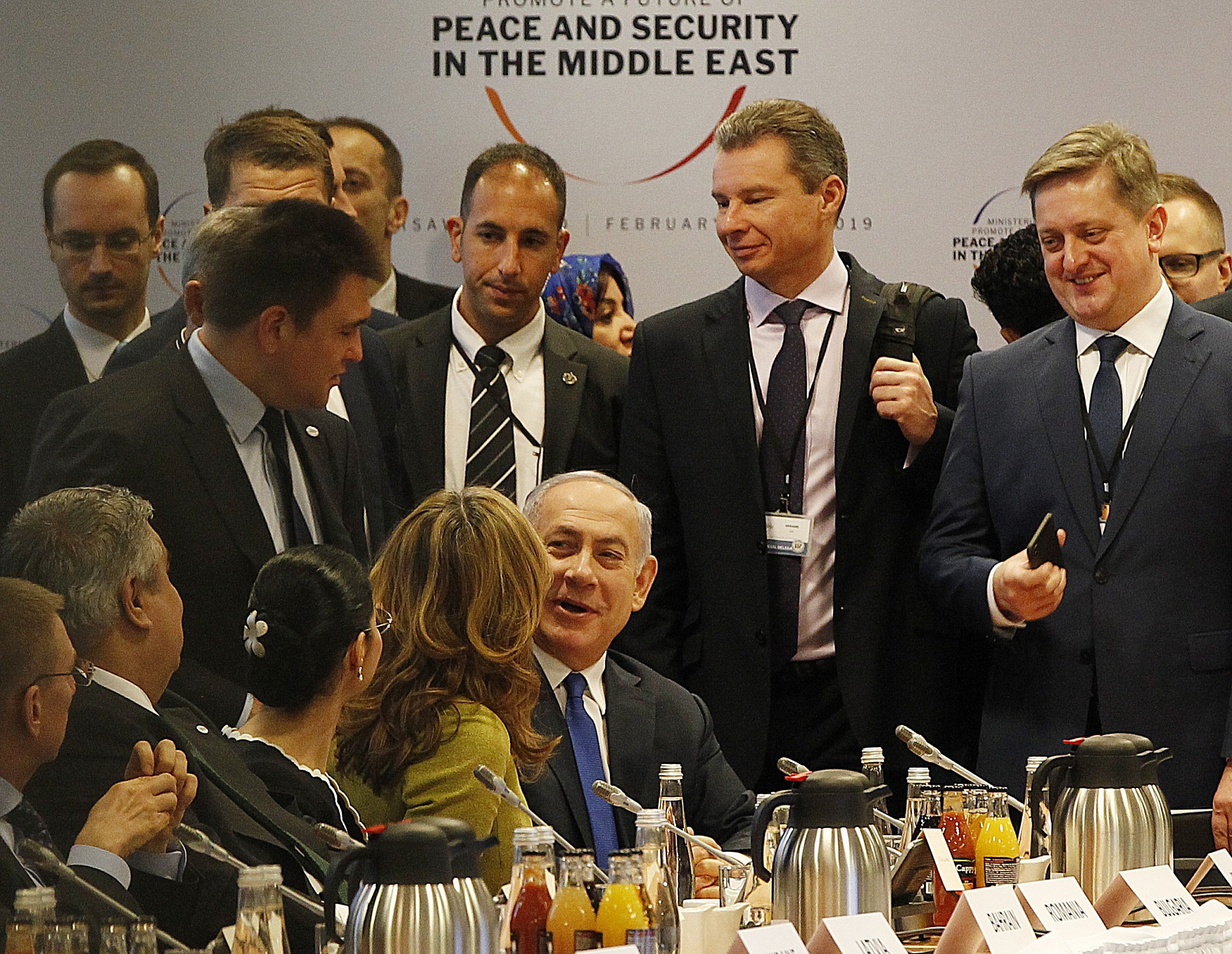
Israeli Prime Minister Benjamin Netanyahu, center, arrives for a session at the conference on Peace and Security in the Middle East in Warsaw, Poland, Thursday, Feb. 14, 2019. (AP Photo/Czarek Sokolowski)

WARSAW, Poland — Four Arab foreign ministers who spoke at the Warsaw Middle East summit affirmed Israel’s right to defend itself against Iranian aggression, Prime Minister Benjamin Netanyahu said Thursday.

Speaking to reporters shortly after he left the event, most of which was closed to the press, the prime minister hailed the very fact that 10 Arab foreign ministers agreed to share a conference stage with an Israeli leader as the “breaking of a taboo.”

“Four out of five Arab foreign ministers who addressed the conference [on Thursday] spoke strongly and clearly against Iran, saying exactly what I’ve been saying for years,” Netanyahu said. “They were as clear as possible about the issue, and Israel’s right to defend itself against Iranian aggression.”

Netanyahu did not specify which four Arab foreign ministers spoke out.

Asked when and how further Arab states would fully normalize relations with Israel, which has peace treaties only with Jordan and Egypt, Netanyahu replied that what happened in Warsaw over the last 24 hours shows that they are already “half-open.”

“Here you have Arab foreign ministers, who say that Israelis have the right to defense themselves, and don’t say it in secret but on a stage with 60 other countries present,” he said.

“It was a very important meeting and I don’t think we exaggerate its importance,” he added. “There is great importance in that they sit in one room, full of cameras” to discuss the Middle East, he said, noting that it was clear to the Arab representatives that, even though most of the conference proceedings were held behind closed doors, it would become public knowledge that they sat together with the Israeli prime minister.
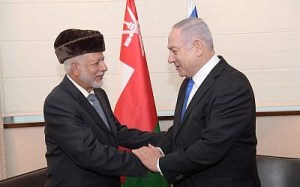
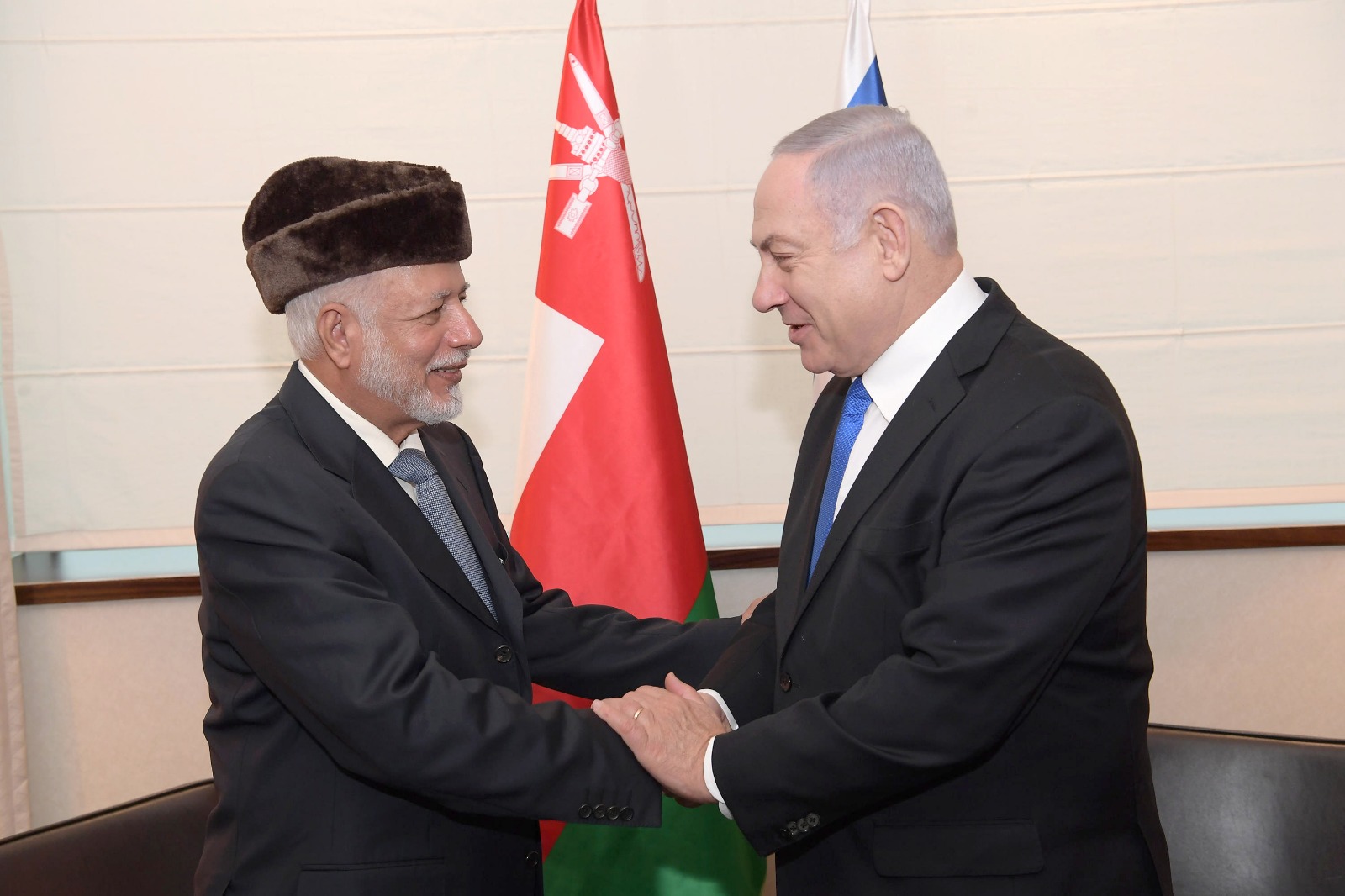
Prime Minister Benjamin Netanyahu (right) greets Omani Foreign Minister Yusuf bin Alawi bin Abdullah at the sidelines of a regional conference on the Middle East in Warsaw, February 13, 2018 (Amos Ben Gershom/GPO)

The Palestinian issue came up during the conference, Netanyahu said, but added that the Arab officials preferred to focus their remarks on Iran.

“Once the Palestinian issue took center stage. Now they say that first and foremost the Iranian issue needs to be dealt with,” Netanyahu said. In fact, the Arab officials who addressed the summit all agreed that an Israeli-Palestinian peace cannot be achieved as long as the Iranian problem is not addressed, he said.
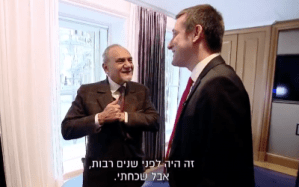
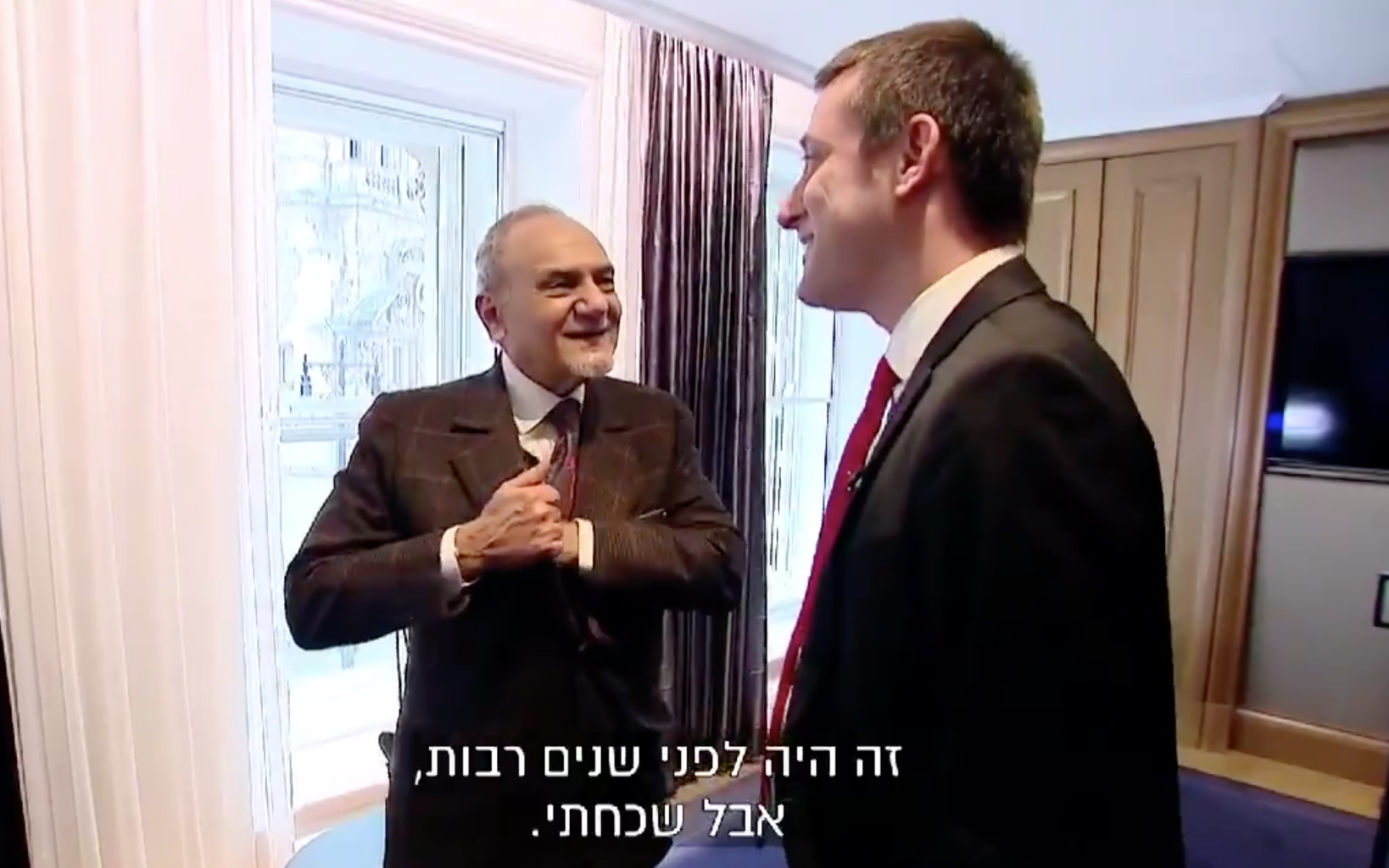
Saudi Prince Turki bin Faisal Al Saud with Channel 13’s Barak Ravid, February 2019 (Twitter screenshot)

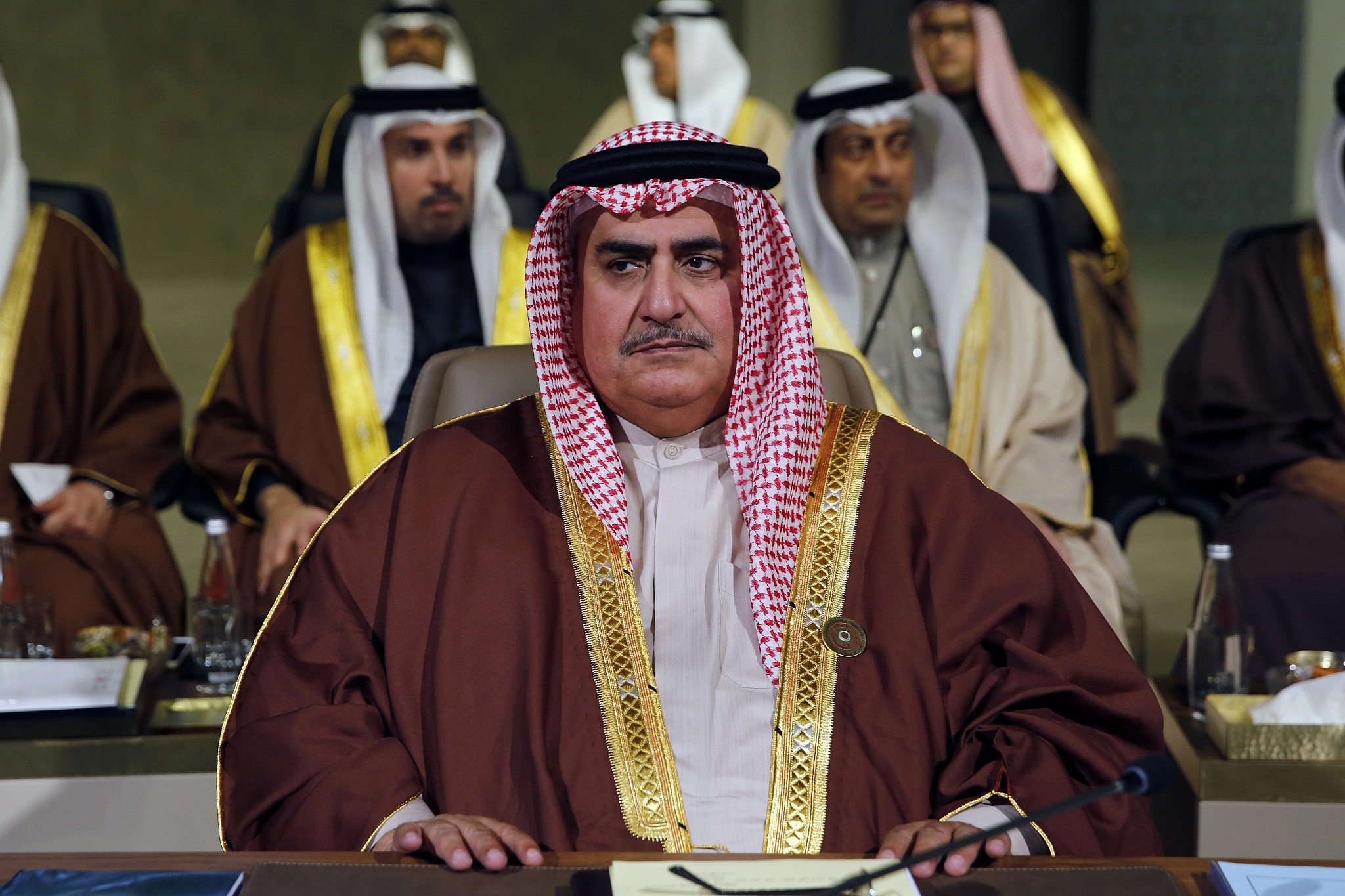
In an unprecedented interview with Israeli television on Wednesday night, the former senior Saudi official, Prince Turki bin Faisal Al Saud, said Netanyahu was deceiving the Israeli public when claiming that Israeli ties with the wider Arab world can be warmed without the Palestinian issue being solved. On the sidelines of the conference on Thursday, meanwhile, Bahrain’s foreign minister told The Times of Israel that Israel-Bahrain relations would be established “eventually.”

On Wednesday here, Netanyahu met with Oman’s foreign minister. At the opening session of the conference on Thursday he was seated next to the foreign minister of Yemen, and interacted briefly with him.
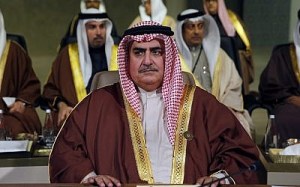
Bahraini Foreign Minister Khalid bin Ahmed al-Khalifa, attends the Arab Economic and Social Development Summit, in Beirut, Lebanon, Sunday, Jan. 20, 2019. (AP Photo/Bilal Hussein)

Netanyahu himself delivered remarks at the opening ceremony at Warsaw’s historic Royal Castle on Wednesday evening. The fact that the Arab delegates did not walk out symbolized “the breaking of a taboo,” the prime minister said.

Secret meetings between Israeli leaders and Arab have been going on for years, he told reporters in a briefing at the city’s new Jewish museum, where earlier in the day he laid a wreath at a monument honoring the victims of the 1943 Warsaw Ghetto uprising.
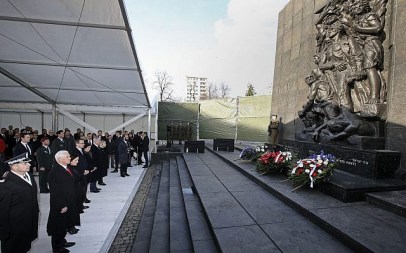
United States Vice President Mike Pence with his wife Karen, Prime Minister of Poland Mateusz Morawiecki with his wife Iwona and Israeli Prime Minister Benjamin Netanyahu with his wife Sara, from left, stand at the Monument to the Ghetto Heroes during a wreath laying ceremony in Warsaw, Poland, February 14, 2019. (Michael Sohn/AP)

“Today, 60 foreign minister were at the conference, and they all knew what this conference was about,” he said. “And this wasn’t a conference about decertification. There is a change here. It expressed itself in things that were said, and things that will be done. This is not happening by chance. Rather, it’s the result of a clear policy that I have been leading for years.”

Officials from 60 countries attended the so-called Ministerial to Promote a Future of Peace and Security in the Middle East, including foreign ministers and deputy foreign ministers from Oman, Morocco, Saudi Arabia, United Arab Emirates, Qatar, Bahrain, Egypt, Kuwait and Jordan.
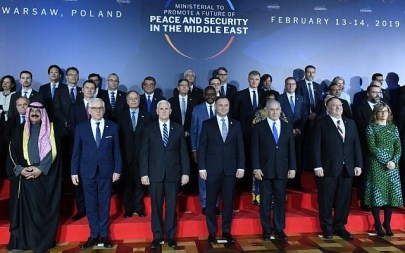
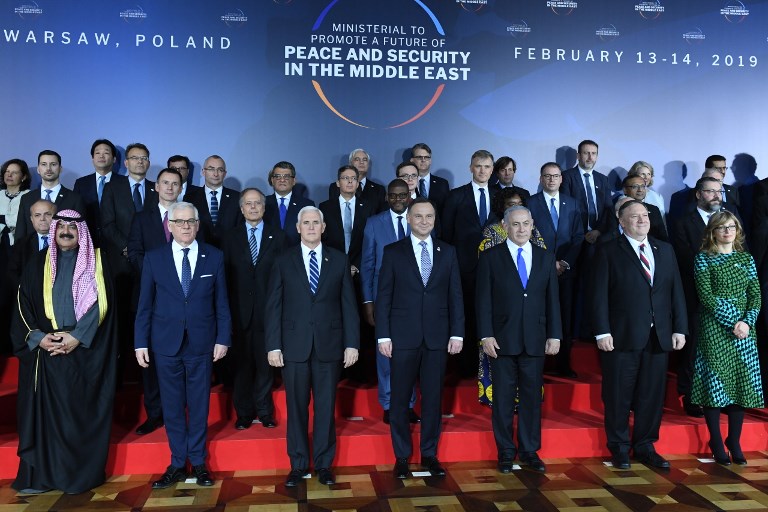
Polish Foreign Minister Jacek Czaputowicz, US Vice President Mike Pence, Poland’s President Andrzej Duda, Prime Minister Benjamin Netanyahu and US Secretary of State Mike Pompeo pose for a family photo at the conference on Peace and Security in the Middle east in Warsaw, on February 13, 2019. (Janek SKARZYNSKI/AFP)

“They all spoke about Iran. They mentioned the Palestinian issue, saying it needs to be solved, but also said that it won’t be solved as long as Iranian aggression continues,” Netanyahu said.

“I don’t want to call it the ‘New Middle East.’ But something amazing is happening here,” he said.

During the briefing, Netanyahu also addressed other topics, including the US administration’s much anticipated peace plan.

He said that senior adviser to US President Donald Trump, Jared Kushner, said that he would not reveal the plan before Israel’s April 9 elections, and that Kushner rejects the 2002 Arab Peace Initiative as a blueprint for an Israel-Palestinian peace accord.
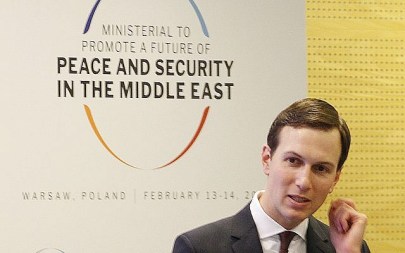
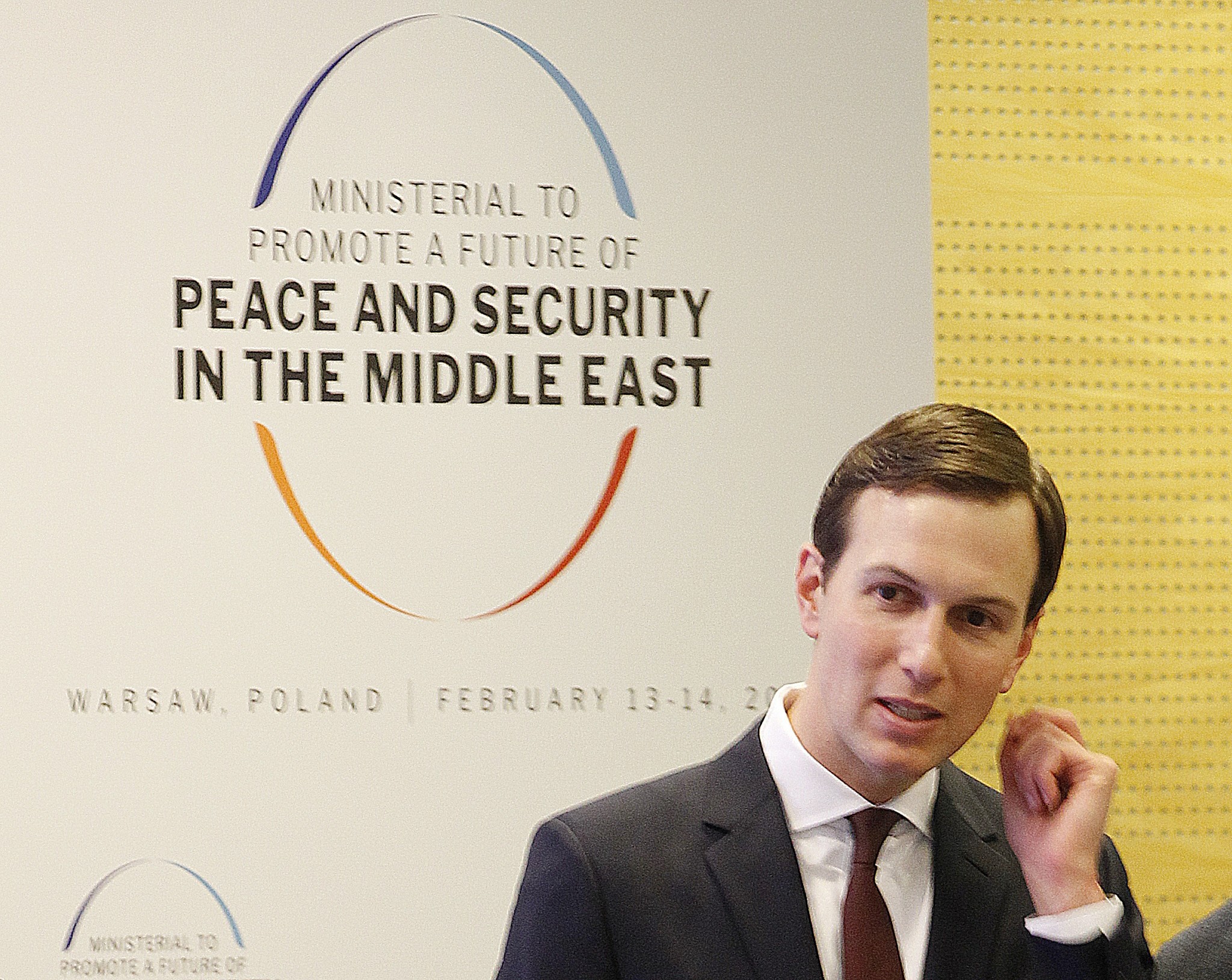
White House Senior Adviser Jared Kushner attends a conference on Peace and Security in the Middle East in Warsaw, Poland, Thursday, Feb. 14, 2019. (AP Photo/Czarek Sokolowski)

“He said the Arab Peace Initiative was important at the time, but is no longer appropriate for today [because] reality has changed,” Netanyahu said of Kushner’s response.

Regarding the April Knesset elections, Netanyahu reiterated that he considers Benny Gantz, his former army chief and currently his main political rival, to be a political leftist, despite the fact that Gantz’s Israel Resilience party ticket includes several known hawks, including two men (Zvi Hauser and Yoaz Hendel) who used to work for Netanyahu.

“The elections are far from being decided. There is close fight, it’s not a done deal,” Netanyahu said.

Netanyahu refused to provide a substantive answer to The Times of Israel’s questions about last year’s controversial joint Israeli-Polish declaration on Poland’s role in the Holocaust, merely saying that the issue came up during his meeting earlier on Thursday with Polish Prime Minister Mateusz Morawiecki.

Leading Israeli historians harshly criticized the joint statement, arguing it inaccurately adopts the Polish narrative of the Holocaust, overstating Polish efforts to rescue Jews and understating anti-Jewish atrocities committed by Poles.

Last July, Netanyahu said he had taken note of the criticism and would address it at a later time, but he has not done so.

“Since then I heard that some of the historians have changed their mind,” he said Thursday, refusing to elaborate.

Asked about the Polish law that prohibits accusing the Polish nation of complicity in Holocaust crimes, Netanyahu replied: “Poles cooperated with the Nazis and I don’t know one person who was sued for saying that.”

The law initially made it a criminal offense, punishable by prison, to accuse the Polish nation of Holocaust complicity. After the joint declaration, Poland amended the law, removing the criminal sanctions, though it is still illegal to make such claims.

Editor’s note: This piece has been updated to reflect Netanyahu’s comments on Poland and the Holocaust according to a recording of the briefing provided by the Prime Minister’s Office. 
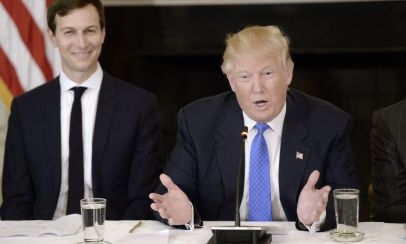
 

In clip leaked by PMO, Arab ministers seen defending Israel, attacking Iran

Posted February 15, 2019 by Joseph Wouk
Categories: Uncategorized

Source: In clip leaked by PMO, Arab ministers seen defending Israel, attacking Iran | The Times of Israel

At Warsaw Mideast summit, Bahraini FM says confronting Tehran more urgent than solving Palestinian issue; UAE top diplomat says Israel has right to attack Iranian targets in Syria

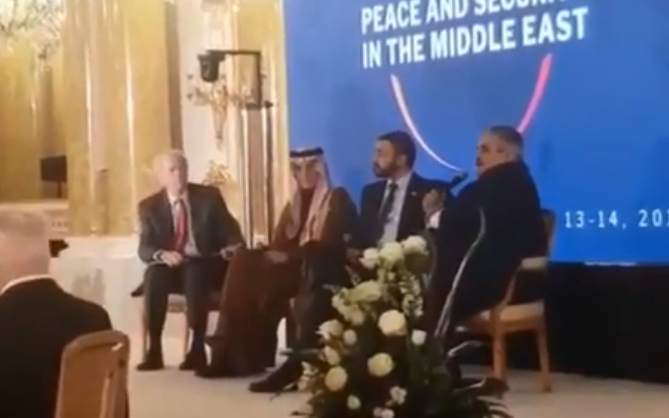
Former US Middle East peace negotiator Dennis Ross and Arab officials on stage during a panel at the Warsaw summit on February 14, 2019. (YouTube screenshot)

WARSAW, Poland — Prime Minister Benjamin Netanyahu’s office on Thursday leaked a video in which the foreign ministers of three Arab countries can be seen harshly attacking Iran and defending Israel, and in one case saying that confronting the Islamic Republic is more pressing than solving the Israeli-Palestinian conflict.

The 25-minute YouTube clip, a link that the PMO sent to several Israeli reporters, showed a segment from a panel discussion at the opening gala of the Warsaw Middle East conference, which was closed to the press.

The comments made by the foreign ministers widely confirmed what Netanyahu told Israeli reporters during a briefing earlier in the day, when he described at considerable length the Arab ministers’ positions.

Less than 30 minutes after reporters published the clip, the PMO removed the video from its YouTube channel.

In the clip, the foreign minister of the United Arab Emirates Sheikh Abdullah bin Zayed Al Nahyan indicated that Israel was justified in attacking Iranian targets in Syria.

“Every nation has the right to defend itself, when it’s challenged by another nation, yes,” he answered in response to a question by the panel’s moderator, former US Middle East peace negotiator Dennis Ross, about Israeli strikes intended to prevent Iran from entrenching itself militarily in Syria.

Bahraini Foreign Minister Khalid bin Ahmed Al Khalifa said that the peace process between Israelis and Palestinians would have been at a much better place if not for Iran’s malign behavior.

“We grew up talking about the Israel-Palestine issue as the most important issue” that has to be “solved, one way or another.” he said. “But then, at a later stage, we saw a bigger challenge, we saw a more toxic one — in fact the more toxic one in our history — that came from the Islamic Republic.”

If it wasn’t for Iran’s regional aggression, “we would have been much closer today in solving this issue with Israel,” Khalifa continued on, with Netanyahu, and other delegates from 60 countries looking on.

“But this is a serious challenge that is preventing us now from moving forward anywhere, be it Syria, be it Yemen, be it Iraq, be it anywhere,” the Bahraini foreign minister said.

“So this is the challenge we have to face in order to deal with other challenges,” he said, referring to Iran.

“When we come to Israel-Palestine, we had the Camp David agreement [between Israel and Egypt in 1978]. There was [the 1991] Madrid [Conference]. There were many other ways of solving it, and had we stayed on the same path, and if it wasn’t for the … guns and foot soldiers of the Islamic Republic, I think we would have been much closer today in solving this issue with Israel. But this is a serious challenge that is preventing us now from moving forward anywhere, be it Syria, be it Yemen, be it Iraq, be it anywhere,” he concluded.

Saudi Minister of State for Foreign Affairs Adel al-Jubeir, who served as the country’s foreign minister until December 2018, argued that Iran’s belligerent activities destabilize the region, thus making Israeli-Palestinian peace impossible to achieve.

“Look at the Palestinians: Who is supporting Hamas and Islamic Jihad, and undercutting the Palestinian Authority? Iran,” he said, going on to cite several conflicts in the wider Middle East where Iran plays a destabilizing role.

“We cannot stabilize the region without peace between Israelis and Palestinians [but] wherever we go we find Iran’s evil behavior,” he said.

He also had some harsh words for the Iran-backed Lebanese terrorist organization Hezbollah.

“One of the biggest jokes is when you say Hezbollah has a political wing and a military wing. There is no such thing,” he said.

But Jubeir reserved the lion’s share of his remarks for a fundamental criticism of the Iran nuclear deal, which he said will enable Iran to acquire nuclear weapons and terrorize its neighbors within a decade, due to its controversial sunset clauses.

“When the JCPOA was signed, everyone thought everything would be fine,” he said, referring to the 2015 nuclear pact by its technical name.

“Meanwhile, we in the region are in the brunt, for us 10 years is the blink of an eye,” he went on, “So, Iran ends up with a nuclear weapon — it is theoretically capable of doing one very quickly because no limits on enrichment — who is going to suffer? We are.”

“Iran gives ballistic missiles to the Houthis [in Yemen] and Hezbollah. Who’s going to suffer? We do, in the region. And so people have to be serious about how to deal with the problem of Iran.”

Jubeir said he wished for Iran to change and become a “normal country.”

“That would be the best for all of us,” he said. “But they’re not there yet. Any attempt to be nice to them, if anything, encourages them, rather than discourages them.”

Ambassador Dennis Ross, a veteran US official, later tweeted of the event: “Same room, same views of Iran’s aggressive, threatening posture in the Middle East, and unmistakable convergence of what should be done to counter it.”

Dennis Ross@AmbDennisRoss

Hatnua party leader Tzipi Livni, a former foreign minister, was critical of the PMO leaking the clip, saying Netanyahu was endangering relations with Arab states for political purposes.

“Relations between nations are based, among other things, on trust between leaders. The filming and leaking by [Netanyahu] of statements made in a closed room, for internal election politics, is unconscionable.

“For years I have had quiet contact with Arab leaders with whom we do not share diplomatic relations, and I never publicized anything from those meetings.”

She called for “external diplomacy, not internal politics.”


At Warsaw parley, Israel’s anti-Iran front is stretched to Yemen, Iraq – DEBKAfile

Posted February 15, 2019 by Joseph Wouk
Categories: Uncategorized

Source: At Warsaw parley, Israel’s anti-Iran front is stretched to Yemen, Iraq – DEBKAfile

Prime Minister Binyamin Netanyahu, while seated next to Yemen’s Foreign Minister Khaled al-Yamani on Feb. 14, hailed the Warsaw conference as “historic” – if only for the unprecedented seating arrangements.

The US, which co-hosted the Conference for Middle East Peace and Security as a major vehicle for the Trump administration’s campaign against Iran, most likely engineered those arrangements.  The event targeted the opponents of the anti-Iran campaign, at home and in Europe. It was also intended to boost Saudi Arabia, whose armed forces have been battling Iran-backed Yemeni Houthi insurgents for four years, and the United Arab Emirate, whose army is fighting alongside the Saudis in Yemen.

For Israel, the event served as a huge campaign boon for Prime Minister Netanyahu whose Likud is campaigning for re-election on April 9. He was shown easily hobnobbing with world leaders on an international stage, notably in amicable first-time encounters with Arab rulers. His seating alongside the Yemeni foreign minister flashed around the media, the day after he met with Omani Foreign Minister Yusuf bin Alawi bin Abdullah.

That juxtaposition also carries a price. Secretary of State Pompeo used it as a symbol of the US administration’s expectations of Israel for a larger military role alongside the US, Saudi Arabia and the UAE in the Yemeni war. The Houthi insurgents are supported not only by Iran but also by Hizballah, Israel’s arch-enemies. Until now Israeli assistance to the Yemeni government went through Saudi Arabia.

In his speech to the Warsaw gathering, Pompeo stressed that the Middle East would not achieve peace and stability without confronting Iran. “It’s just not possible,” he said. They are operating in Lebanon, Syria and Iraq; they support the Houthis in Yemen, as well as Hamas and Hizballah, all of whom pose real threats. The Iranians must be pushed out of those places,” said Pompeo. For the IDF and its intelligence army, the penny has dropped. Netanyahu returns from Warsaw with new Israeli war fronts outside its borders, following on his praise of Arab foreign ministers for speaking with “exceptional power, clarity and unity against the shared threat posed by the Iranian regime.”

In Washington, President Donald Trump faced a hostile front to the campaign he is leading internationally against Iran when the House Democratic majority passed a resolution on Thursday for ending US military support for the Saudi-led coalition fighting in Yemen. The measure passed 248 to 177, and was supported by 230 Democrats and 18 Republicans.


FULL: US Vice Pres. Mike Pence Remarks at Warsaw Summit 

Posted February 14, 2019 by Joseph Wouk
Categories: Uncategorized

( Amazing speech using Jerusalem as the example of how all the Middle East can achieve peace. JW )