Off Topic:  Anti-Semitism worst since WWII, Macron tells French Jewish group

Posted February 21, 2019 by Joseph Wouk
Categories: Uncategorized

Source: Anti-Semitism worst since WWII, Macron tells French Jewish group | The Times of Israel

President vows to ban racist groups and recognize anti-Zionism as a form of anti-Semitism after spate of recent incidents targeting Jews

French President Emmanuel Macron speaks during the 34th annual dinner of the Representative Council of Jewish Institutions of France (CRIF – Conseil Representatif des Institutions juives de France) on February 20, 2019, at the Louvre Carrousel in Paris. LUDOVIC MARIN / POOL / AFP)

PARIS — Anti-Semitism appears to have reached its worst levels since World War II, French President Emmanuel Macron told Jewish community leaders on Wednesday, a day after thousands of people took to the streets to denounce hate crimes.

The scourge has grown in recent years “and the situation has got worse in recent weeks,” Macron told the annual dinner of the Representative Council of French Jewish Institutions (CRIF).

“Our country, and for that matter all of Europe and most Western democracies, seems to be facing a resurgence of anti-Semitism unseen since World War II,” he added.

Europe’s biggest Jewish community is reeling after a string of attacks that have made global headlines.

Macron announced measures including legislation to fight hate speech on the internet, to be introduced by May.
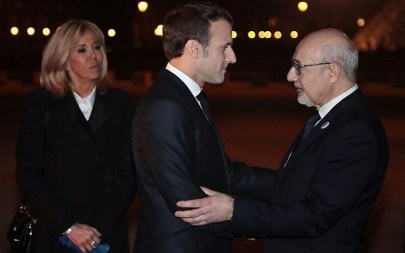
Conseil Representatif des Institutions Juives de France (CRIF) president Francis Kalifat (R) welcomes French President Emmanuel Macron (C), flanked by his wife Brigitte Macron (L) as they arrive at the Louvre Carrousel to attend the 34th annual dinner of the Representative Council of Jewish Institutions of France February 20, 2019, in Paris. (Photo by LUDOVIC MARIN / POOL / AFP)

He said he had asked his interior minister to take steps to ban racist or anti-Semitic groups, singling out “for a start” three far-right groups — Bastion Social, Blood and Honour Hexagone and Combat 18 — which he said “fuel hatred, promote discrimination or call for violence”.

He also vowed that France would recognize anti-Zionism as a form of anti-Semitism.

Macron earlier balked at a call by a lawmaker in his Republic on the Move party to criminalize anti-Zionist statements, which criticize the movement that established Israel as a home for Jews.

On a visit Tuesday to a cemetery in the Alsace region, near Germany, where 96 Jewish tombstones were daubed with swastikas, Macron promised: “We shall act, we shall pass laws, we shall punish.”

French President Emmanuel Macron looks at a grave vandalized with a swastika during a visit at the Jewish cemetery in Quatzenheim, on February 19, 2019, on the day of nationwide marches against a rise in anti-Semitic attacks. (Photo by Frederick FLORIN / POOL / AFP)

Also Tuesday, thousands of people, some carrying banners proclaiming “That’s enough”, held a rally in Paris to denounce anti-Semitism — one of around 70 protests staged nationwide.

Macron and his government have linked the appearance of swastikas and other anti-Semitic graffiti on artworks, shopfronts and headstones to far-right and far-left elements within the “yellow vest” protest movement.

A man wearing a yellow vest holds a placard reading “I am jew”, during a gathering at the Republique square to protest against anti-Semitism, in Paris, France, Tuesday, Feb. 19, 2019. (AP Photo/Thibault Camus

France is ours

A protester caught on video hurling abuse at Jewish writer and philosopher Alain Finkielkraut during a “yellow vest” demonstration in Paris last weekend was taken into custody Tuesday in the eastern city of Mulhouse, authorities said.

Police confirmed the suspect, who has been named in French media as telephone salesman Benjamin W., was the bearded man seen on video calling 69-year-old Finkielkraut a “dirty Zionist” and telling him “France is ours” after the philosopher ran into demonstrators on the street.

Police sources described the 36-year-old suspect as a small-time delinquent with ties to ultra-conservative Muslim groups.

He was one of the most vocal members of a group that jeered Finkielkraut and called him a “racist”, apparently referring to his past warnings about what he sees as the failure of Muslim immigrants to integrate into French society.

French Jewish philosopher Alain Finkielkraut is targeted by yellow vest protesters shouting anti-Semitic slogans, Paris, February 16, 2019 (Screen grab via Yahoo)

The incident caused outrage both in France and abroad, with Israel’s Immigration Minister Yoav Gallant urging French Jews to “come home” to Israel for their safety.

President Reuven Rivlin voiced support for Macron and Finkielkraut, calling the anti-Semitic incidents an “affront” to France.

Earlier Wednesday, Rivlin spoke with Finkielkraut to express his solidarity over the “wicked and hurtful attack.”

“I heard that the demonstrators told you to go back to Tel Aviv. I am sure you know that Tel Aviv is a wonderful place but be in no doubt that every Jew, and every person, has the right to choose wherever they live”, said Rivlin, who also wrote to Macron to thank him for visiting the Jewish cemetery.

Also on Wednesday, Prime Minister Benjamin Netanyahu spoke by telephone with Macron, the Israeli leader’s office said.

Focus on anti-Zionism

Several officials have accused radical “yellow vest” of fomenting a climate of hatred.

The anti-government protests began three months ago over fuel taxes but quickly grew into a broader anti-establishment, anti-capitalist rebellion, with some demonstrators using anti-Semitic slurs to denigrate Macron, a former Rothschild investment banker.

The number of anti-Jewish crimes rose 74 percent last year.

Anti-Semitism has a long history in France where society was deeply split at the end of the 19th century by the Alfred Dreyfus affair over a Jewish army captain wrongly convicted of treason.

During World War II, the French Vichy government collaborated with Germany notably in the deportation of Jews to death camps.

German Chancellor Adolf Hitler, right, shaking hands with Head of State of Vichy France Marshall Philippe Petain, in occupied France, October 24, 1940. (AP Photo)

Traditionally associated with the far right, anti-Semitism has become ingrained in the high-rise French housing estates that house many members of France’s Muslim community, Europe’s largest.

Jews have been targeted in several attacks by French jihadists in recent years.

But the proliferation of anti-Semitic graffiti is seen as a new trend.

In recent days, the word “Juden” was spray-painted on the window of a Paris bagel bakery and swastikas were daubed on postbox portraits of late French Holocaust survivor and women’s rights icon Simone Veil.

 

Rouhani calls US sanctions ‘a terrorist act’

Posted February 21, 2019 by Joseph Wouk
Categories: Uncategorized

Source: Rouhani calls US sanctions ‘a terrorist act’ | The Times of Israel

Iranian president tells cabinet ministers the ‘struggle between Iran and America is currently at a maximum’

Iranian President Hassan Rouhani speaks at a ceremony to mark the second anniversary of the death of former Iranian president Akbar Hashemi Rafsanjani, in Tehran, Iran, on January 10, 2019. (Iranian Presidency Office via AP)

Iranian President Hassan Rouhani speaks at a ceremony to mark the second anniversary of the death of former Iranian president Akbar Hashemi Rafsanjani, in Tehran, Iran, on January 10, 2019. (Iranian Presidency Office via AP)

Iranian President Hassan Rouhani lashed out at US-imposed sanctions as “a terrorist act” during a cabinet meeting in Tehran on Wednesday.

He said US-Iran relations were at a low point following the US withdrawal last May from the 2015 nuclear deal and reimposition of US sanctions, particularly targeting the country’s vital oil sector, according to comments from the meeting released by state media outlet IRIB and translated by Reuters.

“The struggle between Iran and America is currently at a maximum. America has employed all its power against us,” Rouhani told ministers. “The US pressures on firms and banks to halt business with Iran is 100 percent a terrorist act,” he was quoted as saying.

The Trump administration maintains that the 2015 nuclear deal, celebrated by European powers and the previous US administration of former president Barack Obama, was insufficient because it did not include measures to curb the Iranian regime’s ambitions in the region and its ballistic missile program.

US President Donald Trump last year pulled the US out of the deal and re-imposed sanctions on Iran, targeting its vital oil sector.

“Our ultimate aim is to compel Iran to permanently abandon its well-documented outlaw activities and behave as a normal country,” US Secretary of State Mike Pompeo said, when the sanctions were reimposed.

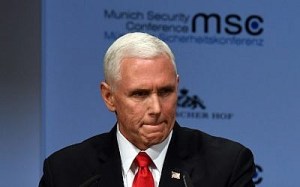
US Vice President Mike Pence speaks during the 55th Munich Security Conference in Munich, southern Germany, on February 16, 2019. (Christof STACHE / AFP)

Last week, US Vice President Mike Pence demanded that European Union allies follow Washington’s lead in withdrawing from the landmark Iran nuclear deal and cease efforts he said were designed to evade US sanctions.

Speaking at a Middle East conference in Poland, Pence accused Iran of being the world’s largest state sponsor of terrorism, adding that it was the “greatest threat to peace and security in the Middle East,” and accused the clerical regime of plotting a “new Holocaust” with its regional ambitions.

Rouhani’s comments were the latest in a string of statements by the Iranian president in recent weeks lambasting US sanctions policy.

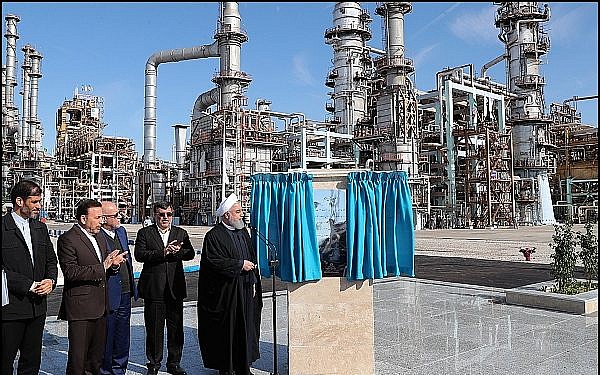
Iranian President Hassan Rouhani dedicates the final phase of a new oil refinery in the city of Bandar Abbas, Iran, February 18, 2019. (Official website photo)

On Monday, Rouhani called the sanctions an “economic war” against Iran, warning that “economic war is more difficult than military war.”

Rouhani spoke as he inaugurated the third and final phase of the sprawling Persian Gulf Star refinery built in the Persian Gulf port city of Bandar Abbas.

Construction of the refinery began in 2006 and it now has the capacity of 400,000 barrels a day, which amounts to about 20 percent of Iran’s 2.1 million barrels of daily refining capacity.

Rouhani praised the inauguration, saying in a televised speech that it comes despite America “imposing the harshest sanctions” on Iran.

“We have inaugurated huge national projects in this situation,” Rouhani said at the inauguration, adding that this comes despite efforts by the US, Israel, and their allies to increase pressure on Iran.

Times of Israel staff contributed to this report.


Democratic Party passes resolution calling for US to re-enter Iran nuke deal

Posted February 21, 2019 by Joseph Wouk
Categories: Uncategorized

Source: Democratic Party passes resolution calling for US to re-enter Iran nuke deal | The Times of Israel

‘The United States should return to its obligations under the JCPOA,’ DNC asserts in new document indicating party will reverse Trump’s withdrawal should it come to power in 2020

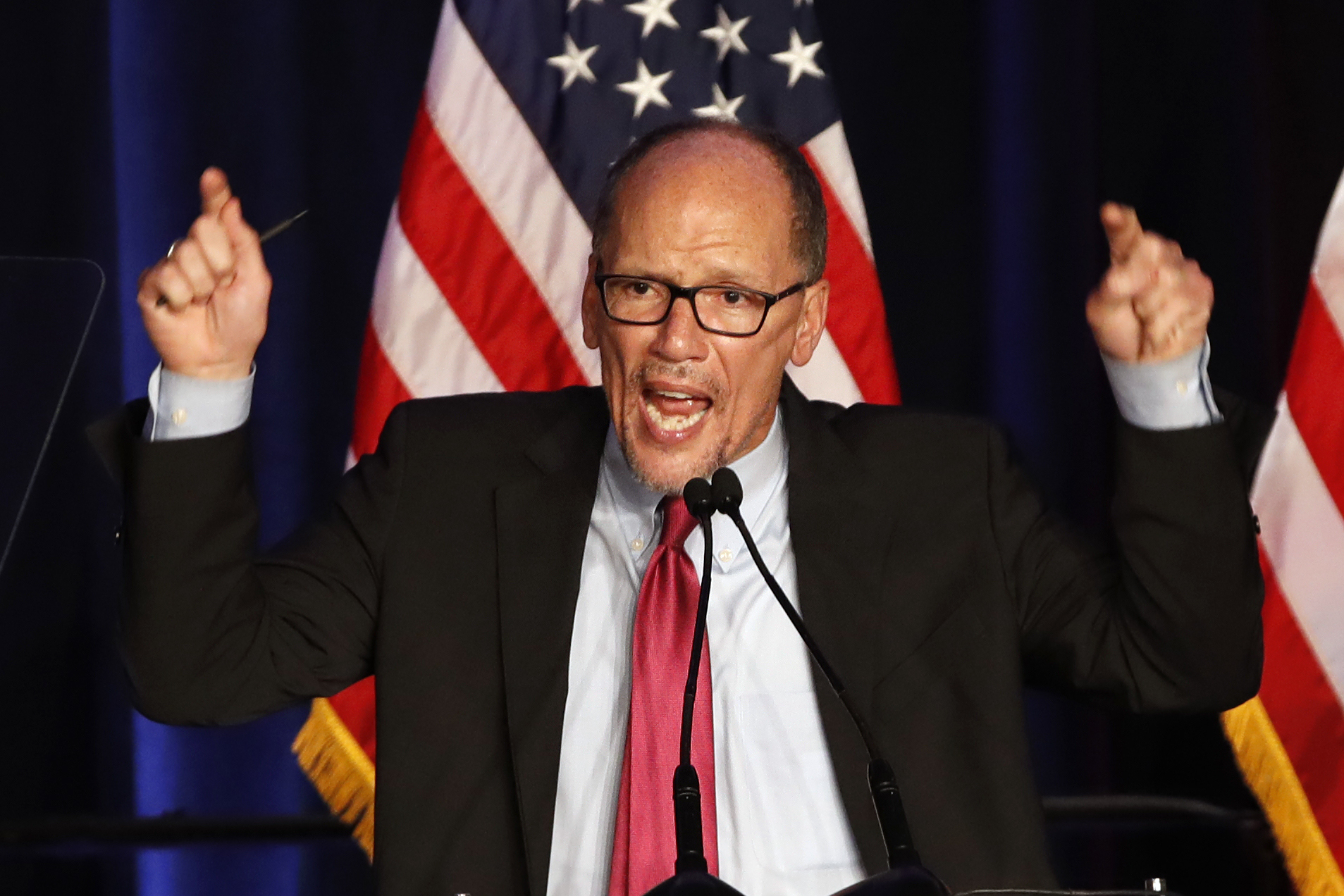
In this this Nov. 6, 2018, file photo, Tom Perez, Chairman of the Democratic National Committee, introduces Minority Leader Nancy Pelosi of Calif., as he speaks about Democratic wins in the House of Representatives to a crowd of Democratic supporters in Washington.(AP Photo/Jacquelyn Martin)

In this this Nov. 6, 2018, file photo, Tom Perez, Chairman of the Democratic National Committee, introduces Minority Leader Nancy Pelosi of Calif., as he speaks about Democratic wins in the House of Representatives to a crowd of Democratic supporters in Washington.(AP Photo/Jacquelyn Martin)

WASHINGTON, DC — The Democratic National Committee passed a resolution last week calling on the US to re-enter the Iran nuclear deal, a sign that the party’s 2020 presidential candidates will run on returning America to the landmark pact from which US President Donald Trump withdrew.

At the February 16 meeting in Washington, DC, the DNC adopted a motion solidifying the party’s position that US should rejoin the Joint Comprehensive Plan of Action, as the deal is formally known, according to a text of the resolution obtained by The Times of Israel.

“The United States should return to its obligations under the JCPOA and utilize multilateral and bilateral diplomacy to achieve political solutions to remaining challenges regarding Iran,” the document says.

Trump unilaterally pulled the United States out of the deal last May and renewed sanctions on the Islamic Republic, all with the intention, he said, to negotiate a new deal that would address three of his concerns: ending the sunset clauses that allow certain restrictions on Iran’s nuclear program to expire; banning Iran’s capacity to test ballistic missiles; and allowing international inspectors full access to Iran’s military sites.

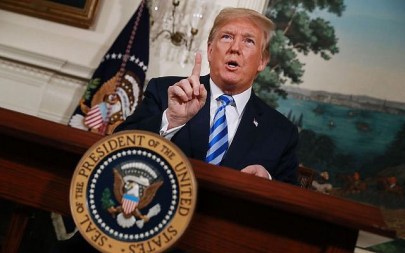
President Donald Trump announcing his decision to leave the Iran nuclear deal in the Diplomatic Reception Room at the White House, May 8, 2018. (Chip Somodevilla/Getty Images)

The other parties to the deal — England, France, Germany, Russia, China and Iran — have all maintained the agreement in spite of the United States walking out.

The agreement, forged under former US president Barack Obama, was struck in July 2015 and implemented in January 2016.

The DNC resolution is an early indication as the 2020 campaign ramps up, that if a Democrat were to win the White House, he or she may bring the United States back into the accord.

Virtually all of the Senate Democrats who have already declared their candidacy — Vermont Senator Bernie Sanders, California Senator Kamala Harris, New Jersey Senator Cory Booker, and Minnesota Senator Amy Klobuchar — opposed Trump’s decision to remove America from the deal.

The DNC resolution says that the Iran deal was working as intended to prevent Tehran from developing a nuclear weapon.

European Union High Representative for Foreign Affairs Federica Mogherini, left, and Iranian Minister of Foreign Affairs Mohammad Javad Zarif, center, take part in a Comprehensive Plan of Action (JCPOA) ministerial meeting on the Iran nuclear deal on July 6, 2018 in Vienna, Austria. (AFP/ APA/ Hans Punz)

“The JCPOA has delivered substantial nonproliferation benefits, including Iran slashing its enriched uranium stockpile by 97% to less than 300 kilograms and the IAEA instituting the world’s strongest nuclear verification regime in Iran,” the text says. 

It also quoted several world leaders — from French President Francois Macron  to EU Representative Federica Mogherini to Trump’s former secretary of state Jim Mattis — explaining the deal’s virtues.

The Iran deal “remains the best means of preventing Iran from developing a nuclear weapon,” British Prime Minister Theresa May is quoted saying.

“The JCPOA is a key nonproliferation achievement that guards against Iran developing nuclear weapons and is of central importance to American security,” the resolution states. “Returning to the JCPOA will restore America’s commitment to an agreement made with allies and prevent a renewed nuclear crisis in the Middle East.”

Iran says it cannot rule out possibility of war with Israel

Posted February 21, 2019 by Joseph Wouk
Categories: Uncategorized

Source: Iran says it cannot rule out possibility of war with Israel | The Times of Israel

Mohammad Javad Zarif accuses Jerusalem of ‘adventurism,’ with its campaign of airstrikes against Iranian targets in Syria and cautions situation could deteriorate

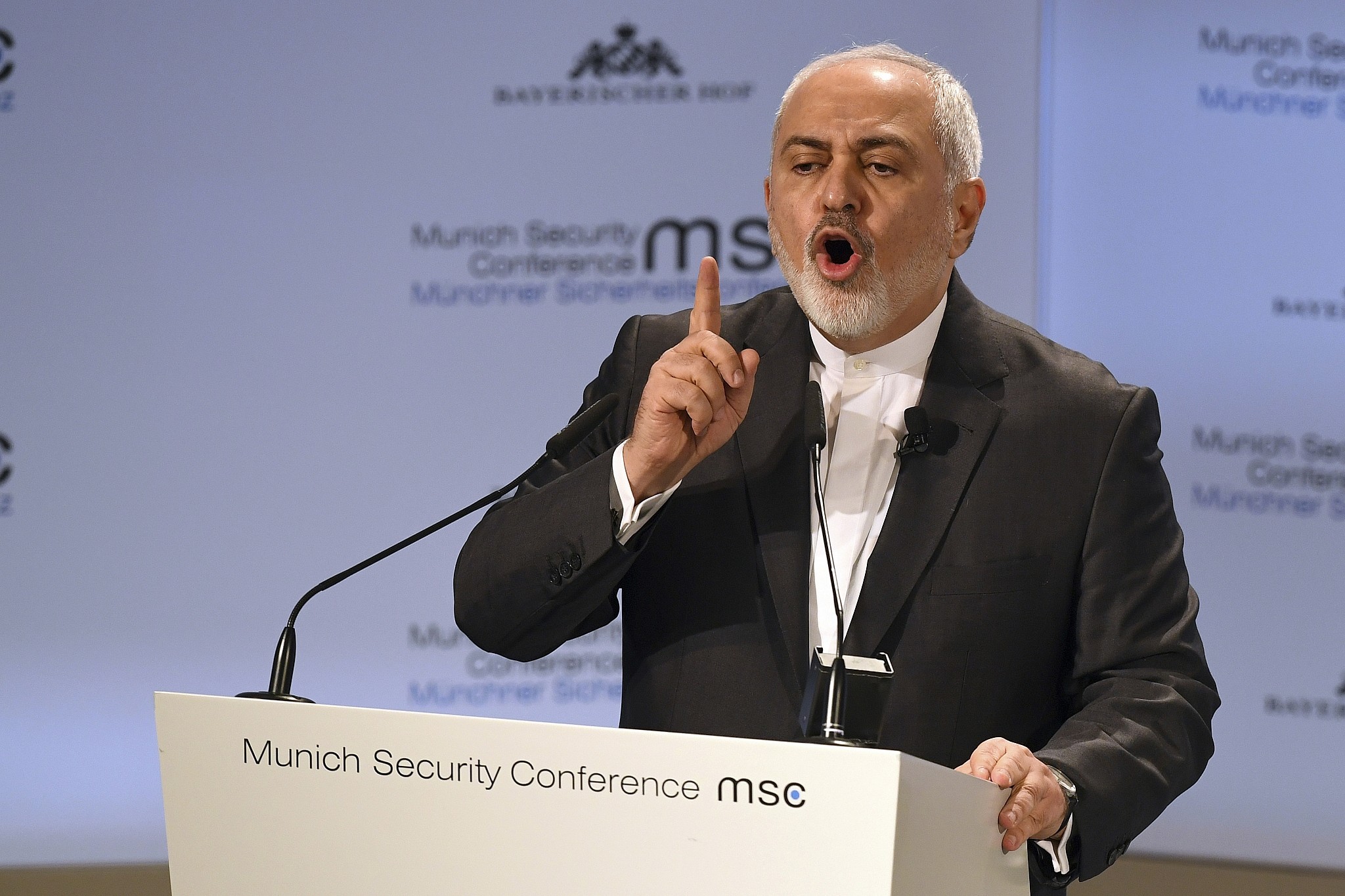
Iranian Foreign Minister Mohammad Javad Zarif speaks during the Munich Security Conference in Munich, Germany, Feb. 17, 2019. (AP Photo/Kerstin Joensson)

Iranian Foreign Minister Mohammad Javad Zarif speaks during the Munich Security Conference in Munich, Germany, Feb. 17, 2019. (AP Photo/Kerstin Joensson)

Iran’s foreign minister accused Israel of “adventurism,” with its campaign of airstrikes against Iranian targets in Syria and said he could not rule out the possibility  that they could lead to a war between the Mideast arch foes.

Speaking to the German Sueddeutsche Zeitung newspaper, Mohammad Javad Zarif said Israel constantly violated Syrian and Lebanese sovereignty, while Iran was in Syria at the invitation of the Assad government.

Israel has carried out dozens of airstrikes against Iranian targets in Syria in a bid to prevent Iran from entrenching itself in the country and transferring advanced weapons to the Hezbollah terror group in Lebanon.

Zarif said the Israeli strikes could lead to war.

“There is adventurism on Israel’s side, and adventurism is always dangerous,” Zarif told the newspaper in an interview to be published on Thursday, according to Reuters.

Asked if he saw an emerging military conflict between Iran and Israel, Zarif said, “I do not, but we cannot exclude the possibility.”

On Sunday, Zarif had warned that Jerusalem is “looking for war” and that the behavior of Israel and the United States was increasing the prospects of a conflict.

“Certainly, some people are looking for war… Israel,”  Zarif told participants at the Munich Security Conference, according to the Reuters news agency.

Zarif said that Israel was violating international law by carrying out bombing raids in Syria, and called on European powers and the US to hold Israel to account for its actions.

“The risk [of war] is great. The risk will be even greater if you continue to turn a blind eye to severe violations of international law.

“Israeli behavior is putting international law on the shelf, US behavior is putting international law on the shelf,” he said.

The Iranian regime views Israel and the US as its political and spiritual arch-enemies, and its leaders regularly vow to destroy the Jewish state.

Israel in recent years has carried out hundreds of airstrikes in Syria against targets linked to Iran, which alongside its proxies and Russia is fighting on behalf of the regime of Syrian President Bashar Assad.

Until recently, Israel typically refrained from commenting on its military activities against Iran in Syria, neither confirming nor denying strikes.

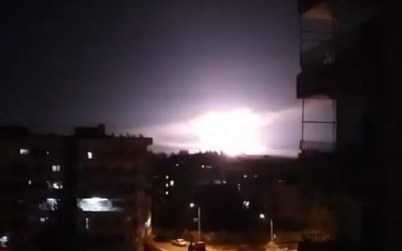
An explosion, reportedly during Israeli airstrikes near Damascus, Syria, on January 21, 2019. (screen capture: YouTube)

Over the past two months, however, that policy of ambiguity has been largely abandoned by Israeli military and political officials, who have begun more openly discussing the Israel Defense Forces’ operations in Syria.

Prime Minister Benjamin Netanyahu has come under fire for breaking Israel’s ambiguity policy regarding attacks in Syria, with critics accusing him of putting Israel’s security at risk to gain points among voters.

Zarif’s words regarding the increasing likelihood of all-out military conflict with Israel comes days after Netanyahu spoke of a joint interest in “war” in the context of the struggle against the Islamic Republic.

In a Hebrew-language video message recorded before he headed last Wednesday to the opening of a Middle East conference in Warsaw, the prime minister hailed the fact that an Israeli leader was about to sit down with senior officials from “leading Arab countries” in order to “advance the common interest of war against Iran.”

An official translation of the statement, provided by the Government Press Office, translated Hebrew phrase milhama b’Iran as “war with Iran,” when it was not clear that Netanyahu had meant literal military action.

The prime minister’s social media accounts published the statement, leading numerous people, including Zarif, to point out its ostensible belligerency.


Israel unveils Rafael’s new advanced bunker buster missile, ‘Rocks’

Posted February 20, 2019 by Joseph Wouk
Categories: Uncategorized

Source: Israel unveils Rafael’s new advanced bunker buster missile, ‘Rocks’ – Arab-Israeli Conflict – Jerusalem Post

The air-to-surface missile can be fired from a significant standoff range, reducing exposure of the aircraft.

BY ANNA AHRONHEIM
 FEBRUARY 20, 2019 14:14
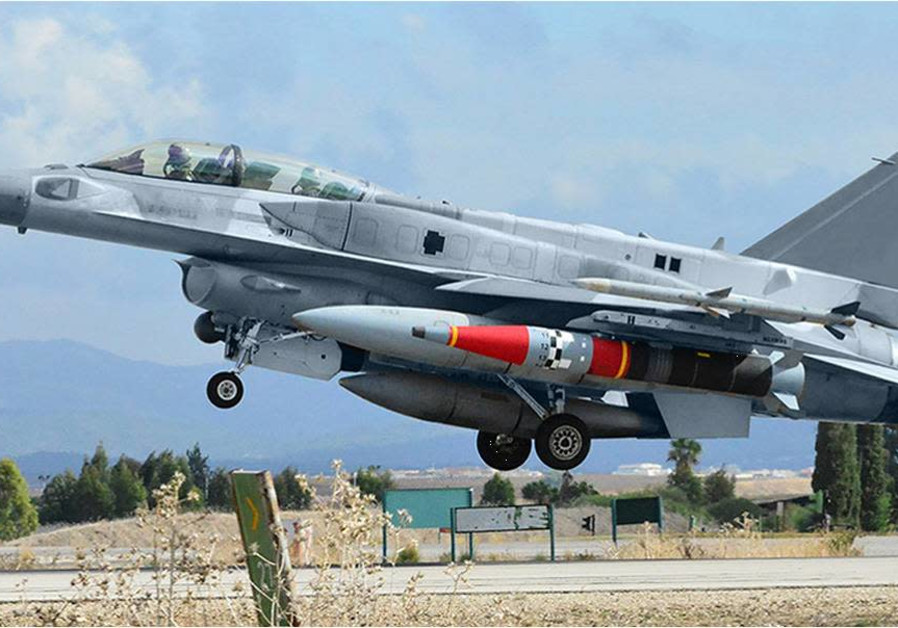
The "Rocks" system deployed on an F-16 fighter jet

With tensions still high between Israel and Iran a new air-to-surface long-range missile designed for to destroy targets deep underground in heavily defended areas has been developed by Israeli defense giant Rafael Advanced Defense Systems.

Dubbed “Rocks,” the innovative missile is being presented this week for the first time at the Aero India Air Show in Bangalore, India.

Earlier in February, a senior Iranian Revolutionary Guards commander threatened to “raze Tel Aviv and Hafia to the ground” if the United States attacked the Islamic Republic.
According to a statement released by Rafael, the new missile is equipped with a penetration or blast fragmentation warhead that is capable of destroying targets above the surface or deep underground in heavily surface-to-air defended areas.
It can be used against quality targets, whether stationary or mobile, and even in areas where the enemy uses countermeasures against GPS systems.
“‘Rocks’ uses its INS/GPS for mid-course navigation while homing on to the target is performed by using its EO seeker and advanced image processing algorithms, which ensures hitting targets with great precision, overcoming GPS jamming or denial,” read the statement.
“Rocks” will be launched from a significant standoff range, far beyond the usual coverage areas of enemy air defense systems. It performs a high velocity trajectory toward the target, reducing the exposure of the aircraft as well as improving the chances of successfully hitting targets.
“‘Rocks’ provides a cutting edge and cost-effective solution that combines several combat-proven technologies inherited from our latest generation SPICE system. “Rocks” effectively answers a growing demand for long range, GPS-independent Air-to-Ground precision strike capability,” said Yuval Miller, Executive Vice-President and General Manager of Rafael’s Air & C4ISR Systems Division.
“Aero India is an excellent opportunity to present this new system, and we can proudly say that today Rafael is well-situated in India with a broad industrial base, joint-ventures, indigenous companies and a substantial supply-chain,” Miller added.
Also on Wednesday, Rafael businessman Avihai Stolero announced that the company had finalized a merger agreement to acquire Yavne-based unmanned aerial systems (UAV) manufacturer, Aeronautics in a deal worth some NIS 850 million ($235m.).
Under the terms of the acquisition, the companies will seek to retain the employees of Aeronautics, who will receive a total of NIS 8.5 million ($2.35m.) as part of the deal.
Aeronautics will then become a full subsidiary of a new company jointly owned by Rafael and Stolero, and will be de-listed from the Tel Aviv Stock Exchange.

Eytan Halon contributed to this report.


Abbas rejects all tax revenues from Israel over terror payment deduction

Posted February 20, 2019 by Joseph Wouk
Categories: Uncategorized

Source: Abbas rejects all tax revenues from Israel over terror payment deduction | The Times of Israel

Dramatic move means PA is giving up $222 million every month, up to a third of its budget, putting it in danger of collapse

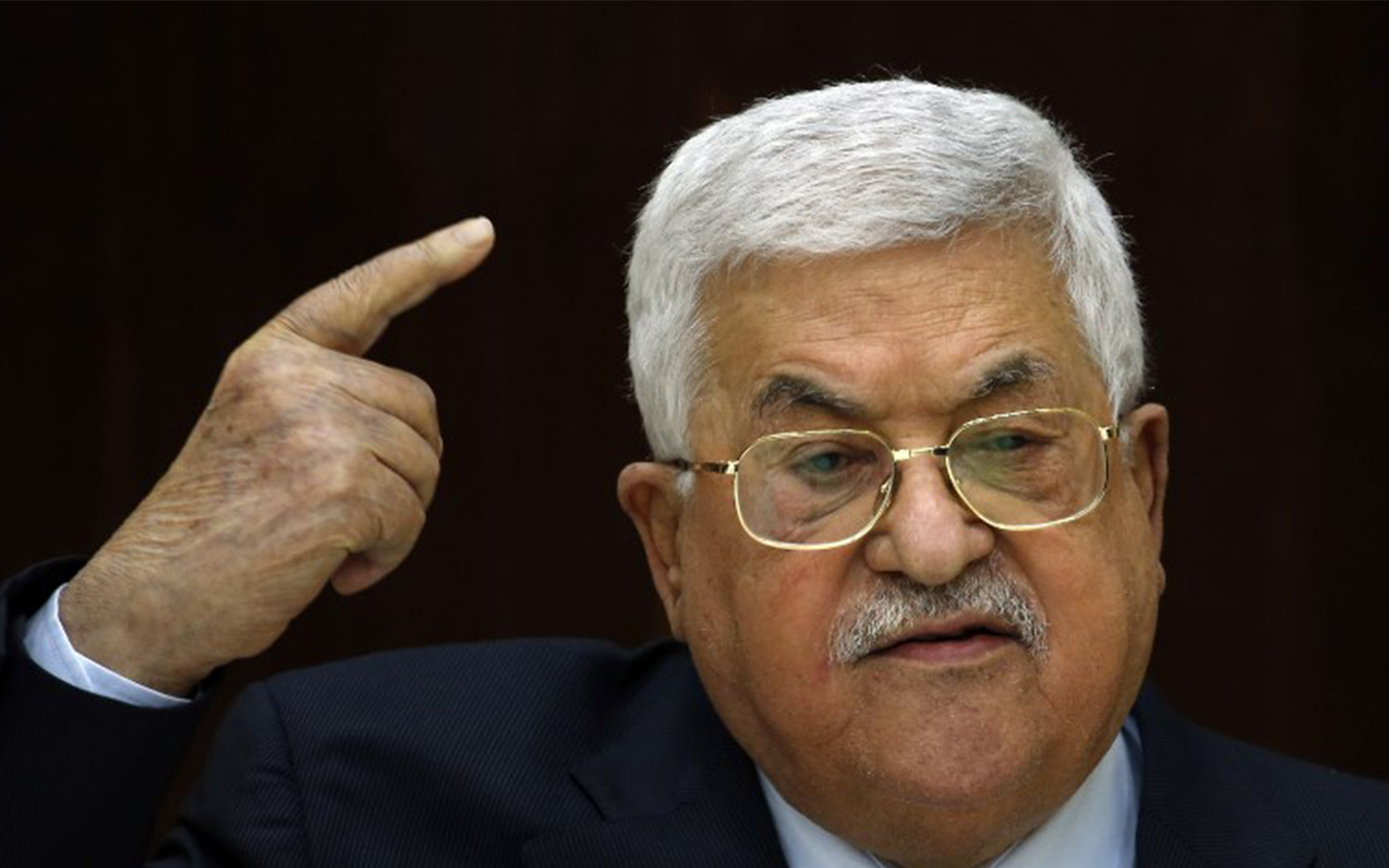
Palestinian Authority President Mahmoud Abbas speaks during a meeting with Palestinian leaders at the Muqata, the Palestinian Authority headquarters, in the West Bank city of Ramallah, on February 20, 2019 (ABBAS MOMANI/AFP)

Palestinian Authority President Mahmoud Abbas speaks during a meeting with Palestinian leaders at the Muqata, the Palestinian Authority headquarters, in the West Bank city of Ramallah, on February 20, 2019 (ABBAS MOMANI/AFP)

Palestinian Authority President Mahmoud Abbas has rejected all tax revenue payments transferred to the PA by Israel, in response to Jerusalem withholding over $138 million of the amount over Ramallah’s payouts to Palestinian attackers and their families.

The dramatic move means the PA is rejecting a large portion of its monthly income, which could lead to its financial collapse. Palestinian officials said Israel currently collects and transfers NIS 803,282,580 ($222 million) to the PA every month, Reuters reported.

Israel’s security cabinet on Sunday approved withholding NIS 502,697,000 ($138 million) from a year’s worth of taxes that Israel is slated to collect on the PA’s behalf.

The security cabinet’s decision was an effort to start implementing a new law that permits Israel to withhold tax money due Ramallah over payments it makes to security prisoners held by Israel and the families of slain attackers, including terrorists.

“We refuse to receive all of the tax funds. We don’t want them. Leave them over with them,” Abbas told a delegation of US Congress members and the dovish Jewish organization J Street at the PA presidential headquarters in Ramallah on Tuesday.

“I tell you honestly that if we only had 20 or 30 million shekels, which is what is paid [monthly] to families of martyrs, we will give them to the families of martyrs. I mean if the [Palestinian] Authority doesn’t have anything other than that [amount], I will pay it to the families of martyrs and prisoners and wounded persons. This needs to be understood,” he said, according to recordings of comments aired Wednesday on Voice of Palestine, the official PA radio station.

Palestinians hold portraits of relatives jailed in Israeli prisons as they protest to demand for their release during a demonstration to mark the Prisoners’ Day in the northern West Bank city of Nablus on April 17, 2018. (AFP PHOTO / JAAFAR ASHTIYEH)

“In addition, I will turn to all international institutions to complain. Perhaps the world will hear me,” Abbas added.

A high-ranking Palestinian official insisted on Tuesday that the Palestinians cannot stop its payments to security prisoners or the families of slain attackers, calling such a move “political suicide.”

“These payments are one of the most sensitive issues in Palestinian society,” the official, who spoke on condition of anonymity, told The Times of Israel. “If the PA were to get rid of them, it would be committing political suicide, especially considering the difficult political situation.”

Palestinian officials have condemned Israel for moving to withhold the half billion shekels, arguing it amounts to “piracy” of Palestinian funds.

Israeli officials have defended the security cabinet’s decision, arguing that the PA’s payments incentivize violence and terrorism.

Avi Dichter, the chair of the Knesset Defense Committee, has said Israel will spread out the withholding of the tax money over 12 months.

If Israel continues to collect a sum of taxes equivalent to that provided in the Reuters report, it will withhold approximately five percent of what it now transfers to the PA on a monthly basis.

Abbas’s rejection of all tax revenues could mean a PA forfeiture of hundreds of millions of shekels each month – several billion a year, and perhaps as much as a third of the PA’s total budget, as Times of Israel analyst Avi Issacharoff pointed out this week.

“It could mean, in other words, the de facto collapse of the PA,” he wrote. “When the PA threatened to do so in the past, Israel caved each time, fearing a spike in violence that could ensue after the PA’s disappearance. But Israel is now in the middle of an election, in which a right-wing incumbent government could find itself politically unable to appear to cave to the Palestinian threat.”

Polls have found that the overwhelming majority of Palestinians oppose the PA suspending its payments to security prisoners, including terrorists who have killed Israeli civilians.

Prime Minister Benjamin Netanyahu chairs the weekly cabinet meeting at the Prime Minister’s office in Jerusalem, February 17, 2019. (AP Photo/Sebastian Scheiner, Pool)

A survey published in July 2017 by the Palestinian Center for Policy and Survey Research found that 91 percent of Palestinians were against halting the payments.

Israeli security officials have long supported strengthening the PA and have argued that initiatives to weaken it could destabilize the situation in the West Bank and hinder the ability of PA security forces to fight terrorism.

Adam Rasgon contributed to this report.


US voices unease over Hezbollah’s role in Lebanon cabinet

Posted February 20, 2019 by Joseph Wouk
Categories: Uncategorized

Source: US voices unease over Hezbollah’s role in Lebanon cabinet – Israel Hayom

Hezbollah continues to violate Lebanon’s policy of noninvolvement in regional conflicts by fighting in “at least three countries” and continues to make its own “national security decisions,” U.S. Ambassador Elizabeth Richard tells Lebanese Prime Minister Hariri.

Associated Press and Israel Hayom Staff // published on 20/02/2019
   
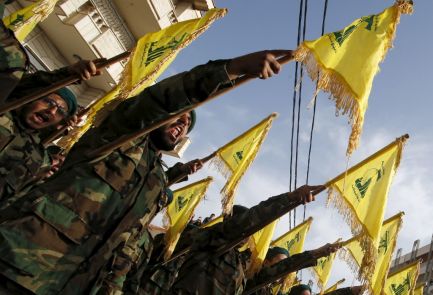
A Hezbollah march in Lebanon 


The U.S. ambassador to Lebanon expressed concerns Tuesday over Hezbollah’s growing role in the country’s new cabinet, saying it does not contribute to stability.

Iran-backed Hezbollah, which also takes part in elections, has named a health minister and two other posts in Lebanon’s cabinet. U.S. officials have called on Prime Minister Saad Hariri’s new government to ensure the terrorist group does not receive support from public resources.

At a meeting with Hariri on Tuesday, Ambassador Elizabeth Richard said Hezbollah continues to violate Lebanon’s policy of noninvolvement in regional conflicts by fighting in “at least three countries.” She was apparently referring to Syria, where the group fights alongside the Bashar Assad regime, Iraq and Yemen, where Iran supports local armed groups.

“I was also very frank with the prime minister about U.S. concern over the growing role in the cabinet of an organization that continues to maintain a militia that is not under the control of the government,” Richard told reporters after the meeting.

She added that Hezbollah continues to make its own “national security decisions” that “endanger the rest of the country.”

The U.S. views Hezbollah as a terrorist group, but is a strong supporter of Lebanon’s national army, supplying it with arms worth hundreds of millions of dollars in recent years. Last week, the American Embassy said the U.S. had delivered laser-guided rockets valued at more than $16 million to the Lebanese army.

Richard said last year alone, the United States provided more than $825 million in assistance, an increase from the year before. She said the U.S. has also supported education and development programs to help Lebanese communities “deal with the unprecedented demands placed on them when their Syrian neighbors fled.”

Lebanon is home to about a million Syrian refugees – a quarter of the tiny Mediterranean country’s population – putting pressure on its crumbling infrastructure.

Minister of State for Refugee Affairs Saleh Gharib briefed President Michel Aoun and Hariri on Tuesday about his visit to Syria the previous day, telling reporters that Syrian officials “were very positive and showed interest in facilitating” refugees’ return.


A window of opportunity in Egypt 

Posted February 20, 2019 by Joseph Wouk
Categories: Uncategorized

Source: A window of opportunity in Egypt – Israel Hayom

Itzhak Levanon

After eight years, the Foreign Ministry’s director general decided to keep Israeli embassy staff in Egypt over the weekend instead of returning them home. This was a welcome decision; the staff’s permanent presence in Cairo allows it to develop and maintain continuous diplomatic work, as expected of any embassy.

The attack on the embassy by an enraged mob in late 2011 and the staff’s consequent hasty withdrawal left Israel without a building for its embassy, with a very minimal team in place, and diplomats who return home to Israel every weekend. As a result, Israel’s diplomatic mission in Egypt has taken a hit. This unacceptable reality has persisted, as stated, for eight years. And although the Foreign Ministry’s decision is a step in the right direction, the embassy will still only function on a semi-normal basis.

Maj. Gen. (res.) Amos Gilad, an authority on Egyptian affairs, says it isn’t viable to lean the countries’ relations on one leg (security-intelligence); and that two legs are needed to ensure stability. The current Egyptian regime, headed by President Abdel-Fattah el-Sissi, doesn’t hide its good relations with Israel and is fostering a positive atmosphere. This provides a window of opportunity to implement full-fledged, proper diplomatic relations. The Egyptian parliament’s decision to extend el-Sissi’s term in office for many more years opens the window even further, allowing the country’s time to stabilize their relationship on more than just the one leg.

To restore diplomatic relations to pre-2011 normalcy, Israel must quickly find a new building for its embassy and staff, including a consular services department working to encourage mutual tourism and promote Israeli interests in Egypt – precisely as the Egyptian Embassy in Tel Aviv operates. The staff has to be the same size as before, to pursue and strengthen the countries’ diplomatic ties. In the stormy Middle East, close relations between Israel and Egypt are vitally important.

The Foreign Ministry, to be sure, always has to contend with complex challenges across the globe, but Israel’s relations with Egypt need to be prioritized. We must not miss this window of opportunity or squander the current regional climate to re-establish the Israeli presence in Cairo, as it was before 2011. The Israeli-Egypt peace accord includes agreement on fully operational embassies. With el-Sissi firmly in power for a long time to come, we must move forward with determination to bring this to fruition.

Itzhak Levanon is the former Israeli ambassador to Egypt.

Russia and its regional aspirations- Jerusalem Studio 398 

Posted February 19, 2019 by Joseph Wouk
Categories: Uncategorized

Off Topic:  With sights set on the moon, Israel to launch privately funded spacecraft Friday

Posted February 19, 2019 by Joseph Wouk
Categories: Uncategorized

Source: With sights set on the moon, Israel to launch privately funded spacecraft Friday | The Times of Israel

Beresheet set to touch down in the Sea of Tranquility on April 11; $100 million project, paid for mostly by Jewish donors, would make Israel 4th country to land a craft on the moon

Yariv Bash, right, Yonatan Winetraub, middle, and Kfir Damari, the founders of SpaceIL, inserting a time capsule into the Beresheet spacecraft, December 17, 2018 (Yoav Weiss)

Yariv Bash, right, Yonatan Winetraub, middle, and Kfir Damari, the founders of SpaceIL, inserting a time capsule into the Beresheet spacecraft, December 17, 2018 (Yoav Weiss)

Israel hopes to become the fourth country in the world to land a spacecraft on the moon, with the launch of the unmanned spacecraft Beresheet from Florida’s Cape Canaveral this Friday. If successful, the 160-kilogram (350 pounds without fuel), four-legged spacecraft will also be the smallest and cheapest spacecraft to land on the moon.

The $100 million (NIS 370 million) spacecraft is a joint venture between private companies SpaceIL and Israel Aerospace Industries, funded almost entirely from private donations from well-known Jewish philanthropists including South African billionaire Morris Kahn, Miriam and Sheldon Adelson, Lynn Schusterman, and others.

Previously, Russia (as the Soviet Union) and the United States have landed on the moon. China landed an unmanned spacecraft on the far side of the moon in 2013.

Beresheet will lift off from Cape Canaveral at approximately 3:45 a.m. IST on Friday (8:45 p.m. Thursday EST), catching a ride on one of Elon Musk’s SpaceX commercial space launches.

Once airborne, the spacecraft will detach from Musk’s Falcon 9 rocket after about half an hour and begin its seven-week journey to the moon. Beresheet will circle Earth six or seven times in a series of growing ellipses before jumping into the moon’s orbit on April 4.

Beresheet will land on the moon in between the detritus left from the Apollo 12 and 15 missions in the Sea of Tranquility, on April 11 around 8 p.m., give or take an hour, according to SpaceIL CEO Dr. Ido Anteby.

“This is the first mission of a small country to the moon, but it’s a non-government mission to the moon, which is privately financed,” Anteby said on Monday at a press conference in Tel Aviv ahead of the launch. “It will open new horizons to the moon for commercial opportunities.”

“Usually, these kinds of projects come from government agencies of major superpowers,” Anteby added.

SpaceIL was the only Israeli contestant in the international Google LunarX PRIZE competition, which offered participants a chance to win $20 million by landing an unmanned spacecraft on the moon. Google ended the contest officially on March 31 with no winner. But the group behind SpaceIL decided to continue its mission, turning to donors to help fund the bare-bones operation.

The Beresheet spacecraft will measure magnetic fields on the moon, data which will be transferred to the Weizmann Institute to help scientists study how the moon was formed millions of years ago. Beresheet will send information for approximately two to three days before the sun’s rays are expected to melt parts of the communication system, ending the mission.

Although scientists are interested in the hard data that Beresheet is expected to gather, Dr. Ofer Doron, the general manager of the Space Division at Israel Aerospace Industries, said one of the main goals of the spacecraft is education.

The Beresheet team hopes that the excitement around Israel’s first moon landing will have an “Apollo effect,” when space travel in the 1960s inspired hundreds of thousands of children in America to study science and aerospace engineering.

“The most exciting part is getting Israeli kids super excited about technology, to see that they can do everything,” said Doron. “It’s a great technological achievement, but it’s also a huge educational achievement.”

The Beresheet team is rolling out a number of educational initiatives along with the Education Ministry to help students follow the spacecraft’s journey, including special kits for teachers and a free smartphone app.

President Reuven Rivlin will host a pajama party with students on Thursday night, staying up until 3:45 to watch the launch at the President’s Residence in Jerusalem. The project employs more educators than engineers, in an effort to ensure that the spacecraft’s journey and moon landing reach as many students as possible, said Daniella Geron, a ground segment system engineer responsible for coordinating between the various teams and the spacecraft.

The spacecraft is carrying a Hebrew Bible inscribed with nanotechnology on a small metal circle the size of a 5 shekel coin, and a time capsule with Israel’s Declaration of Independence and national anthem, the memories of a Holocaust survivor, children’s drawings of space and the moon, the Traveler’s Prayer and a note from the late former president Shimon Peres.

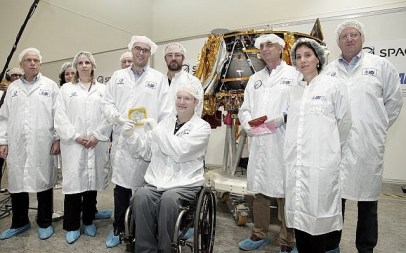
The founders of SpaceIL and members of Israel Aerospace Industries (IAI) displaying the time capsule that was inserted into the Beresheet space craft scheduled to land on the moon in 2019; Dec. 17, 2018 (Yoav Weiss)

The Beresheet Command Center is in Yehud, about 10 miles southeast of Tel Aviv, where the spacecraft was built and tested, including spending 10-day periods in a massive vacuum that blasted the spacecraft alternately with extreme heat and cold in order to ensure it can stand up to the wide temperature fluctuations in space.

In order to cut down on cost and weight, the Beresheet does not have duplicate systems. Most spacecrafts carry duplicate solar panels, communication systems, and other technology, so that if there is a failure, the backup system can kick into place and the mission can continue. With Beresheet, if any piece of equipment fails, the whole project is lost.

Beresheet will travel at speeds of 36,000 kilometers per hour. When it is at its farthest point, approximately 400,000 kilometers away from Earth, the team will be able to communicate with the spacecraft only if  Beresheet’s location can be pinpointed within a few meters. A team of engineers is currently training with NASA satellites to help prepare them for the lunar landing.

The team will have just one opportunity to land on the moon, though it might be able to try again if it misses the first window, Anteby said.

The project almost didn’t happen, a near-casualty of US President Donald Trump’s extended government shutdown. The spacecraft was packed and ready to go in Israel in late December, but still waiting for customs clearance, when disagreements over Trump’s border wall shuttered the American government for 35 days.

If Beresheet hadn’t arrived in America in time to be assembled for the SpaceX launch, the entire project would have fallen apart, said Morris Kahn, the 89-year-old president of SpaceIL. Kahn worked a number of contacts to obtain approval from US Customs despite the government shutdown, and the spacecraft arrived in Florida in time to make the launch.

The moon landing also opened new avenues for cooperation with Israelis and NASA, which is excited about the project’s low cost and hopes to make it a prototype for future moon landings if the operation is successful.

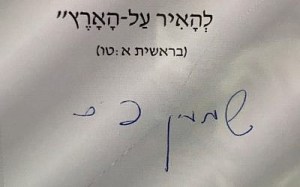
In 2011, Israeli President Shimon Peres gave SpaceIL a biblical verse to insert into the time capsule. It says: “And let them be for lights in the firmament of the heaven to give light upon the earth.” (Genesis, Chapter 1, verse 15)

“How much hutzpah [arrogance] is it to think you can get to the moon with $100 million?” Doron asked. “Maybe we should have named it hutzpah instead of Beresheet.” The public chose the name Beresheet, the Hebrew name of the Book of Genesis, in a poll run by SpaceIL in July 2018.

SpaceIL and Israel Aerospace Industries have also signed agreements with German space agency OHB in addition to NASA.

“There is a trend that now a lot of space agencies want to go back to the moon, so there’s an opportunity here for commercialization,” said Doron. He noted that Israel’s moon landing will bring enhance national pride as well as bring commercial opportunities.

Space travel is going the way of Uber and the sharing economy, with international space agencies looking to cut costs by using “ride shares” to hitchhike into space on existing commercial launches.

The Falcon 9 rocket launch that brings Beresheet into space will also launch a large geo-communication satellite and other equipment for the US Air Force. While Musk has cornered the market on commercial rocket launches, SpaceIL and IAI are hoping to find a niche in inexpensive moon landings, so space agencies or, one day, private individuals or organizations, could send cameras and research equipment to the moon for their own purposes.

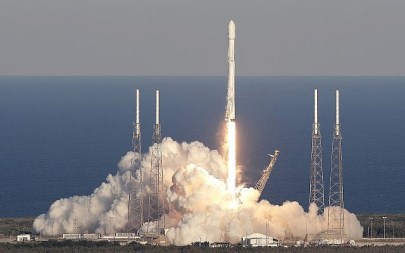
A SpaceX Falcon 9 rocket transporting the TESS satellite lifts off from launch complex 40 at the Cape Canaveral Air Force Station in Cape Canaveral, Florida, April 18, 2018. (AP Photo/John Raoux)

For now, though, the team of engineers and educators has their eyes set on April 11, which is conveniently after Israel’s elections, set for April 9.

Doron said the Beresheet team chose the date before Prime Minister Benjamin Netanyahu called elections.

For now, the 25 engineers are in crunch time, making last-minute adjustments before Friday’s launch.

“We will have about half an hour of contact with the spacecraft every four hours,” explained Geron, the coordinating engineer. Beresheet’s team will use satellite dishes spread across the world in Hawaii, Chile, Sweden, Australia, South Africa, Germany, the continental United States, and Israel, to track the spacecraft, using satellite dishes with diameters of up to 74 meters (240 feet), Geron said.

She noted that the project is about more than just the data they hope to gather about the moon’s magnetic field. “It’s about gaining knowledge that will stay in Israel,” she said. “Everything we went through, all of the connections, all of the late night emails, we learned so much and next time it will be faster and more efficient,” she said. “We needed to find so many creative solutions, ways to make the communication work as the spacecraft is moving and we are moving. We are accumulating all of this knowledge, and also the education branch will inspire so many children.”

Geron said when the engineering team needed a break from the intensive work, they would head out to schools to give lectures about the project, and come back inspired by all of the interest generated by the Beresheet project.

“The moment we connect with the spacecraft after landing, we’ll be able to breathe again,” said Geron. “And it will all be worth it.”