Posted June 22, 2021 by Joseph Wouk Categories: Uncategorized
Visitors to the three domains were greeted on Tuesday with a notice that they were seized under US laws that allow civil and criminal forfeiture of property involved in “trafficking in nuclear, chemical, biological, or radiological weapons technology or material, or the manufacture, importation, sale, or distribution of a controlled substance.”
The seizure notice by the US Department of Justice also invokes a law governing presidential authority in dealing with “unusual and extraordinary threat; declaration of national emergency,” which includes the Iran Nonproliferation Amendments Act of 2005 and the ironically named Iran Freedom Support Act of 2006.
Launched in July 2007, Press TV is the international English-language service of the Islamic Republic of Iran Broadcasting (IRIB), Tehran’s state media agency. Al-Alam goes back to 2003 and is broadcast in Arabic, Farsi and English to audiences in the Middle East and the Mediterranean.
Al-Masirah is not owned by Iran, but by Ansarullah – the movement of the Houthis in Yemen, a faction the US has accused of being “proxies” of Iran on account of them being Shia Muslims and resisting the invasion of Yemen by Saudi Arabia since 2015. The TV channel is headquartered in Beirut, Lebanon.
Neither the US nor the Iranian authorities have commented on the seizures just yet. Meanwhile, the NGO Yemen Solidarity Council condemned the “the deliberate silencing of the Yemeni voice by the American regime.”
Washington’s move comes just a day after the newly elected Iranian President Ebrahim Raisi urged the US to lift all sanctions on Tehran and rejoin the 2015 nuclear deal, negotiated by the Obama administration but unilaterally repudiated by President Donald Trump in 2018.
While the Trump administration took a hard-line approach to Iran, imposing unprecedented sanctions and even assassinating a senior Islamic Revolutionary Guard Corps general – resulting in Iranian missile strikes against US bases in Iraq – it never moved against media outlets. The Biden administration was thought to be open for relaxing tensions.
Just last week, Iranian negotiators said they had reached a deal with their US counterparts to lift the Trump-era sanctions.
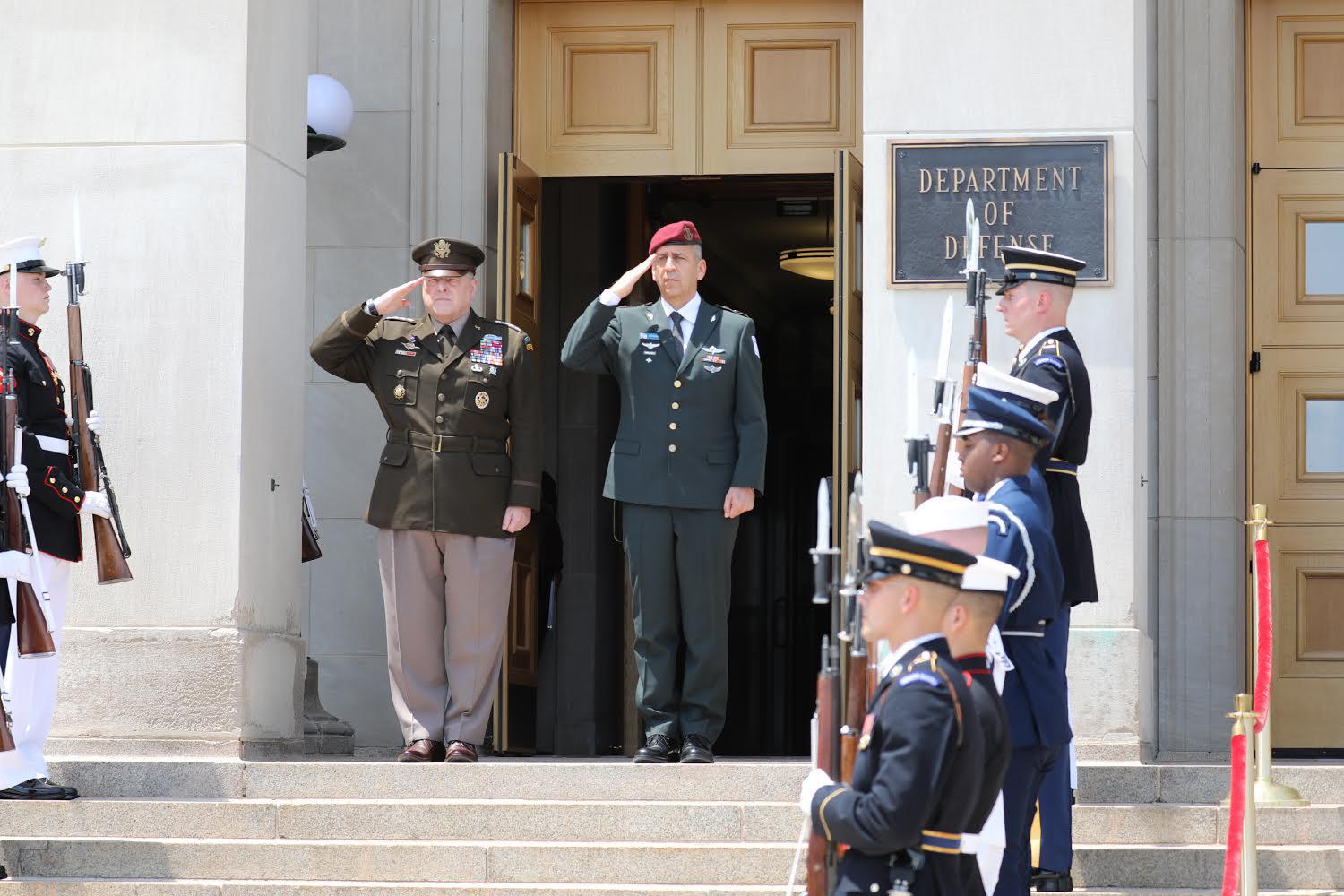
IDF Chief of Staff Aviv Kohavi, center-right, and US Chairman of the Joint Chiefs of Staff Mark Milley, center-left, salute outside the US Department of Defense in Washington, DC, on June 21, 2021. (Israel Defense Forces)
Military chief Aviv Kohavi warned American officials against their government’s plan to reenter the 2015 nuclear deal this week during a visit to Washington, DC, as part of a last-ditch effort by Israel to affect the ongoing negotiations between the United States and Iran in Vienna.
The Israel Defense Forces chief of staff arrived in the United States on Sunday and spent the past two days in meetings with Chairman of the Joint Chiefs of Staff Mark Milley and US Secretary of Defense Lloyd Austin in the Pentagon, the military said.
“The chief of staff presented the failures of the current nuclear deal, which allow Iran to make significant advances in the coming years in the quantity and quality of centrifuges and in the amount and quality of enriched uranium, and he stressed the lack of oversight in the area of developing a nuclear weapon,” the IDF said in a statement.
Kohavi’s visit to the US, which was delayed due to last month’s Gaza conflict, came as indirect talks between Washington and Tehran picked up steam, following the election last week of hardliner Ebrahim Raisi as Iran’s next president.
Both the current and former Israeli governments have voiced opposition to the US rejoining the 2015 nuclear deal, known formally as the Joint Comprehensive Plan of Action, which former US president Donald Trump abrogated in 2018, putting in place a crushing sanctions regime that prompted Iran to also abandon the agreement a year later.
US President Joe Biden has repeatedly stated his intention to return to the agreement, provided Tehran comes back into compliance with it as well. The Biden administration has said it plans to use the JCPOA as a starting off point for brokering a “longer and stronger” nuclear deal, though critics — including those in Israel — say that once the US eases the sanctions in place on Iran and Iranian officials as it returns to the JCPOA, Tehran will no longer have an incentive to negotiate.
Several delegations of Israeli officials, including former Mossad chief Yossi Cohen and National Security Adviser Meir Ben-Shabbat, have traveled to the US in recent months in an effort to dissuade the Biden administration from reentering the agreement.
Iran’s Governor to the International Atomic Energy Agency (IAEA) Kazem Gharib Abadi attends the IAEA Board of Governors meeting at the agency’s headquarters in Vienna, Austria, on June 7, 2021. (JOE KLAMAR / AFP)
In the past, US officials have said that the concerns raised by Israel during these talks will not change the White House’s plans.
Shortly after Biden’s inauguration in January, Kohavi made waves with a particularly blunt speech arguing against the US rejoining the deal, calling it a “bad” plan.
The newly inaugurated Israeli government has said that, while it opposes Biden’s plan to rejoin the deal, it would voice its concerns behind closed doors.
Kohavi, however, has kept his criticism firmly in public.
“The chief of staff emphasized the inherent danger in returning to the original nuclear agreement and stressed that everything must be done to prevent Iran from obtaining military nuclear capabilities,” the IDF said.
During his meeting with Milley, which was attended briefly by Austin, Kohavi also discussed Iran’s expansionist efforts in the Middle East, the efforts being made by the Iran-backed Hezbollah terror group to develop precision-guided missiles, and Israel’s recent conflict in the Gaza Strip with Hamas, the military said.
“The strategic and military alliance with the United States represents a facet of the State of Israel’s national security that is of the utmost importance. Cooperation between the militaries is a force multiplier and of growing mutual interest in recent years, and we will continue to work together against our shared threats in the Middle East,” Kohavi said during the meeting.
Pentagon officials largely refrained from discussing the contents of the meeting, with a spokesperson saying only that Milley “reaffirmed the US commitment to its relationship with Israel.”
Kohavi was joined on his nearly week-long trip by Maj. Gen. Tal Kalman, who leads the IDF’s counter-Iran efforts, as well as Brig. Gen. Amit Sa’ar, who leads Military Intelligence’s Research Division, and Israel’s defense attaché in Washington, Maj. Gen. Yehuda Fuchs, who is due to complete his tenure shortly.
In addition to Milley and Austin, the IDF delegation was scheduled to meet US National Security Adviser Jake Sullivan, the head of the US Central Command Kenneth McKenzie, the head of the US Special Operations Command Richard Clark and other top American defense officials.
Kalman, Sa’ar, and Fuchs will also hold their own meetings with additional American defense officials, according to the IDF.
Kohavi was initially scheduled to travel to Washington in late April, but his trip was called off in light of rising tensions at the time between Israel and the Hamas terror group in the Gaza Strip, which culminated in a vicious 11-day battle last month.
Kohavi was also scheduled to meet with heads of think tanks and other “thought shapers” in the US, as part of Israel’s public relations efforts before returning to Israel on Friday, the military said. Deputy Chief of Staff Eyal Zamir is commanding the IDF in Kohavi’s absence.
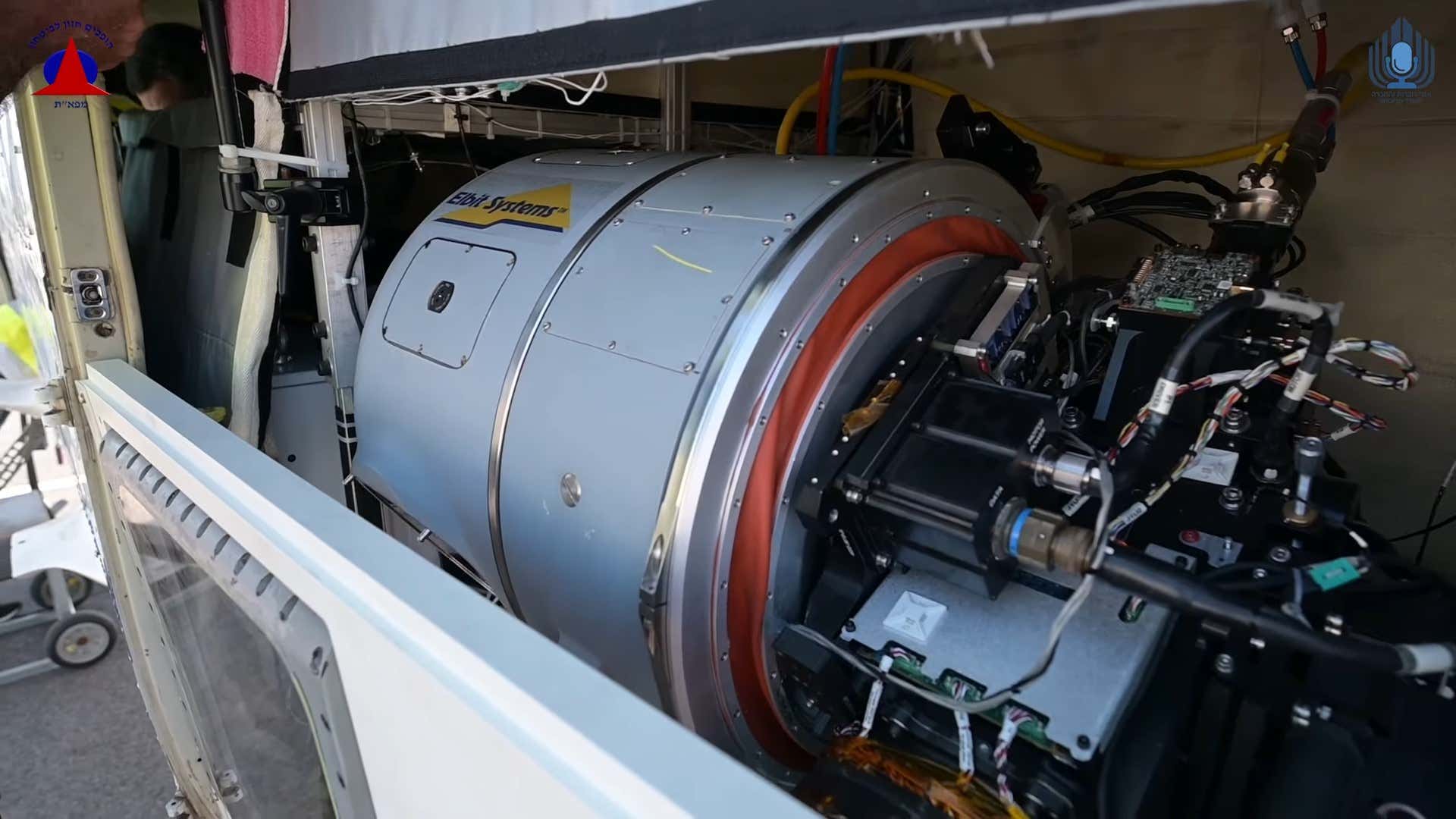
Israel’s Ministry of Defense announced today that it successfully intercepted multiple drones during a test of an airborne high-power laser weapon. The demonstrated system is being hailed as “a strategic change in the air defense capabilities of the State of Israel” and could potentially add a vital capability to Israel’s multi-layered integrated air defense system. While the new high-power laser has been tested against UAVs, statements made by officials involved with the demonstration show that the system is also intended to defend against rocket attacks.
The demonstration was carried out by the Israeli Air Force’s (IAF) “Yanat” missile test unit, Israel’s Directorate of Defense Research and Development (DDR&D), and Israeli defense contractor Elbit Systems. A press release accompanying the announcement states that multiple unmanned aerial vehicles (UAV) were intercepted and destroyed above a test range using the new airborne laser system. Footage shared online shows the system deployed on a Cessna 208 Caravan behind a windowed panel on the left side of the aircraft’s rear fuselage. Few specifics about the laser system’s capabilities have been released, but DDR&D’s Head of Research and Development, Brig. Gen. Yaniv Rotem, stated that the system successfully intercepted drones at a range of more than 1km.
Airborne laser systems offer advantages over ground-based laser systems due to the fact that they are carried aboard aircraft and therefore can be rapidly moved between locations. This offers added flexibility to respond to UAV threats wherever they might present themselves and provides greater coverage over a much wider area, especially when compared to a stationary system.
An airborne counter-drone system also will be less impacted by atmospheric distortion than its ground-based counterparts. Laser directed energy weapons, in general, have limitations, such as being highly susceptible to atmospheric conditions, clouds, and smoke. As with any weapon system, size, weight, thermal loads, and power also significantly limit how effective they are against various threats or even how broadly they can be deployed on different aircraft. You can read all about these issues in this past piece of ours.
Israel’s new airborne laser system is claimed to be able to “effectively intercept long-range threats at high altitudes regardless of weather conditions,” despite the fact that Israel’s Ministry of Defense has previously stated that laser systems do not work well in inclement weather or through cloud cover. Still, laser systems offer advantages over kinetic interceptors, in that cost-per-intercept is much lower despite the potential for high up-front procurement and research and development costs of the laser systems themselves.
The aforementioned cost per intercept advantage is a significant catalyst in the development of Israel’s new airborne laser defense system. Israel’s Defense Minister Benny Gantz said the demonstration of the new system is “significant both in terms of cost-effectiveness and defense capabilities” and “will add a new layer of protection at greater ranges and in facing a variety of threats – securing the State of Israel while saving the costs of interception.”
While the most recent demonstration saw Israel’s new high-power laser shoot down multiple UAVs only, statements made by those developing the program show that this system could also offer a new tool in Israel’s growing arsenal of rocket defenses. Oren Sabag, General Manager of Elbit Systems Intelligence, Surveillance, Target Acquisition and Reconnaissance (ISTAR) Division, said that “that the use of a high-power laser to carry out low-cost airborne interception of rockets and hostile unmanned aircraft, closer to their launching areas and away from population centers, offers a significant change in Israel’s defense capabilities.”
Last year, Israel’s Ministry of Defense announced an unspecified “technological breakthrough” related to an airborne laser system being developed in conjunction with Elbit Systems. That system was claimed to cost just one dollar per intercept, compared with the “tens of thousands of dollars that each Iron Dome interceptor missile costs.” Israel is looking at developing an array of laser weapons that also includes drone-mounted and ground-based systems.
Israel’s new airborne high-power laser system could complement Israel’s existing multi-tier missile defense network, which includes the Iron Dome, Patriot, David’s Sling, and Arrow surface-to-air missile systems, as well as manned fighters and helicopters. The need for a multi-layered approach for lower-end threats presented itself in recent clashes when continuous mass rocket attacks launched by Palestinian militants tested the Iron Dome’s capabilities by overwhelming it with sheer numbers.
Iron Dome and its Tamir interceptors are claimed to be capable of shooting down drones in addition to rockets and short-range artillery, but it remains unclear how effective that capability is. In the most recent round of clashes, the IDF reported shooting down unmanned aircraft flying out of Gaza, but it’s unknown which defense systems were responsible for those intercepts.
Militants have been increasingly using drones to attack Israel, and these low-end threats continue to present challenges for existing defense systems designed to intercept rockets or missiles that follow more predictable ballistic trajectories. The proliferation of low-end drones capable of carrying out improvised attacks is becoming a worldwide security issue, and even relatively small-scale drones are capable of creating large-scale impact when targeting infrastructure or high-value targets.
One could see how Israel could deploy several more mature versions of this system in the skies above key areas such as Gaza or along the border with Lebanon during a time of crisis, in essence providing anti-drone screening in a very efficient package. Migrating the capability to an unmanned system in the future would likely be ideal, enabling a loitering drone defense system.
It’s also worth considering that one of the key benefits of lasers are they they can, at least in principle, fire indefinitely, so long as they have a sufficient and consistent power supply. This is important when considering questions about whether it is possible to simply overwhelm existing defense systems like Iron Dome. At the same time, each individual laser system can only engage one target at a time, and there could be significant lag between individual engagements depending on how long the high-power laser takes to charge up.
The ongoing development of Israel’s airborne high-power laser system aimed at intercepting and defeating UAV threats demonstrates how crucial anti-drone capabilities have become when it comes to air defense. While airborne laser systems have been developed and tested to varying degrees of success by the U.S. Air Force as far back as the 1980s, Israel is the first to actually deploy a counter-drone laser aboard an aircraft and effectively make it work, at least from what has been publicly disclosed. The latest claims represent a technological triumph for the Israel Defense Forces which will likely influence other air arms around the globe.
What remains to be known is just what exact type of laser system is being used here and what its power output and other limitations are. For the test setup, it clearly has limited field of regard, but that will surely change over time. We also don’t know exactly what concept of operations would be employed operationally for such a system like this. Will organic sensors onboard the aircraft provide initial detection and targeting or will that come from external sources alone? Also, aboard which type of platform will this laser unit see its first operational deployment?
The U.S. Air Force is still slated to deploy its first operational airborne laser on an AC-130 gunship soon, but that system is being eyed more for air-to-ground roles. Meanwhile, a far more ambitious initiative is underway to put a podded laser defensive system on a fighter aircraft. All this is fine and well, but Israel’s approach to provide a counter-drone capability with an airborne laser, something U.S. Navy ships haven’t even received in a truly operation state, is quite intriguing. Although it is worth mentioning that there may be undisclosed work underway in the U.S. that is focusing on developing a similar system.
Still, there are aforementioned challenges that remain. It will be interest to see how the IAF and its research wings overcome these challenges as they try to migrate their airborne laser system into an operational state.
Posted June 21, 2021 by Joseph Wouk Categories: Uncategorized
Foreign Minister Lapid urges ‘renewed determination’ to halt Iran’s nuke program, while ministry spokesman says judiciary chief will be ‘most extremist president to date’
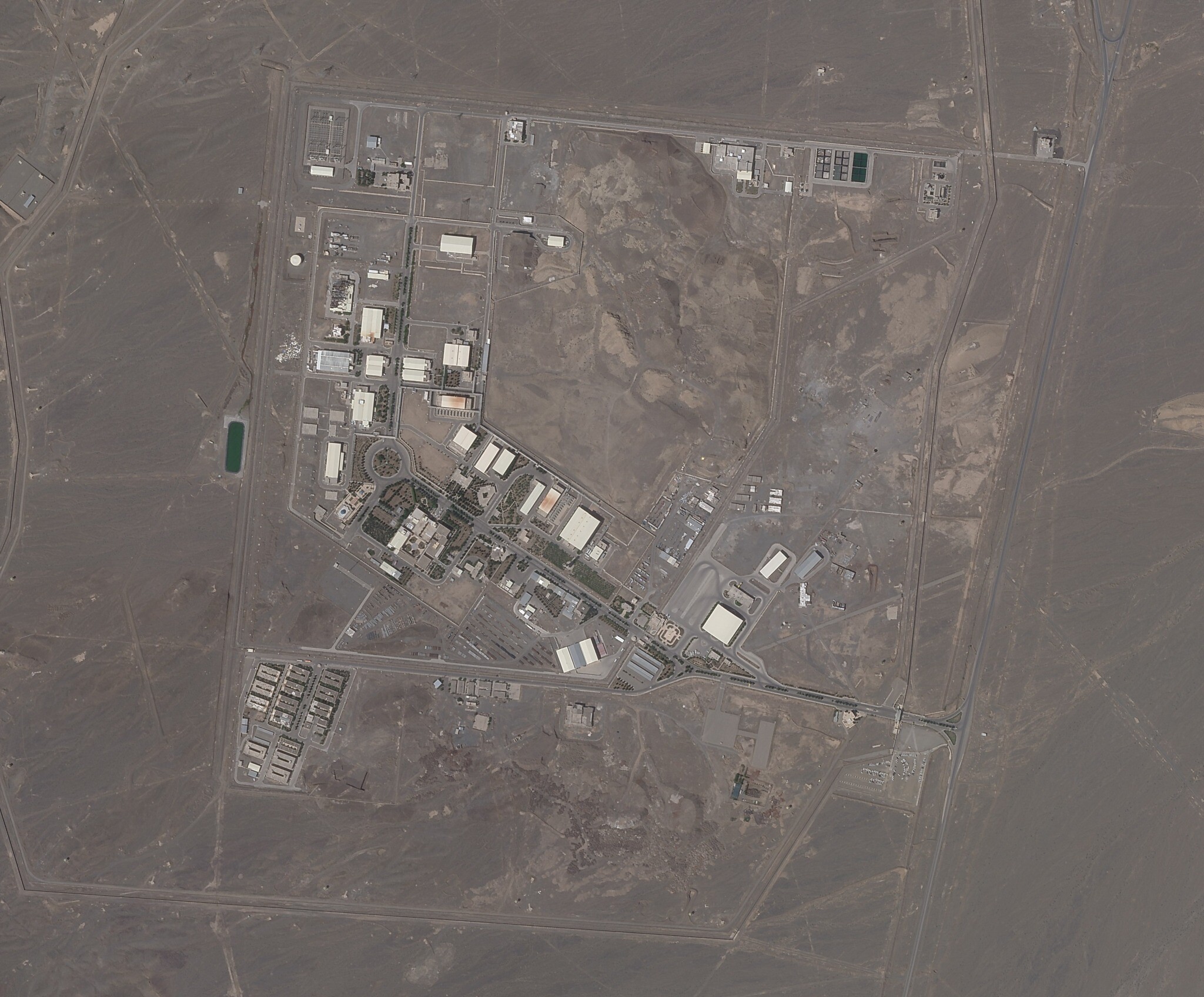
This satellite photo provided from Planet Labs Inc. shows Iran’s Natanz nuclear facility on Wednesday, April 14, 2021. Iran began enriching uranium Friday, April 16, 2021, to its highest level ever at Natanz, edging closer to weapons-grade levels to pressure talks in Vienna aimed at restoring its nuclear deal with world powers after an attack on the site. (Planet Labs via AP)
Security officials believe Iranian President-elect Ebrahim Raisi will adopt Supreme Leader Ayatollah Ali Khamenei’s hardline views on foreign and nuclear policy, and assess that Israel must once again ready plans to potentially attack the Islamic Republic’s nuclear facilities, Israeli television reported Saturday.
Channel 12 said Raisi backs a return to the 2015 deal limiting Iran’s nuclear program in exchange for sanctions relief, and the assessment in Israel is that an agreement with the US to restore the accord won’t be signed until August, when he takes office. In the meantime, however, Iran is expected to build up its stockpile of enriched uranium.
“There will be no choice [now] but to go back and prepare attack plans for Iran’s nuclear program. This will require budgets and the reallocation of resources,” an unnamed senior Israeli source was quoted as saying.
Israel’s Foreign Minister Yair Lapid tweeted Saturday evening: “Iran’s new president, known as the Butcher of Tehran, is an extremist responsible for the deaths of thousands of Iranians. He is committed to the regime’s nuclear ambitions and to its campaign of global terror.”
Lapid argued that “his election should prompt renewed determination to immediately halt Iran’s nuclear program and put an end to its destructive regional ambitions.”
And Foreign Ministry spokesman Lior Haiat tweeted that Raisi will be the “most extremist president to date.
“An extremist figure, committed to Iran’s rapidly advancing military nuclear program, his election makes clear Iran’s true malign intentions, and should prompt grave concern among the international community.”
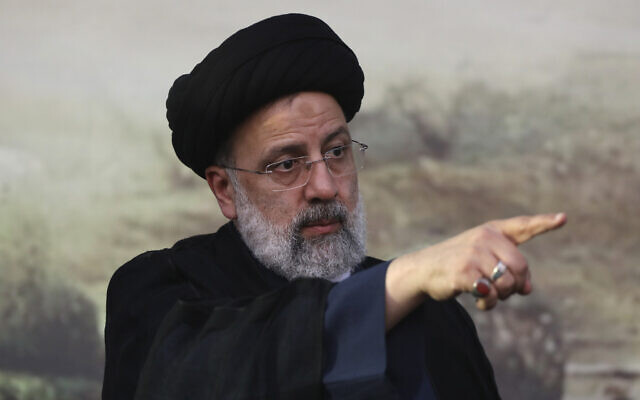
Iran’s presidential candidate Ebrahim Raisi, points during a campaign rally in Eslamshahr, southwest of Tehran, Iran, June 6, 2021. (Vahid Salemi/AP)
On Thursday Defense Minister Benny Gantz said Israel and the United States were working to increase the monitoring of Tehran’s nuclear program, while warning that “all options are on the table” regarding Jerusalem’s preparedness to conduct a military strike in order to prevent Iran from obtaining a nuclear weapon.
IDF Chief of Staff Aviv Kohavi, meanwhile, was set to lead a senior delegation of top Israeli military officers to Washington early Sunday to meet with American officials about Iran’s nuclear program and its expansionist efforts in the region, the Israel Defense Forces said.
“The chief of staff will discuss with his counterparts current shared security challenges, including matters dealing with the Iranian nuclear threat, Iran’s efforts to entrench itself militarily in the Middle East, Hezbollah’s rearmament efforts, the consequences of the threat of precision-guided missiles and joint force build-up,” the military said.
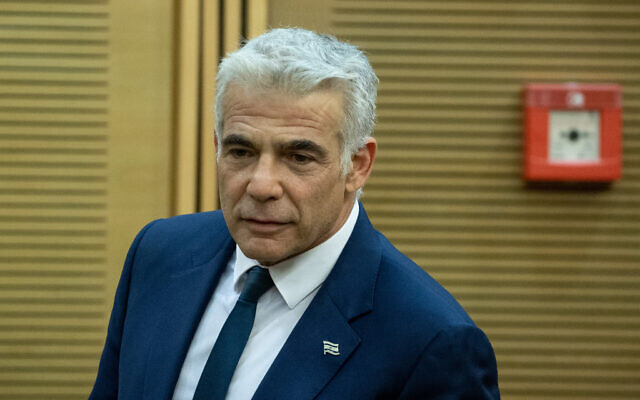
Foreign Minister Yair Lapid arrives for the new government’s first cabinet meeting on June 13, 2021. (Yonatan Sindel/Flash90)
Kohavi’s trip comes amid lingering tensions between the US and Israel over the Iran nuclear issue. US President Joe Biden’s administration intends to return to the 2015 nuclear deal with Iran, a move that Israeli officials, including Kohavi, have staunchly and publicly opposed.
On Friday Channel 13 news reported that Prime Minister Naftali Bennett is hoping to use the coming weeks, ahead of the inauguration of the new Iranian president, to hold talks with Washington in order to positively influence the expected US return to the nuclear deal.
The report said Bennett has removed a ban by his predecessor, Benjamin Netanyahu, on Israeli officials discussing the details of the emerging renewed deal between the US and Iran. Netanyahu had instructed security officials not to hold talks on the details of the deal with American officials, in an apparent effort to distance Israel from it.
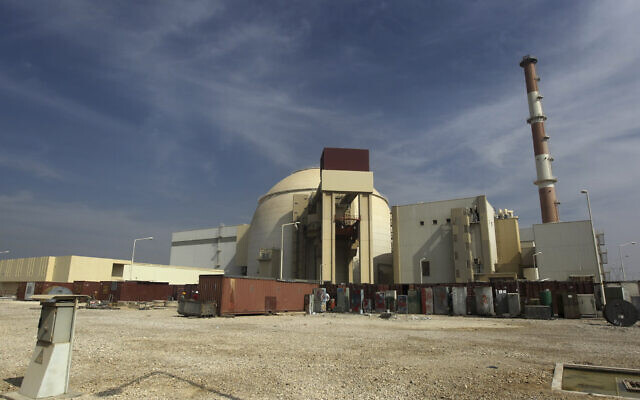
This October 26, 2010, photo shows the reactor building of the Bushehr nuclear power plant just outside the southern city of Bushehr, Iran. (AP Photo/Mehr News Agency, Majid Asgaripour)
This week, Iran announced that it had amassed 6.5 kilograms (14.3 pounds) of uranium enriched to 60% purity, and 108 kilograms of uranium enriched to 20% purity in five months. Uranium enriched to those levels can be relatively easy to further enrich into a weapons-grade level of 90% purity.
Former US president Donald Trump abandoned the Iran deal, known as the Joint Comprehensive Plan of Action (JCPOA), in 2018, imposing fresh sanctions on Iran and Iranian officials, leading Tehran to follow suit shortly thereafter. Since then, Tehran has ratcheted up tensions on the nuclear front by amassing greater quantities of enriched uranium at greater degrees of purity and by making advancements in the development of missiles that could be used to carry a nuclear warhead.
In recent months, Iranian and European negotiation teams have been meeting in Vienna to discuss a return to the nuclear deal by the US and Iran — a move staunchly opposed by top Israeli officials. Though all sides have reported progress, the talks have stalled somewhat in recent weeks as Iran geared up for the presidential elections.
Posted June 8, 2021 by Joseph Wouk Categories: Uncategorized
UN nuclear agency head Grossi has been pushing Tehran for answers on three sites dating back many years where inspections revealed traces of uranium of man-made origin
By AP and TOI STAFF7 June 2021, 4:55 pm Director General of the International Atomic Energy Agency, IAEA, Rafael Mariano Grossi from Argentina, addresses the media during a news conference behind plexiglass shields regarding the agency’s monitoring of Iran’s nuclear energy program at the International Center in Vienna, Austria, Monday, June 7, 2021. (AP Photo/Lisa Leutner)
Iran has failed to answer questions about the discovery of uranium particles at former undeclared sites in the country, the head of the UN nuclear watchdog said Monday, calling on Tehran to provide information “without further delay.”
Rafael Grossi, the head of the International Atomic Energy Agency, has been pushing Iran for answers on three sites dating back many years where inspections had revealed traces of uranium of man-made origin, suggesting they were once connected to Iran’s nuclear program.
The issue is separate from the ongoing negotiations aimed at bringing the United States back into Iran’s 2015 nuclear accord with world powers.
Grossi said in March that Iran had agreed to sit down with international technical experts investigating the discovery, and said he hoped to “come to some satisfactory outcome” by the time of the IAEA board meeting in June.Iran’s Governor to the International Atomic Energy Agency (IAEA), Kazem Gharib Abadi, Political deputy at the Ministry of Foreign Affairs of Iran, Abbas Araghchi, and Deputy Secretary General and Political Director of the European External Action Service (EEAS), Enrique Mora leave the Grand Hotel Vienna where closed-door nuclear talks take place in Vienna, Austria, June 2, 2021. (AP/Lisa Leutner)
But in comments Monday to the IAEA’s board of governors, Grossi said that “after many months, Iran has not provided the necessary explanation for the presence of the nuclear material particles at any of the three locations where the agency has conducted complementary accesses.”
He said Iran also hasn’t answered questions regarding another undeclared location.
“The lack of progress in clarifying the agency’s questions concerning the correctness and completeness of Iran’s safeguards declarations seriously affects the ability of the agency to provide assurance of the peaceful nature of Iran’s nuclear program,” Grossi said.
“For objectivity’s sake, I should say that the Iranian government has reiterated its will to engage and to cooperate and to provide answers, but they haven’t done that so far,” he told reporters later. “So I hope this may change, but as we speak, we haven’t had any concrete progress.”
Grossi also said it was “becoming increasingly difficult” to extend a temporary inspections arrangement with Iran. In February, Tehran suspended some IAEA inspections, leading the agency to strike a temporary three-month deal allowing it to continue its activities despite the reduced level of access.
“I can see this space narrowing down,” said Gros
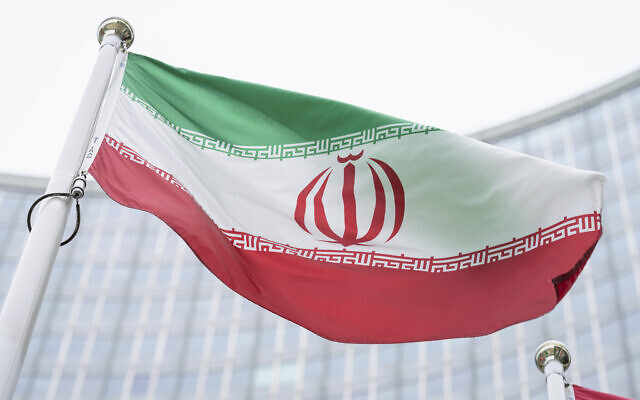
In late May the ad hoc arrangement was extended until June 24, with Grossi describing the remaining time as “very short”.The Iranian flag waves outside of the UN building that hosts the International Atomic Energy Agency, IAEA, office inside in Vienna, Austria, July 10, 2019. (AP Photo/Ronald Zak)
Iran and world powers are engaged in talks in Vienna to rescue the 2015 nuclear deal after former US president Donald Trump walked away from it in 2018 and reimposed crippling sanctions on Tehran. Iran started limiting inspections in a bid to put pressure on the Biden administration to lift the sanctions.
US President Joe Biden has signaled his willingness to revive the plan. While progress has been made and important aspects of a future deal have been hammered out, diplomats have said that tough decisions lie ahead and that nothing would be agreed on until everything was agreed on.
For this to happen, the US would need to return to the accord and lift the sanctions reinstated by Trump while Tehran would have to re-commit to full compliance with nuclear obligations it progressively withdrew from since 2019.
Posted June 8, 2021 by Joseph Wouk Categories: Uncategorized
US secretary of state admits he’s unsure Tehran interested in rejoining pact; IAEA chief adds to skepticism, saying ‘space narrowing’ for a temporary deal
Blinken: Iran may cut nuclear breakout time to weeks if it keeps breaching deal
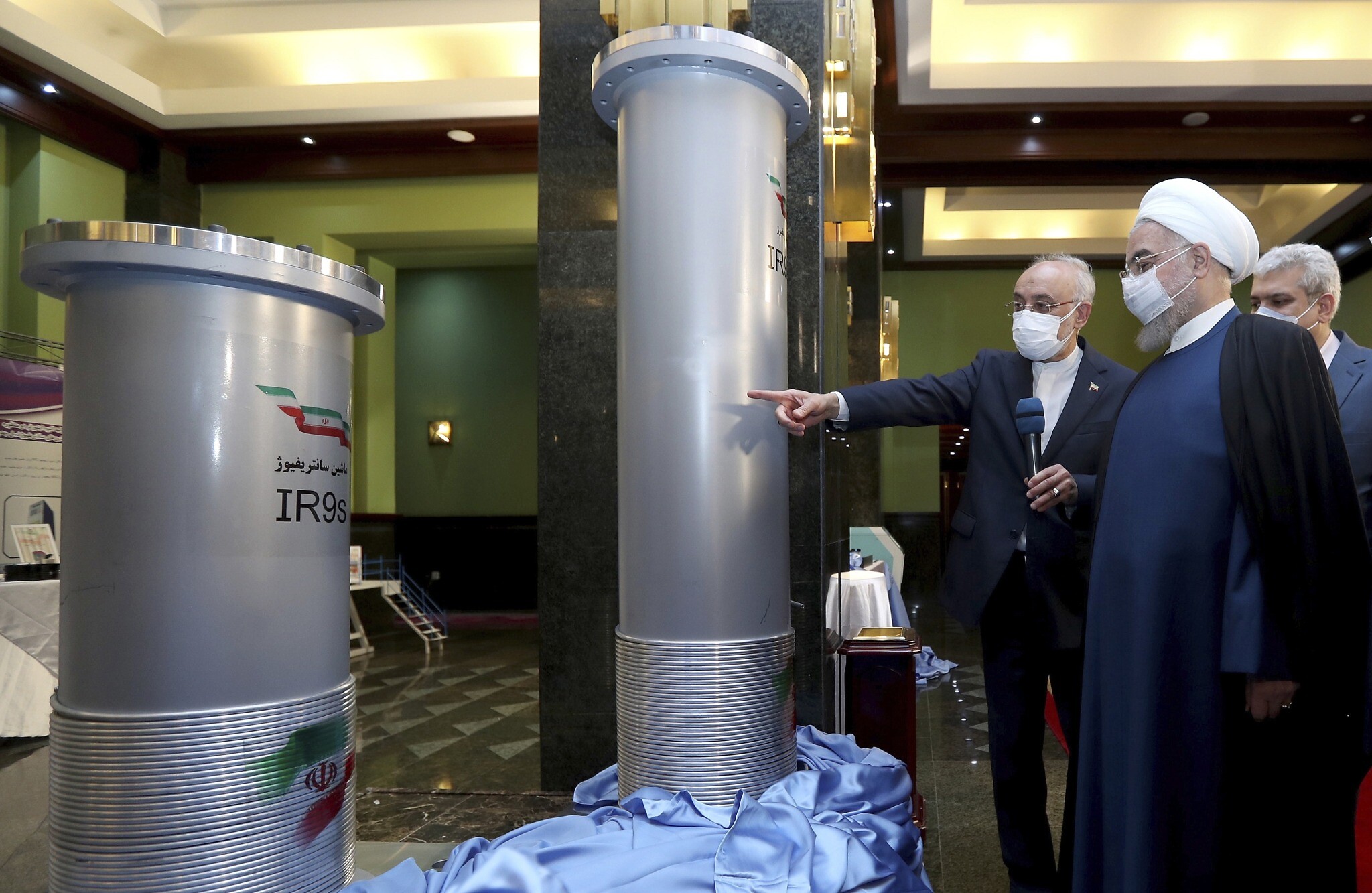
Iranian President Hassan Rouhani, second right, listens to head of the Atomic Energy Organization of Iran Ali Akbar Salehi while visiting an exhibition of Iran’s new nuclear achievements in Tehran, Iran, April 10, 2021. (Iranian Presidency Office via AP)
US Secretary of State Antony Blinken warned Monday that the “breakout time” Iran needs to assemble an atomic bomb could be reduced to just weeks, if Tehran keeps violating the 2015 accord limiting its nuclear program.
Testifying before the House Foreign Affairs Committee on the Biden administration’s budget for the fiscal year of 2021, Blinken admitted that it is unclear if Iran is “willing and prepared” to come back into compliance with the agreement, as talks continue for the United States to rejoin the deal.
“Meanwhile, its program is galloping forward… The longer this goes on, the more the breakout time gets down… it’s now down, by public reports, to a few months at best. And if this continues, it will get down to a matter of weeks,” he lamented.
Former US president Donald Trump pulled out of the Iran nuclear deal in 2018, claiming that it did not do enough to prevent the Islamic republic from building a nuclear weapon.
Trump tightened sanctions on Tehran, and the Iranian authorities responded by loosening restrictions on their nuclear program imposed by the deal.
US President Joe Biden has said that he would rejoin the agreement if Iran returns to compliance with its caps. Washington says it plans to negotiate a “longer and stronger” subsequent deal once the sides have reentered the Joint Comprehensive Plan of Action.
The two sides have been negotiating in Vienna since April through their partners in the multilateral agreement — Britain, China, France, Germany and Russia.
The talks are scheduled to resume later this week in the Austrian capital.
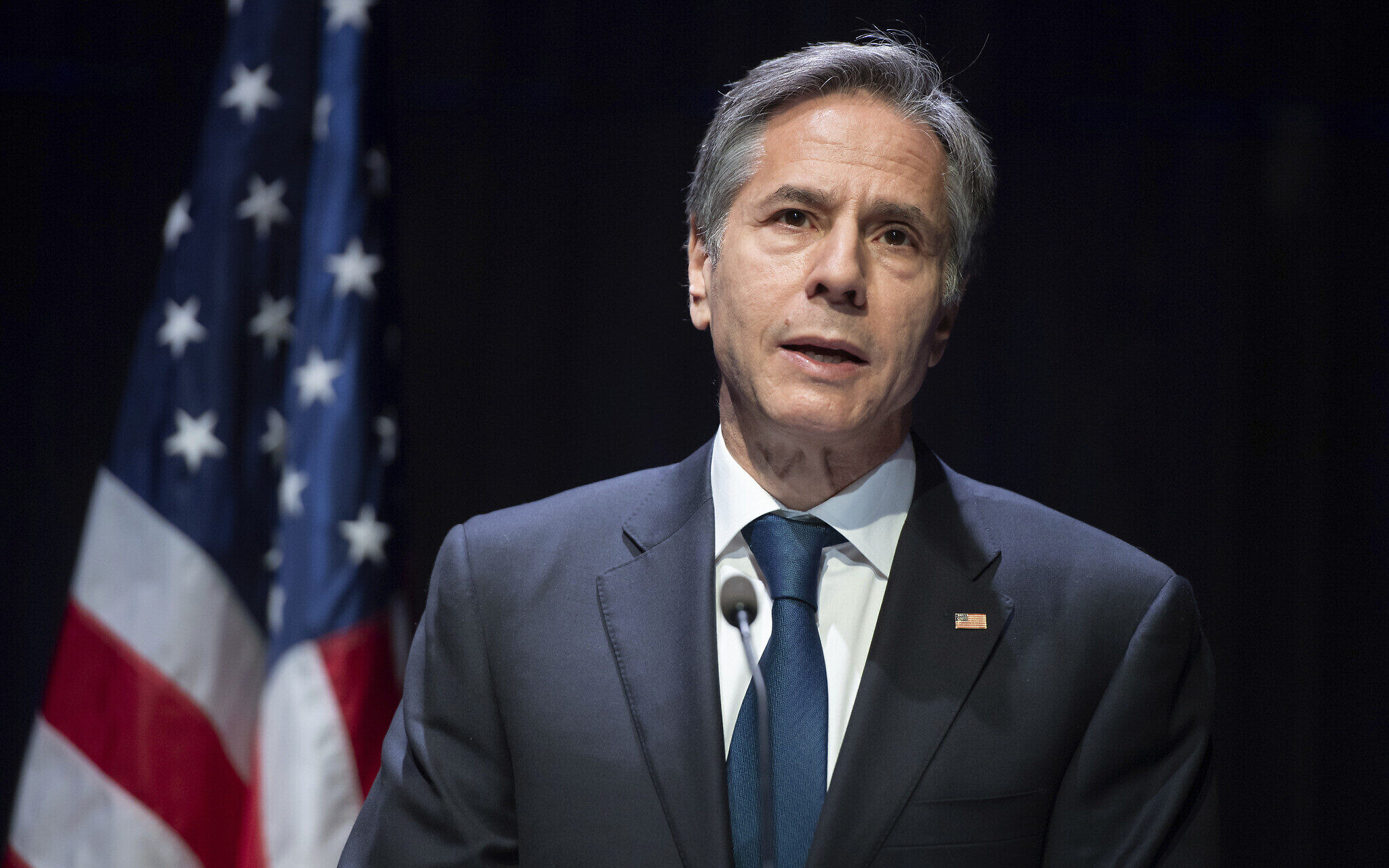
“We’re not even at the stage of returning to compliance for compliance,” Blinken said Monday. “We don’t know if that’s actually going to happen.”US Secretary of State Antony Blinken testifies before the House Foreign Affairs Committee on June 7, 2021. (Screen capture/YouTube)
“There are multiple egregious activities that Iran is engaged in… Each and every one would be even worse if Iran had a nuclear weapon or was on the threshold of being able to have one,” Blinken said, pushing back against claims by Republicans that Iran’s behavior in the region should lead the US to end nuclear deal reentry talks.
‘Space narrowing’ for temporary nuclear deal — IAEA chief
Earlier Monday, the UN nuclear watchdog’s head said it was “becoming increasingly difficult” to extend a temporary inspections arrangement with Iran, as Tehran and world powers try to salvage the nuclear deal.
In February, Tehran suspended some IAEA inspections, leading the agency to strike a temporary three-month deal allowing it to continue its activities despite the reduced level of access.
In late May, the ad hoc arrangement was extended until June 24, with Grossi describing the remaining time as “very short.”Director General of the International Atomic Energy Agency, IAEA, Rafael Mariano Grossi from Argentina, addresses the media during a news conference behind plexiglass shields regarding the agency’s monitoring of Iran’s nuclear energy program at the International Center in Vienna, Austria, June 7, 2021. (AP Photo/Lisa Leutner)
Grossi said he hoped that by “wider general agreement that’s being worked on downtown or by some other means, we are not going to see our… inspection capacities curtailed any more.”
“We cannot limit and continue to curtail the ability of the inspectors to inspect and at the same time pretend that there is trust,” he said.
He also referred to a long-running attempt by the IAEA to get clarity on several undeclared Iranian sites where nuclear activity may have taken place, mostly in the early 2000s.
In April the IAEA launched a new process of “technical discussions” with Iran in an effort to “break the impasse” over the sites.
But a report issued last week made clear that the IAEA’s queries had not been resolved.
Grossi said Monday that his “expectations were not met” and that there had been no “concrete progress” on the issue, despite the Iranian authorities’ stated willingness to cooperate.
Illustrative: Iranian navy speedboats attend a drill in the sea of Oman, on December 30, 2011.(AP/IIPA, Ali Mohammadi)
TEHRAN, Iran (AP) — The largest ship in the Iranian navy caught fire and later sank Wednesday in the Gulf of Oman under unclear circumstances, semiofficial news agencies reported.
The Fars and Tasnim news agencies said efforts failed to save the support ship Kharg, named after the island that serves as the main oil terminal for Iran.
The blaze began around 2:25 a.m. and firefighters tried to contain it, Fars said. The vessel sank near the Iranian port of Jask, some 1,270 kilometers (790 miles) southeast of Tehran on the Gulf of Oman near the Strait of Hormuz — the narrow mouth of the Persian Gulf.
Photos circulated on Iranian social media of sailors wearing life jackets evacuating the vessel as a fire burned behind them. State TV and semiofficial news agencies referred to the Kharg as a “training ship.” Fars published video of thick, black smoke rising from the ship early Wednesday morning.
Satellite photos from Planet Labs Inc. analyzed by The Associated Press showed the Kharg off to the west of Jask on Tuesday. Satellites from the US National Oceanic and Atmospheric Administration that track fires from space detected a blaze at the site of the Jask that started just before the time of the fire reported by Fars.
The Kharg serves as one of a few vessels in the Iranian navy capable of providing replenishment at sea for its other ships. It also can lift heavy cargo and serve as a launch point for helicopters. The ship, built in Britain and launched in 1977, entered the Iranian navy in 1984 after lengthy negotiations that followed Iran’s 1979 Islamic Revolution.
Iranian officials offered no cause for the fire aboard the Kharg. However, it comes after a series of mysterious explosions that began in 2019 targeting ships in the Gulf of Oman. The US Navy later accused Iran of targeting the ships with limpet mines, timed explosives typically attached by divers to a vessel’s hull.
Iran denied targeting the vessels, though US Navy footage showed members of Iran’s Revolutionary Guard removing one unexploded limpet mine from a vessel. The incidents came amid heightened tensions between the US and Iran after then-president Donald Trump unilaterally withdrew America from Tehran’s nuclear deal with world powers.
The sinking of the Kharg marks the latest naval disaster for Iran. In 2020 during an Iranian military training exercise, a missile mistakenly struck a naval vessel near the port of Jask, killing19 sailors and wounding 15. Also in 2018, an Iranian navy destroyer sank in the Caspian Sea.
US Secretary of State Antony Blinken speaks during a press conference at the Harpa Concert Hall in Reykjavik, Iceland, May 18, 2021. (Saul Loeb/Pool Photo via AP)
WASHINGTON — US Secretary of State Antony Blinken said Sunday that it remains unclear whether Iran is prepared to take the necessary steps to return to compliance with the multination nuclear agreement.
Speaking ahead of a fifth round of talks in Vienna on rescuing that deal, Blinken was asked about Iranian reports that Washington had already agreed to lift some of the sanctions that have crippled the Iranian economy.
“We know what sanctions would need to be lifted if they’re inconsistent with the nuclear agreement,” he said on ABC’s “This Week.”
He added that more importantly, “Iran, I think, knows what it needs to do to come back into compliance on the nuclear side, and what we haven’t seen is whether Iran is ready to make a decision.
“That’s the test and we don’t yet have an answer.”
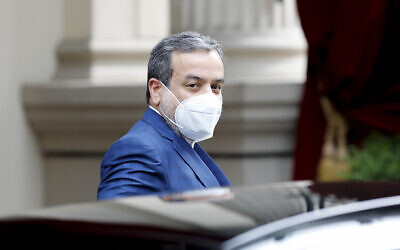
Political deputy at the Ministry of Foreign Affairs of Iran, Abbas Araghchi, enters the ‘Grand Hotel Wien’ where closed-door nuclear talks take place in Vienna, Austria, May 19, 2021. (AP Photo/Lisa Leutner)
Donald Trump in 2018 walked away from the deal, saying Tehran had violated its “spirit” and remained a regional threat. His successor Joe Biden wants to revive the plan.
For that to happen, Washington must agree to lift the sanctions reinstated by Trump and Tehran must commit to follow the terms of the deal.
Once Trump walked away from the agreement, the Islamic republic started to abandon the constraints on its production of nuclear material.
European participants to the Vienna talks had expressed optimism as the latest round of negotiations wound up on Wednesday.
“We’ve made good progress,” Enrique Mora, the European Union official who chaired the talks between Russia, China, Germany, France, Britain and Iran, said in a tweet on Wednesday.
“An agreement is shaping up.”
Indirect negotiations between Washington and Tehran have been going on in the Austrian capital since early April, with the other five countries that are signatories to the deal acting as intermediaries.
Diplomats are hoping to get the US back on board before Iranian presidential elections on June 18.
Rafael Grossi, director general of the International Atomic Energy Agency (IAEA), during a press conference at the agency’s headquarters in Vienna, Austria on May 24, 2021. (ALEX HALADA / AFP)
The head of the United Nations nuclear watchdog has said Iran is enriching uranium to levels that only countries seeking to make atomic weapons reach, and that the Islamic Republic’s nuclear program can no longer be returned to where it stood when a landmark 2015 deal was struck with world powers.
“A country enriching at 60 percent is a very serious thing — only countries making bombs are reaching this level,” International Atomic Energy Agency chief Rafael Grossi said in an interview with the Financial Times published on Wednesday and cited by the Reuters News Agency.
“Sixty percent is almost weapons-grade, commercial enrichment is 2, 3 [percent],” he said. “This is a degree that requires a vigilant eye.”
Though Grossi conceded that Iran has the right to develop its nuclear program, he warned of the consequences of it going too far.
“You cannot put the genie back into the bottle — once you know how to do stuff, you know, and the only way to check this is through verification,” he said, referring to checks by UN monitors.
With the sophistication that Iran has achieved, “you want a really strong, very sturdy verification system,” he said.
The flag of Iran is seen in front of the Headquarters of the International Atomic Energy Agency, in Vienna, Austria, May 24, 2021. (Florian Schroetter/AP)
Grossi’s remarks came as world powers resumed talks with Iran to save the 2015 nuclear agreement that limited the Iranian nuclear program in return for sanctions relief. The US has since pulled out of the pact, applying sanctions, after which Iran began to publicly renege on its own commitment to the deal.
Iran’s violations since the US withdrawal from the deal include a significant increase in the purity and quantity of uranium it has been enriching, effectively reducing the so-called breakout time to produce an atomic bomb. Iran says it does not want to build an atomic bomb, insisting that its nuclear program is for civilian purposes only.
Though the West fears the purified uranium could be used to help Tehran potentially obtain an atomic bomb, US intelligence agencies have said they “assess that Iran is not currently undertaking the key nuclear weapons-development activities… necessary to produce a nuclear device.”
Grossi predicted that even if the nuclear deal is revived, it will not be possible to return Iran’s program to its 2015 state because it has advanced so much.
“The Iranian program has grown, become more sophisticated so the linear return to 2015 is no longer possible,” Grossi said. “What you are able to do is keep their activities below the parameters of 2015.”
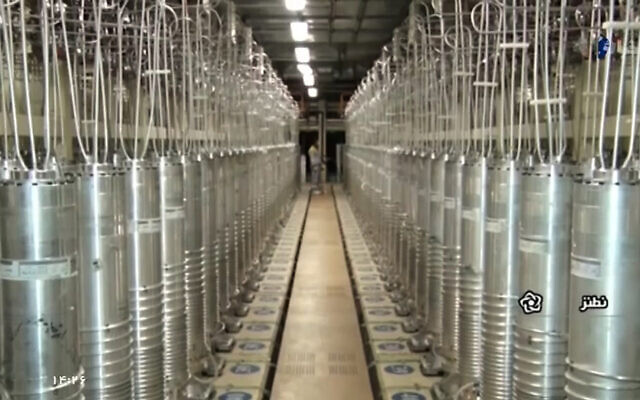
In this image made from April 17, 2021, video released by the Islamic Republic Iran Broadcasting, IRIB, state-run TV, various centrifuge machines line a hall at the Natanz Uranium Enrichment Facility, Iran. (IRIB via AP)
On Tuesday World powers opened a fifth round of talks with Iran aimed at bringing the US back into the nuclear deal, with both sides expressing hope that it might be the final series of negotiations.
The talks in Vienna came a day after the IAEA struck a last-minute agreement with Tehran for a one-month extension to a deal on surveillance cameras at Iran’s nuclear sites. The issue wasn’t directly related to the ongoing talks on the nuclear accord, known as the Joint Comprehensive Plan of Action, or JCPOA, but if Iran had not agreed it could have seriously complicated the discussions.
The US is not directly involved in the talks, but an American delegation headed by US President Joe Biden’s special envoy for Iran, Rob Malley, has been in the Austrian capital. Representatives from the other powers involved — Germany, France, Britain, Russia and China — have shuttled between the Americans and the Iranians to facilitate indirect talks.
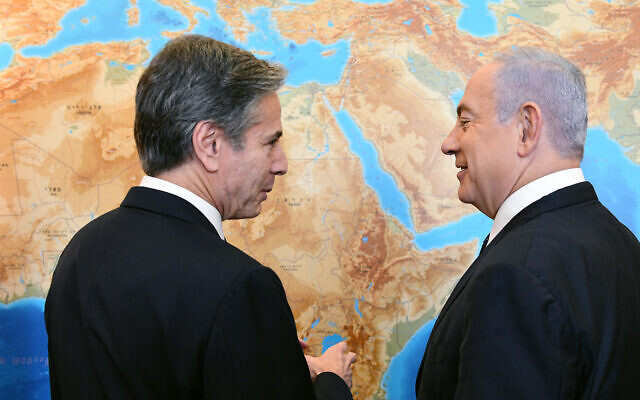
Prime Minister Benjamin Netanyahu, right, meets US Secretary of State Antony Blinken in his office in Jerusalem, May 25, 2021. (Haim Zach / GPO)
In 2018, then-president Donald Trump pulled the US out of the agreement unilaterally, saying it was not broad enough and needed to be renegotiated. As part of a “maximum pressure” campaign, Trump reimposed sanctions on Iran in an effort to bring Tehran back to the table.
The sanctions crippled Iran’s economy, but the Iranian government refused to renegotiate and instead retaliated by slowly and steadily breaking the restrictions on its nuclear activities laid out in the JCPOA. The moves were designed to pressure the other parties involved, thus far unsuccessfully, to come up with incentives to offset the US sanctions.
Biden, who was vice president when the original deal was negotiated, has said he wants the US to rejoin but that Iran has to return to complete compliance. Iran has insisted that all American sanctions imposed under Trump be dropped, including measures that were taken in response to non-nuclear issues.
In Jerusalem on Tuesday, US Secretary of State Antony Blinken defended the decision to reengage with the Iranians and said the US has kept Israel and other partners informed throughout the process. Israel, a close ally, has opposed efforts to revive the nuclear deal, saying it does not have adequate protection to prevent Iran from developing nuclear weapons. Israel has hinted it could act alone in launching a military strike on Iran’s nuclear facilities.
Despite Iran’s violations of the JCPOA, the other nations involved have stressed that the agreement was still important as it allowed International Atomic Energy Agency inspectors to continue their surveillance of Iran’s nuclear facilities.
The continuity of that surveillance was threatened until the agreement negotiated by the IAEA with Iran on Monday.
Posted May 21, 2021 by Joseph Wouk Categories: Uncategorized
PM says rules have changed, Israel to take much tougher stance against Hamas; Gantz sees urgent need for diplomacy, peace built on ‘rubble’ of Hamas leaders’ homes
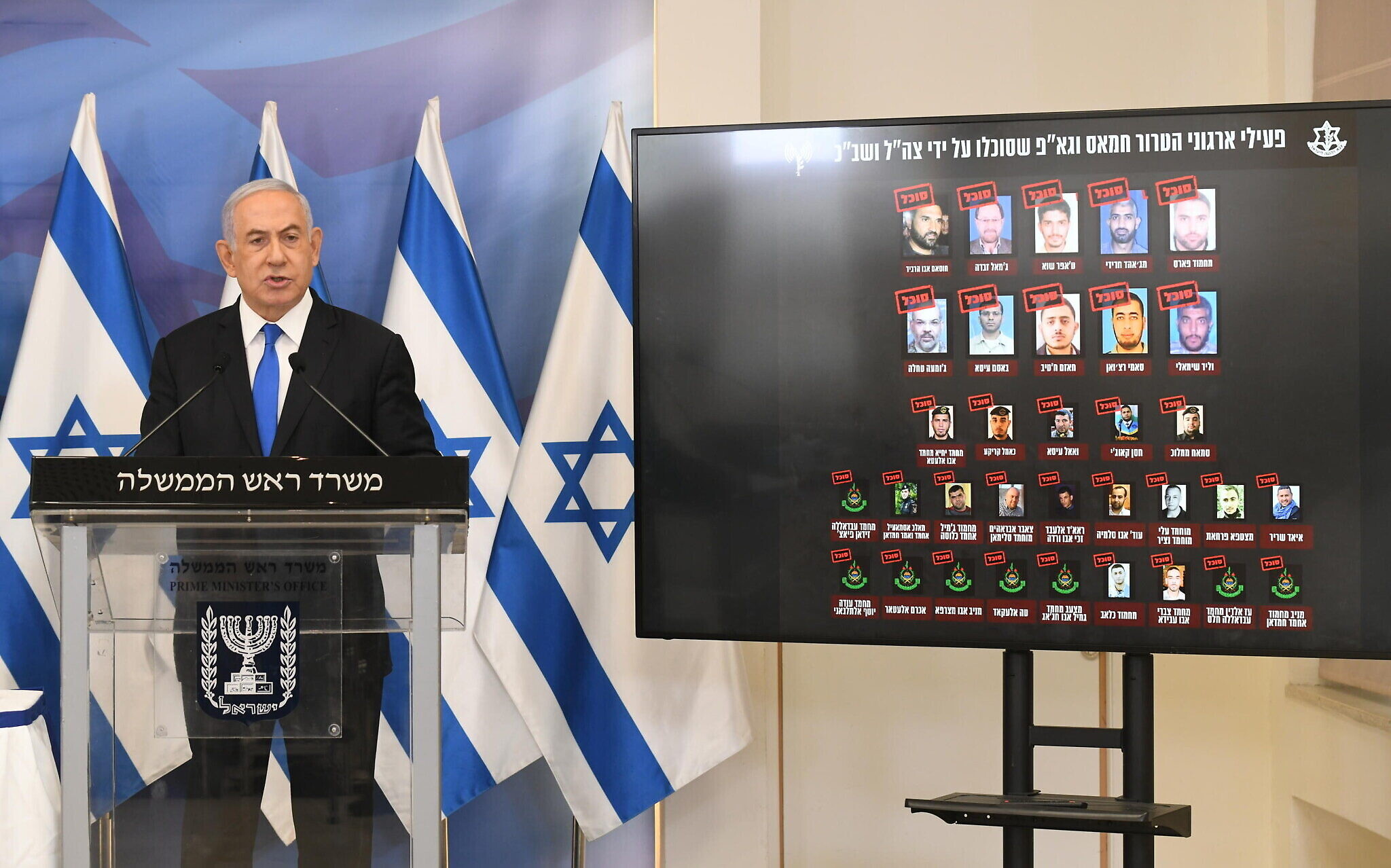
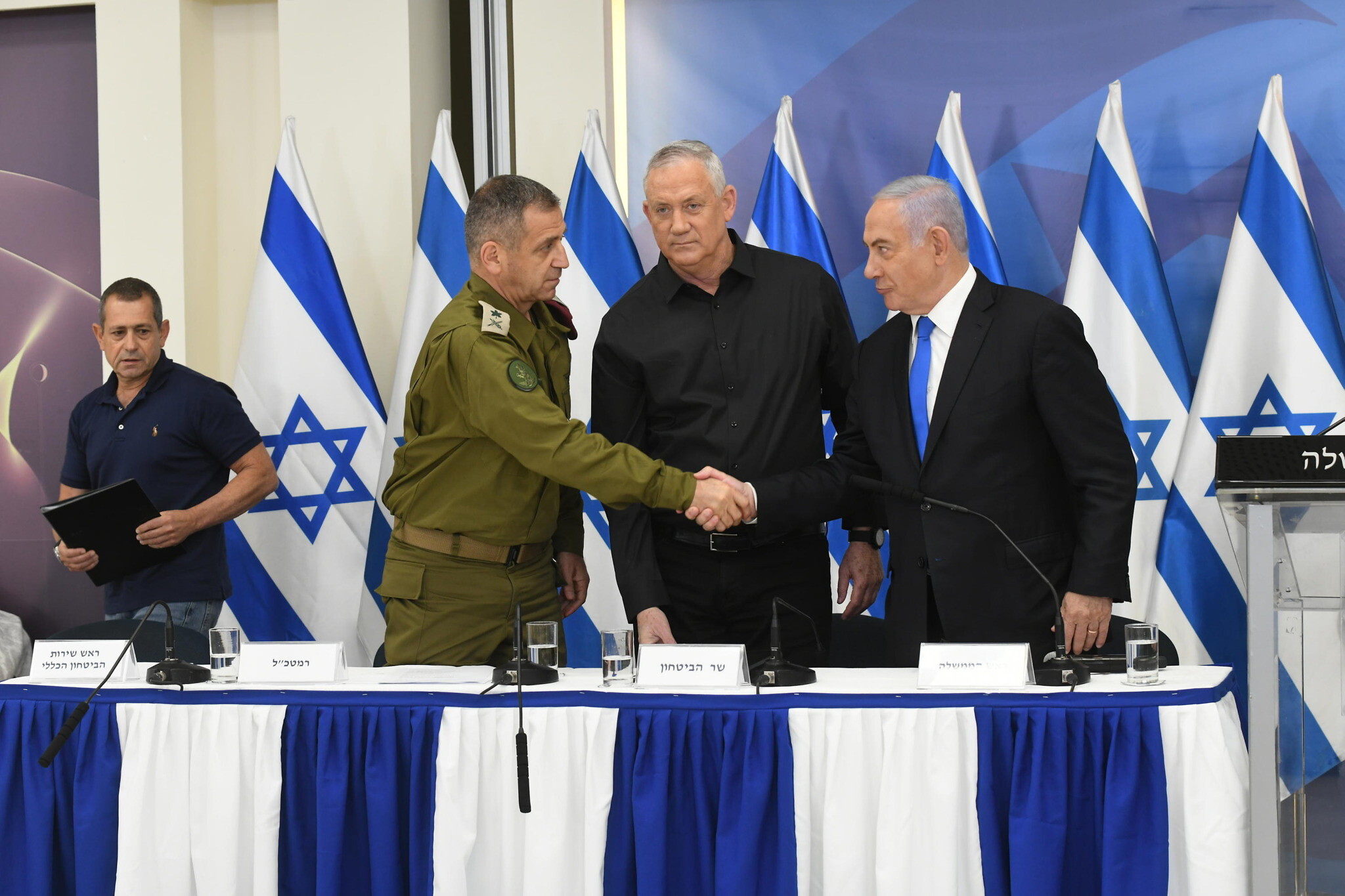
Prime Minister Benjamin Netanyahu gives a statement at a press conference after the Gaza ceasefire, Tel Aviv, May 21, 2021. At his side is a screen showing Gaza terror commanders killed in Operation Guardian of the Walls (Amos Ben Gershom/GPO)
Prime Minister Benjamin Netanyahu vowed Friday that the current round of fighting with Hamas, which appeared to end with an early morning ceasefire, would see a much tougher Israeli stance toward the terror group, and that any future rocket fire from Gaza would be met with “a whole new level of force.” He said Israel had achieved its military objectives in Gaza with “extraordinary” success.
Speaking together with Netanyahu and other security chiefs, Defense Minister Benny Gantz said the truce created an opportunity for peace and it was now time for diplomacy to build a new reality “on the rubble of the homes of the Hamas leaders.” Added Gantz: “If we don’t act diplomatically, quickly and wisely,” this operation will go down as “simply another round of conflict to be followed by the next one.”
In a special statement from the Kirya military headquarters in Tel Aviv, the prime minister said that the “rules of the game were changed” and there would now be no tolerance of any rocket fire from the Gaza Strip.
“We changed the equation not only as regards to the operation but also as regards the future. If Hamas thinks we will tolerate a ‘drizzle’ of rockets, it is mistaken,” the prime minister said, referring to the sporadic fire often seen from Gaza between rounds of more major conflict in recent years.
“We will respond with a whole new level of force to every instance of aggression against the Gaza-envelope communities or anywhere else in Israel,” he said.
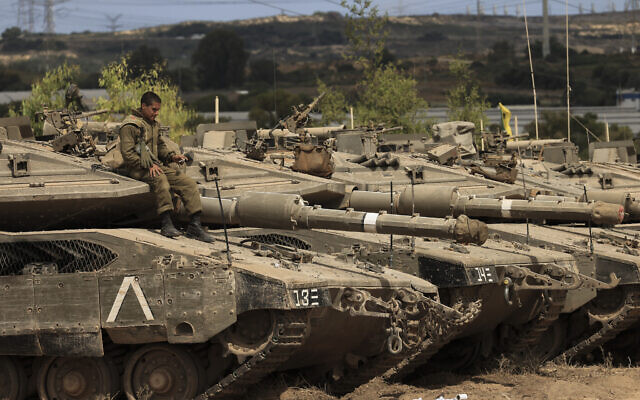
An Israeli soldier sits on top of a tank at a staging ground near the border with Gaza Strip, southern Israel, Friday, May 21, 2021. A cease-fire took effect early Friday after 11 days of heavy fighting between Israel and Hamas. (AP Photo/Tsafrir Abayov)
The prime minister also said that the success of the entire operation — including the thwarting of Hamas drones and most rocket attacks, via an improved Iron Dome missile defense system, and countering Hamas attempts to attack from the sea — meant that the terror group would be more careful in the future about attacking Israel.
“Most of Hamas’s capabilities have been harmed — far more seriously than Hamas commanders imagined. Hamas thought it could fire on Jerusalem and the cities of Israel, and we would just react with business as usual,” the prime minister said.
Netanyahu later issued an English-language statement:
The premier said that Israel fulfilled its objective to deal Hamas a “blow it cannot imagine” by destroying the terror tunnel network it built in Gaza; the military turned it into a “death trap.”
Israel destroyed “a considerable proportion” of Hamas’s internal tunnel routes, its “metro,” in which Hamas had invested vast resources, the prime minister said.
“We harmed more than 100 kilometers” of that network, and turned it into “a death trap for the terrorists,” Netanyahu said.
The prime minister said that although the terror group wanted to carry out many cross-border attacks — including at the tail-end of the operation — it was thwarted by Israel’s subterranean barrier, which detected and “destroyed” the terrorists.
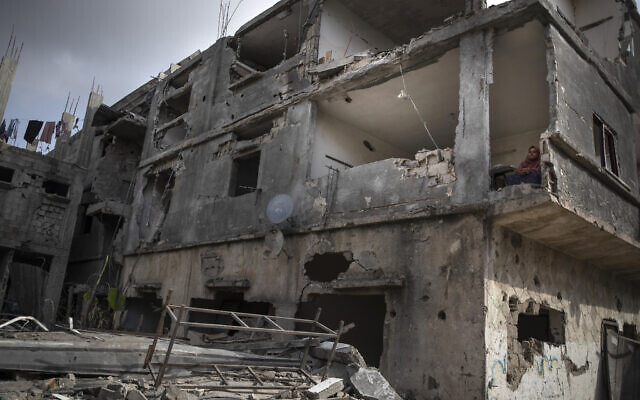
A Palestinian woman sits inside the second floor of her destroyed house following a cease-fire reached after an 11-day war between Gaza’s Hamas rulers and Israel, in town of Beit Hanoun, northern Gaza Strip, Friday, May 21, 2021. (AP Photo/Khalil Hamra)
Netanyahu added that not everything regarding the outcome and impact of the Israeli strikes is yet known to the public, or even to Hamas: “We did daring and innovative things, without getting dragged into an unnecessary misadventure.”
Aboveground, he said Israel killed over 200 terrorists, including 25 senior officials.
“And those who didn’t die, know today that we can reach them everywhere– above or below ground,” the prime minister said, calling it “an achievement no military has ever achieved.”
Hamas may be bragging as it emerges from the tunnels, he said, “but they realize the destruction they brought upon themselves inside Gaza… they know we set them back years.”
Netanyahu also alluded to the Israel Defense Forces’ controversial demolition of a Gaza tower where numerous media agencies had offices, saying that none of the buildings that were struck were “innocent buildings.”
Instead, he said they were “Hamas offices, Hamas command centers, Hamas weapons stores. We hit rocket factories, weapons labs, weapons stores. And we did this with minimal harm to non-involved civilians.”
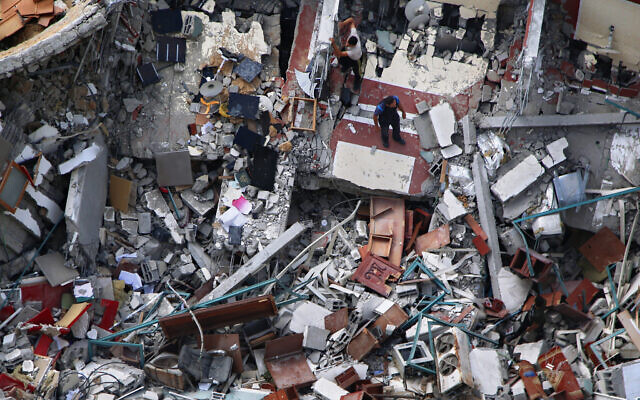
Palestinians inspect the destroyed building housing the offices of The Associated Press and other media after it was hit last week by an Israeli airstrike, in Gaza City, Friday, May 21, 2021. Israel says the building housed Hamas offices. (AP Photo/Hatem Moussa)
The premier said the IDF made “extreme efforts” not to harm civilians, and that no other country in the world takes such steps.
He said that he did not order a ground operation in Gaza because he believed it wasn’t necessary, and that although there will be criticism of that decision, it also prevented unnecessary loss of life.
Netanyahu said he was sad for every civilian killed in the fighting. Israel caused maximum casualties to the Hamas terror group while minimizing Israeli casualties, he said.
Netanyahu also thanked US President Joe Biden and said their six recent conversations were all friendly and warm, arguing that alongside international criticism and pressure, including in the media, Israel also received remarkable international support from dozens of countries and led successful diplomatic efforts with many global leaders.
Netanyahu said he had assured Biden that the operation would stop when its goals were achieved, that Biden “understood this,” and that this is precisely what happened.
“Many in the world are capable of distinguishing between Israel, a democratic state that sanctifies life and has the world’s most moral army, and a bloodthirsty terrorist organization that sanctifies death and commits a double war crime: deliberately firing on [our] civilians while using their civilians as human shields,” Netanyahu said.
Palestinian supporters of Hamas celebrate after a ceasefire between Hamas and Israel, in Khan Younis, in the southern Gaza Strip, on May 21, 2021. (Photo by SAID KHATIB / AFP)
Referring to apparent criticism that the ceasefire does not provide for the return of Israeli captives held in Gaza, Netanyahu said that Israel has not forgotten civilians Avera Mengistu and Hisham al-Sayed and the bodies of IDF soldiers Hadar Goldin and Oron Shaul, and is committed to returning them home.
He also promised more aid for Ashkelon and other battered southern communities, even more than they received after the 2014 war.
The prime minister said that Ashkelon needs more protection after it was hit by 1,000 rockets in the latest round of violence, and should receive economic advantages as part of moves to help the south of the country to thrive.
There was increasing awareness during the violence that large numbers of people do not have shelters or reinforced areas of their homes and do not have enough time to reach public shelters when they hear a rocket alert siren.
The elderly and people with disabilities were particularly vulnerable, as well as those living in unrecognized Bedouin encampments in the south of the country. Ashkelon Mayor Tomer Glam said last week that some 25% of the residents of his city do not have access to a bomb shelter.
Israelis on the streets of Tel Aviv, after a ceasefire between Israel and Hamas. May 21, 2021. (Miriam Alster/FLASH90)
The premier also addressed the eruption of violence between Arabs and Jews inside Israel.
“We arrested 1,300 people and dealt with the rioters with a heavy hand,” he said, repeating his demand that Arab leaders condemn the riots, claiming it was a “significant minority” within that community.
“Nobody will take the law into their own hands — not Arabs and not Jews. Nobody. We are a law-abiding state. And we are one state… We will improve coexistence… so that all Israelis, without exception, will be part of the astonishing success story of our country,” Netanyahu said.
A chance for peace
Meanwhile, Gantz said he hoped the ceasefire could herald the start of a new process aimed at achieving long-term peace.
Gantz reiterated that he believed Israel “surprised” the Hamas terror group with the intensity of its response. “The job is done, but not completed,” he said.
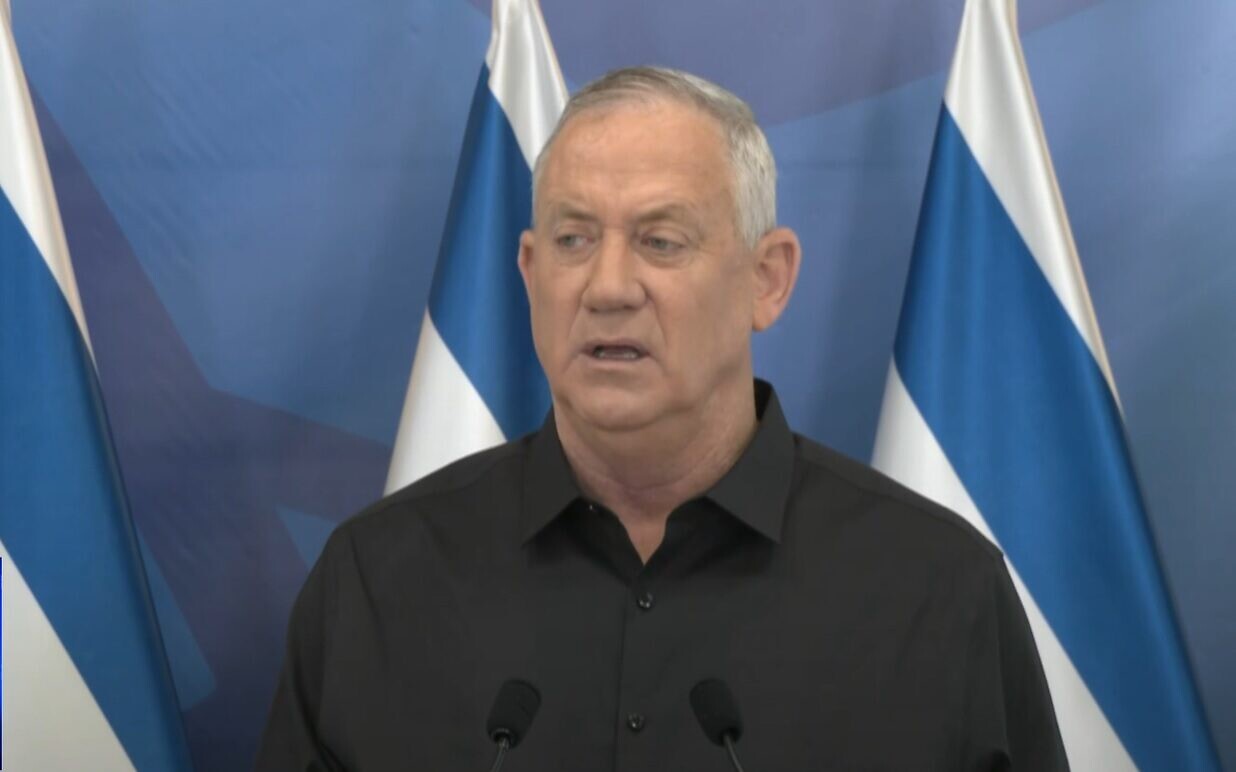
Defense Minister Benny Gantz makes public statement on May 21, 2021 (Screen grab)
“We achieved all our operational goals,” he said, and “set back the enemy by years.” But now that “the military stage is over, it is time for diplomatic action.”
“On the rubble of the homes of the Hamas leaders and of over 100 kilometers of terror tunnels, we must build a new reality,” he said. That “does not mean hasty deals, but long-term processes that will weaken the extremists and strengthen and bring together moderates… There is a chance for peace.”
“We must condition development and reconstruction [in Gaza] not only on calm,” but also on the return of soldiers’ bodies and civilians held hostage in Gaza, and on new moves to create “hope, growth and moderation.”
He called on Netanyahu to not “turn an unprecedented military victory into, heaven forbid, a diplomatic missed opportunity,” saying the matter of the Strip should be strategically and diplomatically dealt with for the long term.
From left: Shin Bet chief Nadav Argaman, IDF chief Aviv Kohavi, Defense Minister Benny Gantz and Prime Minister Benjamin Netanyahu, at a press conference after the Gaza ceasefire, Tel Aviv, May 21, 2021. (Amos Ben Gershom/GPO)
IDF Chief of Staff Aviv Kohavi also addressed the nation, saying that the current operation ended with “very different” results to previous flareups, and that Hamas “made a severe and grave mistake by shooting toward Israel.”
Kohavi, like Netanyahu and Gantz before him, also said the Palestinian terror group was dealt a bigger blow than it anticipated.
“It didn’t read us correctly, and was faced with force it didn’t expect,” he said, adding that the military “made major efforts not to harm civilians” despite Hamas operating in civilian areas.
He said it was no coincidence that Hamas rocket fire tailed off toward the end of the fighting, implying that the blow to Hamas’s rocket launch capacity was extensive.
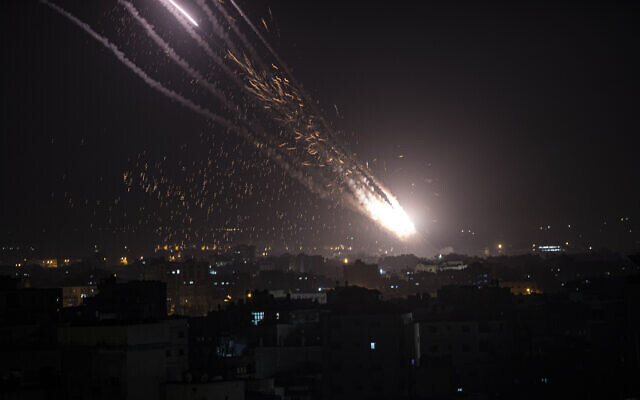
Rockets are launched from the Gaza Strip towards Israel, Monday, May. 10, 2021. (AP Photo/Khalil Hamra)
Shin Bet head Nadav Argaman also spoke, saying that the outcome of the operation could change the reality of the conflict, “depending on what will happen from now on.”
“The rules of the game have changed, and what was is not what will be,” Argaman says. “The Hamas of before this conflict is nothing like the Hamas of the day after.”





 Iran’s Governor to the International Atomic Energy Agency (IAEA), Kazem Gharib Abadi, Political deputy at the Ministry of Foreign Affairs of Iran, Abbas Araghchi, and Deputy Secretary General and Political Director of the European External Action Service (EEAS), Enrique Mora leave the Grand Hotel Vienna where closed-door nuclear talks take place in Vienna, Austria, June 2, 2021. (AP/Lisa Leutner)
 The Iranian flag waves outside of the UN building that hosts the International Atomic Energy Agency, IAEA, office inside in Vienna, Austria, July 10, 2019. (AP Photo/Ronald Zak)
 US Secretary of State Antony Blinken testifies before the House Foreign Affairs Committee on June 7, 2021. (Screen capture/YouTube)
 Director General of the International Atomic Energy Agency, IAEA, Rafael Mariano Grossi from Argentina, addresses the media during a news conference behind plexiglass shields regarding the agency’s monitoring of Iran’s nuclear energy program at the International Center in Vienna, Austria, June 7, 2021. (AP Photo/Lisa Leutner)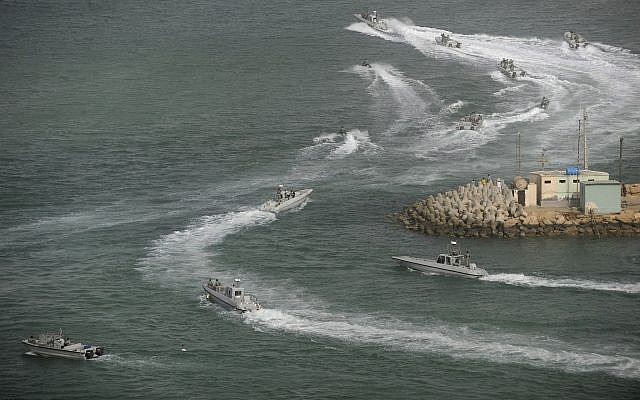







 anneinpt
 artaxes
 danmillerinpanama
 davidking1530
 Peter Hofman
 Joseph Wouk
 Peter
Peter Louisiana Steve
 WarSclerotic

Recent Comments