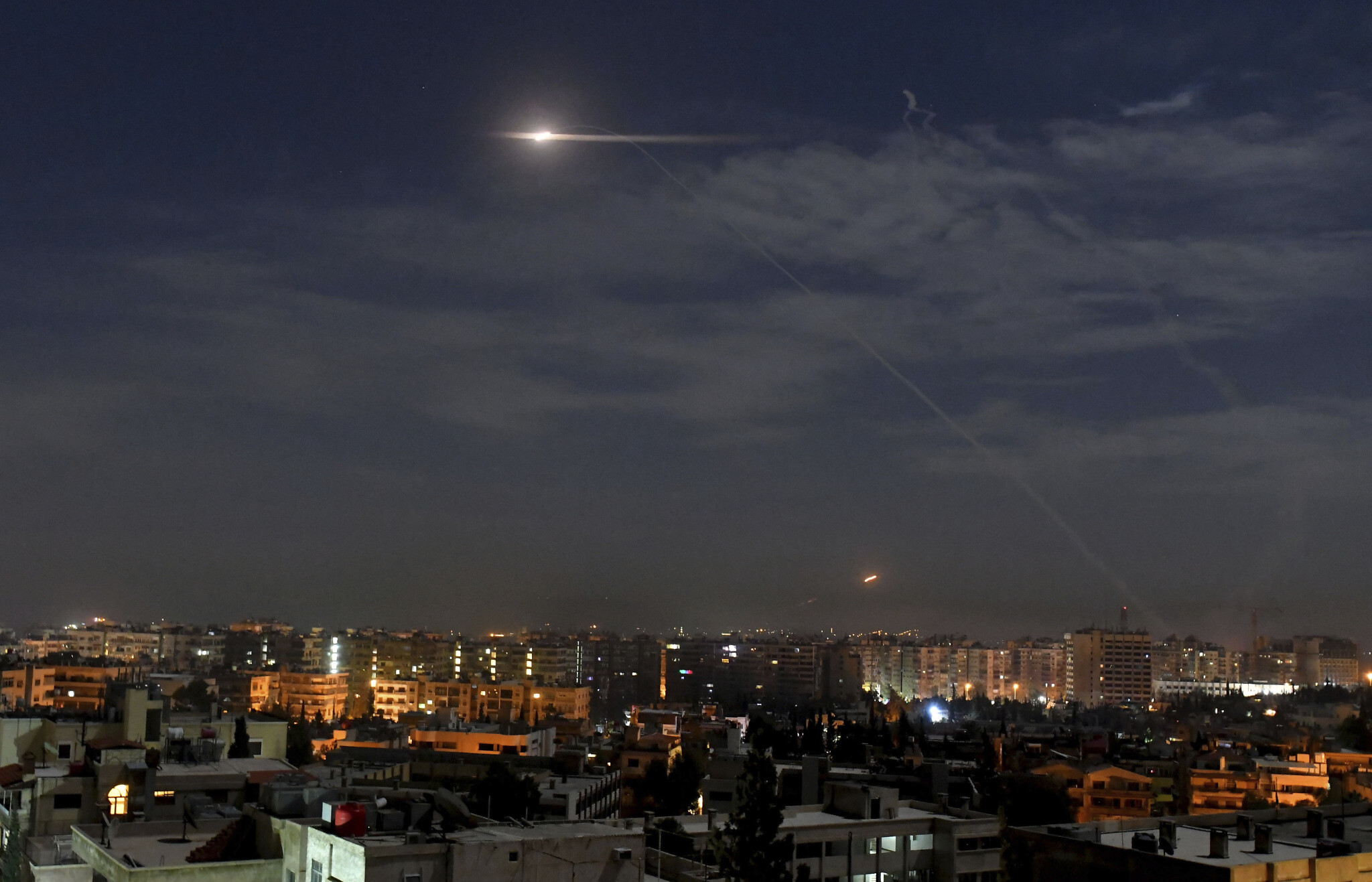
Illustrative: In this photo released by the Syrian official news agency SANA, shows missiles flying into the sky near international airport, in Damascus, Syria on Jan. 21, 2019. (SANA via AP)
Israeli planes carried out airstrikes near Damascus early Friday, Syrian state media claimed, and sounds of explosions were heard in central Israel shortly after.
It was not immediately clear if the two events were linked, but the Israeli military was reportedly investigating whether the explosions were the result of errant air defense missiles.
Syria reported that missiles fired from the direction of Lebanon targeted Damascus, but claimed most were shot down by its air defenses.
A short time later, residents near Tel Aviv reported hearing at least one blast.
The Israel Defense Forces said it was investigating the possibility that a Syria air defense missile that missed its target had landed in the area or off the coast, Hebrew language media reported.Get The Times of Israel’s Daily Editionby email and never miss our top storiesNewsletter email addressGET ITBy signing up, you agree to the terms
No sirens sounded and there were no reports of injuries or damage in Israel.
Syrian air defense missiles have in the past accidentally shot down a Russian military plane and have also reached Cyprus in error.
The IDF did not comment on the alleged strikes in Syria, as per its policy.
Video published by SANA purported to show an air defense missile being fired into the air. A blast could be heard shortly after.
The Britain-based Observatory for Human Rights reported that weapons development centers near Damascus used by Iran-backed militias had been targeted in the alleged Israeli strikes.
On August 19, Syria reported alleged Israeli airstrikes from the direction of Beirut.
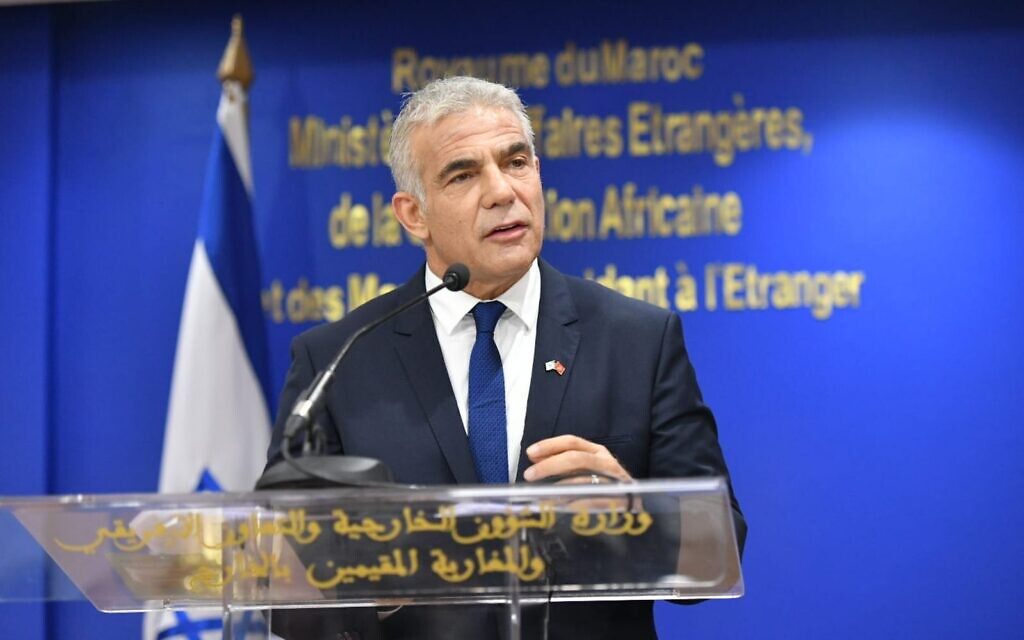
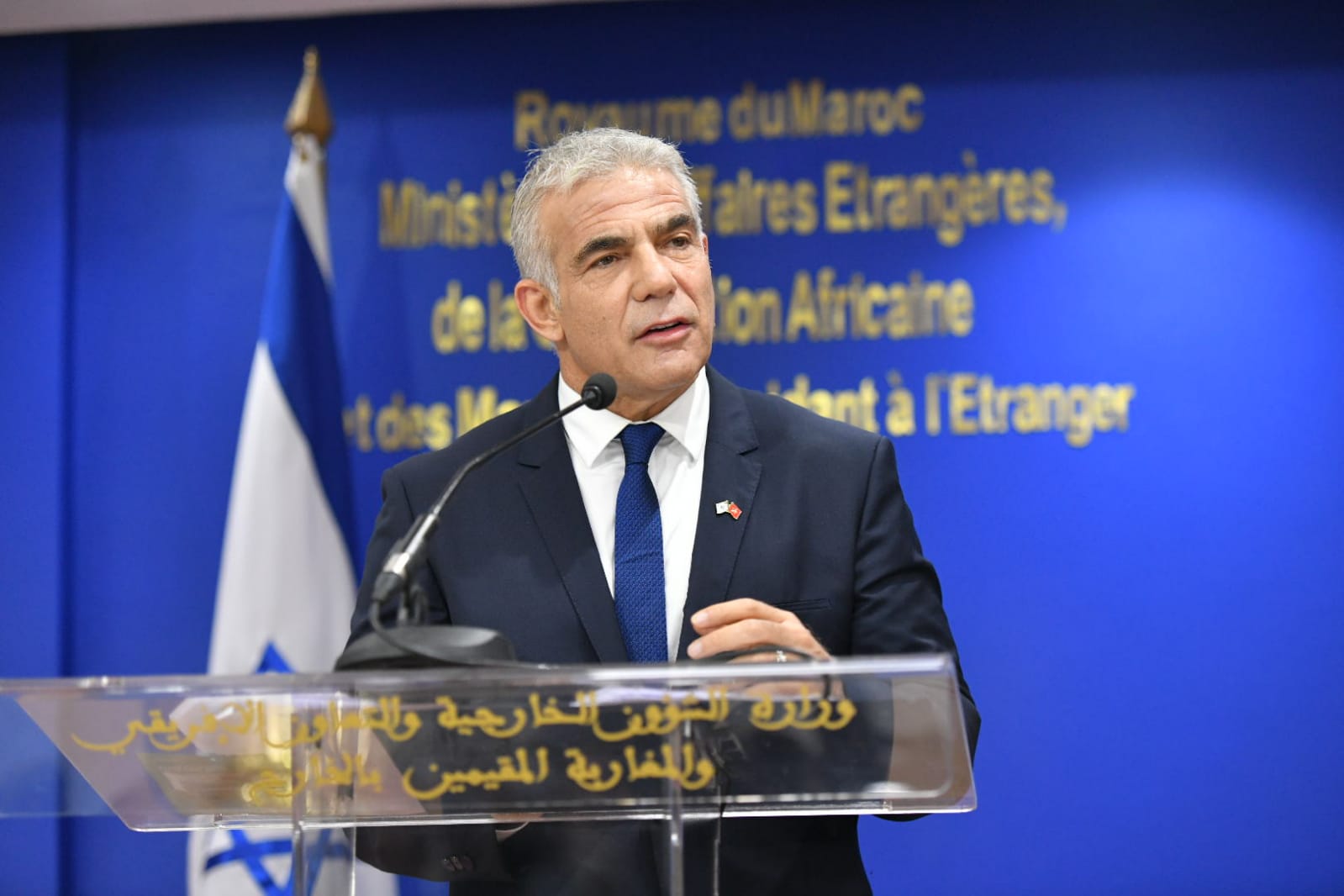
Foreign Minister Yair Lapid speaks at a ceremony with Moroccan Foreign Minister Nasser Bourita in Rabat, on August 11, 2021. (Shlomi Amsalem/GPO)
Speaking at a Casablanca hotel last month during his first visit to Morocco after Jerusalem and Rabat reestablished relations last year, Foreign Minister Yair Lapid laid out his vision for a coalition that would bring hope and prosperity to the region.
“What we are creating here, and what we have been creating over the past few months, is essentially a political axis,” Lapid told journalists.
“Think about it as a sort of alliance consisting of Israel, Morocco, Egypt, and Jordan, and in some ways one can also add Cyprus, Greece, Bahrain, the UAE — all the nations that are moderate religiously with truly limitless economic potential… An alliance of life in the face of the alliance of death of Iran and its emissaries.”
The remark didn’t cause much of a stir during Lapid’s Morocco trip, and it remained below the radar when he revisited the theme last Sunday during a meeting with his Greek and Cypriot counterparts.
The trilateral alliance, Lapid said, was “a key part of something bigger. A moderate, pragmatic and forward-looking alliance. A growing group of countries working together with a shared vision. From the UAE and Bahrain in the Gulf, Morocco in North Africa, Egypt and Jordan in the Middle East, Cyprus and Greece in the Mediterranean, and others that are joining all the time.”Get The Times of Israel’s Daily Editionby email and never miss our top storiesNewsletter email addressGET ITBy signing up, you agree to the terms
An “alliance of life” that spans from the Persian Gulf to the Atlantic Ocean seems to be the essence of Lapid’s emerging vision for the region: the next phase of the Abraham Accords process that Israel — and the foreign minister himself — hopes to lead.Foreign Minister Yair Lapid (center) with his Greek counterpart Nikos Dendias (right) and Cypriot counterpart Nikos Christodoulides, at the Foreign Ministry in Jerusalem, August 22, 2021. (Foreign Ministry)
Facing Turkey and Iran
Though Lapid largely focuses on uncontroversial initiatives like cooperation on agriculture, water, and technological innovation, there is an undeniable geopolitical — even national security — element to the growing partnerships.
There are two very different regional powers that are of concern to members of Lapid’s “alliance of life”: Iran, certainly, but also Turkey, which is seeking to expand its power and influence at the expense of its neighbors.
But interests within Lapid’s desired assortment of partners are tangled and complex, based on countries’ individual concerns.
This is especially apparent in the Gulf, where Saudi Arabia and the UAE — both Western-allied hereditary Sunni regimes with growing ties with Israel — do not see eye-to-eye on their primary foe Iran. For the Saudis, the Iranians represent the main security threat, while the UAE sees the Muslim Brotherhood — and the Turkey-Qatar axis backing it — as its foremost adversary.Saudi Arabian Foreign Minister Adel al-Jubeir (L) speaks with UAE’s Minister of Foreign Affairs Abdullah bin Zayed Al-Nahyan (C) as Bahraini Foreign Minister Khalid bin Ahmed al-Khalifa (R) looks on following a meeting with foreign ministers and military officials from the Saudi-led coalition, in Riyadh, on October 29, 2017. (AFP Photo/Fayez Nureldine)
“You see this different emphasis,” says Brandon Friedman, director of research at the Moshe Dayan Center at Tel Aviv University. “Whereas the Emiratis are very much concerned and cognizant of wherever the Muslim Brotherhood seems to be rearing its head in the region, the Saudis ––while certainly seeing the Brotherhood as a threat internally — externally I think have a less aggressive approach to the Brotherhood outside of Saudi borders.”
While the Saudis have worked closely with the US and Israel to counter Iran, the Emiratis maintain open diplomatic channels to Tehran along with a healthy trade relationship.
Meanwhile, Greece and Cyprus are overwhelmingly focused on Turkey. Besides being a historical enemy with which a series of wars have been fought, Turkey has been flexing its muscles over gas exploration in the eastern Mediterranean while holding the threat of renewed Muslim immigration into Greece and Europe over Athens’ head.Greek Prime Minister Alexis Tsipras (R) welcomes Prime Minister Benjamin Netanyahu (L) prior to a Greece-Israel-Cyprus summit for talks on offshore oil and gas in the eastern Mediterranean and environmental issues in Thessaloniki on June 15, 2017. (AFP PHOTO / SAKIS MITROLIDIS)
In Lapid’s view, there is enough of a common perception of regional threats among Israel’s partners for an alliance to hold. All the countries he names seek regional stability, accept neighboring actors with different views and are not looking to export their religious brand.
Old, cold friends
Egypt and Jordan have had diplomatic relations with Israel for decades, but both countries have maintained a cold peace with the Jewish state, and especially its people.
Israel’s relations with Amman were particularly problematic of late. In March, years of Jordanian frustration with then-prime minister Benjamin Netanyahu boiled over as officials in Amman appeared to accuse him of endangering the region for political gain and alleged that Israel had violated agreements with them.
The Bennett-Lapid government seems determined to change the dynamic. There has been a flurry of high-level contacts between the two neighbors since the new government took office, as well as new economic deals.
The government is also hoping to make headway with the Egyptians, with which Israel enjoys close security cooperation. Last month, Egyptian General Intelligence Directorate chair Abbas Kamel visited Jerusalem for talks with Bennett and Defense Minister Gantz, and extended an invitation for Bennett to make an official visit to Egypt within the next few weeks. The visit would be the first public visit by an Israeli premier since 2011.
Positive energy
Energy resources are another pillar of Lapid’s vision.
The East Mediterranean Gas Forum, or EMFG, which includes Israel, Egypt, Greece, Cyprus and the Palestinian Authority, and is in the process of expanding, has become a de facto outgrowth of one of the regional splits, which has seen Turkey and Qatar leading a pro-Islamist faction, and Egypt siding with Saudi Arabia and the UAE in a pro-Western camp that has increasingly included Israel.This photo taken on August 23, 2019, in Istanbul shows Turkish General Directorate of Mineral research and Exploration’s (MTA) Oruc Reis seismic research vessel docked at Haydarpasa port, which searches for hydrocarbon, oil, natural gas and coal reserves at sea. Greece on August 11, 2020 demanded that Turkey withdraw a research ship at the heart of their growing dispute over maritime rights and warned it would defend its sovereignty, calling for an emergency meeting of EU foreign ministers to resolve the crisis. (Ozan KOSE / AFP)
Turkey insists that its exclusive economic zone stretches across the entire Mediterranean, thanks to a maritime border deal with Libya that would essentially block Israel and Egypt’s access to Europe, potentially upending the EMFG’s plans.
In the Mediterranean, Egypt has aligned itself with Greece and Cyprus, longtime rivals of Turkey that accuse it of illegally drilling for natural gas in their exclusive economic zones. Israel has signed a series of agreements with EMFG countries, especially Greece and Cyprus.
Bringing the alliance to life
The pressing question for Lapid now is how he turns his vision into reality.
Ties between the countries’ civil societies and private sectors in the countries in the axis are a major component of the vision, it is clear. Lapid seems determined to avoid the mistakes made in Israel’s relationships with Jordan and Egypt — and to some extent Turkey — which were mostly based on security ties.
There is also the important question of the role the US will play in firming up such an alliance.President Reuven Rivlin and US President Joe Biden in the White House on June 29, 2021. (Haim Zach/GPO)
As has been on clear display in Afghanistan, Biden is accelerating the bipartisan trend of US withdrawal from the region, hoping to focus on the competition with global powers Russia and China and to deal with domestic challenges.
The Biden administration also doesn’t seem particularly motivated in promoting the Abraham Accords and expanding the countries normalizing relations with Israel. The administration did not call attention to the recent one-year anniversary of the agreements, and Biden’s spokesmen still won’t use the term “Abraham Accords” in describing the pact sealed by the previous administration.
Still, Israeli government officials insist that their US interlocutors have been supportive of both deepening ties with countries that recognize Israel and expanding the existing accords to new countries.
If Lapid, with US support, is able to move his “alliance of life” beyond statements and symbolic agreements, and to create a new, broad and deep coalition, it would certainly be a game-changer. With a reduced US regional presence, such a union would supply a new path for countries to limit Turkish and Iranian ambitions in the region.From left: US President Donald Trump, United Arab Emirates Foreign Minister Abdullah bin Zayed al-Nahyan, Bahrain Foreign Minister Abdullatif bin Rashid Alzayani, and Israel’s Prime Minister Benjamin Netanyahu talk at the White House at the ceremony for the signing of the Abraham Accords between them, September 15, 2020 (Avi Ohayon/GPO )
It also holds the potential to create new opportunities for the young generation in the countries of the alliance, as they deepen their economic, technological, and educational relationship.
That is not to say there won’t be surprises or difficulties for the countries making up the coalition. For Israel, certainly, a new flare-up in Jerusalem or Gaza would strain ties with its new Arab friends.
But the deeper and more varied the ties, the more stress the relationships will be able to bear.
Posted September 1, 2021 by Joseph Wouk Categories: Uncategorized
Premier points at wisdom of his multi-faceted effort against Tehran and spirit of unity in his coalition, but he’ll have to show more boldness going forward if he intends to lead
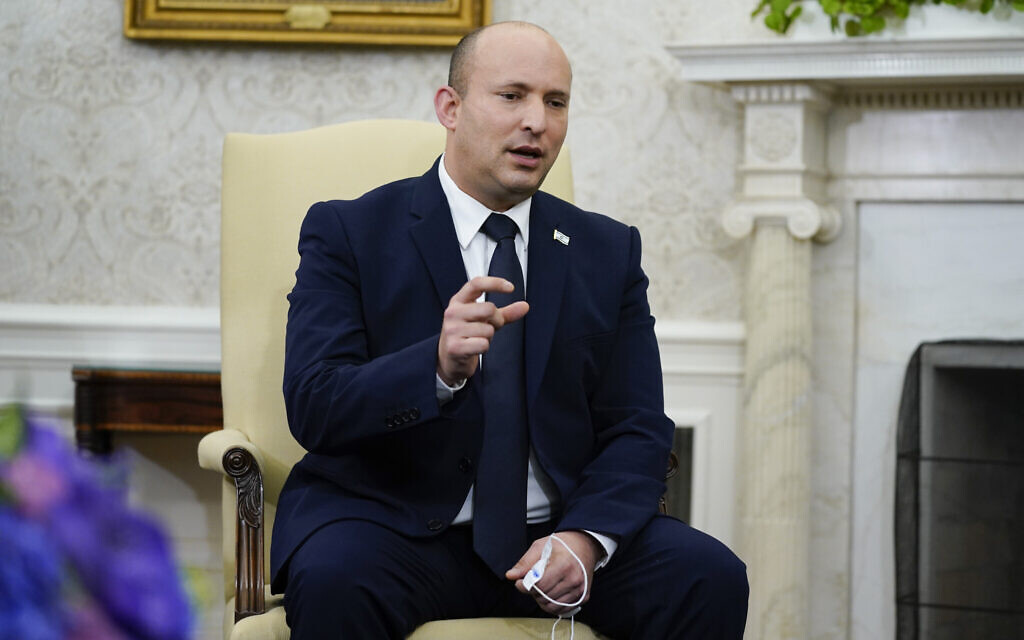
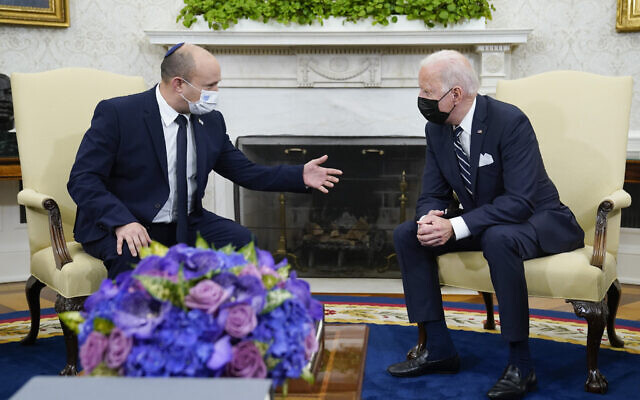
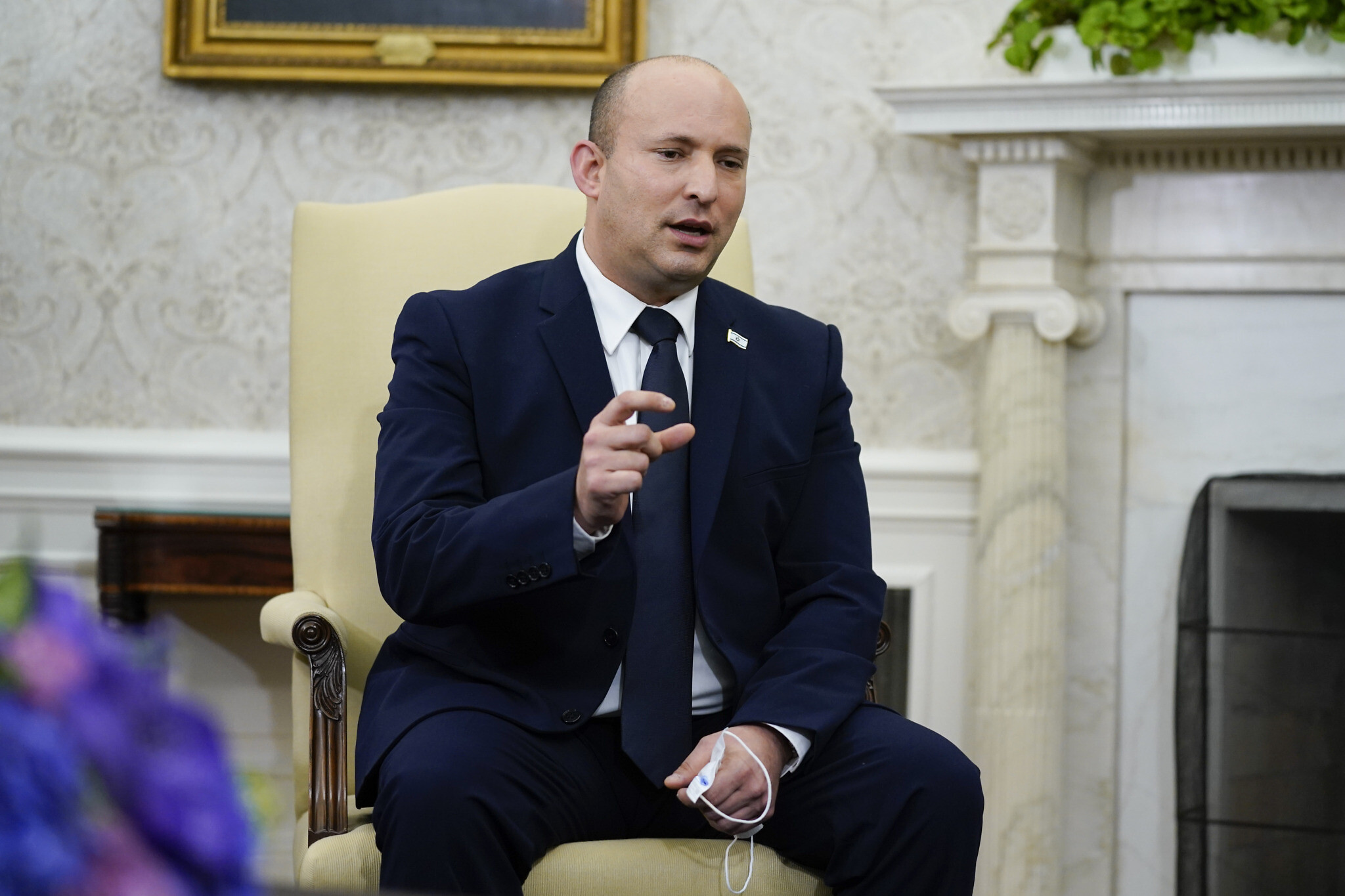
Israeli Prime Minister Naftali Bennett speaks as he meets with President Joe Biden in the Oval Office of the White House, on Friday, August 27, 2021, in Washington, DC. (AP Photo/Evan Vucci)
Naftali Bennett’s first visit to Washington as prime minister was a fairly low-stakes affair.
He came at a time when US government and media attention were focused elsewhere, on the unfolding disaster in Afghanistan and the latest COVID-19 wave. Moreover, his goals in his first meeting with US President Joe Biden were modest: establish a personal connection, present a strategy to stop Iranian nuclear and regional ambitions, advance a visa waiver program and secure a replenishment of Iron Dome missiles.
In this subdued context, Bennett revealed the contours of both how he intends to deal with Iran and how he will lead his unwieldy coalition in general — in each case a low-key approach that hopes to be effective without rocking the boat too much.
Some might say his policy is an example of prudent, cautious statesmanship; others that he’s given up on his principles in order to secure two years as prime minister with no particular goals in mind other than remaining in power.
Death by a thousand cuts
The major international challenge facing Bennett is the Iranian nuclear program.Get The Times of Israel’s Daily Editionby email and never miss our top storiesNewsletter email addressGET ITBy signing up, you agree to the terms
After expectations that the Biden administration’s eagerness to secure a return to the 2015 deal — known formally as the JCPOA — would lead to easy negotiations with the Islamic Republic, that accord is becoming ever more elusive. Iran’s moderate then-president Hassan Rouhani introduced a number of demands to the Vienna talks that he knew the US could not accept, and his hardline successor Ebrahim Raisi will likely take an even more aggressive approach.Iran’s new president Ebrahim Raisi speaks at his swearing-in ceremony at the Iranian parliament in the capital Tehran, on August 5, 2021. (Atta Kenare/AFP)
While Bennett’s predecessor Benjamin Netanyahu was willing to irreparably damage ties with Barack Obama’s White House and possibly with the Democratic Party in his fight against the emerging JCPOA, Bennett reportedly pledged to Biden that despite opposing an American return to the deal, he will not wage a public campaign against it.
Instead, Bennett is opting for a broad approach that looks to counter Iran beyond its nuclear program. He intends to push back on its proxies, on its maritime attacks, on its economy and on the stability of its regime.
The idea, said his advisers last week in Washington, is to push on a number of weak spots simultaneously, in the hope that enough pressure will cause the Islamic Republic to collapse.
Bennett returns to two historical analogies to explain his strategy. He argues that the Middle East is in a Cold War scenario, with Israel playing the role of the US and Iran — a rotting regime hated by most of the population — akin to the Soviet Union. Enough pressure on multiple fronts, Bennett argues, will cause the system to eventually collapse.Illustrative image of a German WWII era U-Boat (CC BY Werner Willmann, Wikimedia commons)
The other analogy he uses is the Battle of the Atlantic in World War II. In order to stop the German U-boat attacks devastating Allied shipping, the US, UK, and Canada developed a range of tactics and technologies to ultimately take control of the North Atlantic. The “little bit of everything” approach that dispersed the Nazi wolfpacks, he says, can also halt Tehran’s nuclear program and possibly even bring the Islamic Republic to its knees.
This approach can be seen as patient and appropriately cautious. While maintaining the goodwill of Israel’s most important ally, Israel will work to covertly present Iran with a range of challenges, forcing it to defend itself everywhere all the time until the whole edifice collapses.
On the other hand, it is hard to describe Bennett’s proposed approach to Iran as much of a strategy. Like many of Israel’s responses to threats, it is a series of impressive tactical efforts without a clear logic uniting them into a properly conceived campaign. Airstrikes and sabotage can certainly be helpful, but on their own they are not going to cause Iran to withdraw its support for armed proxies or compel the supreme leader to suspend his nuclear research program.Iranian Supreme Leader Ayatollah Ali Khamenei addresses the nation in a televised speech marking the anniversary of the 1989 death of Ayatollah Ruhollah Khomeini, the leader of the 1979 Islamic Revolution, in Tehran, Iran, June 3, 2020. (Office of the Iranian Supreme Leader via AP)
The new spirit of unity
“I come here from Jerusalem, our eternal capital,” said Bennett after his one-on-one conversation over coffee with Biden last Friday, “and I bring with me a new spirit, a spirit of goodwill, a spirit of hope, a spirit of decency and honesty, a spirit of unity and bipartisanship of folks who, as you suggested, harbor very different political opinions, even opposing.
“Yet we all share the deep passion to work together to build a better future for Israel,” he told the president in their joint press appearance. “And that’s what Israel is about. We’re out to be good, to do good.”US President Joe Biden meets with Israeli Prime Minister Naftali Bennett in the Oval Office of the White House in Washington, DC, on August 27, 2021. (Nicholas Kamm / AFP)
Bennett and his staff repeated this message throughout the visit — that he has been able to bring together Israeli politicians with very different worldviews around professional, non-ideological discussions to find solutions to the country’s pressing problems like COVID-19, climate change, and the state budget.
Supporters would argue that Bennett’s uniting approach to governing is a welcome and timely change from the partisan bickering Israelis have grown used to in their politics. What’s more, a pandemic like COVID-19 is beyond politics and ideology, and cooperation is required to cope with a disease that has killed 7,000 Israelis.(From left) Benny Gantz, Yair Lapid, Naftali Bennett, Gideon Sa’ar and Merav Michaeli sit together after their new coalition wins Knesset approval, June 13, 2021. (Haim Zach/GPO)
The flaw in this approach, as nice as it may sound, is that it is incoherent. There is no politics without ideology, just as there is no ideal solution to any challenge.
Take the coronavirus pandemic. Goals need to be defined and weighed against each other: protecting lives, protecting the economy, protecting civil rights, protecting education. Without ideology, there is no way to prioritize and no way to make the difficult choices necessary to craft a policy around a set of goals.
More broadly, there is no objective definition of the “better future” for Israel Bennett described to Biden. Every shekel invested in new capabilities to counter the potentially existential threat from Iran is a shekel not invested in the potentially existential threat from climate change. A larger welfare budget means a smaller education budget, and money sent to strengthen Jewish identity in the Diaspora is not spent on combating violent crime in Arab cities.
On policy issues, a leader is expected to wisely balance the competing needs and interests of various constituencies, and come to a coherent policy that reflects the values, desires, priorities, religious sensibilities and rights of most of the public.Protestor holds image of Muhammad Abdelrazek Ades at a Tel Aviv protest against surging crime and violence in Arab communities, March 13, 2021 (Flash90)
The coalition can hold fast and “muddle through,” in the words of a senior Israeli official, for only so long. At some point, Bennett will have to point at real goals based on an underlying worldview, and he may well be forced to do so in the face of a challenge that threatens to rip the government apart.
Avoiding dramatic moves might seem like the right approach for the anti-Netanyahu coalition governing the country. But real threats and problems will arise, and playing small ball for two years is no way to solve them.
The “new spirit” of cooperation is nice, but Bennett will have to start expressing his government’s principles and goals if he wants to be a leader worthy of the name.
Posted August 31, 2021 by Joseph Wouk Categories: Uncategorized
In wide-ranging briefing, defense minister says intel ties with US getting stronger, calls for strengthening the PA and keeping a strict blockade on Gaza until Hamas frees captives
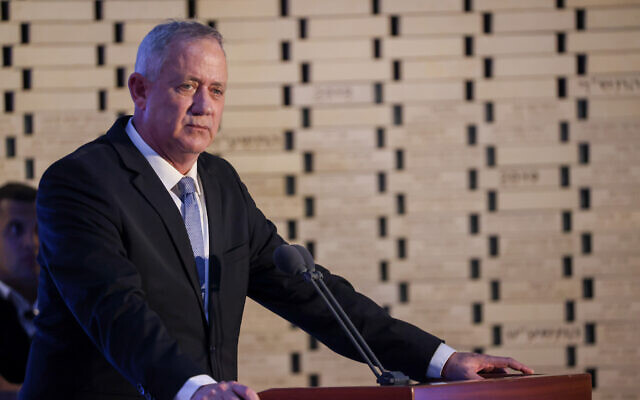
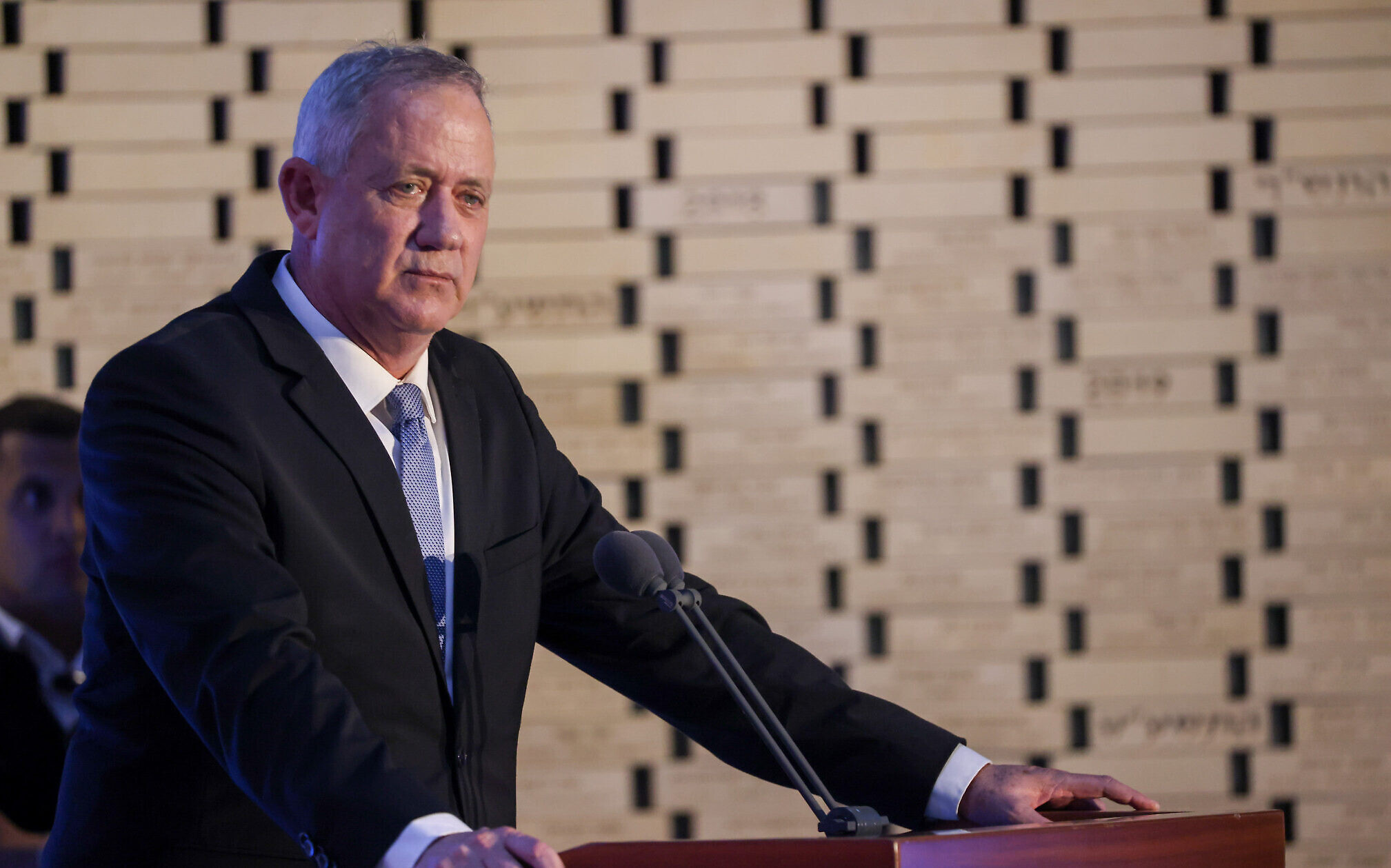
Defense Minister Benny Gantz at a state memorial ceremony marking 7 years since Operation Protective Edge at the National Memorial Hall at the entrance to the military cemetery on Mount Herzl, June 20, 2021. (Yonatan Sindel/Flash90)
Defense Minister Benny Gantz on Monday said Israel and the United States had restored intelligence ties and were working to develop a “Plan B” if the stalled talks between Washington and Tehran regarding a fresh Iran nuclear deal sputter out, following a meeting between Prime Minister Naftali Bennett and US President Joe Biden last week.
Gantz warned that if Iran becomes a nuclear state, it will trigger an international arms race in which many other nations, in the Middle East and beyond, will attempt to acquire an atomic bomb.
“The United States and Israel share intelligence information, and the cooperation with the United States in this field is only getting stronger. We are working with them in order to establish a Plan B and to demonstrate that if there is no deal, other activities will begin, as President Biden said,” the defense minister said, speaking to military correspondents ahead of the Jewish New Year next week.
On Friday, the US president told a joint press conference with Bennett that his administration was “ready to turn to other options” if diplomatic talks with Iran failed, likely alluding to the possibility of clandestine operations and military strikes.
The White House meeting came a day after US officials told the New York Times that Israel’s previous administration had downgraded intelligence sharing with the US after Biden took office. Bennett has sought to restore ties with US Democrats after their relationship with former prime minister Benjamin Netanyahu became frayed, though Iran was the focus of the Friday meeting.Get The Times of Israel’s Daily Editionby email and never miss our top storiesNewsletter email addressGET ITBy signing up, you agree to the terms
Gantz did not specify what the “Plan B” could entail, but Israeli officials have signaled a need for a credible military threat to deter Iran from pursuing nuclear weapons.
Gantz’s comments joined a flurry of threats by Israeli defense officials toward Iran in recent days, including Israel Defense Forces Chief of Staff Aviv Kohavi, who told reporters last week that the military was preparing plans and funding for a potential military strike on Iran’s nuclear facilities.
“We are allocating resources in order to strengthen our ability to act against challenges in the region, chief among them Iran,” Gantz said.
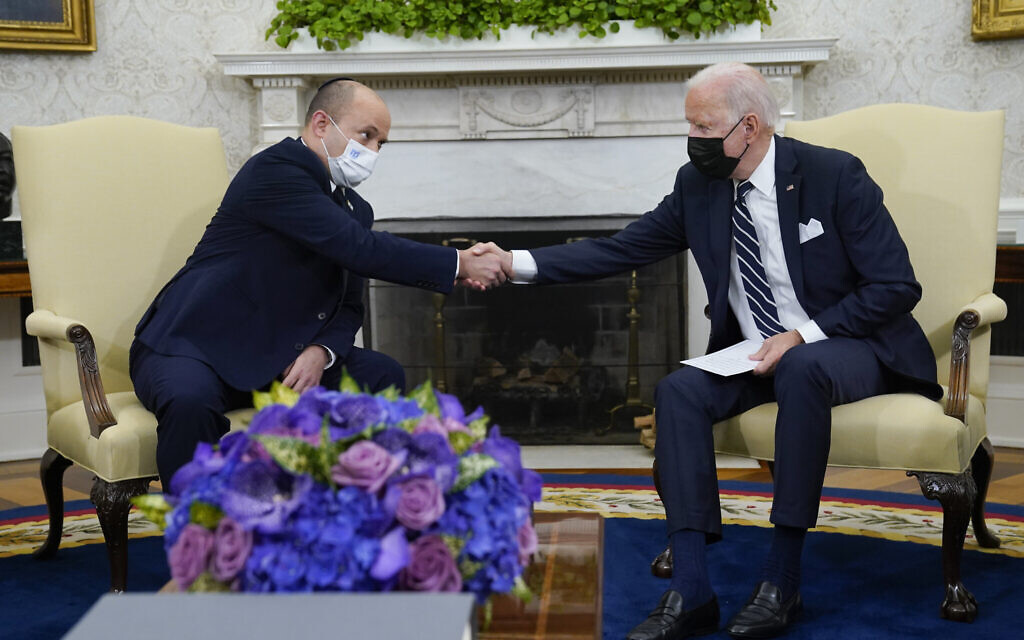
US President Joe Biden (right) shakes hands with Prime Minister Naftali Bennett as they meet in the Oval Office of the White House, Friday, Aug. 27, 2021, in Washington. (AP Photo/Evan Vucci)
The defense minister made his comments during an extended briefing with reporters at the Defense Ministry’s offices in Tel Aviv’s Kirya military base, focusing on Iran along with his meeting Sunday with Palestinian Authority President Mahmoud Abbas, the lingering threats from the Gaza Strip following May’s conflict with terror groups there, the Middle East in general and the ongoing efforts by the government to pass the budget and fund the Defense Ministry’s programs.
“A defense budget allows us to rearm and allows for the operational ability that we need, alongside important social considerations. We are working to improve fortifications in the north and to build the [Lebanese border] barrier that was held up for years,” Gantz said.
Referring to recent efforts by the government to encourage ultra-Orthodox men to perform national service, the defense minister said he was working to expand this in order to get a larger majority of Israelis to enlist, warning that if this is not accomplished within the next decade, Israel will be forced to move to a professional, volunteer military.
“The goal is to get more than 70 percent of people to serve each year, when today we only have roughly 50 percent,” Gantz said.
The defense minister said he instructed the IDF to begin preparing for the possibility that it will have to continue to support the national pandemic response through the end of 2022, after initially planning to scale back the military’s involvement in these efforts following this year’s massive vaccination drive.
Strengthening the PA
Gantz reiterated his support for strengthening the Palestinian Authority, which works closely with Israel on security issues, particularly against Hamas and other terror groups in the West Bank. However, the PA is often maligned in Israel for its financial support for terrorism in the form of stipend to the families of Palestinians imprisoned in Israeli on terrorism charges or killed as they perpetrated terror attacks, as well as for its repeated efforts to gain unilateral recognition as a state in international forums such as the United Nations.
“I told Abbas that we aren’t going anywhere and that the Palestinians aren’t going anywhere. I went to the meeting in order to build confidence and preserve the interests of the State of Israel and the important ties we have with the Palestinian Authority, which I believe we need to strengthen,” Gantz said.
“As the Palestinian Authority gets stronger, Hamas gets weaker, and so long as it has greater governance, we will have more security and we will have to act less,” he added.
The defense minister did not bring up the possibility of renewed peace talks with the Palestinians, and an official close to the prime minister told reporters earlier in the day that “there is no diplomatic process with the Palestinians nor will there be.”
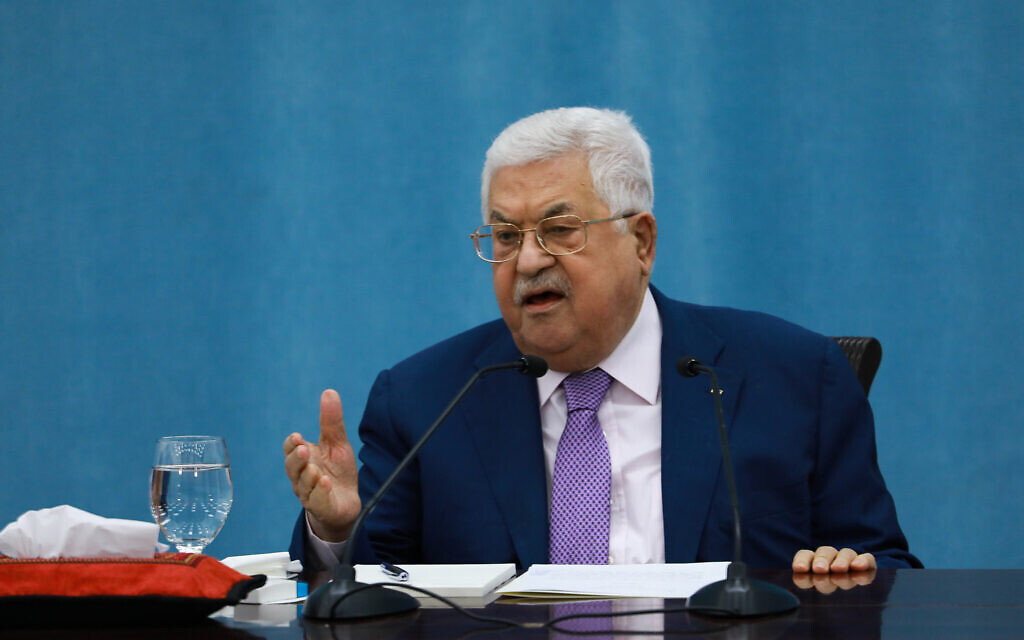
Palestinian president Mahmoud Abbas delivers a speech regarding the Coronavirus outbreak (COVID-19), at the Palestinian Authority headquarters, in the West Bank city of Ramallah, May 5, 2020. (Courtesy Flash90)
Regarding the Gaza Strip, which has recently seen a significant increase in violence along the border, Gantz said Israel was maintaining its policy of making full reconstruction and further development of the enclave contingent upon the release of two Israeli civilians and the remains of two fallen IDF soldiers from Hamas captivity.
The defense minister said the military would also continue to strike more forcefully than it did in the past in response to low-level violence along the border, such as the launching of balloon-borne incendiary devices.
“We said that what had been will not be again, and what had been is not what is happening now. This is in terms of the nature and strength of our retaliations, in the different mechanism through which Qatari funds are being transferred, also on civilian issues and on the dependence of reconstruction on the captives, as I said at the end of the operation,” Gantz said.
Echoing similar comments made recently by IDF chief Kohavi, the defense minister warned that Israel may be at the outset of a fresh round of fighting in Gaza, continuing the campaign from May’s 11-day conflict, known in Israel as Operation Guardian of the Walls, if the violence along the border continues.
“Our strikes in Gaza have been precise and have hit rearmament facilities that are painful for Hamas and that deny it capabilities. I cannot promise that we will not have to continue with a 12th day of Guardian of the Walls,” he said.
Gantz also noted that rocket attacks from Lebanon, which began during Operation Guardian of the Walls, appeared to be the work of Palestinian terror cells linked to Hamas.
During the fighting in Gaza, three rounds of rocket fire were launched at northern Israel, causing neither injuries nor damage. A fourth attack was launched on July 20 and a fifth on August 4 by these Palestinian cells.
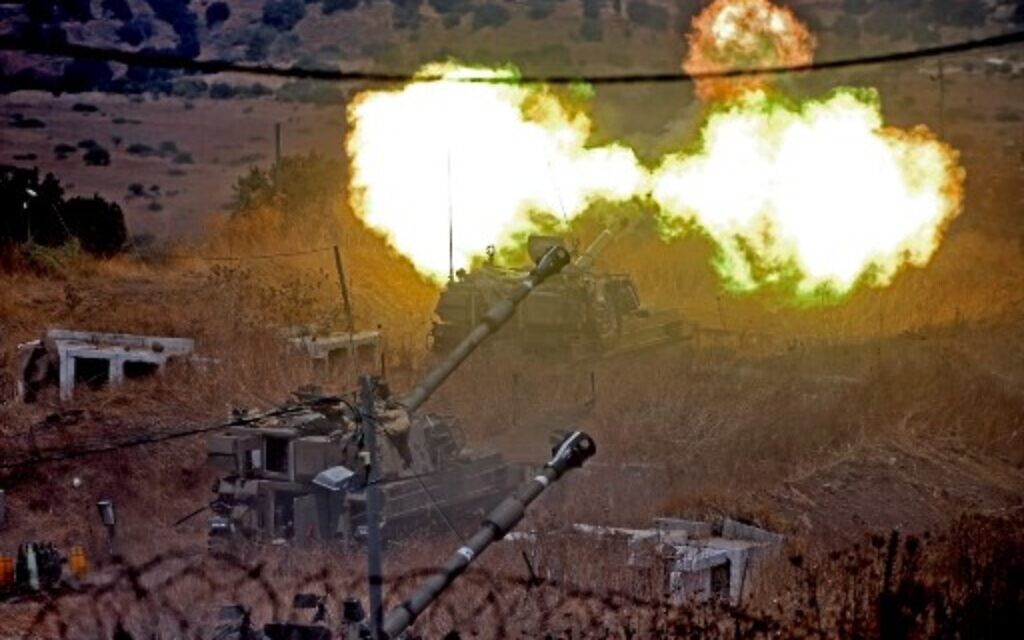
Israeli self-propelled howitzers fire towards Lebanon from a position near the northern Israeli town of Kiryat Shmona following Hezbollah rocket fire from the Lebanese side of the border, on August 6, 2021. (JALAA MAREY / AFP)
“We have seen that Hamas International is trying to create an infrastructure in Lebanon,” Gantz said.
The IDF does not see these cells as a major threat, but has allocated additional intelligence resources to monitoring them. The main threat in Lebanon remains the Iran-backed Hezbollah terrorist militia.
After Israel retaliated forcefully to the August 4 attack, Hezbollah fired 19 rockets at northern Israel, the first time the organization has openly launched such an attack since the 2006 Second Lebanon War. These rocket attacks from Lebanon raised the specter of a potential two-front war in the future, in which Israel would have to fight both Hamas in Gaza and Hezbollah in Lebanon.
“The humanitarian situation in Lebanon is very worrying, but so are the rearmament efforts of Hezbollah. We are prepared for the possibility of fighting on the northern front, including a situation in which we would be fighting on northern and southern fronts,” Gantz said.
Posted August 29, 2021 by Joseph Wouk Categories: Uncategorized
Israeli official tells news site PM stressed to Biden that despite disagreements, he wants them to work together ‘according to rules of honesty and decency’
President Joe Biden meets with Israeli Prime Minister Naftali Bennett in the Oval Office of the White House, Friday, Aug. 27, 2021, in Washington. (AP/Evan Vucci)
Israeli Prime Minister Naftali Bennett pledged to US President Joe Biden that despite opposing a potential Washington move to rejoin the 2015 Iran nuclear deal, he will not wage a public campaign against a possible American return to the accord, the Walla news site reported on Saturday.
Citing two American sources familiar with the details of Bennett and Biden’s meeting on Friday at the White House, the news site said that the Israeli premier stressed the same point in his sit-downs with US Secretary of State Antony Blinken and US National Security Adviser Jake Sullivan.
Bennett’s government opposes US efforts to return to the Iran nuclear agreement, signed in 2015 by the administration led by Barack Obama and abandoned three years later by Donald Trump.
But, according to the sources, Bennett said that he believes dialogue will lead to a better outcome, and that the White House was very appreciative of his stance on the matter. Many current administration officials also served under Obama when he clashed with then-prime minister Benjamin Netanyahu over the deal. Netanyahu, now the opposition leader, lobbied against the deal in a 2015 speech to the US Congress, infuriating Obama, and continues to vociferously oppose a return to the accord, which he argues paves the way to an Iranian nuclear arsenal.
“Even though there are disagreements, I want us to work according to rules of honesty and decency,” Bennett told Biden, according to an Israeli source quoted in the report.Get The Times of Israel’s Daily Editionby email and never miss our top storiesNewsletter email addressGET ITBy signing up, you agree to the terms
Opposition Leader Benjamin Netanyahu’s Likud party on Saturday night blasted Bennett over the report.
“For a picture at the White House, Bennett completely folded in front of Biden and harmed Israel’s security when he promised not to fight publicly,” Likud said in a statement. “This is a dangerous statement that combines inexperience, irresponsibility and a lack of leadership.”
“Iran is galloping toward the bomb and the weak government in Israel proved that it does not intend to fight against it.”
Netanyahu openly campaigned against the deal before it was signed in 2015 under then-US president Barack Obama and has recently been vocal in opposing Biden’s intention to restore the agreement.
Biden’s administration has been seeking a return to the nuclear deal, but this has looked increasingly unlikely as Iran has moved further away from its obligations and as a hardline president, Ebrahim Raisi, has taken office in Tehran.
Bennett and Biden were able to set “rules of the game” for how their offices work during their terms, a senior Israeli official told reporters on Friday after the meeting, saying that they had agreed there would be vigorous direct open dialogue, and that disagreements would be kept quiet.Prime Minister Naftali Bennett (right) and US President Joe Biden have coffee in the White House private presidential dining hall, on August 27, 2021. (White House/Twitter)
The atmosphere in the White House was “not optimistic” about returning to the nuclear deal with Iran, the official added, stressing that the fate of the agreement depended on Iran.
During public remarks the two gave in the Oval Office, Biden clarified that he prefers a diplomatic approach to block Iran’s path to the bomb, namely the revival of the Joint Comprehensive Plan of Action. However, he said that “other options” would be pursued if those negotiations failed and vowed that the US would ensure Iran “never” attains nuclear weapons.
Later pressed on what was meant by other options, White House Press Secretary Jen Psaki declined to elaborate. Israel has been pushing the US to put a “credible military threat” against Iran on the table while negotiating to curb its nuclear efforts.
During the meeting in the White House, Bennett presented his two-pronged approach to dealing with Iran — confronting its regional activities in a quiet, multifaceted “gray zone” campaign, and keeping Tehran permanently a year away from nuclear breakout capability.US President Joe Biden listens during a meeting with Prime Minister Naftali Bennett in the Oval Office at the White House, on August 27, 2021 in Washington, DC. (Pool/Getty Images North America/Getty Images via AFP)
Bennett also presented his view of a Middle East “cold war,” in which Israel is analogous to America, and Iran is a Soviet-like dictatorship, hated by its people and rotten from within.
Bennett was in Washington for the first time since becoming prime minister in June and held a series of meetings with top administration officials. On Wednesday, Bennett met with US Secretary of Defense Lloyd Austin, Blinken, and Sullivan.
His meeting with Biden on Thursday was pushed back to Friday because of the deadly suicide attack at the Kabul airport in Afghanistan, forcing Bennett and his staff to spend Shabbat in Washington before flying back early Sunday morning.
Posted August 20, 2021 by Joseph Wouk Categories: Uncategorized
As the Taliban retake power, the imminent 20th anniversary of 9/11 underlines the horrific consequences of the US failing to reckon with this region’s darkest forces
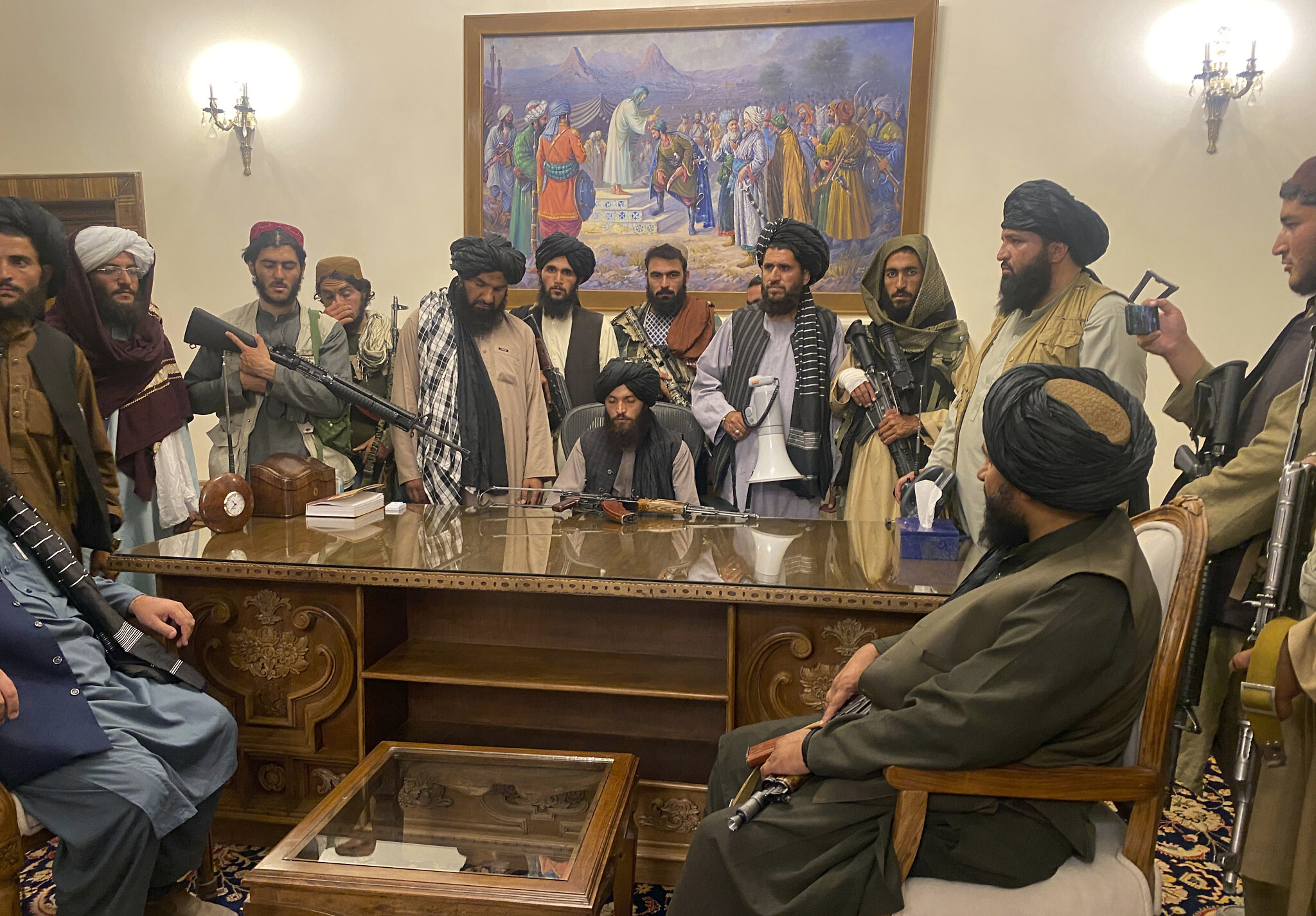
Taliban fighters take control of the Afghan presidential palace after President Ashraf Ghani fled the country, in Kabul, Afghanistan, August 15, 2021. (AP Photo/Zabi Karimi)
Like every national leader, the president of the United States has a prime obligation to safeguard the security and well-being of his citizens. And like his predecessor Donald Trump, President Joe Biden concluded that the presence of US troops and contractors in Afghanistan was having the opposite effect — that the American military deployment, as Biden put it on Monday, was “not in our national security interest.”
Thousands of Americans had lost their lives in the course of the 20-year war since the September 11, 2001, terrorist attacks, when the Bush administration began targeting Afghanistan for harboring al-Qaeda terrorists. And Biden, inheriting an agreement to withdraw the last few thousand US troops, decided to go ahead with it and, he said this week, avoid a “third decade” of war.
Before we get into the profound and dismal wrongheadedness of this decision — which in a matter of a few days has seen the United States humiliated and weakened in the eyes, most especially, of its Islamist enemies — we should note that Israel has twice in recent decades carried out its own hasty military withdrawals on our very own doorstep, under circumstances and with consequences it has to some extent lived to regret.
We left southern Lebanon unilaterally in 2000, under public pressure amid the relentless loss of soldiers’ lives in the Security Zone, and were plunged into the Second Lebanon War six years later. Now we face a full-fledged Hezbollah army on that front. We left Gaza unilaterally in 2005, choosing neither to negotiate the pullout with the Palestinian Authority nor to heed the warnings that emboldened terror groups, claiming vindication, would fill the vacuum. Now we face endless friction and intermittent bloody conflict with Hamas.
Israel, in other words, is not immune to the urge to cut and run.Get The Times of Israel’s Daily Editionby email and never miss our top storiesNewsletter email addressGET ITBy signing up, you agree to the terms
And that is what the United States has now done in Afghanistan, to devastating effect. It has handed Afghanistan back to the Taliban — brutal and benighted Islamic fundamentalists who, when they last controlled the country, oppressed women with a methodical viciousness unparalleled by any other regime worldwide; indiscriminately massacred civilians; restricted education; destroyed agriculture; banned culture and recreation…Taliban fighters stand guard in a vehicle along the roadside in Kabul on August 16, 2021, (AFP)
In consigning Afghanistan to its grisly fate, moreover, the US has shown itself to have been incapable of forging the Afghan military into a competent fighting force, despite all the training, the tens of billions in equipment, the lives lost.
And while Biden now blames Afghanistan’s political leaders for fleeing, and the Afghan army for laying down its arms, the US also reveals itself to have been unable to recognize the unreliability of its Afghan allies. As recently as July 8, Biden asserted with outrageously misguided complacency that “the likelihood there’s going to be the Taliban overrunning everything and owning the whole country is highly unlikely.”
For Israel, the debacle is a reinforcement of our insistence that we, and we alone, put our lives on the line in the defense of this country — even as we forge and nurture our alliances with our vital allies, and none more so than the United States. We do not and must not ask US or any other forces to risk their lives for us, and we dare not rely on any other country or alliance to protect us from our enemies.Taliban officials arrange a Taliban flag before a press conference by Taliban spokesman Zabihullah Mujahid, at the Government Media Information Center, in Kabul, Afghanistan, August 17, 2021. (AP Photo/Rahmat Gul)
For Israel and its allies and semi-allies in the region, the US mishandling of Afghanistan also shocks and horrifies because it gives succor to terrorist groups and extremist regimes. First and foremost of these is Iran, closing in on the bomb, toying with the US in negotiations over a return to the 2015 nuclear deal, determined to destroy “Little Satan” Israel, and now even more contemptuous of the “Great Satan.”
For the United States, however, what’s ultimately worst about the abandonment of Afghanistan to some of the darkest forces on the planet is that it negates, rather than serves, that core presidential obligation to ensure the security and well-being of the American people. The US deployment had been greatly scaled back, and the losses, still of course terrible, reduced to a fraction of those in earlier years. The hapless departure and its consequences, bitter experience indicates all too well, will exact a far greater cost than maintaining that deployment would have.
Biden’s two immediate predecessors complained that, notwithstanding the US commitment to championing freedom and democracy, it was not America’s job to solve all the problems of this part of the world (Barack Obama) and fight our region’s stupid wars (Donald Trump). But that the debacle is playing out around the 20th anniversary of 9/11, when 3,000 people lost their lives in al-Qaeda’s horrific terrorist assault on America, serves to grimly underline the direct consequences for the United States itself of failing to reckon with the ruthless, amoral and sophisticated forces plotting to harm it.People wait to be evacuated from Afghanistan at the airport in Kabul on August 18, 2021. (AFP)
Those regressive forces, most of them strategizing in our part of the world, are murderously hostile to everything that is best about America — its defense of freedoms, its commitment to democracy, its striving for opportunity and equality, its fundamental humanity. Today, they are more confident and stronger than they were just a few days ago. And the bastion of the free world’s defense against them, the United States of America, looks tired and irresolute.
This, at the risk of catastrophic understatement, is not in the US national security interest.US President Joe Biden leaves after speaking about the Taliban’s takeover of Afghanistan, from the East Room of the White House, on August 16, 2021, in Washington, DC. (Brendan Smialowski/AFP)
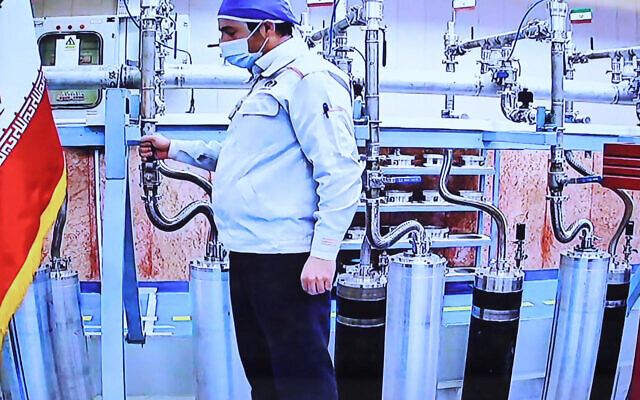
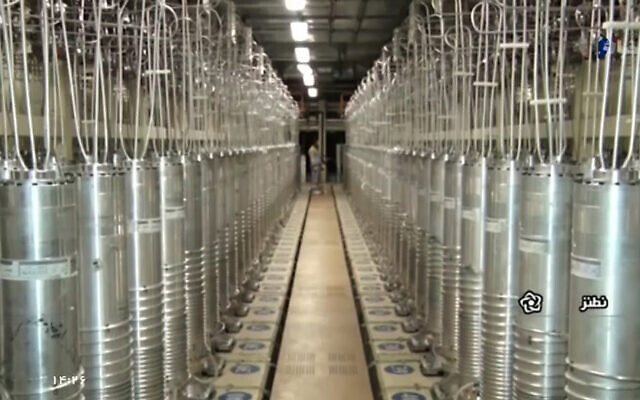
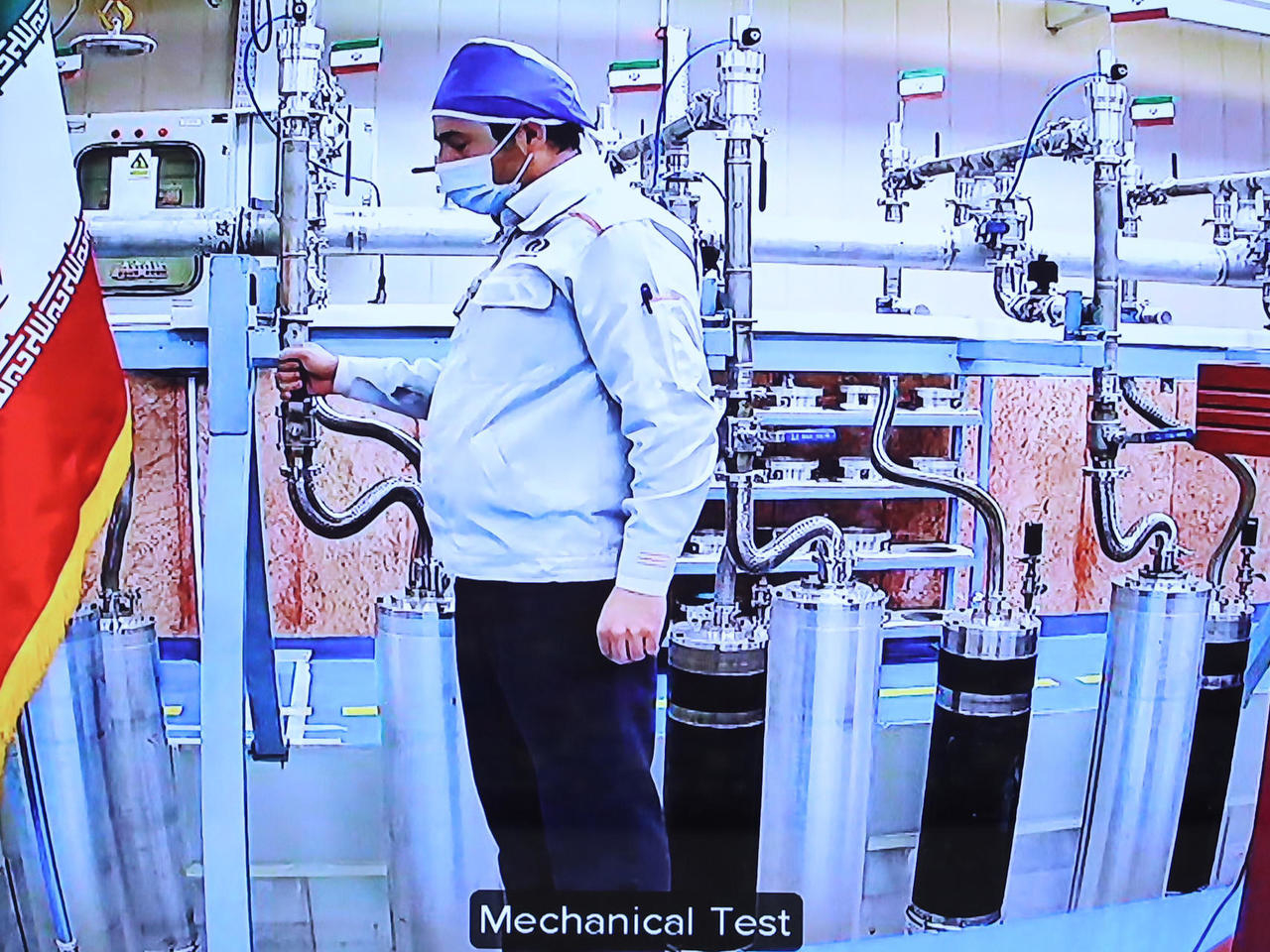
A handout picture provided by the Iranian presidential office on Saturday, April 10, shows a video conference screen of an engineer inside Iran’s Natanz uranium enrichment plant (Iranian Presidency/AFP)
VIENNA — Iran has established a process to accelerate production of highly enriched uranium, the UN nuclear watchdog said Tuesday, with talks to save the 2015 nuclear deal at a standstill.
International Atomic Energy Agency director Rafael Grossi informed IAEA member states that Tehran was boosting such capacity at its Natanz enrichment plant.
The agency verified on Saturday that “Iran had configured a new operational mode for the production of UF6 enriched up to 60 percent U-235,” Grossi said in a statement to AFP.
This involved using two centrifuge cascades compared to one previously, he added.
The move takes Iran closer to the 90 percent purity level needed for use in a nuclear weapon.Get The Times of Israel’s Daily Editionby email and never miss our top storiesNewsletter email addressGET ITBy signing up, you agree to the terms
Tehran had started in mid-April to enrich uranium to 60 percent.
In this image made from April 17, 2021, video released by the Islamic Republic Iran Broadcasting, IRIB, state-run TV, various centrifuge machines line a hall at the Natanz Uranium Enrichment Facility, Iran. (IRIB via AP)
The Islamic Republic has gradually rolled back its nuclear commitments since 2018, when then-US president Donald Trump withdrew from a multilateral nuclear deal and began imposing sanctions.
The 2015 deal known formally as the Joint Comprehensive Plan of Action, or JCPOA, gave Iran relief from sanctions in return for curbs on its nuclear program.
Under the accord, Iran had committed to keep enrichment to 3.67 percent, though it had stepped this up to 20 percent in January.
Trump’s successor Joe Biden said he hopes to revive the nuclear deal and indirect talks in Vienna, through European intermediaries, started in the Austrian capital in April.
But the talks broke up on June 20 without any discernible progress.
The EU said earlier this month that Iran is ready to resume talks under new president Ebrahim Raisi, and meetings could take place in Vienna from early September.
Meanwhile the United States on Monday urged Iran to return to the negotiations, voicing alarm over Iranian production of uranium metal reported by the UN nuclear watchdog.
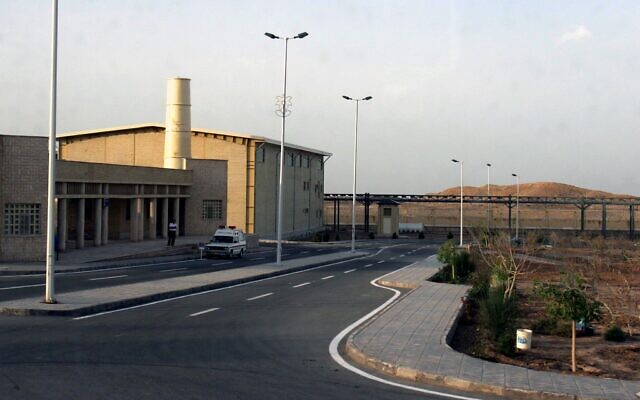
File: Iran’s nuclear enrichment facility in Natanz, Iran (AP Photo/Hasan Sarbakhshian)
According to the report presented by Grossi, Iran has made 200 grams of the metal, after having announced such a project in July for research purposes.
The State Department said Washington believed Tehran “has no credible need to produce uranium metal.”
Under the 2015 deal, Iran promised not to produce the metal, which can be used to build a nuclear bomb.
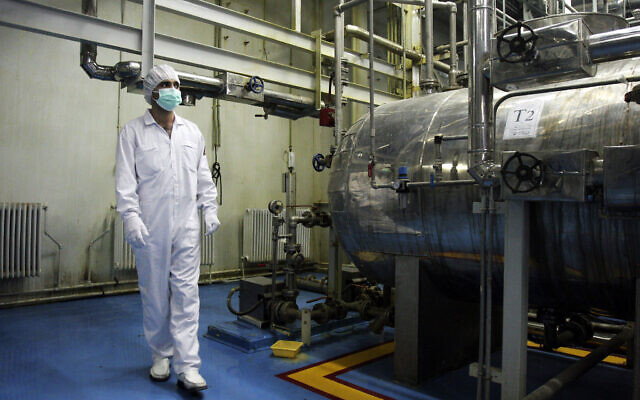
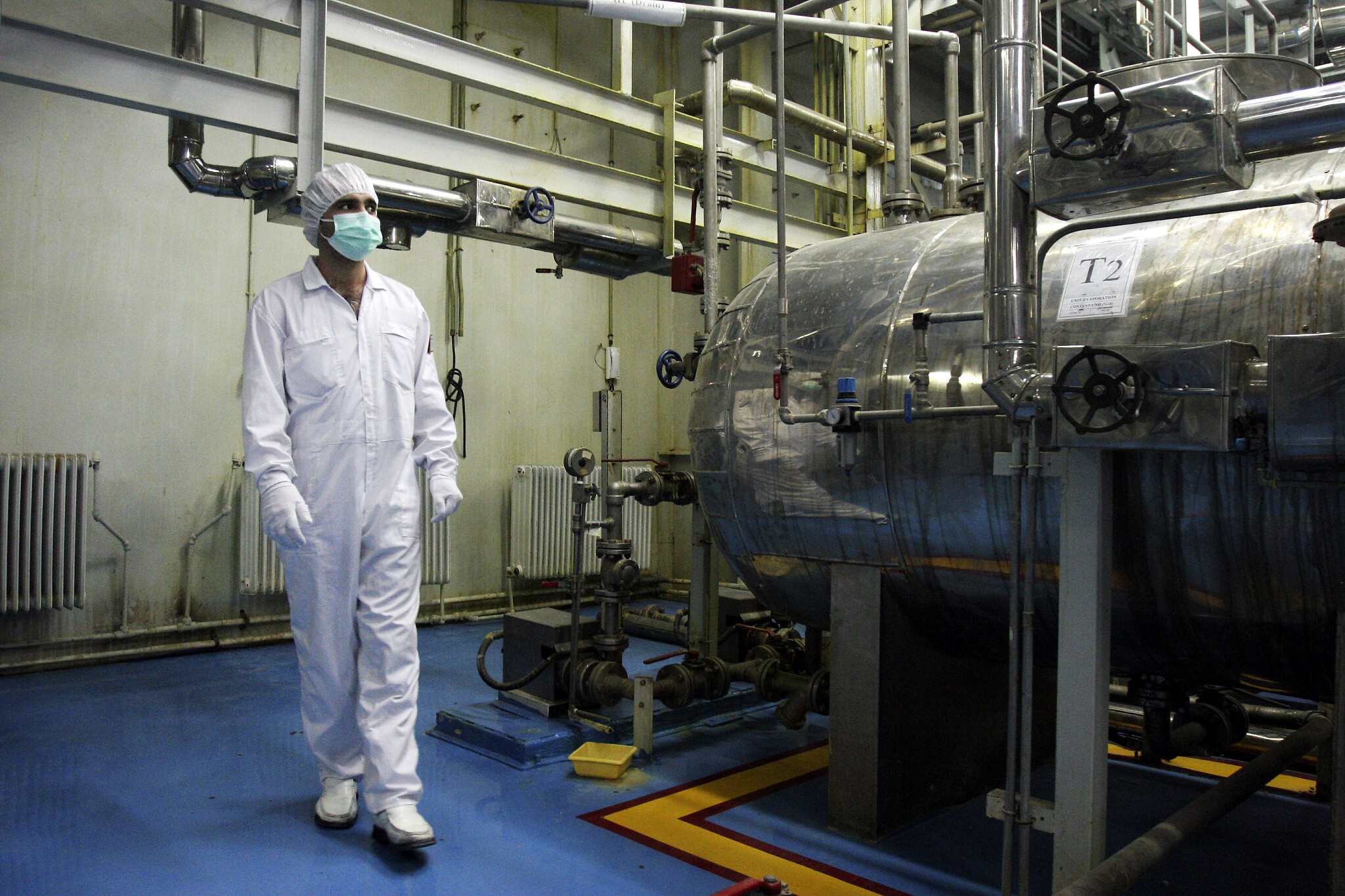
An Iranian technician walks through the Uranium Conversion Facility just outside the city of Isfahan 255 miles (410 kilometers) south of the capital Tehran, Iran, February 3, 2007. (Vahid Salemi/ AP/ File)
With the chances of a return to the 2015 nuclear deal fading, Iran has progressed with producing uranium metal, the UN nuclear watchdog said on Monday.
“On 14 August 2021, the Agency verified… that Iran had used 257g of uranium enriched up to 20% U-235 in the form of UF4 (uranium tetrafluoride) to produce 200g of uranium metal enriched up to 20% U-235,” the International Atomic Energy Agency wrote, according to Reuters.
Uranium metal can be used as a component in nuclear weapons. Iran had signed up to a 15-year ban on “producing or acquiring plutonium or uranium metals or their alloys,” under the so-called Joint Comprehensive Plan of Action (JCPOA) signed in 2015 with world powers.
Iran previously told the UN nuclear watchdog that it was advancing research on uranium metal production, saying it is aimed at providing advanced fuel for a research reactor in Tehran.
The IAEA added that the move was step three in a four-step plan, the fourth being the production of a reactor fuel plate, according to Reuters.Get The Times of Israel’s Daily Editionby email and never miss our top storiesNewsletter email addressGET ITBy signing up, you agree to the terms
But Iran has insisted its nuclear activities are peaceful and that it is not aiming at building a weapon
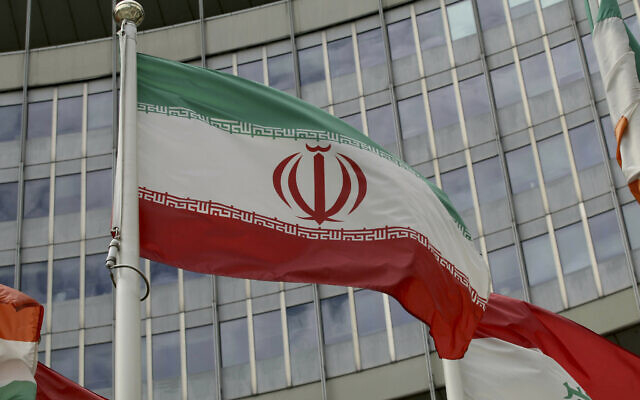
The Iranian flag waves outside of the UN building that hosts the International Atomic Energy Agency, IAEA, office inside in Vienna, Austria, July 10, 2019. (AP Photo/Ronald Zak)
Former United States president Donald Trump pulled out of the deal in 2018 and re-imposed sanctions that have choked Iran’s oil-dependent economy. Iran has responded by walking back measures it had agreed to abide by, including enriching uranium to unprecedented levels, near weapons-grade.
Talks kicked off in April in Vienna to find a way to bring both parties back to the deal. But the last round took place on June 20, with no date set for when they would resume. The EU chairs the meetings.
US President Joe Biden, Trump’s successor, has signaled his readiness to return to the nuclear deal and has engaged in indirect negotiations with Iran alongside formal talks with the agreement’s remaining parties, Britain, China, France, Germany, and Russia.
Police officers stand in front of the ‘Grand Hotel Wien’ in Vienna, Austria, April 9, 2021, where closed-door nuclear talks with Iran take place. (AP Photo/Florian Schroetter)
Israel has long opposed the nuclear deal and Biden’s stated intentions to reenter the treaty.
A return to the 2015 deal seems more unlikely as tensions have risen, notably with an attack by drones last month on an Israeli-linked tanker off Oman that killed a Briton and a Romanian national on board.
The G7 — the US, Britain, Canada, France, Germany, Italy and Japan — blamed the attack on Iran, which denies the accusation.
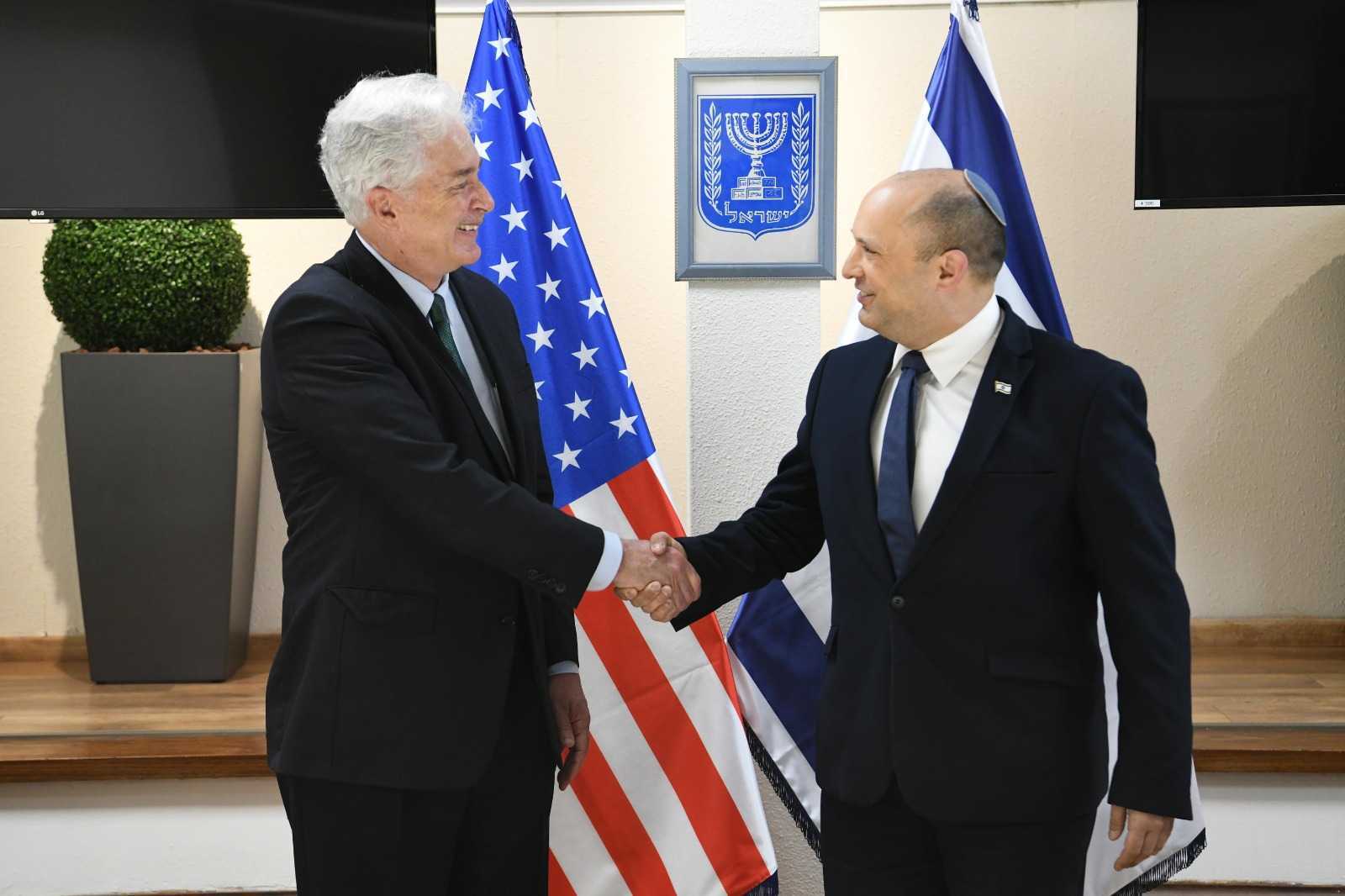
CIA chief William Burns, left, meets with Prime Minister Naftali Bennett in Jerusalem, August 11, 2021. (Amos Ben-Gershon/GPO)
During his meeting this week with CIA chief William Burns, Prime Minister Naftali Bennett told the US spymaster that Jerusalem and Washington should form a joint strategy for a scenario in which Iran refuses to reenter the 2015 nuclear deal, according to an Axios report Thursday.
The report said Israeli officials received the impression that like Israel, Burns is also skeptical on Tehran returning to compliance with the deal under the new hardline government.
“It was important for the prime minister to make it clear that when we say we think it is a mistake to return to the 2015 nuclear deal, it is not an automatic continuation of the Netanyahu government’s policy and that we have a different approach,” the report cited a senior Israel official as saying.
Burns, a career diplomat, played a key role in the US rapprochement with Iran that led to the 2015 deal between Iran and major powers, known as the Joint Comprehensive Plan of Action.
US President Joe Biden has sought to rejoin the pact after former president Donald Trump withdrew from it in 2018. Israel opposes the deal and government officials have held successive rounds of talks with US counterparts on the nuclear negotiations.Get The Times of Israel’s Daily Editionby email and never miss our top storiesNewsletter email addressGET ITBy signing up, you agree to the terms
A report in The New York Times earlier this month said US officials are increasingly pessimistic on the prospects of returning to the accord under the new leadership in Tehran.
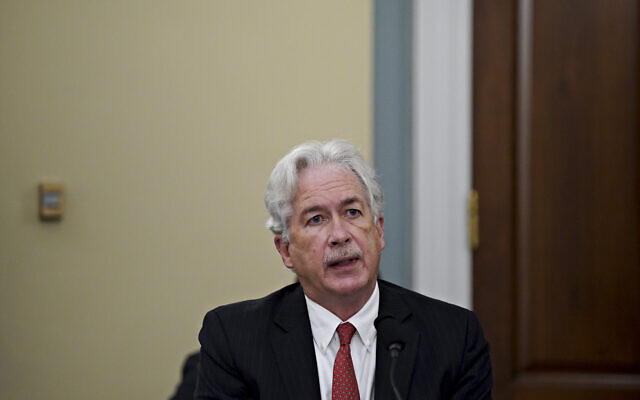
CIA Director William Burns speaks during a House Intelligence Committee hearing on Capitol Hill in Washington, April 15, 2021. (Al Drago/Pool via AP)
Channel 12 news reported on Tuesday that during a meeting with Mossad chief David Barnea, Burns was presented with information intended to show Iran’s new President Ebrahim Raisi as mentally disturbed, untrustworthy and incapable of negotiating a new nuclear deal or sticking to his commitments.
According to the network, Barnea gave Burns a dossier on Raisi that portrayed him as exceptionally extreme, cruel, corrupt and unstable. “The Mossad described him as someone with mental disturbances,” the channel claimed in the unsourced report.
Raisi, a hardline former judiciary head who was Supreme Leader Ali Khamenei’s choice for the role, has been accused of ordering the execution of thousands of prisoners toward the end of the Iran-Iraq war in 1988.
He took office last week, taking over from Hassan Rouhani, a relative moderate who agreed to the landmark deal in 2015 that curbed Iran’s nuclear activities in exchange for sanctions relief.
Iran’s new President Ebrahim Raisi speaks at his swearing-in ceremony at the Iranian parliament in the capital Tehran, on August 5, 2021. (Atta Kenare/AFP)
European Union-sponsored talks in Vienna are aimed at reviving the JCPOA but the last round took place on June 20, with no date set for when they would resume and Western officials estimating that with Raisi in power, the chances of clinching a deal have dwindled significantly.
Bloomberg news reported Monday that with chances of a return to the 2015 deal fading, the US is considering the possibility of easing sanctions on Iran in return for an agreement that the Islamic Republic freeze any progress on its nuclear project,
If a widescale deal cannot be reached, the US is weighing a number of possible interim steps, including sanctions relief, officials familiar with the negotiations were quoted by the news agency as saying.
The move would be different from a full return to the JCPOA, as it would only include limited sanctions relief in exchange for Iran freezing its most provocative nuclear proliferation work, the report said, citing the officials.










 anneinpt
 artaxes
 danmillerinpanama
 davidking1530
 Peter Hofman
 Joseph Wouk
 Peter
Peter Louisiana Steve
 WarSclerotic

Recent Comments