Iran’s nuclear breakout time now ‘really short’ — US official

Posted December 18, 2021 by Joseph Wouk
Categories: Uncategorized


Biden’s national security adviser says ‘we do not yet have a pathway back’ to nuke deal; 2nd official: Talks ‘better than it might have been’ and ‘worse than it should have been’

By TOI STAFF and AFPToday, 2:43 am  

In this image made from April 17, 2021, video released by the Islamic Republic Iran Broadcasting, IRIB, state-run TV, various centrifuge machines line the hall damaged on April 11, 2021, at the Natanz Uranium Enrichment Facility, some 200 miles (322 km) south of the capital Tehran. (IRIB via AP, File)

Illustrative: In this image made from April 17, 2021, video released by the Islamic Republic Iran Broadcasting, IRIB, state-run TV, various centrifuge machines line the hall at the Natanz Uranium Enrichment Facility, some 200 miles (322 km) south of the capital Tehran. (IRIB via AP, File)

The United States estimates the amount of time Iran needs to churn out enough highly enriched uranium for a nuclear bomb is now “very short,” a Biden administration official said Friday.

The official, who briefed reporters on condition of anonymity, did not specify the exact length of time Iran needs to produce enough material for a nuclear weapon. Estimates have put the breakout time at several months.

“But it’s really short. It is unacceptably short,” the official was quoted as saying by Reuters.

The official also called the new assessment of the Islamic Republic’s breakout time “alarming.”

The remarks came as Western powers reported some progress in talks to save the landmark Iran nuclear deal, but European diplomats warned that they were “rapidly reaching the end of the road.”Get The Times of Israel’s Daily Editionby email and never miss our top storiesNewsletter email addressGET ITBy signing up, you agree to the terms

In a blow to European mediators, Iran requested a new pause in the talks in Vienna, which aim to bring the United States back into the 2015 agreement and roll back nuclear activities. The Islamic Republic publicly stepped up its nuclear projects after the US withdrawal from the deal.

The talks had just resumed in late November after a five-month break following the election of a new hardline government in Iran.People walk past Palais Coburg, where closed-door nuclear talks take place in Vienna, Austria, December 17, 2021. (AP Photo/Michael Gruber)

Underlying Western concerns are fears that Iran will soon have made enough progress that the 2015 accord — under which it was promised economic relief in return for drastic curbs on its nuclear work — will be obsolete.

Enrique Mora, the EU official chairing the talks, called for a “sense of urgency” and for talks to resume before the end of the year.

“We are not talking anymore about months, we are talking about weeks,” Mora said.

Former US president Donald Trump pulled out of the deal in 2018 and imposed sweeping sanctions including a unilateral US ban on Iran’s oil sales, vowing to bring the US adversary to its knees.

US President Joe Biden supports a return to the agreement negotiated by predecessor Barack Obama, formally known as the Joint Comprehensive Plan of Action, but has been frustrated by the pace of resurrection efforts.

“It’s not going well in the sense that we do not yet have a pathway back into the JCPOA,” Biden’s national security advisor, Jake Sullivan, said of the talks.

“We are paying the wages of the disastrous decision to leave the deal back in 2018,” he said.

But Sullivan, speaking at the Council on Foreign Relations in Washington, said recent days “have brought some progress at the bargaining table.”US national security adviser Jake Sullivan speaks during the daily briefing at the White House in Washington, December 7, 2021. (AP Photo/Susan Walsh)

Another US official said the latest round was “better than it might have been” and “worse than it should have been.”

The official called for a “very significant acceleration” and said the US was ready to return before New Year’s.

“If it takes this much time to agree on a common agenda, imagine how much time it will take to resolve the issues on that agenda,” they said.

Russia, which along with China is also in the talks, said negotiators agreed to start from where they left off in June before Iran requested a break for its elections.

The latest round was “successful in a sense that it prepared sound basis for more intensive negotiations,” envoy Mikhail Ulyanov wrote on Twitter.

Tehran’s chief negotiator Ali Bagheri said there were “hard and intense negotiations” to agree on the “bases” for further talks which will take place “in the near future.”

The miracle of 48

Posted December 18, 2021 by davidking1530
Categories: Uncategorized

And you could add: “Because Arabs can’t fight their way out of a paper bag”.

EXCLUSIVE: Mossad recruited top Iranian scientists to blow up key nuclear facility

Posted December 18, 2021 by davidking1530
Categories: Uncategorized

Simpsons-nelson-ha-ha-93-p-672x480 ⋆ BYT // Brightest Young Things

A fascinating read.

90 per cent of the plant’s centrifuges were destroyed, putting the complex out of action for up to nine months

https://www.thejc.com/news/world/exclusive-mossad-recruited-top-iranian-scientists-to-blow-up-key-nuclear-facility-1.523163

articlemain

Mossad recruited a team of Iranian nuclear scientists to carry out a covert operation which blew up one of the regime’s most secure nuclear facilities earlier this year, the JC can reveal.

Up to 10 scientists were approached by Israeli agents and agreed to destroy the underground A1000 centrifuge hall at Natanz in April, though they believed that they were working for international dissident groups.

Some of the explosives they used were dropped into the compound by a drone and quietly collected by the scientists, while others were smuggled into the high security facility hidden in boxes of food on a catering lorry. The ensuing destruction caused chaos in the highest echelons of the Iranian leadership. It demolished 90 per cent of the centrifuges at the nuclear plant, delaying progress towards a bomb and putting the key complex out of action for up to nine months.

The new details are among astonishing secrets of three connected Mossad operations that took place over an 11-month period of sabotage in Iran. The first two, in July 2020 and April 2021, targeted the complex in Natanz using explosives, while he third, in June this year, took the form of a quadcopter assault on the Iran Centrifuge Technology Company (TESA), in the city of Karaj, 30 miles northwest of Tehran. The full details are published for the first time by the JC today.

Other revelations include:

  • Mossad spies hid explosives in building materials used to construct the Natanz centrifuge hall as long ago as 2019, then triggered them in 2020:
  • Agents sneaked an armed quadcopter, weighing the same as a motorbike, into Iran piece by piece, and used it to launch missiles at the TESA site in Karaj in June:
  • The three operations were planned together over an 18-month period by a team of 1,000 technicians, analysts and spies, as well as scores of agents on the ground:
  • The three-part assault on Iranian nuclear infrastructure was carried out by Mossad acting alone – known in Israeli intelligence circles as a ‘blue-and-white operation’ – and not jointly with the United States, dubbed ‘blue-white-and-red’.

It comes amid mounting anxiety that Tehran is cynically playing for time as it resumes negotiations in Vienna while pressing ahead with building a nuclear weapon.

In recent weeks, Israel has shared intelligence with Western allies suggesting that Iran is preparing to enrich uranium to 90 per cent purity, the level required to produce a nuclear bomb, Axios reported.

This raises the spectre of a major Israeli air assault on Tehran’s nuclear plants, should both negotiations and sabotage prove insufficient to halt the programme.

This week, the JC has reported that Israel is embarking on a new policy of launching covert attacks on Iranian soil in retaliation for its meddling in the region, meaning that further undercover operations are in the pipeline.

The team of scientists carried out the sabotage in April this year, while the nuclear negotiations with the West were underway in Vienna.

The measures were needed in order to access the underground A1000 centrifuge hall at Natanz, which housed up to 5,000 centrifuges and is protected from air assault by 40 feet of concrete and iron.

Hours after Iran declared that it had begun to use advanced IR-5 and IR-6 centrifuges at the site, in blatant breach of the 2015 nuclear deal, the bombs were remotely set off.

The blast destroyed the independent and highly secure internal power system that supplied the centrifuges.

It caused a power blackout in the heavily fortified complex.

“The scientists’ motivations were all different,” a source said. “Mossad found out what they deeply wanted in their lives and offered it to them.

“There was an inner circle of scientists who knew more about the operation, and an outer circle who helped out but had less information.”

After the explosion, the scientists responsible were spirited away to a safe location. The source added: “All of them are very safe today.”

Iran named a suspect – 43-year-old Reza Karimi – and claimed to have issued an Interpol ‘red notice’ for his arrest. So far he has not been found.

The explosion left a crater so large that one Iranian official fell into it while examining the damage, injuring his head, leg, arm and back.

Fereydoon Abbasi Davani, the head of the Iranian parliament’s energy committee, grudgingly acknowledged to Iranian state television after the attack that the plan was “rather beautiful”.

This was the second of a three-part Mossad operation targeting Iran’s ‘fissile material project’, which is the industrial process of enriching uranium to weapons-grade levels.

The first attack had come on 2 July 2020, with a mysterious explosion inside the Iran Centre for Advanced Centrifuges (ICAC) warehouse at Natanz, central Iran, a key hub in Tehran’s network of nuclear plants dotted around the country.

The orchestration of the blast was audacious. A year earlier, Israeli spies posing as construction wholesalers had sold Iranian officials building materials to be used in the centrifuge hall.

Unbeknownst to the Iranians, the materials had been filled with Mossad explosives. They were built into the hall and remained in place all year. Then, when the time was right, Israel’s spymasters had pushed the button.

Mossad’s brains behind this attack – whom we are not naming – also led a similar operation in the early Nineties, the JC has learnt, in which a desk filled with listening devices was sold to Mahmoud Abbas’ PLO office in Tunisia, providing the Israelis with a stream of audio intelligence.

“The Iranians have always known that Israel has infiltrated their supply chains, but they are powerless to do anything about it,” a source told the JC.

The warehouse had been used to precisely calibrate centrifuges, a vital part of a complex process of producing a nuclear weapon.

The blast caused major damage, destroying a significant quantity of hardware and dramatically degrading the country’s nuclear programme. According to Iranian reports, nobody was injured.

The third and final act in the three-part drama came in June this year. Mossad’s attention now turned to the production of the centrifuges themselves, in order to delay the replacement of the equipment it had damaged in the first two attacks.

Over the preceding weeks, an armed quadcopter drone, weighing the same as a motorcycle, had been smuggled into the country piece by piece by agents.

The target was the TESA complex in Karaj, the most important factory to build the centrifuges – including advanced centrifuges – for the enrichment plants.

On June 23, from a location 10 miles away from the TESA factory, a joint Iranian and Israeli team launched the drone, flew it towards the facility and fired, partly destroying it.

The drone was then piloted back to the team on the ground, who spirited it away to be used again.

The revelations underline Israel’s capacity for striking at the heart of the Iranian regime’s most secret and strongly fortified sites, bolstering the Jewish state’s insistence that if necessary, it will take unilateral military action to prevent the theocracy from achieving a bomb.

Richard Pater, Executive Director of Britain Israel Communications and Research Centre (Bicom), said: “Unlike in the previous rounds of talks, Britain is currently holding the strongest line. This is very much appreciated by Israel, as there is a sense that the Americans are so desperate to return to the deal that they would be too soft.

“However, it is quite clear that Britain and the rest of the international community still sees negotiation as the most effective track to rein in Iranian ambitions.

“Israel is not convinced that this will be enough, and also doubt that more problematic partners, like Russia and China, will be able to hold same line.

“Therefore, the credibility of the threat from Israel needs to be enhanced, reiterated and reimposed, as part of a dual effort to put real pressure on Iranians.

“In terms of geopolitics, that is the message that these operations are sending to the international community.”

Israeli Military Leaders: Biden Nuclear Deal Poses ‘Significant Threat to Israel’s Security’

Posted December 18, 2021 by davidking1530
Categories: Uncategorized

Israeli Military Leaders: Biden Nuclear Deal Poses ‘Significant Threat to Israel’s Security’

A group of nearly 3,000 Israeli military leaders, soldiers, commanders, and intelligence officials are warning the Biden administration and Democrats in Congress that a new nuclear deal with Iran poses “a significant threat to Israel’s security.”

These leaders, who organized under the umbrella group Israel’s Defense and Security Forum (IDSF), raise concerns that the United States will sign a deal that gives Iran the cash assets needed to fund terrorism and put it on a glide path to a nuclear weapon that will be used to destroy the Jewish state, according to a letter sent last week to Senate Foreign Relations Committee chairman Bob Menendez (D., N.J.) and senior Biden administration officials.

The 2015 nuclear accord “is fatally flawed and represents a significant threat to Israel’s security,” the Israeli leaders write, according to a copy of the letter obtained by the Washington Free Beacon. “Returning to this expired and flawed agreement would be a grave mistake.” Iran’s only goal, they say, is to create a “nuclear umbrella under which Tehran can dominate the region.”

The letter, sent on Dec. 9, comes as the Biden administration continues its diplomatic effort to secure a revamped nuclear deal with Iran, which would lift sanctions on the hardline regime and provide it with billions of dollars in cash assets. The Israeli government has expressed its fear about a new deal, but the IDSF letter outlines in the clearest terms to date what the Jewish state expects from the Biden administration if it follows through with negotiations. Concerns about a new deal have been growing as Iran boosts its enrichment of uranium, the central fuel for an atomic weapon, even as it participates in talks with the United States.

As the Biden administration considers inking a temporary deal that places fewer restrictions on Iran’s nuclear program, the Israeli generals warn that this type of agreement “would fuel Iran’s already recovering economy and leave Israel in an unacceptably precarious situation.”

A so-called less-for-more deal removes “necessary pressure from the clerical regime and grant it valuable time to increase its resilience against future American economic pressure, continue skirting international inspections and oversight into their undeclared nuclear activities, and provide patient pathways to nuclear weapons and the missiles to deliver them.” Such an outcome, they say, is unacceptable.

The Israeli military leaders go on to outline seven areas in which Iran must be held accountable in order for any deal to be viewed as a success by Israel.

“A new agreement should include a much more comprehensive verification and supervision mechanism, including the ability to conduct inspections anywhere and anytime, a full resolution of the [International Atomic Energy Agency’s] outstanding questions about undeclared nuclear materials, sites, and activities, and the monitoring and questioning of scientists related to the Iranian nuclear program,” they write.

A new deal should prohibit Iran’s development of ballistic missiles, which the regime is building to deliver a nuclear payload over great distances. The original nuclear accord notably excluded restrictions on Iran’s ballistic missile program, creating a loophole that critics viewed as a fatal flaw.

The United States should also push for the reimposition of all United Nations sanctions on Iran under a mechanism known as “snapback.” The Trump administration chose to invoke this failsafe mechanism, which was written into the original nuclear deal, but the Biden administration reversed the decision soon after taking office. The Israeli military leaders say these sanctions are critical to keeping the Iranian regime’s economy on the ropes.

Any new deal must also renew a longstanding arms embargo on Iran, which expired in October 2020 and has not been renewed. This has allowed Iran to purchase advanced military equipment from nations such as Russia and China, both of which oppose a renewal of the embargo.

The Israeli military leaders also are calling for terrorism sanctions on Iran’s elite Islamic Revolutionary Guard Corps to be preserved under any new deal. Sanctions on the military group have prevented it from expanding its control of Iran’s nuclear-related industries. This would also include sanctions on Iran’s central bank, which funds terrorism and the country’s nuclear program.

“All sanctions for terrorism, missile proliferation, and human rights abuses must be maintained until there is demonstrable evidence that the malign activities underlying those sanctions has permanently ended,” the leaders write.

Report: US tells Israel new tanker jets, key to Iran strike, not coming anytime soon

Posted December 15, 2021 by Joseph Wouk
Categories: Uncategorized

According to NYT, during his visit to DC Defense Minister Gantz asked to accelerate delivery of KC-46 refueling planes but was told first aircraft unlikely to arrive before 2024

By TOI STAFF14 December 2021, 5:04 pm  

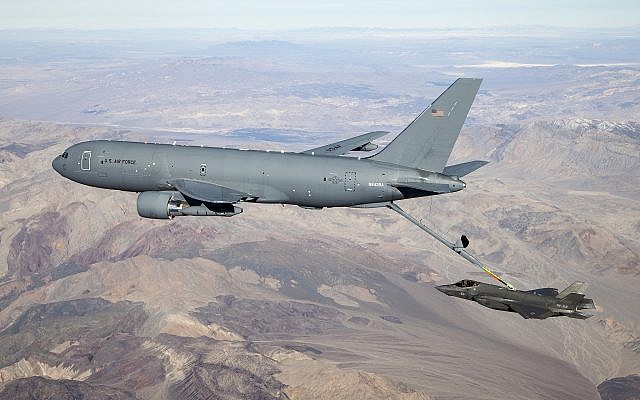
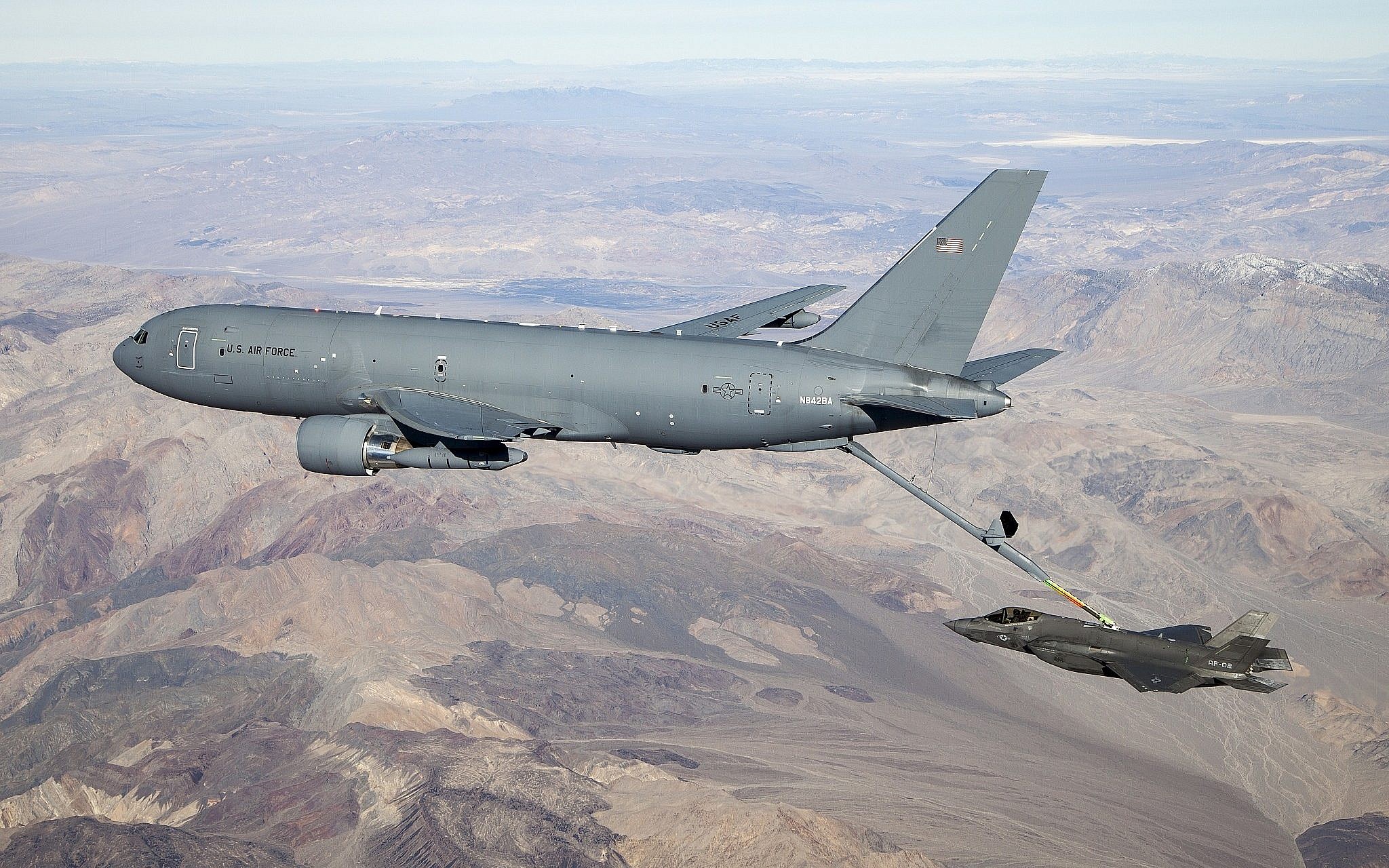
A US Air Force Boeing KC-46 Pegasus aerial refueling plane connects to a F-35 fighter jet over California, January 22, 2019. (US Air Force photo by Ethan Wagner)

A US Air Force Boeing KC-46 Pegasus aerial refueling plane connects to a F-35 fighter jet over California, January 22, 2019. (US Air Force photo by Ethan Wagner)

Israel has asked the United States to accelerate the delivery of refueling aircraft it had purchased that could be needed to attack Iranian nuclear sites, but was told by the Biden administration the first plane likely will not be delivered until 2024, according to a report Tuesday.

The sale of eight new KC-46 Pegasus aerial refueling tankers to Israel was approved by the State Department last March.

Citing American and Israeli officials, the New York Times reported the request was made by Defense Minister Benny Gantz when he met last week with his US counterpart Lloyd Austin in Washington.

US officials reportedly told Gantz the planes were back-ordered but they would work to speed up the delivery.

Funding for the refueling planes is set to come from the military aid package that Israel receives annually from the US.Get The Times of Israel’s Daily Editionby email and never miss our top storiesNewsletter email addressGET ITBy signing up, you agree to the terms

The newspaper noted that the timing of the delivery is key, with officials in US President Joe Biden’s administration worried that Prime Minister Naftali Bennett is seeking to renew the threat of military action against Iran.

It also said the Israeli Air Force was vying with the US Air Force for the planes, with Washington eager to supply the aircraft to its own forces as part of efforts to counter China.

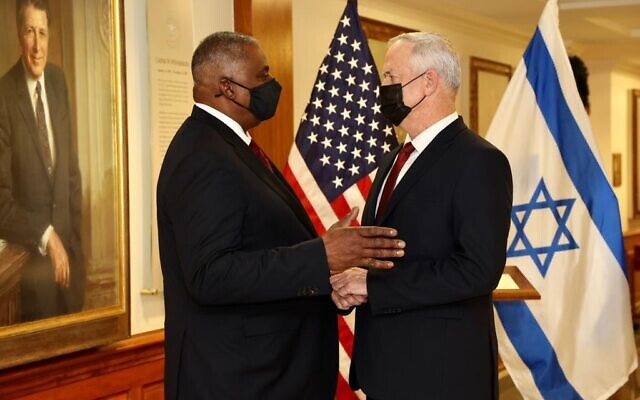
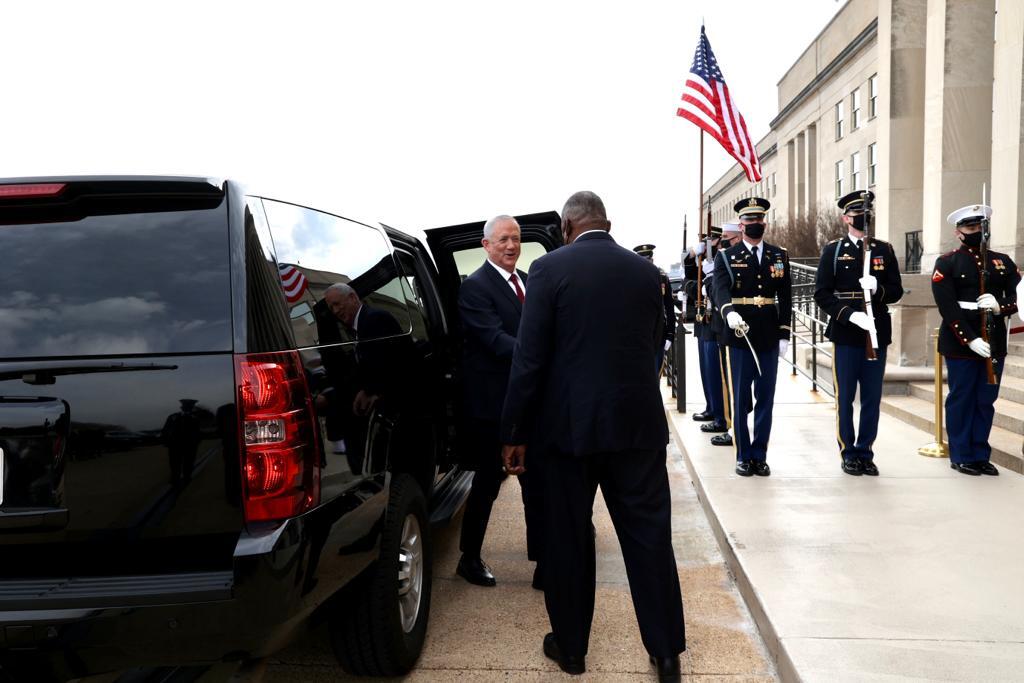
The report noted that the tankers would be a significant upgrade for Israel and that without them, Jerusalem would need to rely on its aging fleet of refueling planes for a strike on Iran, or make a pit stop in Saudi Arabia or the United Arab Emirates, neither of which would want to be linked to an attack on rival Iran.Defense Minister Benny Gantz (L) and US Defense Secretary Lloyd Austin meet at the Pentagon on December 9, 2021. (Defense Ministry)
Current and former officials quoted in the report said Israeli military planners believe that any strike on Iran will likely require multiple sorties against some sites, such as the underground Fordo uranium enrichment facility, necessitating speedy refueling.

US officials told the Times that they did not believe an attack was looming and that Israel’s public preparations for a possible strike could be aimed at putting pressure on Western nations to seek tougher terms in talks on reviving the 2015 deal limiting Iran’s nuclear program.

Israel is vocally opposed to the Iran nuclear deal, which Biden has said he wants to rejoin after his presidential predecessor Donald Trump withdrew the US from the pact in 2018 and reimposed sanctions. Tehran has since steadily increased its breaches of the accord.

Gantz: I told the US I’ve ordered the IDF to prepare a strike against Iran

Posted December 12, 2021 by Joseph Wouk
Categories: Uncategorized


Defense minister says US still aligned with Israel, but has ‘broader priorities’ in region; senior defense official says attack on Iran will be hard without coordinating with US

By JACOB MAGID and TAL SCHNEIDERToday, 1:03 am  

Defense Minister Benny Gantz (L) and US Defense Secretary Lloyd Austin meet at the Pentagon on December 9, 2021. (Defense Ministry)

Defense Minister Benny Gantz (L) and US Defense Secretary Lloyd Austin meet at the Pentagon on December 9, 2021. (Defense Ministry)

HOLLYWOOD BEACH, Florida — Defense Minister Benny Gantz said Friday that he notified US officials during meetings this week in Washington that he had instructed the Israel Defense Forces to prepare for a strike against Iran.

In a briefing with reporters on the sidelines of the Israeli American Council’s national summit in Florida, Gantz said the order he gave was to “prepare for the Iranian challenge at the operational level.”

A senior defense official, speaking on condition of anonymity, indicated that Gantz had presented a timeline for when such an attack might take place during his meetings with US Defense Secretary Lloyd Austin and Secretary of State Antony Blinken, but the source did not specify further.

Gantz told reporters Friday that the US and European countries “are losing patience” and are realizing that Iran is trying to drag out the negotiations, despite “playing a bad hand.”

He said no progress had been made in the recent round of negotiations in Vienna aimed at reviving the nuclear accord known as the Joint Comprehensive Plan of Action.Get The Times of Israel’s Daily Editionby email and never miss our top storiesNewsletter email addressGET ITBy signing up, you agree to the terms

Gantz said he has urged the US to step up the pressure against Iran.

“There is room for international pressure — political, economic and also military — in order to convince Iran to stop its fantasies about a nuclear program,” he said.

Gantz said the administration officials he met with were attentive to Israel’s concerns, and that he emphasized that Iran is first and foremost a global problem, before it is an Israeli one.

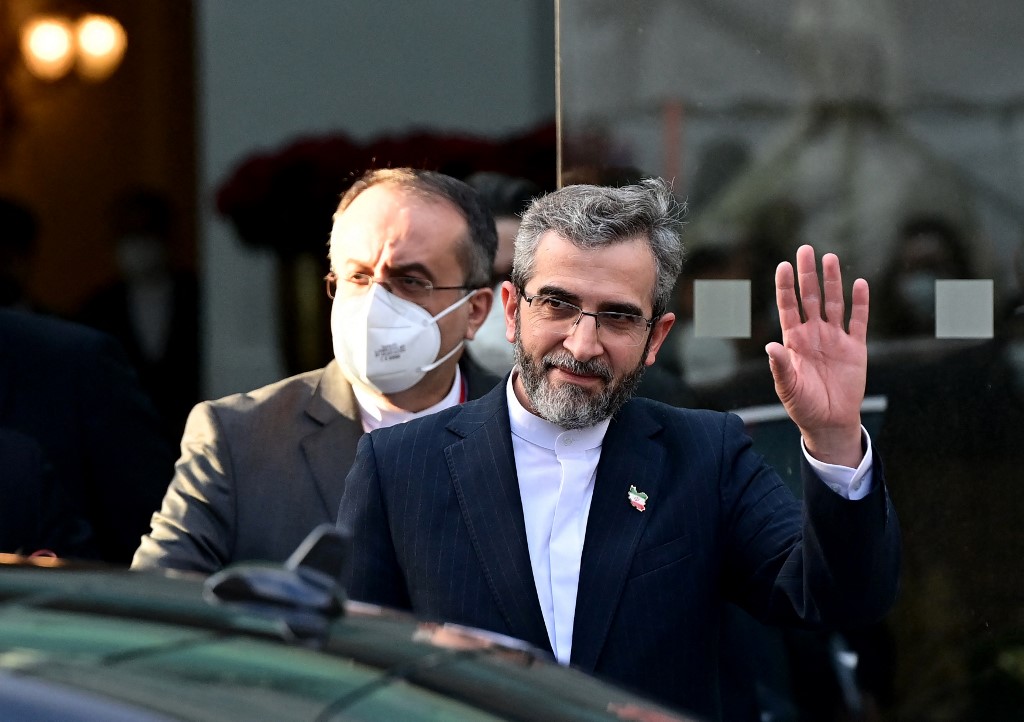
He said he agreed during meetings with Austin and Blinken that the US and Israel would further develop their cooperation against Tehran.Iran’s chief nuclear negotiator Ali Bagheri Kani is seen leaving the Coburg Palais, venue of the Joint Comprehensive Plan of Action (JCPOA) meeting aimed at reviving the Iran nuclear deal, in Vienna, on December 3, 2021. (Joe Klamar/AFP)
The sides also discussed maintaining Israel’s so-called qualitative military edge over other countries in the region, Gantz said. “There are many steps we discussed that will affect Israel’s ability to be the strongest state in the region for many years to come.”

Gantz acknowledged the Biden administration did not provide a deadline for when it will walk out of talks in Vienna if there is no progress, but he expressed confidence the US would begin considering a military option more seriously if there are no positive developments.

The senior defense official said Iran is close to enriching the amount of uranium necessary to assemble a nuclear bomb and that it will be easier to act against Tehran before it crosses that threshold.

The official acknowledged that American public opinion is not supportive of further military intervention in the Middle East, but said as Iran gets closer to a nuclear weapon, Americans will come around.

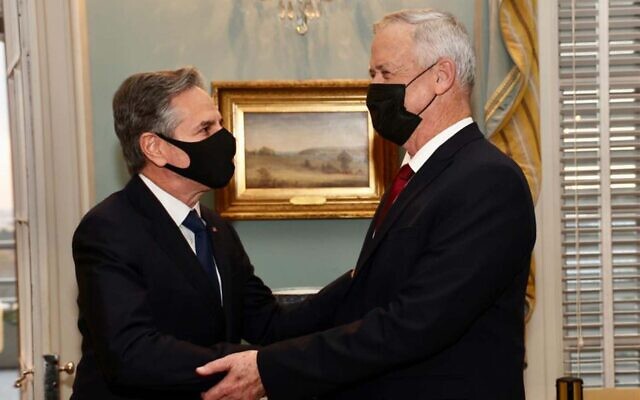
“The Americans are still with us, but at the same time, we as Israelis need to understand that the US has broader priorities,” Gantz said separately.US Secretary of State Antony Blinken (left) meets with Defense Minister Benny Gantz (right) in Washington, DC, on December 9, 2021. (Shmulik Almany/GPO)

“America is the strongest country in the world, and specifically because of that it does not rush to use force. It typically leaves it to later stages in the matter,” he said.

Gantz also justified the need for three separate Israeli officials — Bennett, Foreign Minister Yair Lapid and himself — to hold conversations with Blinken, even though they all discussed the same issue of Iran. Gantz said each of them placed an emphasis on different issues in their discussions, but they coordinated with one another, he said.

Hours later, a senior military official and a rumored candidate to serve as the next IDF chief of staff said Saturday that while Israel will act independently against Iran if it must, a strike against the Islamic Republic’s nuclear facilities would be difficult without coordinating with the US.

“The desire is always to coordinate with [the US] what we are doing, but at the end of the day Israel is responsible for its own fate and will protect the security of its citizens, Maj. Gen. Eyal Zamir said during a live interview on Saturday at the Israeli American Council conference.

Zamir is a former IDF deputy chief of staff currently serving as a research fellow at a think tank in Washington. He is a rumored dark horse candidate to head the IDF, though current deputy chief of staff Herzi Halevi is the assumed frontrunner.

Zamir acknowledged when pushed that “it would be a challenge to launch such an operation without coordinating with the Americans.”

He said that while Israel hopes the US will deter Iran, Israel will act if Washington fails to do so.

He clarified that military action would be a last result and would only be carried out if there is no diplomatic solution to the Iranian problem. He noted that the talks in Vienna are very “worrying” and that all options look very bad as far as Israel is concerned.

US Mideast military chief: Attacks by Iran-backed militias ‘may provoke a response’

Posted December 11, 2021 by Joseph Wouk
Categories: Uncategorized


Marine Gen. Frank McKenzie says Tehran ‘is trying to eject’ US troops from Iraq, and that it holds to dangerous belief its attacks on troops won’t affect nuke talks

By LOLITA C. BALDOR and ROBERT BURNSToday, 10:26 am  

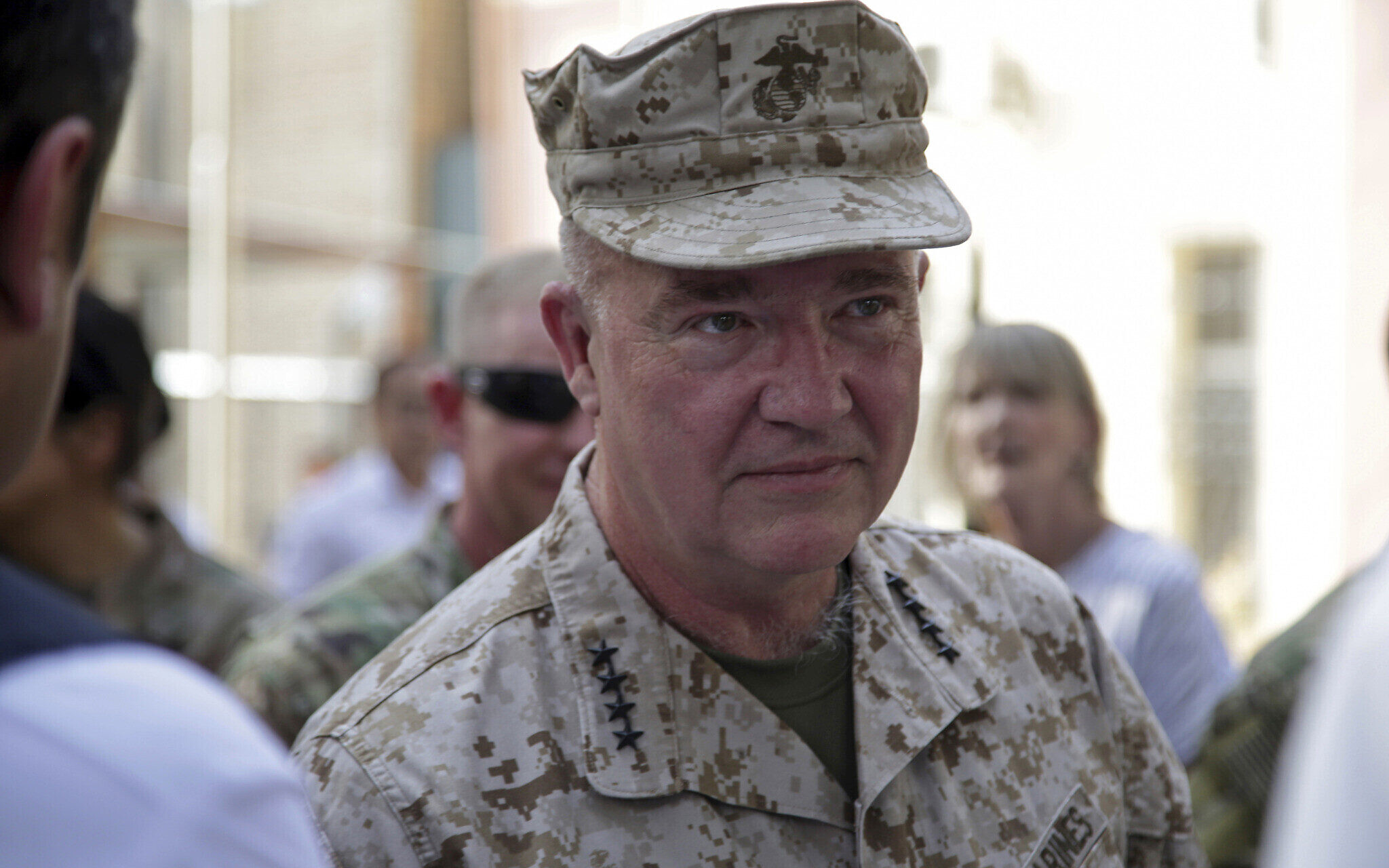
FILE - Marine Gen. Frank McKenzie, the head of US Central Command at Resolute Support headquarters, in Kabul, Afghanistan, July 12, 2021 (AP Photo/Ahmad Seir, File)

FILE – Marine Gen. Frank McKenzie, the head of US Central Command at Resolute Support headquarters, in Kabul, Afghanistan, July 12, 2021 (AP Photo/Ahmad Seir, File)

WASHINGTON (AP) — The top US commander for the Middle East said Thursday that the United States will keep the current 2,500 troops in Iraq for the foreseeable future, and he warned that he expects increasing attacks on US and Iraqi personnel by Iranian-backed militias determined to get American forces out.

Marine Gen. Frank McKenzie said in an interview with The Associated Press at the Pentagon that despite the shift by US forces to a non-combat role in Iraq, they will still provide air support and other military aid for Iraq’s fight against the Islamic State.

Noting that Iranian-backed militias want all Western forces out of Iraq, he said an ongoing uptick in violence may continue through December.

“They actually want all US forces to leave, and all US forces are not going to leave,” he said, adding that as a result, “that may provoke a response as we get later into the end of the month.”

The Iraqi government earlier Thursday announced the conclusion of talks on ending the US combat mission against IS. US forces have been largely in an advisory role for some time, so the announced transition changes little. The announcement reflects a July decision by the Biden administration to end the US combat mission in Iraq by Dec. 31.Get The Times of Israel’s Daily Editionby email and never miss our top storiesNewsletter email addressGET ITBy signing up, you agree to the terms

“We’ve drawn down from bases we didn’t need, we’ve made it harder to get at us. But the Iraqis still want us to be there. They still want the presence, they still want the engagement,” said McKenzie. “So as long as they want it, and we can mutually agree that’s the case — we’re going to be there.”US Army soldiers stand outside their armored vehicle on a joint base with Iraqi army south of Mosul, Iraq, February 23, 2017. (Khalid Mohammed/AP/File)

He said he believes Islamic State militants will continue to be a threat in Iraq and that the group will “keep recreating itself, perhaps under a different name.” The key, he said, will be to ensure that IS is not able to coalesce with other elements around the globe and become increasingly strong and dangerous.

America invaded Iraq in 2003, and at the peak point had more than 170,000 troops battling insurgents in the country and later working to train and advise Iraqi forces. All US forces were withdrawn at the end of 2011, but just three years later, American troops were back to help Iraq beat back the Islamic State group, which had swept across the border from Syria to gain control of a large swath of the country.

The US presence in Iraq has long been a flashpoint for Tehran, but tensions spiked after a January 2020 US drone strike near the Baghdad airport killed a top Iranian general. In retaliation, Iran launched a barrage of missiles at al-Asad airbase, where US troops were stationed. More than 100 service members suffered traumatic brain injuries in the blasts.US soldiers stand at the site of an Iranian bombing at Ain al-Asad air base in Anbar, Iraq, Jan. 13, 2020. (AP/Qassim Abdul-Zahra)

More recently, Iranian proxies are believed responsible for an assassination attempt last month on Iraq’s Prime Minister Mustafa al-Kadhimi. And officials have said they believe Iran was behind the October drone attack at the military outpost in southern Syria where American troops are based. No US personnel were killed or injured in the attack.

“I think an attack to kill the prime minister is a pretty significant event,” McKenzie said. “I think that’s a signpost of the desperation that they’re under right now.” Iranian officials have said Tehran and its allies had nothing to do with last month’s drone attack that lightly injured the Iraqi prime minister.

McKenzie, who has headed US Central Command for nearly three years and traveled extensively throughout the region, painted a picture that reflected the recent upheaval in Afghanistan, where US troops departed at the end of August.

On Afghanistan, McKenzie said al-Qaida has grown slightly since US forces left and that the ruling Taliban leaders are divided about their 2020 pledge to break ties with the group. He said the departure of the US military and intelligence assets from the country has made it “very hard, not impossible” to ensure that neither al-Qaida nor the Islamic State group’s Afghanistan affiliate can pose a threat to the United States.

Like the Taliban’s long campaign to get Americans out of Afghanistan, Iran and its proxies have battled to get the US out of Iraq and the broader Middle East.

“Iran still pursues a vision of ejecting us,” he said. “And they see the principal battleground for that as being in Iraq. And I believe they are under the view that they can increase friction in Iraq to where we will leave.”

Iran, he said, believes that campaign won’t affect the nuclear negotiations that were long stalled but are now restarting. But, he said, “I think it’s a dangerous position for the Iranians to maintain, because I think they’re not going to be able to decouple those two things.”A person walks in front of Palais Coburg where closed-door nuclear talks take place in Vienna, Austria, on December 9, 2021. (AP Photo/Michael Gruber)

McKenzie said that as NATO begins to expand its presence in Iraq as planned, the US will refine its force there. And the total US force presence will depend on future agreements with Iraq’s government.

The US troops in Syria, currently numbering about 900, will continue to advise and assist Syrian rebel forces in the fight against IS, McKenzie said. He said it’s not clear how much longer that will be necessary but said, “I think we are measurably closer than we were a couple of years ago. I still think we have a ways to go.”

More broadly, McKenzie noted that the US troop presence across the Middle East has significantly dropped since last year, when it peaked amid tensions with Iran, at as much as 80,000. The US has identified China and Russia as the top national security threats, labeling China as America’s “pacing challenge,” and has looked to focus more effort and assets in the Pacific.

In its recent review of the positioning of US forces around the world, the Pentagon said little about removing or repositioning troops in the Middle East. McKenzie and other top military leaders have long worried that the US military is concentrated in too few locations in the Middle East and must disperse more to increase security.

“We think it is important to work with our partners in the region to present a more complex targeting problem to Iran,” he said, adding that US will look at other bases and opportunities to move troops around to achieve that goal.

McKenzie said he is particularly concerned by Iran’s development of ballistic and cruise missiles as well as armed drones.

“And so those things are very concerning to me because they continue to develop them,” he said. “And they show no signs of abating in their research in this field, and their fielding of new and increasingly lethal and capable weapons.”

Biden orders to prepare ‘additional measures’ in case Iran nuclear diplomacy fails

Posted December 10, 2021 by Joseph Wouk
Categories: Uncategorized


White House press secretary says US president asked his team to ‘turn to other options’ if no progress made during talks to revive 2015 accord

By AGENCIES9 December 2021, 11:41 pm  

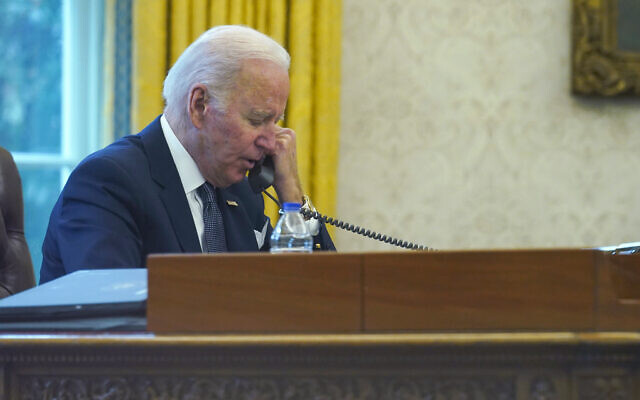
President Joe Biden talks on the phone  from the Oval Office of the White House in Washington, December 9, 2021. (AP Photo/Susan Walsh)

President Joe Biden talks on the phone from the Oval Office of the White House in Washington, December 9, 2021. (AP Photo/Susan Walsh)

US President Joe Biden has ordered his staff to prepare “additional measures” if troubled talks over Iran’s nuclear program, which resumed Thursday in Vienna, fail to reach a resolution.

“The president has asked his team to be prepared in the event that diplomacy fails and we must turn to other options,” White House Press Secretary Jen Psaki told reporters.

“We will have no choice but to take additional measures,” she added.

The latest round of talks began last week and were paused on December 3 with Western participants accusing Iran of going back on progress made earlier this year.

International diplomats restarted the talks Thursday for what the chair of the negotiations called the “difficult endeavor” of reviving the 2015 deal between Iran and world powers.Get The Times of Israel’s Daily Editionby email and never miss our top storiesNewsletter email addressGET ITBy signing up, you agree to the terms

The heads of delegations from the parties to the 2015 deal — Britain, China, France, Germany, Iran, and Russia — were present at the talks in Vienna.The Coburg Palais, the venue of the Joint Comprehensive Plan of Action (JCPOA) revival talks, in Vienna on November 29, 2021. (VLADIMIR SIMICEK / AFP)


Talks in Vienna on Thursday ended an hour after resuming following a few days’ pause, with tensions high after Tehran made demands last week that European countries strongly criticized.

The United States has participated indirectly in the ongoing talks because it withdrew from the accord in 2018 under then-president Donald Trump. US President Joe Biden has signaled that he wants to rejoin the deal.

Last week’s talks were the first in over five months, a gap caused by a new hard-line government assuming power in Tehran. European diplomats last week urged Tehran to come back with “realistic proposals” after the Iranian delegation made numerous demands that other parties to the accord deemed unacceptable.

The accord sealed in Vienna in 2015, formally known as the Joint Comprehensive Plan of Action, was meant to rein in Iran’s nuclear program in return for loosened economic sanctions.

Following the US decision to withdraw and reimpose sanctions against Iran, Tehran has ramped up its nuclear program again by enriching uranium beyond the thresholds allowed in the agreement. Iran has also restricted monitors from the UN atomic watchdog from accessing its nuclear facilities, raising concerns about what the country is doing out of view.

Meanwhile, Israeli and American military leaders are set to discuss possible military drills to practice destroying Iranian nuclear facilities in a potential worst-case scenario, a senior US official said.

Mossad is preparing to strike at the heart of Iran’s nuclear programme

Posted December 9, 2021 by davidking1530
Categories: Uncategorized

Oh how I hope and pray this is true…

A very interesting article.

Mossad is preparing to strike at the heart of Iran’s nuclear programme

https://www.spectator.co.uk/article/mossad-is-prepraring-to-strike-at-the-heart-of-iran-s-nuclear-programme

Iran is about to be hit by a fresh wave of Mossad operations, sources in Jerusalem have told me. This is the result of a change in Israeli policy: from now on, when Tehran’s proxy militias make trouble in the region, the Jewish state will retaliate on Iranian soil. ‘No more attacking the tentacles of the octopus,’ one source said. ‘Now we will go for the head.’

For the foreseeable future, I can confirm, this will not take the form of air raids, missile strikes or drone attacks. Instead, Israel’s feared secret service has been told to carry out pinpoint operations inside the Islamic Republic, inflicting surgical but devastating punishment.

Mossad’s impressive capabilities in Iran were demonstrated by the assassination of Mohsen Fakhrizadeh last November, the full details of which I exposed for the first time in February . A one-ton robot machine gun was smuggled into the country piece-by-piece and used to remotely kill the nuclear scientist as he drove to his holiday home. The spy agency’s capabilities were also demonstrated by the audacious theft of Iran’s entire archive of nuclear secrets from a warehouse outside Tehran in 2018.

As if more evidence was needed, this week I revealed the secret details of three operations – two at a nuclear plant in Natanz and one at the Iran Centrifuge Technology Company (TESA) factory in Karaj – that were planned by 1,000 Mossad personnel [!!!] and executed over 18 months of sabotage.

The first hit, in July 2020, was perhaps the most audacious. The previous year, spies posing as construction suppliers had sold the Iranian authorities materials that were used to build the Iran Centre for Advanced Centrifuges (ICAC) at Natanz, a highly secure nuclear facility in central Iran. Twelve months later, the explosives that Mossad had hidden in the supplies were detonated, destroying the warehouse and the centrifuges it contained.

But there remained the underground hall at Natanz, one of the most secure sites in the Islamic Republic. Named A1000, it housed up to 5,000 centrifuges and was protected from air assault by 40 feet of concrete and iron. This time, Israeli spies managed to persuade the scientists working in this inner sanctum to work for them. Thinking that they were helping a group of international dissidents, the scientists collected explosives that were smuggled into the facility by drone and in a catering lorry, and planted them in the subterranean A1000 hall. The ensuing explosion, which came in April, demolished 90 per cent of the centrifuges there, putting the complex out of action for nine months.

Finally, there was a missile attack on the TESA factory in Karaj in June. The payload was dispatched by a quadcopter drone, weighing the same as a motorcycle, which had been smuggled into the country piece by piece by Israeli spies and their Iranian agents.

Why does all this matter? This week, negotiations between the Iranian regime and Western powers have resumed in Vienna. There is widespread concern that Tehran is playing for time while continuing its progress towards a bomb.

In recent weeks, Israel has shared intelligence with its western allies suggesting that Iran is preparing the technical groundwork to enrich uranium to 90 per cent purity, the level required to produce a nuclear weapon, while paying lip service to a deal. This would be a gamechanger in the balance of power in the region and the world – and an intolerable existential threat to Israel.

When it comes to finding a diplomatic solution to this crisis, Jerusalem would be forgiven for lacking confidence in the international community. In his desperation to undo the Trump legacy and reheat Obamaism, President Biden – the leader of the free world – has dispatched a negotiating team that seems to abide by the principle of ‘give in first, beg for lollypops later.’

Britain, by contrast, has held a stronger line. The last couple of months have been marked by much warmth between London and Jerusalem; both Naftali Bennett and foreign minister Yair Lapid have enjoyed friendly visits to London, and Britain has passed new legislation to ban Hamas’ political wing as well as its military one. When signing a wide-ranging bilateral trade, defence and technology deal with Mr Lapid last week, foreign secretary Liz Truss vowed: ‘We will work night and day to prevent the Iranian regime from ever becoming a nuclear power.’

But as solid as British support may be, it may not be enough to prevent the United States from signing an execrable ‘less for less’ deal, which would allow Iran to receive sanctions relief while retaining the progress it has made towards a bomb. And partners such as Russia and China cannot be relied upon to keep their spanners out of the works.

The stakes could not be higher. Sometimes it seems like public opinion is somnambulant on the matter. We are facing the spectre of a fanatical, Islamist regime – the world’s foremost sponsor of terror, both in the Middle East and across the world – going nuclear. Would it launch a strike at Israel, which it has promised to wipe off the map? What would be the consequences of that? Would Israel and the Gulf States launch a pre-emptive strike? What would America do? Where would all this leave Britain, and our interests overseas? Even the Iranian use of nuclear weapons tactically in Syria or elsewhere is not unimaginable. And that would be an entirely different crisis. Hand-in-hand, the world is sleep-walking into a moment when Jerusalem decides that the risk has become unbearable, air strikes are launched, and full-scale war breaks out.

But in the meantime, the Mossad is coming. That was the coded message that Israeli Prime Minister Naftali Bennett gave to Iran last week. ‘They make us bleed without paying a price for it,’ the Prime Minister said. ‘We have to get to the dispatchers.’

Retaliating directly on Iranian soil enables Mossad to flex its muscles and send a message, creating more fear and confusion in Tehran. This will prepare the way for further sabotage operations on its nuclear facilities. It is vital that this succeeds. The sobering truth is that if international negotiations fail, and Israel’s spies fail, then war is all but certain. For those who aspire to live in peace, rarely has Israel – and the world – needed the Mossad more.

UAE, Saudis seek détente with Tehran, fed up with US-Israel slow motion on nuclear-armed Iran

Posted December 9, 2021 by Joseph Wouk
Categories: Uncategorized

United Arab Emirates and Saudi leaders took significant steps this week towards rapprochement with Tehran, backing away overtly for the first time from the Iran policies pursued by US and Israel. Nonetheless, little notice was attracted by the Emirati National Security Adviser Sheikh Tahnoon bin Zayed’s visit to Tehran on Monday, Dec. 6 and his meetings with his Iranian counterpart, Ali Shamkhani and President Ibrahim Raisi. Likewise, the Saudi Crown Prince Muhammed bin Salman (MbS)’s tour of Gulf capitals kicked off at Muscat, Oman, was practically unreported.

However, according to DEBKAfile’s Iran and Gulf sources, those trips were the first formal steps of a major policy shift in the region that reflects disenchantment with the US and Israel. The two leading Gulf rulers, MbS and the UAE’s Sheikh Muhammed bin Zayed (MbZ), feel they cannot rely on either the US or Israel for protection against Iran’s machinations or for aborting its race for a nuclear weapon. They appear therefore to have decided to abandon their anti-Iran policy and opted instead for rapprochement.
Two events stirred this radical change of orientation, according to the experienced Arab affairs analyst Abdel Bari Atwan: One was America’s failed pullout from Afghanistan and the other was the demonstration of Israel’s military shortcomings in the Guardian of the Walls operation against Hamas in the Gaza Strip, earlier this year. Hamas was able to keep the rockets coming over Israel, notwithstanding the massive deployment of the highly prized Iron Dome anti-rocket system. To Gulf leaders, this shortcoming translated into Israel’s inability to withstand an attack by Iran’s ballistic missiles. They also took note of what they perceived as Israel’s failure to bring the Biden administration on board for realistic measures to stop Iran acquiring a nuclear bomb.

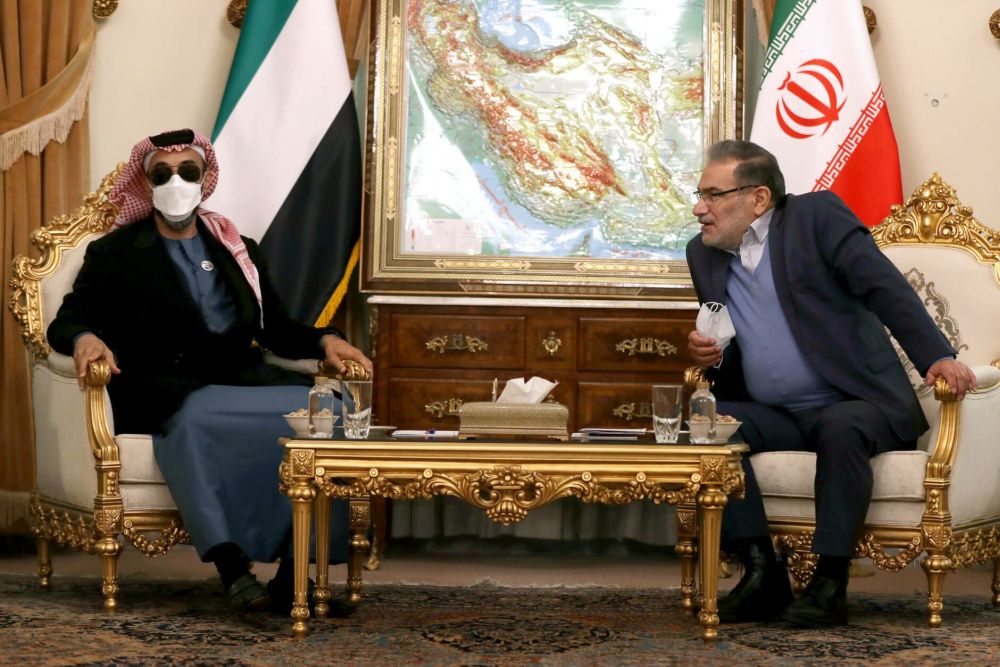
Tehran, for its part, is parading its newfound advantage: NSA Shamkhani and his Emirati visitor were photographed against the background of a large wall map showing a vast, dominant Iran alongside barely discernible Arab Gulf states. (see photo) Iran is clearly not even waiting to acquire a nuclear weapon, or the outcome of its nuclear talks with the world powers in Vienna, before proclaiming itself the region’s dominant power.

Following this groundbreaking meeting: Shamkhani said: “Warm and friendly relations between the countries remain a priority…  that shouldn’t be affected by other nations” – a dig at the UAE’s ties with the US and Israel, whereas President Raisi commented: “There should be no barrier in relations of the two Muslim nations of Iran and the Emirates.” Sheikh Tahnoon responded by inviting the Iranian president for a state visit to Abu Dhabi.

The Saudi ruler followed a different path to Iran. In Muscat, he asked the Omani ruler Sultan Haitham Bin Tareq to act as mediator between Riyadh and Tehran in the hope of a deal that would also end the never-ending civil war in Yemen, in which Saudi Arabia is deeply embroiled. The Omanis have long experience as a power broker. They were active in the backchannel talks between the Obama administration and Iran that resulted in the 2015 nuclear deal.