Posted January 13, 2022 by Joseph Wouk Categories: Uncategorized
Plan said made as Biden administration gears up for political fight as US will have to decide whether to re-enter the deal or walk away and apply further pressure on Tehran
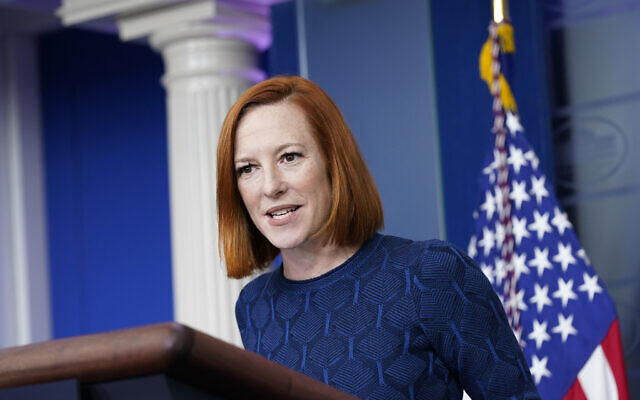
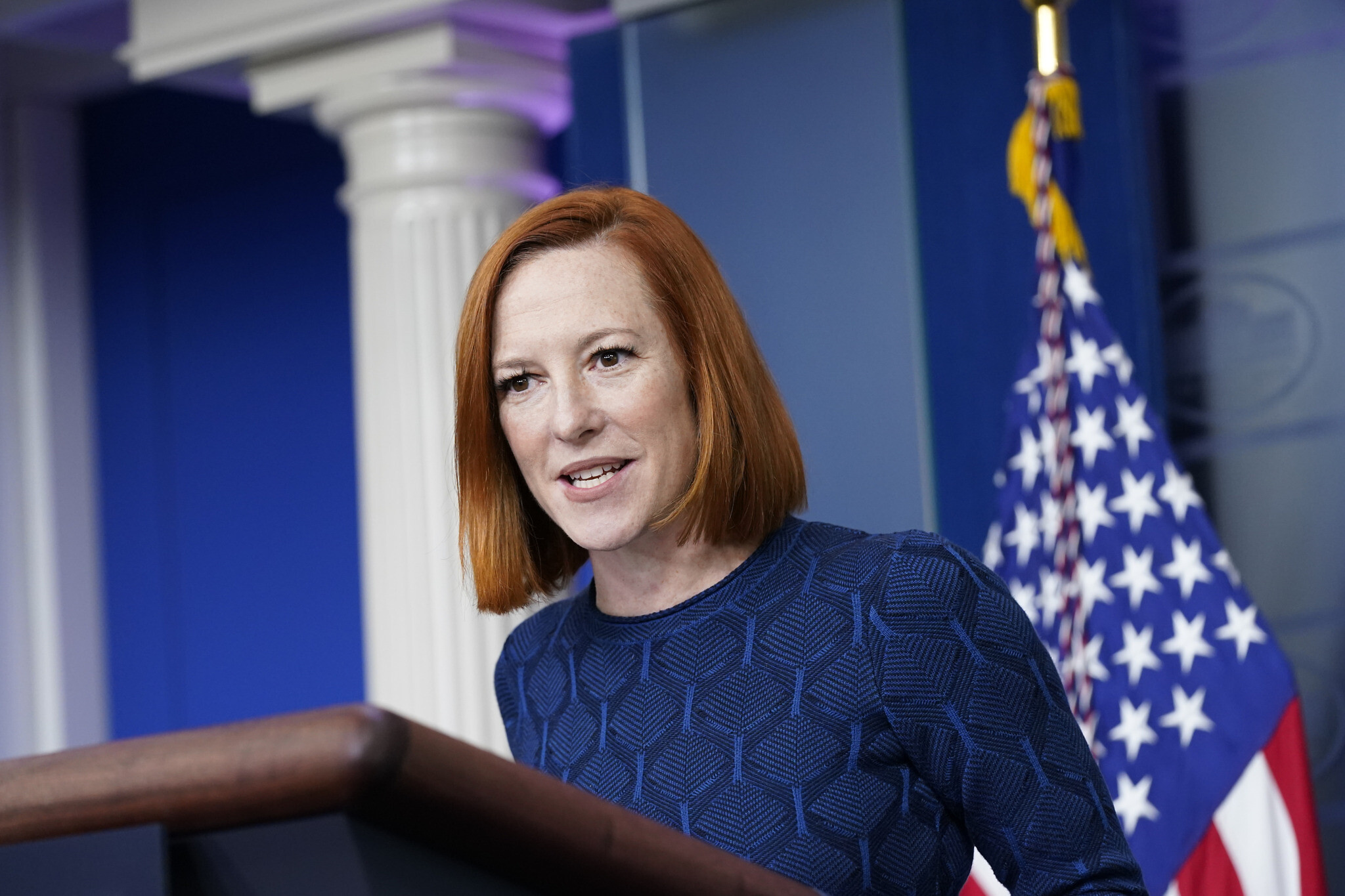
White House press secretary Jen Psaki speaks during a press briefing at the White House, Monday, Jan. 10, 2022, in Washington. (AP Photo/Patrick Semansky)
The Biden administration is gearing up for the Iran nuclear deal talks to reach an end by stepping up criticism of former president Donald Trump and blaming him for the current situation.
In recent days, both State Department spokesperson Ned Price and White House spokesperson Jen Psaki attacked Trump for pulling the US out of the 2015 deal — agreed by Iran, the US, China, Russia, Britain, France and Germany — that offered Tehran sanctions relief in exchange for curbs on its nuclear program.
Trump unilaterally withdrew the US in 2018 and reimposed biting sanctions, prompting Tehran to begin rolling back on its commitments and stepping up its enrichment activities.
The decision to focus on Trump is a deliberate one as the current talks in Vienna aimed at bringing the sides back into the deal head for a conclusion, the Axios news site reported Wednesday, citing two White House sources, saying they wanted to “focus the fire on Trump.”
On Tuesday, Price answered a question on the Vienna talks with a comment on Trump.Get The Times of Israel’s Daily Editionby email and never miss our top storiesNewsletter email addressGET ITBy signing up, you agree to the terms
“It’s worth spending just a moment on how we got here,” Price said. “It is deeply unfortunate that because of an ill-considered or perhaps unconsidered decision by the previous administration that this administration came into office without these stringent verification and monitoring protocols that were in place.”
Price said the Trump administration promised a better deal “that never came close” and instead “Iran has been able to gallop forward with its nuclear promise.”
Later Wednesday, Psaki said none of Iran’s “increased capabilities or aggressive actions they have taken through proxy wars around the world” would have occurred if Trump had not “recklessly pulled out of the nuclear deal with no thought as to what might come next.”https://platform.twitter.com/embed/Tweet.html?dnt=true&embedId=twitter-widget-0&features=eyJ0ZndfZXhwZXJpbWVudHNfY29va2llX2V4cGlyYXRpb24iOnsiYnVja2V0IjoxMjA5NjAwLCJ2ZXJzaW9uIjpudWxsfSwidGZ3X2hvcml6b25fdHdlZXRfZW1iZWRfOTU1NSI6eyJidWNrZXQiOiJodGUiLCJ2ZXJzaW9uIjpudWxsfSwidGZ3X3NwYWNlX2NhcmQiOnsiYnVja2V0Ijoib2ZmIiwidmVyc2lvbiI6bnVsbH19&frame=false&hideCard=false&hideThread=false&id=1481388478533353481&lang=en&origin=https%3A%2F%2Fwww.timesofisrael.com%2Fwhite-house-focusing-blame-on-reckless-trump-ahead-of-iran-nuclear-deal-decision%2F&sessionId=4d9d91949063474870798c0bc900f55db1148b90&siteScreenName=timesofisrael&theme=light&widgetsVersion=86e9194f%3A1641882287124&width=550px
Speaking at a press briefing Psaki said that as a result of Trump’s actions “Iran’s nuclear program was no longer in a box, no longer had the most robust inspection regime ever negotiated, no longer had the tight restrictions on nuclear activity.”
Axios said the White House was laying the groundwork for the end of talks, when the US would either re-enter the deal or walk away and apply further pressure on Tehran.
“Both scenarios will generate political backlash, particularly from Republicans, but the White House wants to keep Democrats together in part by emphasizing that it was Trump who triggered this crisis and left them with only bad options,” Axios said.
The report said the talks were likely to culminate by the end of January or February.
On Tuesday France’s Foreign Minister Jean-Yves Le Drian said the talks were proceeding so slowly that they are unlikely to lead to any agreement “within a realistic timeframe.”In this image made from April 17, 2021, video released by the Islamic Republic Iran Broadcasting, IRIB, state-run TV, various centrifuge machines line the hall damaged on April 11, 2021, at the Natanz Uranium Enrichment Facility, some 200 miles (322 km) south of the capital Tehran. (IRIB via AP, File)
The discussions taking place in Vienna “are underway but from our point of view they are slow, too slow,” Le Drian told the French parliament.
“There is a vital urgency on this issue because of Iran’s own actions and the trajectory of its nuclear program,” he added
On Monday Iran’s foreign ministry spokesman had said that efforts by “all parties” to revive his country’s 2015 nuclear agreement with world powers had resulted in “good progress” during the Vienna talks.
Negotiations to salvage the nuclear deal resumed in late November after they were suspended in June as Iran elected a new, ultra-conservative government.
“There has been good progress on all four issues of removing sanctions, nuclear issues, verification and obtaining guarantees” during the latest round of talks, Iran’s foreign ministry spokesman Saeed Khatibzadeh told reporters on Monday.
The US has participated only indirectly in the Vienna talks, which seek to bring Washington back inside the accord and to ensure Iran re-adheres to its own commitments.
Le Drian had sounded more positive about the talks on Friday, when he said they were progressing on a “rather positive path” while still emphasizing the urgency of bringing them to a speedy conclusion.
The following day his Iranian counterpart Hossein Amir-Abdollahian said the two sides are nearing a “good agreement” due to France “behaving reasonably” after previously playing “the role of a bad cop”.
Britain, France and Germany said last month that the window for concluding a deal was “weeks, not months”, due to the speed of Iran’s nuclear enrichment.
Posted January 11, 2022 by Joseph Wouk Categories: Uncategorized
Prime minister tells Knesset’s Foreign Affairs and Defense Committee that Tehran remains country’s most significant foe, Israel fighting Iranian forces constantly
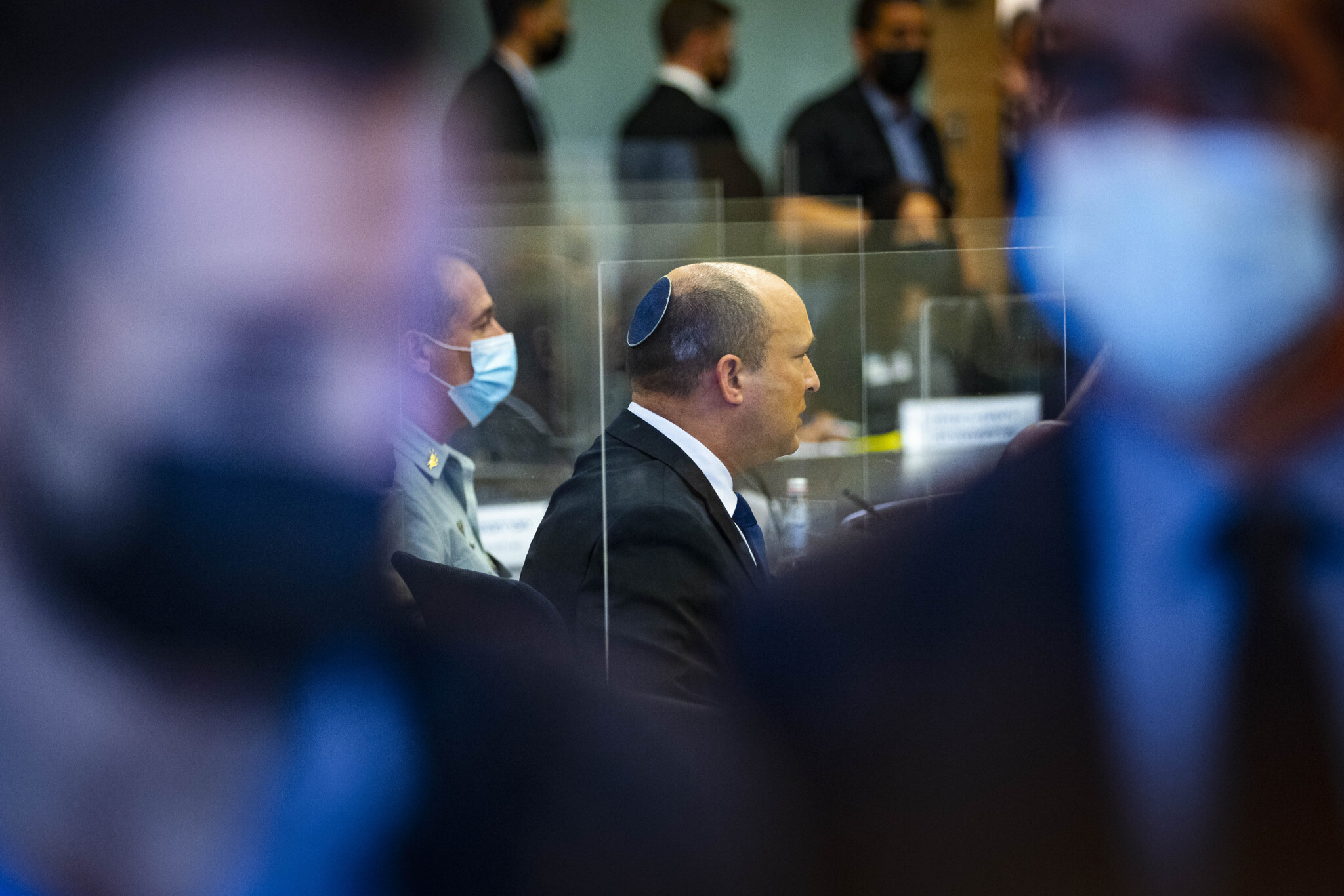
Prime Minister Naftali Bennett attends a Defense and Foreign Affairs Committee meeting at the Knesset in Jerusalem, January 10, 2022. (Olivier Fitoussi/Flash90)
Prime Minister Naftali Bennett told the Knesset on Monday that the country’s military and other security services were undergoing their largest rearming in years.
Bennett’s comments came as the IDF was working intensively to prepare for a potential military strike on Iran’s nuclear facilities, amid growing concerns that ongoing talks between the world powers and Tehran in Vienna about curbing the latter’s nuclear program may result in an agreement that Israel deems unacceptable, or in no agreement whatsoever.
“We are investing in security rearmament of the IDF and the entire defense establishment. I would say this was rearmament that we haven’t seen for years. This rearmament is important to our survival, and I am very glad about it and am determined to see it through quickly,” Bennett said, speaking to the parliament’s powerful Foreign Affairs and Defense Committee.
Bennett’s government increased the 2022 defense budget to nearly NIS 60 billion ($19.2 billion), a large chunk of which was to be earmarked for planning on military engagement with Iran, including billions to upgrade or procure vehicles, ordnance and more.
In a criticism of his predecessor Benjamin Netanyahu, Bennett claimed the military had been in a “tailspin” for years, which “severely damaged Israeli national security, in every dimension.” Bennett was defense minister under Netanyahu in 2019 and 2020.Get The Times of Israel’s Daily Editionby email and never miss our top storiesNewsletter email addressGET ITBy signing up, you agree to the terms
Bennett reiterated that Israel will not be party to a nuclear deal with Iran and will do whatever it deems necessary to ensure the country’s security.
“In terms of the Vienna talks, the nuclear talks — we are indeed concerned. It is important for me to say and to clarify here in a way that can’t be misunderstood: Israel is not part of the agreements, Israel is not bound by what is written in the agreements if they are signed, and Israel will continue to ensure its full freedom of operation in any place and at any time, with no limitations,” Bennett said.
The rest of the premier’s remarks were delivered behind closed doors.
This was Bennett’s first appearance as prime minister before the Foreign Affairs and Defense Committee, a parliamentary body meant to oversee the military, foreign policy and related issues.
In his remarks at the start of the meeting, Bennett told the committee that Iran was “at the top of our list of challenges.”
“Iran is the head of the octopus that sends enemies and proxies and its tentacles at us, on all of our borders. We are dealing — day and light — with Iran and its proxies. We are making a change, moving to a mindset of constant attack and not just constant defense,” he said.
Israel has been engaged in a long-simmering shadow war with Iran for years, mostly through regular airstrikes on Iranian-linked targets in Syria and en route to Syria, as well as occasional attacks — both physical ones and cyber attacks — on Iranian nuclear facilities, according to foreign reports.
Israel has opposed a return to the 2015 deal, instead pushing for negotiators to revamp the accord with stricter restraints on Iran and to address malign activity in the region beyond the nuclear portfolio. Officials have threatened that Israel could take military action to keep Iran from getting a nuclear weapon, even without the support of other nations.
Posted January 8, 2022 by davidking1530 Categories: Uncategorized
I haven’t copied across all the info to be found at the link below – the site owner deserves to get the traffic so hit the link for an interesting piece of analysis!
It seems to me that despite what Melman and others have said, Israel does have options to attack Iran. One approach is to paralyze the regime as a whole: cut off the head by killing the leadership, and cut the spinal cord by wrecking her communications and power infrastructure (perhaps with EMP weapons). Not everything must be done by manned aircraft: drones, submarine-launched missiles, Jericho ICBMs, and even special forces on the ground could take part. In this way, Iran can be taken out of the game without the need to destroy all her nuclear facilities at once. This also entails neutralizing Hezbollah at the same time, which might be the most difficult part.
There are other approaches, but rather than the surgical removal of the nuclear program, I prefer an attack targeting the regime because it will also lead to solutions to other problems, like Hezbollah. Possibly if the regime is hurt badly enough, the domestic Iranian opposition will be free to act, which could bring about the best outcome of all.
This is something that I have always thought – Israel, in attacking Iran, doesn’t need to destroy all the nuke sites straight away. They aren’t going anywhere so can be dealt with accordingly. Best to disable the Iranian threat first (ie leadership). An EMP weapon (delivered by Jericho missile) would be an awesome option were Israel to decide to use one (and if they have such a weapon). Although it would need to be a non-nuclear EMP weapon – setting off an atomic bomb 30km above Iran would cause immense blowback from around the world. A non-nuclear EMP weapon (of equivalent power to a nuclear one) is the holy grail of weapons for Israel to use. I hope they have some smart jews working on this…
Top nuclear expert was killed by the Mossad, who used a one-ton remote-controlled gun smuggled into Iran piece by piece over eight months, the JC can disclose
The Iranian nuclear scientist who was shot dead near Tehran in November was killed by a one-ton automated gun that was smuggled into the country piece-by-piece by the Mossad, the JC can reveal.
The 20-plus spy team, which comprised both Israeli and Iranian nationals, carried out the high-tech hit after eight months of painstaking surveillance, intelligence sources disclosed.
The Tehran regime has secretly assessed that it will take six years before a replacement for top scientist Mohsen Fakhrizadeh is fully operational.
Meanwhile, Israeli analysts have concluded that his death has extended the period of time it would take Iran to achieve a bomb from about three-and-a-half months to two years — with senior intelligence figures privately putting it as high as five years.
The disclosures come as the JC gives the fullest account yet of the assassination that made headlines around the world and significantly degraded Tehran’s nuclear capabilities.
Mohsen Fakhrizadeh, 59, known as the “father of the bomb”, lost his life in a burst of 13 bullets as he travelled with his wife and 12 bodyguards in Absard, near Tehran, on 27 November last year.
Neither his wife nor any of his security team were harmed in the attack, which was carried out using a hyper-accurate automated weapon in order to protect civilians from collateral damage.
Since Fakhrizadeh’s death, speculation has been rife about his killers, with no intelligence agency claiming responsibility for the murder. The circumstances of the killing have also been shrouded in mystery, with wild reports wrongly blaming a team of 62 gunmen.
Now the JC can confirm that Israel’s feared spy agency was behind the hit, which was carried out by mounting the killing device in a Nissan pickup.
The bespoke weapon, operated remotely by agents on the ground as they observed the target, was so heavy because it included a bomb that destroyed the evidence after the killing.
It was carried out by Israel alone, without American involvement, the JC has learnt. US officials were only given a “little clue, like checking the water temperature” prior to the attack, according to top international intelligence sources.
The audacious operation, which humiliated the Tehran leadership, succeeded partly because Iranian security services were too busy watching suspected political dissenters, sources said.
Jacob Nagel, one of Israel’s most senior defence officials who acted as Benjamin Netanyahu’s national security adviser, said: “The Mossad had documents proving that Fakhrizadeh had worked on several nuclear warheads, each one able to cause five Hiroshimas.
“He was serious. He still meant to do what he planned. So someone decided that he had had enough time on earth.”
LONG READ: Death from Mossad’s hyper-accurate gun
By Jake Wallis Simons, Deputy Editor
When Mohsen Fakhrizadeh, Iran’s “father of the bomb”, perished in a hail of bullets on the outskirts of Tehran in November, the assassination stunned the Iranian regime and made headlines around the world. But three months on, key questions remain unanswered.
Nobody even knows how the 59-year-old nuclear scientist was killed. Initial reports suggested he was gunned down by armed men; later, a Revolutionary Guards official blamed a “satellite-operated” gun using artificial intelligence.
Quite where such a device had come from, and how it had been set up, remained unexplained. To this day, nobody knows whether the operation was a snap move or had been planned for months. And despite many theories, no one knows exactly why he was killed.
Uncertainty also hangs over President Trump’s role in the hit. Some analysts argued that he was making his mark before leaving office, while others denied American involvement.
Most importantly of all — despite widespread speculation that Israel was responsible — nobody has pinned down the identity of those behind the killing.
Until now. Today, the JC can confirm that the hit was carried out by Mossad, Israel’s feared intelligence service. And in the most complete account of the operation yet published, we can reveal for the first time the answers to the questions that have eluded the world.
To understand the need for such a high-profile and high-risk operation, the plot must be traced back to the night of 31 January 2018, to a bleak commercial district on the outskirts of the Iranian capital, and a blinding flash of light inside a darkened warehouse.
That was the start of one of the most significant intelligence coups carried out by Mossad in recent times. After a year of surveillance, spies stole a vast archive of Iran’s nuclear secrets, using torches that burned bright at 2,000C to free the documents from 32 giant safes.
Starting with the black ringbinders containing the most vital information, the agents spirited away 50,000 pages of documents and 163 CDs containing the full details of Iran’s clandestine nuclear weapons programme.
Today, the nuclear archive — which Benjamin Netanyahu unveiled in a famous address at the Israeli Defence Ministry in 2018 — is housed in a forensically-secure unit at a secret location in Israel. Sources confirmed that the Jewish state is now using the intelligence it contained to persuade the Biden administration, via the International Atomic Energy Agency, that Tehran cannot be trusted to abide by the terms of any nuclear deal.
“We will base our arguments this time on pure intelligence, not politics,” an Israeli source said. “It will be cleaner to do that.” The secrets would not be new to the Americans, the source clarified, but Israeli officials would be offering their own interpretation and emphasis.
Earlier this month, the Mossad convened a meeting of its Brigadier-Generals to decide how to stop the US from entering another flawed nuclear deal that would only empower Iran. Israel believes that the 2015 Obama agreement, the Joint Comprehensive Plan of Action (JCPOA), disastrously allowed Tehran to keep its nuclear programme intact, pausing it but not dismantling it. And it allowed the regime to siphon money to its numerous proxy militias as soon as sanctions were lifted, subjecting the region to years of havoc.
The archive suggested that Iran had failed to respect the terms of Obama’s bargain. Fast forward to 2021, and Israel hopes that it will convince Joe Biden not to repeat the errors made by his old friend, and maintain some semblance of Donald Trump’s “maximum pressure” campaign on the theocracy.
Operationally, however, the archive meant something else. As soon as Israeli analysts opened those black ringbinders back in 2018, they knew that Mohsen Fakhrizadeh was destined — to use Mossad slang — to “depart”.
“It contained original documents ordering the concealment of the nuclear programme, many of them in Fakhrizadeh’s handwriting,” a source said.
“Analysts realised they were looking at his ink, his fingerprints, his pressure on the paper as he wrote. He was the one who was behind the deception.
“Fakhrizadeh was the father of everything we found in the archive. All was under his command, from the science and the secret sites to the personnel and know-how. He had led an operation to hide it from the world. From that point, it was just a matter of time.”
The assassination plot went live in March 2020, as the world was preoccupied with the Coronavirus threat. A team of Israeli spies was dispatched to Iran, where it liaised with local agents.
The group was comprised of more than 20 operatives, a large number for such a complex and risky mission. A meticulous surveillance operation was launched. “The team built up an extremely detailed, minute-by-minute plan,” said a source. “For eight months, they breathed with the guy, woke up with him, slept with him, travelled with him. They would have smelled his aftershave every morning, if he had used aftershave.”
The decision was made to kill the scientist on the road leading east out of Tehran to the exclusive country retreat of Absard, where he owned a villa.
The team knew that Fakhrizadeh travelled there from Tehran on Fridays. “They knew his daily route, speed and timing, and they knew exactly which doors they would use to get out,” a source said.
The JC has confirmed that the assassins did indeed use a sophisticated remote-controlled gun, with a small bomb built in to allow it to self-destruct (though contrary to Iranian claims, it was not “satellite operated”).
Including the explosives, the bespoke device weighed one ton, and was smuggled into Iran in small pieces over several months. Then it was assembled and installed inside a Nissan pick-up truck, which was parked by the side of the road.
On 27 November, Fakhrizadeh was travelling with his wife in a black Opel saloon, in the midst of a convoy carrying 12 bodyguards. Unbeknownst to them, a team of Israeli spies was on the ground, watching their every move and waiting to operate the gun from a distance.
When the car passed the designated spot, they pressed the button and the hyper-accurate weapon opened fire. Thirteen bullets hit Fakhrizadeh head-on, while his wife, who was sitting 10 inches away, was not harmed.
Iranian authorities claimed that the scientist’s security chief was struck by four bullets as he threw himself across his boss. But sources close to the operation said this was untrue. Not a single one of Fakhrizadeh’s bodyguards, nor anybody aside from the scientist, was killed or injured, the JC can confirm.
“There were several ways to operate but this one was the most accurate,” a source said. “It was the most elegant way to make sure that the target will be hit, and only him. The objective was to avoid harming anyone else.” Claims that gunmen moved in to finish the scientist off were inaccurate, the source added.
As the Mossad team made its escape, the one-ton weapon blew itself up, adding to the confusion at the scene. “Thank God we got all our people out and they didn’t catch anyone. They didn’t even come close,” one of those familiar with the operation said. “Their security was not bad at all, but the Mossad was much better. It was a major thing that happened, a dramatic operation.”
The impact of the assassination was so profound that it surprised even the Mossad top brass. “Israel had a big team there, including Israelis, and it was a big embarrassment for Tehran,” a source said. “The regime was humiliated and devastated. Even the Mossad was surprised by the huge impact.
“The machine was quite an impressive thing. There was a team on the ground as well, which made it quite complicated. But it had to be done and it was worth it.”
The source disclosed: “It has hit the Iranians hard. Tehran has assessed that it will take six years to find a replacement for Fakhrizadeh. Israeli analysis has now put the breakout time (the period it would take Iran to finalise a nuclear bomb) at two years. Before Fakhrizadeh departed, it was about three months.”
And two years is a conservative estimate. Senior Mossad figures privately believe that the breakout time is closer to five years, the JC can reveal. The source added: “The Americans were not involved. It was absolutely an Israeli operation, door to door. It was not political, it was a matter of security. It had nothing to do with Trump or the US election. It happened after Biden was elected.
“But Israel did give the Americans a little clue — not to the level of asking for the green light, more like checking the water temperature. Just like they had notified us before killing (Iranian Brigadier-General Qasem) Soleimani.”
Further assassinations were planned for the future, the source said, though nothing on the same scale as Fakhrizadeh or Soleimani. “Yes, the Mossad may have plans for further departures,” the source said. “We need to keep the pressure on. Israel will keep on fighting, for sure. We have already created big holes in Al Qaeda and the (Iranian special forces) Quds force.” According to Mossad analysis, Iran is responsible for 80 per cent of the threats facing the Jewish state. And there is no doubt that whatever approach the Americans take with Iran, Israel will “defend itself by itself”.
“Our main strategy for leverage over the United States is to present our 2018 intelligence to the IAEA,” a source said. “But if it doesn’t work, we will act. The US won’t love it, but we will keep our sovereignty and fight every existential threat.Many Al Qaeda and Iranian personnel have departed, and now Fakhrizadeh has departed. That has made a big difference.
“But if the situation becomes critical, we will ask nobody for permission. We will kill the bomb.”
ANALYSIS: Tehran beware, the Mossad knows everything
By Norman T. Roule, who served in the Central Intelligence Agency (CIA) for 34 years. From 2008 to 2017, he was National Intelligence Manager for Iran (NIM-I), responsible for US intelligence activities related to the theocracy
The Iranian nuclear archive that Mossad stole three years ago revealed extraordinary detail of Tehran’s covert nuclear weapons programme. But the reason for undertaking such a risky operaion to remove an adversary like Mohsen Fakhrizadeh is not justified by such past activities, but more likely concern of what he might do in the future.
Fakhrizadeh was known for his work on the nuclear weaponisation programme, and it is logical that he was killed to deny Iran this expertise. We shouldn’t ignore, however, the possibility that he was working on other technologies at the same time, which might have also been perceived to be a strategic threat.
Fakhrizadeh was the sole, senior Iranian official to have managed a secret nuclear weapons programme. His work would likely have involved every aspect of project management, from overseeing the budget to looking after personnel. He reportedly enjoyed a rare level of access to Iran’s Supreme Leader and senior military officials.
He also had a reputation of being able to fend off his bureaucratic adversaries, having the backing of the most powerful men in the country. Iran has many nuclear scientists, but his experience made him unique. Whoever his successor turns out to be, they will be highly unlikely to enjoy his stature, bureaucratic clout, or access to such senior leaders.
Several challenges will confront Iran’s Supreme Leader, should he authorise a new weaponisation programme. First, Iran’s adversaries have demonstrated tremendous capacity and skill.
Recently, Iran has suffered heavy losses. First, it lost its most sensitive nuclear archive to Israel. Then, the US killed Major-General Qasem Soleimani and his Iraqi accomplice, Abu Mahdi al-Muhandis, in a surgical operation in Iraq. After that, in August, al-Qaeda leader Abu Muhammad al-Masri and his daughter were killed in another surgical attack in Tehran. Now they have suffered the death of Fakhrizadeh, their top nuclear scientist.
In addition, Iran has claimed sabotage at its nuclear installation in Natanz, as well as at other facilities. These operations showed that Tehran’s adversaries apparently have strong intelligence and a capacity to neutralise hostile actors without risking civilian casualties.
One can’t help thinking that such operations are meant to discourage other Iranians from similar hostile actions, or even from taking the place of the individuals killed in these attacks.
Also, the proven ability of foreign intelligence services to uncover Iran’s most sensitive secrets will likely cause Iran’s leadership to wonder whether they can keep a nuclear weaponisation programme secret long enough to reach completion.
It is hard to imagine that Iran’s leaders wouldn’t believe – with good reason – that such a programme would be discovered well before they had constructed a single weapon. At that point, Iran would risk a diplomatic disaster, and possibly a military strike by its adversaries.
Lastly, it may well be that the nuclear archive stolen by Mossad had no backup in Iran. This information provided not only the details of how to construct a nuclear weapon, but equally importantly, which methods didn’t work. Such knowledge would have allowed Iran to save much time on any future effort. Without these insights and Fakhrizadeh’s memory of them, any future Iranian nuclear weaponisation effort will take far longer to develop.
Tehan’s response to Fakhrizadeh’s killing will require time. They will likely need to conduct an internal security review, if only to try to ensure that any retaliation won’t be discovered. They will fear that anybody involved in planning retribution against the Israelis or Americans could meet a similar fate to Soleimani, Abu Mohammed al-Masri, and Fakhrizadeh.
Scientist was a marked man
By Jacob Nagel, Israel’s acting national security advisor under Prime Minister Benjamin Netanyahu
There are three stages to making a nuclear bomb. First, the fissile material must be produced, which in Iran’s case is uranium. Then comes weaponisation, which means shaping the material into a warhead. Finally, you need to attach it to the means of delivery, usually a missile.
From an Israeli point of view, denying Iran the bomb means dealing with all three of these stages. Some people say that the fire at the uranium enrichment site in Natanz, Iran’s largest such facility, in August, was caused by the Mossad. That would be disrupting the fissile material stage.
In terms of the third stage, Major-General Qasem Soleimani, the Iranian military chief who was killed by an American missile, was involved with funding the nuclear programme and the means of delivery. His departure was a big hole in organising the means of delivery of the bomb.
Fakhrizadeh’s specialism was in stage two, weaponisation. There is only a small number of experts in Iran who understand the weaponisation process — we’re talking double digits. He was the foremost of them. His departure has created a vital break in the chain towards a viable nuclear weapon.
But Fakhrizadeh was even more important than this. He was the head of the Iranian nuclear programme overall. As we learned from the archive stolen by Mossad in 2018, he was responsible for building a cover story, with dual-purpose projects in academia, industry and the civilian world, allowing Iran to cultivate the manpower and know-how necessary to build a bomb.
The International Atomic Energy Agency (IAEA) is about to submit a report detailing the residuals it recently found in four different sites in Iran, which is evidence of nuclear tests and experiments. All of this was Fakhrizadeh. That is the reason why he was ready to depart.
His death was a big blow to Tehran, especially following the blow of the death of Soleimani. Maybe more blows will be necessary.
It is certain that if Iran developed the bomb, it would be a problem for the whole world, including the UK. Israel especially cannot live with a nuclear Iran. So we will defend ourselves by ourselves, and in the process we are defending you, too.
Israel has carried out three major operations over the last 18 months against Iran’s nuclear sites. These attacks involved as many as a thousand Mossad personnel and were executed with ruthless precision using high-tech weaponry, including drones and a quadcopter — and spies within Tehran’s holy of holies, its nuclear program.
Last week, Naftali Bennett, the Israeli prime minister, pivoted to a new policy on Tehran: retaliating against aggression from militias backed by Tehran with covert strikes on Iranian soil.
This builds on the extensive capabilities that the Mossad has built up in the Islamic Republic in recent years. In February — seven months before the New York Times “broke” the same story — I exposed in the Jewish Chronicle of London how Israeli spies killed nuclear scientist Mohsen Fakhrizadeh using a remote-controlled machine gun. I can now reveal the secrets behind Israel’s latest triple attack on Iran’s nuclear ambitions.
At first, the Iranians were mystified. The building had apparently blown itself up. But how? The answer, as they say, shocked them. When the ayatollah’s apparatchiks were renovating the facility in 2019, Israeli agents had posed as construction merchants and sold them building supplies. Those building supplies were packed with explosives. A year later, they were detonated by Tel Aviv.
Although this created substantial damage, the Natanz plant was far from out of the game. Beneath a protective layer of 40 feet of concrete and iron lay the inner sanctum of the A1000 subterranean hall. Inside were up to 5,000 centrifuges that whirred away day and night, minute by minute taking the Iranian regime closer toward a nuclear weapon.
The second phase of the plan swung into action. Mossad spies approached up to 10 Iranian scientists who had access to this hall and managed to persuade them to switch sides — although they led the scientists to believe that they were working for international dissidents, not Israel.
Incredibly, the scientists agreed to blow up the high-security facility.
“Their motivations were all different,” a well-placed Israeli source tells me. “Mossad found out what they deeply wanted in their lives and offered it to them. There was an inner circle of scientists who knew more about the operation, and an outer circle who helped out but had less information.”
There remained the puzzle of getting the explosives into the fortified complex.
This was achieved in two ways. First, a drone flew into its airspace and delivered the bombs to an agreed-upon location to be collected by the scientists. Then came the smuggling.
“Let’s say you wanted to get explosives into Natanz,” a source told me coyly. “How could you do it? You could, for example, think about how people working there need to eat. They need food.
“So you could put the explosives in the lorry that delivers the food to the canteen, and the scientists could pick it up once it’s inside. Yes, you could do that.”
The plan worked. The scientists collected the bombs and installed them. In April, after Iran announced that it had started to use advanced IR-5 and IR-6 centrifuges in the underground hall — in brazen defiance of its nuclear commitments — the explosives were triggered.
The blast destroyed the secure power system, causing a blackout. Ninety percent of the centrifuges were destroyed, putting the facility out of action for up to nine months. The scientists instantly vanished. All are alive and well today.
Mossad’s attention then turned to the production of the centrifuges themselves, to disrupt the regime’s attempt to restore the Natanz facility. The crosshairs moved to Karaj, 30 miles northwest of Tehran, where the Iran Centrifuge Technology Company (TESA) is located.
Over the preceding months, a team of Israeli spies and their Iranian agents had jointly smuggled an armed quadcopter — weighing the same as a motorcycle, a source confirmed — into the country, piece by piece. Now it was time to deploy it.
On June 23, the team assembled the kit and took it to a location 10 miles from the TESA factory. The operatives launched it, piloted it to the factory and released the payload, causing a large explosion. Then the drone returned to the launch site, where it was spirited away to be used again.
It is significant that these operations took place while the negotiations were continuing in Vienna. The Mossad operations were carried out without international collaboration. To use Israeli intelligence slang, the attacks were “blue-and-white” rather than “blue-white-and-red,” which refers to American involvement. This is significant, too.
In recent weeks, Axios reported, Israel has shared intelligence proving that Iran has been laying the technical groundwork for enriching uranium to 90 percent purity, the level required for a bomb.
While Biden’s team, saturated with naivete and a “Back to the Future” focus on the Obama years, fruitlessly pursues jaw-jaw in Vienna, the cynical Iranians are preparing for war — and the Mossad, whose instincts are sharpened by the desire to protect their families from annihilation, is trying to stop them.
The contrast between cloud-cuckoo Washington and post-Holocaust Jerusalem is stark. And in seven months’ time, you might read even this in the New York Times.
Posted January 6, 2022 by Joseph Wouk Categories: Uncategorized
Israel’s ministers and military chiefs aired three diverse views on how to deal with a nuclear Iran at their latest foreign affairs and security cabinet session:
To go along with the negotiating track being pursued by six world powers and Iran in Vienna. Military Intelligence (Aman) director Maj. Gen. Aharon Haliva argued that even if they decided to renew the bad 2015 nuclear accord, some limits would remain to curtail Iran’s nuclear activity and Israel and the IDF would win time to properly prepare for a crushing blow to Iran’s nuclear program. This view is not accepted by the Chief of Staff and most of the generals, who assert that he IDF is already now adequately prepared for this mission.
Another proponent of the Vienna track is Foreign Minister Yair Lapid – except that he says he hopes Israel will have some influence on the final text of the renegotiated accord and be able to insert important changes. By referring to this approach as “trench warfare,” Lapid indicates he has little faith in Israel achieving this goal.
Chief of Staff Lt. Gen. Aviv Kohavi and Mossad chief David Barnea are of one mind on insisting that a deal with Iran would only be acceptable if the 2015 accord was rewritten and substantially improved. Since they realize that this objective is unattainable, they favor following the path of a military strike right away.
Defense Minister Benny Gantz’s voice is missing from the debate. And since Prime Minister Naftali Bennett does not look like coming down in favor of any of the three views, Israel finds itself revisiting the hot, unresolved debate of 2012, which hampered the decision a decade ago on whether or not to attack Iran in order to cut short its drive for a nuclear bomb.
The Biden Administration’s stance is not clear. However, Iran appears to be signaling a readiness for some flexibility with an offer to bring “new ideas” to the table in Vienna. Its delegation chief Bagheri Kani announced at the last session that Iran is backing off its ultimatum for the lifting of all sanctions as a precondition, and ready to embrace a new approach in which “everything has to go in parallel on all the major issues.” None of the powers taking part in the talks is clear about what Tehran is really driving at but are ready to wait and see what new ideas are forthcoming.
The common factor in the current state of play regarding the handling of Iran’s nuclear ambitions is a deep fog of uncertainty surrounding the next steps ahead, whether by the US, Israel or Iran.
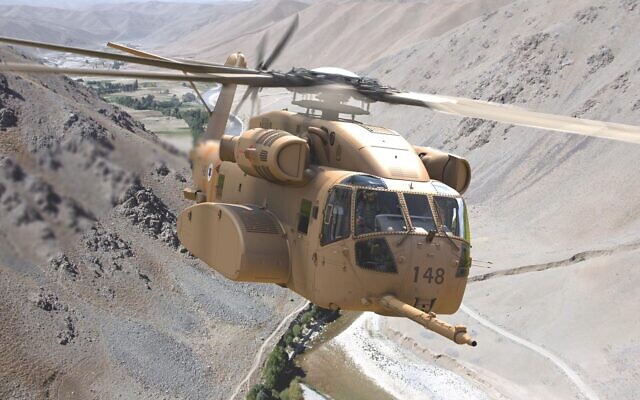
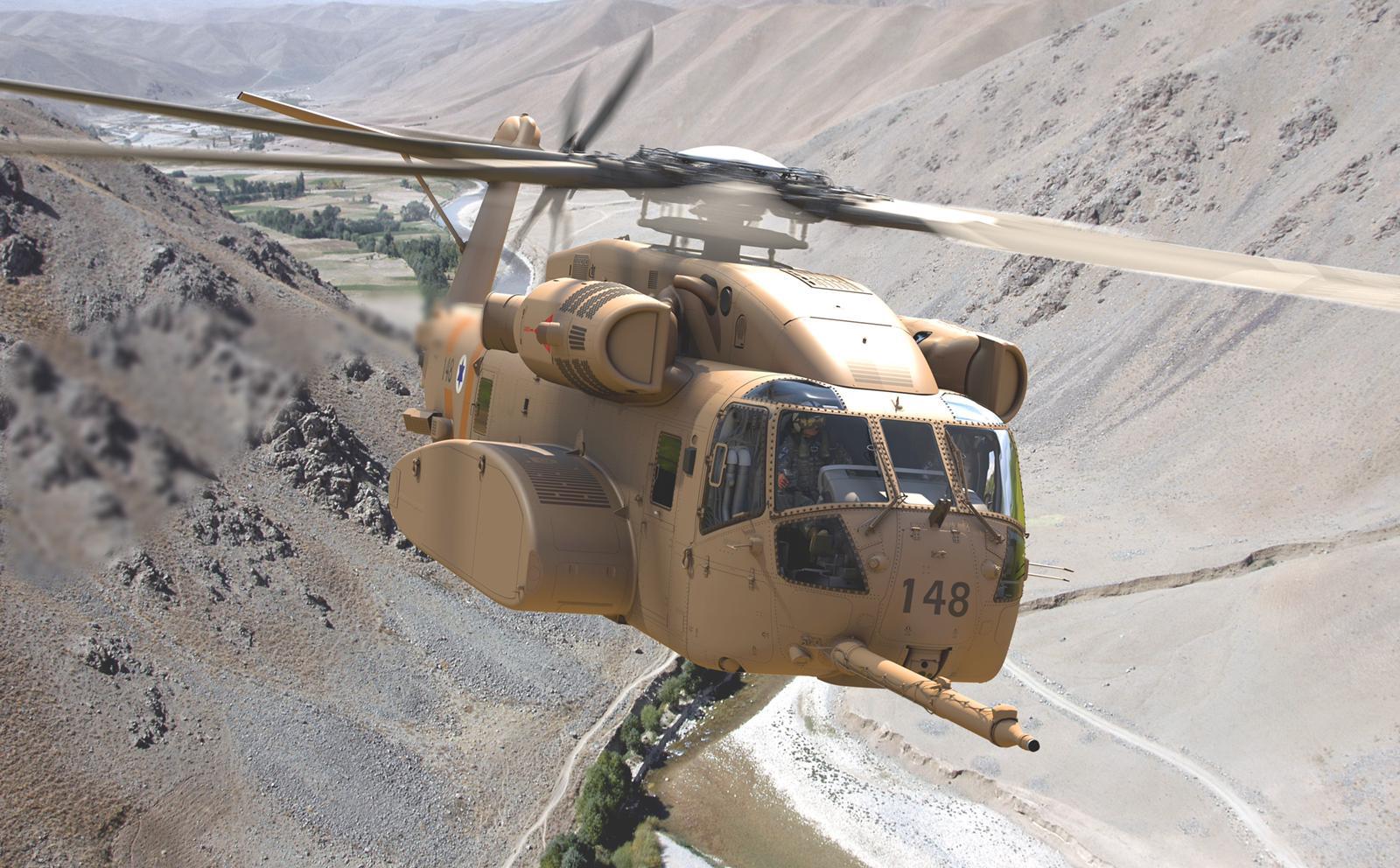
An undated photograph of a Sikorsky CH-53K King Stallion heavy transport helicopter, which Israel signed an agreement to purchase from the United States on December 30, 2021. (Lockheed Martin)
Israel on Thursday signed a long-awaited agreement to purchase a dozen heavy transport helicopters and two additional refueling planes from the United States, in a weapons deal worth over $3 billion, the Defense Ministry said.
These aircraft, along with a number of additional F-35 fighter jets that Israel plans to purchase from the US, are specifically meant to counter threats posed by Iran, including its nuclear program.
According to the ministry, in addition to the fighter jets, transport helicopters and refueling planes, this includes “advanced aerial munitions, air defense systems, new naval and land-based platforms, and cyber and digital systems.”
The 12 CH-53K Sikorsky CH-53K King Stallion heavy transport helicopters will replace Israel’s aging fleet of CH-53 Sea Stallion helicopters, which have been in use for over half a century and have seen a number of maintenance issues in recent years. The first CH-53K helicopters are scheduled to arrive in Israel in 2026, according to the ministry.
Under the agreement, Israel has the option to purchase six more CH-53K helicopters in the future as well.Get The Times of Israel’s Daily Editionby email and never miss our top storiesNewsletter email addressGET ITBy signing up, you agree to the terms
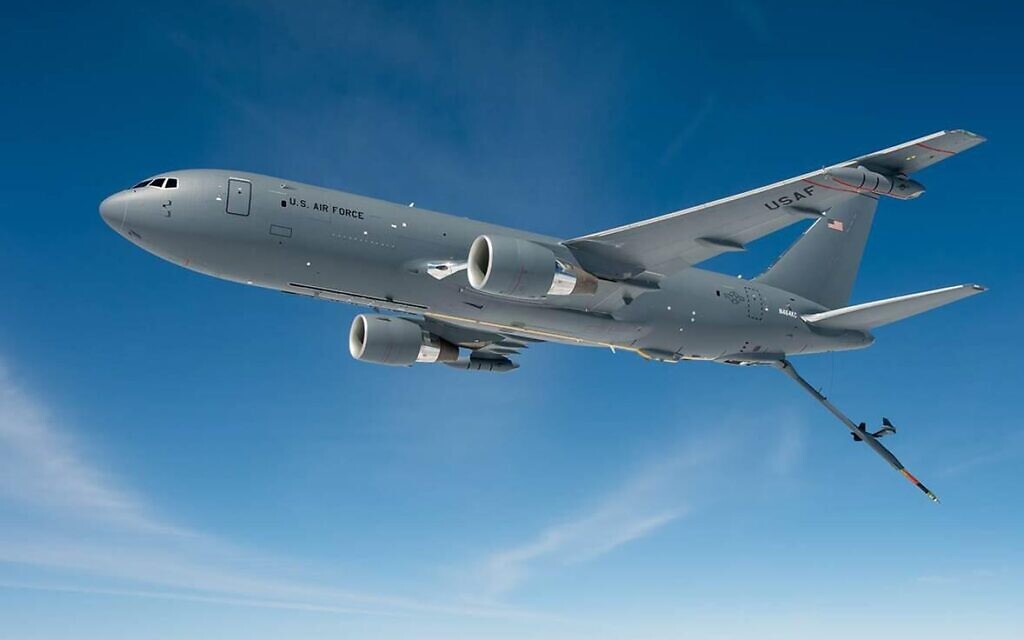
In addition, the delegation of the ministry’s purchasing department signed a deal to buy two more Boeing KC-46 refueling planes, which would be needed in order to conduct strikes against targets in Iran, some 2,000 kilometers (1,200 miles) from Israel and far outside the regular flight range of Israeli jets.An undated photograph of a Boeing KC-46 refueling plane, which Israel signed an agreement to purchase from the United States on December 30, 2021. (Boeing)
Israel has already agreed to purchase two of these refueling planes, which are scheduled to arrive in 2025. Israel has asked that this date be moved up by a year — a move that would require the US to give up its spot in line to receive the planes from Boeing — but Washington has thus far rejected the request.
The helicopter deal will cost Israel roughly $2 billion and the refuelers will cost another $1.1 billion, with the money coming from the $3.8 billion that Israel receives from Washington as part of the 10-year memorandum of understanding between the two countries, the ministry said.
“The purchase of these platforms is part of a wider effort, which is being led by the Defense Ministry with the IDF over the past year and a half to strengthen the capabilities and force build-up of the IDF against current and future threats, mostly those posed by the ‘third-ring,’” the Defense Ministry said.
In Israeli military parlance, the first ring refers to threats directly on the country’s borders, the second ring refers to slightly farther-flung enemies, like those in Iraq or Yemen, and the third ring refers to those yet further away — in practice, it is almost exclusively used in connection with Iran.
Defense Ministry Benny Gantz negotiated the initial approvals for the sales with US officials. The budget was then approved by the ministerial committee for military acquisitions and the Knesset’s joint defense budget committee, Gantz’s office said. This summer, the US State Department also signed off on the sale of the helicopters saying it was “vital to US national interests to assist Israel to develop and maintain a strong and ready self-defense capability.”
The defense minister hailed the purchases, saying in a statement that they were a critical part of the military’s preparedness, particularly against Iran.
“We are continuing to grow stronger, to change, and to adapt the air force to future challenges, those close by and especially those far from Israel’s borders,” he said.
Posted December 28, 2021 by Joseph Wouk Categories: Uncategorized
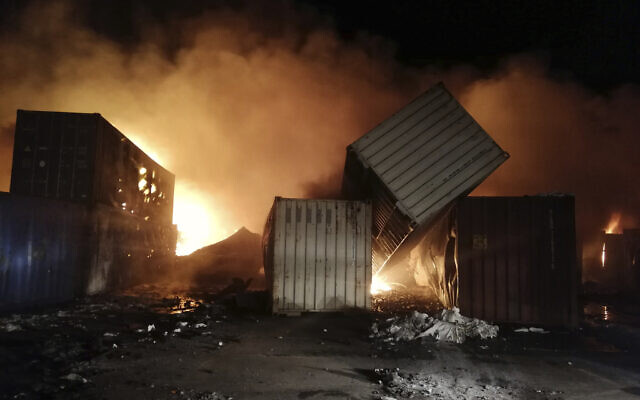
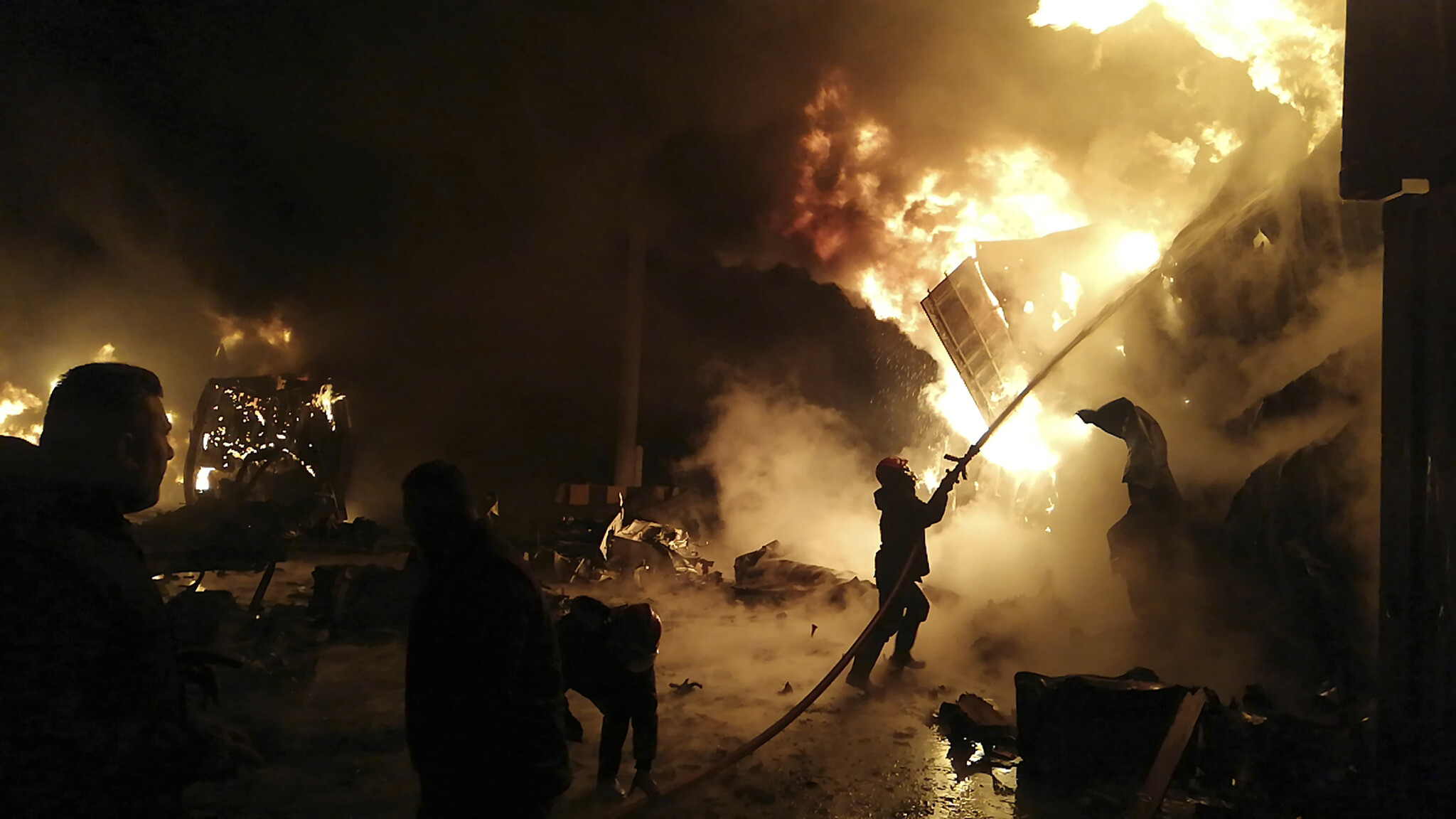
Videos posted to social media show huge explosions and fires raging across the port, likely from secondary explosions of Iranian munitions, in second attack on facility this month
In this photo released by the Syrian official news agency SANA, firefighters work at the scene of a missile attack, at the port of the coastal city of Latakia, Syria, Tuesday, Dec. 28, 2021. (SANA via AP)
Israeli warplanes fired a number of missiles at the port of the coastal city of Latakia early Tuesday morning, causing large explosions and fires, in the second alleged Israeli strike in a month on the key facility.
For years, Israel avoided conducting strikes against the Latakia port due to the large presence of Russian forces nearby, despite Iran allegedly using the terminal to transport advanced munitions through it to its proxies in the region, notably the Lebanese Hezbollah terror group.
SANA, Syria’s state media, quoted an unnamed military official as saying that several missiles struck the container area in the port, setting some of them on fire. He said the strikes caused “massive material damage.”
The Israel Defense Forces did not comment on the Syrian claims, as a matter of policy.
Videos posted to social media showed huge explosions and fires raging across the port, some of them apparently caused by secondary blasts from the missiles causing Iranian munitions to detonate.Get The Times of Israel’s Daily Editionby email and never miss our top storiesNewsletter email addressGET ITBy signing up, you agree to the terms
According to SANA, the missiles came from the direction of the Mediterranean.
The Syrian military official said efforts were still underway to put out fires and assess the damage. There were no immediate reports of casualties in the attack, which activated Syrian air defenses, according to SANA
Syria’s state-run al-Ikhbariyah TV ran footage showing flames and smoke rising from the terminal. It reported damage to nearby residential buildings, a hospital, shops and some tourist sites near the port.
An al-Ikhbariyah TV reporter in the area said the attack appeared to have been larger than the strike earlier this month and the explosions could be heard in Tartus, another coastal city more than 80 kilometers (nearly 50 miles) away.
Until earlier this month, strikes on the port of Latakia were highly irregular. The port is a vital facility where much of Syria’s imports are brought into the war-torn country and through which Iran reportedly brings in weapons and other equipment to its militias.
Though Israel has regularly conducted raids against Iranian-linked targets in Syria, it rarely strikes close to Latakia, let alone inside the terminal, as the Russian military maintains a base of operations nearby. Due to its delicate relationship with Moscow, Israel typically refrains from carrying out attacks against targets if there are Russian troops nearby, though Israel believes that this well-known policy has led Iran to seek to protect its arms transfers by conducting them near Russian-controlled areas.https://www.youtube.com/embed/EdCj1fKDfh0?start=26&feature=oembed
Before this month, the previous time that Israel reportedly conducted a strike on a target in the city of Latakia — though not in the port — was in 2018, during which a Russian spy plane was accidentally shot down by Syrian air defenses, causing a major confrontation between Jerusalem and Moscow. Israel has also reportedly carried out raids against targets in the port city in 2014 and twice in 2013.
Israel has staged hundreds of strikes on targets inside government-controlled Syria over the years but rarely acknowledges or discusses such operations. Many of the strikes in the past had targeted the main airport in the capital Damascus, through which Iran is also believed to transfer advanced arms to its proxies
Israel has acknowledged, however, that it targets the bases of Iranian forces and Iran-allied terror groups, particularly along the Golan border, such as Lebanon’s Hezbollah that has fighters deployed in southern Syria. It says it also attacks arms shipments believed to be bound for the groups.
Hezbollah is fighting on the side of Syrian President Bashar Assad’s forces in the decade-old civil war. In this photo released by the Syrian official news agency SANA, flames rise from containers at the scene of a missile attack, at the port of the coastal city of Latakia, Syria, early Tuesday, Dec. 28, 2021. (SANA via AP) Hours after Syrian media accused Israel of striking the port city of Latakia earlier this month, Prime Minister Naftali Bennett alluded to the incident, saying that the military was constantly fighting “bad forces” in the Middle East.
“We’re pushing back on the bad forces of this region day and night,” he said in English. “We won’t stop for one second. This happens almost daily.”
“In the face of destructive forces we will continue to act, we will be persistent, and we will not tire,” Bennett pledged.
Posted December 24, 2021 by Joseph Wouk Categories: Uncategorized
In shadow of Vienna talks, Jake Sullivan tells PM two countries need to find a joint way forward to face major security issues; Bennett downplays reported snub by White House
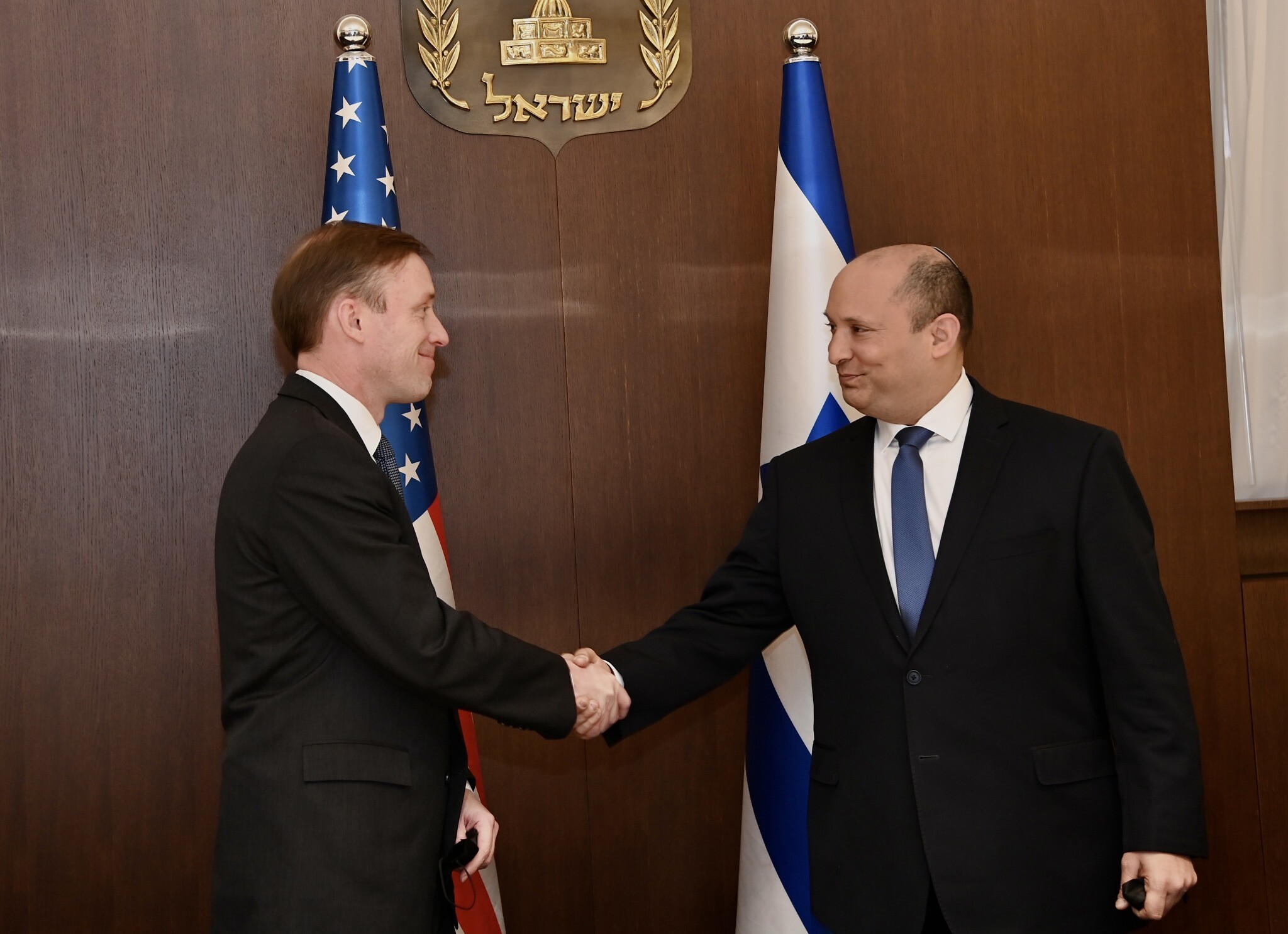
Prime Minister Naftali Bennett (right) meets with US National Security Adviser Jake Sullivan in Jerusalem on December 22, 2021. (David Azagury/US Embassy Jerusalem)
Prime Minister Naftali Bennett met on Wednesday in Jerusalem with US National Security Adviser Jake Sullivan and other visiting US officials, as Israel remained concerned over Western talks in Vienna with Iran over its nuclear program. Sullivan said the US and Israel are at a “critical juncture” in facing a major set of security issues, and need to “develop a common strategy” that serves both their interests.
“These days are pretty important,” Bennett told Sullivan in public remarks in English ahead of their meeting. “What happens in Vienna has profound ramifications for the stability of the Middle East and the security of Israel for the upcoming years. And that’s why it’s such a timely meeting.”
Sullivan told the prime minister that US President Joe Biden sent him to Israel “even just before Christmas” to coordinate and cooperate on their approach to Iran and other security issues.
“At a critical juncture for both of our countries on a major set of security issues, it’s important that we sit together and develop a common strategy, a common outlook, and find a way forward that fundamentally secures your country’s interests and mine,” said Sullivan. “And we believe those interests, like the values upon which our countries are built, are deeply shared and deeply felt.”
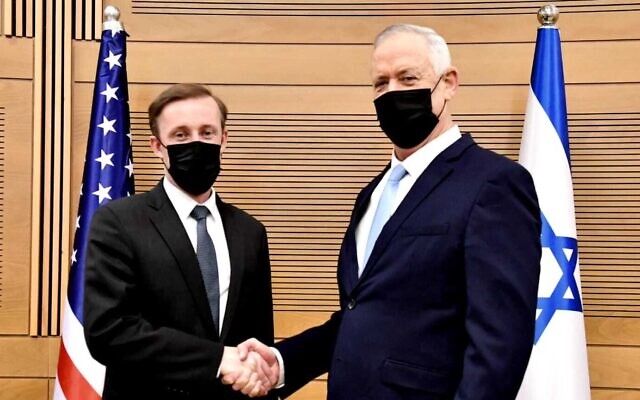
Sullivan then held meetings with Defense Minister Benny Gantz and Foreign Minister Yair Lapid.Get The Times of Israel’s Daily Editionby email and never miss our top storiesNewsletter email addressGET ITBy signing up, you agree to the terms
The meeting between Sullivan and Gantz also focused on Iran, the Defense Ministry said.
“During the meeting, a variety of strategic and cooperative issues were discussed, chief among them the Iranian nuclear fight and Iran’s regional aggression,” Gantz’s office said, noting that IDF chief Aviv Kohavi and director-general of the Defense Ministry Amir Eshel also attended.Defense Minister Benny Gantz meets with visiting US National Security Adviser Jake Sullivan at the Knesset on December 22, 2021. (Ariel Hermoni/Defense Ministry)
During the meeting, which was held at the Knesset, the defense minister also spoke with Sullivan about Israel’s efforts to strengthen ties with the Palestinian Authority, according to his office.
Sullivan held a meeting earlier on Wednesday with his Israeli counterpart, Eyal Hulata, and late Tuesday evening he met with President Isaac Herzog. US Ambassador to Israel Tom Nides and Israeli Ambassador to the US Mike Herzog also took part in Sullivan’s meetings with both Bennett and Herzog.
Sullivan and Bennett met shortly after reports surfaced saying that Biden has been ignoring Bennett’s request for a phone call, which Bennett appeared to downplay on Wednesday.
“I want to say that the relationship between my government and the Biden administration, between Israel and the United States, is as strong as ever,” Bennett said Wednesday. “And being so strong and having this meaningful friendship means that we can also talk openly and candidly about all the shared challenges that we’re facing. And that’s what we’re going to do.”From left: US Ambassador to Israel Tom Nides, US National Security Adviser Jake Sullivan, President Isaac Herzog and Israeli Ambassador to the US Mike Herzog meet in Jerusalem on December 21, 2021. (Haim Zach/GPO)
Herzog’s meeting with Sullivan also focused largely on Iran, with the president expressing “concern with Iran’s progress toward nuclear weapons under the cover of the negotiations in Vienna,” according to his office.
The meetings come as European diplomats warn that nuclear negotiations in Vienna to secure a return to the 2015 nuclear deal with Iran are “rapidly reaching the end of the road.”
In a blow to European mediators, Iran requested a new pause in the talks, which aim to bring the United States back into the agreement and roll back Iran’s nuclear activities. The Islamic Republic publicly stepped up its nuclear projects after the US withdrawal from the deal in 2018.
The talks had resumed in late November after a five-month break following the election of a new hardline government in Iran.
During a press briefing with reporters on Sunday, US State Department Spokesman Ned Price said the White House was not particularly optimistic about the talks, but was not giving up hope.
We are “curbing our enthusiasm for where we are and where we might go. There’s still a lot of work to do,” said Price. “What the team experienced on the ground in Vienna until the talks adjourned late last week, it was progress, but it wasn’t at a pace that was sufficient to get us to where we need if we are to render the JCPOA as a viable vehicle going forward.”People walk past Palais Coburg, where closed-door nuclear talks are taking place in Vienna, Austria, December 17, 2021. (AP Photo/Michael Gruber)
Earlier this month, Gantz visited Washington for discussions on Iran. He later told reporters he’d notified US officials that he had instructed the Israel Defense Forces to prepare for a strike against Iran.
Joining Sullivan in Israel are US envoy to the Middle East Brett McGurk and the State Department’s Acting Assistant Secretary for Near Eastern Affairs Yael Lempert.
A senior administration official told reporters on Monday that Sullivan was not delivering any new information to Israeli officials during this trip.
“It’s a visit that was long-planned, the culmination of a year of very close consultation,” the official said in response to a question from The Times of Israel. “So, there’s not — you know, there’s not a new deliverable or anything. This is part of a face-to-face engagement with close partners.”
After his meetings in Israel, Sullivan will travel to Ramallah to meet Palestinian Authority President Mahmoud Abbas.
Jacob Magid and Times of Israel staff contributed to this report.
Posted December 18, 2021 by Joseph Wouk Categories: Uncategorized
Introduction
Following the renewal of the seventh round of nuclear talks in Vienna, it is becoming more and more clear that all the sides involved are living in a fantasy and that their delusions are gradually being exposed. All the sides are realizing that their hopes and expectations are indeed delusions, and their declarations in recent days attest to the fact that their positions are cut off from reality.
The following is an examination of both sides’ positions.
The American/European Side
The American/European Side Does Not Understand That There Is No Way Back To The 2015 JCPOA Agreement – It Has Been Stripped Of Content By Iran And Exists As A Mere Empty Framework
Although all that remains of the JCPOA is its formal framework, and it has been completely emptied of content by Iran through the latter’s violation of all of its aspects, the American/European side is acting as if Iran’s nuclear program can be brought back under the restrictions of the 2015 JCPOA.[1] According to a November 17, 2021 International Atomic Energy Agency (IAEA) report,[2] Iran is enriching uranium far beyond the 3.67% permitted in the JCPOA, to 60%. Its inventory of uranium exceeds the permitted 300 kg, with 2,489 kg of uranium enriched to a range of levels: 113.8 kg at 20%, 17.7 kg at 60%, 1,622 kg at 2%-5%, and 59 kg at 2%. It is using IR-4- and IR-6-generation centrifuge cascades, much more advanced than the first generation that it is allowed to use; and it is not cooperating with the IAEA, in violation of its commitment to do so. It is also not allowing inspections of its declared nuclear sites and refuses to allow inspections or even to answer questions about its undeclared nuclear sites that have been exposed. Additionally, it is not cooperating with the IAEA in the matter of its plutonium reactor at Arak.
It should be emphasized that no declaration by senior Iranian officials has expressed an Iranian commitment to return to the original 2015 JCPOA even if the U.S. lifts all the sanctions.
The U.S. Administration Has Come To Terms With Iran’s Extortion Of Funds As A Condition For Contacts With It
About a month before the negotiations began, Iranian Foreign Minister Hossein Abdollahian demanded that the Biden administration release at least $10 billion of frozen Iranian funds to prove the seriousness of its intentions.[3]
Iranian Foreign Minister Abdollahian (Source: ISNA, Iran, December 14, 2021)
The U.S. administration released $3.5 billion to the Iranian regime as a gesture of goodwill, in the hope that it would be received as a sign of its serious intentions.[4] Additionally, several days before the talks began, the administration extended the waiver on sanctions for Iraq regarding Iranian oil – a path that allows Iran to sell oil via Iraq – which was also received in the West as an American gesture to the Iranian regime.[5]
The regime mouthpiece, the Kayhan daily, tried to clarify that this was not a precondition, but that “from now on, the payment that must be paid by the American side is $10 billion for its meeting” with the Iranian side, “and this is in order to test the sincerity of their intentions.”[6]
Even After Years Of Negotiations, The U.S. Administration Does Not Understand The Fundamental Political Culture And Ideology Of The Iranian Regime In Its Attitude Towards The U.S.: America Is “The Great Satan”; Iran Does Not Recognize It And Is Unwilling To Maintain A Public Relationship With It, And Will Not Accept A U.S. Return To Negotiations Before It Is Punished
The U.S. has been forced to agree to a preliminary discussion about the conditions for its reacceptance to the negotiations and to the JCPOA. On December 12, 2021, Iranian Deputy Foreign Minister Ali Bagheri Kani, who also heads the Iranian negotiating team, clarified: “One of the central issues in this [round of] negotiations [in Vienna] is to determine the conditions required for the [return of] America to the agreement from which it withdrew and which it now seeks to rejoin. Accordingly, we cannot ignore this agreement [the JCPOA on which Iran says it has based the demands that it has submitted] and I think that our view was not and is not maximalat all.”[7]
Furthermore, the Biden administration saw Iran’s insistence on excluding the U.S. from the negotiating room as a meaningless whim, thinking that the real issues will be determined in the negotiations themselves. U.S. State Department Special Envoy for Iran Robert Malley even reiterated, in a December 9, 2021 Al-Jazeera interview, the American administration’s proposal to Iran to hold direct negotiations “at any time and any place,”saying: “We’re prepared to meet with them face-to-face. We think it’s far superior to indirect negotiations.”[8]
Special Envoy Robert Malley (Source: Al-Jazeera, Qatar, December 9, 2021)
In his statements, Malley revealed the U.S. administration’s grave misunderstanding of how Iran perceives the U.S. position. “The Great Satan” is not a propaganda slogan, but a fundamental stance and an ideological foundation vis-à-vis the U.S., as expressed by the refusal of the government of Iranian President Ebrahim Raisi, like that of his predecessor Hassan Rohani, to conduct any public relationship with the U.S. One example from the past few days of this Iranian regime approach to the U.S. can be found in November 27, 2021 statements by Iranian Armed Forces spokesman Abu Al-Fadl Shekarchi: “The Imam [Ayatollah Ruhollah Khomeini] did well to call America ‘the Great Satan.’ ‘The Great Satan’ is one thing, and there are also smaller Satans, such as England and France… Every so often they, with their satanic nature, lead America itself to perdition. In many cases, England has been the basis for America’s fall, because the American officials are extremely stupid. The Satans in England… are birds of prey… [But] there is no difference between England, France, and America.”[9]
It is now becoming clear to the Americans that the Iranians’ exclusion of them in the negotiations is an essential matter of principle demonstrating that the U.S. is to blame for the situation, and that therefore it must take the first step – the lifting of all sanctions and Iranian verification of this on the ground, a process that takes time. Only afterwards will the Iranians make any move at all.
The U.S. Does Not Understand That Iran Will Not Compromise On Its Positions
With the renewal of the second stage of the seventh round of talks, on December 7, 2021, it is now clear to the Americans that the Iranian regime is considering its position paper, which it submitted, as a final position that must be accepted, and that this position must be the final outcome of the negotiations. The Americans also thought that the seventh round of talks would begin at the same point as the sixth round ended, and that there would be no backtracking from what was concluded by the two sides in the six previous rounds. They are now realizing that the Iranian side is rejecting those conclusions and is beginning from a different point, arguing that its position paper is based on the 2015 JCPOA and therefore must be accepted in full.
Iran’s representative in the IAEA, Mohammad Reza Ghaibi, at a November 25, 2021 IAEA Board of Governors meeting, explained the Iranian regime’s position, according to which “Iran believes that the negotiations must be results-directed. It is, therefore, important that the outcome of these efforts will ensure that all sanctions will be lifted effectively and that this can be verified [by Iran].”[10]
The American/European side had hoped that after the first round of negotiations with the Raisi government, the Iranians would more or less give up on their maximal demands as submitted in writing at the beginning of the seventh round of talks, and would present realistic positions for the opening of “serious” negotiations. But at a December 7, 2021 White House briefing, U.S. National Security Advisor Jake Sullivan expressed his frustration at Iran’s uncompromising position: “The more Iran demonstrates a lack of seriousness at the negotiating table, the more unity there is among the P5+1 and the more they will be exposed as the isolated party in this negotiation. So really, the ball is in Iran’s court as to whether it wants to show up and demonstrate that it’s going to be serious or not.”[11]
National Security Advisor Jake Sullivan (Source: CNN, August 18, 2021)
The Biden administration does not realize that its positive positions vis-à-vis Iran are completely unappreciated by the Iranian leadership – instead, they are perceived as weakness and as a basis for additional extortion.
In light of Iran’s rigidity, the Americans are now compelled to threaten with alternatives, even though they stress that their first preference is negotiations, and are examining cooperation with other countries – the three European countries in the negotiations, Britain, France, and Germany, and also with Israel.
The U.S. Does Not Understand Iran’s Refusal To Negotiate On Other Strategic Issues
The American position included a demand to discuss Iran’s ballistic missiles with a range of over 2,000 km, assuming that the Iranians realize that this must be part of the negotiations. But the Americans are now realizing that Iran’s refusal to discuss this issue is a matter of principle and that Iran will not back down on it.
The Iranian Side
Iran Does Not Understand That Its Positions Are Unrealistic And That The West Cannot Accept Them – And Thinks That It Can Force Them On The West
The new Iranian government, headed by President Ebrahim Raisi, believes that if it insists on its position that it will be able to force the West to lift all the American sanctions and that it will verify that this has been done before it makes any move whatsoever. It must be emphasized that Iran’s demand for all the sanctions to be lifted is in fact an expansion of the JCPOA framework; in the JCPOA it was concluded that only the nuclear sanctions would be lifted and that all the other sanctions on Iran, imposed by Congress for its violation of human rights and promotion of terrorism, would remain in place. This is because Iran refused to include these issues in the negotiations it conducted with the Obama administration, along with the issues of limits on the range of its ballistic missiles and its expansion in the region.
The Iranian regime thinks that its argument that Iran has met its obligations under the JCPOA will continue to be accepted, even though Iran has stripped all significance from the JCPOA, beginning in October 2019, in an orderly and proactive move. According to Iran’s position, the U.S. was the party that failed to meet its obligations, and therefore it is obliged to back down and make the first moves – that is, lift all the sanctions, have Iran verify that they have been lifted, and pay compensation to Iran for the suffering caused by President Donald Trump’s decision to withdraw from the JCPOA.
Statements by Ali Bagheri-Kani, Iranian Deputy Foreign Minister and negotiating team head for the Vienna talks, demonstrate this position. He said on December 9, 2021: “[The solution] to these disputes over [the lifting of] the sanctions [depends on] serious intent and practical willingness on their part [i.e. the U.S.]. When this serious intent is actualized, we will be able to take steps to lift the sanctions. The lifting of the sanctions creates a serious opening for advancing the talks, particularly with regard to [Iran’s] nuclear operation [regarding a return to its commitments].”[12]
Deputy Foreign Minister Bagheri-Kani (Source: Tasnim, Iran, December 7, 2021)
Iranian Foreign Minister Abdollahian wrote in an article published on December 7, 2021 by the Russian newspaper Kommersant: “During the previous six rounds of talks, it became abundantly clear to the Iranian side that America is not paying attention to the fact that there is no way to revive the JCPOA without lifting all the illegal sanctions… I want to stress that the current window of talks will not remain open forever. America and the three European countries must understand this very well.”[13]
The Iranians believe that they are proving their seriousness in the negotiations by adhering to procedural matters: their arrival at the talks, their remaining in Vienna even when the other side departs for consultations, and, primarily, the submission of the position paper whose comprehensive demands they expect to be fully met due to this ostensible “seriousness.” They also announced that they are about to submit an additional document regarding the compensation that the U.S. must pay to Iran for the damage done to it.
President Ebrahim Raisi said at a December 11, 2021 conference for Iran’s ambassadors to neighboring countries: “The presentation of the text of Iran’s proposal at the negotiations proves to the sides in the negotiations that we are in serious negotiations and that if the other side is determined to lift the sanctions, the way to arrive at an agreement is smooth.”[14]
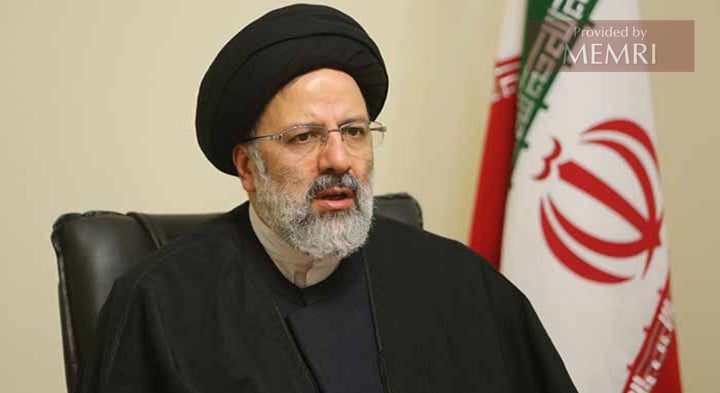
President Raisi (Source: Irdiplomacy.ir, April 16, 2017)
Iranian Interior Minister Ahmad Vahidi said on the eve of the talks’ renewal, on December 6, 2021: “The Raisi government has announced its intention to negotiate by giving two plans to the Europeans. The ball is in Europe’s court, and the outcome must be the complete lifting of the sanctions, and this is the serious demand of the [Raisi] government. The Western sides have returned to their countries [for consultation]. Our demand is clear, and the European countries must compensate [Iran] for their inaction in light of their violation of the [JCPOA] agreement. We must examine how serious they are regarding their commitment, and we are willing to work with them if [they lift the sanctions]. Their commitment must be to lift all the sanctions.”[15] However, it is now becoming clear to the Iranians that neither the U.S. nor Europe are willing to consider their position, even as an opening position.
The Iranian Regime Does Not Understand The Biden Administration’s Positive Intentions
The Iranian desire for the Iranian regime to publicly humiliate the U.S. is preventing the regime from understanding that the Biden administration is trying any way it can, with genuine goodwill, to arrive at an understanding with it by maintaining the JCPOA in a way that will serve Iran’s interests.
The Iranian Regime Is Mistaken In Its Delusions About Its Military Power vs. The U.S.
The Iranian side is deluding itself that it is capable of deterring the U.S. with threats and military operations. Furthermore, the Iranian side truly believes that the U.S. has been deteriorating since the 1979 Islamic Revolution, and that its retreat from Afghanistan is an additional manifestation of its weakness.[16] Recently, the Iranian regime staged an incident that it claimed had taken place in the Persian Gulf between forces of Iran’s Islamic Revolutionary Guard Corps (IRGC) and the U.S. Navy, simulating a U.S. attempt to capture an Iranian oil tanker that was foiled by the IRGC. A four-minute video montage was released depicting the alleged clash; the video included narration and commentary by Iranian strategist Hassan Abbasi, claiming that America has been “dead” since the 1979 hostage crisis. It is superfluous to note that the Pentagon denied that such an incident had taken place.
To view the December 2, 2021 video of an alleged attack and Hassan Abbasi’s commentary on MEMRI TV, click here or below:
It should also be noted that according to the Iranian regime, it dealt a successful blow against the U.S. Army in response to the assassination of IRGC Qods Force commander Qassem Soleimani, who led Iran’s expansion in the region, with missiles fired at the Ain Al-Assad base in Iraq. This is despite the fact that the attack had been coordinated in advance with the Americans so that there would be no loss of American lives. See MEMRI Inquiry and Analysis report The Iran-U.S. Crisis, Part III: Iran’s January 2020 Strikes On U.S. Ayn Al-Asad Airbase – The Roars Of A Fearful Paper Tiger, November 10, 2021.
Assessment
It appears that in light of the profound discrepancies between the sides’ positions, and the Iranian regime’s unwillingness to negotiate directly with the U.S., Iran will continue to demand that the U.S. pay it for continued contact with it in the coming rounds of talks, in order to shore up its shaky economy. At the same time, it is continuing to threaten the U.S. and demand that all the American sanctions be lifted, including those put in place by Congress that the Biden administration is not authorized or able to lift.
It should be noted that the only restriction stressed by the Biden administration concerning Iran is Iran’s obligation never to gain nuclear weapons. Such a demand is ostensibly compatible with the Iranian regime’s proud promotion of Iranian Supreme Leader Ali Khamenei’s alleged fatwa banning nuclear weapons.[17]
Based on the assumption that the Iranian regime is truly not interested in nuclear weapons, the sides should have found a common basis for future understandings. The not-insurmountable distance between these two positions should have led the sides to a common ground for understandings and agreement. But the fact is that neither side is even capable of conducting honest negotiations. This is for two reasons:
The assumption that Iran does not seek nuclear weapons is wrong.
The Iranian regime’s institutional ideological hostility towards the U.S., which it views as the leader of the world order that must step down from its role, does not allow its leaders to arrive at any agreement with the U.S. in which the latter does not fully surrender to the demands of the Iranian regime.
* A. Savyon is director of the MEMRI Iran Media Project; Y. Carmon is President of MEMRI.
[2] Iaea.org/sites/default/files/21/11/gov2021-51.pdf, November 17, 2021.
[3] Abdollahian said on Iranian TV on October 3, 2021: “Biden wants to get to the negotiating table… Therefore, we have told the other sides that our intentions are serious. We are people who negotiate, and we are people of action. You must know that the new Iranian government is one of action. Our people will not benefit from negotiations that will result in drinking coffee. Our people will benefit from negotiations in which all its economic interests are actualized in the framework of the nuclear agreement. [If] Biden’s intent is serious, he must demonstrate this, and serious intention means the release of at least $10 billion of [the Iranian regime’s] funds [that have been blocked in other countries].” Hamshahrionline.ir, October 3, 2021.
[4] Iranian Foreign Ministry spokesman Saeed Khatibzadeh confirmed, on November 15, 2021, that $3.5 billion of Iran’s blocked funds had been released, and added that “Iran is acting for the release of more of its funds.” ISNA, Iran, November 15, 2021.
[5] Freebeacon.com/biden-administration/biden-admin-ignores-congressional-inquiries-into-iran-sanctions-relief. November 29, 2021.
[16] See for example November 27, 2021 statements by Iranian Armed Forces spokesman Abu Al-Fadl Shekarchi: “Forty-three years ago, America was at its peak materially, and every day that has passed since the Islamic Revolution, America has plummeted several hundred meters, and now it is near the bottom.” ISNA, Iran, November 28, 2021.
 In this image made from April 17, 2021, video released by the Islamic Republic Iran Broadcasting, IRIB, state-run TV, various centrifuge machines line the hall damaged on April 11, 2021, at the Natanz Uranium Enrichment Facility, some 200 miles (322 km) south of the capital Tehran. (IRIB via AP, File)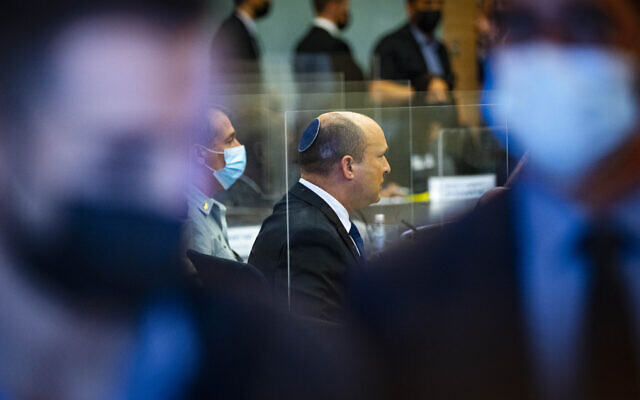


 An undated photograph of a Boeing KC-46 refueling plane, which Israel signed an agreement to purchase from the United States on December 30, 2021. (Boeing)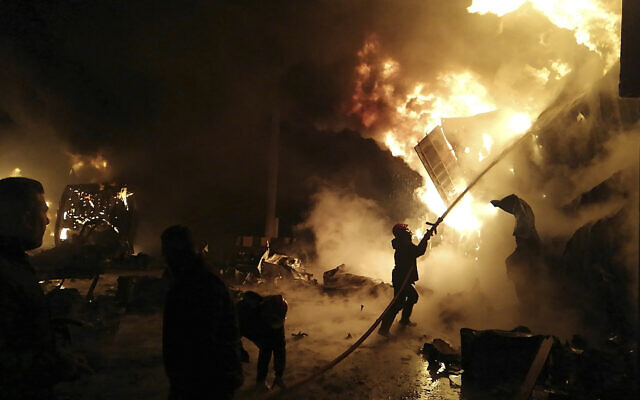
 In this photo released by the Syrian official news agency SANA, flames rise from containers at the scene of a missile attack, at the port of the coastal city of Latakia, Syria, early Tuesday, Dec. 28, 2021. (SANA via AP)
 Defense Minister Benny Gantz meets with visiting US National Security Adviser Jake Sullivan at the Knesset on December 22, 2021. (Ariel Hermoni/Defense Ministry)
 From left: US Ambassador to Israel Tom Nides, US National Security Adviser Jake Sullivan, President Isaac Herzog and Israeli Ambassador to the US Mike Herzog meet in Jerusalem on December 21, 2021. (Haim Zach/GPO)
 People walk past Palais Coburg, where closed-door nuclear talks are taking place in Vienna, Austria, December 17, 2021. (AP Photo/Michael Gruber)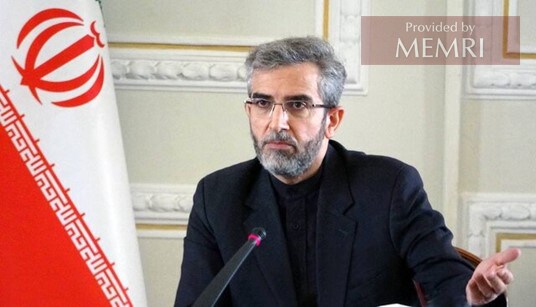




 anneinpt
 artaxes
 danmillerinpanama
 davidking1530
 Peter Hofman
 Joseph Wouk
 Peter
Peter Louisiana Steve
 WarSclerotic
Recent Comments