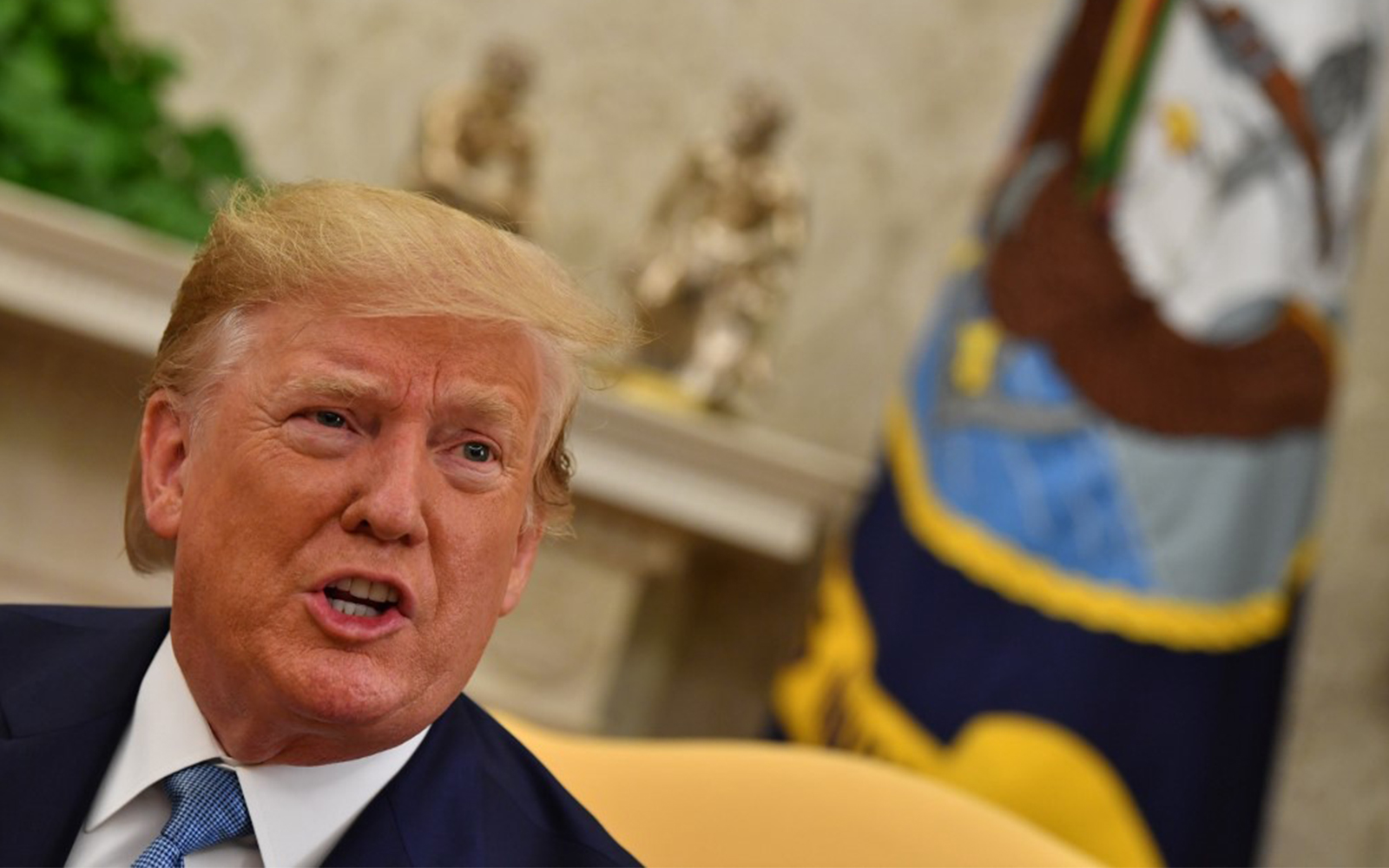
US President Donald Trump speaks during a meeting with Pakistani Prime Minister Imran Khan in the Oval Office at the White House in Washington, DC, on July 22, 2019. (Nicholas Kamm/AFP)
WASHINGTON — US President Donald Trump said Monday that chances of negotiating with Iran were dwindling, as he cited increasing tensions in the Gulf and blasted Tehran as the world’s top “state of terror.”
The president cited a series of recent conflicts involving the Islamic Republic, including the downing of US and Iranian drones and, most recently, Tehran’s announcement that it arrested 17 people in connection to a CIA spy ring, a claim Trump rejected as “lies.”
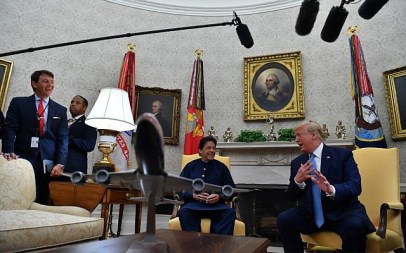
“Frankly it’s getting harder for me to want to make a deal with Iran, because they behave very badly,” Trump told reporters in the Oval Office, as visiting Pakistani Prime Minister Imran Khan sat at his side.
“I’ll tell you it could go either way, very easily,” Trump added. “And I’m OK either way it goes.”
Washington and Tehran have been at loggerheads since May 2018, when Trump unilaterally withdrew the United States from a landmark 2015 deal that put curbs on Iran’s nuclear program in exchange for sanctions relief.
US President Donald Trump speaks during a meeting with Pakistani Prime Minister Imran Khan in the Oval Office at the White House in Washington, DC, on July 22, 2019. (Nicholas Kamm/AFP)
On Monday, Trump ramped up the rhetoric, attacking Iran’s government as “a religious regime that is badly failing,” and saying the country has “tremendous problems economically.”
He also used menacing language, saying the United States was “ready for the absolute worst.”
“We are very geared up. They are really the number one state of terror in the world,” Trump said.
The aggressive remarks came as Washington announced it was placing a leading Chinese oil importer on its sanctions blacklist for trading in Iranian crude.
“As part of that maximum pressure campaign, I am announcing that the United States is imposing sanctions on the Chinese entity Zhuhai Zhenrong and its chief executive Youmin Li,” US Secretary of State Mike Pompeo said in a speech.
“They violated US law by accepting crude oil,” he added.
The sanctions seek to constrict Zhuhai Zhenrong’s access to global financial markets by banning any US individual or business — including financial institutions with US entities, like most global banks — from doing business with the company.
Illustrative: The USS Abraham Lincoln Carrier Strike Group and a US Air Force B-52H Stratofortress conduct joint exercises in the Arabian Sea, June 1, 2019. (US Navy photo by Mass Communication Specialist 1st Class Brian M. Wilbur/Released)
The head of Iran’s navy said Tuesday that Tehran is observing all US ships in the Gulf region and keeps an archive of their movements.
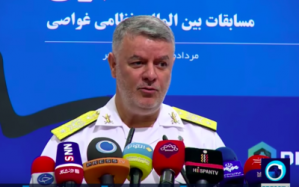
“We observe all enemy ships, particularly (those of) America, point-by-point from their origin until the moment they enter the region,” Rear Admiral Hossein Khanzadi said, according to a report on Iran’s Young Journalists news site, cited by Reuters.
“We have complete images and a large archive of the daily and moment-by-moment traffic of the coalition forces and America,” Khandazi added, noting that the images of the vessels were captured using drones.
The senior naval officer also said that Iran will hold joint naval exercises with “allied countries” for the first time in March 2020, without specifying which nations would take part in the exercises.
Khandazi’s statement came amid elevated tensions in the Gulf after Iranian authorities seized a British-flagged tanker there on Friday.
Navy Rear Admiral Hossein Khanzadi speaks at a Tehran press conference on July 31, 2019. (screen capture: YouTube/PressTV)
British Foreign Secretary Jeremy Hunt on Monday said the UK wanted to establish a European-led maritime protection force for the Gulf but emphasized that London was not seeking a confrontation.
“We will now seek to put together a European-led maritime protection mission to support the safe passage of both crew and cargo in this vital region,” Hunt told parliament.
“We will seek to establish this mission as quickly as possible,” he said, adding: “It will not be part of the US maximum pressure policy on Iran.”
Hunt described Friday’s incident as an act of “state piracy.”
Hunt also said that a British warship, HMS Duncan, that is being dispatched to the region, would arrive by July 29, joining the HMS Montrose currently in the Gulf.
According to the foreign secretary, all British-flagged ships would be asked to give the British authorities notice when they plan to pass through the Strait of Hormuz, where Friday’s incident happened, “to enable us to offer the best protection we can.”
But he added: “It is, of course, not possible for the Royal Navy to provide escorts for every single ship or indeed eliminate all risks of piracy.”
Iran released new video showing the ship’s crew for the first time on Monday, an apparent attempt to show they were unharmed. None of the 23 are British nationals. The crew is mostly Indian, and also includes Filipino, Russian and Latvian nationals.
Friday’s seizure of the Stena Impero came amid already heightened tensions between the US and Iran stemming from US President Donald Trump’s decision last year to pull the US from Iran’s nuclear accord with world powers and reinstate sweeping sanctions on Iran.
Iranian officials say the seizure of the British oil tanker was a justified response to the Royal Navy’s role impounding its Grace 1 supertanker with some 2 million barrels of crude off the coast of Gibraltar, a British overseas territory located on the southern tip of Spain.
Iran’s government spokesman Ali Rabiei said Monday that there are diplomatic solutions to the current crisis, but he also defended Iran’s actions.
“When you illegally seize a ship in Gibraltar… we don’t deem it as necessary to show tolerance,” he said. “Some countries have asked for the immediate release of the British tanker. Well, we ask those countries to make the same request to Britain first.”
Britain says it acted lawfully off the Gibraltar coast to prevent illegal oil shipments to Syria that would have violated European Union sanctions while Iran broke international maritime law by forcing the Stena Impero to change course and go to Iran.
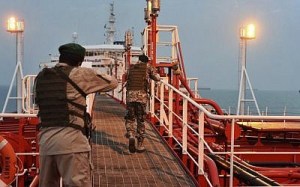
Two armed members of Iran’s Revolutionary Guard on July 21, 2019 inspect the British-flagged oil tanker Stena Impero, which was seized in the Strait of Hormuz on Friday by the Guard, in the Iranian port of Bandar Abbas. (Morteza Akhoondi/Mehr News Agency via AP)
Britain says the tanker was in Omani waters at the time, which Iran disputes.
As the nuclear deal between Tehran and world powers unravels, the US has expanded its military presence in the region, while Iran has begun openly exceeding the uranium enrichment levels set in the accord to try to pressure Europe into alleviating the pain caused by the sanctions.
European nations are trying to save the nuclear deal and have tried to come up with ways to keep trading with Iran but have run smack into Trump’s sanctions, which also target Iranian oil exports.
Boris Johnson, 55, takes over as Britain’s new prime minister after roundly beating Jeremy Hunt in the Tory party vote to succeed Theresa May as prime minister. Twice mayor of London and former foreign secretary, Johnson was a cheerleader for Britain’s exit from the European Union.
Parliament’s opposition to her Brexit deal was May’s Waterloo. Although he is often described as unpredictable, some political commentators liken his entry to 10 Downing Street to Winston Churchill’s takeover of the premiership in WWII.
On his tray are dangerously uncertain issues: Brexit and the tanker standoff with Iran. In his campaign for election, Johnson pledged to try and renegotiate favorable terms for Britain’s exit from the European Union, but if diplomacy failed, the UK would quit without a deal on October 31, a deadline which Brussels refuses to extend. Without a deal, the “divorce” process would, overnight, leave Britain divested of the single market and customs union trade arrangements in unknown waters.
The incoming UK PM starts out with one of the most destabilizing economic crises in Britain’s history. Many MPs, including some Conservatives, have said they will do all they can to stop no deal if the next PM tries to take that route.
In his victory speech, Johnson voiced confidence in his ability along with the team he chooses to overcome all these difficulties and go on to beat Labor led by Jeremy Corbyn in the coming election. For the first time in a decade, Labor has a chance of winning power in view of the disarray in the ruling Conservative Party.
Iran’s capture of the British-flagged Stena Impero on July 19 in reprisal for the British Marines seizure of the Iranian Grace 1 supertanker heading for Syria creates a dangerous standoff between Tehran and London. Calls for a European maritime force by Hunt had only lukewarm support from . Efforts will be stepped up to protect British merchant shipping in the Gulf, perhaps belatedly, but without the US in the lead the UK can’t handle the issue of Gulf maritime security on its own. Johnson enjoys an advantage in Washington in the personal praise lavished on him by President Donald Trump.
The new UK PM has shown friendship for and paid visits to Israel. As mayor of London he opposed the BDS campaign.
This week, Benjamin Netanyahu became the longest-serving prime minister in Israel. In a special interview to Israel Hayom, he looks back on a number of significant events from his time in office, first and foremost the new sanctions on Iran. He discusses the trust he has built with Russian President Vladimir Putin and seeks to calm those who are concerned that religion is taking over the state: “I won’t allow a state run by Jewish law to be established here, and I’ve already stated that. The Bible doesn’t belong to the religious public alone.”
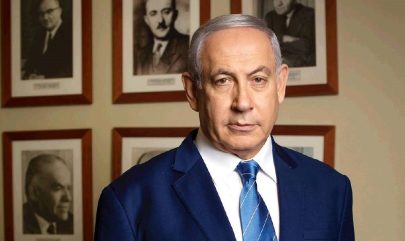
Prime Minister Benjamin Netanyahu | Photo: Arik Sultan
This week, Benjamin Netanyahu became the longest-serving prime minister in Israeli history, if we add his three years in office after the 1996 election to his past 10 and a half years as prime minister. And because 1996 and 2019 are a world apart, we asked him how he views the end of an era from above.
“Stefan Zweig wrote about the end of an era, ‘The World of Yesterday,’ a world that collapsed,” Netanyahu says.
“With us, it’s a different story. What has already happened is that we’ve made Israel into a rising global power. We discovered that we can leverage the basic characteristics of this people into exceptional strength in economics, defense and security, and diplomacy. We’ve proved that it is possible to turn Israel from a small country in a corner of the Middle East into a central world power.”
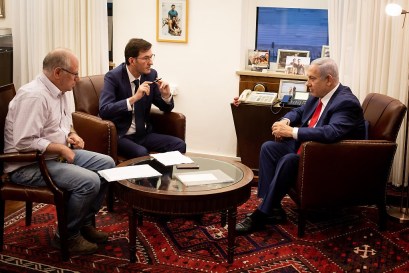
Prime Minister Benjamin Netanyahu is interviewed by Israel Hayom Editor-in-Chief Boaz Bismuth, center, and Amnon Lord | Photo: Arik Sultan
Q: In the past, people said that Israel was a state that was destabilizing the Middle East.
“They also used to say that all the problems in the Middle East were the result of the Palestinian problem.”
Q: And what is the situation today?
“There isn’t anyone who makes that claim seriously anymore. Even our sworn enemies are ashamed to say it because it’s obvious that the lack of stability here is the result of the struggle between the Dark Ages and modernism – between the tyranny of radical Islam and the forces of freedom. That’s the most important battle. That is what is destabilizing everything. Standing up to the fundamentalist Islam that wants to take over first the Middle East and then the entire world. If there’s one element that is stabilizing the Middle East and fighting radical Islam here, it’s Israel. The IDF is the only army in the world that is fighting the Iranian military, and that says it all. The ones who say that more than anyone else are the Arab nations. Their appreciation of us is going sky high. Their ties with us are growing closer. Even Europe understands that.”
The US – building widespread support
Netanyahu arrives for his interview with us hoarse, maybe because we meet him at the end of a workday in which he was surrounded by young staffers. The complicated electoral math of the upcoming election fades away for a moment as the prime minister looks back at how far he has come.
David Ben-Gurion now takes center stage for him more than Winston Churchill, and he refers to his service in the IDF’s elite Sayeret Matkal unit more than he used to. In addition to the rest of the subjects we raised, he also took care to remind us that he wants to “train the future generation of leadership” – a look ahead to the days that will follow him.
Q: In the past, including in the time of Ben-Gurion, foreign leaders would scold the Israeli premier.
“I’m not scolded too much. As the person who serves as the leader of the state of a people who broke the rules of history, rose from the ashes and built itself a state with a strong army, I’ve never felt that I arrive at meetings in an inferior position. I come with sober, realistic, positions, with deep confidence in what I represent. Therefore, one needs to speak with all due respect, and I’m not afraid of confrontation when Israel’s interests demand it.”
Q: The confrontation you had with former US President Obama, on camera. Was that something you planned?
“I don’t call that a confrontation, I call it the truth. I told the truth about our people. The truth about the Middle East. About the Israeli-Palestinian conflict. I said that the root of the conflict lies in their refusal to recognize the Jewish state. Afterward, I heard it described as defiance. I didn’t see it that way. It’s true that it came in response to President Obama’s remark that Israel should return to the 1967 borders. I respected Obama but I wasn’t afraid to express my position and he wasn’t afraid to express him. What wasn’t taken for granted was that I, as the prime minister of Israel, wasn’t bowing down. Even as much as we disagreed about Iran, it didn’t prevent us from arriving at a very important agreement that contributed a lot to our defense – $38 billion in aid over a 10-year period. I value that highly.”
Q: At the time, it was said that we were ‘losing’ America.
“America is our most important ally, but not our only one. Its importance can’t be overstated. But I believe that we also need to create alliances with other countries, not because they will take the place of the US, but because we increase our strength by forging ties with more nations. I’ve invested almost 40 years in fostering the most important element of our ties with America, which is public opinion in the US. While [Israel’s] ties with other countries are mostly based on mutual interests, our alliance with the US is mainly based on shared values. Values that identify us. At the end of the day, in a democracy like the US, policy on Israel stems not only from the person sitting in the White House but also the following factors: public opinion and how it is reflected in Congress, as well as in the White House. In general, Israelis tend to think that it’s just a question of who is in the White House. I held the opinion that it is vital to building a broad network of support for any event in any situation. It doesn’t matter who the president is.”
Q: Some claim that US support for Israel today comes from one party.
“It didn’t use to be a single party. When I was studying in the US after I finished the army, most of the support for Israel came from the Democratic Party. I didn’t find too many fervent supporters of Israel among the Republicans. That changed because America changed. The center of balance of the support changed. I’m not ignoring the voices that oppose us, either. We can’t change people and we can’t control the internal processes that are taking place in other countries. To a limited extent, we can influence them. We need to maximize our hold on the pillars of support and do as much as possible to check the points of opposition.”
Russia: Not just a matter of interests
Q: How would you define our current relations with Russia? Have they prevented a war in the north?
“The answer is yes. At least that’s what [President] Putin said, and I’m quoting him. When I was asked to run [for prime minister] again in 2000, I met Putin for the first time at a Chabad House in Moscow. He asked my wife for permission to steal me away for a few minutes. Three hours later, no one was left in the synagogue and we left. Since then, we’ve met several times. When he sent his forces into Syria, I immediately flew over and talked to him. There were two possibilities. I remember from the time I was a young soldier on the banks of the Suez Canal, how the IDF fought the Russians.”
“We downed their aircraft; they used surface-to-air fire to bring down our planes. It was obvious that we didn’t want to fight each other. I told him, with the directness that characterized our relations – there is mutual respect between us and we speak directly and to the point – that I would have to take action in Syria, that I wasn’t willing to allow Iran to bring its army to our borders. They [Iran] announce their intention of annihilating us. ‘What would you do?’ I asked him. I told him that I was sure he would do the same as me, and so we would continue our actions. That raised the question of how we would operate in such a crowded area if there was no coordination between us [Israel and Russia]. From the moment, we started to coordinate.”
“Since then, we’ve had 12 meetings. We took care to draw a red line between the IDF and the Russian army and from time to time, I would bring the IDF chief of staff or the head of the National Security Council or the head of the air force to Moscow for these meetings, so we could dot the I’s and cross the T’s of the coordination. That prevented a war and preserved the freedom of action that is vital to us. It was achieved through direct contact between leaders and persuasive abilities. Secondly, there was the determined nature of the action. Thirdly, we created additional mutual interests with Russia.”
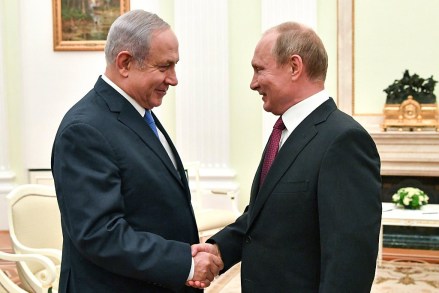
Prime Minister Benjamin Netanyahu shakes hands with Russian President Vladimir Putin at a meeting in Moscow in 2018 | Photo: Yuri Kadobnov/ Pool photo via AP
Q: But with them, it’s just a matter of interests. Where are the shared values?
“First of all, there are a million Russian speakers here [in Israel]. They are a cultural and human bridge.”
Q: Are they important to Putin?
“I think it creates an immediate bond. The bridge creates ties. Secondly, he admires the fact that I appreciate Russia’s role and contribution and suffering in defeating the Nazis. That’s something he doesn’t always hear. But he hears it from me. Not because I want to appeal to him, but because I think we should take into account what the Red Army did to contain the Nazis. And we always need to remember that there were about half a million Jewish soldiers who fought with the Red Army. Walking through Red Square, hearing ‘Hativka’ played here – it thrills the spirit. It shows you where we used to be. They mark Russia’s victory over the Nazis, but Russia wouldn’t have been wiped out even if it had been occupied. We know that we [the Jews] were nearly wiped out. We were the fragments of a people – dust and ashes. And now, 73 years after the victory, a prime minister of Israel is standing up and forming close ties [with Russia] and is one of only two foreign leaders who were invited to the march.”
Q: A Russian immigrant [Yisrael Beytenu chairman Avigdor Lieberman] is accusing you of wanting to found a state-run by Jewish law.
“That’s a bad joke. I won’t allow a state-run by Jewish law to be established here, and I’ve stated that. When the state was founded, there was a question about how we would handle the issue of religion and state. We are the only people through which the threads of both nationality and religion run. There are countries that have a lot of religions and there are religions that include a lot of different peoples. We are a unique people because we lost our land and established our national roots in our religion until we could re-establish our own state. Someone said, ‘Next year in the Vatican’? Ben-Gurion faced the dilemma of religion and state. On one side, there is a religious minority that wants a state governed by Jewish law, and on the other, there is the secular majority who opposes that. How do we solve it? We’re trying to solve it through ad hoc compromises. In one community there’s no public transportation on Shabbat, and in other places, there is, or the [local] Cinematheque is open. It depends on the community.”
Q: You talk about Ben-Gurion, who spoke about balances and the status quo. But I’ve found remarks of his in which he called the Bible ‘our mandate.’ Today, those remarks would be condemned as ‘religification.’
“No. The Bible isn’t the sole province of the religious public. It belongs to the Jewish people. It’s not by chance that we’re here. In those 2,000 years [of exile] there was a great coming into being during which the Bible was written. It’s our people’s book, the one that establishes our identity. There are universal things in the Bible that belong to all of humanity. There is no place where it is expressed more strongly. The Bible is the foundation of our existence. That is what my father [the historian Benzion Netanyahu] taught me. He was a nationalist whose worldview was anchored in the Bible. I married the daughter of a winner of the International Bible Quiz. And I re-launched Bible study at the Prime Minister’s Residence. I want to increase Torah study. I was asked what our core studies were – math and English and science. The same is true in Korea. I’m a Jew who respects Jewish tradition. When I meet haredi MKs and we talk about the weekly Torah portion, I always tell them, ‘Why don’t you study the Bible?’ Did you know that they don’t study the Bible?”
Iran: I was the first to see it
Q: Your rival party [Blue and White] is a military party.
“The military? It sounds like you haven’t been in the army for a long time.”
Q: A part of generals. It seems as if you had a long-term conflict with the security and defense establishment about Iran. What happened there? Former GOC Northern Command Yair Golan accuses you of blowing the Iranian threat out of proportion.
“It’s vital to identify a danger in time. If there’s one thing that characterizes our people, it’s that we haven’t spotted threats in time. My father wrote a book about a leader of the Jews of Spain who was a genius as well as the finance minister, Don Isaac Abravanel. And in 1492, shortly before the Jews were expelled from Spain, he writes that the situation of Spanish Jewry had never been better. A short time later, one of our greatest disasters befell us, and I can give you more examples. The Jews’ lack of ability to foresee the danger of the Holocaust. The arguments about Ze’ev Jabotinsky, who they called an alarmist, and they said the danger in Europe was not an existential threat. It is vital to identify a threat. I saw Iran as a terrible threat and wrote about it back in 1979. I saw the threat of radical Islam. It was clear to me that Islamism would replace Nasser’s pan-Arabism. They [the Iranians] were simply busy fighting a war with their neighbor, Iraq. The moment they were free, they continued the revolution that was designed to spread a murderous, zealous ideology. And a regime like that arming itself with nuclear weapons is an existential threat.”
“The first time I was elected prime minister, I saw that the matter still hadn’t sunk in. We weren’t in complete agreement, to say the least. We were busy with the Palestinians. And no one gave a thought to the issue, even if there was understanding. Yitzhak Rabin did actually think about it. We discussed it a few times. But our systems weren’t calibrated for a confrontation. Not in terms of diplomacy, not in terms of intelligence, not in terms of the military. There was a need to turn the ship around. When I left the Prime Minister’s Office, I did everything I could to bring about sanctions against Iran. I told [then-PM Ehud] Olmert that I wanted to work in the US at the diplomatic level for countries to apply sanctions to Iran. I wouldn’t have done that without his approval. As prime minister, I’ve once again done everything in my power to bring about American sanctions against Iran, as well as prepare our forces to pre-empt the threat. I think that the international community, which thought we would take military action, decided that the way of preventing us from doing do was to issue these sanctions.”
Q: Were we very close to military action?
“We were very serious. It was no bluff. The Obama administration thought so. In any case, as a result of a number of different considerations – and that might have been the main one – the US issued sanctions. Iran collapsed under the pressure. It started to feel the pressure. Then came the [2015] nuclear deal, which let up on the pressure. It gave them a pathway – an expressway – to nuclear capabilities within a few years. It wasn’t conditional on any change in their behavior. The argument was that if Iran received millions as a result of the sanctions being lifted, it would become a moderate state. Today, we can judge. I argued the opposite. Happily, President Trump withdrew from the deal and is applying new pressure to Iran. The answer is pressure, pressure, and more pressure.”
Q: Do you support an attempt to bring down the Iranian regime, or negotiations that will lead to a better deal?
“I support pressure that will do one or the other. It doesn’t matter so much which. But it could lead to one or the other. I won’t weep if there is a regime change, but [pressure] could also lead to a change within the regime, a change of policy. Right now, their policy is to quietly pursue nuclear weapons while also conquering the Middle East with the money that the eased sanctions sent flooding into Iran’s coffers.”
Q: A new book by Ilan Kfir says that in September 2012, you and [Ehud] Barak diverged in your approaches to a nuclear Iran. What happened that Barak, who had supported your policies, jumped ship?
“Ask him.”
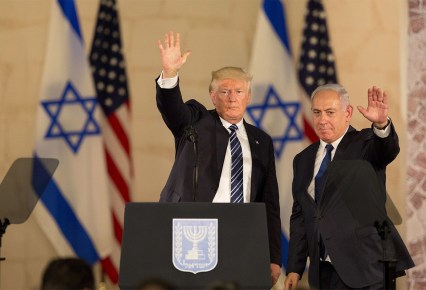
US President Donald Trump with Netanyahu in Jerusalem in May 2017 | Photo: AP (file)
Economy: The base for military might
Q: Ben-Gurion said that Israel’s fate depended on two things: strength and justness. Which is harder to maintain these days?
“You need to increase power, not maintain it. My outlook is built on bolstering our strengths. Without strength, we won’t survive. The weak don’t survive. A strong people forces alliances. So from the first moment, the main question about Israel’s existence was whether we would be able to develop the strengths to not only confront our enemies but also be accepted by the rest of the world. The simple fact is that what makes the world accept you is first and foremost, your strength. You think that the various Asian powers are accepted because they adhere to the practice of meditation?
“Or because of their moral principles and liberalism? Obviously, we also want the support of public opinion and the free nations for our truth and the justice of our path. That’s what I’ve done in the US. There is no Israeli who has worked more than me to sway American public opinion. I talk about justice there, about our rights. They say we’re a primitive state, an apartheid state. One that cruel to women, to minorities. The lies about us are absurd, and I’m hungry to smash them. At the same time, I tried to bolster and double Israel’s power. I gave instructions to build thousands of [missile] interceptors. There’s one bad thing about all these weapons – they cost a lot. Where will the money – tens of billions a year – come from? It will come from fostering our economic strength, by fostering a growing economy and by a relatively low tax rate to create a lot more revenue.
“I’ve learned that you need to develop a relative advantage, and it’s only possible in a free economy. So I’ve devoted a major part of my public life to liberating the Israeli economy, which was concentrate and even demi-socialist, with a huge public sector that was burdening the private sector. The fat were riding the backs of the thin. When I first became prime minister, an Israeli citizen couldn’t take more than $1,000-2,000 out of the country without a special permit from the Bank of Israel. Could the start-up nation have functioned that way? I freed the currency. I also handled the deficits, and not by printing money, but by setting priorities. It demanded some very difficult things, like reducing child stipends. All these decisions led to growth. There is a difference between thinking and doing. You need to shed political blood, and I paid the highest price in the short-term. Economic strength determines military might. Seven years ago, I set a goal of Israel becoming one of the five leading world powers in the cyber sector. I can say that thanks to our cyber capabilities, we’ve prevented 50 major terrorist attacks. When the world sees the quality of the technology, everyone wants to benefit from it. The ‘diplomatic tsunami’ folks argue that the way into the world starts with dangerous, extensive territorial concessions, which will make us accepted in the Arab world. I argued that we needed to take the opposite approach – first reach out to the world, and from there approach the Arab world. Our ties with the Arabs are stronger than they’ve ever been. That might lead to a deal with the Palestinians we could live with. I believe in strength. My rivals believe in concessions that will lead to weakness.”
The future: Don’t be afraid to swim against the stream
Q: Is there a chance that the Likud might bring [former Justice Minister] Ayelet Shaked on board?
“I can tell you one thing – I have some experience in diplomacy, security, and economics. And also with connecting all these things. And I’ve also acquired political experience. My political experience tells me I shouldn’t answer that question.”
Q: In 1996 you said that you wouldn’t serve more than two terms.
“I said that if there were direct elections [for prime minister], if there was a presidential system – which I support – I would support everything it entailed, including term limits. But no parliamentary system anywhere in the world limits the number of terms in office. I’m in favor of the presidential system.”
Q: What drives you after so many years in power?
“A sense of devotion to basing Israel’s strength in the time allotted to me. The public determines how much time I have, not me. Analysts say these things so often that we get sick of hearing them. My mission is, first of all, to check the threats, complete the liberation of the Israeli economy, and reduce regulation. We were one place above last on an OECD index [on economic freedom]. Now we’ve jumped 15 places. I want to reach the top five. You have no idea how happy the citizens of Israel would be. The small business owners whose lives we make miserable with regulations and legal entanglements – they have to be freed. And that will be reflected in prices and in economic growth.
“What also motivates me is the need to stop another threat to us – missiles. We’re on the way to solving the problem, to continuing to normalize relations with the Arab world, and possibly by doing that solving the conflict with our Palestinian neighbors. The choice is between me, with experience and the results that I bring, or Benny Gantz, who lacks experience. I don’t think he can operate in the various fields I’ve described. He doesn’t share the views I’ve described. To be a leader of Israel, which we have made into a rising power on the international stage, you need to be able to play on the global pitch. You have to. If the prime minister of Israel doesn’t take direct action on US public opinion, he can’t act as an equal, he can’t initiate economic and international processes that concern Israel, and Israel won’t continue on its current path. I want to keep strengthening Israel, and also very much want to train the leadership that will come later.”
At the end of our conversation, Netanyahu tells us about his family’s connection to Avraham Arnon, one of the founders of the Sayeret Matkal.
“We became very close when he was ill. He stayed at my parents’ house and told me, ‘I want you to stay in the army, for you to become commander of the Sayeret Matkal, and then continue your way up.’ I told him I had taken part in a lot of operations. I was wounded in the operation to free the Sabena hostages. I lost friends. I had given five years, but I felt that ultimately, the future would be determined by statesmen. I’m not sure that a hundred Sayeret Matkal units can fix the damage caused by one failed statesman.”
“So think about what would have happened if we’d put our heads down and accepted the nuclear deal. As Benny Gantz and Gabi Ashkenazi said, there’s nothing we can do about it. Or [Yair] Lapid, who said it wasn’t so bad and we had to accept it. If I hadn’t appeared before Congress, American public opposition to the deal would have fallen apart. If it had, that meant that Iran would have continued on its path without hindrance, without pressure, without sanctions. Without oversight. I needed to take the opposite tack – often against these same people as well as against others who were in key positions. Ben-Gurion also had to take a stance against the army, numerous times. So I went against the military. Like I went against former Chief of Staff Ashkenazi when I forced him to build the border fence in the south. That fence saved Israel.”
Iran’s supreme leader meets with Hamas deputy leader, says Hezbollah chief’s goal of praying on Temple Mount is ‘an absolutely practical and achievable aspiration’
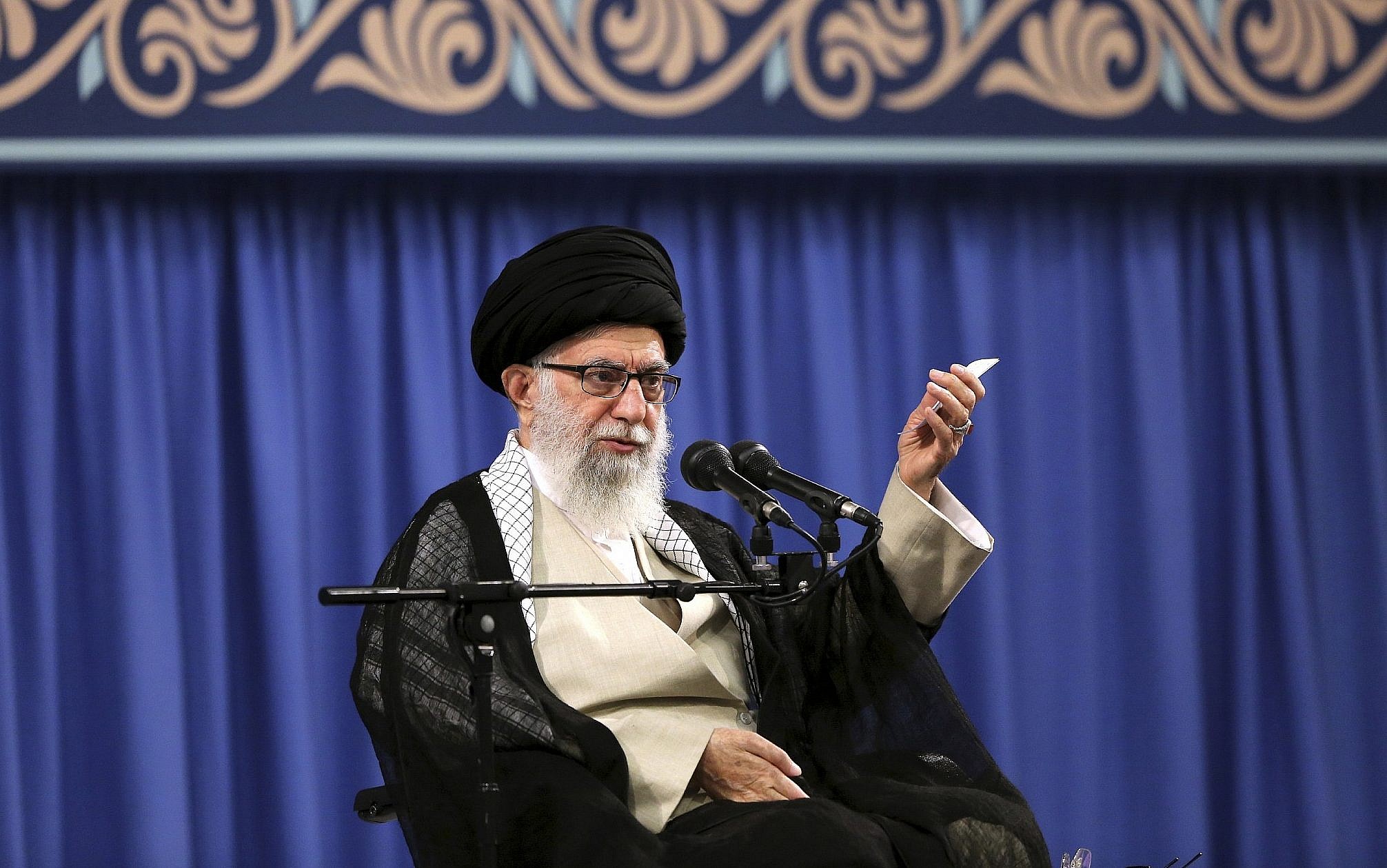
Supreme Leader Ayatollah Ali Khamenei speaks in a meeting with a group of clerics, in Tehran, Iran, July 16, 2019. (Office of the Iranian Supreme Leader via AP)
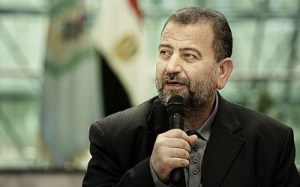
Iran’s supreme leader Ayatollah Ali Khamenei met Monday with a delegation from the Palestinian terror group Hamas and held talks with its deputy chief, Saleh al-Arouri, who is heading the delegation.
Khamenei told the Hamas officials that supporting the Palestinians “is an ideological and religious matter” and strongly condemned the Mideast peace plan pushed by US President Donald Trump’s administration, which he said the Palestinians have “precision missiles” to resist.
“The dangerous conspiracy of the ‘Deal of the Century’ is aimed at destroying the Palestinian identity among the Palestinian public and youth,” an English statement on his website quoted him as saying.
“Confronting the Deal of the Century requires promotional, cultural, and intellectual efforts and the other method is to make the Palestinians feel advancement. Today Palestinians are equipped with precision missiles rather than stones and this means the feeling of advancement,” Khamenei added.
Khamenei.ir@khamenei_ir
Hamas stands at the core of Palestine’s movement, just as Palestine stands at the core of the World of Islam’s movement.
He also said “the return of this holy land [Israel] to the World of Islam is not a strange and unattainable matter” and called Hezbollah leader Hassan Nasrallah’s goal of praying at the Al-Aqsa Mosque on Jerusalem’s Temple Mount “an absolutely practical and achievable aspiration for us.”
Al-Arouri told the Iranian leader that “we believe that based on the divine promise, Qods, and Palestine will be freed from the tyranny of the Zionists,” according to the statement from Khamenei’s office.
The Hamas delegation also met with Kamal Kharrazi, an adviser to Khamenei.
The Iranian official news agency IRNA said al-Arouri’s visit to Tehran followed a visit by senior Iranian parliamentary official Hossein Amir-Abdollahian to Lebanon last week.
The victory of the people of Palestine & the return of this holy land to the World of Islam is not a strange and unattainable matter. 40 years ago no one could believe that in Iran a religious government would emerge & the Israeli embassy in Tehran turn into Palestine’s embassy.
Khamenei.ir@khamenei_ir
That Mr. Sayyid Hassan Nassrallah says: “I will pray at Masjid al-Aqsa, God willing,” is an absolutely practical and achievable aspiration for us. If we all act upon our duties, the divine promise will definitely come true.http://english.khamenei.ir/news/6894
Iran backs both Hamas and the Lebanese terror group Hezbollah. Iran and Hamas do not recognize Israel and have both vowed to destroy it.
On Sunday, al-Arouri met in Tehran with Kamal Kharazi, the head of Iran’s Strategic Council on Foreign Relations, and said that Hamas and Iran stand on “the same path” in fighting Israel, Iran’s semi-official Fars news agency reported.
“We are on the same path as the Islamic Republic — the path of battling the Zionist entity and the arrogant ones,” he said, according to the report.
Hamas deputy political chief Saleh al-Arouri, after signing a reconciliation deal with senior Fatah official Azzam al-Ahmad, during a short ceremony at the Egyptian intelligence complex in Cairo, Egypt, October 12, 2017. (AP/Nariman El-Mofty)
Arouri and several other high-ranking Hamas officials, including Moussa Abu Marzouk, Maher Salah, Husam Badran, Osama Hamdan, Ezzat al-Rishq and Ismail Radwan, arrived in Tehran on Saturday for a multi-day visit, the terror group’s website reported on Saturday.
Arouri, who was elected as Hamas’s deputy chief in October 2017, has traveled to Iran at least five times over the past two years.
He has frequently heaped praised on Iran, which is believed to be a major financial backer of the Izz ad-Din al-Qassam Brigades, Hamas’s military wing.
“Iran is the only country that says that entity is carcinogenic and should be uprooted from the region,” he told the pro-Hamas Al-Quds TV in February 2018. “It is the only country that is prepared to provide real and public support to the Palestinian resistance and others to confront the entity.”
Hamas chief Ismail Haniyeh told a group of Turkish journalists via video-conference on Saturday that he hopes the Hamas delegation’s visit in Iran would achieve “important results.”
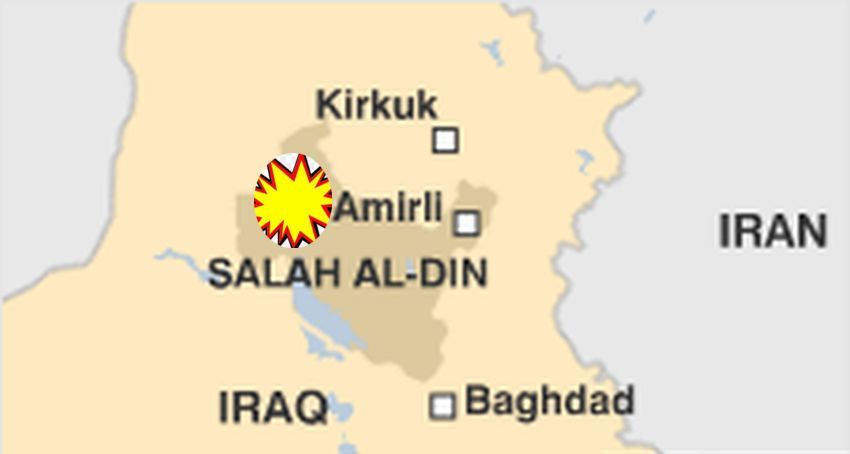
Iranian and Iraq intelligence sources claim an Israeli Harop UAV carried out the attack on the 52ndBrigade of the Hashd Shaabi militia on Friday, July 19. The attack struck the militia at a Badr Brigades camp outside Amerli town in the Salahudin Province northeast of Baghdad.
The sources identify the fragments gathered at the site as belonging to the IAF’s Harop, a loitering combat unmanned vehicle, itself a flying bomb, developed by Israel’s Aerospace Industries. This drone is a stealth munition that can loiter for up to six hours before homing in on a target. It has a range of 1,000km. The Badr camp is about 900km from Israel.
Some Russian aviation websites also speculated on Sunday that Israel was responsible for the attack.
According to Iranian Revolutionary Guards, there were no casualties – in denial of local accounts of deaths among Iranian and Hizballah officers.
If the Iranian and Iraqi claim is confirmed, it would represent three groundbreaking events:
The Israeli Air Force’s first known attack on an Iranian target using a Harop UCAV.
The first Israeli attack deep inside Iraq not far from its border with Iran.
The Israeli minister Tzachi Hnegbi’s blunt remark on Sunday, that in the past two years Israel has caused Iranian military deaths in both overt and covert operations, may have betrayed some impatience with the Trump administration’s policy of military restraint against Iran, including Tehran’s threat to Gulf shipping. In certain circles, Washington’s restraint is seen as exposing Israel to bolder Iranian aggression.
Israel has repeatedly put Tehran on notice that its plans to use Iraq as a launching pad for attacks on Israel would not be tolerated.
The edgy US-Iranian conflict took a new turn on Friday, July 19, with the anonymous drone attack on the pro-Iran Hashd Shaabi’s 52nd Brigade camp outside Amerli, a town in the Iraqi province of Salahudin northeast of Baghdad. Up until then, the targets of this measured, no-casualty conflict were Gulf oil objects and drones. The attack on the Iraqi Shiite militia was in a different class. This time, multiple casualties were reported, including Hashd Shaabi officers and fighters as well as Iranian and Lebanese Hizballah officers and technicians.
Local Sunni tribesmen attested to the camp serving as a transit station for ballistic missiles smuggled from Iran and apparently destined for the Iraqi Shiite militias fighting in Syria and for Hizballah. Other locals described the targeted site as an assembly plant for missile component smuggled from Iran in refrigeration trucks for transporting perishable food.
The attack itself on a military facility lying 110km northeast of Baghdad bears professional military fingerprints provided with good quality intelligence. This is indicated by the operation being conducted in two stages. In the first, an unidentified drone wrecked the buildings. Half an hour later, another unmarked drone made sure the buildings were razed to the ground while also liquidating the first responders coming to the site of the attack.
DEBKAfile’s military and intelligence sources report that some local witnesses had video clips taken two days earlier, which showed an aircraft identified as a US B350 reconnaissance plane making several passes over the area. This top-secret aircraft has served US special forces in counter-terror operations around the world. Its presence with special American forces in Iraq was discovered when one of them crashed in 2016.
On Friday, US officials firmly denied any American role in the attack on the Hashd Shaabi’s 52st Brigade. It occurred at the same time as the USS Boxeramphibious assault vessel shot down an Iranian drone over the Strait of Hormuz. Still, US intelligence support to the assault cannot be ruled out; or even the transfer of intelligence to the party responsible after the plan of attack was presented to Washington.
This scenario would turn the finger of suspicion towards Saudi Arabia, which has a score to settle for the explosive drone which flew in from Iraq in mid-May and damaged a key pumping station on its East-West oil pipeline. Both Riyadh and Washington are unlikely to countenance Iran opening a new front from Iraq in the north on top of the assaults coming from Yemen in the south.
Another theory attributes the attack to Israel, which has put Tehran on notice that the deployment to Iraq of ballistic missiles for aiming at targets on its soil would not be tolerated.
The military connotations of the drone strike on the Iraqi Shiite militia are more far-reaching that the Revolutionary Guards’ seizure of the British Stena Imperotanker in the Persian Gulf. In the latter case, it is highly doubtful that the US or the UK, which is sunk deep in political crisis, will launch a military operation for its release, whereas the former revealed that an armed conflict proper, to which none of the parties admits responsibility, was being waged on the brink of their “quiet war.”
Official in Palestinian terror group lambastes Khalid bin Ahmed Al Khalifa for photo with Israeli counterpart, says it shows ‘just how pro-Zionist some Arab officials have become’
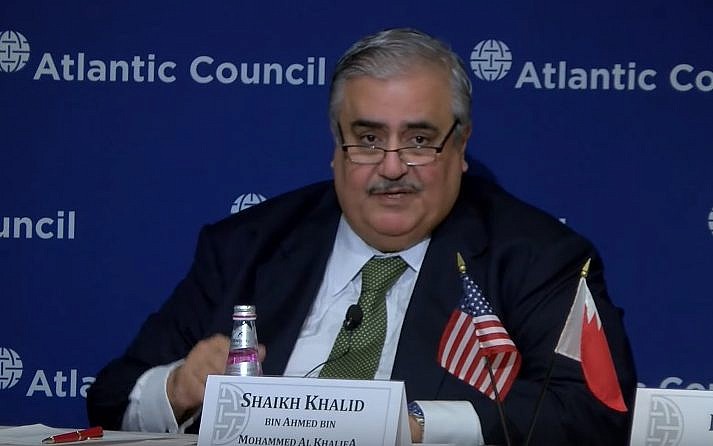
Bahraini Foreign Minister Khalid bin Ahmed Al Khalifa at the Atlantic Council in Washington, DC, July 17, 2019 (YouTube screenshot)
Bahraini Foreign Minister Khalid bin Ahmed Al Khalifa has said that if it were not for Iran’s support of Hamas and other armed groups in the Gaza Strip, Israel and the Palestinians would be nearer to peace.
Iran is a backer of the Izz ad-Din al-Qassam Brigades, the Hamas terror group’s armed wing, and the al-Quds Brigades, Islamic Jihad’s military branch.
“We don’t want to let this issue [of the Israeli-Palestinian conflict] continue to be used by countries or terror groups that seek dominance in the region. And that will bring us to the issue of Iran,” the top Bahraini diplomat said Wednesday at an Atlantic Council event in Washington, DC.
“If it wasn’t for Iran being present — Iranian soldiers, Iranian money, Iranian support for Hamas and jihadis that take control of Gaza — we would have been much closer to achieving a better peace between the Palestinians and Israelis and we would have a better chance,” he said. “But that role was so toxic that it would make things difficult every time.”
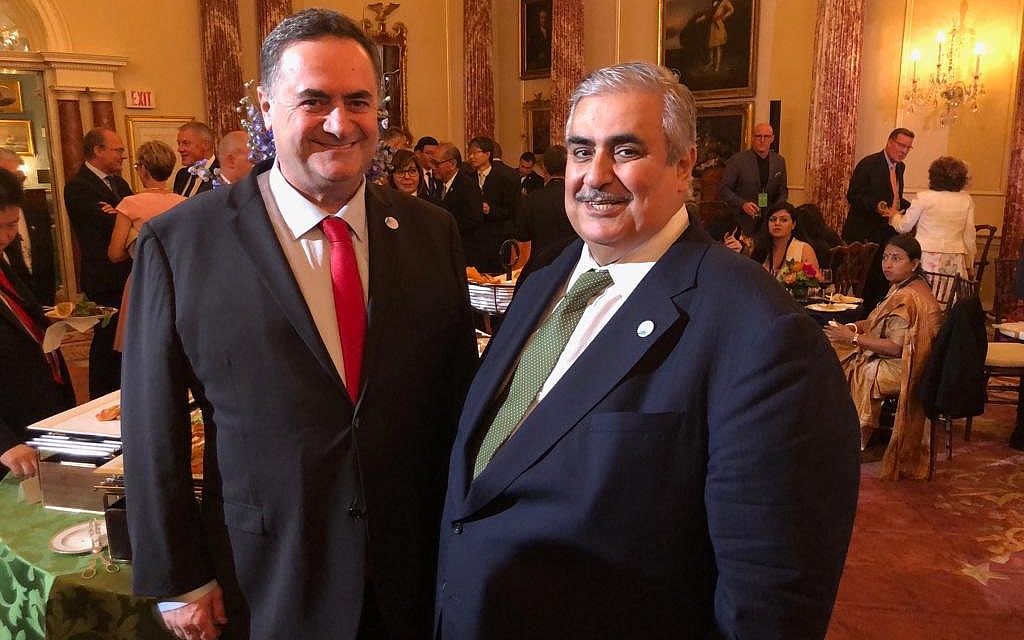
Foreign Minister Israel Katz and his Bahraini counterpart Khalid bin Ahmed Al-Khalifa (R) pose for a photograph at the State Department in Washington on July 17, 2019. (Courtesy)
Like Israel, Bahrain has long vociferously criticized Iran over its support for armed groups in the Middle East. Iran also supports the Houthi rebels in Yemen, the Popular Mobilization Units in Iraq and Syrian President Bashar Assad’s government.
The footage of the Bahraini foreign minister’s comments only surfaced on Friday, when the Atlantic Council posted them to its YouTube page.
Khalifa had also said his country was interested in future tourism and trade with the Jewish state, but added that it was “too early” to discuss such moves. “We want to get there.”
In a first this week, Khalifa posed for a photo with Israeli Foreign Minister Israel Katz. Israeli Prime Minister Benjamin Netanyahu has increasingly touted the country’s growing ties to Arab states through both open and clandestine channels. On Thursday the Foreign Ministry even said Katz and Netanyahu were hoping to work towards peace agreements with Gulf nations in the coming years.
Bahraini Foreign Minister Khalid bin Ahmed Al Khalifa speaks with the Times of Israel on the sidelines of the Peace to Prosperity workshop in Manama, Bahrain, on June 26, 2019. (Courtesy)
But while Khalifa spoke of the Israeli people wanting and deserving “peace of mind in their lives and for the future generations,” he stressed that “as much as the Israelis have the right to their own country, the Palestinians have the right to their own country, on their own land.
“They have been there for millennia. And there’s no way that we ignore their right to belonging to that land,” he said.
Meanwhile Hamas censured Khalifa for his photo with Katz.
“The warm photo of Bahrain and the occupation’s foreign ministers reflects just how pro-Zionist some Arab officials have become,” Hamas official Sami Abu Zuhri tweeted. “These meetings and photos are a betrayal of Jerusalem and Palestine and they will not succeed in undermining the consciousness of the nation or pushing it to give up on Palestine or normalizing the occupation.”
Jason Greenblatt, one of US President Donald Trump’s Middle East peace envoys, posted the photo to Twitter on Thursday and said the two foreign ministers took part in a “friendly exchange.”
Jason D. Greenblatt
✔@jdgreenblatt45
Terrific progress in Washington this week for Israel, Bahrain & the region – @Israel_katz & @khalidalkhalifa friendly exchange at the @StateDept Ministerial to Advance Religious Freedom
Katz said he and Khalifa “discussed Iran, regional threats and bilateral relations, and agreed to remain in contact.”
Israel and Bahrain do not maintain formal diplomatic relations. Both countries, however, have vociferously criticized Iran over its support for armed groups in a number of countries in the Middle East.
Hamas, an Islamist terror group that has vowed to destroy Israel, has urged Arab states against engagement or normalization with Israel.
In late June, Bahrain hosted an American-led workshop which focused on the economic portion of the US administration’s long-awaited proposal to resolve the Israeli-Palestinian conflict.
US Treasury Secretary Steven Mnuchin, fifth from left, and Bahrain Crown Prince Salman bin Hamad Al Khalifa, sixth from left, listen to White House senior adviser Jared Kushner, standing, during the opening session of the ‘Peace to Prosperity’ workshop in Manama, Bahrain on June 25, 2019. (Bahrain News Agency via AP)
While no Israeli officials attended the summit in Manama, a number of Israeli businessmen and journalists did so.
Hamas and the Ramallah-based Palestinian leadership fiercely opposed the conference in the Bahraini capital.
The Palestine Liberation Organization asserted that the conference’s economic focus sought to undermine its aspirations for statehood. It also accused the US of attempting to use the gathering to normalize Israel’s status in the Arab world.
In an interview with The Times of Israel on the sidelines of the summit, Khalifa expressed hope for better relations and eventually “peace” with Israel — a country he nonchalantly declared a part of the region and “there to stay.”
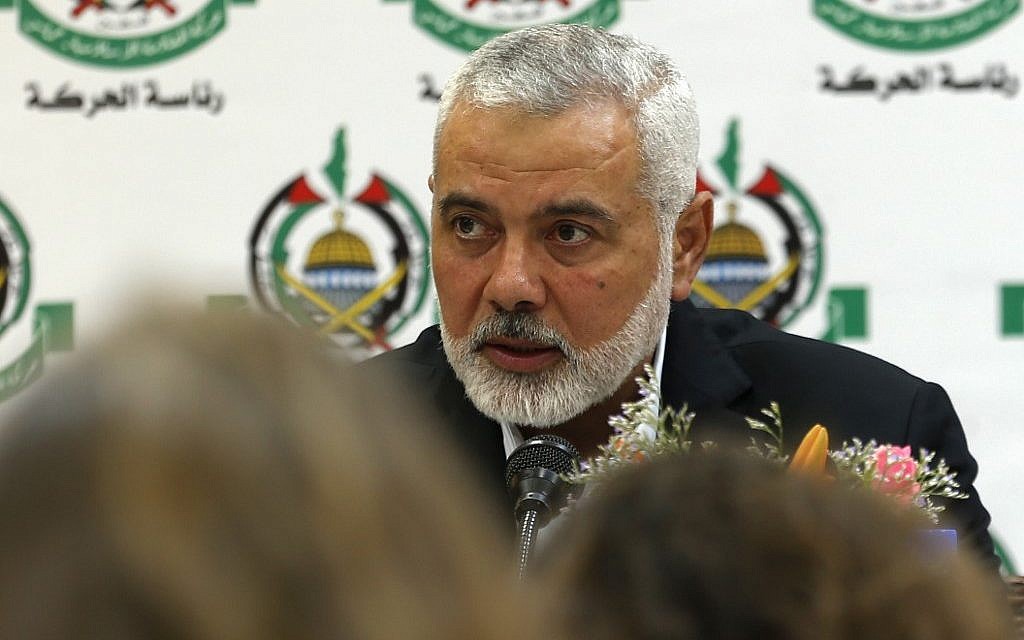
Hamas leader Ismail Haniyeh speaks during a meeting with foreign reporters in Gaza City on June 20, 2019 (Mohammed Abed/AFP)
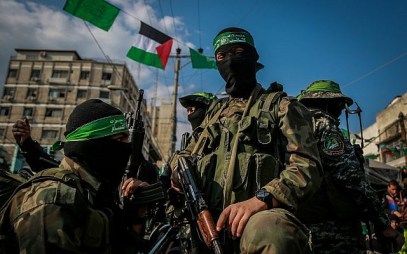
Hamas leader Ismail Haniyeh said Saturday that a delegation of senior officials from the terror group had arrived in Tehran for a visit.
Haniyeh was mum about the purpose of the mission. The delegation was headed by the leader of the group’s military wing in the West Bank, Saleh al-Arouri, the Maariv news site reported.
“The visit will go on for a few days. We’re expecting important results,” Haniyeh said.
Iran is a backer of the Izz ad-Din al-Qassam Brigades, the Hamas terror group’s armed wing, and the al-Quds Brigades, Islamic Jihad’s military branch.
According to the London-based publication Middle East Monitor, described as a pro-Hamas outlet by the BBC, a Hamas delegation met with Iranian officials in Beirut on Friday at the Iranian embassy.
The delegation, which according to the report includes Hamas’ Lebanon representative Ahmed Abdel Hadi, met with the special aide to the President of the Iranian Shura Council, Hossein Amirabdollahian, and briefed him on “the latest developments” and reactions to the US peace plan.
Last month, Washington unveiled the details of the economic aspect of the US peace plan, dubbed “the deal of the century,” saying it would inject $50 billion into struggling economies in the Middle East over the next ten years.
The plan was unveiled in Bahrain in June by White House adviser Jared Kushner, US President Donald Trump’s son-in-law, who hailed it as a “success.”
The proposal — which aims in 10 years to create a million new jobs, slashing unemployment and improving living standards in the West Bank, Gaza and across the Middle East — has been rejected by Palestinians because it does not include a framework for resolving their conflict with Israel. US officials say the political portion of the plan addressing the longstanding thorny issues may not be released until fall.
The summit was boycotted by the Palestinian Authority and thus did not include any official Palestinian delegation. Hamas, vowed to Israel’s destruction, accused Kushner of becoming a “spokesman for the Israeli occupation.”
On Saturday, Haniyeh said Hamas did not oppose establishing a temporary Palestinian state based on 1967 borders but maintained the group’s view that Israel’s control over any lands was illegitimate. He made the comments to a group of Turkish reporters, the Ynet news site reported.
On Friday, several thousand Palestinians gathered near the Hamas-run Gaza Strip’s border with Israel to take part in weekly protests near the fence.
Some 6,000 people reportedly took part in the demonstrations. The Israeli army said some rioters hurled rocks and explosive devices at the border fence and that troops were responding with less-lethal means as well as live fire in several cases where suspects attempted to sabotage or break through the border.
A Palestinian protester hurls rocks at an Israeli army vehicle during clashes between Palestinian protesters and Israeli forces across the barbed-wire fence during a border demonstration near Rafah in the southern Gaza Strip on July 19, 2019. (SAID KHATIB / AFP)
The Hamas-run health ministry in Gaza said over 100 people had been injured in the demonstrations, around half of whom were hit by live fire. Also hurt were four paramedics and two reporters, the ministry said.
Channel 12 news reported that an Israel Defense Forces vehicle was hit by a bullet during the demonstrations, but no one was hurt.
Egyptian security officials had held talks with Palestinian leaders in recent days, in part to prevent a new flare-up of tensions between Israel and the Hamas-ruled Gaza Strip.
Fresh tensions were feared last weekend after Israel shot dead a Hamas field commander along the border, prompting the Islamist terror organization to vow revenge.
Israel later signaled it had fired in error, saying an initial inquiry showed the Hamas member, Mahmoud Ahmad Sabri al-Adham, had been erroneously identified by soldiers as an armed terrorist, but was apparently an operative trying to stop Palestinian youths from breaching the security fence.
Under the fragile ceasefire brokered by Egyptian and UN officials following a severe flareup in May, Israel is meant to ease aspects of its blockade on the coastal enclave in exchange for relative calm. Israel maintains that the blockade is necessary to prevent arms from entering Gaza that could be used in attacks against it.
Supporters of Hamas attend a rally marking the terror group’s founding in Gaza City on December 14, 2015. (Emad Nassar/Flash90)
Al-Adham’s death threatened to spark another round of large-scale violence between Israel and terror groups in Gaza. Throughout the past year and a half, the two sides have fought several bouts — with terror groups firing mortar shells, rockets and missiles at Israeli cities and towns, and the IDF retaliating with airstrikes — often sparked by smaller incidents along the border.
Last week at the protests a senior Hamas official called for members of the Palestinian diaspora to kill Jews around the world, but was forced to walk back his comments as the terrorist group distanced itself from his remarks.
Fathi Hammad, a Hamas politburo member considered a hardliner and known for his fiery rhetoric, said: “We must attack every Jew on the globe by way of slaughter and killing.”
His comments were condemned by PA and UN officials as well as by leaders of his own group.











 anneinpt
 artaxes
 danmillerinpanama
 davidking1530
 Peter Hofman
 Joseph Wouk
 Peter
Peter Louisiana Steve

Recent Comments