IDF strikes Gaza terror squad after drone drops IED on troops 

Posted September 7, 2019 by Joseph Wouk
Categories: Uncategorized

Source: IDF strikes Gaza terror squad after drone drops IED on troops – Arab-Israeli Conflict – Jerusalem Post

IDF attacked 5 Hamas posts after rocket fire on Friday; 2 Palestinian teens killed in border protests

BY ANNA AHRONHEIM
 SEPTEMBER 7, 2019 14:52
IDF strikes Gaza terror squad after drone drops IED on troops

The IDF struck a terror cell in the southern Gaza Strip after a drone dropped an IED on a military position along the border fence, the Israeli military said in a statement.

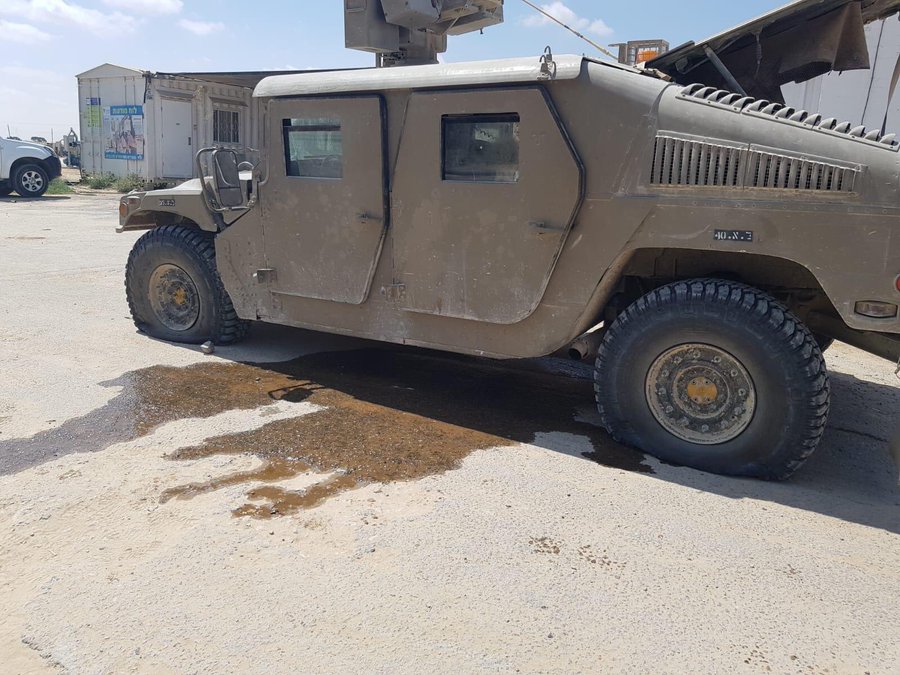
While no IDF troops were injured, there was slight damage to military vehicles by the drone attack.

According to Palestinian reports the cell was hit near Rafiah in the southern Strip.

Anna Ahronheim

@AAhronheim

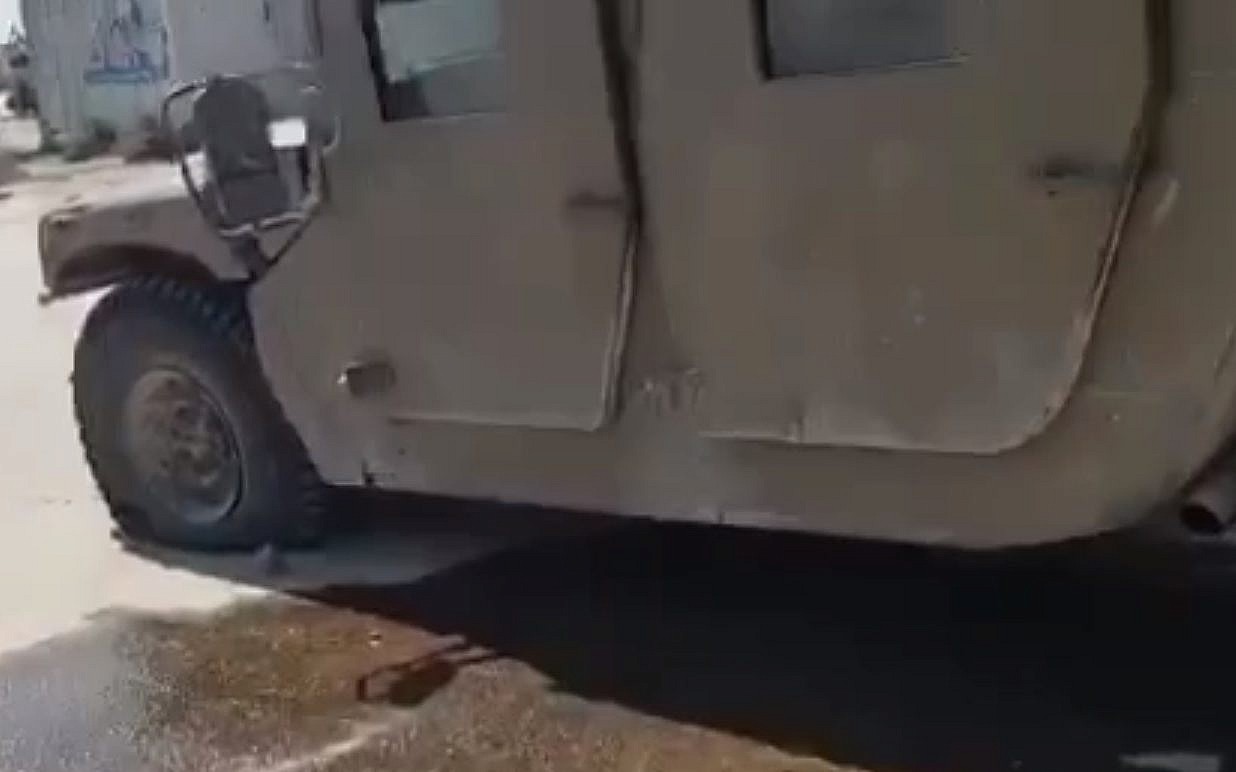
Picture of the vehicle which was targeted by a drone which dropped an IED on it. The drone infiltrated into southern from near the southern city of Rafiah

View image on Twitter

Anna Ahronheim

@AAhronheim

Video from the scene of the damaged vehicle

Embedded video

The incident came hours after the IDF struck several Hamas posts in the northern Gaza Stripon Friday night in retaliation for five rockets which were fired towards southern Israel communities bordering the Hamas-run enclave.

The military said that an IDF tank shelled a Hamas outpost north of Beit Hanoun and an IAF drone stuck a Hamas observation point near Beit Lahia.

The strikes came shortly after incoming rocket sirens were activated in the college-town of Sderot and the communities of Ibim and Kibbutz Or Haner. While there were no injuries two women were treated for shock.

A small fire also broke out after at least one rocket hit an open area outside Sderot.

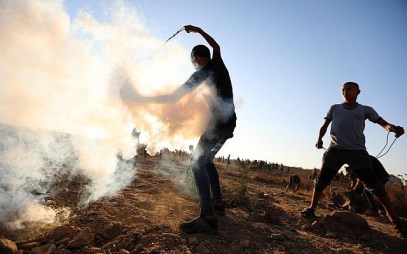
The exchange of fire came hours after two Palestinian teenagers were killed by IDF fire during the weekly Great Return March protests along the Gaza border fence which saw some 6,200 Palestinians riot along the fence, throwing explosive devices at troops.

“The demonstrations were of an especially violent nature, which included a large amount of IEDs, grenades and Molotov cocktails being thrown towards IDF forces along the fence,” read a statement provided by the IDF Spokesperson’s Unit. “There is noticeable damage to the border fence in several locations, and there has been a rising number of attempts to approach the border fence.”

The Hamas-run health ministry identified one of those killed as 17-year-old Ali al-Ashqar who was shot in the neck in northern Gaza Strip. A second teenager, 14 year-old Khaled al-Raba’i was shot in the stomach east of Gaza City.

Another 48 protesters were injured by live bullets and 33 others by rubber-coated rounds, including two medics and a photojournalist.

Hamas spokesperson Hazem Qassem tweeted in response to the deaths that “violating the blood of peaceful demonstrators in the marches of return and deliberately targeting them is a crime that the occupation bears all its repercussions.”


Iran injects uranium gas into advanced centrifuges, violating nuclear deal

Posted September 7, 2019 by Joseph Wouk
Categories: Uncategorized

Source: Iran injects uranium gas into advanced centrifuges, violating nuclear deal | The Times of Israel

Spokesman says Tehran has ability to go beyond 20% enrichment of uranium, which analysts say is short technical step away from weapons-grade; UN inspectors to monitor program

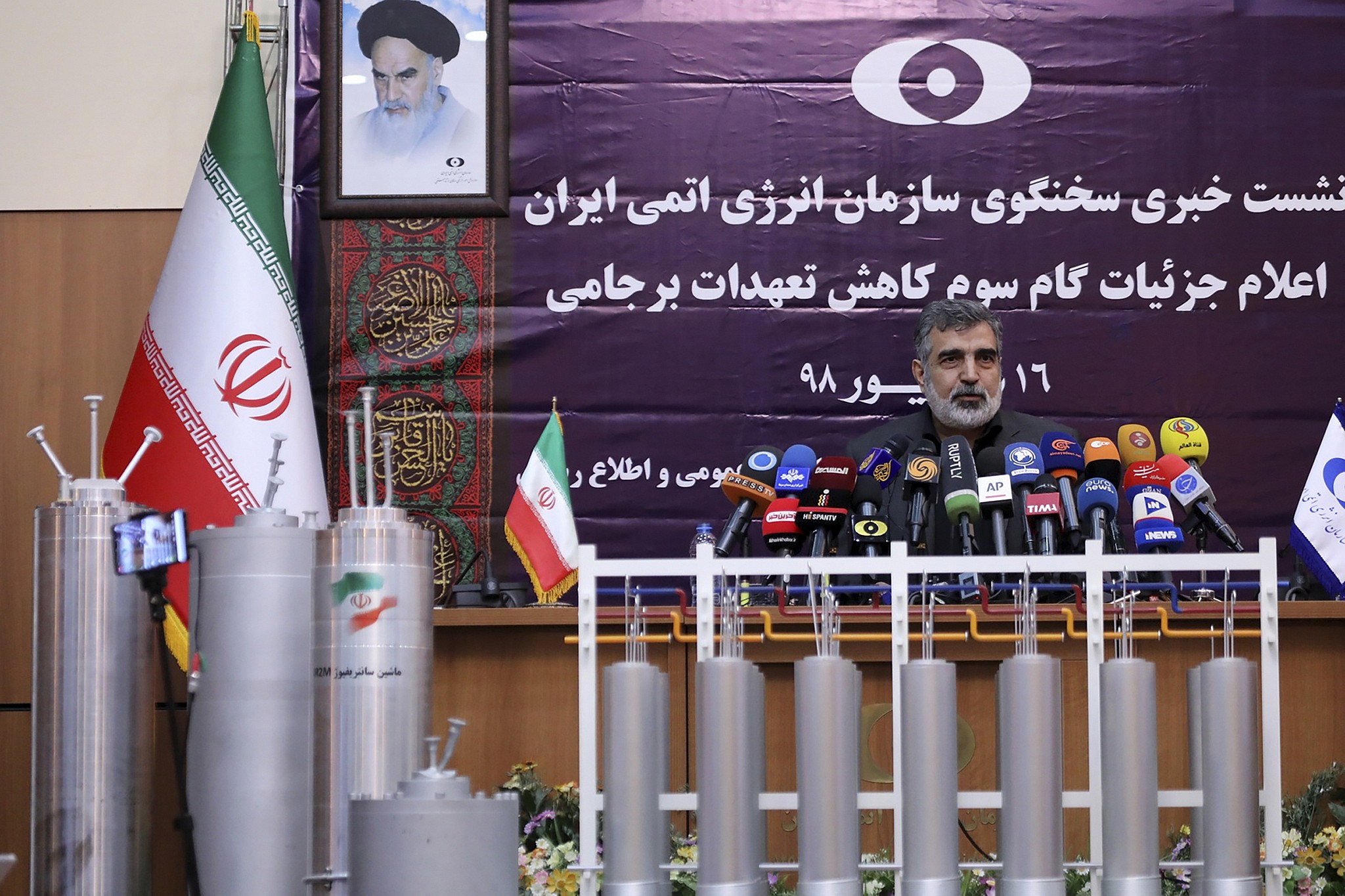
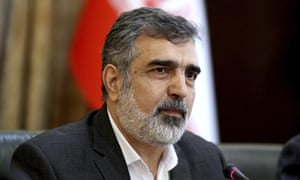
In this photo released by the Atomic Energy Organization of Iran, spokesman of the organization Behrouz Kamalvandi speaks in a news briefing as advanced centrifuges are displayed in front of him, in Tehran, Iran, Sept. 7, 2019 (Atomic Energy Organization of Iran via AP)

In this photo released by the Atomic Energy Organization of Iran, spokesman of the organization Behrouz Kamalvandi speaks in a news briefing as advanced centrifuges are displayed in front of him, in Tehran, Iran, Sept. 7, 2019 (Atomic Energy Organization of Iran via AP)

TEHRAN (AP) — Iran has begun injecting uranium gas into advanced centrifuges in violation of its 2015 nuclear deal with world powers, a spokesman said Saturday.

Behrouz Kamalvandi of the Atomic Energy Organization of Iran made the remarks in a news conference carried on live television. He spoke from a podium with advanced centrifuges standing next to him.

Iran already has breached the stockpile and enrichment level limits set by the deal, while stressing it could quickly revert back to the terms of the accord, if Europe delivers the sanctions relief promised in return for curbing Tehran’s nuclear program.

Kamalvandi warned that Europe had little time left to save the deal. US President Donald Trump withdrew America from the accord over a year ago before imposing crippling trade sanctions on Iran.

Spokesman of the Atomic Energy Organization of Iran (AEOI), Behrouz Kamalvandi answers the press in the capital Tehran on July 17, 2018. (AFP PHOTO / ATTA KENARE)

“As far as the other side does not implement their commitments, they should not expect Iran to fulfill its commitments,” Kamalvandi said.

Kamalvandi said Iran had the ability to go beyond 20 percent enrichment of uranium. Analysts say 20% is just a short technical step away from 90% enrichment, which is weapons-grade level.

Kamalvandi warned several times in his comments that Iran was rapidly approaching a point that would mean a full withdrawal from the deal.

“Our stockpile is quickly increasing; we hope they will come to their senses,” he said.

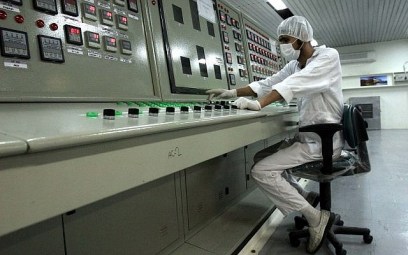
A technician at the Uranium Conversion Facility just outside the city of Isfahan, Iran, 255 miles (410 kilometers) south of the capital Tehran, February 3, 2007. (AP/Vahid Salemi/File)

However, he stressed that Iran would allow UN inspectors to continue to monitor sites in the country. A top official from the UN’s International Atomic Energy Agency was expected to meet with Iranian officials in Tehran on Sunday.

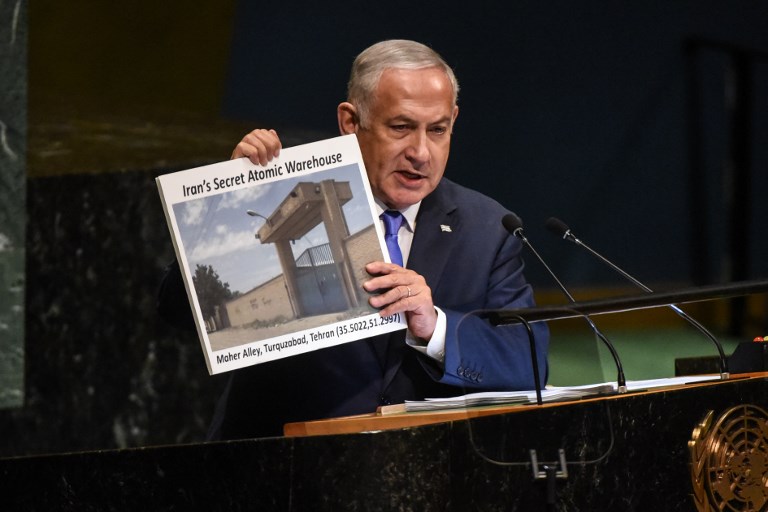
Prime Minister Benjamin Netanyahu holds up a placard showing a suspected Iranian atomic site while delivering a speech at the United Nations during the United Nations General Assembly on September 27, 2018 in New York City. (Stephanie Keith/Getty Images/AFP)

Iran denies that it seeks nuclear weapons. Israel’s Prime Minister Benjamin Netanyahu, who opposed the 2015 deal, insists that Tehran is seeking a nuclear arsenal, and is hiding parts of its program. A New York Times report this week quoted Netanyahu saying he came very close to striking Iran in 2012 to try to halt its rogue nuclear program. The same report said Israel was now again considering a strike on Iran.

Tensions between Iran and the US have risen in recent months that have seen mysterious attacks on oil tankers near the Strait of Hormuz, Iran shooting down a US military surveillance drone and other incidents across the wider Middle East.

Also on Saturday, satellite images showed that a once-detained Iranian oil tanker pursued by the US appears to be off the coast of Syria, where Tehran reportedly promised the vessel would not go when authorities in Gibraltar agreed to release it several weeks ago.

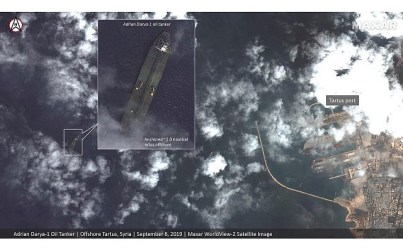
This Friday, September 6, 2019 satellite image provided by Maxar Technologies appears to show the Iranian oil tanker Adrian Darya-1 off the coast of Tartus, Syria. (Satellite image ©2019 Maxar Technologies via AP)

The tanker Adrian Darya-1, formerly known as the Grace-1, turned off its Automatic Identification System late Monday, leading to speculation it would be heading to Syria. Other Iranian oil tankers have similarly turned off their tracking beacons in the area, with analysts saying they believe crude oil ends up in Syria in support of embattled President Bashar Assad’s government.

Images obtained by The Associated Press early Saturday from Maxar Technologies appeared to show the vessel off Syria’s coast, some 2 nautical miles (3.7 kilometers) off shore under intermittent cloud cover.

Iranian and Syrian officials have not acknowledged the vessel’s presence there. There was no immediate report in Iranian state media about the ship, though authorities earlier said the 2.1 million barrels of crude oil onboard had been sold to an unnamed buyer.

The oil on board would be worth about $130 million on the global market, but it remains unclear who would buy the oil as they’d face the threat of US sanctions.

The new images matched a black-and-white image earlier tweeted by John Bolton, the US national security adviser.

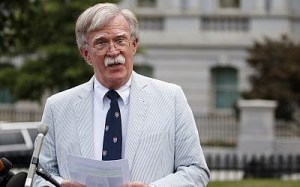
US National Security Adviser John Bolton speaks to media at the White House in Washington, July 31, 2019. (AP Photo/Carolyn Kaster)

“Anyone who said the Adrian Darya-1 wasn’t headed to #Syria is in denial,” Bolton tweeted. “We can talk, but #Iran’s not getting any sanctions relief until it stops lying and spreading terror!”

US prosecutors in federal court allege the Adrian Darya’s owner is Iran’s Revolutionary Guard, which answers only to Supreme Leader Ayatollah Ali Khamenei. On Wednesday, the US imposed new sanctions on an oil shipping network it alleged had ties to the Guard and offered up to $15 million for anyone with information that disrupts its paramilitary operations.

Brian Hook, the US special envoy for Iran, also has reportedly emailed or texted captains of Iranian oil tankers, trying to scare them into not delivering their cargo.

Meanwhile, the US Transportation Department’s Maritime Administration issued on Saturday a new warning to shippers about a potential threat off the coast of Yemen in the southern Red Sea.

“A maritime threat has been reported in the Red Sea in the vicinity of Yemen,” the warning read. “The nature of the event is potential increased hostilities that threaten maritime security.”

Large areas of war-torn Yemen are held by the country’s Houthi rebels, which are allied to Iran. Shipping in the Red Sea has been targeted previously by rebel attacks. On Wednesday, a warning went out after two small boats followed one ship in the region, but there’s been no other information about a new threat there.

Cmdr. Joshua Frey, a spokesman for the US Navy’s Bahrain-based 5th Fleet, said the Navy remained ready to maintain the safety of shippers in the region. He declined to specifically discuss the warning. The US military’s Central Command did not respond to a request for comment.

Times of Israel staff contributed to this report.


Iran puts pressure on Europeans to save nuclear deal within 60-day deadline | The Guardian

Posted September 7, 2019 by Joseph Wouk
Categories: Uncategorized

Source: Iran puts pressure on Europeans to save nuclear deal within 60-day deadline | World news | The Guardian

Tehran leverages use of advanced centrifuges to call for urgent European counter-measures to US sanctions

Behrouz Kamalvandi, the spokesman for the Iranian atomic energy organisation, called on European counterparts to act ‘quickly’.
 Behrouz Kamalvandi, the spokesman for the Iranian atomic energy organisation, called on European counterparts to act ‘quickly’. Photograph: Ebrahim Noroozi/AP

Iran has announced it has started using more advanced centrifuges that could accelerate the development of an atomic weapon in its latest attempt to pressure European powers to salvage a 2015 nuclear deal.

Behrouz Kamalvandi, the Iranian nuclear agency spokesman, told a press conference on Saturday the country did not intend to use the faster centrifuges to enrich uranium to 20% levels – an important threshold on the path to weapons-grade material – but that it had the capacity to do so.

“We have started lifting limitations on our research and development imposed by the deal,” Kamalvandi said. “It will include development of more rapid and advanced centrifuges.

Iran was in compliance of the 2015 international agreement intended to curb its development of nuclear weapons until the US pulled out of the deal in May last year and reimposed crippling economic sanctions.

European signatories to the deal led by France have unsuccessfully sought to find ways to help Tehran evade the US restrictions. Iran is increasing the pressure on Europe to do so, by gradually walking away from its nuclear commitments, including the pledge to refine uranium only using first-generation IR-1 centrifuges.

Kamalvandi said the country had started using IR-4 and IR-6 centrifuges since Friday and would soon test even more advanced models. Officials in the country say an IR-6 can produce enriched uranium 10 times as fast as an IR-1.

Analysts said the announcement was carefully calibrated to highlight the urgency on France and others to help relieve Iran’s ailing economy, while avoiding triggering an armed response from the US or forcing Europe to formally abandon the deal.

“These are all very calculated because they do not want to upset the Europeans and make it less likely for them to save the nuclear agreement,” said Holly Dagres, a nonresident fellow at the Atlantic Council who specialises in Iran’s nuclear program and its relations with the US.

“These are symbolic gestures to say: Time is running out, this deal is hanging by a string, you need to do something.”

Elements in Iran have been accused of trying to sell oil to Syria in breach of UN sanctions, leading earlier this year to the seizure of a tanker carrying approximately $100m (£81m) worth of oil thought to be headed for a Syrian port.

The seizure of the vessel is thought to have led Iran to capture a British-flagged ship, the Stena Impero, by the country’s Revolutionary Guards in July. The ship remains impounded though seven crew members were released this week, leaving 16 aboard.

The Iranian tanker, now called the Adrian Darya, was released on the orders of a Gibraltar court in August and was photographed on Friday close to the Syrian port of Tartus, according to satellite photographs released by a US space technology company.

Maxar Technologies Inc said the image showed the tanker Adrian Darya 1 very close to Tartus on 6 September. The ship appeared to have turned off its transponder in the Mediterranean west of Syria, ship-tracking data showed. The tanker sent its last signal giving its position between Cyprus and Syria sailing north on Monday afternoon.

Iran’s coast guard seized another vessel on Saturday for allegedly smuggling fuel in the Gulf and detained its 12 crew members from the Philippines, the semi-official news agency ISNA reported.

Kamalvandi said on Saturday the International Atomic Energy Agency (IAEA), the UN’s nuclear watchdog, would continue to be allowed to monitor Iranian nuclear sites and that it had been informed about Iran’s “new nuclear steps”.

But he set a 60-day deadline for France, Germany and Britain to find a solution to the US sanctions, after which further nuclear escalation could follow.

“When the other sides do not carry out their commitments, they should not expect Iran to fulfil its commitments,” Kamalvandi said.

Reuters contributed to this report


Latest Gaza rocket fire shows Hamas trying to follow the Hezbollah precedent

Posted September 7, 2019 by Joseph Wouk
Categories: Uncategorized

Source: Latest Gaza rocket fire shows Hamas trying to follow the Hezbollah precedent | The Times of Israel

After Nasrallah vowed to retaliate for deaths of his operatives in Syria, Hamas also hopes to establish a new formula vis-a-vis Israel in response to casualties in border clashes

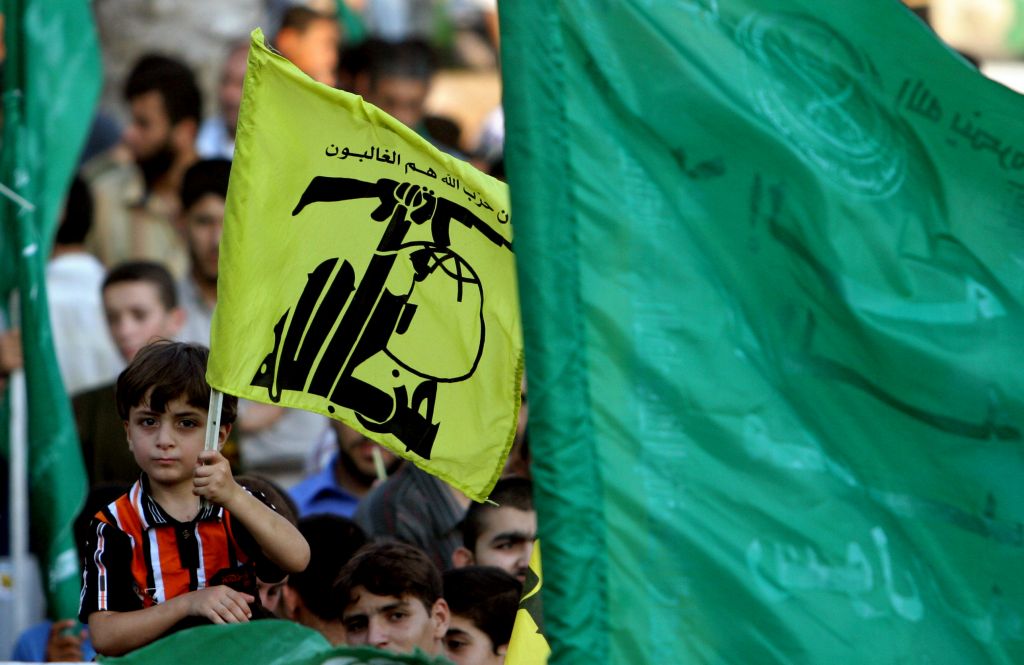
Hamas supporters in Gaza hold Hezbollah and Islamic flags as they demonstrate against Israel  during the Second Lebanon War on July 30, 2006. (AP/Khalil Hamra)

Hamas supporters in Gaza hold Hezbollah and Islamic flags as they demonstrate against Israel during the Second Lebanon War on July 30, 2006. (AP/Khalil Hamra)

The firing of five rockets into Israeli territory from the Gaza Strip late Friday came as little surprise, despite the period of relative calm between Israel and the Palestinian enclave’s Hamas rulers.

For at least two weeks, Hamas has been accusing Israel of violating understandings with the terror group brokered by Egyptian and international mediators, but the Hamas declarations have not been overly aggressive.

However, immediately after it became known that two Palestinians (among them a 17-year-old) were killed in clashes with Israeli troops Friday along the Gaza border, various terror organizations in the Strip threatened that a response would soon come — and indeed it did.

Most of the rockets were fired at open areas, and one towards the outskirts of the southern city of Sderot, suggesting someone in Gaza was mainly seeking to send a message, not exact a price that could make the situation even worse.

The new-old formulation that the Palestinian factions, led by Hamas, are trying to impose is clear: If there are fatalities at the weekly protests on the border, there will also be rockets.

Palestinians clash with Israeli forces along the security fence, east of Bureij in the central Gaza Strip, on September 6, 2019. (Mahmud Hams/AFP)

The desire to establish such a dynamic is reminiscent of the situation with Hezbollah and Lebanon. Just as Hezbollah leader Hassan Nasrallah declared that an attack on the terror group’s operatives in Syria would be met with a response, Hamas too is seeking to produce a formula of its own — aimed first and foremost at public opinion among Palestinians both in and outside Gaza.

The terror group is trying to create a perception among Palestinians that only it can protect the Palestinians, just as Hezbollah and Nasrallah are trying to convince the Lebanese public that only Hezbollah can contend with Israel and create deterrence.

In actuality of course, the two situations are different. Militarily, Hamas is not Hezbollah, to put it mildly.

It must be noted, though, that things are still far from simple for the Lebanese Shiite terror organization. Hezbollah is going through a financial crisis entailing reductions and cutbacks, and faces an even bigger problem in the political context in which it now operates: All of Lebanon is currently focused on the country’s collapsing economy.

Over the past week, Lebanese official leaders (if there truly are any other than Nasrallah) convened several times to discuss ways to save the Lebanese economy. If at this point Lebanon again finds itself dragged into a war on Nasrallah’s account, that would damage Hezbollah’s image as the country’s protector and inflict a hit on Nasrallah’s own image.

A man fixes a Hezbollah flag at the ‘Garden of Iran’ Park in the Lebanese village of Maroun al-Ras on September 1, 2019, as fires blaze on the Lebanese side along the border following an exchange of fire with Israel. (Mahmoud Zayyat/AFP)

Furthermore, such a military adventure could lead to a mass exodus. If just a few years ago hundreds of thousands, and even millions, of Syrians made their way to Lebanon because of the Syrian civil war, this migration could be be reversed in the next war with Israel, with Lebanese citizens fleeing to Syria.

Ultimately, the lack of casualties on the Israeli side from the Hezbollah anti-tank missile attack at the beginning of the week, and the feeling in Lebanon of accomplishment or at least temporary achievement in that Israel had been “successfully” targeted, allowed everyone to take their finger off the trigger.

Israel’s decision not to retaliate for the anti-tank fire or strike heavily at the Hezbollah cells scattered throughout the area derived from a clear desire to end the incident as quickly as possible.

It is obvious to both sides that there will be additional stages in this campaign — but until then, Lebanon can return to economic matters and Israel can go back to the upcoming elections.

But with the Middle East being the Middle East, a decision not to respond up north, along with the enthusiasm with which Israel quickly ended the situation in the north, broadcasts a certain message of weakness in other areas. This causes actors such as Hamas to feel that the firing of a few rockets won’t be met with a response from Israel — or, if so, a minor one.


Army: Gaza drone drops explosives in Israel near border, IDF vehicle damaged

Posted September 7, 2019 by Joseph Wouk
Categories: Uncategorized

Source: Army: Gaza drone drops explosiv in Israel near border, IDF vehicle damaged | The Times of Israel

IDF says it opened fire at terror cell after UAV appeared to leave explosive before returning to Strip; military vehicle lightly damaged but no injuries

Military vehicle the IDF says was damaged when terrorists flew an armed drone across the border from Gaza into Israel (Screen grab via Channel 13 news)

Military vehicle the IDF says was damaged when terrorists flew an armed drone across the border from Gaza into Israel (Screen grab via Channel 13 news)

A group of Palestinian terrorists piloted an armed drone into Israel from the Gaza Strip on Saturday, the army said in a statement.

The Israel Defense Forces said the drone appeared to leave an explosive device near the security fence along the border before returning to Gaza.

It did not specify if the explosive detonated, but said a military vehicle was lightly damaged in the incident.

The IDF said it opened fire at the cell responsible for the drone.

No Israeli soldiers were hurt and there were no immediate reports of Palestinian injuries.

Last month, the IDF said it thwarted an Iranian plot to fly “kamikaze” explosives-laden drones at Israeli territory from Syria.

Saturday’s incident came after Israeli forces attacked several military targets belonging to the Gaza terror group earlier in the day in response to rocket fire from Gaza.

The IDF said it had identified five projectiles that had crossed the border into Israeli territory.

The launches set off rocket sirens in the town of Sderot and the communities of Ibim and Kibbutz Or Haner.

There were no reported injuries. The Ynet news site said two women were being treated for shock.

At least one rocket hit an open area outside Sderot and started a small fire, Hebrew media reported.

Security camera footage reportedly from Sderot showed an explosion in the distance and city residents stopping their cars to run for cover.

The exchange of fire came hours after two Palestinian teens were reportedly killed in clashes with Israeli troops along the border between the Gaza Strip and Israel, in what the IDF called “especially violent” riots.

The Hamas-run health ministry identified one of those killed as 17-year-old Ali al-Ashqar. It said he was shot in the neck in the northern Gaza Strip. A second teenager was shot in the stomach east of Gaza City, the ministry said, later identifying him as Khaled al-Rabaee, 14.

The IDF had no immediate comment on the deaths but said some 6,200 Palestinians took part in the weekly “March of Return,” including hundreds that rioted.

The riots were especially violent and included the throwing of a large number of explosive devices, hand grenades and fire bombs at the fence and IDF soldiers, the army said, adding that there were extensive attempts to damage the border barrier.

During the clashes Israeli soldiers arrested two Palestinians who tried to enter Israel from northern Gaza, the IDF said.

The suspects were not armed and following their arrest were taken in for further questioning, the army said.

A spokesman for Hamas, the terror group that rules Gaza, blamed Israel for the Palestinians’ deaths and warned of a possible response.

“Israel will bear the consequences for this crime,” the Kan public broadcaster quoted Hazem Qassem saying.

The United Nations Special Coordinator for the Middle East Peace Process, Nickolay Mladenov, weighed in on the protests on Friday, criticizing Israel for the killing of the two protesters in a Twitter post.

“Two #Palestinian teenagers killed today at the #Gaza protests. Appalling! #Israel must calibrate its use of force, use lethal force only as a last resort, and only in response to imminent threat of death or serious injury. Protests must be peaceful. The cycle of violence must end,” Mladenov wrote.

Palestinian protesters clash with Israeli troops along the Gaza border near Gaza City, September 6, 2019. (Hassan Jedi/Flash90)

The deadly clashes came just days after Israel lifted restrictions on fuel deliveries to Gaza, a week after curbing them by half due to rocket and mortar fire from the coastal enclave.

Israel has responded to the violence with airstrikes in Gaza on Hamas targets, in keeping with its policy of holding the terror group responsible for any attacks emanating from territory under its control.

Since the outbreak of protests on the Gaza border last year, Israel has intermittently taken a number of steps to curb outbreaks of violence from the coastal territory, such as closing border crossings, cutting fuel shipments and reducing the permitted fishing area off the coast of the Strip. It has rolled back such moves following decreases in violence.

A deal was brokered several months ago by UN and Egyptian officials to end several violent flareups in recent months between Israel and Hamas, which have fought three devastating wars since 2008, and to help stabilize the territory and prevent a humanitarian collapse.

Strengthening the US-Israel alliance 

Posted September 6, 2019 by Joseph Wouk
Categories: Uncategorized

Source: Strengthening the US-Israel alliance – www.israelhayom.com

Israel has two strategic interests that could be significantly advanced by changes in its security ties with the US. Neither necessitates signing a formal agreement.

In 2000 then-Prime Minister Ehud Barak made signing a mutual defense treaty with the US a central component of his national security strategy. That year, as Barak sought to sell the public his plan to give the Temple Mount to Palestine Liberation Organization Chairman Yasser Arafat and Judea and Samaria to Arafat’s terror armies, he presented the option of signing a mutual defense pact with the US as a reasonable payoff for Israel’s sacrifice for peace.

Barak’s thinking was clear.

True, if the PLO boss had accepted Barak’s peace offer Israel would have been left without its capital and without defensible borders. But there was no reason to worry. The Marines would protect us. At the heart of Barak’s vision of a mutual defense treaty stood his unwillingness to bear the burdens of freedom, power and sovereignty.

The present round of chatter about the prospect of achieving a US-Israel defense treaty was initiated by Republican Senator Lindsey Graham (R-SC). In opposition to the view of the majority of Israelis and of the 2016 Republican Party platform, Graham insists on maintaining allegiance to the so-called “two-state solution,” despite its hundred-year record of continuous failure.

Still, Graham is no foe of Israeli sovereignty and military might. To the contrary. Graham played a decisive role in convincing President Donald Trump to recognize Israeli sovereignty over the Golan Heights. So it is inconceivable that Graham shares Barak’s post-Zionist vision of a defenseless Israel protected by Uncle Sam.

Moreover, according to media reports, ahead of the September 17 election Prime Minister Benjamin Netanyahu is making an effort to convince President Trump to make a statement in favor of a new US-Israel defense treaty. Since Netanyahu’s diplomatic policies and his strategic vision of Israel are diametrically opposed to those Barak advanced, it is impossible to imagine that Netanyahu shares Barak’s vision of the purpose of a defense treaty.

What then could be the purpose of a defense treaty? What sort of rearrangement of Israel’s defense ties with the US would advance those ties to both countries’ mutual advantage?

Israel has two strategic interests that could be significantly advanced by changes in its security ties with the US. Neither necessitates signing a formal agreement. At most, they could be included in some form of presidential memorandum or summary of a bilateral meeting between Trump and Netanyahu.

Israel’s first interest is to provide a formal expression and operating framework for Israel’s now intimate working relations and strategic cooperation with the Sunni Arab states.

These burgeoning ties were the unintended but salutary consequence of the Obama administration’s radical Middle East policy.

During his tenure in office, Barack Obama sought to realign the US away from Israel and from America’s longstanding Sunni Arab allies and toward the Muslim Brotherhood and Iran. As Obama’s actions became more damaging, and his intentions unmistakable, Netanyahu reached out to the Saudis, the United Arab Emirates, and Egypt.

Working under the principle that the enemy of my enemy is my friend, Netanyahu’s intuition paid off. The Sunnis recognized that working with Israel would help them to survive Obama’s treachery and responded positively to his overtures.

The first visible consequence of the new partnership came in 2014 during Operation Protective Edge. As Obama sought to coerce Israel into accepting Hamas’s ceasefire terms, (presented as a mediated settlement by Hamas’s state sponsors Turkey and Qatar), the Saudis, the UAE and Egypt stood with Israel in rejecting them. The three Sunni Arab states insisted that Egyptian President Abdel Fattah el-Sissi rather than the Turks or Qataris serve as the mediator between Israel and Hamas. And el-Sissi demanded that Hamas accept Israel’s ceasefire conditions.

Blindsided, Obama was compelled to stand down.

Obama rightly viewed Israel’s cooperative relationship with the Sunnis as a hostile bloc that stymied his efforts to realign the US away from them and toward Iran and the Muslim Brotherhood.

As for Trump, from his earliest moments in office, Trump embraced the newfound partnership Netanyahu had forged of necessity, and made it the centerpiece of his Middle East policy.

For more than two years, Israel and the US have discussed ways to bring Israel’s relations with the Arabs out of the closet. Signing a peace treaty is out of the question. Popular hatred of Israel in the Arab world is ubiquitous. To appease the street, the Arab regimes would be compelled to demand that Israel make massive concessions to the Palestinians in exchange for a peace deal that would do nothing more than formalize the relations that Israel and the Arabs have already forged. Israel would be foolish to pay for what it already achieved.

A different framework is required. And as it happens, the US military has one at the ready.

The US Central Command is responsible for the Middle East. To appease the Arabs, the US military refused to include Israel in Central Command’s area of responsibility and placed Israel instead under the aegis of its European Command.

Central Command’s reputation for hostility to Israel is doubtlessly rooted in this anomaly. How can Central Command officers recognize the value of a state that their Arab interlocutors attack? How can they recognize Israel’s role as a stabilizing force in the Middle East when the Arabs criticize the US incessantly for its friendship with Israel?

Transferring responsibility for Israel to the Central Command would kill two birds with one stone. First, American commanders responsible for military operations in the Middle East would be able to work directly with the US’s most powerful ally in the region. Israel would be in a position to present its views to the relevant US military regional commanders on operational issues that affect its security in real-time.

And second, including Israel in Central Command would provide Israel and its Arab partners with an appropriate framework for open cooperation. Under the umbrella of the US military, the parties would be able to maintain normal ties and develop their relations free of political constraints and pressure.

The second interest that Israel should use a revision of its strategic relations with the US to advance is its interest in discrediting the widely held assessment that it is a drag on US national security rather than an asset and an ally. This goal can be achieved by intensifying US-Israel technological cooperation in weapons systems development generally and hypersonic weapons development specifically.

Hypersonic weapons are the central component of the new arms race in the emerging cold war between the US on the one side and China and Russia on the other. Today, the US is dangerously trailing both Russia and China in this arms race.

Hypersonic speeds are speeds of 5-mach or 6,000 km per hour (3,700 mph) and above. There are two types of hypersonic weapons: hypersonic glide vehicles, which are launched from a rocket or a ballistic missile before gliding to a target; and hypersonic cruise missiles which are powered by high-speed, airbreathing engines or “scramjets” after acquiring their target.

Hypersonic weapons travel at low altitudes and are guided by internal electro-optics systems that enable them to maneuver and change direction during flight while locked on a target. Their atmospheric altitude makes them difficult for satellite-based missile defense systems to track. Their high speed makes them difficult for ground-based anti-missile systems to detect. In congressional testimony, US Under Secretary of Defense for Research and Engineering Michael Griffin stated that the US has no defense against hypersonic weapons.

According to a report on hypersonic weapons published by the Congressional Research Service in July, Russia and China are expected to field hypersonic glide vehicles as early as 2020. Last year, Griffin told defense industry executives that developing hypersonic systems is the Pentagon’s top priority.

According to the CRS report, the US is unlikely to field a hypersonic system before 2022, and that likely is an optimistic projection. Congress appropriated $2.6 billion to hypersonic projects for 2020. A mere 5% of the sum is allocated to hypersonic defense programs.

This brings us to Israel, the US ally so views as a burdensome client.

On July 28, Israel and the US conducted a successful test of the Arrow 3 ballistic missile defense system in Alaska. The Arrow is a joint program developed by Israel Aerospace Industries and Boeing. During the course of the test, the Arrow successfully intercepted a ballistic missile flying at what Netanyahu referred to as “unprecedented altitudes and speed.”

Less than a month later, the Pentagon announced that it was canceling a similar program by Boeing. The proximity of the cancellation of Boeing’s Redesigned Kill Vehicle to the successful Arrow 3 test raises the likelihood that the two events are connected.

As it demonstrated with the Arrow 3 test, Israel has proven capabilities in a number of areas that are relevant to the development of hypersonic weapons. Israel is a world leader for instance in the fields of electronic warfare and electro-optics, both critical components of hypersonic systems. With proper funding, Israel could make a significant contribution to US efforts to step up the development of hypersonic defensive systems and elements of offensive hypersonic weapons for the benefit of both countries.

This then brings back to the issue of an upgraded defense relationship between Israel and the US.

The specter of a Democratic administration casts a pall over Israel’s ties with the US. With the rise of radical forces in the Democratic Party, the positions of its leaders are becoming increasingly hostile to Israel. How can Israel-US ties be altered to survive and even prosper under a hostile administration in the future?

Regardless of his or her own positions on Israel and those of his or her party, a future Democratic president faced with a reality in which Israeli officials cooperate openly with their Sunni Arab counterparts under the aegis of the US Central Command, and in which Israel serves as a key partner in the development of offensive and defensive systems that are critical to the US, will not rush to abandon the US alliance with Israel.

Thanks to Netanyahu’s interest-based foreign policy, Israel has managed to develop strong bilateral relationships based on common interests rather than ideology with a long list of foreign governments. By placing interests ahead of politics, Netanyahu was able to significantly reduce the salience of anti-Semitism as a political force in the international arena.

If Israel and the US are interested in making significant alterations to their strategic ties, it is important that the changes be expressed in the same manner, for the benefit of both countries.


Are Iran and Israel edging toward war? 

Posted September 6, 2019 by Joseph Wouk
Categories: Uncategorized

Source: Are Iran and Israel edging toward war? – www.israelhayom.com

Despite its standoff with the US over the past two years, Iran’s regional power base has been substantially enhanced. Its “Shia crescent,” once aspirational, is now a reality. Having supported and developed the military capabilities of its proxies, Iran is now engaged in transferring to them advanced missile and drone capabilities, which it hopes will one day be unleashed on Israel.

Military activity by Israel over the weekend of August 24-25, 2019, reported widely in the media, ratcheted up Iranian-Israel tension in the region. Because these operations appeared to be a response to the threat of imminent hostile action, the idea that they may also be consistent with a deeper strategy was not the subject of much comment. Yet alongside a determination to prevent the transfer of Iranian military hardware to Hezbollah, an Israeli policy of consistently degrading Iran’s armed forces and their proxies is becoming increasingly apparent.

This longer-term pattern of Israeli military thinking parallels what is emerging as Iran’s deeper purposes in the region. Despite its standoff with the US over the past two years, Iran’s power base in the Middle East has been substantially enhanced. Its “Shia crescent,” once a rather aspirational concept, is now a reality. Having supported and developed the military capabilities of its proxies in Syria, Iraq, Lebanon, Gaza, and Yemen, Iran is now engaged in transferring to them its advanced missile and unmanned drone capabilities. The Houthis in Yemen and Hamas in Gaza are making use of them. If Iran has its way, Hezbollah will one day unleash them on Israel.

At the same time, Iran pursues with increasing determination its opposition to much of the Sunni Muslim world in general, and to Saudi Arabia in particular, seeking constantly to undermine and eventually overturn their regimes. In this one particular, the moderate Arab world and Israel know they stand shoulder to shoulder.

The latest clashes began early on the morning of Saturday, August 24, when, acting on intelligence indicating an imminent “killer” drone strike, Israel attacked military sites in Syria. Shortly afterward, Lebanese sources reported that two Israeli surveillance drones had come down in a Hezbollah stronghold in the Lebanese capital, Beirut. Some reports speculate that they had been involved in the earlier attack in Syria.

Then on Sunday night, August 25, Israeli aircraft carried out three airstrikes deep inside Lebanon on a base belonging to the Popular Front for the Liberation of Palestine, the terrorist group fighting alongside Iranian forces and Iran-backed militias in support of Syrian president, Bashar al-Assad. The base is located in the Bekaa valley in eastern Lebanon, near the border with Syria.

Later that Sunday evening three rockets were fired from Gaza into southern Israel. Within hours the Israeli Air Force had launched a series of strikes on targets in the Gaza Strip, hitting a Hamas military base. That was followed by a retaliatory Hezbollah strike on an IDF base on September 1, and Israel’s response – 100 artillery shells fired into Southern Lebanon.

Is all this military activity by Israel explicable as a direct reaction to provocation, or consistent with a longer-term strategy aimed at weakening Iran’s aggressive capabilities? There have certainly been some unclaimed and unexplained anti-Iran activities in the recent past.

For example, a blast on Tuesday night, August 20, apparently caused by an aerial attack, struck a pro-Iranian Shiite militia facility 80 kilometers (50 miles) north of Baghdad. It came after three unexplained explosions in recent weeks on Iraqi Shiite militia sites that served or hosted Iranian assets. Iraq’s paramilitary groups backed by Iran have blamed the series of blasts on the US and Israel.

Another blast the week before at a weapons depot run by one group sent rockets hurtling across southern Baghdad, killing one person and wounding 29 others. A government investigation concluded that it was caused by a drone attack.

Israel has, in line with its normal policy, neither confirmed nor denied responsibility for these attacks inside Iraq, but if it did carry them out, it would be an extension of its normal anti-Iran campaign. The last time it struck Iranian targets inside Iraq was in 1981, when Israeli fighter jets bombed a nuclear reactor under construction south of Baghdad.

Escalation has also been the name of the game on Iran’s part. Its recent attempt, frustrated by the Israel Defense Forces, to launch a flotilla of “killer drones” into Israel has upped the stakes. Israel’s immediate claim of responsibility for the strike against the Iranian-controlled bases in Syria also strikes a new note. It underlines Israel’s determination to foil any ambition Iran might harbor of establishing a permanent power base in either Syria or Iraq.

The world must hope that neither side will advance its political aims to the point of armed conflict.


Israel’s yellow card to Iran, Hezbollah over precision missile project 

Posted September 6, 2019 by Joseph Wouk
Categories: Uncategorized

Source: Israel’s yellow card to Iran, Hezbollah over precision missile project – www.israelhayom.com

The message conveyed on Tuesday revealing Hezbollah’s precision missile factory in Lebanon and the military base being built by Iran in eastern Syria cannot be mistaken: Israel is warning its enemies to cease and desist or face the consequences – even if it means going to war.

The message conveyed on Tuesday – revealing Hezbollah’s precision missile factory in Lebanon and the military base being built by Iran in eastern Syria – cannot be mistaken: If the activity there doesn’t cease, Israel will have to make it cease.

Both revelations were publicized simultaneously but through different channels. Israel directly released the information regarding the former, via the IDF Spokesperson’s Unit. The latter was exposed by Fox News, whose report was based on “Western intelligence sources.”

Both cases involve substantiated information, backed by satellite images and detailed explanations. They illustrate, yet again, the depth of Israel’s intelligence penetration into the axis linking Iran to Lebanon (via Syria and Iraq), but also the determination of this axis to continue operating. Iran, which despite hundreds of reported and unreported attacks on its facilities and weapons shipments, is still looking for ways to entrench itself in Syria to deploy its Shiite militia proxies, along with Hezbollah. Despite the fog surrounding its precision missile program (including the drone attack in south Beirut 10 days ago), Iran continues to pursue this objective with great vigor.

Employing such means to expose Iran and Hezbollah’s activities is nothing new. Its purpose is to create legitimacy for Israeli action, deliver messages to various audiences and attempt to foil the enemy’s activities without the need for military force. In his speech to the UN General Assembly last year, Prime Minister Benjamin Netanyahu revealed three facilities in the heart of Beirut used by Hezbollah to equip primitive missiles with precision components. Netanyahu’s goal was to pressure the Lebanese government to force Hezbollah to remove those installations from civilian populations and out of harm’s way.

Hezbollah indeed took action. It hastily scrubbed these facilities to remove the evidence, and immediately played dumb by claiming there was nothing there to begin with. We can assume that Hezbollah will respond similarly this time around, but the present circumstances are more complicated from its perspective. Unlike the previously exposed facilities that were situated among civilians, the factory revealed on Tuesday is isolated and strictly military in nature. Israel can attack the facility without harming innocents. Incidentally, those in the know are surely familiar with the town in the Beqaa Valley where the factory is located, al-Nabi Sheet, from a different context: Israeli navigator Ron Arad was held captive there before he disappeared without a trace.

The same applies to the base that Iran is building in Syria. Israel has already established that it will act to enforce its policy of preventing Iran from establishing a military presence in the country, and likely won’t hesitate to strike near the Syrian-Iraqi border as well – certainly considering the recent reports about Israeli airstrikes on numerous Iranian-related targets in Iraq. The hope is for the Syrian and Iraqi governments to pressure Iran to minimize or stop its activities on their soil altogether. Past experience tells us that this pressure would be minimal at best, and even if applied would have zero chance of swaying Iranian policy.

Tuesday’s reports, therefore, are akin to Israel issuing Iran and Hezbollah a yellow card, just before showing them the red card. It would be mistaken to believe that the recent incidents on the northern border concluded this round of hostilities. They were barely the prologue. This campaign will be fought over the enemy’s desire to acquire precision missile capabilities, and Israel reiterated plainly on Tuesday that it has no intention of blinking first this time. If Hezbollah leader Hassan Nasrallah doesn’t choose to shelve the precision missile project on his own, and spare Lebanon from calamity, then Israel will do it for him – even if it means going to war.


Iran to unveil new details on cuts to nuclear commitments Saturday

Posted September 6, 2019 by Joseph Wouk
Categories: Uncategorized

Source: Iran to unveil new details on cuts to nuclear commitments Saturday | The Times of Israel

After setting Friday deadline for an EU solution for skirting US sanctions, Tehran says failure will bring ‘significant’ new rollback of nuclear limits on centrifuges

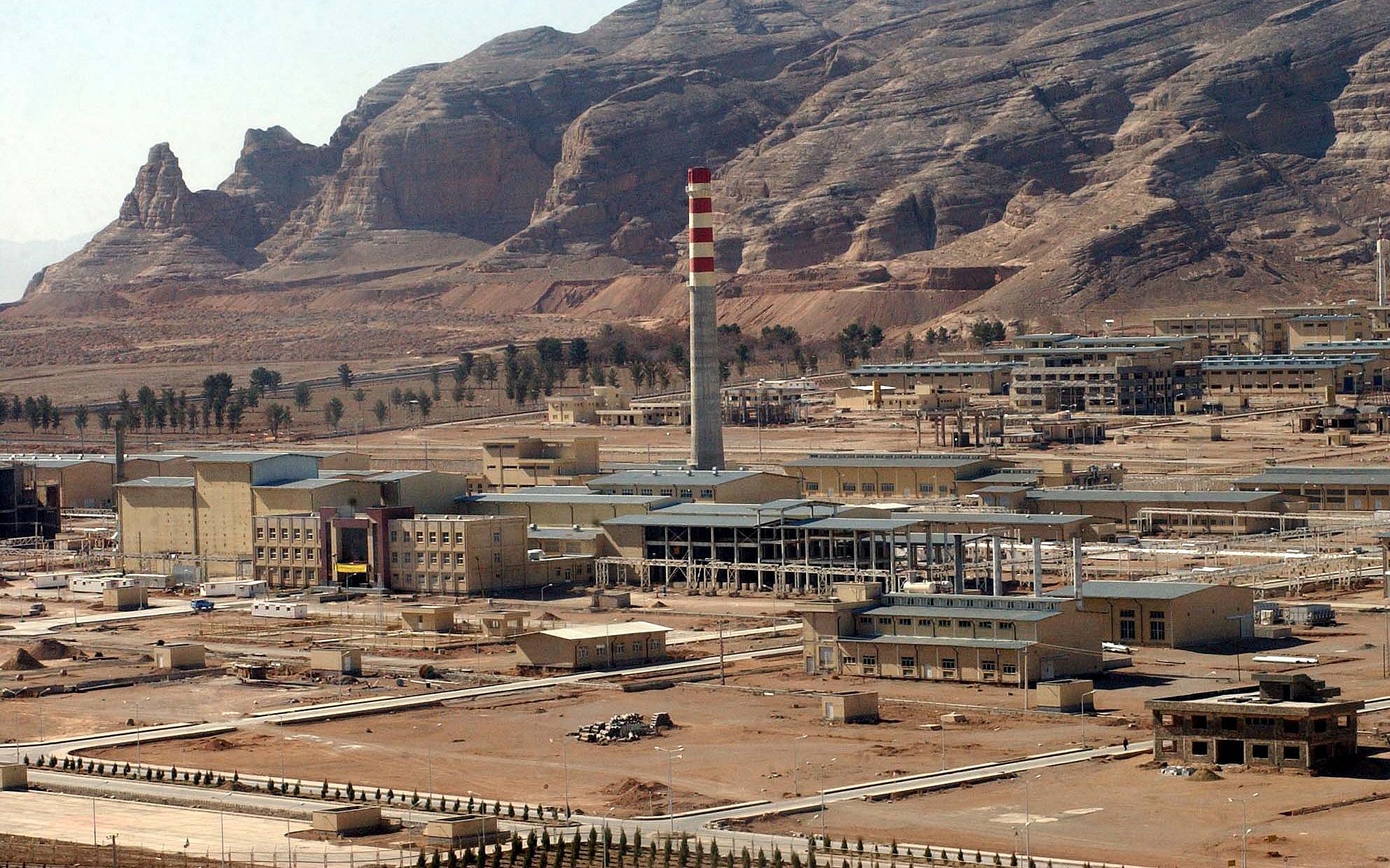
Iran's uranium conversion facility near Isfahan, which reprocesses uranium ore concentrate into uranium hexafluoride gas, which is then taken to Natanz and fed into the centrifuges for enrichment, March 30, 2005.  (AP/Vahid Salemi)

Iran’s uranium conversion facility near Isfahan, which reprocesses uranium ore concentrate into uranium hexafluoride gas, which is then taken to Natanz and fed into the centrifuges for enrichment, March 30, 2005. (AP/Vahid Salemi)

Iran’s atomic energy agency is to make an announcement on Saturday about its next step away from the 2015 nuclear deal between Tehran and world powers, a move that President Hassan Rouhani has described as “highly significant.”

The semi-official Tasnim news agency and other Iranian media reported on Thursday that the agency will hold a press conference to reveal further details.

Rouhani on Wednesday reiterated Iran’s threat to take additional steps that go against the nuclear accord and accelerate nuclear activities if Europe fails to provide a solution, calling it Iran’s third, “most important step” away from the deal.

Rouhani indicated that after Friday’s deadline expires and Iran takes the next step, another two-month deadline to Europe will follow with the aim to resume talks with European leaders on reviving the deal.

The announcement meant Iran’s nuclear agency stood poised Thursday to begin work on advanced centrifuges that will enrich uranium faster as the 2015 nuclear deal unravels further and a last-minute French proposal offering a $15-billion line of credit to compensate Iran for not being able to sell its crude oil abroad because of US sanctions looked increasingly unlikely.

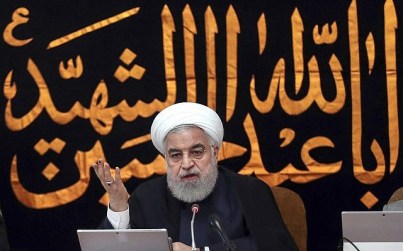
In this photo released by the office of the Iranian Presidency, President Hassan Rouhani speaks in a cabinet meeting in Tehran, Iran, September 4, 2019. (Iranian Presidency Office via AP)

Iran has yet to say officially what exact steps it will take after the Friday deadline, but it is expected to focus on faster centrifuges, speeding enrichment and enabling Tehran to shorten the time it would need to have enough material available to build a nuclear weapon — if it chose to do so.

Under the unraveling deal, which has frayed after US President Donald Trump’s unilateral withdrawal of the US from the accord last year, experts thought Iran would need about a year to reach that point.

The US has continued its effort to choke off Iran’s crude oil sales abroad, a crucial source of government revenue. Iranian Foreign Minister Mohammad Javad Zarif, who continues a whirlwind global diplomatic tour, insists his country will do everything it can to keep those sales going, though he described US sanctions in an angry tweet Thursday as the equivalent of a “jail warden.”

“We will sell our oil, one way or the other,” Zarif told Russian broadcaster RT in a recently aired interview. “The United States will not be able to prevent that.”

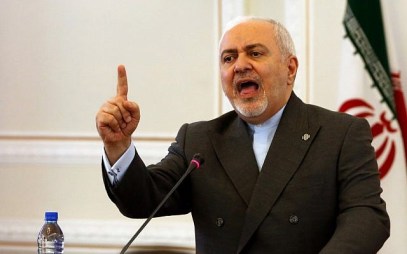
Iran’s Foreign Minister Mohammad Javad Zarif speaks during a press conference in the Iranian capital Tehran on August 5, 2019. (AFP)

Tensions between Iran and the US have been growing since Trump’s pullout from the nuclear deal, which saw Tehran agree to limit its uranium enrichment in exchange for the lifting of economic sanctions. Trump subsequently re-imposed old sanctions on Iran and created new ones, going as far as targeting Iranian officials like Zarif and Iran’s paramilitary Revolutionary Guard.

In his speech late Wednesday, Rouhani said Tehran would soon begin work on research and development of “all kinds” of centrifuges that enrich uranium by rapidly spinning uranium hexafluoride gas.

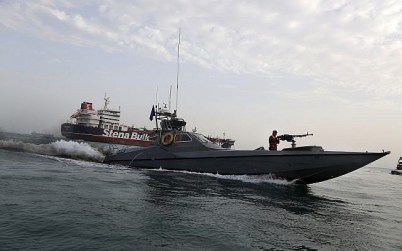
In this July 21, 2019 file photo, a speedboat of Iran’s Revolutionary Guard moves around a British-flagged oil tanker, the Stena Impero, which was seized by the Guard, in the Iranian port of Bandar Abbas. (Hasan Shirvani/Mizan News Agency via AP, File)

Iran has begun to break limits imposed by the 2015 deal, such as just creeping beyond its 3.67%-enrichment limit and its stockpile rules. Iranian officials already have raised the idea of enriching to 20% — a small technical step from weapons-grade levels of 90%.

Iran long has maintained its nuclear program is for peaceful purposes and denies it seeks an atomic bomb. However, Western nations have pointed to previous Iranian research into a weapons program that UN experts say largely ended in 2003 following the US invasion of neighboring Iraq, thought Israel, the US and other nations believe the program continues to be a key regime policy goal.

While Trump maintains he’s open for North Korea-style talks with Iran, his administration has continually upped its pressure on the Islamic Republic. On Wednesday, the US imposed new sanctions on an oil shipping network it alleged had ties to the Guard and offered up to $15 million for anyone with information that disrupts the Guard’s operations.

“There will be more sanctions coming,” Brian Hook, the US special envoy for Iran, told reporters at the State Department. “We can’t make it any more clear that we are committed to this campaign of maximum pressure.”

Hook also directly emailed or texted captains of Iranian oil tankers, trying to scare them into not delivering their cargo, according to the Financial Times.

Zarif reacted angrily to the report.

“Having failed at piracy, the US resorts to outright blackmail_deliver us Iran’s oil and receive several million dollars or be sanctioned yourself,” the diplomat wrote on Twitter.


US nixes Security Council statement that fails to condemn Hezbollah

Posted September 6, 2019 by Joseph Wouk
Categories: Uncategorized

Source: US nixes Security Council statent that fails to condemn Hezbollah | The Times of Israel

Washington rejects text that puts terror group and Israel on equal footing following exchanges of fire along border, diplomatic sources say

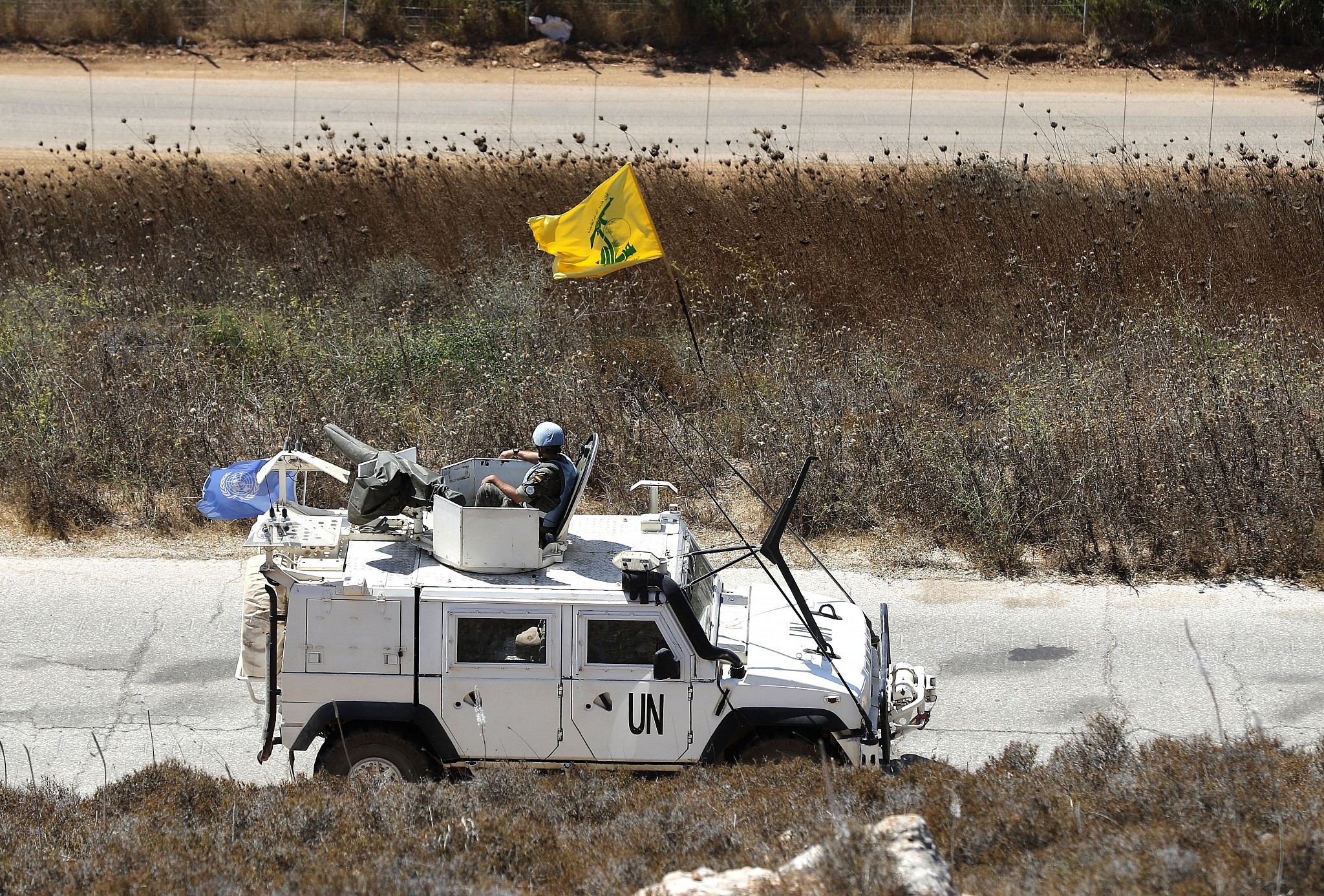
Spanish UN peacekeepers patrolling along the Lebanese-Israeli border pass a Hezbollah flag, in the southern Lebanese village of Kfar Kila, Lebanon, Monday, Sept. 2, 2019. (AP Photo/Hussein Malla)

Spanish UN peacekeepers patrolling along the Lebanese-Israeli border pass a Hezbollah flag, in the southern Lebanese village of Kfar Kila, Lebanon, Monday, Sept. 2, 2019. (AP Photo/Hussein Malla)

The US on Thursday blocked a UN Security Council statement on tensions between Israel and Hezbollah that did not single out violence by the Lebanese terror group, forcing the text to be scrapped, according to diplomatic sources.

In the first version of the six-point text, seen by AFP, council members expressed “deep concern at the recent incidents” during a flare-up between the sides across the “Blue Line” border.

The draft, drawn up by France, added that “members of the security council condemned all violations of the Blue Line, both by air and ground, and strongly calls upon all parties to respect the cessation of hostilities.”

According to diplomats, Washington blocked the statement twice, calling for Hezbollah to be specifically condemned in the text.

Footage from Hezbollah’s Al-Manar television network showing a September 1, 2019, missile strike against an Israeli military vehicle near the northern border, broadcast on September 2. (Twitter, screen capture)

The US said it was impossible for it to back any statement putting Israel’s right to self-determination on an equal footing with Hezbollah, which it considers a terrorist organization, a diplomat explained.

Several other members of the security council objected to the US stance, and the text was eventually abandoned.

Any statement by the council must be backed by all 15 members.

Israel and Hezbollah, which fought a month-long war in 2006, have indicated they do not want to go to war but appeared on a collision course in recent days after Hezbollah vowed it would retaliate for a pair of Israeli strikes against the Iran-backed terrorist group — one in Syria claimed by Israel, and another, in Beirut, that the group blames on the Jewish state.

This picture taken on September 1, 2019 from a location near the northern Israeli town of Avivim, close to the border with Lebanon, shows fires and smoke rising after Lebanon’s Shiite Hezbollah terror movement fired anti-tank missiles into northern Israel (Jalaa MAREY / AFP)

Hezbollah said it fired anti-tank missiles at Israel on Sunday and destroyed an Israeli military vehicle across the border. The IDF said no Israeli soldiers were injured by the 2-3 missiles fired by Hezbollah, which lightly damaged a military jeep and an IDF base.

The Israeli military retaliated by firing approximately 100 artillery shells and bombs at Hezbollah positions in southern Lebanon.

Pictures and videos showing injured soldiers being evacuated had been a ploy meant to trick Hezbollah into thinking it had caused casualties, the army said.

The Iranian proxy group indicated the attack was in retaliation for the Israeli airstrike in Syria last month that killed several operatives, including two of its members.

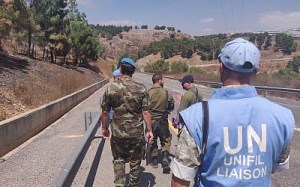
UN peacekeepers and IDF officers visit the site of a Hezbollah missile attack on IDF positions in northern Israel on September 4, 2019. (Israel Defense Forces)

On Thursday, UN peacekeepers toured the site of the attack and called it “a violation of the UN Security Council resolution 1701 … by Hezbollah.”

UN Resolution 1701 calls for all armed groups, besides the Lebanese military, to be removed from southern Lebanon, in the area south of the country’s Litani River.

Israel has repeatedly claimed that Hezbollah, occasionally aided by the Lebanese Armed Forces, maintains an active presence in southern Lebanon of both fighters and weaponry despite this prohibition.

UNIFIL, which is tasked with ensuring Resolution 1701’s implementation, has indicated that the constraints of its mandate prevent it from being able to fully investigate Israel’s claims, namely because of the peacekeepers’ inability to enter private property.

Judah Ari Gross contributed to this report.