At United Nations, Clinton Gives Trump Golden Opportunity

Posted September 17, 2016 by Peter Hofman
Categories: Uncategorized

Tags: , ,

Blue State Blues: At United Nations, Clinton Gives Trump Golden Opportunity

by Joel B. Pollak

16 Sep 2016

Source: At United Nations, Clinton Gives Trump Golden Opportunity

Breitbart News

Democratic presidential nominee Hillary Clinton plans to mingle with foreign leaders at the opening of the United Nations General Assembly next week. Her goal is to use the UN as a backdrop to display her foreign policy credentials, and contrast her experience with that of Republican rival Donald Trump.

Perhaps Clinton hopes to undo Trump’s successful visit to the president of Mexico last month. However, by associating herself with the UN, she has given Trump a golden opportunity.

The UN is a corrupt and destructive institution that Americans do not trust — for good reason. A recent Gallup poll showed that 54% of Americans think the UN does a poor job, while only 38% think it does a good job.

Video: Obama hits campaign trail for Clinton

 http://videos.tout.com/dry/mp4/f82d13bbf457eaee.mp4

Over the past eight years, the Obama administration has actually used the UN to undermine America’s influence, interests and image in the service of his own radical left-wing agenda — and as Secretary of State, Hillary Clinton participated wholeheartedly in that sorry effort.

Over and over again, for example, President Barack Obama took crucial national security decisions to the UN Security Council before approaching Congress.

In 2011, with Secretary Clinton’s full backing, Obama committed the U.S. to war in Libya on the basis of UN Security Council Resolution 1973. He never went to Congress for approval, in defiance of the War Powers Resolution. The result was a poorly conceived intervention, with terrorist consequences the world is still suffering.

In 2015, Obama did it again, approaching the UN Security Council to approve the Iran deal before Congress had any chance to review it. He did so even after signing the Iran Nuclear Review Agreement Act, which was advertised to the public as a guarantee that Congress would have the final say. In the end, Obama defied that law and the disastrous Iran deal — including a side deal giving the regime a ransom of $1.7 billion in cold, hard cash for American captives — was forced down our throats.

Then there is the UN Human Rights Council (UNHRC), a club for the world’s worst human rights abusers, which President George W. Bush wisely avoided, but which Obama enthusiastically forced the U.S. to join. The UNHRC exists for only one purpose, which is to let dictators cover up real human rights abuses by attacking Israel and the U.S. Disgracefully, Obama reported his own country to the UNHRC, allowing Iran the opportunity to bash the U.S. for so-called human rights abuses.

Now, the Obama administration is running for a seat again on the UNHRC, which will hold its elections next month. His goal is to bind the next president to a three-year term, so that the U.S. has to participate again in that charade no matter who wins.

In addition, on Oct. 1, the Obama administration intends to give up control of the Internet, when the Internet Corporation for Assigned Names and Numbers (ICANN) becomes a multilateral institution, rather than an American one. Control of ICANN will likely fall, eventually, to the UN and its International Telecommunications Union (ITU). There, the free speech and free enterprise Americans have taken for granted online could be subject to the whims of tyrannical, censorship-prone regimes.

There is no reason to give up control of the Internet, which has flourished as a free medium only because it has been protected by the guarantees of the U.S. Constitution. The Obama administration simply believes, as one critic observes, that American power is more dangerous than our enemies: better for the UN to govern Americans than for Americans to govern anyone else.

Of course, when it wants to, the Obama administration can see the problems with the U.N. In 2013, when Obama was pushing for limited war in Syria — again without obtaining congressional approval — UN Ambassador Samantha Power blasted the UN, complaining it was “structurally impossible to get meaningful international action through the Security Council.”

In the end, the Obama administration retreated anyway and did nothing to stop the slaughter of hundreds of thousands of civilians.

Trump — who already demonstrated in Mexico City his ability to represent the U.S. on the international stage — can seize the opportunity of Clinton’s UN photo-op to articulate three key policy differences:

1. A Trump administration will never submit the national security of the United States to the UN before Congress.

2. A Trump administration will refuse to participate in the UN Human Rights Council.

3. A Trump administration will not fund UN institutions that demonize America and Israel. 

4. A Trump administration will refuse to cede control of ICANN, and will protect free speech and free enterprise on the Internet.

And when Hillary Clinton parades herself in front of the UN next week, Trump should thank her. There is nothing that better illustrates the contrast between “globalism” and “nationalism” than the UN and the way Obama and Clinton have boosted it.

Watch: Trump Makes Entrance to ‘Do You Hear the People Sing?’ with ‘Les Deplorablés’ Banner

Posted September 17, 2016 by Peter Hofman
Categories: Uncategorized

Watch: Trump Makes Entrance to ‘Do You Hear the People Sing?’ with ‘Les Deplorablés’ Banner

by Breitbart TV

16 Sep 2016

Source: Watch: Trump Makes Entrance to ‘Do You Hear the People Sing?’ with ‘Les Deplorablés’ Banner – Breitbart

Friday at his rally in Miami, FL, Republican presidential nominee Donald Trump made his entrance to “Do You Hear the People Sing?” from the Broadway play Les Miserables to the backdrop of a “Les Deplorablés” banner.

The image is apparently a play off of his opponent Democratic presidential nominee Hillary Clinton, who referred to some Trump supporters as “deplorables” a week earlier.

Trump opened his remarks by saying, “Welcome to all of you Deplorables.”

more :

https://twitter.com/frankthorp/status/776910237747904512/video/1


Les Deplorables

Posted September 17, 2016 by Joseph Wouk
Categories: Uncategorized

“Do You Hear The People Sing?”

[Enjolras:]
Do you hear the people sing?
Singing a song of angry men?
It is the music of a people
Who will not be slaves again!
When the beating of your heart
Echoes the beating of the drums
There is a life about to start
When tomorrow comes!

[Combeferre:]
Will you join in our crusade?
Who will be strong and stand with me?
Beyond the barricade
Is there a world you long to see?

[Courfeyrac:]
Then join in the fight
That will give you the right to be free!

[All:]
Do you hear the people sing?
Singing a song of angry men?
It is the music of a people
Who will not be slaves again!
When the beating of your heart
Echoes the beating of the drums
There is a life about to start
When tomorrow comes!

[Feuilly:]
Will you give all you can give
So that our banner may advance
Some will fall and some will live
Will you stand up and take your chance?
The blood of the martyrs
Will water the meadows of France!

[All:]
Do you hear the people sing?
Singing a song of angry men?
It is the music of a people
Who will not be slaves again!
When the beating of your heart
Echoes the beating of the drums
There is a life about to start
When tomorrow comes

FULL SPEECH : Nigel Farage Last Speech

Posted September 16, 2016 by Peter Hofman
Categories: Uncategorized

Tags: ,

FULL SPEECH : Nigel Farage Last Speech UKIP Party Conference 2016 In Bournemouth – Brexit

Published on Sep 16, 2016

Brexit cheerleader Nigel Farage gives final speech as Ukip leader after EU victory. on September 16, 2016

VIDEO: American commandos ‘forced to run away’ from US-backed Syrian jihadis to the cheers of “ALLAH AKBAR”

Posted September 16, 2016 by Peter Hofman
Categories: Uncategorized

Tags: , , , , , , , , ,

VIDEO: American commandos ‘forced to run away’ from US-backed Syrian jihadis to the cheers of “ALLAH AKBAR”

ByPamela Geller

on September 16, 2016

Source: VIDEO: American commandos ‘forced to run away’ from US-backed Syrian jihadis to the cheers of “ALLAH AKBAR” | Pamela Geller


This must be what Obama means when he says, “leading from behind.”

Look what Obama and Hillary have done to our military. Unrecognizable. This is the poison fruit of their policies which supported and armed  the enemy. What was at first ridiculous and incoherent, is now catastrophic.

Iran is humiliating us at sea, ISIS on land.

Obama continues to be woefully unprepared to face the threat of ISIS and their acolytes: he CREATED the threat by leaving Iraq precipitously and giving an opportunity to this group. Hillary has vowed to follow this failed and reckless strategy.

He has armed the Syrian rebels — many of these arms fell into the hands of ISIS, and the Syrian rebels he armed have the same jihad goal that ISIS does.

“A spokesman for US Central Command said they were aware of the video and looking into the incident. ” Well that instills great confidence ….

“American commandos ‘forced to run away’ from US-backed Syrian rebels,” By Raf Sanchez, Middle East Correspondent, The Telegraph, 16 September 2016:

US commandos are operating in a complex web of alliances and enmities in Syria

Video footage appears to show US commandos fleeing a Syrian town under a barrage of abuse and insults hurled at them by fighters from the American-backed Free Syrian Army (FSA) rebel group.

video appears to be the first evidence of US special forces cooperating with Turkish troops in their battle against Islamic State.The incident illustrates the complex web of alliances and enmities in Syria, where many of America’s allies are fighting each other and some rebel groups that receive US support still harbour strong anti-American sentiments.The footage shows a crowd of rebel fighters in the town of al-Rai near the Turkish border, which was captured from the Islamic State (Isil) by Syrian rebel groups with the backing of Turkey. Turkey, which launched a military incursion into Syria in late August, has been backing the FSA.

The fighters scream anti-American chants as a column of pick-up trucks carrying US commandos drives away from them.

“Christians and Americans have no place among us,” shouts one man in the video. “They want to wage a crusader war to occupy Syria.”

Another man calls out: “They collaborators of America are dogs and pigs. They wage a crusader war against Syria and Islam. ”

The US troops are not wearing traditional uniform but they carry American weapons and are wearing the distinctive round helmets favored by US special forces.

Another video shows the US troops looking nonchalant and waving at the camera even as some of the rebels tell them to leave.

Congress Investigating State-Funded Campaign Against Israeli PM

Posted September 16, 2016 by Peter Hofman
Categories: Uncategorized

Tags: , ,

Congress Investigating Obama Admin-Funded Campaign to Unseat Israeli PM State Department purged emails about $300,000 grant to anti-Netanyahu group.

BY:
September 16, 2016 1:07 pm

Source: Congress Investigating State-Funded Campaign Against Israeli PM

John Kerry / AP

Congress on Friday launched a wide-ranging probe into a secret Obama administration-funded campaign to unseat Israeli Prime Minister Benjamin Netanyahu, according to information exclusively obtained by the Washington Free Beacon.

The probe comes on the heels of an internal government report determining that the State Department provided hundreds of thousands to an organization that plotted to unseat Netanyahu in the country’s 2015 election.

Obama administration officials were found to have deleted emails from State Department accounts containing information about its relationship with OneVoice, the non-profit group that led the effort.

OneVoice, which was awarded $465,000 in U.S. grants through 2014, has been under congressional investigation since 2015, when it was first accused of funneling some of that money to partisan political groups looking to unseat Netanyahu. This type of behavior by non-profit groups is prohibited under U.S. tax law.

A group of nine leading lawmakers led by Sen. David Perdue (R., Ga.) are now formally petitioning the State Department to come clean about the effort and provide answers about how U.S. taxpayer dollars were permitted to be spent on an organization working against the elected leader of America’s closest Middle East ally, according to a readout of the investigation obtained by the Free Beacon.

“State Department officials failed to properly vet the OneVoice grant proposal because they failed to properly conduct an analysis of risks in the pre-award phase,” the senators wrote in a letter to Secretary of State John Kerry. “Unfortunately, it seems that inconsistency and apathy toward oversight of such grants at the State Department is not new. Our aid dollars should be going toward solving real problems, not contributing to the destabilization of allied governments.”

The lawmakers—including Sens. Ted Cruz (R., Texas), Mark Kirk (R., Ill.), Orrin Hatch (R., Utah), Mike Lee (R., Utah), and Johnny Isakson (R., Ga.) among others—wrote that the State Department turned a blind eye to OneVoice’s highly partisan activities and failed to perform proper oversight about how U.S. funds were being spent by the group.

“State Department officials utterly failed to follow established procedures and guidelines to properly identify, mitigate, or guard against any risk that OneVoice would misuse these funds before, during, and after the grant period,” the letter said. “As a direct result of these failures, OneVoice was able to use the more than $300,000 grant to build campaign infrastructure and resources which later were deployed in support of a negative campaign against Prime Minister Benjamin Netanyahu, his Likud Party, and the democratically elected coalition government of Israel during the 2015 Israeli parliamentary election.”

State Department officials were aware of OneVoice’s partisan activities, but still permitted the grant money to be awarded, according to the senators, who are pushing for the administration to take disciplinary action against the officials involved.

“Despite knowledge of such activities, State Department officials failed to adequately document any assessment of the risk that OneVoice might continue obstructive efforts against a certain political party in the event of an election,” the letter stated.

“State Department grant policies and procedures are in place to ensure that taxpayer dollars are used to fund U.S. government initiatives and further U.S. interests,” the letter said.

The senators require the State Department to answer a series of questions about the grant, including how it vetted OneVoice and why proper oversight methods were not employed.

They also are seeking to determine what “disciplinary action” is being taken against U.S. officials who knew about the plan to unseat Netanyahu but failed to take action to report this behavior.

What will Israel’s next war look like?

Posted September 15, 2016 by Peter Hofman
Categories: Uncategorized

Tags: , , , , ,

What will Israel’s next war look like? Could Israel be facing multi-front war with hundreds of thousands of rockets targeting Israeli cities? IDF presents war scenario to cabinet.

Uzi Baruch, 15/09/16 17:17

Source: What will Israel’s next war look like? – Defense/Security – News –

Patriot Missile Battery      IDF/Flash 90

Hundreds of thousands of rockets and missiles targeting Israel. More than 10,000 direct hits by rockets on buildings in Israeli towns. Three hundred and fifty people dead.

That is the scenario presented recently by the IDF to the Security Cabinet, highlighting the potential threats by Israel – and the army’s preparations to confront them.

According to IDF estimates, such a conflict could include attacks by Islamic terror groups from the Gaza Strip, Hezbollah in Lebanon, and the Syrian and Iranian militaries. In such a scenario, most of Israel – and most of Israel’s population – would be under direct threat from rocket and missile fire, though the majority of such weapons would likely hit open spaces.

In the scenario laid out in the IDF report, more than 230,000 rockets and missiles would be directed towards Israel, covering the country from the Haifa district in the north to the southern coast, leaving most of the population vulnerable.

While only 1% of rockets and missiles fired would be expected to cause damage in populated areas, given the large volume of projectiles, hundreds of casualties could result from the conflict.

Next week, Home Front Command will hold its annual emergency exercises. Beginning Sunday and continuing through Wednesday, this year’s exercises, code-names “Standing Firm”, will include emergency sirens in populated areas, to be sounded twice on Tuesday.

Residents are advised to plan a path to the nearest safe-room or bomb shelter as part of the exercises mock emergency sirens.

US issues travel advisory warning for the Golan Heights

Posted September 15, 2016 by Peter Hofman
Categories: Uncategorized

Tags: , , , , , ,

US Embassy issues travel advisory warning for the Golan Heights following mortar fire Following the recent mortar fire into the Israeli controlled Golan Heights; the US Embassy has issued a travel advisory warning to the area. US federal employees are forbidden from traveling north of Route 87 and east of Route 918.

Sep 15, 2016, 3:50PM

Rachel Avraham

Source: US issues travel advisory warning for the Golan Heights – World News | JerusalemOnline

Photo Credit: Reuters/Channel 2 News

In the wake of mortars being constantly fired into the Israeli controlled Golan Heights due to the fighting in recent days between the Syrian Army and rebel forces in the town of Quneitra, the American Embassy “urges US citizens to carefully consider and possibly defer travel to that area until the situation stabilizes.” The US government has forbidden federal employees from traveling north of Route 87 and east of Route 918 in the “Israeli occupied Golan Heights.”

“The United States Embassy continues to closely monitor the security situation and advises US citizens to visit the website of the Government of Israel’s Home Front Command for further emergency preparedness guidelines,” the American Embassy stated in a recent press release. “Recent events underscore the importance of situational awareness. We remind you to be aware of your surroundings at all times, to monitor the media and to follow the directions of emergency responders.”

European Leaders Discuss Plan for European Army

Posted September 14, 2016 by Peter Hofman
Categories: Uncategorized

Tags: ,

European Leaders Discuss Plan for European Army “We are going to move towards an EU army much faster than people believe.”

by Soeren Kern

September 14, 2016 at 5:00 am

Source: European Leaders Discuss Plan for European Army

  • Critics say that the creation of a European army, a long-held goal of European federalists, would entail an unprecedented transfer of sovereignty from European nation states to unelected bureaucrats in Brussels, the de facto capital of the EU.
  • Others say that efforts to move forward on European defense integration show that European leaders have learned little from Brexit, and are determined to continue their quest to build a European superstate regardless of opposition from large segments of the European public.
  • “Those of us who have always warned about Europe’s defense ambitions have always been told not to worry… We’re always told not to worry about the next integration and then it happens. We’ve been too often conned before and we must not be conned again.” — Liam Fox, former British defense secretary.
  • “[C]reation of EU defense structures, separate from NATO, will only lead to division between transatlantic partners at a time when solidarity is needed in the face of many difficult and dangerous threats to the democracies.” — Geoffrey Van Orden, UK Conservative Party defense spokesman.

European leaders are discussing “far-reaching proposals” to build a pan-European military, according to a French defense ministry document leaked to the German newspaper, the Süddeutsche Zeitung.

The efforts are part of plans to relaunch the European Union at celebrations in Rome next March marking the 60th anniversary of the Treaty of Rome, which established the European Community.

The document confirms rumors that European officials are rushing ahead with defense integration now that Britain — the leading military power in Europe — will be exiting the 28-member European Union.

British leaders have repeatedly blocked efforts to create a European army because of concerns that it would undermine the NATO alliance, the primary defense structure in Europe since 1949.

Proponents of European defense integration argue that it is needed to counter growing security threats and would save billions of euros in duplication between countries.

Critics say that the creation of a European army, a long-held goal (see Appendix below) of European federalists, would entail an unprecedented transfer of sovereignty from European nation states to unelected bureaucrats in Brussels, the de facto capital of the EU.

Others say that efforts to move forward on European defense integration show that European leaders have learned little from Brexit — the June 23 decision by British voters to leave the EU — and are determined to continue their quest to build a European superstate regardless of opposition from large segments of the European public.

The Süddeutsche Zeitung reported that it had obtained a copy of a six-page position paper, jointly written by French Defense Minister Jean-Yves Le Drian and his German counterpart, Ursula von der Leyen. The document calls for the establishment of a “common and permanent” European military headquarters, as well as the creation of EU military structures, including an EU Logistics Command and an EU Medical Command.

The document calls on EU member states to integrate logistics and procurement, coordinate military R&D and synchronize policies in matters of financing and military planning. EU intelligence gathering would be improved through the use of European satellites; a common EU military academy would “promote a common esprit de corps.”

According to the newspaper, the document will be distributed to European leaders at an informal summit in Bratislava, Slovakia, on September 16. France and Germany will ask the leaders of the other EU member states not only to approve the measures, but also to “discuss a fast implementation.”

Specifically, France and Germany will for the first time activate Article 44 of the Lisbon Treaty (also known as the European Constitution). This clause allows certain EU member states “which are willing and have the necessary capability” to proceed with the “task” of defense integration, even if other EU member states disapprove.

According to Süddeutsche Zeitung:

“In the wake of the British referendum to leave the European Union, Chancellor Angela Merkel and French President François Hollande have decided to demonstrate the EU’s strength and to push the remaining member states to show more unity. Especially in defense policy, many projects were put on hold because Britain vetoed them. Without London, the two EU founding states, France and Germany, hope for swift decisions.”

On September 8, Defense News reported that the creation of a European army was the central focus of an August 22 meeting between the leaders of France, Germany and Italy in Naples, where the three declared “the beginning of a new Europe.” That meeting was followed by a meeting of defense ministers from the three countries in Paris on September 5.

According to Defense News, Italy is lobbying France and Germany to “back a plan for European tax breaks and financing for joint European defense procurement and development programs, as part of a bid to build a European army.”

A confidential draft document circulated by Italy calls for “fiscal and financial incentives to support new EU cooperative programs for development and joint purchases of equipment and infrastructure supporting the EU’s Common Security and Defense Policy.”

In a September 8 interview with La Repubblica, the EU’s foreign policy chief, Federica Mogherini, called for the establishment of a permanent EU military headquarters in Brussels that would manage all current and future EU military operations. “This could become the nucleus around which a common European defense structure could be built,” she said.

Mogherini insisted that “we are not talking about a European army but about European defense: something we can really do, concretely, starting now.” She also stressed that EU defense policy would remain under the control of European governments rather than the European Commission, the powerful executive arm of the EU.

On September 7, however, The Times reported that Mogherini will present EU leaders attending the summit in Bratislava with a “road map” and a “timetable” for creating EU military structures, which are “the foundation of a European army.” According to newspaper, her plans for military structures able “to act autonomously” from NATO have led to fears that “the EU is seeking to rival the transatlantic alliance.”

The Times quoted Mogherini as saying she was taking advantage of the “political space” opened by the Brexit vote:

“It might sound a bit dramatic but we are at this turning point. We could relaunch our European project and make it more functional and powerful for our citizens and the rest of the world. Or we could diminish its intensity and power. We have the political space today to do things that were not really doable in previous years.”

On May 27, the Sunday Times reported that steps towards creating a European army were being kept secret from British voters until the day after the June 23 referendum:

“In an effort to avoid derailing the Prime Minister’s ‘Remain’ campaign, the policy plans will not be sent to national governments until the day after Britons vote. Until then, only a small group of EU political and security committee ambassadors, who must leave their electronic devices outside a sealed room, can read the proposal.”

On June 28, just days after the British referendum, Mogherini presented European leaders attending an EU summit in Brussels with the “EU Global Strategy on Foreign and Security Policy.” The document explicitly calls for European defense integration, and implicitly calls for the creation of a European army.

According to the document, the EU strategy “nurtures the ambition of strategic autonomy for the European Union.” It adds: “Gradual synchronization and mutual adaptation of national defense planning cycles and capability development can enhance strategic convergence between member states.”

In an interview with The Telegraph, Liam Fox, a former defense secretary who served under former Prime Minister David Cameron, said:

“Those of us who have always warned about Europe’s defense ambitions have always been told not to worry, but step-by-step that ever closer union is becoming a reality. We cannot afford to be conned in this referendum as we were conned in 1975.

“The best way to protect ourselves is to stay close to the US. The US defense budget is bigger than the next 11 countries in the world put together. Europe’s defense intentions are a dangerous fantasy and risk cutting us off from our closest and most powerful ally.

“We’re always told not to worry about the next integration and then it happens. We’ve been too often conned before and we must not be conned again.”

The Conservative Party’s defense spokesman, Geoffrey Van Orden, said the implications of the EU’s defense ambitions are worrying:

“We can all see that the EU might play a useful role in conflict prevention and in some civil aspects of crisis management. But its ambitions go beyond that. The EU motive is not to create additional military capability but to achieve defense integration as a key step on the road to a federal EU state.

“The US and indeed the UK are being misled if they imagine that such moves will enhance NATO — the key guarantor of our collective defense. On the contrary, creation of EU defense structures, separate from NATO, will only lead to division between transatlantic partners at a time when solidarity is needed in the face of many difficult and dangerous threats to the democracies.”

Mike Hookem, the defense spokesman of the UK Independence Party (UKIP), said his party had been warning about the dangers posed by the EU army concept for years:

“I’m pleased to see people are finally waking up. An EU army is not some Eurosceptic fantasy, there are many in Brussels hell-bent on making it happen.”
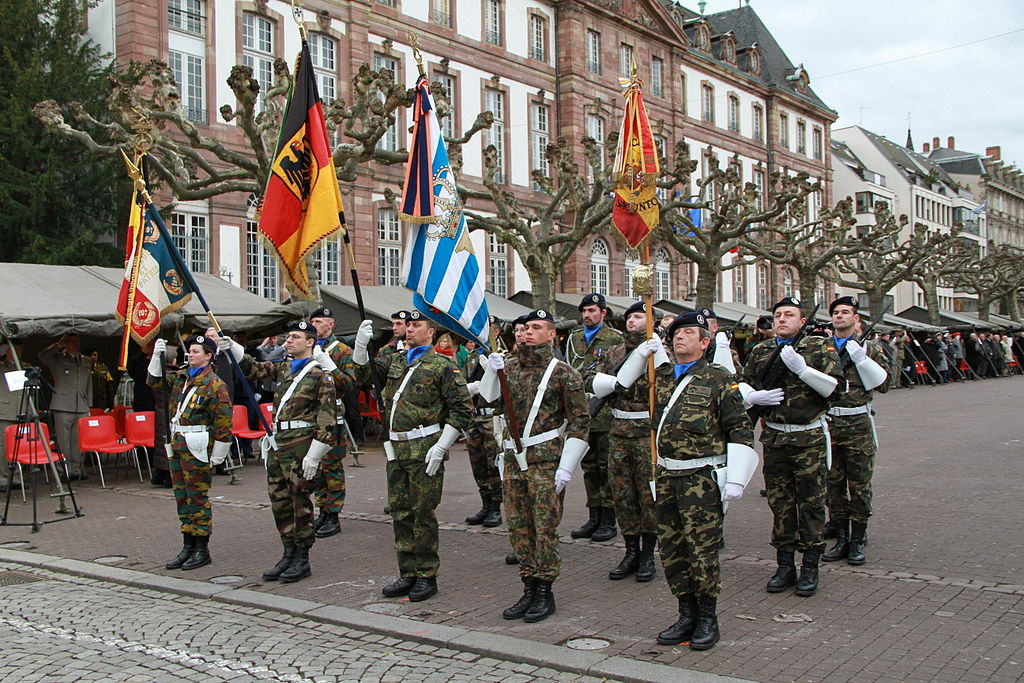
Soldiers from the Eurocorps on parade in Strasbourg, France, on January 31, 2013. Eurocorps is an intergovernmental military unit of approximately 1,000 soldiers from Belgium, France, Germany, Luxembourg and Spain, stationed in Strasbourg. (Image: Claude Truong-Ngoc/Wikimedia Commons)

Soeren Kern is a Senior Fellow at the New York-based Gatestone Institute. He is also Senior Fellow for European Politics at the Madrid-based Grupo de Estudios Estratégicos / Strategic Studies Group. Follow him on Facebook and on Twitter.

Appendix

Select quotes regarding a European army

European federalists have been calling for the creation of a European army in one form or another since 1950. Although a European army is still a long way away from becoming reality, the ultimate goal of European federalists is full defense integration leading to a European military under supranational control.

Since the Lisbon Treaty, which forms the constitutional basis of the European Union, entered into force in December 2009, the political momentum toward European defense integration has picked up steam. The drive toward European defense integration has accelerated during the Obama administration, which has often appeared indifferent to Europe and transatlantic relations. Another important obstacle to European defense integration was removed when Britons voted in June 2016 to exit the European Union.

What follows is a collection of quotes from senior European officials regarding a European army and integrated defense.

September 9. The EU’s foreign policy chief, Federica Mogherini, said:

“I believe a window of opportunity has been opened to give life to a European defense. I wanted to send the message that, despite the British exit, Europe can and must move forward with the process of integration. The prospect of Brexit offered an opportunity not to be slowed by the country that was always most determinedly opposed to the idea of pooling the instruments of defense.”

August 26. Hungarian Prime Minister Viktor Orbán, a staunch critic of the EU’s migration policies, said a joint European army was needed to keep migrants out. At a news conference after a meeting between Central European member states and German Chancellor Angela Merkel in Warsaw, Orbán said: “We should list the issue of security as a priority, and we should start setting up a common European army.”

August 22. Czech Prime Minister Bohuslav Sobotka called for greater European military integration:

“Our experiences with the last migration wave have shown the importance of Europe’s internal borders. In the face of uncontrolled mass migration, even states in the center of Europe have realized that internal borders must be better controlled. Aside from better coordinated foreign and security policy, I also believe that in the long term, we will be unable to do without a joint European army.”

July 23. Hungarian Prime Minister Viktor Orbán said:

“The withdrawal of the British from the EU has led to a significant reduction in the continent’s military strength, and from a military policy perspective we must not remain in this defenseless position… A European army must protect the continent from two sides, from the East and from the South, in terms of protecting against terrorism and migration. Europe cannot even continue to exist without an alliance — a joint EU army.”

July 13. The German Defense Ministry released a white paper outlining the country’s future defense and security policies. The document calls for steps leading to the creation of an EU army, such as the integration of military capabilities and defense industries. “We are aiming to establish a permanent European civil-military operational headquarters in the medium term,” it says. The white paper also says that citizens of other EU countries could be allowed to serve in the German army. Defense Minister Ursula von der Leyen said:

“Britain has paralyzed the European Union on the issues of foreign and security policy. This cannot mean that the rest of Europe remain inactive, but rather we need to move forward on these big issues.”

June 28. French Foreign Minister Jean-Marc Ayrault and German Foreign Minister Frank-Walter Steinmeier released a joint document titled “A Strong Europe in a World of Uncertainties.” It states:

“The security of EU member states is deeply interconnected, as these threats now affect the continent as a whole: any threat to one member state is also a threat to others. We therefore regard our security as one and indivisible. We consider the European Union and the European security order to be part of our core interests and will safeguard them in any circumstances.

“In this context, France and Germany recommit to a shared vision of Europe as a security union, based on solidarity and mutual assistance between member states in support of common security and defense policy. Providing security for Europe as well as contributing to peace and stability globally is at the heart of the European project.

“France and Germany will promote the EU as an independent and global actor able to leverage its unique array of expertise and tools, civilian and military, in order to defend and promote the interests of its citizens. France and Germany will promote integrated EU foreign and security policy bringing together all EU policy instruments.

“The EU should be able to plan and conduct civil and military operations more effectively, with the support of a permanent civil-military chain of command. The EU should be able to rely on employable high-readiness forces and provide common financing for its operations. Within the framework of the EU, member states willing to establish permanent structured cooperation in the field of defense or to push ahead to launch operations should be able to do so in a flexible manner. If needed, EU member states should consider establishing standing maritime forces or acquiring EU-owned capabilities in other key areas.”

June 26. In an interview with Welt am Sonntag, the Chairman of the European Parliament’s Foreign Affairs Committee, Elmar Brok, called for the immediate creation of a joint military headquarters and for the eventual establishment of an EU army:

“We need a common military headquarters and a coalition of the willing in accordance with the permanent structural cooperation of the EU Treaty. An EU army could eventually arise from such a group. This could help to strengthen the role of Europeans in the security and defense policy, together better fulfill the responsibility of Europe in the world and also to achieve more synergies in defense spending.”

June 24. French President François Hollande said:

“Europe needs to be a sovereign power deciding its own future and promoting its model. France will therefore be leading efforts to ensure Europe focuses on the most important issues: the security and defense of our continent, to protect our borders and preserve peace in the face of threats.”

May 29. British Armed Forces Minister Penny Mordaunt said: “A centrally controlled army would be a massive step to the EU’s goal of full political integration, but it would be a very dangerous move.”

February 4. German Defense Minister Ursula von der Leyen confirmed an agreement to integrate some 800 German soldiers into the Dutch navy. While in Amsterdam, where she met with the Dutch Defense Minister, Jeanine Hennis-Plasschaert, von der Leyen called the plan a “prime example for the building of a European defense union.”

December 15, 2015. The European Commission proposed creating a European Border and Coast Guard. The proposal, which was put forward in response to the ongoing European migrant crisis, called for a rapid reaction force of 1,500 officers who would be able to deploy even if a member state did not ask for its help.

October 15, 2015. The president of the European People’s Party (EPP), Joseph Daul, said: “We are going to move towards an EU army much faster than people believe.”

September 12, 2015. An unpublished position paper drawn up by Europe and Defence policy committees of German Chancellor Angela Merkel’s Christian Democratic Party (CDU) was leaked to The Telegraph. The document sets out a detailed 10-point plan for military co-operation in Europe. It calls for “a permanent structured and coordinated cooperation of national armed forces in the medium term.” It adds:

“In the long run, this process should according to the present German coalition agreement lead also to a European Army subject to Parliamentarian control.

“In the framework of NATO, a uniform European pillar will be more valuable and efficient for the USA than with the present rag-rug characterized by a lack of joint European planning, procurement, and interoperability.”

June 15, 2015. Michel Barnier, Special Adviser on European Defence and Security Policy to European Commission President Jean-Claude Juncker, wrote:

“Member States are slow to accept that they need to go beyond a model where defense is a matter of strict national sovereignty…. It is time for a reckoning: traditional methods of cooperation have reached their limits and proved insufficient. European defense needs a paradigm change in line with the exponential increase in global threats and the volatility of our neighborhood. The past has shown that European defense does move ahead if and when there is political will.”

March 9, 2015. In an interview with Die Welt, European Commission President Jean-Claude Juncker said the EU should establish its own army to show Russia it is serious about defending European values:

“Europe has lost a huge amount of respect. In foreign policy too, we are not taken seriously. A common European army would show the world that there will never again be war between EU countries. Such an army would help us to build a common foreign and security policy and allow Europe to meet its responsibilities in the world. With its own army, Europe could respond credibly to a threat to peace in a member country or in a neighboring country of the European Union.”

German Chancellor Angela Merkel and Foreign Minister Frank-Walter Steinmeier said they support Juncker’s proposal for a European army. In an interview with Tagesspiegel, Steinmeier added:

“The long-term goal of a European army is a major policy objective and has been part of the Social Democratic Party’s (SPD) party program for many years. Given the new risks and threats to peace in Europe we now need, as a first step, a rapid adaptation and updating of the common European security strategy.”

March 8, 2015. In an interview with Deutschlandfunk radio, German Defense Minister Ursula von der Leyen said:

“I think that the German army is ready, under certain circumstances, to be subordinated to the control of another nation. That is the goal, that in the European Union we step by step more firmly establish our cooperation, especially in security policy. This intertwining of armies with a view to having a European army is the future.”

May 15, 2014. Jean-Claude Juncker, the European People’s Party lead candidate for president of the next European Commission, wrote:

“I believe that we need to work on a stronger Europe when it comes to security and defense matters. Yes, Europe is chiefly a ‘soft power.’ But even the strongest soft powers cannot make do in the long run without at least some integrated defense capacities. The Treaty of Lisbon provides for the possibility, for those Member States who want to do so, to pool their defense capabilities in the form of a permanent structured cooperation.”

December 19, 2013. The speaker of the European Parliament, Martin Schulz, called for the creation of a European army: “If we wish to defend our values and interests, if we wish to maintain the security of our citizens, then a majority of MEPs consider that we need a headquarters for civil and military missions in Brussels and deployable troops.”

November 15, 2009. In an interview with The Times, Italian Foreign Minister Franco Frattini said it is a “necessary objective to have a European army.” He added:

“Every country duplicates its forces, each of us puts armored cars, men, tanks, planes, into Afghanistan. If there were a European army, Italy could send planes, France could send tanks, Britain could send armored cars, and in this way we would optimize the use of our resources. Perhaps we won’t get there immediately, but that is the idea of a European army.”

May 6, 2008. German Foreign Minister Frank-Walter Steinmeier called for the establishment of the European army “as soon as possible.” He said he had been in talks with his French counterpart to discuss “future structures” of a European army.

December 10-11, 1999. European officials meeting in Helsinki agreed to develop a European Rapid Reaction Force. Also known as the Helsinki Headline Goal, EU member states pledged that by 2003 they would be able to deploy a European military force of 60,000 troops within 60 days and for a period of potentially one year. This goal has never been met.

December 3-4, 1988. British Prime Minister Tony Blair and French President Jacques Chirac met at the French port city of Saint-Malo to discuss future EU defense integration. The summit declaration, which laid the political foundation for a common European defense policy, stated:

“The European Union needs to be in a position to play its full role on the international stage… The Union must have the capacity for autonomous action, backed up by credible military forces, the means to decide to use them, and a readiness to do so, in order to respond to international crises.”

October 24, 1950. The Pleven Plan, named after French Prime Minister René Pleven, was the first plan to create a unified European army. It proposed the “immediate creation of a European army tied to the political institutions of a united Europe.” It stated:

“A European army cannot be created simply by placing national military units side by side, since, in practice, this would merely mask a coalition of the old sort. Tasks that can be tackled only in common must be matched by common institutions. A united European army, made up of forces from the various European nations must, as far as possible, pool all of its human and material components under a single political and military European authority.”

The Pleven Plan was rejected by the French Parliament because it infringed on France’s national sovereignty.

Director of National Intelligence: Climate Change (Not Sharia) Leads to Jihad

Posted September 13, 2016 by danmillerinpanama
Categories: Climate change, Intelligence community, Islamic terrorism, James Clapper, Obama and Islamic terrorism

Tags: , , , ,

Director of National Intelligence: Climate Change (Not Sharia) Leads to Jihad, Counter Jihad, Bruce Cornibe, September 13, 2016

It’s ridiculous when an elite university like MIT promotes bogus lectures such as Is Islamophobia Accelerating Global Warming? However, one can argue that it’s even worse when our top U.S. government leaders advocate for similar bogus theories such as linking climate change to terrorism.

This is what happened recently at the annual Intelligence & National Security Summit in Washington, D.C., when DNI’s James Clapper suggested a connection between environmental issues and terrorism.

The political left has been trying to establish a linkage between the two topics to provide a way to divert attention away from the actual radical Islamic ideology that is at the heart of modern day terrorism.

For example, in Paris a couple weeks after the horrific November 2015 attacks, U.S. President Obama had the audacity to insinuate a connection between climate change and terrorism. It’s bad enough that some leftists continue to push the narrative that humans are the main reason for climate change – now we have to hear our government officials promote a political agenda that basically says if we don’t go “green” we can expect terrorism to continue. Defense One reveals Clapper’s rationale behind this climate change and terrorism connection stating:

…Increased competition for “ever-diminishing food and water resources” will amplify socio-economically motivated armed conflicts, countries’ difficulties controlling their borders, and instability more generally, he said.

“I think climate change is going to be an underpinning for a lot of national security issues,” Clapper said. It affects “so many things: the availability of basics like water and food and other resources which are continually going to become matters of conflict, and already are, between and among countries.”

Defense One goes on to add:

The Pentagon has been getting increasingly serious about preparing for it, warning that warming global temperaturesand extreme weather events would act as a “threat multiplier” and foster terrorism. Earlier this year, Deputy Defense Secretary Bob Work ordered the military to adapt current and future operations to address climate change.

Clapper echoed this warning. Climate change-driven instability and other factors mean that “after ISIL is gone, you can expect some other terrorist entity to arise, and the cycle of extremism [to] continue for the foreseeable future.”

It seems like the line of logic is as follows: Humans (implied) -> climate change -> diminished resources -> struggle for resources -> “extremism”/terrorism

To say that climate change is causing a depletion of our resources like food and water–which then causes conflict that leads to terrorism is a massive stretch of the imagination. Of course, this didn’t stop President Obama and Secretary of State John Kerry from linking climate change to the Syrian civil war.

Even left-leaning national security analyst Peter Brookes debunked this in an article last year, writing that, “there seems to be no strong quantitative (i.e., empirical) evidence to prove a cause-and-effect relationship between changes in the climate and conflict.”

It’s one thing to say that natural resources like fresh water are a security concern in arid regions like areas in the Middle East and Africa, and enter into countries’ national security policy. That much is true– and also obvious. However, to say Islamic jihad is a result from supposed conflict caused by a lack of resources is ludicrous.

Jihadists are driven by motives such as Sharia law and bringing back the Caliphate, not by frustration over the contention of scarce food and water supplies. This type of linkage is even weaker than the belief that terrorists are essentially joining the cause of jihad because of a lack of jobs/economic opportunities. ISIS could be living on the most resource-replete land and they still wouldn’t be satisfied until they bring the world under Islamic rule.

Regardless of their differences, there is a commonality between those who are hyper-ideological; a link between those who are so obsessed with their worldview that they believe it explains literally everything: In Paris last year, Obama said, “climate change — affects all trends”; the totalitarian Islamist thinks implementing Sharia law globally is the answer to solving the world’s problems.

Of course, Obama wants to see the establishment of liberal-progressive values, while the Islamist wants everything Islamic; however, both groups need each other politically at least temporarily in order to build up a powerful enough coalition to launch their respective agendas on the world stage.

Leftist politicians tend to dismiss or ignore the worldwide jihadist movement and seek to combat what they call “extremism” with vague solutions that furthers their political agenda.

Anyone with common sense realizes that hardcore jihadists like ISIS are not going to put down the sword of jihad through diplomacy and random acts of global kindness. The West needs to militarily wipe jihadists like those involved with ISIS off of the face of the earth, but also seek ways in countering their Sharia ideology that is reaching our next generation’s youth.