Dr. Jasser discusses the misreporting of a immigrant registry on Varney & Co 11.17.2016, Fox News and AIFD via YouTube, November 17, 2016
How Trump Can Stop Obama from Closing Gitmo, American Thinker, Ed Lasky, November 18, 2016
Donald Trump can stop Barack Obama from continuing to free terrorists, and the sooner he acts, the better.
Barack Obama is a lame-duck president and, empowered by his pen and a phone (the only weapons he has ever held, no doubt) is determined to continue to carve out a dubious legacy for himself. He had promised to close Guantanamo prison during his first presidential campaign and on the second day in office he issued one of his numerous executive orders to come, this one directing that the prison be closed within one year.
Terrorists were big supporters of Barack Obama. At Gitmo they were chanting “Obama! Obama! Obama!” during election night and when he won started chanting to their guards and prosecutors the refrain “Hey, hey…goodbye”
President Obama was stymied in his efforts to transfer many of them to American prisons when Republicans led an effort (joined by many Democrats) to pass a law that forbade prisoners from being moved into American prisons. But Barack Obama has found another way to release these terrorists (or “detainees” as liberals call them) by working to depict them as less of a threat than they are and then releasing them into the custody of foreign governments.
As Stephen Hayes has written in a Weekly Standard column, “Lying About Gitmo,” Obama and his team have been lying about the backgrounds and records of these terrorists to downgrade their threats to Americans and others around the world:
Let’s begin with the conclusion: Barack Obama is releasing dangerous terrorists against the recommendations of military and intelligence professionals, he’s doing so at a time when the threat level from radical Islamists is elevated, and he is lying about it. He is lying about how many jihadists he has released and lying about their backgrounds, all part of his effort to empty the detention facility at Guantánamo Bay.
Hayes assembles quite the collection of examples of anti-American jihadists that Obama has given a get out of jail card. Included among them are the so-called Taliban Five, terror masterminds released in return for Sgt. Bowe Bergdahl. All five had worked for Al Qaeda before 9/11.
Hayes writes:
Obama has also downplayed the threats from released Guantánamo prisoners in other ways. He describes the detainees as “embittered,” as if the hatred that inspires them grows from their time in Guantánamo rather than their devotion to a murderous cause. Instead of rejoining the war, the recidivists are merely “trying to link up with their old organizations.” Perhaps most bizarre is his description of the process he’s using to determine which detainees can be transferred or set free. “The judgment that we’re continually making is: Are there individuals who are significantly more dangerous than the people who are already out there who are fighting? What do they add? Do they have special skills? Do they have special knowledge that ends up making a significant threat to the United States?”
Those are the criteria? Detainees can be released if the White House determines that they are no more dangerous than, say, the leaders of ISIS, AQAP, Boko Haram, Jabhat al Nusra, the Haqqani network, the Khorasan group? If this is actually the way the administration evaluates potential releases, it would explain why so many veteran jihadists have been freed. It’s a process that prioritizes emptying the facility over the security of the country.
Obama has been dishonest about his policy and has downplayed threats from Islamic terrorism from the first day of his presidency to the (thankfully) last days to come. Pentagon and other national security experts have decried this minimizing of threats to America. His actions have been condemned by Congressman such as Edward Royce, the Republican head of the House Foreign Affairs Committee, who accused the White House of “doubling down on policies that put American lives at risk” and “recklessness.”
Climate change is a greater threat in Obama’s mind.
Barack Obama seems laser-focused on closing Gitmo as part of his legacy. This would cause irreparable harm to the security of America: released terrorists have a very high recidivism rate (killing is what they live for, and released “detainees” have been implicated in subsequent attacks on Americans) and Gitmo has a very unique legal status that makes it absolutely crucial in our battle against terrorism. If Obama succeeds in closing Gitmo and, perhaps, turning it over to the Castro brothers (who no doubt will be glad to have more prison space for their political prisoners), it will never again be an American asset in our fight against Islamic terrorism.
Obama has justified his actions by being able to claim formally that these terrorists are not being freed; instead he has been transferring them to other nations who supposedly will monitor them to prevent their return to terrorism. In practice, this monitoring has been a farce as the various nations, some but not all of them of them Muslim nations, have looked the other way as the terrorists “go back to work.” Detainees have vanished; they have gone off the radar screen and found their ways back to join their fellow terrorists.
What can be done in the next two months to stop Obama?
Donald Trump has vowed to keep the prison open, and to “load it up with some bad dudes.” But he can’t keep his promise if Obama empties the prison and fulfills his promise to close Gitmo.
President-elect Donald Trump and a Republican Congress can put foreign nations on notice that change is coming to Washington and America in January and that nations that cooperate with Barack Obama in his terrorist release program will be scrutinized in the years to come when it comes to foreign aid, trade pacts, security cooperation and a range of other measures. Some of the nations that have taken the terrorists are oil-rich Middle Eastern nations, but others are less wealthy South American nations. Would Uruguay be willing to take any more terrorists if faced with warnings from the incoming administration that moves to take them will be “looked at with disfavor” (to be diplomatic) in the years to come? Even Arab nations, who certainly have no reason to seek to please Barack Obama, might be reluctant to displease a President Trump who they will have to engage with the next four years.
President-elect Donald Trump has a chance to do a great deal to help defend America even before he becomes Commander-in-Chief.
The New York Times’ Dishonest Reporting on the Iran Nuclear Deal, Center for Security Policy, Fred Fleitz, November 17, 2016
You may have read that in response to criticism about its biased coverage of the Trump campaign, the New York Times has rededicated itself to honest reporting.
After you get up off the floor from laughing hysterically, consider this story that ran days after the Times’ renewed commitment to ethical journalism: On November 14, the New York Times ran an article with the headline: “76 Experts Urge Donald Trump to Keep Iran Deal.” In the second paragraph, the article claims this report was signed by “former officials from both major political parties.”
Not until the sixth paragraph does the story mention that this report was issued by the National Iranian American Council (NIAC).
This is the kind of dishonest reporting we have come to expect from the New York Times.
NIAC, well known as the head of the Iran lobby in the United States, aggressively campaigned for the Iran nuclear deal. The Times misleadingly describes it as “a Washington group that has advocated improved relations with Iran, even while sharply criticizing Iranian leaders over human rights issues.”
The NIAC report reads like it was written by the Iranian foreign ministry. Not only does it call for President Trump to stick with the Iran deal and not impose new sanctions, the report ignores a sharp increase in belligerent behavior by Iran since the nuclear agreement was announced, suggests the U.S. should ignore Iran’s ballistic-missile program, and calls for close U.S.–Iran cooperation on Iraq, Syria, and Afghanistan.
According to the report, U.S.–Iran relations have reached their highest point in 37 years due to the nuclear agreement. I don’t think the crews of U.S. ships in the Persian Gulf and the Red Sea who have been harassed by Iranian ships and had missiles fired at them from Yemen would agree.
On Iran’s gross human-rights violations, the report essentially calls for the Trump administration to ignore them and instead makes the bizarre recommendation that President Trump take steps to show that America does not seek to harm innocent Iranians by speeding up the sale of civilian airliners to Iran.
The 76 “experts” who signed the NIAC report are mostly on the far left, including Noam Chomsky, Joseph Cirincione, Juan Cole, and John Esposito.
The article identified Lawrence Korb, Lawrence Wilkerson, Chas Freeman, and Gary Sick as experts who signed the report and served in Republican administrations. The Times did not mention that these men are now firmly on the left.
Korb may have been a Republican at one time but now works for the George Soros-funded Center for American Progress and was a surrogate for Bernie Sanders and Hillary Clinton.
Wilkerson, Secretary of State Colin Powell’s chief of staff, joined the far Left as a fierce critic of the Republican party after Powell stepped down. He has called for George W. Bush and Dick Cheney to be charged with war crimes over the Iraq War.
Freeman, a former ambassador to Saudi Arabia and assistant defense secretary for international affairs in Republican administrations, blamed the “Israel Lobby” for forcing him to withdraw from accepting a top intelligence post in the Obama administration.
And then there is Gary Sick, who the Times identifies as “a Columbia University scholar who served on the National Security Council under Reagan as well as Presidents Gerald Ford and Jimmy Carter.” Sick is better known for circulating a false story in 1980 that that the Reagan campaign persuaded the Iranian government to not free U.S. hostages until after the 1980 election to ensure President Carter’s defeat.
How could the Times fail to mention this report was issued by a group that is essentially Iran’s main lobbying arm in the United States? How could it ignore the strong pro-Iran bias in this report? How could the Times not mention the troubling backgrounds of the signatories like Wilkerson, Freeman, Sick, and others?
Most importantly, why did the Times article not admit the NIAC report has zero credibility and will be completely ignored by the Trump administration?
The answer to these questions is that the New York Times has no interest in changing its ways and doing honest reporting. It remains a propaganda organ of the Left. Fortunately, the Timeshas lost so much credibility that few take articles such as its NIAC-report story seriously.
For a fair and balanced discussion of how President Trump should deal with Iran, see my November 14, 2016, National Review article, “Yes, Trump’s Going to Dump the Iran Deal.”
Hezbollah has U.S. armored personnel carriers. But how did they get them?
Source: Hezbollah has U.S. armored personnel carriers. But how did they get them? – The Washington Post

Jordanian Armed Forces M113 armored personnel carriers attack a simulated invasion force during a mission readiness exercise at the JAF’s Joint Training Center on Jan. 17. (Sgt. Youtoy Martin/U.S. Army)
Over the weekend images surfaced online of a Hezbollah parade in Qusair, Syria, featuring U.S. armored personnel carriers affixed with antiaircraft guns. The images prompted a flurry of speculation about the vehicles’ origin and whether the group had pilfered the stocks of the U.S.-supplied Lebanese military.
The armored personnel carrier, known as the M113, is one of the United States’ most ubiquitous armored vehicles and has been in service since the 1960s. The tracked semi-rhombus-shaped vehicle comes in numerous variants and can be outfitted to carry troops and artillery; its chassis was even used as the basis for a nuclear-missile carrier. It has appeared in every major U.S. conflict since the Vietnam War and is used by U.S. police departments and dozens of others countries’ militaries around the world.
https://twitter.com/tobiaschneider/status/797881849850695680?ref_src=twsrc%5Etfw
As a prominent political and military entity in Lebanon, Hezbollah’s possession of the vehicles could support the theory floated by the defense analyst Tobias Schneider, who tweeted that the personnel carriers were probably taken from the Lebanese Armed Forces, a major recipient of U.S. military aid.
[U.S. accidentally delivered weapons to the Islamic State by airdrop, militants say]
Over the summer, the Lebanese military took possession of dozens of pieces of artillery, armored vehicles, semiautomatic grenade launchers and 1,000 tons of ammunition — all worth about $50 million — as part of the United States’ ongoing efforts to bolster the country’s capacity to fight extremists. The shipment, overseen by the Pentagon and the State Department, brought the amount of U.S. military aid sent to Lebanon in 2016 to $221 million, according to U.S. Ambassador Elizabeth H. Richard.
While Lebanese smugglers have helped move weapons and ammunition to opposition groups in Syria, cases of Lebanese military equipment appearing in the conflict have been rare. In a tweet, the Lebanese military denied that the M113s were taken from its stocks, a claim backed up by a State Department official, who spoke on the condition of anonymity to discuss the issue.
“The Lebanese military has publicly stated that the M113s depicted online were never part of their equipment roster,” the official said. “Our initial assessment concurs: The M113s allegedly in Hezbollah’s possession in Syria are unlikely to have come from the Lebanese military. We are working closely with our colleagues in the Pentagon and in the Intelligence Community on to resolve this issue.”
After comparing the “structual analysis of the vehicles in the picture,” Pentagon spokesman Chris Sherwood said that the Pentagon had ruled out the possiblity of Hezbollah taking the M113s from the Lebanese Armed Forces.
Closely aligned with Iran and Syria, Hezbollah has been fighting alongside Syrian government troops since the beginning of the conflict.
The Hezbollah M113s appear to be an older variant, and U.S. officials said they are inclined to believe that vehicles came from the disintegration of the Southern Lebanese Army, or SLA. The SLA was an Israeli-allied and supplied Christian militia that fought during the Lebanese civil war. Its military equipment was ultimately absorbed by Hezbollah in the early 2000s when Israel withdrew from southern Lebanon.
[Hezbollah ally elected as Lebanon’s new head of state]
In 1985, Israel supplied 20 M113s to the SLA, according to arms transfer data provided by the Stockholm International Peace Research Institute. From 1984 to 1996, Israel provided more than 130 armored vehicles, tanks and artillery pieces to the SLA, according to the data. Another possibility, as pointed out by Schneider in subsequent tweets, is that Hezbollah took them from Syria’s recently renamed al-Qaeda affiliate, formerly known as Jabhat al-Nusra. It is unclear where al-Nusra got its M113s.
U.S. equipment falling into the hands of extremist groups and regional opponents has been a recurring theme in the Middle East and southwest Asia for the past 15 years as American wares have been distributed wholesale to those willing to fight for U.S. causes. Armored vehicles, weapons, night-vision devices and body armor have been diverted from places such as Iraq, Afghanistan, Syria, Saudi Arabia and Yemen, subsequently showing up on battlefields throughout the region.
The post has been updated to reflect a comment from the Pentagon.
Responses In Iran To Trump’s Presidential Win, Memri, By: A. Savyon, E. Kharrazi, and U. Kafash*, November 17, 2016
Introduction
While the Iranian regime’s official position is that there is no difference between a Democrat or a Republican in the White House because both of them will be anti-Iran, there are a number of notable trends in Iranian reactions to Donald Trump’s election:
Reactions Common To Both The Ideological And Pragmatic Camps
o Trump seeks better relations, not conflict, with Russian President Vladimir Putin, so Iran expects that he will let Putin deal with Syria, which is controlled by Iran.
o Trump is unpopular in the West, and will therefore find it difficult to form an international coalition against Iran – which Clinton could have easily done.
o Trump will need some time to identify his Republican allies in Congress before he can act against Iran.
o Since Trump is a businessman, there is cautious hope that his actions will be business-oriented, not purely ideology-oriented.
Reactions From The Pragmatic Camp
Reactions From The Ideological Camp
 Cartoon published November 16, 2016 by the Iranian news agency Mehr. Note the two Hitler serpents behind Trump.
MEMRI’s Assessment
It appears that Iran’s military-political elite prefers to deal with a male president, not a female one.[1] Furthermore, in a November 2 speech ahead of the anniversary of the U.S. Embassy takeover in Tehran, Supreme Leader Ali Khamenei, in an unusual statement, explained Trump’s popularity among the American public as due to the fact that he speaks “honestly.” Moreover, unlike Clinton, Trump is seen by the Iranian leadership as not committed to democratic values or human rights because of his past remarks on women and minorities, and as a dominant ruler with whom Iran can find common ground. Iran has actually chosen to cooperate with Republican administrations that demonstrated strength and determination.
In this context, it is important to note that it is with Republican administrations that have demonstrated strength and determination that Iran has chosen to cooperate. For instance, when the U.S. military operated in Iraq and Afghanistan during the George W. Bush administration, Iran cooperated with U.S. forces and even stopped enriching uranium of its own accord, fearing an American attack. Also, during the Reagan administration, it was the Iranian regime that initiated dialogue with the U.S. on the Iran-Contra affair.
A contemporary example is the announcement by an Iranian diplomatic source, immediately after Trump’s win was declared, that Iran intends to remove from its territory a quantity of heavy water that puts it above the limits set by the JCPOA. An International Atomic Energy Agency (IAEA) report from early November 2016 warned that Iran possessed too much heavy water, but it was only after Trump’s win that Iran hastened to announce its intention to rectify the violation.
It should also be noted that Trump, who was critical of the JCPOA, need not take measures to cancel the agreement. He can take another tack to do this, by this by strictly implementing all sections of the agreement as it already exists, upholding Congress’ initial sanctions on Iran for its human rights violations and support for terrorism, and passing additional sanctions, for example on Iran’s ballistic missile program which the Obama administration did not include in the JCPOA. In fact, in recent months, the Obama administration had been working to help Iran,[2] in direct violation of the JCPOA and of Congress’s initial sanctions.
Such moves could restructure the relationship between Iran and the U.S. administration, making it into one based on cooperation and mutual understanding – in contrast to the Iranian regime’s contempt for and ridicule of the Obama administration. This scenario would be like the Reagan presidential win, after which Iran immediately released the Americans it had been holding hostage for over a year during the Carter administration.
Even more important than the future of the JCPOA, and much more urgent, is what Trump will do about the military and political empire that Iran is building in the Middle East – in Iraq, Syria, Lebanon, and Yemen – with the encouragement of the Obama administration, which sought to shift the region’s Sunni-Shi’ite power balance towards the Shi’ites.[3] What action will he take against the Iran-led Shi’ite axis that is standing against the Sunnis, led by Saudi Arabia and Turkey? What will he do about Iran’s strategic partner, Putin’s Russia?
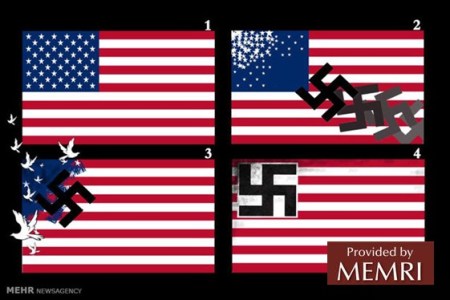 Mehr, November 16, 2016.
Following are excerpts from Iranian reactions to Trump’s win, from both the pragmatic and ideological camps:
Iran’s Pragmatic Camp
Iranian Foreign Minister Javad Zarif said, during a visit to Romania: “We do not interfere in the internal affairs of other countries. This is the choice of the American people. Anyone who will be president in America should recognize the reality in the region and the world, and address it realistically. Iran and America have no political ties, but America must meet its international obligations [under] the JCPOA, along with other parties.”[4]
Iranian Foreign Ministry spokesman Bahram Qassemi said: “The Iranian people and the Islamic Republic of Iran have bad and bitter memories from the previous policies and approach of American administration officials. What is important to Iran, and the Iranian people – whom [we] consider a touchstone – is how the next American administration will act and conduct itself. These things are more important than [Trump’s] statements and the policies he expressed during his election campaign.
“The main cause of the escalating violence, extremism, and provocations of Muslims in the region is the policies of the previous American administrations, and their interference in the affairs of the countries in the region. The instability in the strategic regions of the Middle East, the Persian Gulf, the Gulf of Aden, and the Red Sea, and the threats stemming from the violence, extremism, spread of deviant and dangerous thought, and terrorism of groups such as ISIS – which Iran is at the forefront of combatting – indicate that America must reexamine its regional policy.”[5]
Iranian President Hassan Rohani stated, at a government meeting on November 9, that the JCPOA cannot be cancelled: “Iran’s wisdom in the nuclear agreement was to ratify the JCPOA as a Security Council resolution, and not a [bilateral] agreement with a particular country or administration. Therefore, [the JCPOA] cannot be changed according to the whims of a particular administration… The results of the American election will not influence Iranian policy.” He added: “Because of its mistaken policies, America’s status in international society and in global public opinion has waned, and its growing rift with the global society and with Europe damages this status even further… The American election results attest to domestic worry and instability, which will remain for a long time. It will also take a long time until these domestic disagreements and problems are sorted out.
“America today can no longer take advantage of Iranophobia to create a global anti-Iran coalition. Iran’s policy is based on constructive cooperation with the world, on breaking the nuclear sanctions, and on economic ties with the entire world. [This policy] is now emerging, and can no longer be reversed.”[6]
Reformist intellectual Prof. Sadegh Zibakalam explained on November 10 why Iran’s ideological camp preferred Trump to Clinton: “After the American election, there is surely much rejoicing among the streams hostile to America, and among those in Iran who persist in remaining hostile to America, because when Trump enters the White House there will be no more opportunity to ease Iran-U.S. tensions or to bring the [two] closer together… The extremists will exploit Trump’s positions and tell the moderates ‘See how wrong you were? Do you see we were right and that America can absolutely not be trusted? Look at Trump’s anti-Iran stances – do you see why we said that we cannot be fooled by America and that we shouldn’t take its friendly smile seriously?’
“It won’t be long before many in Iran long for the days when Obama was in the White House and John Kerry ran the U.S. State Department. Then they will realize how good we had it, and that we could have reached understandings with America and moved towards removing the tension – but we missed that golden opportunity.
“The Russians are also glad that an extremist is now in the White House, because they believe that they can handle extremists, but not Democrats. They believe that it is possible to get along with Reagan, Trump, and George Bush, but that it is always difficult to deal with the Democrats. Therefore, the Russians, much like our own extremists, welcome Trump’s election, while moderate liberal streams in Europe that support human rights and such do not.”[7]
Responding to Zibakalam’s argument that Iran would welcome Trump, but not an Obama or a Clinton,the pragmatic website Asr-e Iran wrote: “Many believe that Trump’s victory will damage Iran and that Iran will encounter many problems in the post-Obama era. But in this article we will state not only that Trump’s victory will not harm Iran, but that Iran will benefit it.
“Unlike Obama and Clinton, Trump is more inclined [to deal with] domestic affairs, and does not wish to occupy himself with foreign affairs and regional crises. In his speeches, Trump openly stated that he opposes the attacks in Iraq and Afghanistan and does not want to bring America into other countries’problems. Obama and Clinton desperately wanted to create hegemony in the region and outside it, but because America is now weaker at home, Trump wants to improve its domestic situation, and it can therefore be said that he does not wish to deal with Iran and the Middle East region.
“The most important Trump opponents now are European governments. The Europeans did not want Trump in power. But this is today’s reality, and we can say that Trump’s arrival has opened up a yawning chasm between Europe and America. The American presidents who preceded Trump had global leadership strength, because the world, and especially Europe, recognized them as world leaders. But today, not even the American elite, let alone European countries, recognize Trump as a global powerbroker. This means that Trump cannot form an international coalition against Iran or against countries that oppose America.
“Certainly, Europe in the Trump era will try to engage in its own interests, and will no longer make efforts for American interests. This is Iran’s best opportunity to take advantage of this possible Europe-U.S. gap. The Europeans have expressed interest in economic and political cooperation with Iran, and during these years [i.e. the Obama years], America was the only obstacle. In the Trump era, Iran could strengthen its ties with Europe.
“Trump is an economic player; for him, policy is determined by economic profit. Those who seek economic windfalls are never interested in wars or political crises, which can create market panic, unless the war benefits their economic interests.
“Trump’s America will be a country focused on matters that are marginal and on mere noise. This is the best time for Iran to promote its policy on the regional and international levels. The JCPOA under Trump could be the JCPOA of Iran and Europe, and because of the red-headed American president, America might slowly drift away from the JCPOA with Iran. Of course, we must stress that nothing is certain or predictable, especially with regard to Trump, and therefore the world and Iran should keep a close eye on the 45th American president.”[8]
Foad Izadi, an assistant professor in the American Studies department at Tehran University who has a degree from Louisiana State University, claimed that the biggest gift that Trump’s win is giving Iran is that Trump will find it difficult to mobilize international support against Iran – unlike Clinton, who could have easily done so. He added that Trump would also work against Iran in Congress, as Clinton would have, but that it will take Trump a while to identify his allies in Congress, unlike Clinton who would easily have gained support for whatever she chose to do.
Iran’s Ideological Camp
Deputy Majlis Speaker Ali Motahari said: “There will be a difference between Trump’s positions during the election campaign and [those he will adopt] during his presidency. I will summarize his election positions by saying that his presidency will be better for Iran than Clinton’s would have been, because the Democrats advance [toward their goals] more meticulously and they behead you with cotton wool.
“Trump is more honest and has better positions on Syria. Additionally, he does not view Saudi Arabia positively, and he wants good relations with Russia. I believe Trump’s opposition to the JCPOA is good for Iran. In effect, they [the Americans] can do nothing. Ultimately, I think Trump’s presidency will benefit Iran.”[9]
Mocking Western democracy, the Kayhan daily, on its November 10 front page, called Trump’s victory “Another Win For Liberal Democracy: The Madman Defeats The Mendacious Woman.”[10] That day’s editorial explained: “The whites who voted for Trump, being mostly educated [sic], and not from the upper classes, are greatly inclined to clash with racial minorities. Yesterday, immediately after Trump’s victory, in one state, young people who support him [congregated] and chanted anti-black and anti-Muslim slogans. The domestic situation in America is not so great, and daily events, such as what happened in Ferguson, deprive citizens of security. The Trump era could be anything but a time to heal the wounds opened by racial discrimination…
“Trump’s America will absolutely not be a new America with new capabilities, and therefore his anti-Iran declarations will not come to fruition. What is certain is that in the current situation, most Republicans in today’s House and Senate wish to reduce America’s extra-regional conflicts, and will abandon the rash policies of Obama, [who sought] to solve the [crisis] dossiers of the Middle East.
“Trump cannot reinvigorate America’s weary army, and the region is also lacking forces that can seriously replace those who are interfering there on behalf of America [i.e. rebel groups]. That is, the Trump era will see a decline in the wars waged by those who fight in America’s name.
“An interesting point in the American election was crediting Russia [with influencing the result]… Now there is talk of Russia’s influence in the American elections. Donald Trump not only does not deny allegations that he depends on Russia, but his [campaign] statements regarding U.S.-Russia cooperation brought him votes. He said that if he were elected, he would consider Crimea to be under Russian rule.”[11]
Iranian Army chief of staff Mohammad Bagheri said on November 10: “With regard to statements by the American president-elect and what he said during the election campaign – this man, who has now come to power, was too boastful. I have a suggestion for him: ‘Relax, and ask your naval commanders and officers how your forces on that [U.S.] vessel ended up [i.e. captured by Iran, in January 2016].’ Threatening Iran in the Strait of Hormuz and the Persian Gulf is a joke. The might of Iran’s navy also exists in the IRGC’s land [branch], air [branch], passive defense, and Qods Force.”[12]
Ala Al-Din Boroujerdi, chairman of the Majlis National Security and Foreign Policy Committee, said on November 9: “Trump’s victory shows the America people’s reaction to the [U.S.] policy of warmongering, which caused thousands of Americans to lose their lives and squandered hundreds of millions of U.S. dollars in vain… It seems that American public opinion expects the people’s problems to be addressed [now]… We must wait and see what Trump’s policy vis-à-vis the region and the Islamic world will be…
“As for implementing the JCPOA, there is a difference between Trump campaigning for election and Trump the president. It is natural that when someone is elected U.S. president, they must place themselves within the framework of laws and international relations, including the JCPOA, and must remain committed to them. Any step or action [by Trump] will be met with an appropriate [Iranian] reaction.
“If Trump wants to act according to the positions he expressed during his campaign, he must end America’s cooperation with Saudi Arabia in the evil slaughter of the Yemeni people, because Saudi Arabia cannot drown tens of thousands of oppressed Yemenis in blood and ashes without American support. Trump should, at the very least, stop the [American] shipment of weapons to Saudi Arabia.”[13]
Yadollah Javani, senior advisor to Khamenei’s representative in the IRGC, indicated that Trump’s election campaign was different from previous campaigns, and that this has to do with the domestic situation in the U.S.: “Although Trump himself is seen as a wealthy businessman, in his election campaign he defended the poor, blacks, and the lower classes, and challenged the White House’s discriminatory and corrupt policy. Therefore, his message was popular.” Javani added that Trump becoming president was unlikely to radically shift American policy: “Neither Trump nor Clinton nor anyone else can save America, whose power is dwindling, and which has reached the end of the line as a superpower and an empire… American hostility towards [Iran’s] Islamic Revolution, its Islamic regime, and the Iranian nation lies in the arrogance of the American political regime. Thus, there is no difference between Democrats and Republicans… The clearer the enemy’s hostility becomes, the easier it is to deal with. Based on experience over the past 37 years, the Republicans’ hostility towards the Islamic Revolution and the Iranian nation has been more out in the open [than the Democrats’].”[14]
Hossein Naqavi Hosseini, spokesman for the Majlis National Security and Foreign Policy Committee, said on November 9 that Trump had won because the Americans “were displeased with their rulers.” U.S. foreign policy, he said, “is fixed, and is based on interference, aggression, control, usurpation, and the beheading of nations. [But the difference is that] Democrats loot and behead with cotton wool, while Republicans [do it] cruelly with a knife.” About the JCPOA, he said: “Trump only has two options: [Either] act within the framework of the agreement, since it is not an agreement with America [only]. [Or,] if the Americans tear up the agreement, then Iran will be ready to burn it, as the leader [Khamenei] has said.”[15]
In his main official Friday sermon, on November 11, Ayatollah Ahmad Khatami, Assembly of Experts member and Tehran Friday prayer leader, rebuked all those in Iran who expressed hope for a Trump presidency, contradicting the regime’s official line, and advised Trump to focus on U.S. affairs rather than seek adventures overseas: “Before the election, Iran’s policy [vis-à-vis the candidates] was logical and neutral, because our regime said that as far as that is concerned ‘they are all the same,’ and [all the candidates] take orders from somewhere else – that is, they are servants of the Zionist regime. But some websites and newspapers [in Iran] were biased, and even before the election they welcomed a particular candidate’s win. This was unwise, and it would have been better for them to adhere to the regime’s policy…
“The candidate who won the American presidency said, ‘Our country needs new roads, tunnels, and hospitals, but we do not have the necessary funds.’ Where do the [American] tax dollars go? They are spent on slaughter. I want to preach to the new president who has just come to power in America: If you continue in the path of your predecessors, be certain that your fate will be the same as theirs. They had particular characteristics, and you should not repeat their mistakes.
“The American president-elect must know that the Iranian nation exhausted previous American presidents… You called the Iranian people terrorists. If you have any decency and courage, you will apologize to them.
“Take care, because playing with the Iranian nation is like playing with a lion’s tail. I hope these words will reach your ears. You should know that Iran has a single character and a single slogan. Our character is resisting to the final man and final breath, and our slogan is that of the Imam Hussein: ‘Humiliation and disgrace are far from us.’
“I hope that the new American president is wise enough to carry out what he said when he said ‘I do not want tense [relations] with any country.’ If he does not carry this out, he will soon get to know the Iranian people…”[16]
Majlis speaker Ali Larijani called for restraint, saying, on November 13: “The analyses and editorializing regarding the American president-elect should be more mature. We must refrain from making rash judgments and from judging prematurely. We must wait and allow [Iran’s] diplomatic apparatus to take a clear stance.”[17]
*A. Savyon is director of the MEMRI Iran Studies Project; E. Kharrazi, and U. Kafash are Research Fellows at MEMRI*
Endnotes:
[1] Due in part to a preference by Iran’s political and cultural leadership, which ideologically excludes women in key roles, to not deal directly with a woman, especially one who in the past has openly worked against Iran.
[2] According to Western media reports, the Obama administration, and particularly Secretary of State John Kerry, are pressuring European companies and banks to invest in Iran despite Congress’s sanctions. See, for example, State.gov/secretary/remarks/2016/04/256536.htm, April 23, 2016; State.gov/secretary/remarks/2016/05/257116.htm, May 12, 2016. See also article by Stuart Levey, chief legal officer of HSBC Holdings, and former undersecretary for terrorism and financial intelligence at the U.S. Treasury Department (2004-11), “Kerry’s Peculiar Message About Iran For European Banks: Why is Washington pushing banks like mine to do what is still illegal for American banks?”,” Wsj.com/articles/kerrys-peculiar-message-about-iran-for-european-banks-1463093348, May 12, 2016; Finance.yahoo.com/news/uk-working-resolve-banking-concerns-093933912.html; and Bloomberg.com/view/articles/2016-10-26/clinton-s-allies-promise-a-tougher-line-on-iran.
[3] Saudi Prince Turki Al-Faisal also said that Trump should not cancel the JCPOA and instead should focus on thwarting Iran, “which is working to destabilize” the Middle East. Reuters.com, November 11, 2016.
[4] Tasnim (Iran), November 9, 2016. Behrouz Kamalvandi, spokesman for the Atomic Energy Organization of Iran (AEOI) also said that “Iran is prepared for any development. Iran is attempting to continue implementing the JCPOA” and “it has a long term plan.” Tasnim (Iran), November 9, 2016.
[5] ISNA (Iran), November 9, 2016.
[6] ISNA (Iran), November 9, 2016.
[7] Asr-e Iran (Iran), November 10, 2016.
[8] Asr-e Iran (Iran), November 10, 2016.
[9] ISNA (Iran), November 9, 2016.
[10] Kayhan (Iran), November 10, 2016.
[11] Kayhan (Iran), November 10, 2016.
[12] Tasnim (Iran), November 10, 2016.
[13] ISNA (Iran), November 9, 2016.
[14] Javan (Iran), November 10, 2016.
[15] Javan (Iran), November 9, 2016.
[16] Fars (Iran), November 11, 2016.
[17] ISNA (Iran), November 13, 2016.
Obama, EU leaders agree to keep anti-Russian sanctions over Ukraine
Published time: 18 Nov, 2016 12:27 Edited time: 18 Nov, 2016 13:10
Source: Obama, EU leaders agree to keep anti-Russian sanctions over Ukraine — RT News
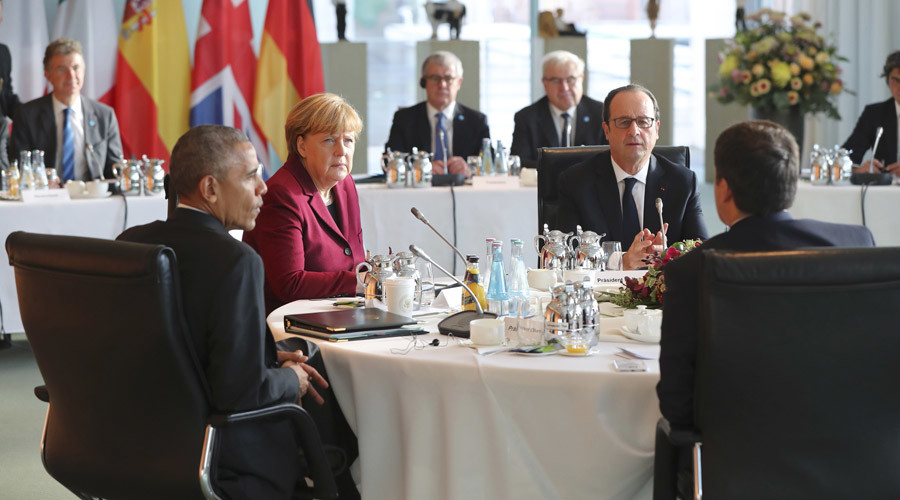
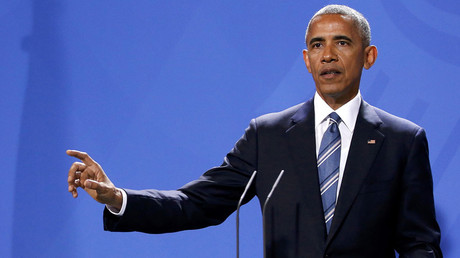
U.S. President Barack Obama, German Chancellor Angela Merkel, French President Francois Hollande and Italian Prime Minister Matteo Renzi meet at the chancellery in Berlin, Germany, November 18, 2016. © Kay Nietfeld / Reuters
President Obama, who is on his final official visit to Europe, met with the leaders of Germany, France, Italy, Spain and the UK on Friday.
Among the main topics on the agenda were extending sanctions against Russia, cooperation within the framework of NATO, the rise of Islamic State (IS, formerly ISIS/ISIL) in Iraq and Syria, and possible new anti-Russian sanctions over Moscow’s actions in Syria.
“The leaders agreed on the necessity of working collectively to move the transatlantic agenda forward, particularly on bringing stabilization to the Middle East and North Africa, as well as securing diplomatic resolution to the conflicts in Syria and eastern Ukraine,” the White House said in the statement.
READ MORE: Russian sanctions cost Italy €7bn and up to 200,000 jobs – Italian MP
“The leaders also affirmed the importance of continued cooperation through multilateral institutions, including NATO,” the White House added.
Sanctions won’t stop Russia from improving its dialogue and ties with other countries, Kremlin spokesman Dmitry Peskov said.
“We [Russia] have never initiated sanctions. These [sanctions] don’t prevent us from building dialogue and continuing the dialogue on matters that are of interest to us, to Russia,” Peskov said.
Russian President Vladimir Putin and outgoing US President Obama are likely to talk informally on the sidelines of the Asia-Pacific summit in the Peruvian capital of Lima, Peskov said on Friday.
“The two administrations have not agreed on any separate meetings, but we can assume that President Putin and President Obama will cross paths on the sidelines of the forum and will talk,” Peskov said.
READ MORE: EU’s dialogue with Russia should be ‘correct and pragmatic’ – Italian FM
Also on Friday, NATO Secretary General Jens Stoltenberg gave a speech at an event hosted by the German Marshall Fund of the United States (GMF), where he said that Europe and the United States “are close economic and trade partners” and mentioned potential threats for the alliance.
“Russia, breaking international law. Turmoil in North Africa and the Middle East. The refugee and migration crisis. International terrorism. Hybrid warfare. And cyber-attacks,” said Stoltenberg, listing the perceived dangers.
Putin: Russia will oppose any attempts to break global strategic balance, incl. NATO missile system
Published time: 18 Nov, 2016 12:07 Edited time: 18 Nov, 2016 13:27
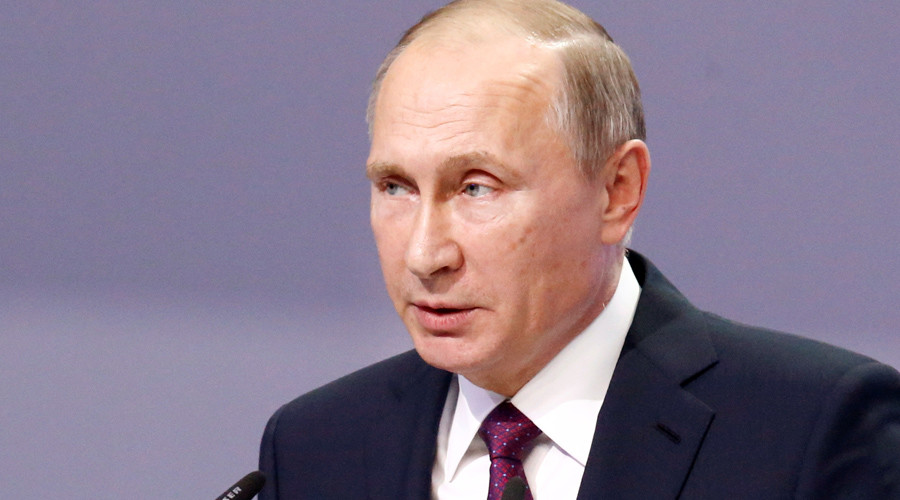
Russian President Vladimir Putin © Sergei Karpukhin / Reuters
“Our goal is to effectively neutralize any military threats to Russia’s security, including those of the [NATO] strategic anti-ballistic missile defense system, the prompt global strike concept and information warfare,” Putin told the Russian military.
“We will continue to do everything needed to preserve the strategic balance of power,” he said, adding that the balance was what had prevented a major military conflict between the opposing camps during the Cold War.
Putin was speaking to Russian generals and defense industry captains in Sochi on Friday, concluding a series of defense-related meetings. He said Russia will continue to develop advanced military technology to protect itself.
“Leading world powers are currently using the most advanced scientific knowledge for weapons development. It includes laser technologies, hypersound technologies, and robotics. Russia is conducting such research too,” the president said.
“As we create advanced weapons systems we strictly follow the international obligations that Russia has taken upon itself. But some other nations, as we all know, cancel previous agreements. As was the case with anti-ballistic missile defense,” Putin added, referring to the withdrawal from the ABM Treaty in 2002 by the administration of then US President George W Bush.
Moscow accuses the US and its NATO partners of compromising Russian national security by developing means to counter Russia’s nuclear deterrence, expanding the alliance towards Russian borders and developing advanced conventional strike technology that may be used for a large attack.
European Union Orders British Press NOT to Report when Terrorists are Muslims, Gatestone Institute, Yves Mamou, November 18, 2016
This is the moment where hate speech laws become a greater threat to democracy and freedom of speech than hate speech itself.
In France, Muslim terrorists are never Muslim terrorists, but “lunatics,” “maniacs” and “youths”.
To attack freedom of the press and freedom of speech is not anti-hate speech; it is submission.
By following these recommendations, the British government would place Muslim organizations in a kind of monopoly position: they would become the only source of information about themselves. It is the perfect totalitarian information order.
Created to guard against the kind of xenophobic and anti-Semitic propaganda that gave rise to the Holocaust, national hate speech laws have increasingly been invoked to criminalize speech that is merely deemed insulting to one’s race, ethnicity, religion, or nationality.
It is disturbing to wonder how long the EU will strongly engage its experts and influence to cut through existing legal obstacles, in a quest to criminalize any type of criticism of Islam, and to submit to the values of jihad.
According the European Commission against Racism and Intolerance (ECRI) — part of the Council of Europe — the British press is to blame for increasing hate speech and racist violence. On October 4, 2016, the ECRI released a report dedicated only to Britain. The report said:
some traditional media, particularly tabloids… are responsible for most of the offensive, discriminatory and provocative terminology. The Sun, for instance, published an article in April 2015 entitled “Rescue boats? I’d use gunships to stop migrants”, in which the columnist likened migrants to “cockroaches”…
The Sun newspaper has also published inflammatory anti-Muslim headlines, such as its front page of 23 November 2015 which read “1 in 5 Brit Muslims’ sympathy for jihadis”, along with a picture of a masked terrorist wielding a knife…
The ECRI report establishes a direct causal link between some tough headlines in British tabloids and the security of the Muslims in the UK. In other words, the British press is allegedly inciting readers to commit “Islamophobic” acts against Muslims.
ECRI considers that, in light of the fact that Muslims are increasingly under the spotlight as a result of recent ISIS-related terrorist acts around the world, fueling prejudice against Muslims shows a reckless disregard, not only for the dignity of the great majority of Muslims in the United Kingdom, but also for their safety.
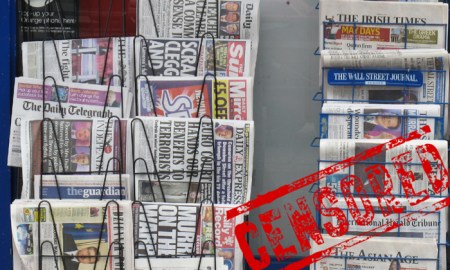
ECRI is basing its report on a recent study from Matthew Feldman, Professor at Teesside University. This study compiled anti-Muslim incidents before and after terrorist’s attacks.
In the seven days prior to the Charlie Hebdo massacre in Paris, where 12 people were killed, there were 12 reported (anti Muslim) incidents, but in the seven days following, there were 45. This pattern was similar in relation to the terror attacks in Sydney, in December and Copenhagen, in February.
So, according to the ECRI and scholars of Teesside University, when Muslim jihadists murder people and the press reports that killers are Muslims, the press, and not Islamists, is encouraging “Islamophobic incidents” in Britain. According to ECRI Chair Christian Ahlund, “It is no coincidence that racist violence is on the rise in the UK at the same time as we see worrying examples of intolerance and hate speech in the newspapers, online and even among politicians.”
For the ECRI, the biggest problem is:
“… where the media stress the Muslim background of perpetrators of terrorist acts, and devote significant coverage to it, the violent backlash against Muslims is likely to be greater than in cases where the perpetrators’ motivation is downplayed or rejected in favour of alternative explanations.”
The report does not explain what could be “alternative explanations.” But we can find examples in French press: when a Muslim attacks a soldier and tries to take his gun, he is not an Islamist terrorist, but a “lunatic.” Such attacks by “lunatics” are very common in France.
The French press downplays attacks by deciding not to name Muslim perpetrators: incriminating a “Mohamed” could, in the minds of French journalists, incite retaliations against Muslims. In another example, Muslim gangs cannot be connected to any form of violence, so they become “youths.” In France, Muslim terrorists are never Muslim terrorists, but “lunatics”, “maniacs” and “youths.”
But that is France. In Britain, tabloids are not so polite, and they understand perfectly the intentions of the ECRI report: to ban the word “Muslim” when it is associated with “violence or terrorism.”
This is the moment where hate speech laws become a greater threat to democracy and freedom of speech than the hate speech itself. Prohibiting journalists from naming “Islamic terrorism,” and encouraging them to hide the association of Muslims with terrorism, is an attempt to misrepresent the truth in the same way the former Soviet Union censored the truth. Taking advantage of some real racist articles in tabloids — not many, because not many are quoted in the report — to attack freedom of the press and freedom of speech is not anti-hate speech; it is submission.
The proof of submission lies in ECRI’s recommendations to the British government:
By following these recommendations, the British government would place Muslim organizations in a kind of monopoly position: they would become the only source of information about themselves. It is the perfect totalitarian information order. If a breach of that kind would open in the future, no doubt all the lobbies would rush into the breach: political parties, Protestants, Catholics, Jews, multinationals, everyone.
The British government did not fall into the trap, and firmly rebuffed ECRI’s demands. It told the European council body:
“The Government is committed to a free and open press and does not interfere with what the press does and does not publish, as long as the press abides by the law.”
In Great Britain, and in all countries of European Union, anti-hate laws already exist. Created to guard against the kind of xenophobic and anti-Semitic propaganda that gave rise to the Holocaust, national hate speech laws have increasingly been invoked to criminalize speech that is merely deemed insulting to one’s race, ethnicity, religion, or nationality.
These laws have also been invoked often by Islamists to sue against anti-Islamist speech (cartoons of Muhammad, blasphemy against Islam, etc.) as manifestations of “racism” — fortunately with little success. Most court cases that Islamists have initiated have failed because Islam is not a race.
Agnes Callamard, expert on human rights, writes in reference to the United Nations Charter:
“ARTICLE 19 recognises that reasonable restrictions on freedom of expression may be necessary or legitimate to prevent advocacy of hatred based on nationality, race, religion that constitutes incitement to discrimination, hostility or violence. The organisation does not extend such legitimate restrictions to offensive and blasphemous expressions.”
It is disturbing to wonder how long the EU will strongly engage its experts and influence to cut through existing legal obstacles, in a quest to criminalize any type of criticism of Islam, and to submit to the values of jihad.
Government controlled media in Iran did not comment or acknowledge the arrests but Arab media outlets have been covering the story quite extensively.
At least a dozen senior officials who were part of the negotiating team that conducted talks with the west regarding the Islamic Republic’s nuclear program were arrested by Iranian authorities on espionage charges, Channel 2 citing an Iranian member of parliament reported Friday.
Iranian MP Husein Al Haj said earlier this week that some of those arrested had dual citizenship but he did not disclose their identities or nationalities.
Government controlled media in Iran did not comment or acknowledge the arrests but Arab media outlets have been covering the story quite extensively.
Iranian authorities earlier in the year had carried out a similar arrest against another member of the negotiating unit, claiming the suspect was a “spy who had infiltrated the nuclear team.”
The suspect was later released on bail but was still under investigation at the time, former Iranian minister of intelligence Gholamhossein Mohseni Ejei said at a news conference on August 28.
Ejei was responding to a question about an Iranian lawmaker’s assertion that a member of the negotiation team who had dual nationality had been arrested on espionage charges.
Tehran’s prosecutor general on Aug. 16 announced the arrest of a dual national he said was linked to British intelligence, but made no mention of the person being in the nuclear negotiations team.
Earlier in August, Iran executed an Iranian nuclear scientist who had been detained since 2010 when he returned home from the United States, after a court convicted him of spying for Washington.
Mohseni Ejei said a court had sentenced Shahram Amiri to death and the sentence had been upheld by Iran’s Supreme court, according to state news agency IRNA.
Amiri, a university researcher working for Iran’s Atomic Energy Organization, disappeared during a pilgrimage to Saudi Arabia in 2009, and later surfaced in the United States. But he returned to Iran in 2010 and received a hero’s welcome before being arrested.
A US official said in 2010 that Washington had received “useful information” from Amiri.
Iran had accused the CIA of kidnapping Amiri. US officials said Amiri had been free to come and go as he pleased, and that he may have returned because of pressures on his family in Iran.
Formally known as the the Joint Comprehensive Plan of Action, the negotiated agreement by world powers and the Islamic Republic was signed in July of 2015, amounting to one of the most significant multilateral policy achievements reached in several decades.
The JCPOA was a culmination of a two-year diplomatic effort in which the five permanent members of the United Nations Security Council, led by the United States, sought to end a twelve-year crisis over Iran’s suspicious nuclear work.
The JCPOA allows Iran to retain much of its nuclear infrastructure, and grants it the right to enrich uranium on its own soil. But the deal also requires Iran to cap and partially roll back that infrastructure for ten to fifteen years, and grants the UN’s nuclear watchdog, the International Atomic Energy Agency, managed access to monitor that program with intrusive inspections.
In exchange, the governments of Britain, France, Russia, China, the US and Germany have agreed to lift all UN sanctions on the Islamic Republic— once Iran abides by a set of nuclear-related commitments.
Israel roundly opposes the agreement, saying it does little to deter Iran from reigniting its nuclear ambitions in the near future.
Prime Minister Benjamin Netanyahu lobbied hard to scuttle the deal last year, going so far as to speak in from the United States Congress without the formal invitation of President Barack Obama.
Newly elected US President Donald Trump has referred to the deal as one of the worst ever negotiated in history, but it remains unclear what action he may take concerning the agreement.
Reauters and Michael Wilner contributed to this article.
Source: Trump offers Flynn post of national security adviser | Fox News
Published November 17, 2016

April 11, 2013: Defense Intelligence Agency Director, Lt. Gen. Michael Flynn testifies on Capitol Hill in Washington. (AP Photo/Manuel Balce Ceneta)
President-elect Donald Trump has offered retired Lt. Gen. Michael Flynn the post of national security adviser, a transition official told Fox News Thursday night.
The official said that Flynn had not yet officially accepted Trump’s offer.
Flynn, who served as the director of the Defense Intelligence Agency (DIA) between 2012 and 2014, has advised Trump on national security issues for months. As national security adviser, he would work in the White House and have frequent access to the president.
The position does not require confirmation by the Senate. Whoever holds it is typically shielded from congressional requests to testify or produce documents.
After leaving the DIA, Flynn became a virulent critic of the Obama administration and the Pentagon. He took issue with a wide range of national security policies, including the administration’s approach to fighting ISIS and, more generally, its handling of global affairs.
Flynn asserted that he had been forced out of the DIA because he disagreed with the administration’s approach to combating extremism. His critics, however, claimed he had mismanaged the agency and that his efforts to force change had met with internal resistance.
In recent public comments, including his fiery address at July’s Republican National Convention, Flynn has emphasized his view that the threat posed by ISIS requires a more aggressive U.S. military, as well as his belief that Washington should work more closely with Moscow.
Flynn is also a champion of renegotiating the Iran nuclear deal, another foreign policy theme Trump pushed during the campaign.
But Flynn’s warmth toward Russia has worried some national security experts. Flynn traveled last year to Moscow, where he joined Russian President Vladimir Putin and other Russian officials in a celebration of the RT network, Russia’s government-controlled television channel. Flynn later explained that he had been paid for taking part in the event, but brushed aside concerns that he was aiding a Russian propaganda effort.
Flynn has also been outspoken in his alarms about the dangers of Islamist groups, complaining on CNN in June that the U.S. needs to “discredit” radical Islam, but that “we’re not allowed to do that right now.” He blamed the Obama administration in a New York Post op-ed in July for failing to design a coherent strategy for opposing ISIS. And in August, he spoke at an event in Dallas for the anti-Islamist group Act for America, saying that Islam “is a political ideology” and that it “definitely hides behind being a religion.”
Flynn’s dark warnings about Islam have not extended to the Islamist-leaning authoritarian Turkish government headed by President Recep Tayyip Erdogan. In an op-ed for the Washington newspaper The Hill just before the election, Flynn wrote that “our ally Turkey” needs support and echoed Erdogan’s warnings that a “shady” Turkish leader now exiled in Pennsylvania should not be given safe harbor in the U.S. Erdogan has called for the extradition of the exile, Fethullah Gullen, but the Obama administration has made no move to comply.
Flynn’s military experience might have made him seem like a natural choice to lead the Pentagon. But without a waiver from Congress, he is not eligible to be secretary of defense because federal law says “a person may not be appointed as secretary of defense within seven years after relief from active duty as a commissioned officer.”
Two sources told Fox News earlier this week that Flynn’s potential appointment is seen by Trump’s team as a way to tap into his national security expertise, without subjecting him to intensive questioning.
During the campaign, Flynn was thought of as a potential running mate for Trump. However, he appeared to fall out of favor after implying that he was pro-choice in a television interview.
Flynn told ABC’s “This Week” in July that women “have to make the decision [on abortion] because they are the ones that are going to decide to bring up that child or not.” The day after the interview aired, he told Fox News that he was a “pro-life Democrat.”
With his public and fervent support for Trump, highlighted by his July convention appearance, Flynn challenged the military’s apolitical traditions. He was not alone in that role. John Allen, a retired Marine general, spoke at the Democratic National Convention as a Hillary Clinton supporter. Their former colleague, retired Gen. Martin Dempsey, wrote in The Washington Post that Flynn and Allen were wrong to have participated as they did.
“The military is not a political prize,” Dempsey wrote. “The American people should not wonder where their military leaders draw the line between military advice and political preference.”
Flynn would not be the first retired general to be asked to serve as part of a president’s national security team. Obama appointed retired Army Gen. David Petraeus as CIA director in 2011.
Colin Powell, who had served as chairman of Joint Chiefs of Staff at the pinnacle of his Army career, became secretary of state during President George W. Bush’s first term. He also served as national security adviser to President Ronald Reagan from 1987 to 1989 while retaining his Army commission as a lieutenant general.
Retired Marine Gen. James Jones, a former commander of U.S. and NATO forces in Europe, served as Obama’s first national security adviser.
Fox News’ Ed Henry and James Rosen and the Associated Press contributed to this report.

 anneinpt
 artaxes
 danmillerinpanama
 davidking1530
 Peter Hofman
 Joseph Wouk
 Peter
 Louisiana Steve


Recent Comments