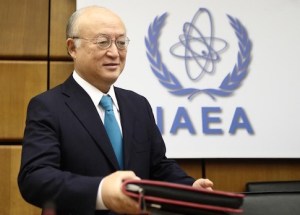
Archive for the ‘Yukiya Amano’ category

Iran threatens to walk away from nuke deal

November 26, 2015

Iran threatens to walk away from nuke deal, Washington ExaminerPete Kasperowicz, November 26, 2015

A top Iranian official warned Thursday that Iran would stop its efforts to comply with the Iran nuclear agreement unless international inspectors stop their investigation into Iran’s past work on its nuclear program.

Under the deal, inspectors were instructed to examine the “possible military dimensions” of Iran’s nuclear program, or PMDs.

International Atomic Energy Agency chief Yukiya Amano is expected to release a new report on Iran’s nuclear program on Dec. 1. Iran’s deputy foreign minister, Seyyed Abbas Araqchi, warned that if the Dec. 1 report doesn’t close the file on PMDs, Iran will walk away.

“In case Yukiya Amano or the Board of Governors presents their report in such a way that it does not meet the stipulated commitments, the Islamic Republic of Iran will also stop [the implementation of] the JCPOA,” he said, according to PressTV, Iran’s state-owned news service.

The JCPOA is the Joint Comprehensive Plan of Action, informally known as the Iran deal.

Iran’s new threat could be a significant problem for the implementation of the deal. On the same day Araqchi spoke, Amano delivered remarks in Vienna in which he said it’s still not clear how much undeclared nuclear material might exist in Iran.

“As my latest report on safeguards implementation in Iran shows, the agency continues to verify the non-diversion of nuclear material declared by Iran under its Safeguards Agreement,” IAEA Director General Yukiya Amano said in a prepared statement in Vienna, Austria.

“But we are not in a position to provide credible assurance about the absence of undeclared nuclear material and activities in Iran, and therefore to conclude that all nuclear material in Iran is in peaceful activities,” he added.

Amano has made similar remarks all year, and it’s a strong sign that Iran has yet to fully cooperate with inspectors under the Iran nuclear agreement.

U.N. Nuclear Watchdog: Iran May Have Built Extension at Disputed Military Site

August 27, 2015

U.N. Nuclear Watchdog: Iran May Have Built Extension at Disputed Military Site, Washington Free Beacon, August 27, 2015

International Atomic Energy Agency (IAEA) Director General Yukiya Amano addresses a news conference after a board of governors meeting at the IAEA headquarters in Vienna, Austria, June 8, 2015. REUTERS/Leonhard Foeger/Files

International Atomic Energy Agency (IAEA) Director General Yukiya Amano addresses a news conference after a board of governors meeting at the IAEA headquarters in Vienna, Austria, June 8, 2015. REUTERS/Leonhard Foeger/Files

VIENNA (Reuters) – Iran appears to have built an extension to part of its Parchin military site since May, the U.N. nuclear watchdog said in a report on Thursday delving into a major part of its inquiry into possible military dimensions to Tehran’s past atomic activity.

A resolution of the International Atomic Energy Agency’s Parchin file, which includes a demand for IAEA access to the site, is a symbolically important issue that could help make or break Tehran’s July 14 nuclear deal with six world powers.

The confidential IAEA report, obtained by Reuters, said:

“Since (our) previous report (in May), at a particular location at the Parchin site, the agency has continued to observe, through satellite imagery, the presence of vehicles, equipment, and probable construction materials. In addition, a small extension to an existing building appears to have constructed.”

Diplomats say any activities Iran has undertaken at Parchin since 2012 are likely to have undermined the agency’s ability to verify intelligence suggesting Tehran previously conducted tests there relevant to nuclear bomb detonations.

Under a “roadmap” accord Iran reached with the IAEA parallel to its groundbreaking deal with the global powers, the Islamic Republic is required to give the Vienna-based watchdog enough information about its past nuclear activity to allow to write a report on the long vexed issue by year-end.

“Full and timely implementation of the relevant parts of the road-map is essential to clarify issues relating to this location at Parchin,” the new IAEA report said.

Iran has for years been stonewalling the PMD investigation but delivered on a promise under the roadmap to provide more information by Aug. 15.

IAEA Director-General Yukiya Amano said on Tuesday that the agency had received substantive amounts of information from Iran although it was too early to say whether any of it is new.

Iran Could Fund Own Nuclear Inspections

August 26, 2015

Iran Could Fund Own Nuclear Inspections, Washington Free Beacon, , August 26, 2015

International Atomic Energy Agency (IAEA) Director General Yukiya Amano arrives for a board of governors meeting at the IAEA headquarters in Vienna November 20, 2014. REUTERS/Heinz-Peter Bader International Atomic Energy Agency (IAEA) Director General Yukiya Amano arrives for a board of governors meeting at the IAEA headquarters in Vienna November 20, 2014. REUTERS/Heinz-Peter Bader

The Department of State on Tuesday left open the possibility that Iran could partially fund international inspections of its own contested nuclear sites, raising concerns that the Islamic Republic is being given too much control over the implementation of the recent deal reached with world powers.

John Kirby, a spokesman for the Department of State, declined to answer multiple questions about how international inspections of Iran’s nuclear sites would be paid for by the International Atomic Energy Agency (IAEA), which is requesting at least $10 million to carry out the work.

The United States will likely fund some portion of the cost, and Kirby left open the possibility that Iran could also foot some of the bill.

The matter has been the subject of much speculation in recent days after it came to light that Iran would be permitted to inspect its own nuclear sites, raising the possibility that Iran could continue to hide nuclear weapons work.

“I don’t have any specific funding contributions to speak to today in terms of amount,” Kirby told reporters. “We’re still working our way through that. I do want to add that we have every intention to continue to contribute to the IAEA for the purpose of this—doing this very important work of the verification of Iran’s nuclear-related commitments.”

“I won’t speak for Iran,” Kirby added. “I don’t know what, if any, commitments Iran has or will engender under this, but we’ve—as we noted in the statement, we’re committed to working with all the member states to ensure that the IAEA has the resources that it needs.”

When pressed to explain whether the United States would pay for Iran to inspect its own nuclear sites or press the Iranian government to foot the bill, Kirby demurred.

“Honestly don’t have a specific answer for you in that regard,” Kirby told reporters. “I mean, again, we’re going to contribute—continue to contribute to the IAEA and their funding needs specifically as it relates to this deal. And it’s not just us; we want other member states to do it as well.”

“I’ll let Iran speak for itself in terms of what, if any, contributions it plans to make,” he added. “But I don’t know that I would characterize the funding resources applied to IAEA and their need to do this work as sort of then paying for any efforts done by Iranian officials to meet compliance.”

Matthew Lee, a reporter for the Associated Press, continued to question Kirby on the issue.

“Well, I mean, someone’s got to pay for it,” Lee said. “They’re not going to work for free, whoever they are, whether they’re Iranians or they’re from Djibouti.”

“Well, I’m assuming many of them are government—work for the government of Iran,” Kirby responded.

Yukiya Amano, the IAEA’s director general, warned on Tuesday that the agency is in dire financial straits and will run out of money later this year.

“The Agency has immediate funding needs related to the continuing costs of implementing monitoring and verification under the existing Joint Plan of Action,” Amano was quoted as saying. “The extra-budgetary contributions which we have previously received for this purpose will be exhausted by the end of September.”

The State Department would not address a request for comment seeking further information about future funding for the IAEA, directing a reporter to call the IAEA directly.

One senior official with a pro-Israel organization criticized the administration for failing to take the funding issue into consideration before inking the deal.

“In the last few weeks we’ve learned that the Iranians will be inspecting themselves at some sites,” said the source, who is involved in the fight over the deal. “Now the administration has opened the door to the Iranians literally paying the salaries of the people who will be inspecting them at other sites.”

“That may or may not happen, but it’s revelatory that the White House cares so little about the nitty-gritty of the inspection regime that they didn’t even bother thinking through these questions,” the source said. “They just want this out of the way.”

The funding issue comes amid new revelations that Iran could be permitted to conduct its own inspections of the Parchin military complex, one of the country’s most disputed nuclear sites.

“Thanks to the Associated Press story, the public now knows that Iran, one of the worst nuclear proliferators in history, will be allowed to inspect itself at the Parchin military facility,” said a senior Republican congressional source. “While the Obama administration had initially refused to publicly confirm or deny Iran’s self-inspection at Parchin, now it’s doubling down and embracing this charade of nuclear verification, and holding open the possibility that the American taxpayer will help pay for the charade,” the source said.

Iran also has revealed in recent weeks that the United States is banned from knowing the details of its nuclear inspections agreement with the IAEA, a disclosure that prompted anger among many U.S. lawmakers.

Iran has gained additional leverage over the IAEA by refusing to sign a document known as the Additional Protocol, which is meant to force Iran to disclose certain details of its nuclear program to the IAEA in order to confirm that Tehran is not operating a clandestine weapons program.

Inspector Clouseau was unavailable (4)

August 22, 2015

Inspector Clouseau was unavailable (4), Power LineScott Johnson, August 21, 2015

Amano’s defense of the Parchin side deal comes amid speculation that the IAEA is being subject to overwhelming pressure by the Americans and the Iranians. On the American side, the leverage is straightforward: Amano is up for reelection next year, and he perennially relies on Western nations to provide him with slim majorities [r].

************************

Omri Ceren emails an update on the IAEA side deal with Iran on Parchin. I think that readers who have followed this important story so far will find this of interest as well. Omri writes:

As was more or less inevitable, today was all about the AP scoop describing the secret IAEA-Iran side deal on Parchin, the military base where Iran conducted hydrodynamic experiments relevant to the detonation of nuclear warheads. The IAEA has been trying to get access to the facility for years to figure out how far the Iranians got, as a prerequisite to setting up a verification regime preventing them from going further. The Obama administration told lawmakers throughout the Iran talks there could be no deal without the Iranians providing that access, but the AP yesterday published the text of a side deal between the IAEA and Iran indicating that the West had caved on that demand.

The document, titled “Separate arrangement II” – which was referenced in a Wednesday AP story and published Thursday – indicates that Iranians will be allowed to inspect themselves for evidence of the nuclear work they conducted at Parchin [a][b]. Instead of allowing IAEA inspectors to collect evidence from the facility, samples will be collected by the Iranians using Iranian equipment. Instead of allowing the IAEA to collect everything it wants, only seven samples will be handed over from mutually agreed upon areas. Instead of giving inspectors access to facilities, photos and videos will be taken by the Iranians themselves, again only from mutually agreed upon areas.

Iran deal supporters haven’t settled on just one response. As of last night administration liaisons were playing for time by telling lawmakers that the earlier AP story about the side deal was just a rumor. Then the AP published the actual draft. So this morning White House allies – including groups that have worked with the administration in lobbying Congress – tweeted around the theory that maybe the AP document was forged, at one point even referencing Israeli Prime Minister Benjamin Netanyahu [c][d][e]. Other validators have been trying to argue that the IAEA can still do its work even without access [f]. The White House will end up taking that latter claim – the IAEA stuff, not the Parchin Truther insanity – and insulating it with the argument that past work doesn’t matter anyway because what matters is the verification regime for future inspections. State Department spokesman Kirby was already floating that claim at yesterday’s press briefing [g].

That talking point might work on a political level. Administration officials can simply assert that the side deal is adequate and then – when pressed for details – declare that they can’t reveal their reasoning because it’s classified. They’ll heavily leverage yesterday’s statement from IAEA chief Amano saying that, for all sorts of classified reasons, the IAEA can live with the arrangement [h]. The opacity might well get the White House through the next month and a half of Congressional review.

But on a policy level, the side deal guts the JCPOA’s verification regime for future violations, which the administration has put at the center of the Iran deal. Administration officials really had no choice: once they gave up on any demands that would physically preclude the Iranians from going nuclear – dismantling centrifuges, mothballing facilities, etc – verification was all they had left. But it’s difficult to see how the pretense of verification can be sustained now that the Parchin side deal has been detailed:

(1) The side deal will become the precedent for future inspections of military sites — The Parchin arrangement – no physical access, restricted sampling, restricted video surveillance, etc. – will likely be used at least in part as a precedent for inspections of future sites. There is at least one other secret side deal out there: the AP’s Parchin document describes itself as “Separate arrangement II,” so presumably there’s a ‘Separate arrangement I’ that isn’t public and that may describe the verification arrangements. The Iranians were already saying that the future verification regime will not include inspector access to military sites, which would track with the Parchin precedent [j][k][l]. David Albright, president of the Institute for Science and International Security, told CNN about the Parchin arrangement “you have to worry that this would set a bad precedent in the Iran context and in the context of other countries” [m]. Rep. Royce sent Kerry a letter a few weeks ago that was even more explicit: the “side deals of today will become central to the agreement’s verification provisions tomorrow” [n] [quote omitted].

(2) IAEA sign-off suggests the agency has bent to political pressure — The Parchin arrangement is a humiliation for the IAEA. Heinonen told CNN that “It is very unusual… I find it really hard to understand why you would let someone else take the samples and only see through the camera” while Albright said “It’s really not normal… I don’t know why they accepted it. I think the IAEA is probably getting a little desperate to settle this” [o]. Until very recently Amano was explicit that the agency required further access to Parchin to resolve PMD issues: last March he “what we don’t know [is] whether they have undeclared activities or something else. We don’t know what they did in the past… we cannot tell we know all their activities” and last June he reiterated “the Agency is not in a position to provide credible assurance about the absence of undeclared nuclear material and activities in Iran” [p][q].

Amano’s defense of the Parchin side deal comes amid speculation that the IAEA is being subject to overwhelming pressure by the Americans and the Iranians. On the American side, the leverage is straightforward: Amano is up for reelection next year, and he perennially relies on Western nations to provide him with slim majorities [r]. On the Iranian side, there are several mechanisms that are getting attention. Some are overt: this week Iran’s Fars News Agency published a boast that Amano knew he “would have been harmed” had he disobeyed Iranian wishes and revealed details of the side deal to Congress (the threat was scrubbed after it garnered international attention; some Iran defenders have suggested that Fars published the threat due to a mistranslation of a speech, though it’s unclear why having a state-controlled vehicle go out of its way to mistranslate and publish a threat is supposed to be reassuring [s][t]). Other Iranian pressure mechanisms are more subtle: for the first eight years of the JCPOA Iran is only bound to provisionally apply, rather than to ratify, the Additional. Even JCPOA supporters describe the concession as being “all about Iran keeping some leverage over the IAEA… it wants to be able to keep the option of revoking its provisional implementation, and not ratifying the AP, as leverage” [u].

[a] http://bigstory.ap.org/article/d8bfeff00c8341caab084841f44d9cde/what-secret-agreement-between-iran-and-un-says
[b] http://bigstory.ap.org/article/bedd428e26924eed95c5ceaeec72d3a4/text-draft-agreement-between-iaea-iran
[c] https://twitter.com/jstreetdotorg/status/634743999597801472
[d] https://twitter.com/tparsi/status/634743163467526144
[e] https://twitter.com/Max_Fisher/status/634726697263349761
[f] http://www.nbcnews.com/id/57764838/ns/msnbc-all_in_with_chris_hayes/#.VdeLL_mrT4Y
[g] http://www.state.gov/r/pa/prs/dpb/2015/08/246211.htm
[h] https://www.iaea.org/newscenter/pressreleases/statement-iaea-director-general-yukiya-amano-1
[i] http://www.powerlineblog.com/archives/2015/07/speaking-of-iran-6.php
[j] http://english.farsnews.com/newstext.aspx?nn=13940429001105
[k] http://en.mehrnews.com/news/108760/No-military-sites-inspections-Velayati
[l] http://www.latimes.com/world/middleeast/la-fg-iran-deal-zarif-20150722-story.html
[m] http://edition.cnn.com/2015/08/20/politics/iran-inspections-report-nuclear-deal-experts/index.html
[n] http://foreignaffairs.house.gov/sites/republicans.foreignaffairs.house.gov/files/Parchin%20side%20deal_0.pdf
[o] http://www.cnn.com/2015/08/20/politics/iran-inspections-report-nuclear-deal-experts/index.html
[p] http://www.pbs.org/newshour/bb/iaea-monitoring-irans-nuclear-program/
[q] https://www.iaea.org/newscenter/statements/introductory-statement-board-governors-63
[r] http://carnegieendowment.org/2012/11/20/plan-for-iaea-safeguards
[s] http://freebeacon.com/national-security/iran-threatened-harm-to-top-nuke-inspector-to-prevent-disclosure-of-secret-deal/
[t] http://english.farsnews.com/newstext.aspx?nn=13940526000960
[u] http://armscontrollaw.com/2015/07/15/much-much-more-on-the-jcpoa/

Iran Threatened ‘Harm’ to Top Nuke Inspector to Prevent Disclosure of Secret Deal

August 18, 2015

Iran Threatened ‘Harm’ to Top Nuke Inspector to Prevent Disclosure of Secret Deal, Washington Free Beacon, Adam Kredo, August 18, 2015

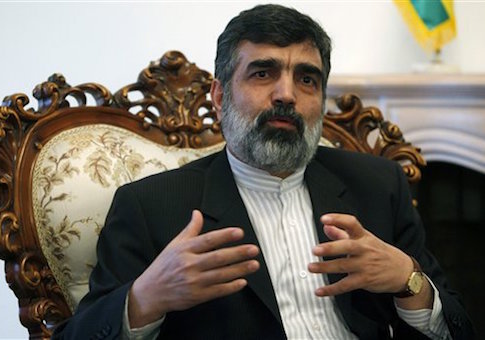
"FILE</aBehrouz Kamalvandi / AP

Iran also has gained additional leverage over the IAEA by refusing to sign a document known as the Additional Protocol, which forces Iran to disclose certain details of its nuclear program to the IAEA so that it can confirm that Tehran is not operating a clandestine weapons program.
“The IAEA desperately wanted the Iranians to ratify the Additional Protocol as part of the deal to lock them into formal obligations that would actually be permanent,” the source explained. “The Obama administration failed to win the concessions, and instead Iran got to promise to ascend eight years from now.”

“So for the next eight years the Iranians get to hold the threat over the IAEA: Don’t push your luck or we’ll refuse to accede in eight years,” the source said.

********************

Iranian leaders prevented a top International Atomic Energy Agency (IAEA) official from disclosing to U.S. officials the nature of secret side deals with the Islamic Republic by threatening harm to him, according to regional reports.

Yukiya Amano, IAEA director general, purportedly remained silent about the nature of certain side deals during briefings with top U.S. officials because he feared such disclosures would lead to retaliation by Iran, according to the spokesman for Iran’s Atomic Energy Organization (AEOI).

Amano was in Washington recently to brief members of Congress and others about the recently inked nuclear accord. However, he did not discuss the nature of side deals with Iran that the United States is not permitted to know about.

Iran apparently threatened Amano in a letter meant to ensure he did not reveal specific information about the nature of nuclear inspections going forward, according to Iranian AEOI spokesman Behrouz Kamalvandi.

This disclosure has only boosted suspicions among some that the Iranians are willing and able to intimidate the top nuclear watchdog and potentially undermine the verification regime that Obama administration officials have dubbed a key component of the nuclear accord.

“In a letter to Yukiya Amano, we underlined that if the secrets of the agreement (roadmap between Iran and the IAEA) are revealed, we will lose our trust in the Agency; and despite the US Congress’s pressures, he didn’t give any information to them,” Kamalvandi was quoted as saying Monday during a meeting with Iranian lawmakers, according to Tehran’s state-controlled Fars News Agency.

“Had he done so, he himself would have been harmed,” the official added.

Iran revealed in recent weeks that the United States is banned from knowing the details of its nuclear inspections agreement with the IAEA, a disclosure that prompted anger in many circles on Capitol Hill.

Iran also has gained additional leverage over the IAEA by refusing to sign a document known as the Additional Protocol, which forces Iran to disclose certain details of its nuclear program to the IAEA so that it can confirm that Tehran is not operating a clandestine weapons program.

Even supporters of the deal have noted that this gives Iran greater “leverage” over the IAEA going forward.

One source close to the Iran fight on Capitol Hill explained that Iran’s refusal to sign the document gives it up to eight more years to threaten the IAEA.

“The IAEA desperately wanted the Iranians to ratify the Additional Protocol as part of the deal to lock them into formal obligations that would actually be permanent,” the source explained. “The Obama administration failed to win the concessions, and instead Iran got to promise to ascend eight years from now.”

“So for the next eight years the Iranians get to hold the threat over the IAEA: Don’t push your luck or we’ll refuse to accede in eight years,” the source said.

Mark Dubowitz, executive director of the Foundation for Defense of Democracies (FDD), expressed concern that Iran could obstruct future inspections.

“Iranian leverage over the IAEA could impede a proper resolution of issues relating to Tehran’s past and possibly continuing weaponization activities,” Dubowitz said. “It may also prevent the agency from ever getting necessary physical access into suspicious sites including military facilities and prevent detection of Iranian clandestine nuclear activities.”

Further complicating the future inspections regime is the expiration of Amano’s term at the IAEA in 2017. The official could be replaced then.

Meanwhile, Iranian officials disclosed on Monday that any nuclear inspector entering Iran on behalf of the IAEA would first have to be screened by Iran’s Intelligence Ministry.

Iran additionally will be given 24 days notice before inspectors enter any site suspected of being used to build a nuclear weapon. U.S. inspectors also will be banned from entering suspicious sites under the deal.

IAEA chief stonewalls Congress

August 7, 2015

IAEA chief stonewalls Congress, Power LinePaul Mirengoff, August 6, 2015

Yukiya Amano, director general of the International Atomic Energy Agency Alliance (IAEA) came to Capitol Hill yesterday to try to reassure members of the Senate Foreign Relations Committee about the Iran nuclear deal. Amano wanted to convince Senators that the private side deals between Iran and the IAEA aren’t problematic and shouldn’t lead Congress to reject the deal.

There was just one problem: Amano couldn’t provide any details about his agency’s confidential arrangement to examine Iran’s nuclear research to see if the mullahs are trying to develop a nuclear weapon. “There were many questions on this issue,” Amano reported. “I repeated that I am not authorized to share or discuss confidential information.”

Amano might therefore just as well have stayed home. According to Committee chairman Bob Corker, “most members left here with greater concerns about the inspection regime than they came in with.”

Corker’s Democratic counterpart, ranking Democrat Benjamin Cardin of Maryland, also expressed disappointment. “I think there are provisions in the document that relate to the integrity of the review,” he said, stating the obvious.

Amano’s justification for not disclosing this vital information doesn’t seem to wash. He protests that the credibility of his agency depends on confidentiality. Yet, Wendy Sherman, the lead U.S. negotiator of the Iran deal, says she has seen documents relating to the side agreements between Iran and the IAEA. As Senator Corker asked, “if Wendy has been able to read it, why can’t we read it?”

But it doesn’t really matter whether Amano has good reasons for not telling Congress what’s in the side agreements. As Sen. Cardin says, these agreements go to the integrity of inspections, and the integrity of inspections goes to viability of the deal (though even under the best inspections possible, the deal doesn’t prevent Iran from becoming a nuclear state in the “out years”).

It’s reasonable to suspect, moreover, that provisions pertaining to the integrity of inspections we farmed out to the IAEA because the U.S. couldn’t get Iran to accept language that (a) it considered necessary or, more likely, (b) it knew Congress would see as vital.

If Congress isn’t permitted to find out what’s in the side agreements, it should reject the deal for that reason alone.