Archive for the ‘UN Security Council’ category

Another area where Congress must be ready to oppose the president.

October 2, 2016

Another area where Congress must be ready to oppose the president, American Spectator, September 30, 2016

President Obama is rumored to be considering a major reversal of decades-long U.S. policy toward Israel by supporting a UN Security Council resolution that unilaterally recognizes a Palestinian state before a peace agreement is negotiated between Israel and the Palestinians. Congress must act to counter this bold and reckless move that endangers Israel’s security and America’s strategic interests.

There is much at stake: Israel is a free and democratic ally in a hostile region that has been repeatedly attacked by its neighbors. Before it occupied the West Bank, Gaza, and Golan Heights in 1967, these territories were used as a base of war and terrorism against the Jewish state. Offers to create a Palestinian state in Gaza and most of the West Bank that would allow for a safe and secure Israel have been repaid by intifada after intifada.

Others have argued persuasively that any Palestinian state established in the absence of a peace agreement with Israel will become a virtually ungovernable hotbed of terrorism sure to threaten not just Israel, but also the region and the world. The events in Gaza in the past decade strongly support this position. Ordinary Palestinians will also suffer, forced to endure rule by the same Islamic fanatics and brutal, corrupt autocrats who have destroyed their economy.

A White House decision to support unilateral Palestinian statehood would unquestionably be contrary to the will of Congress: 88 senators recently signed a letter opposing such an action, while 388 members of the House have signed a similar letter supporting a veto of all “one-sided” UN resolutions concerning the Israel/Palestine issue.

And these numbers understate congressional opposition: several senators refused to sign the letter because they thought it was insufficiently strong. Furthermore, a White House reversal on unilateral Palestinian statehood would also be contrary to the stated policies of both the Democratic and Republican presidential nominees.

To dissuade a determined White House from this course of action, Congress will have to do more than write letters. Here are some of the legislative options that could throw significant roadblocks in its path.

First, Congress should make clear its intention to sanction any unilaterally-declared Palestinian state and its new leaders, blocking their access to U.S. banking and markets, similar tosanctions on the Iranian regime.  Loss of access to the U.S. financial system would be extremely costly to any Palestinian regime.

Second, Congress should make clear its intention to immediately and completely cut hundreds of millions of dollars in annual U.S. direct aid to the Palestinian Authority (PA) in the event that President Mahmoud Abbas succeeds in his bid to win Palestinian statehood recognition at the UN.  Congress reduced this aid by 22 percent last year in retaliation for the PA’s continuing terrorism incitement.  It would be a significant blow to a new state to cut all such aid.

Third, Congress should mandate that any newly-created Palestinian state be designated a state sponsor of terrorism. This designation would include restrictions on U.S. foreign assistance; a ban on defense exports and sales; and various other restrictions. The Palestinian Authority (PA) currently uses a shell-game topay the families of terrorists, something Congress is currently working to stop.  Other PA ties to various terrorist activities go back decades.

Finally, Congress should review and update decades-old federal laws prohibiting U.S. funding of any UN organization that “accords the Palestine Liberation Organization the same standing as member states” to ensure that they apply and cannot be skirted if Abbas wins Security Council recognition of Palestinian statehood.

Congress should use its power boldly to exert influence over this vital issue.  Large majorities in Congress opposed the Iran nuclear deal and had both the facts and public opinion on their side. But due to the peculiarities of the law and the politics of the situation, they were outmaneuvered.  Congress should work to ensure this situation is not repeated.

Though knowledgeable and trusted congressional leaders like Senators Arthur Vandenberg and Henry “Scoop” Jackson once led coalitions in Congress that held great influence in foreign affairs, there is a bipartisan belief that Congress has shirked its duty to shape foreign policy in recent decades.  Now would be a good time to start taking it back.

Hezbollah’s Massive Arms Build-up in Lebanese Civilian Areas

July 19, 2016

Hezbollah’s Massive Arms Build-up in Lebanese Civilian Areas, Front Page MagazineJoseph Klein, July 19, 2016

hn

Every calendar quarter the United Nations Security Council holds an extensive debate on the Israeli-Palestinian “situation.” The Israeli and Palestinian UN representatives make speeches following the Secretary General’s report on the current status, which are normally predictable restatements of their respective positions. This time, however, Israel’s ambassador Danny Danon, addressing the Security Council at its July 12th meeting, presented new graphic evidence of Hezbollah’s alarming arsenal of rockets and missiles located in civilian areas of southern Lebanon.

Ten years ago, when Security Council Resolution 1701 was adopted, ending the war that had broken out between Israel and Hezbollah, the terrorist group was estimated to have had about 7000 rockets. The resolution called for Hezbollah and other armed groups not officially a part of the Lebanese government’s armed forces to relinquish their weapons. Instead, precisely the opposite has happened. Hezbollah never stopped its arms build-up, which has been funded and supplied principally from the world’s leading state sponsor of terror, Iran.

Hezbollah now has approximately 120,000 rockets and missiles aimed at Israeli civilian population centers.  By way of comparison, Ambassador Danon said that “more missiles are hidden underground in 10,000 square kilometers [of Lebanon] than the above-ground 4 million square kilometers” of the European North Atlantic Treaty Organization countries.

Referring to aerial satellite imagery, based on the latest Israeli intelligence, Ambassador Danon demonstrated to the members of the Security Council the location of rocket launchers and arms depots that Hezbollah had placed in civilian areas. “The village of Shaqra has been turned into a Hezbollah stronghold with one out of three buildings used for terror activities, including rocket launchers and arms depots,” Ambassador Danon said.  “Hezbollah has placed these positions next to schools and other public institutions putting innocent civilians in great danger.”

Hezbollah, aided and abetted by Iran, was “committing double war crimes,” the Israeli ambassador charged. “They are attacking civilians, and using Lebanese civilians as human shields,” he said. “We demand the removal of Hezbollah terrorists from southern Lebanon.”

Not surprisingly, Ambassador Danon’s presentation of irrefutable evidence of Hezbollah’s clear and present danger to Israeli and Lebanese civilians, and his demand for Security Council action, fell on deaf ears. In her own statement that followed Ambassador Danon’s remarks, U.S. Ambassador to the UN Samantha Power said not a word about what was just presented regarding Hezbollah. Instead, she stuck to her canned talking points that continue to draw a moral equivalence between acts of Palestinian terrorism and Israeli self-defense. “In recent months, there’s been a steady stream of violence on both sides of the conflict,” she said. Then Ambassador Power proceeded to criticize the building of Israeli settlements, as if again to draw a moral equivalence between housing construction and terrorism. She assailed what she called Israel’s “systematic process of land seizures, settlement expansions, and legalizations of outposts that is fundamentally undermining the prospects for a two-state solution.” All that Ambassador Power said about Lebanon was to decry the political stalemate in electing a new president and to state that “the United States is helping the Lebanese armed forces build the capabilities necessary to counter violent extremism and protect the Lebanese people.”  If the Obama administration were truly interested in countering “violent extremism” in Lebanon and protecting the Lebanese people, it would start by doing everything possible to eliminate the violent extremist threat posed by Hezbollah’s massive rearmament. That, in turn, would require the Obama administration to reverse its appeasement course towards Iran and tighten, not loosen, the financial screws on the regime.

There is no doubt where the bulk of Hezbollah’s funding and arms is coming from. Even Secretary of State John Kerry acknowledged last January Iran’s leading role in arming Hezbollah.

The terrorist organization’s chief Hasan Nasrallah boasted last month about Iran’s bankrolling its operations:

“We are open about the fact that Hezbollah’s budget, its income, its expenses, everything it eats and drinks, its weapons and rockets, are from the Islamic Republic of Iran,” Nasrallah was quoted by Hezbollah’s official Al Ahed newspaper as saying.  “As long as Iran has money we will have money. Hezbollah gets its money and arms from Iran, as long as Iran has money, so does Hezbollah. We extend gratitude to the Leader Imam, [His Eminence] Sayyed Khamenei, and to the leadership of the Islamic Republic and its government, president, scholars and people for their generous support which has never stopped.”

To add insult to injury, Nasrallah made his remarks while honoring the “martyrdom” of a top Hezbollah terrorist killed in Syria whom has been linked to the 1983 attack on the U.S. Marines barracks in Lebanon. That attack took the lives of 241 Americans. Now, Hezbollah is stronger than ever, with Iran’s “generous support.”

Iran continues to fund global terrorism, with its treasury being replenished thanks to the Obama administration’s largesse.

Egypt blocks U.N. Security Council condemnation of Turkey violence

July 16, 2016

Egypt blocks U.N. Security Council condemnation of Turkey violence, Reuters, July 16, 2016

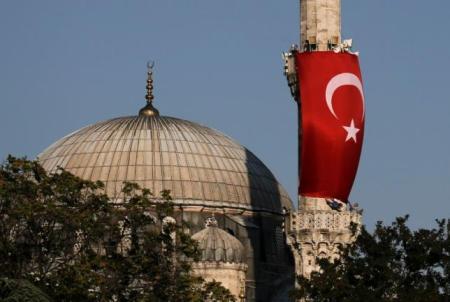
A Turkish flag is seen next to the dome of Hagia Sophia mosque in Istanbul, Turkey, July 16, 2016. REUTERS/Alkis Konstantinidis

A Turkish flag is seen next to the dome of Hagia Sophia mosque in Istanbul, Turkey, July 16, 2016. REUTERS/Alkis Konstantinidis

The United Nations Security Council failed on Saturday to condemn the violence and unrest in Turkey after Egypt objected to a statement that called on all parties to “respect the democratically elected government of Turkey,” diplomats said.

The U.S.-drafted statement also expressed grave concern over the situation in Turkey, urged the parties to show restraint, avoid any violence or bloodshed, and called for an urgent end to the crisis and return to rule of law.

Statements by the 15-member Security council have to be agreed by consensus.

Diplomats, speaking on condition of anonymity, said Egypt argued that the U.N. Security Council was not in a position to determine whether a government had been democratically elected.

Egypt’s mission to the United Nations did not immediately respond to a request for comment.

Turkish forces loyal to President Tayyip Erdogan largely crushed an attempted military coup on Saturday after crowds answered his call to take to the streets in support of the government and dozens of rebels abandoned their tanks.

Egyptian President Abdel Fattah al-Sisi is a former general who overthrew elected President Mohamed Mursi, of the Islamist Muslim Brotherhood, in 2013 after mass protests against Mursi. Turkey provided support for the Muslim Brotherhood in Egypt.