Archive for the ‘U.S. Military’ category

Russia deploys advanced anti-missile system to Syria for first time, US officials say

October 4, 2016

Russia deploys advanced anti-missile system to Syria for first time, US officials say, Fox News, October 3, 2016

The SA-23 can fire two different types of missiles. A smaller missile is used against aircraft and cruise missiles and is known by NATO as Gladiator. The larger missile is used against intermediate-range ballistic missiles and jamming aircraft and is known as Giant. Both missiles use the same type of warhead containing over 300 pounds of explosives, according to military-today.com.

**********************

EXCLUSIVE: Russia has deployed an advanced anti-missile system to Syria for the first time, three US officials tell Fox News, the latest indication that Moscow continues to ramp up its military operations in Syria in support of President Bashar al-Assad.

It comes after Russia’s actions led to the collapse of a cease-fire and the cut-off of direct talks with the U.S.

While Moscow’s motives are not certain, officials say the new weapon system could potentially counter any American cruise missile attack in Syria.

Components of the SA-23 Gladiator anti-missile and anti-aircraft system, which has a range of roughly 150 miles, arrived over the weekend “on the docks” of a Russian naval base along Syria’s Mediterranean coastal city of Tartus, two US officials said.

It is the first time Russia has deployed the SA-23 system outside its borders, according to one Western official citing a recent intelligence assessment. The missiles and associated components are still in their crates and are not yet operational, according to the officials.

The U.S. intelligence community has been observing the shipment of the SA-23 inside Russia in recent weeks, according to one official.

While the purpose is not clear, one US official asked sarcastically, “Nusra doesn’t have an air force do they?” speaking about the Al Qaeda-linked group in Syria.  The Islamic State also does not fly any manned aircraft or possess cruise missiles, in a sign that Russia is directing its actions to protect itself against any potential attack from the United States or its allies.

The SA-23 can fire two different types of missiles. A smaller missile is used against aircraft and cruise missiles and is known by NATO as Gladiator. The larger missile is used against intermediate-range ballistic missiles and jamming aircraft and is known as Giant. Both missiles use the same type of warhead containing over 300 pounds of explosives, according to military-today.com.

Three years ago, President Obama weighed military action against the Assad regime’s chemical weapons facilities as well as airbases housing the regime’s attack helicopters and jets. US Navy ships in the eastern Mediterranean were prepared to launch Tomahawk cruise missiles in a limited strike to cripple the regime.

Russia deployed a separate air defense system, the S-400, to Syria after a Russian jet was shot down by a Turkish warplane last November.  Since the S-400 deployment, the U.S. military has been careful about flying  manned aircraft inside the range of the system, despite repeated pledges by the US military that its airstrikes in Syria are focused on ISIS, not the Assad regime.

Monday, the Pentagon announced it conducted an airstrike potentially killing a “prominent” al-Qaeda linked operative in Syria.  Officials said they were still assessing the strike and have not released the name of their target.

Hours after the State Department announced it was cutting off talks with Moscow, President Vladimir Putin said he had suspended a Russia-U.S. deal on the disposal of weapons-grade plutonium. Putin’s decree released by the Kremlin cited Washington’s “unfriendly actions.”

Top US officials have recently accused Russia and the Syrian regime of indiscriminant bombing in Syria using incendiary and bunker busting bombs on civilians. Two weeks ago, a UN aid convoy was bombed, killing dozens of aid workers attempting to deliver critical supplies to the more than 200,000 Aleppo residents trapped inside the eastern portion of the city, once Syria’s most populated. In the past week, hundreds of civilians, including children, have been killed, according to local reports.

Russia began its air campaign in Syria on Sept. 30, 2015 following a weeks-long buildup of fighter jets and attack aircraft.  Long-range bombers flying from Russia and Iran have also been used to attack Syrian rebels, some backed by the United States.

Days after Russian bombs started falling in Syria, President Obama predicted that Russia and Iran would find themselves mired in a “quagmire.”

“[A]n attempt by Russia and Iran to prop up Assad and try to pacify the population is just going to get them stuck in a quagmire. And it won’t work,” he told reporters in a White House press conference on Oct. 2, 2015.

On Friday, the one-year anniversary of the Russian strikes, the State Department acknowledged that Russia had succeeded in its goal of propping up the Assad regime.

“It is a grim anniversary…It is hard not to assess that they have succeeded in bolstering the regime,” said Mark Toner, a State Dept. spokesman.

The Obama administration is pushing Iraq into further chaos

September 30, 2016

The Obama administration is pushing Iraq into further chaos, Washington Post, Editorial Board, September 29, 2016

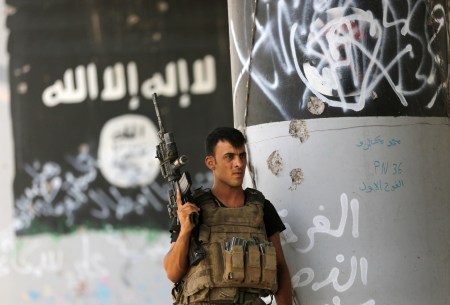
mideast_islamic_state_analysis-6073a-1671A member of Iraqi counterterrorism forces stands guard near Islamic State group militant graffiti in Fallujah, Iraq, in June. (Hadi Mizban/Associated Press)

Though the absence of such political solutions facilitated the rise of the Islamic State, the Obama administration is not pushing for them. It is not using its considerable leverage — U.S. air support will be vital to liberating Mosul — to insist on better political preparations or the exclusion of Shiite militias. Instead, eager for the operation to begin before President Obama leaves office, it has been encouraging Mr. Abadi to speed up the Mosul offensive, while leaving the Day After problem to the Iraqis. That is a highly risky course.

******************************

AN ASSAULT by U.S.-backed Iraqi forces on Mosul, the largest stronghold of the Islamic State, is expected within weeks — far sooner than seemed likely a few months ago. Unfortunately, the acceleration is not good news. The government of Iraqi Prime Minister Haider al-Abadi is rushing the operation forward even though it lacks a strategy to secure and govern the multiethnic city of roughly 1 million people once the terrorists are driven out. It is recruiting sectarian militia forces that have a record of abusing civilians and seizing territory for themselves. Plans for protecting refugees, who may number in the hundreds of thousands, are sketchy.

In short, the Mosul offensive is setting the stage for a potentially catastrophic Day After problem. Though the United States has painfully experienced what such poor preparation can lead to, in Baghdad in 2003 and Libya a decade later, it is pushing the Abadi government to move still faster.

Military experts are more concerned about the aftermath than the fight itself. Brig. Gen. William F. Mullen, who was deputy commander for U.S. operations in Iraq until June, predicted last week that Islamic State defenses in Mosul could collapse quickly. “And then what?” he asked at a forum at the Washington Institute for Near East Policy. The Iraqi government’s plan, he said, amounts to “chips will fall and we’ll sort it out when we get to that.”

“That’s not a good plan,” Mr. Mullen said. “This is going to be ugly.”

It’s not hard to foresee where the ugliness will come from. Though the Mosul attack is expected to be led by U.S.-trained Iraqi counterterrorism units, Mr. Abadi has said Shiite militia forces also will participate. Iraqi Kurdish units may also move in from the north. Controlled by Iran rather than the Baghdad government, several of the Shiite militias were accused of atrocities during and after operations in the Sunni cities of Ramadi and Fallujah. There is ample reason to fear similar abuses against Sunnis in Mosul.

Once the Islamic State is vanquished, the various forces may turn on one another. Kurdish and Shiite fighters already have sparred in nearby Diyala province. Turkey has threatened to intervene on behalf of ethnic Turks in the city. Though a Sunni police force is being trained, it is a fraction of the size needed to prevent human rights abuses and factional fighting.

Plans for governance are equally threadbare. Iraqi leaders reportedly want to restore the former provincial governor and council, but that could be contested by another former governor with his own Sunni force. More important, the Baghdad government has taken no serious steps to resolve long-standing disputes with Sunni and Kurdish leaders over territory, revenue and the delegation of powers to local governments.

Though the absence of such political solutions facilitated the rise of the Islamic State, the Obama administration is not pushing for them. It is not using its considerable leverage — U.S. air support will be vital to liberating Mosul — to insist on better political preparations or the exclusion of Shiite militias. Instead, eager for the operation to begin before President Obama leaves office, it has been encouraging Mr. Abadi to speed up the Mosul offensive, while leaving the Day After problem to the Iraqis. That is a highly risky course.

Pentagon’s top brass explores Islamic ideology’s ties to terror

September 26, 2016

Pentagon’s top brass explores Islamic ideology’s ties to terror, Washington TimesRowan Scarborough, September 25, 2016

obamadunfordPresident Barack Obama walks with Marine Gen. Joseph Dunford Jr., his nominee to be the next chairman of the Joint Chiefs of Staff, after speaking in the Rose Garden of the White House in Washington, Tuesday, May 5, 2015.

U.S. Special Operations Command has privately pressed the staff of the nation’s highest-ranking military officer to include in his upcoming National Military Strategy a discussion of the Sunni Muslim ideology underpinning the brutality of the Islamic State group and al Qaeda.

Thus, behind the scenes, the Pentagon’s top brass have entered a debate coursing through the presidential campaign: how to define an enemy the U.S. military has been fighting for 15 years.

The National Military Strategy, authored by the Joint Chiefs of Staff chairman, is one of the most important guidances issued to global combatant commanders. It prioritizes threats to the nation and how to blunt them.

The 2015 public version does not mention Islamic ideology. It lists terrorists under the ambiguous category of “violent extremist organizations” and singles out al Qaeda and the Islamic State group.

Marine Corps Gen. Joseph F. Dunford took the chairmanship of the Joint Chiefs of Staff two months later and is now preparing his first National Military Strategy.

It is during this process that Special Operations Command, which plays a major role in hunting down terrorists, has provided its input to the Joint Staff, Gen. Dunford’s team of intelligence and operations officers at the Pentagon.

Special Operations Command wants the National Military Strategy to specifically name Salafi jihadism as the doctrine that inspires violent Muslim extremists. Salafi jihadism is a branch within Sunni Islam. It is embraced by the Islamic State and used to justify its mass killings of nonbelievers, including Shiite Muslims, Sunnis and Kurds, as well as Christians.

People knowledgeable about the discussion told The Washington Times that SoCom has not been able to persuade Gen. Dunford’s staff to include Salafi jihadism in any strategy draft. It is unclear whether Gen. Dunford has been briefed on the proposals.

Spokesmen for the Joint Staff and U.S. Special Operations Command in Tampa, Florida, told The Times that they could not comment on a pending strategy. Gen. Dunford’s strategy will be classified in its entirety, meaning there will be no public version as was issued by his predecessor, Army Gen. Martin Dempsey, in 2015.

Special Operations Command is headed by Army Gen. Raymond A. Thomas III, a veteran terrorist hunter who led Joint Special Operations Command, the unit that killed Osama bin Laden and many other extremists.

There does not appear to be an effort to include the words “radical Islamic terrorism” in the strategy. But including a discussion of Salafi jihadism would tie acts of terrorism to Islamic ideology.

President Obama has fiercely rejected any connection between Islam the faith and al Qaeda, the Islamic State or any other Muslim terrorist organizations. He argues that they have corrupted the teachings of the Prophet Muhammad and the Koran. His administration refers to them as simply “extremists.”

The counterargument from many U.S. national security analysts and Muslim scholars is that mass killings are rooted in the Koran and other primary writings and preachings of credible Islamic scholars and imams. These teachings at some mosques and on social media encourage youths to become radical Islamists.

Abu Bakr al-Baghdadi, the ruthless Islamic State founder, is a cleric who studied at a seminary in Iraq. Al-Baghdadi has a Ph.D. in Koranic studies from Iraq’s Saddam University.

‘War of ideas’

If the cycle of global jihadism is to be broken, they say, U.S. officials must accurately assess the nature of the threat and its doctrines. If not, Gen. Dunford’s National Military Strategy is, in essence, directing commanders to ignore threat doctrine and relinquish the information battlefield to the enemy.

“If you look at threat doctrine from that perspective, it’s a much bigger problem because it’s not just the violent jihadists; it’s the nonviolent jihadists who support them,” said one person knowledgeable about the National Military Strategy. “Pretending there is no relationship between the violent jihadists and Islam isn’t going to win. We’re completely ignoring the war of ideas. We’re still in denial. We’re pretending the enemy doesn’t exist.”

A joint counterterrorism report by the American Enterprise Institute and the Institute for the Study of War concluded:

“Salafi-jihadi military organizations, particularly ISIS and al Qaeda, are the greatest threat to the security and values of American and European citizens.”

The Islamic State is also known as ISIS, ISIL and Daesh.

Albert M. Fernandez, who was the State Department’s chief of strategic communication, said that on some level, if not the U.S. directly, people need to talk about the form of Salafi jihadism that promotes violence.

“Using the word ‘extremism’ is extraordinarily vague language,” he said.

Some voices in the Muslim hierarchy differ with Mr. Obama and say the encouragement of violence is a problem that Islam must confront.

One such leader is Hassen Chalghoumi, imam of the Drancy Mosque in Paris. France has Europe’s largest Muslim population and has been wracked by a series of brutal terrorist attacks planned and inspired by the Islamic State.

Mr. Chalghoumi spoke last year at a conference in Washington sponsored by the Middle East Media Research Institute, which tracks jihadi social media and promotes moderate Islamic leaders.

Mr. Chalghoumi said mosques are one “battlefront” in the war on extremism.

“The third battlefront is the mosques, in many of which there is incitement to anti-Semitism, hate and ultimately violence,” he said. “This is the most critical battlefront regarding the future of Islam and its relationship with other religions. But even this one is not solely internal. The government should have a role in prohibiting money from terrorist organizations from reaching mosques and guiding their activities. It should prevent extremist leaders from preaching in pulpits from which they can abuse their power and spew hate and violence. It should make sure that the people who preach religion to others are qualified and endorse human values.”

Teaching terrorism

Advocates of publicly discussing the influence of Salafi jihadism point to Sahih al-Burkhari. It is a nine-volume collection of Sunni Muslim dictates from historical figures that is held as only second in importance to the Koran.

Volume 4, Book 56, justifies the killings of non-Muslims. “Whoever changed his Islamic religion, then kill him,” says one apostle of the Prophet Muhammad.

Volume 9, Book 88, contains this: “During the last days there will appear some young foolish people who will say the best words but their faith will not go beyond their throats (i.e., they will have no faith) and will go out from (leave) their religion as an arrow goes out of the game. So, where-ever you find them, kill them, for who-ever kills them shall have reward on the Day of Resurrection.”

Robert Spencer is an author who runs Jihad Watch, a nonprofit that reports on Islamic extremism.

He explains that Salafi Jihadism is a vehicle for taking the teachings of the Koran and applying them to jihad.

“The Islamic State scrupulously follows the Koran and Sunnah in its public actions, including its pursuit of jihad, and provides in Dabiq its Islamic justification for even its most controversial actions,” he said. “Thus the Islamic State is essentially the apotheosis [highest form] of Salafi Jihadism.”

The Sunnah contains the sayings of the Prophet Muhammad. Dabiq is a town in Syria where a final battle between Muslims and Christians supposedly will take place.

A 2008 strategy paper from Harvard University’s John M. Olin Institute said:
“Like all ideologies, Salafi-Jihadists present a program of action, namely jihad, which is understood in military terms. They assert that jihad will reverse the tide of history and redeem adherents and potential adherents of Salafi-Jihadist ideology from their misery. Martyrdom is extolled as the ultimate way in which jihad can be waged — hence the proliferation of suicide attacks among Salafi-Jihadist groups.”

Defining the enemy

How to define the Islamic State, which controls territory in Syria and Iraq and has franchises in over 20 countries, has been a hot topic in the U.S. presidential campaign.

Republican nominee Donald Trump criticizes Democratic nominee Hillary Clinton for refusing to define the threat as “radical Islamic terrorism.”

He has surrounded himself with advisers who do see the threat that way. Former CIA Director James Woolsey, who has authored papers on the extremist Islamic threat, has joined the campaign as a foreign policy adviser.

Another Trump spokesman is retired Army Lt. Gen. Michael T. Flynn, who led the Defense Intelligence Agency under Mr. Obama. He has said he was fired by the White House for promoting the idea that there is a radical Islamic movement that must be confronted.

One of Mr. Trump’s most ubiquitous surrogates is former New York Mayor Rudolph W. Giuliani, who was on Fox News on Saturday morning again criticizing Mrs. Clinton for not defining the threat.

Mrs. Clinton at one point said “radical jihadists” is the proper description. After the Pulse nightclub massacre in Orlando, Florida, by an Islamic State follower, she said “radical Islam” is permissible. She infrequently uses either term.

“Inflammatory anti-Muslim rhetoric and threatening to ban the families and friends of Muslim Americans as well as millions of Muslim businesspeople and tourists from entering our country hurts the vast majority of Muslims who love freedom and hate terror,” she said in June, taking a swipe at Mr. Trump. “So does saying that we have to start special surveillance on our fellow Americans because of their religion.”

The Defense Department on a few occasions has purged from its ranks those who advocate a discussion on how Islam the religion encourages violence.

In 2008, during the George W. Bush administration, the Pentagon ended a contract with Stephen Coughlin, an Army Reserve officer and lawyer. His consulting work centered on showing the links between Islamic law and violent extremism.

In 2012, in the Obama administration, Gen. Dempsey, then the Joint Chiefs chairman, publicly admonished Army Lt. Col. Matthew Dooley for linking the roots of Islamic teachings to the terrorism’s ideology today. Col. Dooley was removed as a teacher at Joint Forces College within the National Defense University and given a poor performance evaluation.

A student linked some of his training materials, and Muslims complained to the White House.

Gen. Dempsey called Col. Dooley’s training materials “academically irresponsible.”

The university’s teaching guidance says it permits outside-the-box instruction.

Muslim groups have petitioned the White House to end what they consider anti-Muslim training.

One set of complaints came in an October 2011 letter from 57 Islamic groups to Mr. Obama’s chief counterterrorism adviser, John O. Brennan, now the CIA director. Mr. Brennan refuses to use the words “Islamic extremists” or “radical Islamic terrorism.”

Some of the groups were unindicted co-conspirators in a federal terrorist financing prosecution in Texas. They also have ties to the global Muslim Brotherhood, whose goal is a world ruled by Islamic law.

Gen. Dempsey issued the Pentagon’s last National Military Strategy a little over a year ago.

It says the two leading terrorist organizations are al Qaeda and the Islamic State, which are defined as “violent extremist organizations.” That is the paper’s only use of the word “Islamic,” and there is no use of “Muslim” or “Salafi.”

Rockets on Golan, Pentagon flouts Obama, no truce

September 18, 2016

Rockets on Golan, Pentagon flouts Obama, no truce, DEBKAfile, September 17, 2016


syria_golankipat

The Pentagon and US army are not following the orders of their Commander-in-Chief Barack Obama in the execution of the military cooperation accord in Syria concluded by US Secretary of State John Kerry and Russian Foreign Minister Sergei Lavrov in Geneva on Sept. 12.

Five days after the truce they agreed would go into effect Monday, fighting was still raging Saturday, Sept. 17.

DEBKAfile was the only Western publication to foresee this eventuality in an article published on July 18.

It was already evident then that any military cooperation agreement between the two powers would be contingent on America exposing its intelligence-gathering methods to Russia – not just in Syria but worldwide.

As our military sources predicted, this new intelligence sharing arrangement would necessarily extend to the Syrian Air Force as a third partner.

In advance of the deal, Moscow deployed its aircraft carrier, the Admiral Kutzenov, post haste to Syrian waters, to make sure that the Joint Implementation Center set up by the Kerry-Lavrov deal for intelligence-sharing would also apply to the warplanes and cruise missiles on the carrier’s decks and its escort of missile cruisers.

This deal was perceived in Moscow as an opportunity to study the combat methods and tactics practiced by the US Navy and Air force in real battlefield conditions.

But this eventuality was far from the intentions of US security and intelligence chiefs at a time of deepening adversity between Washington and Moscow.

The remarks of State Department spokesman Mark Toner on Thursday, Sept. 5 hinted at these conflicting perceptions: “I don’t think anyone in the US government is necessarily taking at face value Russia’s – or certainly not the Syrian regime’s – commitment to this arrangement.” He went on to say: “What really matters here is that the president of the United States supports this agreement, and our system of government works in such a way that everyone follows what the president says.”

Is that really so?

The fact that Kerry’s spokesman found it necessary to emphasize that “everyone follows what the president says,” strongly indicated that not everyone in Washington was in fact obeying the president.

Such disobedience is almost unheard of and would never be admitted publicly. In this case, it is being kept carefully under wraps.

Defense Secretary Ashton Carter and Chairman of the US Chiefs of Staff Gen. Joseph F. Dunford will never on any account admit that, in the execution of military collaboration with Russia in the Syrian conflict, they are not exactly carrying out the president’s precise instructions.

syrianceasefire480

But Washington sources report that Defense Secretary Carter maintains that he can’t act against a law enacted by Congress. He was referring to the law that prohibits all military-to-military relations with Russia as a result of Moscow’s annexation of the Crimea region of Ukraine.

According to DEBKAfile’s military sources, they are simply dragging their feet in ground operations. This is driving Vladimir Putin and his generals into fits of rage.

Friday, Sept 16, Lavrov accused the US of “stalling on its promise to separate moderate rebel groups in Syria from terrorists,” adding, “US progress in delivering on the promise is slow.”

Saturday, Putin himself burst out that the rebels were “regrouping under the ceasefire.” He put the blame on those “rebels” for the failure of the agreed truce to take effect after five days.

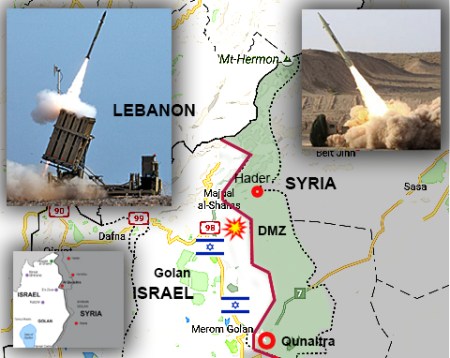
Our military and intelligence sources see a connection between Putin’s angry outburst and the rising tensions on the Syrian-Israeli border in the past week, culminating in the two Syrian rockets that were shot down Saturday over the Golan by Israel’s Iron Dome batteries.

For some time, the Russians and Syrians have made no bones about their objection to Israel’s policy of supporting a motley assortment of Syrian rebel groups in southern Syria close to its border. Among these groups is Al Qaeda’s Syrian arm Jabhat Al-Nusra (the Nusra Front) that has renamed itself Jahat Fath Al-Sham.

Whatever Assad, Iran or Hizballah may accept or reject, President Putin utterly refuses to tolerate Israel allowing the Nusra Front to control parts of this border sector.

Therefore, the rockets and missiles apparently “straying” across the border onto the Golan may well multiply in the coming days.

Yet another complication raised its head over the weekend when the US-backed rebel militia, the Free Syrian Army, vented its fury over the Kerry-Lavrov truce deal by driving away American Special Operations troops helping them in the battle for Al-Rai and abusing them as “infidels.”

The US blames the Russian leader for failing to force Bashar Assad to hold his fire and to let emergency supplies reach the beleaguered population in Aleppo, thereby undermining their ceasefire accord.

But it is becoming evident that the brutal standoff in Syria will be sustained until Putin is satisfied that the US is cooperating with Russian forces in Syria and the Mediterranean region in all spheres.

Before he decides to lean hard on Assad to cease hostilities, he will want to see the White House twisting the arms of the Pentagon and US forces to play ball in the most sensitive spheres.

Donald Trump Hillary Clinton Commander in Chief Forum 9/7/16 NBC September 7, 2016

September 8, 2016

Donald Trump Hillary Clinton Commander in Chief Forum 9/7/16 NBC September 7, 2016, via YouTube


Donald J. Trump ​Military Readiness Remarks

September 7, 2016

Donald J. Trump Military Readiness Remarks, Trump campaign press release, September 7, 2016

Today, I am here to talk about three crucial words that should be at the center of our foreign policy: Peace Through Strength.

We want to achieve a stable, peaceful world with less conflict and more common ground.

I am proposing a new foreign policy focused on advancing America’s core national interests, promoting regional stability, and producing an easing of tensions in the world. This will require rethinking the failed policies of the past.

We can make new friends, rebuild old alliances, and bring new allies into the fold.

I’m proud to have the support of warfighting generals, active duty military, and the top experts who know both how to win – and how to avoid the endless wars we are caught in now. Just yesterday, 88 top Generals and Admirals endorsed my campaign.

In a Trump Administration, our actions in the Middle East will be tempered by realism. The current strategy of toppling regimes, with no plan for what to do the day after, only produces power vacuums that are filled by terrorists.

Gradual reform, not sudden and radical change, should be our guiding objective in that region.

We should work with any country that shares our goal of destroying ISIS and defeating Radical Islamic terrorism, and form new friendships and partnerships based on this mission. We now have an Administration, and a former Secretary of State, who refuse to say Radical Islamic Terrorism.

Immediately after taking office, I will ask my generals to present to me a plan within 30 days to defeat and destroy ISIS.

This will require military warfare, but also cyber warfare, financial warfare, and ideological warfare – as I laid out in my speech on defeating Radical Islamic terrorism several weeks ago.

Instead of an apology tour, I will proudly promote our system of government and our way of life as the best in the world – just like we did in our campaign against communism during the Cold War.

We will show the whole world how proud we are to be American.

At the same time, immigration security is a vital part of our national security.

We only want to admit people to our country who will support our values and love our people.

These are the pillars of a sound national security strategy.

Unlike my opponent, my foreign policy will emphasize diplomacy, not destruction. Hillary Clinton’s legacy in Iraq, Libya, and Syria has produced only turmoil and suffering. Her destructive policies have displaced millions of people, then she has invited the refugees into the West with no plan to screen them.

Including Veteran healthcare costs, the price of the wars in Iraq and Afghanistan could total $6 trillion, according to a report in the Washington Examiner. Yet, after all this money spent and lives lost, Clinton’s policies as Secretary of State have left the Middle East in more disarray than ever before.

Meanwhile, China has grown more aggressive, and North Korea more dangerous and belligerent. Russia has defied this Administration at every turn. Putin has no respect for President Obama or Hillary Clinton.

Sometimes it has seemed like there wasn’t a country in the Middle East that Hillary Clinton didn’t want to invade, intervene or topple. She is trigger-happy and unstable when it comes to war.

Hillary Clinton is just reckless – so reckless, in fact, she put her emails on an illegal server that our enemies could easily hack. Then Clinton’s team used a technology called bleachbit to acid wash her emails. They even took a hammer to some of her 13 phones, to cover her tracks and obstruct justice. These email records were destroyed after she received a subpoena to turn them over.

In the FBI report, she claimed she couldn’t recall important information on 39 occasions.

She can’t even remember whether she was trained in classified information, and said she didn’t even know the letter “C” means confidential.

If she can’t remember such crucial events and information, she is unfit to be Commander-in-Chief.

Her conduct is simply disqualifying.

She talks about her experience, but Hillary Clinton’s only foreign policy experience is “failure.” Everywhere she got involved, things got worse.

Let’s look back at the Middle East at the very beginning of 2009, before Hillary Clinton was sworn-in.

Libya was stable.

Syria was under control.

Egypt was ruled by a secular President and an ally of the United States.

Iraq was experiencing a reduction in violence. The group that would become what we now call ISIS was close to being extinguished.

Iran was being choked off by economic sanctions.

Fast-forward to today. What have the decisions of Obama-Clinton produced?

Libya is in ruins, our ambassador and three other brave Americans are dead, and ISIS has gained a new base of operations.

Syria is in the midst of a disastrous civil war. ISIS controls large portions of territory. A refugee crisis now threatens Europe and the United States. And hundreds of thousands are dead.

In Egypt, terrorists have gained a foothold in the Sinai desert, near the Suez Canal, one of the most essential waterways in the world.

Iraq is in chaos, and ISIS is on the loose.

ISIS has spread across the Middle East, and into the West.

Iran, the world’s largest state sponsor of terrorism, is now flush with $150 billion dollars in cash released by the United States – plus another $1.7 billion dollars in cash ransom payments. In other words, our country was blackmailed and extorted into paying this unheard-of amount of money.

Worst of all, the Nuclear deal puts Iran, the number one state sponsor of Radical Islamic terrorism, on a path to nuclear weapons.

This is Hillary Clinton’s foreign policy legacy.

But that’s not all. President Obama and Hillary Clinton have also overseen deep cuts in our military, which only invite more aggression from our adversaries.

History shows that when America is not prepared is when the danger is greatest. We want to deter, avoid and prevent conflict through our unquestioned military strength.

Under Barack Obama and Hillary Clinton, defense spending is on track to fall to its lowest level as a share of the economy since the end of World War II. We currently have the smallest Army since 1940. The Navy is among the smallest it has been since 1915. And the Air Force is the smallest it has been since 1947.

When Ronald Reagan left office, our Navy had 592 ships. When Barack Obama took office, it had 285 ships. Today, the Navy has just 276 ships.

The average Air Force aircraft is 27 years-old. We have 2nd generation B-52 bombers – their fathers flew the same plane.

Our Army has been shrinking rapidly, from 553,000 soldiers in 2009 to just 479,000 today.

In 2009, our Marine Corps had 202,000 active Marines. Today, it’s just 182,000.

Our ship count is below the minimum of 308 that the Navy says is needed to execute its current missions. President Obama plans to reduce the Army to 450,000 troops—which would hamstring our ability to defend the United States.

It takes 22 years on average to field a major new weapons system.

In 2010, the US spent $554 billion on non-war base defense spending.

In the current year, we are spending $548 billion – a cut of 10% in real inflation-adjusted dollars. This reduction was done through what is known as the sequester, or automatic defense budget cuts. Under the budget agreement, defense took half of the cuts – even though it makes up only one-sixth of the budget.

As soon as I take office, I will ask Congress to fully eliminate the defense sequester and will submit a new budget to rebuild our military.

This will increase certainty in the defense community as to funding, and will allow military leaders to plan for our future defense needs.

As part of removing the defense sequester, I will ask Congress to fully offset the costs of increased military spending. In the process, we will make government leaner and more responsive to the public.

I will ask that savings be accomplished through common sense reforms that eliminate government waste and budget gimmicks – and that protect hard-earned benefits for Americans.

Government-wide, improper government payments are estimated to exceed $135 billion per year, and the amount of unpaid taxes is estimated to be as high as $385 billion.

We can also reduce the size of the federal bureaucracy through responsible workforce attrition – that is, when employees retire, they can be replaced by a smaller number of new employees.

We can also stop funding programs that are not authorized in law. Congress spent $320 billion last year on 256 expired laws. Removing just 5 percent of that will reduce spending by almost $200 billion over 10 years.

The military will not be exempt either – the military bureaucracy will have to be trimmed as well.

Early in my term, I will also be requesting that all NATO nations promptly pay their bills, which many are not doing right now. Only 5 NATO countries, including the United States, are currently meeting the minimum requirement to spend 2% of GDP on defense.

Additionally, I will be respectfully asking countries such as Germany, Japan, South Korea and Saudi Arabia to pay more for the tremendous security we provide them.

Finally, we will have at our disposal additional revenues from unleashing American energy. The Institute for Energy Research cites a “short-run” figure of as much as $36 billion annually from increased energy production.

Using these new funds, I will ask my Secretary of Defense to propose a new defense budget to meet the following long-term goals:

We will build an active Army of around 540,000, as the Army’s chief of staff has said he needs. We now have only 31 Brigade Combat Teams, or 490,000 troops, and only one-third of combat teams are considered combat-ready.

We will build a Marine Corps based on 36 battalions, which the Heritage Foundation notes is the minimum needed to deal with major contingencies – we have 23 now.

We will build a Navy of 350 surface ships and submarines, as recommended by the bipartisan National Defense Panel – we have 276 ships now.

And we will build an Air Force of at least 1,200 fighter aircraft, which the Heritage Foundation has shown to be needed to execute current missions – we have 1,113 now.

We will also seek to develop a state of the art missile defense system.

Under Obama-Clinton, our ballistic missile defense capability has been degraded at the very moment the US and its allies are facing a heightened missile threat from states like Iran and North Korea. As these potential adversaries grow their missile programs, US military facilities in Asia and the Middle East, as well as our allies, are increasingly in range, with the United States homeland also potentially threatened.

We propose to rebuild the key tools of missile defense, starting with the Navy cruisers that are the foundation of our missile defense capabilities in Europe, Asia, and the Middle East. The Obama-Clinton administration tried repeatedly to remove our cruisers from service, then refused to modernize these aging ships.

We will start by modernizing our cruisers to provide the Ballistic Missile Defense capability our nation needs; this will cost around $220 million per modernization as we seek to modernize a significant portion of these 22 ships.

As we expand our Navy toward the goal of 350 ships, we will also procure additional modern destroyers that are designed to handle the missile defense mission in the coming years.

Accomplishing this military rebuild will be a fifty-state effort —every state in the union will be able to take part in rebuilding our military and developing the technologies of tomorrow.

In addition, we will improve the Department of Defense’s cyber capabilities. Hillary Clinton has taught us all how vulnerable we are to cyber hacking.

Which is why one of the first things we must do is to enforce all classification rules, and enforce all laws relating to the handling of classified information.

Hillary Clinton put her emails on a secret server to cover-up her pay-for-play scandals at the State Department. Nothing threatens the integrity of our Democracy more than when government officials put their public office up for sale.

We will also make it a priority to develop defensive and offensive cyber capabilities at our U.S. Cyber Command, and recruit the best and brightest Americans.

One of my first directives after taking office will be asking the Joint Chiefs of Staff, and all relevant federal departments, to conduct a thorough review of United States cyber defenses and identify all vulnerabilities – in our power grid, our communications systems, and all vital infrastructure. I will then ask for a plan to immediately protect those vulnerabilities. At the same time, we will invest heavily in offensive cyber capabilities to disrupt our enemies, including terrorists who rely heavily on internet communications.

These new investments in cybersecurity, and the modernization of our military, will spur substantial new job creation in the private sector and help create the jobs and technologies of tomorrow.

America must be the world’s dominant technological powerhouse of the 21stcentury, and young Americans – including in our inner cities – should get these new jobs.

We must also ensure that we have the best medical care, education and support for our military service members and their families – both when they serve, and when they return to civilian life.

Our debt to our men and women in uniform is eternal.

To all those who have served this nation, I say: I will never let you down.

We will protect those who protect us.

And we will follow their example of unity. We will work across all racial and income lines to create One American Nation.

Together, we will have one great American future.

We will be one people, under one God, saluting one American flag.

America will be a prosperous, generous and inclusive society.

We will discard the failed policies and division of the past, and embrace true American change to rebuild our economy, rebuild our inner cities, and rebuild our country.

We Will Bring Back Our Jobs.

We Will Make America Strong Again.

We Will Make America Safe Again.

And We Will Make America Great Again.
Trump Scores With Vets, Calls for Sequester End, Military Revival

September 7, 2016

Trump Scores With Vets, Calls for Sequester End, Military Revival, Front Page Magazine, Daniel Greenfield, September 7, 2016

trump-1

Good.

These military cuts, despite the efforts to pretend otherwise, had quite a bit to do with Republicans doing the bidding of some libertarian bigwigs looking to get their agenda in through a backdoor. Also see, Deal, Iran. Confronting the sequester head on is the right thing to do.

In a preview, the Trump campaign said the New York billionaire would call on Congress to do away with the “sequester” budget cuts to defense, and request that military generals provide him with a plan for defeating the Islamic State terror group during his first 30 days in office.

Mr. Trump’s plan calls for the number of active Army members to climb to 540,000, the number of Navy ships and submarines to climb to 350, and the number of Air Force fighter aircraft to climb to 1,200.

Those numbers rely on recommendations by the Army chief of staff, the Heritage Foundation and the National Defense Panel, the campaign said.

Meanwhile the Clinton campaign is really relying hard on the LBJ playbook.

On Tuesday, the pro-Clinton super-PAC Priorities USA released a video ad that meshed Trump’s declaration that “I love war” over pictures of battle and a nuclear mushroom cloud.

Subtle. Vets meanwhile are backing Trump.

Donald Trump leads Hillary Clinton by 19 points — 55 percent to 36 percent — among voters who are currently serving or have previously served in the U.S. military, according to the latest NBC News|SurveyMonkey Weekly Election Tracking Poll.

Military brass told numerous US soldiers in Afghanistan to ignore child sex abuse by Afghan “allies”

September 3, 2016

Military brass told numerous US soldiers in Afghanistan to ignore child sex abuse by Afghan “allies”, Jihad Watch

Women are so despised and devalued in Islamic culture that it leads to this sort of thing. And even though this article says that Muslim clerics and the Taliban object to the practice, the Qur’an says that in Paradise, the blessed will be attended not only by the famous virgins, but by boys like pearls as well:

“Those are the ones brought near in the Gardens of Pleasure, a company of the former peoples and a few of the later peoples, on thrones woven, reclining on them, facing each other. There will circulate among them young boys made eternal with vessels, pitchers and a cup from a flowing spring.” — Qur’an 56:11-18

“And they will be given to drink a cup whose mixture is of ginger, a fountain within Paradise named Salsabeel. There will circulate among them young boys made eternal. When you see them, you would think them scattered pearls. And when you look there, you will see pleasure and great dominion.” — Qur’an 76:17-20

And the U.S. military leadership was so intent on pursuing our futile, fruitless, wasteful, pointless misadventure in Afghanistan that they became accessories to this behavior. The whole lot of them should be dishonorably discharged.

Jason-Brezler

“Navy analysis found that a Marine’s case would draw attention to Afghan ‘sex slaves,’” by Dan Lamothe, Washington Post, September 1, 2016:

Last fall, the Navy Department had a controversial disciplinary case before it: Maj. Jason C. Brezler had been asked by Marine colleagues to submit all the information he had about an influential Afghan police chief suspected of abusing children. Brezler sent a classified document in response over an unclassified Yahoo email server, and he self-reported the mistake soon after. But the Marine Corps recommended that he be discharged for mishandling classified material.

The Navy Department, which oversees the Marine Corps, had the ability to uphold or overturn the decision. However, rather than just looking at the merits of the case, Navy officials also assessed that holding new hearings on the case would renew attention on the scandal surrounding child sex abuse in Afghanistan, according to military documents newly disclosed in federal court.

The documents, filed Tuesday in a lawsuit by Brezler against the Navy Department and Marine Corps, also show that Marine and Navy officials in Afghanistan were aware in 2012 of allegations of abuse against children by the Afghan police chief but that the chief was allowed to keep his position in Helmand province anyway. This became a major issue after a teenage boy who worked for the chief — and allegedly was abused by him — opened fire on a U.S. base Aug. 10, 2012, killing three Marines and badly wounding a fourth.

The five-page legal review, written last October by Lt. Cmdr. Nicholas Kassotis for Vice Adm. James W. Crawford III, the judge advocate general of the Navy, recommended that the Marine Corps’ actions against Brezler be upheld. Calling for a new administrative review, known as a Board of Inquiry, would delay actions in the case another six to nine months and possibly increase attention on the case, “especially in the aftermath of significant media attention to the allegations regarding the practice of keeping personal sex slaves in Afghanistan,” Kassotis wrote. A month later in November, acting assistant Navy secretary Scott Lutterloh upheld the Marine Corps’ decision.

Brezler’s case has drawn new attention in recent months as critics of presidential candidate Hillary Clinton have compared her email controversy to Brezler’s, noting that the officer’s military career is on the brink of being over. He sued the Marine Corps and Navy Department in 2014, saying that he was a victim of reprisal for discussing his case with a member of Congress, and it has languished in court since. Brezler wants to block his dismissal, which is now on hold.

Navy and Marine Corps officials declined to discuss the case or the new documents filed in it, citing the pending litigation. A spokesman for the Justice Department, which is handling the lawsuit for the government, also declined to comment.

The Navy Department’s observation about Brezler’s case was made as another U.S. service member’s career was in jeopardy because of his response to alleged child sex abuse in Afghanistan. In that instance, Army Sgt. 1st Class Charles Martland made headlines after the Army decided last year to involuntarily separate him from the service because of a reprimand he had received for hitting an Afghan Local Police (ALP) official in 2011 after the man laughed about kidnapping and raping a teenage boy. The Army overturned its decision in April and allowed Martland, a Green Beret, to stay in the military after Rep. Duncan D. Hunter (R-Calif.) intervened.

The Martland case opened a dialogue in which numerous veterans of the war in Afghanistan said they were told to ignore instances of child sex abuse by their Afghan colleagues. The Defense Department’s inspector general then opened an investigation into the sexual assault reports and how they were handled by U.S. military officials who knew about them.

Brezler’s attorney, Michael J. Bowe, said Wednesday in an email that his client is entitled to a “real review” of his case — “not a whitewash designed to avoid uncomfortable press stories about child rape by our ‘partners’ in Afghanistan.

“Our service members deserve better,” he added….

Indeed.

Who killed Al-Adnani? US, Russia or maybe ISIS?

September 1, 2016

Who killed Al-Adnani? US, Russia or maybe ISIS? DEBKAfile, September 1, 2016

Adnani

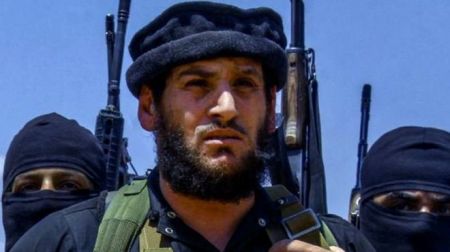
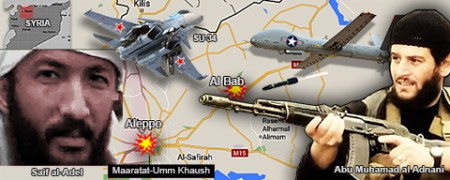
While the US has frequently claimed to have liquidated an Islamic terrorist leader, Russia put in its first claim on Aug. 31, when the defense ministry in Moscow announced for the first time that the day before, an SU-34 bomber had killed ISIS senior terrorist mastermind Mohammed Al-Adnani during a high-profile gathering at Maaratat-Umm Khaush near Aleppo.

The claim was worded so as to indicate that Russian intelligence had pulled off a major feat by a hit that took out 40 high-profile operatives.

This claim came 24 hours after a US official said that a Predator drone rocket had hit a car believed to be carrying Adnani near Al-Bab, and that the results were “being assessed” – even though ISIS itself reported that the terrorist leader, tagged as senior spokesman, “was martyred while surveying the operations to repel the military campaigns against Aleppo.”

The Pentagon sources called the Russian version “lies” and “a joke.”

The distance between al-Bab and Maaratat-Umm Khaush is only 28km, but the gap between the American and Russian claims is less immeasurable.

Fighting has escalated around the city in recent weeks, with rebels breaking a siege by government forces and Syrian and Russian warplanes bombing rebel-held areas.

The competing Russian and American claims of a successful aerial-cum-intelligence action against a high-profile ISIS founder-member break new ground in the war on Islamic terror.

Al-Adnani, who was born in 1977 in the northern Syrian town of Banash, was responsible in the past two years for orchestrating terrorist atrocities in Tunisia, Paris, Brussels, Orlando, Nice, Sinai Peninsula and Istanbul, as well as suicide bombings in Baghdad.

Far from being a joke, the cold war dividing Moscow and Washington appears to have spread to the war on Islamist terror and infected the Syrian arena.

The early collaboration between the two powers in the Syrian conflict has broken down. This was admitted on Aug. 26 in Geneva, after US Secretary of State John Kerry and Russian Foreign Minister Sergei Lavrov failed to agree on further military and intelligence cooperation.

Ironically, it is noted by DEBKAfile’s intelligence and counterterrorism sources, that both powers’ clandestine services received intelligence on their target’s movements from the same source.

IsisSpokesman480

That is another first; never before has any Islamic terrorist organization fed the same piece of intelligence to the US and Russia. If that is what happened, it could mean only one thing: that someone in ISIS had decided it was time for Al-Adani to go.

This would be par for the course in the harsh world of jihadist terror organizations, such as Al Qaeda from which ISIS sprung.

When Osama bin Laden, whom US special forces killed in 2011, felt the need to cull the Al-Qaeda leadership of high-profile operatives who had outlived their usefulness or were suffering from fatigue, he would get rid of them by arranging for US intelligence to be tipped off about their whereabouts.

In one notable instance of this purge, Khalid Sheikh Mohammed, senior planner of the 9/11 attacks on New York and Washington, was turned in to the CIA in 2003.

If this is what happened to Al-Adani, DEBKAfile’s counterterrorism sources link it to the recent reappearance on the Islamist terrorist scene in Syria three weeks ago of the veteran Al-Qaeda master-terrorist Saif al-Adel with a group of followers.

Al-Adel is rated one of the world’s most dangerous terrorists, with long experience of planning and executing mass-casualty operations stretching back to the 1980s. He is “credited” with the large-scale assaults on the East African US embassies in 1998 and a string of murderous strikes in Saudi Arabia in 2003, some of which hit US targets.

It is not yet known how Al-Adel and his gang reached Syria and for what purpose. They are only known to have crossed the border from Iraq. It is presumed by intelligence watchers of terrorist insider politics that, after deciding that Al-Adnan was a spent asset, ISIS leaders found his replacement.

Taliban storms district in eastern Afghanistan

August 27, 2016

Taliban storms district in eastern Afghanistan, Long War Journal, August 27, 2016

Taliban has regenerated its forces since the US withdrew the bulk of its combat forces, is threatening provincial capitals and seizing district centers, and operating openly as a military forces in multiple regions throughout Afghanistan. Additionally, Al Qaeda has become so emboldened by the success of the Taliban that it has established training camps in the country.

*****************

The Taliban took control of the district of Jani Khel in the eastern Afghan province of Paktia yesterday after laying siege to the district center for more than two weeks.

Both Afghan officials and the Taliban confirmed that Jani Khel fell to the Taliban late last night. On Voice of Jihad, the Taliban’s official website, the group claimed that it “stormed the enemy installations in Jani Khel district of Paktia province including district headquarters, police station and all its security and combat posts.”

“Mujahideen took over the district and overran 10 combat posts as well as police checkpoints, raising Islamic Emirate’s white flag,” the Taliban continued. Additionally, it claimed it killed “48 enemy personnel consisting of Arbakis [local militia], police and soldiers of ANA,” or Afghan National Army, and seized “15 armored tanks and 16 armored fighting vehicles,” and destroyed an additional six armored personnel carriers. The Taliban’s claims cannot be confirmed; the group routinely exaggerates the number of casualties inflicted on Afghan forces.

The governor of Jani Khel confirmed the Taliban’s claim that it did overrun the district.

“Our district was surrounded by Taliban for almost five days,” governor Abdul Rahman Solamal told Reuters. “Hundreds of them attacked our check posts overnight. If we do not retake it soon then Taliban can easily move from one province to another and can undermine security in at least three provinces.”

Solamal warned on Aug. 10 that the district was in danger of falling to the Taliban.

“The clashes are still ongoing two kilometers from the center of Janikhel,” he told TOLONews. “If supporting troops are not sent into Janikhel as soon as possible, the district will fall into the hands of the Taliban.”

Solamal’s plea for reinforcements and the failure of the Afghan government and military to provide support to districts under the threat of Taliban assaults has become all too common. The Taliban is sustaining offensive operations throughout Afghanistan as Afghan security forces, backed by US airpower and special forces, continue to struggle containing the jihadist group. Reports from Afghanistan indicate that the provincial capitals of Kunduz and Helmand are also in danger of falling to the Taliban.

The Taliban currently control or contest more than 80 of Afghanistan’s 400 plus districts, according to a study by The Long War Journal. That number may be higher as reports from some districts known to be Taliban strongholds are unavailable.

The Obama administration’s response to the deteriorating security situation has been to slow the withdrawal of US forces from the country, leaving 8,400 troops in Afghanistan instead of the 5,400 originally planned. Still, nearly 1,400 US troops will be withdrawn by the end of the year despite the fact that President Barack Obama described the security environment in Afghanistan as “precarious.” We have yet to hear an explanation as to how fewer troops will help the worsening security situation.

The US military continues to downplay Taliban gains and exaggerate the performance of the Afghan National Defense and Security Forces. On Aug. 25, Brigadier General Charles Cleveland, deputy chief of staff for communications for Resolute Support, NATO’s mission in Afghanistan, said that Afghan forces “are generally on a positive trajectory.”

“But overall, as we look at the country holistically, and as we compare and add into that the progress that we’ve seen at the ministry of defense and the ministry of interior from an institutional level, overall we still do believe that the ANDSF is performing better this year than they performed last year. We think that they are still generally on track with their offensive campaign plan, Operation Shafaq. And then finally, we still believe that they are generally on a positive trajectory.”

Cleveland made the statement despite the fact that that Taliban has regenerated its forces since the US withdrew the bulk of its combat forces, is threatening provincial capitals and seizing district centers, and operating openly as a military forces in multiple regions throughout Afghanistan. Additionally, Al Qaeda has become so emboldened by the success of the Taliban that it has established training camps in the country.