Archive for the ‘U.S. Military’ category

It’s official: U.S. will build new Syrian rebel force to battle Islamic State

October 16, 2014

It’s official: U.S. will build new Syrian rebel force to battle Islamic State, McClatchy DC, Hannah Allam, October 15, 2014

(Phase Two of “Operation We Got It Wrong Again.” Will Kurds or newbies be supplied, equipped and trained? By whom will the “moderates” be vetted and trained? By now focusing on the Syrian political opposition, will we be distancing ourselves from Assad’s supporter Iran?– DM)

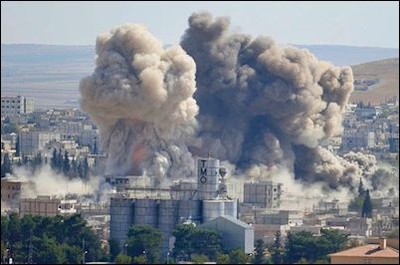
Airstrike KobaniSmoke rises following an airstrike by US-led coalition aircraft in Kobani, Syria, during fighting between Syrian Kurds and the militants of Islamic State group, Oct. 9, 2014. (AP Photo/Lefteris Pitarakis)

This time, Allen said, the United States and its allies will work to strengthen the political opposition and make sure it’s tied to “a credible field force” that will have undergone an intense vetting process.

******************

— John Allen, the retired Marine general in charge of coordinating the U.S.-led coalition’s response to the Islamic State, confirmed Wednesday what Syrian rebel commanders have complained about for months – that the United States is ditching the old Free Syrian Army and building its own local ground force to use primarily in the fight against the Islamist extremists.

“At this point, there is not formal coordination with the FSA,” Allen told reporters at the State Department.

That was perhaps the bluntest answer yet to the question of how existing Syrian rebel forces might fit into the U.S. strategy to fight the Islamic State. Allen said the United States’ intent is to start from scratch in creating a home-grown, moderate counterweight to the Islamic State.

For most of the three years of the Syrian conflict, the U.S. ground game hinged on rebel militias that are loosely affiliated under the banner of the Free Syrian Army, or FSA. Their problems were no secret: a lack of cohesion, uneven fighting skills and frequent battlefield coordination with the al Qaida loyalists of the Nusra Front.

This time, Allen said, the United States and its allies will work to strengthen the political opposition and make sure it’s tied to “a credible field force” that will have undergone an intense vetting process.

“It’s not going to happen immediately,” Allen said. “We’re working to establish the training sites now, and we’ll ultimately go through a vetting process and beginning to bring the trainers and the fighters in to begin to build that force out.”

The Syrian arena is important, Allen said, but to the U.S., “the emergency in Iraq right now is foremost in our thinking.” There will be a simultaneous training-and-equipping campaign for Iraq, where the U.S.-trained military collapsed during the Islamic State’s summer offensive.

Allen said the new training program is “for those elements of the Iraqi national security forces that will have to be refurbished and then put back into the field,” with the ultimate goal of reclaiming Iraqi territories seized by the Islamic State.

Allen sounded confident that the United States and its allies could juggle two massive training efforts even as the Islamic State has shown itself to be resilient under weeks of coalition airstrikes.

“We have the capacity to do both, and there is significant coalition interest in participating in both,” Allen said of the twin force-building efforts in Iraq and Syria.

But, as he stressed repeatedly in his remarks, “it’s going to take a while.”

Ahmad Tomeh, who was just re-elected prime minister of the Syrian opposition’s interim government, told McClatchy that Allen met six leaders of the political opposition during his trip to Istanbul last week, but had no talks with any of the ground commanders, including the vetted, trained commanders the U.S. has been supporting. They asked for increased help, Tomeh said, but got no commitment.

‘Inherent Resolve’: Military campaign against ISIS gets a name

October 15, 2014

‘Inherent Resolve’: Military campaign against ISIS gets a name, Fox News, October 15, 2014

(How about naming the enemy, Islamism? That would not be suitably multicultural. Here are some of the names for the U.S. military operation suggested by Foreign Policy Situation Report readers (via e-mail):

The response to my request for names of the US mission against IS was overwhelming. It’s hard to draw any conclusions from the names offered, but I will say this: SitRep has an engaged, intelligent and global audience (I got responses from all over the world), and the names offered up show a huge disparity in opinion. Some show resolve, while others reflect a growing criticism – one might say cynicism – of Obama’s strategy. Some of the best are below; email me if you’d like to receive the full list.

Operation Empty Chair; Operation Oops, Sorry About That; Operation Good Intentions; Operation Seriously?  Again?; Operation Passive-Aggressive; Operation Coalition of the Dragged Kicking and Screaming; Operation Did I Leave My Keys Here?; Operation Slam Dunk; Operation IS you IS, or IS you Ain’t? Operation Syri-ous about Iraqi Freedom; and Operation Iraqi Freedom 2: Electric Boogaloo.

Make sense. How about “Inherent Dithering?” — DM)

ff_isis_101514US strategy failing as ISIS militants march on

More than two months after the U.S. first launched airstrikes against the Islamic State, the military mission has a name: “Inherent Resolve.”

A senior military source confirmed to Fox News that “Inherent Resolve” officially has been chosen as the title of the operation.

The name comes after questions were raised about why the administration had not named a mission that has escalated to involve several coalition partners and hundreds of airstrikes in both Iraq and Syria.

As of Sunday, the U.S. had conducted nearly 400 strikes in both countries. The number has risen since then – on Wednesday, the U.S. military said it launched another 18 airstrikes overnight near the contested Syrian city of Kobani, intensifying an air campaign against Islamic State militants’ efforts to capture the city near the Turkish border.

Why the mission was not named until now is unclear.

Every U.S. military intervention since the invasion of Panama in 1989, code-named Operation Just Cause, has had a name.

Even the operation to combat Ebola in West Africa was given an operational name the same day it was announced: Operation United Assistance.

An unnamed Defense official was quoted in a recent Wall Street Journal report suggesting the administration was reluctant to name the anti-ISIS mission because: “If you name it, you own it. … And they don’t want to own it.”

But Pentagon spokesman Rear Adm. John Kirby rejected that claim.

He said earlier this month that officials were considering a potential title. Kirby explained that one reason for waiting to name the operation has to do with the complex evolution of the mission.

How to defeat Islamic State’s war machine

October 15, 2014

How to defeat Islamic State’s war machine, Al-MonitorMetin Turcan, October 14, 2014

(Which team is the “junior varsity?”

The article suggests the obvious need for close air support using trained ground forces to guide aircraft to strike useful targets. The U.S. has trained “boots” capable of doing that, but Obama continues to assert that the U.S. will have no ground combat presence in Iraq or Syria. U.S. spotters would need be in combat areas, would be targeted by Islamic State forces and would therefore need to engage in combat. Non-U.S. target spotters, in addition to needing substantial technical training, would also need to be capable of communicating with aircraft pilots. In many if not most case, spotters capable of communicating in English would be needed. –DM)

Although much has been written to explain the tactical military successes of the Islamic State (IS), there has not yet been a comprehensive assessment of how, since June 2014, IS has managed to rule over terrain larger than Lebanon to include 8 million Iraqis and Syrians.

How has it been possible that in a short three months IS has been able to control extensive terrain, with 3,000 IS fighters capturing Mosul, which was guarded by 30,000 Iraqi soldiers, and after seizing Mosul on June 10 engage in battles two days later with Iraqi forces in towns north of Baghdad, 230 miles from Mosul?

Although one can allude to the delayed reaction of the international community, the lack of strong military opposition to IS, the international support IS has acquired and the support from Sunni tribes and political bodies in areas it captures, none of it defies the reality that — at the tactical level — IS is an extremely lethal and effective war machine. To understand this key determinant of IS gains, one has to understand that reality. This article will attempt to analyze the factors contributing to IS’ military efficiency, particularly at the tactical level.

Factors that boost tactical effectiveness of IS can be summarized as fluid and decentralized command and control structure; novel hybrid military tactics blending conventional warfare with terrorist tactics; effective use of armored platforms in offensive operations; dispersion; preservation of momentum at all costs; effective exploitation of topographic and human terrains; simplicity and flexibility in planning; and conducting operations and high levels of initiative and morale.

Fluid and decentralized command control structure

IS does not have permanent and centralized command and control structure in the traditional sense of warfare. Unlike contemporary armies of the world, IS doesn’t make sharp distinctions between strategic, operative and tactical levels. In their traditional warfare, tactical achievements is the way to achieve strategic objectives. For IS, the basic goal is to score tactical successes and expand on them step by step. Deviating from the traditional approach, what IS fields is a bottom-up command structure focused on a fast pace for small military achievements. At the moment, US-led airstrikes have been mostly against IS communication and training facilities. It is extraordinary that there is not a single control facility that has been hit by allied airstrikes.

IS warfare combines and hybridizes terrorist tactics, urban guerrilla warfare and conventional warfare.

IS is adept enough to conduct armor attacks at night and is skilled in accurate firing of their main tank guns with thermal cameras, and is capable of planting improvised explosive devices in critical areas and routes. It wages hybridized guerrilla warfare and conventional armored warfare by deploying eight to 10 men teams carrying out building-by-building, block-by-block clear and hold operations in urban terrain.

After the recent air attacks, IS has dispersed its forces to the extreme. Its teams have been minimized to two or three vehicles and eight to 10 men. Their concealment has been highly professional. IS’ executive orders are brief, setting out what the mission is in simple terms, leaving how it is to be carried out to field units.

It is imperative to acknowledge that a typical IS militant is endowed with a win-win mindset that assures him that to kill in jihad is a blessing, but if he is martyred he will end up in paradise also. No wonder IS combatants are high-adrenalin fighters who can kill and get killed without hesitation.

A typical IS operation goes like this: An IS armored unit of tanks or a mobile unit of eight to 12 fighters with two to three vehicles are informed by WhatsApp, a message on Facebook or Twitter or phone text message, and if this mode is not available through their own radio net, to assemble at a certain place at a certain time. This is the first time we are seeing combat units making use of social media in combat operations. Before its operations, IS disseminates propaganda messages via social media to enemy fighters and civilians living in the targeted urban settlements to demoralize and dishearten them. IS operations and logistics units that are thus alerted assemble at a meeting point within two to three hours, and after another 1 ½ hours of coordination discussions and logistics preparations the operation is underway.

One must remember that a regular IS tank driver is trained to drive his tank at night with a thermal camera, and that the commander of the team has enough tactical military knowledge to best deploy his tanks. Then it is a matter of attacking the enemy’s weakest point, preferably after the morning prayers. Vehicles stage the first phase of the attacks, followed by infantry attacks that depend on the nature of the enemy’s opposition. In these attacks, IS has been remarkably successful in creating a balance between the phased campaign design and maintaining the tempo of warfare. The high tempo of combat is routine for an IS fighter, but usually too high for opposing soldiers.

How to defeat IS?

How to first stop IS and then defeat it? The secret is in a concept that has so far been lacking the forces fighting IS in Syria and Iraq: Close air support that can only be provided by intense cooperation between ground troops and air units. Coalition air attacks so far are at least limiting IS advances; close cooperation between ground forces and armed helicopters such as AH-64 or fixed-wing platforms such as A-10 Thunderbolts can enable full integration of each air mission with fire and movement of ground forces, and bring the end to IS.

The question then becomes how the US-led coalition can provide that level of air support, and who has the substantial technical know-how and military expertise needed on the ground.

We know special forces elements of countries contributing to the coalition are participating in operations to provide precision target guiding with laser pointers. But this has been limited. Then what can be the solution?

Either the local forces fighting against IS will have to learn this technique that requires high military expertise, or special detachments formed by countries contributing to the coalition will be assigned to each combat zone or to major units as a close air support coordinator. It is no surprise then that the hottest topic in ongoing military discussions is who will provide this close air support and how. When tailoring strategies of close air support, one should keep in mind that IS has MANPADs (man-portable air defense systems) that make air units providing close air support highly vulnerable in their low-speed and low-altitude missions.


ISIS: Can the West Win Without a Ground Game?

October 10, 2014

ISIS: Can the West Win Without a Ground Game? Middle East Forum, Jonathan Spyer, October 2014

(It should be (but appears not to be) obvious to our “leaders” that before we have a chance of “winning” the fight against the Islamic State, et al, we need to define “win” and to decide who are our allies and who are our enemies. That has not yet happened. As to ground troops, how many will we need to do what and where? Those questions need to be answered as well, based largely on answers to the first set of questions. — DM)

[A] lack of strategic understanding of the nature of the conflict being waged is preventing the development of a coherent response to the specific problem of the Islamic State, along with the parallel problems of Shia terror groups such as Hezbollah, and the ambitions of the Islamic Republic of Iran. At root is the failure to grasp the implacable nature of political Islam in both its Sunni and Shia variants at the present time.

From this original error, all further errors, and as we can see there are many, inevitably follow.

**********************

The United States and its allies have launched a military campaign whose stated goal is, in the words of President Barack Obama, to “degrade and ultimately destroy” the Islamic State (I.S., also known as ISIS or ISIL) established by Sunni jihadis in a contiguous land area stretching from western Iraq to the Syrian-Turkish border.
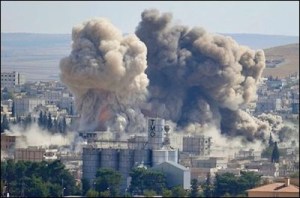
686Smoke rises from a U.S. air strike on Islamic State positions in Kobani.

As the aerial campaign begins in earnest, many observers are wondering what exactly its tactical and strategic objectives are, and how they will be achieved. A number of issues immediately arise.

Any state—even a provisional, slapdash, and fragile one like the jihadi entity now spreading across Iraq and Syria—cannot be “destroyed” from the air. At a certain point, forces on the ground will have to enter and replace the I.S. power. It is not yet clear who is to play this role—especially in the Islamic State’s heartland of Raqqa province in Syria.

In Iraq, the national military and the Kurdish Pesh Merga are now having some successes at chipping away at the Islamic State’s outer holdings. The role of U.S. air support is crucial here. But the center of the Islamic State is not Iraq, and both the Iraqi forces and the Pesh Merga have made clear that they will not cross the border into Syria. This leaves a major question as to who is to perform this task, if the objectives outlined by President Obama are to be achieved.

The answer we have heard most often of late is that elements among the Syrian rebels will be vetted by the U.S., trained in cooperation with the Saudis, and then deployed as the force to destroy the IS on the ground.

If this is indeed the plan, it is deeply problematic.

The Syrian rebels are characterized by extreme disunity, questionable effectiveness, and the presence of hardline Sunni Islamist elements among their most committed units. There are certainly forces of an anti-jihadist ideology among them—the most well-known being the Syrian Revolutionaries Front, headed by Jamal Ma’arouf from the Jebel Zawiya area in northern Syria, and the smaller Harakat Hazm. Both movements have benefitted from Western aid in recent months.

The problem, however, is that these organizations are quite prepared to work with salafi groupings whose worldview is essentially identical to that of the I.S., even if their methods are somewhat different. Thus, if we observe the recent fighting between Assad’s forces and rebels in the Quneitra area along the border with the Israeli Golan Heights, it is clear that the main contribution to rebel achievements came from the Jabhat al-Nusra group, which constitutes the “official franchise” of the core al-Qaeda group in Syria.

Reliable sources confirm that Nusra cooperates with other rebel groups in southern Syria and has even been prepared to minimize its own role, so as to allow other groups to present achievements as their own to Western and Arab patrons and thus secure a continued flow of arms, benefiting all factions.

What this means is that by championing these rebel elements as the ground force which will seek to enter and destroy a weakened I.S. in Raqqa province, the U.S. would be putting itself in the position of supporting one group of Sunni jihadis against another.

In Iraq, while the Kurdish Pesh Merga cooperates de facto with Iran, their alliance is pragmatic and tactical, one that the Kurds would gladly break given the possibility of clear Western sponsorship.

But the fierce condemnations in recent days (even by supposedly “pro-Western” rebel groups such as Hazm) of the U.S. bombing raids into Syria indicate that there is a deeper problem here. The alliance between these Sunni rebel groups and the salafis has a common anti-Western component to it.

It is, in any case, not clear if these Sunni rebels will prove able to defeat the I.S., but even if they were to do so, the presence of radical anti-Western elements among them attests to the danger of a policy of support and sponsorship of them.

Of course, the Sunni jihadis are not the only dangerous players on the ground. Another possible, no less troubling, outcome of the air campaign against the Islamic State could be the return of Bashar al-Assad’s forces to eastern Syria, from which they have been largely expelled over the last year. It is not at all hard to imagine a scenario in which once the I.S. has been weakened by Western air attacks, the Syrian military and its Iranian-backed allies will be able to make gains.

Indeed, the Iranian Revolutionary Guard Corps (IRGC) are already present in northern Iraq (and, of course, in Syria as well) and IRGC personnel have taken part in the fighting in Iraq in recent weeks. Qods force teams are reportedly located at Samarra, Baghdad, Karbala, and the former al-Sahra Air Base near Tikrit. Iran has deployed seven SU-25 ground attack aircraft which have played a role in offering air support to the Kurds and Iraqi special forces.

Following intensive Western bombing, the possibility of the Islamic State eventually being sandwiched between pro-Iranian forces on either side before being destroyed would be a real one. This would achieve the desired goal of destroying the jihadi entity, but it could end up handing a major victory to the Assad regime and its Iranian backers—enemies of the West of significantly greater potency and seriousness than the Islamic State itself.

Such a result would be somewhat reminiscent of the Iraq invasion of 2003, in which the destruction of the Sunni regime of Saddam Hussein ended up largely helping Iran.

How does the West get out of this mess? The discussion about which ground force should be used to replace the Islamic State is itself confused by a much larger misunderstanding regarding the nature of the war now taking place in Iraq and in Syria (and periodically spilling over into Lebanon).

The I.S. has now been depicted as the main problematic factor emerging from this conflict. But the Islamic State is in fact merely a particularly extreme and brutal manifestation of a broader process taking place in this area, in which political Islam of a Sunni variety is at war with the Shia political Islam of Iran and its proxies (especially Hezbollah and the Assad regime).

The I.S. may promote a particularly lurid and repulsive version of Sunni political Islam, but in its beliefs and in its practices it does not represent some unique presence in the Syrian and Iraqi context. Rather, it is little more than a particularly virulent manifestation of a strain of politics and ideology which is the primary cause of the conflict taking place across the region.

In the two scenarios discussed above, both quite plausible outcomes of a Western air campaign, the I.S. would be defeated and replaced by another version of Islamism—either that of its fellow Sunnis, or that of the rival Shi’ites.

A third possibility, however, is that the White House does not actually intend to pursue a policy intended to physically destroy the Islamic State in its heartland in northern Syria. Certainly, more recent statements emerging from the Administration appear to be preparing to “walk back” the President’s comments.

White House Chief of Staff Denis McDonough said in mid-September that success for U.S. policy vis-à-vis the I.S. would come when the group “no longer threatens our friends in the region, no longer threatens the United States.” This sounds like the introduction to a more modest policy of degrading I.S. capabilities, rather than seeking to “destroy” the Islamic State.

Of course, such a modified objective would end the dilemma over which ground forces to ally with. On the other hand, it would also have the effect of a tacit admission that the U.S. did not intend to promote its policy as originally stated by the President in the aftermath of the horrific murder of two U.S. citizens by the Islamic State.

But whether or not the goal of destroying the Islamic State is pursued with vigor, the current failure to see accurately what is happening in the Levant and Mesopotamia looks set to remain. This, in turn, looks set to prevent the emergence of a coherent policy and a coherent allocation of resources.

What is taking place across Syria and Iraq, and across their borders into Lebanon, Turkey, and Iran, is a sectarian war, made possible because of the decline of the police states which for half a century kept the lid on sectarian differences. The regional ambitions of Iran, which has clients and proxies in all three countries, exacerbate this dynamic. The attempts by Saudi Arabia to block Iran’s advance toward the Mediterranean, and by Qatar and Turkey to sponsor various Sunni jihadi elements, have produced a far more confused, and far less effective, Sunni side in this struggle.

The struggle itself, in turn, can be traced back to the failure by these states to develop coherent notions of citizenship or stable national identities in the post-Ottoman period. In other words, this war has been a long time coming, but now it is here.

Because the nature of this struggle is not widely grasped in the West, policy appears somewhat rudderless. This is reflected in the current discussion regarding the response to the Islamic State.

First, Assad was the enemy. This was made clear enough not only by his support for Hezbollah and attempts to nuclearize, but also by his unspeakable brutality and use of chemical weapons against his own citizens.

Then, when the brutality of some of the rebels became apparent, Western public interest in supporting the rebels receded. Soon the I.S. emerged as the new bogeyman. Declarations for its destruction became de rigueur, though it is far from clear how this is going to be carried out—and a de facto alliance with Iran and its clients, at least in Iraq, has emerged. This was seen in the expulsion of the I.S. from the town of Amerli, a pivotal moment in the major setbacks faced by the organization in recent days. In that town, Shi’ite militias were backed by American air power—to telling effect against the Sunni jihadis.

But is it really coherent policy to be backing murderous Shi’ite sectarians against murderous Sunni ones? It is not. Of course, when the West backs the Sunni rebels in Syria, the precise opposite is happening. Weaponry donated to “moderate” rebels then inevitably turns up in the hands of Sunni jihadis, who do most of the fighting associated with the Syrian “rebellion.” The result is that in Iraq the U.S. is helping one side of the Sunni-Shia war, and in Syria it’s helping the other side.

Only when it is understood that the West cannot partner with either version of political Islam does it become possible to formulate a coherent policy toward the Sunni jihadi forces, on the one hand, and toward the Iran-led bloc, on the other.

Such a policy must rest on the identification and strengthening of non-Islamist forces willing to band together and partner with the West. Not all of them are perfect characters, but they all understand the threat that political Islam poses.

Most obviously, there is a line of pro-American states along the southern side of the arena of the war. These are Israel, Jordan, and in a far more partial and problematic way, Saudi Arabia. Both Israel and Jordan have demonstrated that they are able to successfully contain the spread of the chaos coming out of the north. Both are well-organized states with powerful militaries and intelligence structures. Jordan has clearly benefitted from the deployment of U.S. special forces to prevent incursions by the I.S. Israel has also made clear that its resources will be available to assist the Jordanians should this be required. (Egypt, too, while not in the immediate vicinity of the conflict, can be a silent partner as well—as its campaign against the Muslim Brotherhood and tough line against Hamas have shown, it is nothing if not a virulent opponent to political Islam.)

This is what the proper coordination of allied states is supposed to look like. And it works in containing the conflict. To the east of the war’s arena is of course Iran. To its west is the Mediterranean Sea. To its north is a long, contiguous line of Kurdish control, shared between the Kurdish Regional Government of President Massoud Barzani in northern Iraq, as well as the three enclaves created by the PKK-linked Democratic Union Party (PYD) in northern Syria. The YPG militia, which is the military force in these enclaves, has fought the I.S. almost since its inception, and has largely prevailed in keeping the jihadis out of the Kurdish areas.

As part of a strategy of containment, the West should increase support for and recognition of both the Kurdish enclaves in the north of Syria and the Kurdish Regional Government itself. Both are elements capable of containing the spread of the jihadis from the north. It has become clear in recent days that the Pesh Merga, despite early setbacks, is a useful instrument in preventing the further advance westward of the Islamic State, and in so doing protecting the investment of international oil companies in the oil-rich parts of Iraq. The YPG militia, though poorly equipped, has also avoided major losses.

Such a principle of alliance will also encourage the West to reconsider the involvement of Turkey. As events of the last few years have shown, Turkey cannot be a reliable ally in the struggle against political Islam, because its ruling party, AKP, is itself an Islamist party. This is not a theoretical formulation. Turkey’s support for Islamist militias in northern Syria and its opening of its border for them has been a major contributing factor in the proliferation of these elements. There is also considerable evidence that Turkey at the very least turned a blind idea to the activities of the I.S. in the border area in 2013, and may well have offered some help to the jihadis in their fight with the YPG.

In order to grasp the rationale for a policy of dual containment, the nature of the war between rival sectarian forces must be grasped. There is also a need for the clear understanding that the effort to preserve at all costs the territorial integrity of “Iraq” and “Syria” is mistaken. Rather, what should take place is support for those forces committed to order, as listed above, and non-support for the forces of political Islam.

In other words: If political Islam (rather than one specific jihadi group, to quickly be replaced by another) is the real problem, then the real solution is to ally, forcefully and over the long haul, with those forces most committed to stopping it: Israel, Jordan, the Saudis, and the Kurds.

So it may be seen that a lack of strategic understanding of the nature of the conflict being waged is preventing the development of a coherent response to the specific problem of the Islamic State, along with the parallel problems of Shia terror groups such as Hezbollah, and the ambitions of the Islamic Republic of Iran. At root is the failure to grasp the implacable nature of political Islam in both its Sunni and Shia variants at the present time.

From this original error, all further errors, and as we can see there are many, inevitably follow.

The Disaster of ‘Gender Norming’ Ground Combat

October 8, 2014

The Disaster of ‘Gender Norming’ Ground Combat, Front Page Magazine, October 8, 2014

(Please see also Changing our rules of engagement won’t help much. — DM)

AFP 511470058 I ACF AFG HE

The Center for Military Readiness (CMR) has released a 64-page report analyzing ongoing research by the U.S. Marine Corps (USMC) about the effectiveness of integrating women into direct ground combat (DGC) units. The Interim CMR Special Report pokes a giant hole in the Obama administration’s assertions that standards of effectiveness can be maintained irrespective of the biological differences between men and women.

In January 2013, with all the attendant fanfare, Former Secretary of Defense Leon Panetta lifted a 1994 ban on women serving in smaller DGCs, insisting that “women are contributing in unprecedented ways to the military’s mission of defending the nation.” The move was recommended by the Joint Chiefs of Staff, and each branch of service has until January 2016 to seek special exemptions to the change. Panetta argued that women already make up 15 percent of the military and have already faced “the reality of combat.” He further insisted everyone is entitled to see if they can meet the qualifications for being in a DGC.

As it is with so many leftist agendas, the meaning of words can be manipulated to meet them. As the CMR explains, Joint Chiefs of Staff Chairman Gen. Martin Dempsey “has suggested that standards too high for women should be questioned” and has called for a “critical mass” of women in DGC units, a percentage that apparently ranges from 10-15 percent. To achieve this critical mass, the Obama administration has embraced “gender diversity metrics” that could lead to higher-preforming personnel being replaced by those meeting minimum standards characterized as “lower but equal.”

All of this is code-speak for quotas.

In 2012, Gen. James Amos initiated USMC research aimed at finding a way to integrate women into combat units. While physical strength was not the only issue of concern, it is the one where the disparities between men and women could not be obscured. Data collected in 2013 from 409 male and 379 female volunteers by the USMC Training and Education Command (TECOM) revealed several inconvenient truths during the five “proxy” tests designed to simulate ground combat element (GCE) tasks. In conjunction with data from Physical and Combat Fitness Tests (PFT and CFT), the greatest disparity between men and women was demonstrated in tests that measured upper body strength, which is considered essential for both survival and the success of missions involving direct ground combat.

The numbers are stark. In pull-up tests, men averaged 15.69 pull-ups, compared to a 3.59 pull-up average for women. Clean and press tests that involved lifting progressively heavier weights ranging from 70-115 pounds produced a passing rate of 80 percent among men at the 115 pound level, compared to only 8.7 percent of women. In a 120 mm Tank Loading Simulation drill, less than 1 percent of the men failed, compared to 18.68 percent of women. Less than 1 percent of men failed the 155 mm Artillery Lift and Carry, compared to 28.2 percent of women. And in the Obstacle Wall With Assist Box test that used a 20 inch box to simulate a “helping hand,” less than 1.2 percent of men could not get over the obstacle course, compared with 21.32 percent of women.

Enter “gender norming.” Gender norming is the idea that the military should have different (read: lower) standards for women than men. In practice, this has been going on for a long time. As a 1995 article written by Walter Williams reveals, “Army fitness standards call for 80 push-ups for men and 56 for women. Male soldiers ages 17 to 25 must run two miles in 17 minutes and 55 seconds. Females are given 22 minutes and 14 seconds. Male Marine trainees must climb 20 feet of rope in 30 seconds; women are given 50 seconds.” Nonetheless, proponents of gender norming say any concern that it will lead to lowered overall standards is unwarranted—because female soldiers will have to meet stringent guidelines before they are deployed in DGCs.

Not quite. “If we do decide that a particular standard is so high that a woman couldn’t make it, the burden is then on the service to come and explain to the secretary, ‘Why is it that high?  Does it really have to be that high?’” Gen. Dempsey contends.

The CMR further illuminates the machinations taking place, citing a June 2013 report to Congress by the Marines, noting that “gender-neutral” events in the PFT, CFT and obstacle courses “would be gender-normed for score…to account for physiological differences.” The CMR further reveals that researchers see the USMC project as a way to question whether tests such as the PFT and CFT serve as “valid predictors” of success in “combat-related tasks.” All of this is designed to downplay the conclusions reached by the CMR’s evaluation of the study: that “gender norming” is a contradiction of “gender neutral,” and despite the Pentagon’s insistence that those eligible for DGCs will have to meet gender-neutral standards, “data compiled so far indicates that this expectation cannot be met.”

How does the military plan to sidestep the issue? The CMR reveals the insidious concepts being employed in that regard. “Gender Diversity Dividends” could allow women to use “gender scoring tables” to accumulate points or dividends leading to 3rd, 2nd or 1st class status, that may even include extra points for women only. “Lower But Equal Standards” is the idea that the “worst performing decile” (one-tenth) of soldier performance should be used to calculate minimum passing test scores. “Training to Task” is the idea that women could improve their performance in pre-screening and other upper-body strength tests.

As the CMR notes, there is no specific study to support that assertion. A 1997 effort conducted by the Army revealed that specialized training could strengthen women on a temporary basis—but strengthen men even more, while retired expert in military medicine Rear Admiral Hugh Scott explained that androgenic hormones “that are not going to change” account for the differences in muscle mass and endurance training between men and women.

Military women have noticed. A recent survey conducted by the Army revealed that only 7.5 percent of the 30,000 who responded said they would want one of the combat jobs that would be made available. Even more telling, when the Army polled men and women about the physical standards, both groups said they should remain the same. “The men don’t want to lower the standards because they see that as a perceived risk to their team,” David Brinkley, deputy chief of staff for operations at the Army’s Training and Doctrine Command, told the AP. “The women don’t want to lower the standards because they want the men to know they’re just as able as they are to do the same task.” Regardless, the article further noted that “Brinkley’s office at Fort Eustis is filled with charts, graphs and data the Army is using to methodically bring women into jobs that have been previously open only to men.”

The CMR notes the effort is being aided by organizations such as the RAND Corporation, who have produced studies that are “not independent or objective, or likely to challenge the administration’s group-think on military-social issues.” It is group think that is seemingly determined to advance the agenda that methodology can eliminate biological differences between the overwhelming majority of men and women.

However, the military remains determined to try. The CMR notes the Marines will stand up “Ground Combat Element Integrated Task Forces” (GCEITF) that include a 25 percent rate of participation by women and will engage in simulated combat experiences. The CMR warns that the exercise might include “task-shifting” that could conceal deficiencies that would be unworkable in smaller DGC units.

They further warn that Congress needs to get heavily involved in reviewing the research, to consider the many “unresolved controversies that are barely mentioned in the current research.” They include disparities in injuries sustained by women, unit cohesion, the potential for sexual misconduct, readiness, recruiting, retention and reassignment costs, cultural ambivalence with regard to violence against women, and eligibility for Selective Service obligations tied to DGC units.

In conclusion, the CMR’s bottom line is clear: “None of the USMC research results produced so far support the activists’ theories that women can be physical equals and interchangeable with men in the combat arms.”

Unfortunately one suspects such reality is irrelevant. Speaking with Front Page, CMR President Elaine Donnelly noted that gender integration is driven by the idea of “how to make it happen, instead of whether to make it happen.” “The military should not be forced to achieve an agenda the president’s base demands,” she explained. “If you’re going to have a critical mass of women in direct ground combat units, standards have to be lowered. That’s the only was you can achieve that.” Donnelly also explained how such agendas are sustained. “Nobody holds the policy-makers accountable,” she said. For the sake of current and future soldiers who go into harm’s way to protect the nation, Americans must do exactly that — and demand an end to this dangerous, ideology-driven military policy.

Changing only our rules of engagement won’t help much – Updated October 6th

October 6, 2014

Changing only our rules of engagement won’t help much – Updated October 6th, Dan Miller’s Blog, October 6, 2014

(The rather “defeatist” views expressed here are mine and do not necessarily reflect those of Warsclerotic. — DM)

I posted this article from Israel Hayom at Warsclerotic, of which I am an editor. The article argues that to fight the Islamic State we need to change our rules of engagement. The parenthetical comment at the top of the Warsclerotic post is mine and is reproduced below.

(Could the U.S. and her allies put effective boots on the ground, or have the boots and the nation become too multiculturally damaged to do what needs to be done? More than the rules of war needs to change.

When the U.S. responded to the Russian supplied, trained and initially led North Korean invasion on June 25, 1950, we had been at peace for only five years. We were tired and wanted peace to continue but war came to us unexpectedly; it should have been expected. Our peacetime boots were badly supplied, trained and, more often than not, led. Some but not enough officers and senior noncoms had experienced war and knew what to do. Very few in the lower enlisted ranks had or did and “bug out” became a much used phrase. The NK troops had been hardened in combat, were adequately supplied, well trained and well led. Those who did not fight were executed. They pushed us back nearly to Pusan. By mid-September, we had more better led and trained troops; they had also become very angry at the NK troops, and intense anger is a powerful force multiplier. The NK tide was reversed, for a couple of years.

Were we now to try to put green boots on the ground to do what is necessary against well trained, led and financed Islamic troops, a  majority  of the public would oppose it and it would be politically unpopular. Were we to put boots on the ground anyway, they would likely need to undergo lengthy and deadly immersion-style baptism by fire. There would be substantial casualties and the opposition would increase.

Should we do it anyway if only the rules of engagement change? Can we, or is that now a fantasy? — DM)

Can the Obama Nation field a well trained, led and supplied contingent, of adequate size, to defeat the “non-Islamic” Islamic State, its cohorts and friends? Or are we too multicultural and decadent? Is our multicultural focus more on such nonsense as, for only one example, “gender equality” in the military than on winning wars?

I have few if any concerns about real gender equality. Kurdish women fighting against the Islamic State have disabused me of most that I once had. Please watch the video embedded below. One of the commanders was asked why she joked and smiled when around her troops. She answered, “I have to in order to keep their morale high.” That is a statement one would expect from a seasoned and competent commander.

However, when politically correct gender “equality” means that military training and other standards are lowered so that young ladies can serve, it becomes gender inequality and diminishes the effectiveness of our military. It would be only slightly less absurd, and only slightly less dangerous — to them and to those around them — to send such green “boots” on the ground into combat wearing high heel shoes and carrying only their purses.

Compare the Kurdish women fighters to this specimen of our deranged, multicultural and politically correct society:

Back to the Korea “police action:” President Truman had served in World War I as an artillery battery commander and rose to colonel in the reserves. Although a far from perfect Commander in Chief, he knew more about war than Obama could ever learn. Obama has no desire to learn; the “smartest person” in any room, He commonly ignores advice from those who have learned. Truman knew about the need for good military discipline, Obama has very little discipline himself and does not.

We fared poorly during the June 25 through mid-September period in South Korea. Could we now expect green boots on the ground to do even as well if plucked from a peaceful, multicultural environment and sent to fight against the Islamic State, et al, no less brutal than were the North Korean and later Chinese forces? Is there sufficient reason to try, now, even though our “kinetic activity” can not be successful with air power alone?

Do we even know the enemy, when Obama and others continue to refer to Islam as the “Religion of Peace” and praise its contributions to American culture? From Obama’s 2014 Eid Greeting:

While Eid marks the completion of Ramadan, it also celebrates the common values that unite us in our humanity and reinforces the obligations that people of all faiths have to each other, especially those impacted by poverty, conflict, and disease.

In the United States, Eid also reminds us of the many achievements and contributions of Muslim Americans to building the very fabric of our nation and strengthening the core of our democracy. [Emphasis added.]

When the Islamic State is erroneously deemed non-Islamic? When we continue to label Islamic terrorism at home as “workplace violence?” When, shortly after the recent Oklahoma beheading by an Islamist, Obama sends a special messenger from the White House to deliver a belated note of thanks to the mosque he attended for “helping rebuild the Moore community after a destructive tornado tore through the city in 2013.” [Emphasis added.]

Your service is a powerful example of the powerful roots of the Abrahamic faiths and how our communities can come together with shared peace with dignity and a sense of justice,” President Barack Obama said.

The Imam, the leader of the prayer service, stated during his sermon that the Muslim faith has been called a “cancer that needs to be cut off from the American society.

It seems unlikely, at best, that we — or at least too many of us — know the enemy that cannot be named.

According to the linked Israel Hayom article,

Islamic State is not an organization that can be defeated with slow, uncertain, limited action. It cannot be defeated without “boots on the ground.” It is imperative to hit them with force; with waves of growing intensity. They must be attacked continuously, without breaks, without cease-fires and with the utmost determination. [Emphasis added.]

I agree, and wish that we could field a fighting force of that caliber to move quickly and effectively, before too many get clobbered and before we have to bring them all home, many in body bags. We seem less able to do that now than we were during the opening months of the “police action” in Korea. Since we can’t defeat the Islamic State, et al, with “slow, uncertain, limited action,” can we dispatch boots in the tens of thousands to do the job effectively? For the reasons suggested above, that seems even less likely.

Unfortunately, fantasy now trumps reality; until that changes, we should not send green boots into combat; we have few others to send. We. Are. Screwed.


Iran Orders Elite Troops: Lay Off U.S. Forces in Iraq

October 6, 2014

Iran Orders Elite Troops: Lay Off U.S. Forces in Iraq, Daily BeastEli Lake, October 6, 2014

Quds forcesVahid Salemi/AP

U.S. intelligence officials tell The Daily Beast that the apparent Iranian decision not to target American troops inside Iraq reflects Iran’s desire to strike a nuclear bargain with the United States and the rest of the international community before the current negotiations expire at the end of November.

“They are not going after Americans,” one senior U.S. intelligence official told The Daily Beast familiar with the recent assessments. “They want the nuclear talks to succeed and an incident between our guys and their guys would not be good for those talks.”

******************

The last time Iranian and American forces were in Iraq, the two sides quietly fought each other. Now Iran’s Quds Force officers in Iraq are purposely leaving the Americans alone.

Pay no attention to the Shi’ite militias threatening to kill U.S. troops in Iraq. The elite Iranian forces backing those militias have been ordered not to attack the Americans.

That’s the conclusion of the latest U.S. intelligence assessment for Iraq. And it represents a stunning turnaround for Iran’s Quds Force, once considered America’s most dangerous foe in the region.

U.S. intelligence officials tell The Daily Beast that the apparent Iranian decision not to target American troops inside Iraq reflects Iran’s desire to strike a nuclear bargain with the United States and the rest of the international community before the current negotiations expire at the end of November.

“They are not going after Americans,” one senior U.S. intelligence official told The Daily Beast familiar with the recent assessments. “They want the nuclear talks to succeed and an incident between our guys and their guys would not be good for those talks.”

The Quds Force, named for the Arabic word for Jerusalem, are believed to have hundreds of troops in Iraq. As the primary arm of the Iranian state that supports allied terrorist organizations, their operatives worried Obama’s predecessor so much that the Treasury Department began sanctioning its members in 2007 for sabotaging the government of Iraq. The U.S. military accused the Quds Force of orchestrating cells of terrorists in Iraq. In 2012, Wired magazine dubbed Quds Force leader Qassem Suleimani the most dangerous person on the planet. In 2013, the New Yorker arrived at a similar conclusion, and claimed he has “directed Assad’s war in Syria.”

More recently, the Treasury Department has accused the Quds Force of international heroin trafficking and conducting terrorism and intelligence operations against the Afghanistan government. That’s why it’s so extraordinary that the Quds Force would be perceived to be laying off U.S. forces in Iraq.

But in some ways, the assessment is not surprising. Both Iran and the United States share a common enemy in the Islamic State of Iraq and al-Sham (ISIS). In late August, U.S. airpower and Iranian-backed militias broke the ISIS siege on the town of Amerli. Suleimani, the commander of the Quds Force, was photographed in Amerli, after the town was liberated from ISIS.

The latest assessments from the U.S. intelligence community also interpret Iran’s behavior in part as linked to the ongoing negotiations between Iran, the United States, the United Kingdom, France, Germany, Russia and China.

A U.S. intelligence official said the Quds Force behavior was the equivalent of a confidence building measure, a diplomatic term that refers to a concession offered to improve the atmosphere of negotiations. (Iran had already offered to play a more “active role” in the regional fight against ISIS, in exchange for nuclear concessions.)

The latest U.S. nuclear proposal to Iran would be favorable to the Islamic Republic and allow Iran to keep many of its declared centrifuges so long as they were disconnected from one another. Iran’s declared facilities in Qom and Natanz use a centrifuge process to enrich uranium into nuclear fuel.

The latest U.S. assessment also undercuts the public warnings from Iranian backed militias in Iraq that are doing much of the fighting now against ISIS.

Last month, the three largest Shiite militias told President Obama not to send ground troops into Iraq. But because the Quds Force is so instrumental in funding, training and in some cases providing strategic direction to these militias, it would suggest these public warnings were merely idle boasts.

To date, the Pentagon acknowledges that there are more than 1,600 U.S. forces inside Iraq, but these forces do not engage in combat missions, according to the Defense Department. Instead, the U.S. presence in Iraq is to advise Iraqi and Kurdish forces, assess the state of those forces and protect U.S. facilities inside Iraq.

Earlier this month in New York, Iran’s foreign minister Javad Zarif said the presence of foreign forces inside Iraq “creates domestic opposition and domestic resentment.” But in response to a question about the Shi’ite militias’ warnings against the United States, he also stressed that Iran did not support “anything that would complicate the situation” in Iraq..

The recent public warnings from groups like the Mahdi Army and the Asa’ib al-Haq were reminiscent of Iraq between 2006 and 2009. That’s when Shiite militias, working closely with Iran’s Quds Force, placed the sophisticated improvised bombs on routes traveled by U.S. forces. In the later years of the conflict, American forces captured what they said were dozens of Quds Force operatives working inside Iraq.

Exactly how long this informal Quds Force truce lasts is anyone’s guess. But Kimberly Kagan, the president of the Washington-based Institute for the Study of War and a one-time adviser to Gen. David Petraeus, cautioned that this alliance of convenience could break down quickly. “Without a doubt, Iranian backed elements have declared their intention many times in the past to attack the U.S. inside Iraq,” she said. “Whether or not those elements have immediate intentions to attack the United is irrelevant. They are declared enemies of the United States.”

That said, Kagan added that she believed “The Iranians do have a short term interest in being on their best behavior during these nuclear negotiations.” Those negotiations are set to expire at the end of November.

The rules of war need to change

October 5, 2014

The rules of war need to change, Israel Hayom, Dan Margalit, October 5, 2014

(Could the U.S. and her allies put effective boots on the ground, or have the boots and the nation become too multiculturally damaged to do what needs to be done? More than the rules of war needs to change.

When the U.S. responded to the Russian supplied, trained and initially led North Korean invasion on June 25, 1950, we had been at peace for only five years. We were tired and wanted peace to continue but war came to us unexpectedly; it should have been expected. Our peacetime boots were badly supplied, trained and, more often than not, led. Some but not enough officers and senior noncoms had experienced war and knew what to do. Very few in the lower enlisted ranks had or did and “bug out” became a much used phrase. The NK troops had been hardened in combat, were adequately supplied, well trained and well led. Those who did not fight were executed. They pushed us back nearly to Pusan. By mid-September, we had more better led and trained troops; they had also become very angry at the NK troops, and intense anger is a powerful force multiplier. The NK tide was reversed, for a couple of years.

Were we now to try to put green boots on the ground to do what is necessary against well trained, led and financed Islamic troops, a  majority  of the public would oppose it and it would be politically unpopular. Were we to put boots on the ground anyway, they would likely need to undergo lengthy and deadly immersion-style baptism by fire. There would be substantial casualties and the opposition would increase.

Should we do it anyway if only the rules of engagement change? Can we, or is that now a fantasy? — DM)

The enlightened world must pummel Islamic State into a pulp. This cancer needs to be excised, leaving no metastases behind. If the world is soft, the way most greasy, petit-bourgeois masses tend to be, it will soon learn that these horrifying decapitations are in fact prompting thousands of new volunteers to join the ranks of Islamic State. A toothless war will come back to bite us like a boomerang. It will weaken the good guys.

*****************

It was clear from the very beginning that the cruelest most terrible terror organization since the Khmer Rouge would not fold in the face of a flimsy, ill-timed attack by a few American, British and French jets. The possible addition of Australia, Canada and some Arab states — it is not yet clear where Turkey stands — to the coalition will not scare them either. On the contrary — Islamic State group draws its power from its image of extremist outlaws who will never compromise. At this point, refusing to surrender, the Islamic State group had no choice but to decapitate another innocent British national — Alan Henning — who only wanted to do good in this world.

The same fate awaits the next Westerner in line — an American by the name of Peter Kassig, who even converted to Islam to try to save his own life. But the murderers will not let up. Jihadi John is already sharpening his knife.

All this is happening because Islamic State is not an organization that can be defeated with slow, uncertain, limited action. It cannot be defeated without “boots on the ground.” It is imperative to hit them with force; with waves of growing intensity. They must be attacked continuously, without breaks, without cease-fires and with the utmost determination.

The day of Yom Kippur, regardless of the Jewish holiday, was a turning point in the war against Islamic State. They were bombed, yet immediately resumed decapitating prisoners. The reality has become one of walking on the edge; of all or nothing-style fighting. There can be no compromise; there can be no cease-fire. You are either with us or against us.

The enlightened world must pummel Islamic State into a pulp. This cancer needs to be excised, leaving no metastases behind. If the world is soft, the way most greasy, petit-bourgeois masses tend to be, it will soon learn that these horrifying decapitations are in fact prompting thousands of new volunteers to join the ranks of Islamic State. A toothless war will come back to bite us like a boomerang. It will weaken the good guys.

It will not be an easy victory. In the West, there are those who are afraid and who prefer to shut their eyes tight as part of a head-in-the-sand policy. There are those who are truly indifferent. There are bleeding hearts who find partial justification for the Islamist decapitations. One of them wrote an article blaming the Western violence for the rise of Islamic State. Others, at the U.N. of course, wondered whether bombing Islamic State targets would be in line with international law, or whether it could be a violation of Syrian sovereignty.

The hypocrisy is still benefiting the terrorists’ side. In our regional conflict, Hamas fires rockets indiscriminately at Jewish populations without prior warning, and the IDF, before retaliating (with much more force, granted), warns every Gazan to leave their homes to avoid getting hurt. Who gets blamed by the U.N.? Of course it is Israel, which warns the enemy, and not Hamas which fires in every civilian direction.

If, however, the familiar indifference doesn’t trip up the West, Islamic State will be vanquished and forever disgraced. Furthermore, the rules of war and international law will be amended in order to allow democracies to effectively defend themselves. The existing rules are good for guiding conflicts between enlightened nations. But these days, with Islamic State and its ilk dominating the scene, the enlightened world will have to allow itself to fight in a more resolute, effective manner if it doesn’t want to be defeated by Islamic terror.

At the end of the tunnel, a significant overhaul of the rules of war awaits.

LTC. Allen West speaks at National Security Action Summit II

September 30, 2014

Ltc. Allen West speaks at National Security Action Summit II, September 29, 2014

(What are, and what should be, our strategies to combat the growing Islamist threat in Iraq, Syria and elsewhere? — DM)


The Paradox of The “Advisor”

September 30, 2014

The Paradox of The “Advisor” Blackfive, Debow, September 29, 2014

(Please watch the video. Is this what our “advisers” and “trainers” are doing now in Iraq? If so, in a fleeting moment of honesty might it be acknowledged by our “leaders?” — DM)

President Obama: Well, there’s a difference between them advising and assisting Iraqis who are fighting versus a situation in which we got our Marines and our soldiers out there taking shots and shooting back.

****************

So now, we don’t have “boots on the ground” fighting in Iraq.  Instead, we have “advisors” being deployed to Iraq in order to be “embedded” with Iraqi units.

So, when Steve Kroft from CBS actually finds a hardball in the bucket of questions he is lobbing at Barack the Teleprompter Reader, it is interesting to see how he qualifies and hedges his statement regarding exactly what their mission is.

Steve Kroft: You know, you’ve said no American boots on the ground. No combat troops on the ground. We’ve got 1,600 troops there.

President Obama: We do.

Steve Kroft: Some of them are going to be out, embedded with Iraqi units.

President Obama: Well, they’re in harm’s way in the sense that any time they’re in war, it’s dangerous. So I don’t want to downplay the fact that they’re in a war environment and there are hostile forces on the other side. But…

Steve Kroft: And they participated in combat operations.

President Obama: Well, there’s a difference between them advising and assisting Iraqis who are fighting versus a situation in which we got our Marines and our soldiers out there taking shots and shooting back.

As someone who has done this job, let me clear up any misconceptions that the President, or any of his camp followers have regarding what my role as an embedded trainer was; there is just as much or more combat as there is advising.

In fact, the entire deployment I was on in 06/07 was spent in the field with an Afghan unit, “advising” (fighting).  The Taliban and the Haqqani Network were eager for battle with Afghan units, because they knew that attacking American units was a bad day.

Advisers1

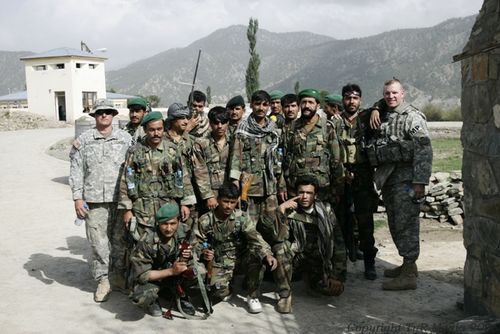
This is what those “embedded trainers” are doing right now in Iraq, so with the Pak border over my right shoulder, here I am “advising” the company commander with my terp on what our next move is, which for him was to get out of his truck and do his damn job instead of hanging out like a spectator.  About an hour before this we had found a rocket launcher that was hidden in the trees and had been firing on FOB Bermel.  It turned out our next move after this little confab (sarcasm doesn’t translate well into Pashto BTW–ed) was to get in a firefight about 5 minutes after this picture was taken with an LP/OP that had been watching us.

advisers2

This is the Weapons Company (yep, that is all of them) in Zerok, where we put a COP in 2006.  It was also where we saw our heaviest fighting in our sector.  In 2009 on July 4th, this attack took place there.


There are quite a few of us who know exactly what the job of “advisor” entails and when the PINO says “Well, there’s a difference between them advising and assisting Iraqis who are fighting versus a situation in which we got our Marines and our soldiers out there taking shots and shooting back.” I promise you, there isn’t a difference from where they are standing, because if they are doing their job, they are standing next to those Iraqis helping to advise them on how to get the job done.

These are the types of words games that we play with our moms and wives and girlfriends in order to convince them that it isn’t what it looks like on the news and despite all that, they lay awake at night wondering and contemplating the “ifs” that no one wants to contemplate.  These aren’t the words of a leader by any measure.

So when the PINO tries to hedge and minimize and play words games about what the US Military Units forward deployed are doing in Iraq, he is only doing so in order to somehow make Code Pink and Media Matters happy with his statements of his non-Bush war stance during his “extended counter-terrorism operation” that may last “years.”

For those of us who have lived it, it is exactly what it is…