Archive for the ‘U.S. in Iraq’ category

In Iraq, Hezbollah’s Got U.S. Tanks, and Washington Wants Them Back

February 21, 2018

David Axe 02.20.18 4:39 AM ET Via The Daily Beast

Source Link: In Iraq, Hezbollah’s Got U.S. Tanks, and Washington Wants Them Back

{Still cleaning up the mess left behind by Barack Barry Sotero Hussein Obama…and dealing with the Iraqi government this former sorry excuse of a POTUS so greatly admired. – LS}

The Pentagon is pressuring Iraq to seize any M-1s that are still in the hands of Iran-backed militias but is vague about how many have been recovered––or not.

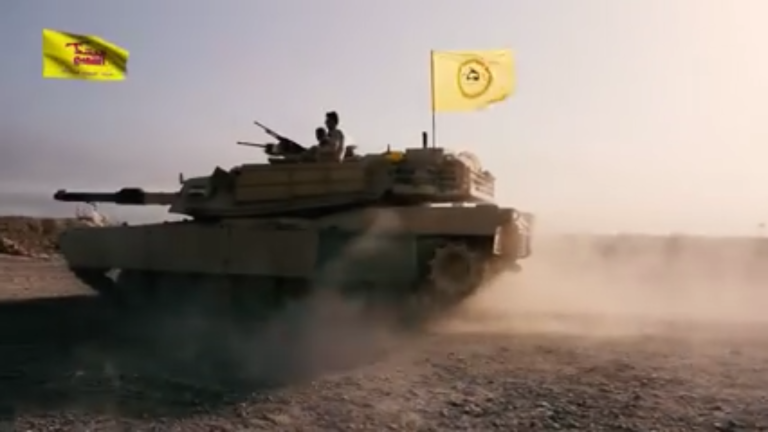
Pro-Iranian militias in Iraq got their hands on at least nine high-tech, U.S.-made M-1 tanks as early as 2015, the U.S. government acknowledged earlier this month. Along with the belated admission, the Pentagon and the U.S. State Department say they are trying to take back the tanks. But to a great extent, the damage is already done. The militias have already deployed them against some of America’s longtime Kurdish allies.

“We are aware that not all U.S.-provided defense articles are under the control of the intended recipient,” a spokesperson for the U.S.-led coalition in Iraq and Syria told The Daily Beast via email. “The U.S. continues to work with the government of Iraq to continue acting as quickly as possible to ensure all defense articles are with their intended recipients.”

The Iraqi army has reclaimed “several” of the tanks, the spokesperson said.

The 70-ton M-1A1 Abrams, the most numerous tank in the arsenals of the U.S. Army and Marine Corps and a mainstay of U.S. allies’ own armies, is one of the most powerful fighting vehicles in the world. The four-person tank boasts a 120-millimeter cannon, thick armor and a gas-turbine engine that can propel the vehicle as fast as 40 miles per hour.

Iraq bought 140 refurbished M-1s from the United States starting in 2008 in order to rebuild armored divisions that American forces had destroyed during the 2003 U.S.-led invasion. The unit cost can vary, but each one is worth approximately $4.3 million.

When the so-called Islamic State swept through northwest Iraq in 2014, Iraqi M-1s were in the thick of the fighting. Militants quickly destroyed five of them, damaged dozens more, and captured several intact M-1s. For a few months at least, ISIS possessed operational M-1s. Then pro-Iran Shia militias—collectively known as “Popular Mobilization Forces” or PMF—recaptured some the tanks, the coalition spokesperson said.

In January 2015, a video appeared online that showed an M-1 flying the flag of the Hezbollah Brigades, a U.S.-designated terror group that’s part of the PMF and fights alongside the Iraqi army. A separate video that appeared in February 2016 showed an M-1 sporting the flag of Kata’ib Sayyid Al Shuhada, another PMF militia.

Recaptured vehicles that the PMF seized from ISIS account for only “some” of the at least nine M-1s that have appeared in the militias’ arsenal, according to the coalition spokesperson. The Iraqi army appears to have supplied the balance of the tanks directly to the PMF, in violation of Iraq’s original contract for the M-1s.

The Shia militias deployed at least one M-1 against Kurdish Peshmerga forces during skirmishes in the contested Iraqi city of Kirkuk in October 2017 when the Kurdish Regional Government was making an ill-fated bid for independence. Although the U.S. did not back that effort, the Kurds remain some of Washington’s closest allies in the region, and Iran its most important adversary.

In this instance the Peshmerga knocked out the tank, reportedly using either a Chinese- or German-made anti-tank missile.The Kurdish Regional Government circulated aerial photos of the burned-out M-1 as proof of the tank’s use by the PMF.

The disabled M-1 quickly disappeared from the battlefield, and a Kurdish commander accused the government of Iraq of moving the tank in order “to hide the truth that they have used Abrams tank against the Peshmerga.”

In any event, the U.S. State Department finally confirmed the PMF’s possession of M-1s in a February report from the inspector general for the Iraq and Syria campaigns. “This quarter, the [Department of State] acknowledged that some U.S.-provided military equipment sent to support the mission, including as many as nine M-1 Abrams tanks, had fallen into the hands of Iranian-backed militias that fought against ISIS in Iraq,” the report stated.

The Pentagon is pressuring Iraq to seize any M-1s that are still in the PMF’s hands. “As recipients of U.S.-origin defense equipment, Iraqi authorities have an obligation to adhere to end-use requirements as outlined in agreements concluded with the United States government.”

Besides withholding future arms shipments, Washington can end support for the scores of M-1s in the Iraqi army’s armored divisions. There have been reports that General Dynamics Land Systems, the Michigan-based company that builds the M-1s and provides spare parts and technicians for the tanks, recently threatened to cut ties with Baghdad over the militia’s use of M-1s. A General Dynamics spokesperson declined to comment on the reports.

Tehran’s New Scheme for Iraq

July 31, 2017

Tehran’s New Scheme for Iraq, Gatestone InstituteAmir Taheri, July 31, 2017

The apparent de-sectarianization of pro-Iran Shiite parties will make it difficult for Allawi and other genuinely non-sectarian Shiite politicians, who are hostile to Iranian influence in Baghdad, to appeal to the Shiite majority on the basis of citizenship and “uruqah“.

The new “de-sectarianization” gambit will also put pressure on Kurdish parties at a time some of them are campaigning for an “independence” referendum. It would be more difficult to sell the idea of an “independent” mini-state of Kurdistan to international public opinion at a time that Iraq is seen to be moving towards a non-religious democratic and pluralist political system.

***************************

In his visit to Moscow last week, Iraqi Vice President Nuri Al-Maliki peddled what he presented as his big idea: inviting Russia to build “a significant presence” in Iraq to counter-balance that of the United States.

Since Maliki is reputed to be Tehran’s candidate as the next Iraqi Prime Minister his “invitation” to Russia cannot be dismissed as a mere personal whim.

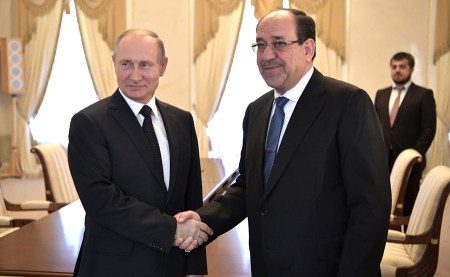
Russian President Vladimir Putin greets Iraqi Vice President Nuri Al-Maliki in Moscow, on July 25, 2017. (Image source: kremlin.ru)

With ISIS driven out of Mosul and, hopefully, soon to be driven other pockets of territory it still controls in Iraq, the decks are being cleared for the forthcoming general election that would decide the shape of the next government in Baghdad. Fancying itself as the “big winner” in Iraq, Iran’s leadership is working on a strategy to make that fancy a reality.

That strategy has three key elements.

The first is to create a new, supposedly “liberal” and “non-sectarian” Shi’ite coalition to dominate the next parliament and, through that, the next government in Baghdad. That requires a reshuffling of political cards and the discarding of some old outfits.

In an editorial last Tuesday, the Islamic Republic of Iran’s official news agency, IRNA, argued that “old formations” that had come into being during the struggle against Saddam Hussein and the subsequent post-liberation crisis were no longer capable of dealing with “new realities in Iraq.”

It was on the basis of that analysis that Ammar al-Hakim, a leading politician-cum-cleric announced his separation from the Supreme Council for the Islamic Revolution in Iraq and the formation of a new party named “National Wisdom Movement” (Tayar al-Hikmah al-Watani).

Hakim, who hails from an old and respected dynasty of clerics originally from Shiraz, argues that time has come to “break barriers of sects and ethnicities” in favor of the concept of “citizenship”. Thus he comes close to advocating the concept of “uruqah” (Iraqi-ness) that has long been a theme of such Iraqi Shiite politicians as Ayyad Allawi and Adel Abdul-Mahdi.

Sources in Tehran expect the “new model” to be adopted by other Shiite parties and groups. Prime Minister Haidar Al-Abadi is reportedly studying the creating of a new “secular” formation away from his original political home in the Ad-Da’awah (“The Call”) Party, which has always been a clearly sectarian formation.

Talks are already under way for the merger of Abadi’s support base with the Sadrist Movement led by Muqtada al-Sadr, scion of another distinguished clerical dynasty originally from Mahallat, southwest of Tehran. According to unconfirmed reports the new Abadi-Sadr coalition will be called “Freedom and Reconstruction”, a clearly non-sectarian identity.

Tehran’s hope is that Maliki will transform his wing of the Ad-Dawah into yet another “non-sectarian” outfit to support his bid for premiership, presumably with support from Hakim.

The apparent de-sectarianization of pro-Iran Shiite parties will make it difficult for Allawi and other genuinely non-sectarian Shiite politicians, who are hostile to Iranian influence in Baghdad, to appeal to the Shiite majority on the basis of citizenship and “uruqah“.

The new “de-sectarianization” gambit will also put pressure on Kurdish parties at a time some of them are campaigning for an “independence” referendum. It would be more difficult to sell the idea of an “independent” mini-state of Kurdistan to international public opinion at a time that Iraq is seen to be moving towards a non-religious democratic and pluralist political system.

The gambit will also make it more difficult for Arab Sunni sectarians to garner support in the name of resisting a Shiite sectarian takeover of government in Baghdad. Salim al-Juburi, a leading Arab Sunni politician and Speaker of the Iraqi Parliament, is reportedly moving towards the creation of a non-sectarian party of his own.

The second element of the Iranian strategy is to almost oblige the clerical authority in Najaf (Marja’iyah) to endorse, even reluctantly, a Shiite political leadership clearly committed to Iran. Tehran knows that no government in Baghdad would have a chance of success without at least tacit blessing from Grand Ayatollah Ai-Muhammad Sistani.

Sistani has consistently refused to play the sectarian card and has advised politicians of all shades to think in terms of national rather than religious considerations. Thus, Tehran’s decision to “de-sectarianize” the Iraqi parties it supports will be a concession to Sistani.

Tehran is offering yet another concession to Sistani by abandoning its campaign to influence the Grand Ayatollah’s succession. The initial Iranian candidate for succession, Ayatollah Mahmoud Shahrudi, a former senior official of the Islamic Republic, has been quietly cast aside and is reported to be in declining health.

Without formally saying so, Iran now admits that the issue of Sistani’s succession must be sorted out by the “howzah” (seminary) in Najaf possibly with some input from Qom and certainly not through diktat from Tehran.

The third element of the strategy is to draw Russia into Iraq as a façade for Iranian influence.

Iranian leaders know that the vast majority of Iraqis resent the emergence of Iran as arbiter of their destiny. Russia, however, is seen as remote enough not to pose a direct threat to the internal balance of power in Iraq. Yet, because Russia has no local support base in Iraq, it would have to rely on Iranian guidance and goodwill to play a leading role there.

A new Baghdad government composed of “non-sectarian” Shiite leaders, promising a better deal for Arab Sunnis and Kurds, and backed by Russia, will be a better cover for the spread and consolidation of Iranian influence in Iraq.

There is, of course, no guarantee that the new Iranian strategy will work. Many Iraqis, including some among those reputedly close to Iran, believe that Iraq itself can and must aspire after becoming a major player in the Middle East rather than playing Sancho Panza to the “Supreme Guide” in Tehran.

Iraqi leaders also see no logic in turning the United States and Arab states into enemies just to suit Tehran’s doomed empire-building project, especially at a time that the Islamic Republic seems to be heading for the choppy waters of Ayatollah Khamenei’s succession.

Remember:

The best laid schemes o’ mice an’ men
Often go awry
And leave us nought but grief and pain,
For promised joy.

Amir Taheri, formerly editor of Iran’s premier newspaper, Kayhan, before the Iranian revolution of 1979, is a prominent author based on Europe. He is the Chairman of Gatestone Europe.

This article first appeared in Asharq Al Awsat and is reprinted here with the kind permission of the author.

