Archive for the ‘U.S. courts’ category

Judges In Seattle and Boston Reach Opposing Opinions On Trump Executive Order

February 4, 2017

Judges In Seattle and Boston Reach Opposing Opinions On Trump Executive Order, Jonathan Turley’s Blog, Jonathan Turley, February 4, 2017

(Professor Turley analyzes the Seattle temporary restraining order against the “Muslim ban” and deems it likely to be reversed in short order. — DM)

massdc


washington-western

The controversy over the Trump immigration executive order has already produced sharply conflicting orders from courts in Washington state and Massachusetts. A judge in Seattle has issued a temporary restraining order nationwide over the executive order while a judge in Boston declined to do so. Such divergent results are not uncommon in such controversies. However, as I have previously explained, I believe that the law favors the Administration despite good-faith arguments advanced by the challengers. Moreover, even if courts strike down a portion of the executive order, it is likely that other portions will be upheld on review. While I have been very critical of the order (and how it was rolled out), I still believe that the weight of binding authority on these trial courts favors President Trump.  We should get an answer sooner than expected: the Administration has decided to ask for an emergency order from the Ninth Circuit to block the Seattle court.  In the meantime, the airlines have been told to start to allow people on planes to the United States and the Justice Department is apparently not filing the emergency motion tonight. That means that people will start to arrive before the Justice Department files.  It could look a bit curious that the Administration is claiming a national security danger in these entries but would wait to file the emergency motion.

District Judge Nathaniel M. Gorton in Massachusetts issued his decision on Friday and found that the president had the authority to issue the executive order.  Gorton wrote “While this Court is sympathetic to the difficult personal circumstances in which these plaintiffs find themselves, if they choose to leave the country, as nonresident aliens, they have no right to re-enter.”

The order from the Western District of Washington did not contain any legal analysis or explanation. Rather U.S. District Court Senior Judge James L. Robart stated that he would release an opinion at a later date. Nevertheless, the order granting a temporary restraining order was a clear victory for challengers. To prevail, a party seeking “must establish that [it] is likely to succeed on the merits, that [it] is likely to suffer irreparable harm in the absence of preliminary relief, that the balance of equities tips in [its] favor, and that [a temporary restraining order] is in the public interest.” Winter v. NRDC, 555 U.S. 7, 20 (2008). On top of that demanding standard, courts tend to be more exacting when an order target the exercise of a core executive function. Adams v. Vance, 570 F.2d 950, 954-55 (D.C. Cir. 1978) (requiring “an extraordinarily strong showing” when an order would “deeply intrude[] into the core concerns of the executive branch.”). Moreover, Judge Robart’s recognition of the right of the state attorney general to bring the case is itself controversial given prior standing rulings.

Ironically, Democratic attorneys general are seeking the ability to sue over precedent established not by President Trump but President Obama. The Obama Administration argued for years that a president had virtually unchecked authority at our borders and specifically that states like Arizona did not have the right to interfere or countermand federal immigration policies. See Arizona v. United States, 132 S. Ct. 2492, 2502 (2012). The case law heavily disfavors a state from bringing a parens patriaeaction on behalf of citizens, let alone non-citizens. Moreover, the complaint by the Washington Attorney General advanced highly speculative claims of injury given (1) the exemption of green card holders, (2) the temporary character of the order; and (3) the loose claims of reduction in tourism and student visas. The complaint states that the order affords the state standing due to its

“separating Washington families, harming thousands of Washington residents, damaging Washington’s economy, hurting Washington-based companies, and undermining Washington’s sovereign interest in remaining a welcoming place for immigrants and refugees.”

Putting aside injury, there remains the question of the likelihood of prevailing given the statutory and case authority favoring executive power in this area. As previously discussed, Section 1182 (f) expressly allows a president to exclude individual aliens or groups of aliens when the Administration determines that entry of such aliens or class of aliens would be “detrimental to the interests of the United States.” The Ninth Circuit (which covers Seattle and issues cases that are binding on Judge Robart) has held that “that statute specifically grants the President, where it is in the national interest to do so, the extreme power to prevent the entry of any alien or groups of aliens into this country as well as the lesser power to grant entry to such person or persons with any restriction on their entry as he may deem to be appropriate.” Mow Sun Wong v. Campbell, 626 F.2d 739, 744 n.9 (9th Cir. 1980).

Challengers rely on 8 U.S.C. §1152 (a) (1) (A), which states that “no person shall receive any preference or priority or be discriminated against in the issuance of of an immigrant visa because of the person’s race, sex, nationality, place of birth, or place of residence.” I have previously raised concerns about the sweeping claims made under this amendment which was part of an effort to end the use of numerical quotas that favored certain parts of Europe. On its face, the provision would not impact much of the executive order since it deals only with the issuance of visas and does not on its face apply to refugees or nonimmigrant visas. Moreover, the law was later amended to exclude changes in “procedures” even for those seeking immigrant visas. Section 1152(a)(1)(B) states that the law shall not be “construed to limit the authority of the Secretary of State to determine the procedures for the processing of immigrant visa applications or the locations where such applications will be processed.” That sounds a lot like an order temporarily suspending entries “to determine what additional procedures should be taken to ensure that those approved for refugee admission do not pose a threat to the security and welfare of the United States” and then “implement such additional procedures.” Executive Order § 5 (a).

If Section 1152 and 1182 present a possible conflict, a court is supposed to adopt that interpretation that avoid the conflict. California ex rel. Sacramento Metro. Air Quality Mgmt. Dist. v. United States, 215 F.3d 1005, 1012 (9th Cir. 2000). Moreover, the degree to which this provision limits the executive power can itself produce a constitutional challenge . . . from the executive branch. I previously discussed cases like United States v. Curtiss-Wright Exp. Corp., 299 U.S. 304 (1936) and the Court recognition of plenary authority of the executive over foreign relations and our borders. The Court has specifically held that “The exclusion of aliens is a fundamental act of sovereignty . . . inherent in the executive power to control the foreign affairs of the nation. Knauff v. Shaughnessy, 338 U.S. 537, 542 (1950).

Part of the difficulty of the challenger’s reading of future law is that it would prove too much. Specifically, it would mean that past actions by both presidents and Congress would be unlawful. It would suggest that, when a president finds that there is a danger related to entries from a particularly country, the president cannot suspend entries from that country. Yet, that is precisely what has happened in the past. In 1986, President Reagan suspended entry of Cuban nationals as immigrants into the United States, subject to certain exceptions. See Suspension of Cuban Immigration, 1986 WL 796773 (Aug. 22, 1986). In 1996, President Clinton suspended entry of members of the Government of Sudan, officials of that Government, and members of the Sudanese armed forces as immigrants or nonimmigrants into the United States. See Suspension of Entry as Immigrants and Nonimmigrants of Persons Who Are Members or Officials of the Sudanese Government or Armed Forces, 1996 WL 33673860 (Nov. 22, 1996). The Justice Department noted in its brief before Judge Robart that both Congress and President Obama made such nationality based determinations to exclude groups of aliens:

“Congress likewise has expressly drawn distinctions based on nationality. For example, in 2015, Congress amended the INA to exclude certain individuals from a visa waiver program (i.e., the ability to enter the United States as a nonimmigrant without a visa) on the basis of nationality. See Consolidated Appropriations Act, 2016, Pub. L. No. 114-113, 129 Stat. 2242, 2990 (2015) (codified at 8 U.S.C. § 1187(a)(12)). Congress expressly excluded nationals of Iraq and Syria from the program, see 8 U.S.C. § 1187(a)(12)(A)(ii), and created a process by which the Secretary of Homeland Security could designate additional “Countries or areas of concern,” for exclusion of a country’s nationals. See id. § 1187(a)(12)(D). As of February 2016, the exclusion applied to nationals of Iraq and Syria (pursuant to the statute’s plain text), as well as nationals of Iran, Sudan, Libya, Somalia, and Yemen (pursuant to Executive Branch designations under the statutory scheme). See Dep’t of Homeland Sec., DHS Announces Further Travel Restrictions for the Visa Waiver Program (Feb. 18, 2016). These seven countries excluded from the visa waiver program are the same seven countries that are covered by Section 3 of the President’s January 27, 2017 Executive Order. See Executive Order § 3(c) (incorporating by reference “countries referred to in section 217 (a) (12) of the INA, 8 U.S.C. 1187 (a) (12).”

None of this means that the challenges to the Executive Order are frivolous or that parts of the Executive Order could not be struck down. However, the weight of existing case law favors the Administration in my view. Courts are bound to avoid conflicts were possible in the interpretation of two laws and further interpret laws to avoid conflicts with constitutional powers. Moreover, they have a long-standing commitment to minimize the extent to which they find parts of a law unconstitutional. The result is that the odds still rest with the Administration in preserving all or part of the law, particularly after exercising its discretion to exempt green card holders.
DHS “will continue to enforce all of President Trump’s Executive Orders” on immigration

January 29, 2017

DHS “will continue to enforce all of President Trump’s Executive Orders” on immigration, Jihad Watch

The Department of Homeland Security will comply with judicial orders; faithfully enforce our immigration laws, and implement President Trump’s Executive Orders to ensure that those entering the United States do not pose a threat to our country or the American people.

**********************************

“President Trump’s Executive Order affects a minor portion of international travelers, and is a first step towards reestablishing control over America’s borders and national security.”

Steps to ensure border control and national security shouldn’t be controversial. That the Left is behaving as if they’re the second coming of the Nazi gas chambers shows how hysterical and silly Leftists have become, while their increasingly violent demonstrations show how eager they are to unleash rioting and bloodshed in the streets. I’ve long noted how thuggish the Left was becoming, and that tendency has sharply accelerated since January 20.

trump2-1

“Department Of Homeland Security Response To Recent Litigation,” DHS.gov, January 29, 2017:

WASHINGTON – The Department of Homeland Security will continue to enforce all of President Trump’s Executive Orders in a manner that ensures the safety and security of the American people. President Trump’s Executive Orders remain in place—prohibited travel will remain prohibited, and the U.S. government retains its right to revoke visas at any time if required for national security or public safety. President Trump’s Executive Order affects a minor portion of international travelers, and is a first step towards reestablishing control over America’s borders and national security.

Approximately 80 million international travelers enter the United States every year. Yesterday, less than one percent of the more than 325,000 international air travelers who arrive every day were inconvenienced while enhanced security measures were implemented. These individuals went through enhanced security screenings and are being processed for entry to the United States, consistent with our immigration laws and judicial orders.

The Department of Homeland Security will faithfully execute the immigration laws, and we will treat all of those we encounter humanely and with professionalism. No foreign national in a foreign land, without ties to the United States, has any unfettered right to demand entry into the United States or to demand immigration benefits in the United States.

The Department of Homeland Security will comply with judicial orders; faithfully enforce our immigration laws, and implement President Trump’s Executive Orders to ensure that those entering the United States do not pose a threat to our country or the American people.

Federal court affirms limits on Inauguration Day protests

January 18, 2017

Federal court affirms limits on Inauguration Day protests, Washington TimesAndrea Noble, January 17, 2017

inauguration_trump_house_democrats_05042_c0-238-5676-3547_s885x516In this Jan. 15, 2016, photo, the U.S. Capitol frames the backdrop over the stage during a rehearsal of President-elect Donald Trump’s swearing-in ceremony in Washington. Some two dozen House Democrats plan to boycott Trump’s inauguration on Friday

A federal appeals court on Tuesday shot down protesters’ challenge of regulations that allow Donald Trump’s Presidential Inauguration Committee first dibs on the location of bleachers along the Friday’s inaugural parade route.

As a result of the ruling by the U.S. Court of Appeals for the D.C. Circuit, the inauguration committee can keep set-aside bleacher seats in place at both Freedom Plaza and in front of the Trump International Hotel – locations protesters had sought to demonstrate in during Friday’s parade.

The decision is a blow to anti-war group Answer Coalition, which has challenged the National Park Services’ allocation of prime space along Pennsylvania Avenue to presidential inaugural committee’s since 2005. The group has argued that the reservation of swaths of Pennsylvania Avenue for the Presidential Inaugural Committee favors the incoming administration over the public and marginalizes and unfairly excludes dissent by preventing public access to what would otherwise be prime demonstration space.

But the court disagreed, finding that the regulations exclude the Answer Coalition “not because it seeks demonstrate, nor due to the content of the message ANSWER wishes to communicate, but to ensure some premium space for ‘ticketed bleachers viewing and access areas’ as part of the event package reserved for the Inaugural Committee.”

“The Park Service’s provision for the Inaugural Committee to construct its bleachers, even as 70 percent of the Inaugural route remains available for demonstration permits, is no more content based than the unchallenged provisions reserving areas for portable toilets, media stands, or viewing areas for individuals with disabilities,” wrote Judge Cornelia T. Pillard, in the 30-page ruling for the thee-judge panel.

Judges Patricia Millett and Sri Srinivasan joined Judge Pillard in the opinion.

Victory: Texas judge dismisses Clock Boy’s defamation lawsuit against critics of his “hate crime” hoax

January 10, 2017

Victory: Texas judge dismisses Clock Boy’s defamation lawsuit against critics of his “hate crime” hoax, Jihad Watch

“During the lengthy hearing, Judge Moore pressed Mohamed’s lawyer, Fort Worth attorney Susan Hutchison, to provide any facts that would suggest that Hanson and the other defendants had said anything false or defamatory about Mohamed or his son during the television broadcasts. After spending a painfully embarrassing 15 minutes flipping through reams of paper, Mohamed’s lawyer was unable to provide any such evidence.”

Islamic supremacists traffic in intimidation in attempting to silence their foes and all critics of jihad terror. Far from being “defamed,” Ahmed Mohamed was showered with adulation from “Facebook founder Mark Zuckerberg, Democratic presidential candidate Hillary Rodham Clinton and Google co-founder Sergey Brin,” while “Tweets, think pieces and daytime TV segments were dedicated to dissecting how Ahmed’s situation typified racism and Islamaphobia [sic] in America,” and he “visited the Google Science Fair, met with Sudan’s President Omar al Bashir, posed with the queen of Jordan at a United Nations Summit, appeared on the ‘Doctor Oz’ show and last night, made it to the White House.”

Ahmed Mohamed became the darling of the political and media elites and met Obama. He was celebrated everywhere as an innocent victim of “Islamophobia.” He became an international hero. This defamation lawsuit was a naked attempt to continue the intimidation efforts that his clock represented. His clock, which looked like a suitcase bomb, was a strike against the dictum “If you see something, say something”: after Ahmed’s clock, school officials and others will think twice before committing career suicide by questioning suspicious behavior by Muslims. After that, Ahmed and his family moved in for the kill, trying to intimidate people into not even daring to criticize Muslims who engage in these intimidation tactics, for fear of being slapped with a lawsuit.

clockboyandpop

“Victory!,” American Freedom Law Center, January 10, 2017:

Following a nearly three-hour hearing held yesterday in Dallas, Texas, newly appointed District Court Judge Maricela Moore dismissed a defamation lawsuit filed by Mohamed Mohamed on his own behalf and on behalf of his 15-year old son, Ahmed Mohamed.

Ahmed is better known as “Clock Boy” for bringing a hoax clock bomb to his Irvine, Texas middle school in September 2015 and causing a bomb scare that led to his arrest and suspension from school.

The American Freedom Law Center (AFLC) filed the motion to dismiss, along with local counsel Pete Rowe, on behalf of the Center for Security Policy (“CSP”) and Jim Hanson, two of the defendants in the defamation case, which also named as defendants the local Fox affiliate, Glenn Beck, and Beck’s production company.

Mohamed had sued Hanson and CSP for statements Hanson had made on Beck’s program about the connection between the Clock Boy hoax bomb affair, the attendant media frenzy created in large part by his father Mohamed, civilization jihad, and the Counsel on American-Islamic Relations (“CAIR”), the Muslim Brotherhood-Hamas front group in the United States that promotes civilization jihad.

During the hearing, AFLC co-founder and senior counsel David Yerushalmi explained to Judge Moore that the purpose of the lawfare-driven lawsuit was to intimidate into silence those who might comment publicly on the connection between jihad, terrorism, sharia, and Islam.  As such, Yerushalmi argued,

“This case is a classic Strategic Lawsuit Against Public Participation or ‘SLAPP’ case and should be dismissed.”

During the lengthy hearing, Judge Moore pressed Mohamed’s lawyer, Fort Worth attorney Susan Hutchison, to provide any facts that would suggest that Hanson and the other defendants had said anything false or defamatory about Mohamed or his son during the television broadcasts.

After spending a painfully embarrassing 15 minutes flipping through reams of paper, Mohamed’s lawyer was unable to provide any such evidence.

At the conclusion of the hearing, Judge Moore took the matter under advisement but informed the parties that she would rule by the end of the day.  Today, the Court published Judge Moore’s ruling dismissing the lawsuit against Hanson and CSP with prejudice.

Upon leaving the courtroom, Yerushalmi explained:

“This lawsuit filed by Clock Boy’s father is yet another example of Islamist lawfare, which is a component of the Muslim Brotherhood’s civilization jihad.”

Yerushalmi further explained that the purpose of such lawsuits, formally labelled Strategic Lawsuits Against Public Participation (“SLAPP”), is to intimidate into silence those who might comment publicly on the connection between jihad, terrorism, sharia, and Islam.

Yerushalmi added:

“The Islamists employ the progressive mainstream media to label any public criticism of a sharia-centric, jihad-driven Islam as ‘Islamophobic,’ and they add fear and financial ruin to the equation by utilizing the legal system to file SLAPP actions,”

Now that the lawsuit has been dismissed, AFLC will petition the court for its legal fees and will seek sanctions against both the plaintiff and his attorney.

Robert Muise, AFLC’s other co-founder and senior counsel, made clear:

“AFLC was formed in large measure to take on Islamists like CAIR who use and abuse the legal system with their cynical form of lawfare to undermine our constitutional liberties—notably free speech.  We have confronted these lawsuits across the country in federal and state courts and have defeated CAIR and its minions at every turn.  When appropriate, we have won sanctions.  This lawsuit will be no different.”

The Saga of Hillary’s Emails Continues

December 28, 2016

The Saga of Hillary’s Emails Continues, Front Page Magazine (The Point), Daniel Greenfield, December 28, 2016

notme

Hillary is increasingly disposable. It’s now a matter of whom else she may take down with her.

************************

It’s not over until the pantsuit sings.

In a new legal development on the controversy over former Secretary of State Hillary Clinton’s emails, an appeals court on Tuesday reversed a lower court ruling and said two U.S. government agencies should have done more to recover the emails.

The ruling from Judge Stephen Williams, of the U.S. Court of Appeals for the District of Columbia Circuit, revives one of a number of legal challenges involving Clinton’s handling of government emails when she was secretary of state from 2009 to 2013.

While the State Department and National Archives took steps to recover the emails from Clinton’s tenure, they did not ask the U.S. attorney general to take enforcement action. Two conservative groups filed lawsuits to force their hand.

A district judge in January ruled the suits brought by Judicial Watch and Cause of Action moot, saying State and the National Archives made a “sustained effort” to recover and preserve Clinton’s records.

But Williams said the two agencies should have done more, according to the ruling in the U.S. Court of Appeals for the District of Columbia Circuit. Since the agencies neither asked the attorney general for help nor showed such enforcement action could not uncover new emails, the case was not moot.

Obviously the case.

The government’s people repeatedly obstructed investigations and the investigations of their obstructionism will likely drag on long after Obama is out of office as one of the dirty polluted remnants of his tainted legacy. The IRS, the emails and Benghazi, along with so much else represent a prolonged battle between activist investigators and radical government figures embedded in the system.

The difference is that Hillary is increasingly disposable. It’s now a matter of whom else she may take down with her.

Trump can eviscerate Obama’s policies by dropping lawsuits, revoking memos

November 11, 2016

Trump can eviscerate Obama’s policies by dropping lawsuits, revoking memos, Washington Times, Stephen Dinan, November 11, 2016

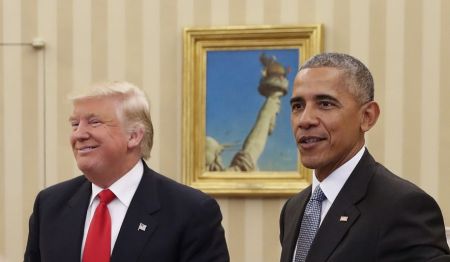
trumpandbammyPresident Barack Obama meets with President-elect Donald Trump in the Oval Office of the White House in Washington, Thursday, Nov. 10, 2016. (AP Photo/Pablo Martinez Monsivais)

Forget about waiting for Congress — Donald Trump can eviscerate Obamacare and cripple President Obama’s global warming framework all on his first few days in office by directing policy from the White House and ordering his Justice Department to drop lawsuits that the current administration is pursuing.

Lawyers said getting rid of the government’s mandate that schools allow transgender students to choose their bathrooms could be as simple as retracting an Education Department letter, then letting judges know that is no longer the administration’s position.

Mr. Obama’s 2014 deportation amnesty, which is also the subject of court challenges, could be nixed by revoking the Homeland Security memo that laid out the policy, then telling judges it’s gone. No memo, no case.

It was always the danger lurking in Mr. Obama’s penchant for going it alone and declining to work with Congress — a new president who disagrees with him can quickly reverse many of his big-ticket accomplishments.

“What Obama’s pen and phone giveth, Trump’s Sharpie and Twitter will taketh away,” said Josh Blackman, an associate professor at the South Texas College of Law.

While repealing Obamacare outright would take congressional action, several controversial provisions could quickly be halted. The administration’s ongoing fight with Catholic nuns and other religious charities, demanding that they play a role in opting out of paying for contraceptives, could end.

It was always the danger lurking in Mr. Obama’s penchant for going it alone and declining to work with Congress — a new president who disagrees with him can quickly reverse many of his big-ticket accomplishments.

“What Obama’s pen and phone giveth, Trump’s Sharpie and Twitter will taketh away,” said Josh Blackman, an associate professor at the South Texas College of Law.

While repealing Obamacare outright would take congressional action, several controversial provisions could quickly be halted. The administration’s ongoing fight with Catholic nuns and other religious charities, demanding that they play a role in opting out of paying for contraceptives, could end.

Even bigger damage could be done to the House of Representatives’ lawsuit arguing that the administration broke the law by paying out Obamacare money that Congress specifically refused to spend.

A district court ruled this year that the administration violated the Constitution by doling out the money despite Congress’ wishes. The Obama administration has appealed, and the lower court judge’s ruling is on hold, but a Trump administration could drop that appeal.

“In this case, the withdrawal of the appeal would effectively accomplish what the Trump administration would likely support,” said Jonathan Turley, a professor at George Washington Law School who is serving as the House’s attorney in the case.

On the environment, rules from the Environmental Protection Agency and the Army Corps of Engineers governing power plants’ carbon emissions and water runoff could also get the heave-ho from a Trump Justice Department that decides they aren’t worth defending.

Senate Majority Leader Mitch McConnell, Kentucky Republican, said he hoped that would happen quickly. “Day One would be a good idea,” he told reporters.

There is precedent for making those kinds of decisions. Mr. Turley pointed to the Obama administration’s refusal to defend in courts the Defense of Marriage Act, which was enacted by Congress and signed by President Clinton.

“Changes in policy or presidents can result in substantial changes in the posture of litigation,” Mr. Turley said. “That’s a perfectly natural process, particularly when you have such a radical change in administrations. There’s no reason why one administration should pursue a policy initiative in court that they now oppose.”

Mr. Turley said Mr. Trump could even ask the Obama administration to request that judges halt the cases for now, to give the next administration a chance to have its say.

“Much of President Obama’s legacy stands on clay feet. The vast majority of his cited accomplishments were unilateral actions taken by executive authority,” he said. “What a president giveth, a president can take away.”

One of the areas where Mr. Obama stretched his authority the most was in immigration. He used prosecutorial discretion and a guidance memo from the Homeland Security Department to create a deportation amnesty for as many as 5 million illegal immigrants. Federal courts put a halt to the 2014 amnesty, but illegal immigrants have sued, saying the judges got it wrong.

Mr. Blackman, who has closely followed that case, said Mr. Trump could end all doubt by having his Homeland Security Department revoke the 2014 memo and let the judges know the case is moot.

Immigrant rights advocates have vowed to fight a Trump administration on immigration and are circling the wagons to defend a 2012 amnesty for illegal immigrant Dreamers.

“We will fight tirelessly alongside our partner organizations to protect DACA and ensure that immigrant youths are safe from deportation and that families aren’t separated,” said Cesar J. Blanco, head of the Latino Victory Fund.

Minority advocacy groups are also likely to howl over the direction a Trump administration could take on voting rights cases.

The current Justice Department has sided with challengers who say voter ID laws are too strict and has even refused to defend the federal Election Assistance Commission, which ruled this year that states can require people to prove citizenship as they register to vote.

That refusal to step in drew a stern rebuke from U.S. District Judge Richard J. Leon. “This is the first time in 14 years I’ve seen this,” he said.

Kris W. Kobach, the secretary of state in Kansas who was left to defend his state law and the EAC, said a Trump administration could change that.

“The Department of Justice can, and should, immediately start defending the federal agency, and that means defending the correct interpretation of the [motor-voter law] so that states may be permitted to ask for proof of citizenship,” he said.

Mr. Kobach said a Trump administration could also put an end to sue-and-settle practices. That is when agencies essentially collude with interest groups, inviting them to sue to force action. The agency then agrees to a settlement that ends up writing rules that the interest groups want.

The U.S. Chamber of Commerce says dozens of EPA regulations, including the power plant greenhouse gas emissions rules, were written this way, outside of the usual public process.

Hans von Spakovsky, senior legal fellow at The Heritage Foundation and a Justice Department lawyer under President George W. Bush, said one challenge will be surmounting inertia on the part of the lawyers who now work there.

“The Trump administration is going to have to clean out the Justice Department from top to bottom because of the complete politicalization by [Attorney Generals Eric H.] Holder and [Loretta E.] Lynch that destroyed the professionalism and ethics of the department — it will be a monumental task as difficult as Hercules having to clean out the Augean stables,” he said.

Obama Gave Iran Money that Belonged to Iran’s Terror Victims

November 3, 2016

Obama Gave Iran Money that Belonged to Iran’s Terror Victims, Counter Jihad, November 2, 2016

iranmoney

Once again, it seems as if neither the law nor the American interest are of great concern to this administration.  When Iran is involved, at least, both the law and our national interests are always set aside.

****************

Here at CounterJihad, we have covered the transfer by the Obama administration of $1.7 billion in giant pallets of cash to the terrorist elements within Iran’s government.  None of the administration’s stories justifying this transfer of wealth to the main state sponsor of terrorism have made sense.  It was not necessary to transfer the money in cash, for example.  The transfer really was a hostage ransom payment, in spite of their denials, to take a second example.

Today, we learned that another aspect of their justification was flawed.  The Obama administration has claimed that the money transferred to Iran belonged to Iran anyway, as a kind of refund for weapons sales that did not happen.  This was always a highly questionable claim, as the government that paid us the money was not the same government that now rules over Iran.  It is unclear why the Iranian revolutionary government would be entitled to moneys advanced by the Shah of Iran.  This makes no more sense than if a homeowner had overpaid property taxes, and the government responded by sending the overpaid money not to him but to the squatters who had forcibly occupied his home over his protest.  Of course, the Shah was no longer in a position to receive a refund, so it wasn’t clear that the money should go to anyone.

What we have learned most recently, however, is that the money did have a proper owner:  victims of Iran’s support of terror.

Alisa Flatow, a twenty-year-old Brandeis University honors student spending her junior year abroad in Israel, boarded a bus in Jerusalem bound for a popular resort area in Gaza. It was the height of the “peace process,” celebrated the year before with Nobel Peace prizes. As the bus entered Gaza, a van filled with explosives slammed into it. Eight people, including Alisa, were killed, and more than 40 others were injured. The attack was carried out by a faction of Islamic Jihad controlled, financed, and directed by the highest levels of Iran’s government….  A federal district court issued a 35-page opinion, Flatow v. Islamic Republic of Iran (1998), awarding a total of $20 million in compensatory damages as well as punitive damages, with both types of damages specifically authorized by the U.S. Congress….

In all, sixteen cases were decided against Iran by courts in the United States between 1998 and 2004, with awards of compensatory damages totaling some $400 million and punitive damages totaling $3.5 billion.

Of course, the problem faced by each victorious plaintiff was collecting the judgment. Stephen Flatow, after unsuccessfully seeking to have the damages paid out of various Iranian assets held in the United States, learned of the $400 million in the FMS fund. The Clinton administration had supported the legislation that allowed suits such as Flatow’s, but then strenuously opposed any effort to have the judgments satisfied from that fund.

In other words, the money was spoken for before the Obama administration elected to transfer it to the IRGC.  It belonged, by the authorization of Congress and the decision of Federal courts, to victims of terrorism sponsored by the Iranian government.  Iran owes them all that money, and a great deal more.

The Obama administration has not rethought its position on sending Iran more and more money, whatever the law may say.  The State Department been busy recently trying to drum up investment for Iran instead.  Secretary of State John F. Kerry has been telling unlikely stories about the sanctions still in place on Iran in order to try to convince bankers to send Iran even more cash.  On this question, it should be noted by anyone thinking of investing, the State Department and the Treasury are very much at odds.

Once again, it seems as if neither the law nor the American interest are of great concern to this administration.  When Iran is involved, at least, both the law and our national interests are always set aside.

Don’t Be Fooled: Hillarygate Probe Is Now a Formal Federal Criminal Investigation

November 1, 2016

Don’t Be Fooled: Hillarygate Probe Is Now a Formal Federal Criminal Investigation, American Thinker, James G. Wiles, November 1, 2016

The NY Times and the Wall Street Journal both reported on Monday morning that an FBI warrant application to a federal judge over the weekend for permission to search Huma Abedin’s emails and laptop had been granted. The application was made on the basis of the Clinton email investigation. Necessarily, that application (as required by the Constitution’s Fourth Amendment) would have been supported by FBI affidavits.

This new fact is a development of immense potential significance – both for Mrs. Clinton personally and for us as American citizens. It is also unprecedented in American history.

At a minimum, it enables us to pierce the thick cloud of black ink and disinformation released over the weekend by Team Hillary and which is being widely misreported in the current news cycle.

The FBI agents had to make this warrant application because their existing Fourth Amendment search authority was on the basis of Anthony Weiner’s (unrelated) suspected misconduct with an underage girl. That investigation was already a grand jury matter. However, that grand jury’s authority – which is supervised by a federal judge — did not authorize the Bureau to pursue information which might be pertinent to the inquiry into Mrs. Clinton’s use of a personal email server while she was Secretary of State. Making that application, under standard DOJ protocol, required approval from Main Justice. In this case, the assistant attorney in charge of the Criminal Division, if not the attorney general.

Since the application was made, it’s safe to conclude that the Criminal Division at Main Justice authorized the warrant application. Thus, at a minimum, the senior leadership of the Justice Department is not as unanimously condemnatory of FBI director Comey’s letter to Congress on Friday as media reports would lead us to believe.

It also explains why Director Comey issued his letter to Congress. The reporting tells us that the FBI’s decision to make a warrant application to the supervising judge of the Weiner grand jury triggered Mr. Comey’s decision to notify Congress. Having promised Congressional leaders (perhaps unwisely, since he was not required to do so) that, if the Bureau uncovered new evidence relating to Hillarygate which required further inquiry, he would so notify them, he proceeded on Friday to keep his word and do so.

Now he’s being condemned by the Democrats and the MSM for not saying why. We’ll get to the reason why he’s not in a minute. But, first, the granting of the warrant application means several important and new things:

1) A federal judge supervising a grand jury has now made a finding, based on FBI affidavits which present evidence gathered during the preliminary Hillary inquiry (the one which the FBI director stated had been closed back in July), that there’s probable cause to believe that a federal crime was committed in connection with Mrs. Clinton’s use of a private email server.

We still, however, don’t know what crime(s) are suspected to have been committed. Or by whom.

2) The FBI can use this new grant of grand jury authority to investigate Mrs. Clinton’s use of a private email server for the first time to issues subpoenaes to obtain testimony from witnesses and compel the production of documents and things. The Bureau and DOJ can, furthermore, use the judge’s probable cause finding to support further warrant applications.

This means that, if DOJ authorizes it, a United States attorney now has the ability for the first time to put subpoenaed witnesses before a grand jury. There, without their lawyer in the room, they may be questioned under oath by a federal prosecutor. If the witnesses take the Fifth – and the witness’s lawyer is allowed to sit outside the grand jury room and be consulted by the witness before answering a question, they can be immunized and, if they still refuse to testify, a judge can jail them indefinitely until they change their mind.

Huma Abedin, according to prior reporting, received a grant of immunity during the FBI’s preliminary investigation. During the first Clinton presidency, Clinton allies chose jail over cooperating with the federal grand jury investigating both Clintons.

We may get to see if a new generation of Clinton allies are willing to do the same.

3) The liberal media’s reporting that the Hillarygate email server investigation has not, in fact, been “reopened” is totally false.

Why?

Because, not only is the probe reopened, it has been upgraded and expanded. It has been upgraded from a preliminary inquiry to a formal criminal investigation with grand jury power. That also means that, at least at the level of the federal grand jury itself, assistant U.S. attorneys assigned to that grand jury are now for the first time formally involved.

In other words: the Beast is now fully awake.

4) This weekend’s development potentially escalates the threat to Mrs. Clinton. While several other procedural steps and processes are necessary, it is a federal grand jury, not the FBI,  which issues indictments. The FBI — using the the grand jury to obtain testimony, conduct searches and compel the production of documents and things – investigates crimes. The U.S. Attorneys, acting though the grand jury, charge and prosecute those persons whom the grand jury finds probable cause to believe have committed those crimes.

5) This weekend’s development also means that, for the first time in American history, a candidate for President of the United States is likely now a subject/target of a federal grand jury investigation.

These facts now enable us to analyze and dispel Team Clinton’s attempts to lay down a thick fog of misdirection over the scene.

Here it is: Mrs. Clinton’s demand that the FBI be “transparent” is pure posturing — spinning to the max (which Mrs. Clinton, as the most criminally investigated presidential candidate in U.S. history, well knows). Younger readers, please take note: this is not, to put it mildly, Hillary Clinton’s first rodeo.

Not for the first time, Mrs. Clinton is being totally disingenuous with the voters (and the media). She is also making FBI director Comey into her personal punching bag. And she’s doing it because she knows that the director can’t fight back.

In this, Mrs. Clinton is simply repeating a tactic which she and her catspaw Sidney Blumenthal used to good effect during the Whitewater, Travelgate, and Monica Lewinsky investigations in the 1990s. And that tactic worked.

It’s called grand jury secrecy. Now that Hillarygate is, for the first time, a grand jury investigation, Federal Rule of Criminal Procedure 6(e) prohibits the FBI and prosecutors from saying anything about “matters occurring before the grand jury.” Their lips are sealed.

Team Hillary’s lips, however, are not. They are neither federal prosecutors nor “agents of the grand jury.” So, Mrs. Clinton and her spokesmen — unlike the federal law enforcement officials they’ve been targeting all weekend — are free to tell us everything they know.

Let’s see if they do. A reporter should ask them.

And, in the meantime, let’s not bother to hold our breaths.

If Hillary really wants “transparency,” let her release the FBI’s warrant application for permission to search Huma Abedin and Mr. Weiner’s emails for evidence relating to whether Hillary’s use of a private server violated federal law. Huma’s lawyers likely have it. If not, they can certainly get it.

Huma, of course, is also free to release the emails too.

That’s why Hillary’s demand for “transparency” by the FBI is moonshine. She damn well knows the feds can’t do it.

She also now knows that the threat level against her has just been upgraded to ORANGE.

William Safire and Christopher Hitchens, thou shouldst be living at this hour!

Obama DOJ drops charges against alleged provider of Libyan weapons

October 5, 2016

Obama DOJ drops charges against alleged provider of Libyan weapons, Politico and , October 4, 2016

A Turi associate asserted that the government dropped the case because the proceedings could have embarrassed Clinton and President Barack Obama by calling attention to the reported role of their administration in supplying weapons that fell into the hands of Islamic extremist militants.

***************************

The Obama administration is moving to dismiss charges against an arms dealer it had accused of selling weapons that were destined for Libyan rebels.

Lawyers for the Justice Department on Monday filed a motion in federal court in Phoenix to drop the case against the arms dealer, an American named Marc Turi, whose lawyers also signed the motion.

The deal averts a trial that threatened to cast additional scrutiny on Hillary Clinton’s private emails as Secretary of State, and to expose reported Central Intelligence Agency attempts to arm rebels fighting Libyan leader Moammar Qadhafi.

Government lawyers were facing a Wednesday deadline to produce documents to Turi’s legal team, and the trial was officially set to begin on Election Day, although it likely would have been delayed by protracted disputes about classified information in the case.

A Turi associate asserted that the government dropped the case because the proceedings could have embarrassed Clinton and President Barack Obama by calling attention to the reported role of their administration in supplying weapons that fell into the hands of Islamic extremist militants.

“They don’t want this stuff to come out because it will look really bad for Obama and Clinton just before the election,” said the associate.

In the dismissal motion, prosecutors say “discovery rulings” from U.S. District Court Judge David Campbell contributed to the decision to drop the case. The joint motion asks the judge to accept a confidential agreement to resolve the case through a civil settlement between the State Department and the arms broker.

“Our position from the outset has been that this case never should have been brought and we’re glad it’s over,” said Jean-Jacques Cabou, a Perkins Coie partner serving as court-appointed defense counsel in the case. “Mr Turi didn’t break the law….We’re very glad the charges are being dismissed.”

Under the deal, Turi admits no guilt in the transactions he participated in, but he agreed to refrain from U.S.-regulated arms dealing for four years. A $200,000 civil penalty will be waived if Turi abides by the agreement.

A State Department official confirmed the outlines of the agreement.

“Mr. Turi cooperated with the Department’s Directorate of Defense Trade Controls in its review and proposed administrative settlement of the alleged violations,” said the official, who asked not be named. “Based on a compliance review, DDTC alleged that Mr. Turi…engaged in brokering activities for the proposed transfer of defense articles to Libya, a proscribed destination under [arms trade regulations,] despite the Department’s denial of…requests for the required prior approval of such activities.”

Turi adviser Robert Stryk of the government relations and consulting firm SPG accused the government of trying to scapegoat Turi to cover up Clinton’s mishandling of Libya.

“The U.S. government spent millions of dollars, went all over the world to bankrupt him, and destroyed his life — all to protect Hillary Clinton’s crimes,” he said, alluding to the deadly Sept. 11, 2012 terrorist attack on the U.S. Consulate in Benghazi, Libya.

Republicans hold Clinton responsible for mishandling the circumstances around that attack. And Stryk said that Turi was now weighing book and movie deals to tell his story, and to weigh in on the Benghazi attack.

Representatives of the Justice Department, the White House and Clinton’s presidential campaign either declined to comment or did not respond to requests for comment on the case or the settlement.

Turi was indicted in 2014 on four felony counts: two of arms dealing in violation of the Arms Export Control Act and two of lying to the State Department in official applications. The charges accused Turi of claiming that the weapons involved were destined for Qatar and the United Arab Emirates, when the arms were actually intended to reach Libya.

Turi’s lawyers argued that the shipments were part of a U.S. government-authorized effort to arm Libyan rebels.

It’s unclear if any of the weapons made it to Libya, and there’s no evidence linking weapons provided by the U.S. government to the Benghazi attacks.

“The proposal did not result in an actual transfer of defense articles to Libya,” the State Department official told POLITICO on Tuesday.

But questions about U.S. efforts to arm Libyan rebels have been mounting, since weapons have reportedly made their way from Libya to Syria, where a civil war is raging between the Syrian Government and ISIL-aligned fighters.

During 2013 Senate hearings on the 2012 Benghazi attack, Clinton, under questioning from Sen. Rand Paul (R-Kentucky), said she had no knowledge of weapons moving from Libya into Turkey.

Wikileaks head Julian Assange in July suggested that he had emails proving that Clinton “pushed” the “flows” of weapons “going over to Syria.”

Additionally, Turi’s case had delved into emails sent to and from the controversial private account that Clinton used as Secretary of State, which the defense planned to harness at any trial.

At a court hearing in 2015, Cabou said emails between Clinton and her top aides indicated that efforts to arm the rebels were — at a minimum — under discussion at the highest levels of the government.

“We’re entitled to tell the jury, ladies and gentlemen of the jury, the Secretary of State and her highest staff members were actively contemplating providing exactly the type of military assistance that Mr. Turi is here to answer for,” the defense attorney said, according to a transcript.

Turi’s defense was pressing for more documents about the alleged rebel-arming effort and for testimony from officials who worked on the issue the State Department and the CIA. The defense said it planned to argue that Turi believed he had official permission to work on arms transfers to Libya

“If we armed the rebels, as publicly reported in many, many sources and as we strongly believe happened and as we believe at least one witness told the grand jury, then documents about that process relate to that effort,” Cabou told Campbell at the same hearing last year.


Internet Giveaway Proceeds After Court Rejects Suit to Halt it

October 2, 2016

Internet Giveaway Proceeds After Court Rejects Suit to Halt it, Power Line, Paul Mirengoff, October 1, 2016

We have written about President Obama’s internet giveaway and how GOP congressional leaders effectively rubber stamped it. An aide to Majority Leader McConnell even tried to blame Donald Trump for the Republicans’ gutlessness.

After Congress failed to act, four Republican state attorneys general filed a lawsuit to stop the giveaway. The four state plaintiffs were Arizona, Oklahoma, Nevada and Texas. Their AGs are Mark Brnovich, Scott Pruitt, Adam Paul Laxalt, and Ken Paxton.

The suit made several arguments against the internet giveaway. Plaintiffs argued that, because it lacks congressional approval (Congress didn’t approve the action, it merely declined to block it) the giveaway amounts to an illegal ceding of U.S. government property. They also contended that the new steward of the internet domain system, an outfit known ICANN, will be so unchecked that it could “effectively enable or prohibit speech on the Internet.”

The AGs also noted that ICANN could revoke the U.S. government’s exclusive use of .gov and .mil, the domains used by states, federal agencies and the U.S. military for their websites. In a statement, Texas Attorney General Paxton said: “The president does not have the authority to simply give away America’s pioneering role in ensuring that the internet remains a place where free expression can flourish.”

The AGs’ suit did a good job of expressing key objections to Obama’s internet giveaway. Yesterday, however, a federal district court judge, George C. Hanks, Jr., rejected the legal challenge. The Obama-appointed judge found that there wasn’t enough evidence that the transfer would be harmful.

Thus, today oversight of the domain naming system has been transferred to “global stakeholders.”

The Obama Commerce Department had stressed that any last-minute attempt to abandon the giveaway would “hurt the credibility of America in the eyes of the rest of the world.” This is true. Blocking the giveaway would have upset what has become the world’s reasonable expectation that the U.S., under President Obama, is a pushover willing to cede control over key affairs to international bodies and even our enemies, and unwilling vigilantly to safeguard national interests.

Because congressional leaders are also pushovers, world expectations have been met and remain intact.