Archive for the ‘U.S. Congress’ category

Iraqi FM Deplores US Plan to Deploy Troops to Baghdad

February 13, 2015

Iraqi FM Deplores US Plan to Deploy Troops to Baghdad, Tasnim News Agency (Iran), February 12, 2015

(With Iran in control of both Iranian and Iraqi troops in Iraq, Obama’s recent request for congressional authorization to, maybe someday if he feels like it, deploy more U.S. special forces troops seems not to be welcome. — DM)

139308161844234754028513

During a press conference in the White House on Wednesday, US President Barack Obama said the Washington-led coalition purportedly fighting against the ISIL terrorist group in Iraq and Syria is on the offensive and that he might use US special forces to eliminate the Takfiris.

**************

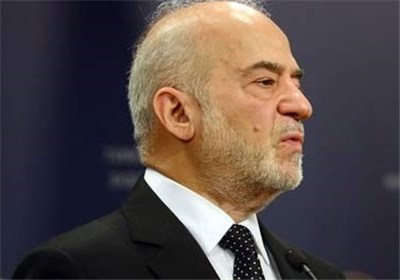
TEHRAN (Tasnim) – Iraq’s foreign minister lashed out at US plans for the deployment of special forces to his country under the pretext of fighting the ISIL terror group, saying Baghdad has not asked the UN for any such troops.

“The message that Iraq has submitted to the (United Nations) Security Council never included a request for ground forces to enter Iraqi territory to conduct such operations,” Ibrahim al-Jafari told a press conference after meetings with Australian Foreign Minister Julie Bishop on Thursday.

The minister further said that Iraqi armed forces were making gains against the extremist militants on their own and were not in need of more troops, Press TV reported.

“We have established a set of guidelines” for the US-led coalition, including air support for Iraqi forces as well as providing training and intelligence, Jafari said, emphasizing that “no country has regular armies or ground troops present in Iraq except for providing training and counseling.”

Bishop, in turn, said Australia’s role in Iraq was solely restricted to aerial support, training, advice and intelligence, adding, “We have not sought to expand our role to include combat troops.”

During a press conference in the White House on Wednesday, US President Barack Obama said the Washington-led coalition purportedly fighting against the ISIL terrorist group in Iraq and Syria is on the offensive and that he might use US special forces to eliminate the Takfiris.

His remarks came hours after he asked Congress to authorize a three-year war against ISIL “and associated forces.”

Iraq has been facing the growing threat of terrorism, mainly posed by the ISIL terrorist group.

The ISIL militants made swift advances in much of northern and western Iraq over the summer, after capturing large swaths of northern Syria.

Since late September, the US and some of its allies have been conducting airstrikes against the ISIL inside Syria without any authorization from Damascus or a UN mandate.

Meanwhile, a combination of concentrated attacks by the Iraqi military and the popular forces, who rushed to take arms after top Iraqi cleric Ayatollah Ali al-Sistani issued a fatwa calling for fight against the militants, have blunted the edge of the ISIL offensive.

4-Star Admiral Slams Obama: Muslim Brotherhood Infiltrated All Of Our National Security Agencies

February 11, 2015

4-Star Admiral Slams Obama: Muslim Brotherhood Infiltrated All Of Our National Security Agencies, You Tube, January 28, 2015

During a press conference on how to combat radical Islamic extremism, Admiral James A. “Ace” Lyons (U.S. Navy, Ret.), former Commander-in-Chief, U.S. Pacific Fleet, stated that under the leadership of Barack Obama the Muslim Brotherhood have infiltrated all of the National Security Agencies of the United States. Furthermore, Lyons said that Obama is deliberately unilaterally disarming the military and spoke to the need for the new GOP controlled congress and Military leaders to stand up to the administration and uphold their oaths.


US only power still in talks with Iran on nukes — senator

February 11, 2015

US only power still in talks with Iran on nukes — senator, Times of Israel, February 10, 2015

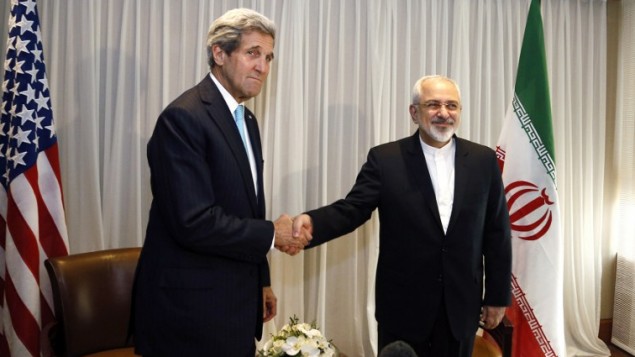
000_Par8073762-e1421787192825-635x357Iranian Foreign Minister Mohammad Javad Zarif (right) shakes hands with US Secretary of State John Kerry (left) in Geneva, January 14, 2015. (photo credit: AFP/Rick Wilking/Pool)

Corker and the Democrat he replaced as committee chairman, Senator Robert Menendez, left the latest briefing expressing concern about the administration basing negotiations on the need to maintain Iran’s potential nuclear weapons “breakout” time to at least one year.

“One of my major concerns all along that is becoming more crystal clear to me, is that we are, instead of preventing proliferation, we are managing proliferation,” Menendez said.

*****************

WASHINGTON — Five of the six world powers negotiating with Iran over its nuclear program have stepped back, leaving Washington to hammer out a deal with Tehran, a key US lawmaker said Tuesday.

“It’s evident that these negotiations are really not P5+1 negotiations any more,” Senate Foreign Relations Committee Chairman Bob Corker said as he emerged from a closed-door briefing by Obama administration officials on the status of nuclear talks with Iran.

“It’s really more of a bilateral negotiation between the United States and Iran.”

The five permanent UN Security Council members — Britain, China, France, Russia and the United States — plus Germany have undertaken years-long talks with Iran in a bid to halt the Islamic republic’s nuclear drive.

Several rounds of sanctions have been imposed on Iran, cutting deeply into the country’s economy.

Under an interim agreement reached in November 2013, Iran has diluted its stock of fissile materials from 20 percent enriched uranium to five percent in exchange for limited sanctions relief.

Bob-Corker-305x172Senator Bob Corker, R-TN (photo credit:: CC BY-SA, byUS Congress, Wikimedia Commons)

But two deadlines for a permanent agreement have already been missed, requiring the talks to be extended.

President Barack Obama met with German Chancellor Angela Merkel at the White House on Monday, and Obama said he saw no reason to further extend the current deadlines.

The present issue, Obama said, was “does Iran have the political will and the desire to get a deal done?”

With a March 31 deadline for a political agreement approaching, and a final deal confirming technical details required by June 30, Corker said the key players are now essentially Washington and Tehran.

“I was in Munich this weekend (for an international security conference) and was very aware that this was becoming more of a one-on-one negotiation,” the Senate Republican told reporters.

Corker and the Democrat he replaced as committee chairman, Senator Robert Menendez, left the latest briefing expressing concern about the administration basing negotiations on the need to maintain Iran’s potential nuclear weapons “breakout” time to at least one year.

“One of my major concerns all along that is becoming more crystal clear to me, is that we are, instead of preventing proliferation, we are managing proliferation,” Menendez said.

Having Iran just one year away from building a bomb would be “a different world and a far more challenging world,” he added.


Iran’s Moves in the Middle East and Why You Should Care.

February 10, 2015

Iran’s Moves in the Middle East and Why You Should Care, The Watchman via You Tube, February 10, 2015


Obama targets Netanyahu, Iran targets Israel

January 29, 2015

Obama targets Netanyahu, Iran targets Israel, Israel Hayom, Richard Baehr, January 29, 2015

Obama will tell himself and anyone who wants to ‎hear that he has brought Iran back into the community of nations. ‎Obama, after all, is a rare man. How many others can make 118 ‎self-referential mentions in a half hour talk, as Obama did in India ‎this week?

Is it any wonder ‎why someone who stands for something, say a country’s security, ‎as Netanyahu does, gets under the skin of a man who is primarily ‎concerned with little more than his own greatness, and whose ‎presidency, in a word, has been a “selfie”?‎

**********************

There is a bit of difference between Iran and U.S. President Barack Obama when it comes to ‎Israel. Iran has never been reticent that its goal is to eliminate the State of Israel, ‎and Israelis too while they are it. Iran’s proxy terror army of Hezbollah ‎contributed their part on Wednesday, killing two Israeli soldiers and wounding seven with anti-tank ‎fire from southern Lebanon directed at an Israeli convoy. Obama seems more ‎interested, at least in the next two months, in eliminating one Israeli — namely, Prime ‎Minister Benjamin Netanyahu. ‎

It has been a remarkable two weeks in U.S.-Israel relations. The president ‎delivered his State of the Union address, in which he argued for staying the course ‎with negotiations with Iran over its nuclear program, overselling what has already ‎been achieved, as well as what might be achieved. He also threatened to veto new ‎sanctions legislation that might be passed by Congress, where some have called for ‎tougher sanctions to be applied to Iran if a satisfactory deal were not struck ‎between the P5+1 and the Iranians by June 30. Obama argued that passing such a ‎measure now would be a sign of bad faith and drive the Iranians from the ‎negotiating table. It was, of course, an odd prediction, since one area in which the ‎Iranians have shown remarkable consistency has been in negotiating with ‎European powers, or the now expanded negotiating group for over 10 years, ‎always without a satisfactory outcome. The Iranians seem to like being seen as ‎negotiating while their nuclear program advances.‎

Fact checkers awarded Obama a bunch of “pinocchios” for his latest effort, suggesting he was all ‎but lying on the matter. No, the Iranians have not dismantled any centrifuges (they ‎have more running than before), they have not removed any fissile material from ‎the country for safekeeping, they have not allowed inspections on demand, they ‎have not disabled their Arak heavy-water reactor, they have not agreed to end any ‎missile program they are working on for delivery of a nuclear bomb. ‎

‎”Our diplomacy is at work with respect to Iran,” Obama said, ‎‎”where, for the first time in a decade, we’ve halted the progress of ‎its nuclear program and reduced its stockpile of nuclear material.”

James Robbins, a senior fellow in national security affairs at the ‎American Foreign Policy Council, begged to disagree:‎

‎”But has Iran’s stockpile shrunk? Under a deal concluded last ‎November, Iran halted work on the most dangerous material, 20 ‎percent refined uranium. However, Iran is still making lower-grade ‎uranium. According to a report from the International Atomic ‎Energy Agency last November, Iran’s stockpiles of low-enriched ‎uranium gas and 5 percent enriched uranium were both growing. ‎Also, the agency cautioned that their figures only covered ‎‎’declared sites,’ the nuclear facilities Iran has publicly ‎acknowledged and allowed to be inspected.”‎

In the days after his address to Congress, the president repeated ‎his threats about vetoing new sanctions legislation, when meeting ‎with Democratic senators, several of whom, along with a few ‎Republican colleagues, had been lobbied on the matter by Britain’s ‎visiting Prime Minister David Cameron. The president upped the ‎ante, accusing Democratic Senator Robert Menendez of New ‎Jersey, a leader in the attempt to pass new sanctions, of not ‎thinking long-term, but just trying to make his donors (could ‎Obama have meant Jewish donors?) happy.

The idea of a foreign leader directly lobbying members of ‎Congress on an issue like the Iranian sanctions bill took on a new ‎life when House Speaker John Boehner invited Netanyahu to ‎address a joint session of Congress on the Iranian issue on ‎February 11. The White House predictably blew its lid, accusing ‎Boehner of breaking established protocol for such an invitation. (It ‎should have been coordinated with the White House.) The usual ‎Obama water carriers like Jeffrey Goldberg were quick to lambaste ‎Netanyahu for stage managing the invitation so as to embarrass ‎Obama, and in the process threaten U.S.-Israel relations. As Joel ‎Pollak describes Goldberg’s argument:‎

‎”In his most recent Atlantic column, he claims, for example, ‎that Obama worked ‘in tandem’ with Netanyahu to promote ‎sanctions on Iran: ‘Netanyahu traveled the world arguing for ‎stringent sanctions, and Obama did much the same.’‎

“That is simply factually untrue. Obama resisted Iran sanctions ‎for months, defying even a unanimous vote in the Democrat-‎controlled Senate. Not only was Israel frustrated, and ‎Congress, but Europe as well, which accused Obama of re-‎inventing the wheel, resetting diplomacy that had started ‎under (gasp) George W. Bush.‎

“In fact, Obama pushed the world towards a more lenient ‎position on Iran, allowing nuclear enrichment in defiance of ‎U.N. Security Council resolutions.”

And then there is this doozy:‎

‎”It is Netanyahu’s job, Goldberg says, as ‘the junior partner in ‎the Israel-U.S. relationship,’ to make concessions.”‎

When it comes to negotiating with Iran, Netanyahu does not ‎sit at the table with the Iranians, but Obama’s representatives ‎do. And it is U.S. negotiators who have been making ‎concessions month after month since the talks began, in what ‎appears to be a desperate attempt to salvage some deal they ‎can broadcast as having achieved a minimal set of objectives. ‎That objective has now been reduced to providing some ‎minimum breakout time for Iran to achieve nuclear weapons ‎capability if they ditch the deal. What will the West do in that ‎time if Iran moves towards the bomb? It is pretty clear, any ‎military response from Obama is out of the question.‎

The administration has further demonstrated its unhappiness ‎about Netanyahu’s impudence in scheming with ‎Boehner, by announcing that neither the president nor his secretary of state will meet with Netanyahu when he visits ‎Washington, a date now moved back three weeks to overlap ‎his visit to the annual American Israel Public Affairs Committee policy conference. The excuse, ‎couched in a diplomatic smokescreen, is that it would be ‎improper for the president to meet with a candidate for office ‎abroad so close to the time of that country’s election. That ‎would be equivalent to electioneering and interference in the ‎other country’s race. Presumably when President Bill Clinton ‎met with Israeli Prime Minister Shimon Peres just weeks ‎before his election contest with Netanyahu in 1996, at a time ‎when Israeli prime ministers were elected in a head-to-head ‎battle, electioneering was the furthest thing from Clinton’s ‎mind. ‎

The Obama team may not meet with Netanyahu when he ‎visits, but an experienced Obama campaign team from 2012 ‎is now in Israel working to defeat Netanyahu. That, in and ‎of itself, is nothing new for Israeli elections. Experienced ‎American campaign teams have aided Israeli candidates from ‎the Left and Right in recent decades. What is new is that the ‎current anti-Netanyahu campaign includes a State ‎Department funded group:‎

‎”U.S.-based activist group OneVoice International has partnered ‎with V15, an ‘independent grass-roots movement’ in Israel that is ‎actively opposing Netanyahu’s party in the upcoming elections, ‎Haaretz reported on Monday. Former national field director for Obama’s 2012 re-election campaign Jeremy Bird is also ‎reportedly involved in the effort.‎

“OneVoice development and grants officer Christina Taler said the ‎group would be working with V15 on voter registration and get-out-‎the-vote efforts but would not engage in overtly partisan activities. ‎She said OneVoice and V15 are still formalizing the partnership.”‎

Obama’s team has gone further to poison the waters for ‎Netanyahu, planting a story in Haaretz that the Mossad was ‎opposed to new sanctions legislation, a charge they publicly ‎rebutted.‎

The Goldberg article was designed to deliver a message that Israel ‎has two important objectives now — to keep Iran from going nuclear ‎‎(for which their best hope of course is to count on Obama to do the ‎job for them in negotiations), and second, to keep American close ‎and happy with Israel’s behavior. Netanyahu, according to Goldberg, is ‎killing the good vibes that presumably must have existed during the ‎Obama years by his recent behavior.‎

There is an alternative interpretation for what is going on. Obama is ‎really not terribly bothered by a nuclear Iran. A bad deal that looks ‎like it delays Iran’s entry to the nuclear club is therefore not a bad ‎option. It also allows Obama to check off one more box on his ‎achievements list before his formal request to have his likeness ‎carved into Mount Rushmore. Pakistan has a bomb. Israel has the ‎bomb. Why not Iran, the leading Shiite nation? Iran, after all, is now ‎our strategic partner, fighting with us to battle ISIS in Iraq. ‎

The latest evidence that Obama is now on the Iranian team is the ‎New York Times editorial calling for accepting that having Assad ‎hang on in Syria is the least bad result, so backing a non-ISIS ‎Syrian rebel team is a bad idea. The New York Times editorial ‎page is little more than a conveyance tool for White House ‎messaging at this point, and so this is now clearly Obama’s ‎posture. How can we fight alongside Iran in Iraq, but support a side ‎that is fighting Iran’s ally Assad in Syria?

Meanwhile, Hezbollah is stepping up its activities in the Golan. The ‎Iranian goal appears to be to establish a base in Syria where Israel ‎can be targeted by the Lebanese group, without getting an Israeli ‎response in Lebanon itself. What is clear is that Hezbollah and Iran ‎have Israel in their sights. If Iran gets the bomb, the retaliation ‎options for Israel when Hezbollah pressure is applied, will be much ‎more limited. There is no certainty that Iran subscribes to the ‎mutually assured destruction deterrence club.‎

But not to worry. Obama will tell himself and anyone who wants to ‎hear that he has brought Iran back into the community of nations. ‎Obama, after all, is a rare man. How many others can make 118 ‎self-referential mentions in a half hour talk, as Obama did in India ‎this week?

Is it any wonder ‎why someone who stands for something, say a country’s security, ‎as Netanyahu does, gets under the skin of a man who is primarily ‎concerned with little more than his own greatness, and whose ‎presidency, in a word, has been a “selfie”?‎

Mossad denies opposing harsher sanctions on Iran

January 22, 2015

Mossad denies opposing harsher sanctions on Iran, Ynet News, Itamar Eichner, January 22, 2015

Head of Israeli spy agency releases statement denying it was working with the Obama administration against Netanyahu on Iran issue.

In an unusual step, the Israeli spy agency Mossad released an official statement on Thursday afternoon in which it denied that it opposes imposing additional sanctions on Iran, as reported in a Bloomberg report earlier in the day.

The Mossad statement said, “Mossad chief Tamir Pardo met with a delegation of American senators on January 19, 2015. The meeting was held at the request of the senators and with the approval of the prime minister. Contrary to the report, the head of the Mossad did not say that he opposed additional sanctions on Iran. The Mossad chief emphasized in the meeting the remarkable efficacy of the sanctions imposed on Iran over the last few years in bringing Iran to the negotiating table.

“The Mossad chief stated that when negotiating with Iran, the ‘carrots and sticks’ approach needs to be taken and at present, there aren’t enough ‘sticks.’ The Mossad chief noted that without strong pressure, it would not be possible to bring to meaningful compromises from the Iranian side.

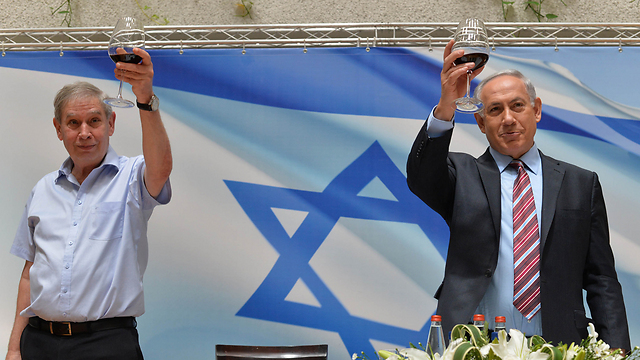
56024560100388640360noPardo and Netanyahu: On the same page (Photo: GPO)

“As for the use of the term ‘grenade’, the Mossad chief did not use that with regards to imposing sanctions, which, as mentioned, he considers to be the ‘sticks’ that would aid in achieving a good agreement. He used this term to describe the possibility of creating a temporary crisis in the talks, at the end of which the negotiations will be renewed under better terms. The Mossad chief specifically stated that the agreement currently being formulated with Iran is bad and might lead to a regional arms race.”

The Bloomberg report was published after US House Speaker John Boehner invited Prime Minister Benjamin Netanyahu to speak in front of Congress about the Iranian nuclear threat. Netanyahu has been urging the American administration to harden its sanctions policy. The Obama administration, Bloomberg reported, has been using the internal divide between the Mossad and Netanyahu to torpedo the bi-partisan proposal, penned by Senators Mark Kirk and Robert Menendez.

Meanwhile, Republican Senator Bob Corker, chairman of the Senate Foreign Relations Committee, has teamed up with Lindsay Graham and John McCain to propose a bill requiring the White House bring any deal with Iran to a vote in Congress.

The Obama administration opposes both measures and has warned the Senate to stay away from the delicate negotiations between Iran and world powers.

According to the report, Mossad officials have briefed the White House, as well as Republican legislators, on their opposition to the Kirk-Menendez bill, which would implement new sanctions on Iran if the negotiations fail to yield results by June 30 or the Islamic Republic fails to live up to its commitments.

Netanyahu, on the other hand, has expressed his support for the legislation, in particular, and sanctions on Iran, in general.

Evidence to Israeli interference in the Iran-US talks comes from comments made by Secretary of State John Kerry, who said an unnamed Israeli intelligence official had said the new sanctions bill would be “like throwing a grenade into the process.” When Menendez heard about the Mossad briefing, he demanded clarifications from Israel’s Ambassador to the US Ron Dermer.

White House: Boehner Invite to Netanyahu Breach of Protocol

January 21, 2015

White House: Boehner Invite to Netanyahu Breach of Protocol, New York Times, January 21, 2015

Earnest says they are reserving judgment about the invitation until they’ve had a chance to speak to the Israelis about what Netanyahu might say.

*********************

ABOARD AIR FORCE ONE — The White House says House Speaker John Boehner’s invitation for Israel’s prime minister to come to Washington is a breach of normal diplomatic protocol.

President Barack Obama’s press secretary, Josh Earnest, says the White House has not heard from Israelis about whether Benjamin Netanyahu plans to speak to Congress Feb. 11. Earnest says they are reserving judgment about the invitation until they’ve had a chance to speak to the Israelis about what Netanyahu might say.

Earnest says typical protocol is that a country’s leader would contact the White House before planning to visit the United States. But Earnest says they didn’t hear about Boehner’s invitation until Wednesday morning, shortly before the speaker announced it publicly.

Earnest was speaking to reporters traveling aboard Air Force One to Idaho on Wednesday.

Boehner invites Israeli PM Netanyahu to address Congress

January 21, 2015

Boehner invites Israeli PM Netanyahu to address Congress, The Washington TimesStephen Dinan, January 21, 2015

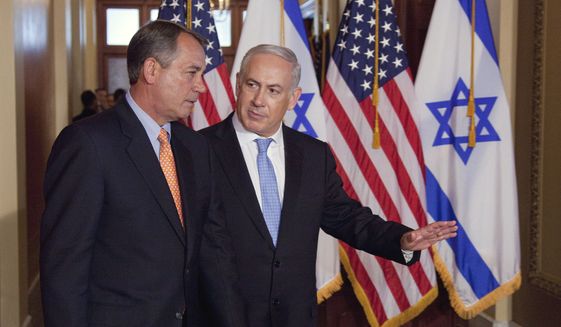
us-israel-iranjpeg-088fd_c0-0-3500-2040_s561x327FILE – In this May 24, 2011 file photo, Israeli Prime Minister Benjamin Netanyahu walks with House Speaker John Boehner of Ohio to make a statement on Capitol Hill in Washington. Boehner has invited Netanyahu to address Congress about Iran.

House Speaker John A. Boehner said Wednesday he’s invited Israeli Prime Minister Benjamin Netanyahu to speak to a joint session of Congress in February.

“In this time of challenge, I am asking the prime minister to address Congress on the grave threats radical Islam and Iran pose to our security and way of life,” Mr. Boehner said. “Americans and Israelis have always stood together in shared cause and common ideals, and now we must rise to the moment again.”

The invitation comes a day after President Obama told Congress he would veto any legislation imposing stiffer sanctions on Iran — a move that has bipartisan support on Capitol Hill, but which the president said would squelch chances for a deal to control Iran’s nuclear program, and could move closer to war.

The speech is slated for Feb. 11. Mr. Netanyahu has addressed Congress twice before, in 1996 and again in 2011.


Making sense of Obama’s counter-intuitive approach to negotiations with Iran

January 19, 2015

Making sense of Obama’s counter-intuitive approach to negotiations with Iran, Power LinePaul Mirengoff, January 18, 2014

Obama doesn’t want just any nuclear deal. Obama wants a deal Iran will feel good about so that he can make more deals with the ruling clerics. He sees Iran as the key to a grand bargain in the Middle East, one that will thwart ISIS and bring stability — on Iran’s terms — to the region. Israel, of course, excepted.

********************

Last week, President Obama and British Prime Minister Cameron pleaded with Congress not to pass new sanctions legislation against Iran. Such legislation, which has strong bipartisan support, could undermine ongoing negotiations, they argued. “Just hold your fire” until we complete negotiations, Obama urged.

But Obama’s position seems nonsensical on its face. The sanctions legislation Congress contemplates passing does exactly what Obama instructs Congress to do. As the Washington Post’s editors remind us, the Menendez-Kirk legislation would impose sanctions only if Iran reaches no agreement before the June 30 deadline it previously agreed to. “Fire” is “held” until then.

If anything, as the Post argues, the legislation would make a deal with Iran more likely. For unless Obama is going to cave entirely (a definite possibility, sadly), Iran will have to make concessions. And Iran is more likely to make concessions if the consequence of no deal is a stepped-up sanction regime.

In other words, the legislation to which Obama objects would give him a bargaining chip. The fact that Obama doesn’t want one (he says he’d veto the Menendez-Kirk bill) should tell Congress that he’s not interested in playing hardball in negotiations with Iran.

Iran is playing hardball, though. It has manufactured two bargaining chips. First, it recently announced that is has begun the construction of two new nuclear reactors.

Second, Iran has referred the case of Jason Rezaian, a Washington Post reporter held prisoner in Tehran, for processing by the “Revolutionary Court.” Rezaian has been denied basic humanitarian treatment by his captors — for example, his weight is down by 40 pounds, according to his mother — and has neither been informed of the charges against him nor allowed to consult with his lawyer, according to the Post.

Put simply, Rezaian is a hostage to the nuclear negotiations. And why not? The Castro brothers got what they wanted from Obama using the same approach.

As with Cuba, Iran is actually using a belt and suspenders approach. Obama has always wanted to lift sanctions on Cuba and he clearly wants a nuclear deal, any deal, with Iran. With Cuba, he was able to obtain the photo ops accompanying a prisoner release to make his concessions easier for Americans to swallow. The Rezaian captivity means that Obama may be able to do the same with a nuclear deal with Iran.

But Obama doesn’t want just any nuclear deal. Obama wants a deal Iran will feel good about so that he can make more deals with the ruling clerics. He sees Iran as the key to a grand bargain in the Middle East, one that will thwart ISIS and bring stability — on Iran’s terms — to the region. Israel, of course, excepted.

This, I believe, is why Obama opposes congressional action that would strengthen his bargaining position. Obama is fine with bargaining from weakness with Iran, and wants to earn credit with the mullahs for standing up on their behalf to Congress, including members of his own party.

A final note. The Post’s editors should be commended for the strong position they advance in today’s editorial. A few days age, I suggested that the Post was experiencing something resembling Stockholm syndrome in its reporting on Iran. If so, the syndrome has not spilled over to its editorial page.

Mahmoud Abbas: Failing the Palestinians and Peace

December 29, 2014

Mahmoud Abbas: Failing the Palestinians and Peace, Front Page Magazine, December 29, 2014

Mahmoud Abbas

[T]he increased authoritarianism of Abu Mazen is reflected in a recent survey by the Palestinian Center for Policy and Survey Research. It indicates that 66% of Palestinians are afraid to criticise Abu Mazen and the PA, and 80% consider the PA institutions to be corrupt and infected with nepotism.

***************

Mahmoud Abbas, (aka Abu Mazen) has been a failure as the Palestinian “Rais.” He failed to lead the Palestinian Authority (PA) toward peace with Israel, and he mismanaged the alleged goal to achieve statehood for the Palestinians. Instead of facing the tough issues and making compromises required in negotiating peace and statehood with the Israelis, Abbas chose an alliance with the Gaza controlled terrorist group Hamas. Following Abbas’ pact with Hamas last April, Israel broke off peace negotiations with the Palestinians, just days before the talks brokered by Secretary of State John Kerry were scheduled to expire.

Abbas isn’t only confusing Israelis, Americans, and is his Europeans patrons, he is perplexing his own Palestinian consituents. Following last summer’s Gaza War between Hamas and Israel, Abbas threatened to join the International Criminal Court (ICC) and saught to indict Israel on war crimes. PA Foreign Minister Riad al-Maliki met with the Chief Prosecutor of the ICC last August to explore ways of joining the court by PA President Abbas signing the Rome Statute.  When, however, the U.S. Congress threatened to cut off all funding to Palestine if Abbas filed war crimes charges against Israel, Abbas backed off. At the same time though, Israel’s Prime Minister threatened to counter-sue, alleging that the rockets fired by Hamas terrorists into Israeli civilian areas constituted “double war” crimes.

The Israeli Law Center called Shurat-HaDin, led by Nitsana Darshan-Leitner submitted a complaint against Mahmoud Abbas in the ICC for “war crimes.” The complaint claims that Abbas may be tried for his responsibility in the missile attacks targeting Israeli cities, executed by the Palestine Liberation Organization (PLO), which Abbas heads. It charges that Fatah, also led by Abbas, was responsible for several missile attacks on Israeli cities. Darshn-Leitner pointed out that Fatah leader Abbas may be tried by the ICC. Abbas is a citizen of Jordan and Jordan is a member-state of the ICC. The ICC has jurisdiction over crimes committed by a citizen of a member state. Darshan-Leitner added, the organization “will not allow Fatah to carry out rocket attacks on Israeli population centers, while hypocritically advocating Palestinian membership in the ICC. Abbas falsely believes that alleged crimes against Arabs are the only ones that should be prosecuted.”

A week ago, Abbas threatened again. This time he fingered the security co-ordination with Israel following the death of Ziad Abu Ein, 55, PA Minister without Portfolio. He promptly backtracked. On November 29, 2014, Abbas declared  that if the United Nations Security Council rejects the Palestinian statehood resolution, he will seek membership in the ICC. He said, “We will seek Palestinian membership in international organizations, including the International Criminal Court in the Hague. We will also reassess our ties with Israel, including ending the security cooperation between us.”

Abbas’ latest gambit is a UN Security Council (UNSC) resolution that would force Israel to withdraw from Judea and Samaria (West Bank) within two-years. According to press reports, U.S. Secretary of State John Kerry requested to postpone the Palestinian initiative at the UNSC until after the Israeli elections, (March 17, 2015) but the Palestinians refused. PA Foreign Minister Riad al-Maliki intimated to reporters that there was disagreement between the Americans and Palestinians on how the elections in Israel would or wouldn’t advance the PA UNSC resolution. Kerry believed that a UNSC vote before the elections would impact adversely on the winners. In other words, a vote before the elections would strengthen Netanyahu and the Right in Israel. Maliki argued that a vote before January, 2015 would be rather positive.

At a closed meeting last week with 28 EU ambassadors, John Kerry revealed that he was asked by former Israeli president Shimon Peres and Tzipi Livni to prevent the Palestinian initiative at the UNSC because it will help “Netanyahu and Bennett (Jewish Home Party chairman) in the upcoming elections.” Maliki posited that Kerry himself has not abided by his pledge not to intervene in the Israeli elections.

Also last week in London, Secretary of State Kerry met with Saeb Erekat, the chief Palestinian negotiator, and according to a PA senior official, Kerry posed a number of U.S. principles that should be included in the Palestinian UNSC resolution. Kerry supposedly refused the two year time period demand by the PA for Israeli withdrawal. The resolution as Kerry suggested should include recognition of Israel as a Jewish state, as well as U.S. opposition to declare Jerusalem as a joint capital for Palestine and Israel. Erekat rejected the U.S. proposals. Kerry declared afterward that the U.S. does not accept the Jordanian (presenting the Palestinian resolution)  and French resolutions. He warned that if the Palestinians insist on presenting the resolutions, the U.S. would use its veto power. Erekat rejected Kerry’s ideas, and insisted that the resolutions would be submitted. As of December 25, 2014, Abbas rejected an Arab League request to delay the submission of the Palestinian statehood until January when five new members who support the Palestinian cause will join the Security Council.

Abbas’ gambits notwithstanding, the increased authoritarianism of Abu Mazen is reflected in a recent survey by the Palestinian Center for Policy and Survey Research. It indicates that 66% of Palestinians are afraid to criticise Abu Mazen and the PA, and 80% consider the PA institutions to be corrupt and infected with nepotism. Last summer, according to the survey, support for Abbas (Abu Mazen) declined to 35% from 50%. “There is no doubt about the fact that outlawing freedoms and rights, especially of professional unions, is a factor in Abbas’ decline in popularity,” said Dr. Khalil Shikaki, one of the survey takers.

PA security agents inspect what is written in the social media, and threaten those who criticize Abbas. Abu Mazen critics point out that after a decade in power he is controlling all systems of government to such an extent as to minimize all resistance. Perceived political rivals such as Mohammad Dahlan, who once served as Abu Mazen’s assistant, and Salam Fayyad, the former Prime Minister of the PA, are vilified by Abbas. Following the Palestinian Unity government formation, headed by Rami Hamdallah last May, elections were to follow. But, once again, internal squabbling prevented it, and added to it was Abbas’ fear of a Hamas victory.

Abu Mazen’s strategy for the establishment of a Palestinian state has reached a cul-de-sac.  None of his gambits proved successful. His rivalry with Hamas is bitter and ongoing, despite the alliance he forged at the expense of negotiations with Israel. And, like his predecessor Yasser Arafat, he balks at the idea of ‘ending the conflict’ with Israel. He knows full well that this might be a death sentence for him, targeting him for assassination. It is for this reason that Abbas and the PA are unlikely to forgo the “right of return” of Palestinian refugees to Israel. Israel for its part, cannot accept such a demographic suicide. This is why Abbas would rather avoid negotiations with Israel and bypass it by going to the UNSC. It is also the ostensible reason why peace with Israel cannot be achieved, and as a result, the Palestinian people continue to suffer political and economic deprivation. Abbas has not been the solution to the Palestinian problems; rather, he has been responsible for failing them.