Archive for the ‘U.S. Congress’ category

Presidential Commitments Then and Now

March 11, 2015

Presidential Commitments Then and Now, Commentary Magazine, March 11, 2015

(Please see also State Dept Describes Iran Deal as ‘Nonbinding’ — DM)

The White House “outrage” at the “open letter” to Iran signed by 47 senators, led by Sen. Tom Cotton, was reinforced by Vice President Biden’s formal statement, which intoned that “America’s influence depends on its ability to honor its commitments,” including those made by a president without a vote of Congress. Perhaps we should welcome Biden’s belated insight. As Jonathan Tobin notes, President Obama on taking office in 2009 refused to be bound by the 2004 Gaza disengagement deal in the letters exchanged between President George W. Bush and Israeli Prime Minister Ariel Sharon. His secretary of state, Hillary Clinton, announced that such commitments were “unenforceable”–that they were non-binding on the new administration. In 2009, Obama disregarded previous commitments not only to Israel but also to Poland, the Czech Republic, and Georgia; he “fundamentally transformed” America’s previous commitments, as he likes to describe the essential element of his entire presidency.

The Gaza disengagement deal was (1) approved by Congress; (2) included in the Gaza disengagement plan presented to the Israeli Knesset, and (3) relied on by Israel in withdrawing from Gaza later in 2005. The history of the deal (which the current secretary of state endorsed at the time as a U.S. “commitment”) is set forth here, and the reason Obama sought to undo it is discussed here. In 2009, the Obama administration refused at least 22 times to answer whether it considered itself bound by the deal; in 2011 it openly reneged on key aspects of it.

President Obama is currently negotiating an arms control agreement in secret, refusing to disclose the details of the offers his administration has made to Iran, a terrorist state according to his own State Department, and a self-described enemy of the United States since 1979. He has opposed not only a congressional debate before he concludes the deal but also a congressional vote afterwards. If he closes a deal with Iran on that basis, it will not be binding on any future president–at least not if that president chooses to follow the precedent Obama himself set in 2009.

If the administration is now seeking to restore the credibility of presidential commitments, the president might consider taking two steps: (1) acknowledge that the U.S. is bound by the disengagement deal negotiated by President Bush with Israel, endorsed by a vote of Congress; and (2) promise to put his prospective deal with Iran to a similar congressional vote once the deal is done. If not, perhaps a reporter at his next press conference will ask how he reconciles his position that (a) he could ignore President Bush’s congressionally approved deal with his view that (b) future presidents must honor the non-congressionally approved one he is negotiating now.

State Dept Describes Iran Deal as ‘Nonbinding’

March 11, 2015

State Dept Describes Iran Deal as ‘Nonbinding’, You Tube, March 11, 2015

(Huh? Does this suggest that the State Department agrees with the “traitorous” letter from Republican members of the Congress? Would a deal also be “nonbinding” on Iran?– DM)


Iran and the Perils of One-Man Rule

March 10, 2015

Iran and the Perils of One-Man Rule, Commentary Magazine, March 9, 2015

One-man rule may make sense in Tehran, but not here. This is not a question of partisanship but a defense of both the Constitution and the security of the nation. The Iranians should know that this deal is unpopular and will have no legitimacy without congressional ratification. Rather than sabotaging diplomacy, the letter is necessary pressure on the president to remember his oath to preserve the Constitution rather than to recklessly risk the country’s safety on Iranian détente.

********************

The letter sent by 47 Republican senators to Iran’s leadership is provoking predictable cries of outrage from liberals and Democrats. Obama administration supporters are decrying the missive as a blatant attempt to sabotage U.S. diplomatic efforts to end the standoff over Iran’s nuclear-weapons program. By warning Tehran that any deal approved by President Obama may be revoked by his successor after January 2017, the GOP caucus is opening itself up to charges of extending partisan warfare to foreign policy. But the letter, intended as much as a shot fired over the bow of the president as it was a lesson in the U.S. Constitution for the ayatollahs, made an important point. No matter what you think about the administration’s blatant push for détente with the Islamist regime, the president’s plans to craft an agreement that will not be submitted to Congress for approval means the senators are correct about its status in law. More importantly, they are highlighting an issue that transcends the nuclear question, even though that is a matter of life and death. A president that seeks to ignore the constitutional separation of powers cannot complain when his critics point out that his fiats cannot be expected to stand the test of time.

The impact of the letter on the Iranians is a matter of speculation. The Islamist regime needs no instructions from Republicans about how to protect their interests as they’ve been successfully stringing along Western governments for more than a decade in nuclear negotiations. In particular, they have scored a series of diplomatic triumphs at the expense of the United States as President Obama has abandoned his past insistence that Iran give up its nuclear program and instead offered concession after concession to the point where the deal that is being offered to the regime is one that will let them keep their infrastructure and will “sunset” restrictions on it. If they truly intend to take advantage of this craven retreat by the putative leader of the free world as opposed to more prevarication until the clock runs out on their march to a weapon, then nothing his Republican opponents say are likely to scare them out of it.

Moreover, the Iranians may believe that the same dynamic that has worked in their favor during the course of the negotiations may similarly ease their fears once such a bad deal is in place. Even a Republican president who has campaigned against appeasement of Iran and understands the dangers of an agreement that will make it possible for Iran to get a bomb either by cheating or, even worse, by abiding by its terms, will be hard-pressed to reverse it. America’s allies will fight tooth and nail against re-imposition of sanctions on an Iran that they want to do business with no matter what that terror-supporting regime is cooking up.

The campaign against reversal will also center on the straw-man arguments used by the president and his apologists to bolster their effort to appease Iran. We will be told that the only alternative to a deal that allows Iran to become a threshold nuclear power is war and not the return to tough sanctions and hard-headed diplomacy that President Obama jettisoned in his zeal for a deal.

But by planning to bypass Congress and treat his pact with Iran as merely an executive decision over which the legislative branch has no say, the president is steering into uncharted waters. Like his executive orders giving amnesty to millions of illegal immigrants that usurp the power of Congress to alter laws governing this issue, a nuclear deal that is not ratified by the Senate, as all treaties must be, can be treated as a presidential whim that is not binding on his successors. If it can be put into effect with only the stroke of a pen, it can just as easily be undone by a similar stroke from another president.

The difficulty of undertaking such a revision should not be underestimated. No president will lightly reverse a foreign-policy decision with such serious implications lightly. That is why an agreement that grants Western approval to Iran’s nuclear ambitions is so dangerous. That it is part of a comprehensive approach to Iran that, despite last week’s disclaimers issued by Secretary of State John Kerry, indicates that the U.S. is prepared to accept the regime’s efforts to achieve regional hegemony makes it even more perilous. Congress needs to act soon to both impose tougher sanctions on Iran and to ensure that any deal must be submitted to it for approval.

But Iran still had to be put on notice that a deal that is not approved by Congress can and should be reversed by the next president. One-man rule may make sense in Tehran, but not here. This is not a question of partisanship but a defense of both the Constitution and the security of the nation. The Iranians should know that this deal is unpopular and will have no legitimacy without congressional ratification. Rather than sabotaging diplomacy, the letter is necessary pressure on the president to remember his oath to preserve the Constitution rather than to recklessly risk the country’s safety on Iranian détente.

Ron Dermer and Dore Gold on Fox

March 8, 2015

Ron Dermer and Dore Gold on Fox, via You Tube, March 8, 2015

(Giving Iran years to pursue its ambition of obliterating the U.S. and Israel, with few or no remaining sanctions as Iran continues its efforts to control the Middle East, and no significant progress in allowing the IAEA to pursue its investigations of Iran’s past and future progress in nuclear weaponry strikes me as worse than merely absurd.– DM)

The leader of the free world

March 6, 2015

The leader of the free world, Truth Revolt, Bill Whittle, via You Tube, March 5, 2015

Scott Ott first described him thus… a brave, thoughtful, serious man doing a brave, thoughtful serious job. In his latest FIREWALL, Bill Whittle provides the amazing and disturbing contrast between The President of the United States and The Leader of the Free World

White House pushing Israel to recall ambassador?

March 5, 2015

White House pushing Israel to recall ambassador? Hot Air, Ed Morrissey, March 5, 2015

Yesterday, the Washington Post and former Obama adviser and Middle East envoy Dennis Ross urged Barack Obama to provide a serious response to the “strong case” presented by Benjamin Netanyahu to a joint session of Congress against the administration’s Iran deal. The left-leaning Israeli paper Ha’aretz reports that the “serious response” has been to treat Israeli ambassador Ron Dermer as an unwelcome guest to the party. Dermer created the embarrassment of Barack Obama this week, as Ha’aretz reports the White House’s thinking, and Dermer has to go if Netanyahu wants to do business over the next two years:

“We are not the ones who created this crisis,” said a senior administration official. “President Obama has another two years in office and we wish to go back to a reality where you can work together despite the differences. The prime minister of Israel is the one who needs to find a way to fix this.”

Although White House officials don’t say so explicitly, they seem to imply that one way to repair the relations between Netanyahu and Obama would be to replace Israel’s ambassador to Washington, Ron Dermer. The latter is seen as an instigator who concocted Netanyahu’s Congress speech behind Obama’s back with John Boehner, the Republican speaker of the House of Representatives.

In his speech to AIPAC, Netanyahu praised Dermer for standing firm and taking the heat in Washington. If Netanyahu wins the election and continues to back Dermer, the ambassador will find himself isolated in the American capital. As long as Obama is in the White House, nobody in the administration will work with him.

Ha’aretz reporter Barak Ravid reports this in a matter-of-fact manner, which misses the irony in this passage:

Over the past six years, there have been more than a few ups and downs in the Netanyahu-Obama relationship – tensions, crises, public recriminations and wrangling before the cameras. Senior U.S. officials say that to date, ongoing relations between the two countries continue to function despite these strains. But this time, they stressed, there was the feeling that Netanyahu was using these differences – in fact, highlighting and intensifying them – for his own political needs.

“Historians can probably find examples of times when there were similar crises in the U.S.-Israel relations in the past,” said a senior U.S. official. “In the last six years we had big differences over the peace process and on other issues, but the situation now is extremely difficult and feels more politically charged than ever before.”

Ahem. When Hamas opened fire on Israel last summer, which country went to Qatar to legitimize the terrorist group in negotiations in order to push Israel into recognizing them? That came just after the Bowe Bergdahl swap sent five high-ranking Taliban commanders to Doha, and the Obama administration needed to show that Qatar could be trusted, and to allow Qatar to curry favor in the region. It took Egypt Abdel Fatah al-Sisi to bigfoot John Kerry out of that particular folly.

Don’t think for a moment that the Obama administration hasn’t been playing politics with Iran all along, too. Which country in this equation has a foreign-policy track record so poor that it has desperately glommed onto the idea of a rapprochement with the largest state sponsor of terrorism in the world? For this White House to accuse another government, especially an ally as beleaguered as Israel, of playing politics with foreign policy and alliances is the height of hypocrisy. Obama’s entire policy in the region has been predicated on playing footsie with Iran since he first took office, either in a sham “containment” relationship or a fully endorsed policy of regional hegemony.

As for Dermer, he’s clearly not the problem. However, as one former US ambassador to Israel says, ambassadors are “an expendable lot,” and Netanyahu may need to find another envoy if he wins another term as Prime Minister. That won’t change the trajectory of this administration’s folly on Iran, though, nor the chronic ineptitude of Obama’s State Department on Israel and the region.

Update on the Update below: That story was from last year, actually, as Gabriel Malor pointed out later on Twitter. We both missed that. I’ve changed the headline to remove the red headline and wanted to post this above the link. My apologies for the confusion, even though it’s still a pretty good reminder of the threat Iran poses to Israel and the region.

Update: Here’s a timely reminder that Netanyahu accurately warned that Iranian support for terrorism was a direct threat to Israel (via Gabriel Malor):

The Israel Navy intercepted a ship early on Wednesday that Iran was using to smuggle dozens of long-range rockets to Gaza.

The IDF’s “Operation Discovery” took place in the Red Sea, 1,500 kilometers away from Israel and some 160 kilometers from Port Sudan. IDF Chief of Staff Lt.-Gen. Benny Gantz oversaw the raid.

Missile ships and navy commandos from the Flotilla 13 unit, backed by the air force, raided the Klos-C cargo ship, which was carrying Syrian- manufactured M-302 rockets.

The ship’s crew is in Israeli custody, and the navy is towing the vessel to Eilat, where it is expected to arrive in the coming days.

The rockets originated in Syria, according to Military Intelligence assessments. Iran reportedly flew the rockets from Syria to an Iranian airfield, trucked them to the seaport of Bander Abbas, and shipped them to Iraq, where they were hidden in cement sacks. The ship then set sail for Port Sudan, near the Sudanese-Eritrean border, on a journey that was expected to last some 10 days.

Hey, but I’m sure the Tehran mullahcracy will be totally trustworthy with those thousands of uranium centrifuges!


US State Department Slams Netanyahu’s ‘Magic Formula’

March 5, 2015

US State Department Slams Netanyahu’s ‘Magic Formula’, Israel National News, Ari Yashar, March 4, 2015

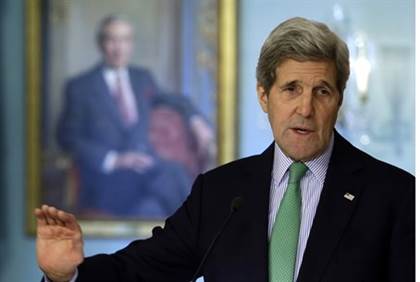
img569560John Kerry Reuters

Harf continued “you can throw out a lot of very scary hypotheticals, but if we look at the technology and we look at where they are today and where they could be in a double-digit duration (i.e. the ten years Obama has called for the deal to last which Iran rejected – ed.), that is further away from a nuclear weapon.”

*********************

US State Department Deputy Spokesperson Marie Harf responded to Prime Minister Binyamin Netanyahu’s Congress Address on Tuesday, and like US President Barack Obama her reaction was highly negative to Netanyahu’s criticism of the approaching Iran deal.

In a similar vein to Obama, she said: “we didn’t hear any – certainly any new ideas today, but more importantly, didn’t hear one single concrete alternative in today’s speech from the Prime Minister about how we could get to a double-digit duration, push breakout time to a year, and cut off the four pathways Iran could…use to get…fissile material for a nuclear weapon.”

Israeli officials responded to this point, arguing there was much new in Netanyahu’s proposal which would require Iran to take real actions indismantling its nuclear program instead of making mere promises to remove sanctions, and would also deal with its ballistic missile program which the current deal avoids.

While Netanyahu and US officials alike have argued no deal is better than a bad deal, Harf opined “no deal means much shorter breakout than under an agreement. Right now, outside experts have said publicly we’re at about two to three months breakout. Our goal is a year.”

Calling Netanyahu’s talk of a better deal “hypothetical” and “rhetoric,” she added “anyone who tells you there’s a magic formula that they have in their head that we don’t have is just not looking at the situation realistically.”

“We need to be very clear about what we’re trying to achieve and what the alternatives look like, not in a fantasy world, not in a world without specifics, but in the real world. And that’s what we’re doing,” she claimed.

Harf stated that Netanyahu said “some sort of perplexing things…including that all sanctions will eventually be lifted on Iran. That is not the case.” She admitted that the nuclear sanctions indeed would indeed be lifted, but “sanctions for terrorism, sanctions for human rights” will remain.

“He also said that at the end of the duration, Iran would have ‘fullinternational legitimacy,’ which is also a little overstated and just not accurate,” stated Harf.

When asked whether by maintaining the deal Iran’s nuclear program would not get legitimacy, she acknowledged that indeed the program would receive such legitimacy, but attempted to differentiate between “full legitimacy” for Iran as opposed to legitimacy for its nuclear program.

“We have always said they would be able to have a domestic enrichment that is peaceful in nature,” she added.

Iran has repeatedly threatened Israel with annihilation, and is the leading state sponsor of terrorism worldwide.

Centrifuges for a nuclear arsenal in weeks

Harf was asked about Netanyahu’s statement that US Secretary of State John Kerry had acknowledged Iran would be allowed to increase to 190,000 centrifuges as its Supreme Leader Ayatollah Ali Khamenei has demanded, a state of affairs that would allow the Islamic regime to produce a nuclear arsenal within weeks.

She insisted that Kerry had not said Iran would be allowed to increase to 190,000 centrifuges in the deal.

“When you are a member, a non-nuclear-weapons member of the NPT (Non-Proliferation Treaty) – and I’m not an NPT expert – but at the conclusion of the duration of this, in addition to the lasting transparency measures we have, Iran will not be able to do things to get to a nuclear weapon,” she claimed.

Harf continued “you can throw out a lot of very scary hypotheticals, but if we look at the technology and we look at where they are today and where they could be in a double-digit duration (i.e. the ten years Obama has called for the deal to last which Iran rejected – ed.), that is further away from a nuclear weapon.”

In response to the bill being proposed to allow Congress to vote on the Iran nuclear deal before it is agreed upon, Harf made clear Obama intends to shoot down any such motion.

“If that comes to the President’s desk, he will veto it. …We can’t negotiate an agreement while Congress is attempting to legislate either what might be in it or that it can’t be implemented, how it could be implemented, which is part of this as well,” she said.

Survey and Feedback Regarding Mr. Netanyahu’s Address to Congress

March 4, 2015

(Tell us what’s on your mind. How about a little poll first. Feel free to add comments and tell us what you expected from Bibi’s speech and why. – LS)

Netanyahu: ‘Even if Israel has to stand alone, Israel will stand.’

March 4, 2015

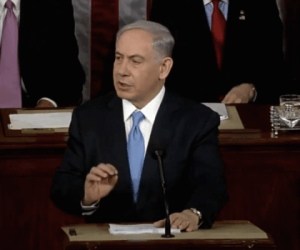
Netanyahu: ‘Even if Israel has to stand alone, Israel will stand.’ Front Page Magazine, Daniel Greenfield, March 4, 2015
Screen-Shot-2015-03-03-at-10.57.51-PM-420x350

“America’s founding document promises life, liberty and the pursuit of happiness. Iran’s founding document pledges death, tyranny, and the pursuit of jihad,” he said. It was the type of clarity that he had brought to the difficult questions of life as a teenager. It is a clarity that still evades Obama today.

A measure of how thoroughly Netanyahu exposed Obama’s unseriousness can be found in Obama’s reply that before taking a position on a nuclear deal “it is very important not to be distracted by the nature of the Iranian regimes’ ambitions when it comes to territory or terrorism.”

For Netanyahu and for many in Congress, Iran’s terrorism is not a distraction; it is the main issue.

********************

In 1967, Benjamin Netanyahu skipped his high school graduation in Pennsylvania to head off to Israel to help in the Six Day War. That same year Obama moved with his mother to Indonesia.

When Obama suggested that Israel return to the pre-1967 borders, described by Ambassador Eban, no right-winger, as “Auschwitz borders,” it was personal for Netanyahu. Like many Israeli teens, he had put his life on hold and risked it protecting those borders.

In the seventies, Obama was part of the Choom Gang and Netanyahu was sneaking up on Sabena Flight 571 dressed as an airline technician. Inside were four terrorists who had already separated Jewish passengers and taken them hostage. Two hijackers were killed. Netanyahu took a bullet in the arm.

The Prime Minister of Israel defended the operation in plain language. “When blackmail like this succeeds, it only leads to more blackmail,” she said.

Netanyahu’s speech in Congress was part of that same clash of worldviews. His high school teacher remembered him saying that his fellow students were living superficially and that there was “more to life than adolescent issues.” He came to Congress to cut through the issues of an administration that has never learned to get beyond its adolescence.

Obama’s people had taunted him with by calling him “chickens__t.” They had encouraged a boycott of his speech and accused him of insulting Obama. They had thrown out every possible distraction to the argument he came to make. Unable to argue with his facts, they played Mean Girls politics instead.

Benjamin Netanyahu had left high school behind to go to war. Now he was up against overgrown boys and girls who had never grown beyond high school. But even back then he had been, as a fellow student had described him, “The lone voice in the wilderness in support of the conservative line.”

“We were all against the war in Vietnam because we were kids,” she said. The kids are still against the war. Against all the wars; unless it’s their own wars. Netanyahu grew up fast. They never did.

Netanyahu could have played their game, but instead he began by thanking Obama. His message was not about personal attacks, but about the real threat that Iran poses to his country, to the region and to the world. He made that case decisively and effectively as few other leaders could.

He did it using plain language and obvious facts.

Netanyahu reminded Congress that the attempt to stop North Korea from going nuclear using inspectors failed. The deal would not mean a denuclearized Iran. “Not a single nuclear facility would be demolished,” he warned. And secret facilities would continue working outside the inspections regime.

He quoted the former head of IAEA’s inspections as saying, “If there’s no undeclared installation today in Iran, it will be the first time in 20 years that it doesn’t have one.”

And Netanyahu reminded everyone that Iran’s “peaceful” nuclear program would be backed by ongoing development of its intercontinental ballistic missile program that would not be touched under the deal.

He warned that the deal would leave Iran with a clear path to a nuclear endgame that would allow it to “make the fuel for an entire nuclear arsenal” in “a matter of weeks”.

Iran’s mission is to export Jihad around the world, he cautioned. It’s a terrorist state that has murdered Americans. While Obama claims to have Iran under control, it has seized control of an American ally in Yemen and is expanding its influence from Iraq to Syria.

Its newly moderate government “hangs gays, persecutes Christians, jails journalists.” It’s just as bad as ISIS, except that ISIS isn’t close to getting a nuclear bomb.

“America’s founding document promises life, liberty and the pursuit of happiness. Iran’s founding document pledges death, tyranny, and the pursuit of jihad,” he said. It was the type of clarity that he had brought to the difficult questions of life as a teenager. It is a clarity that still evades Obama today.

A measure of how thoroughly Netanyahu exposed Obama’s unseriousness can be found in Obama’s reply that before taking a position on a nuclear deal “it is very important not to be distracted by the nature of the Iranian regimes’ ambitions when it comes to territory or terrorism.”

For Netanyahu and for many in Congress, Iran’s terrorism is not a distraction; it is the main issue.

Obama insists in that same interview that “sanctions are not sufficient to prevent Iran from pursuing its nuclear ambitions.” And yet the entire premise of the deal he’s pushing is that the sanctions forced Iran to come to the negotiating table and agree to give up its race for the bomb. Sanctions can’t stop Iran from going nuclear, but negotiations using the sanctions as leverage can.

And to believe all this, we have to avoid being distracted by Iran’s invasions of other countries and support for terrorists.

It’s self-contradictory nonsense that wouldn’t pass muster in a high school paper in 1967. And yet it’s the unchallenged argument dominating the political class, foreign policy experts and the media today.

Netanyahu came to challenge the argument that Iran could be appeased out of getting the bomb. He had to do it because Obama and his media allies had ignored or shut up everyone who had made it before him. By making Netanyahu’s very appearance into the issue, they hoped to shut him down the way they had senators from their own party. They succeeded in making his appearance controversial, but that just meant that more people were listening when he finally broke through and spoke.

“Would Iran be less aggressive when sanctions are removed and its economy is stronger? If Iran is gobbling up four countries right now while it’s under sanctions, how many more countries will Iran devour when sanctions are lifted? Would Iran fund less terrorism when it has mountains of cash with which to fund more terrorism?” he asked.

It’s a question that the administration and its defenders do not want to answer because it strikes at the heart of their logic of appeasement.

The appeasers claim that the negotiations will stabilize the region. Instead Netanyahu demonstrated that they will lead to a region in which every major Muslim country has nukes and is ready to use them.

The appeasers insist that we need to ally with Iran to stop ISIS. Netanyahu brought clarity to that as well.

“Iran and ISIS are competing for the crown of militant Islam. One calls itself the Islamic Republic. The other calls itself the Islamic State. Both want to impose a militant Islamic empire first on the region and then on the entire world,” he warned. “They just disagree among themselves who will be the ruler of that empire,”

Netanyahu offered an alternative to another worthless nuclear agreement by focusing not only on Iran’s nuclear capability, but on its intentions. He asked the world to turn its attention to stopping Iran from attacking its neighbors and engaging in terrorism.

The things that Obama calls a distraction are for Benjamin Netanyahu the main point.

The former high school student who had been described as a “lone voice in the wilderness” closed his speech by saying, “Even if Israel has to stand alone, Israel will stand.”

Netanyahu knows something about standing alone. No Israeli politician has faced the continuing level of hate by the left that he has. The mockery and sneers directed at him by Obama’s media allies in these past weeks have been nothing. The teenager who had learned to stand by his values in a high school in the sixties and as Israel’s ambassador to the United Nations in the eighties has let it all roll off him.

In war, Netanyahu had nearly drowned in the Suez Canal. In politics, he has kept his head above water. In Congress, he concluded by quoting Moses. “Be strong and resolute, neither fear nor dread them.”

It can refer to Iran or to the political mobs of the left who thought that smearing him would silence him.

Netanyahu understood what was at stake when Israel was fighting for its life in 1967. He did not let the comforts of suburbia blind him to the personal sacrifices that he had to make by going to Israel.

That is why he came to America now.
Arab Commentators Strongly Back Netanyahu on Congress Speech, Iran Nuclear Threat

March 4, 2015

Arab Commentators Strongly Back Netanyahu on Congress Speech, Iran Nuclear Threat, Algemeiner, Shirym Ghermezian, March 3, 2015

netanyahu-congress-300x175Prime Minister Netanyahu addresses Congress on the Iranian nuclear threat. Photo: Screenshot.

“What is absurd, however,” Abbas continues, “is that despite this being perhaps the only thing that brings together Arabs and Israelis (as it threatens them all), the only stakeholder that seems not to realize the danger of the situation is President Obama, who is now infamous for being the latest pen-pal of the Supreme Leader of the World’s biggest terrorist regime: Ayottallah Ali Khamenei.”

******************

Leading Arab opinion makers weighed in on the controversy surrounding Israeli Prime Minister Benjamin Netanyahu’s address to Congress on Tuesday and expressed strong support for his stance on the Iranian nuclear threat.

In an op-ed for the Saudi Arabian daily Al-Jazirah on Monday, columnist Dr. Ahmad Al-Faraj asserted that Netanyahu is justified in his campaign against the proposed nuclear deal with Iran, according to The Middle East Media Research Institute. Al-Faraj said Netanyahu’s effort to prevent the signing of the agreement is in the interests of the Gulf states, and that the prime minister “is right to insist on addressing Congress about the nuclear deal.”

“I am very glad of Netanyahu’s firm stance and [his decision] to speak against the nuclear agreement at the American Congress despite the Obama administration’s anger and fury,” Al-Faraj wrote. “I believe that Netanyahu’s conduct will serve our interests, the people of the Gulf, much more than the foolish behavior of one of the worst American presidents.”

The powerful editor-in-chief of Al Arabiya English, Faisal J. Abbas, published a column on Tuesday in which he asked Obama to take notes from Netanyahu on the extent of the Iranian threat. In the piece, titled “President Obama, Listen to Netanyahu on Iran,” Abbas says, “one must admit, Bibi did get it right, at least when it came to dealing with Iran.”

Abbas notes that Netanyahu “hit the nail right on the head” when he said at a recent event in Tel Aviv that “Middle Eastern countries are collapsing and that ‘terror organizations, mostly backed by Iran, are filling in the vacuum.’” In his remarks, Netanyahu “managed to accurately summarize a clear and present danger, not just to Israel (which obviously is his concern), but to other US allies in the region,” Abbas writes.

“What is absurd, however,” Abbas continues, “is that despite this being perhaps the only thing that brings together Arabs and Israelis (as it threatens them all), the only stakeholder that seems not to realize the danger of the situation is President Obama, who is now infamous for being the latest pen-pal of the Supreme Leader of the World’s biggest terrorist regime: Ayottallah Ali Khamenei.”

Abbas slams Obama’s “controversial take on managing global conflicts that raises serious questions.”  The “real Iranian threat” says Abbas, is not just the country’s nuclear ambitions, “but its expansionist approach and state-sponsored terrorism activities which are still ongoing.”