Archive for the ‘U.S. Congress’ category

Obama blinked, Iran didn’t

April 3, 2015

Obama blinked, Iran didn’t, Legal Insurrection, April 3, 2015

Iran celebrates

Well that “Framework” negotiation was fun.

For the Iranians, who got a great deal at least as far as a Framework goes.

As this WaPo editorial points out, the Obama administration gave up on key parameters:

THE “KEY parameters” for an agreement on Iran’s nuclear program released Thursday fall well short of the goals originally set by the Obama administration. None of Iran’s nuclear facilities — including the Fordow center buried under a mountain — will be closed. Not one of the country’s 19,000 centrifuges will be dismantled. Tehran’s existing stockpile of enriched uranium will be “reduced” but not necessarily shipped out of the country. In effect, Iran’s nuclear infrastructure will remain intact, though some of it will be mothballed for 10 years. When the accord lapses, the Islamic republic will instantly become a threshold nuclear state.

That’s a long way from the standard set by President Obama in 2012 when he declared that “the deal we’ll accept” with Iran “is that they end their nuclear program” and “abide by the U.N. resolutions that have been in place.” Those resolutions call for Iran to suspend the enrichment of uranium. Instead, under the agreement announced Thursday, enrichment will continue with 5,000 centrifuges for a decade, and all restraints on it will end in 15 years.

In his speech after the announcement, Obama took care not only to repeat the false rhetorical device of the only choice being between this deal and war, he blamed that choice on Israeli Prime Minister Benjamin Netanyahu. David Horvitz at The Times of Israel writes, Defeatist Obama’s deal with the devil:

Extolling the virtues of his deal with Iran on Thursday, President Barack Obama made a false and extremely nasty assertion: “It’s no secret,” he claimed, incorrectly, “that the Israeli prime minister and I don’t agree about whether the United States should move forward with a peaceful resolution to the Iranian issue.”

It is indeed no secret that Obama and Netanyahu don’t agree on how to thwart Iran’s nuclear weapons ambitions. It is emphatically not the case, however, that Israel’s prime minister opposes “a peaceful resolution to the Iranian issue.” It is emphatically not the case, despite Obama’s insinuation, that Israel’s leader regards military intervention as the only means to thwart Iran.

Netanyahu has not been saying no to diplomacy. His endlessly stated contention is not that war is the only alternative to the deal so delightedly hailed by Obama as “the most effective way to ensure Iran doesn’t get a nuclear weapon.” Rather, in Netanyahu’s insistent opinion, what is needed is simply a different, far more potent deal.


Why throw Netanyahu under the bus again? There are plenty of people, including Democrats in Congress, who don’t view this deal as the only non-war choice.

Netanyahu issued the following statement after the announcement of the Framework deal:

Statement by Prime Minister Benjamin Netanyahu
April 3, 2015

I just came from a meeting of the Israeli cabinet. We discussed the proposed framework for a deal with Iran.

The cabinet is united in strongly opposing the proposed deal.
This deal would pose a grave danger to the region and to the world and would threaten the very survival of the State of Israel.

The deal would not shut down a single nuclear facility in Iran, would not destroy a single centrifuge in Iran and will not stop R&D on Iran’s advanced centrifuges.

On the contrary. The deal would legitimize Iran’s illegal nuclear program. It would leave Iran with a vast nuclear infrastructure. A vast nuclear infrastructure remains in place.

The deal would lift sanctions almost immediately and this at the very time that Iran is stepping up its aggression and terror in the region and beyond the region.

In a few years, the deal would remove the restrictions on Iran’s nuclear program, enabling Iran to have a massive enrichment capacity that it could use to produce many nuclear bombs within a matter of months.

The deal would greatly bolster Iran’s economy. It would give Iran thereby tremendous means to propel its aggression and terrorism throughout the Middle East.

Such a deal does not block Iran’s path to the bomb.

Such a deal paves Iran’s path to the bomb.

And it might very well spark a nuclear arms race throughout the Middle East and it would greatly increase the risks of terrible war.

Now, some say that the only alternative to this bad deal is war.

That’s not true.

There is a third alternative – standing firm, increasing the pressure on Iran until a good deal is achieved.

And finally let me say one more thing.

Iran is a regime that openly calls for Israel’s destruction and openly and actively works towards that end.

Just two days ago, in the midst of the negotiations in Lausanne, the commander of the Basij security forces in Iran said this: “The destruction of Israel is non-negotiable.”

Well, I want to make clear to all. The survival of Israel is non-negotiable.

Israel will not accept an agreement which allows a country that vows to annihilate us to develop nuclear weapons, period.

In addition, Israel demands that any final agreement with Iran will include a clear and unambiguous Iranian recognition of Israel’s right to exist.

Thank you.

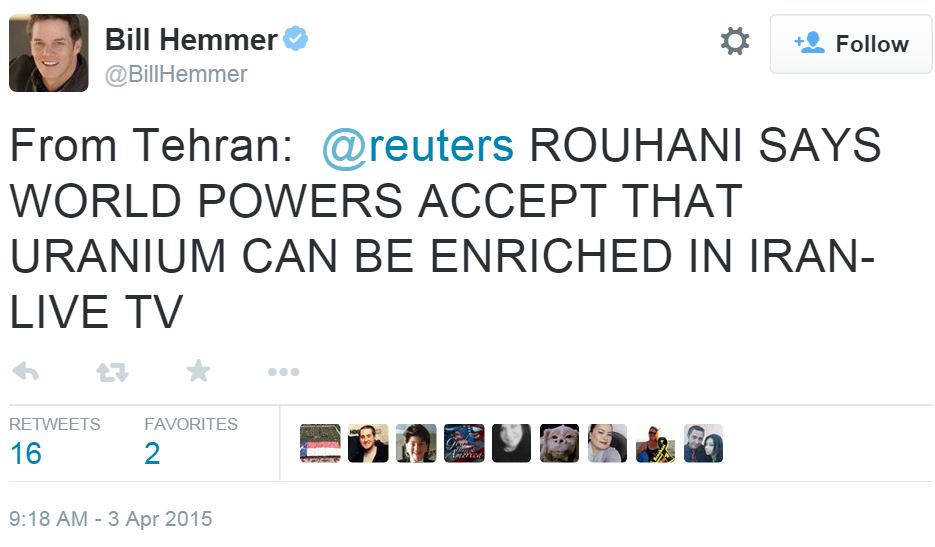
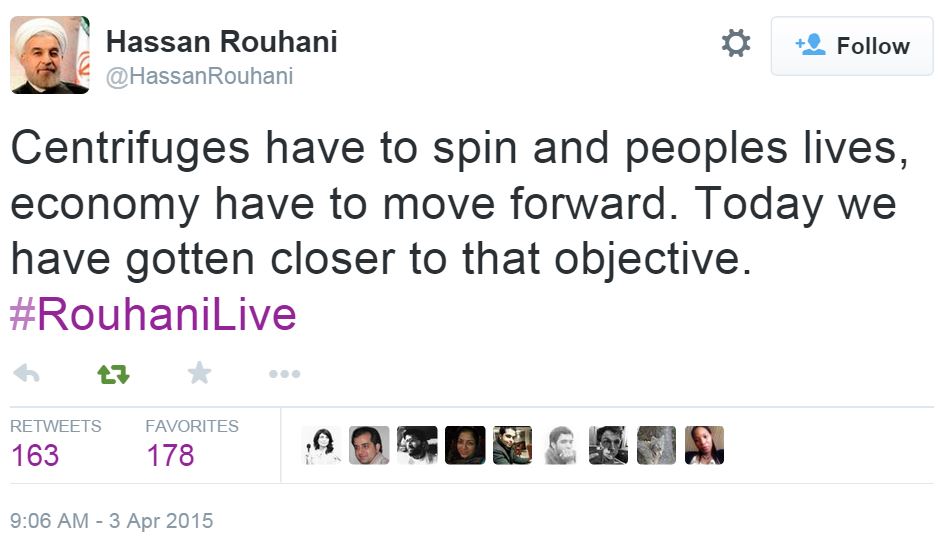
Meanwhile, the Mullah regime crowed at how they got what they wanted (see also tweets in yesterday’s post):

Twitter-Rhouani-Iran-Deal-Centrifuges-spin
Twitter-Bill-Hemmer-Rhouani-Iran-Deal-Enrichment
Twitter-Fars-News-Agency-Iran-Deal-Rouhani

Seems to me the Mullahs know something we don’t.

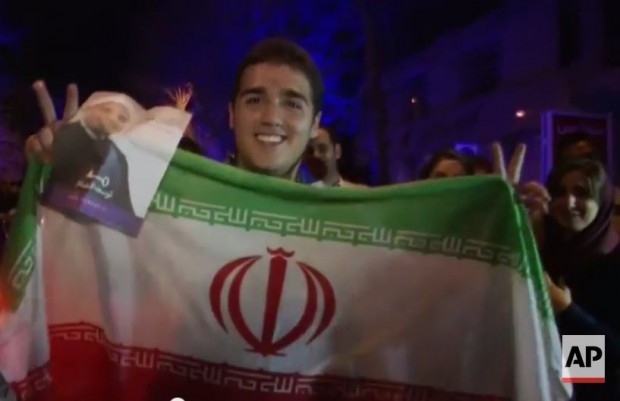
And Iranians took to the streets to celebrate:


There was a better deal to be had. The sanctions were hurting. Obama blinked, the Iranians didn’t.

Iran’s remarkable achievement

April 3, 2015

Iran’s remarkable achievement, Washington PostMichael Gerson, April 3, 2015

Will Iran continue to hold U.S. policy in the Middle East hostage — causing the United States to hush its reactions to Iranian aggression for fear the regime will walk out of a nuclear deal? This is precisely what American friends in the region fear. The real test — for allies and for members of Congress — will be whether Obama can accompany a final nuclear agreement with a much more aggressive resistance to Iranian ambitions in places such as Syria, Iraq and Yemen. Otherwise, Iran will simply use the wealth that comes from lifted sanctions to cause more havoc.

******************

Whatever else the Obama administration accomplished in the Iran nuclear framework, it did a good job keeping the bar of expectations low and then clearing it.

Many assumed various provisions would last 10 years or less; most are for 15 years or more. Many expected the number of operating centrifuges to exceed 6,000; the target is lower. Many expected the total amount of fissile material Iran is allowed to keep to be higher than the agreed 300 kilograms. These achievements created an initial halo of success.

But as former national security adviser Stephen Hadley emphasized to me, “things that seem too good to be true usually are.” In the days of Cold War arms-control agreements, Soviet negotiators would join in the announcement of notional goals. Later, they would claim that some elements would not fly with Moscow. The strategy was to pocket elements of consensus, then use this as the starting point for new negotiations and additional U.S. concessions.

Tehran can be expected to use every ambiguity in the agreement to its advantage as goals are converted into the language of a final deal. Disagreements are already emerging between the Obama administration and the Iranians on how and when sanctions will be lifted in exchange for compliance, with Foreign Minister Mohammad Javad Zarif essentially accusing the White House of deception.

Given the months of hard negotiations ahead, the self-congratulatory tone of President Obama’s speech announcing the agreement was extremely premature. “Depending on what we learn about critical details,” says professor Peter Feaver of Duke University, “this is not spiking in the end zone. It is spiking on the 5-yard line.”

A number of issues seem murky. What becomes of all the fissile material Iran has apparently agreed to export? What is done with the decommissioned centrifuges and infrastructure to make sure they can’t be easily reinstalled during a breakout attempt? What is the pace and ordering of sanctions relief by the United States, the European Union and the United Nations? How fully will Iran be required to account for past military dimensions of its nuclear programs?

But the largest question will not be answered by the next stage of nuclear negotiations. Will this agreement give the Iranian regime cover for what it is currently doing in the Middle East — actively spreading its influence and threatening our allies? Negotiations on the nuclear issue have taken place in isolation from the ballistic missile issue, the terrorism issue and the regional destabilization issue.

For all the praise Obama is claiming, the Iranian regime counts the most remarkable achievement. It has engaged in nuclear negotiations with the United States while actively engaged in a regional conflict against American friends and proxies. Since Obama has prioritized the nuclear negotiations — the only alternative to which, he constantly reminds us, is war — other concessions have seemed small in comparison. Opposition to Bashar al-Assad has become muted, even as he crosses every blood-red line of brutality, to avoid disrupting relations with his Iranian patron. Human rights issues within Iran have become secondary to avoid giving offense. Obama has sometimes seemed more tolerant and empathetic toward Iranian positions than those of allies and partners such as Israel.

Will Iran continue to hold U.S. policy in the Middle East hostage — causing the United States to hush its reactions to Iranian aggression for fear the regime will walk out of a nuclear deal? This is precisely what American friends in the region fear. The real test — for allies and for members of Congress — will be whether Obama can accompany a final nuclear agreement with a much more aggressive resistance to Iranian ambitions in places such as Syria, Iraq and Yemen. Otherwise, Iran will simply use the wealth that comes from lifted sanctions to cause more havoc.

If Iran is treated as a normal nation simply because of its nuclear cooperation — if it interprets a deal as a green light for its actions in the region — neither our traditional allies nor members of Congress will sustain Obama’s nuclear agreement in the long term. And the support of Congress could be dramatically helpful in surrounding a deal with snapback sanctions and the pre-authorization of military force in the event of an Iranian breach.

To secure his nuclear deal with Iran, Obama must show resistance to Iranian aggression across the range of our relationship.

Israel Should ‘Seriously Consider’ Striking Iran, Expert Says

April 3, 2015

Israel Should ‘Seriously Consider’ Striking Iran, Expert Says, Israel National News, Benny Toker and Ari Soffer, April 5, 2015

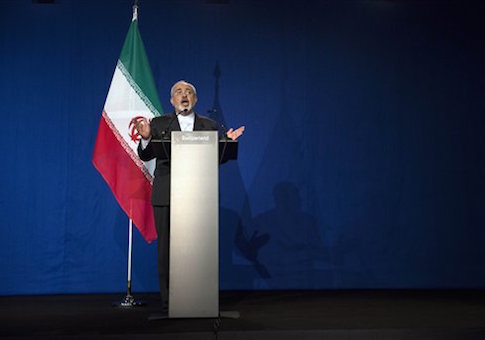
img576072Iranian FM Javad Zarif (R) at press conference announcing nuclear deal Reuters

[M]any countries – most notably Israel’s immediate neighbors – would be supportive of such a strike, and were waiting for Israel to neutralize the threat posed to them by a nuclear-capable Iranian regime.

“In practice no one wants to see a nuclear Iran; all of them are playing the gameso that Israel can pulls the chestnuts out of the fire.

******************

Israel should “seriously consider” a military strike on Iran’s nuclear facilities in the aftermath of the “framework deal” announced between Tehran and western powers Thursday, a leader defense and security expert said.

Speaking to Arutz Sheva Friday, Professor Efraim Inbar, who heads the Begin-Sadat Center for Strategic Studies, said the deal had realized Israel’s worst fears by leaving Iran’s nuclear program essentially intact.

The Islamic Republic’s nuclear program has been granted “legitimacy” by the agreement, which still allowed it to continue enriching uranium and to maintain a reactor capable of producing enriched plutonium, he said. “And that’s what worries Israel, that they (Iran) will be able within a short time frame to reach a nuclear bomb.”

“I hold the view that the only way to stop Iran in its journey to a nuclear bomb is through military means,” Inbar maintained, suggesting that “Israel needs to seriously consider striking a number of important nuclear facilities” to head off the threat.

Inbar went further, stating that Israel had made a serious mistake in not taking out Iran’s nuclear facilities until now. Now that the deal – however bad – was struck, a military strike would be far more difficult, he posited.

Nevertheless, practically-speaking Israel was left with little choice short of accepting a nuclear-armed Iran.

“As long as there was no deal it was easier for Israel to strike. They should have carried out a strike two years ago,” he said. “This is not an easy decision but it’s what needed to be done.”

Despite that fact, many countries – most notably Israel’s immediate neighbors – would be supportive of such a strike, and were waiting for Israel to neutralize the threat posed to them by a nuclear-capable Iranian regime.

“In practice no one wants to see a nuclear Iran; all of them are playing the game so that Israel can pulls the chestnuts out of the fire.

The deal, announced yesterday at a joint conference in Switzerland and widely celebrated as a “victory” in Iran, was quickly lauded by US President Barack Obama as an “historic” agreement.

“I am convinced that if this framework leads to a final comprehensive deal it will make our country, our allies and our world safer,” Obama asserted, insisting that despite criticisms the agreement would effectively cut off any options for Iran to build a nuclear bomb.

But despite Obama’s claim that there was “no daylight” between the US’s commitment to Israel’s security and the framework deal, Israeli officials heavily criticized it as an “historic mistake“.

“If an agreement is reached on the basis of this framework, it is an historic mistake which will make the world far more dangerous,” said the officials, briefing journalists on condition of anonymity.

“It is a bad framework which will lead to a bad and dangerous agreement. The framework gives international legitimacy to Iran’s nuclear program, the only aim of which is to produce a nuclear bomb,” they added.

In Congress as well – where legislators on both sides of the aisle have expressed serious concerns over the pending deal – House Speaker John Boehner branded the agreement “an alarming departure” from the president’s own declared goals. Nevertheless, legislators have given the White House a three-month reprieve on a bill to level harsher sanctions against Iran.

Israeli Prime Minister Binyamin Netanyahu is due to address the deal directly at a press conference Friday, after holding top-level talks withsecurity officials.

Benghazi, Bergdahl, and the Bomb

April 3, 2015

Benghazi, Bergdahl, and the Bomb, Washington Free Beacon, April 3, 2015

Column: President Obama’s stories haven’t held up before. How is the Iran deal any different?

ObamaAP

What the president and Secretary of State John Kerry unveiled Thursday was another fancy, another fairy-tale, another fable about what might happen in an ideal world where enemies and allies share common interests and objectives, autocratic and theocratic regimes adhere to compacts, and moral sincerity is more important than results. Best be skeptical—these so-called triumphs of Obama’s diplomacy have a way of falling to pieces like ancient parchment. And keep in mind this rule: When the president enters the Rose Garden, run for cover.

******************

President Obama strode to the lectern in the Rose Garden Thursday to announce a “historic” agreement between the United States and the Islamic Republic of Iran. The preliminary deal made in Lausanne, Switzerland, the president said, “cuts off every pathway Iran could take to develop a nuclear weapon.” I hope he’s right.

But I’m not counting on it. The president has a terrible record of initial public pronouncements on national security. He has a habit of confidently stating things that turn out not to be true. Three times in the last four years he has appeared in the Rose Garden and made assertions that were later proven to be false. He and his national security team have again and again described a world that does not correspond to reality. No reason to assume these concessions to Iran will be any different.

The U.S. consulate in Benghazi, Libya, was attacked on September 11, 2012. Four Americans were killed, including our ambassador. Obama delivered remarks on the attack in the Rose Garden the following day. “No acts of terror will ever shake the resolve of this great nation,” he said. What he didn’t say was that the killings in Benghazi specifically were a “terrorist attack” or “terrorism.” On 60 Minutes,when asked if he believed Benghazi was a “terrorist attack,” the president replied, “It’s too early to know how this came about.” On September 14, neither the president nor Secretary of State Hillary Clinton called what had happened a terrorist attack. On September 15, Obama referred to Benghazi as a “tragic attack.” On September 16, Susan Rice, then U.N. ambassador, called it a “spontaneous attack.”

By September 24, when Obama recorded a campaign interview with The View, he again refused to say Benghazi was an attack by terrorists. “We’re still doing an investigation,” he told Joy Behar. It was not until two days later that administration officials began referring to Benghazi as a terrorist attack—something the Libyan government had been saying since September 13.

The story originally put out by the White House, that Benghazi was the result of spontaneous anger at an Internet video offensive to Muslim extremists, fell apart in a matter of days. Yet the White House persisted in its false description of reality, declining to confirm what was widely accepted as a premeditated terrorist assault on a U.S. compound, and chose to ascribe responsibility for the events in question to anti-Islamic bias. The evidence continues to mount that Ansar al-Sharia, the Qaeda affiliate in lawless Libya, was behind the events of September 11, 2012, not the stupid video.

In August 2013 President Obama announced in the Rose Garden that Syrian dictator Bashar Assad had crossed the “red line” by gassing his own people. “Now, after careful deliberation, I have decided that the United States should take military action against Syrian regime targets,” the president said. Then he punted the issue to Congress. But no action against Syrian regime targets was ever taken, because the president reversed himself and accepted a Russian proposal to ship Assad’s WMD out of Syria. “This initiative has the potential to remove the threat of chemical weapons without the use of force, particularly because Russia is one of Assad’s strongest allies,” Obama said in a September 10, 2013, televised address. Almost two years later, Assad is dropping barrel bombs filled with chlorine gas on civilians. Success.

Last May, President Obama again walked purposefully to a lectern in the Rose Garden, and informed the world that he had released five Taliban commanders from Guantanamo Bay in exchange for Sergeant Bowe Bergdahl, who had been held prisoner by the Islamic militia for almost half a decade. “Right now,” the president said, “our top priority is making sure that Bowe gets the care and support that he needs and that he can be reunited with his family as soon as possible.”

Criticism of the prisoner swap was immediate, and intensified when Bergdahl’s platoon-mates said he had deserted his post. The White House, as usual, struck back against the critics and repeated its story. On June 2, Susan Rice, now national security adviser, went onThis Week with George Stephanopoulos and said Bergdahl “served the United States with honor and distinction.”

The Government Accountability Office concluded that the Obama administration’s actions were illegal. Bergdahl himself was kept isolated as the Army reviewed the circumstances of his capture by the enemy. Completed in the fall of 2014, the report by Brigadier General Kenneth Dahl still has not been released to the public.

Last week, however, the Army charged Bergdahl with desertion and misbehavior before the enemy. Has the White House reevaluated its trade? Of course not. On the contrary: Pentagon officials suggested on background that Bergdahl wasn’t a deserter, he was a whistleblower!

Three stories that collapsed under the weight of the evidence, three instances of the White House doggedly sticking to its policy line despite everything. This president’s resistance to events in the actual world of space and time is more than ideology, however. It’s also good politics: By refusing to concede the facts of the case, Obama is able to hold his base and stay on offense against his true adversaries: Republicans, conservatives, and Bibi Netanyahu.

And now we have the Iran story. Iran, the president says, will reduce its centrifuges, dilute its enriched uranium, open its nuclear sites to inspectors, and turn its fortified underground reactor into a “research” facility in exchange for sanctions relief. The only alternatives, Obama goes on, are bombing Iran or ending negotiations and re-imposing sanctions. “If, in fact, Prime Minister Netanyahu is looking for the most effective way to ensure Iran doesn’t get a nuclear weapon, this is the best option. And I believe our nuclear experts can confirm that.”

Sure they can. Though I believe other nuclear experts, such as Charles Duelfer, can also confirm that this agreement has major holes, such as the spotty effectiveness of inspections and the failure to get Iran to disclose fully the possible military dimensions of its nuclear program. And there’s always the tricky issue of sanctions relief: The United States says the process of lifting sanctions will be gradual and contingent on Iranian compliance, but Iranian foreign minister Javad Zarif says it will be immediate.

What the president and Secretary of State John Kerry unveiled Thursday was another fancy, another fairy-tale, another fable about what might happen in an ideal world where enemies and allies share common interests and objectives, autocratic and theocratic regimes adhere to compacts, and moral sincerity is more important than results. Best be skeptical—these so-called triumphs of Obama’s diplomacy have a way of falling to pieces like ancient parchment. And keep in mind this rule: When the president enters the Rose Garden, run for cover.

Iran Accuses U.S. of Lying About New Nuke Agreement

April 3, 2015

Iran Accuses U.S. of Lying About New Nuke Agreement, Washington Free Beacon, April 2, 2015

(Breaking news: Obama lied! That’s shocking. Who would’a thunk? — DM)

Switzerland Iran Nuclear TalksJavad Zarif / AP

LAUSANNE, Switzerland — Just hours after the announcement of what the United States characterized as a historic agreement with Iran over its nuclear program, the country’s leading negotiator lashed out at the Obama administration for lying about the details of a tentative framework.

Iranian Foreign Minister Javad Zarif accused the Obama administration of misleading the American people and Congress in a fact sheet it released following the culmination of negotiations with the Islamic Republic.

Zarif bragged in an earlier press conference with reporters that the United States had tentatively agreed to let it continue the enrichment of uranium, the key component in a nuclear bomb, as well as key nuclear research.

Zarif additionally said Iran would have all sanctions lifted once a final deal is signed and that the country would not be forced to shut down any of its currently operating nuclear installations.

Following a subsequent press conference by Secretary of State John Kerry—and release of a administration fact sheet on Iranian concessions—Zarif lashed out on Twitter over what he dubbed lies.

“The solutions are good for all, as they stand,” he tweeted. “There is no need to spin using ‘fact sheets’ so early on.”

Zarif went on to push back against claims by Kerry that the sanctions relief would be implemented in a phased fashion—and only after Iran verifies that it is not conducting any work on the nuclear weapons front.

Zarif, echoing previous comments, said the United States has promised an immediate termination of sanctions.

“Iran/5+1 Statement: ‘US will cease the application of ALL nuclear-related secondary economic and financial sanctions.’ Is this gradual?” he wrote on Twitter.

He then suggested a correction: “Iran/P5+1 Statement: ‘The EU will TERMINATE the implementation of ALL nuclear-related economic and financial sanctions’. How about this?”

The pushback from Iran’s chief diplomat follows a pattern of similar accusations by senior Iranian political figures after the announcement of previous agreements.

Following the signing of an interim agreement with Iran aimed at scaling back its nuclear work, Iran accused the United States of lyingabout details of the agreement.

On Thursday evening, Zarif told reporters the latest agreement allows Iran to keep operating its nuclear program.

“None of those measures” that will move to scale back Iran’s program “include closing any of our facilities,” Zarif said. “We will continue enriching; we will continue research and development.”

“Our heavy water reactor will be modernized and we will continue the Fordow facility,” Zarif said. “We will have centrifuges installed in Fordow, but not enriching.”

The move to allow Iran to keep centrifuges at Fordow, a controversial onetime military site, has elicited concern that Tehran could ramp up its nuclear work with ease.

Zarif said that once a final agreement is made, “all U.S. nuclear related secondary sanctions will be terminated,” he said. “This, I think, would be a major step forward.”

Zarif also revealed that Iran will be allowed to sell “enriched uranium” in the international market place and will be “hopefully making some money” from it.

A “preliminary deal” is announced in Lausanne. Zarif: There is no agreement, no commitments

April 2, 2015

A “preliminary deal” is announced in Lausanne. Zarif: There is no agreement, no commitments, DEBKAfile, April 2, 2015

Obama nuke dealBarack Obama hails nuclear “agreement”

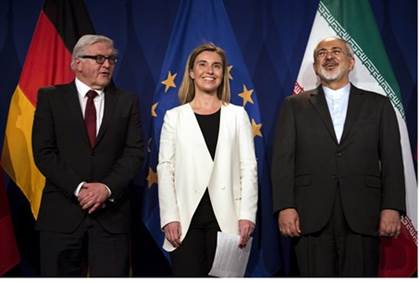
Iranian Foreign Minister Mohammed Javad Zarif and EU Foreign Policy Executive Federica Mogherini announced Thursday, April 2 that “a general agreement for a peaceful nuclear program and a lifting of sanctions against Iran” had been reached in Lausanne. “We have reached solutions on key parameters of a join comprehensive plan of action,” the details to be negotiated between now and June 30,” she said.

Speaking after the EU official, Zarif delivered a long statement ending with the declaration: “There is no agreement; and so no commitments” before June 30.

But President Barack Obama, commenting on the event at the White House, hailed the agreement as a historic event that will change the face of the world and make it a safer place.  “It is a deal that meets our core objectives.” There is no way Iran can get round it to build a bomb, or produce plutonium at its Arak plant. Obama stressed that the verification mechanisms built into the agreed framework would ensure that “if Iran cheats, the world with know it.”

This is a long-term agreement which promises that Iran’s nuclear program will be closely monitoried for the next 20 years. There is much work to be done to hammer out the details before June 30, Obama said, and voiced the hope that the Iranians would not back out of the principles they had accepted in Lausanne.

In the his view, there were just three options for dealing with the Iranian nuclear program: Military force that would hold the program back for no more than two years; more sanctions, when the first round had proved to have little impact; or diplomacy, which he had chosen.

Obama said hoped the US Congress would not heap obstacles in the path of an accord, because the majority of the American popular approved of the course he led.

Before the end of the day, the president said he would talk to Israeli Prime Minister Binyamin Netanyahu and Saudi King Salman, the two leading opponents of the nuclear deal.

The parameters outlined by Mogherini agreed for future negotiation:

• Iran’s enrichment capacity and stockpile would be limited, and Iran’s sole enrichment facility would be at the Natanz nuclear facility. Other nuclear facilities would be converted to other uses.

• The nuclear facility at Fordo would be converted to a nuclear physics and technology center and the facility at Arak would be redesigned as a heavy-water research reactor that will not produce weapons-grade plutonium.

• The European Union would terminate all nuclear-related economic and financial sanctions against Iran, and the United States would do the same once Iran’s implementation of the agreement is confirmed.

• The United Nations would terminate all previous resolutions sanctioning Iran, and would incorporate other restrictions for an agreed-upon period.

The Tricks Obama Is Trying to Play with the Iran Announcement

April 2, 2015

The Tricks Obama Is Trying to Play with the Iran Announcement, Commentary Magazine, April 2, 2015

(When will Iran say what and to whom about Obama’s new “framework?” Will Iran cloud the results of the negotiations as cleverly as did Obama? — DM)

If you look at what happened today between the U.S. and Iran through the lens of domestic American politics, Barack Obama has made a very clever play here—because what might be called “the agreement of the framework of the possibility of a potential deal” gives him new leverage in his ongoing battle with the Senate to limit its ability to play a role in the most critical foreign-policy matter of the decade.

The “framework” codifies the Obama administration’s cave-ins but casts them as thrilling reductions in Iran’s capacities rather than what they are—a pie-in-the-sky effort to use inspections as the means by which the West can “manage” the speed with which Iran becomes a nuclear power.

Obama’s tone of triumph this afternoon was mixed with sharp reminders that the deal is actually not yet done—and that is entirely the point of this exercise from a domestic standpoint. the triumph signals his troops and apologists that the time has come for them to stand with him, praise the deal sheet and pretend it’s a deal, declare it historic, and generally act as though the world has been delivered from a dreadful confrontation by Obama and Kerry.

But since the deal is not yet done, it could still be derailed. And that is where Obama’s truly Machiavellian play here comes in: He may have found a way to put the Senate in a box and keep Democrats from melting away from him on Iran and voting not only for legislation he doesn’t want but also to override the veto he has promised.

The Senate has two provisions at the ready with which it could go ahead any time. One, called Kirk-Menendez, imposes new sanctions on Iran. Obama promised a veto of this bill should it pass, and after today, one ought to presume that it’s dead.

The other, Corker-Menendez, requires the administration to submit any deal to the Senate within 60 days of its signing. This is a key provision because, of course, what the Iranians want—and what they said today they got—was the lifting of all sanctions. The president, in his statement, vowed to lift the “nuclear” sanctions (there are others involving human rights) if the Iranians comply by the terms of the deal.

Existing sanctions legislation features waivers the president can arguably use to do that. But those sanctions were put into place specifically to make it incredibly painful for Iran to retain any nuclear-weapons capability—not as a means of acceding to Iran’s retention of a nuclear capability.

For this reason, and for the reason that the president is essentially negotiating an arms-control treaty with Iran, the Senate should approve any final deal. Obama disagrees and claims this is merely a nuclear-agreement, not a treaty, and therefore Congress has no role.

That’s a very nervy argument. It is not only disrespectful of the Senate but it misrepresents the nature of what’s being negotiated. And that’s why it’s an argument it appeared the president would lose—that senators would not only vote for Corker-Menendez but would override his veto of it.

Which is why the deal-that’s-not-yet-a-deal works in his favor. Talks are now to continue until the end of June. Obama can and will argue to Democrats that they owe it to him, to their base, and to their governing ideology to give him all the room he needs to get to June 30.

Of course, if the legislation does not pass by June 30 and Obama signs a final deal, the game is up; the Senate can’t retroactively insist in July he bring it to them for a vote.

Will there be a deal by June 30? Maybe, maybe not; maybe they’ll finish, maybe they won’t; maybe the Iranians will say they didn’t agree to this or that and blow up the whole thing; who knows. Probably the total collapse, after all this, would bring the Kirk-Menendez sanctions back to life. Which is why there will never be a total collapse—because these talks can simply go on….

NBC’s Engel: Officials Say Allies: Simply Don’t Trust” U.S. Under Obama Admin – The Five

March 28, 2015

NBC’s Engel: Officials Say Allies: Simply Don’t Trust” U.S. Under Obama Admin – The Five, Fox News via You Tube, March 27, 2015

(In other breaking news, today is Saturday, unexpectedly. Please see also, Iranian general in Sanaa to organize Yemen rebel counter-offensive for Saudi-led attacks.  — DM)


Column One: Managing Obama’s war against Israel

March 27, 2015

Column One: Managing Obama’s war against Israel, Jerusalem Post, Caroline Glick, March 26, 2015

ShowImageUS President Barack Obama meets with Prime Minister Benjamin Netanyahu at the White House, October 1, 2014. (photo credit:REUTERS)

As Max Boot explained Wednesday in The Wall Street Journal, the administration’s animosity toward Israel is a function of Obama’s twin strategic aims, both evident since he entered office: realigning US policy in the Middle East toward Iran and away from its traditional allies Israel and the Sunni Arab states, and ending the US’s strategic alliance with Israel.

Obama has reached a point in his presidency where he is prepared to give full expression to his plan to end the US’s strategic alliance with Israel.

He thinks that doing so is both an end to itself and a means of succeeding in his bid to achieve a rapprochement with Iran.

*********************

On Wednesday the Jerusalem Municipality announced it is shelving plans to build 1,500 apartments in the Har Homa neighborhood. Officials gave no explanation for its sudden move. But none was needed.

Obviously the construction of apartments for Jews in Jerusalem was blocked in the hopes of appeasing US President Barack Obama.

But is there any reason to believe he can be appeased? Today the White House is issuing condemnations of Israel faster than the UN.

To determine how to handle what is happening, we need to understand the nature of what is happening.

First we need to understand that the administration’s hostility has little to do with Israel’s actions.

As Max Boot explained Wednesday in The Wall Street Journal, the administration’s animosity toward Israel is a function of Obama’s twin strategic aims, both evident since he entered office: realigning US policy in the Middle East toward Iran and away from its traditional allies Israel and the Sunni Arab states, and ending the US’s strategic alliance with Israel.

Over the past six years we have seen how Obama has consistently, but gradually, taken steps to advance these two goals. Toward Iran, he has demonstrated an unflappable determination to accommodate the terrorism supporting, nuclear proliferating, human rights repressing and empire building mullahs.

Beginning last November, as the deadline for nuclear talks between the US and its partners and Tehran approached, Obama’s attempts to accommodate Tehran escalated steeply.

Obama has thrown caution to the winds in a last-ditch effort to convince Iranian dictator Ali Khamenei to sign a deal with him. Last month the administration published a top secret report on Israel’s nuclear installations. Last week, Obama’s director of national intelligence James Clapper published an annual terrorism threat assessment that failed to mention either Iran or Hezbollah as threats.

And this week, the administration accused Israel of spying on its talks with Iran in order to tell members of Congress the details of the nuclear deal that Obama and his advisers have been trying to hide from them.

In the regional context, the administration has had nothing to say in the face of Iran’s takeover of the Bab el-Mandeb Strait and the Gulf of Aden this week. With its Houthi-proxy now in charge of the strategic waterway, and with its own control over the Straits of Hormuz, Iran is poised to exercise naval control over the two choke points of access to Arab oil.

The administration is assisting Iranian Shi’ite proxies in their battle to defeat Islamic State forces in the Iraqi city of Tikrit. It has said nothing about the Shi’ite massacres of Sunnis that come under their control.

Parallel to its endless patience for Tehran, the Obama administration has been treating Israel with bristling and ever-escalating hostility. This hostility has been manifested among other things through strategic leaks of highly classified information, implementing an arms embargo on weapons exports to Israel in time of war, ending a 40-year agreement to provide Israel with fuel in times of emergency, blaming Israel for the absence of peace, expressing tolerance and understanding for Palestinian terrorism, providing indirect support for Europe’s economic war against Israel, and providing indirect support for the BDS movement by constantly accusing Israel of ill intentions and dishonesty.

Then there is the UN. Since he first entered office, Obama has been threatening to withhold support for Israel at the UN. To date, the administration has vetoed one anti-Israel resolution at the UN Security Council and convinced the Palestinians not to submit another one for a vote.

In the months that preceded these actions, the administration exploited Israel’s vulnerability to extort massive concessions to the Palestinians.

Obama forced Benjamin Netanyahu to announce his support for Palestinian statehood in September 2009. He used the UN threat to coerce Netanyahu to agree to negotiations based on the 1949 armistice lines, to deny Jews their property rights in Jerusalem, Judea and Samaria, and to release scores of terrorist murderers from prison.

Following the nationalist camp’s victory in last week’s election, Obama brought to a head the crisis in relations he instigated. He has done so for two reasons.

First, next week is the deadline for signing a nuclear agreement with Iran. Obama views Netanyahu as the prospective deal’s most articulate and effective opponent.

As Obama sees it, Netanyahu threatens his nuclear diplomacy with Iran because he has a unique ability to communicate his concerns about the deal to US lawmakers and the American people, and mobilize them to join him in opposing Obama’s actions. The letters sent by 47 senators to the Iranian regime explaining the constitutional limitations on presidential power to conclude treaties without Senate approval, like the letter to Obama from 367 House members expressing grave and urgent concerns about the substance of the deal he seeks to conclude, are evidence of Netanyahu’s success.

The second reason Obama has gone to war against Israel is because he views the results of last week’s election as an opportunity to market his anti-Israel and pro-Iranian positions to the American public.

If Netanyahu can convince Americans to oppose Obama on Iran, Obama believes that by accusing Netanyahu of destroying chances for peace and calling him a racist, Obama will be able to win sufficient public support for his anti-Israel policies to intimidate pro-Israel Democratic lawmakers into accepting his pro-Iranian policies.

To this end, Obama has announced that the threat that he will abandon Israel at the UN has now become a certainty. There is no peace process, Obama says, because Netanyahu had the temerity to point out that there is no way for Israel to risk the transformation of Judea and Samaria into a new terror base. As a consequence, he has all but made it official that he is abandoning the peace process and joining the anti-Israel bandwagon at the UN.

Given Obama’s decision to abandon support for a negotiated peace between Israel and the Palestinians, modes of appeasement aimed at showing Israel’s good faith, such as Jewish building freezes, are no longer relevant. Scrapping plans to build apartments in Jewish neighborhoods like Har Homa will make no difference.

Obama has reached a point in his presidency where he is prepared to give full expression to his plan to end the US’s strategic alliance with Israel.

He thinks that doing so is both an end to itself and a means of succeeding in his bid to achieve a rapprochement with Iran.

Given this dismal reality, Israel needs to develop ways to minimize the damage Obama can cause.

Israel needs to oppose Obama’s policies while preserving its relations with its US supporters, including its Democratic supporters. Doing so will ensure that it is in a position to renew its alliance with the US immediately after Obama leaves office.

With regards to Iran, such a policy requires Israel to act with the US’s spurned Arab allies to check Iran’s expansionism and nuclear progress. It also requires Israel to galvanize strong opposition to Obama’s goal of replacing Israel with Iran as America’s chief ally in the Middle East and enabling it to develop nuclear weapons.

As for the Palestinians, Israel needs to view Obama’s abandonment of the peace process as an opportunity to improve our diplomatic position by resetting our relations with the Palestinians. Since 1993, Israel has been entrapped by the chimerical promise of a “two-state solution.”

By late 2000, the majority of Israelis had recognized that there is no way to achieve the two-state solution. There is no way to make peace with the PLO. But due to successive governments’ aversion to risking a crisis in relations with Washington, no one dared abandon the failed two-state strategy.

Now, with Obama himself declaring the peace process dead and replacing it with a policy of pure hostility toward Israel, Israel has nothing to gain from upholding a policy that blames it for the absence of peace.

No matter how loudly Netanyahu declares his allegiance to the establishment of a Palestinian state in Israel’s heartland, Obama will keep castigating him and Israel as the destroyer of peace.

The prevailing, 23-year-old view among our leadership posits that if we abandon the two-state model, we will lose American support, particularly liberal American support. But the truth is more complicated.

Inspired by the White House and the Israeli Left, pro-Israel Democrats now have difficulty believing Netanyahu’s statements of support for the establishment of a Palestinians state. But those who truly uphold liberal values of human rights can be convinced of the rightness of Israel’s conviction that peace is currently impossible and as a consequence, the two-state model must be put on the back burner.

We can maintain support among Republicans and Democrats alike if we present an alternative policy that makes sense in the absence of an option for the two-state model.

Such a policy is the Israeli sovereignty model. If the government adopts a policy of applying Israeli sovereignty over Judea and Samaria in whole – as I recommend in my book The Israeli Solution: A One- State Plan for Peace in the Middle East, or in part, in Area C, as Economy Minister Naftali Bennett recommends, our leaders will be able to defend their actions before the American people, including pro-Israel Democrats.

Israel must base its policy of sovereignty on two principles. First, this is a liberal policy that will ensure the civil rights of Palestinians and Israelis alike, and improve the Palestinians’ standard of living.

Second, such a policy is not necessarily a longterm or permanent “solution,” but it is a stable equilibrium for now.

Just as Israel’s decision to apply its laws to united Jerusalem and the Golan Heights in the past didn’t prevent it from conducting negotiations regarding the possible transfer of control over the areas to the Palestinians and Syrians, respectively, so an administrative decision to apply Israeli law to all or parts of Judea and Samaria will not block the path for negotiations with the Palestinians when regional and internal Palestinian conditions render them practicable.

The sovereignty policy is both liberal and strategically viable. If the government adopts it, the move will rebuild Israel’s credibility and preserve Israel’s standing on both sides of the aisle in Washington.

Never before has Israel had to deal with such an openly hostile US administration. Indeed, until 2009, the very notion that a day would come when an American president would prefer an alliance with Khamenei’s Iran to its traditional alliances with Israel and the Sunni Arab states was never even considered. But here we are.

Our current situation is unpleasant. But it isn’t the end of the world. We aren’t helpless. If we act wisely, we can stem Iran’s nuclear and regional advance. If we act boldly, we can preserve our alliance with the US while adopting a policy toward the Palestinians that for the first time in decades will advance our interests and our liberal values on the world stage.
Obama’s Kabuki dance with Iran fueling mullahs’ hegemony in Middle East

March 26, 2015

Obama’s Kabuki dance with Iran fueling mullahs’ hegemony in Middle East, BreitbartJames Lyons, March 25, 2015

(The present House of Representatives, despite a Republican majority, is very unlikely to bring a bill of impeachment. If it did the present Senate, despite a modest Republican majority, would not convict; that would require a two-thirds majority of the Senators present. We are stuck with Obama at least until January of 2017– DM)

ap_ap-photo681-640x426The Associated Press

The current Kabuki dance ongoing in Geneva between Secretary of State John Kerry and Iranian Foreign Minister Mohammad Jamad Zarif regarding an agreement on Iran’s nuclear weapons program is a sham. Its outcome was pre-ordained many years ago by President Obama in his secret communications with the Iranian mullahs in 2008– at least according to one report.

These secret communications were exposed in a August 29, 2014 article written by Michael Ledeen in PJ Media and drew little attention then, but now must be addressed. According to Ledeen, shortly after Barack Obama clinched the Democratic nomination for president on June 3, 2008, he also opened a secret communication channel to the Iranian mullahs.  The message was that they should not sign any nuclear agreement with the Bush administration on preventing Iran from achieving a nuclear weapon capability. He informed them that he would be much easier to deal with once he assumed the presidency. He further assured the mullahs that he was a “friend” of the Iranian theocracy and that they would be very happy with his policies.

Today, Iran is the world’s leading state sponsor of terrorism that has been “at war” with the United States since the 1979 takeover of our Tehran U.S. Embassy. Since then, Iran has directed many “acts of war” against the United States that have cost the loss of thousands of American lives. Most importantly, Iran provided the key material and training support to the 9/11 hijackers, which cost the lives of 3,000 innocent Americans.

The secret channel was conducted through Ambassador William G. Miller, who previously served in Iran during the Shah’s reign. The Ambassador confirmed to Ledeen the aforementioned communications he personally held with the Iranian mullahs on behalf of candidate Obama during the 2008 campaign. The Iranian mullahs apparently believed the message since on July 20, 2oo8, the New York Times reported “Nuclear Talks with Iran End on a Deadlock.”  The main reason was that Iran would not address the “international demands that it stop enriching uranium.”  What a surprise!

The shocking fact is that candidate Obama secretly told the Iranian mullahs not to make a deal until he assumed the presidency, according to Ledeen’s report. They would then be able to make a much better agreement with him – and that’s exactly what’s happening. Some would consider what candidate Obama did was treason.

President Obama abandoned the requirement that Iran stop enriching uranium.  The result has been that Iran’s nuclear program has been greatly expanded with more secret underground facilities and expanded capability during the course of the long, drawn out negotiations. When the interim agreement, called the “Joint Plan of Action,” was announced in late 2013, the Iranian president openly bragged that the West had finally acknowledged Iran’s right to its uranium enrichment program.

Iran’s chief negotiator, Foreign Minister Zarif, furthermore bragged that Iran “did not agree to dismantle anything; not its centrifuges; not its ballistic missile program; not its nuclear programs.”  It also did not give up its role as the leading state sponsor of terrorism. By his cooperation with Iran in combatting the Islamic State, he is actually sanctioning de facto Iranian hegemony throughout the Persian Gulf region.

Andy McCarthy, in his book Faithless Execution, lays out a very detailed and logical case for President Obama’s impeachment. Even Liberal law professors are now talking about Obama’s many abuses of power, too many to list here.  A summary of President Obama’s extensive violations of law and dereliction of duty are covered on pages 11-26 of Faithless Execution. President Obama’s use and abuse of power is clearly out of control. We are in a Constitutional crisis.

The Constitution vests in the House of Representatives “the sole power of impeachment.”  With a Republican controlled House of Representatives, a simple House Majority can vote out articles of impeachment. However, successfully impeaching a president means removing him from office. Removal requires the president’s conviction on articles of impeachment by a two-thirds vote of the Senate. Even with a Republican controlled Senate, this will require much work.

Clearly the Speaker of the House of Representatives must start the process. If the current Speaker is unable to find the courage to start the impeachment proceedings, then he should resign. The House members should elect a new Speaker who is prepared to live up to his Oath of Office and protect the Constitution. The survival of America as we know it, as the shining city on the hill, must come first before any party politics.