Archive for the ‘Turkey’ category

Obama’s Kobani Crossroads

October 15, 2014

Obama’s Kobani Crossroads, Algemeiner, Noah Beck, October 14, 2014

(Obama needs high profile stuff and photo ops to keep his polls from falling even more dramatically than they have. He needs help from Iran and little if anything else matters. It will be rewarded. — DM)
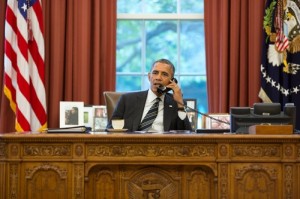
Obama on phone with RouhaniFrom the Oval Office, U.S. President Barack Obama speaks on the phone with Iranian President Hassan Rouhani on Sept. 27, 2013.

Instead of preemptively stopping ISIS from spreading into Iraq, Obama effectively waited until some high-profile beheadings forced him to focus on the danger. While such gruesome murders can reliably rally public opinion in favor of military action, the duty of the Commander-in-Chief is to lead and take military action when and how national security requires it, and not just when terrorists provoke some tardy and token airstrikes into empty buildings.

Kobani also has geostrategic importance to the Iranian nuclear threat. The more ISIS succeeds at capturing territory and recruiting fighters, a trend bolstered by Kobani’s fall, the more desperate the U.S. becomes for help from Iran, which, as leader of the Shiite world, is the natural enemy of the Sunni ISIS fighters.

[A]s Iran watches how feebly the U.S. responds to the loss of Iraq and how Obama cowers from a relatively minor fight in Kobani, the Ayatollahs can rest assured that there really is no U.S. military option to stop their nuclear program. This conclusion becomes all the more inevitable, when they look at Obama’s waning influence at home, as he enters the lame-duck period of his presidency.

*****************

President Obama has consistently disregarded the advice of his military experts on the ISIS threat. And he seems to have written off the Kurdish-Syrian town of Kobani, which may soon be overrun by ISIS.

Whatever the U.S. accomplished after about a decade of war in Iraq has, in a matter of months, deteriorated to a situation that may become unprecedented in its instability and threat to Western interests. Obama’s clumsy departure from Iraq, his military mismanagement of the mess that ensued, and his refusal to intervene in Syria – again, overruling his top security advisers – are what produced the current quagmire.

The loss of Christianity in Mosul didn’t have to happen. Obama’s tardy airstrikes managed to prevent the Mosul Dam from falling, but the city may never be the same. Similarly, why did the Yazidis have to find themselves besieged on Mount Sinjar before the U.S. took action?

Instead of preemptively stopping ISIS from spreading into Iraq, Obama effectively waited until some high-profile beheadings forced him to focus on the danger. While such gruesome murders can reliably rally public opinion in favor of military action, the duty of the Commander-in-Chief is to lead and take military action when and how national security requires it, and not just when terrorists provoke some tardy and token airstrikes into empty buildings.

As the next disaster is about to unfold on Obama’s watch, he should recognize that there is much more at stake with the fight for Kobani than just the loss to ISIS of a small town on the Syria-Turkey border.

Above all, letting Kobani fall means betraying our only ally fighting ISIS on the ground, and allowing them to be massacred while the world watches. What message does the U.S. send to Mideast partners and the world at large, if the Kurds are the only force providing the ground troops that Obama so desperately needs now, and yet Obama is unwilling to support them enough to avoid the horrific slaughter that will follow an ISIS victory in Kobani?

Kobani also has geostrategic importance to the Iranian nuclear threat. The more ISIS succeeds at capturing territory and recruiting fighters, a trend bolstered by Kobani’s fall, the more desperate the U.S. becomes for help from Iran, which, as leader of the Shiite world, is the natural enemy of the Sunni ISIS fighters. Because Iran also has one of the most powerful militaries in the region, and has – even before the ISIS crises – outmaneuvered the West in talks to curb Iranian nuclear ambitions, Iran could easily leverage the situation to secure tacit Western acceptance of its nukes. Indeed, Iran has already signaled its fight-ISIS-for-nukes strategy.

Even more important, as Iran watches how feebly the U.S. responds to the loss of Iraq and how Obama cowers from a relatively minor fight in Kobani, the Ayatollahs can rest assured that there really is no U.S. military option to stop their nuclear program. This conclusion becomes all the more inevitable, when they look at Obama’s waning influence at home, as he enters the lame-duck period of his presidency.

There is also a moral dimension to Kobani. Obama – in his 2009 and 2012 speeches on Holocaust Remembrance Day – proudly recalled how his great uncle helped to liberate a Nazi death camp. Yet Obama’s inaction in Syria has left about 200,000 dead, including many who were simply massacred, and Kobani may be where the next atrocities happen. Does the U.S. not hold itself to a higher standard than that of Turkey, which has thus far chosen just to watch the fighting a mere mile from its border?

Turkish history already includes genocides against the Armenian Christians and the Kurds (in the Dersim Massacre), so it’s no surprise that the Islamist regime of Recep Tayyip Erdoğan would let his army stand idly by, watching and waiting for ISIS to slaughter thousands of Kobani Kurds. But does the U.S. really want to be in the same camp as the Turks on this one? How much more shame will fall upon the United States, and the Obama legacy, when the Internet overflows with images of mass graves containing Kobani’s brave and abandoned fighters, along with Kurdish civilians who were too weak, infirm, or elderly to flee the approaching ISIS barbarism?

As if the above concerns weren’t enough to goad Obama into action, there is also the strategic impact of letting Kobani fall. As good as ISIS recruiting on social media already is, the popularity of this terrorist army among Islamists worldwide will surge when ISIS can boast about one more example of how even the mighty U.S. military can’t stop them.

Having foolishly telegraphed that he won’t send ground troops to confront ISIS, Obama can still try to convert his error into a feint by doing the opposite and sending troops to Kobani. At least that would restore some element of unpredictability to how ISIS regards U.S. military moves in the region.

Obama is effectively weeks away from the lame-duck portion of his presidency. If Republicans take Congress in next month’s midterm elections, then Obama will become that much more ineffectual. But the president can still try to demonstrate some leadership by changing his strategic approach to Mideast threats – if only to prevent his legacy from going into freefall. If the Middle East has only one lesson for Obama, it is that much can go terribly wrong in very little time. With Iranian nukes around the corner and ISIS on the march, two years of Mideast deterioration is a frighteningly long time to be on Obama’s watch.

CBS: Islamic State Gains Ground, ‘Closer To Total Control’ Of Anbar Province

October 14, 2014

You Tube, October 14, 2014

Turkey ‘providing direct support’ to ISIS

October 10, 2014

Turkey ‘providing direct support’ to ISIS, World Net DailyAaron Klein, October 9, 2014

(????????????????????? — DM)

kurdish-fighter

TEL AVIV – NATO member Turkey is providing direct intelligence and logistical support to the ISIS terrorist organization, according to a senior Egyptian security official speaking to WND.

The official said Egypt has information Turkish intelligence is passing to ISIS satellite imagery and other data, with particular emphasis on exposing to ISIS jihadists the positions of Kurdish fighters and the storage locations of their weapons and munitions.

The official confirmed reports that Turkey released ISIS terrorists from jail in a sweeping deal with the jihadist organization that saw the release of 49 hostages from the Turkish embassy in Mosul who were being held by ISIS.

While some news media reports say Turkey may have released at least 180 ISIS terrorists in the deal, including two British jihadists, the Egyptian official said the number of ISIS terrorists released by Turkey was closer to 700.

Tensions between the Turkish government and its Kurdish population have been high as Kurds have sought autonomy for three decades and have faced mass ISIS attacks.

Kurdish forces have been leading a military campaign targeting ISIS in Iraq and Syria.

On Tuesday, Kurdish protesters demanding help in the fight against ISIS clashed with police in Turkey, leaving at least 14 people dead and scores injured, according to reports.

The Egyptian information about Turkey’s alleged role in providing support to ISIS seems to bolster accusations against Turkey and Arab allies made last week by Vice President Joseph Biden.

It was reported Biden last weekend apologized to Turkish President Recep Tayyip Erdogan for “any implication” that Turkey or Arab allies had intentionally supplied weapons to ISIS or helped in the growth other Islamic jihadist groups in Syria, according to the White House.

One week ago, Biden told an audience at Harvard’s Kennedy School of Government that ISIS had been inadvertently strengthened by actions taken by Turkey, the United Arab Emirates and Arab allies who were supporting the insurgency against Syrian President Bashar al-Assad.

Biden further implied Turkey, the UAE and other Arab countries were supplying weapons to al-Qaida and its offshoots in Syria, including the al-Nusra front.

“They poured hundreds of millions of dollars and thousands of tons of weapons into anyone who would fight against Assad,” Biden told students. “Except that the people who were being supplied were al-Nusra and al-Qaida and the extremist elements of jihadis coming from other parts of the world.

“We could not convince our colleagues to stop supplying them,” Biden said.

Regarding Turkey’s alleged role, Biden said, “President Erdogan told me, he’s an old friend, said, ‘You were right. We let too many people (including foreign fighters) through.’ Now they are trying to seal their border.”

Erdogan told reporters he vehemently denied making such a statement.

Bombing for show? Or for effect?

October 10, 2014

Bombing for show? Or for effect? Washington Post OpinionCharles Krauthammer, October 9, 2014

The indecisiveness and ambivalence so devastatingly described by both of Obama’s previous secretaries of defense, Leon Panetta and Bob Gates, are already beginning to characterize the Syria campaign.

The Iraqis can see it. The Kurds can feel it. The jihadists are counting on it.

*********************

During the 1944 Warsaw uprising, Stalin ordered the advancing Red Army to stop at the outskirts of the city while the Nazis, for 63 days, annihilated the non-Communist Polish partisans. Only then did Stalin take Warsaw.

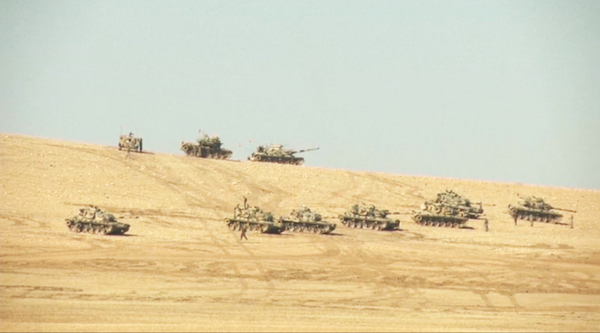
No one can match Stalin for merciless cynicism, but President Recep Tayyip Erdogan of Turkey is offering a determined echo by ordering Turkish tanks massed on the Syrian border, within sight of the besieged Syrian town of Kobane, to sit and do nothing.

For almost a month, Kobane Kurds have been trying to hold off Islamic State fighters. Outgunned, outmanned and surrounded on three sides, the defending Kurds have begged Turkey to allow weapons and reinforcements through the border. Erdogan has refused even that, let alone intervening directly. Infuriated Kurds have launched demonstrations throughout Turkey protesting Erdogan’s deadly callousness. At least 29 demonstrators have been killed.

Because Turkey has its own Kurdish problem — battling a Kurdish insurgency on and off for decades — Erdogan appears to prefer letting the Islamic State destroy the Kurdish enclave on the Syrian side of the border rather than lift a finger to save it. Perhaps later he will move in to occupy the rubble.

Moreover, Erdogan entertains a larger vision: making Turkey the hegemonic power over the Sunni Arabs, as in Ottoman times. The Islamic State is too radical and uncontrollable to be an ally in that mission. But it is Sunni. And it fights Shiites, Alawites and Kurds. Erdogan’s main regional adversary is the Shiite-dominated rule of Syria’s Bashar al-Assad. Erdogan demands that the United States take the fight to Assad before Turkey will join the fight against the Islamic State.

 It took Vice President Biden to accidentally blurt out the truth when he accused our alleged allies in the region of playing a double game — supporting the jihadists in Syria and Iraq, then joining the U.S.-led coalition against them. His abject apologies to the United Arab Emirates, Saudi Arabia and Turkey notwithstanding, Biden was right.

The vaunted coalition that President Obama touts remains mostly fictional. Yes, it puts a Sunni face on the war. Which is important for show. But everyone knows that in real terms the operation remains almost exclusively American.

As designed, the outer limit of its objective is to roll back the Islamic State in Iraq and contain it in Syria. It is doing neither. Despite State Department happy talk about advances in Iraq, our side is suffering serious reverses near Baghdad and throughout Anbar province, which is reportedly near collapse. Baghdad itself is ripe for infiltration for a Tet-like offensive aimed at demoralizing both Iraq and the United States.

As for Syria, what is Obama doing? First, he gives the enemy 12 days of warning about impending air attacks. We end up hitting empty buildings and evacuated training camps.

Next, we impose rules of engagement so rigid that we can’t make tactical adjustments. Our most reliable, friendly, battle-hardened “boots on the ground” in the region are the Kurds. So what have we done to relieve Kobane? About 20 airstrikes in a little more than 10 days, says Centcom.

That’s barely two a day. On the day after the Islamic State entered Kobane, we launched five airstrikes. Result? We hit three vehicles, one artillery piece and one military “unit.” And damaged a tank. This, against perhaps 9,000 heavily armed Islamic State fighters. If this were not so tragic, it would be farcical.

No one is asking for U.S. ground troops. But even as an air campaign, this is astonishingly unserious. As former E.U. ambassador to Turkey Marc Pierini told the Wall Street Journal, “It [the siege] could have been meaningfully acted upon two weeks ago or so” — when Islamic State reinforcements were streaming in the open toward Kobane. “Now it is almost too late.”

Obama has committed the United States to war on the Islamic State. To then allow within a month an allied enclave to be overrun — and perhaps annihilated — would be a major blow.

Guerrilla war is a test of wills. Obama’s actual objectives — rollback in Iraq, containment in Syria — are not unreasonable. But they require commitment and determination. In other words, will. You can’t just make one speech declaring war, then disappear and go fundraising.

The indecisiveness and ambivalence so devastatingly described by both of Obama’s previous secretaries of defense, Leon Panetta and Bob Gates, are already beginning to characterize the Syria campaign.

The Iraqis can see it. The Kurds can feel it. The jihadists are counting on it.

Islamic State seizes large areas of Syrian town despite air strikes

October 9, 2014

Islamic State seizes large areas of Syrian town despite air strikes, Yahoo News via Reuters, Daren Butler and Oliver Holmes, October 9, 2014

The United Nations says only a few hundred inhabitants remain in Kobani but the town’s defenders say the battle will end in a massacre if Islamic State prevails, giving it a strategic garrison on the Turkish border.

*********************

MURSITPINAR Turkey/BEIRUT (Reuters) – Islamic State fighters seized more than a third of the Syrian border town of Kobani, a monitoring group said on Thursday, as U.S.-led air strikes failed to halt their advance and Turkish forces nearby looked on without intervening.

With Washington ruling out a ground operation in Syria, Turkey described as unrealistic any expectation that it would conduct a cross-border operation unilaterally to relieve the mainly Kurdish town.

The commander of Kobani’s heavily outgunned Kurdish defenders said Islamic State controlled slightly less than a third of the town that lies within sight of Turkish territory.

However, he acknowledged that the militants had made major gains in a three-week battle that has also led to the worst streets clashes in years between police and Kurdish protesters across the frontier in southeast Turkey.

The Syrian Observatory for Human Rights said Islamic State, which is still widely known by its former acronym of ISIS, had pushed forward on Thursday.

“ISIS control more than a third of Kobani. All eastern areas, a small part of the northeast and an area in the southeast,” said Rami Abdulrahman, head of the Observatory which monitors the Syrian civil war.

Esmat al-Sheikh, leader of the militia forces in Kobani, said Islamic State had seized about a quarter of the town in the east. “The clashes are ongoing – street battles,” he told Reuters by telephone from the town.

Explosions rocked the town throughout Thursday, with black smoke visible from the Turkish border a few kilometres (miles) away. Islamic State hoisted its black flag in Kobani overnight and a stray projectile landed 3 km (2 miles) inside Turkey. The U.S.-led coalition carried out several airstrikes on Thursday and sporadic gunfire from the besieged town was audible.

The United Nations says only a few hundred inhabitants remain in Kobani but the town’s defenders say the battle will end in a massacre if Islamic State prevails, giving it a strategic garrison on the Turkish border.

They complain that the United States is giving only token support through the air strikes, while Turkish tanks sent to the frontier are looking on but doing nothing to defend the town.

Turkish Foreign Minister Mevlut Cavusoglu played down the likelihood of those forces going to the aid of Kobani.

The strikes had damaged an Islamic State training camp and destroyed one of its support buildings as well as two vehicles, CENTCOM said in a statement. They also hit one small unit and one large unit of militant fighters.

UNREALISTIC EXPECTATIONS

Despite Kurdish appeals for help, Turkey’s Foreign Minister Mevlut Cavusoglu played down the likelihood of its forces going to the aid of Kobani.

“It is not realistic to expect Turkey to conduct a ground operation on its own,” he told a joint news conference with visiting NATO chief Jens Stoltenberg. However, he added: “We are holding talks…. Once there is a common decision, Turkey will not hold back from playing its part.”

Ankara resents any suggestion from Washington that it is not pulling its weight, but wants broader joint action that also targets the forces of Syrian President Bashar al-Assad. “We strongly reject allegations of Turkish responsibility for the ISIS advance,” said a senior Ankara government source.

“Our allies, especially the U.S. administration, dragged their feet for a very long time before deciding to take action against the catastrophic events happening in Syria,” he added.

Turkey has long advocated action against Assad during the civil war, which grew out of a popular uprising in 2011. However, the United States called off air strikes on Damascus government forces at the last minute last year when Assad agreed to give up his chemical weapons.

Retired U.S. General John Allen, tasked by President Barack Obama to oversee the creation and work of the anti-Islamic State coalition, was in Ankara on Thursday and Friday for talks with the Turkish leadership.

President Tayyip Erdogan says he wants the U.S.-led alliance to enforce a “no-fly zone” to prevent Assad’s air force flying over Syrian territory near the Turkish border and create a safe area for an estimated 1.5 million Syrian refugees in Turkey to return.

But Stoltenberg said that establishing a no-fly zone or a safe zone inside Syria has not been discussed by NATO.

TURKISH CLASHES

At least 21 people died in the mainly Kurdish southeast of Turkey on Wednesday during clashes between security forces and Kurds demanding that the government do more to help Kobani. There were also clashes in Istanbul and Ankara.

The fallout from the war in Syria and Iraq has threatened to unravel Turkey’s peace process with its Kurdish community. Ankara has long been suspicious of any Kurdish assertiveness as it tries to end its own 30-year war with the outlawed Kurdistan Workers Party (PKK).

Following Wednesday’s violence in Turkey, streets have been calmer since curfews were imposed in five southeastern provinces, restrictions unseen since the 1990s when PKK forces were fighting the Turkish military in the southeast.

Erdogan said that protesters had exploited the events in Kobani as an excuse to sabotage the peace process. “Carrying out violent acts in Turkey by hiding behind the terror attacks on Kobani shows that the real intention and target is entirely different,” he said in a statement.

Selahattin Demirtas, the head of Kurdish People’s Democratic Party (HDP) which called on Turkish Kurds to take to the streets earlier this week, rejected accusations that this call had provoked the violence. Appealing for calm, he also said jailed PKK leader Abdullah Ocalan had called for talks with the government to be stepped up.

Kurdish leaders in Syria have asked Ankara to help establish a corridor which will allow aid and possibly arms and fighters to cross the border and reach Kobani, but Ankara has so far been reluctant to respond positively.

Syrian Kurds annoyed Ankara last year by setting up an interim administration in the northeast after Assad lost control of the region. Turkey wants Kurdish leaders to abandon their self-declared autonomy and has also been unhappy with their reluctance to join the wider opposition to Assad.

On the Turkish side of the frontier near Kobani, 21-year-old student Ferdi from the eastern Turkish province of Tunceli said if Kobani fell, the conflict would spread to Turkey. “In fact it already has spread here,” he said, standing with a group of several dozen people in fields watching the smoke rising from west Kobani.

Turkish police fired tear gas against protesters in the town of Suruç near the border overnight. A petrol bomb set fire to a house and the shutters on most shops in the town were kept shut in a traditional form of protest against state authorities.


Turkey’s leaders see Kobani as opportunity, not threat

October 8, 2014

Turkey’s leaders see Kobani as opportunity, not threat, al Monitor, Amberin Zaman, October 7, 2014

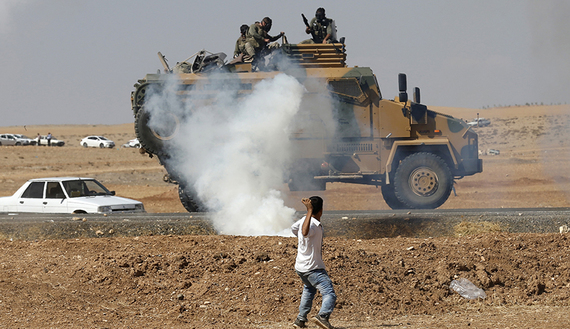
A protester throws stones at an armoured army vehicle during a pro-Kurdish demonstration, near the Mursitpinar border crossing on the Turkish-Syrian border, in SurucA protester throws stones at a Turkish armored vehicle during a pro-Kurdish demonstration in solidarity with the people of Kobani, near the Mursitpinar border crossing on the Turkish-Syrian border, Oct. 7, 2014. (photo by REUTERS/Umit Bektas)

The fall of Kobani would deal a severe blow to Kurdish independence hopes and bolster Turkey’s political goals.

The town has emerged as a symbol of Kurdish resistance.

***************

As Islamic State (IS) fighters keep up their battle to gain control over Kobani, a strategic Syrian Kurdish-controlled enclave on Turkey’s border, the effects of the conflict are being felt in Turkey itself. Thousands of Kurds took to the streets across the country on Oct. 7 to protest Turkey’s inaction against IS’ seemingly unstoppable advance. In the southeastern town of Varto, the government slapped curfews on six provinces in the mainly Kurdish southeast region after clashes between protestors and the security forces, and between rival Kurdish groups, left at least 14 people dead. Elsewhere across the country, police clashed with demonstrators, trying to push them back with pressurized water and pepper spray while the Kurds responded with Molotov cocktails in a foretaste of the violence that is likely to engulf the country should Kobani fall.

None of this comes as a surprise. Many Kurds continue to believe that Turkey is complicit in the jihadists’ onslaught against Kobani. Cemil Bayik, one of the top commanders of the Kurdistan Workers Party (PKK), repeated this claim in a Sept. 25 interview with Al-Monitor. Abdullah Ocalan, the imprisoned PKK leader, is threatening to call off peace talks with the Ankara government should there be a massacre in the enclave. Turkey denies it is siding with IS.

But it is doing little to aid the Kurds. This in turn invites the question of whether Turkey sees the Kurds as a greater threat than the jihadists, who stand to grab their third border crossing with Turkey. Turkish President Recep Tayyip Erdogan appeared to suggest that IS and the PKK were equally dangerous. “It is wrong to view them differently, we need to deal to them jointly,” he told reporters Oct. 3 in Istanbul. Erdogan’s comments hold the key to understanding Turkey’s policy on Kobani.

Turkey’s inaction over Kobani is undermining the peace process. Erdogan’s hopes of winning Kurdish support for constitutional amendments that would boost his presidential powers hang on friendship with the Kurds. A breakdown of the PKK’s 18-month-long cease-fire would likely jeopardize his ruling Justice and Development Party’s (AKP) chances in nationwide parliamentary elections scheduled for June. None of this appears to faze the Ankara government. This is because Erdogan and his AKP disciples view Kobani as an opportunity rather than a threat.

The opportunity ought to be to win the hearts and minds of Turkey’s Kurds by riding to the rescue of their brethren in Syria. Instead, Erdogan has chosen to exploit Kobani’s imminent fall to wrest maximum concessions from assorted Kurdish leaders. This was amply on display during last week’s secret meeting in Ankara between Salih Muslim, the co-chair of the Democratic Union Party (PYD), and senior Turkish officials from the Foreign Ministry and the national intelligence agency, MIT. Muslim reportedly beseeched the officials to allow the passage of arms and, most crucially, anti-tank weapons through the Mursitpinar border crossing with Kobani to enable Syrian Kurdish People’s Protection Units (YPG) fighters to fend off IS. Turkey said it would do so only if the PYD severed all its ties with the Syrian regime, joined the rebels, dissolved the PYD-dominated local governments running the enclaves, shared power with rival Syrian Kurdish parties and distanced itself from the PKK.

Muslim seems to have offered conflicting versions of what transpired, telling Al Jazeera that “agreement was reached in a number of areas” and the BBC that Turkey “did not keep its promises.” He has not responded to Al-Monitor’s repeated requests for comment. Either way, it’s hard to imagine that he yielded to Turkey’s demands or that he even has the authority to do so, because Ocalan and the PKK leadership in the Kandil Mountains call the final shots.

Turkey to its credit has offered sanctuary to more than 100,000 refugees from Kobani, and it is letting wounded YPG fighters in for treatment in hospitals. But Turkey would probably be happy to see Kobani fall. The town has emerged as a symbol of Kurdish resistance. It hosted Ocalan when he used to live in Syria under the patronage of the late Syrian President Hafez al-Assad. Kobani also has huge strategic significance. It lies between a swath of uninterrupted Kurdish-controlled towns and villages to the east collectively known as the canton of Jazeera and the Kurdish-administered town of Afrin to the southwest. The Kurds have long wanted to link the three by pushing out IS and other Syrian rebels from the areas separating them. The prospect of a Kurdish entity run by the PKK is more than Turkey, and especially its generals, can stomach.

Kobani’s fall would deal a humiliating blow to the PKK and weaken its support among Syria’s Kurds. It would also force Muslim and the PYD to patch up their differences with Massoud Barzani, the president of the Kurdistan Regional Government (KRG) in Iraq, who claims to be the “true leader” of all the Kurds. Although Barzani has spoken in defense of Kobani, he has yet to reproach Turkey over its stance.

Meanwhile, the PKK’s threats to resume its war sound like bluster to Turkish ears. Aaron Stein, a security analyst, told Al-Monitor, “The Turkish government is banking on the fact that the PKK can ill afford to open a second front against Turkey when it is battling IS in Iraq and in Syria.” Not only that, Ocalan would be loath to condemn himself to political irrelevance and spend the rest of his days rotting in prison. No matter how bitter, Kobani is a pill the Kurds will be forced to swallow. Ocalan will be forced to continue the peace talks, the pro-Kurdish People’s Democracy party (HDP) will play along and the PKK will hold its fire. This, anyway, seems to be Ankara’s thinking.

But it is fraught with risk.

The new generation of Kurds, as Bayik warned in his interview with Al-Monitor, is so radicalized that even the PKK finds it hard to keep them in line. Should Ocalan be perceived as capitulating to Turkey, he would lose his grip over them, too.

It was the fear of a PKK-dominated Kurdish statelet in Syria that propelled Turkey to resume peace talks with Ocalan in 2012 in the hope that he would keep the Syrian Kurds’ aspirations in check. The plan doesn’t seem to have worked. “The peace process began because of Syria’s Kurds,” recalls Arzu Yilmaz, a scholar of Kurdish affairs at Ankara University. “And it is because of them that it will unravel,” she concludes.

Editor’s Note: This piece has been updated since its initial publication.


U.S. officials: ISIS will capture Kobani, but it’s not a big concern to us

October 8, 2014

U.S. officials: ISIS will capture Kobani, but it’s not a big concern to us, CNN, Holly Yan and Elise Labott, October 8, 2014

(Please see video at the link. Turkey is not interested in helping the Kurds in Kobani, including the Kurdish fighters who are getting overwhelmed. Is keeping Turkey happy part of the Obama Administration war “strategy?”– DM)

As Time.com put it, “If the ISIS militants take control of Kobani, they will have a huge strategic corridor along the Turkish border, linking with the terrorist group’s positions in Aleppo to the west and Raqqa to the east.”

And Staffan de Mistura, U.N. special envoy for Syria, warned of the horrors ISIS could carry out against the people of Kobani — horrors it has carried out elsewhere. “The international community needs to defend them,” he said. “The international community cannot sustain another city falling under ISIS.”

********************

The key Syrian border city of Kobani will soon fall to the Islamist terror group ISIS, several senior U.S. administration officials said.

They downplayed the importance of it, saying Kobani is not a major U.S. concern.

But a look at the city shows why it would mark an important strategic victory for the Islamic mlitant group. ISIS would control a complete swath of land between its self-declared capital of Raqqa, Syria, and Turkey — a stretch of more than 100 kilometers (62 miles).

As Time.com put it, “If the ISIS militants take control of Kobani, they will have a huge strategic corridor along the Turkish border, linking with the terrorist group’s positions in Aleppo to the west and Raqqa to the east.”

And Staffan de Mistura, U.N. special envoy for Syria, warned of the horrors ISIS could carry out against the people of Kobani — horrors it has carried out elsewhere. “The international community needs to defend them,” he said. “The international community cannot sustain another city falling under ISIS.”

Coalition batters ISIS positions with airstrikes

A U.S.-led coalition has been pounding ISIS positions in the region with airstrikes for a few weeks.

The latest strikes, late Tuesday into Wednesday, included nine in Syria, the U.S. military said. Six were in the Kobani area, destroying an ISIS armored personnel carrier, four armed vehicles and two artillery pieces, U.S. Central Command said. U.S. and coalition forces also conducted five airstrikes against ISIS in Iraq, the military said.

The primary goal of the aerial campaign is not to save Syrian cities and towns, the U.S. officials said. Rather, the aim is to go after ISIS’ senior leadership, oil refineries and other infrastructure that would curb the terror group’s ability to operate — particularly in Iraq.

Saving Iraq is a more strategic goal for several reasons, the officials said. First, the United States has a relationship with the Iraqi government. By contrast, the Obama administration wants Syrian President Bashar al-Assad to step down.

Another reason: The United States has partners on the ground in Iraq, including Iraqi forces and Kurdish fighters known as Peshmerga.

Local fighters apparently made some headway Wednesday morning, when some ISIS militants in Kobani were pushed back to the city’s perimeter, Kurdish official Idriss Nassan said.

The battles have been bloody. More than 400 people have been killed in the fight for Kobani since mid-September, the Syrian Observatory for Human Rights said. The opposition group said it has documented the deaths of 219 ISIS jihadists, 163 members of the Kurdish militia and 20 civilians.

Kobani mapMap: Kobani (Ayn al-Arab)

U.S. plan against ISIS: Iraq first, then Syria

The United States’ goal is to first beat back ISIS in Iraq, then eliminate some of its leadership and resources in Syria, the U.S. administration officials said.

If all goes as planned, by the time officials turn their attention to Syria, some of the Syrian opposition will be trained well enough to tackle ISIS in earnest.

Washington has been making efforts to arm and train moderate Syrian opposition forces who are locked in a fight against both ISIS and the al-Assad regime.

Training Syrian rebels could take quite a long time.

“It could take years, actually,” retired Gen. John Allen said last week. “Expectations need to be managed.”

The United States also wants Turkey to do more, the officials said. The administration is urging Turkey to at least fire artillery at ISIS targets across the border.

But the Turkish reluctance, the officials say, is wrapped up in the complex relationship with their own Kurds and the idea that they don’t want to help any of the Kurds in any way.

Hundreds of strikes, millions of dollars

The United States and its allies have made at least 271 airstrikes in Iraq and 116 in Syria.

The cost? More than $62 million for just the munitions alone.

The effect? Negligible, some say, particularly in Iraq.

One by one, the cities have fallen to ISIS like dominoes: Hit, Albu Aytha, Kubaisya, Saqlawia and Sejal.

And standing on the western outskirts of Baghdad, ISIS is now within sight.

“That’s DAIISH right over there,” said Iraqi Brig. Gen. Ali Abdel Hussain Kazim, using the Arabic acronym for ISIS.

The militants’ proximity to the capital is cause for concern. If the terror group manages to infiltrate and launch attacks in Baghdad or its green zone, the results could be disastrous.

Kazim said ISIS has not been able to move from eastern Anbar province to Baghdad. But another brigadier general said that’s not even the biggest threat.

The real danger to the Iraqi capital, Brig. Gen. Mohamed al-Askari said, is from ISIS sympathizers in the city.

“They are a gang,” he said. “They deploy among civilians. They disappear into the civilian population and camouflage themselves.”

Is it a ‘war’? An ‘armed conflict’? Why words matter in the U.S. fight vs. the Islamic State.

October 8, 2014

Is it a ‘war’? An ‘armed conflict’? Why words matter in the U.S. fight vs. the Islamic State, Washington PostKaren DeYoung, October 7, 2014

(The teachings of “international law” are amorphous; meanings depend largely on who interprets it and why. See also  Humpty Dumpty: “”When I use a word,” Humpty Dumpty said, in rather a scornful tone, “it means just what I choose it to mean—neither more nor less.” “The question is,” said Alice, “whether you can make words mean so many different things.”  “The question is,” said Humpty Dumpty, “which is to be master—that’s all.” — DM)

When is a war not a war? Does it matter, when a bomb is dropped or a missile launched, whether it’s called “counterterrorism,” or “armed conflict,” or “hostilities”?

Actually, it does — especially to a president who has said he wants to keep American military action within the bounds of U.S. and international law, and to administration officials who have spent countless hours in recent weeks parsing the language used to describe operations in Syria.

It matters to the American people, who have said in surveys that they favor airstrikes against Islamic State militants in both Syria and Iraq but aren’t much interested in fighting another Middle East ground war. It also matters to Congress, which has not authorized a war since World War II but may decide to approve this specific “use of military force.”

For civilians on the ground, the likelihood of being hit by a U.S. airstrike may be different under President Obama’s narrow guidelines for non-war counterterrorism than under broader international rules governing “armed conflict.” And European allies, several of which have joined U.S. air operations in Iraq, remain uncertain of the international legal justification for military action in Syria.

The administration’s definition of what it is doing has continued to evolve in recent weeks. As government lawyers struggle to provide the president with maximum flexibility under both domestic and international law, the results at times have seemed both inconsistent and confusing.

When Obama announced on Sept. 10 that he had authorized offensive U.S. military action, he emphasized the potential threat the Islamic State posed to the U.S. homeland and said his objective was to “degrade and ultimately destroy” the group. Neither the president nor White House briefers who provided additional context for his remarks mentioned a request by the government of Iraq to conduct airstrikes in Syria.

Yet that request is now cited as a key international legal underpinning for the strikes that began on Sept. 22. It is not clear when it was initially made. On Sept. 23, U.S. Ambassador to the United Nations Samantha Power referred to an Iraqi letter sent to the U.N. secretary general three days earlier reporting an appeal to the United States to “lead international efforts to strike ISIL sites and military strongholds in Syria in order to end the continuing attacks on Iraq.”

Power cited the U.N. Charter’s recognition of the legitimacy of using force for both individual and collective self-defense. She did not mention the objective of destroying the Islamic State, also known as ISIL and ISIS.

The day after Obama’s nationwide address, CNN asked Secretary of State John F. Kerry whether the United States was at war with the Islamic State. That was the “wrong terminology,” Kerry said. “What we are doing is engaging in a very significant counterterrorism operation.”

Three days later, on CBS’s “Face the Nation,” Kerry called such semantic debates “a waste of time.” But, he said, “If people need a place to land . . . yes, we’re at war with ISIL.”

Obama, who has said in the past that the United States is “at war with al-Qaeda,” seemed to disagree when asked the war question about the Islamic State on CBS’s “60 Minutes” on Sept. 28.

“This is not America against ISIL,” he said. “This is America leading the international community to assist a country [Iraq] with whom we have a security partnership with, to make sure that they are able to take care of their business.”

When reporters asked the Pentagon press secretary, Rear Adm. John F. Kirby, on Tuesday whether the U.S. military was “at war with ISIL,” his response was succinct. “Yes, yes,” Kirby said.

Administration lawyers, seeking outside advice, have discussed the Iraq and Syria operations with a number of former officials. “We have encouraged them . . . to clarify publicly their legal theories under both domestic and international law,” said a participant in some of those closed-door discussions who would only discuss a private meeting on the condition of anonymity.

‘Armed conflict’ vs. ‘war’

International law, which uses the words “armed conflict” instead of “war,” applies whether states are fighting each other or against “non-state actors,” such as terrorist groups, although terrorists by definition do not follow the rules.

The law recognizes the possibility of civilian casualties. But governments cannot intentionally target civilians, and any action putting civilians at risk must be proportionate to the importance of the military objective.

In guidelines for lethal counterterrorism action he outlined last year, Obama imposed the narrower standard of “near certainty” that there would be no civilian casualties. But “that was then and this is now,” said John B. Bellinger III, State Department legal counsel in the George W. Bush administration. “I mean that seriously. When they were coming up with all those rules a year ago, they thought the terrorist threat was heading in one direction. Now it seems to be a completely different direction.”

Amid reports of civilian casualties from U.S. strikes in Syria — which the Pentagon said it had not confirmed — administration officials said the “near certainty” standard applied only “outside areas of active hostilities,” based on “among other things, the scope and intensity of the fighting,” said a senior administration official who spoke on the condition of anonymity about legal conclusions.

“We consider Iraq and Syria to be ‘areas of active hostilities,’ based on what we are seeing on the ground right now,” the official said. “This is not the same as a determination that an armed conflict is taking place in the country at issue.” Nevertheless, the official said, the administration has chosen to comply with laws applicable to armed conflict where possible civilian casualties are concerned.

But “in international law, there is only one concept — an armed conflict, or not,” said one former senior administration official who spoke on the condition of anonymity to candidly describe the administration’s quandary. The United States, the former official said, now recognizes something in between — a new category of “a hot battlefield, or an area of active hostilities.”

The administration has also said its actions are a legal response to the threat because Syria is “unwilling or unable” to fight the Islamic State itself. Naz Modirzadeh, founding director of the Harvard Law School Program on International Law and Armed Conflict, called that concept an example of “folk international law.”

Established law, she wrote Thursday on the Lawfare blog, includes no such distinction for violations of sovereignty.

The role of Congress

Under the Vietnam-era War Powers Resolution, the president must notify Congress whenever he sends U.S. forces into “hostilities” and must withdraw them after 60 days unless lawmakers agree.

Obama observed the requirement when launching U.S. military operations in Libya in the spring of 2011 but then adopted what critics called an elastic definition in deciding that the situation did not constitute “hostilities” that put U.S. military personnel at risk, and thus was not subject to the deadline.

In Iraq and Syria, Obama sent the notifications but has said he does not need congressional approval, because U.S. actions are separately justified by the president’s constitutional authority as commander in chief and the 2001 Authorization for Use of Military Force (AUMF) against al-Qaeda and its associates.

Last year, Obama proposed narrowing, and ultimately repealing, the al-Qaeda measure as outdated in an era in which that organization’s core leadership had been “decimated” and new, independent terrorist threats were emerging. Although he pledged to consult Congress on new authorizations for new threats, and some legislation was proposed, nothing had happened by the time the Islamic State took over vast territory in both Syria and Iraq.

The Islamic State and al-Qaeda have mutually and publicly rejected any association with each other. But the administration has said the once-rejected AUMF is valid, because the Islamic State is rooted in an al-Qaeda-linked group born in Iraq a decade ago.

Who Does Turkey Support?

October 7, 2014

Who Does Turkey Support? Gatestone InstituteBurak Bekdil, October 7, 2014

(Oh well.

— DM)

In short, to finish off jihadists, Washington will now work with the man who until recently funded and reinforced these same jihadists, and is proud of his love affairs with Hamas and the Muslim Brotherhood. Hamas’s overseas command center happens to be based in Turkey. Good luck.

Turkish soldiers in tanks are lined up along Turkey’s border with Iraq, “observing” ISIS troops close in on the Syrian Kurdish town of Kobani, in what appears an approaching massacre.

In pragmatic Islamist thinking, one does not properly become a “martyr” if he gets killed by an army other than Israel’s.

As of this writing, on the Turkey-Syria border, CNN correspondent Phil Black hourly beams pictures of the Syrian Kurdish city of Kobani, with a black ISIS flag atop a building in the eastern part of the city, as Turkish soldiers in tanks lined up along the Turkish border “observe” ISIS troops close in for the approaching massacre.

Washington is expecting Ankara wholeheartedly to fight the rougher boys of the Islamist camp to which it belongs? Good luck.

*****************

Last week, U.S. Vice President Joe Biden had to zigzag between the truth that accidentally spilled out of him and Washington’s pragmatism. In a speech at Harvard’s Kennedy School of Government, Biden said: “[Turkish] President (Recep Tayyip) Erdogan, he is an old friend, said you were right, we let too many people through, now we are trying to seal the border.”

The “people,” however, whom Erdogan said Ankara had “let through” were the jihadists whom Turkey had supported with arms and money, and who have now become an international nightmare.

In other words, the U.S. vice president was publicly saying that the Turkish president had confessed to supporting terrorists.

Then Erdogan threatened: “If he [Biden] really said that, he would become history for me.” Finally, a White House statement announced: “The vice president apologized for any implication that Turkey or other allies and partners in the region had intentionally supplied and facilitated the growth of ISIL or other extremists in Syria.”

Erdogan has never hidden that he is ideologically a next of kin to the Muslim Brotherhood and Hamas. Hamas’s overseas command center happens to be based in Turkey. Erdogan has been Hamas’s staunchest (non-Hamas) cheerleader in the last decade, and the Brotherhood’s key regional ally. Press reports say that Turkey has recently welcomed in the Brotherhood’s top brass, who were expelled on Sept. 13 from their five-million-star hotels in Qatar. Ankara has not denied that it is offering a safe haven to the leaders of the Islamist organization.

In short, to finish off the jihadists who have captured large swathes of land in Iraq and Syria, Washington will now work with the man who until recently funded and reinforced these same jihadists (and their various offspring) and is proud of his love affairs with Hamas and the Brotherhood. More ironically, a U.S.-led coalition of nations including Arab states recently killed one of Erdogan’s heroes when the coalition forces struck an ISIS camp in Syria.

733Turkish tanks near the border with Syria, October 2014

When, in 2010, a Turkish-led flotilla that included the ship Mavi Marmara sailed towards Gaza to “break Israel’s siege” of the Hamas-controlled land, Erdogan greeted everyone on board as “heroes.” And when the Israel Defense Forces [IDF] raided the Mavi Marmara and killed nine Turks aboard, Erdogan greeted the Turks as “martyrs.”

Since then, Erdogan has vehemently denied any Turkish governmental support for the Mavi Marmara. He claims he was merely objecting to “Israel’s unjust oppression of the Palestinians.”

But, he insists, no governmental involvement at all.

About a fortnight after the incident, the foreign press in Turkey received a package from the Press and Information General Directorate, a government office reporting to Erdogan. The envelope did not contain a letter, or an explanatory note. Instead, its only content was a DVD, the cover of which showed a photomontage of an Israeli soldier pointing a rifle at a vessel. The vessel was encircled in David’s Star. The DVD cover read: “Moments of Horror.” The line below that read: “Interviews With the Injured Aboard the Aid for Gaza Ship / With English Subtitles.”

As the package arrived, the radio was still quoting Erdogan and his ministers as saying that the flotilla was entirely a nongovernmental initiative.

The Mavi Marmara incident was a wake-up call to Jerusalem, where diplomats had earlier been unrealistically optimistic about building a working relationship with Erdogan despite several other, earlier, warnings, including Erdogan’s famous tirade in Davos against (then) Israeli President Shimon Peres that, “You (Jews) know well how to kill!” The Turkish government has since frozen ambassadorial-level diplomatic relations between Turkey and Israel, and Erdogan has increased his calculated explosive rhetoric against Israel.

Erdogan’s principal argument was that a foreign military had killed Turkish nationals outside of Turkey; that those who were killed were martyrs; and that he would never allow a foreign military to harm one single Turkish citizen. Once again, he was wrong.

One of the lucky survivors of the Mavi Marmara was Yakup Bulent Alniak, an Islamist activist for the Turkish “humanitarian aid group” IHH which organized the Gaza-bound flotilla. IHH is listed by many Western countries as a terrorist organization; but its members, including Alniak, were simply heroes for Erdogan.

Alniak survived the IDF raid in 2010 but lost his life recently, at the end of September, when a U.S.-Arab coalition struck one of the largest ISIS camps in Syria. A coalition of foreign armies had killed a Turkish citizen whom the Turkish leader had declared a hero, but since then Erdogan has remained mute.

Will Erdogan downgrade Turkey’s diplomatic ties with the U.S. and five Muslim nations because their militaries killed a Turkish citizen outside of Turkish territory? No. Probably because, in the pragmatic Islamist thinking, one does not properly qualify as a “martyr” if he gets killed by an army (or armies) other than Israel’s.

As of this writing, on the Turkey-Syria border, CNN correspondent Phil Black hourly beams pictures of the Syrian Kurdish city of Kobani, with a black ISIS flag atop a building in the eastern part of the city, as Turkish soldiers in tanks lined up along the Turkish border “observe” ISIS troops close in for the approaching massacre.

Washington is expecting Ankara wholeheartedly to fight the rougher boys of the Islamist camp to which it belongs? Good luck.

Turkey, the Kurds and Iraq: The Prize and Peril of Kirkuk

October 7, 2014

Turkey, the Kurds and Iraq: The Prize and Peril of Kirkuk, Stratfor, Reva Bhalla, October 7, 2014

Turkey cannot be comfortable with the idea that Kirkuk is in the hands of the Iraqi Kurds unless Ankara is assured exclusive rights over that energy [oil] and the ability to extinguish any oil-fueled ambitions of Kurdish independence.

***************

In June 1919, aboard an Allied warship en route to Paris, sat Damat Ferid Pasha, the Grand Vizier of a crumbling Ottoman Empire. The elderly statesman, donning an iconic red fez and boasting an impeccably groomed mustache, held in his hands a memorandum that he was to present to the Allied powers at the Quai d’Orsay. The negotiations on postwar reparations started five months earlier, but the Ottoman delegation was prepared to make the most of its tardy invitation to the talks. As he journeyed across the Mediterranean that summer toward the French shore, Damat Ferid mentally rehearsed the list of demands he would make to the Allied powers during his last-ditch effort to hold the empire together.

He began with a message, not of reproach, but of inculpability: “Gentlemen, I should not be bold enough to come before this High Assembly if I thought that the Ottoman people had incurred any responsibility in the war that has ravaged Europe and Asia with fire and sword.” His speech was followed by an even more defiant memorandum, denouncing any attempt to redistribute Ottoman land to the Kurds, Greeks and Armenians, asserting: “In Asia, the Turkish lands are bounded on the south by the provinces of Mosul and Diyarbakir, as well as a part of Aleppo as far as the Mediterranean.” When Damat Ferid’s demands were presented in Paris, the Allies were in awe of the gall displayed by the Ottoman delegation. British Prime Minister David Lloyd George regarded the presentation as a “good joke,” while U.S. President Woodrow Wilson said he had never seen anything more “stupid.” They flatly rejected Damat Ferid’s apparently misguided appeal — declaring that the Turks were unfit to rule over other races, regardless of their common Muslim identity — and told him and his delegation to leave. The Western powers then proceeded, through their own bickering, to divide the post-Ottoman spoils.

Under far different circumstances today, Ankara is again boldly appealing to the West to follow its lead in shaping policy in Turkey’s volatile Muslim backyard. And again, Western powers are looking at Turkey with incredulity, waiting for Ankara to assume responsibility for the region by tackling the immediate threat of the Islamic State with whatever resources necessary, rather than pursuing a seemingly reckless strategy of toppling the Syrian government. Turkey’s behavior can be perplexing and frustrating to Western leaders, but the country’s combination of reticence in action and audacity in rhetoric can be traced back to many of the same issues that confronted Istanbul in 1919, beginning with the struggle over the territory of Mosul.

The Turkish Fight for Mosul

Under the Ottoman Empire, the Mosul vilayet stretched from Zakho in southeastern Anatolia down along the Tigris River through Dohuk, Arbil, Alqosh, Kirkuk, Tuz Khormato and Sulaimaniyah before butting up against the western slopes of the Zagros Mountains, which shape the border with Iran. This stretch of land, bridging the dry Arab steppes and the fertile mountain valleys in Iraqi Kurdistan, has been a locus of violence long before the Islamic State arrived. The area has been home to an evolving mix of Kurds, Arabs, Turkmen, Yazidis, Assyro-Chaldeans and Jews, while Turkish and Persian factions and the occasional Western power, whether operating under a flag or a corporate logo, continue to work in vain to eke out a demographic makeup that suits their interests.

mosul-vilayet

At the time of the British negotiation with the Ottomans over the fate of the Mosul region, British officers touring the area wrote extensively about the ubiquity of the Turkish language, noting that “Turkish is spoken all along the high road in all localities of any importance.” This fact formed part of Turkey’s argument that the land should remain under Turkish sovereignty. Even after the 1923 signing of the Treaty of Lausanne, in which Turkey renounced its rights to Ottoman lands, the Turkish government still held out a claim to the Mosul region, fearful that the Brits would use Kurdish separatism to further weaken the Turkish state. Invoking the popular Wilsonian principle of self-determination, the Turkish government asserted to the League of Nations that most of the Kurds and Arabs inhabiting the area preferred to be part of Turkey anyway. The British countered by asserting that their interviews with locals revealed a prevailing preference to become part of the new British-ruled Kingdom of Iraq.

The Turks, in no shape to bargain with London and mired in a deep internal debate over whether Turkey should forego these lands and focus instead on the benefits of a downsized republic, lost the argument and were forced to renounce their claims to the Mosul territory in 1925. As far as the Brits and the French were concerned, the largely Kurdish territory would serve as a vital buffer space to prevent the Turks from eventually extending their reach from Asia Minor to territories in Mesopotamia, Syria and Armenia. But the fear of Turkish expansion was not the only factor informing the European strategy to keep northern Iraq out of Turkish hands.

The Oil Factor

Since the days of Herodotus and Nebuchadnezzar, there have been stories of eternal flames arising from the earth of Baba Gurgur near the town of Kirkuk. German explorer and cartographer Carsten Niebuhr wrote in the 18th century: “A place called Baba Gurgur is above all remarkable because the earth is so hot that eggs and meat can be boiled here.” The flames were in fact produced by the natural gas and naphtha seeping through cracks in the rocks, betraying the vast quantities of crude oil lying beneath the surface. London wasted little time in calling on geologists from Venezuela, Mexico, Romania and Indochina to study the land and recommend sites for drilling. On Oct. 14, 1927, the fate of Kirkuk was sealed: A gusher rising 43 meters (around 140 feet) erupted from the earth, dousing the surrounding land with some 95,000 barrels of crude oil for 10 days before the well could be capped. With oil now part of the equation, the political situation in Kirkuk became all the more flammable.

The British mostly imported Sunni Arab tribesmen to work the oil fields, gradually reducing the Kurdish majority and weakening the influence of the Turkmen minority in the area. The Arabization project was given new energy when the Arab Baath Socialist Party came to power through a military coup in 1968. Arabic names were given to businesses, neighborhoods, schools and streets, while laws were adjusted to pressure Kurds to leave Kirkuk and transfer ownership of their homes and lands to Arabs. Eviction tactics turned ghastly in 1988 under Saddam Hussein’s Anfal campaign, during which chemical weapons were employed against the Kurdish population. The Iraqi government continued with heavy-handed tactics to Arabize the territory until the collapse of the Baathist regime in 2003. Naturally, revenge was a primary goal as Kurdish factions worked quickly to repopulate the region with Kurds and drive the Arabs out.

ethnic-composition-of-kirkuk

Even as Kirkuk, its oil-rich fields and a belt of disputed territories stretching between Diyala and Nineveh provinces have remained officially under the jurisdiction of the Iraqi central government in Baghdad, the Kurdish leadership has sought to redraw the boundaries of Iraqi Kurdistan. After the Iraqi Kurdish region gained de facto autonomy with the creation of a no-fly zone in 1991 and then formally coalesced into the Kurdistan Regional Government after the fall of Saddam Hussein, Kurdish influence gradually expanded in the disputed areas. Kurdish representation increased through multi-ethnic political councils, facilitated by the security protection these communities received from the Kurdish peshmerga and by the promise of energy revenues, while Baghdad remained mired in its own problems. Formally annexing Kirkuk and parts of Nineveh and Diyala, part of the larger Kurdish strategy, would come in due time. Indeed, the expectation that legalities of the annexation process would soon be completed convinced a handful of foreign energy firms to sign contracts with the Kurdish authorities — as opposed to Baghdad — enabling the disputed territories to finally begin realizing the region’s energy potential.

Then the unexpected happened: In June, the collapse of the Iraqi army in the north under the duress of the Islamic State left the Kirkuk fields wide open, allowing the Kurdish peshmerga to finally and fully occupy them. Though the Kurds now sit nervously on the prize, Baghdad, Iran, local Arabs and Turkmen and the Islamic State are eyeing these fields with a predatory gaze. At the same time, a motley force of Iran-backed Shiite militias, Kurdish militants and Sunni tribesmen are trying to flush the Islamic State out of the region in order to return to settling the question of where to draw the line on Kurdish autonomy. The Sunnis will undoubtedly demand a stake in the oil fields that the Kurds now control as repayment for turning on the Islamic State, guaranteeing a Kurdish-Sunni confrontation that Baghdad will surely exploit.

The Turkish Dilemma

The modern Turkish government is looking at Iraq and Syria in a way similar to how Damat Ferid did almost a century ago when he sought in Paris to maintain Turkish sovereignty over the region. From Ankara’s point of view, the extension of a Turkish sphere of influence into neighboring Muslim lands is the antidote to weakening Iraqi and Syrian states. Even if Turkey no longer has direct control over these lands, it hopes to at least indirectly re-establish its will through select partners, whether a group of moderate Islamist forces in Syria or, in northern Iraq, a combination of Turkmen and Sunni factions, along with a Kurdish faction such as Kurdistan Regional Government President Massoud Barzani’s Kurdistan Democratic Party. The United States may currently be focused on the Islamic State, but Turkey is looking years ahead at the mess that will likely remain. This is why Turkey is placing conditions on its involvement in the battle against the Islamic State: It is trying to convince the United States and its Sunni Arab coalition partners that it will inevitably be the power administering this region. Therefore, according to Ankara, all players must conform to its priorities, beginning with replacing Syria’s Iran-backed Alawite government with a Sunni administration that will look first to Ankara for guidance.

However, the Turkish vision of the region simply does not fit the current reality and is earning Ankara more rebuke than respect from its neighbors and the West. The Kurds, in particular, will continue to form the Achilles’ heel of Turkish policymaking.

In Syria, where the Islamic State is closing in on the city of Kobani on Turkey’s border, Ankara is faced with the unsavory possibility that it will be drawn into a ground fight with a well-equipped insurgent force. Moreover, Turkey would be fighting on the same side as a variety of Kurdish separatists, including members of Turkey’s Kurdistan Workers’ Party, which Ankara has every interest in neutralizing.

Turkey faces the same dilemma in Iraq, where it may unwittingly back Kurdish separatists in its fight against the Islamic State. Just as critical, Turkey cannot be comfortable with the idea that Kirkuk is in the hands of the Iraqi Kurds unless Ankara is assured exclusive rights over that energy and the ability to extinguish any oil-fueled ambitions of Kurdish independence. But Turkey has competition. Iraqi President Jalal Talabani’s Patriotic Union of Kurdistan is not willing to make itself beholden to Turkey, as did Barzani’s Kurdistan Democratic Party, while financial pressures continue to climb. Instead, the Patriotic Union of Kurdistan is staying close to Iran and showing a preference to work with Baghdad. Meanwhile, local Arab and Turkmen resistance to Kurdish rule is rising, a factor that Baghdad and Iran will surely exploit as they work to dilute Kurdish authority by courting local officials in Kirkuk and Nineveh with promises of energy rights and autonomy.

This is the crowded battleground that Turkey knows well. A long and elaborate game of “keep away” will be played to prevent the Kurds from consolidating control over oil-rich territory in the Kurdish-Arab borderland, while the competition between Turkey and Iran will emerge into full view. For Turkey to compete effectively in this space, it will need to come to terms with the reality that Ankara will not defy its history by resolving the Kurdish conundrum, nor will it be able to hide within its borders and avoid foreign entanglements.

Turkey, the Kurds and Iraq: The Prize and Peril of Kirkuk is republished with permission of Stratfor.”