Archive for the ‘Turkey’ category

Who is the Real Chickenshit?

November 4, 2014

Who is the Real Chickenshit? Gatestone InstituteBassam Tawil, November 4, 2014

(Are attempts to spawn a new Islamic Caliphate more grounded in fantasy than Obama-Kerry perceptions of the Islamic State, grounded in their ill-formed perceptions of fact and ideology? Or less? — DM)

Judging by their actions, most Arab leaders do not want to create yet another terrorist Islamist state, dedicated to the Muslim Brotherhood’s ideology and to toppling their regimes. We do want a Palestinian state, but please, only one that will provide responsible governance.

According to the “Arab street,” it is the Americans and Europeans who are cowards, afraid to take significant steps against Iran, and terrified of the Islamic ghettoes in their cities, which have been exporting terrorists to fight for the Islamic State, and providing housing to the seasoned fighters who return.

To Arabs, the ultimate irony is that America is paying Qatar to have its airbase there, while Qatar is paying terrorists to kill Americans.

When John Kerry claimed it was the unresolved Palestinian issue that caused a ripple effect that crated ISIS, he simply inspired the Palestinians to use Al-Aqsa mosque as a religious trigger for future bloodshed.

There is a civil war currently under way between radical Islam — motivated by imperialist fantasies of restoring the Islamic Caliphate — and the more moderate secular Muslim regimes that are seeking the path to modernization and progress.

At the same time, Sunni Islam is in the midst of an increasingly violent crisis in its dealings with Shi’ite Iran, which looks as if it is about to be granted nuclear weapons capability, and which for decades quietly has been eyeing neighboring Arab oil fields.

Into the middle of this explosive disarray, U.S. Secretary of State John Kerry and his supporters have thrown the accusation that it was actually Israel’s so-called refusal to reach a peace agreement that was responsible for the ripple effect that led to the creation of ISIS. This incorrect diagnosis of the situation merely postpones the West’s efforts to find a real, workable solution for the Palestinian issue.

774Does Kerry really blame Israel for ISIS? Above, U.S. Secretary of State John Kerry meets with Israeli Prime Minister Benjamin Netanyahu in Tel Aviv, Israel, on July 23, 2014. (Image source: U.S. State Department)

It is easy for the leaders of the Arab world to latch onto Kerry’s accusation and use it justify their weakness and unwillingness to enter into a direct battle against terrorism; to let America do the dirty work, and conveniently to relieve the Arab world of having to recognize Israel and establish a Palestinian state.

They would also be able to avoid dealing with Israel’s demand for the Palestinian territories to be disarmed and the Palestinians’ demands for concessions from Israel.

Judging by their actions, most Arab leaders have no desire to see the Palestinian issue resolved. They seem to prefer preserving the status quo. They blame Israel for refusing to make concessions to the Palestinians and hope that this refusal will weaken Israel, even though Israel is their strategic defense against Iran.

Most Arab leaders do not want to create what is bound soon to become yet another terrorist Islamist state, dedicated to the Muslim Brotherhood’s ideology and to toppling their regimes. The Arab leaders already have to contend with ISIS, Al-Qaeda and the Al-Nusra Front in Syria, Iraq, Libya and Yemen, which are enough for them, to say nothing of Africa from Nigeria to Somalia and everything in between.

But if Israel can be blamed for another of world’s ills, with Kerry’s blessing, why waste the opportunity?

When Jordan’s King Abdullah called the current Islamic civil war a cry of distress, he was not speaking randomly. There is a genuine problem.

No examples are better than Turkey, Qatar and Iran. Turkey, led by its president, Recep Tayyip Erdogan, hosts Hamas’s overseas command center; is supported by Qatar and would apparently like to take control of more Sunni territory by subverting the Sunni Arab monarchies. Such a move would enable Erdogan to realize his outspoken dream of recreating an Ottoman Empire and Caliphate.

Turkey and Qatar, its partner in plotting the return of the Caliphate, have left their fingerprints on most of the terrorist attacks and catastrophes currently visited upon the Middle East, especially in the fields of subversion, incitement to terrorism, and the arming and training of terrorists.

The Middle Eastern Sunni Islamist terrorist organizations, meanwhile, are being incited and indoctrinated by Al-Jazeera TV, a Muslim Brotherhood megaphone that belongs to Qatar’s ruling al-Thani family. It was Al Jazeera’s Arabic channel that created the “Arab Spring” by taking the story of a fruit-seller who merely wanted a permit, and whipping it up, non-stop, until it grew into a revolution that brought down Tunisia’s government.

The Middle East’s terrorist gangs are now armed and trained with funding from Qatar. Recently, in yet another savored irony, Turkey agreed to help train Syrian rebels and allow the U.S. to use its military bases — but for Turkey, the plan is probably to bring down Syria’s non-Sunni President, Bashar Al-Assad, and not, as the U.S. might imagine, to bring down ISIS.

In the past, Persian Gulf states such as Saudi Arabia joined in training Islamic terrorist cadres, but currently, as the Arab proverb goes, “The magic spell boomeranged,” and Saudi Arabia and its Gulf allies have to defend themselves from the very groups they helped create.

Terrorist organizations are now generously funded by Qatar and NATO-member Turkey, which inspire them to attack the regimes of Egypt, Syria, Iraq and Jordan, and various regimes in the Persian Gulf and Africa. Of course, they are all also inspired to attack Israel, as Hamas has done.

Turkey and Qatar are also exploiting the naiveté of the Western world, encouraging ISIS operatives to make preparations to attack Europe and the United States. Preachers of “political Islam” incite susceptible Islamic youths in the West and prepare them for a terrorist campaign. They use the West’s political correctness, free speech and support for “pluralism,” all the while insisting they are not preaching terrorism.

Turkey and Qatar, along with Iran — which does its utmost to export the Ayatollah Khomeini’s Islamic Revolution throughout both North and South America, as well as Syria, Lebanon, Iraq and Yemen — are aided by a mechanism known as the da’wah, or “outreach,” Da’wah, technically the preaching of Islam, is used by political Islam for indoctrinating, enlisting and handling Islamist terrorists worldwide. Perfected for terrorist purposes by the Muslim Brotherhood, its mouthpiece is Sheikh Yusuf al-Qaradawi, who, like Hamas’s leader, Khaled Mashaal, is based in Qatar.

While Iran’s rivals, the Sunni states, conduct their civil wars, Iran only becomes stronger. Not only is it turning itself into a nuclear power, it is also strengthening all its outposts in the Middle East and around the world. It supports the Shi’ite regime in Iraq against ISIS; it arms and funds the Houthis in Yemen and the Hezbollah in Lebanon; and it supports the Syrian Alawite regime against its Sunni opponents.

When it comes to terrorism, Iran does not draw partisan lines. It also supports the Sunni groups Hamas and Palestinian Islamic Jihad, both of which seek to destroy Israel and attack the Egyptians in the Sinai Peninsula.

In response to the colossal threat of radical Islam, the whimpering voice of the West can barely be heard. The U.S. administration targeted Israel for condemnation. A “senior official,” most likely the current White House Chief of Staff Denis McDonough, called Israel’s Prime Minister Benjamin Netanyahu a “chickenshit,” for being afraid to make peace with the Palestinians.

According to the “Arab street,” including the Palestinian street, it is the Americans and Europeans who are cowards, afraid to take significant steps against Iran, and terrified of the Islamic ghettoes in their cities, which have been exporting terrorists to fight for the Islamic State, and providing housing to the seasoned fighters who return.

The Sunni states under Shi’ite threat cannot even reach an agreement among themselves about what is to be done; and the Palestinians, in their folly, have chosen the worst possible moment to ignite violence in Jerusalem and the Al-Aqsa mosque. The Palestinians seem not to understand that the Arab regimes that might support them are currently busy fighting for their own survival, and have no desire to fall prey to Palestinian provocations about what they realize all too well are fictional threats to Jerusalem.

Given the current situation, Turkey’s regional political actions are dangerous, underhanded and hypocritical. To achieve their ends, Turkey’s leaders seem to have no qualms about sacrificing their minorities, such as Christians and the Kurds (most of whom are Sunni). Turkey’s leaders were the first to cry “humanitarian crisis” when Israel imposed a closure on the Gaza Strip to prevent Iran from sending Hamas arms. Turkey sent the Mavi Marmara flotilla to protect the Gazans, who were never in any danger in the first place. Turkey’s leaders then weakened Palestinian Authority President Mahmoud Abbas, who, at least at that time, showed himself willing to reach a peace agreement with the Israelis. But when Syria’s Kurds are being killed in Kobani on a daily basis, the Turks are silent, perhaps secretly comfortable seeing a group that wants a state of its own apart from Turkey, being attacked.

Thus, when John Kerry claimed that it was the unresolved Palestinian issue that caused a ripple effect that created ISIS, he simply inspired the Palestinians to use Al-Aqsa mosque as a religious trigger for future bloodshed. The idea is not new; it was used in 1929 by the Grand Mufti of Jerusalem and led to anti-Jewish riots and the massacre of the Jews in Hebron. It was used again by PLO Chairman Yasser Arafat in 2000, to incite the Palestinians to the second intifada, which killed untold numbers of Jews and Arabs. Today, Mahmoud Abbas and Hamas’s Khaled Mashaal are doing the same thing to incite a jihad that this time will truly be religious and not based on real estate.

The more Kerry accuses Israel of having had a hand in creating ISIS, the more the Palestinians will use Al-Aqsa mosque to stir the fire burning under the bubbling cauldron of the Middle East.

The Palestinians’ religious incitement campaign is currently being waged primarily by Mahmoud Abbas, the man who stood in front of the UN and accused Israel of fomenting a religious war. This is the same Mahmoud Abbas who calls on Palestinians to use every means available to fight Israel, while at the same time denying that he is doing so.

Meanwhile, Qatar lurks in the background, instructing Al-Jazeera TV to incite the Palestinians against Israel, Egypt and Jordan, and encouraging terrorist attacks that lead only to justified Israeli reprisals.

Qatar’s royal family hides behind the security of having a major U.S. airbase on its soil, while supporting Hamas, the Islamic Movement in Israel and the terrorist organizations in the Sinai Peninsula. To Arabs, the ultimate irony is that Americans are paying Qatar to have an airbase there, while Qatar is paying terrorists to kill Americans.

Qatar also still finds time nonsensically to accuse the wakf in Jordan, responsible for Al-Aqsa mosque, of collaborating with Israel to eradicate all signs of Muslim presence on the Temple Mount. Qatar’s only plan with that at the moment, however, is to cause riots in Jordan to oust Jordan’s king.

Inspired by Western accusations against Israel and the West’s enthusiastic recognition of a Palestinian state — without requiring the direct negotiations with Israel, as obligated by international treaties — the Palestinian leadership has become more radicalized.

Mahmoud Abbas has gone so far as to abandon his pretense of moderation: if the Israelis can be accused of creating the ISIS with no mention made of the culpability of Hamas, whose ideology is the same as ISIS’s, Mahmoud Abbas has been freed of any commitment to peace and can actively pursue the unilateral declaration of a Palestinian state.

In addition, witnessing Russia’s abrogation of its 1994 Budapest Memorandum with the Ukraine, with virtually no adverse consequences, must have seemed a precedent too tempting to ignore. Thus, the Palestinian Authority and Hamas do truly speak with one voice, but it is the voice of Hamas.

Khaled Mashaal, head of Hamas’s political bureau, called on all the Palestinians to take up arms to defend Al-Aqsa mosque in Jerusalem. The mosque, he said, justifies jihad and the sacrificing of shaheeds [martyrs] to liberate it, and, as in the Hamas charter, that “resistance” is the only solution for the problems of the Palestinian people.

Mashaal was echoed by Mahmoud Abbas at the 14th Fatah conference. Abbas said that under no condition were Jews to be allowed into Al-Aqsa mosque or the Church of the Holy Sepulcher, because any Jewish presence would defile them. On whose authority did he take possession of the Christian holy sites? A short time earlier, Abbas had even claimed that he had no intention of inciting a third intifada against Israel.

Somehow, John Kerry has managed to link to Israel the Shi’ite-Sunni civil wars, radical Islam’s Muslim Brotherhood-inspired global plot and the creation of ISIS. Then he linked the failure of the Palestinian issue to have been resolved to Israel’s Prime Minister Benjamin Netanyahu.

The unpopular and inconvenient truth is: if there is to be peace, Hamas has to be disarmed, the Palestinian Authority and the Gaza Strip have to be demilitarized, Mahmoud Abbas has to recognize the State of Israel as the homeland of the Jews, and Netanyahu has to recognize the Palestinians state. Israel will then compensate the Palestinians with land in return for the land on which the three large blocks of settlements stand, as has already been agreed.

It is not Israel but the Palestinians who are trying to avoid negotiating a final agreement. They see themselves, with the backing of the UN and Secretary Kerry — and in a final breakdown of any trust in future international agreements — as able to achieve their desired result without having to make any concessions.

People who repeat infamies, as Kerry has done, not only encourage radicalism, they are just delaying the establishment of a Palestinian state. We do want a Palestinian state, but please only one that will provide responsible governance.

Uncertain Future for Kobane Prisoners: Turkey’s Border War (Dispatch 3)

October 21, 2014

Uncertain Future for Kobane Prisoners: Turkey’s Border War (Dispatch 3), You Tube, Vice News, October 20, 2014


What do Kobani airdrops mean for regional politics?

October 21, 2014

What do Kobani airdrops mean for regional politics? Al-MonitorAmberin Zaman, October 20, 2014

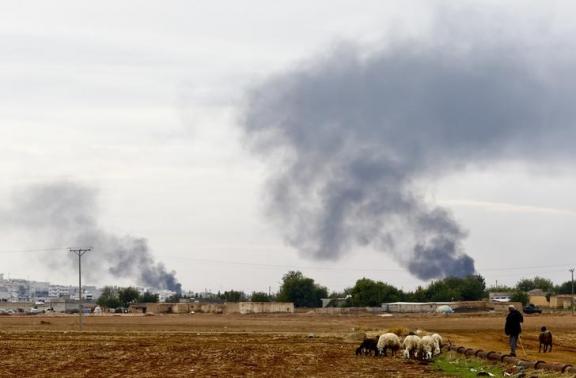
Smoke and flames rise over Syrian town of Kobani after an airstrikeSmoke and flames rise over the Syrian town of Kobani after an airstrike, as seen from the Mursitpinar crossing on the Turkish-Syrian border in the southeastern town of Suruc, Oct. 20, 2014. The United States told Turkey that a US military airdrop of arms to Syrian Kurds battling the Islamic State in Kobani was a response to a crisis situation and did not represent a change in US policy. (photo by REUTERS/Kai Pfaffenbach

The US will use its new leverage over the PYD to push the Kurds to engage with factions opposed to Syrian President Bashar al-Assad, particularly the Free Syrian Army. The YPG’s existing battleground alliance with various rebel factions will, therefore, probably expand.

****************

On Oct. 19, the US Central Command (CENTCOM) announced that it had conducted multiple airdrops near the Syrian Kurdish town of Kobani, which has remained under siege by Islamic State (IS) fighters for more than a month. CENTCOM said US C-13 cargo planes had made multiple drops of arms, ammunition, and medical supplies provided by Kurdish authorities in Iraq. The move is set to have a profound effect on regional balances between Turkey, the Kurds and the United States that will likely reverberate in Tehran and in Damascus as well.

For several weeks now, the US and its allies have been bombing IS positions around Kobani. But the delivery of weapons takes the de facto alliance between the Syrian Kurds and the United States to a new level.

Turkey, which borders Kobani, is best positioned to help the Syrian Kurds. But the country’s ruling Justice and Development (AKP) party has spurned repeated Syrian Kurdish demands to allow weapons and fighters to cross through Turkey into the Syrian Kurdish enclave. On Oct. 18, Turkish President Recep Tayyip Erdogan said that the Syrian Kurdish Democratic Union Party (PYD), whose armed wing the People’s Protection Units (YPG) is battling IS in Kobani, were “the same as the PKK. “It’s a terrorist organization. It would be very, very wrong to expect us to openly say ‘yes’ to our NATO ally America to give this kind of [armed] support [to the PYD],” Erdogan declared.

Erdogan was referring to the PYD’s close links to the Kurdistan Workers Party (PKK), which has been fighting on and off for self-rule inside Turkey since 1984. The PKK is on the State Department’s list of terrorist organizations, and until last month successive US administrations refused to have any contact either with the PKK or the PYD. But the PKK and the YPG’s effectiveness against IS both in Iraq and Syria has triggered a paradigm shift in US strategic thinking. The US and the Syrian Kurds are now allies in the war against IS.

US Secretary of State John Kerry told reporters in Jakarta, Indonesia that while the Obama administration understood Turkey’s concerns, it would have been “irresponsible” and “morally difficult” not to support the Syrian Kurds in their fight against IS.

Kerry said IS had chosen to “make this a ground battle, attacking a small group of people there who, while they are an offshoot group of the folks that our friends the Turks oppose, they are valiantly fighting ISIL and we cannot take our eye off the prize here.” Kerry stressed, however, that it was “a momentary effort” and that the US had “made it very clear” to Turkey that it “is not a shift in the policy of the United States.”

Kerry’s words came hours after US President Barack Obama spoke over the telephone with Erdogan about Kobani. News emerged soon after that Turkey would be allowing Iraqi Kurdish peshmerga fighters to cross through Turkey into Kobani carrying fresh weapons for the YPG. How in the space of 48 hours did Turkey go from calling the PYD terrorists to opening an arms corridor for them?

As analysts ponder these dizzying changes, here a few immediate factors to consider:

      1. Turkey could have led the effort to support anti-IS forces in Kobani by letting arms and fighters through its borders weeks ago. This would have bolstered the peace process between Turkey and its own Kurds, while averting the public relations disaster caused by images of Turkish tanks and soldiers looking on as the Syrian Kurds battled IS in Kobani, thereby reinforcing claims that “Turkey supports IS.

      2. The fact that Turkey was forced into opening a corridor to Kobani only after the US informed Ankara that it would go ahead with the airdrops anyway only increases doubts about Turkey’s commitment to working with its Western partners. It also plays into the hands of Erdogan’s domestic rivals, who will now say he is America’s poodle and that the US is using the PKK to tame Turkey.

      3. One big question is whether the recent days’ events mean that the PYD will move away from the PKK. The likely answer is that the PKK will seek to move closer to the US. The PKK has already established a channel of communication with the US via the PYD in Syria, and is also fighting alongside US-supported Kurdish peshmerga forces in Iraq. Any attempt to drive a wedge between the PYD and the PKK is doomed to fail. Abdullah Ocalan, the imprisoned founder and leader of their PKK, commands the loyalty of Syrian and Turkish Kurds alike.

      4. Any US-PKK dialogue would make the PKK less likely to resume violence against the Turkish army, as this would tarnish its burgeoning legitimacy. Turkey could yet turn the situation to its advantage and make goodwill gestures to the Syrian Kurds. These could include opening the sealed border with the PYD-controlled town of Serkaniye (Ras al Ain). The fact that US drones flew drone reconnaissance missions over Kobani out of the Incirlik air base has gone largely unnoticed in the media. So Turkey actually has helped, but chose not to advertise this.

      5. The Kurds adeptly used the media and global public opinion — which depicted them as the region’s secular, pro-Western force, a space formerly occupied by Turkey — to draw the US into the battle for Kobani. The battle for Kobani then became a symbol of the contest between IS and the coalition, one that the US could no longer afford to lose. Moreover, the concentration of IS forces around Kobani allowed the US to inflict heavy losses on IS fighters.

      6. Iraqi Kurdish President Massoud Barzani is probably unhappy about US engagement with the PYD/PKK, which he views as rivals. But, unlike Turkey, he has turned the situation to his own advantage by projecting himself as a benevolent leader who has aided fellow Kurds in their time of need.

      7. The US will use its new leverage over the PYD to push the Kurds to engage with factions opposed to Syrian President Bashar al-Assad, particularly the Free Syrian Army. The YPG’s existing battleground alliance with various rebel factions will, therefore, probably expand.

      8. Is the de facto non-aggression pact between the Syrian regime and the Kurds coming unstuck? It’s too early to say, because the US insists that its military intervention in Syria is limited to countering IS. The Kurds are likely to continue to hedge their bets for as long as they can.

      9. And what of the PYD’s other primary benefactor, Iran? Will its friendship with the Americans anger the clerics? Much will depend on whether the US and Iran can reach a deal over Iran’s nuclear program. Should the talks fail, the PKK may become an instrument of US policy to be used against Iran.

      10. Any alliance in the Middle East should never be taken for granted.


Syria tribal revolt against Islamic State ignored, fueling resentment

October 21, 2014

Syria tribal revolt against Islamic State ignored, fueling resentment, Washington PostLiz Sly, October 20, 2014

(Aside from responding to anticipated domestic political pressure after the (non-Islamic) Islamic State beheaded an American, what are we doing in Iraq and Syria and why? Are we trying to win hearts and minds, to maintain the semblance of a coalition of the unwilling or merely to do “something?” — DM)

“When you see your relatives being slaughtered, you will be forced to accept compromises you would otherwise never have been prepared to accept,” he said. “And when you see the world has abandoned you, you will do nothing about it.”

******************

The cost of turning against the Islamic State was made brutally apparent in the streets of a dusty backwater town in eastern Syria in early August. Over a three-day period, vengeful fighters shelled, beheaded, crucified and shot hundreds of members of the Shaitat tribe after they dared to rise up against the extremists.

By the time the killing stopped, 700 people were dead, activists and survivors say, making this the bloodiest single atrocity committed by the Islamic State in Syria since it declared its existence 18 months ago.

The little-publicized story of this failed tribal revolt in Abu Hamam, in Syria’s eastern Deir al-Zour province, illuminates the challenges that will confront efforts to persuade those living under Islamic State rule — in Iraq as well as Syria — to join the fight against the jihadist group, something U.S. officials say is essential if the campaign against the militants is to succeed.

The Abu Hamam area has now been abandoned, and many of the bodies remain uncollected, offering a chilling reminder to residents elsewhere of the fate that awaits those who dare rebel.

Just as powerful a message for those living under the militants’ iron fist was the almost complete international silence on the bloodbath.

(Please go to the link for a video — DM)

The fiercest fighting in days shook the Syrian border town of Kobane, forcing more refugees to pour into Turkey for shelter from the violence. (Reuters)

News of the massacre coincided with President Obama’s decision to order airstrikes to turn back an Islamic State advance unfolding farther east in Iraq, toward the Kurdish regional capital of Irbil, as well as humanitarian airdrops to help desperate Iraqi Yazidis trapped on a mountain by the onslaught.

Many Syrians in the opposition are starting to complain about unequal treatment.

U.S. warplanes have carried out more airstrikes on Islamic State forces besieging the Kurdish town of Kobane on Syria’s border with Turkey than on any other single location in Iraq or Syria. And Washington announced Sunday that U.S. planes had airdropped weapons and medical supplies to the beleaguered Kurdish fighters there.

Yet even now, Washington has directed little effort toward helping Sunni Arabs who want to fight the militants but lack the resources to do so, said Abu Salem, who was among the Shaitat tribesman and rebel commanders who gathered recently in an apartment in the Turkish border town of Reyhanli to recount the killings of their clansmen.

“We saw what the Americans did to help the Yazidis and the Kurds. But they have done nothing to help the Sunnis against the Islamic State,” he said.

Abu Salem and the other men said they did not so much begrudge the efforts to help Kurds as wonder why no one had helped them when their community was under attack. The carnage inflicted on the Shaitat tribe has instilled in the Abu Hamam survivors a loathing for the Islamic State and the warped brand of Islamist politics for which it stands, said Abu Siraj, another of the tribesmen. A former lawyer, he, like most of the men, asked to be identified only by his nom de guerre because he fears being tracked even to Turkey by the jihadists.

“Now we hate everyone who prays,” he said. “Now we hate even beards.”

But finding support for efforts to organize against the militants is proving hard, he said, pulling out his mobile phone to show a photograph released that day of the trussed, decapitated body of a friend who had purportedly been caught attempting to throw a hand grenade against them.

“When you see your relatives being slaughtered, you will be forced to accept compromises you would otherwise never have been prepared to accept,” he said. “And when you see the world has abandoned you, you will do nothing about it.”

U.S. officials say the Kobane attacks were not intended to show preference for one community over another, but rather served as an opportunity to take aim at the large number of militant fighters who converged on the town to capture it. The Pentagon claims to have killed hundreds of Islamic State militants around Kobane, in keeping with the wider U.S. goal of targeting the Islamists’ infrastructure and resources in Syria to downgrade their ability to reinforce and finance their operations in Iraq.

The primary focus of the American strategy, Gen. Lloyd Austin, the U.S. Central Command leader, stressed last week, remains on Iraq, and on preventing the Islamic State from projecting power there.

“Iraq is our main effort, and it has to be,” he said at a news conference in Washington. “And the things we are doing right now in Syria are being done primarily to shape the conditions in Iraq.”

Such comments have reinforced perceptions among Syrians that the U.S.-led air war does not have their interests at heart. Differences over the purposes and direction of the war risk alienating the many rebel groups that were engaged in battling the Islamic State before the U.S. government intervened, said Steven Heydemann of the U.S. Institute of Peace.

“It’s already become an impediment,” he said. “I don’t think the administration has fully taken on board how much damage the way they’ve conducted this campaign has done to the relationships they’ve developed with some of these actors.”

‘We were finished’

The Sunni areas of Syria occupied by the Islamic State would seem to be a more likely venue for a revolt than Iraq, where the extremists’ extensive territorial gains this year were aided by local Sunni insurgents and tribes alienated by the discriminatory behavior of the Shiite-led Iraqi government.

In Syria, however, the Islamic State’s conquests came at the expense of local rebels who already had fought to eject their government and then found themselves outgunned and outmaneuvered by the newly emerging Islamist extremists.

The Shaitat tribe, along with many others in the oil-rich province of Deir al-Zour bordering Iraq, spent much of this year battling to retain control of their area against encroachments by the Islamic State, and they might have prevailed had the Islamic State not swept into the Iraqi city of Mosul in June, rebels say. The vast amounts of U.S. weaponry the Islamic State captured were trundled across the rapidly dissolving border with Syria, said Abu Salem, who commanded a rebel battalion in the area before he escaped to Turkey.

“After they took Mosul, we were finished,” he said.

Abu Hamam and a cluster of villages nearby were targeted. After the new armaments from Iraq arrived, “we realized we had no hope. We were surrounded. We wanted to save our people,” said Abu Abdullah, another of the Shaitat fighters, describing how they agreed to a truce with the militants in mid-July.

The Islamic State was permitted to enter the town and establish a garrison, but local leaders were left in charge, he said.

Relations quickly frayed. The crunch came, the tribesmen in Reyhanli said, when Islamic State fighters whipped a local man who was caught smoking a cigarette in the street, a crime under the Islamic State’s harsh interpretation of Islam. The man’s brother, incensed, shot at a passing Islamic State patrol, killing one of its fighters.

The brother was arrested and publicly beheaded, triggering an outpouring of rage. Residents marched on the Islamic State’s headquarters, forcing its fighters to flee. The militants then brought in reinforcements and began shelling the town, using artillery they had captured the previous month in Iraq.

After a three-day barrage, the Islamic State militants moved in. They rounded up all the surviving men and boys older than 15 they could find and set about systematically killing them, the fighters in Reyhanli said.

A photo essay on an Islamic State blog boasted of the different ways tribesmen were killed, including beheadings, mass shootings and a crucifixion. A video shows how the militants lined up scores of captives on a road, their hands bound, then set about clumsily decapitating them, one by one. The executioners, speaking in Tunisian, Egyptian and Saudi accents, taunted those not yet dead by swinging severed heads in front of their faces and telling them, “It’s your turn next.”

The tribesmen in Reyhanli, like many other rebel fighters in Deir al-Zour now living in Turkey or elsewhere in Syria, said they managed to slip away using fake identity cards or escape routes honed during their battle against the government.

They said they are plotting their return, to take revenge and fight — without counting on international support.

“We are tribal people. We will never forget to avenge,” said Abu Salem, the commander of the group. “But we will do it by ourselves, in our own way. We won’t take any help from anyone.”

U.S. Humanitarian Aid Going to ISIS

October 20, 2014

U.S. Humanitarian Aid Going to ISIS, Daily BeastJamie Dettmer, October 19, 2014

Not only are foodstuffs, medical supplies—even clinics—going to ISIS, the distribution networks are paying ISIS ‘taxes’ and putting ISIS people on their payrolls.

While aid is still going into ISIS-controlled areas, only a little is going into Kurdish areas in northeast Syria.

***************

GAZIANTEP, Turkey — While U.S. warplanes strike at the militants of the so-called Islamic State in both Syria and Iraq, truckloads of U.S. and Western aid has been flowing into territory controlled by the jihadists, assisting them to build their terror-inspiring “Caliphate.”

The aid—mainly food and medical equipment—is meant for Syrians displaced from their hometowns, and for hungry civilians. It is funded by the U.S. Agency for International Development, European donors, and the United Nations. Whether it continues is now the subject of anguished debate among officials in Washington and European. The fear is that stopping aid would hurt innocent civilians and would be used for propaganda purposes by the militants, who would likely blame the West for added hardship.

The Bible says if your enemy is hungry, feed him, and if he is thirsty, give him something to drink—doing so will “heap burning coals” of shame on his head. But there is no evidence that the militants of the Islamic State, widely known as ISIS or ISIL, feel any sense of disgrace or indignity (and certainly not gratitude) receiving charity from their foes.

Quite the reverse, the aid convoys have to pay off ISIS emirs (leaders) for the convoys to enter the eastern Syrian extremist strongholds of Raqqa and Deir ez-Zor, providing yet another income stream for ISIS militants, who are funding themselves from oil smuggling, extortion and the sale of whatever they can loot, including rare antiquities from museums and archaeological sites.

“The convoys have to be approved by ISIS and you have to pay them: the bribes are disguised and itemized as transportation costs,” says an aid coordinator who spoke to The Daily Beast on the condition he not be identified in this article. The kickbacks are either paid by foreign or local non-governmental organizations tasked with distributing the aid, or by the Turkish or Syrian transportation companies contracted to deliver it.

And there are fears the aid itself isn’t carefully monitored enough, with some sold off on the black market or used by ISIS to win hearts and minds by feeding its fighters and its subjects. At a minimum the aid means ISIS doesn’t have to divert cash from its war budget to help feed the local population or the displaced persons, allowing it to focus its resources exclusively on fighters and war making, say critics of the aid.

One of the striking differences between ISIS and terror groups of the past is its desire to portray the territory it has conquered as a well organized and smoothly functioning state. “The soldiers of Allah do not liberate a village, town or city, only to abandon its residents and ignore their needs,” declares the latest issue of the group’s slick online magazine, “Dabiq.” Elsewhere in the publication are pictures of slaughtered Kurdish soldiers and a gruesome photograph of American journalist Steven Sotloff’s severed head resting on top of his body. But this article shows ISIS restoring electricity in Raqqah, running a home for the elderly and a cancer treatment facility in Ninawa, and cleaning streets in other towns.

Last year, a polio outbreak in Deir ez-Zor raised concerns throughout the region about the spread of an epidemic. The World Health Organization worked with the Syrian government and with opposition groups to try to carry out an immunization campaign. This has continued. In response to a query by The Daily Beast, a WHO spokesperson said, “Our information indicates that vaccination campaigns have been successfully carried out by local health workers in IS-controlled territory.”

“I am alarmed that we are providing support for ISIS governance,” says Jonathan Schanzer, a Mideast expert with the Washington D.C.-based think tank Foundation for Defense of Democracies. “By doing so we are indemnifying the militants by satisfying the core demands of local people, who could turn on ISIS if they got frustrated.”

U.S. and Western relief agencies have been caught before in an aid dilemma when it comes to the war on terror. Last December, the Overseas Development Institute, an independent British think tank focusing on international development and humanitarian issues, reported that aid agencies in Somalia had been paying militants from the al Qaeda offshoot al-Shabab for access to areas under their control during the 2011 famine.

Al-Shabab demanded from the agencies what it described as “registration fees” of up to $10,000. And in many cases al-Shabab insisted on distributing the aid, keeping much of it for itself, according to ODI. The think tank cited al-Shabab’s diversion of food aid in the town of Baidoa, where it kept between half and two-thirds of the food for its own fighters. The researchers noted the al Qaeda affiliate developed a highly sophisticated system of monitoring and co-opting the aid agencies, even setting up a “Humanitarian Co-ordination Office.”

Something similar appears to be underway now in the Syrian provinces of Raqqa and Deir ez-Zor.

Aid coordinators with NGOs partnering USAID and other Western government agencies, including Britain’s Department for International Development, say ISIS insist that the NGOs, foreign and local, employ people ISIS approves on their staffs inside Syria. “There is always at least one ISIS person on the payroll; they force people on us,” says an aid coordinator. “And when a convoy is being prepared, the negotiations go through them about whether the convoy can proceed. They contact their emirs and a price is worked out. We don’t have to wrangle with individual ISIS field commanders once approval is given to get the convoy in, as the militants are highly hierarchical.” He adds: “None of the fighters will dare touch it, if an emir has given permission.”

That isn’t the case with other Syrian rebel groups, where arguments over convoys can erupt at checkpoints at main entry points into Syria, where aid is unloaded from Turkish tractor-trailers and re-loaded into Syrian ones.

Many aid workers are uncomfortable with what’s happening. “A few months ago we delivered a mobile clinic for a USAID-funded NGO,” says one, who declined to be named. “A few of us debated the rights and wrongs of this. The clinic was earmarked for the treatment of civilians, but we all know that wounded ISIS fighters could easily be treated as well. So what are we doing here helping their fighters, who we are bombing, to be treated so they can fight again?”

What becomes even more bizarre is that while aid is still going into ISIS-controlled areas, only a little is going into Kurdish areas in northeast Syria. About every three or four months there is a convoy into the key city of Qamishli. Syrian Kurds, who are now defending Kobani with the support of U.S. warplanes, have long complained about the lack of international aid. Last November, tellingly, Syrian Kurds complained that Syria’s Kurdistan was not included in a U.N. polio vaccination campaign. U.N. agencies took the position that polio vaccines should go through the Syrian Red Crescent via Damascus when it came to the Kurds.

The origins of the aid programs pre-date President Barack Obama’s decision to “degrade and defeat” ISIS, but they have carried on without major review. The aid push was to reach anyone in need. A senior State Department official with detailed knowledge of current aid programs confirmed to The Daily Beast that U.S. government funded relief is still going into Raqqa and Deir Ez-Zor. He declined to estimate the quantity. But an aid coordinator, when asked, responded: “A lot .”

The State Department official said he, too, was conflicted about the programs. “Is this helping the militants by allowing them to divert money they would have to spend on food? If aid wasn’t going in, would they let people starve? And is it right for us to withhold assistance and punish civilians? Would the militants turn around,. as al-Shabab did when many agencies withdrew from Somalia, and blame the West for starvation and hunger? Are we helping indirectly the militants to build their Caliphate? I wrestle with this.”

Western NGO partners of USAID and other Western agencies declined to respond to Daily Beast inquiries about international relief going to ISIS areas, citing the complexity of the issue and noting its delicacy.

Mideast analyst Schanzer dismisses the notion that ISIS can use an aid shutdown as leverage in its PR campaign: “I think this is false. In areas they control everyone understands they are a brutal organization. This is their basic weakness and by pushing in aid we are curtailing the chances of an internal revolt, which is the best chance you have of bringing down ISIS.”


Fiercest fighting in days hits Syrian border town

October 19, 2014

Fiercest fighting in days hits Syrian border town, ReutersHumeyra Pamuk, October 19, 2014

(Islam is the religion of peace. The (non-Islamic) Islamic State recruits Islamists who then engage in violence because of Israeli intransigence when ordered to commit suicide; thus spake Ubermench Zarathustra Secretary Kerry. — DM)

Smoke rises over the Syrian town of KobaniSmoke rises over the Syrian town of Kobani after an airstrike, as seen from the Turkish-Syrian border in the southeastern town of Suruc, October 19, 2014.

The fiercest fighting in days shook the Syrian border town of Kobani overnight as Islamic State fighters attacked Kurdish defenders with mortars and car bombs, sources in the town and a monitoring group said on Sunday.

Islamic State, which controls much of Syria and Iraq, fired 44 mortars at Kurdish parts of the town on Saturday and some of the shells fell inside nearby Turkey, according to the British-based Syrian Observatory for Human Rights. It said four more mortars were fired on Sunday.

The month-long battle for Kobani has ebbed and flowed. A week ago, Kurds said the town would soon fall. The United States and its coalition partners then stepped up air strikes on Islamic State, which wants to take Kobani in order to strengthen its position in northern Syria.

The coalition has been bombing Islamic State targets in Iraq since August and extended the campaign to Syria in September after Islamic State, a group that espouses a rigid interpretation of Islam and initially fought Syrian President Bashar al-Assad’s forces, made huge territorial gains.

Raids on Islamic State around Kobani have been stepped up, with the fate of the town seen as an important test for U.S. President Barack Obama’s campaign against the Islamists.

NATO member Turkey, whose forces are ranged along the border overlooking Kobani, is reluctant to intervene. It insists the allies should also confront Assad to end Syria’s civil war, which has killed close to 200,000 people since March 2011.

“We had the most intense clashes in days, perhaps a week, last night. (Islamic State) attacked from three different sides including the municipality building and the market place,” said Abdulrahman Gok, a journalist in Kobani.

“Clashes did not stop until the morning. We have had an early morning walk inside the city and have seen lots of damaged cars on the streets and unexploded mortar shells,” he said.

CAR BOMBS

The Observatory reported two Islamic State car bombs hit Kurdish positions on Saturday evening, leading to casualties. A cloud of black smoke towered over Kobani on Sunday.

A fighter from one of the female units of the main Syrian Kurdish militia in Kobani, YPG, said Kurdish fighters were able to detonate the car bombs before they reached their targets.

“Last night there were clashes all across Kobani … this morning the clashes are still ongoing,” she said, speaking on condition of anonymity.

The Observatory said 70 Islamic State fighters had been killed in the past two days, according to sources at the hospital in the nearby town of Tel Abyab, where Islamic State bodies are taken. Reuters cannot independently confirm the reports due to security restrictions.

The Observatory said some Syrian Arab fighters from the Revolutionaries of Raqqa Brigade, who are fighting alongside Kurdish fighters, had executed two Islamic State captives.

“One was a child of around 15 years old. They shot them in the head,” he said.

Islamic State have also used executions throughout their campaigns in Syria and Iraq, killing hundreds of enemy combatants and civilians who oppose their cause, according to Islamic State videos and statements.

Welat Omer, a doctor caring for the few remaining civilians in Kobani, told Reuters by telephone that he was looking after 15 patients, including children and the elderly.

“We need medicine, including antibiotics and milk for the children, and medicine for the elderly, who have heart conditions, diabetes and high blood pressure,” Omer said.

Hundreds of thousands have fled Islamic State’s advance. Turkey hosts about 1.5 million Syrian refugees, including almost 200,000 Syrian Kurds from Kobani.

Ankara has refused to rearm beleaguered Kurdish fighters, who complain they are at huge disadvantage in the face of Islamic State’s weaponry, much of it seized from the Iraqi military when the militants took the city of Mosul in June.

Turkey views the YPG with suspicion for its long-standing links with the Kurdistan Workers Party (PKK), which has waged a 30-year armed campaign for self-rule in Turkey.

President Tayyip Erdogan was quoted in the Turkish media on Sunday as saying Ankara will never arm the YPG through its political wing, the PYD.

“There has been talk of arming the PYD to establish a front here against Islamic State. For us, the PYD is the same as the PKK, it’s a terrorist organization,” he was quoted as saying.

This stance has sparked outrage among Turkey’s own Kurds, who make up about 20 percent of the population. Riots in several cities earlier this month killed left than 35 people dead.

In a call with Erdogan on Saturday night, Obama expressed appreciation for Turkey hosting over a million refugees, including thousands from Kobani.

“The two leaders pledged to continue to work closely together to strengthen cooperation against ISIL (Islamic State),” the White House said.

Obama’s approach to Islamic State has drawn fire from his political opponents at home.

“We have dropped a bomb here and a missile there, but it has been a photo-op foreign policy,” U.S. Senator Ted Cruz of Texas, a Republican and a potential presidential candidate in 2016, said on CNN’s “State of the Union” show.

He criticized Obama for delays in aiding Kurdish fighters in desperate need of weapons and assistance.

Peshmerga head speaks of struggle against IS

October 18, 2014

Peshmerga head speaks of struggle against IS, Al-Monitor, Faraj Obaji, October 17, 2014

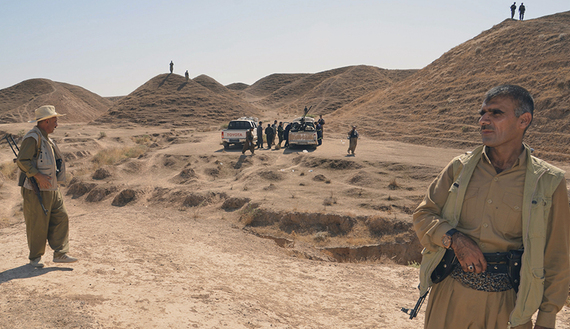
Kurdish peshmerga fighters stand guard around vehicles left behind by fleeing Islamic State militants during clashes in the al-Zerga area near Tikrit cityKurdish peshmerga fighters stand guard around vehicles with weapons and ammunition left behind by fleeing Islamic State militants during clashes in the al-Zerga area near Tikrit city in Salahuddin province, Oct. 8, 2014. (photo by REUTERS)

Commenting on the criticism of certain Kurdish parties inside Kobani, regarding the lack of support provided by KRG to the besieged city, he said, “Despite the differences with certain Kurdish political parties in the city, the KRG expressed its readiness to support our brothers in the city and we asked Washington and its allies to help the resisting Kurdish fighters.

“We helped them as much as possible, and the KRG’s president affirmed this. But, we cannot offer more. We are still waiting for international aid. The region initially includes 5 million people, add to that one and a half million displaced from Syria and the Iraqi provinces. We are helping them and taking care of them, and this is a huge burden.”

******************

Eliminating the Islamic State (IS) in Iraq does not seem to be an easy mission that will happen anytime soon; it seems rather impossible. The terrorist attacks against Iraq exposed how weak the Iraqi army is, how fragile its military structure and intelligence services are, and how it is unable to protect its country against any attack.

Some believe that the responsibility of the army’s failure to fight IS should be borne by the political authority ruling the country since 2004, which was unable to build an army based on a unified doctrine. Others consider the policies adopted by former Prime Minister Nouri al-Maliki faulty and the maliciousness allowed the terrorist group to enter the country, while the political conflicts between the central government and the Sunni leaderships provided an embracing environment for the group in Sunni provinces.

Secretary-General of the Ministry of Peshmerga Lt. Gen. Jabbar Yawar spoke to An-Nahar regarding the situation in Iraq in general, and in the Kurdistan Regional Government (KRG) in particular, in light of the IS threat, which occupied a number of Iraqi provinces, reaching the besieged Kobani.

The peshmerga harasses IS

The Kurdish military leader welcomed the international aid provided to the KRG, which is fighting a crucial battle against IS. He said, “The military aid which reached KRG saved it from falling into the hands of the terrorist group and allowed peshmerga forces to move from the negative defense position to the striker position, inflicting heavy losses on IS.”

Yawar does not hesitate to say, “The peshmerga forces’ position in the fight against IS is much better than the Iraqi army’s position. We are in a continuous fight along the 1,050-kilometer [650-mile] border of five Iraqi provinces, starting from Mosul to Erbil and passing through Kirkuk, Saladin and Diyala.”

He said, “The peshmerga forces have liberated the Mosul Dam and continues to liberate the rest of the regions that have fallen into the hands of IS, while creating plans to completely achieve this.”

The fall of Mosul and Anbar

Yawar attributed the fall of Mosul and Anbar to several reasons, most importantly, the fragility of the army in both provinces. He said, “The army in Mosul was fragile, and its six military units failed to withstand IS. There were also the political conflicts between the Sunni blocs and the government in Baghdad, which prevented these forces from fighting IS in Mosul, Saladin and parts of Kirkuk. These forces either handed over their advanced and heavy weapons to the group and fled, or joined and began to fight alongside IS.”

“The lack of a unified fighting doctrine among the army, and the shortage of air support, were all elements that contributed in the army’s quick collapse and IS’ occupation of a number of Iraqi provinces, especially the Sunni ones,” he said.

The difficulty in liberating Sunni regions

On the subject of the army’s situation in provinces in general, Yawar said that he found “a certain difficulty in liberating the Sunni-dominated regions from IS, such as Anbar, Saladin and Mosul, especially after it fell into the hands of the terrorists who took over its weapons on June 10.” He said that although they used all available means, the Iraqi forces were unable to liberate the city of Heet in Anbar and Tikrit, the center of Saladin province. “The situation on the field unfortunately proves that IS only controls the Sunni-dominated regions. We hope that our Sunni brothers, who are suffering the group’s injustice, will cooperate with the federal government and the KRG in order to eliminate this terrorist group,” he explained.

How did IS reach Erbil’s borders?

When asked how IS was able to reach KRG even though its intentions to occupy the region were obvious, Yawar answered with regret: “We knew before the group attacked Mosul on June 10 that it was up to no good in Iraq and Mosul. We were alerted by the joint committees and meetings that we used to hold in Baghdad, that there were some suspicious and dangerous movements on the borders with Syria. We were advised to strike them at an early stage, but we did not listen. The federal government and its former prime minister, Nouri al-Maliki, believed our proposals were political outbidding. Even when IS attacked Mosul, we asked them to allow us to support the federal forces there, but they told us that they were able to fight back themselves. Then Mosul fell, its residents fled and, due to Maliki’s faulty policy, IS was able to reach Baghdad’s borders.”

When asked why the terrorist group was able to reach Erbil, Yawar said, “When IS’ attack began, the peshmerga fought with all its strength, but it does not own advanced weapons such as the ones the group took from Mosul, because Maliki’s government never reinforced, trained or funded the peshmerga forces, although they are official governmental forces, according to the federal constitution.

“Despite all this, the peshmerga withstood IS from June 10 until the beginning of August. However, when we ran out of munitions and had no source of getting any, the group was able to penetrate our defense and move toward Erbil. Yet, thanks to Washington’s assistance and some of the countries participating in the international alliance, we were able to change the negative defense equation in Erbil and attack IS to liberate our lands,” he said.

Baghdad will not fall

The Kurdish leader ruled out the possibility of Baghdad falling for the time being, according to the available security data. “Until now, the Iraqi army can protect Baghdad and prevent the penetration of IS, which has spread in neighboring regions, such as Amiriya, Fallujah, Saqlawiyah and Ramadi,” he said.

We helped Kobani as much as we could

Commenting on the criticism of certain Kurdish parties inside Kobani, regarding the lack of support provided by KRG to the besieged city, he said, “Despite the differences with certain Kurdish political parties in the city, the KRG expressed its readiness to support our brothers in the city and we asked Washington and its allies to help the resisting Kurdish fighters.

“We helped them as much as possible, and the KRG’s president affirmed this. But, we cannot offer more. We are still waiting for international aid. The region initially includes 5 million people, add to that one and a half million displaced from Syria and the Iraqi provinces. We are helping them and taking care of them, and this is a huge burden.”

Yawar said, “The region has not been able to help Kobani like it should, due to its tough and complex geographic location, as it is 300 kilometers [185 miles] from the Syrian border, and it’s hard for aid to reach it. Kobani’s situation is geographically similar to Gaza or Sinjar.”

Raids

Yawar is not afraid that IS, which he believes is an extension of al-Qaeda in Afghanistan, will persist. He said, “The situation in Iraq and Syria today is similar to that of Tora Bora and Afghanistan. The airstrikes are beneficial for the peshmerga, Kobani and even for the Iraqi government, as they halt the advance of IS militants and drain them. These strikes also destroy IS warehouses and heavy weapons. But, to free these areas completely from IS, a comprehensive international operation should be put in place, like the one in Afghanistan, and there should be an actual training campaign for the Iraqi forces to defend themselves. However, I rule out the possibility of a foreign land intervention in Iraq, with the existing conflict between the ruling political parties.”

No Kurdish expansion

Political circles have been talking about a Kurdish expansion in an attempt to build the awaited state. In this regard, Yawar says, “We are part of the federal state, and neither of us expands into the other’s territories. Until now, there aren’t any official international borders between us and the federal state. We have some problems in many regions administratively. But the KRG and Baghdad are both facing IS threat. We should destroy it first, then resort to the constitution to solve the pending problems with the Baghdad government regarding the land, oil, the budget and Peshmerga.”


It’s official: U.S. will build new Syrian rebel force to battle Islamic State

October 16, 2014

It’s official: U.S. will build new Syrian rebel force to battle Islamic State, McClatchy DC, Hannah Allam, October 15, 2014

(Phase Two of “Operation We Got It Wrong Again.” Will Kurds or newbies be supplied, equipped and trained? By whom will the “moderates” be vetted and trained? By now focusing on the Syrian political opposition, will we be distancing ourselves from Assad’s supporter Iran?– DM)

Airstrike KobaniSmoke rises following an airstrike by US-led coalition aircraft in Kobani, Syria, during fighting between Syrian Kurds and the militants of Islamic State group, Oct. 9, 2014. (AP Photo/Lefteris Pitarakis)

This time, Allen said, the United States and its allies will work to strengthen the political opposition and make sure it’s tied to “a credible field force” that will have undergone an intense vetting process.

******************

— John Allen, the retired Marine general in charge of coordinating the U.S.-led coalition’s response to the Islamic State, confirmed Wednesday what Syrian rebel commanders have complained about for months – that the United States is ditching the old Free Syrian Army and building its own local ground force to use primarily in the fight against the Islamist extremists.

“At this point, there is not formal coordination with the FSA,” Allen told reporters at the State Department.

That was perhaps the bluntest answer yet to the question of how existing Syrian rebel forces might fit into the U.S. strategy to fight the Islamic State. Allen said the United States’ intent is to start from scratch in creating a home-grown, moderate counterweight to the Islamic State.

For most of the three years of the Syrian conflict, the U.S. ground game hinged on rebel militias that are loosely affiliated under the banner of the Free Syrian Army, or FSA. Their problems were no secret: a lack of cohesion, uneven fighting skills and frequent battlefield coordination with the al Qaida loyalists of the Nusra Front.

This time, Allen said, the United States and its allies will work to strengthen the political opposition and make sure it’s tied to “a credible field force” that will have undergone an intense vetting process.

“It’s not going to happen immediately,” Allen said. “We’re working to establish the training sites now, and we’ll ultimately go through a vetting process and beginning to bring the trainers and the fighters in to begin to build that force out.”

The Syrian arena is important, Allen said, but to the U.S., “the emergency in Iraq right now is foremost in our thinking.” There will be a simultaneous training-and-equipping campaign for Iraq, where the U.S.-trained military collapsed during the Islamic State’s summer offensive.

Allen said the new training program is “for those elements of the Iraqi national security forces that will have to be refurbished and then put back into the field,” with the ultimate goal of reclaiming Iraqi territories seized by the Islamic State.

Allen sounded confident that the United States and its allies could juggle two massive training efforts even as the Islamic State has shown itself to be resilient under weeks of coalition airstrikes.

“We have the capacity to do both, and there is significant coalition interest in participating in both,” Allen said of the twin force-building efforts in Iraq and Syria.

But, as he stressed repeatedly in his remarks, “it’s going to take a while.”

Ahmad Tomeh, who was just re-elected prime minister of the Syrian opposition’s interim government, told McClatchy that Allen met six leaders of the political opposition during his trip to Istanbul last week, but had no talks with any of the ground commanders, including the vetted, trained commanders the U.S. has been supporting. They asked for increased help, Tomeh said, but got no commitment.

Kurds make grisly discoveries after retaking ISIS-held territory

October 15, 2014

Kurds make grisly discoveries after retaking ISIS-held territory, Hot Air, Noah Rothman, October 14, 2014

(How serious are we and our coalition of the unwilling about at least degrading the Islamic State? — DM)

There is mixed news from the two fronts in Iraq and Syria where coalition airpower and indigenous partner forces on the ground are fighting Islamic State militants.

Near the Syrian border city of Kobani, reports indicate that Kurdish defenders are beginning to make some gains as they continue to defend the city against the ISIS onslaught. A key hill atop which ISIS fighters famously planted their flag late last week has reportedly been retaken by Kurdish forces.

“The advance came as the US said it had conducted 21 air strikes near the town, slowing down the IS advance,” the BBC revealed. “Tall Shair hill had been captured more than 10 days ago by IS militants.”

As ISIS retreated from the front near the Syrian-Turkish border, Kurdish forces made a series of gruesome discoveries.

“Refugees in Suruc, Turkey, have told how relatives and neighbors were beheaded by [ISIS] militants, while another spoke of how he had seen ‘hundreds’ of decapitated corpses in the besieged town,” The Independent reported on Tuesday.

Amin Fajar (38) a father-of-four who left Kobane and made it across the border and into Suruc, told a British newspaper: “I have seen tens, maybe hundreds, of bodies with their heads cut off.

“Others with just their hands or legs missing. I have seen faces with their eyes or tongues cut out – I can never forget it for as long as I live.”

The Daily Telegraph confirmed The Independent’s reporting about the activities in which ISIS engaged in the areas under their control:

“I have seen tens, maybe hundreds, of bodies with their heads cut off. Others with just their hands or legs missing. I have seen faces with their eyes or tongues cut out — I can never forget it for as long as I live,” Amin Fajar, a 38-year-old father of four, told the Daily Mail about the incredible scene in Kobane.

“They put the heads on display to scare us all.”

Another resident, 13-year-old Dillyar, watched as his cousin Mohammed, 20, was captured and beheaded by the black-clad jihadis as the pair tried to flee the battle-scarred town.

“They pushed him to the ground and sawed his head off, shouting, ‘Allahu Akbar,’ ” the boy said. “I see it in my dreams every night and every morning I wake up and remember everything.”

This unconfirmed video featuring Kurdish fighters in Kobani, flagged by Jeff Gauvin, reveals the extent of the damage done to the city over the course of weeks of fighting.

While America’s partners on the ground are enjoying some successes in Syria, the dispatches from Iraq are far more grim.

There, ISIS continues its siege on Anbar province in preparation for an assault on the capital city of Baghdad. After taking control of a military training base on Monday, CNN reported that ISIS has surrounded one of the largest Iraqi airbases in the country on Tuesday and is preparing to take it.

“According to police sources,” CNN’s Ben Wedeman reported, “the Ayman Asad Airbase, which is about 110 miles to the west of Baghdad – one of the biggest bases in Anbar province – is now surrounded by ISIS fighters, and the people on the base are expecting an attack within the coming hours on that base.”

“We understand that there are Iraqi soldiers who have already fled the base,” Wedeman continued. “We were getting reports for several hours that some of the soldiers had left, shedding their uniforms, leaving their weapons behind.”

That depressing revelation should concern military advisors who believe Iraqi forces defending Baghdad can hold out against an ISIS assault on Baghdad despite outnumbering the attackers by a reported six-to-one ratio. These latest developments reinforce the position of Army Chief of Staff Gen. Raymond Odierno who said with some trepidation recently he was only “somewhat” confident Baghdad could hold out.

Kurds Left Helpless as Kobane Falls to Islamic State: Turkey’s Border Wars (Dispatch 1)

October 15, 2014

 Vice News via You Tube, October 14, 2014

(Whose side is our NATO ally, Turkey, on in Kobane? The (“non-Islamic”) Islamic State or those best able to combat it effectively? How about the Obama Nation?  — DM)