Archive for the ‘Trump and Middle East’ category

US-Israel security interests converge

April 28, 2017

US-Israel security interests converge, Israel Hayom, Yoram Ettinger, April 28, 2017

In 2017, the national security interests of the U.S. and Israel have converged in ‎an unprecedented manner in response to anti-U.S. ‎Islamic terrorism; declining European posture of deterrence; drastic cuts in ‎the U.S. defense budget; an increasingly unpredictable, dangerous globe; ‎Israel’s surge of military and commercial capabilities and U.S.-Israel shared ‎values. ‎

Contrary to conventional wisdom — and traditional State Department policy — ‎U.S.-Israel and U.S.-Arab relations are not a zero-sum game. This is ‎currently demonstrated by enhanced U.S.-Israel strategic cooperation, ‎concurrently with expanded security cooperation between Israel and Egypt, ‎Jordan, Saudi Arabia and other pro-U.S. Arab countries, as well as stronger ‎cooperation between the U.S. and those same Arab countries. Unlike the ‎simplistic view of the Middle East, Arab policymakers are well aware of their ‎priorities, especially when the radical Islamic machete is at their throats. They ‎are consumed by internal and external intra-Muslim, intra-Arab violence, which ‎have dominated the Arab agenda, prior to — and irrespective of — the ‎Palestinian issue, which has never been a core cause of regional turbulence, a ‎crown-jewel of Arab policymaking or the crux of the Arab-Israeli conflict. ‎

Israel’s posture as a unique ally of the U.S. — in the Middle East and beyond — ‎has surged since the demise of the USSR, which transformed the bipolar ‎globe into a multipolar arena of conflicts, replete with highly unpredictable, ‎less controllable and more dangerous tactical threats. Israel possesses proven ‎tactical capabilities in face of such threats. Thus, Israel provides a tailwind to the ‎U.S. in the pursuit of three critical challenges that impact U.S. national security, significantly transcending the scope of the Arab-‎Israeli conflict and the Palestinian issue: ‎

‎1. To constrain/neutralize the ayatollahs of Iran, who relentlessly aspire to ‎achieve nuclear capability in order to remove the ‎U.S. from the Persian Gulf, dominate the Muslim world, and subordinate the American “modern-day Crusaders.”‎

‎2. To defeat global Islamic terrorism, which aims to topple all pro-U.S. Arab ‎regimes, expand the abode of Muslim believers and crash the abode of non-Muslim “‎infidels” in the Middle East and beyond.‎

‎3. To bolster the stability of pro-U.S. Arab regimes, which are lethally ‎threatened by the ayatollahs and other sources of Islamic terrorism.

Moreover, Israel has been the only effective regional power to check the North ‎Korean incursion into the Middle East. For instance, on Sept. 6, 2007, the ‎Israeli Air Force destroyed Syria’s nuclear site, built mostly with the support of ‎Iran and North Korea, sparing the U.S. and the globe the wrath of a ruthless, ‎nuclear Assad regime. ‎

While Israel is generally portrayed as a supplicant expecting the U.S. to extend a ‎helping hand, Adm. (ret.) James G. Stavridis, a former NATO supreme commander, ‎currently the dean of the Fletcher School of Law and Diplomacy at Tufts ‎University, says otherwise. He maintains that Israel is not a supplicant but ‎rather a unique geostrategic partner, extending the strategic hand of the U.S. ‎through a mutually beneficial, highly productive ‎relationship with the U.S.

On Jan. 5, 2017, Stavridis wrote: “Our ‎best military partner in the region, by far, is Israel … as we stand together ‎facing the challenges of the Middle East. … Israeli intelligence gathering is ‎superb. … A second zone of potentially enhanced cooperation is in technology ‎and innovation. … In addition to missile defense, doing more together in ‎advanced avionics (as we did with the F-15), miniaturization (like Israel’s small ‎airborne-warning aircraft) and the production of low-cost battlefield unmanned ‎vehicles (both air and surface) would yield strong results. … We should up our ‎game in terms of intelligence cooperation. [The Israeli intelligence ‎services] of our more segregated sectors on a wide range of trends, including the disintegration of Syria, the events in Egypt and the military and nuclear ‎capability of Iran. … Setting up a joint special-forces training and innovation ‎center for special operations in Israel would be powerful. … It truly is a case ‎of two nations that are inarguably stronger together.” ‎

Unlike other major U.S. allies in Europe, the Far East, Africa and the Middle East, ‎Israel does not require U.S. military personnel and bases in order to produce an ‎exceptionally high added value to the annual U.S. investment in — and not ‎‎”foreign aid” to — Israel’s military posture.

For example, the plant manager of Lockheed Martin, the manufacturer of the ‎F-16 and F-35 fighter planes, told me during a visit to the plant in Fort Worth, Texas: “The ‎value of the flow of lessons derived from Israel’s operation, maintenance and ‎repairs of the F-16 has yielded hundreds of upgrades, producing a mega-‎billion-dollar bonanza for Lockheed-Martin, improving research and ‎development, increasing exports and expanding employment.”

A similar ‎added value has benefitted McDonnell Douglas, the manufacturer of the F-15 fighter plane ‎in Berkeley, Missouri, as well as hundreds of U.S. defense manufacturers, ‎whose products are operated by Israel. The Jewish state — the most ‎predictable, stable, effective, reliable and unconditional ally of the U.S. — has ‎become the most cost-effective, battle-tested laboratory of the U.S. defense ‎industry. ‎

According to a former U.S. Air Force intelligence chief, Gen. George Keegan: ‎‎”I could not have procured the intelligence [provided by Israel on Soviet Air ‎Force capabilities, new Soviet weapons, electronics and jamming devices] with ‎five CIAs. … The ability of the U.S. Air Force in particular, and the Army in ‎general, to defend NATO owes more to the Israeli intelligence input than it ‎does to any other single source of intelligence.” The former chairman of the ‎Senate Appropriations Committee, Sen. Daniel Inouye, revealed that “Israel ‎provided the U.S. [operational lessons and intelligence on advanced Soviet ‎ground-to-air missiles] that would have cost the U.S. billions of dollars to find ‎out.”

On Oct. 28, 1991, in the aftermath of the First Gulf War, then-Defense ‎Secretary Dick Cheney stated: “There were many times during the course of ‎the buildup in the Gulf, and subsequent conflict, that I gave thanks for the ‎bold and dramatic action that had been taken some 10 years before [when ‎Israel destroyed Iraq’s nuclear reactor at Osirak].” The destruction of Iraq’s ‎nuclear capabilities in 1981 spared the U.S. a nuclear confrontation in 1991.

An Israel-like ally in the Persian Gulf would have dramatically minimized U.S. ‎military involvement in Persian Gulf conflicts, and drastically reduced the ‎monthly, mega-billion dollar cost of U.S. military units and bases in the ‎Gulf and Indian Ocean, as is the current Israel-effect in the eastern flank of ‎the Mediterranean.‎

Yoram Ettinger is a former ambassador and head of Second Thought: A U.S.-Israel Initiative.

Iran, Russia Boost Military Ties Amid U.S. Action In Syria

April 24, 2017

Iran, Russia Boost Military Ties Amid U.S. Action In Syria, Washington Free Beacon, , April 24, 2017

(Please see also, Obama’s hidden Iran deal giveaway. — DM)

Russian Foreign Minister Sergei Lavrov (C) shakes hands with his Iranian counterpart Mohammad Javad Zarif (R) as Syrian Foreign Minister Walid Muallem (L) looks on after a joint press conference after their talks in Moscow on April 14, 2017./ AFP PHOTO  ALEXANDER NEMENOV/AFP/Getty Images)

Russia can serve as a major military ally for Iran and help provide it with not just military capabilities, but nuclear technology. Iran and Russia inked several deals in the past years to build a series of new light water nuclear reactors across the Islamic Republic.

***********************

Iran and Russia are moving closer together in their military alliance, working to boost ties and coordination in Syria and elsewhere in the region following the U.S. decision to launch a military strike in Syria, according to regional reports and experts.

Iran’s defense minister is slated to visit Moscow at the end of the month to discuss increased military ties, a move that is meant to deter U.S. action in the region and show a sign of increased force, according to regional experts who spoke to the Washington Free Beacon.

The Tehran-Moscow axis has been growing since the landmark Iran nuclear deal, with Russia making good on a series of weapons deliveries, including the Russian-made S-300 missile defense system. The two countries have been signing an additional number of military deals in recent months and that cooperation is likely to increase in light of the Trump administration’s decision to launch strikes against embattled Syrian President Bashar al-Assad, who is being backed by both Russia and Iran.

Iranian leaders have signaled in recent days that the alliance with Russia is a top priority going forward and that a number of new military deals are in the works.

“The visit by Iranian [President Hassan] Rouhani that took place on March 28 was another step toward developing extensive cooperation between Moscow and Tehran,” Iranian Ambassador to Russia Mehdi Sanaei was quoted in the country’s state-controlled press.

“We hope that we will witness even broader bilateral ties across all areas in the future,” Sanaei said during an event last week marking the Iranian Army Day.

Sanaei also celebrated the recent delivery by Russia of the S-300 missile system, which Tehran had been coveting for some time. The system is viewed by Iran as a major deterrence factor aimed at intimidating U.S. forces in the region.

The delivery of the S-300 system to Iran is a sign that Russia has an interest in bolstering Tehran’s military might, Sanaei said.

Since signing a massive military deal in 2015 with Russia, “important steps have been taken to strengthen bilateral relations in the area of defense,” Sanaei said. “One such step was the delivery of S-300 missile systems to Iran. This is an indicator of mutual trust in defense cooperation.”

As Iran’s defense minister gears up to visit Moscow, regional experts predict that the military ties between the countries will only increase as Assad comes under greater international pressure.

However, the alliance between the countries remains fragile and largely one of convenience.

“Russia and Iran have a similar goal in keeping Assad in power at all costs,” Boris Zilberman, a Russia expert at the Foundation for Defense of Democracies’ (FDD) Center on Sanctions and Illicit Finance, told the Free Beacon. “However, how each perceives the end state in Syria and the other’s role in that future is one of the big questions in the relationship.”

In the short term, both Iran and Russia will aggressively work to “show a united front after America’s first strike on the Assad regime,” Zilberman said. “This is what we are seeing in the flurry of activity, but it is yet to be seen if anything of substance comes out of these talks.”

Behnam Ben Taleblu, a senior Iran analyst at FDD, said that Russia views Iran as a chief counter to U.S. power in the region. The alliance between the countries is likely to strengthen as long as Moscow can use Tehran to offset American influence in the region.

“Russia can and will likely continue to use Iran instrumentally in its larger strategic competition with the United States,” Ben Taleblu said. “One wonders however, how the leadership of the Islamic Republic, which derided the late Shah of Iran for his closeness to the U.S. are able to justify—legally, politically, and even spiritually, the concessions they have made to befriend Russia. As a reminder, no country has taken more territory away from Iran and threatened its sovereignty in the past half millennia than Russia.”

Russia can serve as a major military ally for Iran and help provide it with not just military capabilities, but nuclear technology. Iran and Russia inked several deals in the past years to build a series of new light water nuclear reactors across the Islamic Republic.

“For the past two years Tehran has been drawing closer to Moscow,” Ben Taleblu explained. “Iran will look to Russia to help it drive the U.S. from the region, as well as support its nuclear development under the auspices of the [Iran deal], and engage in a highly selective modernization process for its military. Russia and China will likely become the two largest sources for arms as a UN-mandated arms ban is set to expire in 2020.”

Dr. Sebastian Gorka: Trump Is Not An Interventionist Commander In Chief

April 16, 2017

Dr. Sebastian Gorka: Trump Is Not An Interventionist Commander In Chief, Fox News via YouTube, April 16, 2017

https://www.youtube.com/watch?v=_RUdLjpWu4c


America is back, and Russia is listening

April 13, 2017

America is back, and Russia is listening, Israel Hayom, Boaz Bismuth, April 13, 2017

Trump knows what Obama refused to acknowledge — that the U.S. cannot shirk its duty as the world’s policeman and the region’s sheriff. Obama hoped that he could just ignore this region or let others lead.

*****************************

In September 2013, Russian President Vladimir Putin hosted the G-20 summit in St. Petersburg. This was just days after then-U.S. President Barack Obama effectively decided not to take military action against Syrian President Bashar Assad, who had just used chemical weapons against his people. Two years later, having realized that the U.S. left a vacuum in the region, Russia returned with a force not seen since the end of the Cold War.

U.S. President Donald Trump, who was sworn in less than 100 days ago, has decided to change the political equation the Russians have created. Surprisingly, the Russians are willing to listen, despite their repeated mention of the sorry state of relations between Moscow and Washington.

The U.S. media is fond of reporting on Trump’s so-called illicit ties to the Russian government. But the truth of the matter is that it was Obama, in 2013, who tried to cozy up to the Russians, because he wanted to reach a nuclear deal with Iran — which he considered the most important part of his legacy, much more than an intervention in Syria.

Russian-American relations reached “a low point,” as Secretary of State Rex Tillerson said this week, as a result of the situation in Syria. But both superpowers are still determined to fight terrorism together and support an international inquiry of the chemical attack in Syria’s Idlib province last week.

The joint press conference Tillerson held with his counterpart Sergey Lavrov on Wednesday underscored the fact that superpowers have their own language, and when the U.S. talks like the superpower that it is, Russia has no choice but to play along, even if the Russians made sure Tillerson had to wait until the very last moment before he was told he could meet Putin in Moscow (and the meeting was only two hours long).

Despite all that has been said on Russia-U.S. relations, it is important to note that relations between two big powers are by definition different than any other forms of bilateral relations. Moreover, the current escalation is a plus for Russia because it puts it on equal footing with the U.S. That is why Russia made sure Tillerson’s visit had all the hallmarks of a summit in which the world’s leading superpowers determine how the world is going to run. As far as the Russians are concerned, this is the main accomplishment of the meeting. In the grand scheme of things, it is a win-win for both sides: Trump can distance himself from Russia, and Putin can prove that he can stand up to the Americans.

Despite what most people think, Trump actually acted strategically when he ordered the missile strike last week on a Syrian airbase in retaliation for Assad’s use of chemical weapons. The strike was designed to send a much wider and strategic message, that would resonate well beyond Syria — in Iran, in North Korea and in Russia. It was designed to make sure people think twice before they mess with the U.S.

Trump knows what Obama refused to acknowledge — that the U.S. cannot shirk its duty as the world’s policeman and the region’s sheriff. Obama hoped that he could just ignore this region or let others lead.

Yours truly predicted Trump would be tested in his first months in office, just like President Ronald Reagan was tested in his first year in office. Back then Reagan had to respond to air traffic controllers who went on strike at federal airports; now Trump has to deal with the Russians and Assad. Trump has no qualms about doing an about-face, even on issues that he is not supposed to care about. Both Reagan and Trump changed the rules of the game when they responded to those early tests. Such behavior creates the element of surprise and proves that a president is willing to act like a madman.

Trump Sends a Message to China Through Syria

April 10, 2017

Trump Sends a Message to China Through Syria, Front Page Magazine, Daniel Greenfield, April 10, 2017

On Thursday evening, President Trump met with China’s President Xi and bombed Syria. The decision came as Trump traveled on Air Force One to meet with Xi at Mar-a-Lago. An hour into their dinner, 59 Tomahawk cruise missiles launched and pounded an airbase in Syria. The message wasn’t just for Assad and Putin. It was for Xi and his North Korean client state. The era of a weak America was over.

Xi had come to America expecting an easy photo op visit. President Trump would urge action on North Korea and Xi would smile coldly and shoot him down. Talk of fairer trade would be similarly dismissed.

And then Xi would go home and laugh that the bold new American leader was another paper tiger.

Except that President Trump had a different plan. Instead of Xi showing how tough he could be, Trump gave him a front row seat to a display of American power. The message was both obvious and subtle.

And President Xi, along with Russia’s Vladimir Putin, North Korea’s Kim Jong-un and Iran’s Supreme Leader Khamenei, aren’t laughing.

The obvious part was as blatant as a 1,000 pound explosive warhead slamming into concrete and steel, and as obvious as upstaging Xi’s efforts to stonewall Trump while warning that North Korea could be next if the Chinese leader continues to be obstinate.

Trump had warned throughout the campaign that he would not be laying his military plans on the table. “You’re telling the enemy everything you want to do!” he had mocked Clinton.

His address to the nation came an hour after the missiles had struck. The element of surprise had held.

And Xi came away with a very different message. The Obama era was over. The new guy was bold, dangerous and unpredictable. Like many of Trump’s American opponents, Xi understood now that the jovial man sitting next to him could and would violate the rules of the game without prior warning.

China would have to be careful. There was a cowboy in the White House again.

And that was the subtle part. Trump does not care very much about Assad. What he truly cares about is American power. Left-wing critics quickly pounced on Trump’s past opposition to strikes on Syria and his criticisms of Obama for not enforcing his own “red line”.

There is no contradiction.

Trump didn’t believe that strikes on Syria were a good idea. But once we had committed to a red line, then we had to follow through if we were going to be taken seriously.

And so Trump enforced Obama’s red line. Not because of Obama or Syria. But because of America.

“When he didn’t cross that line after making the threat, I think that set us back a long ways, not only in Syria, but in many other parts of the world because it was a blank threat,” President Trump said.

President Trump intends to get things done. And he knows it won’t happen with “blank” threats.

Asked about whether the strikes represented a message to Xi and North Korea, Secretary of State Tillerson replied, “It does demonstrate that President Trump is willing to act when governments and actors cross the line and cross the line on violating commitments they have made.”

“President Trump has made that statement to the world tonight,” he added.

The message is more subtle than a 1,000 pound warhead. But not by that much.

President Trump’s move bewildered leftist critics who had to shift from accusing him of having a secret relationship with Russia to accusing him of ruining our relationship with Russia. It also enraged some supporters who maintained a dogmatic non-interventionist position. But Trump doesn’t make decisions based on ideology. He measures policies against real world objectives, not abstract philosophies.

What he has always wanted to do is solve real problems.

The problem he was solving on Thursday wasn’t Assad. President Trump recognizes that Syria is an unsolvable problem and that little good can come of extended engagement with it. There are no good guys in Syria. Only Sunni and Shiite Jihadis and their victims. Syria is and will always be a dead end.

The problem is that Obama thoroughly wrecked American prestige and power over eight years. And that makes it painfully difficult to get anything done when no one in the world will take us seriously.

President Trump sees North Korea’s nuclear weapons as a major threat. But he also sees the crisis as a way to leverage our military might to achieve better trade deals with both partners and rivals. He is not wedded to a globalist or anti-globalist ideology. Instead he sees every problem as an opportunity.

He is not committed to any international coalition, globalist or anti-globalist, except where it temporarily serves American purposes. That is what being a true nationalist actually means.

That is what makes him so unpredictable and so dangerous.

President Trump made a point in Syria. He timed that point for maximum effect. The point isn’t that Assad is a bad man. Though he is. It’s not that he isn’t a Russian puppet, though only the lunatic left could have believed that. The point is that he is determined that America will be taken seriously.

Cruise missile diplomacy isn’t new. Bill Clinton fired over 500 cruise missiles into Iraq. Not to mention Sudan. Bush fired cruise missiles into Somalia. Obama signed off on firing cruise missiles into Yemen and Syria at terrorist targets. The difference is that Trump isn’t just saving face with cruise missile diplomacy.

President Trump’s real objective isn’t the Middle East. It’s Asia. He doesn’t see Russia as our leading geopolitical foe, but China. Syria was the opening shot in a staring contest with the People’s Republic. The moves in this chess game will sometimes be obvious and sometimes subtle. And Trump is usually at his most subtle when he’s being obvious. That’s what his enemies usually miss.

President Trump’s first step in Syria was to reestablish physical and moral authority on the international stage while the President of China had to sit there and watch. He humiliated Democrats and their media operation at the peak of their Russia frenzy. And he sent the message that America is back.

It’s not a bad return on a $60 million investment. We’ve spent much more in the field with less to show for it.

The Obama era in international affairs ended with whimper and a hollow Nobel Peace Prize as a trophy. The Trump era in international affairs began with 59 cruise missiles and a big bang.

A new age of diplomacy

April 5, 2017

A new age of diplomacy, Israel Hayom, Prof. Abraham Ben-Zv, April 5, 2017

The character of the new American diplomacy is slowly becoming clear, both in terms of style and essence, and especially as it pertains to the Middle East. We are being given the impression that U.S. President Donald Trump is trying to adopt the management style of late U.S. President Franklin D. Roosevelt, who tended to bypass his secretary of state.

Preliminary signs indicate that Trump sees his current wandering adviser and envoy, Jared Kushner, as a confidant and trustworthy emissary for sensitive diplomatic missions. This is clear from his mission to Baghdad at the beginning of the week and in his ongoing involvement in advancing the peace process in the Palestinian arena. Kushner is also expected to take part in the U.S.-China summit (set to take place in Florida this week), reflecting his role as moderating figure in the charged relationship between Trump and the Chinese leadership and indicating his growing power.

While a young and energetic Kushner hops between continents as the president’s representative, U.S. Secretary of State Rex Tillerson lags behind him, excluded and disconnected from the big decision-makers.

This gives a good idea of style. As for the essence — when it comes to the Middle East in particular, we are seeing a sort of diplomacy that is radically different than former U.S. President Barack Obama’s approach. This is especially true regarding the Trump administration’s efforts to establish a Sunni anti-Iranian axis led by Cairo and Riyadh. While the Obama administration abandoned the United States’ traditional partners on this front, and instead, worked tirelessly to reconcile with Iran, the current White House is signalling unequivocally that it is determined to at least turn over a new leaf in its relationship with these regional powers and to upgrade strategic cooperation with them in order to uproot terrorism.

While Obama’s relationship with Egyptian President Abdel-Fattah el-Sissi was characterized by coldness (in contrast to the warmth he showed to Egypt’s previous leader, Muslim Brotherhood member and sworn Hamas supporter Mohammed Morsi), Trump’s approach is quite different. El-Sissi’s state visit to Washington this week was marked by extraordinary warmth and cordiality on the part of the American president. This was an effort to erase the remnants of the recent past — especially the memory of punitive and alienating policy led by Obama against the Egyptian leader — from the Egyptian consciousness.

A similarly dramatic improvement can be seen in U.S.-Saudi relations, wherein strategic cooperation has also been upgraded recently, especially (but not only) regarding fighting on the Syrian front and in the struggle against the Houthi militias operating in Yemen with Iran’s help and support (against al-Qaida forces in the field). This follows the deep ebb in their relationship due to Obama’s tireless efforts to appease the Ayatollah regime in Iran, the sworn enemy of the Saudi royalty. Regarding Syria, in 2013, Obama abandoned the civilian population there to its fate, remaining, despite his declarations, completely passive even after Syrian President Bashar Assad crossed all the red lines by using murderous chemical weapons against masses of civilians. On Tuesday, too, Assad’s forces carried out a major chemical attack, harming many civilians, in the country’s destroyed and divided north. Based on the growing military involvement and the Trump administration’s determination to deal with the “axis of evil” there too, we can assume that the White House will have a different response to this war crime.

Finally, regarding U.S.-Israeli relations, we are witnessing the expression of exceptional support and identification, reminiscent of the golden age of late U.S. President Lyndon B. Johnson (during which time then-U.S. Ambassador to the U.N. Arthur Goldberg’s speeches reflected the strength and resilience of the “special relationship”). While the Obama administration focused on efforts to settle the conflict, which it defined as a core issue of utmost local and regional importance, the Trump administration is demonstrating a much more relaxed and relevant approach to the complex situation. On this front too, there is real change in the form and style of American diplomacy in the Trump era.

US is back

March 19, 2017

US is back, Israel Hayom, Prof. Eyal Zisser, March 19, 2017

(Please see, for example, A new foundation for Saudi-US relations. — DM

The Trump administration is not even 100 days old, but the Middle East is already feeling the change. The United States is once again taking an active role in the region, and more importantly, Washington is once again standing by the allies and friends it had abandoned. It is now abundantly clear that America can differentiate between the good guys and the bad guys in the region, and that it plans to act for the former and against the latter.

It is an open secret that the election of President Donald Trump, despite being portrayed as an enemy of Islam who gobbles up Muslims, was greeted with a sigh of relief in the region, and in some cases with overt jubilation. America’s allies were fed up with former President Barack Obama and his administration, which turned its back on them during tough times and did not hesitate to criticize them and even question their legitimacy.

The Obama administration was obviously biased in favor of pro-Islamic elements in the region, such as the Muslim Brotherhood in Egypt. It also courted Iran and tried to appease it, in the hope of dissuading it from pursuing its nuclear ambitions and maybe scaling back its destabilizing activities in the region. This all created an unbridgeable gulf between Washington and its old friends, who came to conclusion that even the minimal understanding Washington had of the region’s complexities was no longer there, and that perhaps the Obama administration had lost touch with reality.

Trump is not committed to the former administration’s value system, which was used to pass judgment and essentially sacrifice his allies and friends. For all of Obama’s high-minded values, he essentially let Syria falter and allowed its fate to be decided by the impulses of President Bashar Assad and his friends in Moscow and Teheran.

Many have assumed that Trump would prefer to wait before taking action in the Middle East, a region with which he is not familiar and which does not require immediate American intervention, especially since Obama left him almost no wiggle room. But, surprisingly, the American efforts in the region under his leadership have been the most intense in recent memory.

Last week, Trump hosted Crown Prince Mohammed bin Nayef, Saudi Arabia’s interior minister, whose associates were quick to declare that the meeting was a historic turning point in the countries’ bilateral relations, because the two leaders saw eye-to-eye on the Iranian threat and on the need to counter its efforts to destabilize the region. Similar voices have been heard in Cairo and in Ankara.

Trump is also sending additional forces to Syria to strengthen the American hold on its eastern part. This is designed to help deal a crushing blow to Islamic State and provide a counterweight to the Russian presence, and even more importantly, to the Iranian presence there. Trump has also tried to have the Israelis and the Palestinians resume direct talks without accepting the prerequisites set by Palestinian Authority President Mahmoud Abbas.

Trump’s actions regarding the Palestinian-Israeli conflict are part of a more comprehensive effort to advance regional cooperation in the region, an effort Egyptian President Abdel-Fattah el-Sissi has been pushing for months. Trump hopes this effort will usher in new arrangements between Israel and its Arab neighbor and the Palestinian Authority.

Trump may not have a deep understanding of the region, but he has the instincts of a businessman who wants to win. He may very well prove that one does not have to be impartial to reach a deal, as President Vladimir Putin has proved in Syria. Trump may be able to make Israel and the Palestinian reach certain understandings even while showing his support for Israel. Most importantly, the deal that Trump promotes will not be bound by the value system of Obama or the Europeans, nor will Trump say amen to every request made by the Palestinians. Trump will only make sure the deal advances both sides’ interests.

Only time will tell whether Trump can effect the change he desires in the region.

A new approach to U.S. Middle East strategy

February 16, 2017

A new approach to U.S. Middle East strategy, Center for Security Policy, Adm. James “Ace” Lyons (Ret.) and Clare M. Lopez, February 15, 2017

puzzlepalace

The Trump administration has a unique opportunity to implement a new strategic policy to bring some semblance of stability to the current Middle East chaos. Under the pledge of putting “America first,” our core national security interest in the region should include the following:

  • Eliminating the Islamic State as an identifiable entity.
  • Preventing Iran from achieving a deliverable nuclear weapon capability.
  • Preventing Iran from achieving regional hegemony.
  • Supporting Iranians in their efforts to remove the corrupt Iranian theocracy.
  • Keeping open vital sea lanes and strategic choke points.
  • Defending U.S. bases and facilities.

• Re-emphasizing our support for our friends and allies while assisting threatened minorities (Christians, Assyrians/Chaldeans, Kurds and Yazidis).

Our strategy in the past has been reactive, but now must be driven by our vital core objectives. In that sense, it is not in the U.S. interest to become involved in a 1,300-year-old, intra-Islamic sectarian fight between Shiites and Sunnis. From a Western perspective, there is no good side in this conflict. Both want to kill us.

It also must be recognized that much of the 1916 Sykes-Picot Agreement nation-state system formed in the Middle East after World War I is coming asunder. Syria and Iraq are fractured states and a readjustment of a regional balance of power between Shiite and Sunni will evolve out of the current crisis with or without U.S. involvement. Our invasion of Iraq and the destruction of Saddam Hussein’s Sunni army removed the main blocking force to the expansion of Iran’s Shiite Crescent and ensured the rise of the Islamic State (ISIS) out of Abu Musab al-Zarqawi’s al Qaeda in Iraq.

A Sunni entity that clearly is not ISIS should be assisted to coalesce in what used to be Iraq. Such an entity could involve Anbar Province and the Nineveh Plain, where Assyrians/Turkman/Yazidis are unifying in an effort at preservation and stabilization.

In areas outside of Alawite and Kurdish control and areas liberated from ISIS in the former Syria, Syrian Free Army (SFA) commanders believe that with U.S. and other Western support, they could pry off significant forces from jihadi militias to create a force to defeat Jabhat al-Nusra, Jabhat Fateh al-Sham, and ISIS. This approach should be explored. In implementing a new strategy, we must proceed in a manner that gains cooperation from those whose involvement is essential. This includes Russia, Saudi Arabia and other Gulf Cooperation Council (GCC) countries, and Turkey. The Gulf states must be persuaded to end support for Sunni jihadis, which can only happen if they are assured that they will not be threatened or surrounded by Iran’s Shiite Crescent.

The Trump administration’s recent declaration putting Iran “on notice” is a step in the right direction, as were U.S. Treasury sanctions on 12 entities for supporting Iran’s illicit ballistic missile program. Further, President Trump’s call for establishing safe zones in Syria, e.g., one in the northern Kurdish area, one along the Turkish border, and one on the Jordanian border, could help relieve economic pressure on Jordan and Turkey, which are providing support to millions of refugees. In return, we should expect Turkey and Jordan’s support for our new regional strategy.

President Obama’s policy that deliberately empowered Iran to advance its geostrategic ambitions and move toward a deliverable nuclear weapons capability is over. Our so-called nuclear agreement with Iran must also be terminated and Iran’s joint venture relationship, using North Korea as its off-site laboratory to advance its nuclear and ballistic missile programs, must end. Holding Iran accountable to the agreement is a pipe dream. There is no agreement. Further, a clear, unambiguous declaration from the Trump administration with appropriate follow-on action will go a long way to gain Saudi and GCC cooperation.

With regard to Syria, Bashar Assad must go. It appears Russia may support such action as it reportedly proposed Alawite Gen. Manas Tlass (formerly with the Hafez Assad regime) as his replacement at the Astana talks. SFA commanders may accept this as long as the Assad clan is out of power and in exile. Under such an arrangement, the Alawites would keep control of Damascus and their coastal strip heartland, but lose the rest of former Syria. This is the de facto current situation on the ground today.

Russia may find such an arrangement acceptable, provided it keeps its bases in Latakia and Tartus. While these are major concessions, issues involving Ukraine/Crimea must also be part of the discussion, as well as Libya. The bottom line in the trade-offs must be Russia’s commitment to help in getting Iran, Hezbollah and Shiite militias out of what formerly was Syria.

Turkey also may be helpful in the overall realignment but must be managed carefully, as Turkey under Recep Tayyip Erdogan’s AKP (Justice and Development Party) is moving toward an authoritarian neo-Ottoman jihad state. Clearly, the No. 1 Turkish concern is the Kurds. One option may be to not allow the Kurdish northern-Syria enclave “Rojava” to extend to the Turkish border. There would instead be a safe zone there, guaranteed jointly by Russia and Turkey. Gas and oil pipelines also are major factors that must be included in discussions with both Russia and Turkey.

Since we have no vital objectives in Afghanistan, we should stop wasting our national treasure to support a corrupt tribal society.

If this new strategic approach is followed, our vital core strategic objectives will most likely stand a better chance of being achieved while gradually bringing the current chaos under control.

Trump’s game in Saudi Arabia

February 13, 2017

Trump’s game in Saudi Arabia, American ThinkerJames Lewis, February 13, 2017

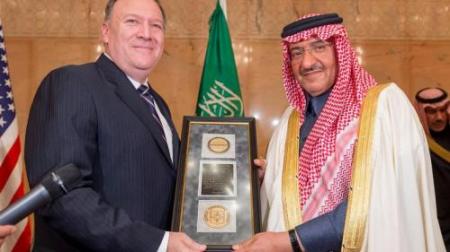
Mike Pompeo, the new CIA head, just flew to Riyadh to give a medal to the reigning son of the king (who is said to suffer from dementia).  While some conservatives regard this as a travesty (e.g., a “Not the Onion” commentary from Zero Hedge), I think this is meant to be an open signal to support the House of Saud, whose help is needed against the Iranians anyway and who support President El-Sisi against Hamas and the Muslim Brotherhood.

saudiaward

It’s not clear what the Saudis did in exchange, but they have been under the gun, fearing that Western media would expose their role in support of violent jihad.  So this looks as though the Saudis have done a lot to settle those debts.  It’s not the kind of public gesture the CIA does a lot.

The Saudis can shut down ISIS/AQ/Al Nusra, or whatever the worst gang of maniacs calls itself today.  They also have no problem with selected assassinations.  SecDef Mattis has a long record of talking about morality and immorality in warfare, and he does not like sadistic monsters.  I think the moral dimension of defensive war has been missing during the Obama years.

These moves may signal both domestic and foreign agreements to calm things down.  The Saudis know that their control of OPEC is waning, since Trump is aggressively opening up domestic traditional and shale energy production (again, something Obama never would do).  But the Saudis need to make a “soft landing,” which is not going to be easy.  So they have been talking peace with Israel, on the assumption that Israel can communicate with the U.S. – at least under Trump.

These are all calming moves in a very agitated international situation. I believe that Trump is going to move aggressively against Muslim Brotherhood infiltration, probably with Saudi backing.  The Saudis are ideologically aligned with ISIS, al-Qaeda, and the M.B.s, but tactically, they could abandon them.  Violent jihad arose with OPEC, and now that OPEC is declining, it would be smart to convince the Saudis that the jig is up.

We can see if there is a marked decrease in jihadist violence.  If not, then the hypothesis is wrong.

The possibility of public exposure of their role in 9/11 is still very real and can be used to ensure their good behavior.

This is Kremlinology, but it’s falsifiable.  There are many dangerous enemies in the world, including George Soros domestically, and the intelligence agencies can torpedo a lot of stuff.  It is smart for Trump to calm things down and focus on the hard parts first.


Beautiful Friendship

February 10, 2017

Beautiful Friendship, Front Page MagazineCaroline Glick, February 10, 2017

flags-1

Originally published by the Jerusalem Post

On Sunday, Trump restated his desire to develop ties with Russian President Vladimir Putin. Netanyahu must present Trump with a viable plan to reconstitute US-Russian ties in exchange for Russian abandonment of its alliance with Tehran and its cooperation with Iran and Hezbollah in Syria.

Next week can be the beginning of a new era in Israel’s relations with the US. But to make the most of this unprecedented opportunity, Israel needs to recognize its role as America’s ally. It must take the necessary steps to perform that role, and it must free the administration from the shackles of the PLO while securing its long-term interests in Judea and Samaria unilaterally, and quietly.

********************

Less than a week after he was inaugurated into office, President Donald Trump announced that he had repaired the US’s fractured ties with Israel. “It got repaired as soon as I took the oath of office,” he said.

Not only does Israel now enjoy warm relations with the White House. When Prime Minister Benjamin Netanyahu arrives in the US capital next week, he will be greeted by the most supportive political climate Israel has ever seen in Washington.

It is true that dangers to Israel’s ties with America lurk in the background. The radical Left is taking control of the Democratic Party.

But the forces now hijacking the party on a whole host of issues have yet to transform their hatred of Israel into the position of most Democratic lawmakers in Congress.

Democrats in both houses of Congress joined with their Republican counterparts in condemning UN Security Council Resolution 2334 that criminalized Israel. A significant number of Democratic lawmakers support Trump’s decision to slap new sanctions on Iran.

Similarly, radical Jewish groups have been unsuccessful in rallying the more moderate leftist Jewish leadership to their cause. Case in point is the widespread support Trump’s appointment of David Friedman to serve as his ambassador to Israel is receiving from the community.

Whereas J Street and T’ruah are circulating a petition calling for people to oppose his Senate confirmation, sources close to the issue in Washington say that AIPAC supports it.

Given this political climate, Netanyahu must use his meeting with Trump to develop a working alliance to secure Israel’s long-term strategic interests both on issues of joint concern and on issues that concern Israel alone.

The first issue on the agenda must be Iran.

Since taking office, Trump has signaled that unlike his predecessors, he is willing to lead a campaign against Iran. Trump has placed Iran on notice that its continued aggression will not go unanswered and he has harshly criticized Obama’s nuclear deal with the mullahs.

In the lead-up to his meeting with Trump, Netanyahu has said that he will present the new president with five options for scaling back Tehran’s nuclear program. No time can be wasted in addressing this problem.

Iran continues spinning its advanced centrifuges.

The mullahs are still on schedule to field the means to deploy nuclear warheads at will within a decade. Netanyahu’s task is to work with Trump to significantly set back Iran’s nuclear program as quickly as possible.

Then there is Syria. And Russia.

On Sunday, Trump restated his desire to develop ties with Russian President Vladimir Putin. Netanyahu must present Trump with a viable plan to reconstitute US-Russian ties in exchange for Russian abandonment of its alliance with Tehran and its cooperation with Iran and Hezbollah in Syria.

Here, too, time is of the essence.

According to news reports this week, President Bashar Assad is redeploying his forces to the Syrian border with Israel. Almost since the outset of the war in Syria six years ago, Assad’s forces have been under Iranian and Hezbollah control. If Syrian forces deploy to the border, then Iran and Hezbollah will control the border.

Israel cannot permit such a development. It’s not just that such a deployment greatly expands the risk of war. As long as Russia is acting in strategic alliance with Iran and Hezbollah in Syria, the deployment of Iranian-controlled forces to the border raises the real possibility that Israel will find itself at war with Russia in Syria.

Then there are the Sunnis. For the past six years, Netanyahu successfully withstood Obama’s pressure by developing an informal alliance with Sunni regimes that share its opposition to Iran and to the Muslim Brotherhood.

According to sources aware of the Trump administration’s strategic plans, the administration wishes to integrate Israel more strongly into Washington’s alliance structure with Sunni regimes. Israel, of course, has good reason to support this plan, particularly if it involves extending the US military’s Central Command to include Israel.

There are, however, significant limitations on the potential of Israel’s ties to Sunni regimes. First, there is the fact that all of these regimes are threatened by Islamist forces operating in their territory and on their borders.

As Israel Air Force commander Maj.-Gen. Amir Eshel warned this week, Israel is concerned that in the event any of these regimes is overthrown, the advanced US weapons it fields will fall under the control of Islamist forces.

Then there is the fact that in exchange for taking their relations with Israel out of the proverbial closet, the Arabs will demand that Israel make concessions to the PLO.

This then brings us to the only subject the media is discussing in relation to Netanyahu’s upcoming meeting with Trump: Will Trump push Israel to make concessions to the PLO or won’t he? The short answer is that it doesn’t appear that Trump has the slightest intention of doing so.

Over the past week, the administration has made three statements about the Palestinians.

First, of course, was the White House’s statement about the so-called Israeli settlements that came out last Thursday.

Although nearly all media reports on the statement claimed it aligned Trump with his predecessors in opposition to Israel’s civilian presence in Judea and Samaria, the fact is that the statement was the most supportive statement any US administration has ever made about those communities.

Obama, of course rejected Israel’s right to any civilian presence beyond the 1949 armistice lines, including in Jerusalem. In his final weeks in office, Obama joined the international mob in falsely castigating Israeli communities in these areas as illegal.

George W. Bush for his part, made a distinction between the so-called settlement blocs and the more isolated Israeli villages in Judea and Samaria. He gave grudging and limited support for Israel’s right to respect the property rights of Jews in the former. He rejected Jewish property rights in the latter.

Trump repudiated both of these positions.

In its statement on Thursday, the administration made no distinction between Jewish property rights in any of the areas. Moreover, the statement did not even reject the construction of new Israeli communities.

According to the text of the statement, “the construction of new settlements or the expansion of existing settlements beyond their current borders may not be helpful in achieving” the goal of peace.

But, then again, they may be helpful. And then again, they may have no impact whatsoever on the chance of achieving peace.

Not only did the administration’s statement not reject Israel’s right to build new communities, it rejected completely the position of Trump’s predecessors that Israeli communities are an obstacle to peace.

In the administration’s words, “We don’t believe the existence of settlements is an impediment to peace.”

After renouncing the positions of its predecessors on Israeli communities in Judea and Samaria, the administration then refused to say whether its vision for peace includes a Palestinian state.

In line with the Republican Party’s platform that makes no mention of support for Palestinian statehood, the Trump administration continues to question the rationale for supporting a policy that has failed for the past 95 years.

Finally, the administration said it had no comment on the regulations law this week regarding Jewish construction rights in Judea and Samaria.

All White House spokesman Sean Spicer would say was that it would be discussed in Trump’s meeting with Netanyahu.

This brings us back to that meeting, and how Netanyahu should broach the Palestinian issue.

Both from statements by administration sources since the election and from the administration’s refusal to speak with Palestinian Authority officials since Trump’s electoral victory, Trump and his top advisers have made clear that they see no upside to US support for the PLO.

They do not want to support the PLO and they do not want to be dragged into fruitless discussions between Israel and the PLO. For the past 24 years, US mediation of those discussions has weakened America’s position in the region, has weakened Israel and has empowered the PLO and anti-American forces worldwide.

According to sources with knowledge of the administration’s position, Trump views the Israeli- Palestinian conflict as an internal Israeli issue.

He expects Israel to deal with it and do so in a way that stabilizes the region and keeps the Palestinians out of the headlines, to the extent possible.

In this vein, sources with knowledge of administration considerations claim that last Thursday’s White House statement on Israeli communities in Judea and Samaria was in part the result of exasperation with Israel’s inability to keep quiet on the issue. Had Netanyahu and Defense Minister Avigdor Liberman not announced that they were issuing permits for thousands of building starts in Judea and Samaria, the White House wouldn’t have felt compelled to issue a statement on the matter.

The administration’s desire to disengage from the PLO is well aligned with Israel’s strategic interests. No good has ever come to Israel from US support for the PLO. Moreover, Israel has achieved its greatest strategic successes in relation to determining its borders when it has kept its moves as low key as possible.

For instance, in 1981, when then-prime minister Menachem Begin applied Israeli law to the Golan Heights, he did so with no fanfare. Rather than loudly announcing Israel’s right to sovereignty over the area, Begin insisted that the move was done to satisfy administrative imperatives and that Israel would be willing to consider border corrections in the event that Syria became serious about peace at some later date.

Begin’s example should inform Netanyahu’s preparations for his meeting with Trump.

Unfortunately, Netanyahu does not seem to realize the implications of Trump’s lack of interest in following in his predecessors’ footsteps in relation to the PLO.

Over the past few weeks, Netanyahu has insisted that he wishes to coordinate his positions on the Palestinians with the administration. While he should take any concerns Trump voices to him on the issue into consideration, he should also make clear that the administration’s belief that no good has come to the US from its support for the PLO is well-founded. He should also explain Israel’s need to control Area C in perpetuity, and the problem with maintaining military administration of the area. Finally, he should assure Trump that Israel intends to secure its interests in Judea and Samaria in a way than does not impinge on US priorities.

Next week can be the beginning of a new era in Israel’s relations with the US. But to make the most of this unprecedented opportunity, Israel needs to recognize its role as America’s ally. It must take the necessary steps to perform that role, and it must free the administration from the shackles of the PLO while securing its long-term interests in Judea and Samaria unilaterally, and quietly.