Archive for the ‘Trump and Israel’ category

New US military moves in the Mid-East & Israel’s Syria air raid were coordinated

December 3, 2017

New US military moves in the Mid-East & Israel’s Syria air raid were coordinated, DEBKAfile, December 3, 2017

(Please see also, Trump’s strategic vision. — DM)

By mid-week, the Trump administration should have reached a decision that indicates whether or not it has caved in under Palestinian threats. The next few days will also show whether the new US Middle East momentum is a flash in the pan or a fresh start to be continued.

*****************************************

The US hands-off to Iran’s top general in Iraq, Ali Abdullah Saleh’s changeover of sides in the Yemen war and Trump’s’ thinking on Jerusalem – all signal a new, proactive US strategy for the region.

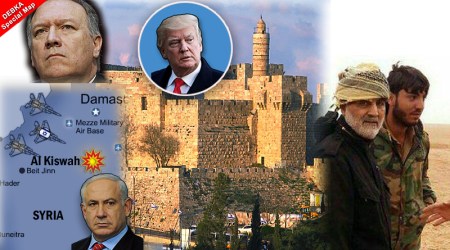
Central Intelligence Agency chief Mike Pompeo was uncharacteristically frank when he addressed high-ranking US military and security officials on Saturday, Dec. 2, at the Reagan Presidential Foundation. He revealed that he had sent a note to the Iranian Revolutionary Guards Al Qods chief, Gen. Qassem Soleimani, and explained: “I sent it because he had indicated that forces under his control might in fact threaten US interests n Iraq.”

Soleimani replied that he had refused to open the letter, commenting: “It didn’t break my heart to be honest with you.” Pompeo went on to elaborate: “What we were communicating to him in that letter was that we will hold him and Iran accountable… and we wanted to make sure that he and the leadership of Iran understood that in a way that was crystal clear.”

Since words clearly don’t mean much without deeds, the United States, after being frozen in place for months in the Middle East, suddenly sprang into action in the past 48 hours, along with its senior Middle East allies, Israel and Saudi Arabia, on four fronts: Iraq, Syria, Yemen and the Palestinians.

IRAQ:  Large-scale US forces arrived at the Kaywan base-K1 west of the oil city of Kirkuk and then split into two contingents: several hundred troops stayed on base while the second contingent headed east on Friday, Dec. 1 towards Tuz Khumatu in eastern Iraq (See attached map)  and took control of the Siddiq military airport 35km to the west. Tuz Khumatu lies 100km west of the Iraqi-Iranian border and 163km north of Baghdad. DEBKAfile’s military sources report that American troops have never been deployed so close to the Iranian border since the 2003 US invasion of Iraq. This movement was meant to strongly advise Iraqi Prime Minister Haydar al-Abadi to stop playing ball with Iran to the extent that he did in mid-October, when he allowed pro-Iranian forces to grab Kirkurk and its oilfields from the Kurds. Washington was chiefly drawing a large X on Soleimani’s plan for bringing  Northern Iraq’s oil under Iranian control.

SYRIA: Early Saturday, Dec. 2, Israeli warplanes dropped missiles on a secret meeting of pro-Iranian Shiite militia chiefs taking place at the Syrian army’s 91st Brigade HQ, outside al-Kiswah – 14km southwest of Damascus and 50km from the Golan. These militias, which have been fighting for Bashar Assad under Gen. Soleimani’s command, were being briefed by Iranian and Hizballah officers on their next offensive. This was Israel’s first attack on any of his forces.

YEMEN: On Saturday, Ali Abdullah Saleh, former president of Yemen, the mainstay of the Iranian-backed Houthi insurgency, announced he was “turning the page.” He was ready to ditch the Houthis and their backer, Iran – provided that the coalition (Saudi Arabia and the United Arab Emirates) lifted the blockade they had imposed on Yemen to cut off incoming Iranian weapons and halted its attacks. Saleh’s announcement sparked violent clashes between his followers and the Houthis.

DEBKAfile’s military sources recall that Yemen’s ex-president had long maintained ties with the CIA. His change of sides was timed to coincide with a fresh US-Saudi intelligence push to restore Saleh to the pro-Western Arab camp and topple pro-Iranian positions in Yemen and the Arabian Peninsula.

ISRAEL AND THE PALESTINIANS: The Trump administration is fed up with dodgy Palestinian tactics on peace negotiations. Egyptian President Abdel-Fatteh El-Sisi and Saudi Crown Prince Muhammad bin-Salman are likewise ready to wash their hands of the Palestinian Authority Chairman Mahmoud Abbas (Abu Mazen). US officials tried threatening to shut down the PLO office in Washington unless the Palestinians finally came to the table for peace talks and are now holding over Palestinian heads a possible decision – either to move the US embassy from Tel Aviv to Jerusalem or recognize the city as Israel’s capital.

To ward off these actions, all Abu Mazen needs to do is to pick up the phone to the White House, the royal palace in Riyadh and the presidential residence in Cairo and declare his willingness to cooperate with their initiatives to restart the peace process. But so far, Abbas is holding out, resorting instead to his outdated tactics: threatening that the entire Middle East will go up in flames and Palestinian terrorism will again raise its head if the Trump administration goes through with new decisions on Jerusalem.

By mid-week, the Trump administration should have reached a decision that indicates whether or not it has caved in under Palestinian threats. The next few days will also show whether the new US Middle East momentum is a flash in the pan or a fresh start to be continued.

Trump’s strategic vision

December 3, 2017

Trump’s strategic vision, Israel National News, Ted Belman, December 2, 2017

Former Minister of Defense for Israel, Moshe Yaalon, just wrote a major opinion piece titled United States Policy in the Middle East: The Need for a Grand Strategy, which was published by the Institute for National Security Studies. In it, he claimed:

“The first year of the Trump administration has been characterized by the lack of clear policy guidelines vis-à-vis the Middle East. The great hopes that many countries in the region hung on the change of administration and a new proactive president in the White House have slowly been eclipsed by a sense of confusion, given United States behavior that shows little consistency and no clear strategic objectives.”

Yaalon, who has been out of office now for two years doesn’t know what is going on. On the contrary, the Trump administration does have a grand strategy, grander than imagined.

Many countries in the region, including Israel, Saudi Arabia and Egypt have never been more hopeful about what they understand to be his strategic objectives and his plans for achieving them.

Remember Trump has consistently refused to telegraph his foreign policy moves while at the same time has consistently repeated that he intends to push back against Iran expansionism.

Saudi Arabia

When President Trump was campaigning, he kept saying that he wanted to defeat ISIS and its ideology. He was ridiculed for thinking he could eradicate the ideology.  It didn’t take him long to make good on his word.

His administration got to work immediately with the Sunni states, but principally with Mohamed ben Salman (MBS) of Saudi Arabia.  Al Sisi of Egypt was already on board as evidenced by a speech he made two years ago in which he said:

“I am addressing the religious scholars and clerics. We must take a long, hard look at the situation we are in. It is inconceivable that the ideology we sanctify should make our entire nation a source of concern, danger, killing, and destruction all over the world. It is inconceivable that this ideology… I am referring not to ‘religion,’ but to ‘ideology’– the body of ideas and texts that we have sanctified in the course of centuries, to the point that challenging them has become very difficult.

“It has reached the point that [this ideology] is hostile to the entire world. Is it conceivable that 1.6 billion [Muslims] would kill the world’s population of seven billion, so that they could live [on their own]  [..]. You cannot see things clearly when you are locked [in this ideology]. You must emerge from it and look from outside, in order to get closer to a truly enlightened ideology. You must oppose it with resolve. Let me say it again: We need to revolutionize our religion.”

Four months after his inauguration, Pres Trump made his historic trip to Riyadh, Saudi Arabia in which he addressed 50 Arab and Muslim leaders:
“Later today, we will make history again with the opening of a new Global Center for Combatting Extremist Ideology – located right here, in this central part of the Islamic world. This groundbreaking new center represents a clear declaration that Muslim-majority countries must take the lead in combatting radicalization”

“But above all we must be united in pursuing the one goal that transcends every other consideration. That goal is to meet history’s great test — to conquer extremism and vanquish the forces of terrorism.

“Young Muslim boys and girls should be able to grow up free from fear, safe from violence, and innocent of hatred.”

His message was clear and had already been agreed upon.

“Yesterday, we signed historic agreements with the Kingdom that will invest almost $400 billion in our two countries and create many thousands of jobs in America and Saudi Arabia.“This landmark agreement includes the announcement of a $110 billion Saudi-funded defense purchase – and we will be sure to help our Saudi friends to get a good deal from our great American defense companies. This agreement will help the Saudi military to take a greater role in security operations.”

The last sentence suggests that the fighting will be done by the Sunnis with American backing rather than the other way around.

“But this (prosperous) future can only be achieved through defeating terrorism and the ideology that drives it.”

The Arab world understands this and is all for it. With the price of oil being what it is and likely to stay low, the Saudis will be bankrupt in a 5 years as they are eating into their surplus of $750 billion at an alarming rate. By jointly agreeing to spend $400 billion to achieve prosperity, they are putting their money where their mouth is. They are committed and so is the US.

As further evidence of their commitment, MBS announced the Vision 2030.

Essentially this is an economic vision that requires Saudi Arabia to open up to the world to create an environment conducive to foreign investment. Thus, it must westernize.

“Our Vision is a strong, thriving, and stable Saudi Arabia that provides opportunity for all. Our Vision is a tolerant country with Islam as its constitution and moderation as its method. We will welcome qualified individuals from all over the world and will respect those who have come to join our journey and our success.”

They also can’t take on Iran without Israel.

Egypt is in a worse position. She needs Israel’s help in building her economy and in defeating the terrorists in Sinai and Libya.

Saudi Arabia, United Arab Emirates, Bahrain, and Egypt cut off diplomatic relations with Qatar in June 2017. The severing of relations included withdrawing ambassadors, and imposing trade and travel bans.

The crisis is an escalation of the Qatar–Saudi Arabia proxy conflict. The Saudi-led coalition cited Qatar’s support for terrorism and open alliance with the Muslim Brotherhood (MB) as the main reasons for their actions. Saudi Arabia and other countries have criticized Al Jazeeraand Qatar’s relations with Iran.
Qatar is a big supporter of the Muslim Brotherhood (MB) and Hamas, whereas Saudi Arabia, Egypt and the others have banned the MB as a terrorist organization and are coming down hard on Hamas.

In October 2017, Saudi Arabia announced plans to build a $500 Billion city to be called Neom in the north west corner of Saudi Arabia. It will reach into Jordan and Egypt.

Bloomberg reported:

“It would be a microcosm of Saudi Arabia 2.0 while its new 32-year-old leader reconfigures the rest of the economy to make it fit for the modern world in a way that past rulers have failed to do. Other massive cities in the desert have been announced with much fanfare, then have floundered short of expectations, like the $10 billion office park on the outskirts of Riyadh sitting largely unoccupied and unfinished.

“The city “constitutes an attempt to create an economic zone that is more efficient and streamlined than the overall economy that will take time to reform,” said James Dorsey, a Middle East specialist at Singapore’s Nanyang Technological University. “The question is whether one can isolate a megacity from the inefficiencies of the country’s economy.””

As you can see, it is a huge gamble, born no doubt out of the huge need to to transform Saudi Arabia.

Jordan

Jordan too is a supporter of the MB, who have their headquarters in the country. While King Abdullah has enjoyed a good reputation among Congressmen and Members of Knesset, his reputation has been greatly tarnished in the last two years, so much so that the White House and the Netanyahu government are ready to ditch him.

What may have been the straw that broke the camel’s back for them is the fact that Jordan’s king very own security agencies, which he controls with an iron-fist, have been caught red-handed stealing US and British weapons and selling them to ISIS.

Here are some recent articles which tell the tale.

Another Jordanian-made knife in the back of Israel.

Israel-Jordan peace agreement: The emperor has no clothes 

They see King Abdullah as an obstacle to peace rather than a guarantor of peace. They also believe that civil war is coming to Jordan unless they make a move to prevent it. While they may not say so publicly, some Israeli journalists do.

The US made their first move this week by announcing:

“Now, according to Stars and Stripes, Congress has added $143 million to the Pentagon budget, to upgrade the strategic Muwaffaq Salti Air Base, close to Jordan’s border with Syria and Iraq. The base has played a key role in the US military in its war with ISIS, and requires urgent upgrades, according to the Air Force, being overwhelmed as it is by the increased numbers and scope of operations.”

This is just the first step in moving the base in Qatar with its 11,000 US airmen to the base in Jordan.

General Charles Wald, USAIR, told Fox News US doesn’t need Qatar air base if Qatar won’t support our fight against terrorism .

This has been done to forestall a civil war in Jordan. The King has lost control of Jordan and the US is calling the shots. Watch for the drama to unfold.

The Arab/Israeli Conflict.

The right in Israel are very unhappy that Trump won’t move the Embassy to Jerusalem, won’t let Israel build though out Judea and Samaria, won’t let her expand the boundaries of Jerusalem and won’t let her demolish illegally build Arab structures. They are also unhappy that Trump keeps working on a plan, a process, for achieving “peace”.

But as the Economist pointed out in a recent article, Whatever the administration produces, Saudi Arabia is likely to support it.

“For Prince Muhammad, it seems, Palestinian aspirations to statehood are less important than countering Iran.”

“Prince Muhammad may calculate that a viable peace process would give him political cover to make the alliance more overt.”

And one might conclude that that is what the purpose of the process is.

Lebanon

Prime Minister Saad Harari resigned his post in Lebanon and then travelled to Saudi Arabia where he made a speech denouncing Hezbollah. On returning to Lebanon, he withdrew his resignation. But all is not lost.

BESA reports, “Hariri is believed to be demanding that Hezbollah halt its support to Houthi rebels in Yemen and withdraw from Syria, where its fighters supported the regime of President Bashar al-Assad. “ and argues that this goal may yet be achieved.

Iraq Kurdistan

The US reprimanded them for holding the referendum against its wishes and allowed Iraq to take back Kirkuk. Do not fear for the independence of Kurdistan. Their day will come. America has a strategic plan which mandates dealing with Jordan first.

The US wants to cement the alliance of Israel, Saudi Arabia and Egypt before pushing back on Iran.

Syria Kurdistan

According to the Washington Post, no friend of Pres Trump, The U.S. must prepare for Iran’s next move in Syria

“A task force of senior former U.S. diplomatic and military officials has come up with suggestions for how Trump could prevent Iran from taking over what’s left of liberated Syria and fulfill his own promise to contain Iranian influence in the region”.

“First, the United States needs to declare a clear Syria policy that removes suspicions that the United States is going to pull up stakes now that the Islamic State caliphate has fallen. The policy should make clear that a U.S. military presence will remain on the ground and in the air, to ensure that the Islamic State doesn’t reemerge and Assad doesn’t retake the entire country, and to provide security for reconstruction.

“Second, the Trump administration must increase its assistance to Sunni communities lucky enough to live outside Assad’s rule and help U.S.-supported local groups hold valuable territory in Syria’s southeast. This territory can provide local communities economic benefits now and political leverage down the line.

“Third, the United States should work with regional allies to stop Iran from moving weapons and troops into Syria. That would require interdicting shipments by sea and ensuring that U.S.-supported forces control key border towns in Syria and Iraq. Such moves could check Iranian aggression without triggering armed conflict with Tehran.”

“Accordingly, Defense Secretary Jim Mattis pledged last week that U.S. forces would remain to prevent the emergence of “ISIS 2.0” and until the political process gets off the ground, but he stopped short of saying America would keep Iran’s aggression at bay.”

As Caroline Glick rightly points out, in Portents of Quagmires in Syria, recently published:

“If Trump keeps US forces in Syrian Kurdistan, and if he refuses to help pay for Syrian reconstruction so long as Assad remains in power and Iranian and Hezbollah forces remain on the ground and if the US ends its civilian and military assistance to Lebanon, the US and its allies will be strengthened, and Russia and its allies will be weakened.

“If the Americans do not interfere as Syrian “freedom fighters” defend against Iranian or Russian “aggression,” it won’t matter what terms the Iranians give Putin for gas, or oil or nuclear deals. He will seek a way out of Syria.“

And she concludes:

“If the Americans do not save them, the situation on the ground augers quagmire, not triumph, for their axis and for their separate regimes.”

So rather than United States behavior showing “little consistency and no clear strategic objectives” as Yaalon writes, I would argue that Trump, does indeed, have a strategic vision. That vision involves the US fostering an open alliance of Saudi Arabia, Egypt, Jordan and Israel so that they can do the heavy lifting in pushing back Iran and its allies and ultimately to prevent Iran from getting the bomb.
Report: Trump expected to move embassy to Jerusalem within days

November 30, 2017

Report: Trump expected to move embassy to Jerusalem within days, Israel National News, David Rosenberg, November 29, 2017

TrumpReuters

Israeli officials expect President Donald Trump to announce plans to relocate the US Embassy in Israel from Tel Aviv to Jerusalem in the coming days, and to officially recognize Jerusalem as the capital of the Jewish state.

According to a report by Channel 2, senior Israeli officials have claimed that the Israeli government expects an announcement from the president in the coming days regarding the Israeli capital, following a comment by Vice President Mike Pence at a special event in Manhattan on Tuesday.

Speaking at an event hosted by the Israeli mission to the United Nations to mark the 70th anniversary of the historic United Nations General Assembly vote on Resolution 181, endorsing the establishment of a Jewish state, Pence said that the president is “actively considering” moving the embassy, calling it a matter of “when and how”.

“President Donald Trump is actively considering when and how to move the American embassy in Israel from Tel Aviv to Jerusalem,” Pence said.

Senior officials in Jerusalem told Channel 2, President Trump is expected to authorize the relocating of the embassy even before his administration presents its plans for a regional peace deal.

The sources claim that Trump has resolved not to renew a waiver allowing the embassy to remain in Tel Aviv.

In 1995, Congress passed the Jerusalem Embassy Act, requiring the president to move the US embassy to Israel’s capital.

The law, which was signed by President Clinton, despite his own opposition to the bill, after it passed with broad bipartisan support.

Under the law, the president may delay implementation of the act for security reasons, renewing the waiver every six months.

In June, President Trump renewed the waiver, despite a campaign pledge to move the embassy.

Unconfirmed reports claim that President Trump is set to announce the formation of a special team to implement the embassy move.

Earlier this month, US Ambassador to Israel David Friedman reiterated his belief that President Trump would in fact relocate the embassy, calling the move a matter of ‘when, not if’.

“The president has also made clear that he intends to move the United States embassy from Tel Aviv to Jerusalem. It is not a question of if, it is a question of when. And I take the president at his word, and I’m personally committed to do all that I can to advocate for this move.”

Palestinians vs. Trump: The Battle Begins

November 25, 2017

Palestinians vs. Trump: The Battle Begins, Gatestone InstituteBassam Tawil, November 25, 2017

Although the full details of the proposed plan have yet to be made public, the Palestinians have already made up their mind: Whatever comes from Trump and his Jewish team is against the interests of the Palestinians.

The Palestinians’ rhetorical attacks on the Trump administration are designed to prepare the ground for their rejection of the proposed “ultimate solution.”

Take careful note: these warning shots may well be translated into yet another intifada against Israel under the fabricated pretext that the Americans and Israelis, with the help of some Arab countries, seek to strip the Palestinians of their rights. One wonders when the world will wake up to the fact that those rights have already been stripped from the Palestinians — by none other than their own brainwashing, inciting and corrupt leaders.

Over the past year, the Palestinians have managed to keep under wraps their true feelings about US President Donald Trump and his Middle East envoys and advisors. In all likelihood, they were hoping that the new US administration would endorse their vision for “peace” with Israel.

Palestinian Authority (PA) President Mahmoud Abbas ensured that his spokesmen and senior officials spoke with circumspection about Trump and his Middle East advisors and envoys. The top brass of the Palestinian Authority in Ramallah felt it was worth giving Trump time to see if he was indeed gullible enough to be persuaded to throw Israel under the bus and fork over their demands.

Well, that bus has long passed.

The Palestinians are now denouncing Trump and his people for their “bias” in favor of Israel. Even more, the Palestinians are openly accusing the Trump administration of “blackmail” and of seeking to “liquidate the Palestinian cause.” To top off the tone, the Palestinians are insinuating that Trump’s top Jewish advisors and envoys — Jared Kushner, Jason Greenblatt and David Friedman — are more loyal to Israel than to the US.

The Palestinians’ unprecedented rhetorical attacks on the Trump administration should be seen as a sign of how they plan to respond to the US president’s plan for peace in the Middle East, which has been described as the “ultimate solution.” Although the full details of the proposed plan have yet to be made public, the Palestinians have already made up their mind: Whatever comes from Trump and his Jewish team is against the interests of the Palestinians.

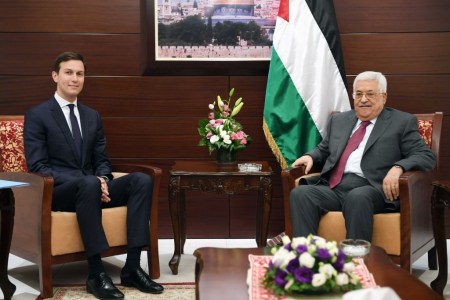
Palestinian Authority President Mahmoud Abbas (right) meets with Jared Kushner, Senior Advisor to U.S. President Donald Trump, on June 21, 2017 in Ramallah. (Photo by Thaer Ghanaim/PPO via Getty Images)

The Palestinian tone makes it clear that the Palestinian leadership and people have already relegated Trump’s peace plan to the trash-bin as nothing more than Israeli-American conspiracy, in collusion with some Arab countries, to impose a solution on the Palestinians and “liquidate” their cause.

To them, the “real” Trump is now apparent. This is how one Palestinian political analyst, Dr. Mazen Safi, reacted to Trump’s proposed peace plan and what he perceives as continued US support for Israel. “The US president and his administration have removed the mask from their face,” he stated. “They are paving the way for a new Israeli aggression on our people and moving the region toward an explosion.”

So what is really behind the Palestinian outrage with the Trump administration?

First, the Palestinians reject the idea of “regional peace” between Israel and Arab countries. The Palestinians maintain that peace between Israel and the Arab countries should come only after, and not before, the Palestinian issue is resolved. The Palestinians fear that any peace agreements between Israel and the Arab countries would come at their expense.

Echoing this fear, the Palestinian daily Al-Quds, which often reflects the views of the Palestinian Authority leadership, pointed out that the recent Arab League foreign minsters’ meeting in Cairo chose to focus on the Iranian and Hezbollah “threat,” breaking from the long-standing traditional obsession of the Arabs with the Palestinian issue. The Palestinians, according to the paper, feel abandoned by their Arab brothers.

“The Arab League meeting in Cairo came out with strong positions against the Iranian threat and didn’t hesitate to classify Hezbollah as a terrorist group,” Al-Quds complained in an editorial. “The meeting ignored the Palestinian cause. We are facing new Arab alliances against Iran, all under American pressure. This will have a negative impact on our cause.”

The Palestinian daily went on to lambast the floating Trump peace plan. It stated that the proposed plan, as published in various media outlets, “Doesn’t serve our interests and aspirations.”

Second, the Palestinians are furious with US threats to shut down the PLO’s diplomatic mission in Washington. They see the threat as an attempt to blackmail them not file charges of war crimes against Israel with the International Criminal Court. The Palestinians also see the threat as an attempt to force them to resume peace talks with Israel unconditionally.

“The US threat to close the PLO’s diplomatic mission in Washington shows disrespect for the Palestinian rights and blind bias in favor of Israel,” Al-Quds said in the same editorial. “It also coincides with growing hollow talk about a US peace plan that has been endorsed by President Trump.”

Third, the Palestinians are now openly talking about Trump’s Jewish advisors and envoys and their “influence” on him and his administration’s policies. This is something that Palestinian Authority officials had refrained from mentioning in the past year because it rings of out-and-out anti-Semitism. Now, however, Palestinian officials and political analysts do not seem to have a problem talking about the influence of the “Jewish lobby” on Trump’s decision-making process and policies.

Hassan Al-Batal, a political analyst closely associated with the Palestinian Authority, referred in a recent article to what he called “the three Jewish pillars of the Trump peace plan – Trump’s son-in law (Kushner), Middle East envoy (Greenblatt) and the US Ambassador to Israel (Friedman).”

Al-Batal expressed “regret” that the recent meeting of the Arab League foreign ministers chose to condemn Hezbollah and Iran. “Palestine is currently witnessing a crisis with Washington,” he said.

Bassam Abu Sharif, a former advisor to Yasser Arafat, went as far as referring to Trump’s Jewish advisors as a “dangerous clique.”

Abu Sharif said that he had no doubt that “what Kushner and his dangerous clique are planning is destructive and inhumane.” The US, he charged, has one major goal: to take full control of the Middle East and steal its resources for once and for all. This requires — according to their scheme — the liquidation of the Palestinian cause.”

Another political analyst, Talal Okal, who is also linked to the Palestinian Authority and its leadership, accused the Trump administration of “misinformation” and attempting to “blackmail” the Palestinians. Referring to the US demand that the Palestinians refrain from filing charges against Israel with the International Criminal Court and threatening to shut down the PLO’s diplomatic mission in Washington, Okal wrote:

“The US administration is practicing blackmail against the Palestinian leadership by demanding that the Palestinians engage in unconditional negotiations with Israel and that the Palestinians refrain from pursuing war crimes against Israel with the International Criminal Court. It’s obvious that the Trump administration is practicing a policy of misinformation.”

Palestinian political analyst Hani Habib claimed that the Trump administration was preparing to blame the Palestinians for the failure of the next peace process. The Palestinians, Habib said, “must be united in facing all forms of American-Israeli blackmail. The US administration’s threat to shut down the PLO’s diplomatic mission in Washington calls into question its ability to play the role of a fair and honest mediator.”

In an article entitled “Cheap American Blackmail,” columnist Omar Hilmi Al-Ghul complained: “The US administration is once again ignoring Palestinian rights and interests. It’s shamelessly and flagrantly seeking to confiscate the Palestinians’ independent decision-making process.”

Al-Ghul, too, made a reference to Trump’s Jewish team:

“The team surrounding Trump, which is in collusion with Israel, is acting in a way that contradicts what the Palestinian leadership wants — to maintain bridges with the US. The American blackmail of the Palestinian leadership is cheap and miscalculated.”

This conspiracy theory, which claims that Trump’s team cares more about Israel than US interests, is repeated in a statement by Fatah: “The US political blackmail contravenes international laws and resolutions pertaining to the Palestinian issue in particular and the peace process in general. This US position endorses the Israeli policy to end the two-state solution.”

The Palestinians’ rhetorical attacks on the Trump administration are designed to prepare the ground for their rejection of the proposed “ultimate solution.”

The Palestinians want it to be seen as a plan concocted by a few Jewish officials in the Trump administration who are more loyal to Israel than their own country, the US.

These officials, the Palestinians argue, have endorsed the position of the Israeli government and serve as its mouthpiece. That is why, they argue, the Palestinians are unable to accept a plan that is in effect a “Jewish-American conspiracy to eliminate the Palestinian cause.”

The Palestinians are also preparing the stage to accuse some Arab countries of “collusion” with this “conspiracy” — putting them on a collision course with Saudi Arabia.

The Palestinian message to the Arab countries, especially Saudi Arabia, should be seen as a warning shot: Collaborate with the Trump administration in the alleged scheme at your peril.

The anti-Trump Palestinian stance is sounding the death-knell for US administration’s effort to achieve comprehensive peace in the Middle East. Take careful note: these warning shots may well be translated into yet another intifada against Israel under the fabricated pretext that the Americans and Israelis, with the help of some Arab countries, seek to strip the Palestinians of their rights. One wonders when the world will wake up to the fact that those rights have already been stripped from the Palestinians — by none other than their own brainwashing, inciting and corrupt leaders.

Bassam Tawil, a Muslim, is based in the Middle East.

Special Counsel Mueller Probing Kushner’s Role in Blocking Obama’s Betrayal of Israel at UNSC

November 22, 2017

Special Counsel Mueller Probing Kushner’s Role in Blocking Obama’s Betrayal of Israel at UNSC, Jewish PressDavid Israel, November 22, 2017

Prime Minister Benjamin Netanyahu (right) and President Donald Trump (left) with Jared Kushner (center) at the start of their May 22 meeting in Jerusalem.

Robert Mueller’s investigation is now moving to Jared Kushner’s interactions with foreign leaders during the presidential transition (between the Nov. 8, 2016 election and the January 20, 2017 inauguration), with an emphasis on his attempt to prevent President Barak Obama’s parting shot at Israel at the United Nations Security Council in December, when the US abstained in a landmark resolution demanding a halt to all Israeli settlement in the “occupied territories,” the Wall Street Journal reported Tuesday.

Washington custom dictates that a president-elect is not expected to come to the nation’s capital until the inauguration other than for a few substantial policy or procedural discussions with the outgoing administration. Although this custom was violated by several incoming US president elects, it was rare for any of them to actually attempt to reverse the sitting president’s policies.

According to the WSJ, the Mueller team is now questioning witnesses about Kushner’s involvement in that controversial resolution, when Israeli officials asked the Trump team to help block the UNSC vote with a US veto, even though Trump was not yet in office.

The Obama administration held back its final and most stinging blow to its ally Israel until after the presidential vote so as not to cause Democratic Jewish voters to retaliate by abandoning presidential candidate Hillary Clinton, then signaled its approval for a vote condemning Israel as soon as the election results had been announced.

The UNSC then cast 14 votes with one US abstention for a resolution saying that Israeli settlements in the disputed territories liberated in 1967, including eastern Jerusalem, have “no legal validity” and demanding a halt to “all Israeli settlement activities,” saying this “is essential for salvaging the two-state solution.” The resolution reiterated that Israeli settlement was a “flagrant violation” of international law.

Among the Trump officials Israel contacted for help were Trump’s son-in-law Kushner and Trump’s former chief strategist Steve Bannon.

According to the WSJ, Mueller is also looking into Kushner’s outreach to other foreign leaders during the presidential transition, and his role in the June 2016 Trump Tower meeting with representatives of the Russian government, presumably to “collect dirt” on Clinton.

Lawmakers to Trump: Stop Stalling on Moving U.S. Embassy in Israel to Jerusalem

November 22, 2017

Lawmakers to Trump: Stop Stalling on Moving U.S. Embassy in Israel to Jerusalem,  Washinton Free Beacon , November 21, 2017

(Please see also, Holding the PLO Accountable. — DM)

Getty Images

A group of leading House lawmakers have petitioned President Donald Trump to immediately move the U.S. Embassy in Israel to Jerusalem ahead of a deadline that could see the White House delaying the move for at least another six months, according to a letter sent to the president and obtained by the Washington Free Beacon.

Rep. Ron DeSantis (R., Fla.), chair of the House Subcommittee on National Security, spearheaded the letter, which urges Trump to finally make good on a heavily scrutinized campaign promise to relocate the U.S. Embassy in Israel from Tel Aviv to Jerusalem, the Jewish state’s capital city.

While Trump has promised to move the embassy—which Congress legally mandated in 1995—as one of his first moves in office, the White House sent shockwaves through the pro-Israel community earlier this year when it renewed a longstanding waiver that ignores the congressional mandate and requires the embassy to remain located in Tel Aviv.

Every president since the law was initiated has signed the waiver, claiming that moving the embassy would interfere with U.S. diplomatic efforts to restart Israeli-Palestinian peace talks. Many observers in Congress and elsewhere thought Trump would finally break that cycle.

Since deciding to renew the waiver preventing the embassy’s move, DeSantis and other lawmakers have been pressuring the administration publicly and privately to make good on its promise.

The latest letter, sent to the White House on Tuesday, is a sign that Congress is becoming increasingly frustrated with Trump’s decision to delay the embassy move.

White House officials told the Free Beacon earlier this month that there is no decision yet on whether it will begin moving the embassy, saying, there is “no news to share” on the matter.

DeSantis told the Free Beacon on Tuesday that the letter is meant to show the Trump administration there is widespread support both in Israel and America for the embassy move.

“After 22 years, it is time to allow the Jerusalem Embassy Act to take effect,” DeSantis said. “I urge the president to decline to sign the impending waiver and announce the relocation of our embassy in Israel to Jerusalem.”

The move would help rally U.S. support for Israel at a critical time, DeSantis said.

“Doing so during this calendar year—the 50th anniversary of the reunification of Jerusalem—would be of incredible significant to millions of people in both Israel and the United States.”

The congressional letter to Trump echoes these sentiments and urges Trump to follow through with his earlier promises on the matter.

“We applaud your administration for standing strong in defense of Israel, and we urge you to fulfill your promise of relocating the U.S. embassy in Israel from Tel Aviv to the capital of Jerusalem as we approach the second waiver deadline of your administration under the Jerusalem Embassy Act on December 1, 2017,” the lawmakers write, referring to the upcoming deadline by which Trump must either renew the waiver or begin the process to relocate the embassy.

This is at least the second congressional letter on the issue since January and it follows a recent hearing on Capitol Hill in which top experts argued the Trump administration has no significant rationale for delaying the move.

“The upcoming deadline is the right time to enforce the Jerusalem Embassy Act,” the lawmakers write. “We are encouraged by the promise you made after the first waiver deadline of your administration in June 2017—that it is a question of when, not if, you will choose to relocate the embassy—and we hope to see your promise fulfilled this December.”

Other signers of the letter include: Reps. Brian Mast (R. Fla.), James Comer (R., Ky.), Trent Franks (R., Ariz.), Virginia Foxx (R., N.C.), Glenn Grothman (R., Wis.), Jody Hice (R., Ga.), Jim Jordan (R., Ohio), Doug Lamborn (R., Colo.), Mark Meadows (R., N.C.), Dennis Ross (R., Fla.), and Lee Zeldin (R., N.Y.).

Former United Nations Ambassador John Bolton, testifying earlier this month before lawmakers on the issue, maintained that arguments the move would negatively impact U.S. peace efforts in the region are unsubstantiated.

“Such a move, would not adversely effect negotiations over Jerusalem’s final status or the broader Middle East peace process,” Bolton told lawmakers. “Nor would it impair our diplomatic relations among predominately Arab or Muslims nations. In fact, by its honest recognition of reality, shifting the embassy would have an overall positive impact for U.S. diplomatic efforts.”

Holding the PLO Accountable

November 21, 2017

Holding the PLO Accountable, FrontPage MagazineCaroline Glick, November 21, 2017

(I have mixed feelings about Secretary of State Tillerson: bad and terrible. He appears to believe that he, not Trump, is the American president. Forget the moribund “peace process,” move the American Embassy to Jerusalem and do it now. Please see also The terrorist had reason to smile as he rammed people. — DM)

Originally published by the Jerusalem Post.

DeSantis argued that until the embassy is moved the Trump administration should take “incremental steps” that move it toward the goal.

Among the steps he advocated, DeSantis said “the American consulates in Jerusalem should report to the American embassy in Israel, not directly to the State Department.”

Tillerson’s letter to Zomlot was shocking because it represented the first time since 1993 that the PLO has been held accountable for its actions. The time has come for the State Department, too, to be held accountable for its behavior. And the best way to start this process is to follow DeSantis’s advice, subordinate the US consulates in Jerusalem to the US ambassador and end their boycott of Jews – US citizens and non-citizens – who live in the Jerusalem area, in Judea and Samaria.

**********************************

Is the PLO’s long vacation from accountability coming to an end? How about the State Department’s? In 1987 the US State Department placed the PLO on its list of foreign terrorist organizations. The PLO was removed from the list in 1994, following the initiation of its peace process with Israel in 1993.

As part of the Clinton administration’s efforts to conclude a long-term peace deal between the PLO and Israel, in 1994 then president Bill Clinton signed an executive order waiving enforcement of laws that barred the PLO and its front groups from operating in the US. His move enabled the PLO to open a mission in Washington.

Whereas Obama’s PLO upgrade was legally dubious, the PLO’s campaign to get recognized as a state breached both of its agreements with Israel and the terms under which the US recognized it and permitted it to operate missions on US soil.

The operation of the PLO’s missions in the US was contingent on periodic certification by the secretary of state that the PLO was not engaged in terrorism, including incitement of terrorism, was not encouraging the boycott of Israel and was not seeking to bypass its bilateral negotiations with Israel in order to achieve either diplomatic recognition or statehood. Under Obama, the State Department refused to acknowledge the PLO’s breach of all the conditions of US recognition.

Angry at the administration’s facilitation of PLO breaches, in 2015 Congress mandated stricter and more precise conditions for continued operation of the PLO’s mission in Washington. Starting in 2016, the PLO was explicitly banned from advocating the prosecution of Israelis by the International Criminal Court. In 2015 the PLO joined the ICC with the explicit purpose of advocating the prosecution of Israelis. And in conformance with this purpose, in his speech before the UN General Assembly in September 2017, PLO/PA chief Mahmoud Abbas called for the ICC to prosecute Israelis for building communities in Judea and Samaria.

Given his experience with US administrations since Clinton, Abbas had every reason to believe that he would suffer no repercussions for his statement. No US administration had ever called the PLO/PA to account for its open breach of the terms of US recognition. So it isn’t surprising that Abbas and his advisers were utterly shocked when on Friday, US Secretary of State Rex Tillerson sent a letter to the PLO mission in Washington informing PLO envoy Husam Zomlot that he could not renew certification of PLO compliance with US law in light of Abbas’s statement in September.

The only way for the mission to remain in place is if President Donald Trump certifies within 90 days that the PLO is engaged in “direct, meaningful negotiations with Israel.”

One of the primary functions of the PLO mission in Washington is to promote and fund the boycott movement against Israel – in contravention of the terms of its operation and the terms of its agreements with Israel.

In written testimony to the House Foreign Affairs subcommittee on the Middle East and North Africa in February, Jonathan Schanzer of the Foundation for Defense of Democracies revealed that the mission is “said to be actively promoting campus BDS [boycott, divestment and sanctions] activity in the US.”

“PLO operatives in Washington, DC,” Schanzer said, “are reportedly involved in coordinating the activities of Palestinian students in the US who receive funds from the PLO to engage in BDS activism. This, of course, suggests that the BDS movement is not a grassroots activist movement, but rather one that is heavily influenced by PLO-sponsored persons.”

In April 2016, Schanzer informed Congress that the PLO consulate in Chicago is a major funder of the BDS campus group Students for Justice in Palestine. The chairman of the US Coalition to Boycott Israel, which among other things funds BDS, is Ghassan Barakat, an official at the PLO’s Chicago consulate. His colleague, Senan Shaqdeh, is a member of the coalition. Shaqdeh also claims to be the founder of Students for Justice in Palestine, the antisemitic BDS group that operates on campuses throughout the US.

As Schanzer noted, in 2014 Shaqdeh traveled to Ramallah to meet with Abbas and PA Prime Minister Rami Hamdallah.

Aside from the fact that the US has refused to hold the PLO accountable for its actions for a quarter century, the PLO has another good reason to be shocked by Tillerson’s letter: the US consulate in Jerusalem operates as almost a mirror to the PLO mission in Washington.

The US consulate in Jerusalem has the same status as an embassy. Like the US ambassador in Tel Aviv, the US consul general in Jerusalem reports directly to the State Department. He is not accredited to Israel. His area of operations includes Jerusalem and its environs within and beyond the 1949 armistice lines, including Beit Shemesh, Mevasseret Zion, Judea and Samaria.

Israeli citizens who live within the consulate’s area of operations are not permitted to receive consular and visa services from the embassy in Tel Aviv. Among the hundreds of thousands of Israeli Jews that are required to receive US consular services from the consulate rather than the embassy are tens of thousands of Jewish dual nationals.

And yet, as Yisrael Medad has exhaustively documented, the Jerusalem consulate maintains an effective boycott of both these dual nationals and Israeli nationals who live in its area of operation. All of the consulate’s activities for US citizens are directed specifically and openly toward “Palestinian residents of Jerusalem and the West Bank.”

Consul General Donald Blome similarly directs all of his efforts toward reaching out to the Palestinians, ignoring as a regular practice the millions of Jews who live in his area of responsibility.

The consulate also openly rejects the notion that Israel and Jews have ties to its area of operations. For instance, Blome went on a hike around Judea and Samaria in July where he effectively erased the Jewish heritage sites in the areas. The consulate echoed UNESCO’s Jew-free version of the history of the land of Israel in a press release that celebrated his walk along the “Masar Ibrahim Al-Khalil” trail in celebration of “the connection of the people with the land.” Jews were not mentioned in the press release. And the historical name of the route he took is “Abraham’s path.”

Scholarships to study in the US and jobs listed on the website are open to “Palestinian residents of Jerusalem and the West Bank.”

In other words, while the PLO missions are pushing the BDS agenda in the US, the US consulate in Jerusalem is implementing it on the ground in Israel.

Tillerson’s letter to the PLO mission on Friday came two weeks before Trump will have to decide whether or not to sign a related waiver. On December 1, Trump will either allow the 1995 Jerusalem Embassy Act to come into force or he will sign a waiver postponing the embassy move for yet another six months.

In a congressional hearing on the issue of moving the embassy to Jerusalem on November 8, Rep. Ron DeSantis said that transfer of the embassy may be delayed due to the Trump administration’s “efforts to pursue a peace deal between Israel and the Palestinian Arabs.”

DeSantis argued that until the embassy is moved the Trump administration should take “incremental steps” that move it toward the goal.

Among the steps he advocated, DeSantis said “the American consulates in Jerusalem should report to the American embassy in Israel, not directly to the State Department.”

Tillerson’s letter to Zomlot was shocking because it represented the first time since 1993 that the PLO has been held accountable for its actions. The time has come for the State Department, too, to be held accountable for its behavior. And the best way to start this process is to follow DeSantis’s advice, subordinate the US consulates in Jerusalem to the US ambassador and end their boycott of Jews – US citizens and non-citizens – who live in the Jerusalem area, in Judea and Samaria.

Trump’s Unsung Success in the Middle East

November 15, 2017

Trump’s Unsung Success in the Middle East, PJ MediaDavid P. Goldman, November 14, 2017

Israel Trump

But overall, Trump’s Middle East policy has been a success, in striking contrast to his predecessors. The supposed Middle East mavens among the preening NeverTrumpers (Max Boot, Reuel Marc Gerecht, Bill Kristol et. al) made a mess of things, and Trump has gone a long way to cleaning it up. That’s not bad for one year in office.

*****************************

President Trump’s Middle East policy is simple: Back our friends and scare the hell out of our enemies, and negotiate where possible with our competitors like Russia and China. By and large it’s working, unlike the catastrophically failed polices of the previous two administrations. Trump did what he said he would do and succeeded. You wouldn’t know that from the #fakenews media.

Start with Israel: The Muslim strategy to destroy Israel hasn’t envisioned war–not at least since 1973–because Israel in all cases would win. Instead, the objective is to ring Israel with missiles and force Israel to retaliate against missile attacks in such a way that the “international community” would respond by imposing a “settlement” on Israel that would leave Israel vulnerable to further missiles attacks, and so forth. This is stated explicitly by Palestinian strategists cited by Haviv Rettig Gur in The Times of Israel.

George W. Bush and Obama gave aid and comfort to the encircle-and-strangle strategy by tying Israel’s hands. Then Secretary of State Condoleezza Rice wouldn’t let Olmert attack Hezbollah with full force in 2006. Rice thinks the Palestinian movement is a branch of the U.S. civil rights movement (if you don’t believe that characterization, read her book “Democracy,” which I will review for Claremont Review of Books).

Obama sandbagged Israel during the 2014 Gaza rocket attacks, suspending delivery of Hellfire missiles to the Jewish State. Israel is the only country in the world that embeds human rights lawyers in every infantry company to make sure that its soldiers keep collateral damage to a minimum.

Hezbollah, Iran’s Lebanese militia, has 150,000 rockets aimed at Israel, and many of them can hit any target in the country. In the case of a major rocket attack from Hezbollah against Israel, military logic dictates the preemptive neutralization of rocket launchers embedded in civilian populations–what an Israeli strategist close to the PM described to me as “Dresden.” There would be tens of thousands of civilian casualties. Trump will not tie Israel’s hands in the case of attack, and will not interfere with Israel’s ability to defend herself. That makes Israel’s deterrent against Iran credible.

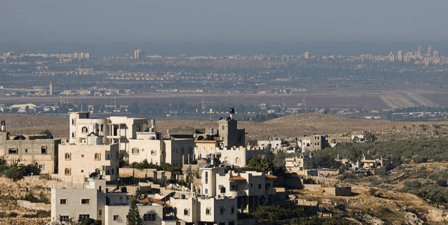
Hillary Clinton insisted that the “technology of war,” in particular the rockets ringing Israel, would force Israel to accept a phony peace agreement whose main effect would be to bring the rocket launchers closer to Israel. The photograph below shows the runways and main terminal building of Israel’s international airport from an Arab village in Judea: Hand this over to the Palestinians and primitive short-range missiles can shut down the Israel economy. There’s an easy way to stop the rockets, which is to kill the people who shoot them. That might mean killing the human shields whom the cowardly terrorists put in front of the rockets, but under international law, a country acting in self-defense has every right to kill civilians.

For that reason alone, anyone who claims to be a friend of Israel must support Trump against the alternative. One can criticize Trump all day with justification, but the existential issue of Israel’s survival requires Jews to support him. Jewish never-Trumpers are infected with what our rabbis of antiquity called “baseless hatred.”

The second big issue is Saudi Arabia, which competed with Iran for decades as the biggest funder of terrorists and religious extremists. After Trump’s March 2017 trip to Saudi Arabia, where he read the riot act to assembled Arab leaders, Saudi Arabia’s Crown Prince has centralized control of the government and seized hundreds of billions of dollars of royal family assets. The $800 billion of royal family wealth targeted is larger than the national reserves of the kingdom. As I wrote in Asia Times last week, Saudi Arabia has gotten its first real government, as opposed to the family regime that allowed every crazy cousin to write checks to terrorists. Of course, the kingdom well might get its second, third and fourth real government in short order if Crown Prince Mohammed bin Salman fails. But the de facto coup is a huge blow to Sunni jihadism and a victory for American policy.

Prince Mohammed and his father King Salman had visited Moscow in late September, and the Russian and Chinese press express guarded optimism about the regime change (see the cited Asia Times article). Russia and China have a great deal to fear from Sunni jihadists (virtually all their Muslim citizens are Sunni) and a Saudi ruler willing to close the tap is good for them. As I wrote, its win-win-win-win for the U.S., Russia, China and Israel.

That ought to scare the Persians plenty. The Saudis get very bad press for chopping up the Houthi-led tribes in Yemen, Iran’s allies. They are making a horrible example of the Houthi for the edification of Iran. That is disgusting, to be sure, but that’s the way things are done in that part of the world. The Assad government in Syria did much worse, deliberately bombing civilians to drive out the Sunni majority in order to replace it with Shi’ite colonists.

The Saudis don’t have much of an army, and their air force depends on Pakistani mercenaries, but they do have nearly 300 fourth-generation aircraft (F-15’s, Eurofighters, and Tornadoes) as well as a huge stock of Chinese-made medium range missiles. They can hire Pakistanis or Egyptians to fly them if necessary. Iran has tough soldiers but no air force to speak of. If it comes to war (which it shouldn’t) between Iran and Saudi Arabia, Iran will suffer badly. A dozen power plants provide more than half the country’s electricity, for example, and could not be defended in case of war.

There isn’t much to do about Iran now that its economic ties point eastwards to China, except to terrify the Tehran mullahs. That’s old-fashioned balance of terror–not my favorite way of doing things, but a policy that worked reasonably well during the Cold War. It’s easy to talk about tearing up the Iran nuclear agreement–but now there are two rail lines linking Iran to China, and the West’s influence in the region has vastly diminished. Unfortunately, grand gestures may not bring grand results, and the U.S. has to play tought and sometimes dirty.

Ultimately any regional issue depends on the strategic position of the United States with respect to China and Russia. We continue to lose ground, and Trump hasn’t yet offered an initiative to reverse it (I would begin by a crash program for missile defense, including space-based systems).

There are any number of things to criticize in the administration’s handling of the Middle East. I would have preferred a tougher approach to Iran’s presence in Syria in our negotiations with Russia over a cease-fire, and a more supportive stance towards the Iraqi Kurds’ aspirations for independence (although as Daniel Pipes observes, the fact that the independence referendum backfired was the Kurds’ own fault). And I would like the president to keep his campaign promise to move our embassy in Israel to Jerusalem.

But overall, Trump’s Middle East policy has been a success, in striking contrast to his predecessors. The supposed Middle East mavens among the preening NeverTrumpers (Max Boot, Reuel Marc Gerecht, Bill Kristol et. al) made a mess of things, and Trump has gone a long way to cleaning it up. That’s not bad for one year in office.

Jared Kushner, Mohammed bin Salman, and Benjamin Netanyahu Are Up to Something

November 8, 2017

Jared Kushner, Mohammed bin Salman, and Benjamin Netanyahu Are Up to Something, Foreign Policy, November 7, 2017

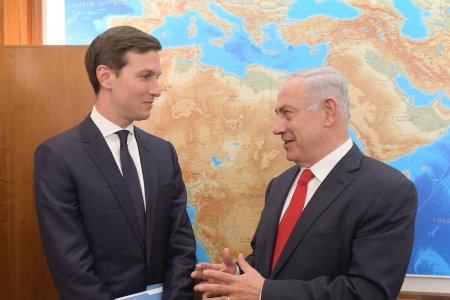
JERUSALEM, ISRAEL – JUNE 21: (ISRAEL OUT) In this handout photo provided by the Israel Government Press Office (GPO), Israel’s Prime Minister Benjamin Netanyahu meets with Jared Kushner on June 21, 2017 in Jerusalem, Israel. (Photo by Amos Ben Gershom/GPO via Getty Images)

Mohammed bin Salman may or may not have recently visited Tel Aviv, where Israel’s Defense Ministry is located. But even if he never set foot in the HaKirya complex, there is little doubt that he has authorized ever closer relations with the Israelis, who view the Iranian threat exactly as he does. And the crown prince is not the only one Jared Kushner has been speaking to: Trump has given his son-in-law overall leadership on the peace process between Israel and the Arabs, and he is reportedly a welcome guest in Israeli Prime Minister Benjamin Netanyahu’s office.

Given Kushner’s role, did Crown Prince Mohammed bin Salman signal his plans when Kushner last met with him — and did Kushner then inform his father-in-law? And if so, how far will Washington, or more precisely, the White House, go to back up the Saudis if their confrontation with Iran gets hot? Or will Israel serve as Trump’s proxy? With this president, this crown prince, and the current prime minister of Israel, anything is possible.

****************************

There seems to be a general consensus in Washington that Saudi Crown Prince Mohammed bin Salman’s ongoing purge of princes and businessmen — including the wealthiest of them all, the business mogul and Prince Al-Waleed bin Talal — is motivated by his determination to consolidate his power, well before his father, King Salman, passes from the scene. He is in this regard a latter-day Adonijah, who had himself crowned king while his father King David was alive. And, like Adonijah, Mohammed bin Salman has made some very powerful enemies in the process. Unlike that Biblical figure, however, he has his father’s support and has taken care to arrest anyone who might threaten his drive to preeminence.

Jared Kushner, U.S. President Donald Trump’s son-in-law and senior advisor, was in Riyadh again only recently. It was his third trip to Saudi Arabia since Trump took office. He again met with Crown Prince Mohammed bin Salman, with whom he appears to have established a close personal relationship. It should therefore come as no surprise that Trump, who shares the young crown prince’s antipathy toward Iran, has commented favorably on the recent developments in Riyadh.

It is said of Donald Trump that he has undermined America’s credibility with its allies. That may be the case in Europe, and perhaps in parts of Asia, though not in Japan or India. But it is certainly not the case in the Middle East. Tensions with Turkey and Egypt emanate primarily from the U.S. Congress, not from the other end of Pennsylvania Avenue. Relations with Israel are better than they have been since the day former President Barack Obama took office. The same can be said of U.S. relations with both Saudi Arabia and the United Arab Emirates or, for that matter, Bahrain and Morocco. The force that unites them all is Iran, whose support for instability throughout the region received a financial fillip from the Joint Comprehensive Plan of Action — that is, the Iran nuclear deal.

Crown Prince Mohammed bin Salman may or may not be a true reformer. His record on that score is not unequivocal. But he is determined to halt the expansion of Iranian influence, which now really does manifest itself as the Shiite crescent about which Jordan’s King Abdullah II forewarned over a decade ago. The crown prince recognizes that his country’s worst nightmare is slowly materializing: Iran is supplying the Houthi rebels to its south and dominates neighboring Iraq to its north. 

It foments instability in Bahrain and could well do the same in Saudi Arabia’s Shiite-majority Eastern Province. And if that were not enough, Iran’s influence is entrenched in Damascus and Beirut. It is particularly for that reason the Saudis forced their ally Saad Hariri, the Lebanese prime minister, to resign his office while on a visit to the Kingdom.

Mohammed bin Salman may or may not have recently visited Tel Aviv, where Israel’s Defense Ministry is located. But even if he never set foot in the HaKirya complex, there is little doubt that he has authorized ever closer relations with the Israelis, who view the Iranian threat exactly as he does. And the crown prince is not the only one Jared Kushner has been speaking to: Trump has given his son-in-law overall leadership on the peace process between Israel and the Arabs, and he is reportedly a welcome guest in Israeli Prime Minister Benjamin Netanyahu’s office.

Given Kushner’s role, did Crown Prince Mohammed bin Salman signal his plans when Kushner last met with him — and did Kushner then inform his father-in-law? And if so, how far will Washington, or more precisely, the White House, go to back up the Saudis if their confrontation with Iran gets hot? Or will Israel serve as Trump’s proxy? With this president, this crown prince, and the current prime minister of Israel, anything is possible.

‘The United States betrayed Israel at the UN’

November 5, 2017

‘The United States betrayed Israel at the UN’, Israel National News, Yoni Kempinski, November 5, 2017

(Please see also, Nikki Haley Uses A Blowtorch On Barack Obama At The United Nations. — DM)

“All in all, I have to say that I am cautiously optimistic about the changes occurring in the culture at the UN. The Israel bashing hasn’t disappeared by any means. But it is less and less. And where it persists, the United States has used its leverage to force change,” she concluded.

****************************************

Nikki Haley, the U.S. Ambassador to the UN, on Saturday night spoke at the opening plenary session of the Israeli American Council (IAC) National Conference in Washington, DC and vowed to continue to work to stop the Israel bashing at the international organization.

She noted that Israel is “the country the United Nations spends half its time on. Unfortunately, I’m not kidding. It seems the breakdown at the UN is to spend half the time on Israel, and half the time on the other member nations.”

While the UN is a hostile place for Israel, said Haley, before she became ambassador she witnessed “a shameful period the United States became a part of that hostility”. She was referring to the passing of UN Resolution 2334, passed by the UN Security Council last December and which “branded Israel as a violator of international law.”

The United States allowing this motion to pass by not vetoing it “was a cowardly act; and a real low point for America at the UN. What happened with 2334 was a betrayal of our friend in the very forum that has been one of its cruelest and most hostile foes. America was far from being a friend to Israel on that day,” said Haley.

“I was still governor of South Carolina, but I came away from the passage of Resolution 2334 certain of one thing: As long as I was U.S. Ambassador, such an act of betrayal would never happen again,” she stressed.

Haley recalled that in the first meeting she attended as ambassador, the UN discussed Israel rather than the fighting in Syria or other pressing issues, adding “it was then that I vowed that the days of Israel bashing at the UN were over.”

She addressed the nuclear deal with Iran, which President Donald Trump did not recertify, describing it as “very very flawed…Iran is engaged in all kinds of bad behavior prohibited by UN Security Council resolutions, including building up Hezbollah in Lebanon.”

“The president’s action has put the Iran deal back in play. We are now pushing the world to confront the totality of the threat by the Iranian regime” not just in its nuclear program, but in the way it backs terror groups and continues to test ballistic missiles, she continued.

“It’s a new day at the UN. Slowly but surely, we’re chipping away at the anti-Israel culture. Three weeks ago, the U.S. withdrew from UNESCO. For the U.S. it was a good call and after we considered UNESCO’s pattern of one-sided resolutions, it was an easy call,” said Haley, who also stressed that Washington is against the UN Human Rights Council’s (UNHRC) blacklist of companies that do business in Judea and Samaria.

“We need to be clear: This is a BDS blacklist, plain and simple. The United States has been opposed to this list from the start. We have not and will not contribute any information to its creation,” she stressed.

“All in all, I have to say that I am cautiously optimistic about the changes occurring in the culture at the UN. The Israel bashing hasn’t disappeared by any means. But it is less and less. And where it persists, the United States has used its leverage to force change,” she concluded