Archive for the ‘Trump and Israel’ category

Shocking – the new ambassador to Israel

December 18, 2016

Shocking – the new ambassador to Israel, Israel National News, Att’y Stephen M. Flatow, December 17, 2016

A Jewish ambassador to Israel who is more sympathetic to Israel than to the Palestinians, and who will respect the wishes of the Israeli public and government? Shocking!

I’m not being sarcastic. It really is shocking. Critics of Israel are so accustomed to Jewish ambassadors who harass and undermine the Israeli government, that the prospect of someone completely different has left them frothing at the mouth. 

David Friedman, President-elect Trump’s choice for ambassador to Israel, is completely unlike his predecessors. And that’s what drives the critics of Israel crazy.

For many decades, the top tiers of the State Department and the diplomatic corps were closed to Jews. Everyone knew that their ranks were reserved for blue bloods and white shoes–people who came from the “right” segment of society and belonged to the “right” country clubs.

In the 1970s, though, a certain kind of Jew began to squeeze through the doors at Foggy Bottom. They had names like Daniel Kurtzer, Dennis Ross, Aaron Miller, and Martin Indyk. They were different than most Jews because they were stridently critical of Israel and were willing to devote themselves to forcing Israel to make one-sided concessions to the Arabs.

Indyk served as U.S. ambassador to Israel from 1995 to 1997 and again from 2000 to 2001. His haughty attitude was obvious from early on: he boasted to the Washington Post (2-24-97) that he saw his job in Israel as similar to “a circus master” who “cracks the whip” in order to “get [the animals] to move around in an orderly fashion.”

Indyk’s practice of interfering in Israel’s internal affairs was notorious. In 1995, for example, he lobbied Knesset Members to oppose a law that would have reduced the chances of Israel surrendering the Golan Heights to Syria.

One shudders to think of the dangers Israel would face today if Indyk had his way and the Golan was in the hands of either the genocidal Assad regime or its genocidal ISIS opponents.

Indyk tried to pressure Israel’s chief rabbi to oppose a housing project in a part of Jerusalem that Indyk wanted Israel to give up. He also tried to block the selection of a cabinet minister whom he thought was insufficiently dovish. Things got so bad that the chairman of the Knesset Foreign Affairs and Defense Committee took the unprecedented step of publicly declaring: “Ambassador Indyk needs to be reminded that he is not the British High Commissioner,” alluding to the British Mandate that preceded Israel’s independence.

The appointment of the second Jewish ambassador to Israel, Daniel Kurtzer, in 2001, did not improve matters. Kurtzer repeatedly pressured Israel to remove security checkpoints (lest Palestinian Arab travelers be inconvenienced) and make one-sided concessions on settlement construction (while never asking the Palestinian Authority to limit its illegal construction). He denounced Israel’s budgetary allocations–an extraordinary act of interference in Israel’s internal affairs. Kurtzer even publicly called on the Israeli public to put pressure on the government to make more concessions.

When Israel responded to Yasser Arafat’s sponsorship of terrorism in the autumn of 2002 by besieging Arafat’s headquarters in Ramallah, Kurtzer rode to the rescue of the arch-terrorist by demanding that the Israeli government end the siege. This took place nine months after Israel had captured Arafat’s ship, the Karine A, with its fifty tons of weapons–the episode that revealed Arafat had never changed his terrorist spots. Yet there was the Jewish U.S. ambassador to Israel, nine months later, trying to rescue the mass murderer.

The third Jewish ambassador to Israel, Dan Shapiro, has not been much better. In an interview with Israel Army Radio last year, Shapiro indicated that U.S. support for Israel at the United Nations and other international forums was conditional on Israel accepting moving towards creation of a Palestinian state. that kind of linkage was all too reminiscent of the Indyk “crack the whip” approach.

Earlier this year, Ambassador Shapiro falsely claimed that “Israeli vigilantism in the West Bank goes on unchecked,” that “Israel has two standards of adherence to rule of law in the West Bank– one for Israelis and one for Palestinians,” and that Israel’s settlement policy “raises questions about Israeli intentions.”

That was a thinly-veiled way of saying that Israel is not really interested in peace if it permits the construction of a kindergarten in Judea, Samaria, or many parts of Jerusalem. Shapiro’s statements were so mean-spirited and inappropriate that Prime Minister Netanyahu himself issued a stinging rebuke: “The ambassador’s statements, on the day when a mother of six who was murdered is buried, and on a day when a pregnant woman is stabbed – are unacceptable and wrong,” the prime minister said.

So yes, David Friedman is going to be a very different kind of Jewish ambassador to Israel. Unlike his disreputable predecessors, Friedman will respect Israel’s right to make its own decisions, instead of “cracking whips” and dictating to Israel how to behave. Friedman will be on the side of the exemplars of democracy and freedom in the Middle East, not the terrorists and the totalitarians. In short, Ambassador Friedman will work to strengthen ties between America and its loyal ally, Israel, instead of undermining them.

What a difference!

Anti-Israel Lefties Freak Out Over Trump Pick for Ambassador to Israel

December 16, 2016

Anti-Israel Lefties Freak Out Over Trump Pick for Ambassador to Israel, Front Page Magazine (The Point), Daniel Greenfield. December 26, 2016

(There are other “problems” with Friedman: not only is he Jewish, he even speaks Hebrew. Secretary Kerry suffered from neither deficiency. Instead, he reflected Obama’s sense of balance toward Israel and what he hoped would become the sovereign state of Palestine, spreading from sea to shining sea. Seriously though, why would it be detrimental to America, or even to Israel, to help to keep the only democratic, non-Islamic nation in the Middle East alive? — DM)

hitlercries

There’s a fresh wind blowing through a stale room full of embittered lefties. The US Ambassador to Israel isn’t supposed to be pro-Israel. He’s supposed to represent the compelling US interest in the PLO.

Lisa Goldman of the truly vile hate site 972 really loses her mind.

“David Friedman’s views lie to the right of Meir Kahane’s. Trump naming him as Amb to Israel is a FU to the 70% of US Jews who vote Democrat,” she rants.

No, but it is an FU to the 2% of US Jews who vote for the Green Party and hate the Jewish State. But there’s more…

“This is true. It’s on the record. Trump’s ambassador to Israel called fellow Jews who support a 2 state solution “worse than kapos.”

The Kapos often didn’t have a choice. If Not Now and JVP’s howlers of hate do. And they chose to be what they are. We must never forget that.

Jill Jacobs of the anti-Israel group T’ruah is also most unhappy..

“New ambassador to Israel insults all liberal Jews, esp @JeremyBenAmi,” Jacobs whines.

Oh no. Not poor Jeremy Ben Ami. And Jeremy is also discommoded.

“Lord help friends of Israel if someone like David Friedman is making US policy on Israel rather than John Kerry,” Jeremy squeals.

That would indeed be the clearest sign that the Lord is helping Israel.

But David Friedman’s pick has caused a complete meltdown in the underground volcanic cavern serving as J Street’s HQ. J Street was already running back and forth waving its arms over a move of the embassy to Jerusalem, blocking Bolton and freaking out over the Chanukah party.

Now it’s losing what little is left of its ugly little mind.

“Trump’s pick of Friedman for Israel Amb is anathema to values that underlie US-Israel relationship. We’ll fight this with all we’ve got,” Jeremy Ben Ami rants.

The official J Street statement declares, “J Street is vehemently opposed to the nomination of David Friedman to be Ambassador to Israel.”

It’s hard to think of a better recommendation for Friedman than that.

“Well Friedman, the group (@jstreetu) you once called “worse than Kapos” is going to make this a hard 4 years for you,” Brooke Davies of J Street threatens.

“One idea from @jstreetdotorg: The Senate should block the confirmation of this dangerous extremist,” Logan Bayroff demands.

You can see them sweat.

Trump’s envoy: The new administration ‘won’t tell Israel what policies to adopt’

December 16, 2016

Trump’s envoy: The new administration ‘won’t tell Israel what policies to adopt’, Times of IsraelEric Cortellessa, December 16, 2016

WASHINGTON — Sitting in a conference room together 13 years ago, David Friedman told his friend Donald Trump that he just purchased an apartment in Jerusalem.

Trump, the real estate tycoon, was immediately curious to know the particulars. “How big was it? How much did it cost?” Friedman recalled him asking, describing the conversation during an interview last month with The Times of Israel. When Friedman cited the price, Trump was surprised.

“That’s really a lot of money,” he responded, according to Friedman’s recollection. “For that kind of money, why wouldn’t you buy a place in East Hampton? Why do you have to go all the way to Israel for a second home?”

The Long Island native’s answer was probably one that the man soon to be president was not expecting. “The world has been fighting over every inch of Jerusalem for the past 3,000 years,” Friedman told Trump. “There’s nobody fighting over East Hampton.”

Trump’s eyes then “opened up,” Friedman said, “and that initiated a decade-plus conversation about Israel.”

Now, in 2016, that exchange seems to have been more fateful than it initially seemed to Friedman, who was announced on Thursday as President-elect Trump’s nominee to be the next US ambassador to Israel.

And the first move Friedman made in that official capacity was to indicate that Trump plans to follow through on his campaign pledge to move the US embassy from Tel Aviv to Jerusalem, breaking decades of precedent under both Republican and Democratic administrations, and underlining an apparent inclination to do what other presidential candidates have promised but declined to deliver once they took office: recognize the holy city as Israel’s capital.

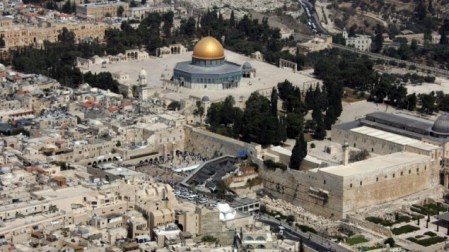
domeoftherockAn aerial view of the Dome of the Rock, left, in the compound known to Muslims as al-Haram al-Sharif and to Jews as Temple Mount, in Jerusalem’s Old City, and the Western Wall, center, the holiest site for Jews, October 2, 2007. (AFP/Jack Guez)

Official US policy has long been to insist that the status of Jerusalem can only be determined through a negotiated settlement between the parties, as both Israelis and Palestinians claim it as their capital.

In a statement Thursday, Friedman, a Hebrew-speaker, declared he was “deeply honored and humbled” that his friend of 15 years selected him to represent America to the Jewish state, and he also left the world with a zinger when he said he looked forward to doing his new job “from the US embassy in Israel’s eternal capital, Jerusalem.”

But Friedman’s declared appetite to move the embassy is not the only reason liberal Jewish organizations have responded to his nomination with something close to horror. The 57-year-old bankruptcy lawyer has also been an outspoken and active supporter of the settlement movement, and has argued that Israel doesn’t face a “demographic threat” to its Jewish character if it fails to separate from the Palestinians.

Friedman serves as president of American Friends of Bet El Institutions, an organization that supports the large West Bank settlement near Ramallah, and over the last year, he has excoriated groups who express criticism of Israel’s settlement policy.

friedman-c2-305x172David Friedman, Donald Trump’s adviser on Israel, talks to Channel 2 News on September 12, 2016. (screen capture: Channel 2)

In June, Friedman accused J Street supporters of being “far worse than kapos” in a column for the right-wing, pro-settlement Israel National News website, using the term for Jews who aided Nazis during the Holocaust. Speaking before the Brookings Institution’s annual Saban Forum earlier this month, he refused to walk back his comparison.

Now that he is slated to become the United States’ top diplomat in Israel — so long as the US Senate confirms his appointment — he will assume one of the most delicate positions in American foreign policy, mediating the US relationship with a close ally in an increasingly unstable region, and after eight tumultuous years of ties between the administration of President Barack Obama and the government of Prime Minister Benjamin Netanyahu.

Last month, Friedman spoke with The Times of Israel about what Trump’s policies and priorities would be toward the Jewish state if he won. Here is what he said.

‘No daylight’ between the US and Israel

When it comes to the US-Israel relationship, Friedman insisted that Trump would represent a sharp break from his predecessor — including in that there would be “no daylight between Israel and America,” a phrase also used in the transition team’s announcement of his selection on Thursday, which indicates a policy of keeping differences out of the public sphere.

“Donald Trump wants to be as supportive of Israel as possible,” Friedman told The Times of Israel. “He doesn’t view Israel as a client state that you just kind of issue directives to. He views Israel as a partner, one of America’s key partners in a global war against Islamic terrorism, so he wants Israel … to be as strong and secure as possible.”

Unlike Obama, who made Israeli settlement construction in the West Bank a fundamental issue of criticism throughout his presidency, Trump will not “put his finger on the scale or tell Israel what policies they should adopt,” Friedman said, adding that his new boss “doesn’t see Israel as in need of any particular correction at this point.”

That principle, he indicated, covers both how Trump will treat the settlement issue and the manner in which Israel seeks to reach an agreement with the Palestinians. The Trump administration will not “dictate to Israel where it can and cannot build” in the West Bank, according to Friedman.

Trump, for his part, has not publicly stated a position on settlements or detailed what kind of a stance he would take. The most common view among Washington’s foreign policy community, and emphatically within the Obama administration, is that, to keep the two-state option alive and ensure Israel’s future as a Jewish and democratic state, the US should try to limit settlement activity to the principal blocs that Israel is expected to retain under any permanent accord.

For his part, Friedman said that a Trump administration “doesn’t see much opportunity for progress until the Palestinians renounce violence and accept Israel as a Jewish state. That’s really a prerequisite.”

One criticism Friedman had of the current president was that Obama saw Israel as “strong” and the Palestinians as “weak,” and thus he believed it was up to the Israelis to take the risks necessary for peace. “Strong vs. weak is less relevant to Trump than the ‘relative conduct of the parties’,” Friedman said.

According to Friedman, Trump was influenced by seeing a video last spring of a stage production put on at a Hamas-affiliated school in Gaza. “Half the kids were dressed up as Israeli soldiers or traditional garb and the other half were dressed up as shahids, and the kids playing terrorists took their fake knives and stabbed all the Jews,” Friedman said of the film. “Fake blood poured on the stage, and the parents all applauded this. In a first grade class.”

knifeA young Palestinian girl attacks ‘Israeli soldiers’ with a knife in a play held in Gaza as part of the ‘Palestine Festival for Children and Education,’ April 2016 (Channel 2 news)

Trump, he said, sees that kind of incitement as “unacceptable and an insoluble impediment to peace.”

But didn’t Trump say he wanted to be neutral?

In February 2016, then-Republican presidential hopeful Trump called Israeli-Palestinian peace “probably the toughest agreement of any kind to make,” but vowed to give it “one hell of a shot.”

He also pledged he would do that by being “sort of a neutral guy,” when pressed by MSNBC’s Joe Scarborough over whether he ascribed fault to either side for failing to reach an accord. “A lot of people have gone down in flames trying to make that deal. So I don’t want to say whose fault is it,” he said. “I don’t think it helps.”

Trump took immediate heat for this promise on the campaign trail, and seemed to indicate a walk-back during his speech at the 2016 AIPAC Policy Conference and elsewhere, but he has not explicitly rescinded this posture.

Friedman argued, however, that his language has been misunderstood. “What he was really referring to was trying to sponsor negotiations that would take place without preconditions,” he said. “That was what he viewed as neutrality, and that’s frankly been the view of the Israeli government for some time.”

Friedman cited Obama’s demand in his first term that Netanyahu place a moratorium on all West Bank settlement construction, as a trust-building measure, to be “an example of the absence of neutrality, but it’s in favor of the Palestinians against the Israelis.”

And what about that two-state solution?

As one of Trump’s top two Israel advisers at the time, along with Jason Dov Greenblatt, Friedman said the candidate had not yet decided exactly how he’d go about handling Israel’s conflict with the Palestinians, but that he would be open to new ideas, including embracing avenues outside the two-state framework.

Friedman stated that, in his discussions with Trump, “a two-state solution is not a priority. I don’t think he is wed to any particular outcome. A two-state solution is a way, but it’s not the only way.”

Unlike the last three presidents, who have tried to push both parties into negotiating a compromise, Trump will let the Israel make its determinations without pressure from the US, said Friedman.

“A Trump administration will try to be helpful with the Israelis bringing stability to the region, to make it as quiet as possible, as peaceful as possible, and ultimately to come up with a long-term solution,” he said. “As far as what that solution is, Trump will be guided by the Israelis’ view, very much so, and will not be seeking to impose any particular path upon the Israeli government.”

Israel’s First Project with Trump

December 9, 2016

Israel’s First Project with Trump, Front Page MagazineCaroline Glick, December 9, 2016

firstproject

Originally published by the Jerusalem Post

[R]ecently Hezbollah commander Hassan Nasrallah bragged, “We’re open about the fact that Hezbollah’s budget, its income, its expenses, everything it eats and drinks, its weapons and rockets are from the Islamic Republic of Iran.”

******************************

Israeli officials are thrilled with the national security team that US President-elect Donald Trump is assembling. And they are right to be.

The question now is how Israel should respond to the opportunity it presents us with.

The one issue that brings together all of the top officials Trump has named so far to his national security team is Iran.

Gen. (ret.) John Kelly, whom Trump appointed Wednesday to serve as his secretary of homeland security, warned about Iran’s infiltration of the US from Mexico and about Iran’s growing presence in Central and South America when he served as commander of the US’s Southern Command.

Gen. (ret.) James Mattis, Trump’s pick to serve as defense secretary, and Lt.-Gen. (ret.) Michael Flynn, whom he has tapped to serve as his national security adviser, were both fired by outgoing President Barack Obama for their opposition to his nuclear diplomacy with Iran.

During his video address before the Saban Forum last weekend, Prime Minister Binyamin Netanyahu said that he looks forward to discussing Obama’s nuclear Iran nuclear deal with Trump after his inauguration next month. Given that Netanyahu views the Iranian regime’s nuclear program – which the nuclear deal guaranteed would be operational in 14 years at most – as the most serious strategic threat facing Israel, it makes sense that he wishes to discuss the issue first.

But Netanyahu may be better advised to first address the conventional threat Iran poses to Israel, the US and the rest of the region in the aftermath of the nuclear deal.

There are two reasons to start with Iran’s conventional threat, rather than its nuclear program.

First, Trump’s generals are reportedly more concerned about the strategic threat posed by Iran’s regional rise than by its nuclear program – at least in the immediate term.

Israel has a critical interest in aligning its priorities with those of the incoming Trump administration.

The new administration presents Israel with the first chance it has had in 50 years to reshape its alliance with the US on firmer footing than it has stood on to date. The more Israel is able to develop joint strategies with the US for dealing with common threats, the firmer its alliance with the US and the stronger its regional posture will become.

The second reason it makes sense for Israel to begin its strategic discussions with the Trump administration by addressing Iran’s growing regional posture is because Iran’s hegemonic rise is a strategic threat to Israel. And at present, Israel lacks a strategy for dealing with it.

Our leaders today still describe Hezbollah with the same terms they used to describe it a decade ago during the Second Lebanon War. They discuss Hezbollah’s massive missile and rocket arsenal.

With 150,000 projectiles pointed at Israel, in a way it makes sense that Israel does this.

Just this week Israel reinforced the sense that Hezbollah is more or less the same organization it was 10 years ago when – according to Syrian and Hezbollah reports – on Tuesday Israel bombed Syrian military installations outside Damascus.

Following the alleged bombing, Defense Minister Avigdor Liberman told EU ambassadors that Israel is committed to preventing Hezbollah from transferring advanced weapons, including weapons of mass destruction, from Syria to Lebanon.

The underlying message is that having those weapons in Syria is not viewed as a direct threat to Israel.

Statements like Liberman’s also send the message that other than the prospect of weapons of mass destruction or precision missiles being stockpiled in Lebanon, Israel isn’t particularly concerned about what is happening in Lebanon.

These statements are unhelpful because they obfuscate the fact that Hezbollah is not the guerrilla organization it was a decade ago.

Hezbollah has changed in four basic ways since the last war.

First, Hezbollah is no longer coy about the fact that it is an Iranian, rather than Lebanese, organization.

Since Iran’s Revolutionary Guards founded Hezbollah in Lebanon in 1983, the Iranians and Hezbollah terrorists alike have insisted that Hezbollah is an independent organization that simply enjoys warm relations with Iran.

But today, with Hezbollah forming the backbone of Iran’s operations in Syria, and increasingly prominent in Afghanistan and Iraq, neither side cares if the true nature of their relationship is recognized.

For instance, recently Hezbollah commander Hassan Nasrallah bragged, “We’re open about the fact that Hezbollah’s budget, its income, its expenses, everything it eats and drinks, its weapons and rockets are from the Islamic Republic of Iran.”

What our enemies’ new openness tells us is that Israel must cease discussing Hezbollah and Iran as separate entities. Israel’s next war in Lebanon will not be with Hezbollah, or even with Lebanon. It will be with Iran.

This is not a semantic distinction. It is a strategic one. Making it will have a positive impact on how both Israel and the rest of the world understand the regional strategic reality facing Israel, the US and the rest of the nations of the Middle East.

The second way that Hezbollah is different today is that it is no longer a guerrilla force. It is a regular army with a guerrilla arm and a regional presence. Its arsenal is as deep as Iran’s arsenal.

And at present at least, it operates under the protection of the Russian Air Force and air defense systems.

Hezbollah has deployed at least a thousand fighters to Iraq where they are fighting alongside Iranian forces and Shi’ite militia, which Hezbollah trains. Recent photographs of a Hezbollah column around Mosul showed that in addition to its advanced missiles, Hezbollah also fields an armored corps. Its armored platforms include M1A1 Abrams tanks and M-113 armored personnel carriers.

The footage from Iraq, along with footage from the military parade Hezbollah held last month in Syria, where its forces also showed off their M-113s, makes clear that Hezbollah’s US platform- based maneuver force is not an aberration.

The significance of Hezbollah’s vastly expanded capabilities is clear. Nasrallah’s claims in recent years that in the next war his forces will stage a ground invasion of the Galilee and seek to seize Israeli border towns was not idle talk. Even worse, the open collaboration between Russia and Iran-Hezbollah in Syria, and their recent victories in Aleppo, mean that there is no reason for Israel to assume that Hezbollah will only attack from Lebanon. There is a growing likelihood that Hezbollah will make its move from Syrian territory.

The third major change from 2006 is that like Iran, Hezbollah today is much richer than it was before Obama concluded the nuclear deal with the ayatollahs last year. The deal, which canceled economic and trade sanctions on Iran, has given the mullahs a massive infusion of cash.

Shortly after the sanctions were canceled, the Iranians announced that they were increasing their military budget by 90%. Since Hezbollah officially received $200 million per year before sanctions were canceled, the budget increase means that Hezbollah is now receiving some $400m. per year from Iran.

The final insight that Israel needs to base its strategic planning on is that a month and a half ago, Hezbollah-Iran swallowed Lebanon.

In late October, after a two-and-a-half-year fight, Saad Hariri and his Future Movement caved to Iran and Hezbollah and agreed to support their puppet Michel Aoun in his bid for the Lebanese presidency.

True, Hariri was also elected to serve as prime minister. But his position is now devoid of power.

Hariri cannot raise a finger without Nasrallah’s permission.

Aoun’s election doesn’t merely signal that Hariri caved. It signals that Saudi Arabia – which used the fight over Lebanon’s presidency as a way to block Iran’s completion of its takeover of the country – has lost the influence game to Iran.

Taken together with Saudi ally Egyptian President Abdel Fattah al-Sisi’s announcement last week that he supports Syrian President Bashar Assad’s remaining in power, Aoun’s presidency shows that the Sunnis have accepted that Iran is now the dominant power in Iraq, Syria and Lebanon.

This brings us back to Hezbollah’s tank corps and the reconstruction of the US-Israel alliance.

After the photos of the US-made armored vehicles in Hezbollah’s military columns were posted online, both Hezbollah and the Lebanese Armed Forces insisted that the weapons didn’t come from the LAF.

But there is no reason to believe them.

In 2006, the LAF provided Hezbollah with targeting information for its missiles and intelligence support. Today it must be assumed that in the next war, the LAF, and its entire arsenal will be placed at Hezbollah-Iran’s disposal. In 2016 alone, the US provided the LAF with $216m. in military assistance.

From Israel’s perspective, the most strategically significant aspect of Hezbollah-Iran’s uncontested dominance over all aspects of the Lebanese state is that while they control the country, they are not responsible for it.

Israeli commanders and politicians often insist that the IDF has deterred Hezbollah from attacking Israel. Israel’s deterrence, they claim, is based on the credibility of our pledge to bomb the civilian buildings now housing Hezbollah rockets and missiles in the opening moments of the next conflict.

These claims are untrue, though. Since Hezbollah- Iran are not responsible for Lebanon despite the fact that they control it through their puppet government, Iranian and Hezbollah leaders won’t be held accountable if Israel razes south Lebanon in the next war. They will open the next war not to secure Lebanon, but to harm Israel. If Lebanon burns to the ground, it will be no sweat off their back.

The reason a war hasn’t begun has nothing to do with the credibility of Israel’s threats. It has to do with Iran’s assessment of its interests. So long as the fighting goes on in Syria, it is hard to see Iran ordering Hezbollah to attack Israel. But as soon as it feels comfortable committing Hezbollah forces to a war with Israel, Iran will order it to open fire.

This then brings us back to the incoming Trump administration, and its assessment of the Iranian threat.

Trump’s national security appointments tell us that the 45th president intends to deal with the threat that Iran poses to the US and its interests.

Israel must take advantage of this strategic opening to deal with the most dangerous conventional threat we face.

In our leaders’ conversations with Trump’s team they must make clear that the Iranian conventional threat stretches from Afghanistan to Israel and on to Latin America and Michigan. Whereas Israel will not fight Iran in Iraq and Afghanistan, or in the Americas, it doesn’t expect the US to fight Iran in Lebanon. But at the same time, as both allies begin to roll back the Iranian threat, they should be operating from a joint strategic vision that secures the world from Iran’s conventional threat.

And once that it accomplished, the US and Israel can work together to deal with Iran’s nuclear program.

The Israel-Palestinian impasse after Trump

December 1, 2016

The Israel-Palestinian impasse after Trump, Israel National News, Dr. Mordechai Nisan, December 1, 2016

There will likely be a dramatic shift in American Middle East foreign policy free of Oriental enthusiasms, abstract paradigms of a new regional order, and State Department ‘Arabists’ who consider Zionism the root cause of the conflict. Donald Trump’s hard-nosed political realism and sympathetic attitude toward Israel will at long last set the record straight. His pre-election statements point to a fundamental change which acknowledges that Israel alone decides on its national interests, based on sacred values, geo-strategic environment, and accumulated experience.

***************************

Soon after the end of the June 1967 Six Day War, Israel’s Foreign Minister Abba Eban met in New York with U.S. Secretary of State Dean Rusk. Eban was asked about Israel’s thinking on a future political settlement following her extraordinary military victory and territorial conquests.  He responded that the Israeli government had decided on June 19 that in exchange for peace agreements, Israel would return the Sinai Peninsula to Egypt and the Golan Heights to Syria, while considering granting autonomy to the Arab population in the ‘West Bank’.

Rusk, Eban later recorded in his autobiography, could hardly believe what he was saying and responded that “he did not know of any case in modern history where a country, which had been attacked and emerged victorious, put forward such daring proposals so soon after.” President Johnson considered that Israel’s po‎sition was “constructive;” while Gideon Rafael, Israel’s Ambassador to the United Nations, later wrote that the Secretary of State was impressed by Israeli “moderation.”

When Donald Trump will meet with Binyamin Netanyahu, it is reasonable to assume that the President will ask the Israeli Prime Minister – fifty years after the Rusk-Eban exchange – how he envisions a political resolution of the conflict with the Palestinians.

***

After the liberation of Judea and Samaria from Jordanian rule, political controversy engulfed the Israelis into interminable division. Historically, the political Center-Left was not always, as it later evolved, opposed to Jewish settlement and Israeli territorial retention.

In May 1973 Minister of Defense Moshe Dayan said in a BBC TV interview: “Israel should remain for eternity and until the end of time in the West Bank…if Palestinians didn’t like this, they could go and establish themselves in an Arab country.” Prime Minister Golda Meir was decisive in her autobiography:  “Obviously, no Israeli government could ever obligate itself to a permanent banning of Jews from any part of the Holy Land.”

Since the dramatic Likud victory in 1977, Israel’s political Left has withered. Their last and distant election victory was in 1999, having cast aside principles endorsed by Dayan and Meir and which later became the hallmark of patriotism and realism for Begin, Shamir, and Netanyahu.

***

n February 1945, toward the end of the Second World War, President Roosevelt assured King Abdul Aziz al-Saud “that he would do nothing to assist the Jews against the Arabs and would make no move hostile to the Arab people.” In 2017 President Trump can assure Prime Minister Netanyahu that he would do nothing to assist the Arabs against the Jews and would make no move hostile to the Israeli people.

This policy po‎sition will clear the political slate by burying the delusional Oslo Accords which failed to elicit mutual trust and reconciliation, cancelling the phony peace process which is all one-sided for the Palestinians, and invalidating the two-state solution whose complexity far surpasses its simple appellation. The Palestinians refuse to recognize the Jewish state, claiming all of Palestine for themselves.

Let us be clear on what we know about sociology, religion, and politics in Palestinian culture.  A Palestinian state in Judea and Samaria would bear the defective features of harrowing clan tribalism, Islamic fanaticism, and simmering violence. This rogue and irredentist state would be a disaster for Arab autonomy – but not a Palestinian state – in Judea and Samaria is the maximum concession that Israel can offer without endangering its safety.

There will likely be a dramatic shift in American Middle East foreign policy free of Oriental enthusiasms, abstract paradigms of a new regional order, and State Department ‘Arabists’ who consider Zionism the root cause of the conflict. Donald Trump’s hard-nosed political realism and sympathetic attitude toward Israel will at long last set the record straight. His pre-election statements point to a fundamental change which acknowledges that Israel alone decides on its national interests, based on sacred values, geo-strategic environment, and accumulated experience.

Presidential candidate Donald Trump declared to a large and enthusiastic AIPAC audience on March 21, 2016: ‘the days of treating Israel as a second-class citizen will end on day one’ [following his inauguration].

         ***

Six components shape a political solution for the intractable conflict in the Land. Let us transcend sloganeering – like “territories for peace” – and scale the high ground for a new, radical, and sensible approach. With the encouragement and resources of Washington, a new Israeli plan may actually work.

Here is the six-point plan:

A/1: Jewish settlement in Judea and Samaria is the national and civilian ex‎pression of a biblical promise to the patriarch Abraham – the Land of Israel belongs to the ancient Jewish people.

A/2: Israeli sovereignty in Judea and Samaria is the only political condition that can provide the country with minimum strategic depth and topographical command, securing itself from military and security threats and perils.

B/1: Arab autonomy – but not a Palestinian state – in Judea and Samaria is the maximum concession that Israel can offer without endangering its safety.

B/2: Arab migration eastward to Jordan should be encouraged and financed in shaping new demographic and political realities in the spirit of the formula: the Palestinians east of the Jordan River and only Israel west of the river.

C/1: UNRWA, an international trough supplying resources for Palestinian terrorism and hateful propaganda against Israel, having routinized Palestinians’ dependency and subservience as wards of global exploitation must be shut down by America cancelling its financial support.

C/2: Palestinian refugees from 1948 – few of whom are still alive and whose progeny incongruously fills the refugee rolls – should be freed from their collective humiliation and squalor, as in Lebanon, through resettlement in Jordan, Iraq, South America, West Africa, and elsewhere.

The broad ramifications of this ABC plan will redraw the political and demographic map; out of the box, we can finally think again.

***

Trump launched a paradigm shift in America; can Netanyahu, with Trump’s support, launch his in Israel?

Donald Trump challenged, ridiculed, and vilified, the icons of Political Correctness: regarding the environment, government, globalization, trade, Islam, race and immigration.

The march of political folly must end. The unfolding circumstances can now sustain a historic paradigm shift on the century-old conflict between Arabs and Jews in the Holy Land.

Sent to Arutz Sheva by the writer, also appeared on Frontpage.com.


The UN’s Palestine Language

November 30, 2016

The UN’s Palestine Language, Gatestone InstituteA.J. Caschetta, November 30, 2016

For decades, UN agencies have slandered the Jewish state, most recently with the April 2016 accusation that it has been “planting Jewish fake graves” in Palestinian territory, and with UNESCO declaring last year that the ancient Jewish Biblical sites Rachel’s Tomb and the Cave of the Patriarchs are actually Muslim holy sites, and last month that the Temple Mount, where the Jewish Temples were destroyed in 587 BCE and 70 CE, is an Islamic site with no connection to Judaism.

West Bank: This territory was for millennia called Judea and Samaria. After the 1948 War of Independence, Transjordan annexed it, renamed it the “West Bank,” and occupied it for nearly two decades. In the Six Day War, after Jordan attacked Israel, Israel entered the territory and administered it until the Oslo Accords era, when Israel turned over much of the area to the Palestinian Authority.

Occupation: When it comes to Israel, the UN is obsessed with the word “occupation.” A recent Wall Street Journal article documents 530 General Assembly references to Israel as an “occupying power” versus zero for Indonesia (East Timor), Turkey (Cyprus), Russia (Georgia, Crimea), Morocco (Western Sahara), Vietnam (Cambodia), Armenia (Azerbaijan), Pakistan (Kashmir), or China (Tibet). Saying that Jews are “occupying” Judea is as nonsensical as saying Arabs are “occupying” Arabia or Gauls are “occupying” France.

Settlement: The UN uses the term to insinuate Israeli theft of “Palestine.” The Obama administration eagerly embraced this terminology. If there is an occupying force in Gaza, it is Hamas. The West Bank is “disputed territories” to anyone claiming a modicum of neutrality. As Elliot Abrams put it, “the term ‘settlement’ loses meaning when applied to Jews building homes in their nation’s capital city.”

US President-elect Donald Trump won the White House promising to reform our dysfunctional government. But will he also stand up to the even more dysfunctional United Nations?

As the Trump campaign emphasized in a position paper released November 2, the UN has long displayed “enormous anti-Israel bias.” For decades, UN agencies have slandered the Jewish state, most recently with the April 2016 accusation that it has been “planting Jewish fake graves” in Palestinian territory, and with UNESCO declaring last year that the ancient Jewish Biblical sites Rachel’s Tomb and the Cave of the Patriarchs are actually Muslim holy sites, and last month that the Temple Mount, where the First and Second Jewish Temples were destroyed in 587 BCE and 70 CE, is an Islamic site with no connection to Judaism. On the day America elected a new president, the UN adopted ten new resolutions against Israel.

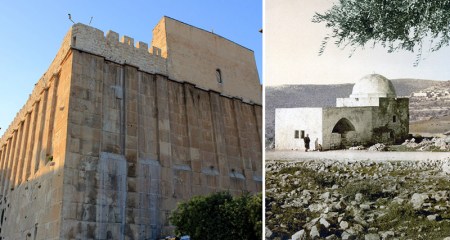
2003UNESCO last year declared ancient Jewish Biblical sites to actually be Muslim holy sites: the Tomb of the Patriarchs in Hebron (left) as the “Ibrahimi Mosque,” and Rachel’s Tomb in Bethlehem (right) as the “Bilal ibn Rabah Mosque.” (Images source: Wikimedia Commons)

The UN’s greatest achievements against the Jewish state have been rhetorical. By controlling the language of the Palestinian-Israel conflict, the UN has skewed the narrative falsely against Israel. This fabricated language is, in turn, absorbed and perpetuated by the media (both old and new), academics, politicians, and pop culture figures such as Roger Waters, further tainting the world’s perception of the conflict.

UN documents regularly use the term “occupied Palestine” and refer to “occupied Palestinian territory” (especially the “West Bank”) being stolen by Jewish “settlement activity.” All four UN terms — “Palestine,” “occupation,” “West Bank,” and “settlement” — are misleading.

Palestine: While UN documents regularly refer to “Palestine” and “the State of Palestine,” there is, in fact, no state of Palestine. As David Bukay shows “there has never been a land known as Palestine governed by Palestinians at any time in history.” Until recently there have never been a people nor a culture known as “Palestinian” distinct from “Arab.” The Arabs who lived in UN Mandated Palestine turned down statehood in 1947 by rejecting UN Resolution 181. In 1974 the UN recognized the PLO, a terrorist organization, as the official representative of the Palestinian people, paving the way for its emergence from the Oslo peace process under the guise of the Palestinian Authority (PA). In 2000, the PA turned down yet another offer of statehood because the offer did not recognize the “right of return” for millions of descendants of those displaced in 1948 to relocate to within Israel — a population transfer that would eliminate the existence of a Jewish state by demographic means. In 2012, the UN General Assembly upgraded the PA/PLO government to “Non-member Observer State”; UN rules dictate that new member states can only be created by the Security Council.

West Bank: The term “West Bank” is also a misnomer. In fact, this territory was for millennia called Judea and Samaria. After the 1948 War of Independence, Transjordan (now known as the Kingdom of Jordan) annexed it, renamed it the “West Bank,” and occupied it for nearly two decades. In the Six Day War, after Jordan attacked Israel, Israel entered the territory and administered it until the Oslo Accords era; then it turned over much of the area to the Palestinian Authority. The final borders of a Palestinian state were left contingent upon Palestinian progress in ending terrorism and bilateral negotiations over presumed land swaps.

Occupation: When it comes to Israel, the UN is obsessed with the word “occupation.” A recent Wall Street Journal article documents 530 General Assembly references to Israel as an “occupying power” versus zero for Indonesia (East Timor), Turkey (Cyprus), Russia (Georgia, Crimea), Morocco (Western Sahara), Vietnam (Cambodia), Armenia (Azerbaijan), Pakistan (Kashmir), or China (Tibet). UNESCO’s “Occupied Palestine” document uses the phrase “Israel, the occupying Power” thirteen times.

Most Palestinians in Judea and Samaria live under the governance of the Palestinian Authority. Referring to this territory as the “occupied West Bank,” is an unnecessary concession to the UN narrative. Saying that Jews are “occupying” Judea is as nonsensical as saying Arabs are “occupying” Arabia or Gauls are “occupying” France. Nevertheless many media sources (Washington Post, New York Times) use this term reflexively. New-media sources often take it a step farther. Any Google search combining the words “occupation” and “Israel” leads to a “People Also Ask” drop-down offering the following: “At the heart of the Israel/Palestine conflict today lies the question of the Palestinian territories occupied by Israel since the war of 1967, which include the West Bank, Gaza Strip and East Jerusalem.” Somehow Google missed the fact there have not been Israelis in Gaza since 2005.

Settlement: The term “settlement” evokes imagery of white European settlers encroaching on the ancestral territories of red, brown and black peoples, connoting the moral baggage of colonialism. The UN uses the term to insinuate Israeli theft of “Palestine.” In truth, many of the “West Bank settlers” bemoaned by the UN are not pioneers from other lands but infants, new members of growing families in long-established Jewish neighborhoods.

The Obama administration eagerly embraced this terminology. On July 27, Obama State Department spokesman John Kirby issued a statement that reads as though it were written at the UN. The document, entitled “Recent Israeli Settlement Announcements,” suggests that Obama’s State Department has come around to the UN’s way of thinking, especially in “strongly condemning” Israel for its “settlement activity” which it pronounces “corrosive to the cause of peace.”

Now that South Carolina governor Nikki Haley has been chosen as the Trump administration’s Ambassador to the UN, it will be up to her to challenge the UN’s ahistorical, slanted Palestine thinking. If there is an occupying force in Gaza, it is Hamas. What Israelis call Judea and Samaria, and Palestinians call the West Bank, are “disputed territories” to anyone claiming a modicum of neutrality. As Elliot Abrams put it, “the term ‘settlement’ loses meaning when applied to Jews building homes in their nation’s capital city.”

Moving the US Embassy to Jerusalem

November 30, 2016

Moving the US Embassy to Jerusalem, Israel National News, Dr. Max Singer, November 30, 2016

(Please see also, Jimmy Carter wants UN to impose a Palestinian state by fiat, with US recognition. — DM)

The US State Department, which has always opposed moving the US embassy in Israel from Tel Aviv to Jerusalem, understands very well that any peace agreement between Israel and the Palestinians will leave at least western Jerusalem as Israel’s capital and part of sovereign Israel. So why will the State Department nevertheless advise President-Elect Donald Trump not to fulfill his promise to move the embassy?

Moving the embassy to Israel’s actual capital would provoke Arab anger at the US and lead to protests that might turn violent. The foreign policy establishment wishes to prevent this result and protect America’s status as an “honest broker.” It therefore continues to insist that because Jerusalem’s ultimate status can only be determined by agreement between Israel and the Palestinians, and that it would be wrong for the US to “prejudge” the outcome by acting on the truth that Israel’s capital is Jerusalem.

This is a perfect example of the kind of politically-correct establishment pettifogging that Trump campaigned against. Moving the embassy to Jerusalem is a low-cost action that he could take as soon as he is inaugurated, and one of the easiest and quickest changes in policy that he could implement. The new US consulate in Jerusalem was built with security features that would be needed for an embassy, so the move could be started almost immediately, without any prejudice to the Palestinian claim to eastern Jerusalem.

The State Department’s insistence on the diplomatic fiction that none of Jerusalem is part of Israel helps preserve the Palestinian hope that, someday, Israel will be forced to give up its capital and will be destroyed as the independent, democratic Jewish state.

That Palestinian hope is the main obstacle to peace. The Palestinians can only make peace when their community – and perhaps the Arab world of which it is a part – comes to understand that international pressure will never force Israel to acquiesce in its own destruction. One of the best ways the US can demonstrate that it will never consent to the Palestinian destruction of Israel is for Washington to stop ignoring blatant Palestinian lies that work against peace.

There is another way that an American truth-telling strategy could encourage peace.  Palestinian leadership now tells its people – and most of them believe – that compromise with Israel would be immoral because Israel is a colonial invader that stole Palestinian land by force. By that argument, Israel has no moral claim to any of the land, and any concession to it would be dishonorable.

But Israel is descended from Jewish kingdoms that ruled parts of the land for centuries in ancient times. It too has a traditional base for moral claims to the territory (in addition to legal claims from the League of Nations mandate). If the Palestinians recognized this truth, they would see that compromise between the two groups, each of which has valid claims to the land, could be an honorable way to end the dispute and not a cowardly yielding to force.

To undermine this moral basis for compromise with Israel, Palestinian leadership flatly denies any ancient Jewish connection to the land. They claim, for example, that there never was a Jewish temple on the Temple Mount from which Jesus could have chased the money-changers. Yet their own history belies this claim. In 1929, the Supreme Moslem Council in Jerusalem, in its guide to the Mount, wrote: “[The Temple Mount’s] identity with the site of Solomon’s Temple is beyond dispute.”

The US may not be able to induce the Palestinian Authority to stop inciting its constituents and teaching its children to hate Israel. But there are ways in which the US can expose and eventually defeat Palestinian lies that work against peace; ways that do not require getting agreement from anyone.

Exploring these new approaches would constitute a striking change in diplomatic direction. There are many examples of the West rejecting truth on behalf of the Palestinians and their Arab supporters. For example, some Western countries went along with the recent denial by UNESCO of any ancient Jewish connection to the land of Israel. The US politely ignores the Palestinian lie that there was never a Jewish temple on the Temple Mount.

If the US consistently tells the truth about the ancient Jewish presence in Palestine, and publicly refuses to swallow the Palestinians’ false and anti-peace denials of history, the Palestinian leadership will not for long be able to keep the truth from their people, or at least from the large educated class.

The US has followed a policy of avoiding truths that are painful or embarrassing to the Arabs for at least 50 years. It hasn’t worked. Maybe it is time to try the strategy of telling the truth. Moving the US embassy to Jerusalem, in accordance with the long-standing congressional position, would be a good way for President Trump to make a start on a truth-telling strategy – as well as to fulfill a campaign promise.

Iran, Hamas and the Dance of Death

November 23, 2016

Iran, Hamas and the Dance of Death, Gatestone InstituteKhaled Abu Toameh, November 23, 2016

It now appears that the Obama Administration’s failed policies in the Middle East have increased the Iranians’ appetite, such that they are convinced that they can expand their influence to the Palestinians as well.

Iran has one goal only: to eliminate the “Zionist entity” and undermine moderate and progressive Arabs and Muslims.

“Relations between Iran and Hamas are currently undergoing revitalization, and are moving in the right direction,” announced Osama Hamdan, a senior Hamas official. He went on to explain that “moving in the right direction” means that Iran would “continue to support the resistance” against Israel.

Hamas and Iran have no meaningful ideological or strategic differences. Both share a common desire to destroy Israel and replace it with an Islamic empire. Iran expects results: Hamas is to use the financial and military support to resume attacks on Israel and “liberate all of Palestine, from the Jordan River to the Mediterranean Sea.”

As far as Iran is concerned, there is nothing better than having two proxy terror organizations on Israel’s borders — Hezbollah in the north and Hamas in the south.

The biggest losers, once again, will be President Mahmoud Abbas and his Palestinian Authority in the West Bank.

Israel’s presence in the West Bank has thus far thwarted Iran’s repeated attempts to establish bases of power there.

The Iranians and Hamas are exploiting the final days of the Obama Administration to restore their relations and pave the way for Tehran to step up its meddling in the internal affairs of the Palestinians in particular and the Israeli-Palestinian conflict in general.

Emboldened by the nuclear deal framework with the world powers, Iran has already taken the liberty of interfering in the internal affairs of other Arabs, particularly the Iraqis, Lebanese, Syrians, Yemenites and some Gulf countries.

It now appears that the Obama Administration’s failed policies in the Middle East have increased the Iranians’ appetite, such that they are convinced that they can expand their influence to the Palestinians as well.

Thanks to the civil war in Syria, relations between Hamas and Iran have been strained over the past few years. Hamas’s refusal to support the regime of Bashar Assad — Iran’s chief ally in the region — has led the Iranians to suspend financial and military aid to the Islamist movement in the Gaza Strip. However, recent signs indicate that Iran and Hamas are en route to a kind of Danse Macabre — a move that will undoubtedly allow Tehran to become a major player in the Israeli-Palestinian conflict.

1162-2Iran used to funnel money to Hamas because the terrorist group shares Iran’s desire to destroy Israel and replace it with an Islamic empire. Relations between Iran and Hamas foundered a few years back, when Hamas leaders refused to support the Iranian-backed Syrian dictator, Bashar Assad. Pictured above: Hamas leader Khaled Mashaal (left) confers with Iranian “Supreme Leader” Ali Khamenei, in 2010. (Image source: Office of the Supreme Leader)

This, of course, bodes badly for any future peace process between Israel and the Palestinians. Iran has one goal only: to eliminate the “Zionist entity” and undermine moderate and progressive Arabs and Muslims.

The new US administration would do well to take very seriously Iran’s comeback to the Israeli-Palestinian conflict, because of its implications not only concerning prospects for peace, but also because it means that this will lead to an upsurge in violence and terror attacks against Israel.

Proof of Iran’s renewed effort to infiltrate the Palestinian arena was provided this week by statements made by a senior Hamas official, Osama Hamdan, who is in charge of the Islamist movement’s “external affairs.” Asked about Hamas’s relations with Iran, Hamdan was quoted as saying that he had good reason to be optimistic.

“Relations between Iran and Hamas are currently undergoing revitalization, and are moving in the right direction,” Hamdan announced. He went on to explain that “moving in the right direction” means that Iran would “continue to support the resistance” against Israel:

“Relations between Iran and Hamas extend over a period of 25 years. Undoubtedly, any flaw in this relationship has a negative impact. But this relationship is capable of renewing itself. This is a relationship that is based on supporting the resistance and the Palestinian cause.”

In reality, Hamas and Iran have no meaningful ideological or strategic differences. Both share a common desire to destroy Israel and replace it with an Islamic empire. The two entities are also committed to an “armed struggle” against Israel, and are vehemently opposed to any compromise with it.

The crisis between the two sides over the civil war in Syria is no more than a minor, tactical dispute. When it comes to the real agenda, such as destroying Israel and launching terror attacks, Iran and Hamas continue to be in total alignment.

Another sign of the apparent rapprochement between Iran and Hamas came in the form of reports that the Islamist movement has appointed a new leader in the Gaza Strip with close ties to Tehran. According to the reports, Emad El Alami, who previously served as Hamas’s first emissary to Tehran, has been entrusted with temporarily replacing Ismail Haniyeh as the ruler of the Gaza Strip. Haniyeh has in recent months relocated from the Gaza Strip to Qatar. At this stage, it remains unclear when and if Haniyeh will return to the Gaza Strip. Some Palestinians have surmised that Haniyeh may replace the Doha-based Khaled Mashaal as head of the Hamas “Political Bureau.” If this happens, then El Alami, who is regarded by many Palestinians as Iran’s agent, will become the permanent de facto ruler of the Gaza Strip.

El Alami’s rise to power will undoubtedly further facilitate Iran’s ambition to become a significant player in the Israeli-Palestinian conflict through the gates of the Gaza Strip. This means that Hamas can expect more cash and weapons to enter Gaza in the coming weeks and months. Such an influx would significantly increase the likelihood of another war between Hamas and Israel. Iran’s millions will not be used by Hamas for building schools and hospitals, or providing desperately needed jobs for Palestinians in the Gaza Strip. Nor will the Iranian-supplied weapons be stored in Hamas warehouses and tunnels, or used in military parades.

Iran expects results: Hamas is to use the financial and military support to resume attacks on Israel and “liberate all of Palestine, from the Jordan River to the Mediterranean Sea.”

When Hamas leaders talk about Iranian support for the Palestinian “resistance,” they mean suicide bombings, rocket attacks and other forms of terrorism. They are saying with unmistakable clarity that they seek a resumption of Iranian support for the “resistance” — not for the tens of thousands of unemployed and impoverished Palestinians living under the Hamas regime in the Gaza Strip. The well-being of the Palestinians living under its rule is the last thing on Hamas’s mind.

The Iranians, for their part, appear to be extremely eager to resume their role as enablers and funders of any group that vows to eliminate Israel. As far as Iran is concerned, there is nothing better than having two proxy terror organizations on Israel’s borders — Hezbollah in the north and Hamas in the south.

Iran is already backing other terror groups in the Gaza Strip, such as the Palestinian Islamic Jihad and Al-Sabireen. But these are tiny groups compared to Hamas, which has tens of thousands of gunmen and a strong military group, Ezaddin Al Kassam. And there is nothing to prevent Iran from extending its control to the Gaza Strip through Hamas, especially in the wake of the Obama Administration’s policy of appeasing not only the Iranians, but also the Muslim Brotherhood.

In the coming months, Hamas is scheduled to hold secret elections to elect a replacement for Khaled Mashaal. Mashaal’s departure from the scene is also set to facilitate Iran’s effort to infiltrate the Gaza Strip. The three candidates who are seen as potential successors to Mashaal — Ismail Haniyeh, Musa Abu Marzouk and Yehya Al Sinwar — have all pledged to improve their movement’s ties with Iran.

The biggest losers, once again, will be President Mahmoud Abbas and his Palestinian Authority (PA) in the West Bank.

PA officials continue to express deep concern over Iran’s meddling in Palestinian affairs, especially its financial and military support for terror groups in the Gaza Strip and even some parts of the West Bank. Yet Israel’s presence in the West Bank has thus far thwarted Iran’s repeated attempts to establish bases of power there. Abbas has no choice but to work with Israel if he wishes to prevent Iran and its supporters from overthrowing his regime, and perhaps dragging him to the center of Ramallah and hanging him as a traitor.

Abbas and his senior aides are nonetheless plenty worried about Iran’s increased efforts to infiltrate the Palestinian arena. At a lecture in Bahrain last week, PLO Secretary-General Saeb Erekat sounded an alarm bell when he said:

“Iran has no right to interfere in the internal affairs of the Palestinians. Iran must respect the particularity of our country. We hope that Iran will focus on placing Palestine back on the map and not intervene through this or that group.”

But this warning is likely to fall on deaf ears in the waning Obama Administration, which obviously no longer shares the widespread concern among Arabs and Palestinians that Iran remains a major threat to stability and security in the region, including Israel. Perhaps the new US administration will see Iran and its machinations a bit more clearly. The alternative is allowing Iran and its proxy terror groups further to drench the region in blood.

Time for Israel to Walk Away From US Aid

July 29, 2016

Time for Israel to Walk Away From US Aid, Front Page MagazineCaroline Glick, July 29, 2016

(Try again next year if Trump wins? — DM)

flags

Originally published by the Jerusalem Post

On Monday, acting head of the National Security Council Yaakov Nagel will sit down with his US counterpart, Susan Rice, and try to conclude negotiations about a new, multi-year defense assistance package.

We must all hope that he fails.

No clear Israeli interest will be advanced by concluding the aid deal presently on the table. 

Indeed, the deal now being discussed will cause Israel massive, long-term economic and strategic damage. This is true for a number of reasons.

First, there is the issue of the deal’s impact on Israel’s military industries, which are the backbone of Israel’s strategic independence.

Under the current defense package, which is set to expire next year, a quarter of the US aid Israel receives is converted to shekels and spent domestically.

Reportedly, the deal now under negotiation will bar Israel from using any of the funds domestically.

The implications for our military industries are dire. Not only will thousands of Israelis lose their jobs. Israel’s capacity to develop its own weapons systems will be dangerously diminished.

Then there is the problem of joint projects.

Today, Israel receives additional US funds to develop joint projects, including the Iron Dome and David’s Sling short range missile and rocket defense programs. These programs were undertaken in response to threats that weren’t foreseen when the current deal was negotiated a decade ago.

According to reports, the deal now being negotiated denies Israel and the US the ability to fund jointly new projects or to provide supplemental funding for existing projects. All funding for all projects will be covered by the lump sum that is currently being negotiated.

Not only does this preclude new projects, it prevents Congress from exercising oversight over administration funding of existing joint projects with Israel. President Barack Obama has consistently tried to slash funding of missile defense programs, only to be overridden by Congress. Under the deal now on the table, Congress will be denied the power to override a hostile administration.

Given the obvious problems with the aid program currently being proposed by the Obama administration, there’s little wonder that until now, Prime Minister Benjamin Netanyahu has publicly stated that if necessary, Israel is ready to wait for the next administration. Some argue that Netanyahu’s apparent newfound interest in concluding negotiations on Obama’s terms owes to his fear that this is the best offer Israel is likely to get. Both Hillary Clinton and Donald Trump for various reasons, it is argued, will be less likely to offer significant increases in US military assistance.

Assuming this is accurate, the question becomes whether Israel has an interest in the assistance at all.

And so we come to the F-35.

For Israel, to a significant degree, the aid package on offer is about the F-35, the US’s fifth generation fighter, otherwise known as the Joint Strike Fighter.

Last month Defense Minister Avigdor Liberman and IAF Chief of Staff Brig.-Gen Tal Kelman flew to Texas to ceremonially “take possession” of Israel’s first two F-35s. Both aircraft are set to be delivered to Israel in December.

To date, the IAF has purchased 33 F-35s – all with US aid money. The IAF wants to purchase a total of 75 F-35s, which are supposed to replace the F-16s and the F-15s that the IAF currently fields.

As Liberman made clear during his visit, whether Israel purchases them or not is entirely dependent on the aid deal.

We should not take them. We should walk away.

And we should walk away even if we receive nothing in exchange for the planes we reject.

The F-35 is a disaster of epic proportions, for the US first and foremost. If Israel agrees to base its next generation fighters on the F-35, it will be a disaster for us as well. Although it is late in the game, we need to cut our losses.

To date, the F-35 has cost the US $400 billion.

That is twice what it was supposed to cost. The project is already four years behind schedule and still in development. It won’t be operational until May 2018 – at the earliest.

The F-35 is a jet that was developed by a committee and tasked with doing everything. So it isn’t surprising that it doesn’t work. In February, J. Michael Gilmore, the director of the Pentagon’s Operational Test and Evaluation office, submitted a scathing report to Congress on the F-35 program.

It is worth going through just a few of his findings.

The F-35’s calling card is its stealth capacity.

According to the engineers at Lockheed Martin, the JSF is supposed to be all-but-invisible to radar systems. Its stealth system is supposed to be far superior to the stealth capabilities of its third generation predecessors.

But at present, its stealth systems do not work, and it is unclear whether they will ever work as planned.

First there is the problem with the JSF’s cooling systems. The JSF is too hot. To prevent its single engine from melting down in flight, pilots are forced to open its weapons bays at high speeds and altitudes every 10 minutes. When the weapons bays are open, the stealth systems do not work.

Then there is the software. The F-35 is considered one big flying computer. It uses over 20 million lines of computer code. These codes are supposed to make it the most maneuverable and stealthy aircraft in history. The problem is that the codes are defective. The software programs that enable the plane to fly, maneuver, and engage in combat are all defective. So are the software programs that control the plane’s stealth capabilities.

And fixing them is not a simple process.

The fixed software systems can’t simply be attached to existing hardware – or to existing planes. The planes themselves have to be rebuilt to adjust to the new software. So the models that have already been produced, including the two F-35s that are set for delivery in December, will all have to be rebuilt before they will be combat ready.

And as a panel of US defense and aviation experts that convened in late February following the publication of Gilmore’s report noted, that too will take time and cost hundreds of millions of dollars.

Another major problem is that the F-35’s nerve center is dysfunctional and there is no clear path to fixing it. The F-35 is controlled by the Autonomic Logistics Information System. The ALIS is a central computer system, located in the US.

All F-35s all over the world will be required to log into the ALIS system to upload computer files after each flight and to check flight readiness. The ALIS is supposed to identify broken parts and help speed up repairs and handle mission data uploads.

ALIS has the capacity to prevent F-35s from taking off. ALIS can lock out pilots and ground crews if it sees danger. If this happens, maintenance technicians have to convince the computer that they either dealt with the issues the computer identified or that it was a false alarm.

Dan Grazier, a member of that panel, whose deliberations were reported by This Week, warned that this power renders the entire F-35 fleet vulnerable to hackers. If someone were able to convince the computer that something was wrong across the fleet, they might be able to keep all the F-35s grounded. Although the damage wouldn’t be permanent, it could continue long enough to cause the US or an ally to lose a battle or fail a mission.

For Israel, this vulnerability is prohibitive even if ALIS is ever made to work. The significance of ALIS control over all F-35s worldwide is that the US – and anyone able to hack the US system – will control the IAF. It will operate at the pleasure of the US government, and those able to hack US computers. They will be able to ground IAF planes whenever they wish.

This critical problem was acknowledged obliquely by Lt.-Col. Yotam, the commander of Israel’s first F-35 or Adir squadron, in an interview with Israel Defense in April.

Lt.-Col. Yotam said, “The maintenance concept of the Adir is based on international management and logistics in terms of spare parts and maintenance echelons.”

Israeli experts note that although in theory Israel will be able to crack the ALIS code and override it, it will take years to develop such a capacity. In the meantime, the IAF will become a contract employee of the US government whose operation is subject to US approval on a flight by flight basis.

The US Air Force, Marines and Navy are all trying to figure out how to deal with the deficiencies of the F-35. There is a vague hope that the US will develop a different fifth generation fighter.

More F-18s and A-10s will likely be ordered. Deputy Defense Secretary Robert Work told Fighting Global that he foresees using the current batch of F-15s into the 2040s. In other words, the US Air Force will deploy 70-year-old planes alongside the defective F-35s.

This, of course, is a disaster for the US. And if Israel goes ahead with the F-35 project it will be an even bigger disaster for us.

Back when the Pentagon convinced the Shamir government to scrap the Lavi project and purchase the F-16, the argument that won the day was economic. The Lavi was simply too expensive.

Today, both economics and strategic arguments indicate that the opposite is the case, even if walking away involves ending US military aid.

If Israel cuts its losses and begins to develop a fifth generation jet fighter that meets its own specific needs, rather than one designed by a committee to meet other countries’ needs poorly, it will end up both far safer and far more prosperous than if it goes ahead with the F-35 project. It will produce a better plane, better suited for Israeli defense needs, and simultaneously stimulate the growth of Israeli military industries, providing jobs for thousands of Israelis.

If Israel walks away from the military assistance package currently under discussion, it will be in a position to sign joint development deals with the US and other governments on a project by project basis and so ensure that we develop the weapons systems we need, not the ones the US thinks we should have, as we need them. Just as India is investing billions of dollars in joint projects with Israel, so will the US in the future.

It is far from clear that the US can afford its $400b. white elephant. It is abundantly clear that Israel cannot afford it.

Whether or not a Trump or Clinton administration will be more forthcoming is really beside the point. The point is that the US aid deal is really a deal for Lockheed Martin, not for Israel. And we need to say no.